
Publishing Your Research
        Prof. Dr. Khalid Mahmood
  Department of Library and Information Science
          University of the Punjab


                                                  1
Agenda
   My publishing case study
   Writing for publishing
   Finding publishing avenues
   Review process
   Publishing process
   From thesis to journal articles
   From thesis to book
   Online publishing
   Self publishing
   Promoting your publications
   Ethical and legal issues
                                      2
My publishing case study
Books                         7

Journal articles published   104

Journal articles accepted     6

Refereed conference papers    5

Total                        122
                                   3
Year wise distribution


                         4
Country wise distribution
Pakistan                    41
UK                          36
USA                         28
Germany                     6
Netherlands                 4
Malaysia                    1
Japan                       1
Australia                   1
West Indies                 1
Iran                        1
Canada                      1
Argentina                   1
                                 5
Authorship

Single       45


Co-author    77

                  6
Where did papers come from
Papers written for journals         72

Conference papers published as      17
journal articles

Papers from my PhD/Postdoc thesis   11

Papers from students’ theses        15

Papers from friends’ theses         5
                                         7
My PhD thesis
   Locally published in
    2005
   Published from
    Germany in 2009
   Freely available at
    HEC’s Pakistan
    Research Repository
   Published 9 papers
    based on it

                           8
My postdoctoral research

   Published from
    Germany in 2011

   Published 2 papers
    based on it


                           9
Writing for publishing


                         10
Why do I write?
   You have a research grant and must publish the
    results of your research
   You want a job or a promotion
   You want to disseminate your work or research
    findings to a particular audience
   You want your research to have political, social,
    or scientific implications for change
   You want to contribute to intellectual discussion
    or scientific debate
   You want to generate new knowledge
   You are passionate about your subject area and
    are compelled to write
                                                        11
Levels of scholarly publishing


                                 12
Building your manuscript

 Budget your time for writing
 The first draft
 Reviewing the first draft
 The second draft
 Getting feedback from colleagues
 The third draft


                                     13
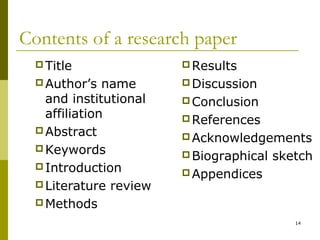
Contents of a research paper
   Title                Results
   Author’s   name      Discussion
    and institutional    Conclusion
    affiliation          References
   Abstract
                         Acknowledgements
   Keywords
                         Biographical   sketch
   Introduction
                         Appendices
   Literature review
   Methods

                                            14
Format of paper
 Format of the paper is determined by the
  journal
 Check their web site for information
 Differences from one journal to another:
       Style of references
       Tables and figures
       Line spacing
       Font
       Word limit
       Writing style
       File type                            15
Useful sources for authors
   Author guidebooks
   Author associations
       International Science Writers Association
       National Writers Association
       Professional Writers Association
       Authors Guild
       Pakistan Writers Guild
       Pakistan Medical Writers' Association
   Online resources
       AuthorAid
       Emerald Literati Network
       Taylor & Francis Author Services


                                                    16
AuthorAid


            17
Emerald Literati Network


                           18
Taylor & Francis Author Services


                                   19
Finding publishing avenues


                         20
How to find journals
   Ulrich's International Periodical Directory

   Directory of Open Access Journals (DOAJ)

   Journal Citation Reports

   Scopus Journal Analyzer

   IngentaConnect
                                                  21
Ulrich's International Periodical Directory


                                         22
A journal entry in Ulrich’s


                              23
Directory of Open Access Journals


                                    24
Journal Citation Reports


                           25
Scopus Journal Analyzer


                          26
IngentaConnect


                 27
How to select right journal
 Look at your reference list
 Ask your colleagues for advice
 Think about who will want to read your
  paper
 Read papers from short-listed journals
 Put your shortlist of journals in rank order,
  from first choice to last choice
 Discuss your choice with your co-authors


                                              28
Criteria for journal selection
 Referring system
 Impact factor/citation scores
 Circulation
 Journal type
 Time lag
 Reputation of editors
 Professional vs. commercial ownership
 Quality of production


                                          29
Review process


                 30
Manuscript submission

   Guidelines for authors

   Process of submission

   Acknowledgement by editor


                                31
Review
process


          32
Process of review
 First scanning by editor
 Selection of reviewers
 Double blind review
 Time for review
 Decision of reviewers
 Communication of decision to author
 Acceptance, Rejection or Revision
 Submission and review of revised version
 Final decision

                                             33
Criteria for judging a paper
 Does the article add to what is already
  known?
 Is the article demonstrably related to what
  has been previously written?
 Are the arguments employed valid in
  terms of the body of knowledge?
 Is the article easy to read?
 Do the arguments flow logically?
 Are the conclusions strong?

                                            34
Review
pro forma


            35
Handling reviewers’ comments

  Make  adjustments and attach
   explanation
  Don’t feel obligated to make all
   recommended changes
  Don’t take comments personally
  Be polite in all correspondence


                                      36
Publishing process


                     37
Publishing process
 Paying for publication
 Copyright agreement by author
 Decision of issue to include paper
 Copy editing
 Proof reading
 Printing
 Notification of publishing to author
 Delivery of printed issue and off-prints


                                             38
From thesis to journal articles


                             39
From thesis to journal article

 Decide how many articles can be published
 Cut-paste-edit
 Re-write some parts
 Each article should be independent with all
  required contents
 Supervisor as co-author


                                            40
From thesis to book


                      41
From thesis to book

 Seek permission from university
 Improve contents
 Improve language
 Re-format
 Find publisher


                                    42
Online publishing


                    43
Advantages of online publishing
 Better chances of acceptance
 More control over the process
 Higher royalties
 Author-friendly contracts
 Shorter response times
 Faster publication
 Multimedia and format options
 Mass market place


                                  44
Where to publish online

   E-publishing company
       Lulu.com


   Institutional website

   Personal website

   Blog
                            45
Self publishing


                  46
The self-publishing process
   Develop your idea
   Write your manuscript
   Proofread and market test your manuscript
   Prepare your business plan
       Who will buy your book?
       How will you market and sell it?
   Decide how many copies you will print and the format of
    book you want
   Get quotes for typesetting and printing
   Get manuscript 'print ready' (typeset)
   Design the book cover
   Print the book
   Market and advertise the book
   Fulfill orders
   Collect payment and record sales
                                                              47
Promoting your publications


                          48
Promoting your publications
   Book review
   Flyer
   Book launching ceremony
   Email discussion groups
   Sending off-prints to experts/writers
   Newsletters/newspapers
   Entry in search engines
   Entry in databases
   Online bookstores
   Continued work of your students/research team

                                                    49
Ethical and legal issues


                           50
Ethical considerations

 Accurate reporting of research results
 Data retention and sharing
 Duplication and piecemeal publication
 Plagiarism
 Protecting confidentiality
 Conflict of interest


                                           51
Legal considerations

   Publication credit
       Co-authorship
       Order of authorship
 Publishing contract
 Copyright
 Defamation


                              52
Thanks for your patience


                           53

Khalid publishing your research-workshop-march 2012

  • 1.
    Publishing Your Research Prof. Dr. Khalid Mahmood Department of Library and Information Science University of the Punjab 1
  • 2.
    Agenda  My publishing case study  Writing for publishing  Finding publishing avenues  Review process  Publishing process  From thesis to journal articles  From thesis to book  Online publishing  Self publishing  Promoting your publications  Ethical and legal issues 2
  • 3.
    My publishing casestudy Books 7 Journal articles published 104 Journal articles accepted 6 Refereed conference papers 5 Total 122 3
  • 4.
  • 5.
    Country wise distribution Pakistan 41 UK 36 USA 28 Germany 6 Netherlands 4 Malaysia 1 Japan 1 Australia 1 West Indies 1 Iran 1 Canada 1 Argentina 1 5
  • 6.
    Authorship Single 45 Co-author 77 6
  • 7.
    Where did paperscome from Papers written for journals 72 Conference papers published as 17 journal articles Papers from my PhD/Postdoc thesis 11 Papers from students’ theses 15 Papers from friends’ theses 5 7
  • 8.
    My PhD thesis  Locally published in 2005  Published from Germany in 2009  Freely available at HEC’s Pakistan Research Repository  Published 9 papers based on it 8
  • 9.
    My postdoctoral research  Published from Germany in 2011  Published 2 papers based on it 9
  • 10.
  • 11.
    Why do Iwrite?  You have a research grant and must publish the results of your research  You want a job or a promotion  You want to disseminate your work or research findings to a particular audience  You want your research to have political, social, or scientific implications for change  You want to contribute to intellectual discussion or scientific debate  You want to generate new knowledge  You are passionate about your subject area and are compelled to write 11
  • 12.
    Levels of scholarlypublishing 12
  • 13.
    Building your manuscript Budget your time for writing  The first draft  Reviewing the first draft  The second draft  Getting feedback from colleagues  The third draft 13
  • 14.
    Contents of aresearch paper  Title  Results  Author’s name  Discussion and institutional  Conclusion affiliation  References  Abstract  Acknowledgements  Keywords  Biographical sketch  Introduction  Appendices  Literature review  Methods 14
  • 15.
    Format of paper Format of the paper is determined by the journal  Check their web site for information  Differences from one journal to another:  Style of references  Tables and figures  Line spacing  Font  Word limit  Writing style  File type 15
  • 16.
    Useful sources forauthors  Author guidebooks  Author associations  International Science Writers Association  National Writers Association  Professional Writers Association  Authors Guild  Pakistan Writers Guild  Pakistan Medical Writers' Association  Online resources  AuthorAid  Emerald Literati Network  Taylor & Francis Author Services 16
  • 17.
  • 18.
  • 19.
    Taylor & FrancisAuthor Services 19
  • 20.
  • 21.
    How to findjournals  Ulrich's International Periodical Directory  Directory of Open Access Journals (DOAJ)  Journal Citation Reports  Scopus Journal Analyzer  IngentaConnect 21
  • 22.
  • 23.
    A journal entryin Ulrich’s 23
  • 24.
    Directory of OpenAccess Journals 24
  • 25.
  • 26.
  • 27.
  • 28.
    How to selectright journal  Look at your reference list  Ask your colleagues for advice  Think about who will want to read your paper  Read papers from short-listed journals  Put your shortlist of journals in rank order, from first choice to last choice  Discuss your choice with your co-authors 28
  • 29.
    Criteria for journalselection  Referring system  Impact factor/citation scores  Circulation  Journal type  Time lag  Reputation of editors  Professional vs. commercial ownership  Quality of production 29
  • 30.
  • 31.
    Manuscript submission  Guidelines for authors  Process of submission  Acknowledgement by editor 31
  • 32.
  • 33.
    Process of review First scanning by editor  Selection of reviewers  Double blind review  Time for review  Decision of reviewers  Communication of decision to author  Acceptance, Rejection or Revision  Submission and review of revised version  Final decision 33
  • 34.
    Criteria for judginga paper  Does the article add to what is already known?  Is the article demonstrably related to what has been previously written?  Are the arguments employed valid in terms of the body of knowledge?  Is the article easy to read?  Do the arguments flow logically?  Are the conclusions strong? 34
  • 35.
  • 36.
    Handling reviewers’ comments  Make adjustments and attach explanation  Don’t feel obligated to make all recommended changes  Don’t take comments personally  Be polite in all correspondence 36
  • 37.
  • 38.
    Publishing process  Payingfor publication  Copyright agreement by author  Decision of issue to include paper  Copy editing  Proof reading  Printing  Notification of publishing to author  Delivery of printed issue and off-prints 38
  • 39.
    From thesis tojournal articles 39
  • 40.
    From thesis tojournal article  Decide how many articles can be published  Cut-paste-edit  Re-write some parts  Each article should be independent with all required contents  Supervisor as co-author 40
  • 41.
  • 42.
    From thesis tobook  Seek permission from university  Improve contents  Improve language  Re-format  Find publisher 42
  • 43.
  • 44.
    Advantages of onlinepublishing  Better chances of acceptance  More control over the process  Higher royalties  Author-friendly contracts  Shorter response times  Faster publication  Multimedia and format options  Mass market place 44
  • 45.
    Where to publishonline  E-publishing company  Lulu.com  Institutional website  Personal website  Blog 45
  • 46.
  • 47.
    The self-publishing process  Develop your idea  Write your manuscript  Proofread and market test your manuscript  Prepare your business plan  Who will buy your book?  How will you market and sell it?  Decide how many copies you will print and the format of book you want  Get quotes for typesetting and printing  Get manuscript 'print ready' (typeset)  Design the book cover  Print the book  Market and advertise the book  Fulfill orders  Collect payment and record sales 47
  • 48.
  • 49.
    Promoting your publications  Book review  Flyer  Book launching ceremony  Email discussion groups  Sending off-prints to experts/writers  Newsletters/newspapers  Entry in search engines  Entry in databases  Online bookstores  Continued work of your students/research team 49
  • 50.
  • 51.
    Ethical considerations  Accuratereporting of research results  Data retention and sharing  Duplication and piecemeal publication  Plagiarism  Protecting confidentiality  Conflict of interest 51
  • 52.
    Legal considerations  Publication credit  Co-authorship  Order of authorship  Publishing contract  Copyright  Defamation 52
  • 53.
    Thanks for yourpatience 53