REFRIGERENT-
DEFINITION OF REFRIGERENT-
A refrigerant is a substance or mixture, usually a Fluid, used
in a heat pump and refrigeration cycle . In most cycles it
undergoes phase transitions from a liquid to a gas and back
again. Many working fluids have been used for such
purposes. Fluorocarbons, especially chlorofluorocarbons,
became commonplace in the 20th century, but they are
being phased out because of their ozone depletion effects.
Other common refrigerants used in various applications are
ammonia, sulfur dioxide, and non-halogenated
hydrocarbons such as propane.
“REFRIGERENT MAINTAIN THE LOWER TEMPERATURE”
DEFINITION OF IDEAL REFRIGERENT-
• The ideal refrigerant would have favorable thermodynamic
properties, be noncorrosive to mechanical components, and be
safe, including free from toxicity and flammability. It would not
cause ozone depletion or climate change. Since different fluids
have the desired traits in different degree, choice is a matter of
trade-off.
• The desired thermodynamic properties are a boiling point
somewhat below the target temperature, a high heat of
vaporization, a moderate density in liquid form, a relatively high
density in gaseous form, and a high critical temperature. Since
boiling point and gas density are affected by pressure,
refrigerants may be made more suitable for a particular
application by choice of operating pressures
PRINCIPLE-
PRINCIPLE OF REFRIGERENT-
• 1. The temperature and energy required to change
state are a function of pressure.
• 2. Heat only moves from a higher temperature to a
lower temperature.
• 3. A large amount of energy is required to change the
state of matter.
• 4. Fluid flow only occurs if a pressure difference
exists.
PRINCIPLE-
PRINCIPLE OF IDEAL REFRIGERENT-
• 1) The refrigerant should have low boiling point and
low freezing point.
• 2) It must have low specific heat and high latent
heat. Because high specific heat decreases the
refrigerating effect per kg of refrigerant and high
latent heat at low temperature increases the
refrigerating effect per kg of refrigerant
WORKING/PROCEDURE-
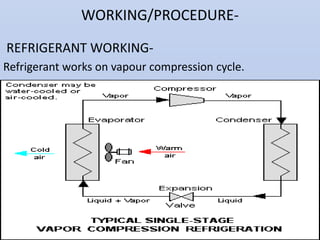
REFRIGERANT WORKING-
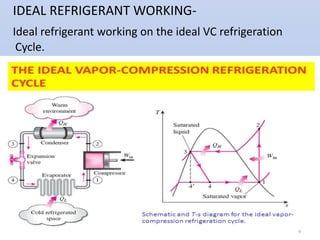
Refrigerant works on vapour compression cycle.
The vapor-compression uses a circulating liquid refrigerant as the medium
which absorbs and removes heat from the space to be cooled and
subsequently rejects that heat elsewhere. Figure depicts a typical,
single-stage vapor-compression system.
All such systems have four components:
A compressor, a condenser, a thermal expansion valve (also called a
throttle valve or metering device)and an evaporator.
1.Circulating refrigerant enters the compressor in the thermodynamic
state known as a saturated vapor and is compressed to a higher
pressure, resulting in a higher temperature as well.
2.The hot, compressed vapor is then in the thermodynamic state known
as a superheated vapor and it is at a temperature and pressure at which
it can be condensed with either cooling water or cooling air.
3.That hot vapor is routed through a condenser where it is cooled and
condensed into a liquid by flowing through a coil or tubes with cool
water or cool air flowing across the coil or tubes.
This is where the circulating refrigerant rejects heat from the system
and the rejected heat is carried away by either the water or the air .
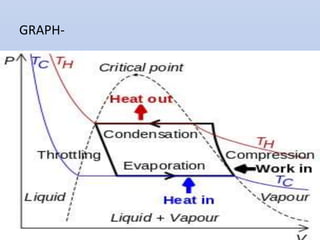
GRAPH-
• The condensed liquid refrigerant, in the thermodynamic state known
as a saturated liquid, is next routed through an expansion valve
where it undergoes an abrupt reduction in pressure. That pressure
reduction results in the adiabatic flash evaporation of a part of the
liquid refrigerant. The auto-refrigeration effect of the adiabatic flash
evaporation lowers the temperature of the liquid and vapor
refrigerant mixture to where it is colder than the temperature of the
enclosed space to be refrigerated.
• The cold mixture is then routed through the coil or tubes in the
evaporator. A fan circulates the warm air in the enclosed space across
the coil or tubes carrying the cold refrigerant liquid and vapor
mixture.
• To complete the refrigeration cycle, the refrigerant vapor from the
evaporator is again a saturated vapor and is routed back into the
compressor.
• EXAMPLE- R134-a AND R-610 etc.
IDEAL REFRIGERANT WORKING-
Ideal refrigerant working on the ideal VC refrigeration
Cycle.
• 1) The refrigerant should have low boiling point and low freezing
point.
• 2) It must have low specific heat and high latent heat. Because high
specific heat decreases the refrigerating effect per kg of refrigerant
and high latent heat at low temperature increases the refrigerating
effect per kg of refrigerant.
• 3) The pressures required to be maintained in the evaporator and
condenser should be low enough to reduce the material cost and
must be positive to avoid leakage of air into the system.
• 4) It must have high critical pressure and temperature to avoid large
power requirements.
• 5) It should have low specific volume to reduce the size of the
compressor.
• EXAMPLE-
Ammonia (NH3)(R-717)
Dichloro–Difluoro methane (Freon–12) (R-12) [C Cl2 F2]
Difluoro monochloro methane – or Freon-22 (R-22) [CH Cl F2]
Refrigerant –absorbent mixture combination -
Ideal, homogeneous binary mixtures:-
A binary mixture of Two component, components 1 and 2 is
called as an ideal mixture, when it satisfies the following
conditions.
• Condition 1: The volume of the mixture is equal to the sum of the
volumes of its constituents, i.e., upon mixing there is neither
contraction nor expansion.
• Condition 2: Neither heat is generated nor absorbed upon mixing,
i.e., the heat of solution is zero.
• Condition 3: The mixture obeys Raoult’s law in liquid phase, i.e.,
the vapour pressure exerted by components 1 and 2.
• Condition 4: The mixture obeys Dalton’s law in vapour phase; i.e.,
the vapour pressure exerted by components 1 and 2.
PROPERTIES -
• PROPERTIES OF REFRIGERENT-
Low Freezing Point
Refrigerants should have low freezing point than the normal
operating conditions. It should not freeze during application. Water
for example cannot be used below 0 Deg C.
Low Condensing Pressure
The lower the condenser pressure the power required for
compression will be lower. Higher condenser pressure will result in
high operating costs. Refrigerants with low boiling points will have
high condenser pressure and high vapor density. The condenser
tubes have to be designed for higher pressures which also give raise
to capital cost of the equipment. If Boiling Point is Low, High
Condenser Pressure – Reciprocating Compressor is used. Eg:
Ammonia, R22, R12 etc If Boiling Point is High, Low Condenser
Pressure – Centrifugal Compressor is used. Eg: R11, R13 & R114 etc
• High Evaporator Pressure
This is the most important property of refrigerant. In a
negative pressure evaporator Atmospheric air or Moisture
will Leak into the system. The moisture inside the system
will starts freezing at low temperature zones and clogs and
chokes the system.
Toxicity
Toxicity is the important properties of refrigerants. The
refrigerants should be non poisonous to humans and food
stuff. The toxicity depends upon the concentration and
exposure limits.
PROPERTIES OF IDEAL REFRIGERANT-
• 1) It must have high thermal conductivity to reduce the
area of heat transfer in evaporator and condenser.
• 2) It should be non-flammable, non-explosive, non-toxic
and non-corrosive.
• 3) It should not have any bad effects on the stored
material or food, when any leak develops in the
system.
• 4) It must have high miscibility with lubricating oil and it
should not have reacting properly with lubricating oil in
the temperature range of the system.
• 5) It should give high COP in the working temperature
range. This is necessary to reduce the running cost of
the system.
• 6) It must be readily available and it must be cheap also.
• PROPERTIES OF REFRIGERENT ABSORVENT MIXTURE:-
• The solution used in absorption refrigeration systems may be
considered as a homogeneous binary mixture of refrigerant
and absorbent. Depending upon the boiling point difference
between refrigerant and absorbent and the operating
temperatures, one may encounter a pure refrigerant vapour
or a mixture of refrigerant and absorbent vapour in generator
of the absorption system. Unlike pure substances, the
thermodynamic state of a binary mixture (in liquid or vapour
phase) cannot be fixed by pressure and temperature alone.
According to Gibbs’ phase rule, one more parameter in
addition to temperature and pressure is required to
completely fix the thermodynamic state. Generally, the
composition of the mixture is taken as the third independent
parameter. The composition of a mixture can be expressed
either in mass fraction or in mole fraction.
ADVANTAGE/DISADVANTAGE-
• ADVANTAGE-
Here are some of the important properties of the refrigerant R12:
• 1) Safe properties: Refrigerant R12 is nontoxic, nonflammable, and non-
explosive. This makes it highly popular for the domestic as well as the
commercial applications.
• 2) Stability: R12 is highly stable chlorofluorocarbon and it does not
disintegrate even under the extreme operating conditions. However, if it is
brought in contact with the flame of fire or the electrical heating element, it
disintegrates into the toxic products. Thus whenever there is leakage of R12
refrigerant it is advised to put all the flames off and keep the doors open so
that it can escape to the open atmosphere.
• DISADVANTAGE-
R12 is CFC: R12 is the most widely used refrigerant, unfortunately it is
the CFC and it has unusually high potential to cause the depletion of
the ozone layer. R12 is being replaced by other refrigerants and some
of the suggested replacements for R12 are: R-134a, R-401a, R-401b.
INDUSTRAIAL APPLICATION-
• Industrial heat pump using refrigerant -
• NH3:
• • hot water temperatures up to 90˚C
• • Using condensing waste heat
• • Using stable thermal heat source
• HC:
• • allowing to exceed 120˚C temperatures
• • Competition fossil fuel steam boilers
• Ammonia:
• • historically most common used refrigerant
• • Accounts for most HCFC & HFC conversions
• CO2:
• Settling in negative temperature applications
• HC & Air: very low temperature applications
CONCLUSION
• The metal shaving conformer obtained from industrial waste
presents very good sound absorber characteristics at low
frequencies. The discrepancy between samples for high frequency
absorption is not due to the experimental measurement, and we
think it comes from the glue used to agglomerate the metal
shavings. In any case more studies must be done in this sense to
clarify that result.
• The textile conformers made from textile waste by us present
different absorption coefficients, and while one of them present
high values for low frequency, the other one absorbs more for high
frequency. In any case, these results are only an indication that it is
interesting to follow studying this kind of samples to confirm this
results and try to increase the absorption coefficient with new
samples.
• Finally, we have measured the influence of two kinds of
multiperfored plaques as resonators placed on some of the tested
samples. The results indicate that the absorption is increased at low
frequency as expected.
k10772 shivkant tiwari

k10772 shivkant tiwari

  • 2.
    REFRIGERENT- DEFINITION OF REFRIGERENT- Arefrigerant is a substance or mixture, usually a Fluid, used in a heat pump and refrigeration cycle . In most cycles it undergoes phase transitions from a liquid to a gas and back again. Many working fluids have been used for such purposes. Fluorocarbons, especially chlorofluorocarbons, became commonplace in the 20th century, but they are being phased out because of their ozone depletion effects. Other common refrigerants used in various applications are ammonia, sulfur dioxide, and non-halogenated hydrocarbons such as propane. “REFRIGERENT MAINTAIN THE LOWER TEMPERATURE”
  • 3.
    DEFINITION OF IDEALREFRIGERENT- • The ideal refrigerant would have favorable thermodynamic properties, be noncorrosive to mechanical components, and be safe, including free from toxicity and flammability. It would not cause ozone depletion or climate change. Since different fluids have the desired traits in different degree, choice is a matter of trade-off. • The desired thermodynamic properties are a boiling point somewhat below the target temperature, a high heat of vaporization, a moderate density in liquid form, a relatively high density in gaseous form, and a high critical temperature. Since boiling point and gas density are affected by pressure, refrigerants may be made more suitable for a particular application by choice of operating pressures
  • 4.
    PRINCIPLE- PRINCIPLE OF REFRIGERENT- •1. The temperature and energy required to change state are a function of pressure. • 2. Heat only moves from a higher temperature to a lower temperature. • 3. A large amount of energy is required to change the state of matter. • 4. Fluid flow only occurs if a pressure difference exists.
  • 5.
    PRINCIPLE- PRINCIPLE OF IDEALREFRIGERENT- • 1) The refrigerant should have low boiling point and low freezing point. • 2) It must have low specific heat and high latent heat. Because high specific heat decreases the refrigerating effect per kg of refrigerant and high latent heat at low temperature increases the refrigerating effect per kg of refrigerant
  • 6.
  • 7.
    The vapor-compression usesa circulating liquid refrigerant as the medium which absorbs and removes heat from the space to be cooled and subsequently rejects that heat elsewhere. Figure depicts a typical, single-stage vapor-compression system. All such systems have four components: A compressor, a condenser, a thermal expansion valve (also called a throttle valve or metering device)and an evaporator. 1.Circulating refrigerant enters the compressor in the thermodynamic state known as a saturated vapor and is compressed to a higher pressure, resulting in a higher temperature as well. 2.The hot, compressed vapor is then in the thermodynamic state known as a superheated vapor and it is at a temperature and pressure at which it can be condensed with either cooling water or cooling air. 3.That hot vapor is routed through a condenser where it is cooled and condensed into a liquid by flowing through a coil or tubes with cool water or cool air flowing across the coil or tubes. This is where the circulating refrigerant rejects heat from the system and the rejected heat is carried away by either the water or the air .
  • 8.
  • 9.
    • The condensedliquid refrigerant, in the thermodynamic state known as a saturated liquid, is next routed through an expansion valve where it undergoes an abrupt reduction in pressure. That pressure reduction results in the adiabatic flash evaporation of a part of the liquid refrigerant. The auto-refrigeration effect of the adiabatic flash evaporation lowers the temperature of the liquid and vapor refrigerant mixture to where it is colder than the temperature of the enclosed space to be refrigerated. • The cold mixture is then routed through the coil or tubes in the evaporator. A fan circulates the warm air in the enclosed space across the coil or tubes carrying the cold refrigerant liquid and vapor mixture. • To complete the refrigeration cycle, the refrigerant vapor from the evaporator is again a saturated vapor and is routed back into the compressor. • EXAMPLE- R134-a AND R-610 etc.
  • 10.
    IDEAL REFRIGERANT WORKING- Idealrefrigerant working on the ideal VC refrigeration Cycle.
  • 11.
    • 1) Therefrigerant should have low boiling point and low freezing point. • 2) It must have low specific heat and high latent heat. Because high specific heat decreases the refrigerating effect per kg of refrigerant and high latent heat at low temperature increases the refrigerating effect per kg of refrigerant. • 3) The pressures required to be maintained in the evaporator and condenser should be low enough to reduce the material cost and must be positive to avoid leakage of air into the system. • 4) It must have high critical pressure and temperature to avoid large power requirements. • 5) It should have low specific volume to reduce the size of the compressor. • EXAMPLE- Ammonia (NH3)(R-717) Dichloro–Difluoro methane (Freon–12) (R-12) [C Cl2 F2] Difluoro monochloro methane – or Freon-22 (R-22) [CH Cl F2]
  • 12.
    Refrigerant –absorbent mixturecombination - Ideal, homogeneous binary mixtures:- A binary mixture of Two component, components 1 and 2 is called as an ideal mixture, when it satisfies the following conditions. • Condition 1: The volume of the mixture is equal to the sum of the volumes of its constituents, i.e., upon mixing there is neither contraction nor expansion. • Condition 2: Neither heat is generated nor absorbed upon mixing, i.e., the heat of solution is zero. • Condition 3: The mixture obeys Raoult’s law in liquid phase, i.e., the vapour pressure exerted by components 1 and 2. • Condition 4: The mixture obeys Dalton’s law in vapour phase; i.e., the vapour pressure exerted by components 1 and 2.
  • 13.
    PROPERTIES - • PROPERTIESOF REFRIGERENT- Low Freezing Point Refrigerants should have low freezing point than the normal operating conditions. It should not freeze during application. Water for example cannot be used below 0 Deg C. Low Condensing Pressure The lower the condenser pressure the power required for compression will be lower. Higher condenser pressure will result in high operating costs. Refrigerants with low boiling points will have high condenser pressure and high vapor density. The condenser tubes have to be designed for higher pressures which also give raise to capital cost of the equipment. If Boiling Point is Low, High Condenser Pressure – Reciprocating Compressor is used. Eg: Ammonia, R22, R12 etc If Boiling Point is High, Low Condenser Pressure – Centrifugal Compressor is used. Eg: R11, R13 & R114 etc
  • 14.
    • High EvaporatorPressure This is the most important property of refrigerant. In a negative pressure evaporator Atmospheric air or Moisture will Leak into the system. The moisture inside the system will starts freezing at low temperature zones and clogs and chokes the system. Toxicity Toxicity is the important properties of refrigerants. The refrigerants should be non poisonous to humans and food stuff. The toxicity depends upon the concentration and exposure limits.
  • 15.
    PROPERTIES OF IDEALREFRIGERANT- • 1) It must have high thermal conductivity to reduce the area of heat transfer in evaporator and condenser. • 2) It should be non-flammable, non-explosive, non-toxic and non-corrosive. • 3) It should not have any bad effects on the stored material or food, when any leak develops in the system. • 4) It must have high miscibility with lubricating oil and it should not have reacting properly with lubricating oil in the temperature range of the system. • 5) It should give high COP in the working temperature range. This is necessary to reduce the running cost of the system. • 6) It must be readily available and it must be cheap also.
  • 16.
    • PROPERTIES OFREFRIGERENT ABSORVENT MIXTURE:- • The solution used in absorption refrigeration systems may be considered as a homogeneous binary mixture of refrigerant and absorbent. Depending upon the boiling point difference between refrigerant and absorbent and the operating temperatures, one may encounter a pure refrigerant vapour or a mixture of refrigerant and absorbent vapour in generator of the absorption system. Unlike pure substances, the thermodynamic state of a binary mixture (in liquid or vapour phase) cannot be fixed by pressure and temperature alone. According to Gibbs’ phase rule, one more parameter in addition to temperature and pressure is required to completely fix the thermodynamic state. Generally, the composition of the mixture is taken as the third independent parameter. The composition of a mixture can be expressed either in mass fraction or in mole fraction.
  • 17.
    ADVANTAGE/DISADVANTAGE- • ADVANTAGE- Here aresome of the important properties of the refrigerant R12: • 1) Safe properties: Refrigerant R12 is nontoxic, nonflammable, and non- explosive. This makes it highly popular for the domestic as well as the commercial applications. • 2) Stability: R12 is highly stable chlorofluorocarbon and it does not disintegrate even under the extreme operating conditions. However, if it is brought in contact with the flame of fire or the electrical heating element, it disintegrates into the toxic products. Thus whenever there is leakage of R12 refrigerant it is advised to put all the flames off and keep the doors open so that it can escape to the open atmosphere. • DISADVANTAGE- R12 is CFC: R12 is the most widely used refrigerant, unfortunately it is the CFC and it has unusually high potential to cause the depletion of the ozone layer. R12 is being replaced by other refrigerants and some of the suggested replacements for R12 are: R-134a, R-401a, R-401b.
  • 18.
    INDUSTRAIAL APPLICATION- • Industrialheat pump using refrigerant - • NH3: • • hot water temperatures up to 90˚C • • Using condensing waste heat • • Using stable thermal heat source • HC: • • allowing to exceed 120˚C temperatures • • Competition fossil fuel steam boilers • Ammonia: • • historically most common used refrigerant • • Accounts for most HCFC & HFC conversions • CO2: • Settling in negative temperature applications • HC & Air: very low temperature applications
  • 19.
    CONCLUSION • The metalshaving conformer obtained from industrial waste presents very good sound absorber characteristics at low frequencies. The discrepancy between samples for high frequency absorption is not due to the experimental measurement, and we think it comes from the glue used to agglomerate the metal shavings. In any case more studies must be done in this sense to clarify that result. • The textile conformers made from textile waste by us present different absorption coefficients, and while one of them present high values for low frequency, the other one absorbs more for high frequency. In any case, these results are only an indication that it is interesting to follow studying this kind of samples to confirm this results and try to increase the absorption coefficient with new samples. • Finally, we have measured the influence of two kinds of multiperfored plaques as resonators placed on some of the tested samples. The results indicate that the absorption is increased at low frequency as expected.