1. HaloCarbons
2. Azeotropic Refrigerants
3. Zeotropic Refrigerants
4. Inorganic Refrigerants
5. Hydrocarbon Refrigerants
1
 Halocarbon Refrigerant are all synthetically
produced and were developed as the Freon
family of refrigerants.
Examples :
 CFC’s : R11, R12, R113, R114, R115
 HCFC’s : R22, R123
 HFC’s : R134a, R404a, R407C, R410a
2
 Carbon Dioxide
 Water
 Ammonia
 Air
 Sulphur dioxide
3
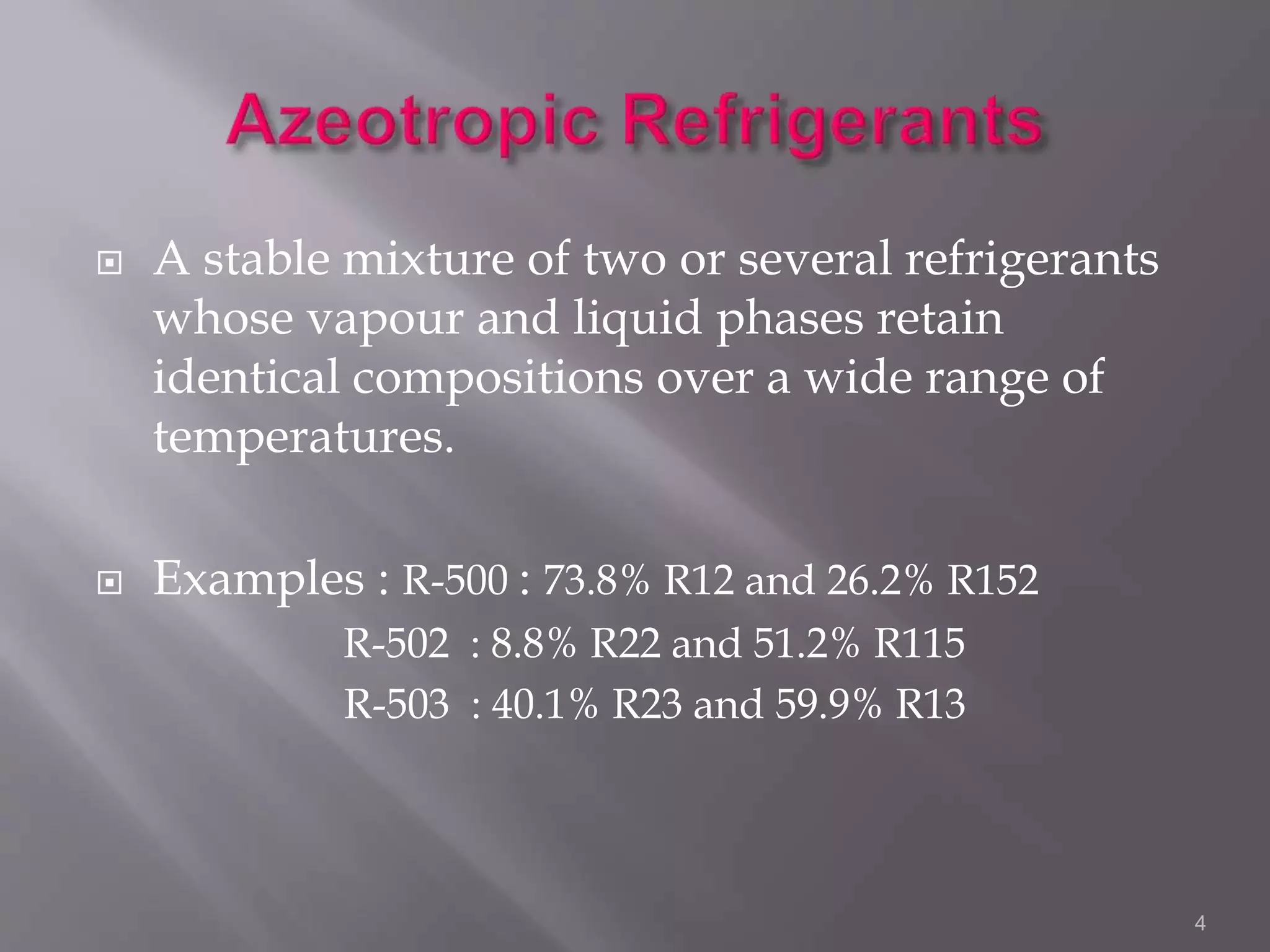
 A stable mixture of two or several refrigerants
whose vapour and liquid phases retain
identical compositions over a wide range of
temperatures.
 Examples : R-500 : 73.8% R12 and 26.2% R152
R-502 : 8.8% R22 and 51.2% R115
R-503 : 40.1% R23 and 59.9% R13
4
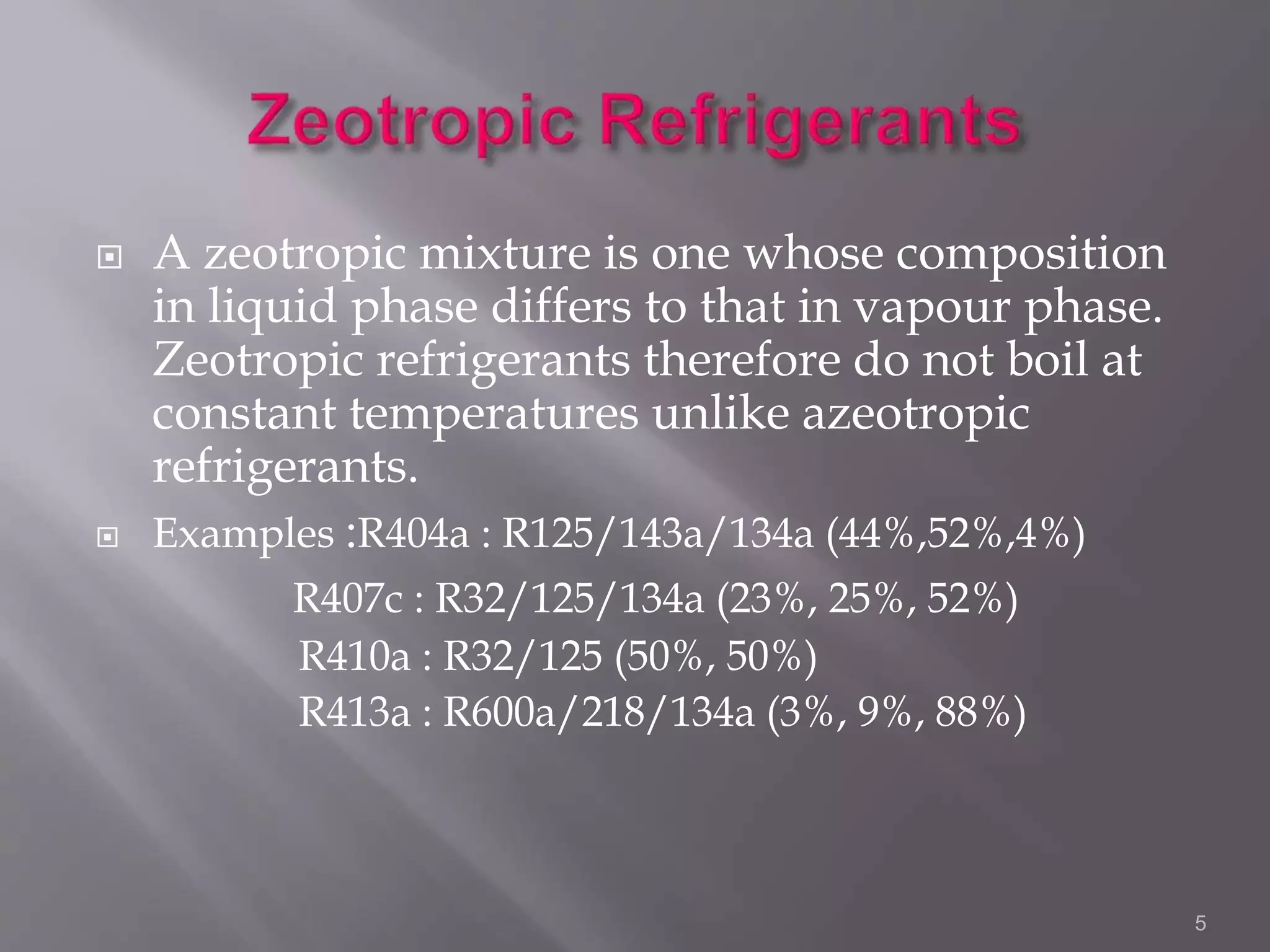
 A zeotropic mixture is one whose composition
in liquid phase differs to that in vapour phase.
Zeotropic refrigerants therefore do not boil at
constant temperatures unlike azeotropic
refrigerants.
 Examples :R404a : R125/143a/134a (44%,52%,4%)
R407c : R32/125/134a (23%, 25%, 52%)
R410a : R32/125 (50%, 50%)
R413a : R600a/218/134a (3%, 9%, 88%)
5
 Many hydrocarbon gases have successfully
been used as refrigerants in industrial,
commercial and domestic applications.
 Examples: R170, Ethane, C2H6
R290 , Propane C3H3
R600, Butane, C4H10
R600a, Isobutane, C4H10
Blends of the above Gases
6
 1834 : Jacob Perkins patented refrigeration by vapour
compression which was based on the reverse Rankine
cycle
 Use of Natural Refrigerants:
1880’s : NH3, SO2, CO2, HC’s
 Toxic and flammable refrigerants led to fatal accidents
 Use of Synthetic Refrigerants: (Stability, Non-toxicity and
efficiency)
1930 : R11, R12
1936 : R22
1961 : R507
7
- Depletion of the ozone layer in the stratosphere
- Global warming :
Refrigerants directly contributing to global
warming when released to the atmosphere
Indirect contribution based on the energy
consumption of among others the compressors (
CO2 produced by power stations )
8
Refrigerant Group Atmospheric
life
ODP GWP
R11 CFC 130 1 4000
R12 CFC 130 1 8500
R22 HCFC 15 .05 1500
R134a HFC 16 0 1300
R404a HFC 16 0 3260
R410a HFC 16 0 1720
R507 HFC 130 1 3300
R717 NH3 - 0 0
R744 CO2 - 0 1
R290 HC < 1 0 8
R600a HC < 1 0 8
9
 Leakage rate is the amount of green house gases
released into the atmosphere by the refrigeration
system. It is given by the mass of refrigerant emissions
in kilograms times the GWP of the refrigerant
 Leakage Rate = Mass of refrigerant leaking from
system x GWP of Refrigerant
 Typical leakage rates:
Hermetic compressor : 1 - 2%
Split units : 6 - 8%
Automotive air conditioning : 10 - 20%
10
HFC’s are definitely not a good option for the
replacement of CFC’s and HCFC’s
The best choices from an environmental point
of view are the natural refrigerants:
 Ammonia
 Hydrocarbons
 Carbon dioxide : Mainly for Vehicle AC and
mobile refrigeration
11
 Non Flammable
 Non toxic
 Inexpensive and widely available
 Its high operating pressure provides potential
for system size and weight reducing potential.
Drawbacks:
 Operating pressure (high side) : 80 bars
 Low efficiency
12
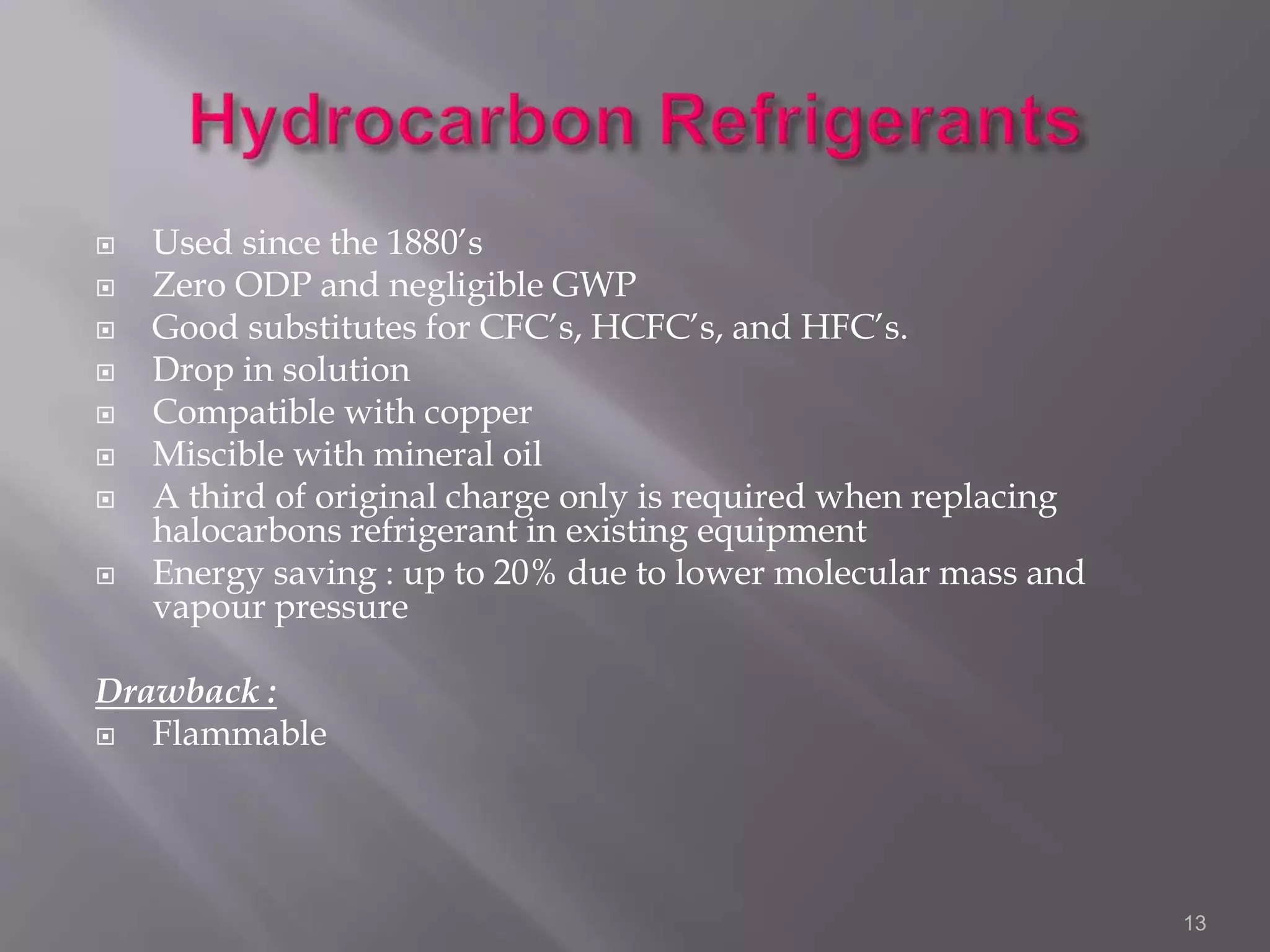
 Used since the 1880’s
 Zero ODP and negligible GWP
 Good substitutes for CFC’s, HCFC’s, and HFC’s.
 Drop in solution
 Compatible with copper
 Miscible with mineral oil
 A third of original charge only is required when replacing
halocarbons refrigerant in existing equipment
 Energy saving : up to 20% due to lower molecular mass and
vapour pressure
Drawback :
 Flammable
13
 HC refrigerants were first used in the late
1800’s/early 1900’s
 They are naturally occuring
 They have zero ODP and Minimal GWP
 They are compatible with most lubricants
 They are ‘more’ compatible with materials
normally used in the industry
 HC’s can reduce/eliminate acids forming
14
 HC’s are more efficient than chemical
refrigerants
 MACS
 Domestic Refrigeration and Air Conditioning
 Commercial/Industrial Refrigeration and Air
Conditioning
 Exceptions Flooded evaporator and Centrifugal
15

Characteristic/ Refrigerant /Commercial R22 HR22
Class Classification HCFC HC
Molecular Formula CHClF2 CH3 CH3
+
CH3 CH2 CH3
Molecular Mass 86.5 41.1
Critical Temperature ( °C ) 2
96.2 > 130
Boiling Point ( °C ) - 41 - 42
Refrigerant Efficiency (J/g) 160.8 359.1
Lubricant Miscibility Mineral All Type
16
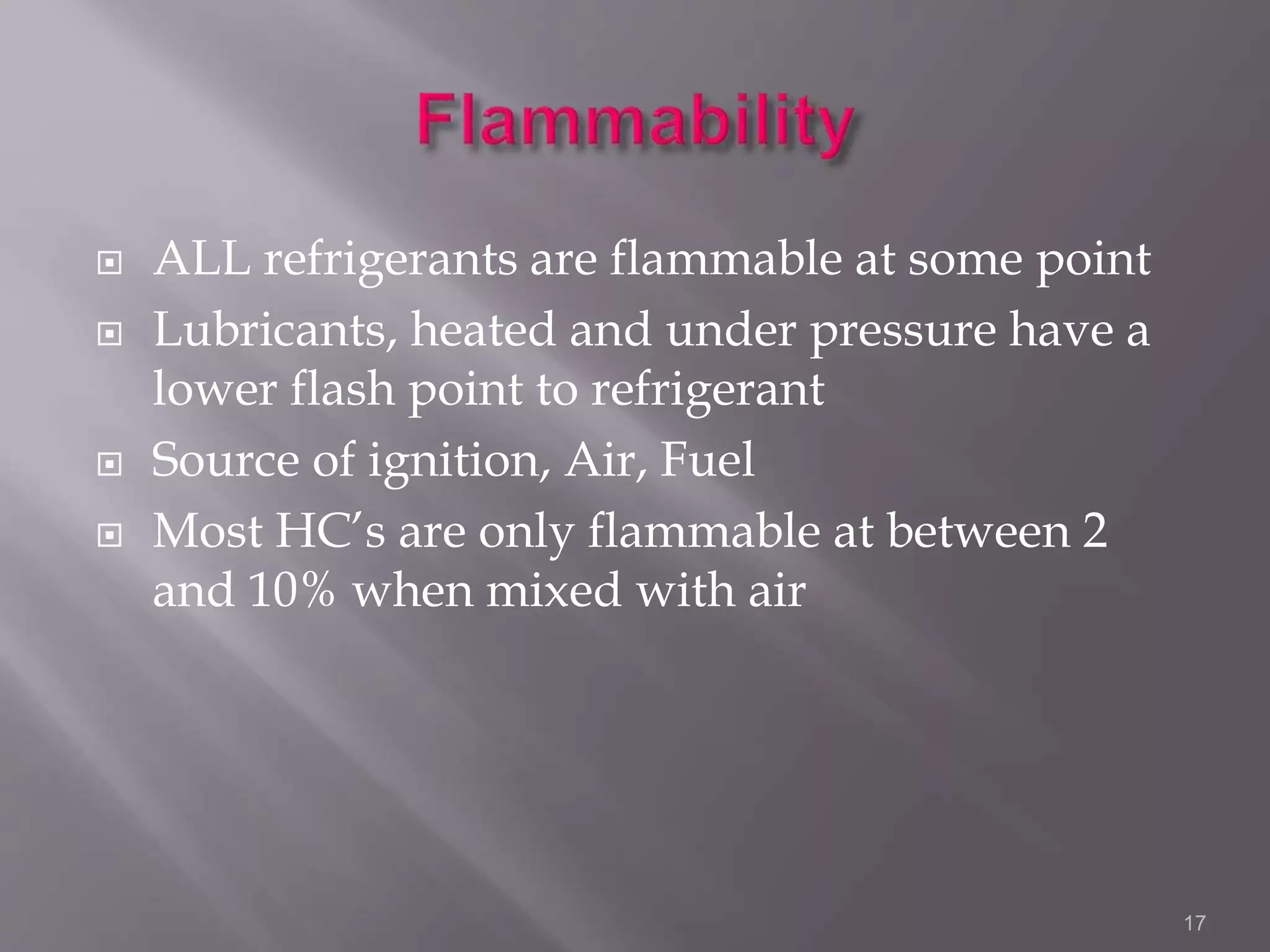
 ALL refrigerants are flammable at some point
 Lubricants, heated and under pressure have a
lower flash point to refrigerant
 Source of ignition, Air, Fuel
 Most HC’s are only flammable at between 2
and 10% when mixed with air
17
 Approximate auto ignition temperatures
 R22 630 ºC
 R12 750 ºC
 R134a 740 ºC
 R290 465 ºC
 R600a 470 ºC
 Oil 222 ºC
18
 When HC’s burn they produce carbon and
steam
 When chemical refrigerants burn they ALL
produce highly toxic fumes.
19
Natural production 3000 million tons/year
Production in factories 120 million tons/year
Used in refrigeration 6 million tons/year
20
 ODP = 0
 GWP = 0
 Excellent thermodynamic characteristics: small
molecular mass, large latent heat, large vapour density
and excellent heat transfer characteristics
 High critical temperature (132C) : highly efficient
cycles at high condensing temperatures
 Its smell causes leaks to be detected and fixed before
reaching dangerous concentration
 Relatively Low price
21
 Toxic
 Flammable ( 16 – 28% concentration )
 Not compatible with copper
 Temperature on discharge side of compressor
is higher compared to other refrigerants
22
Concentration ( ppm ) Effect
5 Noticeable by smell
25 Irritation noticeable
50 Irritation of nose, mouth and throat; acclimatization after a while
500 Immediate irritation of mucous membranes, respiration difficult
3500 Lethal after a short period of exposure
20000 Causes blisters and chemical burns
Lower explosion limit 16 % by volume in air
Higher explosion limit 25 % by volume in air
Ignition temperature 650 C
Ignition energy required .01 to 1 Joule
23
 Evaporation enthalpy 0 oC 1262 KJ/KG
 Pressure at 0 oC 4,9 bar
 Pressure ratio 0/35 oC 3,15
 COP 0/35 oC 6,77
 Discharge temperature 0/35 oC 81 oC
 Volumetric refrigerating capacity 3800 KJ/m3
 Volumetric refrigerating capacity of R134a 2000 KJ/m3
24
 In the aftermath of the Montreal protocole HFC’s have
predominantly replaced CFC’s and HCFC’s in RAC
equipment.
 Due to their high GWP, HFC’s are not a good
replacement solution.
 The solution are the natural refrigerants :
Ammonia, Hydrocarbons and Carbon dioxide
 System need to have low TEWI factor
 High efficiency with ammonia and lower power
consumption with hydrocarbons
25

Refrigerant ppt

  • 1.
    1. HaloCarbons 2. AzeotropicRefrigerants 3. Zeotropic Refrigerants 4. Inorganic Refrigerants 5. Hydrocarbon Refrigerants 1
  • 2.
     Halocarbon Refrigerantare all synthetically produced and were developed as the Freon family of refrigerants. Examples :  CFC’s : R11, R12, R113, R114, R115  HCFC’s : R22, R123  HFC’s : R134a, R404a, R407C, R410a 2
  • 3.
     Carbon Dioxide Water  Ammonia  Air  Sulphur dioxide 3
  • 4.
     A stablemixture of two or several refrigerants whose vapour and liquid phases retain identical compositions over a wide range of temperatures.  Examples : R-500 : 73.8% R12 and 26.2% R152 R-502 : 8.8% R22 and 51.2% R115 R-503 : 40.1% R23 and 59.9% R13 4
  • 5.
     A zeotropicmixture is one whose composition in liquid phase differs to that in vapour phase. Zeotropic refrigerants therefore do not boil at constant temperatures unlike azeotropic refrigerants.  Examples :R404a : R125/143a/134a (44%,52%,4%) R407c : R32/125/134a (23%, 25%, 52%) R410a : R32/125 (50%, 50%) R413a : R600a/218/134a (3%, 9%, 88%) 5
  • 6.
     Many hydrocarbongases have successfully been used as refrigerants in industrial, commercial and domestic applications.  Examples: R170, Ethane, C2H6 R290 , Propane C3H3 R600, Butane, C4H10 R600a, Isobutane, C4H10 Blends of the above Gases 6
  • 7.
     1834 :Jacob Perkins patented refrigeration by vapour compression which was based on the reverse Rankine cycle  Use of Natural Refrigerants: 1880’s : NH3, SO2, CO2, HC’s  Toxic and flammable refrigerants led to fatal accidents  Use of Synthetic Refrigerants: (Stability, Non-toxicity and efficiency) 1930 : R11, R12 1936 : R22 1961 : R507 7
  • 8.
    - Depletion ofthe ozone layer in the stratosphere - Global warming : Refrigerants directly contributing to global warming when released to the atmosphere Indirect contribution based on the energy consumption of among others the compressors ( CO2 produced by power stations ) 8
  • 9.
    Refrigerant Group Atmospheric life ODPGWP R11 CFC 130 1 4000 R12 CFC 130 1 8500 R22 HCFC 15 .05 1500 R134a HFC 16 0 1300 R404a HFC 16 0 3260 R410a HFC 16 0 1720 R507 HFC 130 1 3300 R717 NH3 - 0 0 R744 CO2 - 0 1 R290 HC < 1 0 8 R600a HC < 1 0 8 9
  • 10.
     Leakage rateis the amount of green house gases released into the atmosphere by the refrigeration system. It is given by the mass of refrigerant emissions in kilograms times the GWP of the refrigerant  Leakage Rate = Mass of refrigerant leaking from system x GWP of Refrigerant  Typical leakage rates: Hermetic compressor : 1 - 2% Split units : 6 - 8% Automotive air conditioning : 10 - 20% 10
  • 11.
    HFC’s are definitelynot a good option for the replacement of CFC’s and HCFC’s The best choices from an environmental point of view are the natural refrigerants:  Ammonia  Hydrocarbons  Carbon dioxide : Mainly for Vehicle AC and mobile refrigeration 11
  • 12.
     Non Flammable Non toxic  Inexpensive and widely available  Its high operating pressure provides potential for system size and weight reducing potential. Drawbacks:  Operating pressure (high side) : 80 bars  Low efficiency 12
  • 13.
     Used sincethe 1880’s  Zero ODP and negligible GWP  Good substitutes for CFC’s, HCFC’s, and HFC’s.  Drop in solution  Compatible with copper  Miscible with mineral oil  A third of original charge only is required when replacing halocarbons refrigerant in existing equipment  Energy saving : up to 20% due to lower molecular mass and vapour pressure Drawback :  Flammable 13
  • 14.
     HC refrigerantswere first used in the late 1800’s/early 1900’s  They are naturally occuring  They have zero ODP and Minimal GWP  They are compatible with most lubricants  They are ‘more’ compatible with materials normally used in the industry  HC’s can reduce/eliminate acids forming 14
  • 15.
     HC’s aremore efficient than chemical refrigerants  MACS  Domestic Refrigeration and Air Conditioning  Commercial/Industrial Refrigeration and Air Conditioning  Exceptions Flooded evaporator and Centrifugal 15
  • 16.
     Characteristic/ Refrigerant /CommercialR22 HR22 Class Classification HCFC HC Molecular Formula CHClF2 CH3 CH3 + CH3 CH2 CH3 Molecular Mass 86.5 41.1 Critical Temperature ( °C ) 2 96.2 > 130 Boiling Point ( °C ) - 41 - 42 Refrigerant Efficiency (J/g) 160.8 359.1 Lubricant Miscibility Mineral All Type 16
  • 17.
     ALL refrigerantsare flammable at some point  Lubricants, heated and under pressure have a lower flash point to refrigerant  Source of ignition, Air, Fuel  Most HC’s are only flammable at between 2 and 10% when mixed with air 17
  • 18.
     Approximate autoignition temperatures  R22 630 ºC  R12 750 ºC  R134a 740 ºC  R290 465 ºC  R600a 470 ºC  Oil 222 ºC 18
  • 19.
     When HC’sburn they produce carbon and steam  When chemical refrigerants burn they ALL produce highly toxic fumes. 19
  • 20.
    Natural production 3000million tons/year Production in factories 120 million tons/year Used in refrigeration 6 million tons/year 20
  • 21.
     ODP =0  GWP = 0  Excellent thermodynamic characteristics: small molecular mass, large latent heat, large vapour density and excellent heat transfer characteristics  High critical temperature (132C) : highly efficient cycles at high condensing temperatures  Its smell causes leaks to be detected and fixed before reaching dangerous concentration  Relatively Low price 21
  • 22.
     Toxic  Flammable( 16 – 28% concentration )  Not compatible with copper  Temperature on discharge side of compressor is higher compared to other refrigerants 22
  • 23.
    Concentration ( ppm) Effect 5 Noticeable by smell 25 Irritation noticeable 50 Irritation of nose, mouth and throat; acclimatization after a while 500 Immediate irritation of mucous membranes, respiration difficult 3500 Lethal after a short period of exposure 20000 Causes blisters and chemical burns Lower explosion limit 16 % by volume in air Higher explosion limit 25 % by volume in air Ignition temperature 650 C Ignition energy required .01 to 1 Joule 23
  • 24.
     Evaporation enthalpy0 oC 1262 KJ/KG  Pressure at 0 oC 4,9 bar  Pressure ratio 0/35 oC 3,15  COP 0/35 oC 6,77  Discharge temperature 0/35 oC 81 oC  Volumetric refrigerating capacity 3800 KJ/m3  Volumetric refrigerating capacity of R134a 2000 KJ/m3 24
  • 25.
     In theaftermath of the Montreal protocole HFC’s have predominantly replaced CFC’s and HCFC’s in RAC equipment.  Due to their high GWP, HFC’s are not a good replacement solution.  The solution are the natural refrigerants : Ammonia, Hydrocarbons and Carbon dioxide  System need to have low TEWI factor  High efficiency with ammonia and lower power consumption with hydrocarbons 25