EMBRYOLOGY OF
NERVOUS SYSTEM
Dr NAVEEN THOTA
SVIMS
Introduction
   Formation of neurons and neuroglial cells
   Neural tube and its sub divisions
   Spinal cord
   Medulla oblongata
   Pons
   Midbrain
   Cerebral hemisphere
   Corpus striatum
   Cerebral cortex
   Autonomic nervous system
Formation of neurons and
neuroglial cells
 Neural tube first lined by single layer
  of cells
 Proliferate to form several layers
    ◦ Matrix layer
    ◦ Mantle layer
    ◦ Marginal layer
Contd..
   Stages in the formation of a nerve cell
    are:
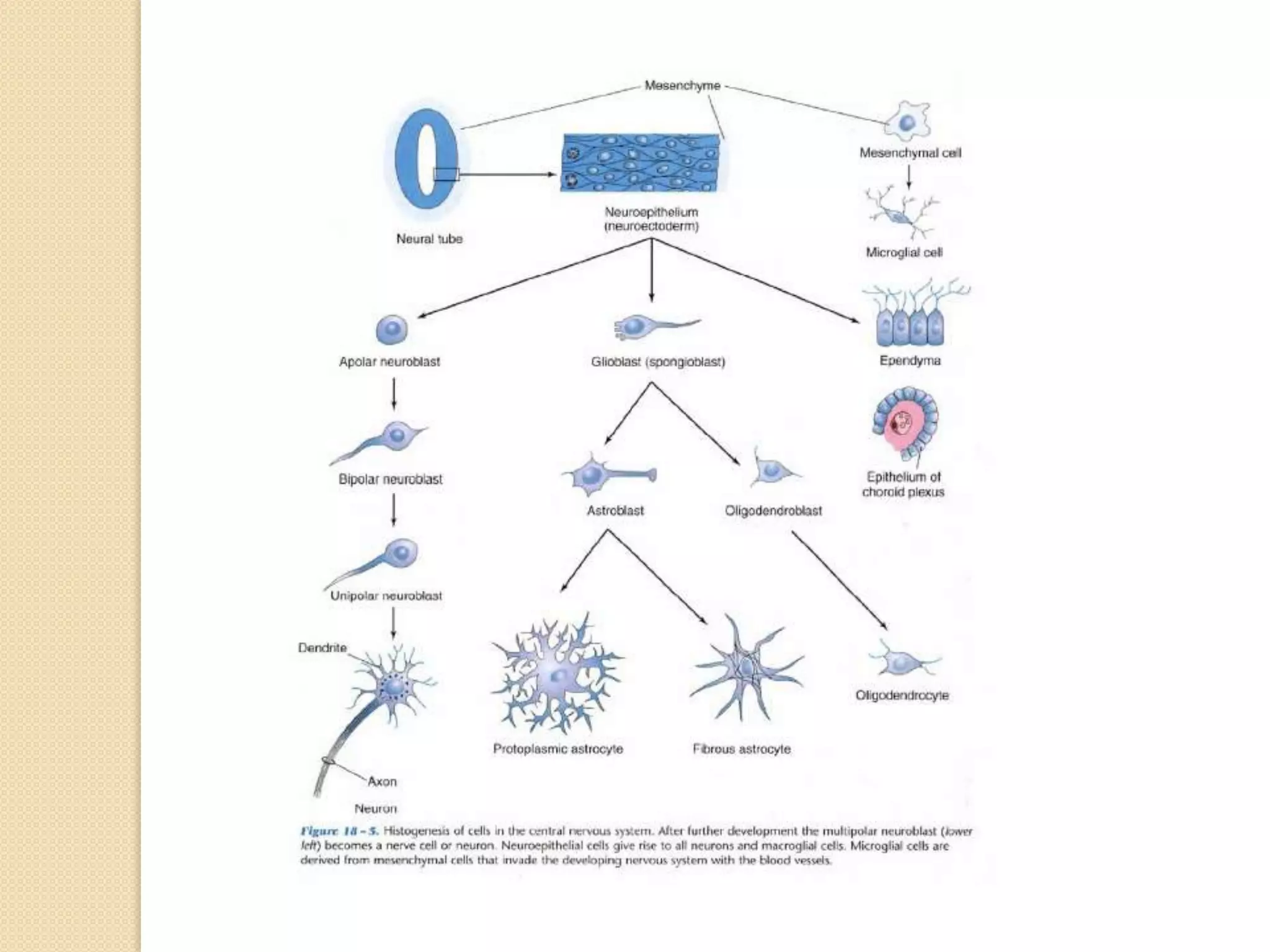
    ◦   Apolar neuroblast
    ◦   Bipolar neuroblast
    ◦   Unipolar neuroblast
    ◦   Multipolar neuroblast
    ◦   Axon and dendrites
 Neuroglial cells are also formed from
  germinal cells of the ependymal layer
 Glioblasts migrate in to mantle and
  marginal layer as medulloblasts
 They differentiate either into
  astroblasts or oligodendroblasts
 Microglial cells are mesodermal in
  origin
Myelination of fibers
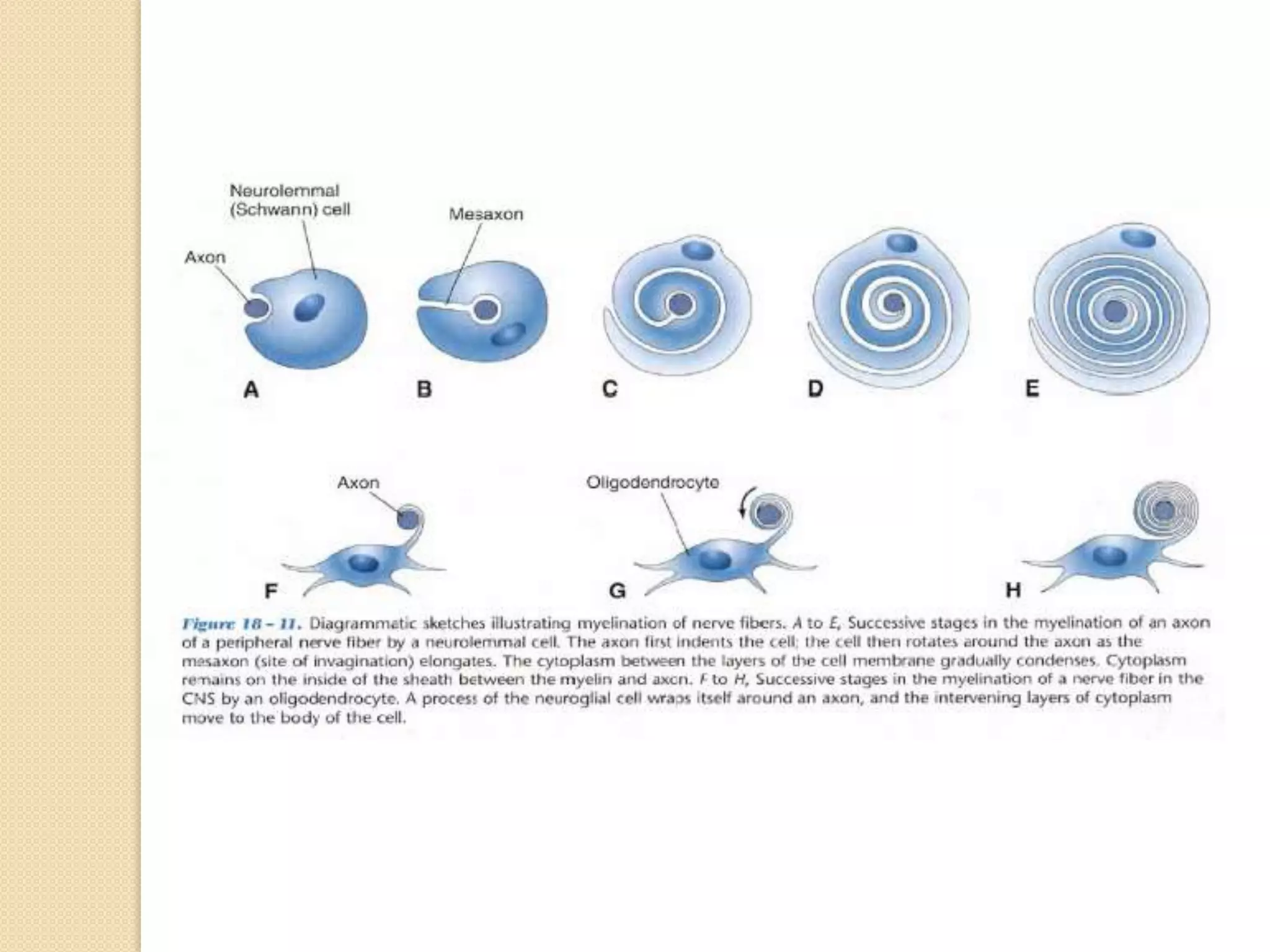
 Nerve fibers which remain with in the
  brain and spinal cord receives support
  from and are ensheathed by neuroglial
  cells
 Peripheral nerves special sheath
  called the neurolemma derived from
  schwann cells
 Myelin of the CNS derived from
  oligodendrocytes
Neural tube and its
subdivisions
 Whole of the nervous system is
  derived from ectoderm except blood
  vessels and neuroglial elements
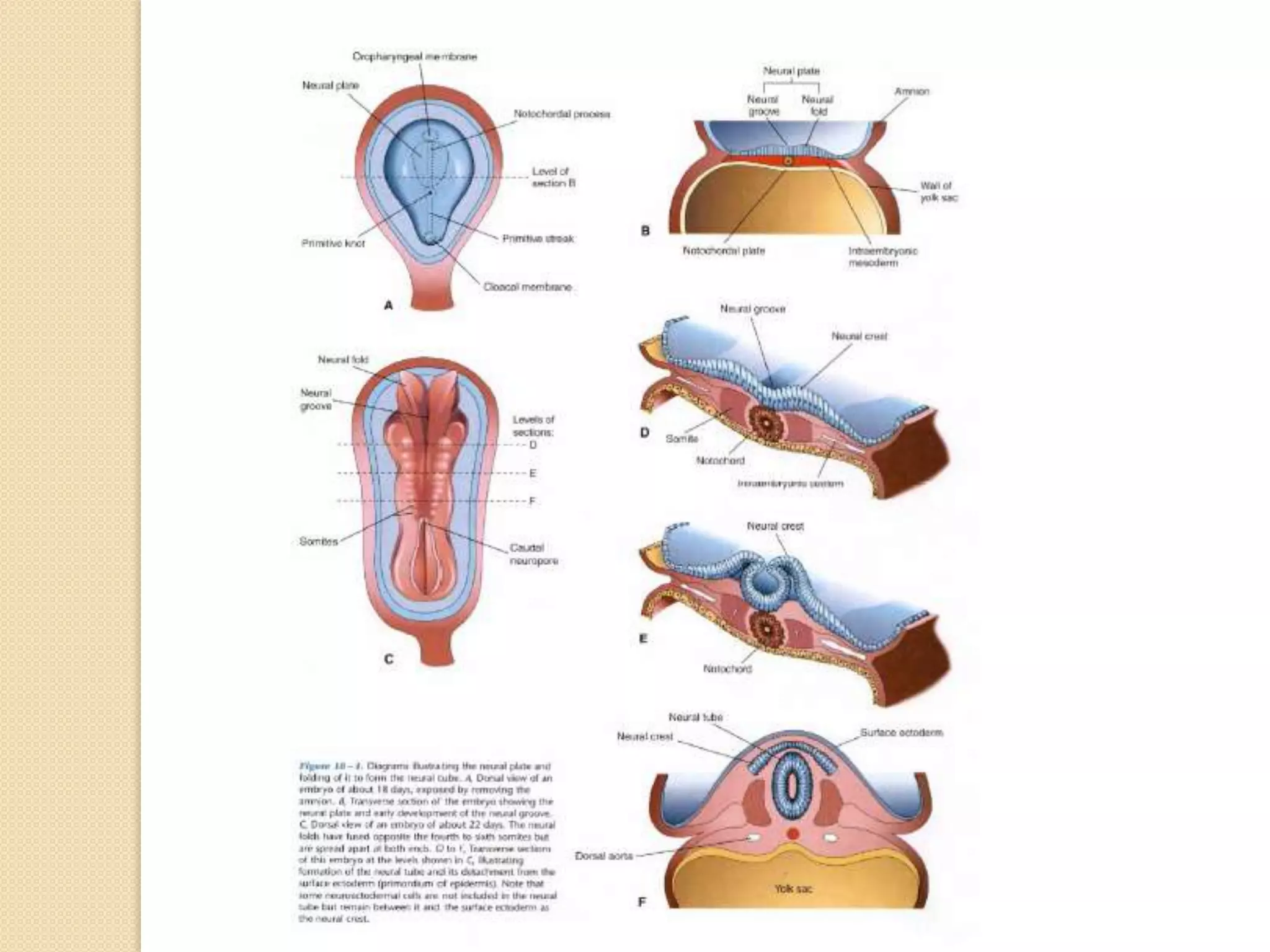
 Ectoderm situated on the dorsal
  aspect of embryonic disc forms the
  neural plate
 Neural groove
 Neural tube
 Enlarges cranial part and caudal
  tubular part
Contd..
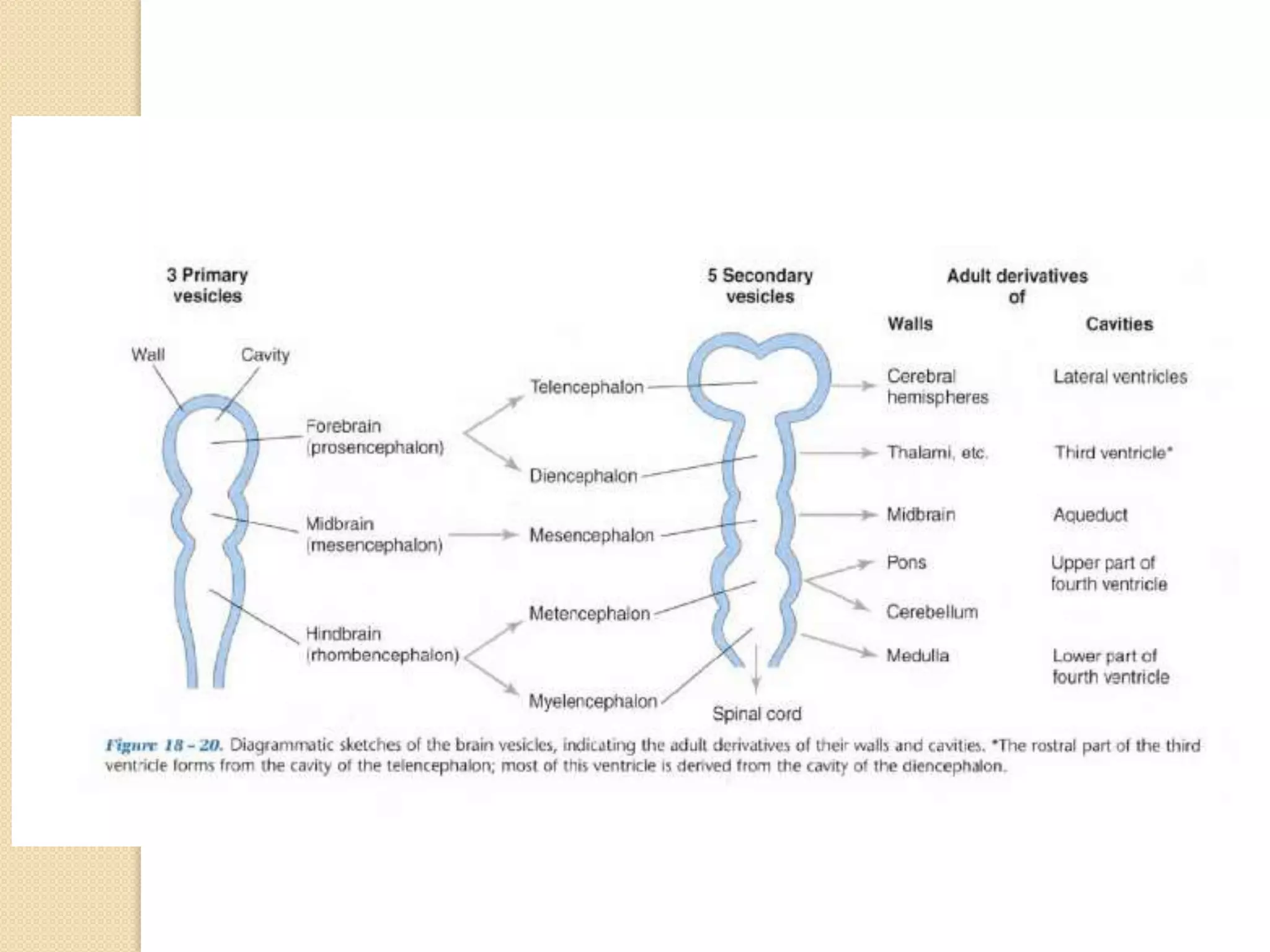
 The cavity of the brain shows three
  dilatations
 Prosencephalon, mesencephalon,
  rhombencephalon
 Prosencephalon
    ◦ Diencephalon
    ◦ Telencephalon
   Rhombencephalon
    ◦ Metencephalon
    ◦ Myelencephalon
Contd..
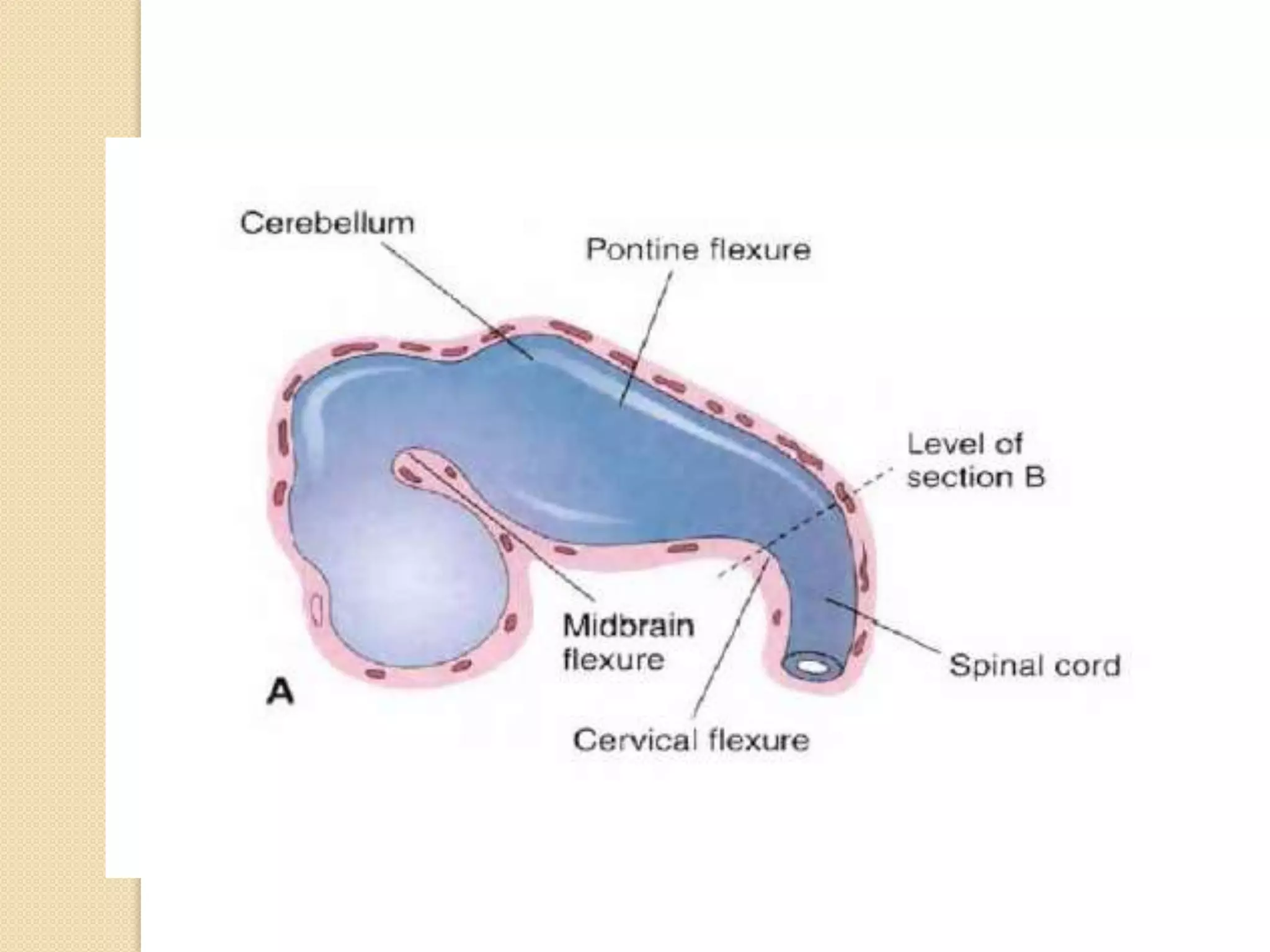
   The relative position is altered by
    number of flexures
    ◦   Cervical flexure
    ◦   Mesencephalic flexure
    ◦   Pontine flexure
    ◦   Telencephalic flexure
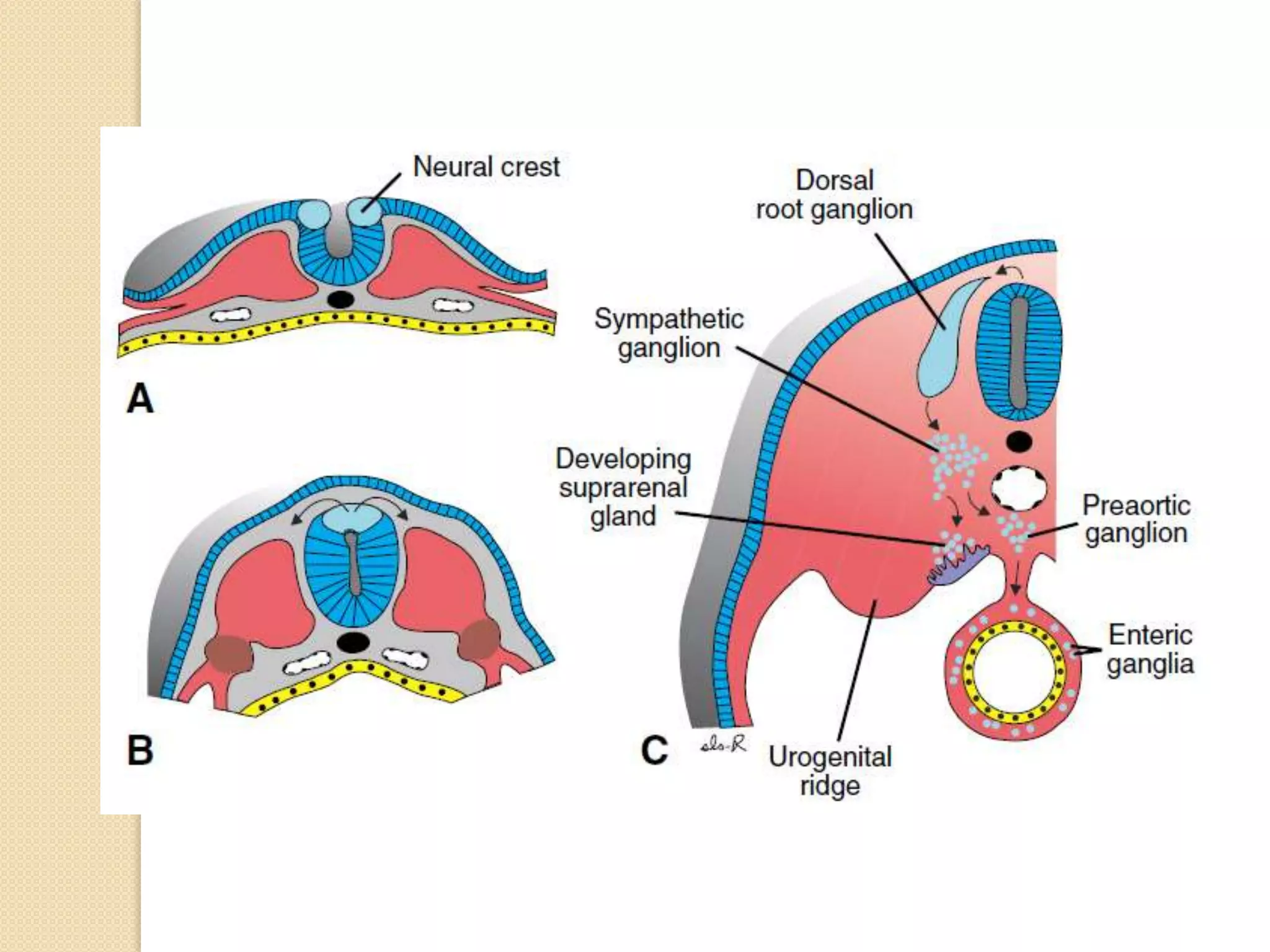
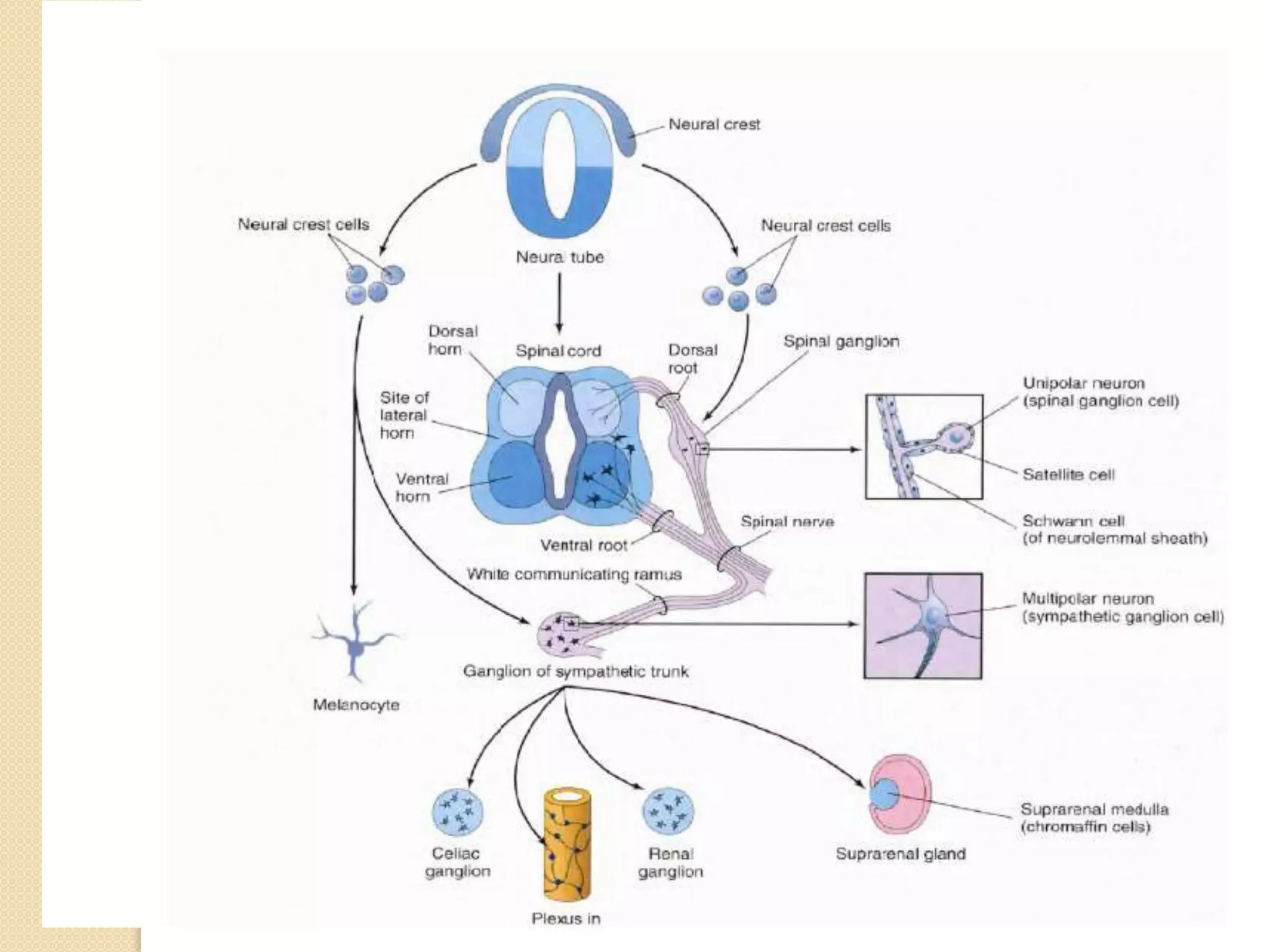
Neural crest
   Cells between the neural plate and the
    rest of the ectoderm form primordia of
    the neural crest
    ◦ DRG
    ◦ Sensory ganglia of 5, 7, 9, 10
    ◦ Neurons and satellite cells of sympathetic
      ganglia
    ◦ Parasymathetic ganglia
    ◦ Schwann cells
Contd..
 ◦ Specific cells adrenal medulla
 ◦ Chromaffin tissue
 ◦ melanoblasts
Spinal cord
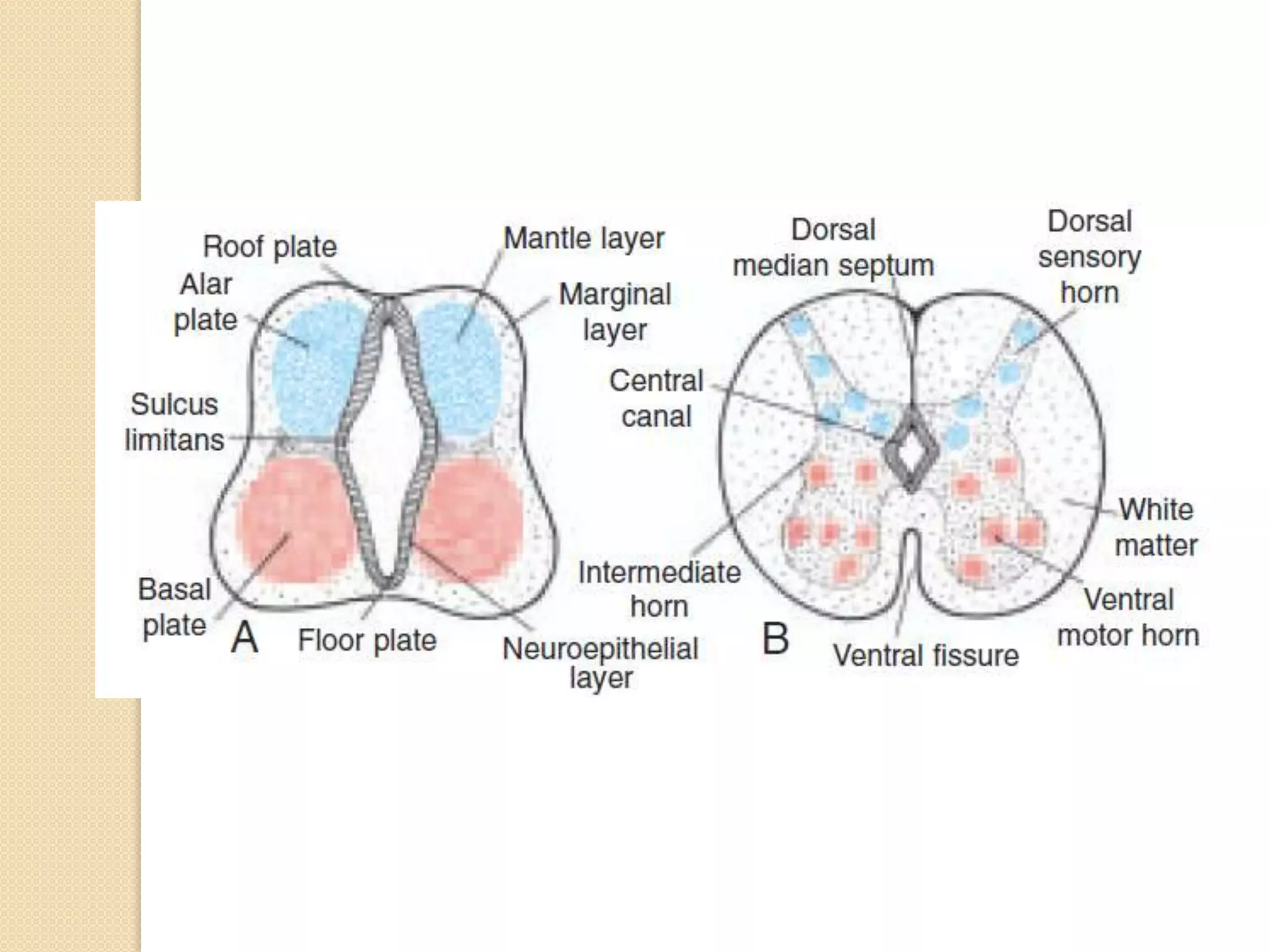
   Devolops from caudal cylindrical part of
    neural tube
   Cavity of the tube bounded by thick
    lateral wall, thin roof and floor
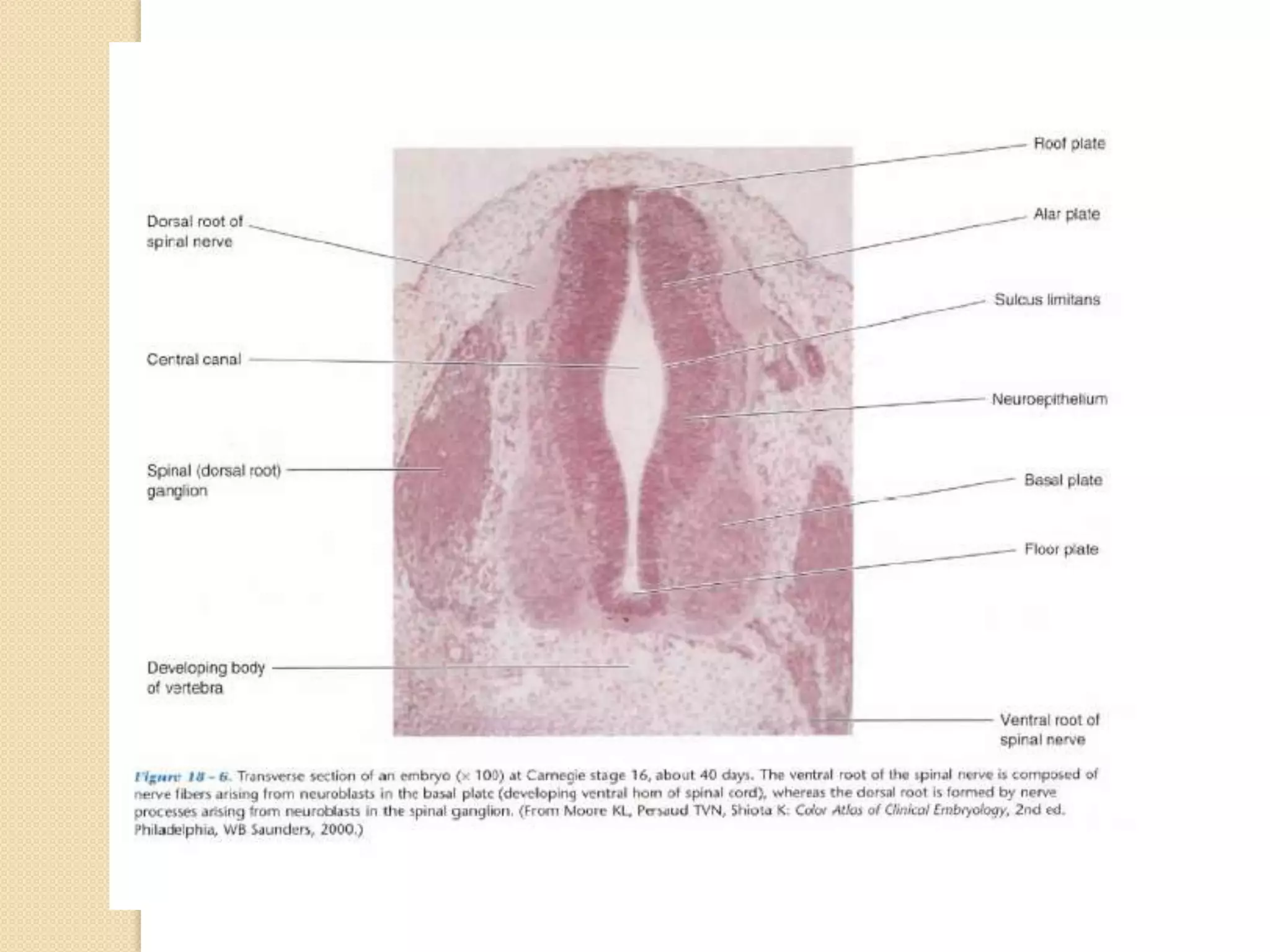
   Tube subdivides in to three layers matrix
    layer, mantle layer and marginal layer
   Ventral layer of the mantle layer grows
    faster than dorsal layer
   Line seperating the compressed ventral
    part from the dorsal part is called sulcus
    limtans
Contd..
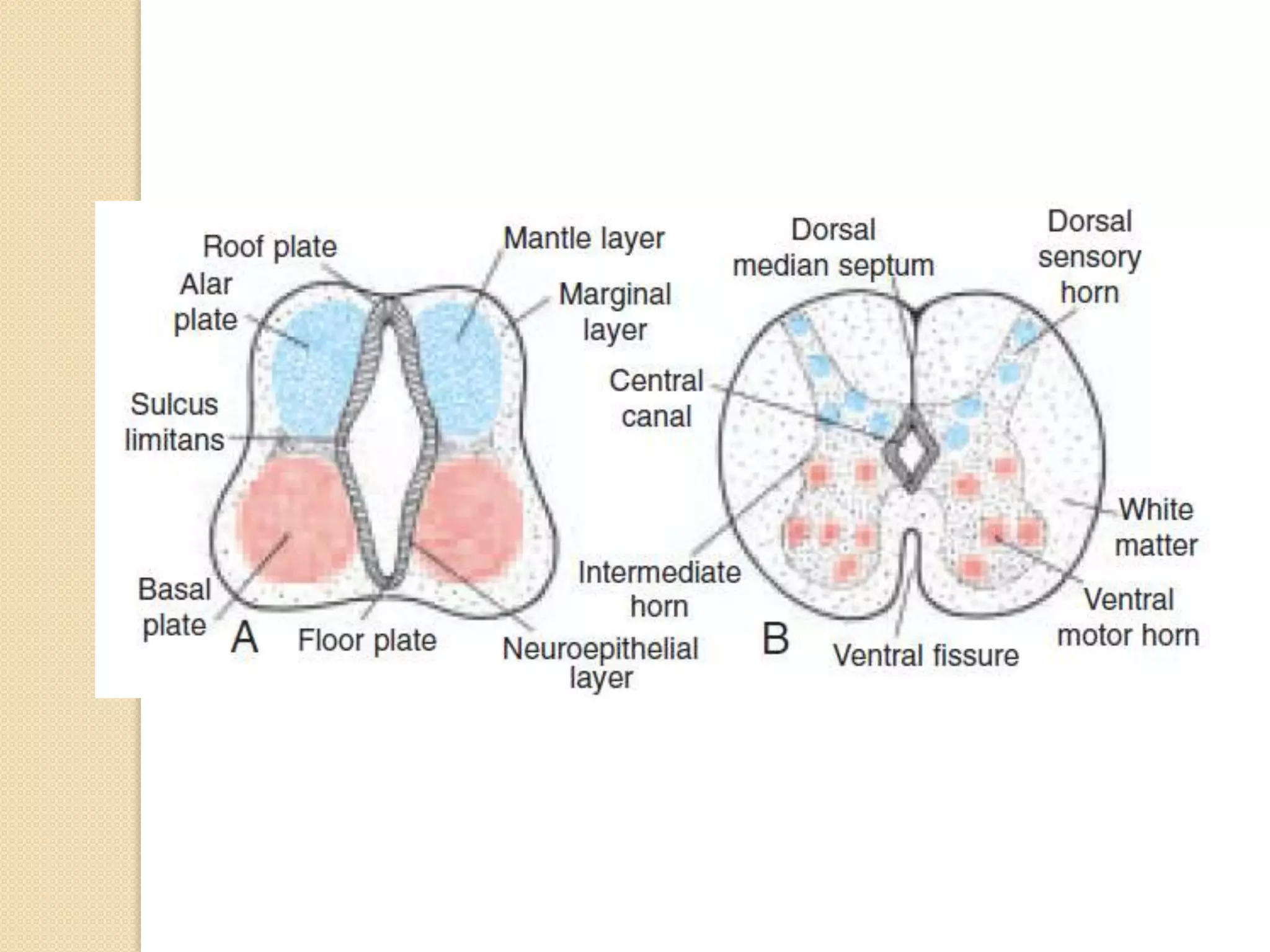
 Dorsal or alar lamina
 Ventral or basal lamina
 Posteriomedeian fissure
 Anteriomedian fissure
 Nerve cells that devolop in mantle
  zone of the basal lamina becomes the
  neuron of anterior grey column and
  from the alar lamina the neuron of the
  posterior grey column
Contd..
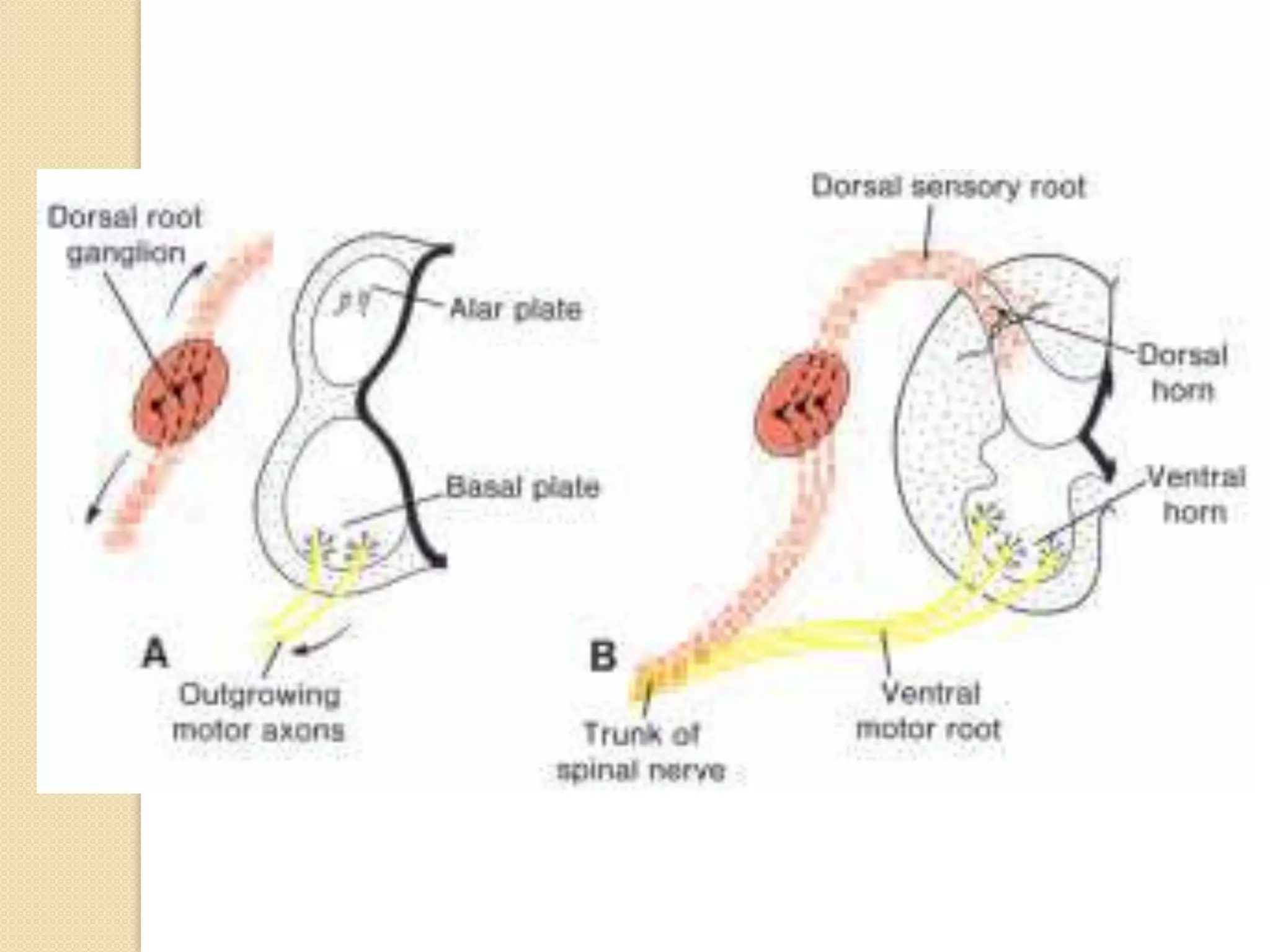
 Dorsal nerve root ganglia are formed
  by axons of the cells that develop from
  neural crest
 Axons from the post grey column
  enter the marginal layer to form the
  ascending tract
 Descending tracts are formed by the
  axons projecting from the brain
 Grey columns divide the white matter
  in to anterior, posterior and lateral
  columns
POSITIONAL CHANGES OF

                  THE CORD
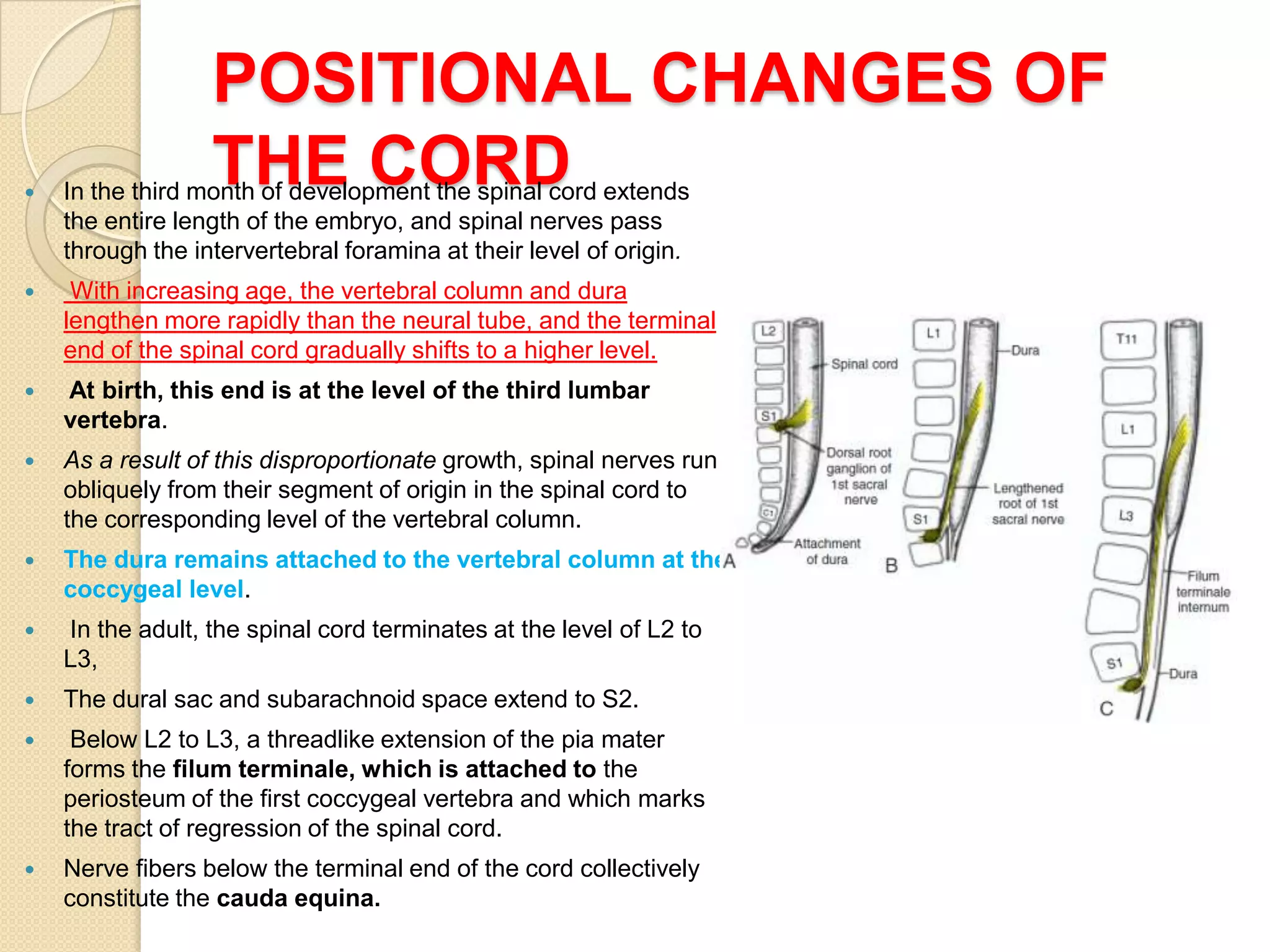
    In the third month of development the spinal cord extends
    the entire length of the embryo, and spinal nerves pass
    through the intervertebral foramina at their level of origin.
    With increasing age, the vertebral column and dura
    lengthen more rapidly than the neural tube, and the terminal
    end of the spinal cord gradually shifts to a higher level.
   At birth, this end is at the level of the third lumbar
    vertebra.
   As a result of this disproportionate growth, spinal nerves run
    obliquely from their segment of origin in the spinal cord to
    the corresponding level of the vertebral column.
   The dura remains attached to the vertebral column at the
    coccygeal level.
   In the adult, the spinal cord terminates at the level of L2 to
    L3,
   The dural sac and subarachnoid space extend to S2.
    Below L2 to L3, a threadlike extension of the pia mater
    forms the filum terminale, which is attached to the
    periosteum of the first coccygeal vertebra and which marks
    the tract of regression of the spinal cord.
   Nerve fibers below the terminal end of the cord collectively
    constitute the cauda equina.
Medulla oblongata
 Myelencephalon
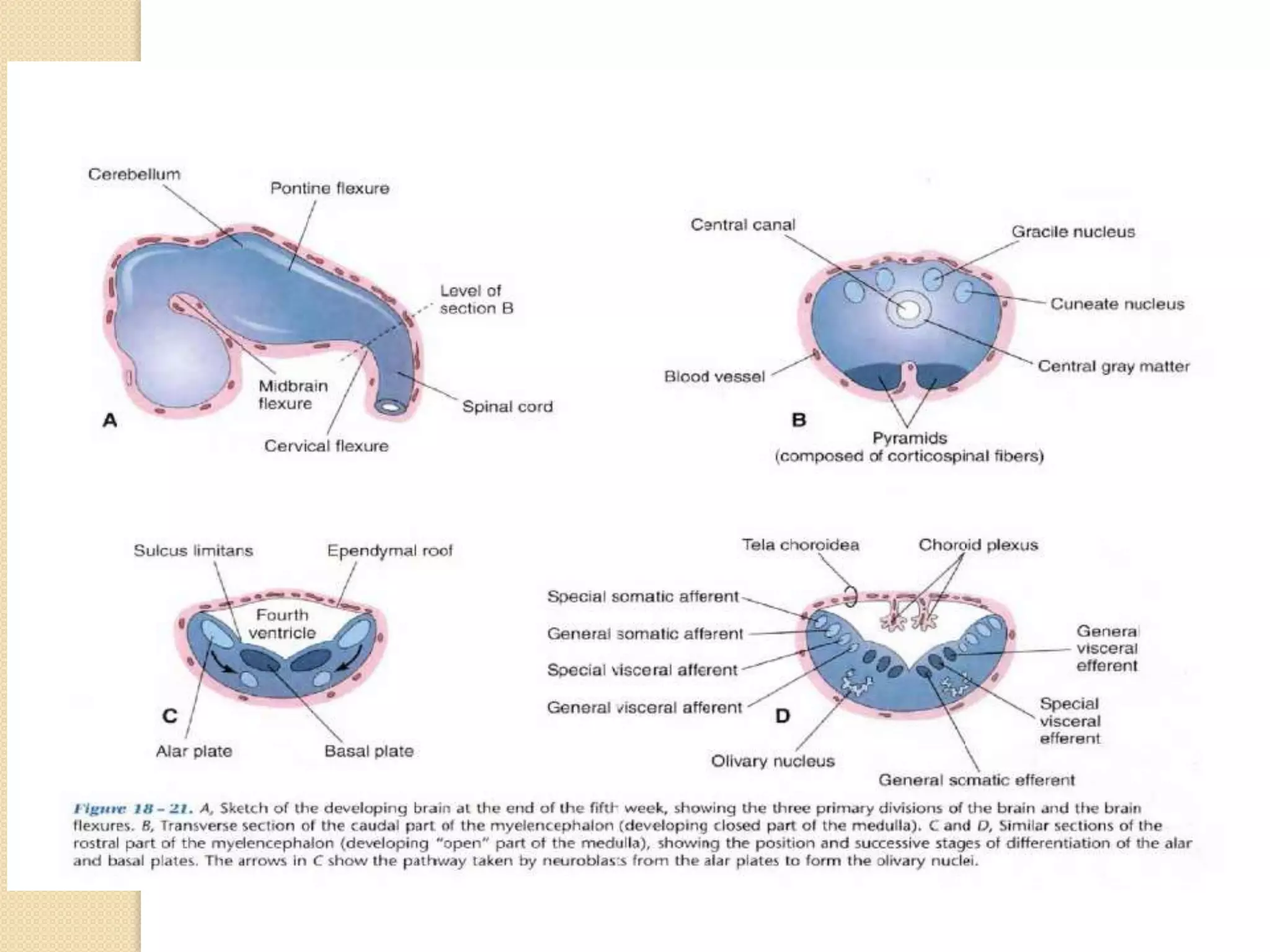
 Early devolopment simillar to spinal
  cord sulcus limitans divides in to alar
  and basal lamina
 Roof plate becomes greatly widened
  resuting which alar plate comes
  dorsolateral to basal plate
 Alar plate forms olivary nuclei and
  cranial nerve nuclei
Contd..
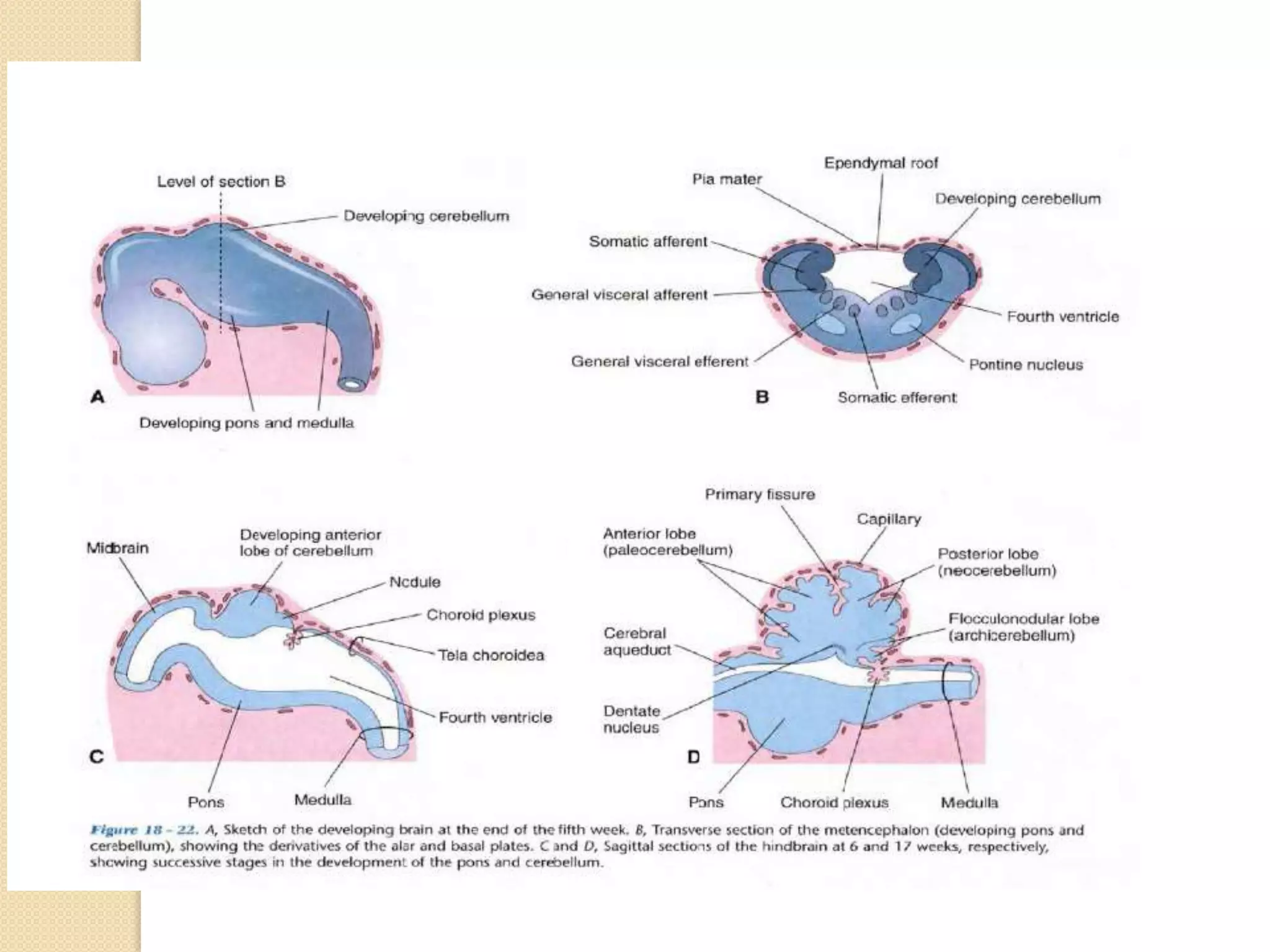
Pons
 Ventral part of metencephalon
 Contribution alar lamina of the
  myelencephalon and gives rise to
  pontine nuclei axons arising from them
  forms MCP
 Lateral part of alar lamina becomes
  rhombic lips to form the cerebellum
 Nuclei arising from basal and alar
  plate lie in dorsal or tegmental part of
  pons
Contd..
   Ventral part of pons constitutes:
    ◦ Middle cerebellar peduncle
    ◦ Corticospinal, corticobulbar and
      corticopontine fibers
Mid brain
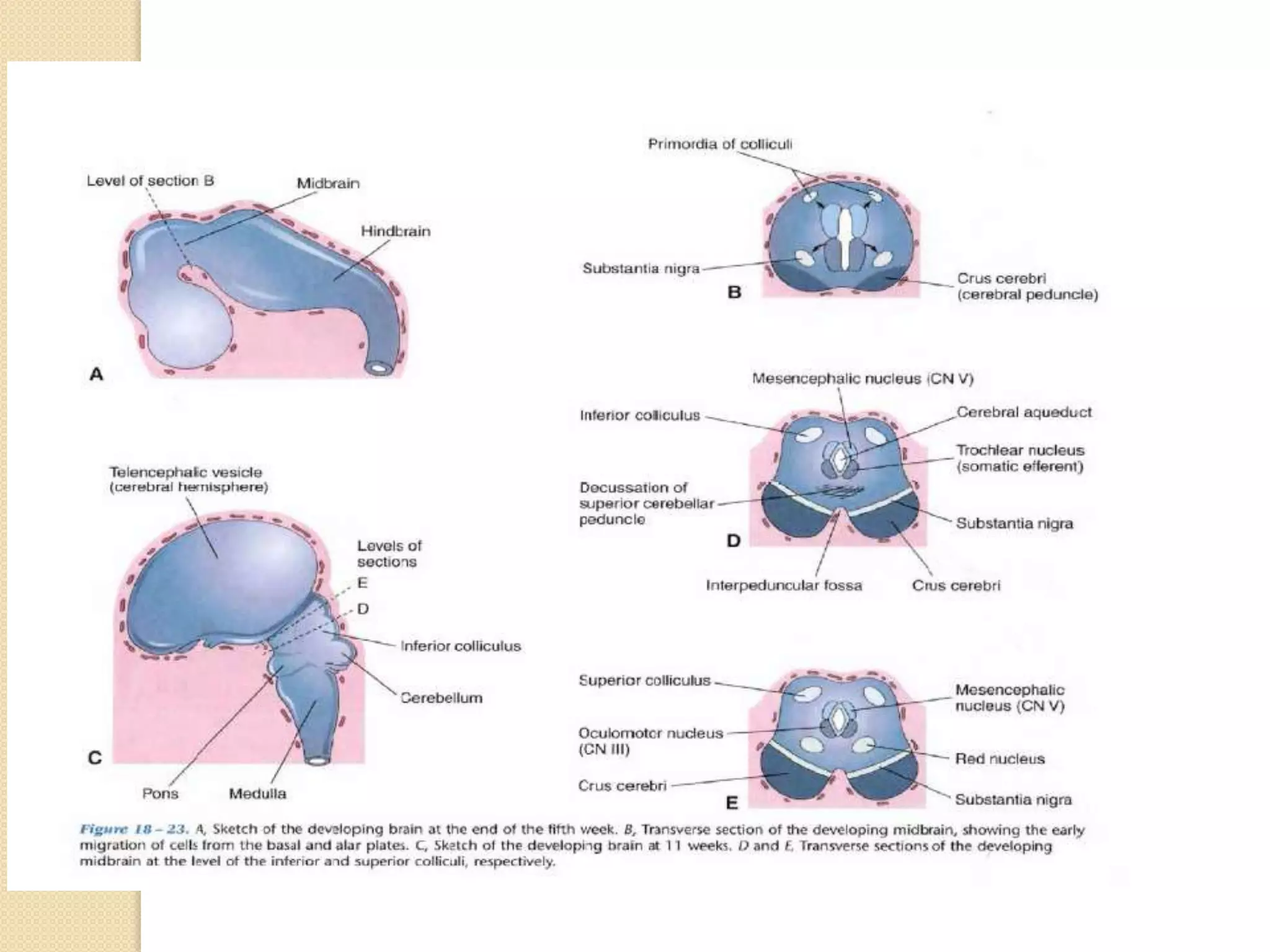
   Nuclei of the basal lamina
    ◦ Occulomotor nuclei
    ◦ Trochlear nuclei
    ◦ Edinger Westphal nuclei
   Alar lamina gives rise to
    ◦ Colliculi
    ◦ Red nucleus
    ◦ Substantia nigra
Contd..
   Marginal layer ventral part of
    mesencephalon invaded by down
    growing fibers of CST, corticobulbar
    and cortico pontine pathway and
    forms crus cerebri
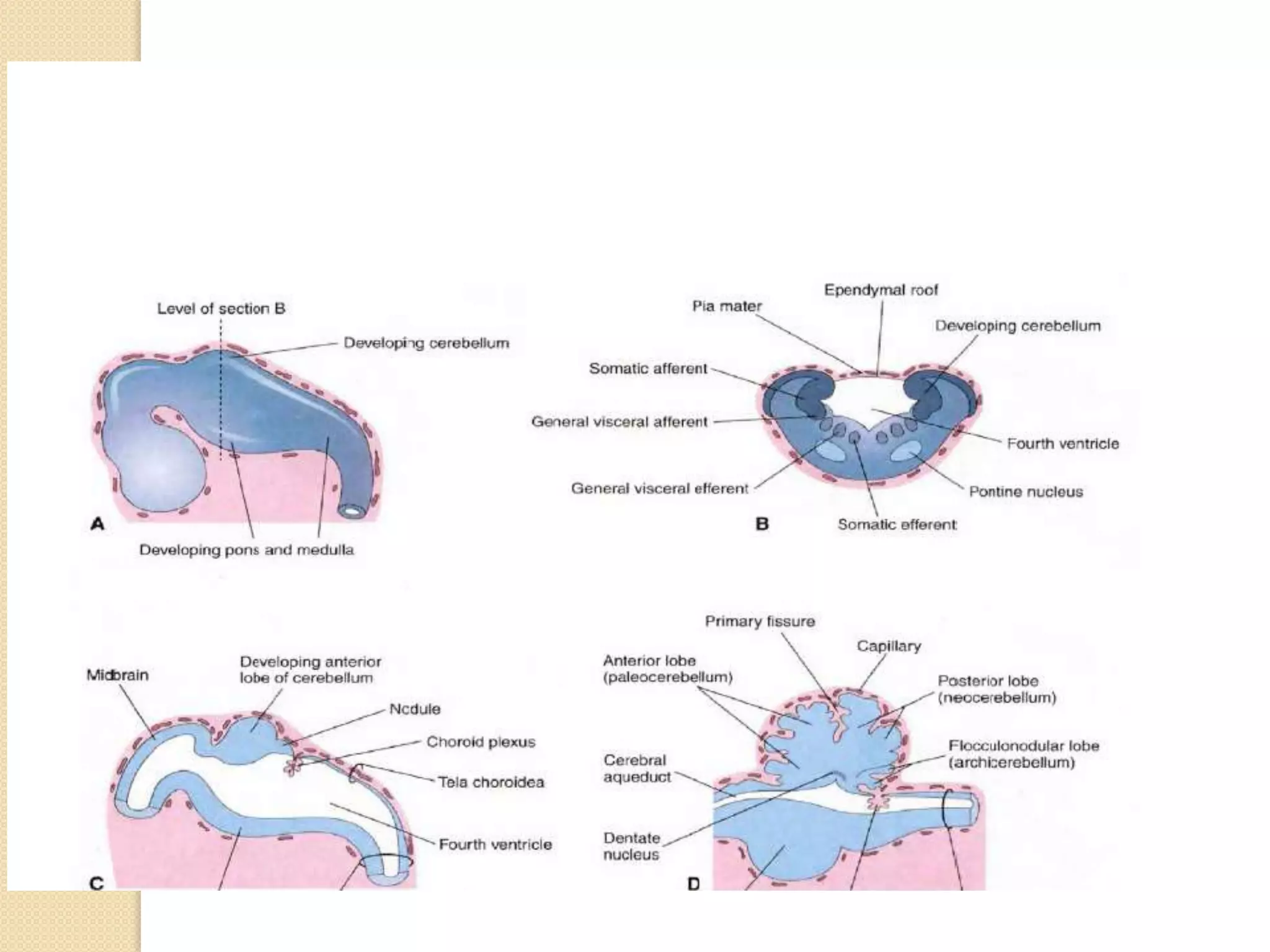
Cerebellum
 Devolops from dorsolateral part of alar
  lamina of the metencephalon
 Rhombic lips on either side grows and
  fuses medially to form cerebellum
 Consists of usual matrix, mantle and
  marginal layer
 Cells of the mantle layer migrating in to
  marginal layer forms cortex and those
  don’t forms dentate, emboliform, fastigial
  and globose nuclei
Contd..
 Superior cerebellar peduncle
 Middle cerebellar peduncle
 Inferior cerebellar peduncle
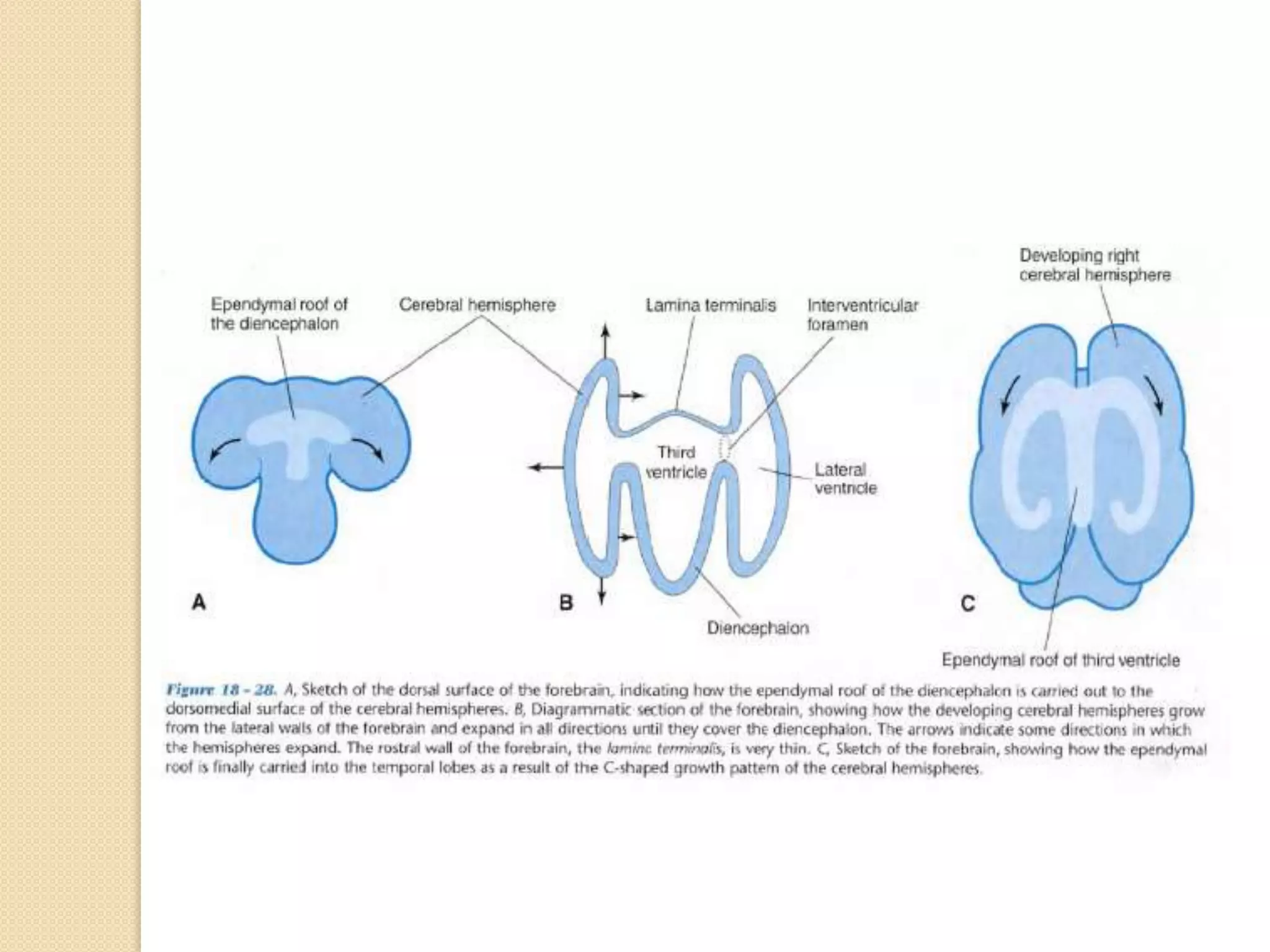
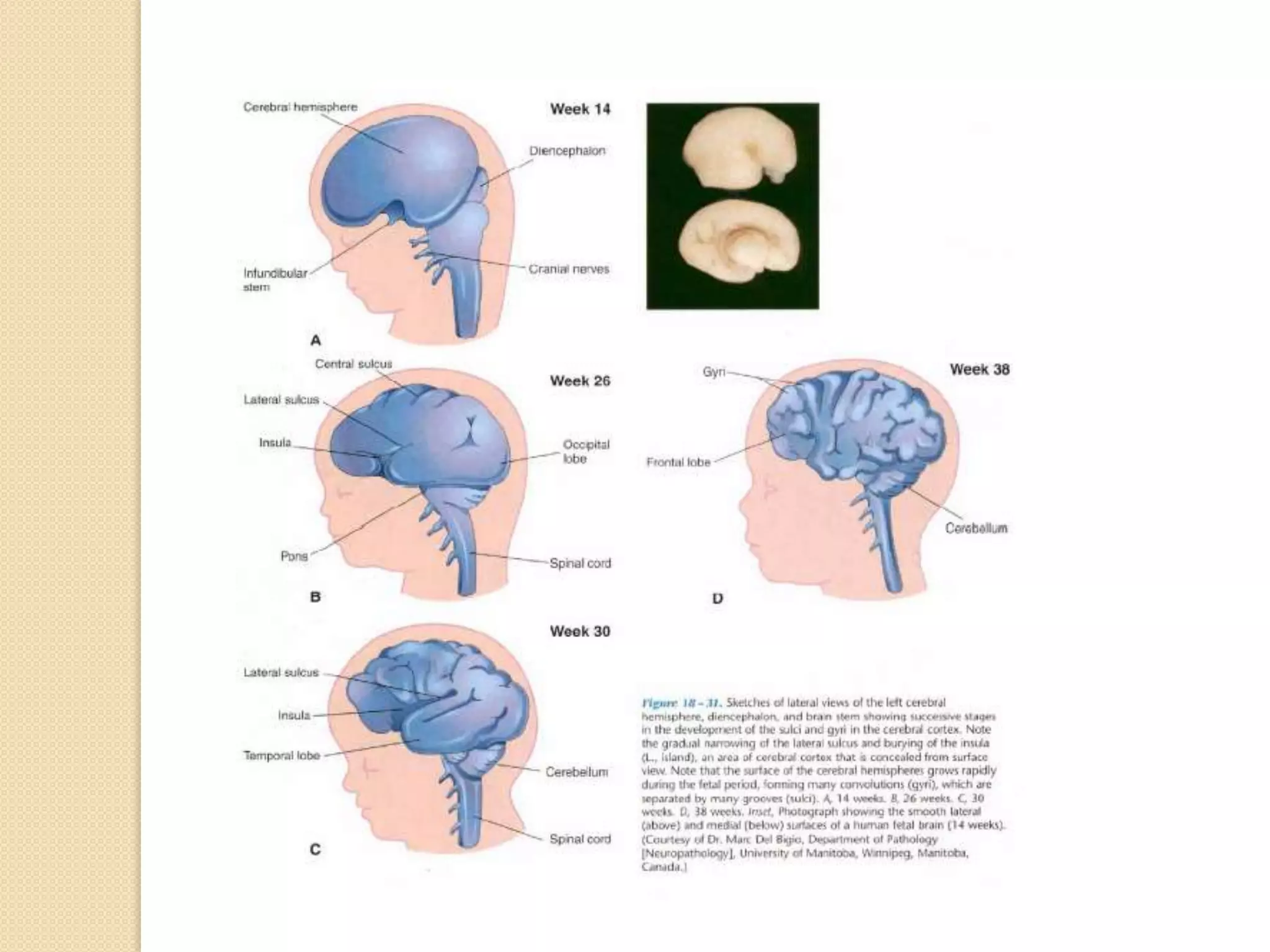
Cerebral hemispheres
 Median diencephalon and lateral
  telencephalon
 Telancephalon
    ◦ Cerebral cortex and corpus striatum
   Diencephalon
    ◦ Epithalamus, thalamus and hypothalamus
   Telencephalic vesicles are small
    initially rapidly grows upwards,
    forwards and backwards completely
    covers the diencephalon
Contd..
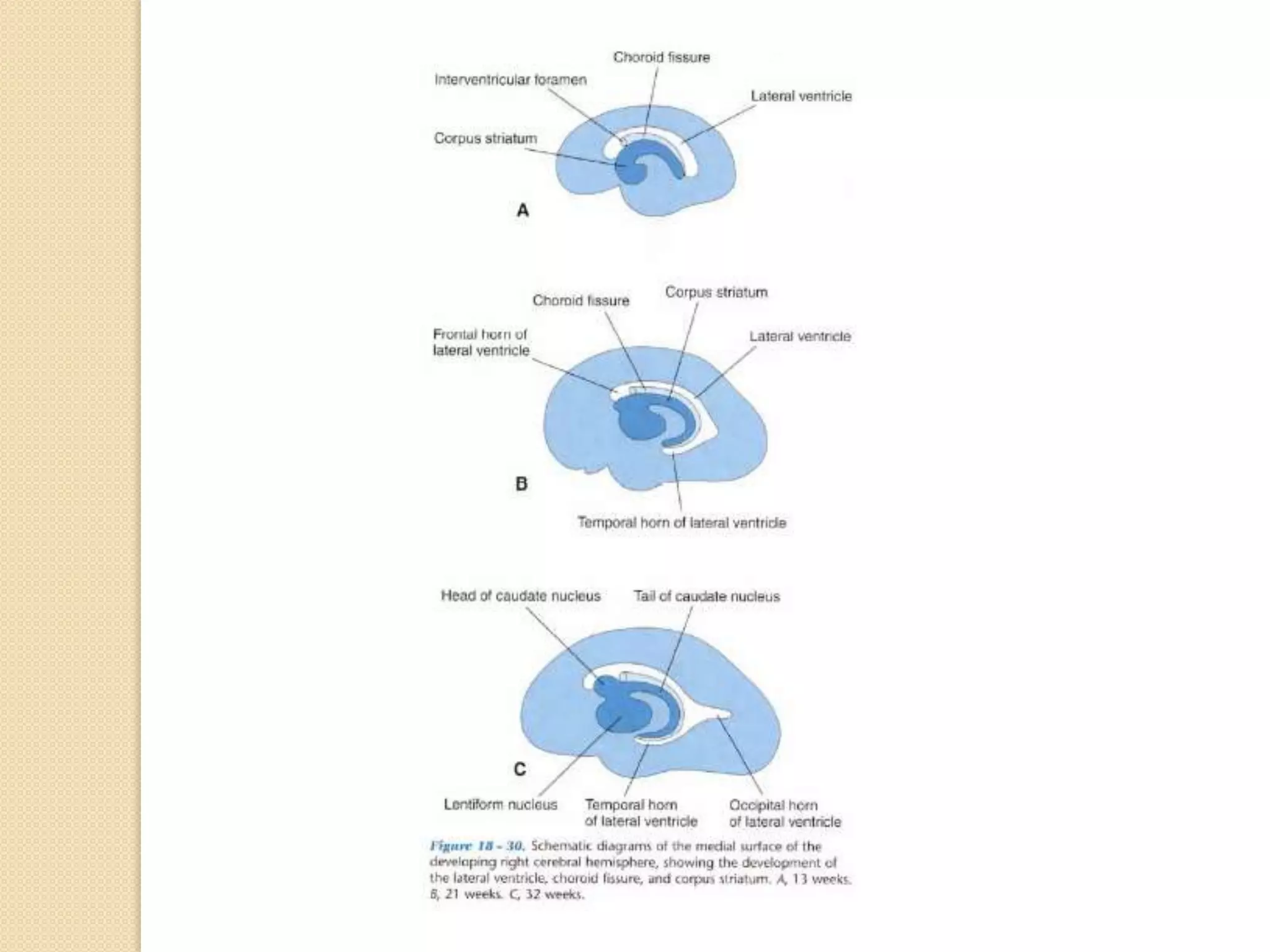
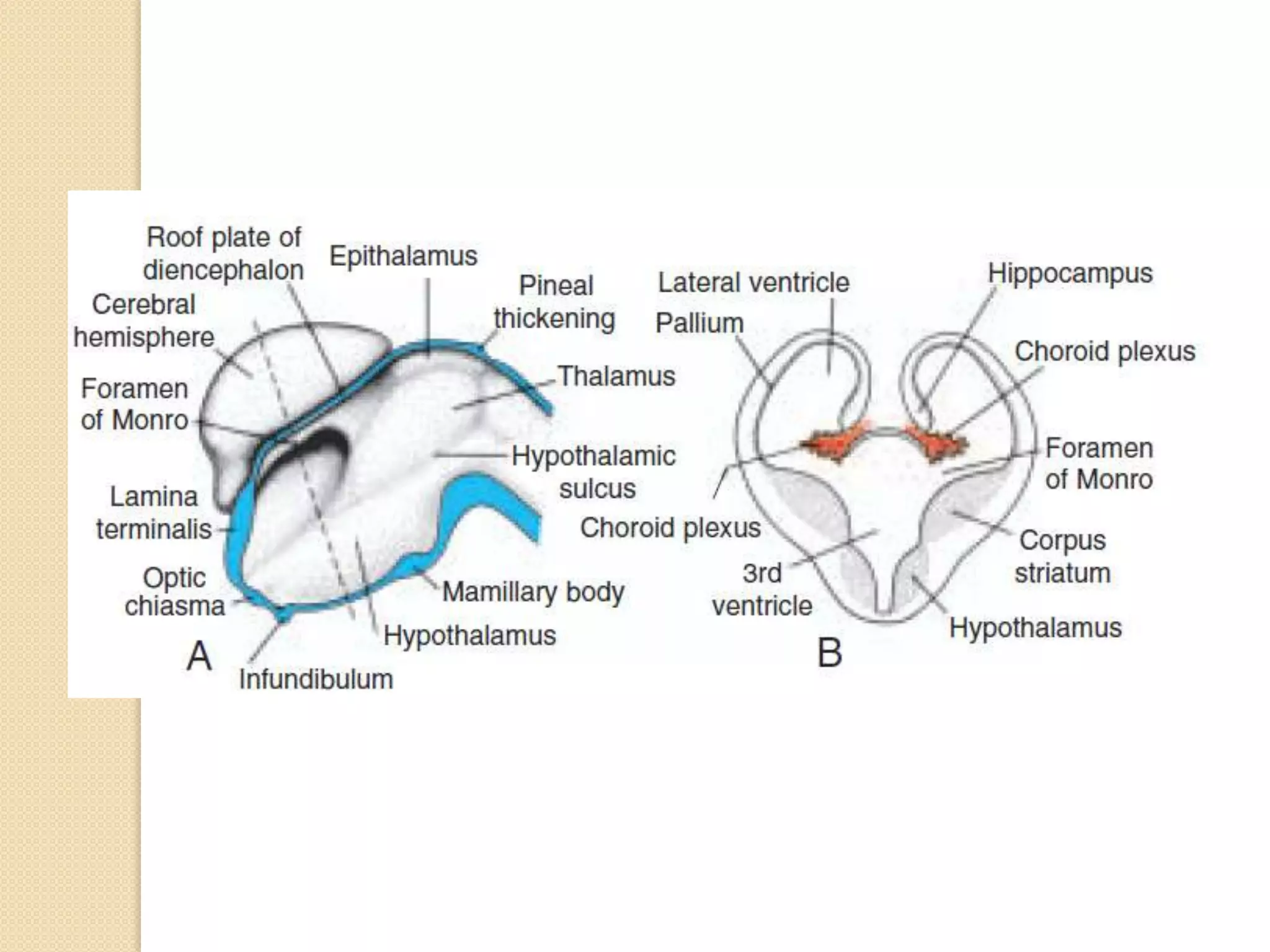
 Cavity of diencephalon form third
  ventricle and of telencephalic vesicles
  form lateral ventricles
 Each lateral is at first a small spherical
  space
    ◦ Forward and backward growth elongates
      anterioposteriorly
    ◦ Grows downwards and forwards to form the
      temporal lobe and horn
    ◦ Backward growth to form occipital pole and
      posterior horn
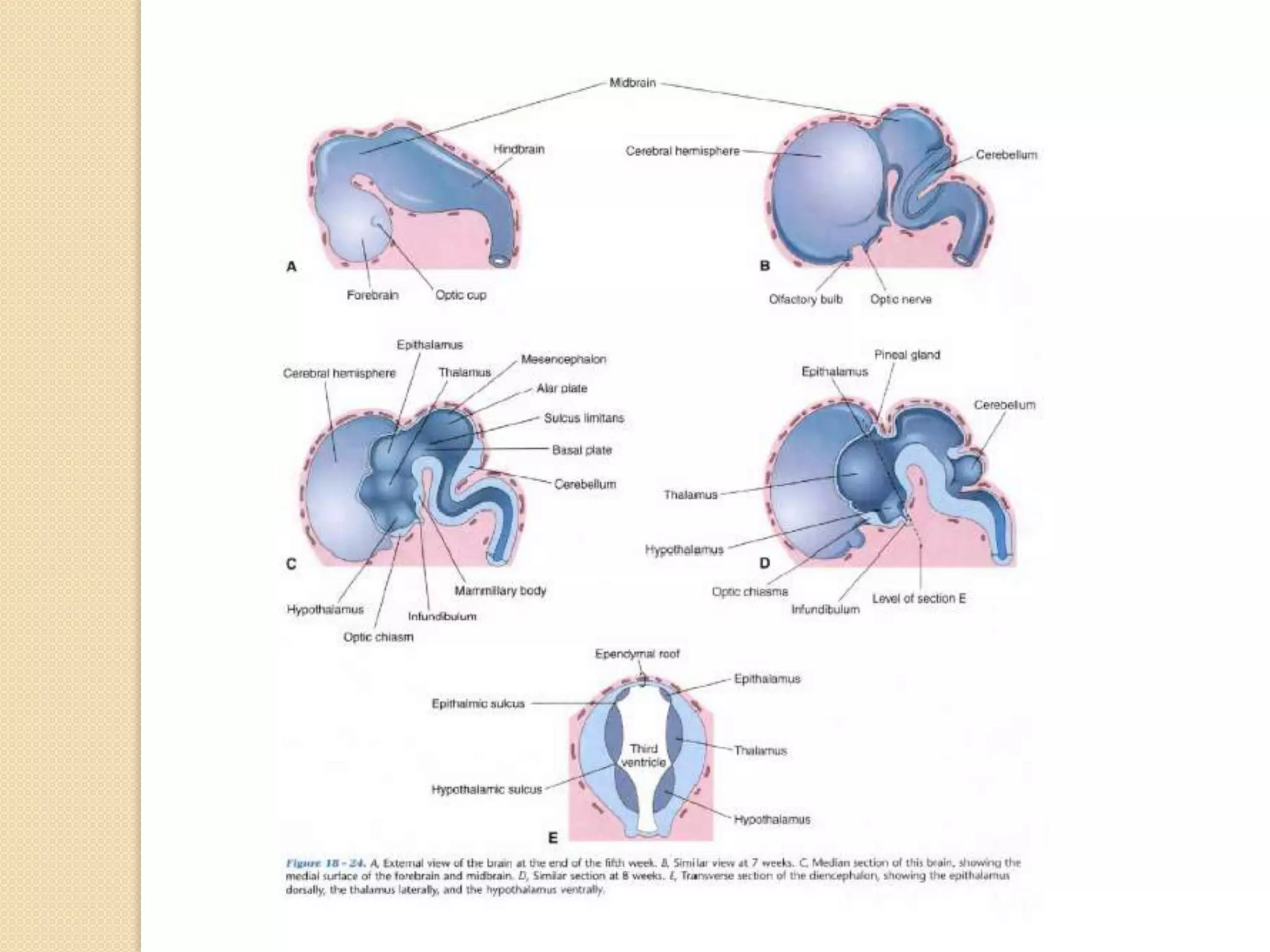
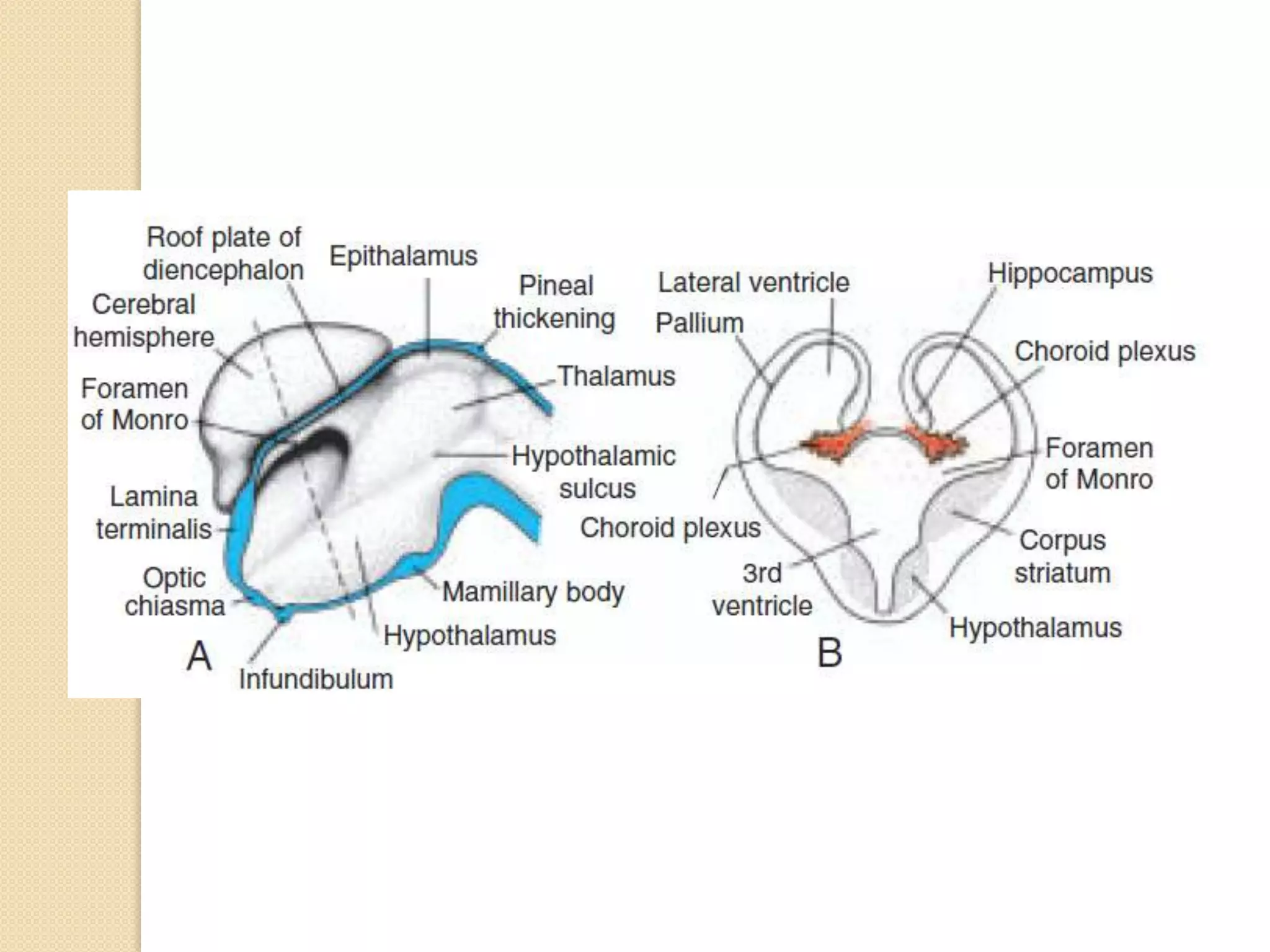
Thalamus and hypothalamus
 Devolops from diencephalon
 Lateral wall of diencephalon becomes
  thickened
 Divided by epithalamic and
  hypothalamic sulci
 Epithalamus represented by
  habenular and pineal body
Corpus striatum
 Derivative of telencephalon
 Telencephalic vesicle can be
  subdivided in to basal part which is
  thick and superior part is thin
 Some cells migrate in to marginal
  layer and forms cortex and remaining
  cells form copus striatum
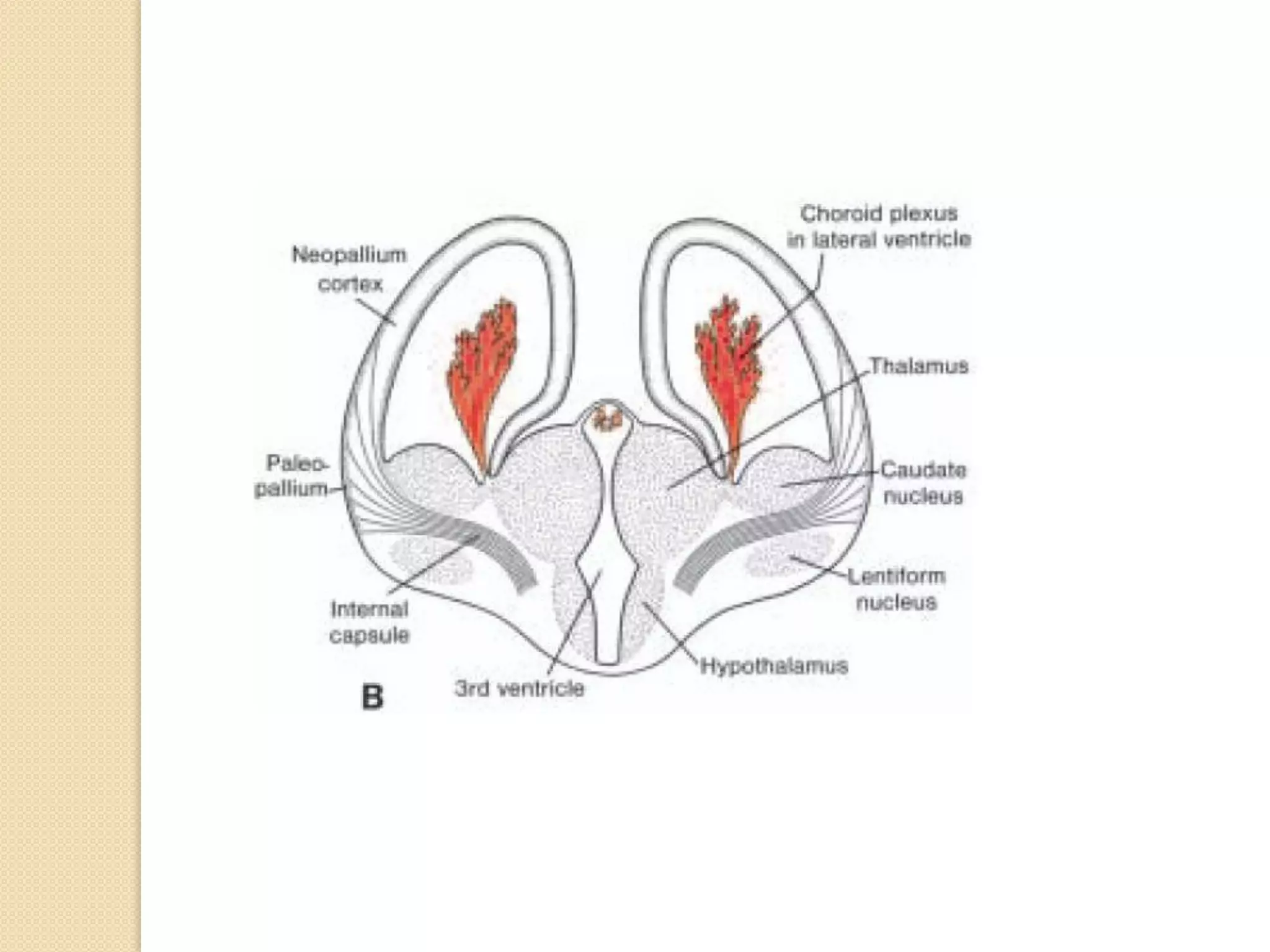
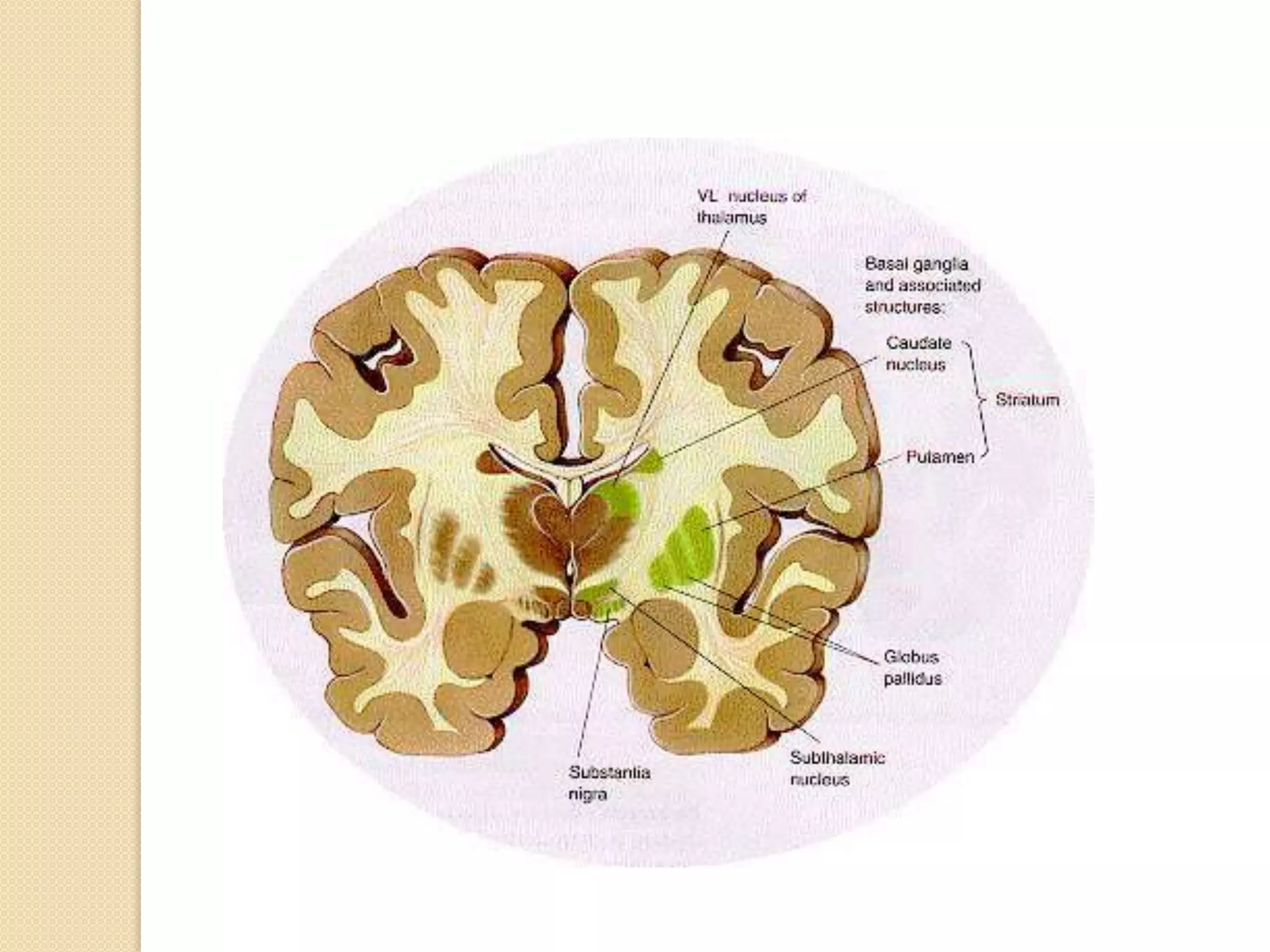
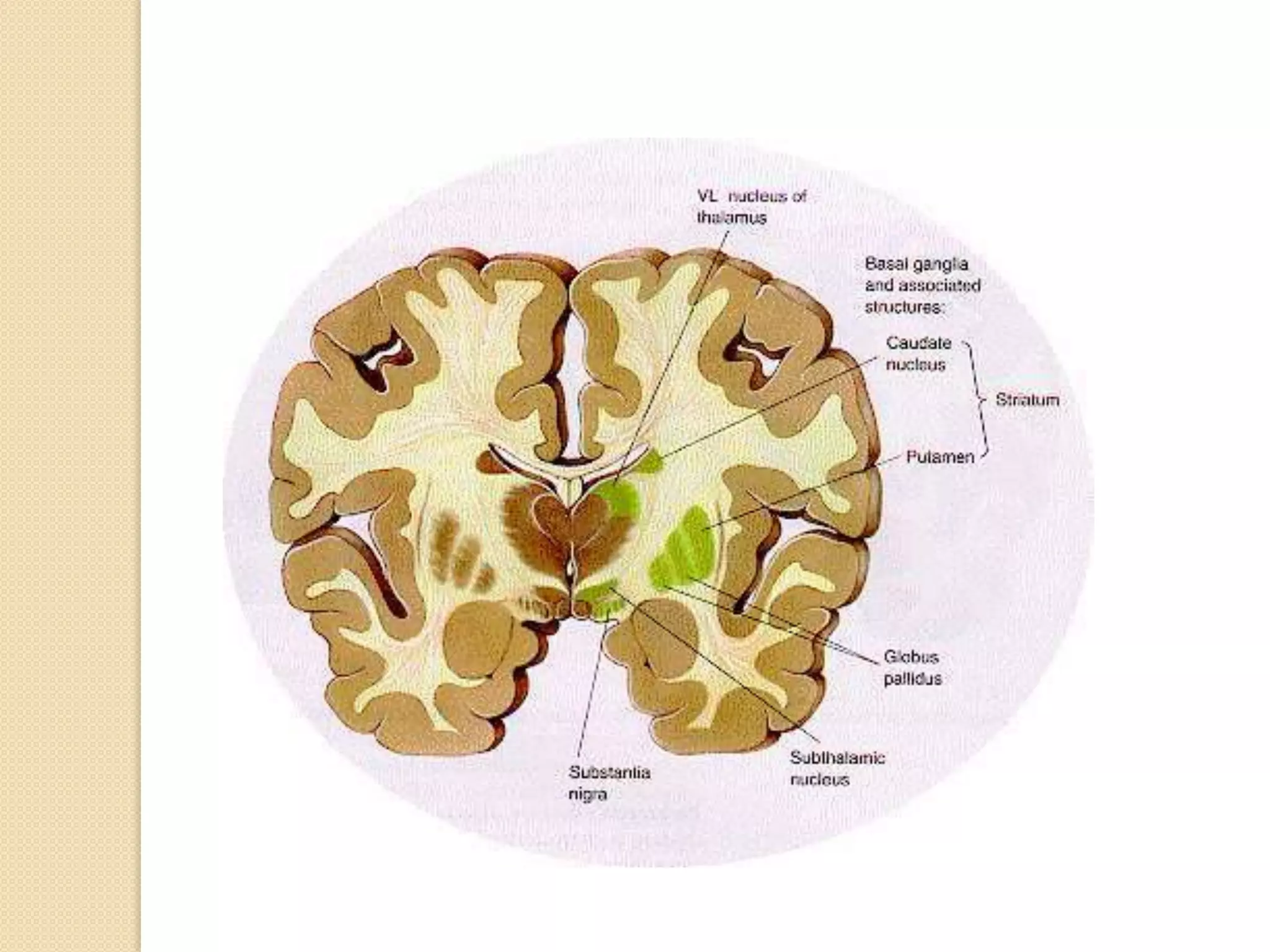
 Corpus striatum subdivided into
  medial and lateral divisions
Contd..
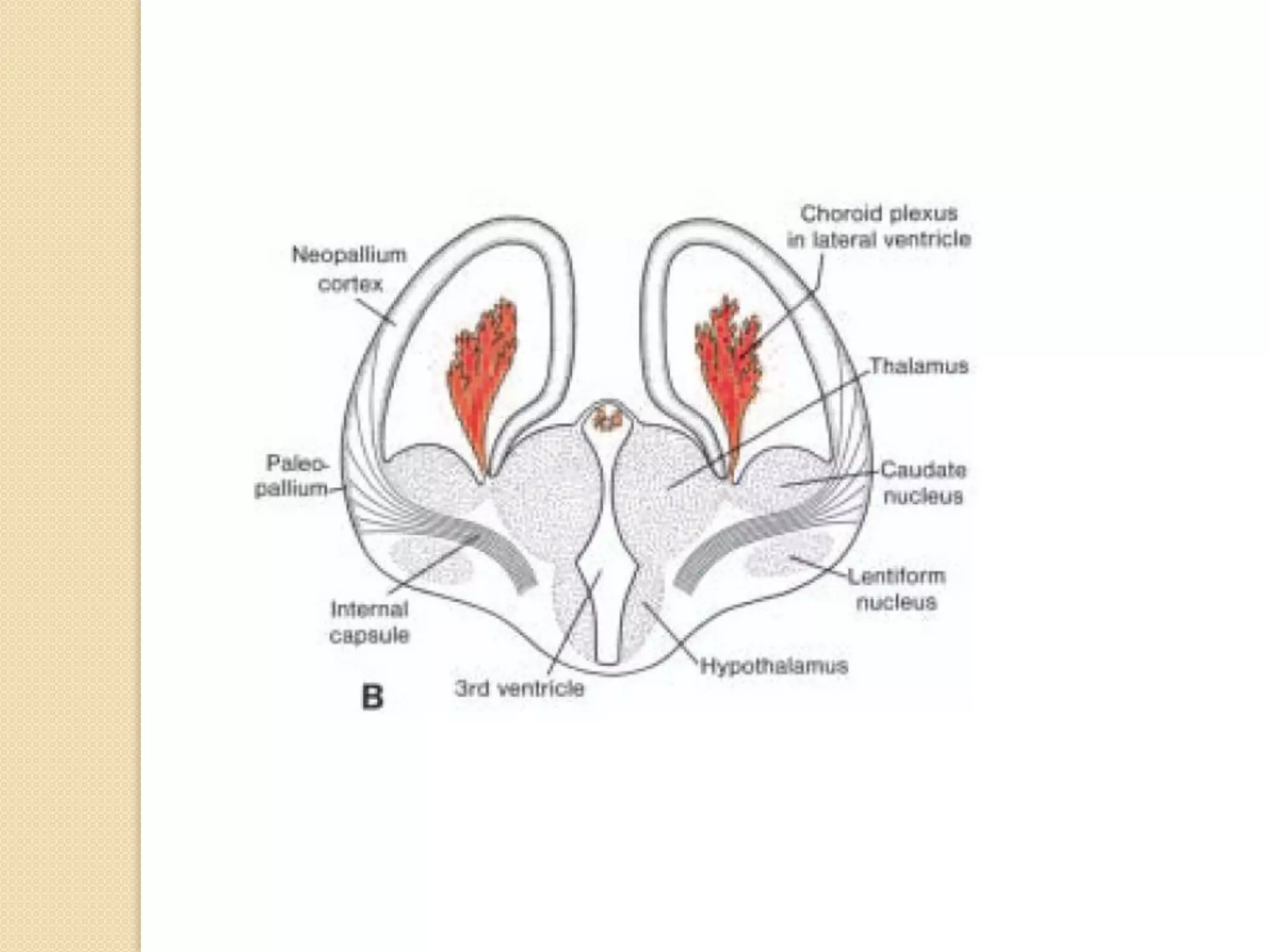
 Fibers descending from cerebral
  cortex passes through medial and
  lateral parts constitutes internal
  capsule
 Medial or deeper part form caudate
  nucleus and superficial or lateral part
  forms lentiform nucleus
Cerebral cortex
 Formed by migration of cells from the
  mantle layer in to overlying marginal
  layer
 Region of insula relatively slow in
  growth and gradually overgrown by
  adjacent area forms the opercula
 Cortex divided in to
    ◦ Hippocampal
    ◦ Pyriform
    ◦ neocortex
Contd..
 Pyriform cortex that recives olfactory
  sensation constitutes uncus,
  parahippocampal gyrus and anterior
  perforated substance
 Telencephalon has a medial wall
  opposing each other gives rise to
  hippocampal cortex
 Pyriform cortex arises from marginal
  layer superficial to corpus striatum
 With formation of inferior horn
  hippocampus follows the curve and
  assumes aring shaped configuration
Contd..
 Superior part of the hippocampus
  becomes ridimentary and forms
  indesium gresium
 White matter of the cerebral cortex is
  formed by projection, association,
  commisural and ascending fibers
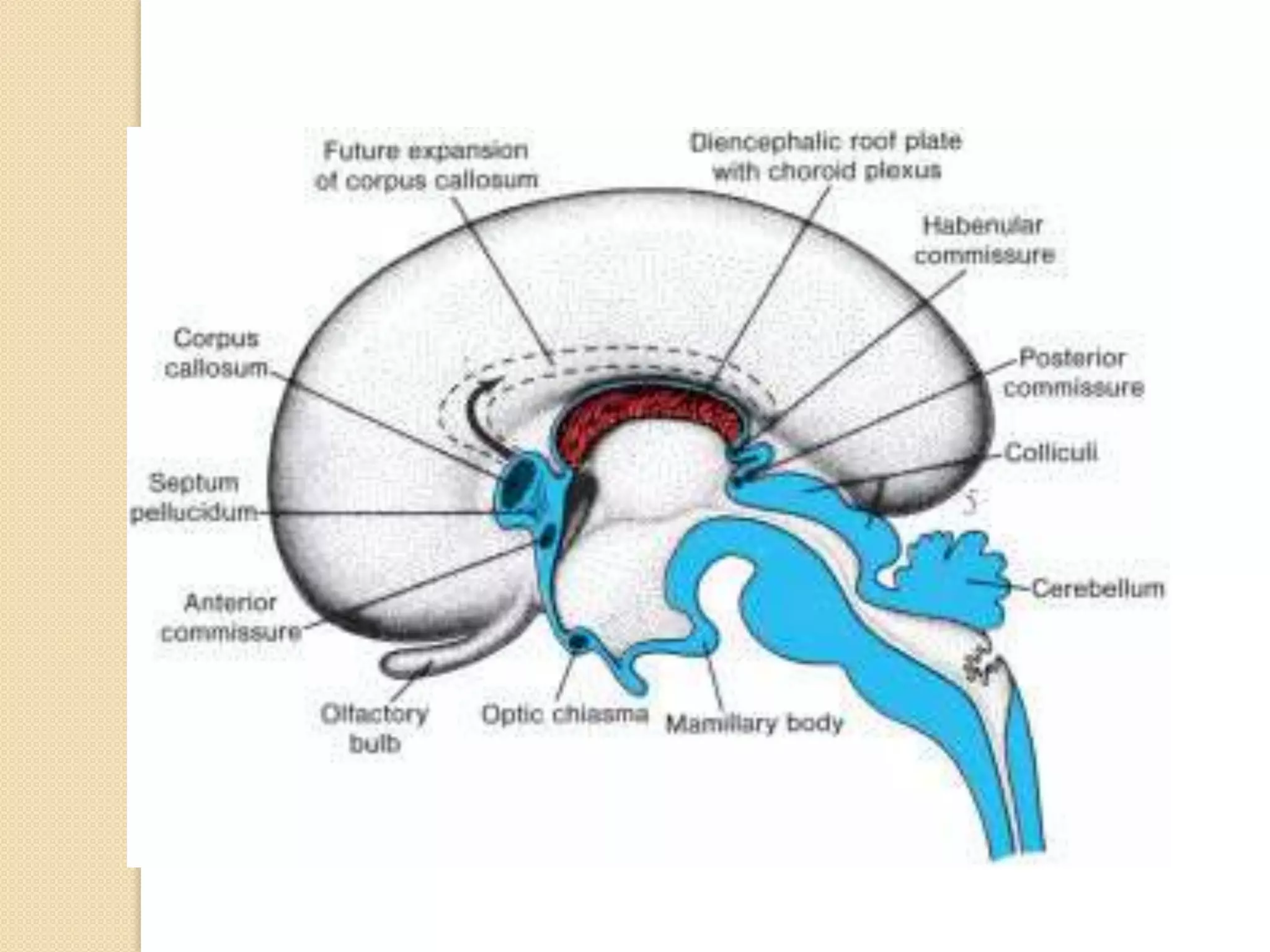
Cerebral commisures
 Part of the neural tube that closes the
  cranial end of prosencephalon is
  lamina terminalis
 Anterior commisure
 Hippocampal commisure
 Corpus collosum
 Optic chiasma, habenular commisure,
  posterior commisure.
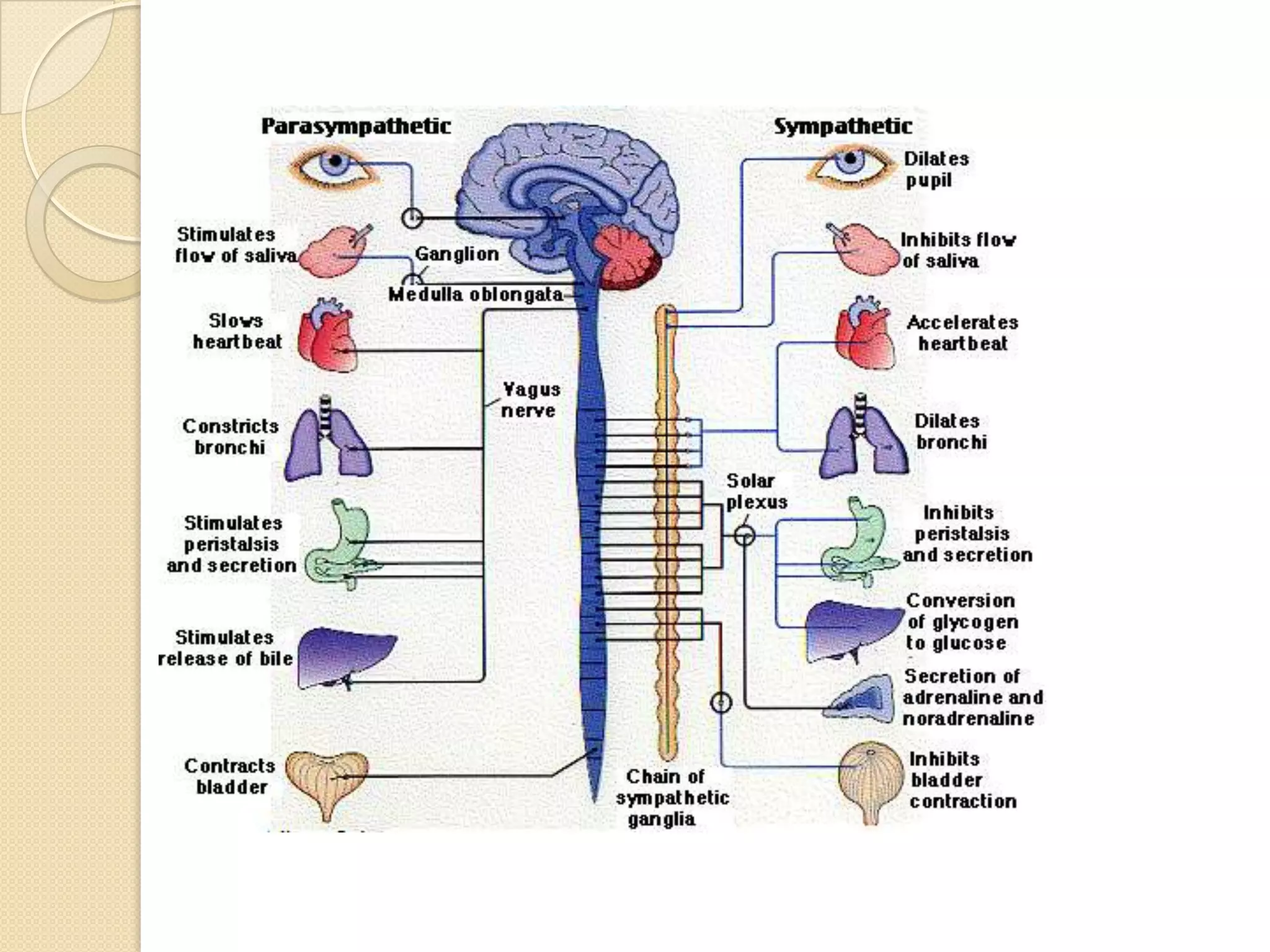
Autonomic nervous system
 Sympathetic nervous system
 Parasympathetic nervous system
Sympathetic nervous system
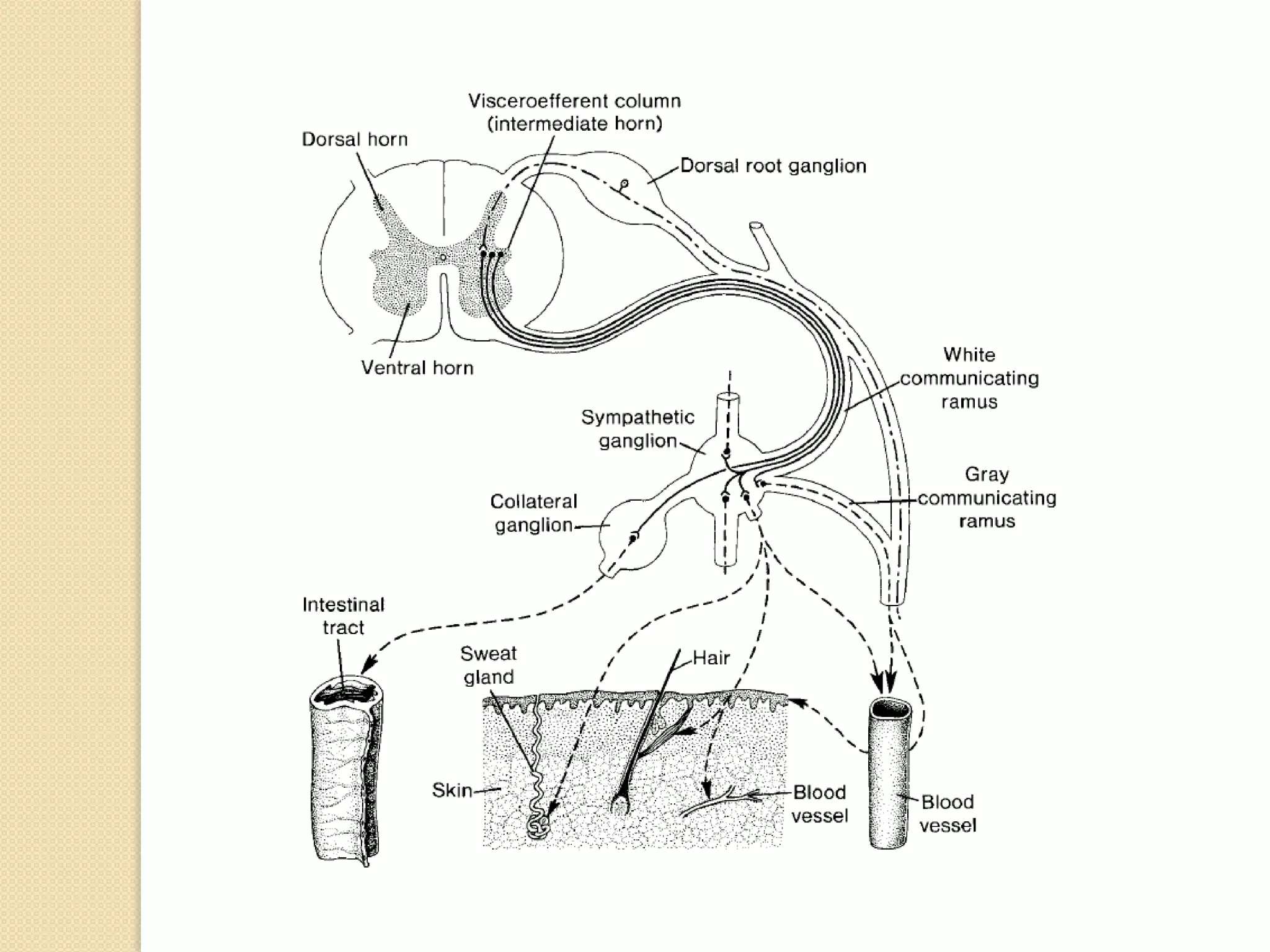
 Preganglionic neurons devolop from
  mantle layer of thoracolumbar region
  of the spinal cord
 Located in lateral horn of the cord
 After short course in the spinal
  nervethey leave them and grows
  towards the postganglionic neurons
Contd..
   Postganglionic neurons are of two
    types
    ◦ Sympathetic trunk
    ◦ Visceral ganglia
Parasympathetic nervous
system
   Cranial parasympathetic out flow
    ◦ Derived GVE nuclear column of the brain
      stem
        Edinger westphal nucleus
        Salivatory nucleus
        Lacrimatory nucleus
        Dorsal nucleus of vagus
   Sacral parasympathetic out flow
    ◦ Preganglionic cells are formed in the
      mantle layer of the spinal cord near the
      sulcus limitans S2-S4
Contd..
   Postganglionic neurons lies near the
    viscera
Thank u

Embryology of nervous system

  • 1.
  • 2.
    Introduction  Formation of neurons and neuroglial cells  Neural tube and its sub divisions  Spinal cord  Medulla oblongata  Pons  Midbrain  Cerebral hemisphere  Corpus striatum  Cerebral cortex  Autonomic nervous system
  • 3.
    Formation of neuronsand neuroglial cells  Neural tube first lined by single layer of cells  Proliferate to form several layers ◦ Matrix layer ◦ Mantle layer ◦ Marginal layer
  • 4.
    Contd..  Stages in the formation of a nerve cell are: ◦ Apolar neuroblast ◦ Bipolar neuroblast ◦ Unipolar neuroblast ◦ Multipolar neuroblast ◦ Axon and dendrites
  • 5.
     Neuroglial cellsare also formed from germinal cells of the ependymal layer  Glioblasts migrate in to mantle and marginal layer as medulloblasts  They differentiate either into astroblasts or oligodendroblasts  Microglial cells are mesodermal in origin
  • 7.
    Myelination of fibers Nerve fibers which remain with in the brain and spinal cord receives support from and are ensheathed by neuroglial cells  Peripheral nerves special sheath called the neurolemma derived from schwann cells  Myelin of the CNS derived from oligodendrocytes
  • 9.
    Neural tube andits subdivisions  Whole of the nervous system is derived from ectoderm except blood vessels and neuroglial elements  Ectoderm situated on the dorsal aspect of embryonic disc forms the neural plate  Neural groove  Neural tube  Enlarges cranial part and caudal tubular part
  • 12.
    Contd..  The cavityof the brain shows three dilatations  Prosencephalon, mesencephalon, rhombencephalon  Prosencephalon ◦ Diencephalon ◦ Telencephalon  Rhombencephalon ◦ Metencephalon ◦ Myelencephalon
  • 14.
    Contd..  The relative position is altered by number of flexures ◦ Cervical flexure ◦ Mesencephalic flexure ◦ Pontine flexure ◦ Telencephalic flexure
  • 16.
    Neural crest  Cells between the neural plate and the rest of the ectoderm form primordia of the neural crest ◦ DRG ◦ Sensory ganglia of 5, 7, 9, 10 ◦ Neurons and satellite cells of sympathetic ganglia ◦ Parasymathetic ganglia ◦ Schwann cells
  • 17.
    Contd.. ◦ Specificcells adrenal medulla ◦ Chromaffin tissue ◦ melanoblasts
  • 20.
    Spinal cord  Devolops from caudal cylindrical part of neural tube  Cavity of the tube bounded by thick lateral wall, thin roof and floor  Tube subdivides in to three layers matrix layer, mantle layer and marginal layer  Ventral layer of the mantle layer grows faster than dorsal layer  Line seperating the compressed ventral part from the dorsal part is called sulcus limtans
  • 22.
    Contd..  Dorsal oralar lamina  Ventral or basal lamina  Posteriomedeian fissure  Anteriomedian fissure  Nerve cells that devolop in mantle zone of the basal lamina becomes the neuron of anterior grey column and from the alar lamina the neuron of the posterior grey column
  • 24.
    Contd..  Dorsal nerveroot ganglia are formed by axons of the cells that develop from neural crest  Axons from the post grey column enter the marginal layer to form the ascending tract  Descending tracts are formed by the axons projecting from the brain  Grey columns divide the white matter in to anterior, posterior and lateral columns
  • 26.
    POSITIONAL CHANGES OF  THE CORD In the third month of development the spinal cord extends the entire length of the embryo, and spinal nerves pass through the intervertebral foramina at their level of origin.  With increasing age, the vertebral column and dura lengthen more rapidly than the neural tube, and the terminal end of the spinal cord gradually shifts to a higher level.  At birth, this end is at the level of the third lumbar vertebra.  As a result of this disproportionate growth, spinal nerves run obliquely from their segment of origin in the spinal cord to the corresponding level of the vertebral column.  The dura remains attached to the vertebral column at the coccygeal level.  In the adult, the spinal cord terminates at the level of L2 to L3,  The dural sac and subarachnoid space extend to S2.  Below L2 to L3, a threadlike extension of the pia mater forms the filum terminale, which is attached to the periosteum of the first coccygeal vertebra and which marks the tract of regression of the spinal cord.  Nerve fibers below the terminal end of the cord collectively constitute the cauda equina.
  • 27.
    Medulla oblongata  Myelencephalon Early devolopment simillar to spinal cord sulcus limitans divides in to alar and basal lamina  Roof plate becomes greatly widened resuting which alar plate comes dorsolateral to basal plate  Alar plate forms olivary nuclei and cranial nerve nuclei
  • 28.
  • 29.
    Pons  Ventral partof metencephalon  Contribution alar lamina of the myelencephalon and gives rise to pontine nuclei axons arising from them forms MCP  Lateral part of alar lamina becomes rhombic lips to form the cerebellum  Nuclei arising from basal and alar plate lie in dorsal or tegmental part of pons
  • 30.
    Contd..  Ventral part of pons constitutes: ◦ Middle cerebellar peduncle ◦ Corticospinal, corticobulbar and corticopontine fibers
  • 32.
    Mid brain  Nuclei of the basal lamina ◦ Occulomotor nuclei ◦ Trochlear nuclei ◦ Edinger Westphal nuclei  Alar lamina gives rise to ◦ Colliculi ◦ Red nucleus ◦ Substantia nigra
  • 33.
    Contd..  Marginal layer ventral part of mesencephalon invaded by down growing fibers of CST, corticobulbar and cortico pontine pathway and forms crus cerebri
  • 35.
    Cerebellum  Devolops fromdorsolateral part of alar lamina of the metencephalon  Rhombic lips on either side grows and fuses medially to form cerebellum  Consists of usual matrix, mantle and marginal layer  Cells of the mantle layer migrating in to marginal layer forms cortex and those don’t forms dentate, emboliform, fastigial and globose nuclei
  • 36.
    Contd..  Superior cerebellarpeduncle  Middle cerebellar peduncle  Inferior cerebellar peduncle
  • 38.
    Cerebral hemispheres  Mediandiencephalon and lateral telencephalon  Telancephalon ◦ Cerebral cortex and corpus striatum  Diencephalon ◦ Epithalamus, thalamus and hypothalamus  Telencephalic vesicles are small initially rapidly grows upwards, forwards and backwards completely covers the diencephalon
  • 39.
    Contd..  Cavity ofdiencephalon form third ventricle and of telencephalic vesicles form lateral ventricles  Each lateral is at first a small spherical space ◦ Forward and backward growth elongates anterioposteriorly ◦ Grows downwards and forwards to form the temporal lobe and horn ◦ Backward growth to form occipital pole and posterior horn
  • 43.
    Thalamus and hypothalamus Devolops from diencephalon  Lateral wall of diencephalon becomes thickened  Divided by epithalamic and hypothalamic sulci  Epithalamus represented by habenular and pineal body
  • 45.
    Corpus striatum  Derivativeof telencephalon  Telencephalic vesicle can be subdivided in to basal part which is thick and superior part is thin  Some cells migrate in to marginal layer and forms cortex and remaining cells form copus striatum  Corpus striatum subdivided into medial and lateral divisions
  • 46.
    Contd..  Fibers descendingfrom cerebral cortex passes through medial and lateral parts constitutes internal capsule  Medial or deeper part form caudate nucleus and superficial or lateral part forms lentiform nucleus
  • 50.
    Cerebral cortex  Formedby migration of cells from the mantle layer in to overlying marginal layer  Region of insula relatively slow in growth and gradually overgrown by adjacent area forms the opercula  Cortex divided in to ◦ Hippocampal ◦ Pyriform ◦ neocortex
  • 51.
    Contd..  Pyriform cortexthat recives olfactory sensation constitutes uncus, parahippocampal gyrus and anterior perforated substance  Telencephalon has a medial wall opposing each other gives rise to hippocampal cortex  Pyriform cortex arises from marginal layer superficial to corpus striatum  With formation of inferior horn hippocampus follows the curve and assumes aring shaped configuration
  • 52.
    Contd..  Superior partof the hippocampus becomes ridimentary and forms indesium gresium  White matter of the cerebral cortex is formed by projection, association, commisural and ascending fibers
  • 56.
    Cerebral commisures  Partof the neural tube that closes the cranial end of prosencephalon is lamina terminalis  Anterior commisure  Hippocampal commisure  Corpus collosum  Optic chiasma, habenular commisure, posterior commisure.
  • 58.
    Autonomic nervous system Sympathetic nervous system  Parasympathetic nervous system
  • 59.
    Sympathetic nervous system Preganglionic neurons devolop from mantle layer of thoracolumbar region of the spinal cord  Located in lateral horn of the cord  After short course in the spinal nervethey leave them and grows towards the postganglionic neurons
  • 60.
    Contd..  Postganglionic neurons are of two types ◦ Sympathetic trunk ◦ Visceral ganglia
  • 62.
    Parasympathetic nervous system  Cranial parasympathetic out flow ◦ Derived GVE nuclear column of the brain stem  Edinger westphal nucleus  Salivatory nucleus  Lacrimatory nucleus  Dorsal nucleus of vagus  Sacral parasympathetic out flow ◦ Preganglionic cells are formed in the mantle layer of the spinal cord near the sulcus limitans S2-S4
  • 63.
    Contd..  Postganglionic neurons lies near the viscera
  • 65.