Technology transfer from
R&D TO PRODUCTION
Archana.k
Objective
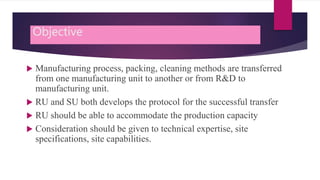
 Manufacturing process, packing, cleaning methods are transferred
from one manufacturing unit to another or from R&D to
manufacturing unit.
 RU and SU both develops the protocol for the successful transfer
 RU should be able to accommodate the production capacity
 Consideration should be given to technical expertise, site
specifications, site capabilities.
GRANULARITY OF TECHNOLOGY TRANSFER
PROCESS
 The granularity is a level of details considered in a transfer model or
decision process.
 The greater the granularity the greater the level of details of transfer
 Granularity depends on the needs the transfer model should fulfil.
 It was often used by the top-level managers, business analysts who
want to have a general over view and time and resources needed to
accomplish the transfer.
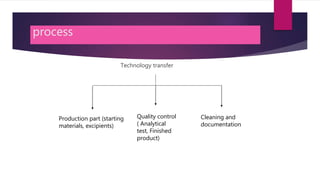
process
Technology transfer
Production part (starting
materials, excipients)
Quality control
( Analytical
test, Finished
product)
Cleaning and
documentation
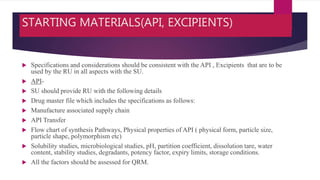
STARTING MATERIALS(API, EXCIPIENTS)
 Specifications and considerations should be consistent with the API , Excipients that are to be
used by the RU in all aspects with the SU.
 API-
 SU should provide RU with the following details
 Drug master file which includes the specifications as follows:
 Manufacture associated supply chain
 API Transfer
 Flow chart of synthesis Pathways, Physical properties of API ( physical form, particle size,
particle shape, polymorphism etc)
 Solubility studies, microbiological studies, pH, partition coefficient, dissolution tare, water
content, stability studies, degradants, potency factor, expiry limits, storage conditions.
 All the factors should be assessed for QRM.
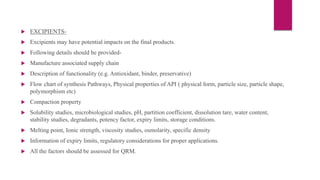
 EXCIPIENTS-
 Excipients may have potential impacts on the final products.
 Following details should be provided-
 Manufacture associated supply chain
 Description of functionality (e.g. Antioxidant, binder, preservative)
 Flow chart of synthesis Pathways, Physical properties of API ( physical form, particle size, particle shape,
polymorphism etc)
 Compaction property
 Solubility studies, microbiological studies, pH, partition coefficient, dissolution tare, water content,
stability studies, degradants, potency factor, expiry limits, storage conditions.
 Melting point, Ionic strength, viscosity studies, osmolarity, specific density
 Information of expiry limits, regulatory considerations for proper applications.
 All the factors should be assessed for QRM.
Finished products
 SU should provide following details:
 Quantitative and qualitative composition, physical description, In-process controls, Handling methods,
Packing, storing conditions.
 Any information generated during process development, process optimization should be provided
 Historical data: Clinical development ( route of administration selection, clinical tests)
 Scale-up activities: Process optimization, critical parameters, pilot scale reports along with the pilot
batches details.
 Full scale manufacturing activities : number of batches, any change controls
 Change control log: Changes to particular process, Analytical methods, process optimization,
Improvements
 Investigations about the critical issues and their outcomes of these investigations.
 The SU should provide details of the Healthy, safety, environmental, parameters to be considered during
the manufacturing process ( protective clothing, precautions for certain procedures)
 SU should provide information about current processing's and testing's information:
 Details of facility requirements
 MSDS –Material safety data sheet ( Information of starting materials and storage requirements)
 Manufacturing steps-(flow charts, master batch records, qualification of equipment, holding times, bulk
transfer between steps)
 Description of analytical methods
 Design space
 Validation records
 Annual product quality review
 Authorized protocols
 Environmental conditions, any special requirements of equipment for specific product transfer.
 The Ru should consider to do the tasks of the following , If any changes or differences collaborate with the
SU.
 Qualification of facilities and equipment.
 Description of manufacturing process, flow charts, procedure at the RU.
 Determining of critical steps in manufacturing.
 Preparation of SOP’S.
 Stability information evaluation along with site specific stability evaluation.
 Compliance with the regulatory requirements.
PACKING AND PACKING MATERIALS
 Details from SU should include:
 Specifications of suitable container system, closure system.
 Any information on design, packing, processing, labelling.
 QC testing- details should include:
 Protection against degradation of formulation of products due to environmental influences.
 Safety of formulation
 Compatibility
 Drug delivery
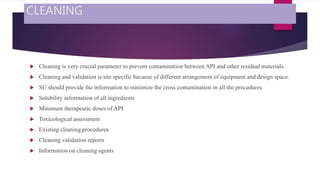
CLEANING
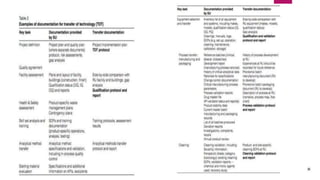
 Cleaning is very crucial parameter to prevent contamination between API and other residual materials.
 Cleaning and validation is site specific because of different arrangement of equipment and design space.
 SU should provide the information to minimize the cross contamination in all the procedures.
 Solubility information of all ingredients
 Minimum therapeutic doses of API
 Toxicological assessment
 Existing cleaning procedures
 Cleaning validation reports
 Information on cleaning agents
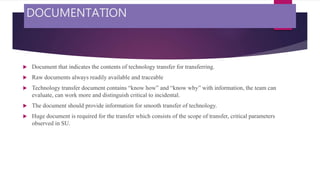
DOCUMENTATION
 Document that indicates the contents of technology transfer for transferring.
 Raw documents always readily available and traceable
 Technology transfer document contains “know how” and “know why” with information, the team can
evaluate, can work more and distinguish critical to incidental.
 The document should provide information for smooth transfer of technology.
 Huge document is required for the transfer which consists of the scope of transfer, critical parameters
observed in SU.
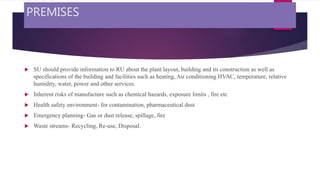
PREMISES
 SU should provide information to RU about the plant layout, building and its construction as well as
specifications of the building and facilities such as heating, Air conditioning HVAC, temperature, relative
humidity, water, power and other services.
 Inherent risks of manufacture such as chemical hazards, exposure limits , fire etc
 Health safety environment- for contamination, pharmaceutical dust
 Emergency planning- Gas or dust release, spillage, fire
 Waste streams- Recycling, Re-use, Disposal.
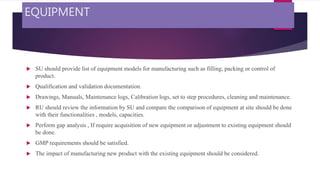
EQUIPMENT
 SU should provide list of equipment models for manufacturing such as filling, packing or control of
product.
 Qualification and validation documentation.
 Drawings, Manuals, Maintenance logs, Calibration logs, set to step procedures, cleaning and maintenance.
 RU should review the information by SU and compare the comparison of equipment at site should be done
with their functionalities , models, capacities.
 Perform gap analysis , If require acquisition of new equipment or adjustment to existing equipment should
be done.
 GMP requirements should be satisfied.
 The impact of manufacturing new product with the existing equipment should be considered.
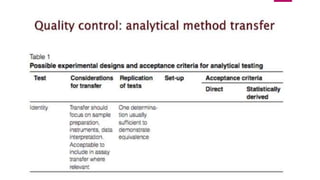
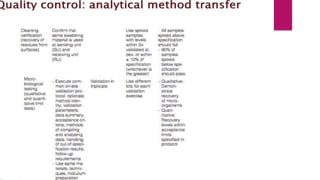
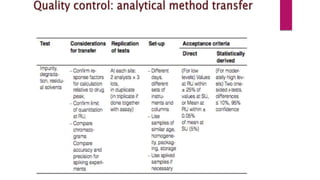
QUALITY CONTROL : ANALYTICAL
METHOD TRANSFER
 Is the documented process that qualifies a laboratory (the receiving unit) to use an
analytical test procedure that originated in another laboratory (the transferring unit),
thus ensuring that the receiving unit has the procedural knowledge and ability to
perform the transferred analytical procedure as intended.
 Is the verification that a method or test procedure works in an equivalent fashion at
two or more different sites or laboratories and meets all acceptance criteria.
 In short, analytical method transfer qualifies a laboratory to use a test procedure.
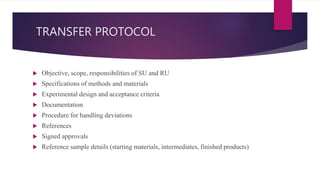
TRANSFER PROTOCOL
 Objective, scope, responsibilities of SU and RU
 Specifications of methods and materials
 Experimental design and acceptance criteria
 Documentation
 Procedure for handling deviations
 References
 Signed approvals
 Reference sample details (starting materials, intermediates, finished products)
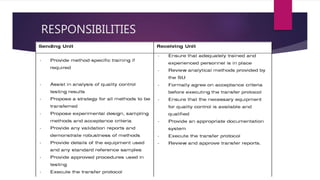
RESPONSIBILITIES
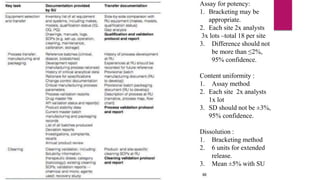
Assay for potency:
1. Bracketing may be
appropriate.
2. Each site 2x analysts
3x lots –total 18 per site
3. Difference should not
be more than ≤2%,
95% confidence.
Content uniformity :
1. Assay method
2. Each site 2x analysts
1x lot
3. SD should not be ±3%,
95% confidence.
Dissolution :
1. Bracketing method
2. 6 units for extended
release.
3. Mean ±5% with SU
Thank you