Cell injury lecture-3
Archana.k
Intracellular accumulations in lipids
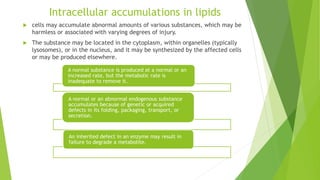
 cells may accumulate abnormal amounts of various substances, which may be
harmless or associated with varying degrees of injury.
 The substance may be located in the cytoplasm, within organelles (typically
lysosomes), or in the nucleus, and it may be synthesized by the affected cells
or may be produced elsewhere.
A normal substance is produced at a normal or an
increased rate, but the metabolic rate is
inadequate to remove it.
A normal or an abnormal endogenous substance
accumulates because of genetic or acquired
defects in its folding, packaging, transport, or
secretion.
An inherited defect in an enzyme may result in
failure to degrade a metabolite.
Hyperlipoproteinemia:
 Condition of abnormally elevated levels of
lipids/lipoproteins in the blood.
 Hyperlipoproteinemia
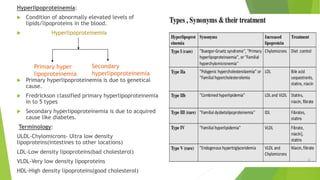
 Primary hyperlipoproteinemia is due to genetical
cause.
 Fredrickson classified primary hyperlipoproteinemia
in to 5 types
 Secondary hyperlipoproteinemia is due to acquired
cause like diabetes.
Terminology:
ULDL-Chylomicrons- Ultra low density
lipoproteins(intestines to other locations)
LDL-Low density lipoproteins(bad cholesterol)
VLDL-Very low density lipoproteins
HDL-High density lipoproteins(good cholesterol)
Primary hyper
lipoproteinemia
Secondary
hyperlipoproteinemia
Intracellular accumulation in proteins
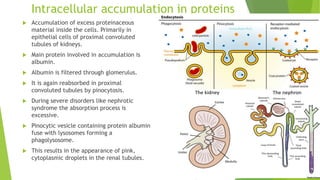
 Accumulation of excess proteinaceous
material inside the cells. Primarily in
epithelial cells of proximal convoluted
tubules of kidneys.
 Main protein involved in accumulation is
albumin.
 Albumin is filtered through glomerulus.
 It is again reabsorbed in proximal
convoluted tubules by pinocytosis.
 During severe disorders like nephrotic
syndrome the absorption process is
excessive.
 Pinocytic vesicle containing protein albumin
fuse with lysosomes forming a
phagolysosome.
 This results in the appearance of pink,
cytoplasmic droplets in the renal tubules.
Intracellular accumulation in carbohydrates
 Carbohydrate or glycogen accumulation intracellularly are due to
abnormalities in the metabolism of the glucose or glycogen.
 Two types 1. Glycogen infiltration 2.Glycogen storage.
 Glycogen Infiltration: Accumulation of glycogen due to excess amount of
glucose in circulation.(Hyperglycemia).
 Hyperglycemia is absorbed in Diabetes mellitus due to insufficient insulin.
 Glycogen storage:
 Defects in breaking down of glycogen in the muscles, liver and other cells.
 Caused due to genetical defect and acquired causes.
Calcification
 Extracellular deposition or accumulation of calcium is
known as calcification.
 Calcification of soft tissue ( arteries, cartilage) caused
by Vit K deficiency or poor calcium absorption.
 calcification can occur in almost any part of the body.
 Two types: 1. Dystrophic calcification 2. Metastatic
calcification
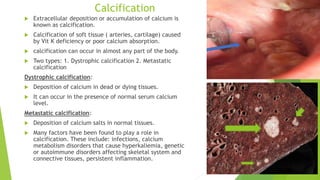
Dystrophic calcification:
 Deposition of calcium in dead or dying tissues.
 It can occur in the presence of normal serum calcium
level.
Metastatic calcification:
 Deposition of calcium salts in normal tissues.
 Many factors have been found to play a role in
calcification. These include: infections, calcium
metabolism disorders that cause hyperkaliemia, genetic
or autoimmune disorders affecting skeletal system and
connective tissues, persistent inflammation.
Enzyme leakage and cell death
 The major cellular organelle containing digestive enzymes are lysosomes.
1. Acid phosphatases for phosphate esters
2. Nucleases : DNAase, RNAase for breakdown of nucleic acids.
3. Protein digesting enzymes: proteases, collagenases
4. Carbohydrate digesting enzymes
5. Lipid digesting enzymes.
 Enzymes within lysosomes are responsible for cell death.
 Lysosomes mediate events in cell death process called apoptosis.
 Survival of cells require constant turning over. New components and
structures are made while the old and worn out components are removed.
 During starvation cells use autophagy to breakdown cellular components and
provide energy for their survival.
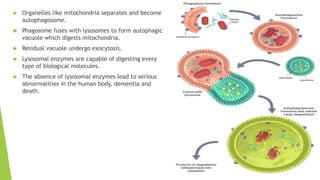
 Organelles like mitochondria separates and become
autophagosome.
 Phagosome fuses with lysosomes to form autophagic
vacuole which digests mitochondria.
 Residual vacuole undergo exocytosis.
 Lysosomal enzymes are capable of digesting every
type of biological molecules.
 The absence of lysosomal enzymes lead to serious
abnormalities in the human body, dementia and
death.
Alkalosis
 Alkalosis is excessive alkalinity in the blood caused by elevated levels of
bicarbonate or loss of acid from blood.
 Severe prolonged vomiting, High administration of alkaline salts
 Two types:1. Metabolic alkalosis 2. Respiratory alkalosis
Metabolic alkalosis:
 Primary increase of serum bicarbonate concentration.
 Loss of H⁺ and gain of HCO3.
 pH imbalance due to decreased neutralization of bicarbonate because of less
levels of acid.
Respiratory alkalosis:
 Amount of carbon dioxide in blood drops or removal of excess level of
carbondioxide below than normal range.
 This results in imbalance of pH in the body.
 Results in hyperventilation.
Acidosis
 Over production of acid in blood or loss of bicarbonate from the blood.
 Causes due to diabetes, starvation, asthma
 Two types : 1. Metabolic Acidosis 2. respiratory Acidosis
Metabolic acidosis:
 Too much of acid and less bicarbonate to neutralize.
 Metabolic acidosis leads to acidaemia if unchecked where the pH is low and
production of hydrogen ions are more.
 High level of hydrogen ions leads to rapid breathing.
Respiratory Acidosis:
 The lungs are unable to remove all the carbon dioxide processed in the body.
 This leads to pH imbalance in the body thus making blood acidic.
 In severe retention of carbon dioxide patient may develop confusion,
drowsiness and coma.
Electrolyte imbalance
 There are many chemicals in blood stream that regulate important functions
of bodies.
 These chemicals are called electrolytes.
 When dissolved in water, electrolytes separate into positively and negatively
charged ions.
 Human body’s nerve reactions and muscle functions are dependent upon the
proper exchange of these electrolyte ions outside and inside cells.
 Examples of electrolytes are calcium, magnesium, potassium and sodium.
Electrolyte imbalance can cause a variety of symptoms.
 Normal Adult values:
 Calcium : 4.5-5.5 mEq/L
 Chloride : 97-107 mEq/L
 Potassium : 3.5-5.3 mEq/L
 Magnesium : 1.5-2.5 mEq/L
 Sodium : 136-145 mEq/L
Electrolyte Imbalance:
 The level of electrolyte in the body is abnormal called as electrolyte imbalance.
 The most serious electrolyte disturbance involves abnormalities in the levels of
Sodium, Potassium or Calcium.
Causes: include diarrhea, vomiting, perspiration, injury, blood loss, fluid loss from
burns, eating disorders, alcoholism, cancer, diabetes and certain medication.
 Malabsorption-The body may be unable to absorb these electrolytes due to a
variety of stomach disorders, medications.
 Chemotherapy: Chemotherapy drugs (Cisplatin) Diuretics (furosemide [Lasix] or
Bumetanide) Antibiotics (Amphotericin B) ,Corticosteroids (Hydrocortisone).
Symptoms:
 Blood test results indicate an altered potassium, magnesium, sodium, or calcium
levels, may experience muscle spasm, weakness, twitching, or convulsions.
 Blood test results showing low sodium levels may lead to: irregular heartbeat,
confusion, blood pressure changes, nervous system or bone disorder.
 Blood test results showing high levels of calcium may lead to: weakness or
twitching of the muscles, numbness, fatigue, and irregular heartbeat and blood
pressure changes.

Cell injury lecture 3

  • 1.
  • 2.
    Intracellular accumulations inlipids  cells may accumulate abnormal amounts of various substances, which may be harmless or associated with varying degrees of injury.  The substance may be located in the cytoplasm, within organelles (typically lysosomes), or in the nucleus, and it may be synthesized by the affected cells or may be produced elsewhere. A normal substance is produced at a normal or an increased rate, but the metabolic rate is inadequate to remove it. A normal or an abnormal endogenous substance accumulates because of genetic or acquired defects in its folding, packaging, transport, or secretion. An inherited defect in an enzyme may result in failure to degrade a metabolite.
  • 3.
    Hyperlipoproteinemia:  Condition ofabnormally elevated levels of lipids/lipoproteins in the blood.  Hyperlipoproteinemia  Primary hyperlipoproteinemia is due to genetical cause.  Fredrickson classified primary hyperlipoproteinemia in to 5 types  Secondary hyperlipoproteinemia is due to acquired cause like diabetes. Terminology: ULDL-Chylomicrons- Ultra low density lipoproteins(intestines to other locations) LDL-Low density lipoproteins(bad cholesterol) VLDL-Very low density lipoproteins HDL-High density lipoproteins(good cholesterol) Primary hyper lipoproteinemia Secondary hyperlipoproteinemia
  • 4.
    Intracellular accumulation inproteins  Accumulation of excess proteinaceous material inside the cells. Primarily in epithelial cells of proximal convoluted tubules of kidneys.  Main protein involved in accumulation is albumin.  Albumin is filtered through glomerulus.  It is again reabsorbed in proximal convoluted tubules by pinocytosis.  During severe disorders like nephrotic syndrome the absorption process is excessive.  Pinocytic vesicle containing protein albumin fuse with lysosomes forming a phagolysosome.  This results in the appearance of pink, cytoplasmic droplets in the renal tubules.
  • 5.
    Intracellular accumulation incarbohydrates  Carbohydrate or glycogen accumulation intracellularly are due to abnormalities in the metabolism of the glucose or glycogen.  Two types 1. Glycogen infiltration 2.Glycogen storage.  Glycogen Infiltration: Accumulation of glycogen due to excess amount of glucose in circulation.(Hyperglycemia).  Hyperglycemia is absorbed in Diabetes mellitus due to insufficient insulin.  Glycogen storage:  Defects in breaking down of glycogen in the muscles, liver and other cells.  Caused due to genetical defect and acquired causes.
  • 6.
    Calcification  Extracellular depositionor accumulation of calcium is known as calcification.  Calcification of soft tissue ( arteries, cartilage) caused by Vit K deficiency or poor calcium absorption.  calcification can occur in almost any part of the body.  Two types: 1. Dystrophic calcification 2. Metastatic calcification Dystrophic calcification:  Deposition of calcium in dead or dying tissues.  It can occur in the presence of normal serum calcium level. Metastatic calcification:  Deposition of calcium salts in normal tissues.  Many factors have been found to play a role in calcification. These include: infections, calcium metabolism disorders that cause hyperkaliemia, genetic or autoimmune disorders affecting skeletal system and connective tissues, persistent inflammation.
  • 7.
    Enzyme leakage andcell death  The major cellular organelle containing digestive enzymes are lysosomes. 1. Acid phosphatases for phosphate esters 2. Nucleases : DNAase, RNAase for breakdown of nucleic acids. 3. Protein digesting enzymes: proteases, collagenases 4. Carbohydrate digesting enzymes 5. Lipid digesting enzymes.  Enzymes within lysosomes are responsible for cell death.  Lysosomes mediate events in cell death process called apoptosis.  Survival of cells require constant turning over. New components and structures are made while the old and worn out components are removed.  During starvation cells use autophagy to breakdown cellular components and provide energy for their survival.
  • 8.
     Organelles likemitochondria separates and become autophagosome.  Phagosome fuses with lysosomes to form autophagic vacuole which digests mitochondria.  Residual vacuole undergo exocytosis.  Lysosomal enzymes are capable of digesting every type of biological molecules.  The absence of lysosomal enzymes lead to serious abnormalities in the human body, dementia and death.
  • 9.
    Alkalosis  Alkalosis isexcessive alkalinity in the blood caused by elevated levels of bicarbonate or loss of acid from blood.  Severe prolonged vomiting, High administration of alkaline salts  Two types:1. Metabolic alkalosis 2. Respiratory alkalosis Metabolic alkalosis:  Primary increase of serum bicarbonate concentration.  Loss of H⁺ and gain of HCO3.  pH imbalance due to decreased neutralization of bicarbonate because of less levels of acid. Respiratory alkalosis:  Amount of carbon dioxide in blood drops or removal of excess level of carbondioxide below than normal range.  This results in imbalance of pH in the body.  Results in hyperventilation.
  • 10.
    Acidosis  Over productionof acid in blood or loss of bicarbonate from the blood.  Causes due to diabetes, starvation, asthma  Two types : 1. Metabolic Acidosis 2. respiratory Acidosis Metabolic acidosis:  Too much of acid and less bicarbonate to neutralize.  Metabolic acidosis leads to acidaemia if unchecked where the pH is low and production of hydrogen ions are more.  High level of hydrogen ions leads to rapid breathing. Respiratory Acidosis:  The lungs are unable to remove all the carbon dioxide processed in the body.  This leads to pH imbalance in the body thus making blood acidic.  In severe retention of carbon dioxide patient may develop confusion, drowsiness and coma.
  • 11.
    Electrolyte imbalance  Thereare many chemicals in blood stream that regulate important functions of bodies.  These chemicals are called electrolytes.  When dissolved in water, electrolytes separate into positively and negatively charged ions.  Human body’s nerve reactions and muscle functions are dependent upon the proper exchange of these electrolyte ions outside and inside cells.  Examples of electrolytes are calcium, magnesium, potassium and sodium. Electrolyte imbalance can cause a variety of symptoms.  Normal Adult values:  Calcium : 4.5-5.5 mEq/L  Chloride : 97-107 mEq/L  Potassium : 3.5-5.3 mEq/L  Magnesium : 1.5-2.5 mEq/L  Sodium : 136-145 mEq/L
  • 12.
    Electrolyte Imbalance:  Thelevel of electrolyte in the body is abnormal called as electrolyte imbalance.  The most serious electrolyte disturbance involves abnormalities in the levels of Sodium, Potassium or Calcium. Causes: include diarrhea, vomiting, perspiration, injury, blood loss, fluid loss from burns, eating disorders, alcoholism, cancer, diabetes and certain medication.  Malabsorption-The body may be unable to absorb these electrolytes due to a variety of stomach disorders, medications.  Chemotherapy: Chemotherapy drugs (Cisplatin) Diuretics (furosemide [Lasix] or Bumetanide) Antibiotics (Amphotericin B) ,Corticosteroids (Hydrocortisone). Symptoms:  Blood test results indicate an altered potassium, magnesium, sodium, or calcium levels, may experience muscle spasm, weakness, twitching, or convulsions.  Blood test results showing low sodium levels may lead to: irregular heartbeat, confusion, blood pressure changes, nervous system or bone disorder.  Blood test results showing high levels of calcium may lead to: weakness or twitching of the muscles, numbness, fatigue, and irregular heartbeat and blood pressure changes.