Reading Strategies: Beginning, 
During and After.
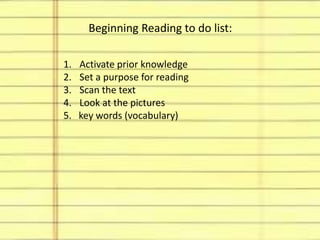
Beginning Reading to do list: 
1. Activate prior knowledge 
2. Set a purpose for reading 
3. Scan the text 
4. Look at the pictures 
5. key words (vocabulary)
Activate prior knowledge: 
In order to understand 
the importance of and to fully 
comprehend what one is reading, 
one must activate prior knowledge. 
When activating prior knowledge 
one will make connections before, 
during and after reading (prior 
knowledge).
Activate prior knowledge: 
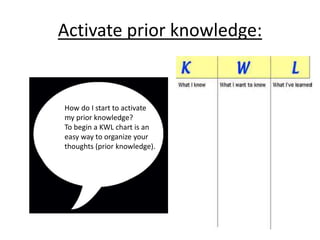
How do I start to activate 
my prior knowledge? 
To begin a KWL chart is an 
easy way to organize your 
thoughts (prior knowledge).
K-W-L 
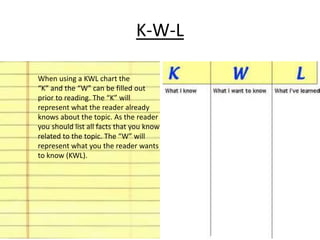
When using a KWL chart the 
“K” and the “W” can be filled out 
prior to reading. The “K” will 
represent what the reader already 
knows about the topic. As the reader 
you should list all facts that you know 
related to the topic. The “W” will 
represent what you the reader wants 
to know (KWL).
Setting a Purpose for Reading: 
Once the KWL chart has been started the brain should be warming up. 
Now that the brain has had time to think about what you know and 
what you want to know, it is time to use this information to determine 
the purpose for reading. 
“When you read a nonfiction text, your purpose is to learn something, so 
You want to be ready to learn before you start reading (reading purpose)”. 
By looking at the front and back of the text, reading the title and using the 
KWL information you will have a better understanding of what you are going 
to read and why.
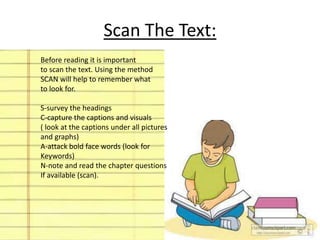
Scan The Text: 
Before reading it is important 
to scan the text. Using the method 
SCAN will help to remember what 
to look for. 
S-survey the headings 
C-capture the captions and visuals 
( look at the captions under all pictures 
and graphs) 
A-attack bold face words (look for 
Keywords) 
N-note and read the chapter questions 
If available (scan).
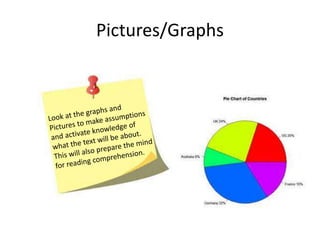
Pictures/Graphs
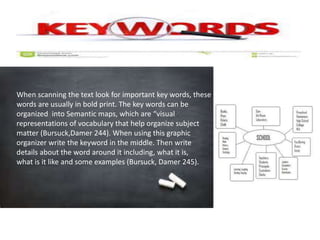
When scanning the text look for important key words, these 
words are usually in bold print. The key words can be 
organized into Semantic maps, which are “visual 
representations of vocabulary that help organize subject 
matter (Bursuck,Damer 244). When using this graphic 
organizer write the keyword in the middle. Then write 
details about the word around it including, what it is, 
what is it like and some examples (Bursuck, Damer 245).
During Reading: 
1. Run strategy- reading speed(fluency) 
2. Run- word recognition 
3. Graphic organizers 
4. Self-Questioning 
5. Pause-Think-Reflect
RUN: 
RUN will help you remember three important tips for reading. 
R- read and adjust speed (run). While reading pause to take note 
if you are remembering what you are reading. If not 
slow down and think about what you are reading. 
U- use word identification skills (run). Use context 
clues for unfamiliar words, break words apart 
and sound them out. 
N- notice and check parts you don’t 
understand (run).
Graphic Organizers: 
Graphic organizers such as tables and charts help to organize information and assist 
the memory while reading and after reading for review (Bursuck, Damer 286). 
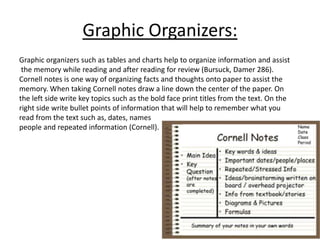
Cornell notes is one way of organizing facts and thoughts onto paper to assist the 
memory. When taking Cornell notes draw a line down the center of the paper. On 
the left side write key topics such as the bold face print titles from the text. On the 
right side write bullet points of information that will help to remember what you 
read from the text such as, dates, names 
people and repeated information (Cornell).
Self Questioning: 
While reading it is important to ask questions as a way of reviewing the text. This will help 
you to determine if your are comprehending and understanding the text 
(Bursuck, Damer 296). Think of questions that will help make sense of the text; such as 
considering the bullet points from the Cornell notes, what I am writing down does it make sense 
with the bullet points? Can I find an answer in this section? What 
does the text want me to remember from this section? When 
asking these questions and you find you are having trouble 
answering them, then go back and re-read the text. Remember 
RUN - slow down and read slowly for comprehension.
Pause-Think-Retell: 
During reading at the end of a section or page pause and think. Think about what was 
just read and try to retell the sequence of events in your head. If you are able to think 
and retell what was read then move on, if not go back and re-read the section (pause).
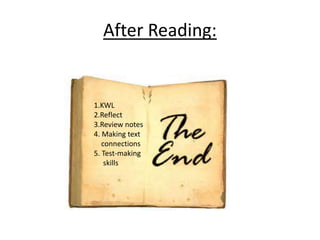
After Reading: 
1.KWL 
2.Reflect 
3.Review notes 
4. Making text 
connections 
5. Test-making 
skills
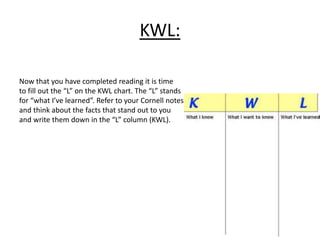
KWL: 
Now that you have completed reading it is time 
to fill out the “L” on the KWL chart. The “L” stands 
for “what I’ve learned”. Refer to your Cornell notes 
and think about the facts that stand out to you 
and write them down in the “L” column (KWL).
Reflect: 
After reading has been 
completed it is time to 
think about what you have 
read. Review your notes and 
write down a summary of what 
you have learned. A summary 
or reflection will help to reinforce 
the new information to memory 
(reflect).
Review Notes:
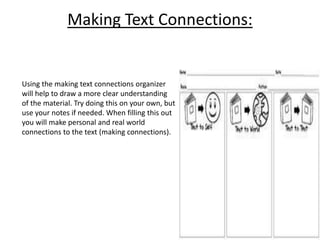
Making Text Connections: 
Using the making text connections organizer 
will help to draw a more clear understanding 
of the material. Try doing this on your own, but 
use your notes if needed. When filling this out 
you will make personal and real world 
connections to the text (making connections).
Test Making Skills: 
Now that you have had plenty of time to review the text and your notes, try 
your test making skills. Try making a test about 5 questions and then exchange your 
test with a partner. Try to take the test and then give each other feedback 
(Bursuck, Damer 318).
To wrap up an review there are three parts to being an organized reader before 
reading, during reading and after reading strategies. Remember to skim the text, 
reflect on what you already know, take clear notes, slow down and re-read, review 
notes, re-read for comprehension and above all reflect and take in the information 
from the text. Enjoy reading don’t look at it like a task but as an opportunity to 
broaden your mind.
Works Cited: 
Prior knowledge (2014). Activating Prior Knowledge. 
https://www.teachervision.com/skill-builder/reading-comprehension/48540.html 
Bursuck, W, Damer, M. (2011,2007). Teaching Reading to Students Who Are at Risk or Have Disabilities. 
Pearson. NJ. 
Cornell (2014). http://lsc.cornell.edu/Sidebars/Study_Skills_Resources/cornellsystem.pdf 
KWl (2014).http://www.portal.state.pa.us/portal/server.pt/community/before-during-after_ 
reading_strategies/7540/a_-_after_%28post_reading%29/508382 
Making Connection (2014). Ready to Use Graphic Organizers. 
http://www.abss.k12.nc.us/cms/lib02/NC01001905/Centricity/Domain/93/ReadytoUseNonFicti 
onGraphicOrganizerswit.pdf (making connections) 
Pause (2014).Strategies to Use During and After Reading. 
.http://teacher.scholastic.com/lessonrepro/lessonplans/profbooks/strategies.htm 
Reading Purpose (2014).Introduce Purpose for Reading. 
http://www.freereading.net/index.php?title=Introduce:_Purpose_for_Reading 
Reflection (2014).http://www.portal.state.pa.us/portal/server.pt/community/before-during-after_ 
reading_strategies/7540/a_-_after_%28post_reading%29/508382 
Review Materials(2014). Review Materials Committing Learning to Long Term memory. 
http://www.mindtools.com/pages/article/newISS_05.htm 
Run (2014). http://educatoral.com/scan_n_run.html 
Scan (2014). http://educatoral.com/scan_n_run.html

Red4348 ca#2 slideshare

  • 1.
  • 2.
    Beginning Reading todo list: 1. Activate prior knowledge 2. Set a purpose for reading 3. Scan the text 4. Look at the pictures 5. key words (vocabulary)
  • 4.
    Activate prior knowledge: In order to understand the importance of and to fully comprehend what one is reading, one must activate prior knowledge. When activating prior knowledge one will make connections before, during and after reading (prior knowledge).
  • 5.
    Activate prior knowledge: How do I start to activate my prior knowledge? To begin a KWL chart is an easy way to organize your thoughts (prior knowledge).
  • 6.
    K-W-L When usinga KWL chart the “K” and the “W” can be filled out prior to reading. The “K” will represent what the reader already knows about the topic. As the reader you should list all facts that you know related to the topic. The “W” will represent what you the reader wants to know (KWL).
  • 7.
    Setting a Purposefor Reading: Once the KWL chart has been started the brain should be warming up. Now that the brain has had time to think about what you know and what you want to know, it is time to use this information to determine the purpose for reading. “When you read a nonfiction text, your purpose is to learn something, so You want to be ready to learn before you start reading (reading purpose)”. By looking at the front and back of the text, reading the title and using the KWL information you will have a better understanding of what you are going to read and why.
  • 8.
    Scan The Text: Before reading it is important to scan the text. Using the method SCAN will help to remember what to look for. S-survey the headings C-capture the captions and visuals ( look at the captions under all pictures and graphs) A-attack bold face words (look for Keywords) N-note and read the chapter questions If available (scan).
  • 9.
  • 10.
    When scanning thetext look for important key words, these words are usually in bold print. The key words can be organized into Semantic maps, which are “visual representations of vocabulary that help organize subject matter (Bursuck,Damer 244). When using this graphic organizer write the keyword in the middle. Then write details about the word around it including, what it is, what is it like and some examples (Bursuck, Damer 245).
  • 11.
    During Reading: 1.Run strategy- reading speed(fluency) 2. Run- word recognition 3. Graphic organizers 4. Self-Questioning 5. Pause-Think-Reflect
  • 12.
    RUN: RUN willhelp you remember three important tips for reading. R- read and adjust speed (run). While reading pause to take note if you are remembering what you are reading. If not slow down and think about what you are reading. U- use word identification skills (run). Use context clues for unfamiliar words, break words apart and sound them out. N- notice and check parts you don’t understand (run).
  • 13.
    Graphic Organizers: Graphicorganizers such as tables and charts help to organize information and assist the memory while reading and after reading for review (Bursuck, Damer 286). Cornell notes is one way of organizing facts and thoughts onto paper to assist the memory. When taking Cornell notes draw a line down the center of the paper. On the left side write key topics such as the bold face print titles from the text. On the right side write bullet points of information that will help to remember what you read from the text such as, dates, names people and repeated information (Cornell).
  • 14.
    Self Questioning: Whilereading it is important to ask questions as a way of reviewing the text. This will help you to determine if your are comprehending and understanding the text (Bursuck, Damer 296). Think of questions that will help make sense of the text; such as considering the bullet points from the Cornell notes, what I am writing down does it make sense with the bullet points? Can I find an answer in this section? What does the text want me to remember from this section? When asking these questions and you find you are having trouble answering them, then go back and re-read the text. Remember RUN - slow down and read slowly for comprehension.
  • 15.
    Pause-Think-Retell: During readingat the end of a section or page pause and think. Think about what was just read and try to retell the sequence of events in your head. If you are able to think and retell what was read then move on, if not go back and re-read the section (pause).
  • 16.
    After Reading: 1.KWL 2.Reflect 3.Review notes 4. Making text connections 5. Test-making skills
  • 17.
    KWL: Now thatyou have completed reading it is time to fill out the “L” on the KWL chart. The “L” stands for “what I’ve learned”. Refer to your Cornell notes and think about the facts that stand out to you and write them down in the “L” column (KWL).
  • 18.
    Reflect: After readinghas been completed it is time to think about what you have read. Review your notes and write down a summary of what you have learned. A summary or reflection will help to reinforce the new information to memory (reflect).
  • 19.
  • 20.
    Making Text Connections: Using the making text connections organizer will help to draw a more clear understanding of the material. Try doing this on your own, but use your notes if needed. When filling this out you will make personal and real world connections to the text (making connections).
  • 21.
    Test Making Skills: Now that you have had plenty of time to review the text and your notes, try your test making skills. Try making a test about 5 questions and then exchange your test with a partner. Try to take the test and then give each other feedback (Bursuck, Damer 318).
  • 22.
    To wrap upan review there are three parts to being an organized reader before reading, during reading and after reading strategies. Remember to skim the text, reflect on what you already know, take clear notes, slow down and re-read, review notes, re-read for comprehension and above all reflect and take in the information from the text. Enjoy reading don’t look at it like a task but as an opportunity to broaden your mind.
  • 24.
    Works Cited: Priorknowledge (2014). Activating Prior Knowledge. https://www.teachervision.com/skill-builder/reading-comprehension/48540.html Bursuck, W, Damer, M. (2011,2007). Teaching Reading to Students Who Are at Risk or Have Disabilities. Pearson. NJ. Cornell (2014). http://lsc.cornell.edu/Sidebars/Study_Skills_Resources/cornellsystem.pdf KWl (2014).http://www.portal.state.pa.us/portal/server.pt/community/before-during-after_ reading_strategies/7540/a_-_after_%28post_reading%29/508382 Making Connection (2014). Ready to Use Graphic Organizers. http://www.abss.k12.nc.us/cms/lib02/NC01001905/Centricity/Domain/93/ReadytoUseNonFicti onGraphicOrganizerswit.pdf (making connections) Pause (2014).Strategies to Use During and After Reading. .http://teacher.scholastic.com/lessonrepro/lessonplans/profbooks/strategies.htm Reading Purpose (2014).Introduce Purpose for Reading. http://www.freereading.net/index.php?title=Introduce:_Purpose_for_Reading Reflection (2014).http://www.portal.state.pa.us/portal/server.pt/community/before-during-after_ reading_strategies/7540/a_-_after_%28post_reading%29/508382 Review Materials(2014). Review Materials Committing Learning to Long Term memory. http://www.mindtools.com/pages/article/newISS_05.htm Run (2014). http://educatoral.com/scan_n_run.html Scan (2014). http://educatoral.com/scan_n_run.html