Active Reading
• Have you ever read something only to realize you
have no idea what you read?
• Have you ever looked back over something
you’ve read and realized that you highlighted or
underlined almost the whole page?
• Have you ever done poorly on a test, quiz, or
essay even though you did the reading?
If you’ve answered yes, you may have been
stuck in a passive reading mindset. This
won’t work in college!
Annotating—A Key to Active Reading
To become a more active reader, think of yourself
as in dialogue with the text you are reading.
• Do not just highlight or underline, but also write in
the margins of your text if you can (or in a
notebook if you cannot). This is called annotating.
• Write questions.
• Note why something is important.
• Argue with the author.
• Tell the author why you agree with him or her.
• Record your surprise at something you have read.
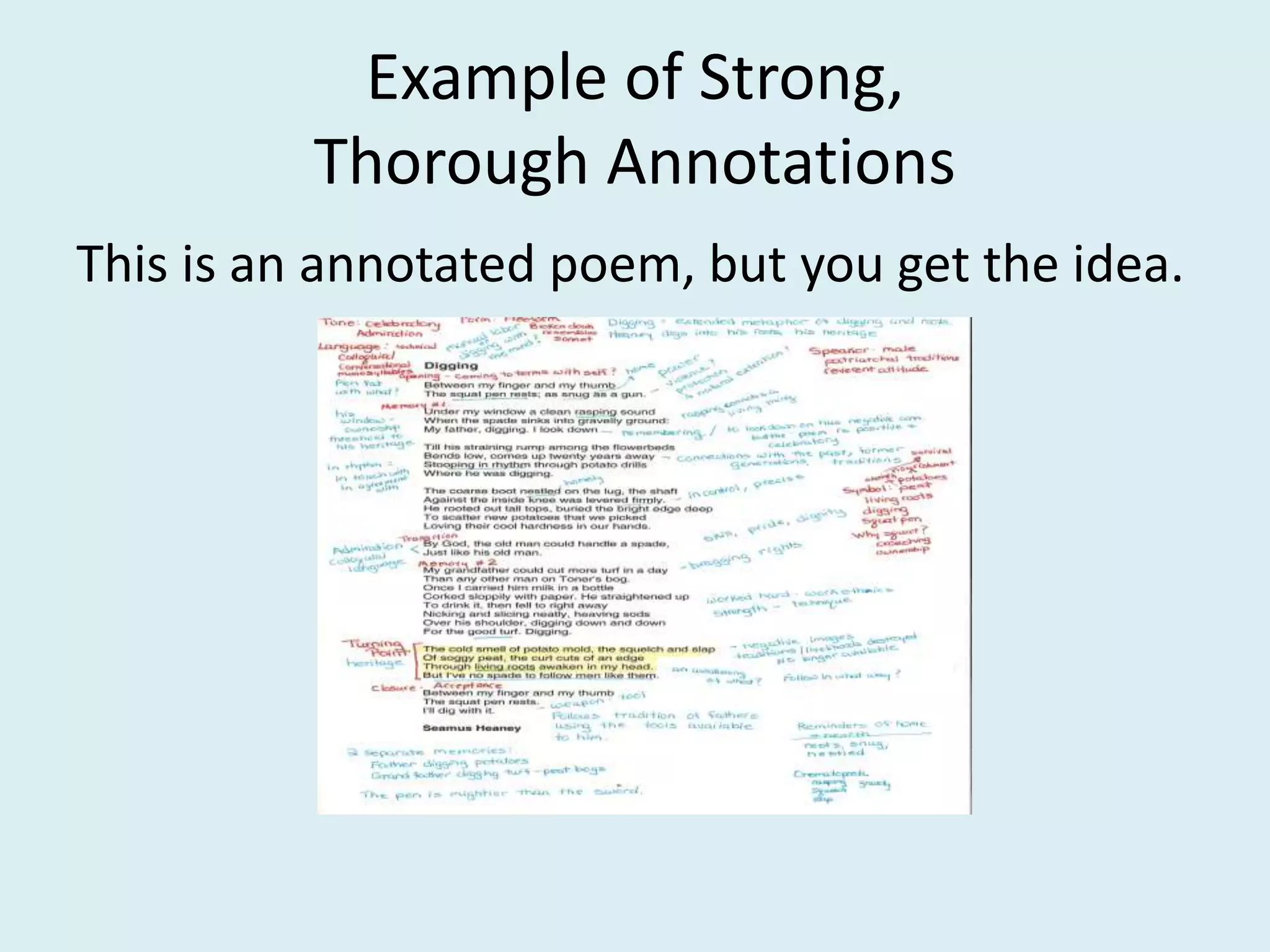
Example of Strong,
Thorough Annotations
This is an annotated poem, but you get the idea.
Why Become an Active Reader?
This approach will help you better remember
what you have read. You will also start to
develop a critical perspective on the reading and
place it in relation to other texts you have read.
In class, you will not only be able to say what the
text said; you also will have something to say
about it—this practice enables you to analyze!
How to Annotate
Here are some kinds of responses you might want to
write in marginal or other notes:
• Questions (to the author, to yourself, to the professor)
• What the text makes you wonder or want to learn
more about
• Connections/comparisons to other readings or your
life
• Critique of the argument
• Extensions (x could also apply to y)
• How the text connects, to contradicts, or complicates
your own thinking
Practicing Annotations
• Read ALL of Zemliansky’s chapter on argument. It is
a longer piece, so you only have to print and
practice annotating pages 11-12. This will take
longer than you may be used to, but it will result in
three benefits:
1. You’ll be able to contribute to a discussion.
2. You’ll be able to write about the concepts more
easily.
3. You’ll have a better understanding and memory of
what you read.

Active reading and annotating

  • 1.
    Active Reading • Haveyou ever read something only to realize you have no idea what you read? • Have you ever looked back over something you’ve read and realized that you highlighted or underlined almost the whole page? • Have you ever done poorly on a test, quiz, or essay even though you did the reading? If you’ve answered yes, you may have been stuck in a passive reading mindset. This won’t work in college!
  • 2.
    Annotating—A Key toActive Reading To become a more active reader, think of yourself as in dialogue with the text you are reading. • Do not just highlight or underline, but also write in the margins of your text if you can (or in a notebook if you cannot). This is called annotating. • Write questions. • Note why something is important. • Argue with the author. • Tell the author why you agree with him or her. • Record your surprise at something you have read.
  • 3.
    Example of Strong, ThoroughAnnotations This is an annotated poem, but you get the idea.
  • 4.
    Why Become anActive Reader? This approach will help you better remember what you have read. You will also start to develop a critical perspective on the reading and place it in relation to other texts you have read. In class, you will not only be able to say what the text said; you also will have something to say about it—this practice enables you to analyze!
  • 5.
    How to Annotate Hereare some kinds of responses you might want to write in marginal or other notes: • Questions (to the author, to yourself, to the professor) • What the text makes you wonder or want to learn more about • Connections/comparisons to other readings or your life • Critique of the argument • Extensions (x could also apply to y) • How the text connects, to contradicts, or complicates your own thinking
  • 6.
    Practicing Annotations • ReadALL of Zemliansky’s chapter on argument. It is a longer piece, so you only have to print and practice annotating pages 11-12. This will take longer than you may be used to, but it will result in three benefits: 1. You’ll be able to contribute to a discussion. 2. You’ll be able to write about the concepts more easily. 3. You’ll have a better understanding and memory of what you read.