Before, During, and
After Reading
Strategies
Sara Hulings
RED4348
Fall 2016
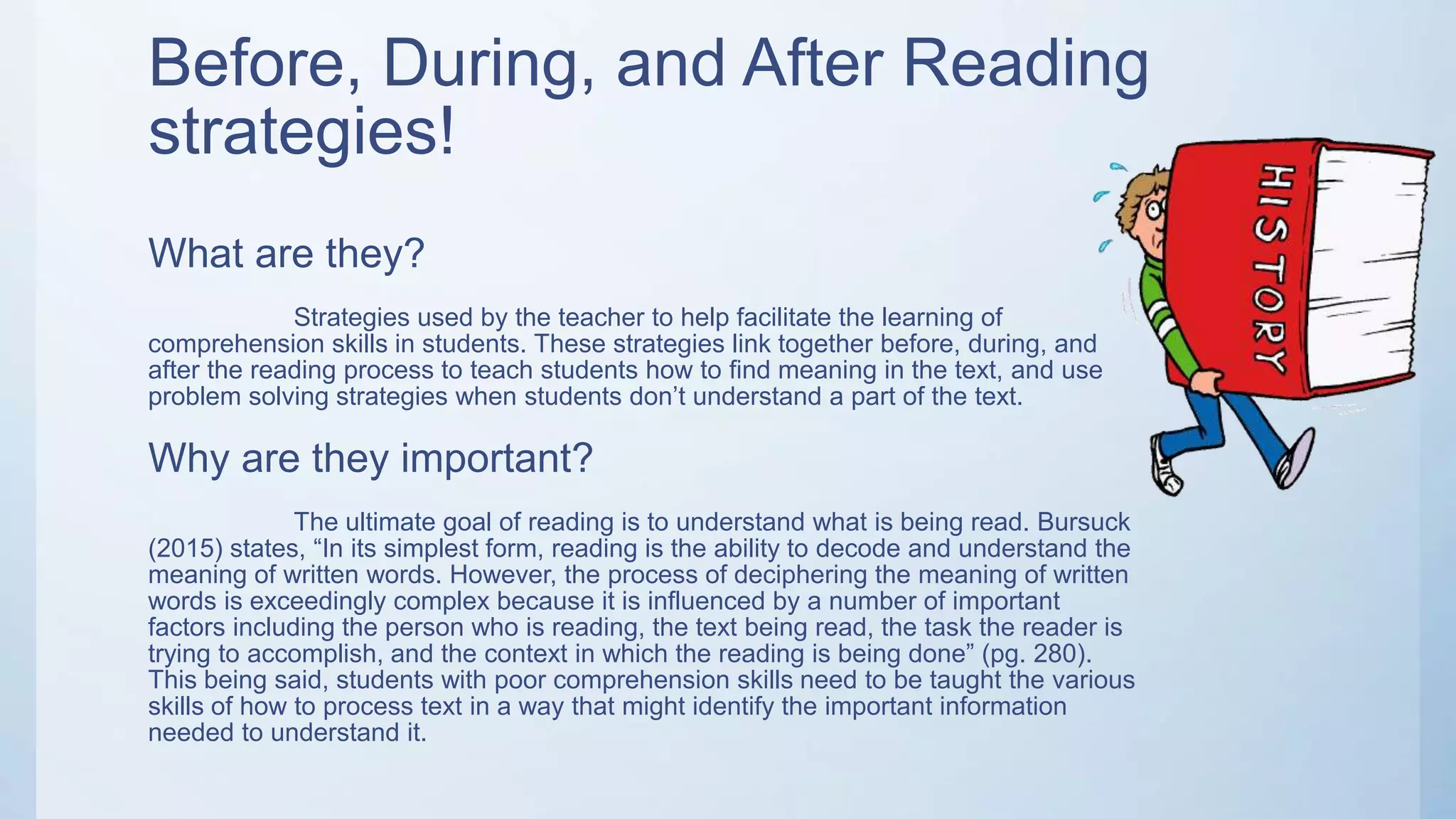
Before, During, and After Reading
strategies!
What are they?
Strategies used by the teacher to help facilitate the learning of
comprehension skills in students. These strategies link together before, during, and
after the reading process to teach students how to find meaning in the text, and use
problem solving strategies when students don’t understand a part of the text.
Why are they important?
The ultimate goal of reading is to understand what is being read. Bursuck
(2015) states, “In its simplest form, reading is the ability to decode and understand the
meaning of written words. However, the process of deciphering the meaning of written
words is exceedingly complex because it is influenced by a number of important
factors including the person who is reading, the text being read, the task the reader is
trying to accomplish, and the context in which the reading is being done” (pg. 280).
This being said, students with poor comprehension skills need to be taught the various
skills of how to process text in a way that might identify the important information
needed to understand it.
Let’s start at the Beginning!
Before Reading Strategies
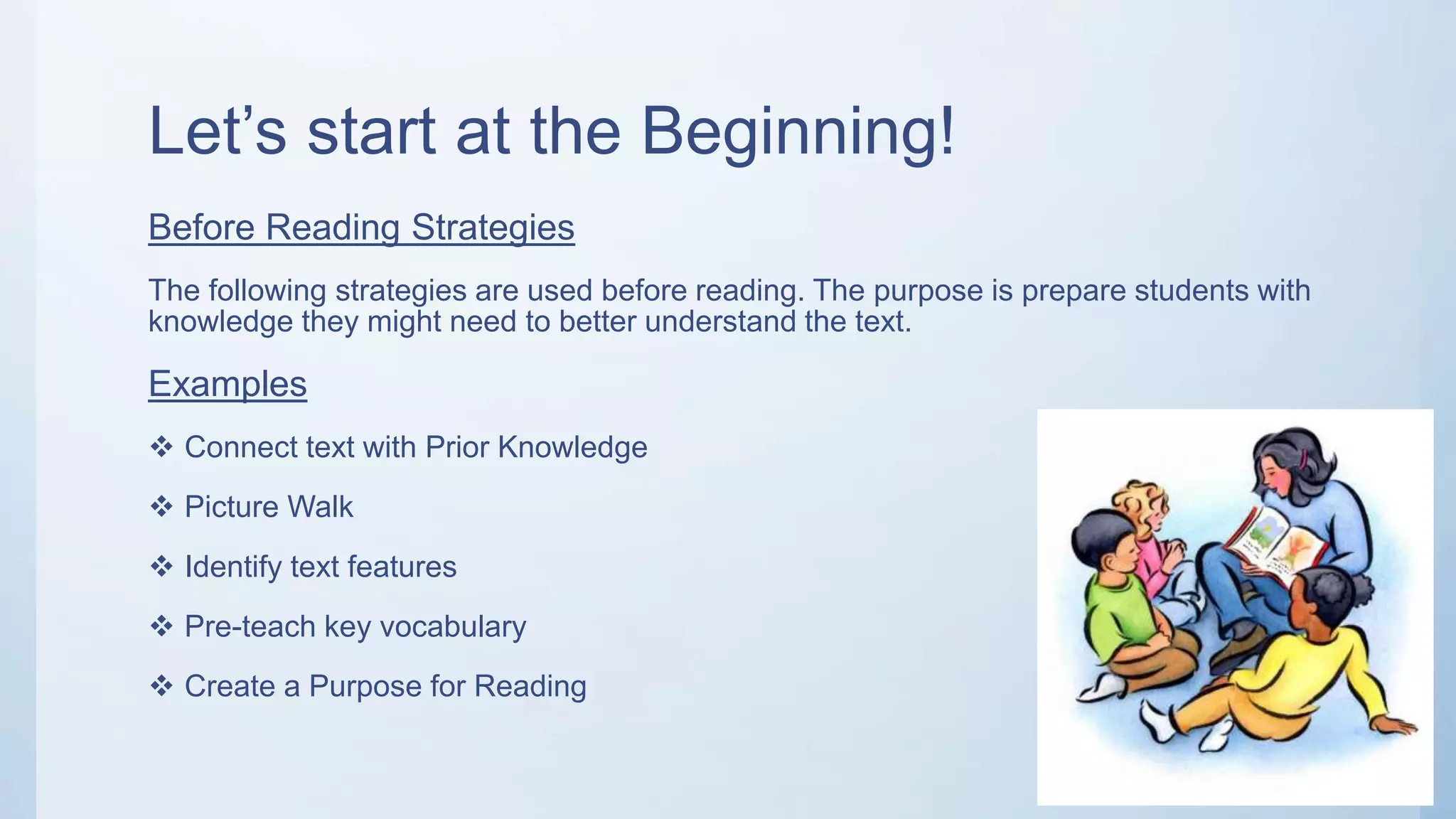
The following strategies are used before reading. The purpose is prepare students with
knowledge they might need to better understand the text.
Examples
 Connect text with Prior Knowledge
 Picture Walk
 Identify text features
 Pre-teach key vocabulary
 Create a Purpose for Reading
Connect to Prior Knowledge!
Allowing students a way to connect to the text using prior knowledge allows them to better
understand what they are reading. It can also help them retain new information in their long
term memory.
 Ask questions
 Everyone share an experiance
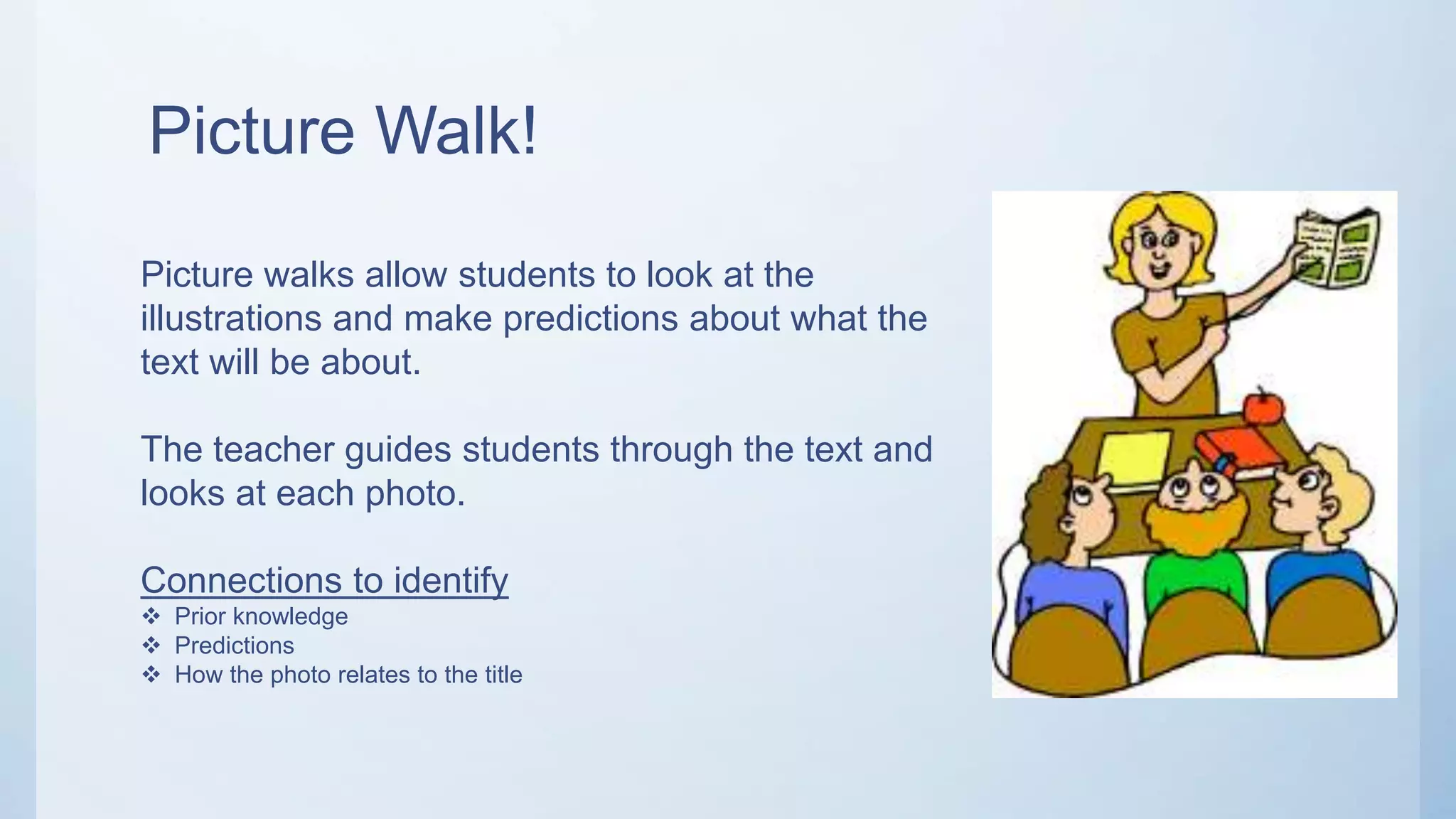
Picture Walk!
Picture walks allow students to look at the
illustrations and make predictions about what the
text will be about.
The teacher guides students through the text and
looks at each photo.
Connections to identify
 Prior knowledge
 Predictions
 How the photo relates to the title
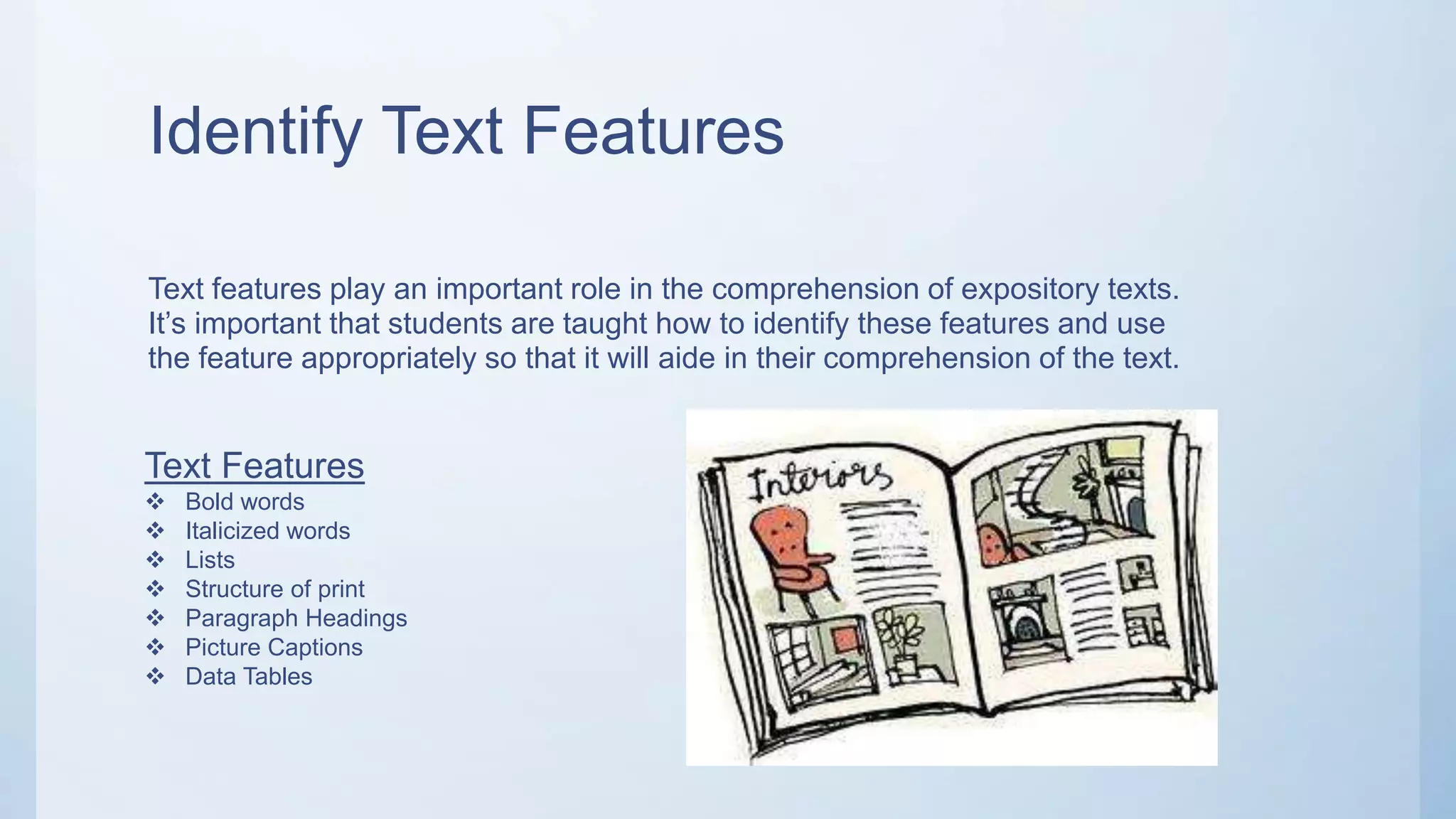
Identify Text Features
Text features play an important role in the comprehension of expository texts.
It’s important that students are taught how to identify these features and use
the feature appropriately so that it will aide in their comprehension of the text.
Text Features
 Bold words
 Italicized words
 Lists
 Structure of print
 Paragraph Headings
 Picture Captions
 Data Tables
Pre-Teach Key Terms/Vocabulary
Defining unknown vocabulary and key terms prepares
students for comprehending the text better.
 Students skim text to identify unknown words, and then define.
 Assign a word to groups of students to define using a graphic organizer like the Frayer
Model.
 Dramatization of the word.
 Have students use the word to create their own sentence.
Create a Purpose for Reading
Teachers create a purpose for reading to give students clues
to listen or look for when reading.
 Make predictions before reading.
 Introduce the after reading activity.
 Allow students to select their own reading text
 Anticipation guide (List of statements that they agree or disagree with that can be found in
the text)
Let’s start reading!
During Reading Strategies
The following strategies are during the reading process. The purpose is to teach and model
important metacognitive skills that help in understanding a text as a student reads.
Examples
 Reciprocal Teaching (Predict, Question, Clarity, Summarize)
 Think A-loud
 Fact Charts
 Close Readings
 Seed Discussions
Reciprocal Teaching
The teacher asks students to make predictions and then the
students monitor their predictions and change their answers
as they read.
 Students Make predictions.
 Students question what they are reading and how it relates to their prediction.
 Students clarify what the text states
 Students summarize in your own words.
Think A-louds
Teachers read a text and stop at brief points to make
comments about what he/she is thinking as he/she reads.
This models the metacognitive language students should use
as they read.
 Ask questions
 Make connects with prior knowledge
 Identify confusing language or words and look for context clues
 Answer previous questions when found in text.
Fact Charts
Teachers create a chart to list facts learned from reading the
text. This is allows students to identify key details within a
text.
 KWL
 Facts List
Close Readings
Bursuck (2015) states that close reading is “A method in
which students read and reread text in order to focus on its
increasingly deeper meanings.” (pg. 292).
 Used for complex text.
 Question for each reading should increase in difficulty
Seed Discussions
Students create discussion topics as they read.
 Questions I don’t understand
 Comments about things I’ve learned
 Things that seem interesting or surprising
 Vocabulary I want to know more about
 Descriptive writing that I particularly enjoyed
 Things that remind me of other things I know
Time to Review!
After Reading Strategies
The following strategies are used after the reading process. The purpose is to review
information gained from the reading and ensure there was an understanding of the main
ideas within the text.
Examples
 Graphic Organizers
 Discussions
 Compose the Test
 Summarize
 Create a Timeline
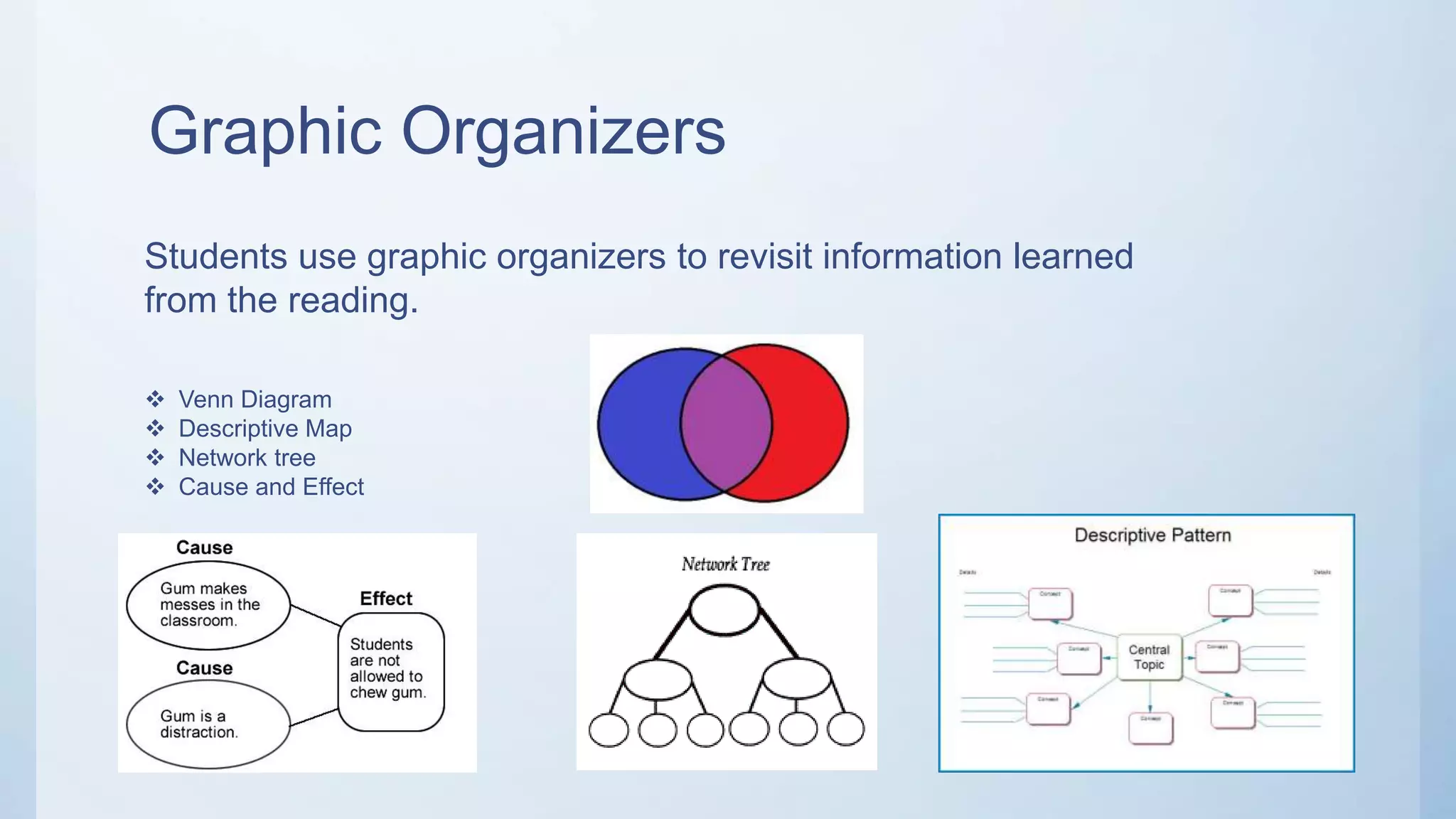
Graphic Organizers
Students use graphic organizers to revisit information learned
from the reading.
 Venn Diagram
 Descriptive Map
 Network tree
 Cause and Effect
Discussions
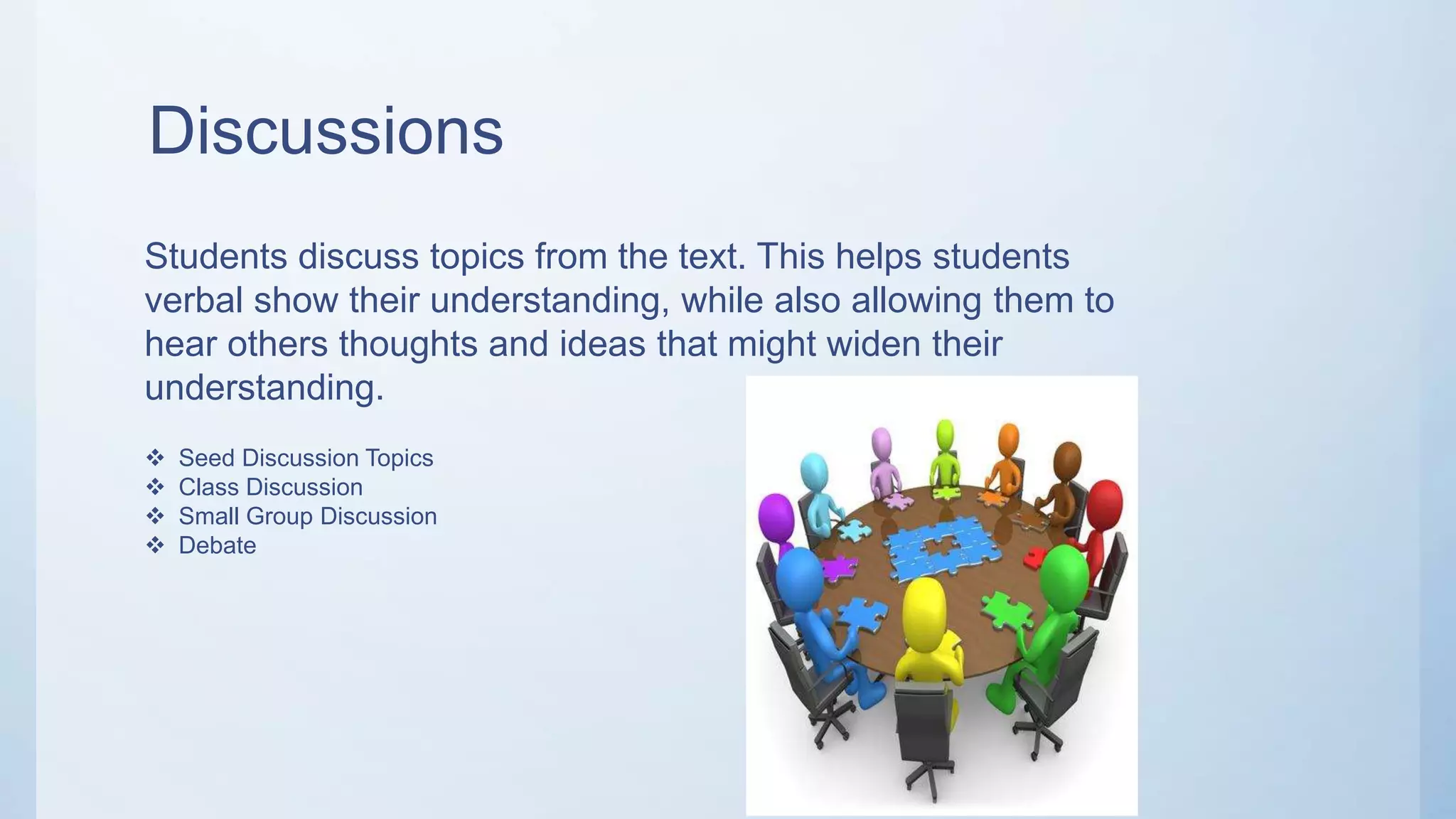
Students discuss topics from the text. This helps students
verbal show their understanding, while also allowing them to
hear others thoughts and ideas that might widen their
understanding.
 Seed Discussion Topics
 Class Discussion
 Small Group Discussion
 Debate
Compose the Test
Students create their own test question using the
text as a guide. Helps student decide the main
idea and important information from the text.
 Students write 1-2 questions (compile and use the questions for the test)
 Small groups create a test, then each groups test is passed around to be taken. The test is
then turned back in to be corrected by the original group.
 Students create a test for future classes.
 Teach students the 4 QAR’s (Question, Answer Relationships) and have them design
questions from the text.
Summarize
Students put what the main idea and key details into their
own words.
 Oral Summary
 Summary games
 Save the Last Word
1. Students choose a key detail or paragraph and copy it onto the front of an index
card.
2. On the reverse side they write what they liked or found interesting about the detail
or paragraph.
3. One at a time the students read the passage or detail they wrote down.
4. Other students make comments about what they liked or didn’t like about that detail
or paragraph
5. The student who wrote the paragraph or detail gets to have the last word by reading
what they wrote on the other side.
Create a Timeline
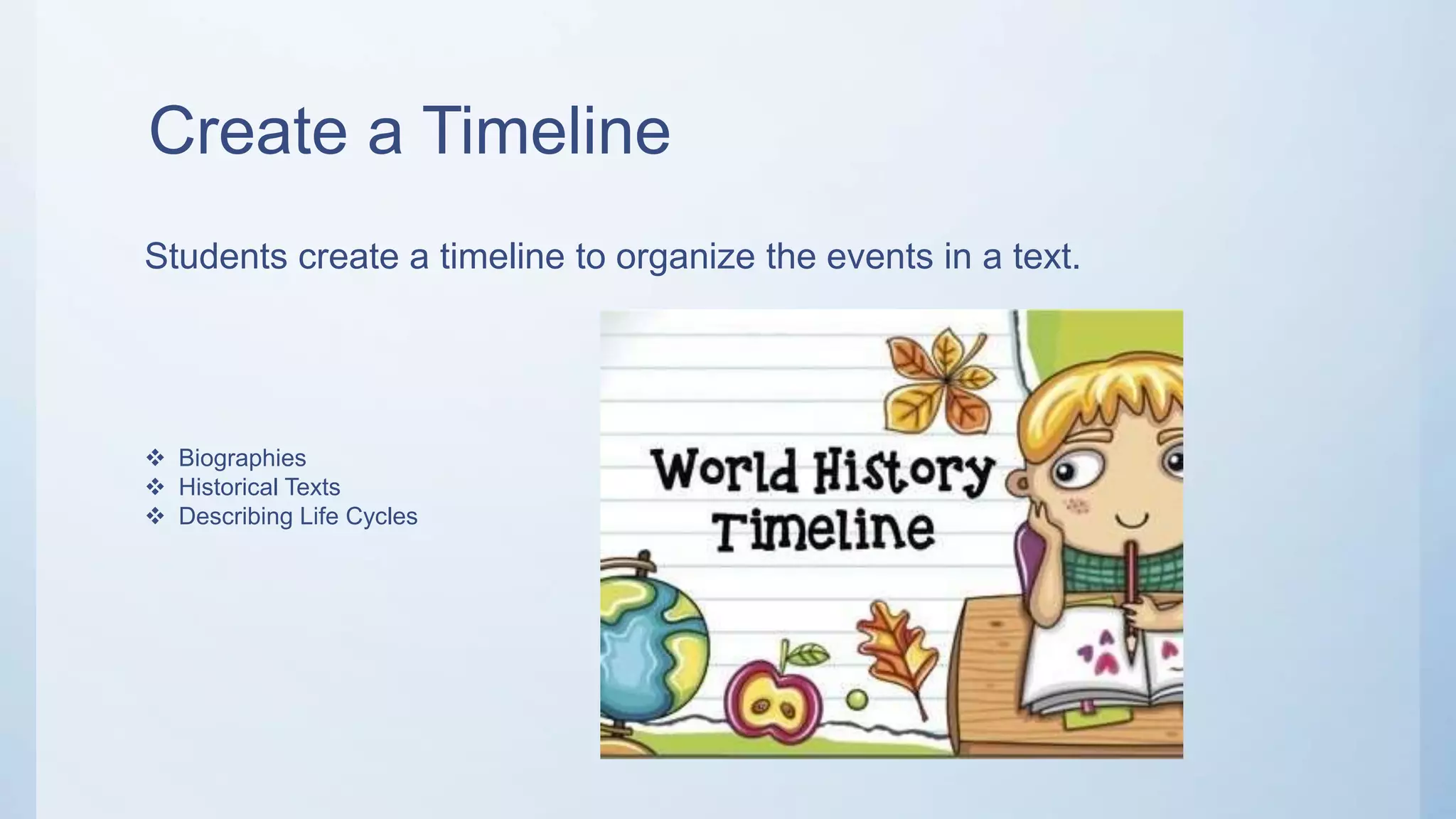
Students create a timeline to organize the events in a text.
 Biographies
 Historical Texts
 Describing Life Cycles
In Conclusion…
Before, During, and After Reading Strategies
Using these strategies through out the reading process is a great way too ensure
students are understanding what they are reading. The metacognitive skills being taught
in Before, During and After reading strategies help students to become life long learners
as they will be able to determine the meaning from a variety of texts by using the various
problem solving skills you teach them.
Resources
BlogSpot.com.Retrieved from http://1.bp.blogspot.com/-ycZLRre-
4EQ/U2ZbE7XMWDI/AAAAAAAAEQo/GTEW3x8LUhY/s1600/Learning4.png
Bursuck, W. D., & Damer, M. (2015). Teaching reading to students who are at risk or have disabilities: A
multi-tier, RTI approach.
Seminole County Public Schools. (n.d.). During Reading. Retrieved from
http://www.scps.k12.fl.us/curriculum/AcademicCore/LanguageArtsandReading/SecondaryReading/D
uringReading.aspx

Before, during, and after reading strategies

  • 1.
    Before, During, and AfterReading Strategies Sara Hulings RED4348 Fall 2016
  • 2.
    Before, During, andAfter Reading strategies! What are they? Strategies used by the teacher to help facilitate the learning of comprehension skills in students. These strategies link together before, during, and after the reading process to teach students how to find meaning in the text, and use problem solving strategies when students don’t understand a part of the text. Why are they important? The ultimate goal of reading is to understand what is being read. Bursuck (2015) states, “In its simplest form, reading is the ability to decode and understand the meaning of written words. However, the process of deciphering the meaning of written words is exceedingly complex because it is influenced by a number of important factors including the person who is reading, the text being read, the task the reader is trying to accomplish, and the context in which the reading is being done” (pg. 280). This being said, students with poor comprehension skills need to be taught the various skills of how to process text in a way that might identify the important information needed to understand it.
  • 3.
    Let’s start atthe Beginning! Before Reading Strategies The following strategies are used before reading. The purpose is prepare students with knowledge they might need to better understand the text. Examples  Connect text with Prior Knowledge  Picture Walk  Identify text features  Pre-teach key vocabulary  Create a Purpose for Reading
  • 4.
    Connect to PriorKnowledge! Allowing students a way to connect to the text using prior knowledge allows them to better understand what they are reading. It can also help them retain new information in their long term memory.  Ask questions  Everyone share an experiance
  • 5.
    Picture Walk! Picture walksallow students to look at the illustrations and make predictions about what the text will be about. The teacher guides students through the text and looks at each photo. Connections to identify  Prior knowledge  Predictions  How the photo relates to the title
  • 6.
    Identify Text Features Textfeatures play an important role in the comprehension of expository texts. It’s important that students are taught how to identify these features and use the feature appropriately so that it will aide in their comprehension of the text. Text Features  Bold words  Italicized words  Lists  Structure of print  Paragraph Headings  Picture Captions  Data Tables
  • 7.
    Pre-Teach Key Terms/Vocabulary Definingunknown vocabulary and key terms prepares students for comprehending the text better.  Students skim text to identify unknown words, and then define.  Assign a word to groups of students to define using a graphic organizer like the Frayer Model.  Dramatization of the word.  Have students use the word to create their own sentence.
  • 8.
    Create a Purposefor Reading Teachers create a purpose for reading to give students clues to listen or look for when reading.  Make predictions before reading.  Introduce the after reading activity.  Allow students to select their own reading text  Anticipation guide (List of statements that they agree or disagree with that can be found in the text)
  • 9.
    Let’s start reading! DuringReading Strategies The following strategies are during the reading process. The purpose is to teach and model important metacognitive skills that help in understanding a text as a student reads. Examples  Reciprocal Teaching (Predict, Question, Clarity, Summarize)  Think A-loud  Fact Charts  Close Readings  Seed Discussions
  • 10.
    Reciprocal Teaching The teacherasks students to make predictions and then the students monitor their predictions and change their answers as they read.  Students Make predictions.  Students question what they are reading and how it relates to their prediction.  Students clarify what the text states  Students summarize in your own words.
  • 11.
    Think A-louds Teachers reada text and stop at brief points to make comments about what he/she is thinking as he/she reads. This models the metacognitive language students should use as they read.  Ask questions  Make connects with prior knowledge  Identify confusing language or words and look for context clues  Answer previous questions when found in text.
  • 12.
    Fact Charts Teachers createa chart to list facts learned from reading the text. This is allows students to identify key details within a text.  KWL  Facts List
  • 13.
    Close Readings Bursuck (2015)states that close reading is “A method in which students read and reread text in order to focus on its increasingly deeper meanings.” (pg. 292).  Used for complex text.  Question for each reading should increase in difficulty
  • 14.
    Seed Discussions Students creatediscussion topics as they read.  Questions I don’t understand  Comments about things I’ve learned  Things that seem interesting or surprising  Vocabulary I want to know more about  Descriptive writing that I particularly enjoyed  Things that remind me of other things I know
  • 15.
    Time to Review! AfterReading Strategies The following strategies are used after the reading process. The purpose is to review information gained from the reading and ensure there was an understanding of the main ideas within the text. Examples  Graphic Organizers  Discussions  Compose the Test  Summarize  Create a Timeline
  • 16.
    Graphic Organizers Students usegraphic organizers to revisit information learned from the reading.  Venn Diagram  Descriptive Map  Network tree  Cause and Effect
  • 17.
    Discussions Students discuss topicsfrom the text. This helps students verbal show their understanding, while also allowing them to hear others thoughts and ideas that might widen their understanding.  Seed Discussion Topics  Class Discussion  Small Group Discussion  Debate
  • 18.
    Compose the Test Studentscreate their own test question using the text as a guide. Helps student decide the main idea and important information from the text.  Students write 1-2 questions (compile and use the questions for the test)  Small groups create a test, then each groups test is passed around to be taken. The test is then turned back in to be corrected by the original group.  Students create a test for future classes.  Teach students the 4 QAR’s (Question, Answer Relationships) and have them design questions from the text.
  • 19.
    Summarize Students put whatthe main idea and key details into their own words.  Oral Summary  Summary games  Save the Last Word 1. Students choose a key detail or paragraph and copy it onto the front of an index card. 2. On the reverse side they write what they liked or found interesting about the detail or paragraph. 3. One at a time the students read the passage or detail they wrote down. 4. Other students make comments about what they liked or didn’t like about that detail or paragraph 5. The student who wrote the paragraph or detail gets to have the last word by reading what they wrote on the other side.
  • 20.
    Create a Timeline Studentscreate a timeline to organize the events in a text.  Biographies  Historical Texts  Describing Life Cycles
  • 21.
    In Conclusion… Before, During,and After Reading Strategies Using these strategies through out the reading process is a great way too ensure students are understanding what they are reading. The metacognitive skills being taught in Before, During and After reading strategies help students to become life long learners as they will be able to determine the meaning from a variety of texts by using the various problem solving skills you teach them.
  • 22.
    Resources BlogSpot.com.Retrieved from http://1.bp.blogspot.com/-ycZLRre- 4EQ/U2ZbE7XMWDI/AAAAAAAAEQo/GTEW3x8LUhY/s1600/Learning4.png Bursuck,W. D., & Damer, M. (2015). Teaching reading to students who are at risk or have disabilities: A multi-tier, RTI approach. Seminole County Public Schools. (n.d.). During Reading. Retrieved from http://www.scps.k12.fl.us/curriculum/AcademicCore/LanguageArtsandReading/SecondaryReading/D uringReading.aspx