Before, During, and After
Reading
By Laticka Long
Professor Jennifer Bishop
RED4348
CA#1
Purpose Of Reading
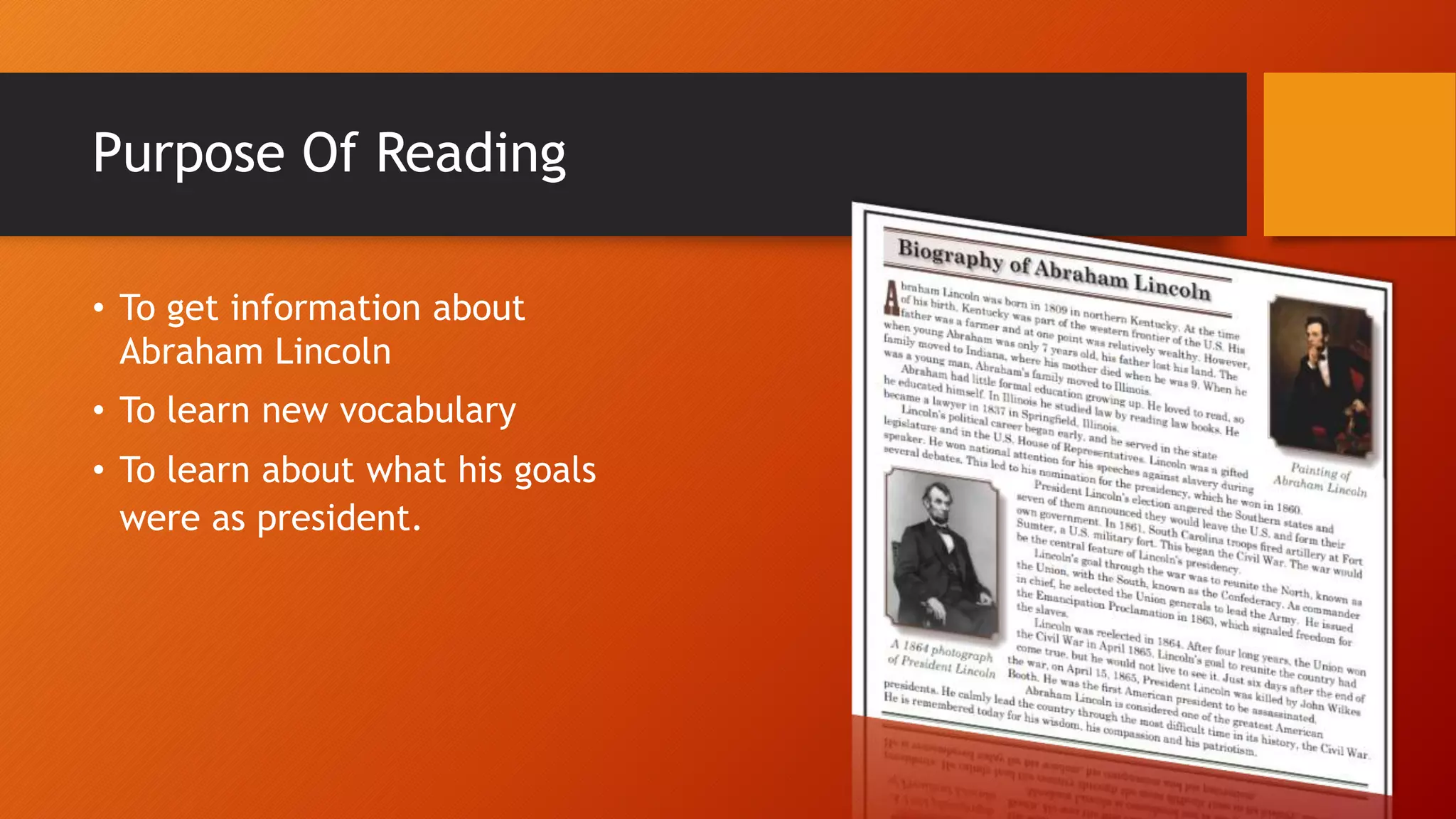
• To get information about
Abraham Lincoln
• To learn new vocabulary
• To learn about what his goals
were as president.
• This will prepare students for the passage/book
• It will also allow students to connect the
information using the different strategies with
ease
• It will help students determine the main idea
Teacher’s Purpose
• Connect new text information to prior
knowledge.
• Increase interest
• Introduce a graphic organizer
• Teach a few vocabulary words to
understand the text
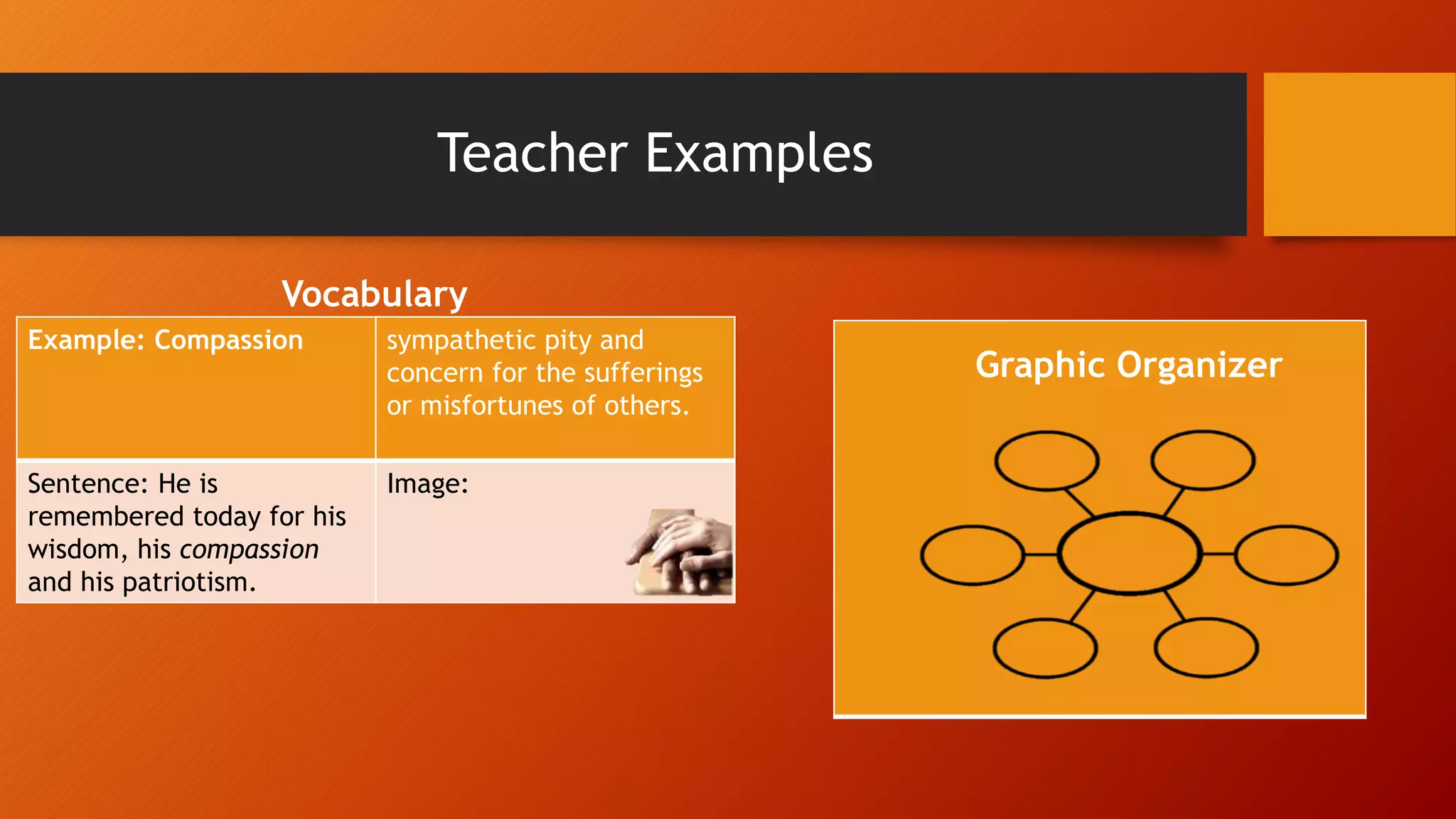
Teacher Examples
Example: Compassion sympathetic pity and
concern for the sufferings
or misfortunes of others.
Sentence: He is
remembered today for his
wisdom, his compassion
and his patriotism.
Image:
Vocabulary
Graphic Organizer
Students Learn to:
• Read the title and headings.
• Look at the pictures.
• Predict what the passage might be about.
• Ask themselves what they already know about the topic.
• Consider the purpose of reading
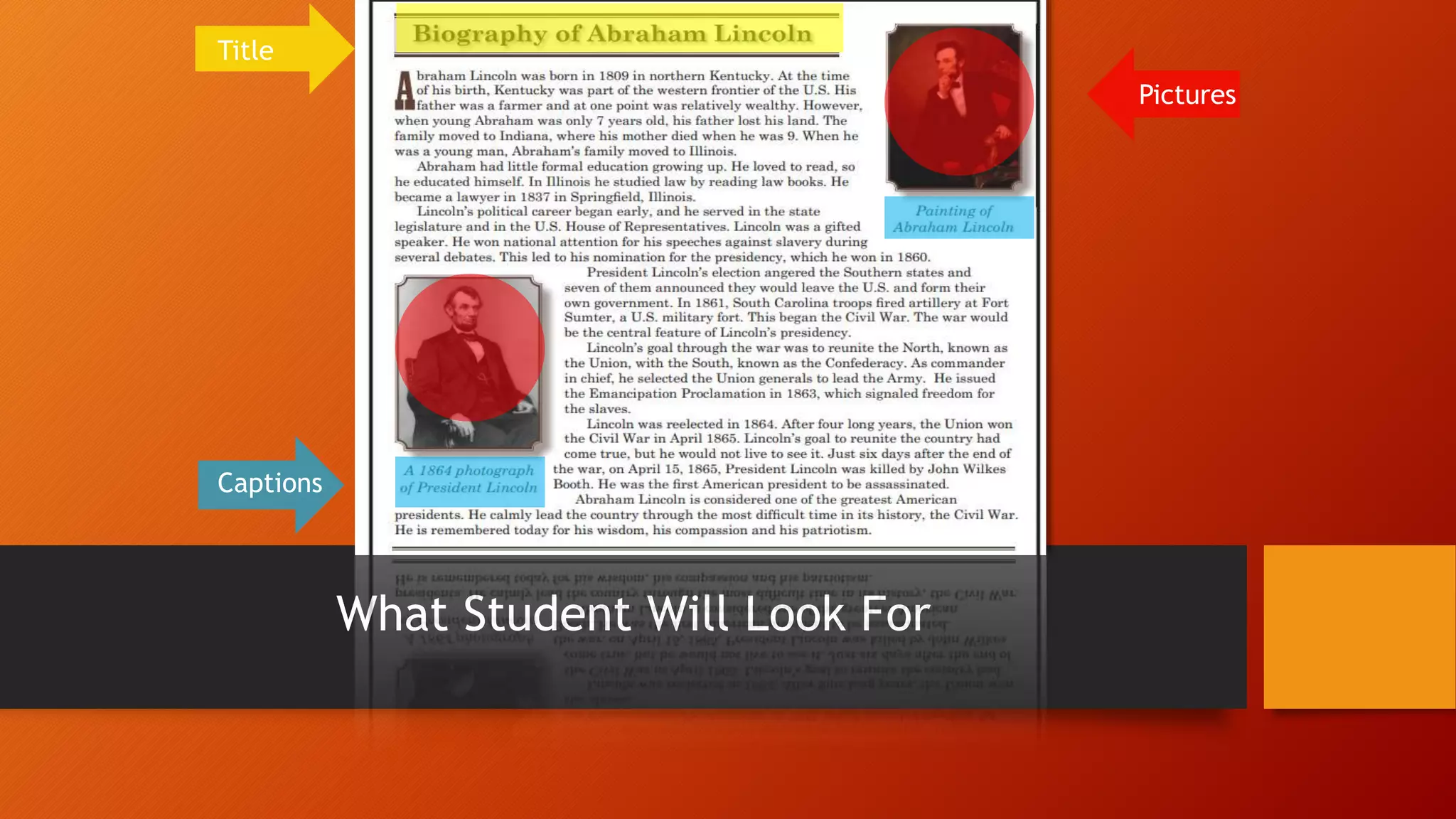
What Student Will Look For
Title
Pictures
Captions
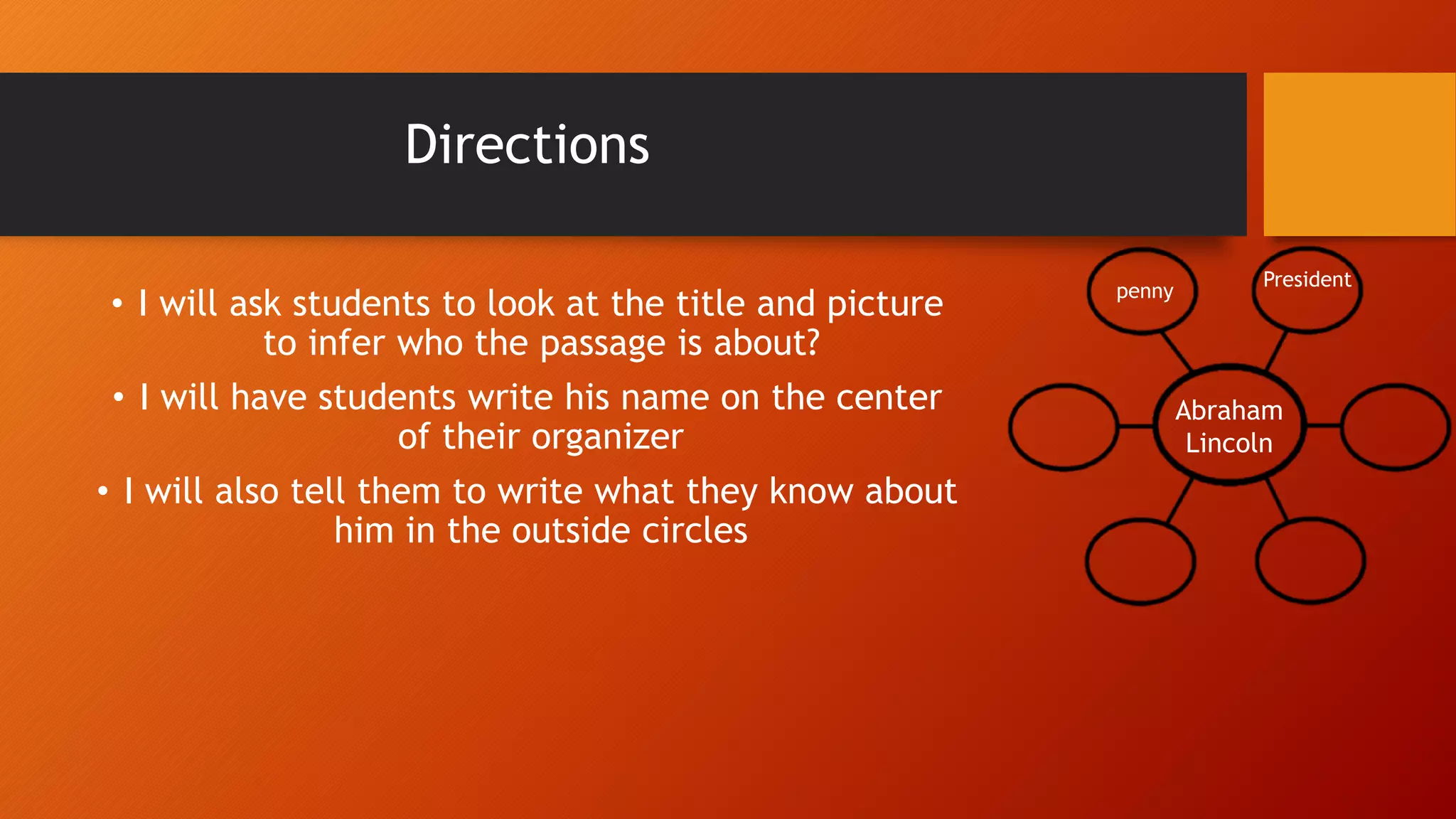
Directions
• I will ask students to look at the title and picture
to infer who the passage is about?
• I will have students write his name on the center
of their organizer
• I will also tell them to write what they know about
him in the outside circles
Abraham
Lincoln
President
penny
During Reading
• This strategy is used to help students make
connections with prior knowledge while
reading the text
• This also allows students to actually
comprehend what they are reading
Teacher’s Purpose
• use a graphic organizer to
teach comprehension strategy
or to provide connections
between concepts and other
pieces of information in text
• evaluate students’ use of
comprehension strategies.
• Explain unknown vocabulary
Comprehension Evaluation
• Ask questions
Examples:
1. What did the Emancipation Proclamation do?
2. How did he die?
3. How did he win national attention?
Students Learn too:
• Stop and summarize what has been read
• Make connections
• Think about what they are reading and make sense of it
Questions students ask themselves
1. Who was this about?
2. What has a great affect on the present?
3. How was he remembered?
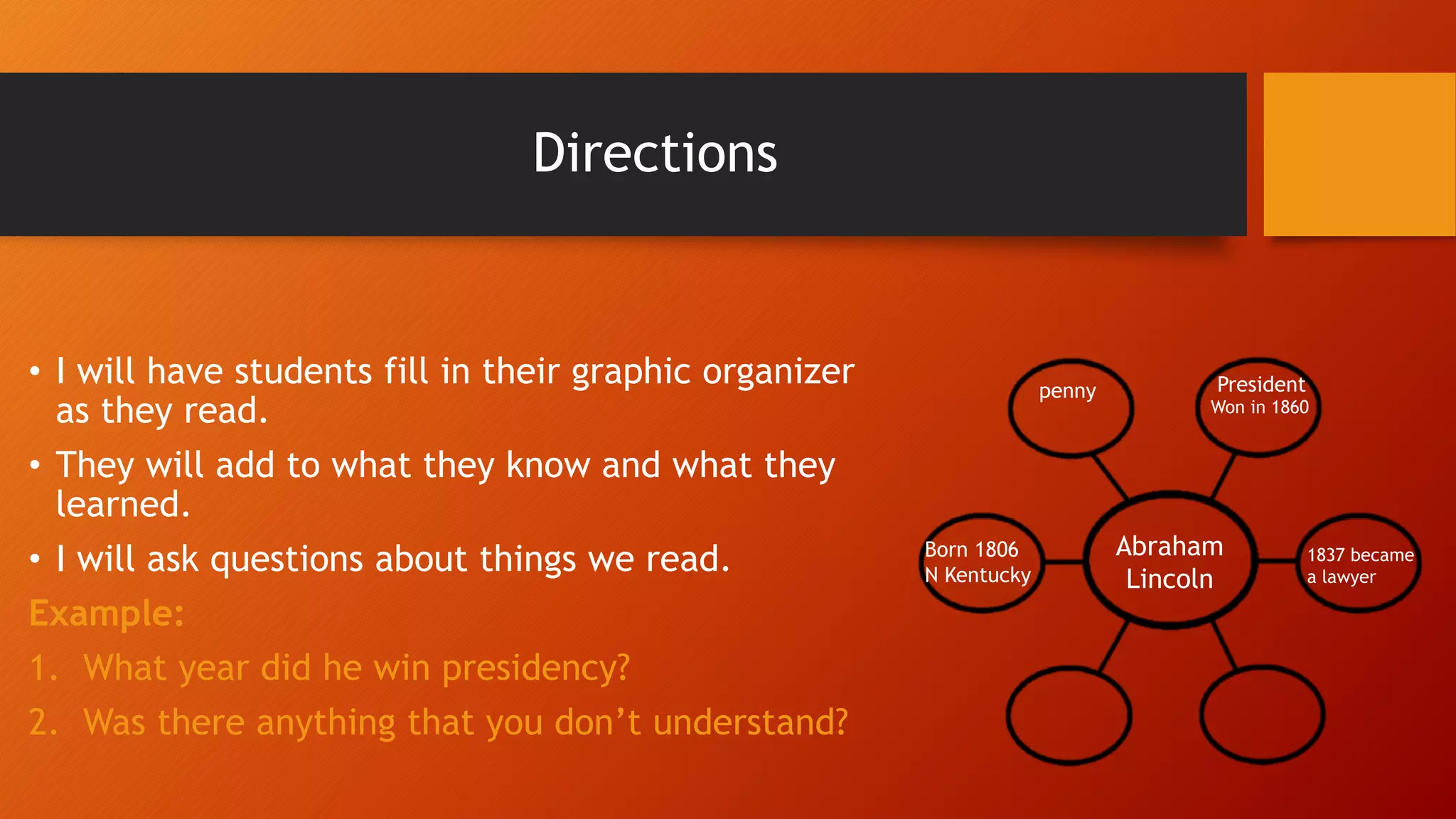
Directions
• I will have students fill in their graphic organizer
as they read.
• They will add to what they know and what they
learned.
• I will ask questions about things we read.
Example:
1. What year did he win presidency?
2. Was there anything that you don’t understand?
Abraham
Lincoln
Presidentpenny
1837 became
a lawyer
Born 1806
N Kentucky
Won in 1860
After Reading
• This allows students to pull all the information
together and review what they have read.
• This will allow the teacher to ask questions and see
if their students understood what they read
Teacher’s Purpose
• help students incorporate
information from text with their own
primary knowledge.
• teach students to summarize main
ideas in text.
• Provide the opportunity to
• apply critical thinking skills.
Students Learn too:
• Generate questions about the text
• Write or speak on a specified topic related to material read.
• Compare what was read with something already known.
• Summarize a reading selection.
Directions
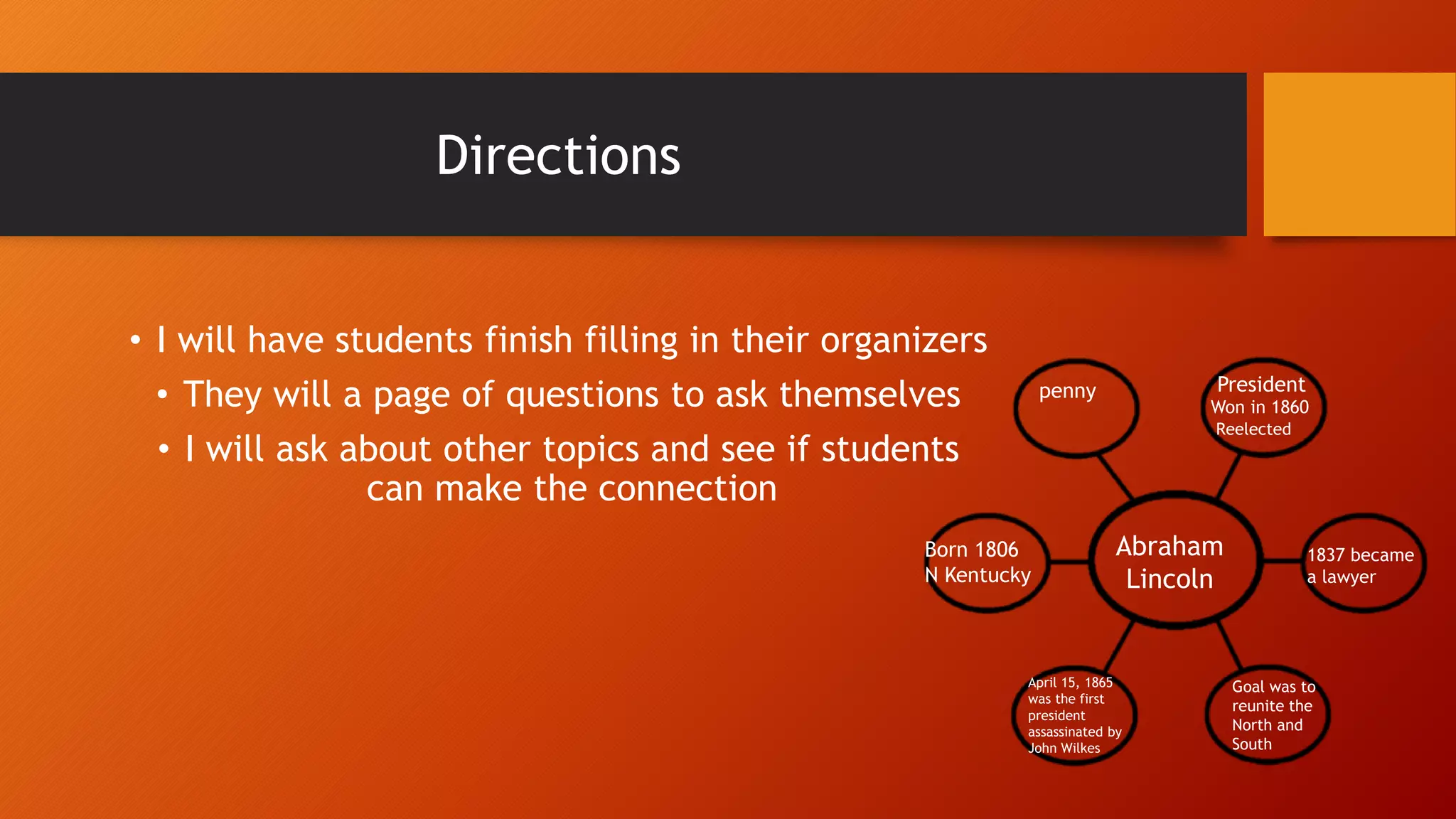
• I will have students finish filling in their organizers
• They will a page of questions to ask themselves
• I will ask about other topics and see if students
can make the connection
Abraham
Lincoln
Presidentpenny
1837 became
a lawyer
Born 1806
N Kentucky
Won in 1860
April 15, 1865
was the first
president
assassinated by
John Wilkes
Reelected
Goal was to
reunite the
North and
South
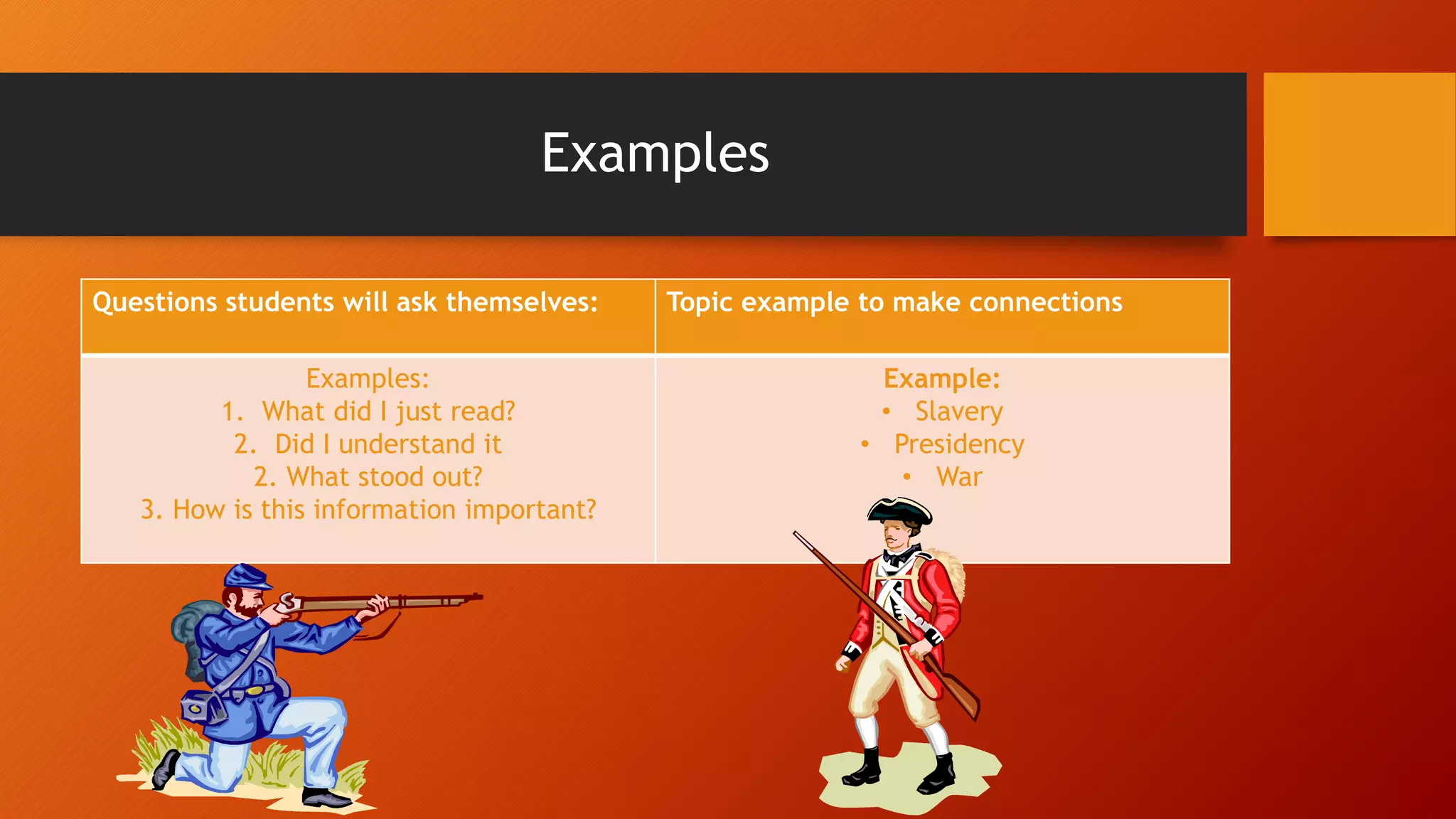
Examples
Questions students will ask themselves: Topic example to make connections
Examples:
1. What did I just read?
2. Did I understand it
2. What stood out?
3. How is this information important?
Example:
• Slavery
• Presidency
• War
Why Use Strategies?
• As a reader these are important to enhance
awareness and comprehension of what they
are reading. Teachers are there to imbed and
magnify these strategies to help make reading
more interesting and comprehensible.
Work Cited
Bursuck, W. D., & Damer, M. (2007). Reading instruction for
students who are at risk or have disabilities. Boston: Pearson/Allyn
and Bacon.
http://www.k12reader.com/reading-
comprehension/GR7_Abraham_Lincoln_Biography.pdf

Reading Strategies

  • 1.
    Before, During, andAfter Reading By Laticka Long Professor Jennifer Bishop RED4348 CA#1
  • 2.
    Purpose Of Reading •To get information about Abraham Lincoln • To learn new vocabulary • To learn about what his goals were as president.
  • 3.
    • This willprepare students for the passage/book • It will also allow students to connect the information using the different strategies with ease • It will help students determine the main idea
  • 4.
    Teacher’s Purpose • Connectnew text information to prior knowledge. • Increase interest • Introduce a graphic organizer • Teach a few vocabulary words to understand the text
  • 5.
    Teacher Examples Example: Compassionsympathetic pity and concern for the sufferings or misfortunes of others. Sentence: He is remembered today for his wisdom, his compassion and his patriotism. Image: Vocabulary Graphic Organizer
  • 6.
    Students Learn to: •Read the title and headings. • Look at the pictures. • Predict what the passage might be about. • Ask themselves what they already know about the topic. • Consider the purpose of reading
  • 7.
    What Student WillLook For Title Pictures Captions
  • 8.
    Directions • I willask students to look at the title and picture to infer who the passage is about? • I will have students write his name on the center of their organizer • I will also tell them to write what they know about him in the outside circles Abraham Lincoln President penny
  • 9.
    During Reading • Thisstrategy is used to help students make connections with prior knowledge while reading the text • This also allows students to actually comprehend what they are reading
  • 10.
    Teacher’s Purpose • usea graphic organizer to teach comprehension strategy or to provide connections between concepts and other pieces of information in text • evaluate students’ use of comprehension strategies. • Explain unknown vocabulary
  • 11.
    Comprehension Evaluation • Askquestions Examples: 1. What did the Emancipation Proclamation do? 2. How did he die? 3. How did he win national attention?
  • 12.
    Students Learn too: •Stop and summarize what has been read • Make connections • Think about what they are reading and make sense of it Questions students ask themselves 1. Who was this about? 2. What has a great affect on the present? 3. How was he remembered?
  • 13.
    Directions • I willhave students fill in their graphic organizer as they read. • They will add to what they know and what they learned. • I will ask questions about things we read. Example: 1. What year did he win presidency? 2. Was there anything that you don’t understand? Abraham Lincoln Presidentpenny 1837 became a lawyer Born 1806 N Kentucky Won in 1860
  • 14.
    After Reading • Thisallows students to pull all the information together and review what they have read. • This will allow the teacher to ask questions and see if their students understood what they read
  • 15.
    Teacher’s Purpose • helpstudents incorporate information from text with their own primary knowledge. • teach students to summarize main ideas in text. • Provide the opportunity to • apply critical thinking skills.
  • 16.
    Students Learn too: •Generate questions about the text • Write or speak on a specified topic related to material read. • Compare what was read with something already known. • Summarize a reading selection.
  • 17.
    Directions • I willhave students finish filling in their organizers • They will a page of questions to ask themselves • I will ask about other topics and see if students can make the connection Abraham Lincoln Presidentpenny 1837 became a lawyer Born 1806 N Kentucky Won in 1860 April 15, 1865 was the first president assassinated by John Wilkes Reelected Goal was to reunite the North and South
  • 18.
    Examples Questions students willask themselves: Topic example to make connections Examples: 1. What did I just read? 2. Did I understand it 2. What stood out? 3. How is this information important? Example: • Slavery • Presidency • War
  • 19.
    Why Use Strategies? •As a reader these are important to enhance awareness and comprehension of what they are reading. Teachers are there to imbed and magnify these strategies to help make reading more interesting and comprehensible.
  • 20.
    Work Cited Bursuck, W.D., & Damer, M. (2007). Reading instruction for students who are at risk or have disabilities. Boston: Pearson/Allyn and Bacon. http://www.k12reader.com/reading- comprehension/GR7_Abraham_Lincoln_Biography.pdf