Critical
Assignment #1
RED4348
Kathryn Borruso
READING STRATEGIES FOR
BEFORE, DURING, AND
AFTER READING
BEFORE YOU BEGIN READING
1) Set a purpose for reading.
1) Preview what you are going to
read.
2) Activate your background
knowledge.
3) Make predictions about what
you will read.
1) Set your reading speed.
Reading preparation
is important
because it affects
how you
comprehend what
you read.
Setting a
purpose
defines
and
supports
the
reason(s)
why you
are
reading a
certain
text.
1. SET A PURPOSE FOR
READING
Why do you want to read a certain
text?
You:
• Need information on a certain
topic.
• Are reading for enjoyment.
• Need to make a decision on a
topic.
• Are curious to begin learning
about a subject.
• Want to build/create something.
There are multiple benefits of
previewing what you are going to
read. Some of the benefits are:
 Noticing any new vocabulary words.
 Gaining an idea about the content
of what you will be reading.
 Increasing an interest in reading
the text.
During the preview stage, you
should:
 Look at the titles and headings.
 Look at the pictures and graphics.
 Skim through the text.
2. PREVIEW WHAT YOU ARE GOING TO
READ
Word Webs can be beneficial when noticing words that aren’t
familiar to you.
Before you begin reading, you can create a word web to jot
down any information you think you know about the word, and
then use the word web while reading to define the word.
2. PREVIEW WHAT YOU ARE GOING TO
READ CONTINUED…
3. ACTIVATE YOUR
BACKGROUND KNOWLEDGE
Connecting previous knowledge
with new knowledge.
To understand and comprehend text,
you need to access your prior
knowledge on the subject.
For example, when reading about hurricanes
that have impacted Florida, students who have
lived in Florida and experienced hurricanes
would understand the text content more than
someone who doesn’t know about hurricanes in
Florida.
3. ACTIVATE YOUR
BACKGROUND KNOWLEDGE
CONTINUED…
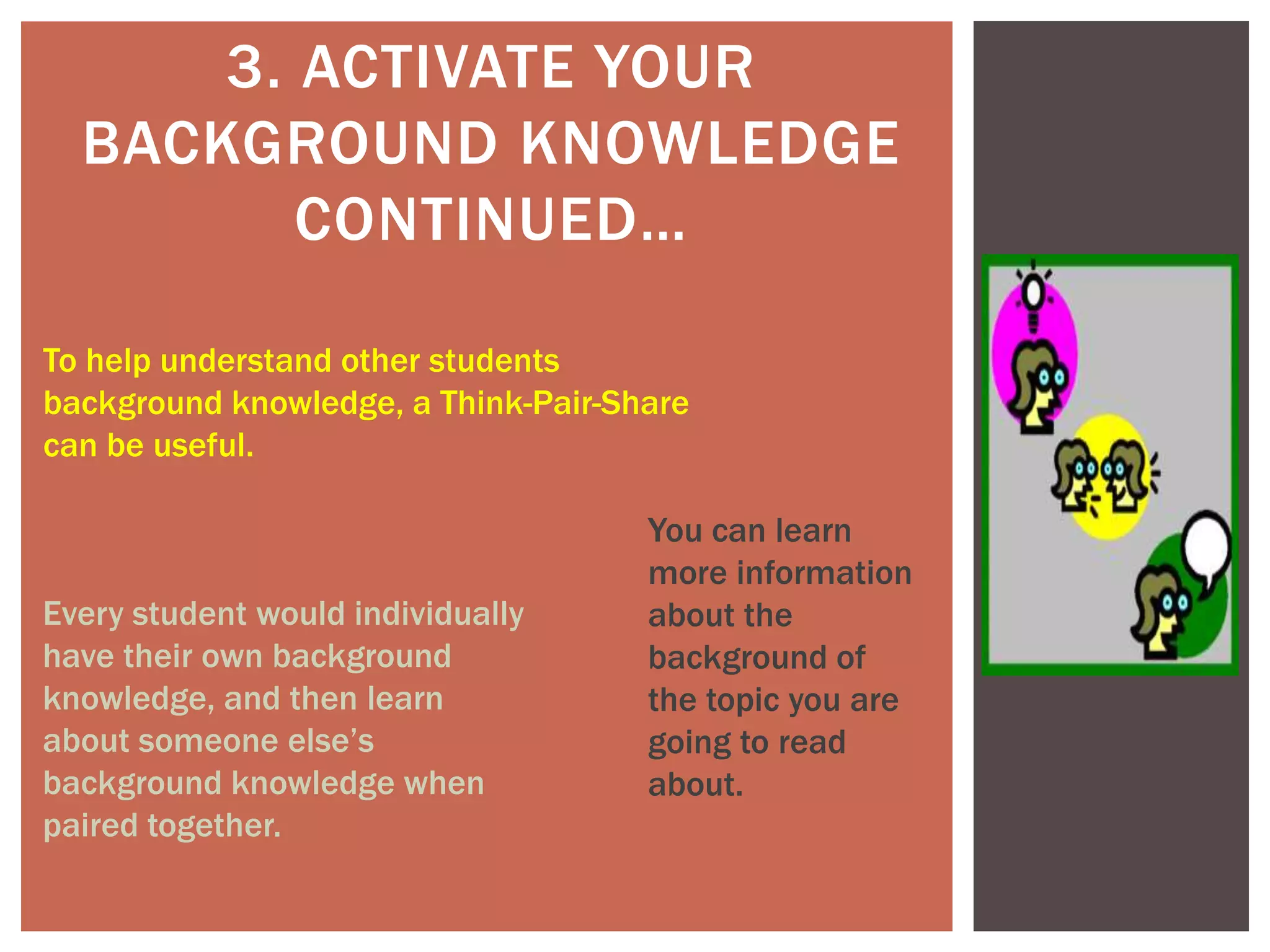
To help understand other students
background knowledge, a Think-Pair-Share
can be useful.
Every student would individually
have their own background
knowledge, and then learn
about someone else’s
background knowledge when
paired together.
You can learn
more information
about the
background of
the topic you are
going to read
about.
Predict what you think you
may discover/find while you
are reading.
4. MAKE PREDICTIONS
Create a list of questions you think
can be answered by reading the
text.
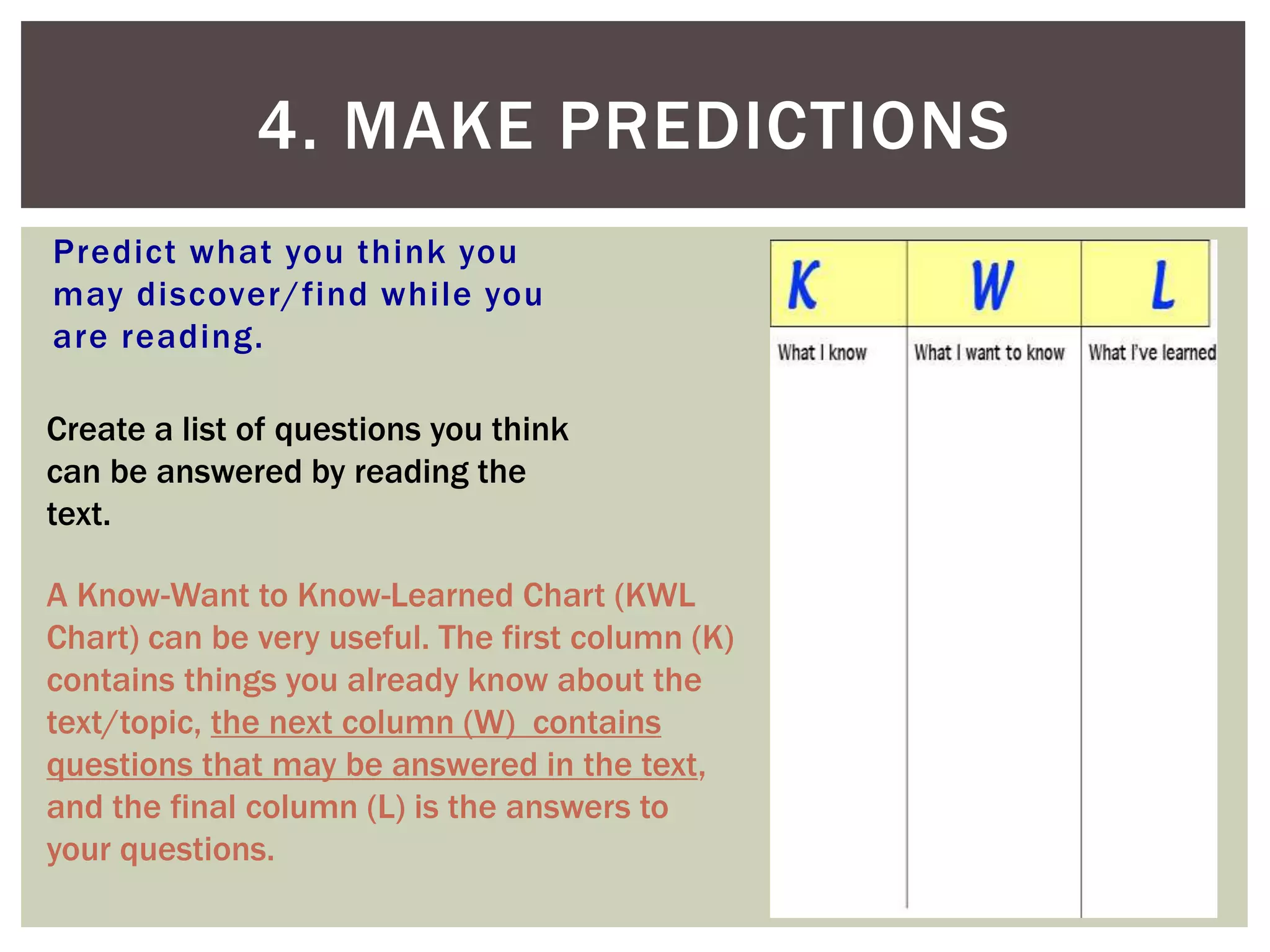
A Know-Want to Know-Learned Chart (KWL
Chart) can be very useful. The first column (K)
contains things you already know about the
text/topic, the next column (W) contains
questions that may be answered in the text,
and the final column (L) is the answers to
your questions.
5. SET YOUR READING SPEED
Setting an appropriate reading
speed can help you to understand
the material more completely.
Different types of writing have
different reading rates, so before
reading you should determine the
proper reading speed.
Speed relates to your reading purpose. Write down
why you are reading and the speed you should read
at to support why you are reading. For example, if I
was reading to find specific information, I would
read slowly and carefully. If I was reading for
enjoyment, I would read in a more relaxed way.
DURING READING
1) Monitor your reading.
2) Visualize what you are
reading.
3) Question throughout the
text.
4) Make connections.
5) Determine the importance
of content.
During reading strategies
help you to stay engaged
throughout your reading
and comprehension.
You can
refer back
to your
notes at
any point
during a
reading to
remember
what was
previously
read.
1. MONITOR YOUR READING
Throughout reading any text you
want to keep asking yourself,
“Do I understand what I just
read?”
This will allow you to know
if it is necessary to reread
certain material or not.
Note-taking guides can be beneficial for students to
ensure that they are comprehending important
material.
Use the information from the
text to create mental images of
what you are reading. This can
help you comprehend what is
occurring throughout the text.
Creating visualizations will help
you recall details and draw
conclusions.
A teacher may provide an
illustration activity, so all
students can see concrete
images of the text content.
2. VISUALIZE
3. QUESTION
Create questions as you are reading a
text. Questions may be:
• What is the author not telling me?
• What is the author’s purpose for this
paragraph?
• What did I learn from this section?
• Did I want to know more about that?
When you question what you read,
you are understanding the text on
a larger scale.
A teacher may post questions
on the board to think of while
reading to provoke deeper
thoughts.
When making connections, you are
using both text information and
background knowledge.
Connections can be made between
ideas, concepts, and people in non-
fiction texts.
This strategy also involves self-
questioning. Some connection
questions you ask yourself are:
 Does this relate to another text I
have read?
 How are these details related to
our current world?
 Does this text relate to my daily
life?
4. MAKE CONNECTIONS
5. DETERMINE IMPORTANCE
Knowing your purpose for reading ties
into determining which information is
important and which is not.
In different texts, you
will read lots of
information that may
not relate to what you
are reading about. By
using a graphic
organizer, you can
ensure that you
understand the most
important
information clearly.
AFTER READING
1) Reflect on what you have
read.
1) Clarify for understanding.
2) Summarize what you have
read.
3) Discuss the new
information.
4) Apply the new information.
After reading strategies
review your understanding
and comprehension of text.
1. REFLECT
Review what you have just read to see if
you understand everything.
Can you identify the purpose for writing?
Can you list important ideas and details?
Did you learn any new vocabulary words?
This strategy
can involve
self-
questioning,
note-taking,
and graphic
organizer use.
If you have questions about the text that you need to
understand, clarifying is a great strategy.
You can go back into the text and reread information to
understand more completely.
Rereading may involve:
 Reading to find the definition of a word.
 Reading a paragraph to understand the purpose.
 Reading a certain section to search for key information.
2. CLARIFY
3. SUMMARIZE
During a summary, you briefly
describe what you have read by
discussing main points.
When summarizing non-fiction,
some things to keep in mind are:
• The main idea of the text.
• The supporting details in the
text.
• Evidence in the text.
• Clear explanations of content.
This strategy
will help you
retain the
information
you read, as
well as check
for
understanding.
Discussions help to improve reading
comprehension because multiple
students are sharing how they used
other reading strategies to
comprehend material.
A class can discuss key questions of a
text through a group Question-
Answer- Relationship Activity (QAR
Activity). Types of QAR questions are:
 Right There Questions- found
directly in the text.
 Think and Share Questions- parts of
a text put together.
 Author and You Questions- think
about what the author has said.
 On My Own Questions- use own
experiences to answer.
4. DISCUSS
This will help
you to
remember the
information
read as well as
understanding
how to use the
information in
real life.
5. APPLY
Tell someone what you read
about in detail and/or use the
new knowledge to enhance
another area of your life.
For example, if you
were reading a non-
fiction text on
protection from
mosquitoes, you can
explain to someone the
importance of
protection and
recommend how to stay
protected in their
everyday lives.
Explain what you have
learned from reading and
if you met your purpose
for reading.
Critical
Assignment #1
RED4348
Kathryn Borruso
REFERENCES
Content References
Bursuck, William D., and Mary Damer. Reading Instruction for Students Who Are at Risk or Have
Disabilities. Boston: Pearson/Allyn and Bacon, 2007. Print.
"Classroom Strategies." Reading Rockets. N.p., n.d. Web. 25 Mar. 2016. <http://
www.readingrockets.org/strategies>.
Roe, Betty D., and Elinor P. Ross. Integrating Language Arts Through Literature and Thematic
Units. Boston, MA: Pearson/A and B, 2006. Print.
Critical
Assignment #1
RED4348
Kathryn Borruso
REFERENCES
Image References
Anchor Charts. Digital image. Pinterest. N.p., n.d. Web. <https://www.pinterest.com/quinnate2/
anchor-charts/>.
Arussell. Digital image. Wiki PB Works. N.p., n.d. Web. <http://arussell.pbworks.com/w/page/
69681/FrontPage>.
Beckert, Allison. Writing Tips & Creative Theory. Digital image. Art of Stories. N.p., n.d. Web.
<http://art-of-stories.com/writing-tools-narrative-summary/>.
Book Clipart. Digital image. Pinterest. N.p., n.d. Web. <https://www.pinterest.com/pin/
158540849355142597/>.
Comprehension Strategies After Reading. Digital image. Play to Learn. N.p., n.d. Web. <http://
playtolearnpreschool.us/comprehension-strategies-after-reading/>.
Comprehension Strategies Before Reading. Digital image. Play to Learn. N.p., n.d. Web. <http://
playtolearnpreschool.us/comprehension-strategies-before-reading/>.
Comprehension Strategies During Reading. Digital image. Play to Learn. N.p., n.d. Web. <http://
playtolearnpreschool.us/comprehension-strategies-during-reading/>.
Critical
Assignment #1
RED4348
Kathryn Borruso
REFERENCES
Image References
Detective Clip Art. Digital image. ClipArts. N.p., n.d. Web. <http://cliparts.co/detective-clip-art>.
Digital image. Clip Art Panda. N.p., n.d. Web. <http://www.clipartpanda.com/categories/
pseudonym-clipart>.
Digital image. Help For Struggling Readers. N.p., n.d. Web. <http://
helpforstrugglingreaders.blogspot.com/2012_06_01_archive.html>.
Digital image. Ladybug's Teacher Files. N.p., n.d. Web. <http://www.ladybugsteacherfiles.com/
2011_05_01_archive.html>.
Digital image. My Cute Graphics. N.p., n.d. Web. <http://www.franklin.provo.edu/Site_School/
0015/index0015.htm>.
Digital image. TEFLReflections Word Press. N.p., n.d. Web. <https://
teflreflections.wordpress.com/tag/reading-for-gist/>.
Digital image. 3rd Grade Reading Parade Word Press. N.p., n.d. Web. <https://
rxt027.wordpress.com/author/rxt027/>.
Effective Reading Comprehension Strategies. Digital image. SCP.HBSD.CA Library. N.p., n.d. Web.
<http://scp.hdsb.ca/content/other%20sites/library/?
OpenItemURL=S13BF044C>.
Critical
Assignment #1
RED4348
Kathryn Borruso
REFERENCES
Image References
Godfrey. Student Success. Digital image. Mrs. Godfrey's Class Weebly. N.p., n.d. Web. <http://
mrsgodfreysclass.weebly.com/student-success.html>.
KWL Chart. Digital image. WIkis Engrade. N.p., n.d. Web. <https://wikis.engrade.com/
kwlreading>.
Ramsden, Susan. A Deep Breath Moment. Digital image. Coetail. N.p., n.d. Web. <https://
www.coetail.com/ramsdensuzy/2015/09/20/what-if/>.
Reading Comprehension. Digital image. Pinterest. N.p., n.d. Web. <https://www.pinterest.com/
santillanam/reading-comprehension/>.
Reading Resources. Digital image. Franklin Elementary School. N.p., n.d. Web. <http://
www.franklin.provo.edu/Site_School/0015/index0015.htm>.
Think Pair Share Strategy. Digital image. Angelenes Virtual Tool Bag. N.p., n.d. Web. <https://
angelenesvirtualtoolbag.wikispaces.com/Think-Pair-Share+Strategy>.
Word Web. Digital image. Pinterest. N.p., n.d. Web. <https://www.pinterest.com/pin/
195977021254321552/>.

RED4348 Critical Assignment #1

  • 1.
    Critical Assignment #1 RED4348 Kathryn Borruso READINGSTRATEGIES FOR BEFORE, DURING, AND AFTER READING
  • 2.
    BEFORE YOU BEGINREADING 1) Set a purpose for reading. 1) Preview what you are going to read. 2) Activate your background knowledge. 3) Make predictions about what you will read. 1) Set your reading speed. Reading preparation is important because it affects how you comprehend what you read.
  • 3.
    Setting a purpose defines and supports the reason(s) why you are readinga certain text. 1. SET A PURPOSE FOR READING Why do you want to read a certain text? You: • Need information on a certain topic. • Are reading for enjoyment. • Need to make a decision on a topic. • Are curious to begin learning about a subject. • Want to build/create something.
  • 4.
    There are multiplebenefits of previewing what you are going to read. Some of the benefits are:  Noticing any new vocabulary words.  Gaining an idea about the content of what you will be reading.  Increasing an interest in reading the text. During the preview stage, you should:  Look at the titles and headings.  Look at the pictures and graphics.  Skim through the text. 2. PREVIEW WHAT YOU ARE GOING TO READ
  • 5.
    Word Webs canbe beneficial when noticing words that aren’t familiar to you. Before you begin reading, you can create a word web to jot down any information you think you know about the word, and then use the word web while reading to define the word. 2. PREVIEW WHAT YOU ARE GOING TO READ CONTINUED…
  • 6.
    3. ACTIVATE YOUR BACKGROUNDKNOWLEDGE Connecting previous knowledge with new knowledge. To understand and comprehend text, you need to access your prior knowledge on the subject. For example, when reading about hurricanes that have impacted Florida, students who have lived in Florida and experienced hurricanes would understand the text content more than someone who doesn’t know about hurricanes in Florida.
  • 7.
    3. ACTIVATE YOUR BACKGROUNDKNOWLEDGE CONTINUED… To help understand other students background knowledge, a Think-Pair-Share can be useful. Every student would individually have their own background knowledge, and then learn about someone else’s background knowledge when paired together. You can learn more information about the background of the topic you are going to read about.
  • 8.
    Predict what youthink you may discover/find while you are reading. 4. MAKE PREDICTIONS Create a list of questions you think can be answered by reading the text. A Know-Want to Know-Learned Chart (KWL Chart) can be very useful. The first column (K) contains things you already know about the text/topic, the next column (W) contains questions that may be answered in the text, and the final column (L) is the answers to your questions.
  • 9.
    5. SET YOURREADING SPEED Setting an appropriate reading speed can help you to understand the material more completely. Different types of writing have different reading rates, so before reading you should determine the proper reading speed. Speed relates to your reading purpose. Write down why you are reading and the speed you should read at to support why you are reading. For example, if I was reading to find specific information, I would read slowly and carefully. If I was reading for enjoyment, I would read in a more relaxed way.
  • 10.
    DURING READING 1) Monitoryour reading. 2) Visualize what you are reading. 3) Question throughout the text. 4) Make connections. 5) Determine the importance of content. During reading strategies help you to stay engaged throughout your reading and comprehension.
  • 11.
    You can refer back toyour notes at any point during a reading to remember what was previously read. 1. MONITOR YOUR READING Throughout reading any text you want to keep asking yourself, “Do I understand what I just read?” This will allow you to know if it is necessary to reread certain material or not. Note-taking guides can be beneficial for students to ensure that they are comprehending important material.
  • 12.
    Use the informationfrom the text to create mental images of what you are reading. This can help you comprehend what is occurring throughout the text. Creating visualizations will help you recall details and draw conclusions. A teacher may provide an illustration activity, so all students can see concrete images of the text content. 2. VISUALIZE
  • 13.
    3. QUESTION Create questionsas you are reading a text. Questions may be: • What is the author not telling me? • What is the author’s purpose for this paragraph? • What did I learn from this section? • Did I want to know more about that? When you question what you read, you are understanding the text on a larger scale. A teacher may post questions on the board to think of while reading to provoke deeper thoughts.
  • 14.
    When making connections,you are using both text information and background knowledge. Connections can be made between ideas, concepts, and people in non- fiction texts. This strategy also involves self- questioning. Some connection questions you ask yourself are:  Does this relate to another text I have read?  How are these details related to our current world?  Does this text relate to my daily life? 4. MAKE CONNECTIONS
  • 15.
    5. DETERMINE IMPORTANCE Knowingyour purpose for reading ties into determining which information is important and which is not. In different texts, you will read lots of information that may not relate to what you are reading about. By using a graphic organizer, you can ensure that you understand the most important information clearly.
  • 16.
    AFTER READING 1) Reflecton what you have read. 1) Clarify for understanding. 2) Summarize what you have read. 3) Discuss the new information. 4) Apply the new information. After reading strategies review your understanding and comprehension of text.
  • 17.
    1. REFLECT Review whatyou have just read to see if you understand everything. Can you identify the purpose for writing? Can you list important ideas and details? Did you learn any new vocabulary words? This strategy can involve self- questioning, note-taking, and graphic organizer use.
  • 18.
    If you havequestions about the text that you need to understand, clarifying is a great strategy. You can go back into the text and reread information to understand more completely. Rereading may involve:  Reading to find the definition of a word.  Reading a paragraph to understand the purpose.  Reading a certain section to search for key information. 2. CLARIFY
  • 19.
    3. SUMMARIZE During asummary, you briefly describe what you have read by discussing main points. When summarizing non-fiction, some things to keep in mind are: • The main idea of the text. • The supporting details in the text. • Evidence in the text. • Clear explanations of content. This strategy will help you retain the information you read, as well as check for understanding.
  • 20.
    Discussions help toimprove reading comprehension because multiple students are sharing how they used other reading strategies to comprehend material. A class can discuss key questions of a text through a group Question- Answer- Relationship Activity (QAR Activity). Types of QAR questions are:  Right There Questions- found directly in the text.  Think and Share Questions- parts of a text put together.  Author and You Questions- think about what the author has said.  On My Own Questions- use own experiences to answer. 4. DISCUSS
  • 21.
    This will help youto remember the information read as well as understanding how to use the information in real life. 5. APPLY Tell someone what you read about in detail and/or use the new knowledge to enhance another area of your life. For example, if you were reading a non- fiction text on protection from mosquitoes, you can explain to someone the importance of protection and recommend how to stay protected in their everyday lives. Explain what you have learned from reading and if you met your purpose for reading.
  • 22.
    Critical Assignment #1 RED4348 Kathryn Borruso REFERENCES ContentReferences Bursuck, William D., and Mary Damer. Reading Instruction for Students Who Are at Risk or Have Disabilities. Boston: Pearson/Allyn and Bacon, 2007. Print. "Classroom Strategies." Reading Rockets. N.p., n.d. Web. 25 Mar. 2016. <http:// www.readingrockets.org/strategies>. Roe, Betty D., and Elinor P. Ross. Integrating Language Arts Through Literature and Thematic Units. Boston, MA: Pearson/A and B, 2006. Print.
  • 23.
    Critical Assignment #1 RED4348 Kathryn Borruso REFERENCES ImageReferences Anchor Charts. Digital image. Pinterest. N.p., n.d. Web. <https://www.pinterest.com/quinnate2/ anchor-charts/>. Arussell. Digital image. Wiki PB Works. N.p., n.d. Web. <http://arussell.pbworks.com/w/page/ 69681/FrontPage>. Beckert, Allison. Writing Tips & Creative Theory. Digital image. Art of Stories. N.p., n.d. Web. <http://art-of-stories.com/writing-tools-narrative-summary/>. Book Clipart. Digital image. Pinterest. N.p., n.d. Web. <https://www.pinterest.com/pin/ 158540849355142597/>. Comprehension Strategies After Reading. Digital image. Play to Learn. N.p., n.d. Web. <http:// playtolearnpreschool.us/comprehension-strategies-after-reading/>. Comprehension Strategies Before Reading. Digital image. Play to Learn. N.p., n.d. Web. <http:// playtolearnpreschool.us/comprehension-strategies-before-reading/>. Comprehension Strategies During Reading. Digital image. Play to Learn. N.p., n.d. Web. <http:// playtolearnpreschool.us/comprehension-strategies-during-reading/>.
  • 24.
    Critical Assignment #1 RED4348 Kathryn Borruso REFERENCES ImageReferences Detective Clip Art. Digital image. ClipArts. N.p., n.d. Web. <http://cliparts.co/detective-clip-art>. Digital image. Clip Art Panda. N.p., n.d. Web. <http://www.clipartpanda.com/categories/ pseudonym-clipart>. Digital image. Help For Struggling Readers. N.p., n.d. Web. <http:// helpforstrugglingreaders.blogspot.com/2012_06_01_archive.html>. Digital image. Ladybug's Teacher Files. N.p., n.d. Web. <http://www.ladybugsteacherfiles.com/ 2011_05_01_archive.html>. Digital image. My Cute Graphics. N.p., n.d. Web. <http://www.franklin.provo.edu/Site_School/ 0015/index0015.htm>. Digital image. TEFLReflections Word Press. N.p., n.d. Web. <https:// teflreflections.wordpress.com/tag/reading-for-gist/>. Digital image. 3rd Grade Reading Parade Word Press. N.p., n.d. Web. <https:// rxt027.wordpress.com/author/rxt027/>. Effective Reading Comprehension Strategies. Digital image. SCP.HBSD.CA Library. N.p., n.d. Web. <http://scp.hdsb.ca/content/other%20sites/library/? OpenItemURL=S13BF044C>.
  • 25.
    Critical Assignment #1 RED4348 Kathryn Borruso REFERENCES ImageReferences Godfrey. Student Success. Digital image. Mrs. Godfrey's Class Weebly. N.p., n.d. Web. <http:// mrsgodfreysclass.weebly.com/student-success.html>. KWL Chart. Digital image. WIkis Engrade. N.p., n.d. Web. <https://wikis.engrade.com/ kwlreading>. Ramsden, Susan. A Deep Breath Moment. Digital image. Coetail. N.p., n.d. Web. <https:// www.coetail.com/ramsdensuzy/2015/09/20/what-if/>. Reading Comprehension. Digital image. Pinterest. N.p., n.d. Web. <https://www.pinterest.com/ santillanam/reading-comprehension/>. Reading Resources. Digital image. Franklin Elementary School. N.p., n.d. Web. <http:// www.franklin.provo.edu/Site_School/0015/index0015.htm>. Think Pair Share Strategy. Digital image. Angelenes Virtual Tool Bag. N.p., n.d. Web. <https:// angelenesvirtualtoolbag.wikispaces.com/Think-Pair-Share+Strategy>. Word Web. Digital image. Pinterest. N.p., n.d. Web. <https://www.pinterest.com/pin/ 195977021254321552/>.