ACTIVE READING & NOTE TAKING STRATEGIES This presentation was created following the Fair Use Guidelines for  Educational Multimedia. Certain materials are included under the  Fair Use exemption of the U.S. Copyright Law.  Further use of these materials and this presentation is restricted.
In order to be a truly successful reader of anything you must learn to have a conversation with the text and meaningful interaction with the words and ideas. There are a number of methods for recording textual information in order to have your own conversation as well as to guide your discussion with others.
There is no right or wrong method. I would like you to try each one and then use the method you like best.  For certain texts/assignments I will require a specific method otherwise use the one you like best.  Do make sure you practice active reading; you will gain and retain more, as well as be a stronger participant in guided discussions.
ANNOTATION Read with a pencil, making marks, notes, comments etc. as you read, specifically looking for the “big three”:  Purpose:  What is the purpose? Why was it published? What is the reader to learn? Frame:  How did the author help me to understand or access the purpose? What clues were used throughout? Tone:  What is the author/speaker’s attitude/tone toward his/her subject and audience?
DIALECTICAL OR DUAL ENTRY JOURNALS Double entry note taking that involves recording textual information with an appropriate source reference in the left column and the reader’s response in the right.  See example.
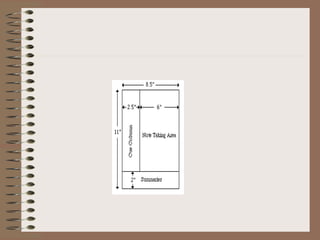
CORNELL NOTE-TAKING Formal note-taking method Includes a header which includes all documentation information Cues or questions in the left column Copious traditional notes in the right and a summary at the bottom. Helpful for dense information Info needed in long-term memory Feel free to play around designing pre-made pages at  www.eleven21.com/notetaker/
 
RHETORICAL PR ÈCIS/SUMMARY Before one earns the right to express an opinion one should prove that one understands what was read. The 4-sentence formula and the “introductory first sentence” with rhetorically specific verbs helps a reader better articulate his/her ideas in a concise and clear form.  (see Rhe torical Prècis handout)
READING GUIDE Following given guidelines  (see Reading Guide Instructions and Rhetorical Pr ècis handouts)  the reader is accountable for his/her own learning and textual interaction. Readers author a summary  (using Prècis format)  excerpt pivotal quotes, construct a set of context-driven questions and create or reproduce a visual aid that stands for the text  (example presented in class).
BIG CHUNKS Consider the “big chunks” about the information you read. The purpose is to highlight major pieces of information when a text covers a significant range of details, as your time period background does. (Two additional techniques will also be provided to help you do this.)
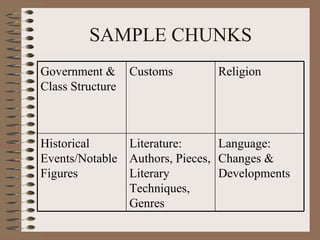
SAMPLE CHUNKS Language: Changes & Developments Literature: Authors, Pieces, Literary Techniques, Genres Historical Events/Notable Figures Religion Customs Government & Class Structure
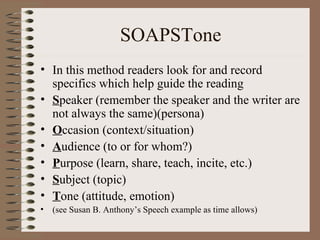
SOAPSTone In this method readers look for and record specifics which help guide the reading S peaker (remember the speaker and the writer are not always the same)(persona) O ccasion (context/situation) A udience (to or for whom?) P urpose (learn, share, teach, incite, etc.) S ubject (topic) T one (attitude, emotion) (see Susan B. Anthony’s Speech example as time allows)
One more acronym For MATURE Audiences ONLY
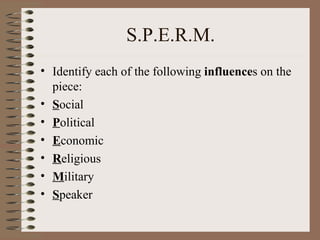
S.P.E.R.M. Identify each of the following  influence s on the piece: S ocial P olitical E conomic R eligious M ilitary S peaker
ACTIVE READING Remember that no matter which “note-taking” strategy you use, you are expected to be mentally active. It is a VERB! Your brain must be DOING something, not just an exercise for your eye movement in a back and forth pattern! Continually ask questions and make connections.
LEVELS OF QUESTIONS FACTUAL:  one answer, retrieval information. EVALUATIVE:  one answer, personal, positive or negative based upon retrieval information. INTERPRETATIVE:  “why?” has multiple answers, can extrapolate the information to a new situation. If you can create a question with at least two possible “correct” answers then you have an interpretive level question. When using interpretative level with a text make sure you use a quote to support your answer and explain why.  (Relates to Bloom’s Taxonomy)
Adapted from Wynn Perdue’s English Language and Composition Workshop held June 2007 and a compilation of workshop materials and discussion.

Active reading & note taking

  • 1.
    ACTIVE READING &NOTE TAKING STRATEGIES This presentation was created following the Fair Use Guidelines for Educational Multimedia. Certain materials are included under the Fair Use exemption of the U.S. Copyright Law. Further use of these materials and this presentation is restricted.
  • 2.
    In order tobe a truly successful reader of anything you must learn to have a conversation with the text and meaningful interaction with the words and ideas. There are a number of methods for recording textual information in order to have your own conversation as well as to guide your discussion with others.
  • 3.
    There is noright or wrong method. I would like you to try each one and then use the method you like best. For certain texts/assignments I will require a specific method otherwise use the one you like best. Do make sure you practice active reading; you will gain and retain more, as well as be a stronger participant in guided discussions.
  • 4.
    ANNOTATION Read witha pencil, making marks, notes, comments etc. as you read, specifically looking for the “big three”: Purpose: What is the purpose? Why was it published? What is the reader to learn? Frame: How did the author help me to understand or access the purpose? What clues were used throughout? Tone: What is the author/speaker’s attitude/tone toward his/her subject and audience?
  • 5.
    DIALECTICAL OR DUALENTRY JOURNALS Double entry note taking that involves recording textual information with an appropriate source reference in the left column and the reader’s response in the right. See example.
  • 6.
    CORNELL NOTE-TAKING Formalnote-taking method Includes a header which includes all documentation information Cues or questions in the left column Copious traditional notes in the right and a summary at the bottom. Helpful for dense information Info needed in long-term memory Feel free to play around designing pre-made pages at www.eleven21.com/notetaker/
  • 7.
  • 8.
    RHETORICAL PR ÈCIS/SUMMARYBefore one earns the right to express an opinion one should prove that one understands what was read. The 4-sentence formula and the “introductory first sentence” with rhetorically specific verbs helps a reader better articulate his/her ideas in a concise and clear form. (see Rhe torical Prècis handout)
  • 9.
    READING GUIDE Followinggiven guidelines (see Reading Guide Instructions and Rhetorical Pr ècis handouts) the reader is accountable for his/her own learning and textual interaction. Readers author a summary (using Prècis format) excerpt pivotal quotes, construct a set of context-driven questions and create or reproduce a visual aid that stands for the text (example presented in class).
  • 10.
    BIG CHUNKS Considerthe “big chunks” about the information you read. The purpose is to highlight major pieces of information when a text covers a significant range of details, as your time period background does. (Two additional techniques will also be provided to help you do this.)
  • 11.
    SAMPLE CHUNKS Language:Changes & Developments Literature: Authors, Pieces, Literary Techniques, Genres Historical Events/Notable Figures Religion Customs Government & Class Structure
  • 12.
    SOAPSTone In thismethod readers look for and record specifics which help guide the reading S peaker (remember the speaker and the writer are not always the same)(persona) O ccasion (context/situation) A udience (to or for whom?) P urpose (learn, share, teach, incite, etc.) S ubject (topic) T one (attitude, emotion) (see Susan B. Anthony’s Speech example as time allows)
  • 13.
    One more acronymFor MATURE Audiences ONLY
  • 14.
    S.P.E.R.M. Identify eachof the following influence s on the piece: S ocial P olitical E conomic R eligious M ilitary S peaker
  • 15.
    ACTIVE READING Rememberthat no matter which “note-taking” strategy you use, you are expected to be mentally active. It is a VERB! Your brain must be DOING something, not just an exercise for your eye movement in a back and forth pattern! Continually ask questions and make connections.
  • 16.
    LEVELS OF QUESTIONSFACTUAL: one answer, retrieval information. EVALUATIVE: one answer, personal, positive or negative based upon retrieval information. INTERPRETATIVE: “why?” has multiple answers, can extrapolate the information to a new situation. If you can create a question with at least two possible “correct” answers then you have an interpretive level question. When using interpretative level with a text make sure you use a quote to support your answer and explain why. (Relates to Bloom’s Taxonomy)
  • 17.
    Adapted from WynnPerdue’s English Language and Composition Workshop held June 2007 and a compilation of workshop materials and discussion.