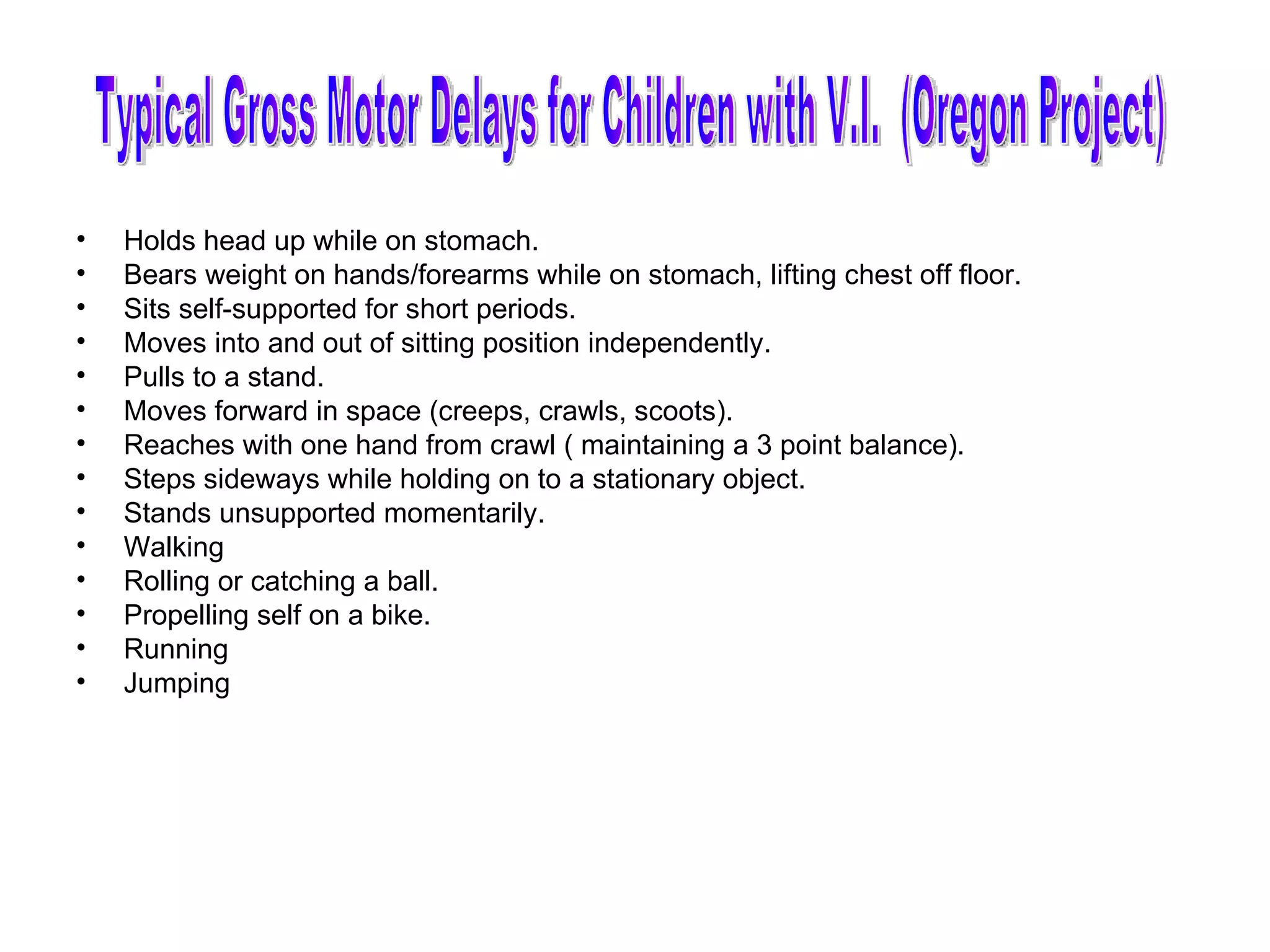
Holds head up while on stomach. Bears weight on hands/forearms while on stomach, lifting chest off floor. Sits self-supported for short periods. Moves into and out of sitting position independently. Pulls to a stand. Moves forward in space (creeps, crawls, scoots). Reaches with one hand from crawl ( maintaining a 3 point balance). Steps sideways while holding on to a stationary object. Stands unsupported momentarily. Walking Rolling or catching a ball. Propelling self on a bike. Running Jumping Typical Gross Motor Delays for Children with V.I.  (Oregon Project)
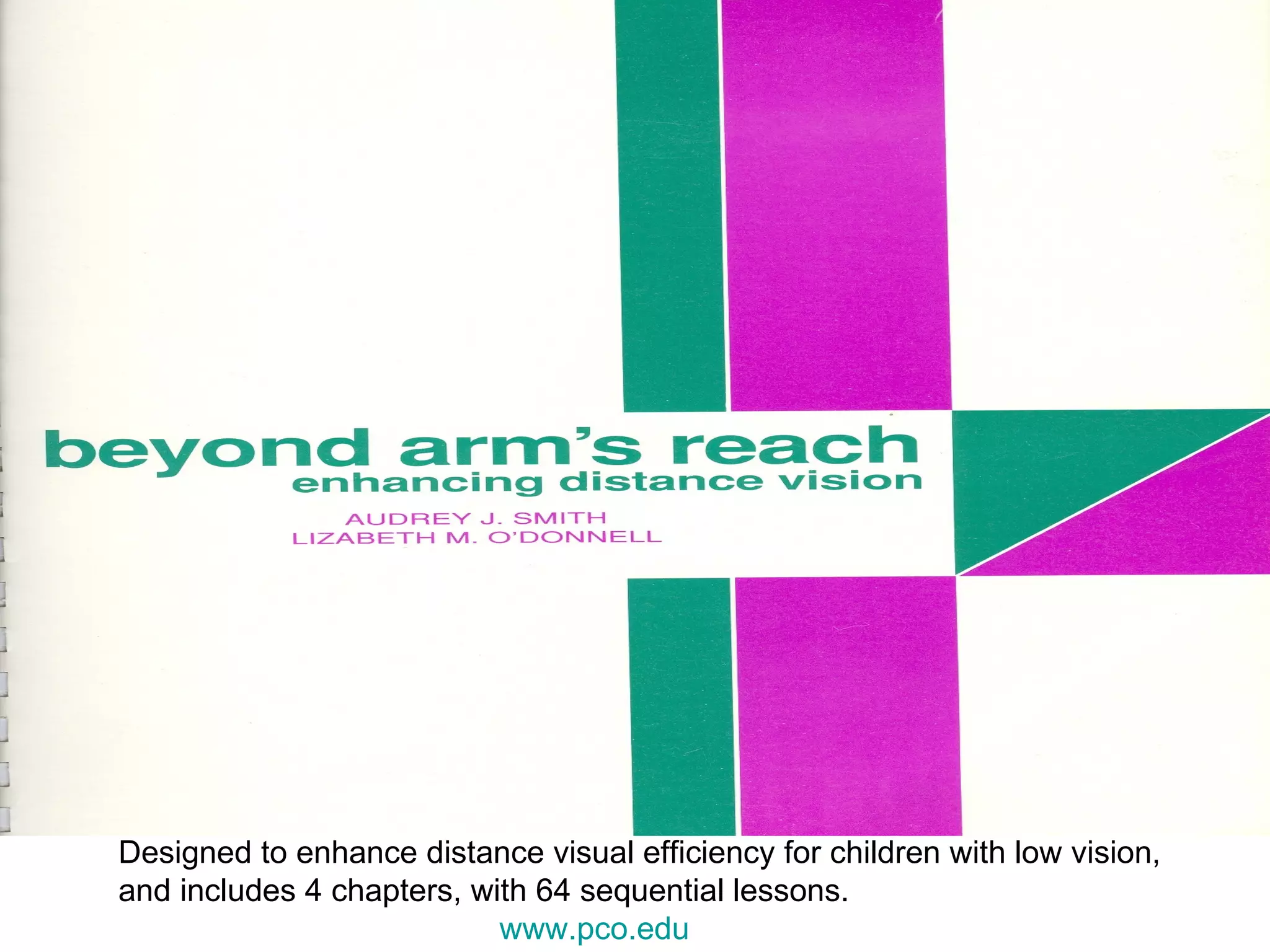
Designed to enhance distance visual efficiency for children with low vision, and includes 4 chapters, with 64 sequential lessons. www.pco.edu
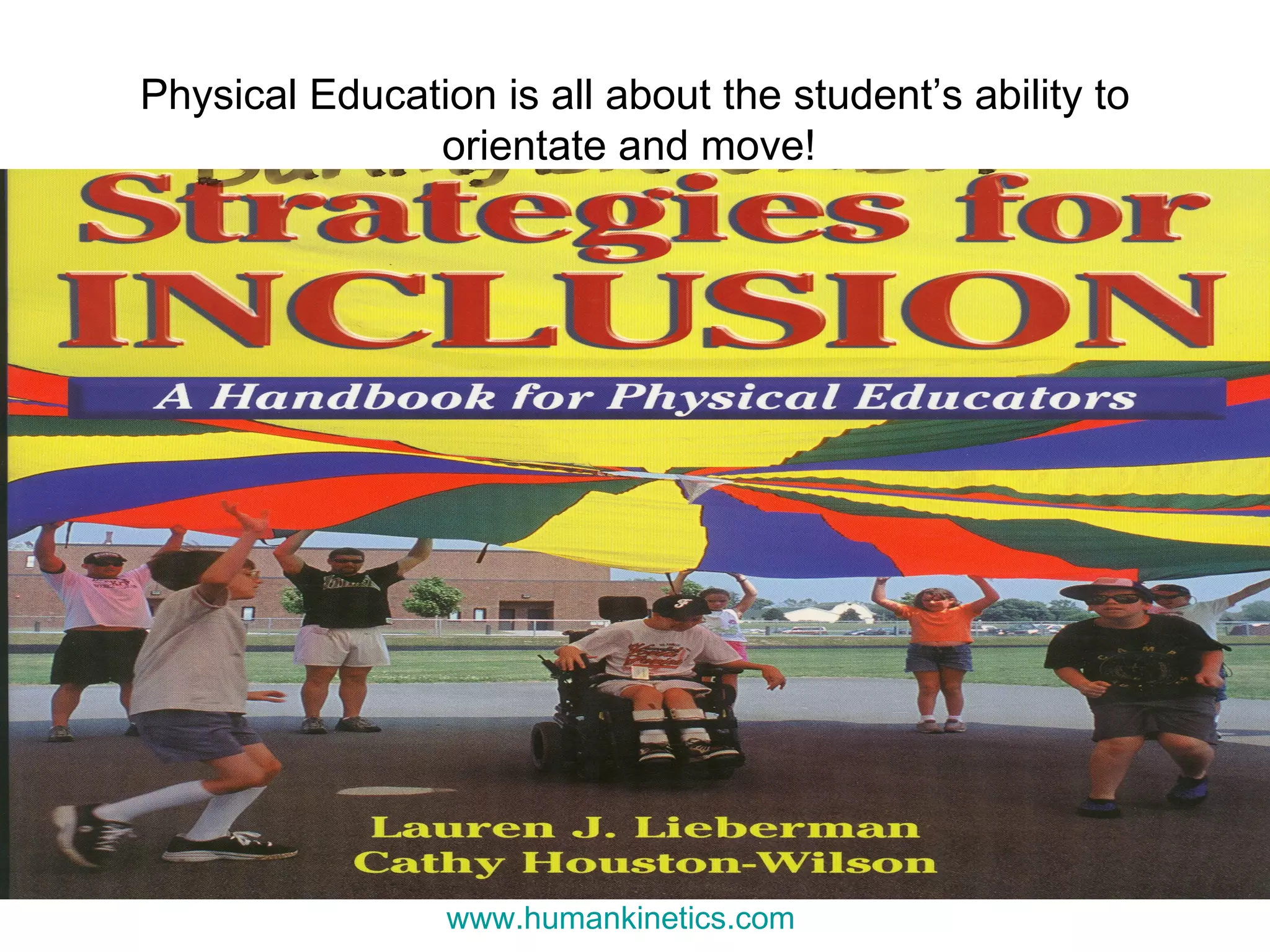
Physical Education is all about the student’s ability to orientate and move!  www.humankinetics.com
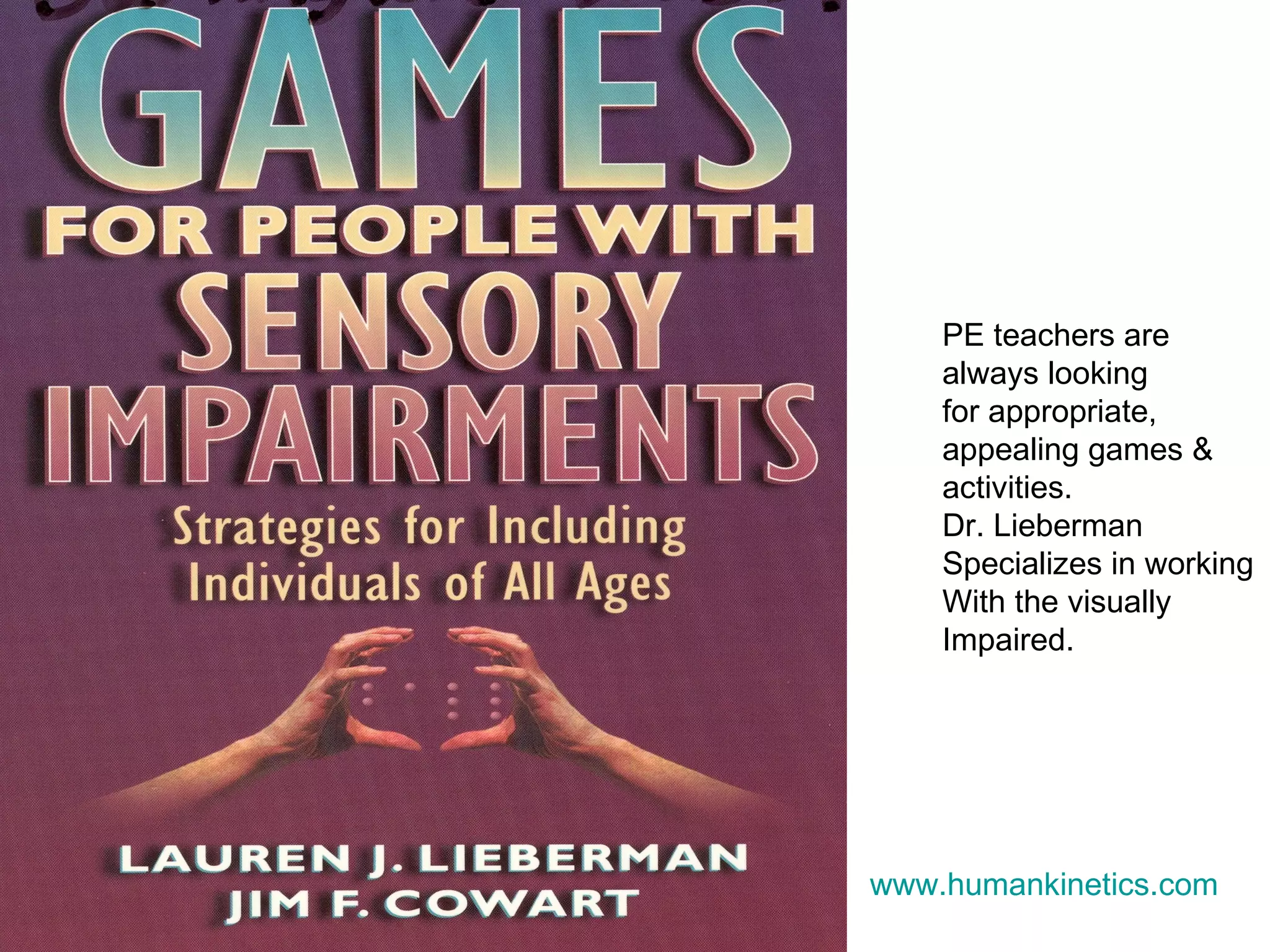
www.humankinetics.com   PE teachers are  always looking  for appropriate,  appealing games &  activities.  Dr. Lieberman Specializes in working  With the visually Impaired.
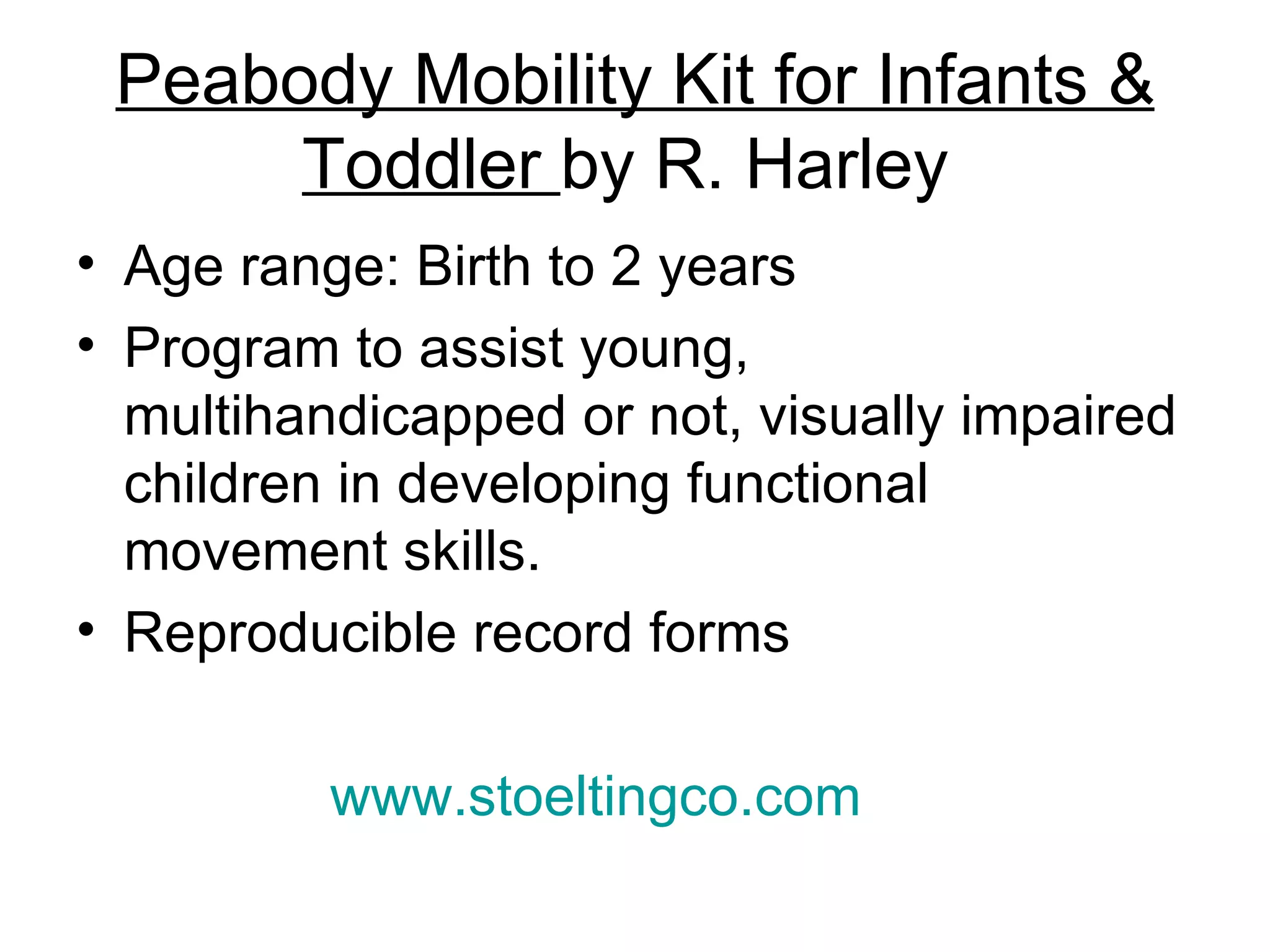
Peabody Mobility Kit for Infants & Toddler  by R. Harley  Age range: Birth to 2 years Program to assist young, multihandicapped or not, visually impaired children in developing functional movement skills. Reproducible record forms  www.stoeltingco.com
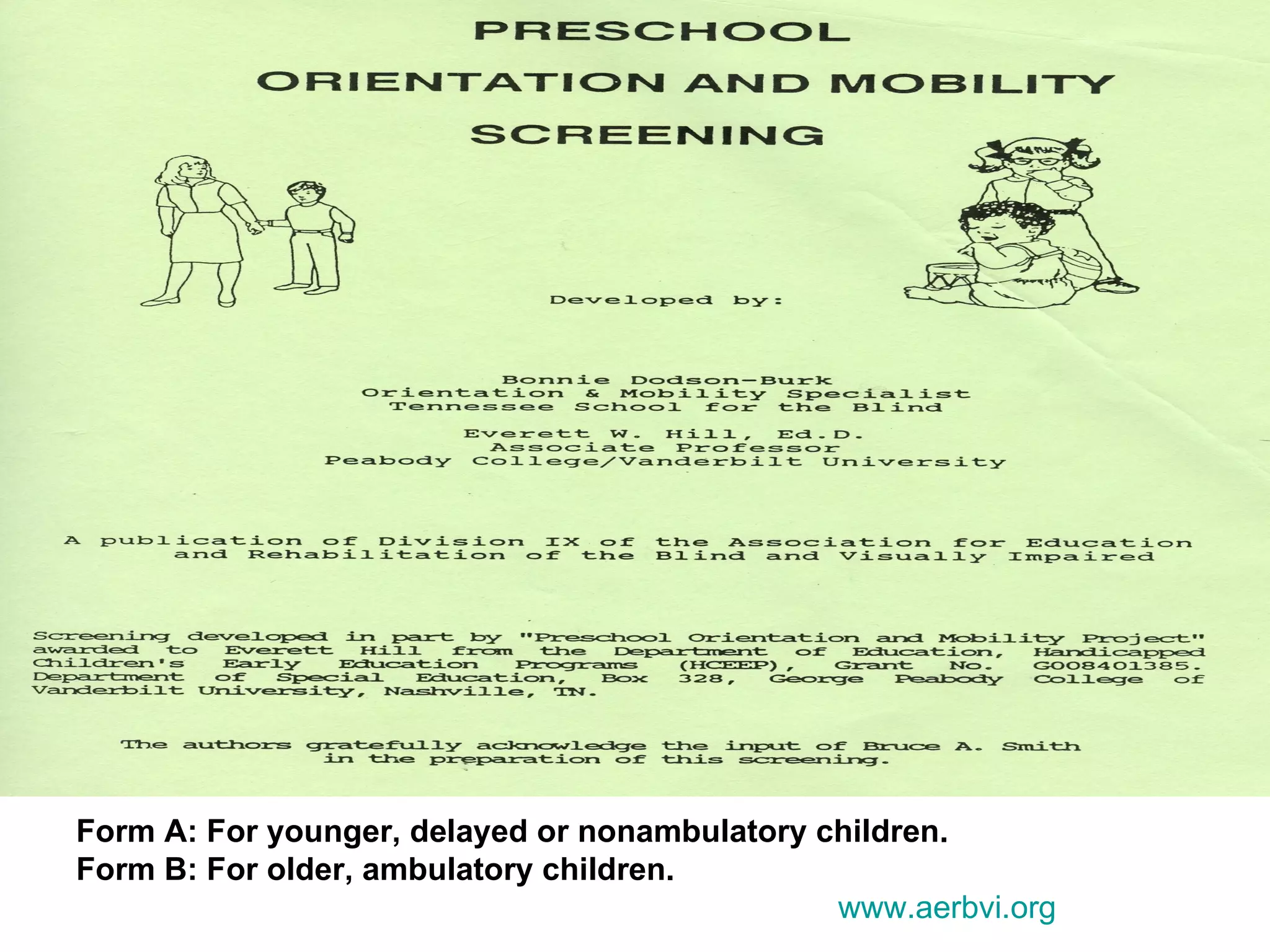
Form A: For younger, delayed or nonambulatory children. Form B: For older, ambulatory children.  www.aerbvi.org
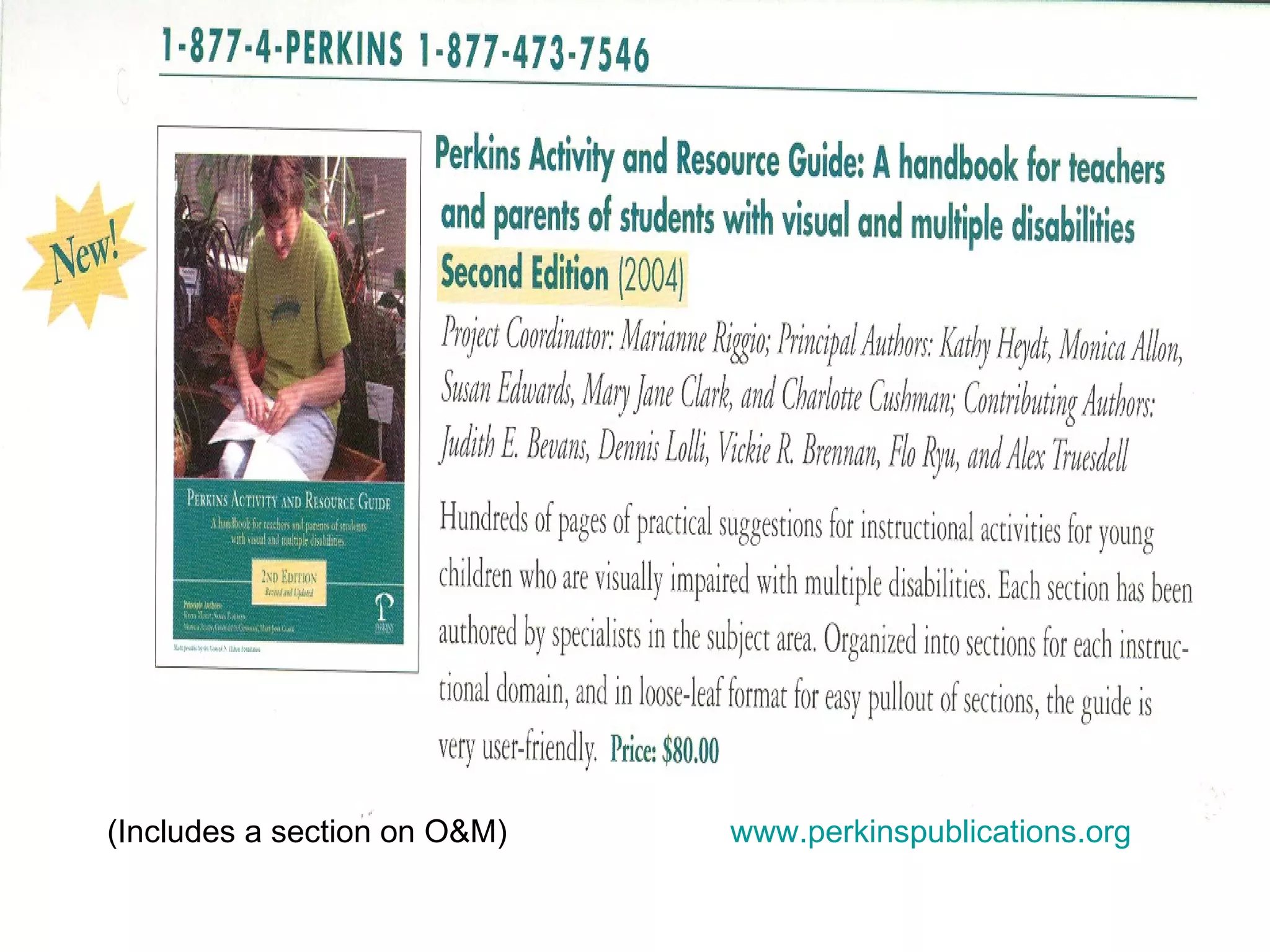
www.perkinspublications.org   (Includes a section on O&M)
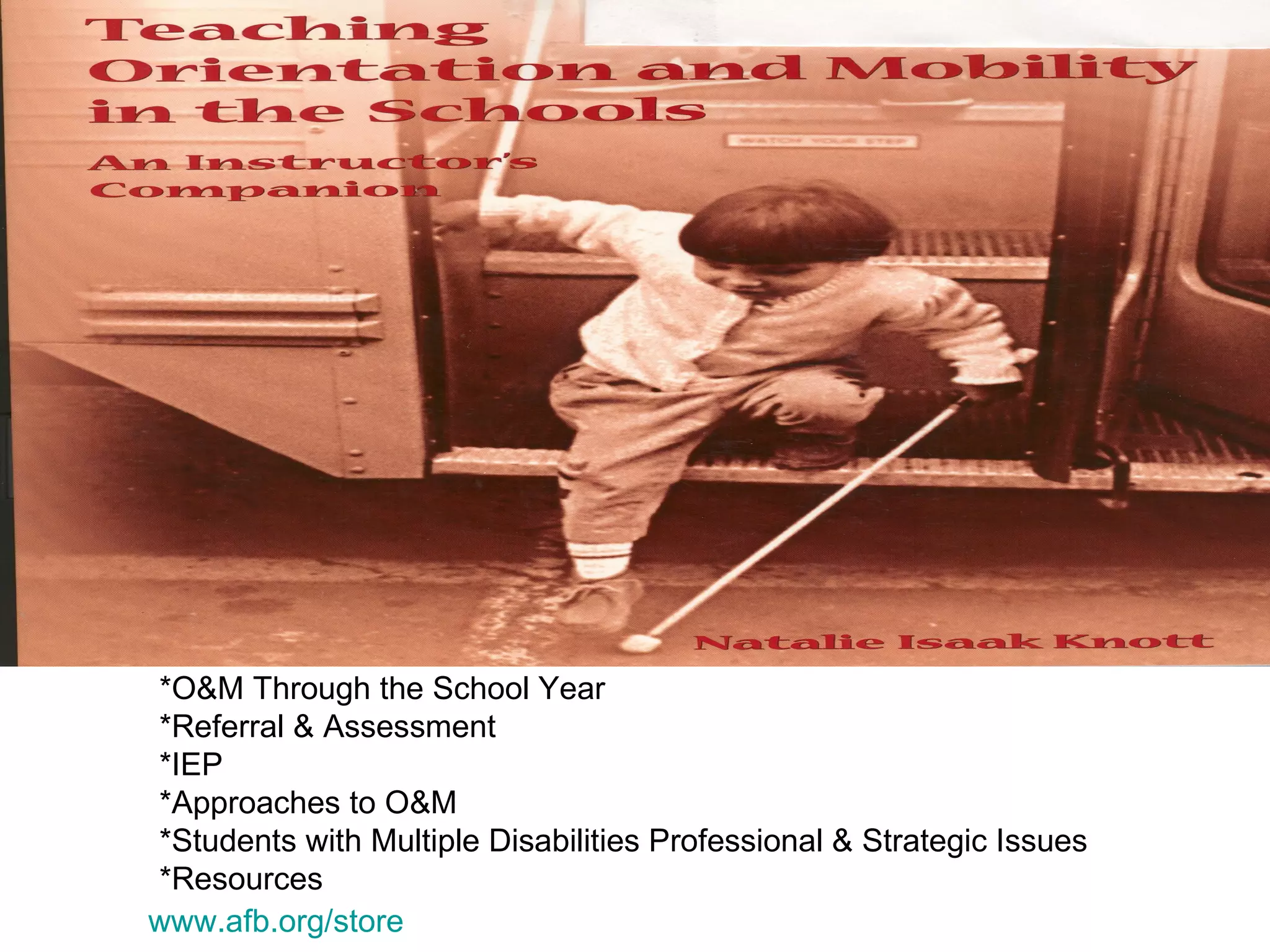
www.afb.org/store   *O&M Through the School Year *Referral & Assessment *IEP *Approaches to O&M *Students with Multiple Disabilities Professional & Strategic Issues *Resources
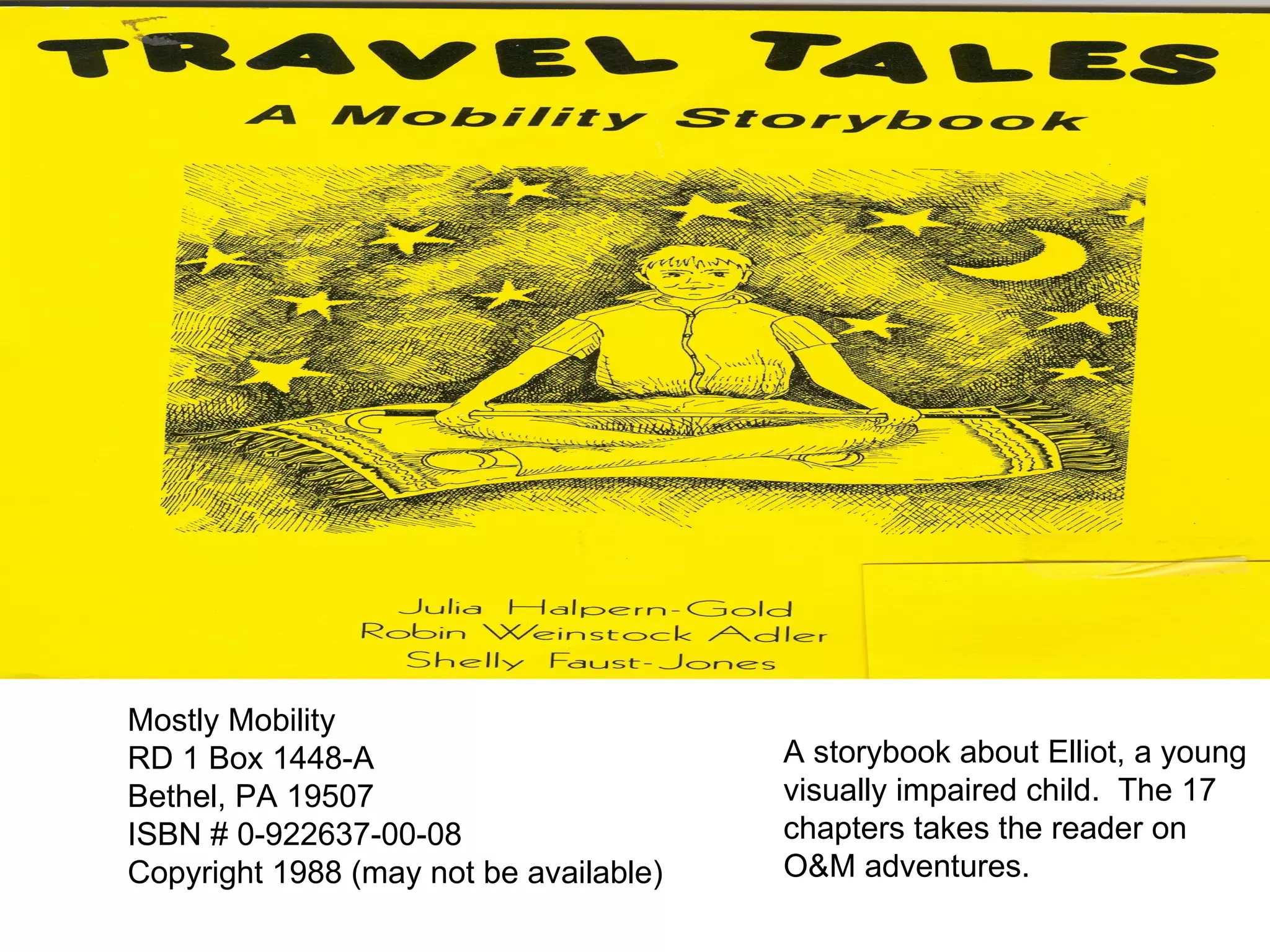
Mostly Mobility RD 1 Box 1448-A Bethel, PA 19507 ISBN # 0-922637-00-08  Copyright 1988 (may not be available) A storybook about Elliot, a young  visually impaired child.  The 17  chapters takes the reader on  O&M adventures.
www.tsbvi.edu
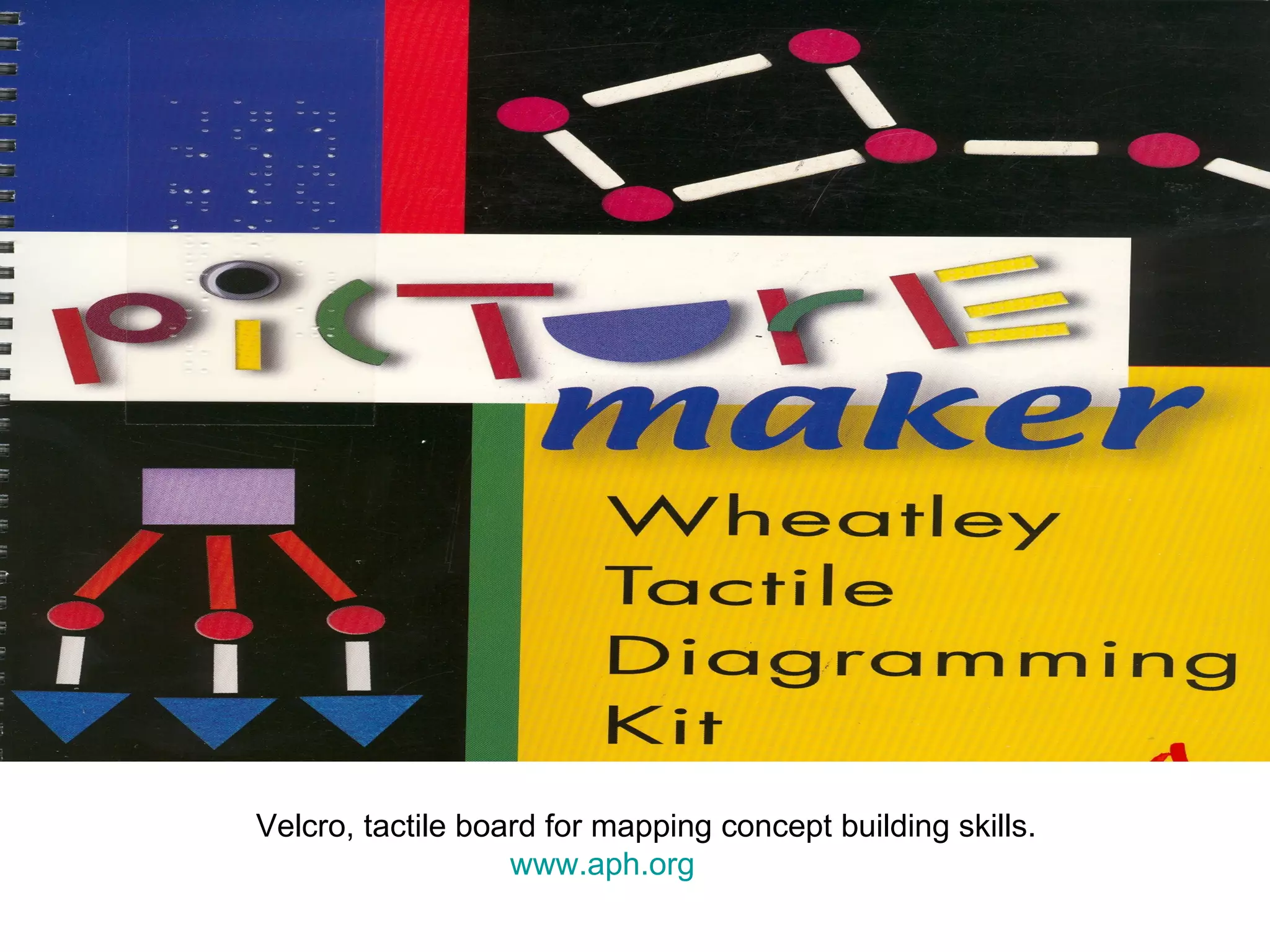
Velcro, tactile board for mapping concept building skills. www.aph.org
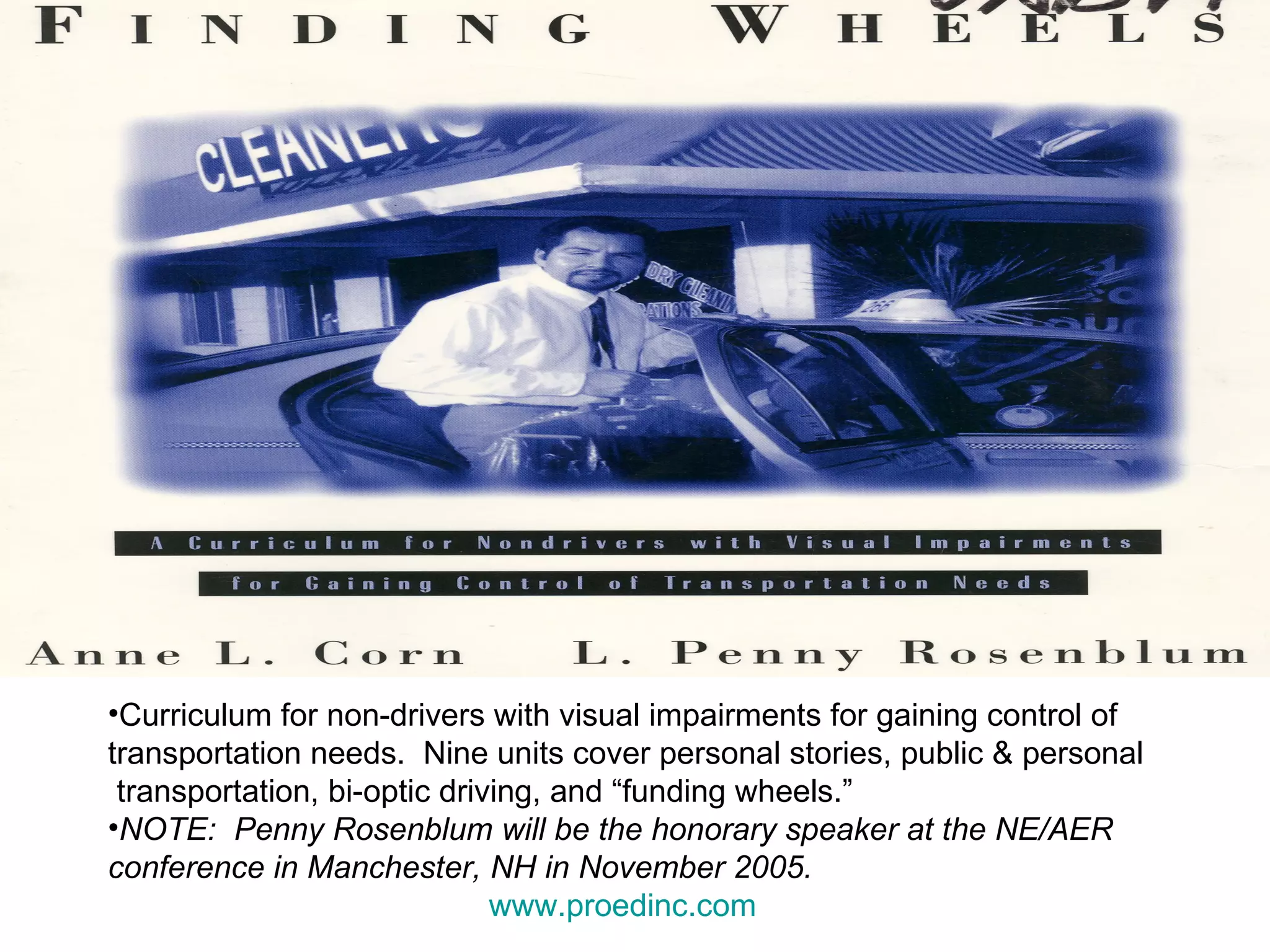
Curriculum for non-drivers with visual impairments for gaining control of  transportation needs.  Nine units cover personal stories, public & personal transportation, bi-optic driving, and “funding wheels.”  NOTE:  Penny Rosenblum will be the honorary speaker at the NE/AER conference in Manchester, NH in November 2005.  www.proedinc.com
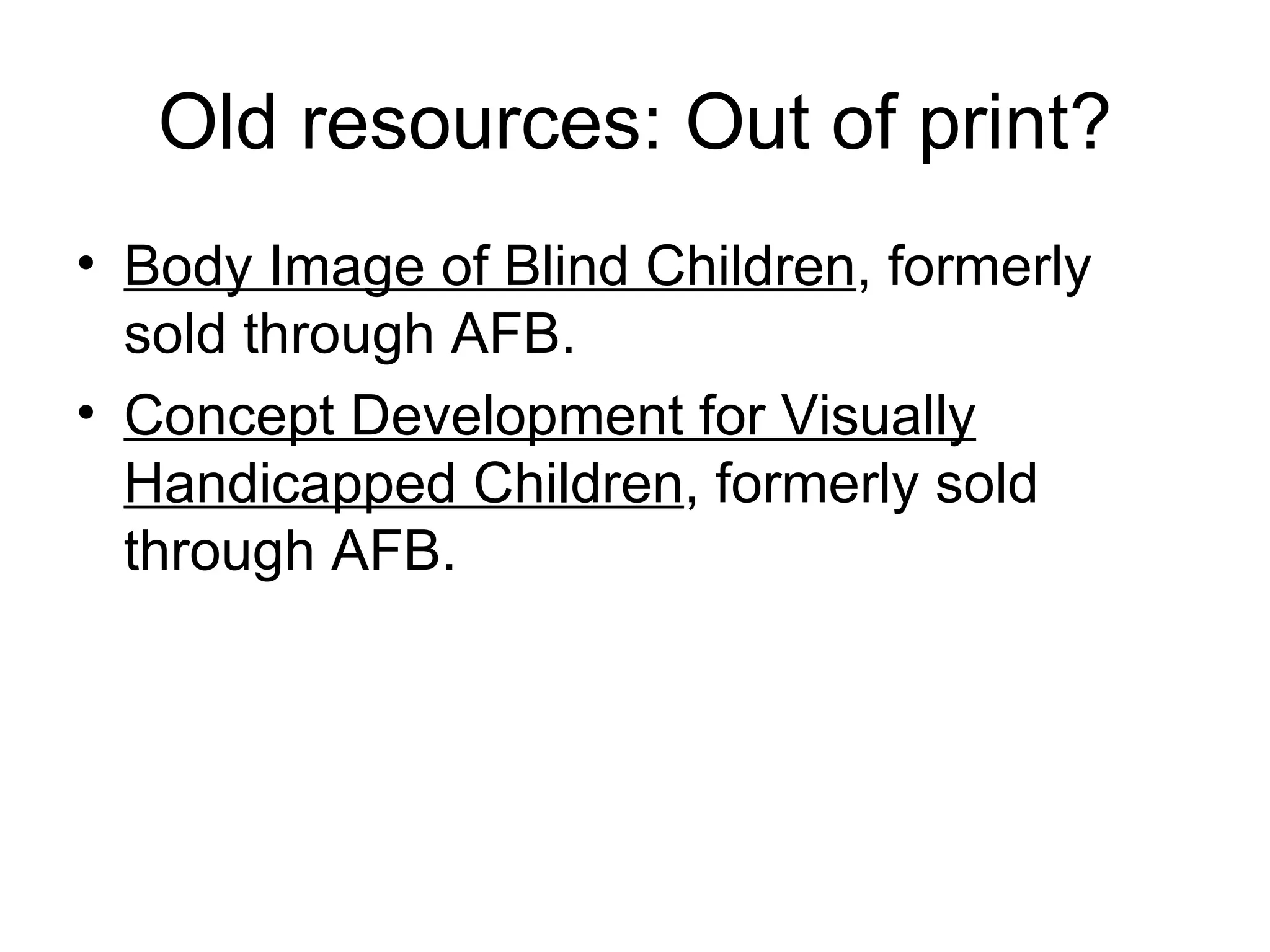
Old resources: Out of print? Body Image of Blind Children , formerly sold through AFB. Concept Development for Visually Handicapped Children , formerly sold through AFB.
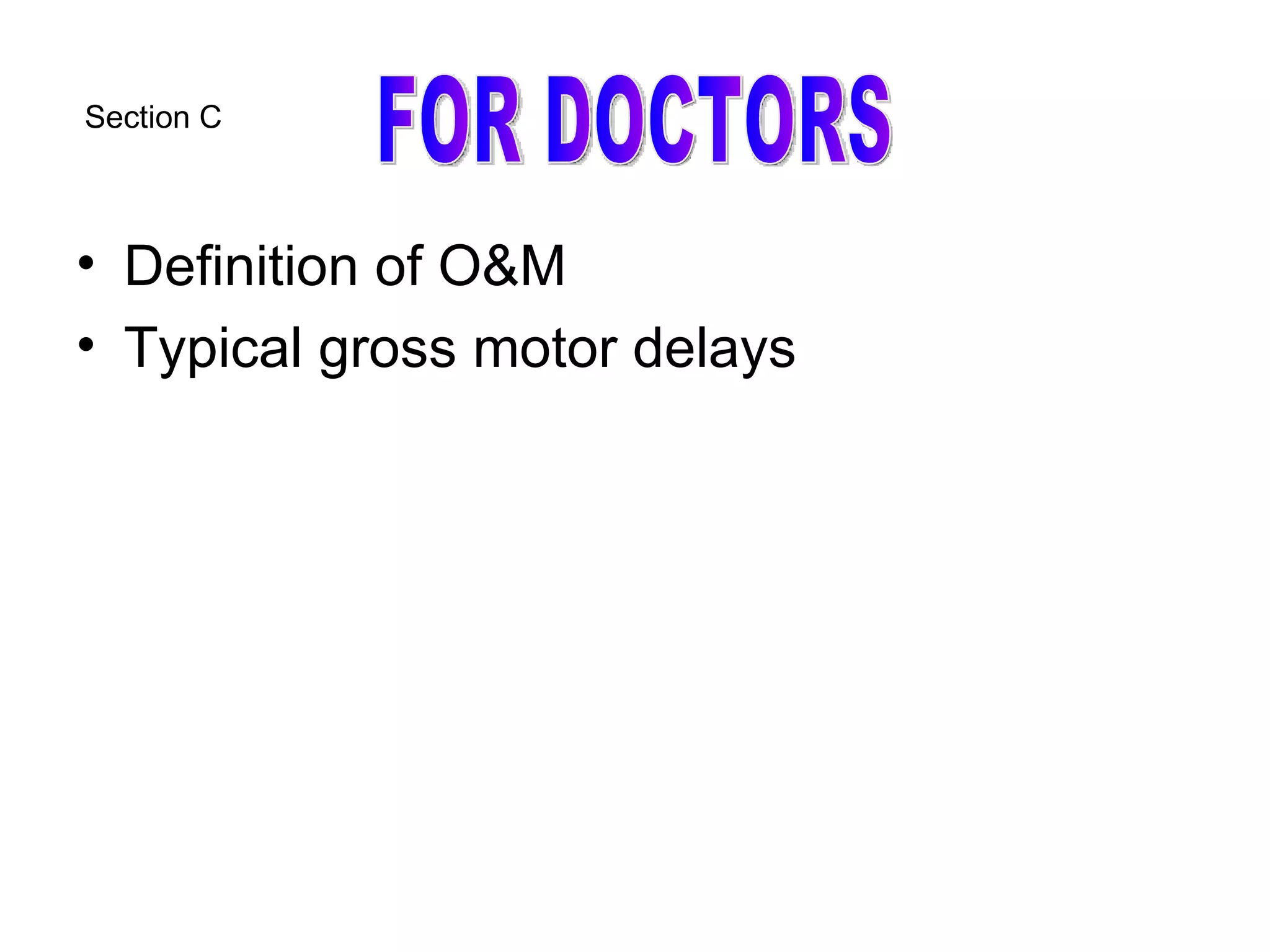
Definition of O&M Typical gross motor delays Section C FOR DOCTORS
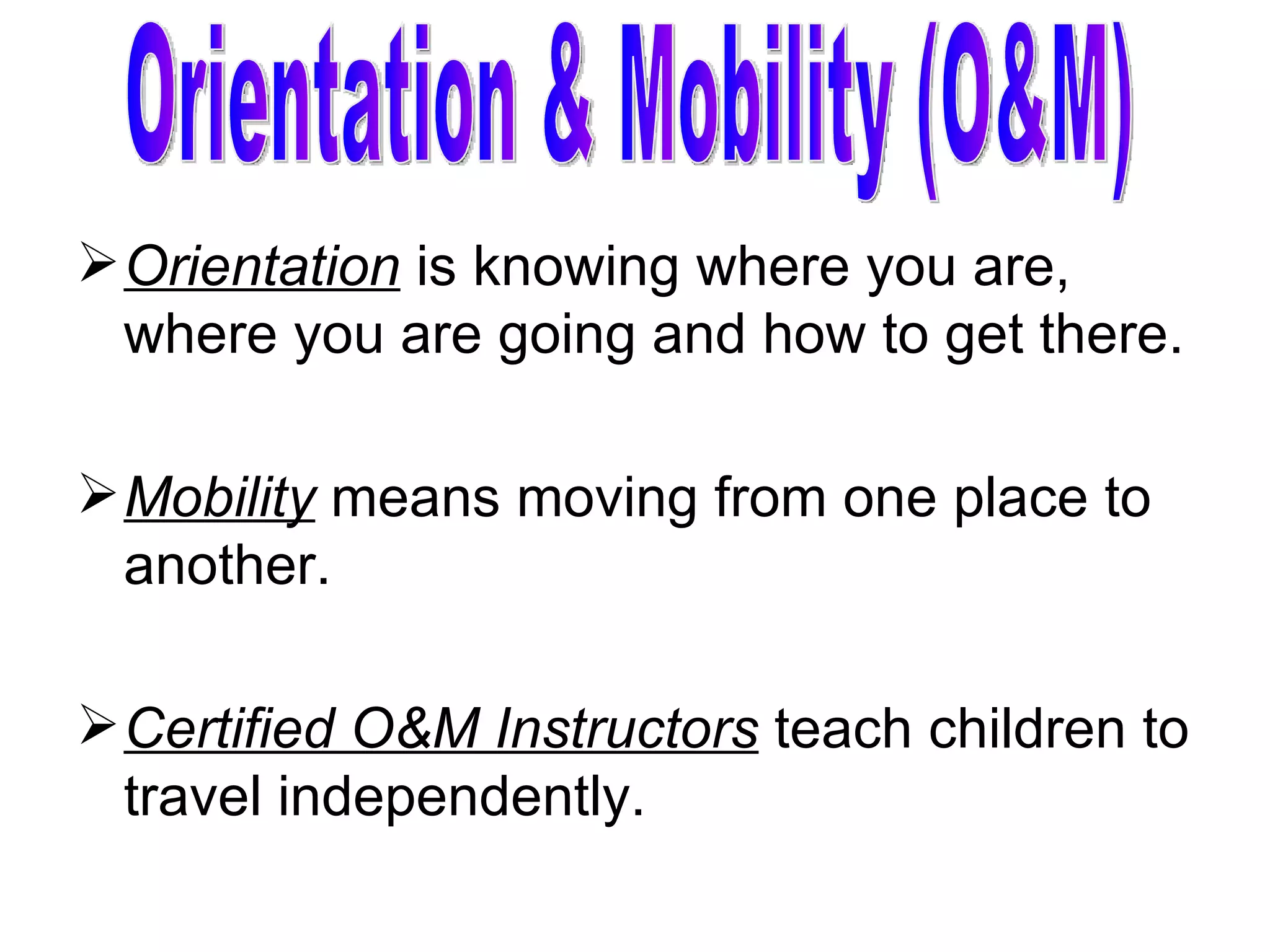
Orientation  is knowing where you are, where you are going and how to get there. Mobility  means moving from one place to another. Certified O&M Instructors  teach children to travel independently.  Orientation & Mobility (O&M)
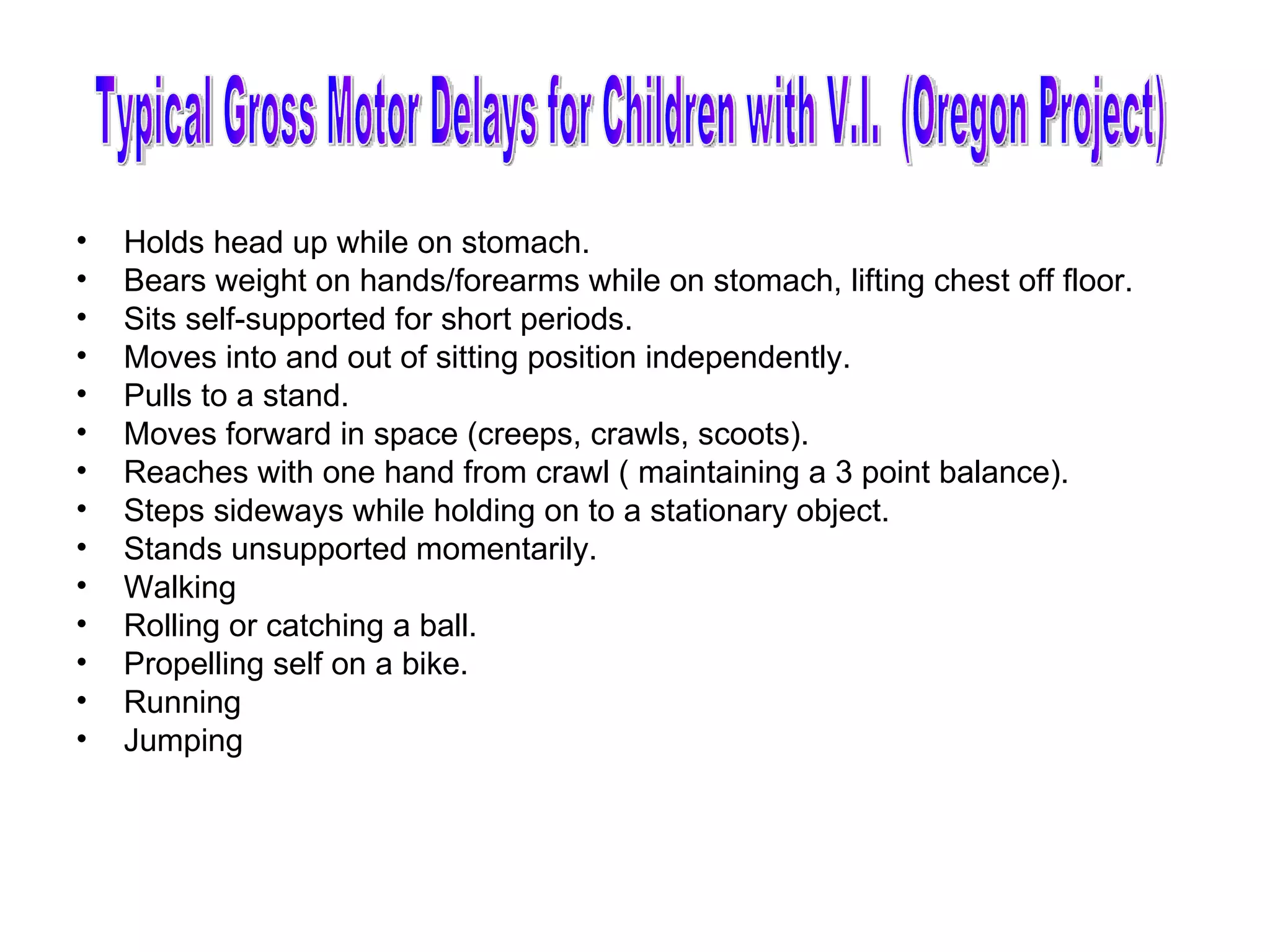
Holds head up while on stomach. Bears weight on hands/forearms while on stomach, lifting chest off floor. Sits self-supported for short periods. Moves into and out of sitting position independently. Pulls to a stand. Moves forward in space (creeps, crawls, scoots). Reaches with one hand from crawl ( maintaining a 3 point balance). Steps sideways while holding on to a stationary object. Stands unsupported momentarily. Walking Rolling or catching a ball. Propelling self on a bike. Running Jumping Typical Gross Motor Delays for Children with V.I.  (Oregon Project)
AMEN! I did it!

Orientation and Mobility: Part 2

  • 1.
    Holds head upwhile on stomach. Bears weight on hands/forearms while on stomach, lifting chest off floor. Sits self-supported for short periods. Moves into and out of sitting position independently. Pulls to a stand. Moves forward in space (creeps, crawls, scoots). Reaches with one hand from crawl ( maintaining a 3 point balance). Steps sideways while holding on to a stationary object. Stands unsupported momentarily. Walking Rolling or catching a ball. Propelling self on a bike. Running Jumping Typical Gross Motor Delays for Children with V.I. (Oregon Project)
  • 2.
    Designed to enhancedistance visual efficiency for children with low vision, and includes 4 chapters, with 64 sequential lessons. www.pco.edu
  • 3.
    Physical Education isall about the student’s ability to orientate and move! www.humankinetics.com
  • 4.
    www.humankinetics.com PE teachers are always looking for appropriate, appealing games & activities. Dr. Lieberman Specializes in working With the visually Impaired.
  • 5.
    Peabody Mobility Kitfor Infants & Toddler by R. Harley Age range: Birth to 2 years Program to assist young, multihandicapped or not, visually impaired children in developing functional movement skills. Reproducible record forms www.stoeltingco.com
  • 6.
    Form A: Foryounger, delayed or nonambulatory children. Form B: For older, ambulatory children. www.aerbvi.org
  • 7.
    www.perkinspublications.org (Includes a section on O&M)
  • 8.
    www.afb.org/store *O&M Through the School Year *Referral & Assessment *IEP *Approaches to O&M *Students with Multiple Disabilities Professional & Strategic Issues *Resources
  • 9.
    Mostly Mobility RD1 Box 1448-A Bethel, PA 19507 ISBN # 0-922637-00-08 Copyright 1988 (may not be available) A storybook about Elliot, a young visually impaired child. The 17 chapters takes the reader on O&M adventures.
  • 10.
  • 11.
    Velcro, tactile boardfor mapping concept building skills. www.aph.org
  • 12.
    Curriculum for non-driverswith visual impairments for gaining control of transportation needs. Nine units cover personal stories, public & personal transportation, bi-optic driving, and “funding wheels.” NOTE: Penny Rosenblum will be the honorary speaker at the NE/AER conference in Manchester, NH in November 2005. www.proedinc.com
  • 13.
    Old resources: Outof print? Body Image of Blind Children , formerly sold through AFB. Concept Development for Visually Handicapped Children , formerly sold through AFB.
  • 14.
    Definition of O&MTypical gross motor delays Section C FOR DOCTORS
  • 15.
    Orientation isknowing where you are, where you are going and how to get there. Mobility means moving from one place to another. Certified O&M Instructors teach children to travel independently. Orientation & Mobility (O&M)
  • 16.
    Holds head upwhile on stomach. Bears weight on hands/forearms while on stomach, lifting chest off floor. Sits self-supported for short periods. Moves into and out of sitting position independently. Pulls to a stand. Moves forward in space (creeps, crawls, scoots). Reaches with one hand from crawl ( maintaining a 3 point balance). Steps sideways while holding on to a stationary object. Stands unsupported momentarily. Walking Rolling or catching a ball. Propelling self on a bike. Running Jumping Typical Gross Motor Delays for Children with V.I. (Oregon Project)
  • 17.