Comprehensive LET Reviewer based
on NCBTS and Table of Specifications
(TOS) released by PRC
LET
Reviewer
GENERAL EDUCATION
1
Table of Contents
English.....................................................................................................2
Study and Thinking Skills ......................................................................2
Writing in the Discipline.........................................................................7
Speech and Oral Communication.......................................................... 14
Philippine Literature............................................................................. 29
Master Works of the World.................................................................... 37
Natural Science...................................................................................... 52
Science ................................................................................................ 52
Biological Science................................................................................. 54
Physical Science................................................................................... 65
Earth and Space Science ...................................................................... 71
Mathematics.......................................................................................... 80
........................................................................................................... 80
Fundamentals of Math ......................................................................... 80
Elementary Algebra .............................................................................. 89
Plane Geometry.................................................................................... 99
Statistics and Probability.................................................................... 109
Social Science...................................................................................... 114
......................................................................................................... 114
Philippine Government, New Constitution with Human Rights ............. 114
Philippine History............................................................................... 119
Basic Economics, Taxation, Land Reform and Cooperative................... 129
Riza’s Life and Works and other Heroes and Heroines.......................... 139
Introduction Humanities: Art Appreciation .......................................... 143
Information and Communication Technology..................................... 151
Introduction to Computers ................................................................. 151
References........................................................................................... 157
2
English
Study and Thinking Skills
Study skills are an array of skills which tackle the process of organizing and taking
in new information, retaining information, or dealing with assessments. They
include mnemonics, which aid the retention of lists of information, effective reading,
concentration techniques, and efficient note taking (Wikipedia).
Thinking skills are mental processes used in cognitive functions that enable people
to process information, make connections, make decisions, and create new ideas.
Study Strategies and Thinking Skills
Remembering Information
Mnemonics – a technique that allows learners to organize, retain, and remember
information.
1. Acronyms – using the first letter from a group of words to form a new word.
Example: ROYGBIV – Color of the rainbow (Red, Orange, Yellow, Green, Blue,
Indigo, Violet)
2. Acrostics - creating sentences from the first letter of every word that needs to
be remembered.
Example: To remember the order of notes of the treble staff which is EGBDF
by using acrostic – Every Good Boy Does Fine.
3. Chaining - creating a story where each word or idea you have to remember
cues the next idea you need to recall.
4. Chunking - breaking large pieces of information down into smaller groups or
units.
5. Imagery or Visualization – creating pictures on your mind.
6. Graphic Organizers - are visual representations that show how information is
organized.
7. Keywords - using what a word sounds like to visualize something.
Example: To remember the two different parts of the brain: cerebrum and
cerebellum. Since the cerebrum is larger than the cerebellum, the keyword
for cerebrum could be drum (a large instrument) and the keyword for
cerebellum could be bell (a small instrument).
8. Method of Loci – creating visual associates using familiar locations.
9. Peg words - visualizing words literally attached to familiar objects.
Example: One is a gun. Two is a shoe. Three is a bee. Four is a door. Five is a
hive.
10. Repetition - saying or writing information several times.
11. Rhymes and Songs – creating rhymes or songs of facts.
Notetaking
A. Linear notetaking is the process of writing down information in the order in
which you receive it.
3
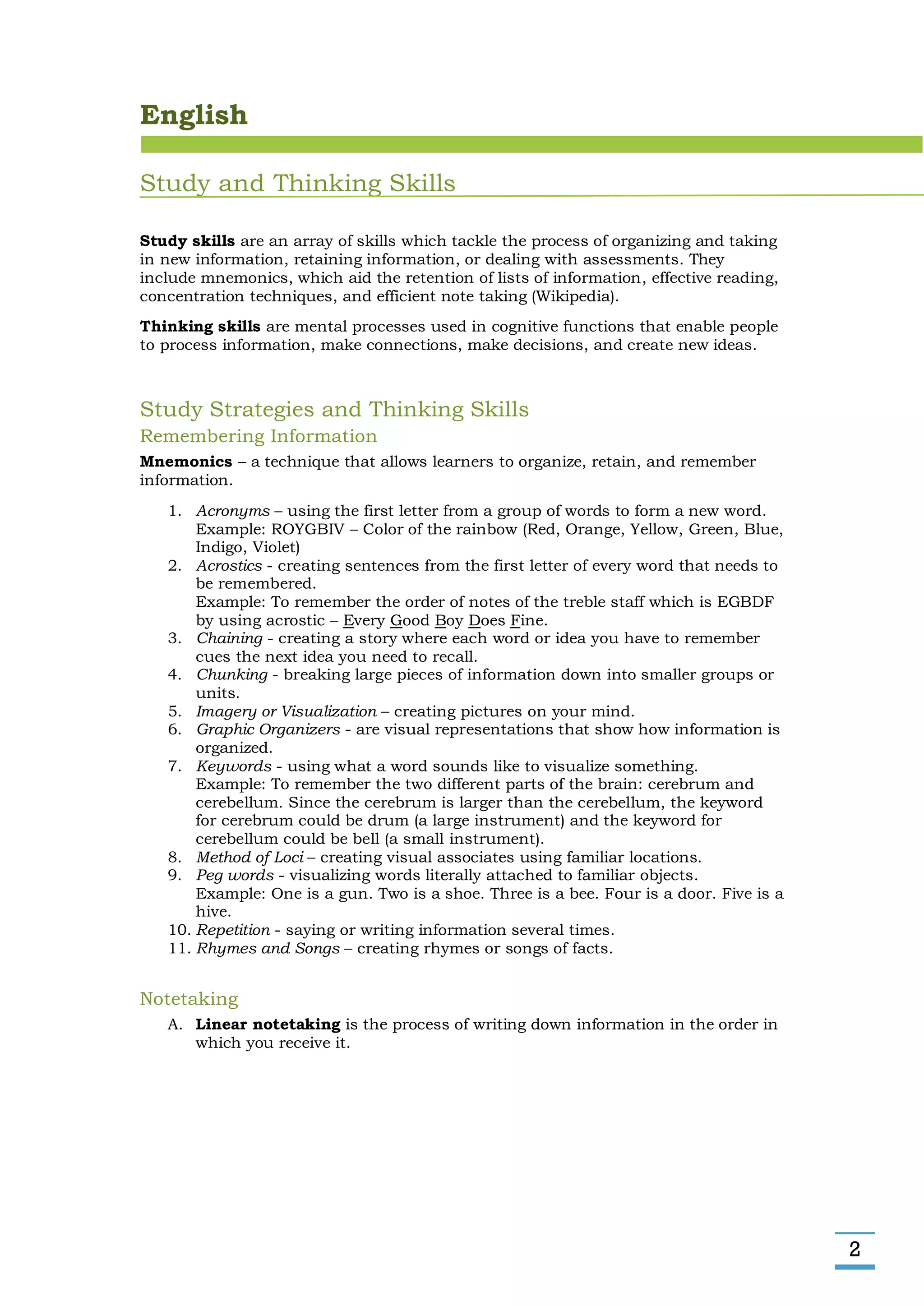
1. Outlining – is breaking down of information into logical formal and
sequence. It is used for topics that include a lot of details.
2. Sentence Method – is writing down each topic as a jot note sentence.
It is used during face-paced lessons. It is not about breaking down
information, but it is about recording information.
B. Non-Linear notetaking
1. SQ3R - is a study strategy for students designed to increase
engagement and retention of a text/written information.
• Survey – skim the text and find the main ideas.
• Question – write down your questions.
• Read – read thoroughly and search for answers to your
questions.
• Recite - write answers based on your thoughts.
• Review – write a summary of what you have learned to be
studied in the future.
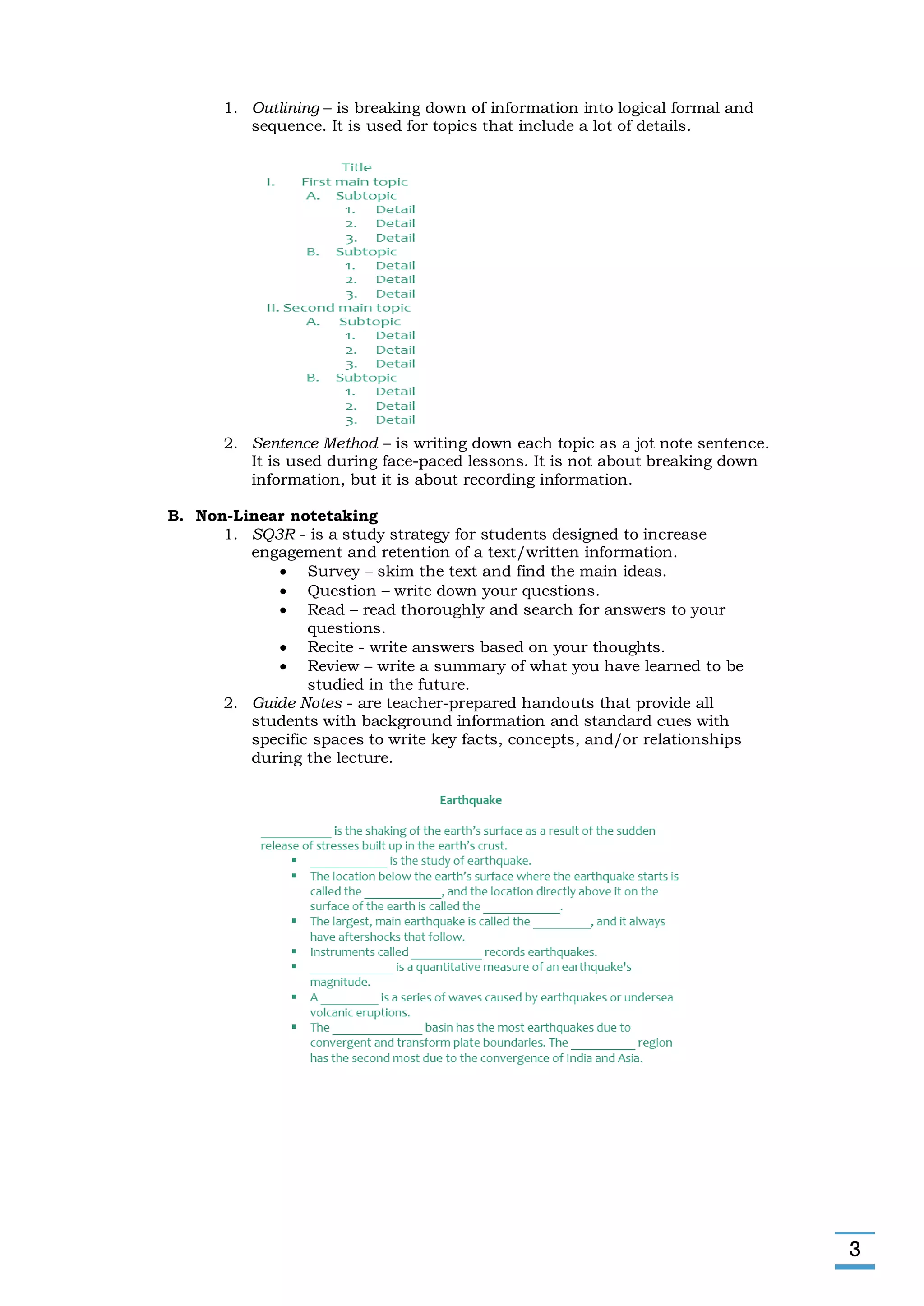
2. Guide Notes - are teacher-prepared handouts that provide all
students with background information and standard cues with
specific spaces to write key facts, concepts, and/or relationships
during the lecture.
4
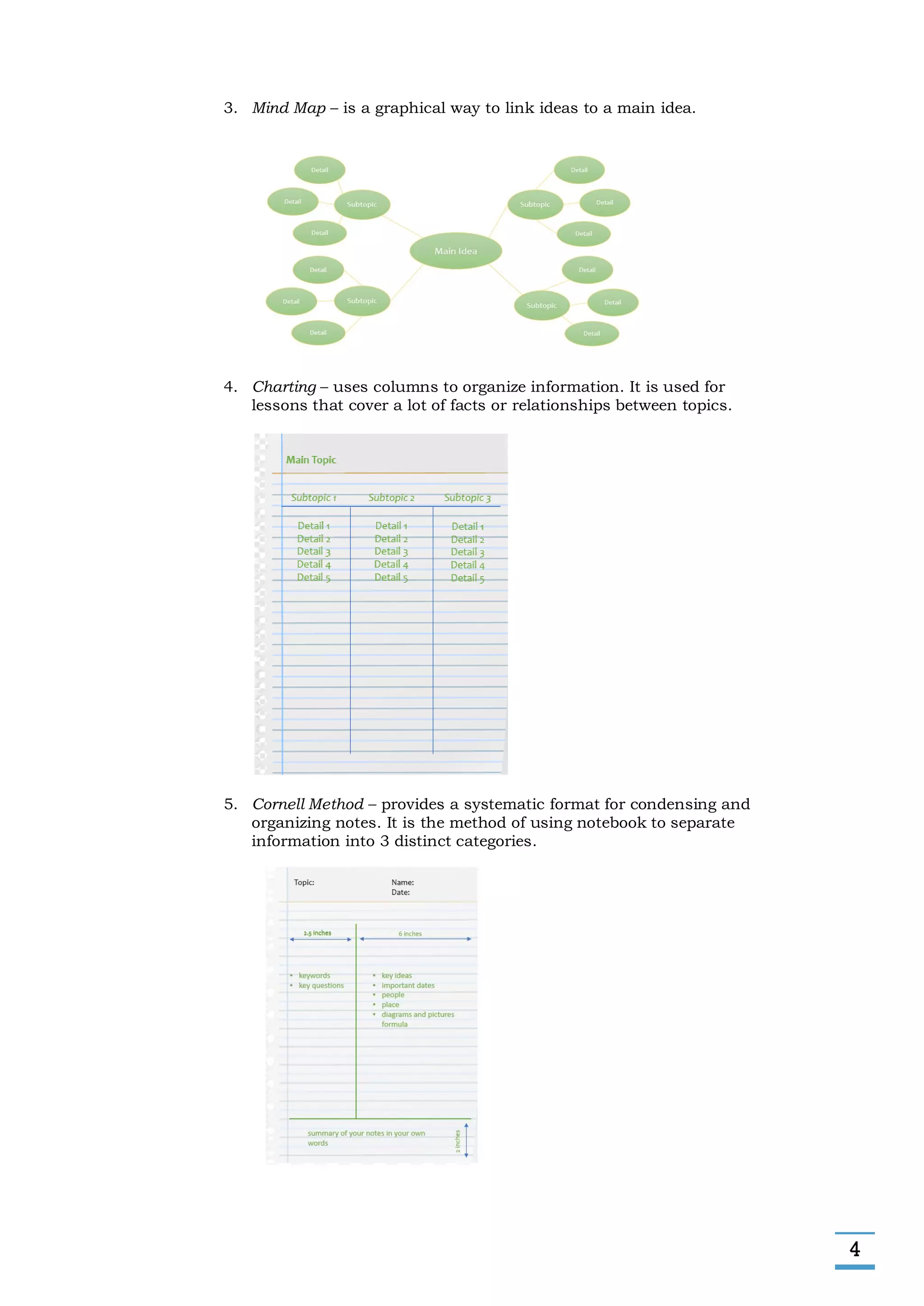
3. Mind Map – is a graphical way to link ideas to a main idea.
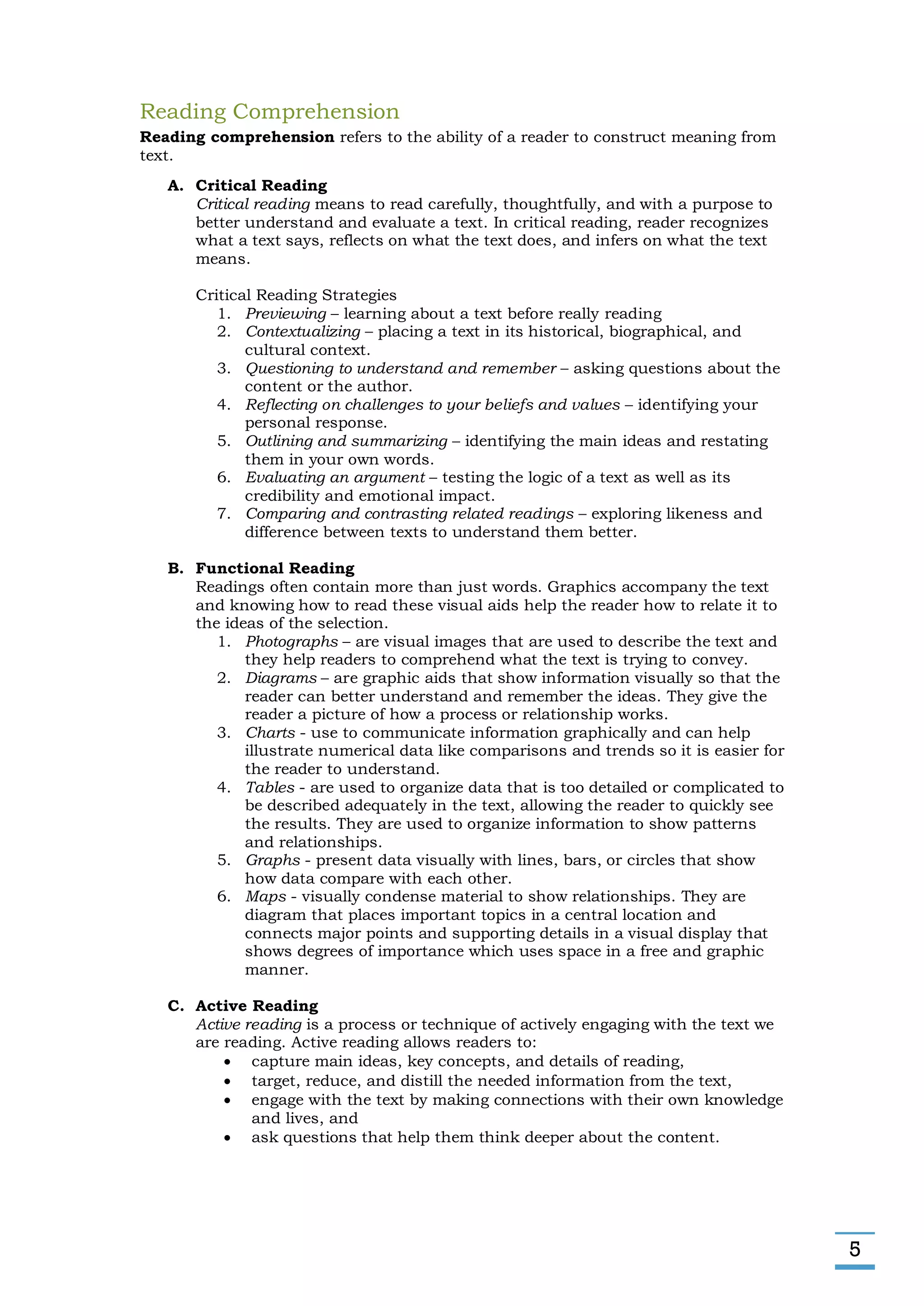
4. Charting – uses columns to organize information. It is used for
lessons that cover a lot of facts or relationships between topics.
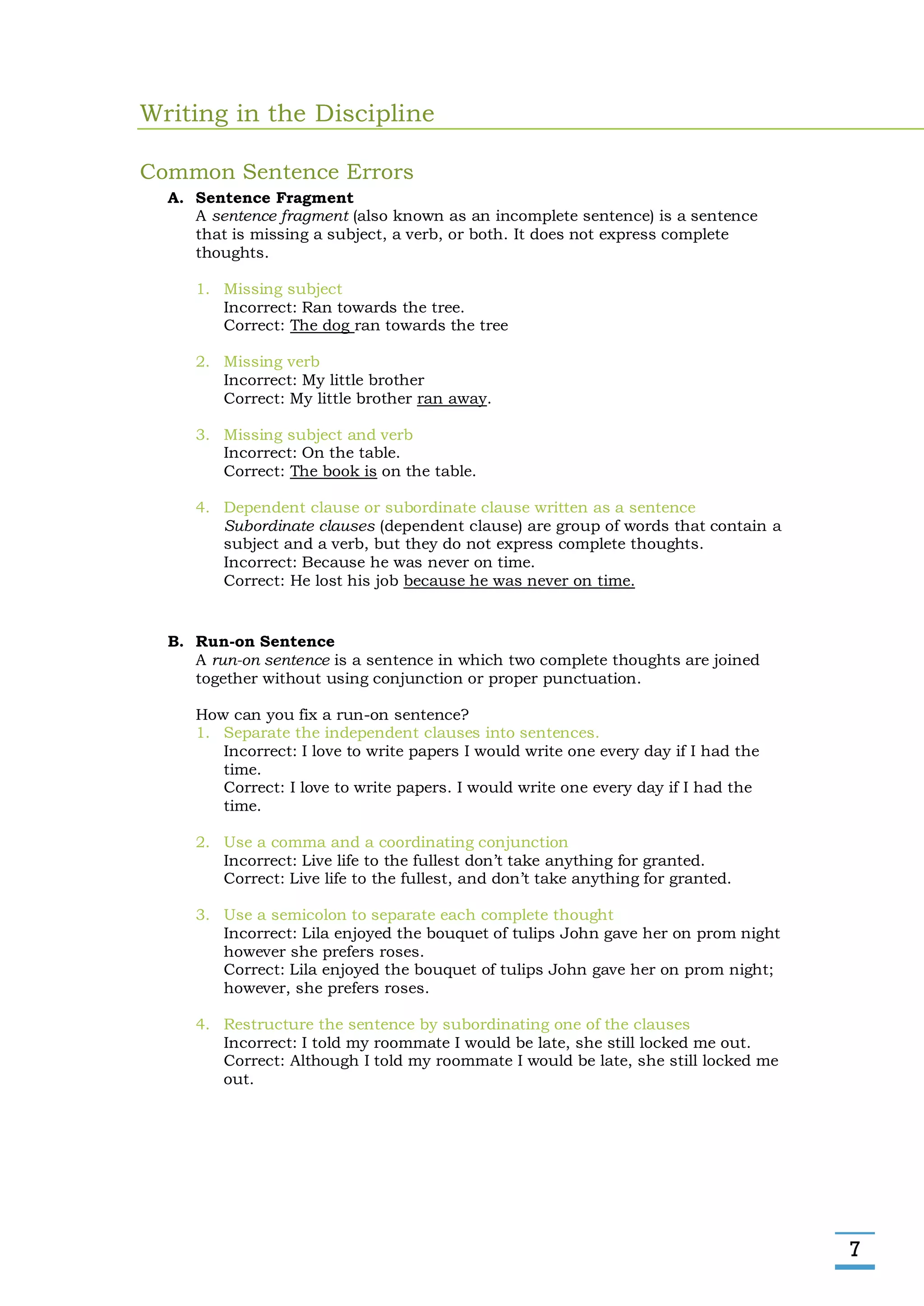
5. Cornell Method – provides a systematic format for condensing and
organizing notes. It is the method of using notebook to separate
information into 3 distinct categories.
5
Reading Comprehension
Reading comprehension refers to the ability of a reader to construct meaning from
text.
A. Critical Reading
Critical reading means to read carefully, thoughtfully, and with a purpose to
better understand and evaluate a text. In critical reading, reader recognizes
what a text says, reflects on what the text does, and infers on what the text
means.
Critical Reading Strategies
1. Previewing – learning about a text before really reading
2. Contextualizing – placing a text in its historical, biographical, and
cultural context.
3. Questioning to understand and remember – asking questions about the
content or the author.
4. Reflecting on challenges to your beliefs and values – identifying your
personal response.
5. Outlining and summarizing – identifying the main ideas and restating
them in your own words.
6. Evaluating an argument – testing the logic of a text as well as its
credibility and emotional impact.
7. Comparing and contrasting related readings – exploring likeness and
difference between texts to understand them better.
B. Functional Reading
Readings often contain more than just words. Graphics accompany the text
and knowing how to read these visual aids help the reader how to relate it to
the ideas of the selection.
1. Photographs – are visual images that are used to describe the text and
they help readers to comprehend what the text is trying to convey.
2. Diagrams – are graphic aids that show information visually so that the
reader can better understand and remember the ideas. They give the
reader a picture of how a process or relationship works.
3. Charts - use to communicate information graphically and can help
illustrate numerical data like comparisons and trends so it is easier for
the reader to understand.
4. Tables - are used to organize data that is too detailed or complicated to
be described adequately in the text, allowing the reader to quickly see
the results. They are used to organize information to show patterns
and relationships.
5. Graphs - present data visually with lines, bars, or circles that show
how data compare with each other.
6. Maps - visually condense material to show relationships. They are
diagram that places important topics in a central location and
connects major points and supporting details in a visual display that
shows degrees of importance which uses space in a free and graphic
manner.
C. Active Reading
Active reading is a process or technique of actively engaging with the text we
are reading. Active reading allows readers to:
• capture main ideas, key concepts, and details of reading,
• target, reduce, and distill the needed information from the text,
• engage with the text by making connections with their own knowledge
and lives, and
• ask questions that help them think deeper about the content.
6
Active Reading Strategies
1. Predict – try figure out what might happen next.
2. Visualize – picture the people, places, and events being described.
3. Connect – connect what you are reading to other texts and the real
world.
4. Question – ask questions before, during, and after reading.
5. Clarify – stop and check for understanding, identify main point, and
summarize.
6. Evaluate – form opinion and draw conclusion.
Levels of Comprehension Skills
1. Literal Level of Comprehension (Reading the lines) - focuses on reading the
passages, hearing the words, or viewing the images. It involves identifying
the important and essential information.
2. Inferential Level of Comprehension (Reading between the lines) - the focus
shifts to reading between the lines, looking at what is implied by the material
under study. It requires students to combine pieces of information in order to
make inferences about the author's intent and message.
3. Critical Level of Comprehension (Reading beyond the lines) - the principal
focus of this level of comprehension is the aspect of evaluation. It is the
judgment of validity or worth of what is read or heard, based on sound
criteria of standards developed through previous experiences.
4. Application Level of Comprehension - understandings at the literal and
interpretive levels are combined, reorganized, and restructured at the applied
level to express opinions, draw new insights and develop fresh ideas.
7
Writing in the Discipline
Common Sentence Errors
A. Sentence Fragment
A sentence fragment (also known as an incomplete sentence) is a sentence
that is missing a subject, a verb, or both. It does not express complete
thoughts.
1. Missing subject
Incorrect: Ran towards the tree.
Correct: The dog ran towards the tree
2. Missing verb
Incorrect: My little brother
Correct: My little brother ran away.
3. Missing subject and verb
Incorrect: On the table.
Correct: The book is on the table.
4. Dependent clause or subordinate clause written as a sentence
Subordinate clauses (dependent clause) are group of words that contain a
subject and a verb, but they do not express complete thoughts.
Incorrect: Because he was never on time.
Correct: He lost his job because he was never on time.
B. Run-on Sentence
A run-on sentence is a sentence in which two complete thoughts are joined
together without using conjunction or proper punctuation.
How can you fix a run-on sentence?
1. Separate the independent clauses into sentences.
Incorrect: I love to write papers I would write one every day if I had the
time.
Correct: I love to write papers. I would write one every day if I had the
time.
2. Use a comma and a coordinating conjunction
Incorrect: Live life to the fullest don’t take anything for granted.
Correct: Live life to the fullest, and don’t take anything for granted.
3. Use a semicolon to separate each complete thought
Incorrect: Lila enjoyed the bouquet of tulips John gave her on prom night
however she prefers roses.
Correct: Lila enjoyed the bouquet of tulips John gave her on prom night;
however, she prefers roses.
4. Restructure the sentence by subordinating one of the clauses
Incorrect: I told my roommate I would be late, she still locked me out.
Correct: Although I told my roommate I would be late, she still locked me
out.
8
Types of Run-on Sentences
1. A fused sentence occurs when independent clauses run together with no
marks of punctuation or coordinating conjunctions to separate them.
Example:
Incorrect: Winnie dropped her watch it felt in the mud.
Correct: Winnie dropped her watch, and it felt in the mud.
2. A comma splice occurs when two or more independent clauses are joined
only by a comma.
Example:
Incorrect: Carlo read the novel, his friends saw the movie.
Correct: Carlo read the novel. His friends saw the movie.
C. Dangling and Misplaced Modifiers
A modifier is a word, phrase, or clause that clarifies or describes another
word, phrase, or clause.
A dangling modifier is a grammatical error where the modifying word or
phrase is attached to the wrong subject or where the subject is missing in a
sentence.
Examples:
Incorrect: To win the spelling bee, Luis and Gerard should join our team.
Correct: If we want to win the spelling bee this year, Luis and Gerard should
join our team.
Incorrect: Working through the night, the report was finished in time for
class.
Correct: Working through the night, Jeremy finished the report in time for
class.
A misplaced modifier is a word, phrase, or clause that is improperly
separated from the word it modifies or describes.
Examples:
Incorrect: She wore a bicycle helmet on her head that was too large.
Correct: She wore a bicycle helmet that was too large on her head.
Incorrect: They bought a puppy for my sister they call Pepe.
Correct: They bought a puppy they call Pepe for my sister.
D. Faulty Parallelism
A faulty parallelism happens when the structure of a sentence is not
grammatically parallel.
1. Use parallel structure with elements joined by coordinating conjunctions,
especially and, but, and or.
Incorrect: I enjoy cooking and to bake.
Correct: I enjoy cooking and baking.
2. Use parallel structure with elements in lists or in a series.
Incorrect: The frustrated customer wanted to exchange the article, to
obtain a refund or she wanted to speak to the manager.
Correct: The frustrated customer wanted to exchange the article, to
obtain a refund or to speak to the manager.
3. Use parallel structure with elements being compared
Incorrect: l like painting than to bake.
Correct: I like painting than baking.
9
4. Use parallel structure with elements joined by a linking verb or a verb of
being
Incorrect: Many people mistakenly think that being wealthy is the same
thing as to be happy.
Correct: Many people mistakenly think that being wealthy is the same
thing as being happy.
5. Use parallel structure with elements joined by a correlative conjunction
Incorrect: Bert will meet us either at the restaurant or he will be at the
taxi stand.
Correct: Either Bert will meet us at the restaurant or he will be at the taxi
stand.
E. Incorrect word usage
Affect (verb) – means to influence
Effect (noun) – indicates the result of an influence
Incorrect: How did the play effect you?
Correct: How did the play affect you?
Better – means recovering
Well – means completely recovered
Incorrect: He is well now than he was week ago.
Correct: He is better now than he was week ago.
If – introduces a condition
Whether – introduces a choice
Incorrect: He asked me if I intended to go to Korea.
Correct: He asked me whether I intended to go to Korea.
Flout – means to insult
Flaunt – means to make a display of
Incorrect: Mr. Sanchez flaunted the authority of the principal.
Correct: Mr. Sanchez flouted the authority of the principal.
Advice (noun) – an opinion or recommendation offered as a guide to action
Advise (verb) - to recommend, or to give information to someone
Incorrect: I have a problem and need some advise.
Correct: I have a problem and need some advice.
The Topic Sentence and Paragraph
Paragraph
A paragraph is a group of related sentences that present and develop one main idea.
Parts of a Paragraph
1. Topic sentence – states the main or general idea of a paragraph.
2. Supporting details – supports the topic sentence. It explains the main idea. It
gives details relating to the main idea.
3. Concluding statement – restates or sums up the main idea.
10
Topic Sentence
• It states the main idea.
• It addresses one aspect of the subject that can be adequately covered in one
paragraph.
• It controls the other sentences in the paragraph.
• It is more general than the sentences that develop it.
There are two types of topic sentence:
1. Stated or obvious topic sentence – this is the type of topic sentence that is
correctly expressed in the paragraph.
Example:
I think my mom would be a great teacher. She cares about my progress in
school. When teaching me a difficult skill, she is a patient and gives me a
variety of ways to learn. She also helps me with mistakes. Let my mom teach!
Topic sentence: I think my mom would be a great teacher.
2. Implied topic sentence – this is type of topic sentence that is not stated
directly but is strongly suggested by the supporting details in the paragraph.
Example:
Yellow, the color of the sun, is often associated with optimism, happiness,
and friendship. Green, the color of nature, has come to suggest growth and
rebirth. Blue, the color of the sky, may suggest eternity or endless beauty.
Red, the color of both blood and fire, is often connected with strong feelings
such as courage, lust, and rage.
Topic sentence: Different colors may bring different meanings or symbolic
representation.
Positions of Topic Sentence
1. At the beginning – topic sentence is usually found at the beginning of a
paragraph, where it gives a preview of and direction to the sentences that
come after it.
2. At the end – sometimes, the topic sentence comes at the end of the
paragraph, where it draws a conclusion or functions as a summary.
3. At the middle - less frequently, topic sentence comes in the middle of the
paragraph, where it can provide a transition between two kinds of details.
4. At both beginning and end – the topic sentence can also be found in the
beginning and end of the paragraph.
11
Elements of Good Paragraph
1. Unity – all sentences in a paragraph relate to the topic sentence. All the
supporting sentences in a paragraph must be relevant, meaning directly
related to the main idea.
2. Coherence – the sentences must hold together, that is, the movement from
one sentence to the next must be logical and smooth without obvious shifts
or jumps.
Two ways of creating coherence are: use transition words to create bridges
from one sentence to the next and be consistent in using verb tenses and
point of voice.
3. Completeness – it means a paragraph is well-developed. All sentences should
clearly and sufficiently support the topic sentence.
Patterns of Paragraph Development
1. Narration
Narration tells a story. It relates an incident or series of events that leads to a
conclusion or ending. It tells the reader where, when and what happened.
Narration follows a chronological pattern of development. It is a convincing
mode of paragraph development to the extent that it tells a coherent story.
A narrative paragraph contains action verbs and transition words that
indicate time or sequence.
2. Description
Description gives information of what a person, an object, a place, or a
situation is like. It appeals to the reader’s senses - it makes the reader see,
hear, taste, smell, or feel the subject.
A descriptive paragraph has concrete and specific details, which are carefully
chosen by a writer, to paint a picture in the mind of the reader.
12
3. Definition
Definition explains a concept, term, or subject. Its main purpose is to tell
what something is. It consists of three parts: (1) the term, concept, or subject
to be defined; (2) the general class to which it belongs, and (3) the
characteristics that differentiate it from the other members of its class. This
pattern of development is commonly used in the sciences, humanities, and
business.
4. Comparison/Contrast
Comparison focuses on similarities between things, and contrast focuses on
their differences. Comparison and contrast paragraphs are common in
writing in many academic disciplines like the humanities, sciences, and
business.
A paragraph developed by comparison and contrast has a unifying idea or
purpose. Also, it must be balanced in such a way that there is an equal
amount of information for each subject to avoid.
5. Cause and Effect
A cause-and-effect pattern examines the relationship what happens (the
effect) and why it happens (the cause). This is an effective pattern to use to
help the reader better understand one subject in relation to another.
13
6. Persuasion
A persuasive paragraph intends to convince readers to do or believe in
something. Many writing genres such as critiques or reviews, reaction
papers, editorials, proposals, advertisements, and brochures make strong
use of persuasive paragraphs to state opinions and to influence others.
A persuasive paragraph allows you to express personal conviction or opinion
about an issue or topic and make the readers agree with or adopt writer’s
conviction or opinion.
7. Exemplification
Exemplification provides examples and illustrations to further clarify or
explain the concept or subject matter. It presents the general statement and
then provides specific and concrete examples to expound on the main idea.
8. Problem Solving
A problem solution pattern divides information into two main sections, one
that describes a problem and one that describes a solution. This pattern is
typically used in persuasive writing, where the writer's general purpose is to
convince the reader to support a certain course of action.
14
Speech and Oral Communication
Grammar
Part of Speech
NOUNS
A noun is a word used to describe a person, place, thing, or idea.
Kinds of Nouns
1. Proper Nouns - are the names of specific people, places, things, or ideas.
It should always be capitalized.
Examples: Atty. Dela Cruz, Peter Pan, Quezon City
2. Common Nouns – are the names of any persons, places, things, or ideas.
It is general.
Examples: lawyer, character, municipal city
3. Collective Nouns – are nouns that are singular in form but refer to a
group of people or things.
Examples: furniture, crockery, army
4. Concrete Nouns– refer to people, places, or things that we can experience
with our five senses (taste, touch, sight, hearing, or smell).
Examples: Light, flower, sun
5. Abstract Nouns – are nouns that you cannot sense. They are the names
that we use for emotions, ideals, or ideas.
Examples: joy, hate, faith
6. Countable Nouns – can be counted.
Examples: three books, a dog, six mangoes
7. Uncountable Nouns – cannot be counted.
Examples: water, rice, coffee, sugar
8. Compound Nouns – are nouns that are made up of two or more words.
Examples: toothpaste, blackboard, bedroom
Number of Nouns
• Singular is used when the noun refers to one item.
• Plural is used when the noun refers to more than one item.
Rules in Forming the Plural of Nouns
1. Add -s to form the plural of most nouns.
Examples: boy – boys, chair - chairs
2. Add -es to nouns ending in ch, sh, s, x, or z.
Examples: box – boxes, dress – dresses, church – churches
3. In some cases, nouns ending in s or z, double the s or z prior to adding es.
Examples: gas – gasses, fez - fezzes
4. Add -es to nouns ending with a consonant before an o.
Examples: hero – heroes, tomato – tomatoes, cargo - cargoes
5. Add -s to nouns ending in y after a vowel.
Examples: monkey – monkeys, valley – valleys, key – keys
6. Nouns ending in a consonant + -y, change y to i and add -es.
Examples: puppy – puppies, city – cities, country – countries
7. Most nouns ending in f or fe change f or fe into v and adding es.
Examples: thieve – thieves, loaf – loaves, knife – knives
Exception: Some nouns ending in f, simply add s.
Examples: roof – roofs, belief – beliefs, proof – proofs
15
8. Nouns ending in us, change us to i.
Examples: cactus – cacti, focus – foci
9. Nouns ends in is, change i to e.
Examples: analysis – analyses, ellipsis – ellipses
10. Noun ending in on, change on to a.
Examples: criterion – criteria, phenomenon - phenomena
11. Some nouns do not change at all when they are in plural form.
Examples: fish – fish, sheep – sheep, series – series, species – species
12. Some nouns change their spelling when they become plural. They are called
irregular nouns.
Examples: tooth – teeth, child – children, ox – oxen, goose - geese
Noun Cases
Noun cases refer to a noun's function within that sentence.
1. Nominative – used as subject of a verb.
Example: Ram is an intelligent boy.
2. Objective or Accusative – used as the direct objects of verbs or objects of
preposition.
Example: The vendors sell oranges.
3. Dative – used as indirect object of the verb.
Example: The teacher gave the students few exercises.
4. Possessive or Genitive – denotes possession or ownership.
Example: This is your pencil.
5. Vocative case - used to call (or to get the attention of) a person or persons.
Example: Robert, students are waiting for you in the library.
PRONOUNS
A pronoun is a word that takes the place of a noun.
Antecedent of the pronoun – the noun to which a pronoun refers. A pronoun must
agree with its antecedent.
Examples:
• Bob was late for class, so he had to hurry.
• Rachelle and Rochelle made the pizza that they ate for dinner.
Kinds of Pronouns
1. Personal pronouns – are used for a specific object or person and they change
their forms to indicate the different genders, numbers, case, and persons
speaking. The personal pronouns are I and me, you, he and him, she and her,
it, we and us, and they and them.
Example: She is doing the laundry.
2. Relative pronouns - are used to connect relative clauses to independent
clauses. Relative pronouns include that, what, which, who, and whom.
Example: There is a car in the parking lot that someone has painted a bright
pink.
3. Demonstrative pronouns - are used to show or identify one or a number of
nouns that may be far or near in distance or time. Demonstrative pronouns:
this/these (near) and that/those (far).
Example: That is a beautiful house.
16
4. Interrogative pronouns - are used to ask questions about a person or object
that we do not know about. The interrogative pronouns are who, what,
which, and whose.
Example: Who wants a bag of apple candies?
5. Indefinite pronouns - are used to show unspecified objects or people, whether
in plural or in singular. They are used to indicate the entire noun or some of
the noun or none of the noun. Some common indefinite nouns are anyone,
someone, none, everything, many, few, etc.
Example: Everybody was late to work because of the traffic jam.
6. Reflexive and Intensive pronouns
Reflexive Pronouns are those which are used to indicate a noun which has
been used in an earlier part of the same sentence. These pronouns are
myself, themselves, yourself, ourselves, herself, himself and itself.
Example: Rosa was going to take it to the shop but ended up fixing it herself
one afternoon.
Intensive Pronouns are used to lay emphasis on the pronoun that comes
before them in the sentence.
Example: I built this house myself.
7. Reciprocal pronoun - are used when two or more nouns are doing or being the
same to one another. There are just two reciprocal pronouns - each other and
one another.
Example: They haven’t seen one another since last year.
8. Possessive pronouns - are used to show that something belongs to an
antecedent. The possessive pronouns are my, your, its, his, her, our, their and
whose.
Example: The students practiced their presentation after school.
PRONOUN-ANTECEDENT AGREEMENT
1. A pronoun and its antecedent must agree.
Example: The car would not stop because its brakes failed.
2. A phrase or clause between the subject and verb does not change the
number of the antecedent.
Example: The can of green peas sits on its shelf.
3. Singular indefinite pronoun antecedents take singular pronoun referents,
and plural indefinite pronoun antecedents require plural referents.
Examples:
Singular - Everyone in my English class does his or her homework.
Plural – Both do a good job in their office.
4. Compound subjects joined by and always take a plural referent.
Example: Jane and John made their presentation.
5. With compound subjects joined by or/nor, the referent pronoun agrees with
the antecedent closer to the pronoun.
Examples:
Either Jill or Kate will probably get first prize for her essay.
Neither the dog nor the cats could find their way through the maze.
17
6. Collective Nouns (group, jury, crowd, team, etc.) may be singular or plural,
depending on meaning.
Examples:
Singular - The committee granted its permission.
Plural - The committee put their signatures on the document.
7. Plural form subjects with a singular meaning take a singular referent.
Example: The news has lost its sting two days later.
Singular Pronouns
Nominative Objective Possessive
1st Person I me my, mine
2nd Person you you your, yours
3rd Person he, she, it him, her, it his, her, hers, its
Plural Pronouns
Nominative Objective Possessive
1st Person we us our, ours
2nd Person you you your, yours
3rd Person they them their, theirs
VERB
A verb is a word that expresses an action or a state of being.
Verbs tell you what the subject of a sentence or clause is doing (or being). Verbs are
conjugated according to person, number, gender, tense, aspect, mood, or voice.
Verb Forms
1. Root Form of the Verb
The root form of a verb is the base form of the word.
The root form of the verb is the same as the infinitive form with “to” removed.
Examples: to see – see, to be – be, to go – go
The root form of a verb is used to create other forms of the verb when
conjugated. This is always true with regular verbs, but may not apply with
irregular verbs, depending on the tense.
Examples:
Go - I am going to school.
Show - The girl showed her mother the picture she drew in school.
2. Third Person Singular Form of a Verb
The third person singular (he/she/it/one) conjugation is the verb form that
tends to be different from other conjugations. For regular verbs, the verb
form ends in -s (or sometimes -es).
Examples: he jumps, it works, they climb
18
3. Present Participle Form of a Verb
The present participle verb form is created by adding -ing to the root word. It
is used in the past, present, and future progressive verb tenses.
Examples:
Draw - They have been drawing for hours.
Clean – They will be cleaning the house on Saturday.
4. Past and Past Participle Forms of the Verb
The past and past participle verb form for regular verbs is the root word plus
-ed. It is only used with the past tenses.
Examples:
Stack - The books were stacked on the shelf.
Play - He had played mobile games for the whole weekend.
Forgive - I had forgiven him for his rude words.
Types of Verbs
1. Regular verbs - form their past and past participle forms by adding -ed.
Examples:
Base Form Past Form Past
Participle
cook cooked cooked
play played played
2. Irregular verbs - form their past and past participle forms in different ways.
Examples:
Base Form Past Form Past
Participle
break broke broken
seek Sought sought
3. Transitive verbs – have a definite object on which, or for which the action is
being performed.
Example: Rose is cleaning the kitchen
4. Intransitive verbs – show action but there is no specific object on which the
action is being done.
Example: Rose is cleaning right now.
5. Dynamic verbs – denote an actual action or expression or process done by
the subject.
Example: She buys new clothes every week.
6. Static verbs – tell us about the state of mind of the subject, or the relation
between the subject and the object.
Example: The cupboard requires a new coat of paint.
7. Linking verbs – connect the subject to a noun or adjective that helps in
describing or providing additional information about the subject.
Example: They are kind students.
19
8. Finite verbs –are verbs that have a subject and show tense. They act as the
main verb and can be changed according to the noun. They use in present
and past tense. They can be indicative of passive or active voice and also of
number (singular or plural).
Example: Sara walks home. (The subject is "Sara." The tense of the verb is
the present tense.)
9. Infinite verbs – are verbs that do not show tense. They cannot be main verb
as they do not talk about the action that is being performed by the subject or
noun. They do not indicate tense, mood, or gender. They are used as nouns,
adverbs adjectives. They are also used to form non-finite clauses which are
simply dependent clauses that use non-finite verbs.
• Gerund - Louie likes playing basketball.
• Infinitive - Louie wants a game to play.
• Participle - Lee was the playing reserve.
TENSES
A. Present Tense
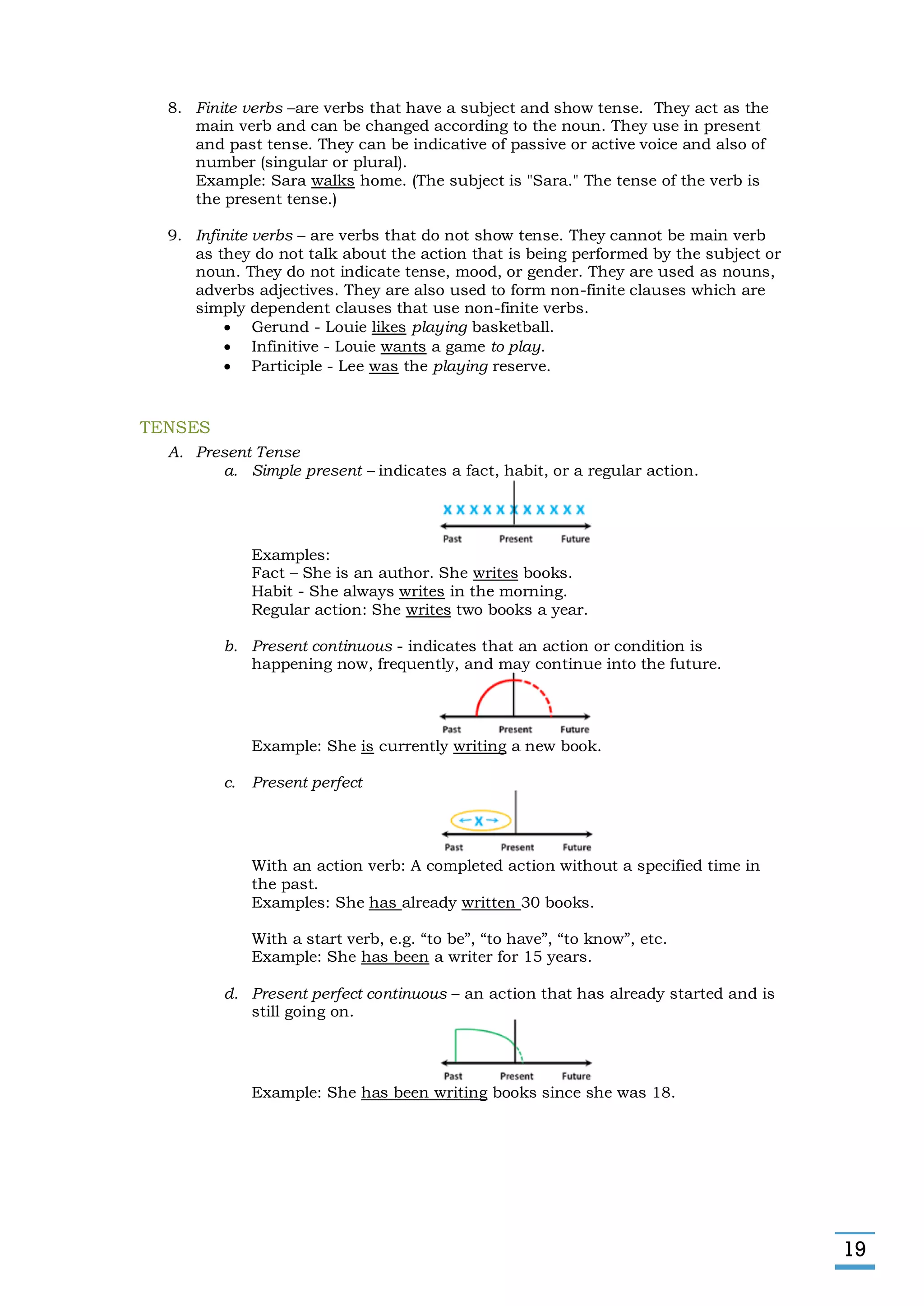
a. Simple present – indicates a fact, habit, or a regular action.
Examples:
Fact – She is an author. She writes books.
Habit - She always writes in the morning.
Regular action: She writes two books a year.
b. Present continuous - indicates that an action or condition is
happening now, frequently, and may continue into the future.
Example: She is currently writing a new book.
c. Present perfect
With an action verb: A completed action without a specified time in
the past.
Examples: She has already written 30 books.
With a start verb, e.g. “to be”, “to have”, “to know”, etc.
Example: She has been a writer for 15 years.
d. Present perfect continuous – an action that has already started and is
still going on.
Example: She has been writing books since she was 18.
20
B. Past Tense
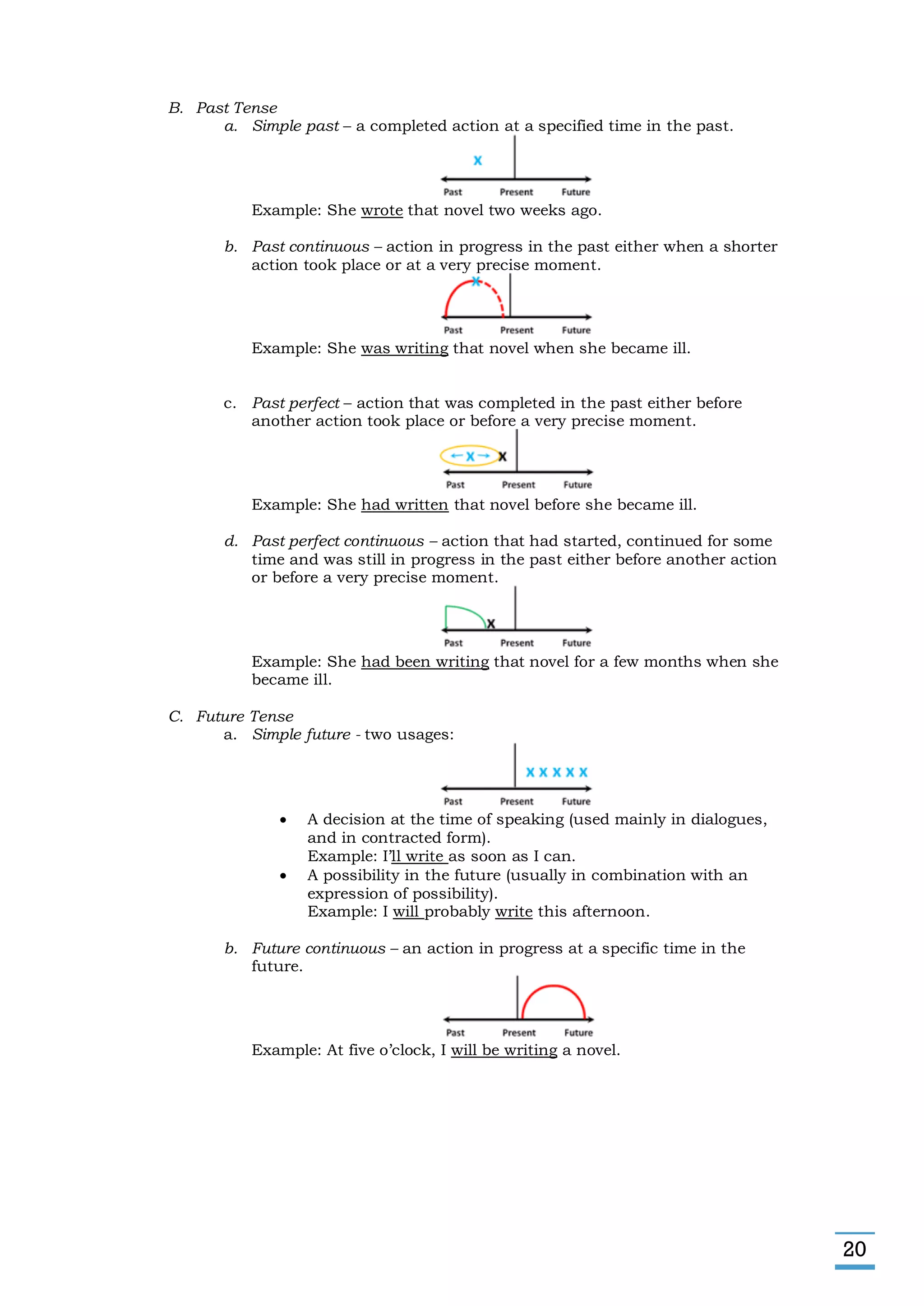
a. Simple past – a completed action at a specified time in the past.
Example: She wrote that novel two weeks ago.
b. Past continuous – action in progress in the past either when a shorter
action took place or at a very precise moment.
Example: She was writing that novel when she became ill.
c. Past perfect – action that was completed in the past either before
another action took place or before a very precise moment.
Example: She had written that novel before she became ill.
d. Past perfect continuous – action that had started, continued for some
time and was still in progress in the past either before another action
or before a very precise moment.
Example: She had been writing that novel for a few months when she
became ill.
C. Future Tense
a. Simple future - two usages:
• A decision at the time of speaking (used mainly in dialogues,
and in contracted form).
Example: I’ll write as soon as I can.
• A possibility in the future (usually in combination with an
expression of possibility).
Example: I will probably write this afternoon.
b. Future continuous – an action in progress at a specific time in the
future.
Example: At five o’clock, I will be writing a novel.
21
c. Future perfect – action that will be completed in the future either
before a specific moment or before another action takes place.
Example: She will have written at least two novels by the end of the
year.
d. Future perfect continuous – action that will have started, continued for
some time and will still be in progress in the future either before a
specific moment or before another action takes place.
Example: She will have been writing for a few hours by the time she
left.
Modals
Modal verbs are auxiliary verbs (also called helping verbs) like can, will, could, shall,
must, would, might, and should.
1. Possibility – might, may, could, can
Examples: It looks nice, but it might be very expensive.
2. Ability and skill – can, could
Example: Dianne can speak 3 languages.
3. Advice - should
Example: You shouldn’t smoke.
4. Obligation – must, have to
Example: You must do your homework.
5. Permission – can, could, may
Example: Can I try my hand at it?
6. Habit and inclination – will, would
Example: I will never refuse you anything.
SUBJECT-VERB AGREEMENT
1. The subject and the verb must agree in number.
Examples:
He goes to work by bus
The dog chases the cat.
2. An intervening phrase or clause between subject and verb does not change
the number of the subject.
Examples:
The team captain, as well as his players, is anxious.
The woman with all the dogs walks down my street.
22
3. Prepositional phrases between the subject and verb usually do not affect
agreement.
Example:
The colors of the rainbow are beautiful.
4. Inverted subjects must agree with the verb.
Examples:
There are butterflies in your garden.
There is a bush near the school playground.
How is Maria handling the news of her grandfather’s death?
5. If two subjects are joined by “and”, they typically require a plural verb form.
Examples:
Kimberly and Keith are friendly.
She and her friends are at the mall.
Exception: The verb is singular if the two subjects separated by “and” refer to
the same person or thing.
Example:
Bacon and eggs is my favorite dish
6. Two subjects joined by “or/not”, “either…or/neither…nor”, “not only…but
also” take the verb that agrees with the subject closest to it.
Examples:
Neither my mother nor my father goes to university.
Either my father or my brothers are coming.
Not only you but also I am planning to go.
7. The verb is singular if the subject is a singular indefinite pronoun such as
each, either, neither, one, no one, every one, someone, anyone, nobody,
somebody, anybody, everybody, one, no.
Examples:
Nobody gets rich from writing nowadays.
Either of the plans is equally dangerous.
The verb is plural if the subject is a plural indefinite pronoun such as
several, few, both, many.
Example:
Few were left alive after the flood.
Some indefinite pronouns (some, any, all, most) may be either singular or
plural, depending upon their use in a sentence: with uncountable, use
singular; with countable, use plural.
Examples:
Some of the books are out of place. Please put them in the right order. (Books
are countable.)
Some of the music was weird. (Music is uncountable.)
8. With words that indicate portions such percent, fraction, part, majority,
some, all, none, remainder, etc. look at the noun after of. If the noun after of
is singular, use a singular verb. If it is plural, use a plural verb.
Examples:
A lot of the pie has disappeared.
A lot of the pies have disappeared.
A third of the city is unemployed.
A third of the people are unemployed.
23
9. Use a singular verb for expressions of measurement, time, money, and
weight when the amount is considered one unit.
Examples:
Four liters of oil was required to get the car running.
Three miles is too far to walk.
10. Plural form subjects with a singular meaning take a singular verb (such as
mumps, home economics, social studies economics, measles, calisthenics,
statistics, civics, physics, gymnastics, phonics, news, acrobatics, aesthetics,
thesis, mathematics, etc.).
Examples:
The news is on at six.
Gymnastics is his favorite sport.
Mathematics is the science of pure quantity.
Plural form subjects with a plural meaning take a plural verb (such scissors,
trousers, eyeglasses, grits, pliers, tweezers, etc.)
Examples:
Scissors are laying on the table.
My jeans aren’t dry, so I will wear shorts.
11. Collective nouns such as group, team, committee, class, and family usually
take singular verb.
Examples:
The herd is stampeding.
The team runs during practice
The crew is preparing to dock the ship.
12. The expression “the number of” takes singular verb while “a number of”
takes plural verb.
Examples:
The number of students in the class is limited.
A number of books are on reserve in the library.
13. Titles of single entities (books, organizations, countries, etc.) are always
singular.
Example:
Harry Potter is a phenomenal novel.
The Burbs is a movie starring Tom Hanks.
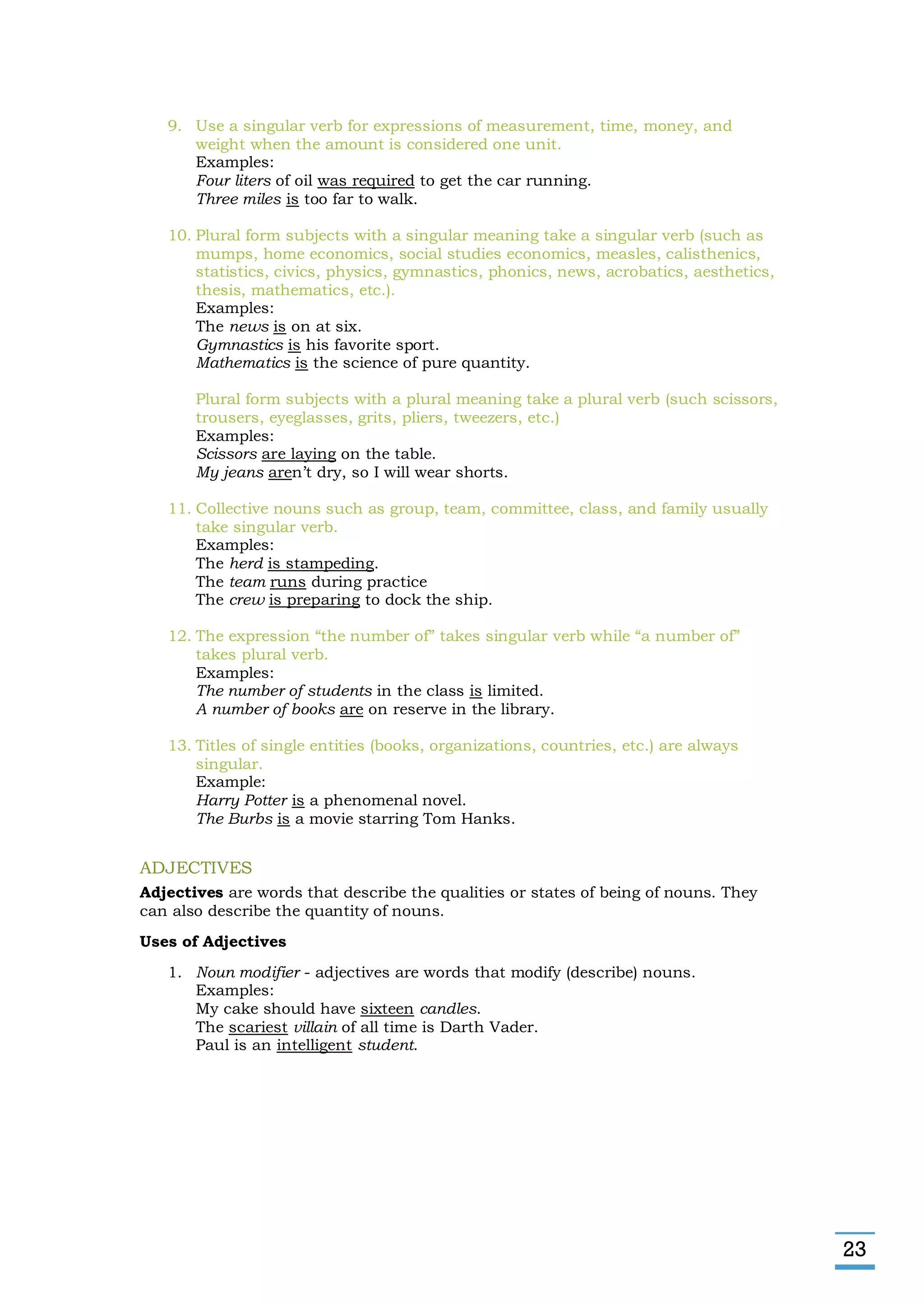
ADJECTIVES
Adjectives are words that describe the qualities or states of being of nouns. They
can also describe the quantity of nouns.
Uses of Adjectives
1. Noun modifier - adjectives are words that modify (describe) nouns.
Examples:
My cake should have sixteen candles.
The scariest villain of all time is Darth Vader.
Paul is an intelligent student.
24
2. Predicate adjective - adjectives can also act as a complement to linking verbs
or the verb to be. A linking verb is a verb like to feel, to seem, or to taste that
describes a state of being or a sensory experience.
Examples:
That cow sure is happy.
It smells gross in her bedroom.
Driving is faster than walking.
3. Articles - also modify the nouns.
Examples:
A cat is always afraid of water.
The dog is hungry.
Mark won an award.
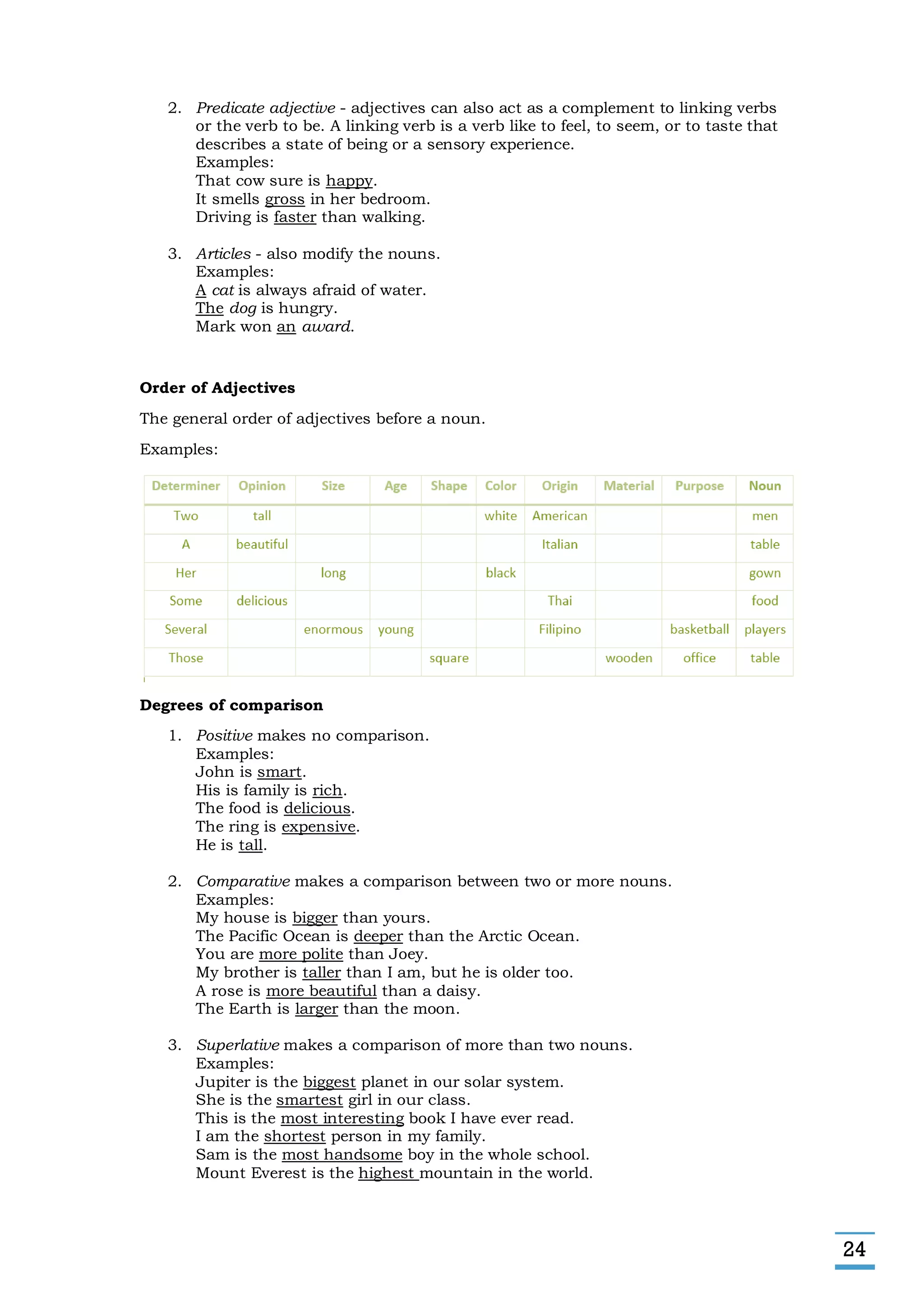
Order of Adjectives
The general order of adjectives before a noun.
Examples:
Degrees of comparison
1. Positive makes no comparison.
Examples:
John is smart.
His is family is rich.
The food is delicious.
The ring is expensive.
He is tall.
2. Comparative makes a comparison between two or more nouns.
Examples:
My house is bigger than yours.
The Pacific Ocean is deeper than the Arctic Ocean.
You are more polite than Joey.
My brother is taller than I am, but he is older too.
A rose is more beautiful than a daisy.
The Earth is larger than the moon.
3. Superlative makes a comparison of more than two nouns.
Examples:
Jupiter is the biggest planet in our solar system.
She is the smartest girl in our class.
This is the most interesting book I have ever read.
I am the shortest person in my family.
Sam is the most handsome boy in the whole school.
Mount Everest is the highest mountain in the world.
25
Kinds of Adjectives
1. Descriptive adjective is a word which describes nouns and pronouns.
Example: I have a fast car.
2. Quantitative adjective provides information about the quantity of the nouns
and pronouns.
Example: They have three houses in the province.
3. Proper adjective is the adjective form of proper nouns.
Example: Filipino people are hard workers.
4. Demonstrative adjective directly refers to something or someone.
Example: These cats are cute.
5. Possessive adjective indicates possession or ownership.
Example: Her books are expensive.
6. Interrogative adjective asks a question.
Example: What game do you want to play?
7. Indefinite adjective provides indefinite/unspecific information about the
noun. The common indefinite adjectives are few, many, much, most, all, any,
each, every, either, nobody, several, some, etc.
Example: I gave some candy to her.
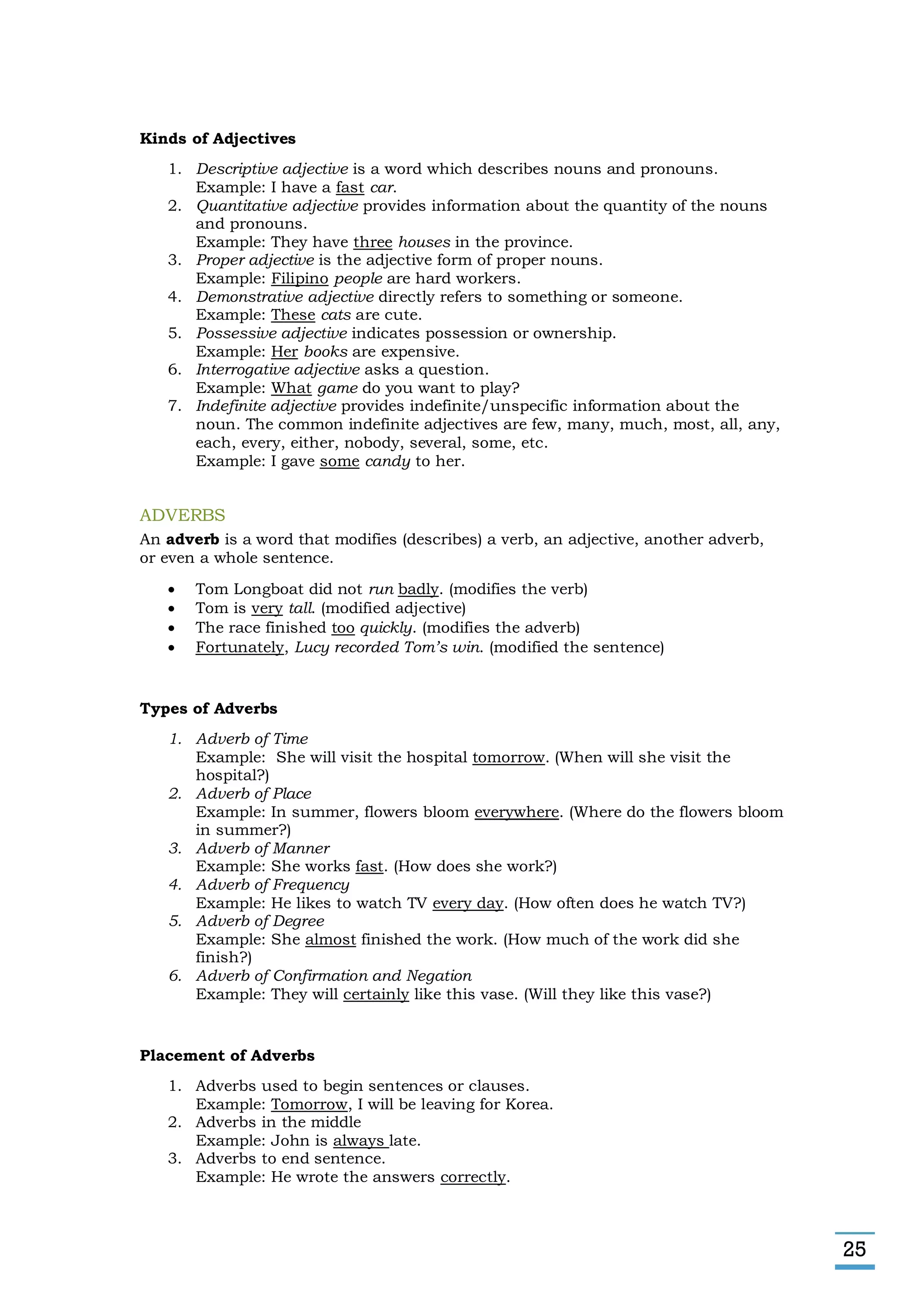
ADVERBS
An adverb is a word that modifies (describes) a verb, an adjective, another adverb,
or even a whole sentence.
• Tom Longboat did not run badly. (modifies the verb)
• Tom is very tall. (modified adjective)
• The race finished too quickly. (modifies the adverb)
• Fortunately, Lucy recorded Tom’s win. (modified the sentence)
Types of Adverbs
1. Adverb of Time
Example: She will visit the hospital tomorrow. (When will she visit the
hospital?)
2. Adverb of Place
Example: In summer, flowers bloom everywhere. (Where do the flowers bloom
in summer?)
3. Adverb of Manner
Example: She works fast. (How does she work?)
4. Adverb of Frequency
Example: He likes to watch TV every day. (How often does he watch TV?)
5. Adverb of Degree
Example: She almost finished the work. (How much of the work did she
finish?)
6. Adverb of Confirmation and Negation
Example: They will certainly like this vase. (Will they like this vase?)
Placement of Adverbs
1. Adverbs used to begin sentences or clauses.
Example: Tomorrow, I will be leaving for Korea.
2. Adverbs in the middle
Example: John is always late.
3. Adverbs to end sentence.
Example: He wrote the answers correctly.
26
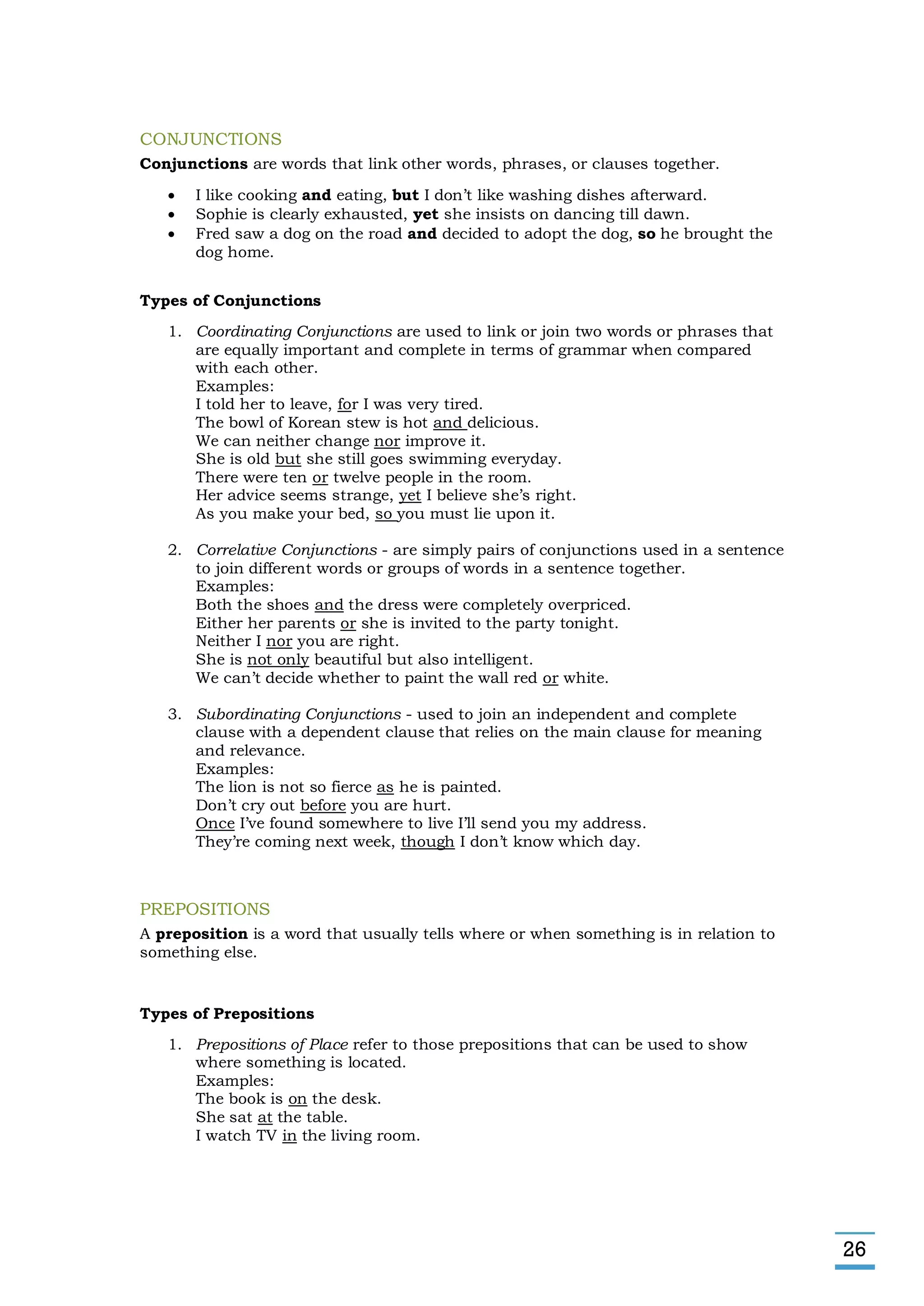
CONJUNCTIONS
Conjunctions are words that link other words, phrases, or clauses together.
• I like cooking and eating, but I don’t like washing dishes afterward.
• Sophie is clearly exhausted, yet she insists on dancing till dawn.
• Fred saw a dog on the road and decided to adopt the dog, so he brought the
dog home.
Types of Conjunctions
1. Coordinating Conjunctions are used to link or join two words or phrases that
are equally important and complete in terms of grammar when compared
with each other.
Examples:
I told her to leave, for I was very tired.
The bowl of Korean stew is hot and delicious.
We can neither change nor improve it.
She is old but she still goes swimming everyday.
There were ten or twelve people in the room.
Her advice seems strange, yet I believe she’s right.
As you make your bed, so you must lie upon it.
2. Correlative Conjunctions - are simply pairs of conjunctions used in a sentence
to join different words or groups of words in a sentence together.
Examples:
Both the shoes and the dress were completely overpriced.
Either her parents or she is invited to the party tonight.
Neither I nor you are right.
She is not only beautiful but also intelligent.
We can’t decide whether to paint the wall red or white.
3. Subordinating Conjunctions - used to join an independent and complete
clause with a dependent clause that relies on the main clause for meaning
and relevance.
Examples:
The lion is not so fierce as he is painted.
Don’t cry out before you are hurt.
Once I’ve found somewhere to live I’ll send you my address.
They’re coming next week, though I don’t know which day.
PREPOSITIONS
A preposition is a word that usually tells where or when something is in relation to
something else.
Types of Prepositions
1. Prepositions of Place refer to those prepositions that can be used to show
where something is located.
Examples:
The book is on the desk.
She sat at the table.
I watch TV in the living room.
27
2. Prepositions of Time are often used to refer to times and dates.
Examples:
Many shops don't open on Sundays.
She's always up before dawn.
She had promised to be back by five o'clock.
3. Prepositions of Movement show movement from one place to another.
Examples:
The milk is above the soda in the refrigerator.
They told stories around the campfire.
The river runs through the woods.
Preposition Chart
Preposition of Time
Preposition How It’s Used Example
At
Specific time
Mealtime
Part of the day
Age
at 3pm
at lunch
at sundown
at age 30
In
Century
Decade
Year
Month
Season
Time period
in the 1900’s
in the 90’s
in 2021
in November
in Summer
in three
minutes
On
Day of the week
Date
Occasion or event
on Monday
on February 14
on my birthday
Preposition of Place
Preposition How It’s Used Example
At
Address
Specific location
at 26 Ruby St.
at Rainbow
Village
at SM Mall
In
Country
City
Neighborhood
Location inside
in the
Philippines
in Valenzuela
City
in Chinatown
in the kitchen
On
Street
Avenue
Higher than
something
Location outside
on Pearl St.
on Quezon Ave.
on the table
on the patio
28
INTERJECTION
An interjection is a word that you throw in between sentences or thoughts to
express emotion or feelings.
Examples:
• Help! I am about to fall!
• Ouch! That bee just stung me!
• I forgot to do the homework assignment (oops), but my teacher gave me an
extra day to finish it.
• Gee, I hadn’t thought of that.
• Oh, really? I doubt that.
QUESTION TAGS
A question tag is short question at the end of statement.
Rules
1. Positive statement uses a negative tag, or vice-versa
Examples:
May can cook adobo, can’t she?
They aren’t funny, are they?
2. Put “will you” in case of Imperative sentences (Order/Request)
Examples:
Pass me the pen, will you?
Keep quiet, will you?
3. Put “shall we” in case of suggestion often introduced by “let’s”
Examples:
Let’s do our homework first, shall we?
Let’s go for an outing, shall we?
4. When there is no Direct Auxiliary is mentioned
Examples:
John studies hard, doesn’t he?
She bought a dress, didn’t she?
They sing really well, don’t they?
5. When has, have, or had are main verbs
Examples:
He had fever, didn’t he?
She has a bicycle, doesn’t she?
29
Philippine Literature
Pre-Colonial Period (Years before 1565)
• The literature of the pre-colonial Filipinos was characterized by oral
tradition.
• The literature reflects customs and traditions in everyday life such as
households, farming, fishing, hunting, taking care of children, etc.
• They already had own system of writing and the first Filipino alphabet is
called Alibata.
Early Forms of Philippine Literature
• Riddle (bugtong) – consists of two-liner statements, questions or phrases that
has double or hidden meaning. It is called Tigmo in Cebu, Paktakon in
Ilonggo, and Patotdon in Bicol.
• Proverb (salawikain) – is traditional saying or maxim used by Filipinos based
on local culture, wisdom, and philosophies from Filipino life (Wikipedia).
• Tanaga – is a quatrain in with seven syllables each with the same rhyme at
the end of each line.
• Folk Song – is a form of folk lyric which expresses the people's hopes,
aspirations, and lifestyles.
o Ambahan (Mangyan) – about human relationships and social
entertainment
o Hele or Oyayi - lullaby
o Kalusan (Ivatan) – work song
o Kanogan (Cebuano) – song of lamentation for the dead
o Kumintang – war song
o Kundiman – melancholic love song
o Tagay (Cebuano and Waray) – drinking song
• Myth – is a sacred narrative explaining how the world and man came to be in
their present form.
o The Legend of Maria Makiling
o Malakas at Maganda
• Fable – is a short allegorical tale emphasizing on a moral or any principle of
behavior, and the characters are usually animals.
• Epic – describes the adventures of the hero and can be classified into two
groups: epics of romance, in which the main adventures consist of the hero's
courting of specific women or his search for beautiful women he can marry,
and epics in which the hero undertakes adventures mainly in the service of
his family, his country, his people, and for others (Wikipedia).
o Agyu or Olahing and Tuwaang (Manobos)
o Bantugan (Maranao)
o Biag ni Lam-ang (Ilocano)
o Hinilawod (Panay)
o Hudhud and Alim (Ifugao)
o Kudaman (Palawan)
o Ibalon (Bikolano)
o Sandayo (Subanon)
• Legend – is a traditional story that describes the origin of things and the
world. They also explain the supernatural events, mysteries, and cultural
tradition.
30
Spanish Period (1585 – 1863)
• Literature is classified as religious and secular.
• Alibata was replaced by Roman Alphabet.
• Teaching of Christian Doctrine became the basis of religious practices.
• European legends and traditions brought here became assimilated in our
songs, corridoes, and moro-moros.
• The Spanish language which became the literary language during this time
lent many of its words to our language.
• Grammar books were printed in Filipino.
• Our periodicals during these times gained religious tone.
Forms of Literature during Spanish Period
A. Folk Song
• Leron-Leron Sinta (Tagalog)
• Pamulinawen (Ilokano)
• Dandansoy (Bisaya)
• Sarong Banggi (Bicolano)
• Atin Cu Pung Singsing (Kapampangan)
B. Religious and Recreational Plays
1. Cenaculo – this is a dramatic performance to commemorate the passion
and death of Jesus Christ.
2. Lagaylay – this is a special occasion for the Pilareños of Sorsogon during
Maytime to get together. This also shows praise, respect and offering love
to the Blessed Cross by St. Helena and the mound she dug in.
3. Panunuluyan – this is presented before 12:00 on Christmas Eve. This is a
presentation of the search of the Virgin Mary and St. Joseph for an inn
wherein to deliver the baby Jesus.
4. Salubong – an Easter play that dramatizes the meeting of the Risen
Christ and his Mother.
5. Awit – is a colorful tales of chivalry made for singing and chanting.
Example: Ibong Adarna
6. Balagtasan - this is a poetic joust or a contest of skills in debate on a
particular topic or issue.
7. Korido – is a metrical tale written in octosyllabic quatrains. Example:
Florante at Laura by Francisco Baltazar
8. Carillo (Shadow Play) – this is a form of dramatic entertainment
performed on a moonless night during a town fiesta or on dark nights
after a harvest. This shadow play is made by projecting cardboard figures
before a lamp against a white sheet. The figures are moved like
marionettes whose dialogues are produced by some experts.
9. Karagatan - this is a poetic vehicle of a socio- religious nature celebrated
during the death of a person. Duplo replaced the Karagatan. this is a
poetic joust in speaking and reasoning.
10. Moro-Moro – a play that depicts the fighting between Moros and
Christians.
11. Sainete – a short musical comedy that were exaggerated and shown
between long plays.
12. Tibag – the word tibag means to excavate. This ritual was brought here
by the Spaniard to remind the people about the search of St. Helena for
the Cross on which Jesus died through a dramatic performance.
13. Zarzuela – considered the father of the drama; it is a musical comedy or
melodrama three acts which dealt with man’s passions and emotions like
love, hate, revenge, cruelty, avarice or some social or political problem.
31
First Books Written During the Spanish Period
1. Ang Doctrina Cristiana (The Christian Doctrine) – it was written by Fr. Juan de
Placencia and Fr. Domingo Nieva, in Tagalog and Spanish. It contained the
Our Father, Hail Mary, Hail Holy Queen, Ten Commandments, The Seven
Mortal Sins, How to Confess, and The Catechism.
2. Nuestra Señora del Rosario – the second book printed in the Philippines by
Fr. Blancas de San Jose in 1602. It contains the biographies of saints,
novenas, and questions and answers on religion.
3. Ang Barlaan at Josephat – this is a Biblical story printed in the Philippines
and translated to Tagalog from Greek by Fr. Antonio de Borja.
4. Pasion – this is a book about life and suffering of Jesus Christ.
5. Urbana at Felisa – it was written by Modesto de Castro, the Father of Classic
Prose in Tagalog. These are letters exchanges of two sisters dealing with good
behavior.
6. Vocabulario Dela Lengua Tagala – this is the first Tagalog dictionary written
by Fr. Pedro de Dan Buenaventura.
Notable Filipinos During Spanish Period
1. Francisco Baltazar- he was popularly known as Balagtas and he is the
Master of Traditional Tagalog Poetry.
2. Jose Dela Cruz – he was the foremost exponent of the comedy.
Period of Enlightenment (1872 – 1898)
• Filipino spirit reawakened when the three priests namely Gomez, Burgos and
Zamora were guillotined without sufficient evidence of guilt.
• Literature contained mostly about accusation against the government and
was meant to arouse the people to unite and to prepare for independence.
The Propaganda Movement (1872-1896)
The main goal of the Propaganda Movement was to create reforms in the Philippines.
Their objectives were:
1. Equal treatment for the Filipinos and the Spaniards under the law
2. Recognition of the Philippines as a province of Spain
3. Representation of Filipino in the Spanish Cortes
4. Secularization of the clergy
5. Freedom of speech
6. Abolition of polo y servicios (labor service) and the bandala (forced sale of
local products to the government)
Forms of Literature During Propaganda Movement
A. Political Essays – satires, editorials and news articles were written to attack
and expose the evils of Spanish rule.
1. Diarong Tagalog (1882)
2. La Solidaridad (1888)
B. Political Novels
1. Noli Me Tangere by Jose Rizal (1887)
2. El Filibusterismo by Jose Rizal (1891)
32
C. Poetries
1. Hibik ng Pilipinas by Andres Bonifacio (1896)
2. Liwanag at Dilim by Emilio Jacinto (1896)
3. True Decalogue by Apolinario Mabini (1898)
Notable Filipinos During Propaganda Movement
1. Andres Bonifacio
• He was the Father of the Philippine Revolution.
• He wrote a poem entitled “Pag-ibig sa Tibuang Lupa” in 1986 directed
to the Filipinos in order to arouse their spirit of nationalism and self-
independence.
2. Antonio Luna
• His pen name is Tabing-Ilog.
• He wrote La Independencia.
3. Graciano Lopez-Jeana
• He wrote Fray Botod when he was 18.
• He was first editor of La Solidaridad, the official newspaper of the
Propaganda Movement.
4. Jose Maria Panganiban
• Hi pen name is Jomapa.
• He wrote “Ang Lupang Tinubuan” and “Anatomia de Regines.”
5. Jose Rizal
• His pen names are Laong Laan and Dimasalang.
• He wrote Noli Me Tangere and El Filibusterismo.
6. Marcelo H. Del Pilar
• His pen names are Plaridel and Dolores Manapat.
• He founded the short-lived Diariong Tagalog (Tagalog Newspaper) on
June 1, 1882.
• He wrote “Dasalan at Tuksuhan”, a satire on friar’s hypocrisy,
licentiousness and greed sarcasm.
7. Mariano Ponce
• His names are Naning, Kalipulako, and Tikbalang.
• He wrote Efemeridas Filipinas (1914), Documentos Filipinas (1916),
La Provincia Bulacan (1917), and Wika at Lahi (1917).
8. Pedro Paterno
• His pen name is Justo Desiderio Magalang.
• He wrote Ninay, the first social novel in Spanish by a Filipino, in
1885.
American Regime (1910 – 1945)
• Americans influenced Filipino writers to write using English language.
• Filipino writers went into all forms of literature like news, reporting, poetry,
stories, plays, essays, and novels. Their writings clearly depicted their love of
country and their longings for independence.
Characteristics of Literature During this Period
The literature during this period was divided into:
A. Literature in Spanish
1. Cecilio Apostol - wrote "A Rizal " and is considered the best poem in
praise of the hero of Bagumbayan.
2. Fernando Ma. Guerero - he collected the best of his poem in a book
called Crisalidas, and one of the poems written in this book was
"Invocacion A Rizal."
33
3. Jesus Balmori - well-known for his pen name of Batikuling. He and
Manuel Bernabe participated in a debate on the topic -
"Remembrance and Forgetfulness". He was elected Poet Laureate in
Spanish besting Manuel Bernabe.
4. Manuel Bernabe - is a lyric poet. He was more attractive to the public
in a debate with Balmori because of the melodious words he used. He
defended Olvido.
5. Claro M. Recto - he collected his poems in a book entitled Bajo Los
Cocoteros. One of his writings dedicated to Rizal is "Ante El Martir.”
B. Literature in Filipino
1. Lope K. Santos - "Father of the National language Grammar", he was
also called "apo" of the Tagalog writers. "Banaag at Sikat" was his
masterpiece.
2. Jose Corazon de Jesus - known as Huseng Batute, he was also called
the poet of love in his time. "Ang Isang Punong Kahoy", an elegy, is
believed to be his masterpiece.
3. Armando V. Hernandez - was dubbed "Poet of the Laborers", his
masterpiece is "Ang Panday"
4. Valeriano Hernandez Pena - known as Tandang Anong, he considers
"Nena at Neneng" his masterpiece.
5. Inigo Ed Regalado - a popular storyteller, novelist, and newspaper
man.
C. Literature in English
1. Period of Re-orientation (1898 – 1910)
• It began with the occupation of Manila by the American forces
on August 13, 1898. It extended to the publication of the
College Folio in 1910 when Filipino writers made their first
attempts at expression in the new language.
• The nationalistic and rebellious spirit against the American
occupation also found expression in the Filipino literature in
English of this period. It consisted mostly of articles dealing
with patriotism and nationalism.
• The two periodicals published in English were: El
Renacimiento, founded by Rafael Palma in 1901 and
Philippine Free Press, established in Manila 1905 by R.
McCullough Dick and D. Theo Rogers.
2. Period of Imitation (1910 – 1924)
• It began in 1910 when the College Folio made its appearance
in the University of the Philippines.
• This period was characterized by a strict adherence to the
conventional forms of literature as exemplified in the works of
Longfellow, Hawthorne, Emerson, Tennyson, Thackeray, and
Macaulay, and by a careful observance of the rules of
grammar and rhetoric.
• The publication of magazines and newspapers in English gave
budding writers a chance to see their compositions in print
such as Philippine Review, Independent, Rising Philippines,
and Citizens, in addition to the Philippine Collegian, the UP-
student organ. Philippines Herald became the pioneer Filipino
newspaper in English in 1920.
• Paz Marquez Benitez gained some measure of mastery far
ahead of the period as exemplified in her short story “Dead
Stars.” This story was, for a long time, considered “a model of
perfection in character delineation, local color, plot, and
message.”
• The first book of poems and the first novel in English written
by a Filipino were published during this period - “Never Mind
34
and Other Poems” by Procopio Solidum and “A Child of
Sorrow” by Zoilo M. Galang.
3. Period of Self Discovery and Growth (1925 – 1941)
• Filipino writers had acquired the mastery of English writing.
They now confidently and competently wrote on a lot of
subjects although the old-time favorites of love and youth
persisted. They went into all forms of writing like the novel
and the drama.
• “Azucena” written by Marcelo de Gracia Concepcion became
the first book of Filipino verse to be printed in America.
• The first Filipino biographer to write in English is Carlos
Quirino with his “The Great Malayan.”
• In the essay, the notable writings included “Literature and
Society” by Salvador P. Lopez and “Horizons from My Nipa
Hut” by Francisco P. Icasiano.
Japanese Period (1941 -1945)
• Philippine literature in English came to a halt.
• All newspapers were not circulated in the community except for Tribune and
Philippine Review.
• The weekly Liwayway was placed under strict surveillance until it was
managed by a Japanese named Ishiwara.
• Japanese were able to influence and encourage the Filipino in developing the
vernacular literature.
Forms of Literature During Japanese Period
A. Dramas
Many of plays were reproductions of English plays to Tagalog. A few
playwriters were:
1. Jose Ma. Hernandez – wrote “Panday Pira”
2. Francisco Soc Rodrigo – wrote “Sa Pula, Sa Puti”
3. Clodualdo del Mundo – wrote “Bulaga”
4. Julian Cruz Balmaceda – wrote “Sino ba Kayo?”, “Dahil sa Anak”, and
“Higante ng Patay”
B. Poetries
The common theme of most poems during the Japanese occupation was
nationalism, country, love, and life in the barrios, faith, religion, and the
arts. Three types of poems emerged during this period:
1. Haiku – is a poem of free verse and it is made up of seventeen (17)
syllables divided into three (3) lines. The first line has five, the second
– seven and the third – five. It is allegorical in meaning, short and
covers a wide scope in meaning.
2. Tanaga - it is short but has measure and rhyme. Each line has
seventeen syllables and is also allegorical in meaning.
3. Karaniwang Anyo – it is the usual and common form of poetry.
C. Short Stories
Best short stories in 1945:
1. “Lupang Tibuan” by Narciso Reyes
2. “Uhaw ang Tigang na Lupa” by Liwayway Arceo
3. “Lungsod Ngaun at Dagat-dagatan” by NVM Gonzales
35
Contemporary Period
A. Rebirth of Freedom (1946 – 1970)
• The early post-liberation period was marked by a kind of “struggle of
mind and spirit” posed by the sudden emancipation from the enemy, and
the wild desire to see print.
• There was a proliferation of newspapers:
o Free Press and Morning Sun of Sergio Osmeña Sr.
o Daily Mirror of Joaquin Roces
o Evening News of Ramon Lopez
o Bulletin of Hans Menzi
Some of the Writers and Their Works
• The Voice of the Veteran - a compilation of the best works of some Ex-
USAFFE men like Amante Bigornia, Roman de la Cruz, Ramon de Jesus,
and J.F. Rodriguez.
• Twilight in Tokyo and Passion and Death of the USAFFE by Leon Ma.
Guerrero
• For Freedom and Democracy by S.P. Lopez
• Betrayal in the Philippines by Hernando Abaya
• Seven Hills Away by NVM Gonzales
Some Notable Works
• Heart of the Islands (1947) - a collection of poems by Manuel Viray
• Philippine Cross Section (1950) – a collection of prose and poetry by
Maximo Ramos and Florentino Valeros
• Prose and Poems (1952) by Nick Joaquin
• Philippine Writing (1953) by T.D. Agcaoili
• Philippine Harvest by Amador Daguio
• Horizon Least (1967) – a collection of works by the professors of UE,
mostly in English (short stories, essays, research papers, poem and
drama) by Artemio Patacsil and Silverio Baltazar
• The “Hand of the Enemy” by Kerima Polotan won the Stonehill Award for
the Filipino novel in English in 1961.
• The “Adversary” by Luis V. Teodoro Jr. won the Philippines Free Press
short story award in 1968. His other works such as “The Trail of
Professor Riego” won second prize in the Palanca Memorial Awards for
Literature in 1968 and “The Distant City” in 1970 won the Graphic short
story award in 1970.
B. Period of Activism (1970 – 1972)
• During this period, youth moved to seek reforms because of ills of society.
They rallied on the streets to demand a change in the government.
• Filipino writers utilized their writings to undermine the issues of
exploitations and injustice in the country.
• Literature and mass communication were silenced, but gradually, a
group of Filipino writers took their writing underground and recommitted
themselves to writing short stories, poetry and novels that explored the
social concerns of the times.
36
C. Period of New Society (1972 – 1981)
• All themes in most writings dealt with the development or progress of the
country –like the Green Revolution, family planning, proper nutrition,
environment, drug addiction, etc.
• The New Society tried t0 stop pornography or those writings that had a
negative impact on the morals of the people.
• Ministry of Public Affairs was established by the military government to
supervise the newspapers, books & other publications.
• The government revived old plays such as Cenaculo, Zarzuela, and
Embayoka of the Muslims. Cultural Center of the Philippines, Folk Arts
Theater and Metropolitan Theater were built to have a place for these
plays.
• Kislap and Liwayway became the avenues for Filipino writers to publish
many of their works.
• Poems dealt with patience, regard for native culture, customs, and the
beauties of nature and surroundings.
• Newspapers donned new forms.
• News on economic progress, discipline, culture, tourism, and the like
were favored more than the sensationalized reporting of killings, rape,
and robberies. Filipinos before were hooked in reading magazines and
comics.
D. Period of Third Republic (1981 – 1985)
• The Don Carlos Palanca Memorial Awards for literature, which was
launched in 1950, continued its recognition of the best in the literary
fields –poetry, short story, essays, and the one and three-act plays.
• Poems during this period of the Third Republic were romantic and
revolutionary.
• Many Filipino songs dealt with themes that were true-to-life like those of
grief, poverty, aspirations for freedom, love of God, of country and
fellowmen.
37
Master Works of the World
Figure Speech
1. Alliteration – is the repetition of an initial consonant sound.
Examples:
She sells seashells by the seashore.
Garry grumpily gathered the garbage.
2. Anaphora – is when a word is repeated multiple times within a phrase.
Examples:
He had one apple, one banana, and one mango.
Give me liberty or give me death.
3. Antithesis – is applying a juxtaposition of ideas which are contrasting in a
statement that is balanced.
Examples:
Man proposes, God deposes.
Many are called, but few are chosen. Matthew 22:14
4. Apostrophe – directly addresses an absent person as if he were present or
an inanimate object or an abstract idea as if it had life.
Examples:
O, pardon me, thou bleeding piece of earth. (Julius Caesar, Act III, Scene I)
Come on trousers, you have to fit me.
5. Assonance – is the repetition of identical or similar vowel sounds in a series
of words, phrases, and/or syllables.
Examples:
Clamp your hands and stamp your feet.
Fleet feet sweep by sleeping geese.
6. Chiasmus – is when two sentences are balanced against one another but
with the words reversed.
Examples:
Work to live and do not live to work.
Let us never negotiate out of fear but let us never fear to negotiate. (John F.
Kennedy)
7. Euphemism – is a more polite or gentle way to say something.
Examples:
He passed away. (Pass away is the euphemism for die.)
I am letting you go. (Letting you go is the euphemism for fired.)
8. Hyperbole – is a term which uses an exaggeration to add a more dramatic
meaning to the sentence.
Examples:
She cried so long that she made a lake.
I’m so hungry, I could eat a horse.
9. Irony – is a statement which conveys the exact opposite meaning of what is
literally said.
Examples:
A pilot has a fear of heights.
The police station gets robbed.
38
10. Litotes – is an understatement which applies a negative to express the
meaning of the affirmative.
Examples:
He is no fool. (He is smart)
There isn’t anything I won’t eat when I’m hungry. (I will eat anything when
I’m hungry.)
11. Metaphor – is an implied comparison between two different things which
share something in common.
Examples:
His words cut deeper than a knife.
I am the good shepherd, … and I lay down my life for the sheep. (John 10:14-
15)
12.Metonymy – is when a phrase is replaced with another which has a similar
meaning or used to describe something in an indirect manner.
Examples:
He is a man of cloth. (man of the church)
I remain loyal to the crown. (power/authority)
13. Onomatopoeia – is word which resembles the sound it is describing.
Examples:
The lion roared as it chased its prey.
I hear the snap of a twig.
14. Oxymoron – is when two words which appear to contradict one another but
when used together make a true and sometimes positive statement.
Examples:
I was like a silent scream.
She showed a cruel kindness.
15. Paradox – is a statement that contradicts itself.
Examples:
My weakness is my strength.
I must be cruel to be kind. (Hamlet by William Shakespeare)
16. Personification – is when an object or idea is given human attributes.
Examples:
The angry clouds marched across the sky.
The lonely lighthouse vigilantly shined its light to warn ships away from its
rocky coast.
17. Pun – is a play of words that are similar in sound but have different
meaning.
Examples:
I was struggling to figure out how lightning works, but then it struck me.
A chicken crossing the road is truly poultry in motion.
18. Simile – is a comparison of two things using “as” and “like”.
Examples:
I wondered lonely as a cloud.
The sun was like a yellow marble in the sky.
19. Synecdoche – is a statement in which only part of something is expressed to
relate to the whole.
Examples:
Jack bought a new set of wheels. (it means car)
Man cannot live by bread alone. (it means food)
39
20. Understatement – is a statement which is made to be less important that
what is actually being conveyed.
Examples:
It rained a bit more than usual. (Describing an area being flooded by heavy
rainfall.)
He is not too thin. (Describing an obese person)
Sumerian, Egyptian and Hebrew Literature
A. Summer Literature
Sumerian literature constitutes the earliest known corpus of recorded
literature, including the religious writings and other traditional stories
maintained by the Sumerian civilization and largely preserved by the later
Akkadian and Babylonian empires (Wikipedia).
• The Sumerian civilization first developed writing around 3400 B.C.,
when they began making markings on clay tablets in a script known
as cuneiform.
• Two of their oldest known literary works are:
o Kesh Temple Hymn - is an ancient ode to the Kesh temple and
the deities that inhabited it.
o Instructions of Shuruppak - is a piece of “wisdom literature”
that takes the form of sagely advice supposedly handed down
from the Sumerian king to his son teaching him how to
behave.
• Epic of Gilgamesh is history’s oldest known fictional story. It is about
the quests and adventures of Gilgamesh, the mythological hero-king
of Uruk and his half-wild friend, Enkidu, and then the search of
Gilgamesh for the secret of immortality after death of his friend.
B. Egyptian Literature
Ancient Egyptian literature comprises a wide array of narrative and poetic
forms. Their literature depicts the peoples’ life, culture, and beliefs. The
ancient Egyptians wrote their works on papyrus as well as on tombs, stele,
obelisks, temple, and more, and they viewed literature as a source of
spiritual nourishment and a unique way to elevate style of expression.
• Most of Egyptian literature was written in hieroglyphics or hieratic
script. Hieroglyphics, which employs characters in the form of
pictures, were used on monuments such as tombs, obelisks, stele,
and temples while hieratic script was used in writing on papyrus and
ceramics.
• The Egyptian Book of the Dead is a collection of spells which enable
the soul of the deceased to navigate the afterlife.
• The Story of Sinube is considered one of the finest works of ancient
Egyptian literature. It is a story of a man who fled his duties in Egypt
and became a Bedouin in an Asiatic tribe.
C. Hebrew Literature
Hebrew literature is chiefly a religious literature. It consists of ancient,
medieval, and modern writings in the Hebrew language.
• The Hebrew Bible is called the Tanakh after the first letter of the
name of the three sections of which it is composed: the Torah
(instruction or law called Pentateuch), the Nevi'im (Prophets), and the
Kethuvim (Writings).
• Mishna is the primary rabbinic codification of oral laws as derived
from the Torah. It comprises six major sections or orders (sedarim)
that contain 63 tractates (massekhtaot).
40
• Talmud is collection of ancient teachings and the primary source of
Jewish religious law and theology.
Persian and Arabic Literature
A. Persian Literature
The Persian Literature is among the oldest in the world, spanning thousands
of years, and has influenced the literary works of many other cultures.
• During the old Iranian period, literature was dominated by religious
writings and the most significant was the Avesta, bible of
Zoroastrianism. The bible contains cosmogony, law, and liturgy, and
the teachings of the prophet Zoroaster.
• Among the great writers are:
o Omar Khayyam – he wrote “Rubaiyat”, a verse form consisting
of four-line stanzas. Rubaiyat is a poem of high divine and
spiritual meaning.
o Hafez - is best known for his poems. He mostly wrote in the
literary genre of lyric poetry or ghazals.
o Sadi – he was the author of the classic literary works “Bustan”
(translated as The Orchard) and “Gulistan” (translated as The
Rose Garden). These books contain teachings and stories
about love, religion, and other aspects of life.
• Persian Poetry
Classical Persian poetry is always rhymed. The principal verse forms:
o Qasida is a long poem in monorhyme, usually of a panegyric,
didactic or religious nature.
o Masnavi, written in rhyming couplets, is employed for heroic,
romantic, or narrative verse.
o Ghazal is a poetic form consisting of rhyming couplet and
refrain and it is about pain of loss or separation and the
beauty of love.
o Rubaiyat – is a poetry style that is used to describe Persian
quatrain.
o Divan – is a collection of poets ghazals and other verse
arranged alphabetically according to rhymes.
• The greatest and most influential work is the “Shahnameh”, the
Persian Book of Kings, written by the poet Abolqasem Ferdowsi
between 977-1010 CE. It is also the longest work of epic poetry ever
written, composed of more than 60,000 verses.
B. Arabic Literature
Arabian Literature is rich and varied, mostly made of poems, anecdotes, tales
or romances, historical accounts, and philosophies.
• Arabs possessed a highly develop poetry transmitted orally from
generation to generation.
• The written literature began to be known with the collection of
Qur’an, the sacred book of Islam.
• The three periods of written literature:
o Umayyad period (A.D. 661 -750) - Arabic prose was limited
primarily to grammatical treatises, commentaries on the
Koran and the compiling of stories about Mohammed and his
companions.
o Abbasid period (A.D. 750 - 1258) – it is regarded as the
“Greatest Period of Development and Achievement.” An Arabic
prose sprinkled with poetry and utilized rhyme prose known
as saj, a rhymed prose.
41
▪ Arabian Nights or The Thousand and One Nights
contains inventive type of folk literature, which based
on the recitation of rawis.
o Modern period (19th Century – present) – Arabic Literature
declined during the Ottoman Turkish domination; however,
the Renaissance period took place, so then Arabs revived their
classical genres and they came into contact to Western
Literature and Civilization. Short story and novel came to
being in this period.
• Kahlil Gibran influenced modern Arabic literature and composed
inspirational pieces in English, including “The Prophet”.
Indian Literature
Indian Literature is one of the oldest and richest literatures in the world. In ancient
times, the literary work used to be imparted orally. The literature is influenced by a
religious doctrine karma, the chain of good and bad action and their inevitable
consequences, which result to the repeated birth and death of the soul.
A. Sanskrit Literature
• Literature is written in Sanskrit language.
• Texts were produced about 16th century BC by people known as Aryans,
cattle herders who were originally nomadic and who established
kingdoms in North India.
• Vedas, the book of knowledge, is composed in Old Sanskrit by Aryan
poets. It constitutes the fundamental scripture of the Hindu religion and
is used as sacramental rites of Hinduism. The texts which make up the
Four Vedas are:
o Rig-Veda – is the Veda of Praise
o Sama-Veda – is the book of chants
o Yajur-Veda – is the book of prayers
o Antharva-Veda – is the book of spells
• Brahmanas is a prose text composed by Hindu priest that discusses the
solemn sacrificial rituals as well as the commitment on their meaning.
• Arankayas constitutes the philosophy behind ritual sacrifice of the
ancient Hindu sacred texts, the Vedas and it was composed by people
who meditated in the woods.
• Upanishads is the India’s oldest philosophical treaties and forms the
foundation of major schools of Hindu philosophy. It was composed by a
group of sages who questioned the usefulness of ritual religion. It
consists of 108 dialogues between teachers and their students about the
individual soul’s unity.
• Tipitaka, “The Three Baskets”, is the major religious text of Buddhism and
includes the teachings of Buddha.
• Mahabharata is the great epic of the Bharata Dynasty. It was written by
Vyasa. It is a tale of dispute between two branches of the Bharata clans
over the right to rule the kingdom.
• Ramayana, “The Way of Rama” was written by the poet Valkimi. It tells the
story of the hero Rama, prince of Ayodhya and incarnation of the god
Vishnu Ramayana.
B. Classical Literature
• It started with the flowering of the Gupta dynasty.
• Literature was nurtured by the caste system.
• Kavya was the major form of classical literature in Sanskrit.
• Kalidasa was a Classical Sanskrit author who is often considered ancient
India's greatest playwright and dramatist. She wrote “Shakuntala”, a
42
poetic drama that tells the story of a love affair between a king and a
woodland maiden Shakuntala.
• Panchatantra, “The Five Strategies” is written by Vishnusharman and it is
a collection of stories in prose and verse, which features animals as the
characters, teaching lessons on human conduct.
• Puranas is a genre of mythological narratives. It contains narratives about
the history of the Universe from creation to destruction and the genealogies
of kings, heroes, sages, and deities.
C. Medieval Literature
• Different regions began to develop its own distinctive culture. Indian
languages were influenced by Islamic religion, Persian, and Arabic
languages. Unique version of local myths, legends, romances and epics
emerged.
• Bhakti were authors who belong to Hindu movement who wrote lyric poetry
devoted to Hindu gods and goddesses.
D. Colonial Period to Independence
• British became a colonial power and they introduced English education for
upper-class Indians so that they can serve the colony. They also introduced
the printing press, which made possible for the establishment of
newspapers and journals.
• Rabindranath Tagore is an innovative poet of the Bengali language who
drew on traditional forms of poetry and performance. He is the first non-
European winner of the Nobel Prize award for literature. Gitanjali, “Song
Offerings” is his best-known work, which is a collection of poems written
in 1910.
E. Independence Onwards
• Indian independence from Britain in 1947 marked the start of modern
Indian literature.
Chinese Literature
Chinese literature reflects the political and social history of China and the impact of
powerful religions that came from within and outside the country. Its tradition goes
back thousands of years and has often inspired by philosophical questions about
meaning of life, how to live ethically in society, and how to live in spiritual harmony
with the natural order of the universe.
A. Shang Dynasty (Development of Chinese Writing)
• People of this dynasty practiced a religion based on the belief that nature
was inhabited by many powerful gods and spirits. Among the significant
advances of this period were hieroglyphic writing on bronze wares and
oracle bones, decimal system, a twelve-month calendar, and a system of
writing consisting of 3,000 characters.
B. Zhou Dynasty (Basic Philosophical and Religious Literature)
• The great literary works of philosophy and religion that became the basis
for Chinese religious and social belief stem from what is called the Spring
and Autumn Period (770-476) and the Warring States Period (475-221).
• This period was also known as One Hundred Schools of Thought because
of simultaneous emergence of religions and philosophies. Among them
were:
o Lao Tzu – he is the proponent of Taoism and stressed freedom,
simplicity, and the mystical contemplation of nature
o Confucius – he is the founder of Confucianism and emphasized a
code of social conduct and stressed the importance of discipline,
morality, and knowledge.
43
• The Book of Songs (Shih Ching) first compiled in the 6th century B.C. and
it is the oldest collection of Chinese poetry and the model of poetic
expression and moral insight.
• The Parables of the Ancient Philosophers illustrate the Taoist belief and
the humanism of the Chinese thought.
C. Qin Dynasty (Literary Disaster and Legalism)
• This period saw unification of China and the strengthening of central
government.
• This dynasty standardized the written Classical Language that was
meant to help control the society.
• Established a philosophical school that was called Legalism. The
Legalists advocated government by a system of laws that rigidly
prescribed punishments and rewards for specific behaviors and they
believed the strict law was needed for social order.
D. Han Dynasty (Scientific and Historical Texts)
• This period was one of the most glorious eras of Chinese history and was
marked by the introduction of Buddhism from India.
• Confucianism was revived. Confucian texts were rewritten and
republished.
• The era’s major contributions were historical texts and scientific works.
Sima Qian wrote “Historical Records” that is a major history concerning
the overall history of China from before the Shang Dynasty until the Han
Dynasty.
E. Tang Dynasty (Early Woodblock Printing and Poetry)
• Fine arts and literature flourished during this period.
• The greatest contribution of this dynasty in Chinese literature was
poetry.
o Li Bai was one of the greatest romantic poets of ancient China.
o Du Fu was one of the greatest realist poets of China.
• Tang poets, inspired by scenes of natural beauty, wrote poems about the
fragile blossoms in spring, the falling of leaves in autumn, or the
changing shape of the moon.
F. Song Dynasty (Early Woodblock Printing, Travel Literature, Poetry,
Scientific Texts, and the Neo-Confucian Classics)
• This period was characterized by delicacy and refinement although
inferior in terms of literary arts but great in learning.
• The Five Classics and Four Books together create the foundation of
Confucianism. They were the basis of the civil examination in imperial
China and can be considered the Confucian canon.
o Five Classics
▪ Shijing - Book of Odes/Poetry
▪ Shujing - Book of Documents
▪ Yijing - Book of Changes
▪ Lijing - Book of Rites
▪ Chunqui - Spring and Autumn Annals
o Four Books
▪ Doctrine of the Mean - is attributed to Zisi, Confucius’
grandson, and deals with how to maintain perfect balance
and harmony in one's life.
▪ Great Learning – is a guide for moral self-cultivation.
▪ Mencius - is a collection of conversations Mencius had
with Kongzi.
▪ Analects - is a collection of Kongzi's teachings and
discussions with disciples.
44
G. Yuan Dynasty (Drama and Great Fictional Novels)
• Dramatic operatic theaters with human actors speaking in vernacular
language was a favorite form of entertainment and some of China’s best
dramatic scripts were written in this dynasty.
• Guan Hanqing is regarded as one of the best playwrights of the times. He
wrote “Midsummer Snow” that was one of the most popular drama
pieces.
• The Romance of the Western Chamber was written by Wang Shifu. It is
considered one of the best romantic dramas ever written in China.
• Two of the greatest novels in Chinese Literature were These are Water
Margin and The Romance of the Three Kingdoms.
H. Ming Dynasty (Novels)
• This period was a time of great ferment and change in Chinese literature.
Literature and literary style had become fossilized by the insistence of the
scholars on a rigid style and adherence to the Chinese classics.
• The most important literary form invented in the Ming period was the
vernacular novel and it was written in vernacular rather than Classical
Chinese. The three most famous Ming novels are:
o Journey to the West (Hsi-yu chi, also called, The Monkey King) is
the most read and most famous classic Chinese novel.
o Tale of the Water Margin (Shui-hu chuan) - was the most
influential and popular novel of the Ming period.
o The Plum in the Golden Vase (Chin- p'ing mei)
I. Qing Dynasty (Novels and Pre-modern Literature)
• In the 19th century, foreign literature became better known, and
modernistic literature was developed near the end of the era.
• The Dream of the Red Chamber, also called The Story of the Stone, is the
novel written by Cao Zhan in the 18th century that is generally
considered to be the greatest of all Chinese novels and among the
greatest in world literature.
J. Modern Era (Westernized Literature)
• Literature became westernized, and the Classical Language wasn’t used.
• There was a lot of politically oriented literature printed. Scholars had
access to foreign literature, and many students studied abroad.
Japanese Literature
Japanese literature spans a period of almost 2 millennia of writing. Writings are
influenced by Chinese literature. Japanese are generally based on important in
political and cultural events.
A. Nara period
• Japanese literature traces its beginnings to oral traditions that were first
recorded in written form in the early 18th century
• Kojiki (Record of Ancient Matters) is the oldest surviving book dealing
with ancient Japanese history. This tells about the creation of the world,
the god, the goddess of the mythological period and facts about the
earliest history of Japan.
• Nihon Shoki (Chronicle of Japan) is the second oldest history book of
classical Japan
• Fudoki (Records of Wind and Water) are ancient reports on provincial
culture, geography, and oral tradition presented to the reigning monarchs
of Japan.
45
• The most brilliant literary product of this period was the Man’yoshu
(Collection of Ten Thousand Leaves).
• Tanka is a verse form comprising 31 syllables (5-7- 5-7-7).
• In 905, Kokinwakashu or Kokinshu (Collection of Poems from Ancient and
Modern Times) was published as the first poetry anthology commissioned
by an emperor.
B. Heian period
• The period is considered Japan’s “Golden Age,” a high point in Japanese
culture that greatly influenced art and architecture.
• Murasaki Shikibu wrote the 54-chapter novel entitled Genjimonogatari
(Tale of Genji).
• Sei Shonagon wrote Makura no Soshi (Pillow Book).
• Konjaku Monogatari (Tales of a Time That Is Now Past) a Japanese
collection of over one thousand tales written during this period. It added
new dimension to literature.
C. Kamakura- Muromachi period
• Works from this period are notable for its more somber tone compared to
the works of previous eras, with themes of life and death, simple
lifestyles, and redemption through killing.
• Heike Mono-gatari (Tales of Heike) depicts the rise and fall of the Taira
with the spotlight on their wars with the Minamoto clan (Genji).
• Shin Kokinwakashu (New Collection of Poems from Ancient and Modern
Times) is an anthology of poetry commissioned by retired Emperor Go
Toba.
• Kamo No Chomei wrote Hojoki (An Account of My Hut).
• Yoshida Kenko wrote Tsurezuregusa (Essay of Idleness), a collection of
essays.
• Shobogenzo (Treasury of the True Dharma Eye) is collection of works
written in Japanese by the 13th century Japanese Buddhist monk and
marked the development in Zen thought.
• Taiheiki (Chronicle of the Great Peace) is a Japanese historical epic.
• Fushikaden (Flowering Spirit) is a brilliant essay on dramatic art written
by Zeami.
D. Edo period
• Early Edo prose literature encompassed a diverse range of subjects -
didactic tracts, travel guides, essays, satires, and picaresque fiction.
Later Edo fiction, called gesaku, was mostly comic or satirical in nature,
although it also included long Confucian didactic tales.
• Renga, a japanese linked-verse poetry in which two or more poets
supplied alternating sections of a poem, became a favorite past time.
• Matsuo Basho is the most famous Haiku poet. Haiku is a poetic form of
17 syllables in 5-7-5.
E. Meiji period
• This period took the first steps toward developing a modern literature.
• Ukigumo (Drifting Clouds) is often called the first modern Japanese novel
and was written by Futabatei Shimei.
F. Taisho Period
• This period is characterized by a liberal arts ideology, individualism, a
democratic spirit, aestheticism, and anti-naturalism. In the latter half of
the period, the liberal arts ideology was gradually replaced by socialism.
46
Greek and Roman Literature
Greek Literature
A. Ancient Greek Literature
a. Archaic
• Poetry was intended to be sung or recited, an outcome of an oral
tradition, delivered at festivals.
• Homer wrote “Iliad and Odyssey.” The Iliad tells the story of the
Greek struggle to rescue Helen, a Greek queen, from her Trojan
captors. The Odyssey takes the fall of the city of Troy as its
starting point and crafts a new epic around the struggle of one of
those Greek warriors, the hero Odysseus.
• Some greatest writers during this period are:
▪ Aesop - a Greek fabulist and storyteller credited with a
number of fables now collectively known as Aesop's
Fables.
▪ Hesiod - father of Greek didactic poetry.
▪ Sappho - a Greek poet known for her lyric poetry, written
to be sung while accompanied by a lyre.
b. Classical
• Oral recitation of poetry, as well as lyric poetry, morphed into
drama.
• Tragedy was developed by three of the greatest tragedians in the
history of the theater:
▪ Aeschylus – father of tragedy. His most famous work is
“Prometheus Bound” which tells the myth of the Titan
punished by Zeus for giving humanity the gift of fire.
▪ Sophocles – his most famous is “Oedipus the King”
(Oedipus Rex), which is known for its impressive
construction and use of dramatic devices.
▪ Euripides - his most famous tragedies, which reinvent
Greek myths and probe the darker side of human nature,
include Medea, The Bacchae, Hippolytus, Alcestis, and The
Trojan Women.
• Among the greatest philosophers are:
▪ Plato - his most famous work was “The Republic”, a book
on the nature and value of justice.
▪ Aristotle - his many works include Nichomachean Ethics (a
treatise on ethics and morality), Physics, and Poetics.
c. Hellenistic
• Greek poetry flourished, and drama was represented by the New
Comedy.
• Among the greatest poets are:
▪ Callimachus – a Greek poet who wrote “Aetia” (Causes),
which revealed his fascination for the great Greek past.
▪ Theocritus - a Sicilian poet and the creator of Ancient
Greek pastoral poetry.
▪ Apollonius of Rhodes – a Greek epic poet, best known as
the author of the epic poem “The Argonautica”, the
popular myth of Jason and the Argonauts’ quest for the
Golden Fleece.
d. Roman
• Literature in Greek in the Roman period contributed significant
works to the subjects of poetry, comedy, history, and tragedy.
47
B. Byzantine literature
• Byzantine literature combined Greek and Christian civilization on the
common foundation of the Roman political system. It possesses four
primary cultural elements: Greek, Christian, Roman, and Oriental.
C. Modern Greek Literature
• Greek literature reflects the evolution of European modernism in such
various forms as French symbolism and surrealism or British American
experiment in narrative techniques.
• Erotokritos, a romance composed by Vikentios, is the famous work of this
period.
Roman Literature
• Roman literature was greatly influenced by Greek.
A. Golden Age
• Poetry is the most famous type of Roman literature. The three most
well-known Roman poets are:
▪ Virgil - is known for writing the epic poem the “Aeneid.” The
Aeneid tells the story of Aeneas's journey in search of the land
where he is destined to build the city that will one day become
the great Roman Empire.
▪ Horace - is a great lyric poet and satirist and is known for a
collection of lyric poems called the Odes.
▪ Ovid – his famous work was the epic “Metamorphoses.” It tells
the history of the world from creation to when Julius Caesar
was made a god. He was also famous for writing love poems.
• Julius Caesar wrote some historical works including the De Bello
Gallico, which told the story of his military campaigns of Gaul.
B. Silver Age
• Among the well-known authors in this era are:
▪ Seneca is known for his philosophical works, and for his
plays, which are all tragedies.
▪ Lucan – wrote the epic poem, Pharsalia. Pharsalia, also known
as De Bello Civili, details the civil war between Julius Caesar
and the forces of the Roman Senate led by Pompey the Great.
▪ Statius - is a poet known for his epic of twelve books, Thebaid
and Silvae, a collection of Latin occasional poetry.
▪ Martial – is poet who brought the Latin epigram. He has been
called the greatest Latin epigrammatist and he is considered
the creator of the modern epigram.
▪ Tacitus – is a Roman orator and one of the greatest prose
stylists who wrote in the Latin language.
▪ Juvenal – is a great satirist and he became famous for his
savage wit and biting descriptions of life in Rome.
American Literature
A. The Colonial Period
• The writings of this time centered on religious, practical, or historical
themes.
• The most influential writers of the Colonial Period include John
Winthrop, Cotton Mather, Benjamin Franklin, and Anne Bradstreet.
48
B. The Revolutionary Age (1765–1790)
• This period is rich with political writing.
• Some of the greatest documents of American history were authored. In
1776, Thomas Paine authored “Common Sense” and Thomas Jefferson
wrote “The Declaration of Independence.”
C. The Early National Period (1775–1828)
• The writers of this new American literature wrote in the English style, but
the settings, themes, and characters were authentically American.
• The Contrast is the first American comedy written for the stage and was
written by Royall Tyler in 1787.
• The Power of Sympathy is the first American Novel and was written by
William Hill in 1789.
• Edgar Allan Poe is one of the notable writers in this period and he is best
known for his poetry and short stories, particularly his tales of mystery
and the macabre.
D. The Romantic Period or The American Renaissance (1828–1865)
• This period is also known as Age of Transcendentalism.
• The writers of this period produced works of originality and excellence
that helped shape the ideas, ideals, and literary aims of many American
writers.
• Some notable writers are:
▪ Ralph Waldo Emerson became the most widely known man of
letters in America, establishing himself as a prolific poet, essayist,
popular lecturer, and an advocate of social reforms.
▪ Henry Wadsworth Longfellow was one of the most widely known
and best-loved American poets.
▪ Nathaniel Hawthorne was an American novelist, dark romantic,
and short story writer.
▪ Harriet Beecher Stowe is best known for her novel Uncle Tom's
Cabin.
E. The Realistic Period (1865–1900)
• The major form of literature produced in this era was realistic fiction.
• The major writers of the Realistic Period include:
▪ Mark Twain – his real name is Samuel Langhorne Clemens. He
wrote “The Adventures of Tom Sawyer” (1876) and “Adventures of
Huckleberry Finn” (1885).
▪ Kate Chopin - is a writer best known for her stories about the
inner lives of sensitive, daring women. She wrote “The
Awakening.”
F. The Naturalist Period (1900–1914)
• These writings are often frank, crude, and tragic.
• Naturalist writers such as Frank Norris, Theodore Dreiser, and Jack
London created some of the most powerfully raw novels in American
literary history.
G. The Modern Period (1914–1939)
• The American Modernists experimented with subject matter, form, and
style and produced achievements in all literary genres.
• Among the well-known poets are:
▪ E.E. Cummings was an innovative poet known for his lack of
stylistic and structural conformity.
▪ Robert Frost was an American poet and winner of four Pulitzer
Prizes. His famous works include “Fire and Ice,” “Mending Wall,”
“Birches,” “Out,” “Nothing Gold Can Stay” and “Home Burial.”
49
▪ T.S. Eliot was an American-English poet, playwright, literary critic,
and editor. He is best known as a leader of the Modernist
movement in poetry and as the author of such works as “The
Waste Land” (1922) and “Four Quartets” (1943).
• Among American Modernist Prose Writers are:
▪ Edith Wharton was American author best known for her stories
and novels about the upper-class society into which she was
born.
▪ Henry Sinclair Lewis became the first American novelist to win the
Nobel Prize for Literature. He wrote the novel, Arrowsmith.
H. The Contemporary Period (1939 to present)
• American literature has become broad and varied in terms of theme,
mode, and purpose.
British Literature
A. Old English (Anglo-Saxon) Period (450–1066)
• Written literature began to develop from oral tradition, and in the eighth
century poetry written in the vernacular Anglo-Saxon (also known as Old
English) appeared.
• Beowulf, a great Germanic epic poem, is one of the most well-known
eighth century Old English pieces of literature.
• Two poets of the Old English Period who wrote on biblical and religious
themes were Caedmon and Cynewulf.
B. Middle English Period (1066–1500)
• In the early years, writings were religious in nature; however, from about
1350 onward, secular literature began to rise.
• Well-known writings in this period are:
▪ The Canterbury Tales by Geoffrey Chaucer
▪ Sir Gawain and the Green Knight
▪ Morte d'Arthur by Thomas Malory
C. The Renaissance (1500–1660)
• This is divided into:
▪ Elizabethan Age - lyric poetry, prose, and drama were the major
styles of literature that flowered during this age.
o William Shakespeare - as an English playwright, poet, and
actor, widely regarded as the greatest writer in the English
language and the world's greatest dramatist. He wrote
“Romeo and Juliet”, “Hamlet”, and “Othello.”
▪ Jacobean Age - literature became sophisticated, somber, and
conscious of social abuse and rivalry. This age produced rich
prose and drama as well as the King James translation of the
Bible.
▪ Caroline Age - the writers of this age wrote with refinement and
elegance. This era produced a circle of poets known as the
"Cavalier Poets.”
o Robert Burton was an English writer and best known for
his encyclopedic book The Anatomy of Melancholy.
▪ Commonwealth Period (Puritan Interregnum) - This period
produced the political writings, and drama suffered.
D. The Neoclassical Period (1600–1785)
• The literature of this time is known for its use of philosophy, reason,
skepticism, wit, and refinement. The Neoclassical Period also marks the
50
first great age of English literary criticism. It can be divided into three
subsets:
▪ Restoration – this age produced an abundance of prose and poetry
and the distinctive comedy of manners known as Restoration
comedy.
o John Locke - he is recognized as the founder of British
empiricism and the author of the first systematic
exposition and defense of political liberalism.
▪ Augustan Age - literature with the predominant characteristics of
refinement, clarity, elegance, and balance of judgment.
o Robinson Crusoe - is one of the first two English novels
and it was written by Daniel Defoe.
o Pamela or Virtue Rewarded is an epistolary novel first
published in 1740 by English writer Samuel Richardson.
▪ Age of Sensibility - literature reflected the worldview of
Enlightenment and began to emphasize instinct and feeling,
rather than judgment and restraint.
E. The Romantic Period (1785–1832)
• Romantic literature can be characterized by its personal nature, its
strong use of feeling, its abundant use of symbolism, and its exploration
of nature and the supernatural.
• The writings of the Romantics were considered innovative based on their
belief that literature should be spontaneous, imaginative, personal, and
free.
• Some known writers are:
▪ William Wordsworth - is best known for Lyrical Ballads.
▪ Jane Austen – she is known for six novels - Sense and Sensibility
(1811), Pride and Prejudice (1813), Mansfield Park (1814), Emma
(1815), and Persuasion and Northanger Abbey (both 1817).
▪ Samuel Taylor Coleridge - was a major poet of the English
Romantic period, a literary movement characterized by
imagination, passion, and the supernatural. He is also noted for
his works on literature, religion, and the organization of society.
▪ Lord Byron - was a British Romantic poet and satirist and he
wrote “Don Juan.”
• Romantic Period that Gothic literature was born. Characteristics of Gothic
literature are dark and gloomy settings and characters and situations
that are fantastic, grotesque, wild, savage, mysterious, and often
melodramatic.
▪ Mary Wollstonecraft Shelley is best known for writing
“Frankenstein” (The Modern Prometheus).
F. The Victorian Period (1832–1901)
• Victorian literature deals with the issues and problems of the day.
• Some contemporary issues that the Victorians dealt with include the
social, economic, religious, and intellectual issues and problems
surrounding the Industrial Revolution, growing class tensions, the early
feminist movement, pressures toward political and social reform, and the
impact of Charles Darwin's theory of evolution on philosophy and
religion.
G. The Edwardian Period (1901–1914)
• The writings of the Edwardian Period reflect and comment on these social
conditions.
H. The Georgian Period (1910–1936)
• This era also produced a group of poets known as the Georgian poets.
51
• Georgian poetry tends to focus on rural subject matter and is traditional
in technique and form.
I. The Modern Period (1914–?)
• The authors of the Modern Period have experimented with subject matter,
form, and style and have produced achievements in all literary genres.
J. The Postmodern Period (1945–?)
• Post modernism blends literary genres and styles and attempts to break
free of modernist forms.
52
Natural Science
Science
Science
• It came from the Latin word “scientia” which means knowledge.
• It is the process of acquiring knowledge and investigating by making
observation, posing questions, and testing through experimentation.
• Simply, it is the systematized body of knowledge based on facts.
Steps in Scientific Method
Scientific method is an orderly, logical, and rational manner of solving problem.
1. Make an observation – an observation starts when you notice something in
the world around you and decide you want to find out more about it.
2. Define the problem - defining the problem creates an idea that can be
tested using a series of experiments.
3. Formulate a hypothesis – a hypothesis is a statement that uses a few
observations, without any experiment evidence, to define why something
happens. It is an educated guess.
4. Perform experiments – an experiment is a series of tests to see if your
hypothesis is correct or incorrect. Record the data you discover for each test.
Type of Variables
• Independent variable – the one thing you change. Limit to only one in
an experiment.
• Dependent variable – the change that happens because of the
independent variable.
• Controlled variable – everything you want to remain constant and
unchanging.
Example: You want to know how different liquids affect the plant growth.
• Independent variable – the liquid used to water each plan e.g. soda,
juice, water
• Dependent variable – the height of the plant (growth)
• Controlled variable – type of plant used, pot size, amount of liquid,
soil type
5. Analyze data – analyzing data takes what you found in your experiments
and compares it to your hypothesis. Perform another experiment to gather
better data if needed.
6. Draw conclusion – drawing a conclusion presents the experimental data and
explains how it supports or rejects the hypothesis.
53
Scientific Traits and Attitudes
Scientific attitude is the scientist’s way of doing and thinking especially when
performing an experiment or any scientific investigation.
1. Belief – he believes that everything that happens in this world has a cause or
reason.
2. Curiosity or inquisitiveness - he shows interest and pays particular
attention to objects or events. He asks questions and seeks answers.
3. Objectivity – he does not allow his feelings and biases to influence his
recording of observations, interpretation of data, and formulation of
conclusions.
4. Critical-mindedness – he bases suggestions and conclusions on evidences.
When in doubt, he questions the veracity of a statement in relation to the
evidence presented.
5. Open-mindedness - he listens to and respects the ideas of others. He
accepts criticism and changes his mind if reliable evidence contradicts his
believes.
6. Inventiveness – he can generate new and original ideas.
7. Risk-taking - he expresses his opinions and tries new ideas even at the risk
of failure or criticism.
8. Intellectual honesty – he gives a truthful report of observations. He does
not withhold important information just to please himself or others.
9. Humility – he is humble when he admits that he is not free from committing
errors. He recognizes that there may be better ideas and realizes that there
are individuals whom he may have to consult to arrive at correct
observations and conclusions.
10. Responsibility – he actively participates in a task and also dutifully
performs tasks assigned to him.
54
Biological Science
Biology
The word biology is derived from the Greek words - “bios” meaning life and “logos”
meaning study and is defined as the science of life and living organisms.
Cell Biology
Cell
• It is the basic unit of life.
• It is also the basic building blocks of all living things.
• It was first discovered and named by Robert Hooke in 1665.
• It has basic living functions, some of which are to manufacture proteins and
other materials to help build the cell, to produce energy, and to aid in
reproduction.
The Cell Theory
• Cells are the fundamental unit of structure and function in living organisms.
• New cells arise from other pre-existing cells through cell division.
• Energy flow occurs within the cells.
• Cells contain DNA which is passed from cell to cell during cell division.
• All known living things are made up of one or more cells.
Types of Cell
1. Prokaryotic cell
• No membrane bound nucleus
• Most prokaryotes are unicellular
• Examples: bacteria and blue-green algae
2. Eukaryotic cell
• Membrane bound nucleus
• Most eukaryotes are multicellular
• Examples: fungi, plant and animal cells
Basic Cell Structure
1. Cell Membrane - it supports and protects the cell. It controls the movement
of substances in and out of the cells. It separates the cell from the external
environment.
2. Cell Wall - it is the most prominent part of the plant’s cell structure. It is
made up of cellulose, hemicellulose and pectin. It is present exclusively in
plant cells. It protects the plasma membrane and other cellular components.
3. Cytoplasm - is a thick, clear, jelly-like substance present inside the cell
membrane. Most of the chemical reactions within a cell take place in this
cytoplasm.
4. Nucleus - it contains the hereditary material of the cell, the DNA. It sends
signals to the cells to grow, mature, divide and die.
5. Cell Organelles - are composed of various cell organelles that perform
certain specific functions to carry out life’s processes.
a. Nucleolus is the site of ribosome synthesis. It is also involved in
controlling cellular activities and cellular reproduction.
b. Nuclear membrane protects the nucleus by forming a boundary
between the nucleus and other cell organelles.
55
c. Chromosomes play a crucial role in determining the sex of an
individual. Each human cell contains 23 pairs of chromosomes.
d. Endoplasmic reticulum is involved in the transportation of substances
throughout the cell. It plays a primary role in the metabolism of
carbohydrates, synthesis of lipids, steroids and proteins.
e. Golgi bodies are called the cell’s post office as it is involved in the
transportation of materials within the cell.
f. Ribosome is where the proteins are synthesized.
g. Mitochondrion is called “the powerhouse of the cell.” It is where the
respiration takes place and energy is produced.
h. Lysosome protects the cell by engulfing the foreign bodies entering
the cell and helps in cell renewal. Therefore, it is known as the cell’s
suicide bags.
i. Chloroplast is the primary organelles for photosynthesis. It contains
the pigment chlorophyll.
j. Vacuole stores food, water, and other waste materials in the cell.
Cell Reproduction
1. Mitosis (somatic cells) – produce two new cells whose chromosomes are the
same as the parent cell (diploid).
2. Meiosis (sex cells) – produce two new cells with half the number of
chromosomes as the parent cell (haploid).
Types of Cellular Transport
Whether or not a substance can pass through the plasma membrane is determined
by the permeability of the membrane:
• Permeable – almost all substances can pass through
• Impermeable – no substance can pass through
• Selectively permeable – some substances can pass through while other
cannot.
56
Types of Cellular Transport
A. Active Transport – energy is required so substances can pass through.
• Endocytosis – movement of materials from outside the cell toward the
inside.
o Phagocytosis – cell eating, engulfing of solid materials
o Pinocytosis – cell drinking, engulfing of liquid materials
• Exocytosis – movement of materials from inside of the cell toward the
outside.
B. Passive Transport - substances can pass through without energy use.
• Diffusion – is the movement of molecules from higher concentration to
lower concentration.
• Osmosis – is the movement of water through a semi-permeable
membrane from area of higher to lower concentration.
o Osmotic pressure – force exerted by the water molecules that
spread through the area.
o Types of solution:
1. An isotonic solution is one that has the same
concentration of solutes both inside and outside the
cell. The water does not diffuse or move.
2. A hypertonic solution is one that has a higher solute
concentration outside the cell than inside. The water
moves outside the cell, resulting in the shrinking of the
cell.
3. A hypotonic solution is the one that has a higher solute
concentration inside the cell than outside. The water
moves inside the cell, resulting in the swelling of the
cell.
Types of Cell Division
1. Mitosis – body cells (somatic cells) are produced for growth and
development.
2. Meiosis – sex cells (gametes) are produced, and they are necessary for
reproduction.
Anatomy and Physiology
• Anatomy - refers to the internal and external structures of the body and
their physical relationships.
• Physiology refers to the study of the functions of those structures.
Basic Life Processes
• Metabolism – the sum of all chemical processes that occur in the body. This
includes catabolism (the breaking down of complex chemical substances into
simpler ones) and anabolism (the building up of complex chemical
substances from smaller, simpler ones).
• Responsiveness – is the body’s ability to detect and respond to changes in
its internal or external environment.
• Movement – includes motion of the whole body, individual organs, single
cells, and even tiny organelles inside cells.
57
• Growth – is an increase in body size. It may be due to an increase in the size
of existing cells, the number of cells, or the amount of material surrounding
cells.
• Reproduction – is the formation of new cells for tissue growth, repair or
replacement, and the production of a new individual.
Overview of Human Body System
1. Integumentary System – encloses internal body structures and site of
many sensory receptors.
• Skin prevents water loss and regulates body temperature. It transmits
the senses of touch, pain, and pleasure and maintains body
temperature by secreting sweat.
• Hair lubricates the scalp, which secretes pheromones and cools or
warms our heads.
• Nails protect the sensitive tips of fingers and toes from injury.
2. Skeletal System – supports and protects the body’s internal organs.
• Ribs protect the abdominal organs, which are both vulnerable to
injury and dangerous to our well-being when injured.
• Skull protects our brain which controls all functions of our bodies
and minds.
• Skeleton provides the framework and shape to our bodies. It also
connects to our major muscles to allow movement.
• Bones store minerals such as calcium and create blood cells in the
soft bone tissue called marrow.
3. Muscular System – helps maintain body system and enables movement with
skeletal system.
• Cardiac muscles are found in the heart and power the actions that
maintain blood flow through our body.
• Smooth or involuntary muscles are found in the heart and organs.
They surround the internal organs and are responsible for their
movement such as moving food through the digestive tract.
• Skeletal or voluntary muscles are responsible for carrying out the
actions and movements caused by messages sent from our brains
through our nervous system.
4. Nervous System – detects and processes sensory information and activates
body responses.
5. Endocrine System – secretes hormone and regulates bodily processes.
• Hypothalamus maintains body’s homeostasis and regulates body
temperature, heart rate and blood pressure.
• Pituitary gland secretes hormones for body’s growth and development.
• Pineal Gland produces melatonin which plays a major role in the body
sleep-wake cycle.
• Thyroid regulates body energy and metabolism.
• Parathyroid secretes hormones necessary for calcium absorption.
• Thymus produces T-cells and helps body fight diseases.
• Ovary secretes estrogen and progesterone.
• Testes secretes testosterone.
• Pancreas aids in digestion of proteins, fats and carbohydrates. It is
responsible for production of insulin and glucagon.
• Adrenal gland produces hormones that allow the body to react to
stress such as adrenaline and cortisol.
58
6. Circulatory System – delivers oxygen and nutrients to issues and regulates
temperature in the body.
• Heart pumps blood through the network of arteries and veins called
the cardiovascular system.
• Veins are blood vessels that carry blood towards the heart.
• Arteries are the blood vessels that deliver oxygen-rich blood from the
heart to the different part of the body.
• Capillaries are tiny blood-containing structures that connect
arterioles to venules.
7. Lymphatic System – returns fluid to blood and defends against pathogens.
• Tonsil aids in fighting pathogens.
• Lymphocytes are type of white blood cell that produces anti-bodies for
immunity.
• Thymus stores lymphocytes.
• Lymph nodes defends body from infection.
• Spleen filters blood debris and old red blood cells.
8. Respiratory System – maintains breathing. It supplies the body with oxygen
for cellular respiration by collecting oxygen in the lungs and disposing of
carbon dioxide by breathing out the waste product.
• Lungs are a pair of spongy, air-filled organs located on either side of
the chest (thorax) and helps in breathing.
• Trachea or windpipe conducts inhaled air into the lungs through its
tubular branches called bronchi.
• Bronchi is the tiny sacs that allow for the exchange of oxygen and
carbon dioxide in the lungs.
• Bronchioles deliver air to alveoli.
• Alveoli is where oxygen and carbon dioxide are exchanged.
9. Digestive System – is responsible for the breaking down and absorption of
nutrients and the elimination of the waste not utilized by the body. It is
responsible for identifying which minerals, vitamins, and other essentials
from the foods we eat can be absorbed and utilized or stored by the body and
which are to be disposed of and carrying out those functions.
• Mouth – breaks down food
• Esophagus – squeezes down food toward stomach in a process called
peristalsis.
• Stomach - secretes acid and enzymes that digest food.
• Small intestine - absorbs nutrients and water from food so they can
be used by the body.
• Large intestine – eliminates waste products.
10. Urinary System – is responsible for eliminating waste products of
metabolism and other materials from the body that are of no use.
• Kidney – filter waste products from the bloodstream and produce
urine.
• Ureters – are long, thin tubes that carry urines from the kidney to the
bladder.
• Bladder – is a muscular sac that stores urine.
• Urethra – is a narrow tube connected to the bladder that removes
urine from the body.
11. Reproductive System - produces sex hormones and gametes and creates
human life.
59
Botany
It is the study of plants.
Structure and Function of Plants
1. Root – absorbs water and nutrients from the soil.
2. Stem – supports the plant and transports the water and nutrients to the
leaves.
3. Leaf – manufactures food for the plant.
4. Flowers – helps in reproduction.
Parts of the Flower
1. Sepals - flower buds are often covered by green leaf-like structures.
2. Petals - attract pollinators and also protect the inner reproductive structures
of a flower.
3. Stamens - are the male part of a flower. Each stamen comprises a long
tubular filament with a sac called the anther at the top. Pollen grains contain
male reproductive cells or male gametes and are produced in anthers.
4. Pistils are the female part of a flower. Each carpel has a swollen sac-like
base called the ovary, which contains female reproductive cells called ovules.
Pollination
The transfer of pollen grains from the anther to the stigma of a flower.
Types of Pollination
1. Self-pollination – pollination that occurs within the same flower.
a. Autogamy - It is a type of self-pollination in which an intersexual or
perfect flower is pollinated by its own pollen.
b. Geitonogamy - It is a type of pollination in which pollen grains of one
flower are transferred to the stigma of another flower belonging to
either the same plant or genetically similar plant.
2. Cross-pollination (Xenogamy/Allogamy) – pollination that occurs from one
flower to a different flower.
a. Anemophily - it is a mode of cross pollination or transfer of pollen
grains through the agency of wind.
b. Hydrophily – it is a mode of pollination or transfer of pollen grains
through the agency of water.
c. Entomophily - the pollen grains are carried by insects.
d. Ornithophily - it is the mode of allogamy performed by birds.
Plant Response to External Stimuli
Tropism - plants respond to changes in the environment by growing their stems,
roots, or leaves toward or away from the stimulus.
• Phototropism - the way a plant grows or moves in response to light.
• Gravitropism - the way a plant grows or moves in response to gravity.
• Hydrotropism - the way a plant grows or moves in response to water.
• Thigmotropism - the way a plant grows or moves in response to touch.
60
Photosynthesis
• This the process by which plants makes their own food.
• It takes place in the leaf.
• Chloroplasts are found in the cells of the leaf and contain chlorophyll (a
green pigment that absorbs the light energy from the sun).
• Sunlight is used to provide the energy necessary for photosynthesis to take
place. Plants use carbon dioxide gas from the air and water taken in through
the roots to make sugar (food).
• Oxygen is produced during the process of photosynthesis. It is released into
the air through openings or pores in the leaf called stomata.
• The products of this reaction are glucose (energy), water, and oxygen.
• The food (sugar) that is created through the process of photosynthesis is
used to provide energy needed by the plants to perform life functions. To get
the energy, plants must break down the sugar in a process called
respiration.
• Some of the water taken in through the roots of plant is used in the process
of photosynthesis. Most of the water is lost through the leaves. The loss of
water through the leaves is called transpiration.
Ecology
• This is the study on how organisms interact with each other and with their
environment.
• It came from the words “aikos” meaning home and “logos” meaning to study.
Biological Communities
An ecosystem is a group of living things and their environment.
Niche - particular way of making a living of each species.
Habitat - a certain place where each species is best suited to live.
Living things are affected by both living and non-living things. These are:
1. Biotic factors – these are living parts of the environment (animals, plants,
fungi, etc.)
2. Abiotic factors – these are non-living parts of the environment (light, soil,
rock, water, etc.)
Levels of Organization
• Individual/Species – group of similar organisms that breed and produce
fertile offspring.
• Population – group of organisms that belong to the same species and live in
the same area.
• Community – group of different populations that live in the same area.
• Ecosystem – community of organism that live together and interact with
abiotic environment.
• Biomes – group of ecosystems with similar climate and dominant
communities.
• Biosphere – the portion of Earth in which all life exists including land, water,
and air.
61
Roles in Ecosystem
Ecological Classification of Organisms
1. Autotrophs – they make their own food, and they are called producers. They
are two types of autotroph:
a. Photoautotrophs – they get energy from the sunlight (photosynthesis).
b. Chemoautotrophs – they get energy from the chemicals
(chemosynthesis).
2. Heterotrophs – they get their food from another source, and they are called
consumers. They are classified by what they eat:
a. Herbivore - only eat plant
b. Carnivore – eat animal
c. Omnivores – eat both plant and animal
d. Detritivore – feed on plant and animal remain
• Producers create food energy. They are the base of all life on Earth. Most
producers use photosynthesis but a very small number use chemosynthesis.
Flow of Energy in Ecosystems
Energy flow is the flow of energy through living things within an ecosystem. All
living organisms can be organized into producers and consumers, and those
producers and consumers can further be organized into a food chain. Each step in a
food chain or food web is a trophic level. (Wikipedia).
The Sun supports most of Earth's ecosystems. Plants create chemical energy from
abiotic factors that include solar energy. The food energy created by producers is
passed through the food chain.
• Food chain – is a simple diagram that shows one-way energy flows through
an ecosystem.
• Food web – is a network of interconnect food chains in an ecosystem.
Trophic Levels
• It is the position the occupies in a food chain or food web.
• Producers make the first trophic level.
• Consumers make the second, third, or higher trophic level.
o Primary consumer – eats the first trophic level
o Secondary consumer – eats the second trophic level.
o Tertiary consumer- eats the third trophic level.
o Quaternary consumer – eats the fourth trophic level.
Ecological Pyramid
A graphical representation of the trophic level in the ecosystem. It shows the
number of organisms, energy relationships, and biomass in the ecosystem.
• Energy Pyramid – represents the amount of energy available in each trophic
level.
o Only about 10% of the energy stored in an organism is transferred to
the next trophic level.
o The more levels that exist between producers and top-level
consumers in an ecosystem, the less energy that remains from the
original amount.
• Biomass Pyramid – represents that total amount of living tissue available
with each trophic level of a food chain.
62
o It represents the amount of potential food available for each trophic
level (grams of organic matter per unit area).
o Typically, the greatest biomass is at the bottom of the pyramid.
Ecological Relationship
Symbiosis came from two Greek words that mean “sym” meaning with and "biosis”
meaning living. It describes an ecological relationship between two organisms from
different species that is sometimes, but not always, beneficial.
• Mutualism - when both species benefit
• Commensalism - when one species benefits and the other is unaffected
• Parasitism - when one species benefits and the other is harmed
• Predation – when one species (the predator) hunts and kills another species
(the prey)
• Competition – when there is struggle among organisms for the same limited
resources in an ecosystem
Earth’s Energy and Resources
Energy is the ability to do work and change matter.
• All forms of energy apply to the Law of Conservation of Energy, which
states that energy is neither created nor destroyed. This means that the
amount of energy is always the same, even though its form may change.
• All organisms receive their energy from the sun either indirectly or directly,
depending on whether they are producers or consumers.
• Energy has two main forms:
• The energy to make the electricity comes from fuel.
• When fuel is burned, most energy is released as heat.
Types of Energy
A. Kinetic Energy – the energy in motion
1. Thermal energy – is a heat energy. It is the vibration or movement of
particles.
2. Mechanical energy – energy due to the motion of an object.
3. Electrical energy – energy from the flow of electric charge.
4. Radiant energy – is a light energy. It is electromagnetic energy that
travels in transverse wave.
B. Potential Energy – the energy that is stored
1. Chemical energy – energy stored in bonds of atoms and molecules.
2. Gravitational energy – energy stored in an object’s height.
3. Elastic energy – energy stored in elastic object.
4. Nuclear energy – energy stored in atom’s nuclei.
Forms of Energy
• Fuel – is a material that releases energy as it chemically changes.
• Heat – is the energy from the movement from atoms and molecules that can
be transferred.
63
Renewable and Non-Renewable Resources
• Renewable resource – is a resource that can be replenished as quickly as
they are used. Examples: solar, water, wind, biomass, and geothermal
energy.
• Non-renewable resource – is a resource that cannot be replenished as
quickly as they are used. Examples: coal, petroleum, natural gas
Human Impacts on the Earth’s Environment
A. Soil Pollution
• Soil pollution is pollution of the earth's natural land surface by
industrial, commercial, domestic, and agricultural activities.
• The introduction of substances, biological organisms, or energy into
the soil, resulting in a change of the soil quality, which is likely to
affect the normal use of the soil or endangering public health and the
living environment.
Erosion – is the geological process by which rock fragments and sediments
are carried along by natural forces such as wind or water.
Causes of Erosion
1. Deforestation and illegal mining
2. Overgrazing and burning of grassland
3. Construction projects
4. Agrochemical
B. Water Pollution
• Water pollution occurs when harmful substances contaminate a river,
lake, ocean, or other body of water, degrading water quality that
harms humans and other living organisms or makes water unsuitable
for human consumption.
Eutrophication – is a natural or artificial process by which a body of water
becomes overly enriched with minerals and nutrients which induce excessive
growth of algae.
C. Air Pollution
• Air pollution is the emission of gases, chemicals, and particulate
matter into the atmosphere.
Environmental Effects of Air Pollution
1. Ozone Depletion – is the gradual thinning of Earth's ozone layer in the
upper atmosphere caused by the release of chemical compounds
containing gaseous chlorine or bromine from industry and other
human activities (Britannica).
2. Global Warming - is the increase in Earth's average surface
temperature due to the greenhouse gases in the atmosphere as people
burn fossil fuels.
3. Greenhouse Effect - is a process that occurs when gases in Earth's
atmosphere trap the Sun's heat.
64
65
Physical Science
Branches of Physical Science
• Physics – deals with matter and energy and of the interaction between the
two.
• Chemistry – deals with the composition and properties of matter.
• Earth Science – deals with the physical aspects of Earth.
Basic Concepts
A. Force – is a push and pull.
o Sets of forces:
▪ Parallel forces – forces whose lines of action are parallel to
each other.
▪ Concurrent forces – forces whose lines of action meet at a
common point.
o Friction – is a force that opposes motion between two surfaces. They
are types of friction:
▪ Static friction - acts on objects when they are resting on a
surface.
▪ Sliding friction is friction that acts on objects when they are
sliding over a surface.
▪ Rolling friction is friction that acts on objects when they are
rolling over a surface.
B. Motion – is a change in position.
o Speed (scalar) is the time rate at which an object is moving along a
path. Formula is v = d/t where v is speed, d is distance, and t is time.
o Velocity (vector) is the rate and direction of an object's movement.
o Acceleration is the change in velocity at a given time interval.
C. Gravity – is a force that pulls things toward the center of the earth.
D. Work – is the product of the force applied and the displacement through
which the force is directed. Formula is W = Fd and measured in Newton
meter (Nm) or joule (J).
E. Power – is the rate of doing work. Formula is P = W/t and measures in
joule/sec or watt.
Newton’s Law of Motion
1. Law of Inertia – a body remains in a state of rest or uniform motion unless
acted upon by an external force.
2. Law of Acceleration - the amount of acceleration of a body is proportional to
the acting force and inversely proportional to the mass of the body. Force
equals mass times acceleration (f=ma).
3. Law of Interaction - for every action, there is an equal but opposite reaction.
Simple Machines
Machine – it makes work easier.
1. Screw has a “thread” or “groove” wrapped around a central cylinder and it is
used with gears or as a fastening mechanism. Examples: jar lid, drill, faucet,
bottle cap
2. Wheel-and-axle combines a wheel with a central fixed axle which ensures
that both must rotate together, and it helps make lifting objects easier.
Examples: doorknob, screwdriver, eggbeater, water wheel
66
3. Lever is a bar that pivots or rotates on a point called a fulcrum. Examples:
nutcracker, wheelbarrows, shovel, baseball bat
4. Pulley is a grooved wheel with a rope, and it used to raise/lower/move a
load. Examples: flagpole, window blinds, crane
5. Inclined plane is a flat, sloped surface and it is used to raise or lower heavy
objects. Examples: ramp, hatchet, chisel
6. Wedge has slanting slides that meet at an edge and it splits material apart.
Examples: knife, axe, saw, needle
Matters
Mass is anything that occupies space and has mass.
States of Matter
1. Solid
• Particles are tightly packed, usually in regular pattern
• Particles will vibrate but cannot move past each other.
• Solids retain their shape.
2. Liquid
• Particles are close together with no regular pattern.
• Particles can move or slide past one another.
• Liquids assume the shape of their container.
3. Gas
• Particles are well separated with no regular pattern.
• Particles vibrate and move freely of high speed.
• Gases assumes the shape of their container.
Changes in Matter
1. Physical Change
• It is a change in the physical properties of substances but does not
change its chemical properties.
• A change that takes place when a matter changes in size, shape or
form.
• Examples: boiling, melting, freezing
2. Chemical Change
• It is a change in the chemical nature and properties of substances to
form new substances.
• Examples: burning, cooking, rusting
Properties of Matter
1. Physical Properties - any characteristic that can be determined without
changing the substance’s chemical identity.
a. Extensive – any characteristic of matter that depends on the amount
of matter being measured. Examples: mass, volume, weight, pressure
b. Intensive – any characteristic of matter that does not depend on the
amount of the substance present. Examples: density, taste, color,
specific heat capacity, melting point
67
2. Chemical Properties – Aany characteristic that can be determined only by
changing a substance’s molecular structure. Examples: combustion,
corrosion, decomposition
Phases of Matter
1. Melting – from solid to liquid.
2. Freezing – from the liquid to solid.
3. Sublimation – from solid to gas.
4. Deposition – from gas to solid.
5. Condensation – from gas to liquid.
6. Evaporation – from liquid to gas.
Mixture
Matter composed of two or more substances that can be separated by physical
means. They are two types of mixture:
1. Homogenous mixture - is a mixture in which the composition is uniform
throughout the mixture. Examples: blood, vinegar, air, steel, wine
• Solutions – are homogenous mixture. The components of solution are
solute, which is the dissolved particles, and the solvent, which is the
dissolving particles.
2. Heterogeneous mixture - is a mixture that is non-uniform and contains
smaller component parts. Examples: chocolate chip cookies, salt and pepper,
oil and water
• Suspensions – are heterogenous mixtures where particles are too
large that they settle at the bottom of the container.
• Colloids – are heterogenous mixtures whose particles are not large
enough to settle nor small enough to be dissolved, like the Tyndall
Effect, which is the scattering of light particles.
Pure Substance
It has constant composition and distinct chemical properties.
1. Elements – are the simplest form of matter since they cannot be
decomposed further even through chemical means. It consists of a single
type of atom.
• Atomic number is the number of protons in each atom.
• Hydrogen is the most common element found in the universe. It is
also the lightest element.
• Helium is the second most common element in the universe but is
very rare on the Earth.
2. Compounds – are composed of two or more elements, which chemically
combined in a definite ratio, by mass.
Atom
Atoms make up almost everything in the universe. They are the building blocks of
matter.
There are two parts of an atom: the nucleus and the electrons.
1. Nucleus – contains protons and neutrons. They are of the same size, but
neutron has no charge, and proton has a positive charge.
2. Electron – is much smaller than either protons or neutrons and have a
negative electrical charge.
68
Properties of Atom
1. Because the mass of an electron is negligible, the atomic mass of an atom is
the mass of its protons and neutrons.
2. Two atoms of the same elements have the same number of protons, but the
number of neutrons in each nucleus can be different. Atoms of an element
with different amounts of neutrons are called isotopes.
3. When an atom either gains or loses electrons, it becomes an ion. An atom
with more protons than electrons is positively charged and vice-versa.
4. When two or more atoms link up, they form a molecule with a molecular
mass of the sum of all the atoms in the molecule.
5. The molecular mass is the sum of all of the masses of the atoms in the
molecule.
Metals and Non-Metals
Properties of Metal and Non-Metals
Property Metal Non-Metal
Conductivity – is the ability
to conduct heat or
electricity.
Good conductor of heat and
electricity
Poor conductor of heat and
electricity
Malleability - is a physical
property of metals that
defines their ability to be
hammered or pressed into
thin sheets without
breaking.
High malleable except for
Zinc, Antimony and Arsenic
Non-malleable, brittle
Ductility - is the ability of a
material to be drawn into
wire.
Ductile Not ductile
Density High density Low density
State
Solid at room temperature
except Mercury
Solid, liquid, or gas at a
room temperature
Methods in Separating Mixtures
1. Sieving – is a method of separating small particles from bigger particles
using sieve.
2. Filtration – is a method of separating an insoluble solid from a solution.
3. Evaporation is a method of separating a soluble solid from a solution.
4. Distillation – the process by which a mixture is separated by heating a
solution and condensing using a cooling tube.
5. Crystallization - is a process which separates a pure solid in the form of its
crystals from a saturated solution.
6. Sedimentation - is the process by which the insoluble, heavy solid particles
settle down in the solution due to gravity.
7. Decantation – is the process of obtaining clear liquid by pouring the solution
into another container in order to leave the sediments in the bottom of the
original container.
8. Magnetism - is the method of separating components of mixtures by using
magnets to attract magnetic materials.
9. Centrigugation - subtance is subjected to circular or rotational motion in a
centrifuge.
69
Methods in Separating Mixtures
10. Sieving – is a method of separating small particles from bigger particles
using sieve.
11. Filtration – is a method of separating an insoluble solid from a solution.
12. Evaporation is a method of separating a soluble solid from a solution.
13. Distillation – the process by which a mixture is separated by heating a
solution and condensing using a cooling tube.
14. Crystallization - is a process which separates a pure solid in the form of its
crystals from a saturated solution.
15. Sedimentation - is the process by which the insoluble, heavy solid particles
settle down in the solution due to gravity.
16. Decantation – is the process of obtaining clear liquid by pouring the solution
into another container in order to leave the sediments in the bottom of the
original container.
17. Magnetism - is the method of separating components of mixtures by using
magnets to attract magnetic materials.
18. Centrigugation - subtance is subjected to circular or rotational motion in a
centrifuge.
Heat and Temperature
• Heat is the total kinetic energy of molecules of a body.
• Temperature is the average kinetic energy of molecules.
Methods of Heat Transfer
• Conduction – is the transfer of heat energy by direct contact.
• Convection - is the movement of heat by actual motion of matter.
• Radiation - is the transfer of energy with the help of electromagnetic waves.
Sound
Sound is a form of energy and it comes from vibrations. There are two types of
sound:
• Music is produced by periodic vibrations, having regular wave pattern e.g.
sound of musical instruments.
• Noise is produced by irregular vibrations, having irregular wave pattern. e.g.
sound produced by moving vehicles.
Facts about sound
• Sound travels faster in water than air.
• Light travels faster than sound.
• Sound waves can bend around corners and obstacles.
• No sound can travel in a vacuum, which is an area having no air at all.
• Wind has no sound. The wind blowing against an obstacle makes a sound.
• When sound waves bounced off on objects instead of absorbing the sound
waves, you can hear echoes produced. The echo is a reflection of the sound
waves produced because of the bouncing off of waves.
• If you have bigger object, where the sound waves will bounce off, then more
and louder echo is produced.
• Ultrasonic waves are sound waves that vibrate very fast. Their frequencies
are too high to be detected by the human ear.
70
Characteristics of Sound
1. Loudness – is the measure of the volume of a sound wave. It is determined
from amplitude. It distinguishes between loud and feeble sounds.
2. Pitch – is a measure of how high or low the tone of a sound wave. It is
determined from the frequency. It distinguishes between shriller and flatter
sounds.
3. Timbre or quality – it distinguishes one sound from another having the same
loudness and pitch.
71
Earth and Space Science
Earth
• It is the third planet from the Sun and is the largest of the terrestrial planets.
• It is the only planet in our solar system known to support life.
• Earth is an oblate spheroid.
• It has only one moon.
• It is the densest planet in the Solar System.
• Water covers about 75% of the Earth’s surface.
• It takes 365 days or 1 year for the Earth to complete one full orbit.
• It is tilted 23.4 degrees on its axis causing different seasons.
• The rotation of the planet on its axis every 24 hours produces the day-and-
night cycle.
• This ‘bulge’ is caused by the gravitational pull of moon and sun. Gravity is an
invisible force that attracts objects towards the planet.
• Earth’s atmosphere is mostly oxygen and nitrogen, wrapped around it,
protecting our planet from the ultraviolet rays and from meteors.
Earth’s Layers
A. Layers by Composition
• Crust – is less than 1% of the Earth’s mass. There are two types: oceanic
crust (mafic) and continental crust (felsic).
• Mantle (ultramafic) – is hot, ultramafic rock filled with magnesium and
iron. It represents about 68% of Earth’s mass.
• Core (metallic) – is mostly iron metal. The core makes up about 31% of
the Earth’s mass.
B. Layers by Mechanical Properties
• Lithosphere – is composed of both crust and the portion of the upper
mantle and behaves as a brittle, rigid solid.
• Asthenosphere – is partially molten upper mantle material and behaves
plastically and can flow.
Atmosphere, Weather and Climate
An atmosphere is the blanket of gases surrounding a planet. Earth's atmosphere is
composed of about 78% nitrogen, 21% oxygen, and one percent other gases.
• The atmosphere is made of gases that are essential for photosynthesis and
other life activities.
• The atmosphere protects living things from the Sun’s most harmful rays.
Gases reflect or absorb the strongest rays of sunlight.
• The atmosphere moderates Earth's temperature. Weather takes place in the
atmosphere.
Layers of the Atmosphere
1. Troposphere
• It is where we live.
• All weather happens in this layer.
• Air pressure is the highest at this level.
72
2. Stratosphere
• Planes fly near the bottom of this layer.
• The ozone is found in this layer.
3. Mesosphere
• Meteors burn up at this layer.
• This is the coldest layer of the atmosphere.
4. Thermosphere
• Auroras are formed in this layer.
• This is the hottest layer of the atmosphere.
5. Exosphere
• Many satellites orbits in this layer.
• Air pressure is lowest at this layer.
Weather and Climate
• Weather is the condition of the atmosphere in a particular place at a short
period of time.
• Climate is the average weather condition in a region over a long or a number
of years.
• Meteorology is the study of atmosphere.
Water Cycle
The water cycle shows how water evaporates from the surface of the earth, rises into
the atmosphere, cools and condenses into rain in clouds, and falls again to the
surface as precipitation. It is also known as hydrologic cycle.
• The sun is the driving force of the water cycle.
• Only 3% of the water in Earth is freshwater or water that we can drink.
• Water is constantly being recycled.
Weather Disturbances
It refers to any disruption of the atmosphere’s stable condition.
• Located in the North Pacific where the greatest number of typhoons form,
the Philippines is visited by an average of 22 typhoons every year, five of
which are destructive.
• Every typhoon season begins with the first name in the assigned list, and
the rolls of names are each reused every four years.
• Names of storms that leave too much destruction in their wake however are
"retired" and replaced with new ones from PAGASA's list of names.
Different Weather Disturbances
1. Tropical depression – wind speed of less than 63 kph.
2. Tropical storm – wind speed of 63 to 118 kph.
3. Typhoon – wind speed of more than 1180 kph.
73
Typhoon
Anatomy of a Typhoon
1. Eye - is an area with the lowest air pressure. It serves as the reference point
in plotting the typhoon’s location.
2. Eyewall – is a mass of cumulonimbus clouds that whirls around the eye,
where the severe weather occurs.
3. Rainband - is a curved band of clouds and thunderstorms that spiral out of
the eye wall.
How tropical storms are developed
1. Water evaporates from the ocean surface and comes into contact with a mass
of cold air, forming clouds.
2. A column of low pressure develops at the center. Winds form around the
column.
3. As pressure in the center column (the yes) weakens, the speed of the wind
around it increases.
Clouds
Clouds are made of tiny drops of water. These drops stick to dusk and other tiny
particles in the air.
• Clouds may form anywhere in the troposphere. Clouds that form on the
ground are called fog.
• Water vapor condenses on particles in the air to form clouds.
• Clouds block sunlight in the day. Clouds trap heat in the atmosphere at
night.
Types of Clouds
1. Stratus Clouds - these clouds are formed when a mass of warm air is slowly
pushed up over a mass of cooler air or over a mountain. Stratus means
“layer,” and these clouds form layers. These clouds can produce rain.
2. Cumulus Clouds - these clouds form when large bubbles of warm air rise
rapidly into the atmosphere. Cumulus clouds have flat bottoms and puff
tops. Cumulus means “hump.” Small white cumulus clouds mean fair
weather.
3. Cumulonimbus clouds – these are dense, towering vertical clouds that bring
thundershowers.
4. Cirrus clouds - wispy, feathery, and composed entirely of ice crystals formed
high in the sky. Cirrus means “curl of hair.” Cirrus clouds usually mean
good weather.
Plate Tectonics, Volcanoes and Earthquakes
Plate Tectonics
• A plate is a large chunk of lithosphere. There are a dozen major plates and
several minor plates.
• A plate can carry continental crust, oceanic crust, or some of each.
• Plates can be identified by the locations of earthquake epicenters.
• Plates move by seafloor spreading.
• Seafloor spreading is driven by mantle convection.
• Plates move as if on a conveyor belt.
74
Volcano
A volcano is a rupture in the crust of a planetary-mass object, such as Earth, that
allows hot lava, volcanic ash, and gases to escape from a magma chamber below the
surface (Wikipedia).
Volcanoes are located along convergent and divergent plate boundaries. They can be
found in the middle of plates at hot spots.
• Active - currently erupting or showing signs of erupting soon.
• Dormant – no current activity but has erupted recently.
• Extinct – no activity for some time and will probably not erupt again.
Anatomy of a Volcano
1. Magma chamber - is a large underground pool of molten rock underneath the
Earth’s crust.
2. Magma – is molten rock under the surface of the earth.
3. Conduit – is the underground passage in the volcano which magma travels
up.
4. Crater – is the mouth of the volcano that surrounds the vent.
5. Throat – is conduit’s part that eject lava and volcanic ash.
6. Lava –is a molten rock which erupts from the volcano.
7. Ash – consists of small pieces of pulverized rock, minerals and volcanic glass
formed during a volcanic eruption.
8. Vent – is an opening on the surface of a volcano that emits lava, gases, ash
or other volcanic materials.
9. Ash cloud – is a cloud of ash formed by the volcanic eruption.
10. Fumarole – is a hole, crack, or fissure on the surface near volcanoes.
11. Pyroclastic flow - refers to a fast-moving current of hot gas and rock that is
moving away from a volcano.
12. Volcanic bomb - is a mass of molten rock (tephra) formed when a volcano
ejects viscous fragments of lava during an eruption.
Types of Volcanoes
1. Cinder cone volcano is the simplest, most common type, and has a
characteristic cone shape. It has explosive eruptions caused by gas rapidly
expanding and escaping from the molten lava that comes out like a fountain.
The lava cools quickly and falls as cinders that build up around the vent
forming a cone shape, leaving a crater at the summit. It can be as high as
100 to 400 meters.
2. Composite volcano - also referred to as stratovolcanoes. It is a tall conical
mountain composed of an alternating layer of lava-flow, which justifies the
name composite volcano. It can have a cluster of vents, with lava breaking
through walls or issuing from fissures on the sides of the mountain. The
eruption is extremely explosive and dangerous. It can be up to 100 to 3500
meters high.
3. Shield volcano is a huge, gently sloped volcano. The eruption is not explosive;
the lava does not eject violently but flows over the crater rim forming broad
low profile. It can be as high as 9000 meters from the base.
Earthquake
Earthquake is the shaking of the earth’s surface as a result of the sudden release of
stresses built up in the earth’s crust.
• Seismology is the study of earthquake.
75
• The location below the earth’s surface where the earthquake starts is called
the hypocenter, and the location directly above it on the surface of the earth
is called the epicenter.
• The largest, main earthquake is called the mainshock, and it always have
aftershocks that follow.
• Instruments called seismograph records earthquakes.
• Richter scale is a quantitative measure of an earthquake's magnitude.
• A tsunami is a series of waves caused by earthquakes or undersea volcanic
eruptions.
• The Pacific Ocean basin has the most earthquakes due to convergent and
transform plate boundaries. The Himalaya region has the second most due to
the convergence of India and Asia.
Types of Earthquake
1. Tectonic earthquake – earthquake occurs when rocks in the earth’s crust
break due to geological forces created by movement of tectonic plates.
2. Volcanic earthquake – earthquake related to the volcanic activity.
3. Explosive earthquake – it happens during the testing of nuclear weapon.
4. Collapse earthquake – small earthquake in underground caverns and mines.
Earth’s Rocks and Minerals
Rocks
A rock is a naturally formed, non-living Earth material. Nearly all rocks are made of
minerals.
Types of Rocks
• Igneous rock - forms from the cooling and hardening of magma.
• Sedimentary rock - forms by compacting and cementing together of
sediments.
• Weathering – breaks down rocks
• Erosion – sediments are carried by running water or gravity from one
place to another.
• Metamorphic rock – forms when rock is subjected by high heat or high
pressure.
• Metamorphism is the change that takes place within a body of rock
as a result of it being subjected to conditions that are different from
those in which it formed.
Minerals
Minerals are naturally occurring, inorganic solids with a definite chemical
composition and a crystal lattice structure. They are present in nature and can be
made of one element or more elements.
• A mineral is an inorganic, crystalline solid.
• A mineral forms through natural processes.
• Minerals can be identified by their characteristic physical properties.
76
Properties of Minerals
1. Color – is the appearance of a mineral due the absorption of certain light
rays.
2. Luster - describes the reflection of light off a mineral’s surface.
3. Streak - is the color of a mineral in its powdered form.
4. Specific gravity - describes how much matter is in a certain amount of space.
5. Hardness - is the strength with which a mineral resists its surface being
scraped or punctured.
• Moh Scale of Hardness - this scale is a chart of relative hardness of
the various minerals (1 - softest to 10 - hardest).
6. Cleavage - is the tendency of a mineral to break along certain a flat, smooth
surface.
7. Fracture - is the tendency of a mineral to break along irregular surface.
Mineral Groups
1. Silicate minerals – are the largest mineral group and extremely common. The
basic building blocks of these minerals are silica tetrahedrons. Examples:
Quartz, Feldspar
2. Native elements - contain atoms of only one element. Examples: Gold, Silver,
Diamond
3. Carbonates – are formed when one carbon atom is bonded to three oxygen
atoms. Example: Calcite
4. Halide minerals – form when salt water evaporates. All halides are ionic
minerals, and soluble in water. Examples: table salt
5. Oxides – contain one or two metal elements combined with oxygen. Example:
Magnetite
6. Phosphates – have a similar atomic structure to silicate minerals. They are
not particularly common. Example: Apatite
7. Sulfate minerals – contain sulfur atoms bonded to four oxygen atoms. They
also form when salt water evaporates. Example: Gypsum
8. Sulfides – form when metallic elements combine with sulfur in the absence of
oxygen. Example: Pyrite
Astronomy
Origin of the Universe
1. Big Bang Theory – all matter and energy came from a point of singularity
which exploded due to high heat and pressure. This theory states that no
new matter is being created through time.
2. Steady State Theory - this theory states that the universe is constantly
expanding through time with new materials being created.
3. Pulsating Theory – this posits that the universe is in constant expansion-
retraction cycle, going from one point of singularity to another.
Sun
• It is the star at the center of the Solar System.
• It is a yellow dwarf star, a hot ball of glowing gases.
• The Sun is the largest object within our solar system, comprising 99.8% of
the system’s mass.
• The energy created by the Sun's core is nuclear fusion.
77
• The Sun's magnetic field spreads throughout the solar system via the solar
wind.
• As a star, the Sun is a ball of gas (92.1% hydrogen and 7.8% helium) held
together by its own gravity.
• The Sun does not have any rings.
• The Sun’s visible surface sometimes has dark sunspots, which are areas of
intense magnetic activity that can lead to solar explosions.
Surface features of the Sun
• Sunspots occur in pairs. Each is one side of a loop of the Sun's magnetic
field on the Sun's surface. Sunspots come and go on an 11-year cycle.
• Sunspots are cooler and darker than the rest of the Sun's surface. They are
marked by intense magnetic activity.
• Solar prominences are the plasma loops that connect two sunspots.
• Solar flares and coronal mass ejections are eruptions of highly energetic
particles from the Sun's surface.
Planets
• There are eight planets current count orbiting the sun.
• The inner, rocky planets are Mercury, Venus, Earth and Mars. The outer
planets are gas giants Jupiter and Saturn and ice giants Uranus and
Neptune.
Planets in the Solar System are:
• Mercury – the smallest planet in our solar system and closet to the Sun. It is
slightly larger than Earth’s Moon. Mercury is the fastest planet, zipping
around the Sun every 88 Earth days.
• Venus – spins slowly in the opposite direction from the most planets. A
thick atmosphere traps heat in a runaway greenhouse effect, making it the
hottest planet in our solar system.
• Earth – our home planet. It is the only place that is inhabited by living
things. It is also the only planet in our solar system with liquid water on the
surface.
• Mars – is a dusty, cold, desert world with a very thin atmosphere. There is
strong evidence Mars was wetter and warmer with a thicker atmosphere
billions of years ago.
• Jupiter – is more than twice as massive than the other planets of our solar
system combined. The giant planet’s Great Red spot is a centuries-old storm
bigger than Earth.
• Saturn – adorned with a dazzling complex system of icy rings, it is unique in
our solar system. The other giant planets have rings, but none are as
spectacular as Saturn’s.
• Uranus – rotates at a nearly 90-degree angle from the plane of its orbit. The
unique tilt makes Uranus appear to spin its side.
• Neptune – distant major planet orbiting our Sun. It is dark, cold and
whipped by supersonic winds. It was the first planet located through
mathematical calculations.
Dwarf planets in the solar system are:
Except for Ceres, which lies in the main asteroid belt, these dwarf planets are
located in the Kuiper Belt.
78
• Pluto – is a complex world of ice mountains and frozen planets.
• Ceres – makes up almost a third of the asteroid belt’s total mass, but it is
still far smaller than Earth’s moon. Ceres is heavily cratered with large
amounts of ice underground.
• Makemake – takes 310 Earth years for it to complete one orbit around the
Sun.
• Haumea – is one of the fastest rotating objects in our solar system.
• Eris – is one of the largest known dwarf planets in our solar system. It is
about the same size as Pluto, but it is three times farther from the Sun. One
orbit takes about 557 years.
Earth’s Moon
o The Moon is Earth’s only natural satellite and the fifth largest moon in the
solar system.
o The Moon’s presence helps stabilize our planet’s wobble, which helps
stabilize our climate.
o The Moon’s distance from Earth is about 240,000 miles (385,000km).
o The Moon has a very thin atmosphere called an exosphere.
o The Moon is a rocky, solid-surface body with much of its surface cratered
and pitted from impacts.
Asteroid, Comets, Meteoroids
o Asteroids, sometimes called minor planets, are rocky, airless remnants left
over from the early formation of our solar system about 4.6 billion years ago.
o Comets are cosmic snowballs of frozen gases, rock and dust that orbit the
Sun.
o Meteoroids are objects in space that range in size from dust grains to small
asteroids.
o When meteoroids enter Earth’s atmosphere at high speed and burn up, the
fireballs or “shooting stars” are called meteors.
o When a meteoroid survives a trip through the atmosphere and hits the
ground, it is called a meteorite.
Stars and Galaxies
Stars
• They are giant collection of glowing gasses at high temperature.
• They differ in size, temperature, and age.
• Stars are first born in a cloud of gas and dust, known as a nebula.
• A main sequence star is a star that is able to sustain itself through nuclear
fusion.
• A Hertzsprung – Russell Diagram plots the stars based on their brightness
and temperature.
Constellation
• These are patterns of stars in the sky.
• Although stars move across the sky, they stay in the same patterns.
• The rotation of the Earth causes these patterns to shift in the sky.
• The stars move in clusters called asterism.
79
Galaxies
• They are the biggest group of stars, each containing millions or even billions
of stars held together by gravity.
• Galaxies are divided into:
o Spiral galaxies are rotating disk of stars and dust. In the center is a
dense bulge of material. Several spiral arms come out from the
center. Spiral galaxies have lots of gas and dust and many young
stars.
o Elliptical galaxies - are oval or egg-shaped galaxy with older stars and
little gas and dust.
o Irregular galaxies – are galaxies that are neither spiral nor elliptical.
They were deformed either by gravitational attraction to a larger
galaxy or by a collision with another galaxy.
o Dwarf galaxies are small galaxies containing “only” a few million to a
few billion stars.
Eclipse
An eclipse occurs when one astronomical body moves into the shadow of another
astronomical body.
• Solar eclipse – is when a new moon passed in between the sun and the
Earth, casting a show on the Earth.
• Lunar eclipse – happens when a full moon passed through the Earth’s
shadow.
80
Mathematics
Fundamentals of Math
Numbers
A number is a mathematical object used to count, measure, and label. Different
types of numbers:
• Counting numbers – numbers that we use in counting (1, 2, 3, 4, 5…)
• Whole numbers – union of the number zero and the set of counting numbers
(0, 1, 2, 3, 4, 5….)
• Rational numbers – any numbers that can be written in the form fractions, as
long as the denomination is not equal to zero.
• Prime numbers – numbers that have no other factors except 1 or itself (2, 3,
5, 7, 11, 17)
• Composite numbers – numbers that have more than two factors (4, 6, 8, 12)
• Integers – numbers which includes zero, negative numbers, and positive
numbers (-2, -1, 0, 1, 2)
• Irrational numbers – numbers which cannot be written as fractions.
Fundamental Operations on Integers
1. Addition
a. The sum of two positive integers is the sum of their absolute values
with a positive sign.
6 + 4 = 10
b. The sum of two negative integers is the sum of their absolute values
with negative sign (-).
-4 + -5 =- 9
c. The sum of two integers having opposite signs is the difference of
their absolute values with the sign of integer of greater absolute
value.
6 + (-9) = -3
2. Subtraction
a. In subtraction, we change the sign of the integer which is to be
subtracted and then add to the first integer. In other words, if a and b
are two integers, then a – b = a + (-b).
12– (5) = 12 + (-5) = 7
3. Multiplication
a. When two integers have the same sign, their product is the product of
their absolute values with positive sign.
6 × 7 = 42 and (-3) × (-5) = 15
b. The product of two integers having opposite signs is the product of
their absolute values with negative sign.
(-10) × 8 = (- 80)
4. Division
a. Division of two integers having the same sign is the division of their
absolute value with a positive sign. If both integers have the same
sign, then the quotient will be positive.
9 ÷ 3 = 3 and (-24) ÷ (-12) = 2
b. If both integers have different signs, the quotient will be negative.
12 ÷ (-3) = (-4)
81
Divisibility Rules
Divisor Condition Example
2 The last digit is even (0,2,4,6,8) 128
3 The sum of the digits is divisible by 3 381 (3+8+1=12, and 12÷3 =
4)
4 The last 2 digits are divisible by 4 1312 is (12÷4=3)
5 The last digit is 0 or 5 175
6 Is even and is divisible by 3 (it passes both
the 2 rule and 3 rule above)
114 (it is even, and
1+1+4=6 and 6÷3 = 2)
7 Double the last digit and subtract it from a
number made by the other digits. The result
must be divisible by 7.
672 (Double 2 is 4,
67−4=63, and 63÷7=9)
8 The last three digits are divisible by 8 109816
9 The sum of the digits is divisible by 9 1629 (1+6+2+9=18, and
again, 1+8=9)
10 The number ends in 0 220
Prime Factorization
It is finding which prime numbers multiply together to make the original number.
Methods of Factorization
A. Factor Tree
Step Process Illustration
1 Start by dividing the number by the first
prime number 2 and continue dividing by 2
until you get a decimal or remainder. Then
divide by 3, 5, 7, etc. until the only numbers
left are prime numbers.
2 Write the number as a product of prime
numbers.
82
B. Continuous Division Method
Step Process Illustration
1 Divide the number by the smallest prime
number which divides the number exactly.
2 We divide the quotient again by the smallest
or the next smallest prime number if it is not
exactly divisible by the smallest prime
number. We repeat the process till the
quotient becomes 1. Remember, we use only
prime numbers to divide.
C. Greatest Common Factor (GCF)
Step Process Illustration
1 Find the prime factors of each number, using
prime factorization.
2 Identify those prime factors that both
numbers have in common and multiply
them.
D. Least Common Multiple (LCM)
Step Process Illustration
1 List the prime factors of each number.
2 Multiply each factor the greatest number of
times it occurs in either number. If the same
factor occurs more than once in both
numbers, you multiply the factor the
greatest number of times it occurs.
Fractions
A fraction represents part of a whole.
The fraction (
𝑎
𝑏
) is composed of a numerator (a) and a denominator (b).
Types of Fractions
1. Proper Fraction – the numerator is less than the denominator. Note that a
proper fraction is always less than one.
𝟐
𝟑
𝟏
𝟕
𝟓
𝟗
2. Improper Fraction – the numerator is greater than the denominator. Note
that an improper fraction is always greater than one.
𝟕
𝟑
𝟗
𝟒
𝟏𝟑
𝟗
83
3. Mixed Fractions – has a whole number and proper fraction.
1
𝟑
𝟒
7
𝟓
𝟕
8
𝟒
𝟏𝟏
Operations on Fractions
Rule Operation Example
Adding and Subtracting
Fractions with Same
Denominators
Add or subtract the numerators,
and write the result over the same
denominator
Adding and Subtracting
Fractions with Different
Denominators
Use equivalent fractions which do
have a common denominator by
finding the least common multiple
(LCM) of the two denominators
Multiplying a Fraction by
a Fraction
Multiply the numerators to get the
numerator of the product, and
multiply the denominators to get
the denominator of the product
Multiplying a Fraction by
an Integer
Any integer n can be written as
the fraction
𝑛
1
Dividing by a Fraction
Multiply by the reciprocal of the
fraction
Equivalent fractions
A fraction remains equivalent if the numerator and the denominator are multiplied
or divided by the same number.
Simplification of a fraction
A fraction is written in its simplified form if the numerator and the denominator
have no common factor.
Decimals
Decimals are a shorthand way to write fractions and mixed numbers with
denominators that are powers of 10, like 10,100,1000,10000, and so on.
6
15
= 0.4
84
Decimal Place Value
Ten
Thousan
ds
Thousan
ds
Hundred
s
Tens
Ones
Decimal
Point
Tenths
Hundred
ths
Thousan
dths
Ten
thousan
dths
Hundred
Thousan
dths
6 4 3 . 6 8 9
3 1 . 0 2 7 9
8 7 5 2 0 . 1 8 6 4 3
Operations on Decimals
A. Addition and Subtraction
1. Write the numbers in column with the decimal points line up.
2. Put zeros so the numbers have the same length.
3. Add
B. Multiplication
1. Multiple the numbers as if they were whole numbers.
2. Put the decimal point in the answer - it will have as many decimal
places as the two original numbers combined.
C. Division
1. Multiply the divisor by a power of 10 to make it a whole number.
2. Multiply the dividend by the same power of 10. Place the decimal
point in the quotient.
3. Divide the dividend by the whole-number divisor to find the quotient.
Conversion
A. Fraction to Decimal
Divide the numerator by the denominator
6
11
= 0.5454
B. Decimal to Percent
Multiply the decimal number by 100%.
0.125 × 100% = 12.5%
85
C. Percent to Decimal
Divide by 100 and remove the percentage sign.
50% =
50
100
= 0.5
Move the decimal point two places to the left.
D. Decimal to Fraction
Multiply the decimal by a fraction the numerator and denominator of which
are both equal to such power of 10, with as many zeros as there are decimal
places in the given decimal, and then simply.
0.625 = 0.625 x
1000
1000
=
625
1000
=
5
8
Ratio and Proportion
Ratio – is a way of comparing two quantities of the same kind by using division. The
ratio of a to b is written as a:b or
𝑎
𝑏
.
Proportion - means that two ratios are equal. The ratio of 1:2 to 3:6 forms the
proportion 1:2 = 3:6 or
1
2
=
3
6
.
Types of Proportion
1. Direct Proportion – describes the direct relationship between two quantities.
In other words, if one quantity increases, the other quantity also increases
and vice-versa.
In general, when two variables x and y are such that the ratio
𝑦
𝑥
remains
constant, we say that y is directly proportional to x.
If we represent the constant by k, then we can get the equation:
𝑦
𝑥
= k or y = kx where k ≠ 0.
In notation, direct proportion is written as y ∝ x.
Example:
2. Inverse Proportion – describes the indirect relationship between two
quantities. In other words. If one quantity increases, the other quantity
decreases and vice-versa.
In general, when two variables x and y are such that xy = k where k is a non-
zero constant, we say that y is inversely proportional to x.
In notation, inverse proportion is written as y ∝
1
𝑥
.
86
Example:
3. Partitive Proportion - describes a whole amount being divided or
distributed into two or more unequal parts.
Example:
Problem Solving on Ratio and Proportion
1. Tiffany can read 4 comic books in 10 hours. Assuming all books are the
same font and length, how many hours would it take her to read 50 comic
books?
2. Vince ran 10 miles in 80 minutes. At that rate how far would he run in 2.5
hours?
3. Jenny and Richard share some candies in the ratio 7:3. Jenny gives 3
candies to Richard and now the ratio is 5:3. How many candies did each
have initially?
87
4. John has 30 marbles, 18 of which are red and 12 of which are blue. Jane
has 20 marbles, all of them either red or blue. If the ratio of the red marbles
to the blue marbles is the same for both John and Jane, then John has how
many more blue marbles than Jane?
Percent, Rate and Base
Percent – is part or quantity of percent of the base (P=R x B)
Base – represents whole or quantity equal to 100% (B= P/R)
Rate – is the percent (R=P/B)
Identifying the Percentage, Rate and Base.
1. Peter ate 4 out of 5 of his chocolate bars. This means he ate 80% of the
chocolate bar.
Percent Rate Base
4 80% 5
2. The interest rate for savings in a bank is 3.5% per year. When Henry
deposited ₱1,000.00 in the bank, his money earned an interest of ₱35.00 in
a year.
Percent Rate Base
₱35.00 3.5% ₱1,000.00
R B
88
Solving Percent, Rate and Base
1. 3% of what is 45?
2. 60 is what percent of
200?
3. 20% of 25 is what part of 160?
4. During a 3-day sale with all items marked 20% off, Jap bought a shorts at
₱200.00. What was the original price of the shorts?
5. In a survey to determine the reaction of people about having a national ID,
80% of the 2,400 people responded in favor of the national ID. How many of
the people did not agree to have national ID?
89
Elementary Algebra
Real Numbers
A real number is a number that can be found on the number line. I can be rational
or irrational number.
• Rational numbers such as integers (-2, 0, 1), fractions (
1
2
, -
1
3
)
• Irrational numbers such as √2, π
Properties of Real Numbers
1. Commutative – for any real numbers a and b, a + b = b + a and ab = ba.
2. Associate – for any real numbers a, b and c, (a + b) + c = a + (b + c) and (ab)c
= a(bc).
3. Distributive – for any real numbers a, b and c, a (b + c) = ab + ac.
4. Closure – for any real numbers a and b, a + b and ab are also real numbers.
5. Identity – for any real numbers a, a + 0 = a and a x 1 = a.
6. Inverse – for any real number a, a + (-a) = 0 and a x
1
a
= 1, but for not 0 as
1
0
is undefined.
Equalities
Equality is the state of being equal. Having the same amount or value.
Properties of Equality
1. Reflexive – for all real numbers a, a = a.
2. Symmetric – for all real numbers a and b, if a=b, then b=a.
3. Transitive – for all real numbers a, b and c, if a=b and b=c, then a=c
4. Substitution – for all real numbers a and b, if a=b, then a can be substituted
for b in any equation.
5. Addition Property – for all real numbers a, b and c, if a = b, then a + c = b +
c.
6. Subtraction Property – for all real numbers a, b and c, if a = b, then a - c =
b - c.
7. Multiplication Property– for all real numbers a, b and c, if a = b, then ac =
b c.
8. Division Property – for all real numbers a, b and c, if a = b and c ≠ 0, then
a
c
=
b
c
.
90
Linear Equation
A linear equation is an equation for a straight line.
• The standard form is 𝐴𝑥 + 𝐵𝑦 + 𝐶 = 0, where A and B cannot be both zero.
• It usually has constants and must have simple variables, but variables do
have exponents, square roots, cube roots, etc.
• Examples: 𝑦 – 2 = 3(𝑥 + 1) and
𝑦
2
= 3 while these are not linear equations:
𝑦2
– 2 = 0, 3√𝑥– 𝑦 = 6
Slope-Intercept Form
• The equation of a straight line is usually written this way:
𝑦 = 𝑚𝑥 + 𝑏, where m is the slope, and b is the y intercept.
(Remember: m means move, and b means line begins)
Point-Slope Form
• The "point-slope" form of the equation of a straight line is:
𝑦 − 𝑦1 = 𝑚(𝑥 − 𝑥1), where (𝑥1, 𝑦1) is a known point, m is the slope of the
line, and (𝑥, 𝑦) is any other point on the line.S
Writing equation using Slope-Intercept and Point-Slope Form
1. Find the general equation of the line which passes through the points (2, -1)
and (-3, 5). Answer: 𝟔𝒙 + 𝟓𝒚 − 𝟕 = 𝟎
2. What is the equation of the line with x-intercept of 4 and y-intercept of 3?
Answer: 𝟑𝒙 + 𝟒𝒚 = 𝟏𝟐
3. Find the equation of the line with a slope of 4 and passing through the point
(-5, 3). Answer: 𝟒𝒙 – 𝒚 = −𝟐𝟑
4. What is the equation of the line whose slope is -2 and whose y-intercept is 3?
Answer: 2x + y = 3
Problem Solving on Linear Equation
1. Three less than twice a number is 13. What is the number?
91
2. Five years ago, Kate was 5 times as old as her son. In 5 years, her age will be
8 less than three times her son's age at that time. Find their age.
3. Tickets were sold for a school activity. Adult tickets cost ₱12 while student
tickets cost ₱8. Ana sold 14 tickets for ₱132. How many tickets of each type
did she sell?
92
4. An integer is 1 less than twice that of another. If their sum is 20, find the
integers.
5. Ram has 20 ounces of a 20% of salt solution. How much salt should he add
to make it a 25% solution?
Inequalities
An inequality refers to the relative size of two values. Examples: 2y +
1 ≤ 7 and x + 3 > 2.
Compound inequality - an inequality that combines two simple
inequalities that are separated by either “and” and “or” Example: x >
3 and x < 12 is also written as 3 < x < 12.
93
Properties of Inequality
1. Transitive - if a < b and b < c, then a < c. Likewise, if a > b and b > c, then a
> c.
2. Reversal - if a > b then b < a. If a < b then b > a.
3. Law of Trichotomy – says that only one of the following is true: a > b or a =
b or a < b.
4. Addition Property - if a < b, then a + c < b + c and if a > b, then a + c > b +
c.
5. Subtraction Property - if a < b, then a + c < b – c and if a > b, then a − c > b
– c.
6. Multiplication Property - if a < b, and c is positive, then ac < bc but if a < b,
and c is negative, then ac > bc.
7. Division Property – if a > b and c > 0, then
a
c
>
b
c
but c < 0, then
a
c
<
b
c
.
8. Additive Inverse - if a < b then −a > −b and if a > b then −a < −b
9. Multiplicative Inverse - if a < b then
1
a
>
1
b
and if a > b then
1
a
<
1
b
. But when
either a or b is negative (not both) the direction stays the same.
10. Non-Negative Property of Squares – a square of a number is greater than or
equal to zero: a2
≥ 0.
11. Square Root Property - taking a square root will not change the inequality
but only when both a and b are greater than or equal to zero. If a ≤ b then √a
≤ √b (for a, b ≥ 0).
Linear Inequality
A Linear Inequality is an inequality which involves a linear function (Wikipedia). On
the right side is the graph of line inequality y ≤ x + 2.
Solving Inequalities
1. Add or subtract a number from both sides.
Example: x + 3 < 7
• Subtract 3 from both sides: x + 3 − 3 < 7 − 3
• The answer is x < 4
If x is on the right, swap sides but reverse the inequality sign.
Example: 12 < x + 5
• Subtract 5 from both sides: 12 − 5 < x + 5 − 5
• The result is: 7 < x.
• Swap the sides and reverse the sign: x > 7
2. Multiply or divide both sides by a positive number. Change the direction of
the inequality when multiplying or dividing both sides by a negative number.
Example: −2y < −8
• Divide both sides by −2: −
−2𝑦
−2
<
−8
−2
• Reverse the inequality: −
−2𝑦
−2
>
−8
−2
• The answer is y > 4
94
Problem Solving on Inequalities
1. Mark and Keith play in the same soccer team. Last Saturday Keith scored 3
more goals than Mark, but together they scored less than 9 goals. What are
the possible number of goals Keith scored?
2. George’s score in Science test were 85, 89, 90 and 93. What must be his
score in the fifth and last test to get an average score of at least 90?
3. Alice charges her music students ₱300.00 for every 2-hour lesson plus a
₱100.00 for recital fee. How many lessons can the student take if she pays
more than ₱2,500.00?
Polynomials
A polynomial is an expression that can have constants, variables and exponents
that can be combined using addition, subtraction, multiplication and division but
never division by a variable. It can also have one or more terms, but not an infinite
number of terms.
95
Part of Polynomial
𝟑𝒙 + 𝟓𝒚𝟐
+ 𝟖
• 3 and 5 are coefficient.
• X and y are variable.
• 2 is exponent.
• 7 is constant.
These are polynomials:
• 7x
• x – 3
• 6𝑦2
-
7
8
𝑥
• 5
•
𝑥
3
is a polynomial because you can divide by a constant
• √2 is a polynomial because it is a constant
These are not polynomials:
• 4𝑥−2
is not because the exponent is negative
•
3
𝑥+5
is not because dividing by a variable is not allowed same with
1
𝑥
• √𝑥 is not, because the exponent is
1
2
Monomial, Binomial, Trinomial
• Monomial – one term (4𝑥3
)
• Binomial – two terms (7x – 8)
• Trinomial – 3 terms (3x + 5𝑦2
+ 8)
Principles in Evaluation of Polynomial Expression
a. Group like terms using the commutative and associative properties.
b. Combine like terms using the distributive property.
c. Simplify powers can also help you multiplying monomials.
1. Multiplying powers with like bases: 𝑎𝑚
x 𝑎𝑛
= 𝑎𝑚+𝑛
2. Raising a power to a power: (𝑎𝑚
)𝑛
= 𝑎𝑚𝑛
3. Raising a product to a power: (𝑎𝑏)𝑛
= 𝑎𝑛
x 𝑏𝑛
4. Zero power: 𝑎0
= 1
5. Negative power: 𝑎−𝑛
=
1
𝑎𝑛
6. Dividing power like bases:
𝑎𝑚
𝑎𝑛 = 𝑎(𝑚−𝑛)
7. Raising a quotient to a power: (
𝑎
𝑏
)
𝑛
=
𝑎𝑛
𝑏𝑛
96
Factoring Polynomials
Factoring a polynomial means writing it as a product of 2 or more monomials.
1. Common Monomial Factoring
• Determine the greatest common factor of the given terms. The
greatest common factor or GCF is the largest factor that all terms
have in common: 12𝑥5
– 18𝑥3
– 3𝑥2
• Factor out (or divide out) the greatest common factor from each term:
3𝑥2
(4𝑥3
–6𝑥 − 1)
2. Grouping
• Factor 3𝑥2
+ 𝑥𝑦 − 12𝑥 – 4𝑦
• Group the first two terms together and then the last two terms
together: (3𝑥2
+ 𝑥𝑦) − (12𝑥 – 4𝑦)
• Factor out a GCF from each separate binomial (factor x from the first
and factor out 4 from the second):
(𝑥(3𝑥 + 𝑦) − 4(3𝑥 + 𝑦)
• Factor out the common binomial (Divide 3x + y) out of both parts:
(3𝑥 + 𝑦)(𝑥 − 4)
3. Square of a binomial (Perfect Square Trinomial)
• Factor 𝑥2
+ 8𝑥 + 16
• Check if the first and the last terms are perfect square
• Examine the middle term if it has either positive or negative. If the
middle term of the trinomial is positive or negative, then the factors
will have a plus and minus sign respectively.
• Write the square of the binomial: (𝑥 + 4)2
4. Difference of two square
• Factor 𝑥2
− 36
• Find the square roots of the two terms that are perfect squares: the
square of 𝑥2
is x and 36 is 6
• Write the factorization as the sum and difference of the square roots:
(𝑥 – 6)(𝑥 + 6)
5. Sum of two cubes
• Shortcut: 𝑎3
+ 𝑏3
= (𝑎 + 𝑏)(𝑎2
– 𝑎𝑏 + 𝑏2)
• Factor 𝑥3
+ 64
• Decide if the two terms have anything in common, called the greatest
common factor or GCF.
• Rewrite the original problem as a sum of two perfect cubes: (𝑥)3
+
(4)3
• Write what you see: 𝑥 + 4
• Square-Multiply-Square: 𝑥2
, 4(𝑥), 42
𝑥2
, 4𝑥, 16
• Same, Different, End on a Positive: (𝑥 + 4)(𝑥2
– 4𝑥 + 16)
6. Difference of two cubes:
• Shortcut: 𝑎3
− 𝑏3
= (𝑎 – 𝑏)(𝑎2
+ 𝑎𝑏 + 𝑏2)
Degree
The degree of a polynomial with only one variable is the largest exponent of that
variable.
• In 𝟐𝒙𝟑
– 𝟓𝒙𝟐
+ 𝒙 + 𝟑, the degree is 3.
97
Rational Expressions
Rational Expressions is the ratio of two polynomials. It is just like a fraction, but
with polynomials.
𝐱𝟐
+ 𝟐𝐱 – 𝟏
𝟔𝐱𝟐
Problem Solving Involving Rational Expressions
1. Carlo can do a piece of work in 6 days. Peter can do same job in 4 days. How
much time will take them to do the same job together?
2. The denominator of a fraction is 3 more than the numerator. If both the
numerator and denominator are increased by 2, the resulting fraction is
2
3
.
Find the fraction.
98
3. Catherine is one-fifth of his mother’s age. In 10 years, she will be
2
5
of her
mother’s age. How old is her mother?
4. Bus A travels 120km in the same time that bus B travel travels 80km. If bus
A goes 10 km/hr faster than bus B, find the rate of each bus.
99
Plane Geometry
Line
A line is a series of points that extends in two opposite direction with end.
• Line segment – a line when it does have ends.
• Ray – a line when it does have one end.
• Interval – distance between two points on a line.
Different Types of Line
Line Description
Parallel Lines
Lines that do not have any point of
intersection and do not intersect with
each other.
Perpendicular Lines
Lines that intersect at right angle to each
other.
Intersecting Lines
Lines that cross each other.
Transversal Lines
Lines that intersect at least two other
lines
Angles
An angle measures the amount of turn.
• Vertex is the point where two rays meet to form an angle.
• The name of the angle below is ∠ABC.
100
Types of Angels
Angle Description
Right Angle
An angle that is exactly 90°
Acute Angel
An angle that is less than 90°
Obtuse Angel
An angle that is more than 90°
Straight Angel
An angle that is exactly 180°
Reflex Angel
An angle that is greater than 180°
Angle Pairs
Complementary angle - the sum of the two angles is 90°.
Supplementary angle – the sum of the two angles is 180°.
Adjacent angle – two angles with a common vortex, a common side, and no
common interior points.
101
Vertical angle – pairs of opposite angles made by intersecting line.
Linear pair – a pair of adjacent angles where non-common sides form a straight
line.
Angel Theorem
1. All right angles are congruent.
2. If two angles are complements of the same angle, then the two angles are
congruent.
3. If two angles are supplements of the same, then the two angles are
congruent.
4. If two angles are vertical, then they are congruent.
5. If a transversal intersects two parallel lines, then the alternate exterior angles
are congruent.
Polygon
A polygon is a plane geometric figure made of straight lines and the shape is closed.
• The segments are called its sides, and the points where two edges meet are
vertices.
• Polygons are named based on the number of sides.
Types of Polygons
1. Regular or Irregular
Regular polygon has all angles equal and all sides equal; otherwise, it is
irregular.
• A regular polygon has equal length of all sides and equal measures of all
interior angles.
• The sum of all interior angle of a regular polygon is equal to: (𝑛 − 2)𝑥 180.
• The measure of each interior angle of a regular polygon is equal to:
(𝑛−2) 𝑥 180
𝑛
.
102
Name Sides Interior Angle
Triangle 3 60°
Quadrilateral 4 90°
Pentagon 5 108°
Hexagon 6 120°
Heptagon 7 128.571°
Octagon 8 135°
Nonagon 9 140°
Decagon 10 144°
Undecagon 11 147.273°
2. Concave or Convex
Concave has no internal angle can be more than 180°; otherwise, it is convex.
3. Simple or Complex
A simple polygon has only one boundary, and it does not cross over itself. A
complex polygon intersects itself.
Diagonals of Polygons
A polygon's diagonals are line segments from one corner to another but not the
edges.
The number of diagonals of an n-sided polygon is
𝒏(𝒏−𝟑)
𝟐
Examples:
Name Sides Number of Diagonals
Triangle 3 0
Quadrilateral 4 2
Pentagon 5 5
Hexagon 6 9
Heptagon 7 14
Octagon 8 20
Nonagon 9 27
Decagon 10 35
103
Triangle
• A triangle has three sides and three angles.
• The three angles always add to 180°.
• Triangles may be classified based on the length of sides:
o Equilateral triangle – has three sides of equal length. It is called an
equiangular triangle because all three angles measure exactly 60°.
o Isosceles triangle – has two sides equal length. The two angles
opposite the two equal sides are also equal in measure.
o Scalene – has three sides of unequal length. All three angles are also
of unequal measure.
• Triangles may also be classified based on the measure of internal angles:
o Right triangle – has exactly one right angle among its internal angles.
o Acute triangle – is composed of three acute internal angles.
o Obtuse triangle – has exactly one obtuse angle among its internal
angles.
Special Triangles
• The dimension of a right triangle follows the Pythagorean Theorem.
o The side opposite the right angle is called the hypotenuse (c).
o The two other sides are called the legs (a, b).
o For any right triangle, 𝑎2
+ 𝑏2
= 𝑐2
.
o The length of the hypotenuse is equal to the length of one the legs
multiplied by √2.
• For a 30-60-90 right triangle:
o The length of the hypotenuse is two times the length of the shorter
leg.
o The length of the longer leg is equal to the length of the shorter leg
multiplied by √3.
• For an equilateral triangle:
o The height is defined by the following formula:
𝐻𝑒𝑖𝑔ℎ𝑡 = 𝑎
√3
2
.
104
o The area is defined by the following formula:
𝐴𝑟𝑒𝑎 = 𝑎2
√3
4
.
Quadrilateral
A quadrilateral means “four sides”. It has:
• four sides
• four vertices
• interior angles that add to 360 degrees
Types of Quadrilaterals
Type Description Illustration
Rectangle
Every angle is a right angle (90°) and
opposite sides are parallel and of
equal length.
Square
Every angle is a right angle (90°). All
sides are parallel and of equal
length.
Rhombus
All sides have equal length. Opposite
sides are parallel and opposite
angles are equal. Its diagonals bisect
the angles of the quadrilateral.
Parallelogram
Opposite sides are parallel and equal
in length and opposite angles are
equal. Its diagonals bisect each
other.
Trapezoid
One pair of opposite sides is parallel.
The parallel sides are the bases, and
the non-parallel sides are its legs.
Kite
Two pairs of adjacent sides are
equal. One pair of opposite sides are
equal. One diagonal bisects the
other. Diagonals intersect at right
angle.
105
Measurements
Measurement is a number that shows the size or amount of something.
Metric System of Measurement
The metric system is a system of measuring. It has three main units:
• m = the meter for length
• kg = the kilogram for mass
• s = the second for time
The Metric System had its beginnings back in 1670 by a mathematician called
Gabriel Mouton.
The modern version, (since 1960) is correctly called "International System of Units"
or "SI" (from the French "Système International").
Conversion of Units
Conversion Table
Unit
Customary Units Metric Units
used primarily in US used in most parts of the world
Length
1 foot - 12 inches 1 centimeter - 10 millimeters
1 yard - 3 feet 1 decimeter - 10 centimeters
1 yard - 36 inches 1 meter - 10 decimeters
1 mile - 1,760 yards 1 kilometer - 1,000 meters
1 mile - 5,280 feet
Capacity/
Volume
1 pint - 2 cups 1 liter - 1,000 millimeters
1 quart - 2 pints 1 liter - 10 deciliters
1 gallon - 4 quarts
Weight/Mass
1 pound - 16 ounces 1 gram - 1,000 milligrams
1 ton - 2,000 pounds 1 kilogram - 1,000 grams
Unit Comparing Metric and Customary
Measures
Length 1 inch - 2.54 centimeters
1 meter - 39.37 inches
1 meter - 1.09 yard
1 kilometer - 0.6 mile
1 mile - 1.6 kilometer
Capacity/
Volume
1 liter - 1.06 quart
1 gallon - 3.8 liters
Weight/Mass 1 ounce - 28 grams
1 kilogram - 2.2 pounds
Temperature Conversion Formula Table
Unit To Celsius To Fahrenheit
Celsius (C) C (9/5) + 32
Fahrenheit (F − 32) × 5/9
Kelvin K – 273.15 (K – 273.15) x 9/5 + 32
106
Area
An area is the size of a surface.
Shape Formula
Square
𝐴𝑟𝑒𝑎 = 𝑠2
Rectangle
𝐴𝑟𝑒𝑎 = 𝑙 𝑥 𝑤
Triangle
𝐴𝑟𝑒𝑎 = ½𝑏 × ℎ
Circle
𝐴𝑟𝑒𝑎 = 𝜋 × 𝑟2
Trapezoid
𝐴𝑟𝑒𝑎 = ½ (𝑏1 + 𝑏2)
107
Perimeter
A perimeter is the distance around a two-dimensional shape.
Shape Formula
Square
𝑃𝑒𝑟𝑖𝑚𝑒𝑡𝑒𝑟 = 4𝑠
Rectangle
𝑃𝑒𝑟𝑖𝑚𝑒𝑡𝑒𝑟 = 2𝑙 + 2𝑤
Triangle
𝑃𝑒𝑟𝑖𝑚𝑒𝑡𝑒𝑟 = 𝑎 + 𝑏 + 𝑐
Circle
𝑃𝑒𝑟𝑖𝑚𝑒𝑡𝑒𝑟 = 2𝜋𝑟
108
Volume
A volume is the amount of 3-dimensional space something takes up
Shape Formula
Cube
𝑉𝑜𝑙𝑢𝑚𝑒 = 𝑠3
Prism
𝑉𝑜𝑙𝑢𝑚𝑒 = 𝑙 𝑥 𝑤 𝑥 ℎ
Cone
𝑉𝑜𝑙𝑢𝑚𝑒 =
1
3
𝑥 𝜋𝑟2
ℎ
Cylinder
𝑉𝑜𝑙𝑢𝑚𝑒 = 𝜋𝑟2
ℎ
Pyramid
𝑉𝑜𝑙𝑢𝑚𝑒 =
1
3
𝑥 𝑏 𝑥 ℎ
Sphere
𝑉𝑜𝑙𝑢𝑚𝑒 =
4
3
𝑥 𝜋𝑟3
109
Statistics and Probability
Counting Techniques
Fundamental Principle of Counting
The fundamental counting principle states that if there are m ways to do one
thing, and n ways to do another thing, then there are m x n ways to do both things.
Examples:
1. A fast-food restaurant has special meal combo. Each bundle has a drink, a
side meal, and a desert. The choices are:
a. Soda, Iced Tea, Pineapple Juice, Coffee
b. Burger Steak with rice, Spaghetti and Fried Chicken, Chicken Burger
c. Sundae, Apple Pie, Slice of Blueberry Cake
How many combo meals are possible?
Answer: There are 4 types of drinks, 3 types of side meal and 3 types of
desserts. N = 4 x 3 x 3, so N = 36.
2. A pair of dice is rolled once. How many possible outcomes are there?
Answer: There are 6 sides on each die. There are two dices. N = 6 x 6, so N =
36.
Permutation
A permutation refers to the arrangement of objects with reference to order.
The factorial function (symbol is !) just means to multiply a series of descending
natural numbers.
• 4! = 4 × 3 × 2 × 1 = 24
• 7! = 7 × 6 × 5 × 4 × 3 × 2 × 1 = 5,040
• 1! = 1
1. Linear permutation refers to the number of ordered arrangement of objects
in a line. The formula is: nPr =
n!
(n−r)!
where n ≥ r.
Examples:
a. In how many can the first, second and third winners may be chosen
in a beauty pageant with 10 contestants?
Answer:
10P3 =
10!
(10−3)!
=
10 𝑥 9 𝑥 8 𝑥 7!
7!
= 10 x 9 x 8 = 720
b. A license plate begins with three letters. If the possible letters are A,
B, C, D and E, how many different permutations of these letters can
be made if no letter is used more than once?
Answer:
The problem involves 5 things (A, B, C, D, E) taken 3 at a time.
5P3 =
5!
(5−3)!
=
5 𝑥 4 𝑥 3 𝑥 2!
2!
= 5 x 4 x 3 = 60.
110
2. Circular permutations are an ordered arrangement of objects in a circular
manner. The formula is P = (N − 1)!
Examples:
1. If 6 persons are to be seated in a round table with 6 chairs, how
many ways can they be seated?
Answer:
P = (6 − 1)! = 5! = 5 x 4 x 3 x 2 = 120
2. In how many ways can 4 married couples seat themselves around a
circular table if men and women sit alternately?
Answer:
Women x Men
(4 – 1)! x 4! = 3! x 4! = (3 x 2) x (4 x 3 x 2) = 6 x 24 = 144
3. Permutation with Repetitions – The number of distinct permutations of n
things of which x1 are of one kind, x2 are of second kind and Xn are of nth
kind. The formula is:
nPr
x1! x2! …xn!
Examples:
1. How many different 5-letter arrangements can be formed from the
word APPLE?
Answer:
Combination
A combination is an arrangement of objects without repetition where order is not
important. A combination of n objects, arranged in groups of size r, without
repetition, and order not being important is: nCr =
n!
r! (n−r)!
Examples:
1. In a bucket there are 10 balls, every ball is numbered from 1 to 10, if
somebody pulls out 3 of these balls randomly, how many combinations of
could he take.
Answer:
2. A man will go on a trip for 3 days, so he will take with him 3 shirts, if he has
7 shirts, how many combinations of shirts can he take?
Answer:
111
Probability
Probability means simply how likely something is to happen.
• Probability is measured on the scale of 0 to 1. Zero probability indicates that
there is no chance that an event will happen while a probability of one
indicates that an event is certain to occur.
1. Theoretical Probability – is what is expected to happen based on
mathematics.
2. Experimental probability – is found by repeating an experiment and
observing the outcomes.
Statistics
Statistics is the branch of mathematics used to collect, analyze, and summarize
quantities of data and help investigators draw sound conclusions. In short, it is the
study of data. Its two main branches are descriptive statistics and inferential
statistics.
• Descriptive statistics describes data.
• Inferential statistics allows you to make predictions from that data.
Sampling
Sample is a collection of data from part of the population.
Kind of Sampling
1. Random sampling - is a method of choosing samples in which all the
members of the population are given an equal chance of being selected. Some
ways of getting samples through this method are roulette wheel and fishbowl
technique.
2. Systematic sampling - is a method in which sample members from a larger
population are selected according to a random starting point but with a fixed,
periodic interval.
3. Stratified sampling – is a method in which the total population is divided into
smaller groups or strata.
112
4. Cluster sampling - is a method where the researchers divide the entire
population into sections or clusters that represent a population.
Graphical Representations of Data
Graphical Representation is a way of analyzing numerical data. It exhibits the
relation between data, ideas, information and concepts in a diagram.
1. Line graph or the linear graph is used to display the continuous data and it
is useful for predicting future events over time.
2. Bar graph is used to display the category of data and it compares the data
using solid bars to represent the quantities.
3. Histogram - uses bars to represent the frequency of numerical data that are
organized into intervals. Since all the intervals are equal and continuous, all
the bars have the same width.
4. Pie chart - shows the relationships of the parts of the whole. The circle is
considered with 100% and the categories occupied is represented with that
specific percentage.
5. Pictogram - is a way of showing data using images.
6. Stem and Leaf Plot – the data are organized from least value to the greatest
value. The digits of the least place values from the leaves and the next place
value digit forms the stems.
7. Box and Whisker Plot – The plot diagram summarizes the data by dividing
into four parts. Box and whisker show the range (spread) and the middle
(median) of the data.
Measures of Central Tendency
It is a single value that is used to identify the center of the data, it is taught as the
typical value in a set of scores. It tends to lie within the center if it is arranged form
lowest to highest or vice versa. There are three measures of central tendency
commonly used: the mean, median and mode.
1. Mean - is the common measures of center and it also known as the
arithmetic average.
2. Median - is a point that divides the scores in a distribution into two equal
parts when the scores are arranged according to magnitude that is from
lowest score to highest score or highest score to lowest score. If the number
of scores is an odd number, the value of the median is the middle score.
When the number of scores is even number, the median values is the average
of the two middle scores.
3. Mode - refers to the score or scores that occurred most in the distribution.
There are classifications of mode:
a. Unimodal is a distribution that consists of only one mode.
b. Bimodal is a distribution of scores that consist of two modes.
c. Multimodal is a score distribution that consists of more than two
modes.
113
Measures of Variability
A single value is used to describe the spread out of the scores in distribution that is
above or below the measures of central tendency. There are three commonly used
measures variability, the range, quartile deviation and standard deviation
1. Range is the difference between highest and lowest score in the data set.
Formula is: Range equals highest score minus lowest score (R = HS – LS)
2. Quartile Deviation is the half of the differences the third quartile (Q3) and
the first quartile (Q1). It is based on the middle 50% of the range, instead the
range of the entire set of distribution. In symbol, QD = (Q3-Q1)/2.
3. Standard deviation is the most important and useful measures of variation,
it is the square root of the variance. It is an average of the degree to which
each set of scores in the distribution deviates from the mean value. It is more
stable measures of variation because it involves all the scores in a
distribution rather than range and quartile deviation.
4. Coefficient of variation is a measure of relative variation expressed as
percentage of the arithmetic mean. It is used to compare the variability of
two or more sets of data even when the observations are expressed in
different units of measurement.
114
Social Science
Philippine Government, New Constitution with
Human Rights
Politics
Politic Science is the systematic study of the state and government. The word
“political” is derived from the Greek polis, meaning city, or what today would be the
equivalent of sovereign state, and the word “science” comes from Latin scire,
meaning to know.
Politics
• It is the creation, maintenance and amendment of social norms or rules.
• It is an art and science of the government.
• It is the realm of public affairs or the state.
Basic Concepts of Politics
• Order – is the central to the study of politics because it shows different
components of human society.
Structure of Orders
o Community – is one kind of social order which refers to the
association of individual who shares a common identity.
o Government – is a higher level of social order that exist primarily for
the maintenance and perpetuation of the community.
o State - is the largest social order today and in which the term politics
originally derived.
• Power – is the main source of reign of the government. It is the possession
to govern or rule the state.
• Justice – is the process of legalizing and penalizing the abuse of political
power and power to rule.
Political Ideologies
• Liberalism
o Individual freedom
o Equality of opportunity
o Government by consent
o State’s role is to safeguard freedom of the individual
• Conservatism
o Importance of tradition
o Gradual social change
o Human beings are imperfect and flawed
o State’s role is to maintain order
• Socialism
o Collectivism
o Equality
o Opposed to capitalism
o Human beings are capable of self- fulfilment if given the opportunity
by society
115
• Fascism
o Totalitarian system led by a dictator and emphasizes an aggressive
nationalism and most often, racism
o Complete control on the part of the government over the lives of its
citizens
o Absolute discipline
o Use of violent means of pursuing power
Power
Power is the ability to exercise one’s will over others.
Basic Sources of Powers
• Force – is the actual or threatened use of coercion to impulse one’s will on
others
• Influence – refers to the existence of power through a process of persuasion
• Authority – refers to institutionalized power that is recognized by the people
over whom it is exercised
Governance
• It is commonly defined as the exercise of power or authority by political
leaders for the well-being of their country's citizens or subjects.
• It is also how government decision making affects people in that nation.
Characteristics of Good Governance (UNESCO)
1. Participation
• People should be able to voice their own opinions through legitimate
immediate organizations or representatives.
• Participation also implies freedom of association and expression.
2. Rule of Law
• Democracy is essentially the rule of law.
• Rule of law demands that the people and the civil society render
habitual obedience to the law.
• It also demands that the government acts within the limits of the
powers and functions prescribed by the law.
3. Effectiveness and Efficiency
• Processes and institutions should be able to produce results that
meet the needs of their community.
• Resources of the community should be used effectively for the
maximum output.
4. Transparency
• It means that people are open to information regarding decision-
making process and the implementation of the same.
• In legal terms, it means that information on matters of public concern
is made available to the citizens or those who will be directly affected.
• It also means that transactions involving public interests must be
fully disclosed and made accessible to the people.
5. Responsiveness
• It means that institutions and processes serve all stakeholders in a
timely and appropriate manner.
116
6. Equity and Inclusiveness
• Good governance assures an equitable society.
• People should have opportunities to improve or maintain their well-
being.
• Social equity refers to a kind of justice that gives more opportunity to
the less fortunate members of the society.
7. Consensus Oriented
• Governance is consensus oriented when decisions are made after
taking into consideration the different viewpoints of the people of the
society.
8. Accountability
• It means answerability or responsibility for one’s action. It is based on
the principle that every person or group is responsible for their
actions most especially when their acts affect public interest.
State
State – is a community of persons more or less numerous, permanently occupying a
definite portion of territory, having a government of their own to which the great
body of inhabitants render obedience, and enjoying the freedom from external
control.
Origin of State
1. Divine Theory - it holds that the state of divine creation and the ruler is
obtained by God to govern the people. Reference has been made by advocates
of this theory to the laws which Moses received at Mt. Sinai.
2. Necessity or Force Theory - it maintains that states must have been
created through force by some great warriors who imposed their will upon
the weak.
3. Paternalistic Theory - it attributes the origin of states to the enlargement of
the family, which remained under the authority of the father or the mother.
By natural stages, the family grew into a clan, then developed into a tribe
which broadened into a nation that becomes a state.
4. Social Contract Theory - it asserts that the early states must have been
formed by deliberate and voluntary compact among the people to form a
society and organize government for their common good. This theory justifies
the right of the people to revolt against a bad ruler.
Elements of State
1. People – this refers to the mass of population living within the state.
2. Territory – it includes not only the land over which the jurisdiction of the
state extends, but also the rivers and lakes therein, a certain area of the sea
which abuts upon its coasts and the air space above it.
3. Government – it refers to the agency through which the will of the state is
formulated, expressed and carried out.
4. Sovereignty – the term may be defined as the supreme power of the state to
command and enforce obedience to its will from people within its jurisdiction
and corollary, to have freedom from the foreign control.
117
Nation
A nation is a group of people bound together by certain characteristics such as
common social origin, language, customs, and traditions, and who believes that they
are one and distinct from other.
Inherent Powers of the State
1. Police Power - it is the power of the state to regulate individual's rights and
property for the general welfare.
2. Eminent/Domain or Power of Expropriation - it is the power of the state to
take possession of private property for public purpose and after payment of
just compensation.
3. Power of Taxation - the power of the state to enforce proportionate
contributions from the people for support of all government programs and
services.
Modes of Acquiring Territory
1. Discovery - a discovery of a particular portion of the earth’s surface coupled
with occupation. A discovery without occupation will not make the discover
the owner thereof.
2. Prescription - means continued occupation over a long period of time by one
state of territory actually and originally belonging to another state.
3. Accretion - is the attainment of sovereignty over new land due to slow
movement of natural forces.
4. Cessation - is the transfer of territory usually by treaty from one state to
another.
5. Conquest - the acquisition of territory by means of force.
Forms of Government
1. Democracy is a form of government that allows the people to choose
leadership. The primary goal is to govern through fair representation and
prevent abuses of power.
2. Communism is a centralized form of government led by a single party that is
often authoritarian in its rule.
3. Oligarchies are governments in which a collection of individuals rules over a
nation. A specific set of qualities, such as wealth, heredity, and race, are
used to give a small group of people power.
4. Aristocracy refers to a government form in which a small, elite ruling class -
the aristocrats -have power over those in lower socioeconomic strata.
5. Monarchy is a power system that appoints a person as head of state for life
or until abdication. Authority traditionally passes down through a succession
line related to one's bloodline and birth order within the ruling royal family,
often limited by gender.
6. Theocracy refers to a form of government in which a specific religious
ideology determines the leadership, laws, and customs. In many instances,
there is little to no distinction between scriptural laws and legal codes.
7. Colonialism is a form of government in which a nation extends its
sovereignty over other territories.
8. Totalitarianism is an authoritarian form of government in which the ruling
party recognizes no limitations whatsoever on its power, including in its
citizens' lives or rights.
9. Federation can be defined as political organization characterized by the
union of small states, groups or parties, which are self-governed in internal
affairs and are united under a central government.
118
10. A military dictatorship is a nation ruled by a single authority with absolute
power and no democratic process.
Constitution
• Constitution refers to that body of rules and principles in accordance with
which powers of sovereignty are regularly exercised.
• In the Philippine Constitution, it may be defined as that written instrument
by which the fundamental powers of the government are established, limited,
and defined and by which these powers are distinguished among the several
departments or branches for their safe and useful exercise for the benefit of
the people.
Kinds of Constitution
A. As to their origin and history:
1. Conventional or enacted – one which is enacted by a constituent
assembly or granted by a monarch
2. Cumulative or evolved – one which is a product of growth or a long
period of development originating in customs, traditions, judicial
decisions, etc.
B. As to their form
1. Written – one which has been given definite written form at a
particular time
2. Unwritten – one which is entirely the product of political evolution,
consisting largely of a mass of customs, usages, etc.
C. As to manner of amending them:
1. Rigid or inelastic – one regarded as a document of special sanctity
which cannot be amended or altered
2. Flexible or elastic – one which possesses no higher legal authority
than ordinary laws and which may be altered in the same way as
other laws
119
Philippine History
Pre-Colonial Period
The Philippines’ pre-colonial period was filled with indigenous peoples engaged in
healthy trade with various cultures and economies in the region and the foreign
traders.
Philippines Pre-History
• The first Homo species on the Philippines arrived during the Pleistocene
period (631,000 and 777,000 years ago). This is evidenced by unearthed
artifacts found in Kalinga.
• The earliest known hominin remains in the Philippines are the 67,000-year-
old fossil discovered in 2007 in the Callao Caves, Cagayan.
• An earlier find in Tabon Cave, Palawan (1962) was fossilized fragments of
skull and jawbone of three individuals, called the “Tabon Man”. It was
presumed a Negrito, who were among the archipelago’s earliest inhabitants.
• There have been several models of early human migration to the Philippines
(Wikipedia):
o Wave Migration Theory – H. Otley Beyer proposed that Filipino
ancestors came to the islands first via land bridges and then later via
seagoing vessels such as the balangay.
o Core Population Theory – Felipe Landa Jocano proposed that early
inhabitants of Southeast Asia were of the same ethnic group with a
similar culture, but over time, they differentiated themselves.
o Out of Sundaland – Modern authors proposed that the origin of the
Austronesian peoples, including the early Filipinos, were from the
sunken Sundaland landmass: modern Sumatra, Java, Borneo, and
the Malay Peninsula.
o Out of Taiwan – Peter Bellwood proposed that the first Austronesians
reached the Philippines in around 2,200 BCE from Taiwan to Batanes
Islands, then settled downwards to the rest of the islands of the
Philippines and Southeast Asia.
Pre-Colonial Philippines
• The majority of the political system in the early Philippines was led by
leaders called Datus, responsible for ruling autonomous groups called
barangay.
• A Datu is the-Chief executive, legislative, and judicial administrator of each
tribe of barangay. He executes the law with the help of his own dependents
and a number of people from the freeman class. He does his judicial and
legislative duties with the help of the members of the Council of the Elders.
The council is made up of the oldest and the most affluent members of the
community.
• The social hierarchy is divided into three:
o Maharlika – noble class who were the immediate family of datu.
o Timawa – freemen who were born free or former slaves who gained
freedom from their lords. They were the farmers, artisans, warriors,
artists, blacksmiths and hunters.
o Alipin – they were indentured servants. There are two types:
▪ Aliping Namamahay was a servant that lived in their own little
house on the property of their master.
▪ Aliping Sagigilid was a servant that lived around the house of
their master.
120
▪ An Alipin can actually become free and become a Timawa
provided he or she fulfilled the services of their master, this
process is known as Tinimawa.
• Judicial process had trials which were held publicly, and decisions were
rendered promptly thereby avoiding what is known as justice delayed. The
disputes between individuals were settled by a court made up of the village
chief and the council of elders; between barangays, a board made up of
elders from neutral barangays acted as arbiter. Trial by ordeal was adopted
to determine the guilt or innocence of the accused by subjecting them to a
painful, or at least an unpleasant, usually dangerous experience.
• Economic life: The main industry and the main source of income of the early
Filipinos is agriculture. They practiced fry farming (kaingin) and root crop
rotation.
• Religion: Animism was widely practiced in the pre-colonial Philippines. This
is a collection of beliefs in the idea that the world is inhabited by spirits and
supernatural entities, both good and bad, and that respect must be accorded
to them through worship.
• Education: Parents trained their children informally. Fathers trained their
male children in hunting, carpentry, agriculture, shipbuilding and mining.
Mothers educated their female children in housekeeping, weaving, basket-
making and other agriculture-related activities.
Philippines During Spanish Rule (1521 – 1898)
• Ferdinand Magellan arrived in the Philippines in 1521. Magellan landed on
the island of Cebu, claiming the lands for Spain and naming them Islas de
San Lazaro. He set up friendly relations with some of the local chieftains and
converted some of them to Roman Catholicism. They anchored on Homonhon
and later sailed to an islet south of Leyte where they celebrated the first
mass on March 31, 1521. While Magellan was killed in a battle with the
Mactan chief Lapu-Lapu, nevertheless his expedition paved way for the
eventual colonization of the Philippines by Spain.
• After the Magellan expedition, several expeditions followed:
o Fray Garcia Jofre de Loaisa (1525) – to search for gold and spices
o Sebastian Cabot (1526) – to find new route to the Pacific
o Alvaro Saavedra (1527) – to look for the survivors of the Trinidad,
Laoaysa and Cabot expedition.
o Ruy Lopez de Villalobos – to Christianize the inhabitants in the
Philippines. He renamed Islas de San Lazaro to Las Islas Filipinas
(Philippines) after King Philip II of Spain.
• In 1565, Miguel Lopez de Legazpi arrived to establish a permanent
settlement in the Philippine Islands. He concluded a blood compact with
Sikatuna, a chieftain of Bohol, then signed a treaty of friendship with Rajah
Tupas of Cebu where the first Spanish settlement San Miguel was
established. It was later named Santissimo Nombre de Jesus. Further
colonization was made in the Visayas and up north. Martin De Goite
fortified Manila, which was under Rajah Sulayman, a Muslim chieftain. In
1571, Legaspi established Manila as capital of the Philippines.
Economy
• The Spaniards implemented economic programs which are mainly about
land ownership and taxes.
• Encomienda: The encomienda is a land ownership system with the use of
title as proof of ownership. These are the lands given by the King of Spain to
its soldiers who joined the military expeditions. The landlords are called
encomiendero. They are the ones who collect the taxes or rent from the
residents of their land.
121
• Taxation: To support the colony, several forms of taxes and monopolies were
imposed.
o Tithe is the payment of the 10% of an individual’s annual income to
the government.
o Sanctorum is the tax being paid as support to the church.
o Tribute (buwis) is the tax or rent given to the landlord a resident is
under.
o Tribute was abolished in 1884 and a personal cedula (graduated poll
tax based on income) was instituted for residents 18 years of age and
above.
o Taxes were excessive and most of which went into the pockets of
officials.
• Forced Labor: Polo y servicio is the forced labor for 40 days of men ranging
from 16 to 60 years of age who were obligated to give personal services to
community projects. One could be exempted from polo by paying the falla, a
daily fine of one and a half real. In 1884, labor was reduced to 15 days.
• Galleon trade or Manila Acapulco Trade: doctrine of mercantilism or
monopoly of goods from colonies was imposed by Spain. The Philippines
traded only with China and Mexico in the 16th century and goods were
shipped by the Spanish galleons.
• Tobacco Monopoly: it was established by Governor-General José Basco y
Vargas on March 1, 1782 with the aim of increasing government revenue.
Tobacco became a major commodity in the galleon trade. The tobacco
monopoly made the colony self-sustaining and profit-earning.
Government
• Spain established a centralized colonial government in the Philippines that
was composed of national and local governments.
• The national government maintained peace and order, collected taxes, and
built schools and other public works. The local government governed the
provinces, municipalities and barangay.
• Governor-General acted as the Spanish King’s representative to the
Philippines. He served as the chief executive of the country. Miguel López de
Legazpi was first governor-general.
• There were two types of local government units:
o Alcaldias headed by the Alcalde Mayor governed the provinces that
had been fully subjugated (under Spanish control already)
o Corregimientos headed by Corregidor governed the provinces that
were not yet entirely under Spanish control.
• Spanish introduced ayuntamiento (town council) which consists of alcalde
(mayor), rigidores (councilors), and alguaciles (chief of police).
• The social system during the colonization:
o Peninsulares – are pure blooded Spaniards born from Spain and sent
to Spanish colonies to govern.
o Criollos – are Spaniards born in America
o Insulares – are full-blooded Spaniards born in the Philippines.
o Mestizos – those people of mixed race.
o Indios – are native people in the Philippines.
Education
• During the early years of Spanish colonization, education was mostly run by
the Church. Spanish friars and missionaries educated the natives and
converted indigenous populations to the Catholic faith.
• On December 20, 1863, Queen Isabella of Spain ordered the Education
Decree which provided free access to primary education for boys and girls in
each town. It also provided for a complete and structured educational
122
system, with primary education leading to secondary and tertiary education.
Subjects taught included non-religious courses such as mathematics,
history, geography, philosophy and psychology, among others.
Rise of Nationalism
Cause of Filipino Revolts
1. The desire to regain the lost freedom
2. The Spanish abuses/oppression
3. Agrarian complaints or the loss of Filipino lands
4. The religious intolerance of the Spanish authorities
All revolts, from Lakandula to Apolinario Dela Cruz, had failed. There were reasons
why our early revolts against Spanish failed.
1. The absence of nationalism among the people
2. The geographical location of each revolt
3. Lack of national leaders
4. The presence of Filipinos who side with the Spaniards
5. Lack of better armament
6. The superiority of the Spanish forces in terms of organization and armament
Factors that contributed to the birth of Filipino Nationalism
1. Opening of Philippines to world trade
2. Rise of Middle Class
3. Secularization Controversy
4. Liberal Regime of Carlos Maria de la Torre
5. The Cavite Mutiny
6. The Execution of GOMBURZA
Propaganda Movement
• The emergence of more Filipino illustrados gave birth to a unified nationalist
movement, which is known as the propaganda movement.
• Reforms sought by the movement:
o Equality of Filipinos and Spaniards before the law
o Assimilation of the Philippine as regular province of Spain
o Restoration of Philippine representation in the Spanish Cortes
o Secularization of Philippine parishes and the expulsion of the friars
o Human rights for Filipinos such as freedom of speech, freedom of the
press, and freedom to meet and petition for redress of grievances
• La Solidaridad, organ of the Propaganda Movement, was the newspaper
founded by Graciano Lopez Jaena in Barcelona on December 31, 1889.
• Rizal founded La Liga Filipina (The Philippine League) on July 3, 1982. The
aims of the La Liga are the following:
o Unification of the whole archipelago into one compact, vigorous, and
homogenous body.
o Protection in cases of want and necessity
o Defense against violence and injustice
o Encouragement of instruction, agriculture, and commerce
o Study and implementation of reforms.
123
The Katipunan
• Andres Bonifacio, Teodoro Plata, Valentin Diaz, Ladislao Diwa, Jose Dizon
and Deodato Arellano founded an underground society known as the Kataas-
taasan, Kagalang-galangang Katipunan ng mga Anak ng Bayan (KKK) on July
7, 1892.
• The objectives of the Katipunan were threefold:
o Political - separation of the Philippines from Spain
o Moral - teaching of good manners, hygiene, and good moral character
o Civic - principle of self-help and the defense of the poor and the
oppressed
• Katipunan was a government in itself.
The structure of the Katipunan is as follows:
o Kataas-taasang Sangunian (Supreme Council) – Central or National
government
o Sanguniang Bayan (Provincial Council) – Provincial government
o Sanguniang Balangay (Popular Council) – administers the town
o Sanguniang Hukuman (Judicial Council) – holds judicial power
Grade Membership of Katipunan
o Katipon (associate) – wore a black mask and has the password Anak
ng Bayan
o Kawal (soldier) – wore a green mask and has the password GOM-
BUR-ZA
o Bayani (patriot) wore red mask and has the password Rizal
• Deodato Arellano became the first president, and later on he was deposed by
Bonifacio as Supremo (president).
• Emilio Jacinto, known as the brains of Katipunan, wrote the Kartilla which
serves as a primer to the members of the Katipunan.
The Revolution of 1896
• The discovery of Katipunan led to the Cry of Pugadlawin or Cry of Balintawak
which proclaimed their defiance to the Spanish government by tearing their
cedulas personales, the symbol of the Filipino vassalage to Spain.
• Governor General Ramon Blanco declared a state of war against Manila and
seven other provinces who waged war against Spain namely: Cavite, Laguna,
Batangas, Bulacan, Tarlac, Pampanga, and Nueva Ecija.
• On September 12, thirteen were put to death at Plaza de Armas, near the
Fort San Felipe in Cavite and are now remembered as Los Trece Martires.
• Rizal was convicted of sedition, rebellion, and illicit association was executed
by firing squad at Bagumbayan Field (now Luneta) on December 30, 1896.
The Biak-na-Bato Republic
• On November 1, 1897 the revolutionary leaders met and adopted a
constitution titled the Provisional Constitution of the Philippine Republic. A
charter based on the Cuban Constitution was also drafted by Felix Ferrer and
Isabelo Artacho.
• It declared that the aim of the revolution was the separation of the
Philippines from Spanish monarchy and the formation of an independent
state.
• The pact consisted of three documents namely: Program, Act of Agreement,
and the third discussing the question of indemnity.
124
The Spanish - American War
• Spanish-American war broke out on April 25, 1898 and ended on August 12
of the same year.
• Factors that contributed to the United States decision to open hostilities
against Spain:
o The Cuban struggle for independence
o The sinking of the battleship U.S.S. Maine in Havana Harbor
• Manifest Destiny refers to the belief that the U.S. has the divinely ordained
duty to help troubled countries.
• The conclusion of the Spanish-American war, which resulted to the victory of
the Americans, paved the way to the end of the Spanish colonial rule and the
rise of the United States as a global power.
Philippines During American Infiltration
• American settlement in the Philippines began during the Spanish colonial
period. The period of American colonialization of the Philippines lasted 48
years, from cession of the Philippines to the U.S. by Spain in 1898 to U.S.
recognition of Philippine independence on July 4, 1946.
• Faced with defeat, the Philippines was ceded to the United States by Spain
on December 10, 1898 after a payment of US$ 20 million to Spain in
accordance with the "Treaty of Paris" ending the Spanish-American War.
• Civil government was established in 1901 with Howard Taft as the first
American Governor-General of the Philippines.
• English was declared the official language.
• Six hundred American teachers were imported aboard the USS Thomas. They
were called Thomasites.
The Road toward Philippine Independence
1. Jones Act, formally Philippine Autonomy Act of 1916 - the law was approved
by President Woodrow Wilson after it was proposed by William Atkinson
Jones, an American congressman. The law provides that the grant of
independence would come only "as soon as a stable government can be
established" which gave the United States Government the power to
determine when this "stable government" has been achieved.
2. Tydings - McDuffie Act – this law was proposed by Milliard Tydings and
congressman John McDuffie of the US. It stated the 10-year preparation for
the Philippine independence through a commonwealth government.
The Commonwealth Government
• The Hare-Hawes Cutting Act, passed by Congress in 1932, provided for
complete independence of the islands in 1945 after 10 years of self-
government under U.S. supervision.
• Manuel Luis Quezon was elected President of the Philippine Commonwealth,
and Sergio Osmena was elected Vice President of the Philippine
Commonwealth.
• Some accomplishment of this government:
o Reorganization of the government by creating offices.
o Creation of new chartered cities – Cebu, Iloilo, Bacolod, Davao,
Zamboanga, San Pablo, Quezon City, Cavite and Tagaytay
o Social Program
▪ Created Court of Industrial Relations to address labor
disputes in the industries
▪ Enacted the minimum wage law, eight hours daily work and
Tenancy Law for the farmer’s protection
125
▪ Created the Office of the Public Defenders, aimed at helping
poor Filipinos in their court suits (now called as the Public
Attorney’s Office)
▪ Created the Court of Appeal to aid the Supreme Court of the
Philippines in its disposition of justice.
o Education Program
▪ Instituted the National Council of Education and the
Residence Certificate Law that would attend to educational
programs of the government
▪ Created the Office of Adult Education to address the literacy
problems of adults in the country
▪ The adoption of national language, based on Tagalog through
Executive Order 134 and mandated that the national language
should be part of the school curriculum
o Philippine Defense
▪ Compulsory military training (ROTC) of able-bodied Filipino
youths, under the supervision of Gen. Douglas MacArthur
Philippines During Japanese Occupation
• The invasion of the Philippines started on 8 December 1941, ten hours after
the attack on Pearl Harbor.
• Japan successfully occupied the Philippines after the fall of Bataan April 9
and fall of Corregidor May 6 from 1942 to 1944.
• General Douglas MacArthur declared Manila as open city on December 26,
1941.
• 76,000 captured soldiers were forced to embark on the Death March to a
prison camp more than 100 kilometers north. Approximately 10,000
prisoners died due to thirst, hunger, and exhaustion.
• On January 3, 1943, Gen. Masaharu Homma, the Commander and Chief of
the Japanese Imperial Army in the Philippines, issued his first proclamation
making Philippines an official member of the Greater East Asia Co-Prosperity
Sphere.
• Homma decreed the dissolution of the Commonwealth of the Philippines and
established the Philippine Executive Commission. Jorge Vargas became the
Chairman of the Philippines Executive Commission.
The Second Republic Philippines
• On October 14, 1943, the Japanese government formally announced the
independence of the Philippines and proclaimed it as Republic.
• Jose P. Laurel was elected as the president. During his term in the office, he
was faced with:
o Hunger due to lack of food supply
o Heavy Japanese military presence throughout the entire region
o Japanese control of transportation, media, and communications
• Liberation of the Filipinos came with the return of Gen. Douglas McArthur.
Japan finally surrendered after Hiroshima (August 6,1945) and Nagasaki
(August 9; 1945) were destroyed by atomic bombs.
126
The Presidents of the Philippine Republic
A. Emilio F. Aguinaldo (1898 – 1901)
• He led the country in the Spanish-Philippine War and the American-
Philippine War.
• He led the proclamation of the Philippine Independence.
• He was known as the President of the Revolutionary Government.
• He signed the Pact of Biak-na-Bato, creating a truce between the
Spanish and Philippine revolutionaries.
B. Manuel L. Quezon (1935 – 1944)
• He approved Filipino as the national language of the Philippines.
• He created National Council of Education.
• He fought for the passage of the Tydings - McDuffie Act (1934).
C. Jose P. Laurel (1943 – 1945)
• The only Philippine president who served the three branches of
government – he became a senator-congressman, associate justice,
and president.
• He organized KALIBAPI (Kapisanan sa Paglilingkod sa Bagong
Pilipinas, or Association for Service to the New Philippines), a
provisional government during the Japanese occupation
• He founded Lyceum of the Philippines.
D. Sergio Osmena (1944 – 1946)
• He joined with U.S. Gen. Douglas McArthur in Leyte on October 20,
1944, to begin restoration of Philippine freedom after Japanese
occupation.
• Philippine National Bank was rehabilitated, and the country joined
the International Monetary Fund during his presidency.
E. Manuel A. Roxas (1946 – 1948)
• Congress accepted the Philippine Rehabilitation Act and Philippine
Trade Act laws under his term.
F. Elpidio R. Quirino (1948 – 1953)
• He created the Social Security Commission.
• He created the Integrity Board to monitor graft and corruption.
• Quezon City became capital of the Philippines in 1948.
G. Ramon Magsaysay Sr. (1953 – 1957)
• He became Chairman of the Committee on Guerrilla Affairs.
• His presidency was referred to as the Philippines’ “Golden Years” for
its lack of corruption
• The Philippines was ranked second in Asia’s clean and well-governed
countries during his presidency.
• He established the National Resettlement and Rehabilitation
Administration (NARRA) among other agrarian reforms.
• He made the Philippine a member of the Southeast Asia Treaty
Organization.
H. Carlos P. Garcia (1957 – 1961)
• He was known for promoting “Filipino First Policy,” which favored
Filipino businesses over foreign investors.
• He established the Austerity Program focusing on Filipino trade and
commerce.
• He became a famous poet and known as the “Prince of Visayan Poets”
and the “Bard from Bohol.”
• Cultural arts were revived.
127
I. Diosdado P. Macapagal (1961 – 1965)
• He was a great economist, he established the first Land Reform Law,
allowing for the purchase of private farmland to be distributed in
inexpensive, small lots to the landless.
• He placed the Philippine peso on the free currency exchange market
and encouraged exports.
• He signed the Minimum Wage Law.
• He signed the law to create the Philippine Veteran’s Bank.
J. Ferdinand E. Marcos (1965 – 1986)
• He worked for the changing of the 1934 Constitution and the result
was the Constitution of 1973 providing for a parliamentary
government.
• He built more schools, roads, bridges, hospitals, and other
infrastructure than all former presidents combined such as CCP
Complex, Light Rail Transit (LRT), etc.
• He declared Martial Law on September 21, 1972 because of
deteriorating peace and order situation in the country.
K. Corazon C. Aquino (1986 – 1992)
• The first woman to be president of the Philippines or any Asian
country.
• She signed the Family Code of 1987, a major civil law reform, and
1191 Local Government Code, which reorganized the structure of the
executive branch of government.
• She was named “Woman of the Year” in 1986 by TIME magazine.
• She established Commission on Human Rights (CHR) on May 5,
1987.
• She enacted the Republic Act No. 6657 known as the Comprehensive
Agrarian Reform Law on June 10, 1988.
• She framed and ratified the Constitution of 1987.
L. Fidel V. Ramos (1992 – 1998)
• He promoted family-planning practices to help to solve the country’s
growing population.
• He received British Knighthood from Her Majesty Queen Elizabeth II
(Knight Grand Cross of the Order of St. Michael and St. George)
• He signed into law the creation of Commission on Higher Education
(CHED) which served as the highest authority in Philippine education
and Technical Education and Skills Development Authority (TESDA)
to promote technical education in the country.
M. Joseph E. Estrada (1998 – 2001)
• He signed into law the RA 9749 known as Clean Air Act.
• He was credited with the passage of, among other pieces of
legislation, the bills on irrigation project and the protection of
carabaos.
• He was impeached on November but in January People Power II took
place when to the senators voted not to open an envelope containing
the evidences against him.
N. Gloria Macapagal Arroyo (2001 – 2010)
• She assumed presidency by virtue of People Power II Revolution or
EDSA II.
• Her vision for the country as ''building a strong republic throughout
her tenure. Her agenda consists of building up a strong bureaucracy,
lowering crime rates, increasing tax collection, improving economic
growth and intensifying counter terrorism efforts.
128
• Philippine Peso became the best-performing currency of the year in
Asia in 2007 during her term.
O. Benigno Aquino III (2010 – 2016)
• He initiated shifting to K-12 education in the Philippines.
• He initiated the Peace agreement with the Moro Islamic Liberation
Front in October 2012.
P. Rodrigo Duterte (2017 – 2022)
• He signed Tax Reform for Acceleration and Inclusion or TRAIN law in
December 2017.
• He started a nationwide campaign to rid the country of crime,
corruption, and illegal drugs.
• He prioritized infrastructure spending, initiating the massive Build!
Build! Build! Infrastructure Plan.
129
Basic Economics, Taxation, Land Reform and
Cooperative
Economics
Economics
• It is from the Greek word “Olkonomia” meaning “management of the
household.”
• It is a social science that assesses the relationship between the consumption
and production of goods and services in an environment of finite resources. A
focus of the subject is how economic agents behave or interact both
individually (microeconomics) and in aggregate (macroeconomics).
Division of Economics
1. Microeconomics - the branch of economics that examines the functioning of
individual industries and the behavior of individual decision-making units,
these are business forms and households.
2. Macroeconomics - the branch of economics that examines the economic
behavior at aggregates - income, employment, output, and so on - in a
national scale.
Basic Economic Questions
• What to produce – what goods and services to produce with its land labor and
capital
• How to produce – how to produce each good or service – determining what
mix of land, labor, and capital to use in production methods to employ
• For whom to produce – must decide which members of society will receive
how much of the goods and services produced – the process of allocating
income.
Economic Measures of Development
• Gross Domestic Product (GDP) is the total value of goods and services
produced by a country in a year.
• Gross National Product (GNP) measures the total economic output of a
country, including earnings from foreign investments.
• Stock Exchange is a measure of the performance of an economy based on the
portfolio investment, that is, indirect form of investment.
o Portfolio investment is foreign capital inflow by foreign investors into
shares and financial securities. It is the ownership and management
of production and/or marketing facilities in a foreign country.
• Foreign Exchange Rates is the price of the domestic currency stated in terms
of another currency.
Economic System
An economic system is a means by which societies or governments organize and
distribute available resources, services, and goods across a geographic region or
country. In other words, it is how society uses resources to satisfy people’s wants.
Economic systems are grouped into:
130
1. Traditional Economy – it relies on habit, custom, or belief to decide what to
produce, how to produce it, and to whom to distribute it.
2. Market Economy - this is also known as laissez faire economy or free market
economy. In this type of economy individuals and firms pursue their own
self-interest without any central direction or regulation.
3. Command Economy - the basic economic questions are answered by a central
government or planning agency. Through a combination of government
ownership of enterprises and central planning, the government dictates the
directions of the economy.
4. Mixed Economy - a regulated market economy. The government plays a vital
role in the economy while allowing the market mechanism to govern the
economy.
Production
• The act of making goods and services to satisfy human wants and to
maximize profits
• It refers to manufacturing of goods, distributing the goods produced, and
providing services.
Factors of Production
1. Land includes all resources found on land, and in the sea.
2. Labor is the human effort that can be applied to the production of goods and
services.
3. Capital is a factor of production that has been produced for use in the
production of other goods and services.
4. Entrepreneurship coordinates all the factors of production to produce goods
and services.
Demand
Demand refers to a consumer's desire to purchase goods and services and
willingness to pay a price for a specific good or service.
Law of Demand
• It is a fundamental principle of economics that states that at a higher price
consumers will demand a lower quantity of a good.
• It states that quantity purchased varies inversely with price. In other words,
the higher the price, the lower the quantity demanded.
Factors Affecting Demand
• Fashion, taste and demand
• Changes in income
• Changes in population
• Changes in the price of related goods
• Advertisement
• Introduction of new product
• Festive seasons
• Emergency situation
131
Exemptions to the Law of Demand
1. Giffen Goods refers to a good that people consume more of as the price rises
2. Snob Goods is a good where the main attraction is related to its image of
being expensive, exclusive and a symbol of social status.
Supply
Supply is a market expression of the cumulative willingness and ability of all firms
to sell different amount of a product at different prices over a given period of time.
Law of Supply
When price increases, supply increases. When price decreases, supply decreases.
Factors of Supply
• Cost of production
• Price of related goods
• No. of firms in the industry
• Seasonality (weather condition)
• Expectation of future price
Market Equilibrium
• The objective of the market is to reach a state in which the quantity of goods
that producers are willing and able to supply and the quantity of goods that
buyers are willing and able to buy are equal at the same price.
• Equilibrium is the state in which market supply and demand balance each
other, and as a result prices become stable. Generally, an over-supply of
goods or services causes prices to go down, which results in higher
demand—an under-supply or shortage causes prices to go up resulting in
less demand.
Disequilibrium Condition
1. Excess Demand: Qd > Qs = shortage
• When the price is less than equilibrium price, then quantity
demanded greater than the quantity supplied
2. Excess Supply: Qd < Qs = surplus / glut
• When price greater than equilibrium price, then quantity supplied
greater than quantity demand
Price Elasticity
• It measures the responsiveness of demand and supply, whenever price
changes.
• The price elasticity of demand is the ratio of the percentage change in
quantity to the percentage change in price.
132
Determinants of Price Elasticity of Demand
1. Nature of the good
If the good is luxury, more elastic; if the good is necessity, inelastic or less
elastic
2. Availability of substitutes
More substitute, more elastic; less substitute, less elastic
3. Share in the consumer's income
If the share is small, inelastic or less elastic; if the share is big, more elastic
4. Adjustment time available
If the adjustment time is short, inelastic or less elastic; if the adjustment
time is long, more elastic
Market Regulation: Price Control
Price controls are restrictions imposed by governments to ensure that goods and
services remain affordable.
Types of Price Control
1. Price ceiling - the maximum price that can be charged
2. Price floor - the minimum price that can be charged
Different Market Structures
Market structure refers to how different industries are classified and differentiated
based on their degree and nature of competition for services and goods.
A. Perfect Competition - is a market structure where a large number of buyers
and sellers are present, and all are engaged in the buying and selling of the
homogeneous products at a single price prevailing in the market.
B. Monopoly - is market structure characterized by a single seller, selling a
unique product in the market.
C. Oligopoly is a market structure with a small number of firms, none of which
can keep the others from having significant influence.
D. Monopolistic competition characterizes an industry in which many firms offer
products or services that are similar, but not perfect substitutes.
E. Monopsony is a market structure in which a single buyer substantially
controls the market as the major purchaser of goods and services offered by
many would-be sellers.
Business Organization
Business organization describes how businesses are structured and how their
structure helps them meet their goals.
A. Sole Proprietorship
• It is the simplest business form under which one can operate a
business.
• Sole proprietorship is not a legal entity.
• It simply refers to a person who owns the business and is personally
responsible for its debts.
133
B. Partnership
• A business organization in which two or more individuals manage
and operate the business.
• Both owners are equally and personally liable for the debts from the
business.
C. Cooperatives
• Cooperatives are businesses governed on the principle of one
member, one vote.
• There are several common types of co-ops (as well as hybrids—which
combine more than one type)
D. Corporation
• A legal entity owned by stockholders whose liability is limited to the
value of their stock.
Unemployment
The situation in which people are willing and able to work at current wage rates, but
do not have jobs.
Kinds of Unemployment
• Frictional Unemployment – occurs when people change jobs, get laid off from
their current jobs, take some time to find the right job after they finish their
schooling, or take time off from working for a variety of other reasons.
• Cyclical Unemployment - this type of unemployment happens due to the
fluctuating nature of the market.
• Structural Unemployment - occurs when workers' skills do not match the jobs
that are available. Technological advances are one cause of structural
unemployment.
• Seasonal Unemployment - occurs when industries slow or shut down for a
season or make seasonal shifts in their production schedules.
Inflations & Deflations
Inflation - is an increase in the general price level of goods and services.
Types of Inflation
• Demand Pull Inflation - occurs when demand for goods and services exceeds
supply
• Cost-push Inflation - increase in the cost production results in price increases
Deflation - is a decrease in the general price level of goods and services.
Government Roles in Combating Inflation
A. Fiscal Policy - is the use of government revenue collection and expenditure to
influence a country's economy.
1. Expansionary fiscal policy is when the government increases the
money supply in the economy using budgetary instruments to either
raise spending or cut taxes - both having more money to invest for
customers and companies.
2. Contractionary fiscal policy is when the government either cuts
spending or raises taxes.
134
B. Monetary policy is an economic policy that manages the size and growth rate
of the money supply in an economy.
1. Easy money policy – increases the money supply usually by lowering
interest rates.
2. Tight, money policy - decrease in the supply of money in the economy
to fight inflationary pressure.
Exchange Rate
• Depreciation – a fall in the price of a nation’s currency relative to foreign
currencies
• Appreciation - a rise in the price of nations currency relative to foreign
currencies
• Devaluation - government policy that lowers the nations exchange rate
International Trade
• Imports - are goods and services brought by people in one country that are
produce in other countries.
• Exports - are goods brought from our country to other country.
• Tariff - is a government-imposed tax on imports.
• Dumping – occurs when an industry sells products on the world market at
prices below the cost of production.
Taxation
Taxation
• It is an inherent power of the state to impose and collect revenues to defray
the necessary expenses of the government.
• It refers to the practice of a government collecting money from its citizens to
pay for public services.
• It is compulsory level on private individuals and organization by the
government to raise revenue to finance expenditure on public goods and
services.
Purpose of Taxation
• To collect revenue for the government
• To redistribute income
• To combat inflation
• To correct an adverse balance of payment
• To check consumption of goods which are considered undesirable
• To protect local infant industries
• To influence population trend
• To improve unfavorable terms of trade
• To reallocate resources to create a sense of identity
Sources and Origin of Taxation
• The Constitution
• Statutes or Presidential Degrees
• Bureau of Internal Revenue regulations
• Judicial Decision
• Provincial, Municipal and Barrio Ordinances
• Observance of International Agreement
• Administrative Ruling and Opinions
135
Classification of Tax System
• Progressive Income Tax -the higher the income, the higher the tax rate.
• Proportional Tax - the tax rate is constant and unaffected by the level of
income.
• Regressive Tax - the higher the income, the lower the tax rate.
A. Classification: As to who bears the burden
• Direct Tax - refers to the tax which is demanded from an individual
who tends to buy or purchase a good or service. (e.g. Income Tax)
• Indirect Tax - refers to the tax paid primarily by a person who can
shift the burden upon someone else. (e.g. VAT)
B. Classification: As to Scope/ Authority
• National Taxes – imposed by the National Government under the
National Internal Revenue Code and other laws particularly the Tariff
and Customs Code
• Local Taxes – imposed by the local government to meet particular
needs under the Local Government Code, such as Real Property Tax
and the Community Tax
C. Classification: As to purpose
• General – refers to the tax levied to an individual for a general public
purpose
• Special – refers to the tax levied to an individual for a particular or
specific purpose
D. Classification: As to determination of the amount
• Specific –one imposed and based on weight, volume capacity, length,
number or any other physical unit of measurement
• Ad valorem – one imposed and based on selling price or other
specified value of the article
E. Classification: As to the subject matter
• Personal/Poll/Capitation Tax - this tax means that there is a fixed
amount upon all persons residing within a specified territory with no
regards to their property or occupation. (e.g. Residence Tax)
• Property Tax - this tax refers to one assessed on all property located
within a certain territory on a specified date in proportion to its value.
(e.g. Real Estate Tax)
• Excise Tax - this tax embraces any form of burden not laid directly
upon person or property. (e.g., Value-Added Tax/VAT)
• VAT is a form of sales tax. It is an indirect tax levied upon the
consumption of the sale of goods and services and on the imports of
goods into the country.
Characteristics of a Sound Tax System
• Efficiency - must generated revenue greater than the amount of money the
government must spend to collect taxes.
• Equity - individual and groups belonging to the same income bracket must
be taxed equally while belonging to different income groups must be taxed
differently.
• Convenience - measures and procedures that will make it more convenient
for taxpayers to pay.
• Stability - tax system must not be too often, or it will encourage tax payers to
withhold tax payment until a more preferred system is put in place.
136
Agrarian Reform
Republic Act No. 6657
The Comprehensive Agrarian Reform Law of 1988 which was signed into law by
Pres. Corazon Aquino.
Definition of Agrarian Reform
Agrarian Reform means the redistribution of lands, regardless of crops or fruits
produced to farmers and regular farmworkers who are landless, irrespective of
tenurial arrangement, to include the totality of factors and support services designed
to lift the economic status of the beneficiaries and all other arrangements alternative
to the physical redistribution of lands, such as production or profit-sharing, labor
administration, and the distribution of shares of stocks, which will allow
beneficiaries to receive a just share of the fruits of the lands they work.
Principles of Agrarian Reform
The policy of the state to pursue a comprehensive Agrarian Reform Program (CARP)
to:
• To promote social justice
• To move the nation toward sound rural development and industrialization
• To establish owner cultivatorship of economic-size farms as the basis of
Philippine agriculture.
Coverage of CARP
• All alienable and disposable lands of the public domain devoted to or suitable
for agriculture
• All lands of the public domain in excess of the specific limits as determined
by the Congress
• All other lands owned by the governments devoted to or suitable for
agriculture
• All public lands devoted to or suitable for agriculture regardless of the
agricultural products raised or can be raised.
Retention Limits
• Five hectares for landowners
• Three hectares to be awarded to each child of the landowner subject to the
following qualification:
o At least 15 years old
o Actually tilling the soil or directly managing the farm
Beneficiaries
• Agricultural lessees and share tenants
• Regular farm workers
• Seasonal farm workers
• Other farm workers
• Actual tillers or occupants of public lands
• Collectives or cooperatives
• Other directly working on the land
137
Salient Features of CARP
• CARP covers all agricultural lands and not only devoted to rice and corn.
• CARP covers not only those privately owned tenanted lands but also that of
agricultural land owned by Multinational Corporations and commercial
farms.
• Lower retention limits of three hectares.
• Rights of indigenous communities, to their ancestral lands, are protected to
ensure their economic, social and cultural well-being.
• In determining just compensation, the cost of acquisition of the land, the
current value of like properties, its nature, actual use and income, the sworn
valuation of the owner, the tax declarations and the assessment made by the
government assessors shall be considered.
• Lands awarded to beneficiaries shall be paid to the Land Bank of the
Philippines in 30 annual amortization at six percent interest per annum.
Republic Act 9700
Comprehensive Agrarian Reform Program Extension with Reforms, known also as
CARPER, is the amendatory law that extends again the deadline of distributing
agricultural lands to farmers for five years. It also amends other provisions stated in
CARP.
Cooperatives
• A free association of persons voluntarily joined together
• With common bond of interest
• Legally constituted
• Purpose of conducting an economic enterprise
• Owned, controlled and administered democratically
• Making equitable contributions to the capital required
• Accepting a fair share of the risks and benefits
• Organized in accordance with generally accepted principles
New Cooperative Laws
A. Cooperative Code of the Philippines (RA 6938)
Definition (Article 3)
A cooperative is a duly registered association of persons, with a common
bond of interest, who have voluntarily joined together to achieve a lawful
common social or economic end, making equitable contributions to the
capital required and accepting a fair share of the risks and benefits of the
undertaking in accordance with universally accepted cooperative principles.
Principles (Article 4)
• Open and Voluntary Membership
• Democratic Control
• Limited Interest in Capital
• Division of Net Surplus
• Cooperative Education
• Cooperation Among Cooperatives
138
Types and Categories of Cooperatives (Article 32)
Types of Cooperatives
1. Credit Cooperative is one which promotes thrift among its members
and creates funds in order to grant loans for productive and provident
purposes.
2. Consumers Cooperative is one the primary purpose of which is to
procure and distribute commodities to members and non-members.
3. Producers cooperative is one that undertakes joint production whether
agricultural or industrial.
4. Marketing Cooperative is one which engages in the supply of
production inputs to members and markets their products.
5. Service Cooperative is one which engages in medical and dental care,
hospitalization, transportation, insurance, housing, labor, electric
light and power, communication and other services.
6. Multipurpose Cooperative is one which combines two (2) or more of the
business activities of these different types of cooperatives.
Categories of Cooperatives
1. Primary – the members of which are natural persons.
2. Secondary – the members of which are primaries.
3. Tertiary – the members of which are secondaries upward to one
(1) or more apex organizations.
B. Cooperative Development Authority (RA 6939)
Creation of Cooperative Development Authority (CDA) to promote the viability
and growth of cooperatives as instruments of equity, social justice and
economic development.
C. Executive Order 95 and 96 issued by President Fidel Valdez Ramos.
139
Riza’s Life and Works and other Heroes and
Heroines
About Rizal
A. Early Life
o José Protasio Rizal Mercado y Alonso Realonda was born on June 19,
1861 in Calamba, Laguna.
o He was the 7th of the 11 children of Francisco Mercado Rizal and
Teodora Alonso Realonda.
o He learned the alphabet from his mother at 3 and could read and
write at age 5.
B. Education
o Rizal first studied under Justiniano Aquino Cruz in Biñan, Laguna.
o He studied at the Ateneo Municipal de Manila and graduated with a
Bachelor of Arts degree and was one of the nine students in his class
declared sobresaliente or outstanding.
o He continued his education at the Ateneo Municipal de Manila to
obtain a land surveyor and assessor's degree while taking up
Philosophy and Letters at the University of Santo Tomas. Upon
learning that his mother was going blind, Rizal shifted to study
ophthalmology at the UST Faculty of Medicine and Surgery.
o He traveled alone to Madrid in May 1882 and studied medicine at the
Universidad Central de Madrid where he earned the degree, Licentiate
in Medicine.
C. La Liga Filipina
o Rizal founded a secret organization called La Liga Filipina in the
house of Doroteo Ongjunco at Ilaya Street, Tondo, Manila on July 3,
1892.
o The aims of the organization:
▪ To unite the whole archipelago into one compact, vigorous,
and homogenous body
▪ Mutual protection in every want and necessity
▪ Defense against all violence and injustice
▪ Encouragement of instruction, agriculture, and commerce
▪ Study and application of reforms.
o Three days after its founding, he was arrested and subsequently
thrown into exile in Dapitan, Zamboanga Del Note because of his
direct participation in nationalistic campaign that alarmed the
Spanish authorities.
o La Liga later disbanded due to differences in principles among its
members. This led to the formation of Cuerpo de Compromisarios
(pledge to continue supporting La Solidaridad) and the Katipunan
(radicals led by Andres Bonifacio devoted themselves to a new and
secret society).
D. Execution and Legacy
o Rizal asked for permission to travel to Cuba as an army doctor. His
request was approved Governor-General Ramón Blanco, but in
August 1896, Katipunan revolted. Though he had no ties to the group
and disapproved of its violent methods, he was arrested shortly
thereafter.
o After a show trial, Rizal was convicted of rebellion, sedition, and
conspiracy and he was sentenced to death by firing squad. His public
execution was carried out in Manila on December 30, 1896, when he
140
was 35 years old. His execution created more opposition to Spanish
rule.
Rizal’s Works
1. Sa Aking Kabata (To My Fellow Youth) - is a poem about the love of one's
native language written in Tagalog. Rizal said: “Ang hindi magmahal sa
sariling wika, ay higit pa sa hayop at malansang isda, kaya ang marapat
pagyamaning kusa na tulad sa isang tunay na nagpala.”
2. A La Juventud Filipina (To the Filipino Youth) – is a poem written in
Spanish when he was in UST. It was dedicated to the Filipino youth which he
describes as the “Fair Hope of the Fatherland.”
3. Mi Primera Inspiracion (My First Inspiration) - was the first poem written
during his third academic year in Ateneo de Municipal. It was dedicated to
his mother showing his eternal love and appreciation for her.
4. Letter to the Young Women of Malolos - a long letter written in Tagalog to
the young women of Malolos in compliance to Marcelo H. Del Pilar's request
to praise the ladies of Malolos for their bravery to establish a school to learn
Spanish. It is a famous, literary work where he voiced out the conviction that
women should think for themselves, should be educated, and should be
more active in public office.
5. The Intimate Alliance Between Religion and Good Education – a poem
that tells the importance of education to enlighten the nation which was
useful to gain societal freedom for every nation.
6. Junto Al Pasig (Beside Pasig River) - a one-act zarzuela written in Spanish
which on Christianity, Innocence against Evil, and Paganism.
7. Noli Me Tangere (Touch Me Not) - is the first novel written in 1887 and
published in Germany. He wrote the novel to describe perceived inequities of
the Spanish Catholic friars and the ruling government Spanish colonial era.
8. El Filibusterismo – is the second novel written in 1891 and it is the sequel
to Noli Me Tangere. It exhibits a dark theme (as opposed to the hopeful
atmosphere in the first novel) in which it depicts the country’s issues and
how the protagonist attempts a reform.
9. Mi Ultimo Adios (My Last Farewell) - is a poem written before his execution
by firing squad. It is a poem that tells us how beautiful the Philippines is,
and he wants us to learn from our past and to see the truth about how the
world view us.
Other Heroes and Heroines
1. Andres Bonifacio
He was the hero of the uprising Balintawak in 1896. He founded Katipunan
and considered the “Father of Revolution.”
2. Emilio Jacinto
He was recognized as the “Brain of Katipunan” and the author of Kartilla. He
edited the Kalayaan, which was the official newspaper of the Katipunan.
3. Emilio Aguinaldo
He was a Filipino general, politician, and independence leader. He played an
instrumental role in the Philippine independence during the Philippine
Revolution against Spain and the Philippine-American War that resisted
American occupation. He eventually pledged his allegiance to the US
government. He was the President of the First Republic and the youngest
Philippine President.
141
4. Jose Apolonio Burgos
He was a priest-reformist and martyr, and Jose Rizal’s professor at Ateneo
De Municipal. He vigorously defended the native priests from attacks by the
Spaniards who believed in the superiority of the white race. He falsely
accused of encouraging the Cavite rebellion and was executed in Manila
along with two other clergymen, Mariano Gomez and Jacinto Zamora.
5. Gregorio Del Pilar
He was a Filipino general of the Philippine Revolutionary Army during the
Philippine–American War. He was the hero of Battle of Tirad Pass.
6. Marcelo H. Del Pilar
He was a Filipino revolutionary leader of the Philippine Revolution and one of
the leading illustrado propagandists of the Philippine War of Independence.
He was one of the co-publishers and founders of La Solidaridad newspaper.
In 1882, he founded the newspaper "Diariong Tagalog" to promote reforms
among the farmers and peasants.
7. Graciano Lopez y Jaena
He was a Filipino writer and journalist in the Philippine Revolution. While in
Spain, he wrote various periodicals to bring about reforms in the Philippines.
He was the founder and the first editor of the patriotic "La Solidaridad.”
8. Sultan Muhammad Dipatuan Kudarat
He was the Sultan of Maguindanao. He successfully fought off Spanish
invasions and halted the spread of Catholicism on the island of Mindanao.
9. Lapu-Lapu
He was the Datu of the Island of Mactan. He was regarded as the first
Filipino hero because he was the native to resist Spanish colonization
through his victory over the explorer Ferdinand Magellan.
10.General Antonio Luna
He was a Filipino army general, who fought in the Philippine–American War.
He was regarded as one of the fiercest generals of his time. He became one of
the Filipino expatriates who mounted the Propaganda Movement and wrote
for La Solidaridad.
11.Teresa Magbanua
She was a Filipino schoolteacher and general during the Philippine
Revolution and the Philippine-American War. She was known as the "Joan of
Arc of the Visayas."
12.Apolinario Mabini
He was a Filipino revolutionary leader, educator, lawyer, and statesman who
served first as a legal and constitutional adviser to the Revolutionary
Government, and then as the first Prime Minister of the Philippines upon the
establishment of the First Philippine Republic. He is often referred as
“Sublime Paralytic.”
13.Gabriela Silang
She was a Filipina revolutionary leader best known for her role as the female
leader of the Ilocano independence movement from Spain. She was often
called “Joan of Arc of Ilocandia.”
14.Melchora Aquino
She was a Filipino revolutionary who became known as "Tandang Sora"
because of her age during the Philippine Revolution. She was known as
“Mother of the Katipunan and Philippine Revolution" for having supported
142
the revolution consistently by curing the Katipuneros who were hurt during
the revolution.
15.Trinidad Tecson
She also fought at Subic in Zambales and brought the sick and wounded to
Biak-na-Bato, even if it meant having to cross the Zambales mountains. She
was known as the "Mother of Biak-na-Bato" and "Mother of Mercy". She was
given the title "Mother of Biak-na-Bato" by Gen. Emilio Aguinaldo. She was
also cited as the "Mother of the Philippine National Red Cross" for her service
to her fellow Katipuneros.
143
Introduction Humanities: Art Appreciation
Introduction to Humanities
Humanities
• It came from the Latin word “humanus” which means refined, culture and
human.
• It is defined as the study aspects of human society and culture.
• It helps us understand others through their languages, histories and
cultures.
Branches of Humanities
• Literature – is a body of written works.
• Art – is a visual object or experience consciously created through an
expression of skill or imagination.
• Language - is a structured system of communication used by humans,
based on speech and gesture (spoken language), sign, or often writing.
• Music - is the art of arranging sounds in time to produce a composition
through the elements of melody, harmony, rhythm, and timbre.
• Philosophy - is the study of general and fundamental questions, such as
those about existence, reason, knowledge, values, mind, and language.
• History - is the study of the past.
Art
• The term “art” is related to the Latin word “ars” meaning, art, skill, or craft.
• It is the representation of replication of something beautiful or meaning.
• It is the arrangement of lines, colors, shapes, and other aesthetic elements.
• It is the expression of subjective experiences and emotions.
Work of Art
• It is something that is considered to have aesthetic value, something that is
beautiful, intriguing, interesting, creative or extremely well done.
• It must have an artistic merit and literary merit.
• It is a symbolic state of meaning rather having a practical function.
• Examples: Mona Lisa, The Last Supper
Function of Art
A. Personal Functions - satisfying individual needs for personal expression
1. For personal expression of the artists’ ideas and feelings
2. To educate our senses and sharpen our perception of colors, forms,
textures, designs, etc. in our environment
3. For fresh insights into nature and human nature for greater
understanding of ourselves and the world around us
B. Social Functions -social needs for display, celebration and communication
1. It seeks to influence the collective behavior of a people.
2. It is created to be seen or used primarily in public situations.
3. It expresses or describes social or collective aspects of existence as
opposed to individual and personal kinds of experiences.
144
C. Physical Function - our physical needs for utilitarian objects and structures
1. The need for beauty in functional objects for everyday use
2. The need for aesthetic design of a building is determined primarily by
its operational function
3. Planning of communities according to environmental and operational
efficiency
Visual Arts
• Visual arts refer to the artworks perceived by seeing which are shown in 2 –
3 dimensional forms reflecting the cultural, social, and religious temper of
the era.
• They are art forms that create works that are primarily visual in nature.
Principles of Design
• Harmony – a sense of belonging together of the various parts of the design
that gives unity, which is essential to beauty.
• Balance – a feeling of ability and equilibrium of parts distributed around a
central point.
• Rhythm - the continuous use of colors, patterns, objects that carry our
attention from one part to another.
• Proportion – it gives the eye the right and proper relationship of one object to
the other.
• Emphasis - the focal point that rests on the subordinate part or space and
easily attracts the attention of the onlooker and enhance the beauty of the
object.
PAINTING
It is the practice of applying paint, pigment, color or other medium to a solid surface
such as canvas, wood, plastic, glass, paper, or concrete.
Basic Elements of Painting
A. Color (Hue) – it is a series of wavelengths which strike the retina.
B. Line – it is a man’s own invention, or extension of a point.
o Horizontal lines are restful, peaceful, and stable.
o Vertical lines suggest respectability, endurance, and alertness.
o Curvy lines express rhythm and movement.
o Zig zag lines show excitement and action.
C. Shape – it is an area of flat surface enclosed by a line.
D. Texture - it refers to the feel or tactile quality of a surface of an object: the
roughness or smoothness of an object.
E. Size - it is smallness or largeness of an object.
Painting Styles
A. Fresco is a mural painting technique that involves painting with water-based
paint directly onto wet plaster so that the paint becomes an integral part of
the plaster.
B. Tempera – is a painting technique with pigments bound in a water-soluble
emulsion, such as water and egg yolk, or an oil-in-water emulsion such as oil
and a whole egg.
145
C. Oil – is a painting technique with pigments that are bound with a medium of
drying oil.
D. Mural – is a painting applied to and made integral with the surface of a wall
or ceiling.
E. Encaustic - also known as hot wax painting, is a painting technique in which
colored pigments are mixed with hot liquid wax to make paint.
F. Gouache – is a painting technique in which a gum or an opaque white
pigment is added to watercolors to produce opacity.
G. Watercolor - also aquarelle, is a painting method in which the paints are
made of pigments suspended in a water-based solution.
H. Acrylic painting – is a painting executed in the medium of synthetic acrylic
resins.
Different Techniques
A. Realism – is the precise, detailed and accurate representation in art of the
visual appearance of scenes and objects.
B. Surrealism – it is used to emphasize the unconscious creative activity of the
mind.
C. Cubism – it shows the flatness of the picture and rejects traditional
perspective.
D. Expressionism – tries to express subjective feelings and emotions of the
artist.
E. Impressionism – goes beyond what is real. May use distortion of form and
color to interpret inner sensation and emotion.
F. Symbolism - is the practice or art of using an object or a word to represent an
abstract idea.
G. Pointillism – is a technique of painting in which small, distinct dots of color
are applied in patterns to form an image.
H. Futurism - emphasizes the dynamism, speed, energy, and power of the
machine and the vitality, change, and restlessness of modern life.
I. Minimalism – the form is reduced to outmost simplicity geometrical shape
which emphasizes space.
J. Fauvism – is characterized by vivid colors, free treatment of form, and a
resulting vibrant and decorative effect.
K. Dadaism - is an art movement. It is characterized by an attitude of mockery
and humor and is based on absurd things and on what had no value. It used
ways of expression full of satire and irony and used gestures to incite
provocation.
L. Constructivism – construction of abstract pictures such as metal and wire.
SCULPTURE
It is an artistic form in which hard or plastic materials are worked into three-
dimensional art objects.
Different Types of Sculptures based on techniques
1. Freestanding sculpture – is also known as Full Round Sculpting. This
sculpture is completely three dimensional and can be viewed from different
angles.
2. Relief sculpture – is a complex art form that combines many features of the
two-dimensional pictorial arts and the three-dimensional sculptural arts.
o High relief sculpture is also known as alto-relievo or alto-relief
sculpture. This is a technique where the sculpted images projects
outside the background surface.
146
o Low relief sculpture is also known as basso-relievo or bas-relief
sculptures. This is a technique where the sculpture projects very
slightly from the background surface.
o Sunken relief sculpture is also known as intaglio or incised relief
sculpture. This is a technique where the sculpted image never rises
above the background surface. The sculpting takes place below the
background surface.
3. Kinetic sculpture – is a sculpture which involves aspects of physical motion.
Sculptural Processes
1. Additive - involves adding materials to “build up” the sculpture.
o Assemblage – involves gathering and joining different materials
arranged in such a way that they create a piece.
o Casting – involves making a mold and then pouring a liquid material,
such as molten metal, plastic, rubber or fiberglass into the mold.
o Modelling – involves when a soft or malleable material such as clay is
built up and shaped to create a form.
o Welding/Fabrication – involves melting and joining metals using an
electric arc to create a sculpture.
2. Subtractive - relies on the removal of the material to “reveal” the sculpture.
o Carving - involves using tools to shape a form by cutting or scraping
away from a solid material such as stone, wood, ivory or bone.
ARCHITECTURE
• It is defined as the art of designing and constructing buildings and
structures.
Performing Arts
• They are art forms in which artists use their body or voice to convey artistic
expression.
MUSIC
• It is an artistic form of auditory communication incorporating instrumental
or vocal tones in a structured and continuous manner; any pleasing and
harmonious sound produced by singers or musical instruments.
• It is the art of arranging sounds in time to produce a composition through
the elements of melody, harmony, rhythm, and timbre.
Elements of Music
1. Rhythm - describes how long or short a sound is.
a. Beat - regular pulsation, a basic unit of length in musical time.
b. Meter - beats organized into recognizable/recurring accent patterns.
c. Tempo – is speed of beat.
• Largo = "large" or labored (slow)
• Adagio = slow
• Andante = steady "walking" tempo
• Moderato = moderate
• Allegro = fast ("happy")
• Presto = very fast
147
2. Melody – is a series of pitches that make a tune.
3. Harmony - is the sound created when two or more pitches are performed at
the same time to form a chord. Harmony is often described in terms of its
relative harshness:
a. Dissonance - a harsh-sounding harmonic combination
b. Consonance - a smooth-sounding harmonic combination
4. Dynamics - refers to the volume of a piece of music.
a. Piano - means to play quietly or softly, which creates a low and light
intensity in the music.
b. Forte - means to play loudly and strongly, creating a high intensity in
the music.
c. Mezzo piano means to play medium quiet.
d. Mezzo forte means to play medium loud.
e. Pianissimo means to play very quietly.
f. Fortissimo means to play very loudly.
5. Form/Structure - refers to the order and arrangement of the different parts.
a. Strophic - a design in vocal music, in which the same music is used
for several different verses (strophes) of words.
b. Through-composed - a structure in which there is no repeat or return
of any large-scale musical section.
c. Binary - a two-part form in which both main sections are repeated.
d. Ternary - a three-part form featuring a return of the initial music
after a contrasting section.
6. Timber - refers to the unique sound quality of an instrument.
7. Texture - refers to the number of instruments or voices that contribute to the
overall density of the music.
a. Monophonic - music with only one note sounding at a time.
b. Homophonic - music with two or more notes sounding at the same
time.
c. Polyphonic - music with two or more independent melodies sounding
at the same time.
Musical Instruments
1. String – violin, guitar, cello, bass, harp
2. Percussion – xylophone, maracas, marimba, chimes, tambourine, drums
3. Woodwinds – clarinet, bassoon, oboe, flute
4. Brass – saxophone, trumpet, trombone, tuba, French horn
DANCE
• Dance is a performance art form consisting of purposefully selected
sequences of human movement.
• It is a succession or arrangement of steps and rhythmic movements to
musical or rhythmic accompaniment. It may be performed for such purposes
as entertainment, part of rituals or the expression of inner thoughts and
emotions.
Elements of Dance
• Body
• Action
• Space
• Time
• Energy
148
Kinds of Dance
A. Communal dance is specific to the culture and generation and usually
performed in costumes that are very detailed, bright, and full of color.
B. Ritual dance - is a conscious dance organized volitionally in its design,
purpose and meaning. Example: rain dance
C. Folk dance - is a form of dance developed by a group of people that reflects
the traditional life of a certain country or region. Examples: Cariñosa,
Tinikling, Singkil
D. Social dance - is a category of dances that have a social function and context.
Examples: rumba, cha-cha, salsa, merengue, foxtrot, waltz, tango
E. Theatrical dance - is any form of dance that is performed for an audience and
usually performed in a theater or another public. Examples: ballet, jazz, tap,
musical theatre
THEATER ARTS AND CINEMA
Drama is a mode of fictional representation through dialogue and performance: a
play, opera, mime, ballet, etc., performed in a theatre, or on radio or television.
Elements of Drama in the Modern Theater
Literary Elements
• Characters – these are the people portrayed by actors in the play.
• Plot – refers to the action, the basic storyline of the play.
• Theme – refers to the message that the play gives to the audience.
• Dialogue – refers to the words written by playwright and spoken by
characters in the play.
• Convention – these techniques and methods used by playwright and director
to create the desired stylistic effect.
• Genre – refers to the type of play.
• Audience – is the group who watch the play.
Technical Elements
• Scenery/set - used as a setting for a theatrical production.
• Costumes – are special kind of clothing and accessories worn by actors on
stage in order to aid dramatic actions.
• Properties – a prop, is an object used on stage or screen by actors during a
performance or screen production.
• Lights – means that every placement, intensity, and color of lights have to be
set as needed to help communicate environment, mood, or feeling.
• Makeup –is used to assist in creating the appearance of the characters that
actors portray during a theater production.
Performance Elements
• Acting – the use of face, body, and voice to portray the character.
• Character motivation – the reason or reasons for a character’s behavior.
• Character analysis - the process of examining how the elements of drama –
literary, technical and performance – are used.
• Empathy – the capacity to relate to the feelings of another.
149
Cinema or Film
• It is called as “motion picture.”
• It is a series of moving images shown on a screen, usually with sound, that
make up a story.
Elements of Cinema
• Image - the series of still photographs rapidly projected on screen.
• Time - has two types: the actual duration of the films and the diegetic time
or the time that is the result of the story or narrative.
• Motion - the illusion of movement of the many still frames through a
projector.
• Sound - refers to the aural element which could include the dialogue of the
characters, sound effects, music scores, narrations, and voice over.
• Lighting - the manipulation of light and dark which helps achieve the effects
being created.
• Sequence - the continuity of events, using the visual language of film. It is
the interesting ordering and arranging of shots to tell a story.
• Composition - pertains to the use of visual elements and principles to create
a frame that is artistically interesting, engaging, and inconsistent with the
overall picture the film is creating.
Categories of Film Genres
According to Setting.
• Crime - is a film genre inspired by and analogous to the crime fiction literary
genre.
• Fantasy – is film that belongs to the fantasy genre with fantastic themes,
usually magic, supernatural events, mythology, folklore, or exotic fantasy
worlds.
• Film noir - is a stylized genre of film marked by pessimism, fatalism, and
cynicism
• History – is a fiction film showing past events or set within a historical
period.
• Music - is a film genre in which songs by the characters are interwoven into
the narrative, sometimes accompanied by dancing.
• Prison - is a film genre concerned with prison life and often prison escape.
• Sci-Fi - is a film genre that uses speculative, fictional science-based
depictions of phenomena that are not fully accepted by mainstream science,
such as extraterrestrial lifeforms, alien worlds, extrasensory perception and
time travel, along with futuristic elements such as spacecraft, robots, etc.
• Sports - is a film genre that uses sport as the theme of the film.
• War – is a film genre concerned with warfare, typically about naval, air, or
land battles, with combat scenes central to the drama.
• Western - is a genre that revolves around stories primarily set in the late
19th century in the American Old West.
According to Mood:
• Action - is a film genre in which the protagonist or protagonists are thrust
into a series of events that typically include violence, extended fighting,
physical feats, rescues and frantic chases.
• Adventure – is a genre of film whose plots feature elements of travel.
• Comedy - is a category of film in which the main emphasis is on humor.
150
• Drama – is serious presentations or stories with settings or life situations
that portray realistic characters in conflict with either themselves, others, or
forces of nature.
• Horror - is one that seeks to elicit fear or disgust in its audience for
entertainment purposes.
• Mystery - is a genre of film that revolves around the solution of a problem or
a crime.
• Romance – is a genre of the film that dwells on the elements of romantic love.
• Thriller - also known as suspense film or suspense thriller, is a broad film
genre that evokes excitement and suspense in the audience.
According to Format
• Live action – is a film involving filming real people or animals.
• Animation – is a film in which individual drawings, paintings, or illustrations
are photographed frame by frame (stop-frame cinematography).
• Biographical film - also known as “biopic”, is a film that dramatizes the life of
a non-fictional or historically based person or people.
• Documentary - is a non-fictional motion-picture intended to "document
reality, primarily for the purposes of instruction, education, or maintaining a
historical record.”
According to Target Audience
• Children’s film- intended for young children and no special effort is made to
make the film attractive for other audiences.
• Family film - intended to be attractive to people of all ages and suitable for
viewing by a young audience.
• Adult film - intended to be viewed only by an adult audience, content may
include violence, disturb themes, obscene language, or explicit sexual
behavior. Adult may also be used as a synonym for pornographic film.
151
Information and Communication
Technology
Introduction to Computers
Computer - is an electronic device that manipulates information, or data. It has the
ability to store, retrieve, and process data.
History of Information Technology
There are 4 main ages that divide up the history of information technology.
A. Premechanical (3000B.C. and 1450A.D)
The premechanical age is the earliest age of information technology. When
humans first started communicating, they would try to use language or
simple picture drawings known as petroglyphs which were usually carved in
rock.
• As alphabets became more popular and more people were writing
information down, pens and paper began to be developed. They wrote
information in papyrus scroll and rag using reed pen, ink brush, or
quill.
• The first 1-9 system was created by people from India in 100A.D. In
875A.D, the number 0 was invented.
• Abacus is a counting device for making calculations that has beads
that slide on rods. It is the popular data processing device which was
developed in China in 3000 B.C.
B. Mechanical (1450 and 1840)
The mechanical age is when we first start to see connections between our
current technology and its ancestors. Manual mechanical is a tool or a device
with simple mechanism powered by the hand. Devices of this type required
some sort of physical effort from the user when used. The earliest data
processing devices were all manual mechanical devices due to the absence of
electricity and adequate industrial technology. Some devices developed
during this period are:
• Napier's bones are a manually operated calculating device created by
John Napier for the calculation of products and quotients of
numbers.
• Slide Rule – was first developed by William Oughtred by inscribing
logarithms on wood or ivory. It was the first mechanical analog
computer. It is a device consisting of two stationary sets and one
sliding set of numbers in the center to perform multiplication and
division.
• Pascaline – also known as Arithmetic Machine, is a mechanical
calculator invented by Blaise Pascal. It was used only for addition and
subtraction of numbers by manipulating digits.
• Leibniz’s Calculator - was invented by Baron Gottfried Wilhelm von
Leibniz in 1874. It utilizes the same techniques for addition and
subtraction as the Pascaline but could also perform multiplication,
division, and square roots.
• Analytical Engine - is the first fully automatic calculating machine
invented by Charles Babbage in 1822. He is known as the “Father of
Modem Computers’’ as a result of his contributions to the basic
design of the computer.
152
C. Electromechanical (1840 and 1940)
It is the beginning of telecommunication. An electromechanical device is
usually powered by an electric motor and uses switches and relays.
• The telegraph was created in the early 1800s.
• Morse code was created by Samuel Morse in 1835.
• The telephone, one of the most popular forms of communication ever,
was created by Alexander Graham Bell in 1876.
• The first radio was developed by Guglielmo Marconi in 1894.
• Mark I is the first large-scale automatic digital computer and was
created by Harvard University around 1940. This computer was 8ft
high, 50ft long, 2ft wide, and weighed 5 tons. It was programmed
using punch cards. Its official name was Automatic Sequence
Controlled Calculator.
D. Electronics (1940 to present)
It is the present period. Electronics are devices which use electrical switches
and circuitry.
• ENIAC was the first high-speed, digital computer capable of being
reprogrammed to solve a full range of computing problems. This
computer was designed to be used by the U.S. Army for artillery firing
tables. It mainly used vacuum tubes to do its calculations.
• The second generation replaced vacuum tubes with transistors,
punch cards were replaced with magnetic tape, and rotating magnetic
drums were replaced by magnetic cores for internal storage.
• Fortran and Cobol were high-level programming languages created
during this time.
Generation of Computers
A. First generation (1940 - 1956): Vacuum Tubes
• The computers of first generation used vacuum tubes as the basic
components for memory and circuitry for CPU (Central Processing
Unit).
• First generation computers relied on machine language, the lowest-
level programming language understood by computers, to perform
operations, and they could only solve one problem at a time. It would
take operators days or even weeks to set-up a new problem. Input
was based on punched cards and paper tape, and output was
displayed on printouts.
• The UNIVAC and ENIAC computers are examples of first-generation
computing devices. The UNIVAC was the first commercial computer
delivered to a business client, the U.S. Census Bureau in 1951.
B. Second generation (1956 – 1963): Transistors
• In this generation, transistors were used that were cheaper,
consumed less power, more compact in size, more reliable and faster
than the first-generation machines made of vacuum tubes. In this
generation, magnetic cores were used as the primary memory and
magnetic tape and magnetic disks as secondary storage devices.
• Second-generation computers moved from cryptic binary machine
language to symbolic, or assembly, languages, which allowed
programmers to specify instructions in words. High-level
programming languages were also being developed at this time, such
as early versions of COBOL and FORTRAN. These were also the first
computers that stored their instructions in their memory, which
moved from a magnetic drum to magnetic core technology.
153
C. Third generation (1964 – 1971): Integrated Circuits
• The computers of third generation used Integrated Circuits (ICs) in
place of transistors. A single IC has many transistors, resistors, and
capacitors along with the associated circuitry. The IC was invented by
Jack Kilby.
• Instead of punched cards and printouts, users interacted with third
generation computers through keyboards and monitors and
interfaced with an operating system, which allowed the device to run
many different applications at one time with a central program that
monitored the memory.
D. Fourth generation (1971 – present): Microprocessors
• Computers of fourth generation used Very Large Scale Integrated
(VLSI) circuits. VLSI circuits having about 5000 transistors and other
circuit elements with their associated circuits on a single chip made it
possible to have microcomputers of fourth generation. Fourth
generation computers became more powerful, compact, reliable, and
affordable.
• In 1981, IBM introduced its first computer for the home user, and in
1984 Apple introduced the Macintosh.
E. Fifth generation (present and beyond): Artificial Intelligence
• In the fifth generation, VLSI technology became ULSI (Ultra Large-
Scale Integration) technology, resulting in the production of
microprocessor chips having ten million electronic components. This
generation is based on parallel processing hardware and AI (Artificial
Intelligence) software. AI is an emerging branch in computer science,
which interprets the means and method of making computers think
like human beings.
• Quantum computation and molecular and nanotechnology will
radically change the face of computers in years to come. The goal of
fifth-generation computing is to develop devices that respond to
natural language input and are capable of learning and self-
organization.
Classification of Computers
Computer scan is broadly classified by their speed and computing power.
1. PC (Personal Computer) or Micro-Computers - it is a single user computer
system having a moderately powerful microprocessor. It is termed as a
computer that is equipped microprocessor as its CPU.
2. Workstation - it is also a single user computer system, similar to the
personal computer; however, has a more powerful microprocessor.
3. Mini-Computer - it is a multi-user computer system, capable of supporting
hundreds of users simultaneously.
4. Main Frame - it is a multi-user computer system, capable of supporting
hundreds of users simultaneously. Software technology is different from
minicomputer.
5. Super-Computer - it is an extremely fast computer, which can execute
hundreds of millions of instructions per second.
The Computer System
A computer system is a set of integrated devices that input, output, process, and
store data and information.
154
Components of Computer System
A. Hardware – is the physical parts or components of a computer, such as the
monitor, mouse, keyboard, computer data storage, etc. Hardware devices can
be classified into four distinct categories:
1. Input Devices - are used to input raw data.
a. Keyboard is the most common and very popular input device
which helps to input data to the computer.
b. Mouse is a hand-held pointing device that detects two-
dimensional motion relative to a surface.
c. Joystick is also a pointing device, which is used to move the
cursor position on a monitor screen.
d. Light pen is a pointing device similar to a pen. It is used to
select a displayed menu item or draw pictures on the monitor
screen.
e. Scanner is an input device that scans documents such as
photographs and pages of text.
f. Digitizer is an input device which converts analog information
into digital form.
g. Microphone is an input device to input sound that is then
stored in a digital form.
h. Bar Code Reader is a device used for reading bar coded data
(data in the form of light and dark lines).
i. Optical Mark Reader (OMR) is a special type of optical
scanner used to recognize the type of mark made by pen or
pencil.
j. Optical Character Reader (OCR) is an input device used to
read a printed text.
2. Processing devices – are used to process raw data instructions into
information.
a. Central Processing Unit (CPU) is the part of a computer
system that is commonly referred to as the "brains" of a
computer. It is responsible for executing a sequence of stored
instructions called a program.
b. Graphics Processing Unit (GPU) is a chip or electronic circuit
capable of rendering graphics for display on an electronic
device.
c. Motherboard is the main circuit board of your computer and
is also known as the mainboard or logic board. It allocates
power and allows communication to and between the CPU,
RAM, and all other computer hardware components.
3. Output devices – are used to disseminate and display both data and
information.
a. Monitors, commonly called as Visual Display Unit (VDU), are
the main output device of a computer. It forms images from
tiny dots, called pixels that are arranged in a rectangular
form. The sharpness of the image depends upon the number
of pixels.
b. Printer is an output device, which is used to print
information on paper.
c. Speakers are attached to computers to facilitate the output of
sound. Sound cards are required in the computer for
speakers to function.
d. Headset is a combination of speakers and microphone. It is
used for communication.
e. Projector is a display device that projects a computer-created
image onto another surface.
f. Plotter generates a hard copy of a digitally depicted design.
g. Global Positioning System (GPS) is a radio-based navigation
system that is composed of a sender computer and a receiver.
155
4. Storage devices – are used to retain or store data.
a. Random Access Memory (RAM) is the primary storage of a
computer.
b. Hard Disk Drive (HDD) is non-volatile magnetic storage
device capable of remembering vast amounts of data.
c. Solid State Drive (SSD) is non-volatile storage device capable
of holding large amounts of data.
d. Optical storage disc is a computer storage disk that stores
data digitally and uses laser beams to read and write data.
Examples are CD, DVD and Blu-Ray drives.
e. DVD-RAM is an optical media storage device. It allows user to
run programs and copy, rewrite or delete files.
f. ROM is a non-volatile memory chip whose contents cannot be
altered.
g. USB Flash Memory is non-volatile solid-state storage device
which uses NAND flash memories to store data.
5. Communication devices - is a hardware device capable of transmitting
data, instructions, and information between a sending device and a
receiving device.
a. MODEM (Modulator-Demodulator) - allows a computer or
another device, such as a router or switch, to connect to the
internet.
b. Bluetooth is a short-range wireless technology standard used
for exchanging data over short distances from fixed and
mobile devices.
c. Network interface card is an electronic device that connects a
computer to a computer network, usually a LAN. It is also
known as a NIC, network card, or network interface
controller.
d. Wi-Fi (Wireless Fidelity) - is a type of wireless networking
technology that enables to connect a device to the internet
without any cables.
e. Smartphone is a mobile device that combines cellular and
mobile computing functions into one unit.
B. Software – is a set of instructions, data or programs used to operate
computers and execute specific tasks. It categorizes into:
1. Software application fulfills a specific need or performs specific tasks.
2. System software is designed to run a computer's hardware and
application programs. Examples are Microsoft Windows, MacOS,
Linux, etc.
C. Liveware - refers to computer users.
Cloud Computing
A cloud computing is the delivery of computing services - including servers,
storage, databases, networking, software, analytics, and intelligence - over the
internet (the cloud).
Different Types of Cloud Deployment
1. Private – is a cloud computing environment dedicated to a single customer
or to one organization.
156
2. Public – is a cloud computing environment in which a service provider
makes resources available to the multiple customers. Examples are Amazon
Web Services (AWS), Google Cloud, IBM Cloud, and Microsoft Azure.
3. Hybrid - is a cloud computing environment that combines a public cloud
and a private cloud by allowing data and applications to be shared between
them.
4. Community - is a hybrid form of private cloud. They are multi-tenant
platforms that enable different organizations to work on a shared platform.
Different Cloud Services
1. SaaS (Software as a Service) - this cloud computing solution involves the
deployment of software over the internet to various businesses who pay via
subscription or a pay-per-use model.
2. PaaS (Platform-as-a-Service) - this is where cloud computing providers
deploy the infrastructure and software framework, but businesses can
develop and run their own applications.
3. IaaS (Infrastructure as Service) - this is the most common service model of
cloud computing as it offers the fundamental infrastructure of virtual
servers, network, operating systems and data storage drives.
157
References
(2021, February 12). Retrieved from Math is Fun:
https://www.mathsisfun.com/index.htm
(2021, February 17). Retrieved from Grammarly: https://www.grammarly.com/
(2021, February 19). Retrieved from ESL Grammar: https://eslgrammar.org/
A Reviewer for Licensure Examination for Teachers (General Education). (2016).
Manila: The Philippine Normal University.
Baceros, E. L. (2009). Communication Skills I: Improving Study and Thinking Skills.
Quezon City: Rex Printing Company, Inc.
Balud, A. A., Anciado, N. D., & Ag, M. M. (2020). 21st Century Literature from the
Philippines and the World. Rizal: Department of Education – CALABARZON.
Bernabe, J. G. (1990). Integrated Mathematics. Manila: Vibal Publishing House, Inc.
Comprehensive LET Reviewer (General Education). (2011). Quezon City: Lorimar
Publishing, Inc.
De Leon, H. S. (1999). Philippine Constitution. Rex Book Store: Manila.
Dimalanta, O. A., & Mata, V. M. (2001). Philippine Contemporary Literature in
English. UST Printing Press. : Manila.
Duka, C. D. (2019). Reviewer for the Licensure Examination for Teachers (LET).
Manila: Manila Review Institute, Inc.
Earth Science. (2021, February 11). Retrieved from CK-12:
https://www.ck12.org/c/earth-science/
Elements. (2021, February 10). Retrieved from Ducksters:
https://www.ducksters.com/science/elements.php
Estolas, J. V. (1995). Introduction to Humanities: Arts for Fine Living. Manila:
National Bookstore, Inc.
Garner, J. (2009). Introduction to Political Science. New York.
Kahayon, A. H., & Zulueta, C. A. (2005). Philippine Literature: Through the Years.
Mandaluyong City: Catcho Hermanos, Inc.
Lacia, F. C. (2003). The Literatures of the Philippines. Manila: Rex Bookstore.
Literature Research: Literary Periods: British & American. (2021, March 2). Retrieved
from The Master's University:
https://masters.libguides.com/c.php?g=598462&p=6105472
Mader, S., & Windelspecht, M. (2019). Biology 13th Edition. New York: McGraw-Hill.
Mazon, C. M. (2005). Study and Thinking Skills. Manila: St. Augustine Publications,
Inc.
Ortiz, M. R. (1976). Art : perception and appreciation. Manila : University of the East.
Planets. (2021, February 10). Retrieved from NASA:
https://solarsystem.nasa.gov/planets/overview/
Problem Solving Involving Rational Expressions. (2021, February 14). Retrieved from
Wow Math.
158
Sahni, H. (2013). Everyday Conversation. New Delhi: Lotus Press.
Sound. (2021, February 2). Retrieved from Learn Hive:
http://www.learnhive.net/learn/icse-grade-7/physics/sound
Sun. (2021, February 10). Retrieved from NASA:
https://solarsystem.nasa.gov/solar-system/sun/overview/
Tarbuck, E. J., & Lutgens, F. K. (2015). Earth Science, 14th Edition. New York City:
Pearson.
Types of Volcanoes. (2021, February 10). Retrieved from Science Facts:
https://www.sciencefacts.net/types-of-volcanoes.html
Velasco, R. A. (1997). The Great Filipino Heroes. Loacan Publishing House: Manila.
Zaide, G. F., & Zaide, S. M. (2014). José Rizal: Life, Works, and Writings of a Genius,
Writer, Scientist, and National Hero 2nd Edition. Anvil Publishing, Inc.:
Mandaluyong City.

LET Reviewer - General Education

  • 1.
    Comprehensive LET Reviewerbased on NCBTS and Table of Specifications (TOS) released by PRC LET Reviewer GENERAL EDUCATION
  • 2.
    1 Table of Contents English.....................................................................................................2 Studyand Thinking Skills ......................................................................2 Writing in the Discipline.........................................................................7 Speech and Oral Communication.......................................................... 14 Philippine Literature............................................................................. 29 Master Works of the World.................................................................... 37 Natural Science...................................................................................... 52 Science ................................................................................................ 52 Biological Science................................................................................. 54 Physical Science................................................................................... 65 Earth and Space Science ...................................................................... 71 Mathematics.......................................................................................... 80 ........................................................................................................... 80 Fundamentals of Math ......................................................................... 80 Elementary Algebra .............................................................................. 89 Plane Geometry.................................................................................... 99 Statistics and Probability.................................................................... 109 Social Science...................................................................................... 114 ......................................................................................................... 114 Philippine Government, New Constitution with Human Rights ............. 114 Philippine History............................................................................... 119 Basic Economics, Taxation, Land Reform and Cooperative................... 129 Riza’s Life and Works and other Heroes and Heroines.......................... 139 Introduction Humanities: Art Appreciation .......................................... 143 Information and Communication Technology..................................... 151 Introduction to Computers ................................................................. 151 References........................................................................................... 157
  • 3.
    2 English Study and ThinkingSkills Study skills are an array of skills which tackle the process of organizing and taking in new information, retaining information, or dealing with assessments. They include mnemonics, which aid the retention of lists of information, effective reading, concentration techniques, and efficient note taking (Wikipedia). Thinking skills are mental processes used in cognitive functions that enable people to process information, make connections, make decisions, and create new ideas. Study Strategies and Thinking Skills Remembering Information Mnemonics – a technique that allows learners to organize, retain, and remember information. 1. Acronyms – using the first letter from a group of words to form a new word. Example: ROYGBIV – Color of the rainbow (Red, Orange, Yellow, Green, Blue, Indigo, Violet) 2. Acrostics - creating sentences from the first letter of every word that needs to be remembered. Example: To remember the order of notes of the treble staff which is EGBDF by using acrostic – Every Good Boy Does Fine. 3. Chaining - creating a story where each word or idea you have to remember cues the next idea you need to recall. 4. Chunking - breaking large pieces of information down into smaller groups or units. 5. Imagery or Visualization – creating pictures on your mind. 6. Graphic Organizers - are visual representations that show how information is organized. 7. Keywords - using what a word sounds like to visualize something. Example: To remember the two different parts of the brain: cerebrum and cerebellum. Since the cerebrum is larger than the cerebellum, the keyword for cerebrum could be drum (a large instrument) and the keyword for cerebellum could be bell (a small instrument). 8. Method of Loci – creating visual associates using familiar locations. 9. Peg words - visualizing words literally attached to familiar objects. Example: One is a gun. Two is a shoe. Three is a bee. Four is a door. Five is a hive. 10. Repetition - saying or writing information several times. 11. Rhymes and Songs – creating rhymes or songs of facts. Notetaking A. Linear notetaking is the process of writing down information in the order in which you receive it.
  • 4.
    3 1. Outlining –is breaking down of information into logical formal and sequence. It is used for topics that include a lot of details. 2. Sentence Method – is writing down each topic as a jot note sentence. It is used during face-paced lessons. It is not about breaking down information, but it is about recording information. B. Non-Linear notetaking 1. SQ3R - is a study strategy for students designed to increase engagement and retention of a text/written information. • Survey – skim the text and find the main ideas. • Question – write down your questions. • Read – read thoroughly and search for answers to your questions. • Recite - write answers based on your thoughts. • Review – write a summary of what you have learned to be studied in the future. 2. Guide Notes - are teacher-prepared handouts that provide all students with background information and standard cues with specific spaces to write key facts, concepts, and/or relationships during the lecture.
  • 5.
    4 3. Mind Map– is a graphical way to link ideas to a main idea. 4. Charting – uses columns to organize information. It is used for lessons that cover a lot of facts or relationships between topics. 5. Cornell Method – provides a systematic format for condensing and organizing notes. It is the method of using notebook to separate information into 3 distinct categories.
  • 6.
    5 Reading Comprehension Reading comprehensionrefers to the ability of a reader to construct meaning from text. A. Critical Reading Critical reading means to read carefully, thoughtfully, and with a purpose to better understand and evaluate a text. In critical reading, reader recognizes what a text says, reflects on what the text does, and infers on what the text means. Critical Reading Strategies 1. Previewing – learning about a text before really reading 2. Contextualizing – placing a text in its historical, biographical, and cultural context. 3. Questioning to understand and remember – asking questions about the content or the author. 4. Reflecting on challenges to your beliefs and values – identifying your personal response. 5. Outlining and summarizing – identifying the main ideas and restating them in your own words. 6. Evaluating an argument – testing the logic of a text as well as its credibility and emotional impact. 7. Comparing and contrasting related readings – exploring likeness and difference between texts to understand them better. B. Functional Reading Readings often contain more than just words. Graphics accompany the text and knowing how to read these visual aids help the reader how to relate it to the ideas of the selection. 1. Photographs – are visual images that are used to describe the text and they help readers to comprehend what the text is trying to convey. 2. Diagrams – are graphic aids that show information visually so that the reader can better understand and remember the ideas. They give the reader a picture of how a process or relationship works. 3. Charts - use to communicate information graphically and can help illustrate numerical data like comparisons and trends so it is easier for the reader to understand. 4. Tables - are used to organize data that is too detailed or complicated to be described adequately in the text, allowing the reader to quickly see the results. They are used to organize information to show patterns and relationships. 5. Graphs - present data visually with lines, bars, or circles that show how data compare with each other. 6. Maps - visually condense material to show relationships. They are diagram that places important topics in a central location and connects major points and supporting details in a visual display that shows degrees of importance which uses space in a free and graphic manner. C. Active Reading Active reading is a process or technique of actively engaging with the text we are reading. Active reading allows readers to: • capture main ideas, key concepts, and details of reading, • target, reduce, and distill the needed information from the text, • engage with the text by making connections with their own knowledge and lives, and • ask questions that help them think deeper about the content.
  • 7.
    6 Active Reading Strategies 1.Predict – try figure out what might happen next. 2. Visualize – picture the people, places, and events being described. 3. Connect – connect what you are reading to other texts and the real world. 4. Question – ask questions before, during, and after reading. 5. Clarify – stop and check for understanding, identify main point, and summarize. 6. Evaluate – form opinion and draw conclusion. Levels of Comprehension Skills 1. Literal Level of Comprehension (Reading the lines) - focuses on reading the passages, hearing the words, or viewing the images. It involves identifying the important and essential information. 2. Inferential Level of Comprehension (Reading between the lines) - the focus shifts to reading between the lines, looking at what is implied by the material under study. It requires students to combine pieces of information in order to make inferences about the author's intent and message. 3. Critical Level of Comprehension (Reading beyond the lines) - the principal focus of this level of comprehension is the aspect of evaluation. It is the judgment of validity or worth of what is read or heard, based on sound criteria of standards developed through previous experiences. 4. Application Level of Comprehension - understandings at the literal and interpretive levels are combined, reorganized, and restructured at the applied level to express opinions, draw new insights and develop fresh ideas.
  • 8.
    7 Writing in theDiscipline Common Sentence Errors A. Sentence Fragment A sentence fragment (also known as an incomplete sentence) is a sentence that is missing a subject, a verb, or both. It does not express complete thoughts. 1. Missing subject Incorrect: Ran towards the tree. Correct: The dog ran towards the tree 2. Missing verb Incorrect: My little brother Correct: My little brother ran away. 3. Missing subject and verb Incorrect: On the table. Correct: The book is on the table. 4. Dependent clause or subordinate clause written as a sentence Subordinate clauses (dependent clause) are group of words that contain a subject and a verb, but they do not express complete thoughts. Incorrect: Because he was never on time. Correct: He lost his job because he was never on time. B. Run-on Sentence A run-on sentence is a sentence in which two complete thoughts are joined together without using conjunction or proper punctuation. How can you fix a run-on sentence? 1. Separate the independent clauses into sentences. Incorrect: I love to write papers I would write one every day if I had the time. Correct: I love to write papers. I would write one every day if I had the time. 2. Use a comma and a coordinating conjunction Incorrect: Live life to the fullest don’t take anything for granted. Correct: Live life to the fullest, and don’t take anything for granted. 3. Use a semicolon to separate each complete thought Incorrect: Lila enjoyed the bouquet of tulips John gave her on prom night however she prefers roses. Correct: Lila enjoyed the bouquet of tulips John gave her on prom night; however, she prefers roses. 4. Restructure the sentence by subordinating one of the clauses Incorrect: I told my roommate I would be late, she still locked me out. Correct: Although I told my roommate I would be late, she still locked me out.
  • 9.
    8 Types of Run-onSentences 1. A fused sentence occurs when independent clauses run together with no marks of punctuation or coordinating conjunctions to separate them. Example: Incorrect: Winnie dropped her watch it felt in the mud. Correct: Winnie dropped her watch, and it felt in the mud. 2. A comma splice occurs when two or more independent clauses are joined only by a comma. Example: Incorrect: Carlo read the novel, his friends saw the movie. Correct: Carlo read the novel. His friends saw the movie. C. Dangling and Misplaced Modifiers A modifier is a word, phrase, or clause that clarifies or describes another word, phrase, or clause. A dangling modifier is a grammatical error where the modifying word or phrase is attached to the wrong subject or where the subject is missing in a sentence. Examples: Incorrect: To win the spelling bee, Luis and Gerard should join our team. Correct: If we want to win the spelling bee this year, Luis and Gerard should join our team. Incorrect: Working through the night, the report was finished in time for class. Correct: Working through the night, Jeremy finished the report in time for class. A misplaced modifier is a word, phrase, or clause that is improperly separated from the word it modifies or describes. Examples: Incorrect: She wore a bicycle helmet on her head that was too large. Correct: She wore a bicycle helmet that was too large on her head. Incorrect: They bought a puppy for my sister they call Pepe. Correct: They bought a puppy they call Pepe for my sister. D. Faulty Parallelism A faulty parallelism happens when the structure of a sentence is not grammatically parallel. 1. Use parallel structure with elements joined by coordinating conjunctions, especially and, but, and or. Incorrect: I enjoy cooking and to bake. Correct: I enjoy cooking and baking. 2. Use parallel structure with elements in lists or in a series. Incorrect: The frustrated customer wanted to exchange the article, to obtain a refund or she wanted to speak to the manager. Correct: The frustrated customer wanted to exchange the article, to obtain a refund or to speak to the manager. 3. Use parallel structure with elements being compared Incorrect: l like painting than to bake. Correct: I like painting than baking.
  • 10.
    9 4. Use parallelstructure with elements joined by a linking verb or a verb of being Incorrect: Many people mistakenly think that being wealthy is the same thing as to be happy. Correct: Many people mistakenly think that being wealthy is the same thing as being happy. 5. Use parallel structure with elements joined by a correlative conjunction Incorrect: Bert will meet us either at the restaurant or he will be at the taxi stand. Correct: Either Bert will meet us at the restaurant or he will be at the taxi stand. E. Incorrect word usage Affect (verb) – means to influence Effect (noun) – indicates the result of an influence Incorrect: How did the play effect you? Correct: How did the play affect you? Better – means recovering Well – means completely recovered Incorrect: He is well now than he was week ago. Correct: He is better now than he was week ago. If – introduces a condition Whether – introduces a choice Incorrect: He asked me if I intended to go to Korea. Correct: He asked me whether I intended to go to Korea. Flout – means to insult Flaunt – means to make a display of Incorrect: Mr. Sanchez flaunted the authority of the principal. Correct: Mr. Sanchez flouted the authority of the principal. Advice (noun) – an opinion or recommendation offered as a guide to action Advise (verb) - to recommend, or to give information to someone Incorrect: I have a problem and need some advise. Correct: I have a problem and need some advice. The Topic Sentence and Paragraph Paragraph A paragraph is a group of related sentences that present and develop one main idea. Parts of a Paragraph 1. Topic sentence – states the main or general idea of a paragraph. 2. Supporting details – supports the topic sentence. It explains the main idea. It gives details relating to the main idea. 3. Concluding statement – restates or sums up the main idea.
  • 11.
    10 Topic Sentence • Itstates the main idea. • It addresses one aspect of the subject that can be adequately covered in one paragraph. • It controls the other sentences in the paragraph. • It is more general than the sentences that develop it. There are two types of topic sentence: 1. Stated or obvious topic sentence – this is the type of topic sentence that is correctly expressed in the paragraph. Example: I think my mom would be a great teacher. She cares about my progress in school. When teaching me a difficult skill, she is a patient and gives me a variety of ways to learn. She also helps me with mistakes. Let my mom teach! Topic sentence: I think my mom would be a great teacher. 2. Implied topic sentence – this is type of topic sentence that is not stated directly but is strongly suggested by the supporting details in the paragraph. Example: Yellow, the color of the sun, is often associated with optimism, happiness, and friendship. Green, the color of nature, has come to suggest growth and rebirth. Blue, the color of the sky, may suggest eternity or endless beauty. Red, the color of both blood and fire, is often connected with strong feelings such as courage, lust, and rage. Topic sentence: Different colors may bring different meanings or symbolic representation. Positions of Topic Sentence 1. At the beginning – topic sentence is usually found at the beginning of a paragraph, where it gives a preview of and direction to the sentences that come after it. 2. At the end – sometimes, the topic sentence comes at the end of the paragraph, where it draws a conclusion or functions as a summary. 3. At the middle - less frequently, topic sentence comes in the middle of the paragraph, where it can provide a transition between two kinds of details. 4. At both beginning and end – the topic sentence can also be found in the beginning and end of the paragraph.
  • 12.
    11 Elements of GoodParagraph 1. Unity – all sentences in a paragraph relate to the topic sentence. All the supporting sentences in a paragraph must be relevant, meaning directly related to the main idea. 2. Coherence – the sentences must hold together, that is, the movement from one sentence to the next must be logical and smooth without obvious shifts or jumps. Two ways of creating coherence are: use transition words to create bridges from one sentence to the next and be consistent in using verb tenses and point of voice. 3. Completeness – it means a paragraph is well-developed. All sentences should clearly and sufficiently support the topic sentence. Patterns of Paragraph Development 1. Narration Narration tells a story. It relates an incident or series of events that leads to a conclusion or ending. It tells the reader where, when and what happened. Narration follows a chronological pattern of development. It is a convincing mode of paragraph development to the extent that it tells a coherent story. A narrative paragraph contains action verbs and transition words that indicate time or sequence. 2. Description Description gives information of what a person, an object, a place, or a situation is like. It appeals to the reader’s senses - it makes the reader see, hear, taste, smell, or feel the subject. A descriptive paragraph has concrete and specific details, which are carefully chosen by a writer, to paint a picture in the mind of the reader.
  • 13.
    12 3. Definition Definition explainsa concept, term, or subject. Its main purpose is to tell what something is. It consists of three parts: (1) the term, concept, or subject to be defined; (2) the general class to which it belongs, and (3) the characteristics that differentiate it from the other members of its class. This pattern of development is commonly used in the sciences, humanities, and business. 4. Comparison/Contrast Comparison focuses on similarities between things, and contrast focuses on their differences. Comparison and contrast paragraphs are common in writing in many academic disciplines like the humanities, sciences, and business. A paragraph developed by comparison and contrast has a unifying idea or purpose. Also, it must be balanced in such a way that there is an equal amount of information for each subject to avoid. 5. Cause and Effect A cause-and-effect pattern examines the relationship what happens (the effect) and why it happens (the cause). This is an effective pattern to use to help the reader better understand one subject in relation to another.
  • 14.
    13 6. Persuasion A persuasiveparagraph intends to convince readers to do or believe in something. Many writing genres such as critiques or reviews, reaction papers, editorials, proposals, advertisements, and brochures make strong use of persuasive paragraphs to state opinions and to influence others. A persuasive paragraph allows you to express personal conviction or opinion about an issue or topic and make the readers agree with or adopt writer’s conviction or opinion. 7. Exemplification Exemplification provides examples and illustrations to further clarify or explain the concept or subject matter. It presents the general statement and then provides specific and concrete examples to expound on the main idea. 8. Problem Solving A problem solution pattern divides information into two main sections, one that describes a problem and one that describes a solution. This pattern is typically used in persuasive writing, where the writer's general purpose is to convince the reader to support a certain course of action.
  • 15.
    14 Speech and OralCommunication Grammar Part of Speech NOUNS A noun is a word used to describe a person, place, thing, or idea. Kinds of Nouns 1. Proper Nouns - are the names of specific people, places, things, or ideas. It should always be capitalized. Examples: Atty. Dela Cruz, Peter Pan, Quezon City 2. Common Nouns – are the names of any persons, places, things, or ideas. It is general. Examples: lawyer, character, municipal city 3. Collective Nouns – are nouns that are singular in form but refer to a group of people or things. Examples: furniture, crockery, army 4. Concrete Nouns– refer to people, places, or things that we can experience with our five senses (taste, touch, sight, hearing, or smell). Examples: Light, flower, sun 5. Abstract Nouns – are nouns that you cannot sense. They are the names that we use for emotions, ideals, or ideas. Examples: joy, hate, faith 6. Countable Nouns – can be counted. Examples: three books, a dog, six mangoes 7. Uncountable Nouns – cannot be counted. Examples: water, rice, coffee, sugar 8. Compound Nouns – are nouns that are made up of two or more words. Examples: toothpaste, blackboard, bedroom Number of Nouns • Singular is used when the noun refers to one item. • Plural is used when the noun refers to more than one item. Rules in Forming the Plural of Nouns 1. Add -s to form the plural of most nouns. Examples: boy – boys, chair - chairs 2. Add -es to nouns ending in ch, sh, s, x, or z. Examples: box – boxes, dress – dresses, church – churches 3. In some cases, nouns ending in s or z, double the s or z prior to adding es. Examples: gas – gasses, fez - fezzes 4. Add -es to nouns ending with a consonant before an o. Examples: hero – heroes, tomato – tomatoes, cargo - cargoes 5. Add -s to nouns ending in y after a vowel. Examples: monkey – monkeys, valley – valleys, key – keys 6. Nouns ending in a consonant + -y, change y to i and add -es. Examples: puppy – puppies, city – cities, country – countries 7. Most nouns ending in f or fe change f or fe into v and adding es. Examples: thieve – thieves, loaf – loaves, knife – knives Exception: Some nouns ending in f, simply add s. Examples: roof – roofs, belief – beliefs, proof – proofs
  • 16.
    15 8. Nouns endingin us, change us to i. Examples: cactus – cacti, focus – foci 9. Nouns ends in is, change i to e. Examples: analysis – analyses, ellipsis – ellipses 10. Noun ending in on, change on to a. Examples: criterion – criteria, phenomenon - phenomena 11. Some nouns do not change at all when they are in plural form. Examples: fish – fish, sheep – sheep, series – series, species – species 12. Some nouns change their spelling when they become plural. They are called irregular nouns. Examples: tooth – teeth, child – children, ox – oxen, goose - geese Noun Cases Noun cases refer to a noun's function within that sentence. 1. Nominative – used as subject of a verb. Example: Ram is an intelligent boy. 2. Objective or Accusative – used as the direct objects of verbs or objects of preposition. Example: The vendors sell oranges. 3. Dative – used as indirect object of the verb. Example: The teacher gave the students few exercises. 4. Possessive or Genitive – denotes possession or ownership. Example: This is your pencil. 5. Vocative case - used to call (or to get the attention of) a person or persons. Example: Robert, students are waiting for you in the library. PRONOUNS A pronoun is a word that takes the place of a noun. Antecedent of the pronoun – the noun to which a pronoun refers. A pronoun must agree with its antecedent. Examples: • Bob was late for class, so he had to hurry. • Rachelle and Rochelle made the pizza that they ate for dinner. Kinds of Pronouns 1. Personal pronouns – are used for a specific object or person and they change their forms to indicate the different genders, numbers, case, and persons speaking. The personal pronouns are I and me, you, he and him, she and her, it, we and us, and they and them. Example: She is doing the laundry. 2. Relative pronouns - are used to connect relative clauses to independent clauses. Relative pronouns include that, what, which, who, and whom. Example: There is a car in the parking lot that someone has painted a bright pink. 3. Demonstrative pronouns - are used to show or identify one or a number of nouns that may be far or near in distance or time. Demonstrative pronouns: this/these (near) and that/those (far). Example: That is a beautiful house.
  • 17.
    16 4. Interrogative pronouns- are used to ask questions about a person or object that we do not know about. The interrogative pronouns are who, what, which, and whose. Example: Who wants a bag of apple candies? 5. Indefinite pronouns - are used to show unspecified objects or people, whether in plural or in singular. They are used to indicate the entire noun or some of the noun or none of the noun. Some common indefinite nouns are anyone, someone, none, everything, many, few, etc. Example: Everybody was late to work because of the traffic jam. 6. Reflexive and Intensive pronouns Reflexive Pronouns are those which are used to indicate a noun which has been used in an earlier part of the same sentence. These pronouns are myself, themselves, yourself, ourselves, herself, himself and itself. Example: Rosa was going to take it to the shop but ended up fixing it herself one afternoon. Intensive Pronouns are used to lay emphasis on the pronoun that comes before them in the sentence. Example: I built this house myself. 7. Reciprocal pronoun - are used when two or more nouns are doing or being the same to one another. There are just two reciprocal pronouns - each other and one another. Example: They haven’t seen one another since last year. 8. Possessive pronouns - are used to show that something belongs to an antecedent. The possessive pronouns are my, your, its, his, her, our, their and whose. Example: The students practiced their presentation after school. PRONOUN-ANTECEDENT AGREEMENT 1. A pronoun and its antecedent must agree. Example: The car would not stop because its brakes failed. 2. A phrase or clause between the subject and verb does not change the number of the antecedent. Example: The can of green peas sits on its shelf. 3. Singular indefinite pronoun antecedents take singular pronoun referents, and plural indefinite pronoun antecedents require plural referents. Examples: Singular - Everyone in my English class does his or her homework. Plural – Both do a good job in their office. 4. Compound subjects joined by and always take a plural referent. Example: Jane and John made their presentation. 5. With compound subjects joined by or/nor, the referent pronoun agrees with the antecedent closer to the pronoun. Examples: Either Jill or Kate will probably get first prize for her essay. Neither the dog nor the cats could find their way through the maze.
  • 18.
    17 6. Collective Nouns(group, jury, crowd, team, etc.) may be singular or plural, depending on meaning. Examples: Singular - The committee granted its permission. Plural - The committee put their signatures on the document. 7. Plural form subjects with a singular meaning take a singular referent. Example: The news has lost its sting two days later. Singular Pronouns Nominative Objective Possessive 1st Person I me my, mine 2nd Person you you your, yours 3rd Person he, she, it him, her, it his, her, hers, its Plural Pronouns Nominative Objective Possessive 1st Person we us our, ours 2nd Person you you your, yours 3rd Person they them their, theirs VERB A verb is a word that expresses an action or a state of being. Verbs tell you what the subject of a sentence or clause is doing (or being). Verbs are conjugated according to person, number, gender, tense, aspect, mood, or voice. Verb Forms 1. Root Form of the Verb The root form of a verb is the base form of the word. The root form of the verb is the same as the infinitive form with “to” removed. Examples: to see – see, to be – be, to go – go The root form of a verb is used to create other forms of the verb when conjugated. This is always true with regular verbs, but may not apply with irregular verbs, depending on the tense. Examples: Go - I am going to school. Show - The girl showed her mother the picture she drew in school. 2. Third Person Singular Form of a Verb The third person singular (he/she/it/one) conjugation is the verb form that tends to be different from other conjugations. For regular verbs, the verb form ends in -s (or sometimes -es). Examples: he jumps, it works, they climb
  • 19.
    18 3. Present ParticipleForm of a Verb The present participle verb form is created by adding -ing to the root word. It is used in the past, present, and future progressive verb tenses. Examples: Draw - They have been drawing for hours. Clean – They will be cleaning the house on Saturday. 4. Past and Past Participle Forms of the Verb The past and past participle verb form for regular verbs is the root word plus -ed. It is only used with the past tenses. Examples: Stack - The books were stacked on the shelf. Play - He had played mobile games for the whole weekend. Forgive - I had forgiven him for his rude words. Types of Verbs 1. Regular verbs - form their past and past participle forms by adding -ed. Examples: Base Form Past Form Past Participle cook cooked cooked play played played 2. Irregular verbs - form their past and past participle forms in different ways. Examples: Base Form Past Form Past Participle break broke broken seek Sought sought 3. Transitive verbs – have a definite object on which, or for which the action is being performed. Example: Rose is cleaning the kitchen 4. Intransitive verbs – show action but there is no specific object on which the action is being done. Example: Rose is cleaning right now. 5. Dynamic verbs – denote an actual action or expression or process done by the subject. Example: She buys new clothes every week. 6. Static verbs – tell us about the state of mind of the subject, or the relation between the subject and the object. Example: The cupboard requires a new coat of paint. 7. Linking verbs – connect the subject to a noun or adjective that helps in describing or providing additional information about the subject. Example: They are kind students.
  • 20.
    19 8. Finite verbs–are verbs that have a subject and show tense. They act as the main verb and can be changed according to the noun. They use in present and past tense. They can be indicative of passive or active voice and also of number (singular or plural). Example: Sara walks home. (The subject is "Sara." The tense of the verb is the present tense.) 9. Infinite verbs – are verbs that do not show tense. They cannot be main verb as they do not talk about the action that is being performed by the subject or noun. They do not indicate tense, mood, or gender. They are used as nouns, adverbs adjectives. They are also used to form non-finite clauses which are simply dependent clauses that use non-finite verbs. • Gerund - Louie likes playing basketball. • Infinitive - Louie wants a game to play. • Participle - Lee was the playing reserve. TENSES A. Present Tense a. Simple present – indicates a fact, habit, or a regular action. Examples: Fact – She is an author. She writes books. Habit - She always writes in the morning. Regular action: She writes two books a year. b. Present continuous - indicates that an action or condition is happening now, frequently, and may continue into the future. Example: She is currently writing a new book. c. Present perfect With an action verb: A completed action without a specified time in the past. Examples: She has already written 30 books. With a start verb, e.g. “to be”, “to have”, “to know”, etc. Example: She has been a writer for 15 years. d. Present perfect continuous – an action that has already started and is still going on. Example: She has been writing books since she was 18.
  • 21.
    20 B. Past Tense a.Simple past – a completed action at a specified time in the past. Example: She wrote that novel two weeks ago. b. Past continuous – action in progress in the past either when a shorter action took place or at a very precise moment. Example: She was writing that novel when she became ill. c. Past perfect – action that was completed in the past either before another action took place or before a very precise moment. Example: She had written that novel before she became ill. d. Past perfect continuous – action that had started, continued for some time and was still in progress in the past either before another action or before a very precise moment. Example: She had been writing that novel for a few months when she became ill. C. Future Tense a. Simple future - two usages: • A decision at the time of speaking (used mainly in dialogues, and in contracted form). Example: I’ll write as soon as I can. • A possibility in the future (usually in combination with an expression of possibility). Example: I will probably write this afternoon. b. Future continuous – an action in progress at a specific time in the future. Example: At five o’clock, I will be writing a novel.
  • 22.
    21 c. Future perfect– action that will be completed in the future either before a specific moment or before another action takes place. Example: She will have written at least two novels by the end of the year. d. Future perfect continuous – action that will have started, continued for some time and will still be in progress in the future either before a specific moment or before another action takes place. Example: She will have been writing for a few hours by the time she left. Modals Modal verbs are auxiliary verbs (also called helping verbs) like can, will, could, shall, must, would, might, and should. 1. Possibility – might, may, could, can Examples: It looks nice, but it might be very expensive. 2. Ability and skill – can, could Example: Dianne can speak 3 languages. 3. Advice - should Example: You shouldn’t smoke. 4. Obligation – must, have to Example: You must do your homework. 5. Permission – can, could, may Example: Can I try my hand at it? 6. Habit and inclination – will, would Example: I will never refuse you anything. SUBJECT-VERB AGREEMENT 1. The subject and the verb must agree in number. Examples: He goes to work by bus The dog chases the cat. 2. An intervening phrase or clause between subject and verb does not change the number of the subject. Examples: The team captain, as well as his players, is anxious. The woman with all the dogs walks down my street.
  • 23.
    22 3. Prepositional phrasesbetween the subject and verb usually do not affect agreement. Example: The colors of the rainbow are beautiful. 4. Inverted subjects must agree with the verb. Examples: There are butterflies in your garden. There is a bush near the school playground. How is Maria handling the news of her grandfather’s death? 5. If two subjects are joined by “and”, they typically require a plural verb form. Examples: Kimberly and Keith are friendly. She and her friends are at the mall. Exception: The verb is singular if the two subjects separated by “and” refer to the same person or thing. Example: Bacon and eggs is my favorite dish 6. Two subjects joined by “or/not”, “either…or/neither…nor”, “not only…but also” take the verb that agrees with the subject closest to it. Examples: Neither my mother nor my father goes to university. Either my father or my brothers are coming. Not only you but also I am planning to go. 7. The verb is singular if the subject is a singular indefinite pronoun such as each, either, neither, one, no one, every one, someone, anyone, nobody, somebody, anybody, everybody, one, no. Examples: Nobody gets rich from writing nowadays. Either of the plans is equally dangerous. The verb is plural if the subject is a plural indefinite pronoun such as several, few, both, many. Example: Few were left alive after the flood. Some indefinite pronouns (some, any, all, most) may be either singular or plural, depending upon their use in a sentence: with uncountable, use singular; with countable, use plural. Examples: Some of the books are out of place. Please put them in the right order. (Books are countable.) Some of the music was weird. (Music is uncountable.) 8. With words that indicate portions such percent, fraction, part, majority, some, all, none, remainder, etc. look at the noun after of. If the noun after of is singular, use a singular verb. If it is plural, use a plural verb. Examples: A lot of the pie has disappeared. A lot of the pies have disappeared. A third of the city is unemployed. A third of the people are unemployed.
  • 24.
    23 9. Use asingular verb for expressions of measurement, time, money, and weight when the amount is considered one unit. Examples: Four liters of oil was required to get the car running. Three miles is too far to walk. 10. Plural form subjects with a singular meaning take a singular verb (such as mumps, home economics, social studies economics, measles, calisthenics, statistics, civics, physics, gymnastics, phonics, news, acrobatics, aesthetics, thesis, mathematics, etc.). Examples: The news is on at six. Gymnastics is his favorite sport. Mathematics is the science of pure quantity. Plural form subjects with a plural meaning take a plural verb (such scissors, trousers, eyeglasses, grits, pliers, tweezers, etc.) Examples: Scissors are laying on the table. My jeans aren’t dry, so I will wear shorts. 11. Collective nouns such as group, team, committee, class, and family usually take singular verb. Examples: The herd is stampeding. The team runs during practice The crew is preparing to dock the ship. 12. The expression “the number of” takes singular verb while “a number of” takes plural verb. Examples: The number of students in the class is limited. A number of books are on reserve in the library. 13. Titles of single entities (books, organizations, countries, etc.) are always singular. Example: Harry Potter is a phenomenal novel. The Burbs is a movie starring Tom Hanks. ADJECTIVES Adjectives are words that describe the qualities or states of being of nouns. They can also describe the quantity of nouns. Uses of Adjectives 1. Noun modifier - adjectives are words that modify (describe) nouns. Examples: My cake should have sixteen candles. The scariest villain of all time is Darth Vader. Paul is an intelligent student.
  • 25.
    24 2. Predicate adjective- adjectives can also act as a complement to linking verbs or the verb to be. A linking verb is a verb like to feel, to seem, or to taste that describes a state of being or a sensory experience. Examples: That cow sure is happy. It smells gross in her bedroom. Driving is faster than walking. 3. Articles - also modify the nouns. Examples: A cat is always afraid of water. The dog is hungry. Mark won an award. Order of Adjectives The general order of adjectives before a noun. Examples: Degrees of comparison 1. Positive makes no comparison. Examples: John is smart. His is family is rich. The food is delicious. The ring is expensive. He is tall. 2. Comparative makes a comparison between two or more nouns. Examples: My house is bigger than yours. The Pacific Ocean is deeper than the Arctic Ocean. You are more polite than Joey. My brother is taller than I am, but he is older too. A rose is more beautiful than a daisy. The Earth is larger than the moon. 3. Superlative makes a comparison of more than two nouns. Examples: Jupiter is the biggest planet in our solar system. She is the smartest girl in our class. This is the most interesting book I have ever read. I am the shortest person in my family. Sam is the most handsome boy in the whole school. Mount Everest is the highest mountain in the world.
  • 26.
    25 Kinds of Adjectives 1.Descriptive adjective is a word which describes nouns and pronouns. Example: I have a fast car. 2. Quantitative adjective provides information about the quantity of the nouns and pronouns. Example: They have three houses in the province. 3. Proper adjective is the adjective form of proper nouns. Example: Filipino people are hard workers. 4. Demonstrative adjective directly refers to something or someone. Example: These cats are cute. 5. Possessive adjective indicates possession or ownership. Example: Her books are expensive. 6. Interrogative adjective asks a question. Example: What game do you want to play? 7. Indefinite adjective provides indefinite/unspecific information about the noun. The common indefinite adjectives are few, many, much, most, all, any, each, every, either, nobody, several, some, etc. Example: I gave some candy to her. ADVERBS An adverb is a word that modifies (describes) a verb, an adjective, another adverb, or even a whole sentence. • Tom Longboat did not run badly. (modifies the verb) • Tom is very tall. (modified adjective) • The race finished too quickly. (modifies the adverb) • Fortunately, Lucy recorded Tom’s win. (modified the sentence) Types of Adverbs 1. Adverb of Time Example: She will visit the hospital tomorrow. (When will she visit the hospital?) 2. Adverb of Place Example: In summer, flowers bloom everywhere. (Where do the flowers bloom in summer?) 3. Adverb of Manner Example: She works fast. (How does she work?) 4. Adverb of Frequency Example: He likes to watch TV every day. (How often does he watch TV?) 5. Adverb of Degree Example: She almost finished the work. (How much of the work did she finish?) 6. Adverb of Confirmation and Negation Example: They will certainly like this vase. (Will they like this vase?) Placement of Adverbs 1. Adverbs used to begin sentences or clauses. Example: Tomorrow, I will be leaving for Korea. 2. Adverbs in the middle Example: John is always late. 3. Adverbs to end sentence. Example: He wrote the answers correctly.
  • 27.
    26 CONJUNCTIONS Conjunctions are wordsthat link other words, phrases, or clauses together. • I like cooking and eating, but I don’t like washing dishes afterward. • Sophie is clearly exhausted, yet she insists on dancing till dawn. • Fred saw a dog on the road and decided to adopt the dog, so he brought the dog home. Types of Conjunctions 1. Coordinating Conjunctions are used to link or join two words or phrases that are equally important and complete in terms of grammar when compared with each other. Examples: I told her to leave, for I was very tired. The bowl of Korean stew is hot and delicious. We can neither change nor improve it. She is old but she still goes swimming everyday. There were ten or twelve people in the room. Her advice seems strange, yet I believe she’s right. As you make your bed, so you must lie upon it. 2. Correlative Conjunctions - are simply pairs of conjunctions used in a sentence to join different words or groups of words in a sentence together. Examples: Both the shoes and the dress were completely overpriced. Either her parents or she is invited to the party tonight. Neither I nor you are right. She is not only beautiful but also intelligent. We can’t decide whether to paint the wall red or white. 3. Subordinating Conjunctions - used to join an independent and complete clause with a dependent clause that relies on the main clause for meaning and relevance. Examples: The lion is not so fierce as he is painted. Don’t cry out before you are hurt. Once I’ve found somewhere to live I’ll send you my address. They’re coming next week, though I don’t know which day. PREPOSITIONS A preposition is a word that usually tells where or when something is in relation to something else. Types of Prepositions 1. Prepositions of Place refer to those prepositions that can be used to show where something is located. Examples: The book is on the desk. She sat at the table. I watch TV in the living room.
  • 28.
    27 2. Prepositions ofTime are often used to refer to times and dates. Examples: Many shops don't open on Sundays. She's always up before dawn. She had promised to be back by five o'clock. 3. Prepositions of Movement show movement from one place to another. Examples: The milk is above the soda in the refrigerator. They told stories around the campfire. The river runs through the woods. Preposition Chart Preposition of Time Preposition How It’s Used Example At Specific time Mealtime Part of the day Age at 3pm at lunch at sundown at age 30 In Century Decade Year Month Season Time period in the 1900’s in the 90’s in 2021 in November in Summer in three minutes On Day of the week Date Occasion or event on Monday on February 14 on my birthday Preposition of Place Preposition How It’s Used Example At Address Specific location at 26 Ruby St. at Rainbow Village at SM Mall In Country City Neighborhood Location inside in the Philippines in Valenzuela City in Chinatown in the kitchen On Street Avenue Higher than something Location outside on Pearl St. on Quezon Ave. on the table on the patio
  • 29.
    28 INTERJECTION An interjection isa word that you throw in between sentences or thoughts to express emotion or feelings. Examples: • Help! I am about to fall! • Ouch! That bee just stung me! • I forgot to do the homework assignment (oops), but my teacher gave me an extra day to finish it. • Gee, I hadn’t thought of that. • Oh, really? I doubt that. QUESTION TAGS A question tag is short question at the end of statement. Rules 1. Positive statement uses a negative tag, or vice-versa Examples: May can cook adobo, can’t she? They aren’t funny, are they? 2. Put “will you” in case of Imperative sentences (Order/Request) Examples: Pass me the pen, will you? Keep quiet, will you? 3. Put “shall we” in case of suggestion often introduced by “let’s” Examples: Let’s do our homework first, shall we? Let’s go for an outing, shall we? 4. When there is no Direct Auxiliary is mentioned Examples: John studies hard, doesn’t he? She bought a dress, didn’t she? They sing really well, don’t they? 5. When has, have, or had are main verbs Examples: He had fever, didn’t he? She has a bicycle, doesn’t she?
  • 30.
    29 Philippine Literature Pre-Colonial Period(Years before 1565) • The literature of the pre-colonial Filipinos was characterized by oral tradition. • The literature reflects customs and traditions in everyday life such as households, farming, fishing, hunting, taking care of children, etc. • They already had own system of writing and the first Filipino alphabet is called Alibata. Early Forms of Philippine Literature • Riddle (bugtong) – consists of two-liner statements, questions or phrases that has double or hidden meaning. It is called Tigmo in Cebu, Paktakon in Ilonggo, and Patotdon in Bicol. • Proverb (salawikain) – is traditional saying or maxim used by Filipinos based on local culture, wisdom, and philosophies from Filipino life (Wikipedia). • Tanaga – is a quatrain in with seven syllables each with the same rhyme at the end of each line. • Folk Song – is a form of folk lyric which expresses the people's hopes, aspirations, and lifestyles. o Ambahan (Mangyan) – about human relationships and social entertainment o Hele or Oyayi - lullaby o Kalusan (Ivatan) – work song o Kanogan (Cebuano) – song of lamentation for the dead o Kumintang – war song o Kundiman – melancholic love song o Tagay (Cebuano and Waray) – drinking song • Myth – is a sacred narrative explaining how the world and man came to be in their present form. o The Legend of Maria Makiling o Malakas at Maganda • Fable – is a short allegorical tale emphasizing on a moral or any principle of behavior, and the characters are usually animals. • Epic – describes the adventures of the hero and can be classified into two groups: epics of romance, in which the main adventures consist of the hero's courting of specific women or his search for beautiful women he can marry, and epics in which the hero undertakes adventures mainly in the service of his family, his country, his people, and for others (Wikipedia). o Agyu or Olahing and Tuwaang (Manobos) o Bantugan (Maranao) o Biag ni Lam-ang (Ilocano) o Hinilawod (Panay) o Hudhud and Alim (Ifugao) o Kudaman (Palawan) o Ibalon (Bikolano) o Sandayo (Subanon) • Legend – is a traditional story that describes the origin of things and the world. They also explain the supernatural events, mysteries, and cultural tradition.
  • 31.
    30 Spanish Period (1585– 1863) • Literature is classified as religious and secular. • Alibata was replaced by Roman Alphabet. • Teaching of Christian Doctrine became the basis of religious practices. • European legends and traditions brought here became assimilated in our songs, corridoes, and moro-moros. • The Spanish language which became the literary language during this time lent many of its words to our language. • Grammar books were printed in Filipino. • Our periodicals during these times gained religious tone. Forms of Literature during Spanish Period A. Folk Song • Leron-Leron Sinta (Tagalog) • Pamulinawen (Ilokano) • Dandansoy (Bisaya) • Sarong Banggi (Bicolano) • Atin Cu Pung Singsing (Kapampangan) B. Religious and Recreational Plays 1. Cenaculo – this is a dramatic performance to commemorate the passion and death of Jesus Christ. 2. Lagaylay – this is a special occasion for the Pilareños of Sorsogon during Maytime to get together. This also shows praise, respect and offering love to the Blessed Cross by St. Helena and the mound she dug in. 3. Panunuluyan – this is presented before 12:00 on Christmas Eve. This is a presentation of the search of the Virgin Mary and St. Joseph for an inn wherein to deliver the baby Jesus. 4. Salubong – an Easter play that dramatizes the meeting of the Risen Christ and his Mother. 5. Awit – is a colorful tales of chivalry made for singing and chanting. Example: Ibong Adarna 6. Balagtasan - this is a poetic joust or a contest of skills in debate on a particular topic or issue. 7. Korido – is a metrical tale written in octosyllabic quatrains. Example: Florante at Laura by Francisco Baltazar 8. Carillo (Shadow Play) – this is a form of dramatic entertainment performed on a moonless night during a town fiesta or on dark nights after a harvest. This shadow play is made by projecting cardboard figures before a lamp against a white sheet. The figures are moved like marionettes whose dialogues are produced by some experts. 9. Karagatan - this is a poetic vehicle of a socio- religious nature celebrated during the death of a person. Duplo replaced the Karagatan. this is a poetic joust in speaking and reasoning. 10. Moro-Moro – a play that depicts the fighting between Moros and Christians. 11. Sainete – a short musical comedy that were exaggerated and shown between long plays. 12. Tibag – the word tibag means to excavate. This ritual was brought here by the Spaniard to remind the people about the search of St. Helena for the Cross on which Jesus died through a dramatic performance. 13. Zarzuela – considered the father of the drama; it is a musical comedy or melodrama three acts which dealt with man’s passions and emotions like love, hate, revenge, cruelty, avarice or some social or political problem.
  • 32.
    31 First Books WrittenDuring the Spanish Period 1. Ang Doctrina Cristiana (The Christian Doctrine) – it was written by Fr. Juan de Placencia and Fr. Domingo Nieva, in Tagalog and Spanish. It contained the Our Father, Hail Mary, Hail Holy Queen, Ten Commandments, The Seven Mortal Sins, How to Confess, and The Catechism. 2. Nuestra Señora del Rosario – the second book printed in the Philippines by Fr. Blancas de San Jose in 1602. It contains the biographies of saints, novenas, and questions and answers on religion. 3. Ang Barlaan at Josephat – this is a Biblical story printed in the Philippines and translated to Tagalog from Greek by Fr. Antonio de Borja. 4. Pasion – this is a book about life and suffering of Jesus Christ. 5. Urbana at Felisa – it was written by Modesto de Castro, the Father of Classic Prose in Tagalog. These are letters exchanges of two sisters dealing with good behavior. 6. Vocabulario Dela Lengua Tagala – this is the first Tagalog dictionary written by Fr. Pedro de Dan Buenaventura. Notable Filipinos During Spanish Period 1. Francisco Baltazar- he was popularly known as Balagtas and he is the Master of Traditional Tagalog Poetry. 2. Jose Dela Cruz – he was the foremost exponent of the comedy. Period of Enlightenment (1872 – 1898) • Filipino spirit reawakened when the three priests namely Gomez, Burgos and Zamora were guillotined without sufficient evidence of guilt. • Literature contained mostly about accusation against the government and was meant to arouse the people to unite and to prepare for independence. The Propaganda Movement (1872-1896) The main goal of the Propaganda Movement was to create reforms in the Philippines. Their objectives were: 1. Equal treatment for the Filipinos and the Spaniards under the law 2. Recognition of the Philippines as a province of Spain 3. Representation of Filipino in the Spanish Cortes 4. Secularization of the clergy 5. Freedom of speech 6. Abolition of polo y servicios (labor service) and the bandala (forced sale of local products to the government) Forms of Literature During Propaganda Movement A. Political Essays – satires, editorials and news articles were written to attack and expose the evils of Spanish rule. 1. Diarong Tagalog (1882) 2. La Solidaridad (1888) B. Political Novels 1. Noli Me Tangere by Jose Rizal (1887) 2. El Filibusterismo by Jose Rizal (1891)
  • 33.
    32 C. Poetries 1. Hibikng Pilipinas by Andres Bonifacio (1896) 2. Liwanag at Dilim by Emilio Jacinto (1896) 3. True Decalogue by Apolinario Mabini (1898) Notable Filipinos During Propaganda Movement 1. Andres Bonifacio • He was the Father of the Philippine Revolution. • He wrote a poem entitled “Pag-ibig sa Tibuang Lupa” in 1986 directed to the Filipinos in order to arouse their spirit of nationalism and self- independence. 2. Antonio Luna • His pen name is Tabing-Ilog. • He wrote La Independencia. 3. Graciano Lopez-Jeana • He wrote Fray Botod when he was 18. • He was first editor of La Solidaridad, the official newspaper of the Propaganda Movement. 4. Jose Maria Panganiban • Hi pen name is Jomapa. • He wrote “Ang Lupang Tinubuan” and “Anatomia de Regines.” 5. Jose Rizal • His pen names are Laong Laan and Dimasalang. • He wrote Noli Me Tangere and El Filibusterismo. 6. Marcelo H. Del Pilar • His pen names are Plaridel and Dolores Manapat. • He founded the short-lived Diariong Tagalog (Tagalog Newspaper) on June 1, 1882. • He wrote “Dasalan at Tuksuhan”, a satire on friar’s hypocrisy, licentiousness and greed sarcasm. 7. Mariano Ponce • His names are Naning, Kalipulako, and Tikbalang. • He wrote Efemeridas Filipinas (1914), Documentos Filipinas (1916), La Provincia Bulacan (1917), and Wika at Lahi (1917). 8. Pedro Paterno • His pen name is Justo Desiderio Magalang. • He wrote Ninay, the first social novel in Spanish by a Filipino, in 1885. American Regime (1910 – 1945) • Americans influenced Filipino writers to write using English language. • Filipino writers went into all forms of literature like news, reporting, poetry, stories, plays, essays, and novels. Their writings clearly depicted their love of country and their longings for independence. Characteristics of Literature During this Period The literature during this period was divided into: A. Literature in Spanish 1. Cecilio Apostol - wrote "A Rizal " and is considered the best poem in praise of the hero of Bagumbayan. 2. Fernando Ma. Guerero - he collected the best of his poem in a book called Crisalidas, and one of the poems written in this book was "Invocacion A Rizal."
  • 34.
    33 3. Jesus Balmori- well-known for his pen name of Batikuling. He and Manuel Bernabe participated in a debate on the topic - "Remembrance and Forgetfulness". He was elected Poet Laureate in Spanish besting Manuel Bernabe. 4. Manuel Bernabe - is a lyric poet. He was more attractive to the public in a debate with Balmori because of the melodious words he used. He defended Olvido. 5. Claro M. Recto - he collected his poems in a book entitled Bajo Los Cocoteros. One of his writings dedicated to Rizal is "Ante El Martir.” B. Literature in Filipino 1. Lope K. Santos - "Father of the National language Grammar", he was also called "apo" of the Tagalog writers. "Banaag at Sikat" was his masterpiece. 2. Jose Corazon de Jesus - known as Huseng Batute, he was also called the poet of love in his time. "Ang Isang Punong Kahoy", an elegy, is believed to be his masterpiece. 3. Armando V. Hernandez - was dubbed "Poet of the Laborers", his masterpiece is "Ang Panday" 4. Valeriano Hernandez Pena - known as Tandang Anong, he considers "Nena at Neneng" his masterpiece. 5. Inigo Ed Regalado - a popular storyteller, novelist, and newspaper man. C. Literature in English 1. Period of Re-orientation (1898 – 1910) • It began with the occupation of Manila by the American forces on August 13, 1898. It extended to the publication of the College Folio in 1910 when Filipino writers made their first attempts at expression in the new language. • The nationalistic and rebellious spirit against the American occupation also found expression in the Filipino literature in English of this period. It consisted mostly of articles dealing with patriotism and nationalism. • The two periodicals published in English were: El Renacimiento, founded by Rafael Palma in 1901 and Philippine Free Press, established in Manila 1905 by R. McCullough Dick and D. Theo Rogers. 2. Period of Imitation (1910 – 1924) • It began in 1910 when the College Folio made its appearance in the University of the Philippines. • This period was characterized by a strict adherence to the conventional forms of literature as exemplified in the works of Longfellow, Hawthorne, Emerson, Tennyson, Thackeray, and Macaulay, and by a careful observance of the rules of grammar and rhetoric. • The publication of magazines and newspapers in English gave budding writers a chance to see their compositions in print such as Philippine Review, Independent, Rising Philippines, and Citizens, in addition to the Philippine Collegian, the UP- student organ. Philippines Herald became the pioneer Filipino newspaper in English in 1920. • Paz Marquez Benitez gained some measure of mastery far ahead of the period as exemplified in her short story “Dead Stars.” This story was, for a long time, considered “a model of perfection in character delineation, local color, plot, and message.” • The first book of poems and the first novel in English written by a Filipino were published during this period - “Never Mind
  • 35.
    34 and Other Poems”by Procopio Solidum and “A Child of Sorrow” by Zoilo M. Galang. 3. Period of Self Discovery and Growth (1925 – 1941) • Filipino writers had acquired the mastery of English writing. They now confidently and competently wrote on a lot of subjects although the old-time favorites of love and youth persisted. They went into all forms of writing like the novel and the drama. • “Azucena” written by Marcelo de Gracia Concepcion became the first book of Filipino verse to be printed in America. • The first Filipino biographer to write in English is Carlos Quirino with his “The Great Malayan.” • In the essay, the notable writings included “Literature and Society” by Salvador P. Lopez and “Horizons from My Nipa Hut” by Francisco P. Icasiano. Japanese Period (1941 -1945) • Philippine literature in English came to a halt. • All newspapers were not circulated in the community except for Tribune and Philippine Review. • The weekly Liwayway was placed under strict surveillance until it was managed by a Japanese named Ishiwara. • Japanese were able to influence and encourage the Filipino in developing the vernacular literature. Forms of Literature During Japanese Period A. Dramas Many of plays were reproductions of English plays to Tagalog. A few playwriters were: 1. Jose Ma. Hernandez – wrote “Panday Pira” 2. Francisco Soc Rodrigo – wrote “Sa Pula, Sa Puti” 3. Clodualdo del Mundo – wrote “Bulaga” 4. Julian Cruz Balmaceda – wrote “Sino ba Kayo?”, “Dahil sa Anak”, and “Higante ng Patay” B. Poetries The common theme of most poems during the Japanese occupation was nationalism, country, love, and life in the barrios, faith, religion, and the arts. Three types of poems emerged during this period: 1. Haiku – is a poem of free verse and it is made up of seventeen (17) syllables divided into three (3) lines. The first line has five, the second – seven and the third – five. It is allegorical in meaning, short and covers a wide scope in meaning. 2. Tanaga - it is short but has measure and rhyme. Each line has seventeen syllables and is also allegorical in meaning. 3. Karaniwang Anyo – it is the usual and common form of poetry. C. Short Stories Best short stories in 1945: 1. “Lupang Tibuan” by Narciso Reyes 2. “Uhaw ang Tigang na Lupa” by Liwayway Arceo 3. “Lungsod Ngaun at Dagat-dagatan” by NVM Gonzales
  • 36.
    35 Contemporary Period A. Rebirthof Freedom (1946 – 1970) • The early post-liberation period was marked by a kind of “struggle of mind and spirit” posed by the sudden emancipation from the enemy, and the wild desire to see print. • There was a proliferation of newspapers: o Free Press and Morning Sun of Sergio Osmeña Sr. o Daily Mirror of Joaquin Roces o Evening News of Ramon Lopez o Bulletin of Hans Menzi Some of the Writers and Their Works • The Voice of the Veteran - a compilation of the best works of some Ex- USAFFE men like Amante Bigornia, Roman de la Cruz, Ramon de Jesus, and J.F. Rodriguez. • Twilight in Tokyo and Passion and Death of the USAFFE by Leon Ma. Guerrero • For Freedom and Democracy by S.P. Lopez • Betrayal in the Philippines by Hernando Abaya • Seven Hills Away by NVM Gonzales Some Notable Works • Heart of the Islands (1947) - a collection of poems by Manuel Viray • Philippine Cross Section (1950) – a collection of prose and poetry by Maximo Ramos and Florentino Valeros • Prose and Poems (1952) by Nick Joaquin • Philippine Writing (1953) by T.D. Agcaoili • Philippine Harvest by Amador Daguio • Horizon Least (1967) – a collection of works by the professors of UE, mostly in English (short stories, essays, research papers, poem and drama) by Artemio Patacsil and Silverio Baltazar • The “Hand of the Enemy” by Kerima Polotan won the Stonehill Award for the Filipino novel in English in 1961. • The “Adversary” by Luis V. Teodoro Jr. won the Philippines Free Press short story award in 1968. His other works such as “The Trail of Professor Riego” won second prize in the Palanca Memorial Awards for Literature in 1968 and “The Distant City” in 1970 won the Graphic short story award in 1970. B. Period of Activism (1970 – 1972) • During this period, youth moved to seek reforms because of ills of society. They rallied on the streets to demand a change in the government. • Filipino writers utilized their writings to undermine the issues of exploitations and injustice in the country. • Literature and mass communication were silenced, but gradually, a group of Filipino writers took their writing underground and recommitted themselves to writing short stories, poetry and novels that explored the social concerns of the times.
  • 37.
    36 C. Period ofNew Society (1972 – 1981) • All themes in most writings dealt with the development or progress of the country –like the Green Revolution, family planning, proper nutrition, environment, drug addiction, etc. • The New Society tried t0 stop pornography or those writings that had a negative impact on the morals of the people. • Ministry of Public Affairs was established by the military government to supervise the newspapers, books & other publications. • The government revived old plays such as Cenaculo, Zarzuela, and Embayoka of the Muslims. Cultural Center of the Philippines, Folk Arts Theater and Metropolitan Theater were built to have a place for these plays. • Kislap and Liwayway became the avenues for Filipino writers to publish many of their works. • Poems dealt with patience, regard for native culture, customs, and the beauties of nature and surroundings. • Newspapers donned new forms. • News on economic progress, discipline, culture, tourism, and the like were favored more than the sensationalized reporting of killings, rape, and robberies. Filipinos before were hooked in reading magazines and comics. D. Period of Third Republic (1981 – 1985) • The Don Carlos Palanca Memorial Awards for literature, which was launched in 1950, continued its recognition of the best in the literary fields –poetry, short story, essays, and the one and three-act plays. • Poems during this period of the Third Republic were romantic and revolutionary. • Many Filipino songs dealt with themes that were true-to-life like those of grief, poverty, aspirations for freedom, love of God, of country and fellowmen.
  • 38.
    37 Master Works ofthe World Figure Speech 1. Alliteration – is the repetition of an initial consonant sound. Examples: She sells seashells by the seashore. Garry grumpily gathered the garbage. 2. Anaphora – is when a word is repeated multiple times within a phrase. Examples: He had one apple, one banana, and one mango. Give me liberty or give me death. 3. Antithesis – is applying a juxtaposition of ideas which are contrasting in a statement that is balanced. Examples: Man proposes, God deposes. Many are called, but few are chosen. Matthew 22:14 4. Apostrophe – directly addresses an absent person as if he were present or an inanimate object or an abstract idea as if it had life. Examples: O, pardon me, thou bleeding piece of earth. (Julius Caesar, Act III, Scene I) Come on trousers, you have to fit me. 5. Assonance – is the repetition of identical or similar vowel sounds in a series of words, phrases, and/or syllables. Examples: Clamp your hands and stamp your feet. Fleet feet sweep by sleeping geese. 6. Chiasmus – is when two sentences are balanced against one another but with the words reversed. Examples: Work to live and do not live to work. Let us never negotiate out of fear but let us never fear to negotiate. (John F. Kennedy) 7. Euphemism – is a more polite or gentle way to say something. Examples: He passed away. (Pass away is the euphemism for die.) I am letting you go. (Letting you go is the euphemism for fired.) 8. Hyperbole – is a term which uses an exaggeration to add a more dramatic meaning to the sentence. Examples: She cried so long that she made a lake. I’m so hungry, I could eat a horse. 9. Irony – is a statement which conveys the exact opposite meaning of what is literally said. Examples: A pilot has a fear of heights. The police station gets robbed.
  • 39.
    38 10. Litotes –is an understatement which applies a negative to express the meaning of the affirmative. Examples: He is no fool. (He is smart) There isn’t anything I won’t eat when I’m hungry. (I will eat anything when I’m hungry.) 11. Metaphor – is an implied comparison between two different things which share something in common. Examples: His words cut deeper than a knife. I am the good shepherd, … and I lay down my life for the sheep. (John 10:14- 15) 12.Metonymy – is when a phrase is replaced with another which has a similar meaning or used to describe something in an indirect manner. Examples: He is a man of cloth. (man of the church) I remain loyal to the crown. (power/authority) 13. Onomatopoeia – is word which resembles the sound it is describing. Examples: The lion roared as it chased its prey. I hear the snap of a twig. 14. Oxymoron – is when two words which appear to contradict one another but when used together make a true and sometimes positive statement. Examples: I was like a silent scream. She showed a cruel kindness. 15. Paradox – is a statement that contradicts itself. Examples: My weakness is my strength. I must be cruel to be kind. (Hamlet by William Shakespeare) 16. Personification – is when an object or idea is given human attributes. Examples: The angry clouds marched across the sky. The lonely lighthouse vigilantly shined its light to warn ships away from its rocky coast. 17. Pun – is a play of words that are similar in sound but have different meaning. Examples: I was struggling to figure out how lightning works, but then it struck me. A chicken crossing the road is truly poultry in motion. 18. Simile – is a comparison of two things using “as” and “like”. Examples: I wondered lonely as a cloud. The sun was like a yellow marble in the sky. 19. Synecdoche – is a statement in which only part of something is expressed to relate to the whole. Examples: Jack bought a new set of wheels. (it means car) Man cannot live by bread alone. (it means food)
  • 40.
    39 20. Understatement –is a statement which is made to be less important that what is actually being conveyed. Examples: It rained a bit more than usual. (Describing an area being flooded by heavy rainfall.) He is not too thin. (Describing an obese person) Sumerian, Egyptian and Hebrew Literature A. Summer Literature Sumerian literature constitutes the earliest known corpus of recorded literature, including the religious writings and other traditional stories maintained by the Sumerian civilization and largely preserved by the later Akkadian and Babylonian empires (Wikipedia). • The Sumerian civilization first developed writing around 3400 B.C., when they began making markings on clay tablets in a script known as cuneiform. • Two of their oldest known literary works are: o Kesh Temple Hymn - is an ancient ode to the Kesh temple and the deities that inhabited it. o Instructions of Shuruppak - is a piece of “wisdom literature” that takes the form of sagely advice supposedly handed down from the Sumerian king to his son teaching him how to behave. • Epic of Gilgamesh is history’s oldest known fictional story. It is about the quests and adventures of Gilgamesh, the mythological hero-king of Uruk and his half-wild friend, Enkidu, and then the search of Gilgamesh for the secret of immortality after death of his friend. B. Egyptian Literature Ancient Egyptian literature comprises a wide array of narrative and poetic forms. Their literature depicts the peoples’ life, culture, and beliefs. The ancient Egyptians wrote their works on papyrus as well as on tombs, stele, obelisks, temple, and more, and they viewed literature as a source of spiritual nourishment and a unique way to elevate style of expression. • Most of Egyptian literature was written in hieroglyphics or hieratic script. Hieroglyphics, which employs characters in the form of pictures, were used on monuments such as tombs, obelisks, stele, and temples while hieratic script was used in writing on papyrus and ceramics. • The Egyptian Book of the Dead is a collection of spells which enable the soul of the deceased to navigate the afterlife. • The Story of Sinube is considered one of the finest works of ancient Egyptian literature. It is a story of a man who fled his duties in Egypt and became a Bedouin in an Asiatic tribe. C. Hebrew Literature Hebrew literature is chiefly a religious literature. It consists of ancient, medieval, and modern writings in the Hebrew language. • The Hebrew Bible is called the Tanakh after the first letter of the name of the three sections of which it is composed: the Torah (instruction or law called Pentateuch), the Nevi'im (Prophets), and the Kethuvim (Writings). • Mishna is the primary rabbinic codification of oral laws as derived from the Torah. It comprises six major sections or orders (sedarim) that contain 63 tractates (massekhtaot).
  • 41.
    40 • Talmud iscollection of ancient teachings and the primary source of Jewish religious law and theology. Persian and Arabic Literature A. Persian Literature The Persian Literature is among the oldest in the world, spanning thousands of years, and has influenced the literary works of many other cultures. • During the old Iranian period, literature was dominated by religious writings and the most significant was the Avesta, bible of Zoroastrianism. The bible contains cosmogony, law, and liturgy, and the teachings of the prophet Zoroaster. • Among the great writers are: o Omar Khayyam – he wrote “Rubaiyat”, a verse form consisting of four-line stanzas. Rubaiyat is a poem of high divine and spiritual meaning. o Hafez - is best known for his poems. He mostly wrote in the literary genre of lyric poetry or ghazals. o Sadi – he was the author of the classic literary works “Bustan” (translated as The Orchard) and “Gulistan” (translated as The Rose Garden). These books contain teachings and stories about love, religion, and other aspects of life. • Persian Poetry Classical Persian poetry is always rhymed. The principal verse forms: o Qasida is a long poem in monorhyme, usually of a panegyric, didactic or religious nature. o Masnavi, written in rhyming couplets, is employed for heroic, romantic, or narrative verse. o Ghazal is a poetic form consisting of rhyming couplet and refrain and it is about pain of loss or separation and the beauty of love. o Rubaiyat – is a poetry style that is used to describe Persian quatrain. o Divan – is a collection of poets ghazals and other verse arranged alphabetically according to rhymes. • The greatest and most influential work is the “Shahnameh”, the Persian Book of Kings, written by the poet Abolqasem Ferdowsi between 977-1010 CE. It is also the longest work of epic poetry ever written, composed of more than 60,000 verses. B. Arabic Literature Arabian Literature is rich and varied, mostly made of poems, anecdotes, tales or romances, historical accounts, and philosophies. • Arabs possessed a highly develop poetry transmitted orally from generation to generation. • The written literature began to be known with the collection of Qur’an, the sacred book of Islam. • The three periods of written literature: o Umayyad period (A.D. 661 -750) - Arabic prose was limited primarily to grammatical treatises, commentaries on the Koran and the compiling of stories about Mohammed and his companions. o Abbasid period (A.D. 750 - 1258) – it is regarded as the “Greatest Period of Development and Achievement.” An Arabic prose sprinkled with poetry and utilized rhyme prose known as saj, a rhymed prose.
  • 42.
    41 ▪ Arabian Nightsor The Thousand and One Nights contains inventive type of folk literature, which based on the recitation of rawis. o Modern period (19th Century – present) – Arabic Literature declined during the Ottoman Turkish domination; however, the Renaissance period took place, so then Arabs revived their classical genres and they came into contact to Western Literature and Civilization. Short story and novel came to being in this period. • Kahlil Gibran influenced modern Arabic literature and composed inspirational pieces in English, including “The Prophet”. Indian Literature Indian Literature is one of the oldest and richest literatures in the world. In ancient times, the literary work used to be imparted orally. The literature is influenced by a religious doctrine karma, the chain of good and bad action and their inevitable consequences, which result to the repeated birth and death of the soul. A. Sanskrit Literature • Literature is written in Sanskrit language. • Texts were produced about 16th century BC by people known as Aryans, cattle herders who were originally nomadic and who established kingdoms in North India. • Vedas, the book of knowledge, is composed in Old Sanskrit by Aryan poets. It constitutes the fundamental scripture of the Hindu religion and is used as sacramental rites of Hinduism. The texts which make up the Four Vedas are: o Rig-Veda – is the Veda of Praise o Sama-Veda – is the book of chants o Yajur-Veda – is the book of prayers o Antharva-Veda – is the book of spells • Brahmanas is a prose text composed by Hindu priest that discusses the solemn sacrificial rituals as well as the commitment on their meaning. • Arankayas constitutes the philosophy behind ritual sacrifice of the ancient Hindu sacred texts, the Vedas and it was composed by people who meditated in the woods. • Upanishads is the India’s oldest philosophical treaties and forms the foundation of major schools of Hindu philosophy. It was composed by a group of sages who questioned the usefulness of ritual religion. It consists of 108 dialogues between teachers and their students about the individual soul’s unity. • Tipitaka, “The Three Baskets”, is the major religious text of Buddhism and includes the teachings of Buddha. • Mahabharata is the great epic of the Bharata Dynasty. It was written by Vyasa. It is a tale of dispute between two branches of the Bharata clans over the right to rule the kingdom. • Ramayana, “The Way of Rama” was written by the poet Valkimi. It tells the story of the hero Rama, prince of Ayodhya and incarnation of the god Vishnu Ramayana. B. Classical Literature • It started with the flowering of the Gupta dynasty. • Literature was nurtured by the caste system. • Kavya was the major form of classical literature in Sanskrit. • Kalidasa was a Classical Sanskrit author who is often considered ancient India's greatest playwright and dramatist. She wrote “Shakuntala”, a
  • 43.
    42 poetic drama thattells the story of a love affair between a king and a woodland maiden Shakuntala. • Panchatantra, “The Five Strategies” is written by Vishnusharman and it is a collection of stories in prose and verse, which features animals as the characters, teaching lessons on human conduct. • Puranas is a genre of mythological narratives. It contains narratives about the history of the Universe from creation to destruction and the genealogies of kings, heroes, sages, and deities. C. Medieval Literature • Different regions began to develop its own distinctive culture. Indian languages were influenced by Islamic religion, Persian, and Arabic languages. Unique version of local myths, legends, romances and epics emerged. • Bhakti were authors who belong to Hindu movement who wrote lyric poetry devoted to Hindu gods and goddesses. D. Colonial Period to Independence • British became a colonial power and they introduced English education for upper-class Indians so that they can serve the colony. They also introduced the printing press, which made possible for the establishment of newspapers and journals. • Rabindranath Tagore is an innovative poet of the Bengali language who drew on traditional forms of poetry and performance. He is the first non- European winner of the Nobel Prize award for literature. Gitanjali, “Song Offerings” is his best-known work, which is a collection of poems written in 1910. E. Independence Onwards • Indian independence from Britain in 1947 marked the start of modern Indian literature. Chinese Literature Chinese literature reflects the political and social history of China and the impact of powerful religions that came from within and outside the country. Its tradition goes back thousands of years and has often inspired by philosophical questions about meaning of life, how to live ethically in society, and how to live in spiritual harmony with the natural order of the universe. A. Shang Dynasty (Development of Chinese Writing) • People of this dynasty practiced a religion based on the belief that nature was inhabited by many powerful gods and spirits. Among the significant advances of this period were hieroglyphic writing on bronze wares and oracle bones, decimal system, a twelve-month calendar, and a system of writing consisting of 3,000 characters. B. Zhou Dynasty (Basic Philosophical and Religious Literature) • The great literary works of philosophy and religion that became the basis for Chinese religious and social belief stem from what is called the Spring and Autumn Period (770-476) and the Warring States Period (475-221). • This period was also known as One Hundred Schools of Thought because of simultaneous emergence of religions and philosophies. Among them were: o Lao Tzu – he is the proponent of Taoism and stressed freedom, simplicity, and the mystical contemplation of nature o Confucius – he is the founder of Confucianism and emphasized a code of social conduct and stressed the importance of discipline, morality, and knowledge.
  • 44.
    43 • The Bookof Songs (Shih Ching) first compiled in the 6th century B.C. and it is the oldest collection of Chinese poetry and the model of poetic expression and moral insight. • The Parables of the Ancient Philosophers illustrate the Taoist belief and the humanism of the Chinese thought. C. Qin Dynasty (Literary Disaster and Legalism) • This period saw unification of China and the strengthening of central government. • This dynasty standardized the written Classical Language that was meant to help control the society. • Established a philosophical school that was called Legalism. The Legalists advocated government by a system of laws that rigidly prescribed punishments and rewards for specific behaviors and they believed the strict law was needed for social order. D. Han Dynasty (Scientific and Historical Texts) • This period was one of the most glorious eras of Chinese history and was marked by the introduction of Buddhism from India. • Confucianism was revived. Confucian texts were rewritten and republished. • The era’s major contributions were historical texts and scientific works. Sima Qian wrote “Historical Records” that is a major history concerning the overall history of China from before the Shang Dynasty until the Han Dynasty. E. Tang Dynasty (Early Woodblock Printing and Poetry) • Fine arts and literature flourished during this period. • The greatest contribution of this dynasty in Chinese literature was poetry. o Li Bai was one of the greatest romantic poets of ancient China. o Du Fu was one of the greatest realist poets of China. • Tang poets, inspired by scenes of natural beauty, wrote poems about the fragile blossoms in spring, the falling of leaves in autumn, or the changing shape of the moon. F. Song Dynasty (Early Woodblock Printing, Travel Literature, Poetry, Scientific Texts, and the Neo-Confucian Classics) • This period was characterized by delicacy and refinement although inferior in terms of literary arts but great in learning. • The Five Classics and Four Books together create the foundation of Confucianism. They were the basis of the civil examination in imperial China and can be considered the Confucian canon. o Five Classics ▪ Shijing - Book of Odes/Poetry ▪ Shujing - Book of Documents ▪ Yijing - Book of Changes ▪ Lijing - Book of Rites ▪ Chunqui - Spring and Autumn Annals o Four Books ▪ Doctrine of the Mean - is attributed to Zisi, Confucius’ grandson, and deals with how to maintain perfect balance and harmony in one's life. ▪ Great Learning – is a guide for moral self-cultivation. ▪ Mencius - is a collection of conversations Mencius had with Kongzi. ▪ Analects - is a collection of Kongzi's teachings and discussions with disciples.
  • 45.
    44 G. Yuan Dynasty(Drama and Great Fictional Novels) • Dramatic operatic theaters with human actors speaking in vernacular language was a favorite form of entertainment and some of China’s best dramatic scripts were written in this dynasty. • Guan Hanqing is regarded as one of the best playwrights of the times. He wrote “Midsummer Snow” that was one of the most popular drama pieces. • The Romance of the Western Chamber was written by Wang Shifu. It is considered one of the best romantic dramas ever written in China. • Two of the greatest novels in Chinese Literature were These are Water Margin and The Romance of the Three Kingdoms. H. Ming Dynasty (Novels) • This period was a time of great ferment and change in Chinese literature. Literature and literary style had become fossilized by the insistence of the scholars on a rigid style and adherence to the Chinese classics. • The most important literary form invented in the Ming period was the vernacular novel and it was written in vernacular rather than Classical Chinese. The three most famous Ming novels are: o Journey to the West (Hsi-yu chi, also called, The Monkey King) is the most read and most famous classic Chinese novel. o Tale of the Water Margin (Shui-hu chuan) - was the most influential and popular novel of the Ming period. o The Plum in the Golden Vase (Chin- p'ing mei) I. Qing Dynasty (Novels and Pre-modern Literature) • In the 19th century, foreign literature became better known, and modernistic literature was developed near the end of the era. • The Dream of the Red Chamber, also called The Story of the Stone, is the novel written by Cao Zhan in the 18th century that is generally considered to be the greatest of all Chinese novels and among the greatest in world literature. J. Modern Era (Westernized Literature) • Literature became westernized, and the Classical Language wasn’t used. • There was a lot of politically oriented literature printed. Scholars had access to foreign literature, and many students studied abroad. Japanese Literature Japanese literature spans a period of almost 2 millennia of writing. Writings are influenced by Chinese literature. Japanese are generally based on important in political and cultural events. A. Nara period • Japanese literature traces its beginnings to oral traditions that were first recorded in written form in the early 18th century • Kojiki (Record of Ancient Matters) is the oldest surviving book dealing with ancient Japanese history. This tells about the creation of the world, the god, the goddess of the mythological period and facts about the earliest history of Japan. • Nihon Shoki (Chronicle of Japan) is the second oldest history book of classical Japan • Fudoki (Records of Wind and Water) are ancient reports on provincial culture, geography, and oral tradition presented to the reigning monarchs of Japan.
  • 46.
    45 • The mostbrilliant literary product of this period was the Man’yoshu (Collection of Ten Thousand Leaves). • Tanka is a verse form comprising 31 syllables (5-7- 5-7-7). • In 905, Kokinwakashu or Kokinshu (Collection of Poems from Ancient and Modern Times) was published as the first poetry anthology commissioned by an emperor. B. Heian period • The period is considered Japan’s “Golden Age,” a high point in Japanese culture that greatly influenced art and architecture. • Murasaki Shikibu wrote the 54-chapter novel entitled Genjimonogatari (Tale of Genji). • Sei Shonagon wrote Makura no Soshi (Pillow Book). • Konjaku Monogatari (Tales of a Time That Is Now Past) a Japanese collection of over one thousand tales written during this period. It added new dimension to literature. C. Kamakura- Muromachi period • Works from this period are notable for its more somber tone compared to the works of previous eras, with themes of life and death, simple lifestyles, and redemption through killing. • Heike Mono-gatari (Tales of Heike) depicts the rise and fall of the Taira with the spotlight on their wars with the Minamoto clan (Genji). • Shin Kokinwakashu (New Collection of Poems from Ancient and Modern Times) is an anthology of poetry commissioned by retired Emperor Go Toba. • Kamo No Chomei wrote Hojoki (An Account of My Hut). • Yoshida Kenko wrote Tsurezuregusa (Essay of Idleness), a collection of essays. • Shobogenzo (Treasury of the True Dharma Eye) is collection of works written in Japanese by the 13th century Japanese Buddhist monk and marked the development in Zen thought. • Taiheiki (Chronicle of the Great Peace) is a Japanese historical epic. • Fushikaden (Flowering Spirit) is a brilliant essay on dramatic art written by Zeami. D. Edo period • Early Edo prose literature encompassed a diverse range of subjects - didactic tracts, travel guides, essays, satires, and picaresque fiction. Later Edo fiction, called gesaku, was mostly comic or satirical in nature, although it also included long Confucian didactic tales. • Renga, a japanese linked-verse poetry in which two or more poets supplied alternating sections of a poem, became a favorite past time. • Matsuo Basho is the most famous Haiku poet. Haiku is a poetic form of 17 syllables in 5-7-5. E. Meiji period • This period took the first steps toward developing a modern literature. • Ukigumo (Drifting Clouds) is often called the first modern Japanese novel and was written by Futabatei Shimei. F. Taisho Period • This period is characterized by a liberal arts ideology, individualism, a democratic spirit, aestheticism, and anti-naturalism. In the latter half of the period, the liberal arts ideology was gradually replaced by socialism.
  • 47.
    46 Greek and RomanLiterature Greek Literature A. Ancient Greek Literature a. Archaic • Poetry was intended to be sung or recited, an outcome of an oral tradition, delivered at festivals. • Homer wrote “Iliad and Odyssey.” The Iliad tells the story of the Greek struggle to rescue Helen, a Greek queen, from her Trojan captors. The Odyssey takes the fall of the city of Troy as its starting point and crafts a new epic around the struggle of one of those Greek warriors, the hero Odysseus. • Some greatest writers during this period are: ▪ Aesop - a Greek fabulist and storyteller credited with a number of fables now collectively known as Aesop's Fables. ▪ Hesiod - father of Greek didactic poetry. ▪ Sappho - a Greek poet known for her lyric poetry, written to be sung while accompanied by a lyre. b. Classical • Oral recitation of poetry, as well as lyric poetry, morphed into drama. • Tragedy was developed by three of the greatest tragedians in the history of the theater: ▪ Aeschylus – father of tragedy. His most famous work is “Prometheus Bound” which tells the myth of the Titan punished by Zeus for giving humanity the gift of fire. ▪ Sophocles – his most famous is “Oedipus the King” (Oedipus Rex), which is known for its impressive construction and use of dramatic devices. ▪ Euripides - his most famous tragedies, which reinvent Greek myths and probe the darker side of human nature, include Medea, The Bacchae, Hippolytus, Alcestis, and The Trojan Women. • Among the greatest philosophers are: ▪ Plato - his most famous work was “The Republic”, a book on the nature and value of justice. ▪ Aristotle - his many works include Nichomachean Ethics (a treatise on ethics and morality), Physics, and Poetics. c. Hellenistic • Greek poetry flourished, and drama was represented by the New Comedy. • Among the greatest poets are: ▪ Callimachus – a Greek poet who wrote “Aetia” (Causes), which revealed his fascination for the great Greek past. ▪ Theocritus - a Sicilian poet and the creator of Ancient Greek pastoral poetry. ▪ Apollonius of Rhodes – a Greek epic poet, best known as the author of the epic poem “The Argonautica”, the popular myth of Jason and the Argonauts’ quest for the Golden Fleece. d. Roman • Literature in Greek in the Roman period contributed significant works to the subjects of poetry, comedy, history, and tragedy.
  • 48.
    47 B. Byzantine literature •Byzantine literature combined Greek and Christian civilization on the common foundation of the Roman political system. It possesses four primary cultural elements: Greek, Christian, Roman, and Oriental. C. Modern Greek Literature • Greek literature reflects the evolution of European modernism in such various forms as French symbolism and surrealism or British American experiment in narrative techniques. • Erotokritos, a romance composed by Vikentios, is the famous work of this period. Roman Literature • Roman literature was greatly influenced by Greek. A. Golden Age • Poetry is the most famous type of Roman literature. The three most well-known Roman poets are: ▪ Virgil - is known for writing the epic poem the “Aeneid.” The Aeneid tells the story of Aeneas's journey in search of the land where he is destined to build the city that will one day become the great Roman Empire. ▪ Horace - is a great lyric poet and satirist and is known for a collection of lyric poems called the Odes. ▪ Ovid – his famous work was the epic “Metamorphoses.” It tells the history of the world from creation to when Julius Caesar was made a god. He was also famous for writing love poems. • Julius Caesar wrote some historical works including the De Bello Gallico, which told the story of his military campaigns of Gaul. B. Silver Age • Among the well-known authors in this era are: ▪ Seneca is known for his philosophical works, and for his plays, which are all tragedies. ▪ Lucan – wrote the epic poem, Pharsalia. Pharsalia, also known as De Bello Civili, details the civil war between Julius Caesar and the forces of the Roman Senate led by Pompey the Great. ▪ Statius - is a poet known for his epic of twelve books, Thebaid and Silvae, a collection of Latin occasional poetry. ▪ Martial – is poet who brought the Latin epigram. He has been called the greatest Latin epigrammatist and he is considered the creator of the modern epigram. ▪ Tacitus – is a Roman orator and one of the greatest prose stylists who wrote in the Latin language. ▪ Juvenal – is a great satirist and he became famous for his savage wit and biting descriptions of life in Rome. American Literature A. The Colonial Period • The writings of this time centered on religious, practical, or historical themes. • The most influential writers of the Colonial Period include John Winthrop, Cotton Mather, Benjamin Franklin, and Anne Bradstreet.
  • 49.
    48 B. The RevolutionaryAge (1765–1790) • This period is rich with political writing. • Some of the greatest documents of American history were authored. In 1776, Thomas Paine authored “Common Sense” and Thomas Jefferson wrote “The Declaration of Independence.” C. The Early National Period (1775–1828) • The writers of this new American literature wrote in the English style, but the settings, themes, and characters were authentically American. • The Contrast is the first American comedy written for the stage and was written by Royall Tyler in 1787. • The Power of Sympathy is the first American Novel and was written by William Hill in 1789. • Edgar Allan Poe is one of the notable writers in this period and he is best known for his poetry and short stories, particularly his tales of mystery and the macabre. D. The Romantic Period or The American Renaissance (1828–1865) • This period is also known as Age of Transcendentalism. • The writers of this period produced works of originality and excellence that helped shape the ideas, ideals, and literary aims of many American writers. • Some notable writers are: ▪ Ralph Waldo Emerson became the most widely known man of letters in America, establishing himself as a prolific poet, essayist, popular lecturer, and an advocate of social reforms. ▪ Henry Wadsworth Longfellow was one of the most widely known and best-loved American poets. ▪ Nathaniel Hawthorne was an American novelist, dark romantic, and short story writer. ▪ Harriet Beecher Stowe is best known for her novel Uncle Tom's Cabin. E. The Realistic Period (1865–1900) • The major form of literature produced in this era was realistic fiction. • The major writers of the Realistic Period include: ▪ Mark Twain – his real name is Samuel Langhorne Clemens. He wrote “The Adventures of Tom Sawyer” (1876) and “Adventures of Huckleberry Finn” (1885). ▪ Kate Chopin - is a writer best known for her stories about the inner lives of sensitive, daring women. She wrote “The Awakening.” F. The Naturalist Period (1900–1914) • These writings are often frank, crude, and tragic. • Naturalist writers such as Frank Norris, Theodore Dreiser, and Jack London created some of the most powerfully raw novels in American literary history. G. The Modern Period (1914–1939) • The American Modernists experimented with subject matter, form, and style and produced achievements in all literary genres. • Among the well-known poets are: ▪ E.E. Cummings was an innovative poet known for his lack of stylistic and structural conformity. ▪ Robert Frost was an American poet and winner of four Pulitzer Prizes. His famous works include “Fire and Ice,” “Mending Wall,” “Birches,” “Out,” “Nothing Gold Can Stay” and “Home Burial.”
  • 50.
    49 ▪ T.S. Eliotwas an American-English poet, playwright, literary critic, and editor. He is best known as a leader of the Modernist movement in poetry and as the author of such works as “The Waste Land” (1922) and “Four Quartets” (1943). • Among American Modernist Prose Writers are: ▪ Edith Wharton was American author best known for her stories and novels about the upper-class society into which she was born. ▪ Henry Sinclair Lewis became the first American novelist to win the Nobel Prize for Literature. He wrote the novel, Arrowsmith. H. The Contemporary Period (1939 to present) • American literature has become broad and varied in terms of theme, mode, and purpose. British Literature A. Old English (Anglo-Saxon) Period (450–1066) • Written literature began to develop from oral tradition, and in the eighth century poetry written in the vernacular Anglo-Saxon (also known as Old English) appeared. • Beowulf, a great Germanic epic poem, is one of the most well-known eighth century Old English pieces of literature. • Two poets of the Old English Period who wrote on biblical and religious themes were Caedmon and Cynewulf. B. Middle English Period (1066–1500) • In the early years, writings were religious in nature; however, from about 1350 onward, secular literature began to rise. • Well-known writings in this period are: ▪ The Canterbury Tales by Geoffrey Chaucer ▪ Sir Gawain and the Green Knight ▪ Morte d'Arthur by Thomas Malory C. The Renaissance (1500–1660) • This is divided into: ▪ Elizabethan Age - lyric poetry, prose, and drama were the major styles of literature that flowered during this age. o William Shakespeare - as an English playwright, poet, and actor, widely regarded as the greatest writer in the English language and the world's greatest dramatist. He wrote “Romeo and Juliet”, “Hamlet”, and “Othello.” ▪ Jacobean Age - literature became sophisticated, somber, and conscious of social abuse and rivalry. This age produced rich prose and drama as well as the King James translation of the Bible. ▪ Caroline Age - the writers of this age wrote with refinement and elegance. This era produced a circle of poets known as the "Cavalier Poets.” o Robert Burton was an English writer and best known for his encyclopedic book The Anatomy of Melancholy. ▪ Commonwealth Period (Puritan Interregnum) - This period produced the political writings, and drama suffered. D. The Neoclassical Period (1600–1785) • The literature of this time is known for its use of philosophy, reason, skepticism, wit, and refinement. The Neoclassical Period also marks the
  • 51.
    50 first great ageof English literary criticism. It can be divided into three subsets: ▪ Restoration – this age produced an abundance of prose and poetry and the distinctive comedy of manners known as Restoration comedy. o John Locke - he is recognized as the founder of British empiricism and the author of the first systematic exposition and defense of political liberalism. ▪ Augustan Age - literature with the predominant characteristics of refinement, clarity, elegance, and balance of judgment. o Robinson Crusoe - is one of the first two English novels and it was written by Daniel Defoe. o Pamela or Virtue Rewarded is an epistolary novel first published in 1740 by English writer Samuel Richardson. ▪ Age of Sensibility - literature reflected the worldview of Enlightenment and began to emphasize instinct and feeling, rather than judgment and restraint. E. The Romantic Period (1785–1832) • Romantic literature can be characterized by its personal nature, its strong use of feeling, its abundant use of symbolism, and its exploration of nature and the supernatural. • The writings of the Romantics were considered innovative based on their belief that literature should be spontaneous, imaginative, personal, and free. • Some known writers are: ▪ William Wordsworth - is best known for Lyrical Ballads. ▪ Jane Austen – she is known for six novels - Sense and Sensibility (1811), Pride and Prejudice (1813), Mansfield Park (1814), Emma (1815), and Persuasion and Northanger Abbey (both 1817). ▪ Samuel Taylor Coleridge - was a major poet of the English Romantic period, a literary movement characterized by imagination, passion, and the supernatural. He is also noted for his works on literature, religion, and the organization of society. ▪ Lord Byron - was a British Romantic poet and satirist and he wrote “Don Juan.” • Romantic Period that Gothic literature was born. Characteristics of Gothic literature are dark and gloomy settings and characters and situations that are fantastic, grotesque, wild, savage, mysterious, and often melodramatic. ▪ Mary Wollstonecraft Shelley is best known for writing “Frankenstein” (The Modern Prometheus). F. The Victorian Period (1832–1901) • Victorian literature deals with the issues and problems of the day. • Some contemporary issues that the Victorians dealt with include the social, economic, religious, and intellectual issues and problems surrounding the Industrial Revolution, growing class tensions, the early feminist movement, pressures toward political and social reform, and the impact of Charles Darwin's theory of evolution on philosophy and religion. G. The Edwardian Period (1901–1914) • The writings of the Edwardian Period reflect and comment on these social conditions. H. The Georgian Period (1910–1936) • This era also produced a group of poets known as the Georgian poets.
  • 52.
    51 • Georgian poetrytends to focus on rural subject matter and is traditional in technique and form. I. The Modern Period (1914–?) • The authors of the Modern Period have experimented with subject matter, form, and style and have produced achievements in all literary genres. J. The Postmodern Period (1945–?) • Post modernism blends literary genres and styles and attempts to break free of modernist forms.
  • 53.
    52 Natural Science Science Science • Itcame from the Latin word “scientia” which means knowledge. • It is the process of acquiring knowledge and investigating by making observation, posing questions, and testing through experimentation. • Simply, it is the systematized body of knowledge based on facts. Steps in Scientific Method Scientific method is an orderly, logical, and rational manner of solving problem. 1. Make an observation – an observation starts when you notice something in the world around you and decide you want to find out more about it. 2. Define the problem - defining the problem creates an idea that can be tested using a series of experiments. 3. Formulate a hypothesis – a hypothesis is a statement that uses a few observations, without any experiment evidence, to define why something happens. It is an educated guess. 4. Perform experiments – an experiment is a series of tests to see if your hypothesis is correct or incorrect. Record the data you discover for each test. Type of Variables • Independent variable – the one thing you change. Limit to only one in an experiment. • Dependent variable – the change that happens because of the independent variable. • Controlled variable – everything you want to remain constant and unchanging. Example: You want to know how different liquids affect the plant growth. • Independent variable – the liquid used to water each plan e.g. soda, juice, water • Dependent variable – the height of the plant (growth) • Controlled variable – type of plant used, pot size, amount of liquid, soil type 5. Analyze data – analyzing data takes what you found in your experiments and compares it to your hypothesis. Perform another experiment to gather better data if needed. 6. Draw conclusion – drawing a conclusion presents the experimental data and explains how it supports or rejects the hypothesis.
  • 54.
    53 Scientific Traits andAttitudes Scientific attitude is the scientist’s way of doing and thinking especially when performing an experiment or any scientific investigation. 1. Belief – he believes that everything that happens in this world has a cause or reason. 2. Curiosity or inquisitiveness - he shows interest and pays particular attention to objects or events. He asks questions and seeks answers. 3. Objectivity – he does not allow his feelings and biases to influence his recording of observations, interpretation of data, and formulation of conclusions. 4. Critical-mindedness – he bases suggestions and conclusions on evidences. When in doubt, he questions the veracity of a statement in relation to the evidence presented. 5. Open-mindedness - he listens to and respects the ideas of others. He accepts criticism and changes his mind if reliable evidence contradicts his believes. 6. Inventiveness – he can generate new and original ideas. 7. Risk-taking - he expresses his opinions and tries new ideas even at the risk of failure or criticism. 8. Intellectual honesty – he gives a truthful report of observations. He does not withhold important information just to please himself or others. 9. Humility – he is humble when he admits that he is not free from committing errors. He recognizes that there may be better ideas and realizes that there are individuals whom he may have to consult to arrive at correct observations and conclusions. 10. Responsibility – he actively participates in a task and also dutifully performs tasks assigned to him.
  • 55.
    54 Biological Science Biology The wordbiology is derived from the Greek words - “bios” meaning life and “logos” meaning study and is defined as the science of life and living organisms. Cell Biology Cell • It is the basic unit of life. • It is also the basic building blocks of all living things. • It was first discovered and named by Robert Hooke in 1665. • It has basic living functions, some of which are to manufacture proteins and other materials to help build the cell, to produce energy, and to aid in reproduction. The Cell Theory • Cells are the fundamental unit of structure and function in living organisms. • New cells arise from other pre-existing cells through cell division. • Energy flow occurs within the cells. • Cells contain DNA which is passed from cell to cell during cell division. • All known living things are made up of one or more cells. Types of Cell 1. Prokaryotic cell • No membrane bound nucleus • Most prokaryotes are unicellular • Examples: bacteria and blue-green algae 2. Eukaryotic cell • Membrane bound nucleus • Most eukaryotes are multicellular • Examples: fungi, plant and animal cells Basic Cell Structure 1. Cell Membrane - it supports and protects the cell. It controls the movement of substances in and out of the cells. It separates the cell from the external environment. 2. Cell Wall - it is the most prominent part of the plant’s cell structure. It is made up of cellulose, hemicellulose and pectin. It is present exclusively in plant cells. It protects the plasma membrane and other cellular components. 3. Cytoplasm - is a thick, clear, jelly-like substance present inside the cell membrane. Most of the chemical reactions within a cell take place in this cytoplasm. 4. Nucleus - it contains the hereditary material of the cell, the DNA. It sends signals to the cells to grow, mature, divide and die. 5. Cell Organelles - are composed of various cell organelles that perform certain specific functions to carry out life’s processes. a. Nucleolus is the site of ribosome synthesis. It is also involved in controlling cellular activities and cellular reproduction. b. Nuclear membrane protects the nucleus by forming a boundary between the nucleus and other cell organelles.
  • 56.
    55 c. Chromosomes playa crucial role in determining the sex of an individual. Each human cell contains 23 pairs of chromosomes. d. Endoplasmic reticulum is involved in the transportation of substances throughout the cell. It plays a primary role in the metabolism of carbohydrates, synthesis of lipids, steroids and proteins. e. Golgi bodies are called the cell’s post office as it is involved in the transportation of materials within the cell. f. Ribosome is where the proteins are synthesized. g. Mitochondrion is called “the powerhouse of the cell.” It is where the respiration takes place and energy is produced. h. Lysosome protects the cell by engulfing the foreign bodies entering the cell and helps in cell renewal. Therefore, it is known as the cell’s suicide bags. i. Chloroplast is the primary organelles for photosynthesis. It contains the pigment chlorophyll. j. Vacuole stores food, water, and other waste materials in the cell. Cell Reproduction 1. Mitosis (somatic cells) – produce two new cells whose chromosomes are the same as the parent cell (diploid). 2. Meiosis (sex cells) – produce two new cells with half the number of chromosomes as the parent cell (haploid). Types of Cellular Transport Whether or not a substance can pass through the plasma membrane is determined by the permeability of the membrane: • Permeable – almost all substances can pass through • Impermeable – no substance can pass through • Selectively permeable – some substances can pass through while other cannot.
  • 57.
    56 Types of CellularTransport A. Active Transport – energy is required so substances can pass through. • Endocytosis – movement of materials from outside the cell toward the inside. o Phagocytosis – cell eating, engulfing of solid materials o Pinocytosis – cell drinking, engulfing of liquid materials • Exocytosis – movement of materials from inside of the cell toward the outside. B. Passive Transport - substances can pass through without energy use. • Diffusion – is the movement of molecules from higher concentration to lower concentration. • Osmosis – is the movement of water through a semi-permeable membrane from area of higher to lower concentration. o Osmotic pressure – force exerted by the water molecules that spread through the area. o Types of solution: 1. An isotonic solution is one that has the same concentration of solutes both inside and outside the cell. The water does not diffuse or move. 2. A hypertonic solution is one that has a higher solute concentration outside the cell than inside. The water moves outside the cell, resulting in the shrinking of the cell. 3. A hypotonic solution is the one that has a higher solute concentration inside the cell than outside. The water moves inside the cell, resulting in the swelling of the cell. Types of Cell Division 1. Mitosis – body cells (somatic cells) are produced for growth and development. 2. Meiosis – sex cells (gametes) are produced, and they are necessary for reproduction. Anatomy and Physiology • Anatomy - refers to the internal and external structures of the body and their physical relationships. • Physiology refers to the study of the functions of those structures. Basic Life Processes • Metabolism – the sum of all chemical processes that occur in the body. This includes catabolism (the breaking down of complex chemical substances into simpler ones) and anabolism (the building up of complex chemical substances from smaller, simpler ones). • Responsiveness – is the body’s ability to detect and respond to changes in its internal or external environment. • Movement – includes motion of the whole body, individual organs, single cells, and even tiny organelles inside cells.
  • 58.
    57 • Growth –is an increase in body size. It may be due to an increase in the size of existing cells, the number of cells, or the amount of material surrounding cells. • Reproduction – is the formation of new cells for tissue growth, repair or replacement, and the production of a new individual. Overview of Human Body System 1. Integumentary System – encloses internal body structures and site of many sensory receptors. • Skin prevents water loss and regulates body temperature. It transmits the senses of touch, pain, and pleasure and maintains body temperature by secreting sweat. • Hair lubricates the scalp, which secretes pheromones and cools or warms our heads. • Nails protect the sensitive tips of fingers and toes from injury. 2. Skeletal System – supports and protects the body’s internal organs. • Ribs protect the abdominal organs, which are both vulnerable to injury and dangerous to our well-being when injured. • Skull protects our brain which controls all functions of our bodies and minds. • Skeleton provides the framework and shape to our bodies. It also connects to our major muscles to allow movement. • Bones store minerals such as calcium and create blood cells in the soft bone tissue called marrow. 3. Muscular System – helps maintain body system and enables movement with skeletal system. • Cardiac muscles are found in the heart and power the actions that maintain blood flow through our body. • Smooth or involuntary muscles are found in the heart and organs. They surround the internal organs and are responsible for their movement such as moving food through the digestive tract. • Skeletal or voluntary muscles are responsible for carrying out the actions and movements caused by messages sent from our brains through our nervous system. 4. Nervous System – detects and processes sensory information and activates body responses. 5. Endocrine System – secretes hormone and regulates bodily processes. • Hypothalamus maintains body’s homeostasis and regulates body temperature, heart rate and blood pressure. • Pituitary gland secretes hormones for body’s growth and development. • Pineal Gland produces melatonin which plays a major role in the body sleep-wake cycle. • Thyroid regulates body energy and metabolism. • Parathyroid secretes hormones necessary for calcium absorption. • Thymus produces T-cells and helps body fight diseases. • Ovary secretes estrogen and progesterone. • Testes secretes testosterone. • Pancreas aids in digestion of proteins, fats and carbohydrates. It is responsible for production of insulin and glucagon. • Adrenal gland produces hormones that allow the body to react to stress such as adrenaline and cortisol.
  • 59.
    58 6. Circulatory System– delivers oxygen and nutrients to issues and regulates temperature in the body. • Heart pumps blood through the network of arteries and veins called the cardiovascular system. • Veins are blood vessels that carry blood towards the heart. • Arteries are the blood vessels that deliver oxygen-rich blood from the heart to the different part of the body. • Capillaries are tiny blood-containing structures that connect arterioles to venules. 7. Lymphatic System – returns fluid to blood and defends against pathogens. • Tonsil aids in fighting pathogens. • Lymphocytes are type of white blood cell that produces anti-bodies for immunity. • Thymus stores lymphocytes. • Lymph nodes defends body from infection. • Spleen filters blood debris and old red blood cells. 8. Respiratory System – maintains breathing. It supplies the body with oxygen for cellular respiration by collecting oxygen in the lungs and disposing of carbon dioxide by breathing out the waste product. • Lungs are a pair of spongy, air-filled organs located on either side of the chest (thorax) and helps in breathing. • Trachea or windpipe conducts inhaled air into the lungs through its tubular branches called bronchi. • Bronchi is the tiny sacs that allow for the exchange of oxygen and carbon dioxide in the lungs. • Bronchioles deliver air to alveoli. • Alveoli is where oxygen and carbon dioxide are exchanged. 9. Digestive System – is responsible for the breaking down and absorption of nutrients and the elimination of the waste not utilized by the body. It is responsible for identifying which minerals, vitamins, and other essentials from the foods we eat can be absorbed and utilized or stored by the body and which are to be disposed of and carrying out those functions. • Mouth – breaks down food • Esophagus – squeezes down food toward stomach in a process called peristalsis. • Stomach - secretes acid and enzymes that digest food. • Small intestine - absorbs nutrients and water from food so they can be used by the body. • Large intestine – eliminates waste products. 10. Urinary System – is responsible for eliminating waste products of metabolism and other materials from the body that are of no use. • Kidney – filter waste products from the bloodstream and produce urine. • Ureters – are long, thin tubes that carry urines from the kidney to the bladder. • Bladder – is a muscular sac that stores urine. • Urethra – is a narrow tube connected to the bladder that removes urine from the body. 11. Reproductive System - produces sex hormones and gametes and creates human life.
  • 60.
    59 Botany It is thestudy of plants. Structure and Function of Plants 1. Root – absorbs water and nutrients from the soil. 2. Stem – supports the plant and transports the water and nutrients to the leaves. 3. Leaf – manufactures food for the plant. 4. Flowers – helps in reproduction. Parts of the Flower 1. Sepals - flower buds are often covered by green leaf-like structures. 2. Petals - attract pollinators and also protect the inner reproductive structures of a flower. 3. Stamens - are the male part of a flower. Each stamen comprises a long tubular filament with a sac called the anther at the top. Pollen grains contain male reproductive cells or male gametes and are produced in anthers. 4. Pistils are the female part of a flower. Each carpel has a swollen sac-like base called the ovary, which contains female reproductive cells called ovules. Pollination The transfer of pollen grains from the anther to the stigma of a flower. Types of Pollination 1. Self-pollination – pollination that occurs within the same flower. a. Autogamy - It is a type of self-pollination in which an intersexual or perfect flower is pollinated by its own pollen. b. Geitonogamy - It is a type of pollination in which pollen grains of one flower are transferred to the stigma of another flower belonging to either the same plant or genetically similar plant. 2. Cross-pollination (Xenogamy/Allogamy) – pollination that occurs from one flower to a different flower. a. Anemophily - it is a mode of cross pollination or transfer of pollen grains through the agency of wind. b. Hydrophily – it is a mode of pollination or transfer of pollen grains through the agency of water. c. Entomophily - the pollen grains are carried by insects. d. Ornithophily - it is the mode of allogamy performed by birds. Plant Response to External Stimuli Tropism - plants respond to changes in the environment by growing their stems, roots, or leaves toward or away from the stimulus. • Phototropism - the way a plant grows or moves in response to light. • Gravitropism - the way a plant grows or moves in response to gravity. • Hydrotropism - the way a plant grows or moves in response to water. • Thigmotropism - the way a plant grows or moves in response to touch.
  • 61.
    60 Photosynthesis • This theprocess by which plants makes their own food. • It takes place in the leaf. • Chloroplasts are found in the cells of the leaf and contain chlorophyll (a green pigment that absorbs the light energy from the sun). • Sunlight is used to provide the energy necessary for photosynthesis to take place. Plants use carbon dioxide gas from the air and water taken in through the roots to make sugar (food). • Oxygen is produced during the process of photosynthesis. It is released into the air through openings or pores in the leaf called stomata. • The products of this reaction are glucose (energy), water, and oxygen. • The food (sugar) that is created through the process of photosynthesis is used to provide energy needed by the plants to perform life functions. To get the energy, plants must break down the sugar in a process called respiration. • Some of the water taken in through the roots of plant is used in the process of photosynthesis. Most of the water is lost through the leaves. The loss of water through the leaves is called transpiration. Ecology • This is the study on how organisms interact with each other and with their environment. • It came from the words “aikos” meaning home and “logos” meaning to study. Biological Communities An ecosystem is a group of living things and their environment. Niche - particular way of making a living of each species. Habitat - a certain place where each species is best suited to live. Living things are affected by both living and non-living things. These are: 1. Biotic factors – these are living parts of the environment (animals, plants, fungi, etc.) 2. Abiotic factors – these are non-living parts of the environment (light, soil, rock, water, etc.) Levels of Organization • Individual/Species – group of similar organisms that breed and produce fertile offspring. • Population – group of organisms that belong to the same species and live in the same area. • Community – group of different populations that live in the same area. • Ecosystem – community of organism that live together and interact with abiotic environment. • Biomes – group of ecosystems with similar climate and dominant communities. • Biosphere – the portion of Earth in which all life exists including land, water, and air.
  • 62.
    61 Roles in Ecosystem EcologicalClassification of Organisms 1. Autotrophs – they make their own food, and they are called producers. They are two types of autotroph: a. Photoautotrophs – they get energy from the sunlight (photosynthesis). b. Chemoautotrophs – they get energy from the chemicals (chemosynthesis). 2. Heterotrophs – they get their food from another source, and they are called consumers. They are classified by what they eat: a. Herbivore - only eat plant b. Carnivore – eat animal c. Omnivores – eat both plant and animal d. Detritivore – feed on plant and animal remain • Producers create food energy. They are the base of all life on Earth. Most producers use photosynthesis but a very small number use chemosynthesis. Flow of Energy in Ecosystems Energy flow is the flow of energy through living things within an ecosystem. All living organisms can be organized into producers and consumers, and those producers and consumers can further be organized into a food chain. Each step in a food chain or food web is a trophic level. (Wikipedia). The Sun supports most of Earth's ecosystems. Plants create chemical energy from abiotic factors that include solar energy. The food energy created by producers is passed through the food chain. • Food chain – is a simple diagram that shows one-way energy flows through an ecosystem. • Food web – is a network of interconnect food chains in an ecosystem. Trophic Levels • It is the position the occupies in a food chain or food web. • Producers make the first trophic level. • Consumers make the second, third, or higher trophic level. o Primary consumer – eats the first trophic level o Secondary consumer – eats the second trophic level. o Tertiary consumer- eats the third trophic level. o Quaternary consumer – eats the fourth trophic level. Ecological Pyramid A graphical representation of the trophic level in the ecosystem. It shows the number of organisms, energy relationships, and biomass in the ecosystem. • Energy Pyramid – represents the amount of energy available in each trophic level. o Only about 10% of the energy stored in an organism is transferred to the next trophic level. o The more levels that exist between producers and top-level consumers in an ecosystem, the less energy that remains from the original amount. • Biomass Pyramid – represents that total amount of living tissue available with each trophic level of a food chain.
  • 63.
    62 o It representsthe amount of potential food available for each trophic level (grams of organic matter per unit area). o Typically, the greatest biomass is at the bottom of the pyramid. Ecological Relationship Symbiosis came from two Greek words that mean “sym” meaning with and "biosis” meaning living. It describes an ecological relationship between two organisms from different species that is sometimes, but not always, beneficial. • Mutualism - when both species benefit • Commensalism - when one species benefits and the other is unaffected • Parasitism - when one species benefits and the other is harmed • Predation – when one species (the predator) hunts and kills another species (the prey) • Competition – when there is struggle among organisms for the same limited resources in an ecosystem Earth’s Energy and Resources Energy is the ability to do work and change matter. • All forms of energy apply to the Law of Conservation of Energy, which states that energy is neither created nor destroyed. This means that the amount of energy is always the same, even though its form may change. • All organisms receive their energy from the sun either indirectly or directly, depending on whether they are producers or consumers. • Energy has two main forms: • The energy to make the electricity comes from fuel. • When fuel is burned, most energy is released as heat. Types of Energy A. Kinetic Energy – the energy in motion 1. Thermal energy – is a heat energy. It is the vibration or movement of particles. 2. Mechanical energy – energy due to the motion of an object. 3. Electrical energy – energy from the flow of electric charge. 4. Radiant energy – is a light energy. It is electromagnetic energy that travels in transverse wave. B. Potential Energy – the energy that is stored 1. Chemical energy – energy stored in bonds of atoms and molecules. 2. Gravitational energy – energy stored in an object’s height. 3. Elastic energy – energy stored in elastic object. 4. Nuclear energy – energy stored in atom’s nuclei. Forms of Energy • Fuel – is a material that releases energy as it chemically changes. • Heat – is the energy from the movement from atoms and molecules that can be transferred.
  • 64.
    63 Renewable and Non-RenewableResources • Renewable resource – is a resource that can be replenished as quickly as they are used. Examples: solar, water, wind, biomass, and geothermal energy. • Non-renewable resource – is a resource that cannot be replenished as quickly as they are used. Examples: coal, petroleum, natural gas Human Impacts on the Earth’s Environment A. Soil Pollution • Soil pollution is pollution of the earth's natural land surface by industrial, commercial, domestic, and agricultural activities. • The introduction of substances, biological organisms, or energy into the soil, resulting in a change of the soil quality, which is likely to affect the normal use of the soil or endangering public health and the living environment. Erosion – is the geological process by which rock fragments and sediments are carried along by natural forces such as wind or water. Causes of Erosion 1. Deforestation and illegal mining 2. Overgrazing and burning of grassland 3. Construction projects 4. Agrochemical B. Water Pollution • Water pollution occurs when harmful substances contaminate a river, lake, ocean, or other body of water, degrading water quality that harms humans and other living organisms or makes water unsuitable for human consumption. Eutrophication – is a natural or artificial process by which a body of water becomes overly enriched with minerals and nutrients which induce excessive growth of algae. C. Air Pollution • Air pollution is the emission of gases, chemicals, and particulate matter into the atmosphere. Environmental Effects of Air Pollution 1. Ozone Depletion – is the gradual thinning of Earth's ozone layer in the upper atmosphere caused by the release of chemical compounds containing gaseous chlorine or bromine from industry and other human activities (Britannica). 2. Global Warming - is the increase in Earth's average surface temperature due to the greenhouse gases in the atmosphere as people burn fossil fuels. 3. Greenhouse Effect - is a process that occurs when gases in Earth's atmosphere trap the Sun's heat.
  • 65.
  • 66.
    65 Physical Science Branches ofPhysical Science • Physics – deals with matter and energy and of the interaction between the two. • Chemistry – deals with the composition and properties of matter. • Earth Science – deals with the physical aspects of Earth. Basic Concepts A. Force – is a push and pull. o Sets of forces: ▪ Parallel forces – forces whose lines of action are parallel to each other. ▪ Concurrent forces – forces whose lines of action meet at a common point. o Friction – is a force that opposes motion between two surfaces. They are types of friction: ▪ Static friction - acts on objects when they are resting on a surface. ▪ Sliding friction is friction that acts on objects when they are sliding over a surface. ▪ Rolling friction is friction that acts on objects when they are rolling over a surface. B. Motion – is a change in position. o Speed (scalar) is the time rate at which an object is moving along a path. Formula is v = d/t where v is speed, d is distance, and t is time. o Velocity (vector) is the rate and direction of an object's movement. o Acceleration is the change in velocity at a given time interval. C. Gravity – is a force that pulls things toward the center of the earth. D. Work – is the product of the force applied and the displacement through which the force is directed. Formula is W = Fd and measured in Newton meter (Nm) or joule (J). E. Power – is the rate of doing work. Formula is P = W/t and measures in joule/sec or watt. Newton’s Law of Motion 1. Law of Inertia – a body remains in a state of rest or uniform motion unless acted upon by an external force. 2. Law of Acceleration - the amount of acceleration of a body is proportional to the acting force and inversely proportional to the mass of the body. Force equals mass times acceleration (f=ma). 3. Law of Interaction - for every action, there is an equal but opposite reaction. Simple Machines Machine – it makes work easier. 1. Screw has a “thread” or “groove” wrapped around a central cylinder and it is used with gears or as a fastening mechanism. Examples: jar lid, drill, faucet, bottle cap 2. Wheel-and-axle combines a wheel with a central fixed axle which ensures that both must rotate together, and it helps make lifting objects easier. Examples: doorknob, screwdriver, eggbeater, water wheel
  • 67.
    66 3. Lever isa bar that pivots or rotates on a point called a fulcrum. Examples: nutcracker, wheelbarrows, shovel, baseball bat 4. Pulley is a grooved wheel with a rope, and it used to raise/lower/move a load. Examples: flagpole, window blinds, crane 5. Inclined plane is a flat, sloped surface and it is used to raise or lower heavy objects. Examples: ramp, hatchet, chisel 6. Wedge has slanting slides that meet at an edge and it splits material apart. Examples: knife, axe, saw, needle Matters Mass is anything that occupies space and has mass. States of Matter 1. Solid • Particles are tightly packed, usually in regular pattern • Particles will vibrate but cannot move past each other. • Solids retain their shape. 2. Liquid • Particles are close together with no regular pattern. • Particles can move or slide past one another. • Liquids assume the shape of their container. 3. Gas • Particles are well separated with no regular pattern. • Particles vibrate and move freely of high speed. • Gases assumes the shape of their container. Changes in Matter 1. Physical Change • It is a change in the physical properties of substances but does not change its chemical properties. • A change that takes place when a matter changes in size, shape or form. • Examples: boiling, melting, freezing 2. Chemical Change • It is a change in the chemical nature and properties of substances to form new substances. • Examples: burning, cooking, rusting Properties of Matter 1. Physical Properties - any characteristic that can be determined without changing the substance’s chemical identity. a. Extensive – any characteristic of matter that depends on the amount of matter being measured. Examples: mass, volume, weight, pressure b. Intensive – any characteristic of matter that does not depend on the amount of the substance present. Examples: density, taste, color, specific heat capacity, melting point
  • 68.
    67 2. Chemical Properties– Aany characteristic that can be determined only by changing a substance’s molecular structure. Examples: combustion, corrosion, decomposition Phases of Matter 1. Melting – from solid to liquid. 2. Freezing – from the liquid to solid. 3. Sublimation – from solid to gas. 4. Deposition – from gas to solid. 5. Condensation – from gas to liquid. 6. Evaporation – from liquid to gas. Mixture Matter composed of two or more substances that can be separated by physical means. They are two types of mixture: 1. Homogenous mixture - is a mixture in which the composition is uniform throughout the mixture. Examples: blood, vinegar, air, steel, wine • Solutions – are homogenous mixture. The components of solution are solute, which is the dissolved particles, and the solvent, which is the dissolving particles. 2. Heterogeneous mixture - is a mixture that is non-uniform and contains smaller component parts. Examples: chocolate chip cookies, salt and pepper, oil and water • Suspensions – are heterogenous mixtures where particles are too large that they settle at the bottom of the container. • Colloids – are heterogenous mixtures whose particles are not large enough to settle nor small enough to be dissolved, like the Tyndall Effect, which is the scattering of light particles. Pure Substance It has constant composition and distinct chemical properties. 1. Elements – are the simplest form of matter since they cannot be decomposed further even through chemical means. It consists of a single type of atom. • Atomic number is the number of protons in each atom. • Hydrogen is the most common element found in the universe. It is also the lightest element. • Helium is the second most common element in the universe but is very rare on the Earth. 2. Compounds – are composed of two or more elements, which chemically combined in a definite ratio, by mass. Atom Atoms make up almost everything in the universe. They are the building blocks of matter. There are two parts of an atom: the nucleus and the electrons. 1. Nucleus – contains protons and neutrons. They are of the same size, but neutron has no charge, and proton has a positive charge. 2. Electron – is much smaller than either protons or neutrons and have a negative electrical charge.
  • 69.
    68 Properties of Atom 1.Because the mass of an electron is negligible, the atomic mass of an atom is the mass of its protons and neutrons. 2. Two atoms of the same elements have the same number of protons, but the number of neutrons in each nucleus can be different. Atoms of an element with different amounts of neutrons are called isotopes. 3. When an atom either gains or loses electrons, it becomes an ion. An atom with more protons than electrons is positively charged and vice-versa. 4. When two or more atoms link up, they form a molecule with a molecular mass of the sum of all the atoms in the molecule. 5. The molecular mass is the sum of all of the masses of the atoms in the molecule. Metals and Non-Metals Properties of Metal and Non-Metals Property Metal Non-Metal Conductivity – is the ability to conduct heat or electricity. Good conductor of heat and electricity Poor conductor of heat and electricity Malleability - is a physical property of metals that defines their ability to be hammered or pressed into thin sheets without breaking. High malleable except for Zinc, Antimony and Arsenic Non-malleable, brittle Ductility - is the ability of a material to be drawn into wire. Ductile Not ductile Density High density Low density State Solid at room temperature except Mercury Solid, liquid, or gas at a room temperature Methods in Separating Mixtures 1. Sieving – is a method of separating small particles from bigger particles using sieve. 2. Filtration – is a method of separating an insoluble solid from a solution. 3. Evaporation is a method of separating a soluble solid from a solution. 4. Distillation – the process by which a mixture is separated by heating a solution and condensing using a cooling tube. 5. Crystallization - is a process which separates a pure solid in the form of its crystals from a saturated solution. 6. Sedimentation - is the process by which the insoluble, heavy solid particles settle down in the solution due to gravity. 7. Decantation – is the process of obtaining clear liquid by pouring the solution into another container in order to leave the sediments in the bottom of the original container. 8. Magnetism - is the method of separating components of mixtures by using magnets to attract magnetic materials. 9. Centrigugation - subtance is subjected to circular or rotational motion in a centrifuge.
  • 70.
    69 Methods in SeparatingMixtures 10. Sieving – is a method of separating small particles from bigger particles using sieve. 11. Filtration – is a method of separating an insoluble solid from a solution. 12. Evaporation is a method of separating a soluble solid from a solution. 13. Distillation – the process by which a mixture is separated by heating a solution and condensing using a cooling tube. 14. Crystallization - is a process which separates a pure solid in the form of its crystals from a saturated solution. 15. Sedimentation - is the process by which the insoluble, heavy solid particles settle down in the solution due to gravity. 16. Decantation – is the process of obtaining clear liquid by pouring the solution into another container in order to leave the sediments in the bottom of the original container. 17. Magnetism - is the method of separating components of mixtures by using magnets to attract magnetic materials. 18. Centrigugation - subtance is subjected to circular or rotational motion in a centrifuge. Heat and Temperature • Heat is the total kinetic energy of molecules of a body. • Temperature is the average kinetic energy of molecules. Methods of Heat Transfer • Conduction – is the transfer of heat energy by direct contact. • Convection - is the movement of heat by actual motion of matter. • Radiation - is the transfer of energy with the help of electromagnetic waves. Sound Sound is a form of energy and it comes from vibrations. There are two types of sound: • Music is produced by periodic vibrations, having regular wave pattern e.g. sound of musical instruments. • Noise is produced by irregular vibrations, having irregular wave pattern. e.g. sound produced by moving vehicles. Facts about sound • Sound travels faster in water than air. • Light travels faster than sound. • Sound waves can bend around corners and obstacles. • No sound can travel in a vacuum, which is an area having no air at all. • Wind has no sound. The wind blowing against an obstacle makes a sound. • When sound waves bounced off on objects instead of absorbing the sound waves, you can hear echoes produced. The echo is a reflection of the sound waves produced because of the bouncing off of waves. • If you have bigger object, where the sound waves will bounce off, then more and louder echo is produced. • Ultrasonic waves are sound waves that vibrate very fast. Their frequencies are too high to be detected by the human ear.
  • 71.
    70 Characteristics of Sound 1.Loudness – is the measure of the volume of a sound wave. It is determined from amplitude. It distinguishes between loud and feeble sounds. 2. Pitch – is a measure of how high or low the tone of a sound wave. It is determined from the frequency. It distinguishes between shriller and flatter sounds. 3. Timbre or quality – it distinguishes one sound from another having the same loudness and pitch.
  • 72.
    71 Earth and SpaceScience Earth • It is the third planet from the Sun and is the largest of the terrestrial planets. • It is the only planet in our solar system known to support life. • Earth is an oblate spheroid. • It has only one moon. • It is the densest planet in the Solar System. • Water covers about 75% of the Earth’s surface. • It takes 365 days or 1 year for the Earth to complete one full orbit. • It is tilted 23.4 degrees on its axis causing different seasons. • The rotation of the planet on its axis every 24 hours produces the day-and- night cycle. • This ‘bulge’ is caused by the gravitational pull of moon and sun. Gravity is an invisible force that attracts objects towards the planet. • Earth’s atmosphere is mostly oxygen and nitrogen, wrapped around it, protecting our planet from the ultraviolet rays and from meteors. Earth’s Layers A. Layers by Composition • Crust – is less than 1% of the Earth’s mass. There are two types: oceanic crust (mafic) and continental crust (felsic). • Mantle (ultramafic) – is hot, ultramafic rock filled with magnesium and iron. It represents about 68% of Earth’s mass. • Core (metallic) – is mostly iron metal. The core makes up about 31% of the Earth’s mass. B. Layers by Mechanical Properties • Lithosphere – is composed of both crust and the portion of the upper mantle and behaves as a brittle, rigid solid. • Asthenosphere – is partially molten upper mantle material and behaves plastically and can flow. Atmosphere, Weather and Climate An atmosphere is the blanket of gases surrounding a planet. Earth's atmosphere is composed of about 78% nitrogen, 21% oxygen, and one percent other gases. • The atmosphere is made of gases that are essential for photosynthesis and other life activities. • The atmosphere protects living things from the Sun’s most harmful rays. Gases reflect or absorb the strongest rays of sunlight. • The atmosphere moderates Earth's temperature. Weather takes place in the atmosphere. Layers of the Atmosphere 1. Troposphere • It is where we live. • All weather happens in this layer. • Air pressure is the highest at this level.
  • 73.
    72 2. Stratosphere • Planesfly near the bottom of this layer. • The ozone is found in this layer. 3. Mesosphere • Meteors burn up at this layer. • This is the coldest layer of the atmosphere. 4. Thermosphere • Auroras are formed in this layer. • This is the hottest layer of the atmosphere. 5. Exosphere • Many satellites orbits in this layer. • Air pressure is lowest at this layer. Weather and Climate • Weather is the condition of the atmosphere in a particular place at a short period of time. • Climate is the average weather condition in a region over a long or a number of years. • Meteorology is the study of atmosphere. Water Cycle The water cycle shows how water evaporates from the surface of the earth, rises into the atmosphere, cools and condenses into rain in clouds, and falls again to the surface as precipitation. It is also known as hydrologic cycle. • The sun is the driving force of the water cycle. • Only 3% of the water in Earth is freshwater or water that we can drink. • Water is constantly being recycled. Weather Disturbances It refers to any disruption of the atmosphere’s stable condition. • Located in the North Pacific where the greatest number of typhoons form, the Philippines is visited by an average of 22 typhoons every year, five of which are destructive. • Every typhoon season begins with the first name in the assigned list, and the rolls of names are each reused every four years. • Names of storms that leave too much destruction in their wake however are "retired" and replaced with new ones from PAGASA's list of names. Different Weather Disturbances 1. Tropical depression – wind speed of less than 63 kph. 2. Tropical storm – wind speed of 63 to 118 kph. 3. Typhoon – wind speed of more than 1180 kph.
  • 74.
    73 Typhoon Anatomy of aTyphoon 1. Eye - is an area with the lowest air pressure. It serves as the reference point in plotting the typhoon’s location. 2. Eyewall – is a mass of cumulonimbus clouds that whirls around the eye, where the severe weather occurs. 3. Rainband - is a curved band of clouds and thunderstorms that spiral out of the eye wall. How tropical storms are developed 1. Water evaporates from the ocean surface and comes into contact with a mass of cold air, forming clouds. 2. A column of low pressure develops at the center. Winds form around the column. 3. As pressure in the center column (the yes) weakens, the speed of the wind around it increases. Clouds Clouds are made of tiny drops of water. These drops stick to dusk and other tiny particles in the air. • Clouds may form anywhere in the troposphere. Clouds that form on the ground are called fog. • Water vapor condenses on particles in the air to form clouds. • Clouds block sunlight in the day. Clouds trap heat in the atmosphere at night. Types of Clouds 1. Stratus Clouds - these clouds are formed when a mass of warm air is slowly pushed up over a mass of cooler air or over a mountain. Stratus means “layer,” and these clouds form layers. These clouds can produce rain. 2. Cumulus Clouds - these clouds form when large bubbles of warm air rise rapidly into the atmosphere. Cumulus clouds have flat bottoms and puff tops. Cumulus means “hump.” Small white cumulus clouds mean fair weather. 3. Cumulonimbus clouds – these are dense, towering vertical clouds that bring thundershowers. 4. Cirrus clouds - wispy, feathery, and composed entirely of ice crystals formed high in the sky. Cirrus means “curl of hair.” Cirrus clouds usually mean good weather. Plate Tectonics, Volcanoes and Earthquakes Plate Tectonics • A plate is a large chunk of lithosphere. There are a dozen major plates and several minor plates. • A plate can carry continental crust, oceanic crust, or some of each. • Plates can be identified by the locations of earthquake epicenters. • Plates move by seafloor spreading. • Seafloor spreading is driven by mantle convection. • Plates move as if on a conveyor belt.
  • 75.
    74 Volcano A volcano isa rupture in the crust of a planetary-mass object, such as Earth, that allows hot lava, volcanic ash, and gases to escape from a magma chamber below the surface (Wikipedia). Volcanoes are located along convergent and divergent plate boundaries. They can be found in the middle of plates at hot spots. • Active - currently erupting or showing signs of erupting soon. • Dormant – no current activity but has erupted recently. • Extinct – no activity for some time and will probably not erupt again. Anatomy of a Volcano 1. Magma chamber - is a large underground pool of molten rock underneath the Earth’s crust. 2. Magma – is molten rock under the surface of the earth. 3. Conduit – is the underground passage in the volcano which magma travels up. 4. Crater – is the mouth of the volcano that surrounds the vent. 5. Throat – is conduit’s part that eject lava and volcanic ash. 6. Lava –is a molten rock which erupts from the volcano. 7. Ash – consists of small pieces of pulverized rock, minerals and volcanic glass formed during a volcanic eruption. 8. Vent – is an opening on the surface of a volcano that emits lava, gases, ash or other volcanic materials. 9. Ash cloud – is a cloud of ash formed by the volcanic eruption. 10. Fumarole – is a hole, crack, or fissure on the surface near volcanoes. 11. Pyroclastic flow - refers to a fast-moving current of hot gas and rock that is moving away from a volcano. 12. Volcanic bomb - is a mass of molten rock (tephra) formed when a volcano ejects viscous fragments of lava during an eruption. Types of Volcanoes 1. Cinder cone volcano is the simplest, most common type, and has a characteristic cone shape. It has explosive eruptions caused by gas rapidly expanding and escaping from the molten lava that comes out like a fountain. The lava cools quickly and falls as cinders that build up around the vent forming a cone shape, leaving a crater at the summit. It can be as high as 100 to 400 meters. 2. Composite volcano - also referred to as stratovolcanoes. It is a tall conical mountain composed of an alternating layer of lava-flow, which justifies the name composite volcano. It can have a cluster of vents, with lava breaking through walls or issuing from fissures on the sides of the mountain. The eruption is extremely explosive and dangerous. It can be up to 100 to 3500 meters high. 3. Shield volcano is a huge, gently sloped volcano. The eruption is not explosive; the lava does not eject violently but flows over the crater rim forming broad low profile. It can be as high as 9000 meters from the base. Earthquake Earthquake is the shaking of the earth’s surface as a result of the sudden release of stresses built up in the earth’s crust. • Seismology is the study of earthquake.
  • 76.
    75 • The locationbelow the earth’s surface where the earthquake starts is called the hypocenter, and the location directly above it on the surface of the earth is called the epicenter. • The largest, main earthquake is called the mainshock, and it always have aftershocks that follow. • Instruments called seismograph records earthquakes. • Richter scale is a quantitative measure of an earthquake's magnitude. • A tsunami is a series of waves caused by earthquakes or undersea volcanic eruptions. • The Pacific Ocean basin has the most earthquakes due to convergent and transform plate boundaries. The Himalaya region has the second most due to the convergence of India and Asia. Types of Earthquake 1. Tectonic earthquake – earthquake occurs when rocks in the earth’s crust break due to geological forces created by movement of tectonic plates. 2. Volcanic earthquake – earthquake related to the volcanic activity. 3. Explosive earthquake – it happens during the testing of nuclear weapon. 4. Collapse earthquake – small earthquake in underground caverns and mines. Earth’s Rocks and Minerals Rocks A rock is a naturally formed, non-living Earth material. Nearly all rocks are made of minerals. Types of Rocks • Igneous rock - forms from the cooling and hardening of magma. • Sedimentary rock - forms by compacting and cementing together of sediments. • Weathering – breaks down rocks • Erosion – sediments are carried by running water or gravity from one place to another. • Metamorphic rock – forms when rock is subjected by high heat or high pressure. • Metamorphism is the change that takes place within a body of rock as a result of it being subjected to conditions that are different from those in which it formed. Minerals Minerals are naturally occurring, inorganic solids with a definite chemical composition and a crystal lattice structure. They are present in nature and can be made of one element or more elements. • A mineral is an inorganic, crystalline solid. • A mineral forms through natural processes. • Minerals can be identified by their characteristic physical properties.
  • 77.
    76 Properties of Minerals 1.Color – is the appearance of a mineral due the absorption of certain light rays. 2. Luster - describes the reflection of light off a mineral’s surface. 3. Streak - is the color of a mineral in its powdered form. 4. Specific gravity - describes how much matter is in a certain amount of space. 5. Hardness - is the strength with which a mineral resists its surface being scraped or punctured. • Moh Scale of Hardness - this scale is a chart of relative hardness of the various minerals (1 - softest to 10 - hardest). 6. Cleavage - is the tendency of a mineral to break along certain a flat, smooth surface. 7. Fracture - is the tendency of a mineral to break along irregular surface. Mineral Groups 1. Silicate minerals – are the largest mineral group and extremely common. The basic building blocks of these minerals are silica tetrahedrons. Examples: Quartz, Feldspar 2. Native elements - contain atoms of only one element. Examples: Gold, Silver, Diamond 3. Carbonates – are formed when one carbon atom is bonded to three oxygen atoms. Example: Calcite 4. Halide minerals – form when salt water evaporates. All halides are ionic minerals, and soluble in water. Examples: table salt 5. Oxides – contain one or two metal elements combined with oxygen. Example: Magnetite 6. Phosphates – have a similar atomic structure to silicate minerals. They are not particularly common. Example: Apatite 7. Sulfate minerals – contain sulfur atoms bonded to four oxygen atoms. They also form when salt water evaporates. Example: Gypsum 8. Sulfides – form when metallic elements combine with sulfur in the absence of oxygen. Example: Pyrite Astronomy Origin of the Universe 1. Big Bang Theory – all matter and energy came from a point of singularity which exploded due to high heat and pressure. This theory states that no new matter is being created through time. 2. Steady State Theory - this theory states that the universe is constantly expanding through time with new materials being created. 3. Pulsating Theory – this posits that the universe is in constant expansion- retraction cycle, going from one point of singularity to another. Sun • It is the star at the center of the Solar System. • It is a yellow dwarf star, a hot ball of glowing gases. • The Sun is the largest object within our solar system, comprising 99.8% of the system’s mass. • The energy created by the Sun's core is nuclear fusion.
  • 78.
    77 • The Sun'smagnetic field spreads throughout the solar system via the solar wind. • As a star, the Sun is a ball of gas (92.1% hydrogen and 7.8% helium) held together by its own gravity. • The Sun does not have any rings. • The Sun’s visible surface sometimes has dark sunspots, which are areas of intense magnetic activity that can lead to solar explosions. Surface features of the Sun • Sunspots occur in pairs. Each is one side of a loop of the Sun's magnetic field on the Sun's surface. Sunspots come and go on an 11-year cycle. • Sunspots are cooler and darker than the rest of the Sun's surface. They are marked by intense magnetic activity. • Solar prominences are the plasma loops that connect two sunspots. • Solar flares and coronal mass ejections are eruptions of highly energetic particles from the Sun's surface. Planets • There are eight planets current count orbiting the sun. • The inner, rocky planets are Mercury, Venus, Earth and Mars. The outer planets are gas giants Jupiter and Saturn and ice giants Uranus and Neptune. Planets in the Solar System are: • Mercury – the smallest planet in our solar system and closet to the Sun. It is slightly larger than Earth’s Moon. Mercury is the fastest planet, zipping around the Sun every 88 Earth days. • Venus – spins slowly in the opposite direction from the most planets. A thick atmosphere traps heat in a runaway greenhouse effect, making it the hottest planet in our solar system. • Earth – our home planet. It is the only place that is inhabited by living things. It is also the only planet in our solar system with liquid water on the surface. • Mars – is a dusty, cold, desert world with a very thin atmosphere. There is strong evidence Mars was wetter and warmer with a thicker atmosphere billions of years ago. • Jupiter – is more than twice as massive than the other planets of our solar system combined. The giant planet’s Great Red spot is a centuries-old storm bigger than Earth. • Saturn – adorned with a dazzling complex system of icy rings, it is unique in our solar system. The other giant planets have rings, but none are as spectacular as Saturn’s. • Uranus – rotates at a nearly 90-degree angle from the plane of its orbit. The unique tilt makes Uranus appear to spin its side. • Neptune – distant major planet orbiting our Sun. It is dark, cold and whipped by supersonic winds. It was the first planet located through mathematical calculations. Dwarf planets in the solar system are: Except for Ceres, which lies in the main asteroid belt, these dwarf planets are located in the Kuiper Belt.
  • 79.
    78 • Pluto –is a complex world of ice mountains and frozen planets. • Ceres – makes up almost a third of the asteroid belt’s total mass, but it is still far smaller than Earth’s moon. Ceres is heavily cratered with large amounts of ice underground. • Makemake – takes 310 Earth years for it to complete one orbit around the Sun. • Haumea – is one of the fastest rotating objects in our solar system. • Eris – is one of the largest known dwarf planets in our solar system. It is about the same size as Pluto, but it is three times farther from the Sun. One orbit takes about 557 years. Earth’s Moon o The Moon is Earth’s only natural satellite and the fifth largest moon in the solar system. o The Moon’s presence helps stabilize our planet’s wobble, which helps stabilize our climate. o The Moon’s distance from Earth is about 240,000 miles (385,000km). o The Moon has a very thin atmosphere called an exosphere. o The Moon is a rocky, solid-surface body with much of its surface cratered and pitted from impacts. Asteroid, Comets, Meteoroids o Asteroids, sometimes called minor planets, are rocky, airless remnants left over from the early formation of our solar system about 4.6 billion years ago. o Comets are cosmic snowballs of frozen gases, rock and dust that orbit the Sun. o Meteoroids are objects in space that range in size from dust grains to small asteroids. o When meteoroids enter Earth’s atmosphere at high speed and burn up, the fireballs or “shooting stars” are called meteors. o When a meteoroid survives a trip through the atmosphere and hits the ground, it is called a meteorite. Stars and Galaxies Stars • They are giant collection of glowing gasses at high temperature. • They differ in size, temperature, and age. • Stars are first born in a cloud of gas and dust, known as a nebula. • A main sequence star is a star that is able to sustain itself through nuclear fusion. • A Hertzsprung – Russell Diagram plots the stars based on their brightness and temperature. Constellation • These are patterns of stars in the sky. • Although stars move across the sky, they stay in the same patterns. • The rotation of the Earth causes these patterns to shift in the sky. • The stars move in clusters called asterism.
  • 80.
    79 Galaxies • They arethe biggest group of stars, each containing millions or even billions of stars held together by gravity. • Galaxies are divided into: o Spiral galaxies are rotating disk of stars and dust. In the center is a dense bulge of material. Several spiral arms come out from the center. Spiral galaxies have lots of gas and dust and many young stars. o Elliptical galaxies - are oval or egg-shaped galaxy with older stars and little gas and dust. o Irregular galaxies – are galaxies that are neither spiral nor elliptical. They were deformed either by gravitational attraction to a larger galaxy or by a collision with another galaxy. o Dwarf galaxies are small galaxies containing “only” a few million to a few billion stars. Eclipse An eclipse occurs when one astronomical body moves into the shadow of another astronomical body. • Solar eclipse – is when a new moon passed in between the sun and the Earth, casting a show on the Earth. • Lunar eclipse – happens when a full moon passed through the Earth’s shadow.
  • 81.
    80 Mathematics Fundamentals of Math Numbers Anumber is a mathematical object used to count, measure, and label. Different types of numbers: • Counting numbers – numbers that we use in counting (1, 2, 3, 4, 5…) • Whole numbers – union of the number zero and the set of counting numbers (0, 1, 2, 3, 4, 5….) • Rational numbers – any numbers that can be written in the form fractions, as long as the denomination is not equal to zero. • Prime numbers – numbers that have no other factors except 1 or itself (2, 3, 5, 7, 11, 17) • Composite numbers – numbers that have more than two factors (4, 6, 8, 12) • Integers – numbers which includes zero, negative numbers, and positive numbers (-2, -1, 0, 1, 2) • Irrational numbers – numbers which cannot be written as fractions. Fundamental Operations on Integers 1. Addition a. The sum of two positive integers is the sum of their absolute values with a positive sign. 6 + 4 = 10 b. The sum of two negative integers is the sum of their absolute values with negative sign (-). -4 + -5 =- 9 c. The sum of two integers having opposite signs is the difference of their absolute values with the sign of integer of greater absolute value. 6 + (-9) = -3 2. Subtraction a. In subtraction, we change the sign of the integer which is to be subtracted and then add to the first integer. In other words, if a and b are two integers, then a – b = a + (-b). 12– (5) = 12 + (-5) = 7 3. Multiplication a. When two integers have the same sign, their product is the product of their absolute values with positive sign. 6 × 7 = 42 and (-3) × (-5) = 15 b. The product of two integers having opposite signs is the product of their absolute values with negative sign. (-10) × 8 = (- 80) 4. Division a. Division of two integers having the same sign is the division of their absolute value with a positive sign. If both integers have the same sign, then the quotient will be positive. 9 ÷ 3 = 3 and (-24) ÷ (-12) = 2 b. If both integers have different signs, the quotient will be negative. 12 ÷ (-3) = (-4)
  • 82.
    81 Divisibility Rules Divisor ConditionExample 2 The last digit is even (0,2,4,6,8) 128 3 The sum of the digits is divisible by 3 381 (3+8+1=12, and 12÷3 = 4) 4 The last 2 digits are divisible by 4 1312 is (12÷4=3) 5 The last digit is 0 or 5 175 6 Is even and is divisible by 3 (it passes both the 2 rule and 3 rule above) 114 (it is even, and 1+1+4=6 and 6÷3 = 2) 7 Double the last digit and subtract it from a number made by the other digits. The result must be divisible by 7. 672 (Double 2 is 4, 67−4=63, and 63÷7=9) 8 The last three digits are divisible by 8 109816 9 The sum of the digits is divisible by 9 1629 (1+6+2+9=18, and again, 1+8=9) 10 The number ends in 0 220 Prime Factorization It is finding which prime numbers multiply together to make the original number. Methods of Factorization A. Factor Tree Step Process Illustration 1 Start by dividing the number by the first prime number 2 and continue dividing by 2 until you get a decimal or remainder. Then divide by 3, 5, 7, etc. until the only numbers left are prime numbers. 2 Write the number as a product of prime numbers.
  • 83.
    82 B. Continuous DivisionMethod Step Process Illustration 1 Divide the number by the smallest prime number which divides the number exactly. 2 We divide the quotient again by the smallest or the next smallest prime number if it is not exactly divisible by the smallest prime number. We repeat the process till the quotient becomes 1. Remember, we use only prime numbers to divide. C. Greatest Common Factor (GCF) Step Process Illustration 1 Find the prime factors of each number, using prime factorization. 2 Identify those prime factors that both numbers have in common and multiply them. D. Least Common Multiple (LCM) Step Process Illustration 1 List the prime factors of each number. 2 Multiply each factor the greatest number of times it occurs in either number. If the same factor occurs more than once in both numbers, you multiply the factor the greatest number of times it occurs. Fractions A fraction represents part of a whole. The fraction ( 𝑎 𝑏 ) is composed of a numerator (a) and a denominator (b). Types of Fractions 1. Proper Fraction – the numerator is less than the denominator. Note that a proper fraction is always less than one. 𝟐 𝟑 𝟏 𝟕 𝟓 𝟗 2. Improper Fraction – the numerator is greater than the denominator. Note that an improper fraction is always greater than one. 𝟕 𝟑 𝟗 𝟒 𝟏𝟑 𝟗
  • 84.
    83 3. Mixed Fractions– has a whole number and proper fraction. 1 𝟑 𝟒 7 𝟓 𝟕 8 𝟒 𝟏𝟏 Operations on Fractions Rule Operation Example Adding and Subtracting Fractions with Same Denominators Add or subtract the numerators, and write the result over the same denominator Adding and Subtracting Fractions with Different Denominators Use equivalent fractions which do have a common denominator by finding the least common multiple (LCM) of the two denominators Multiplying a Fraction by a Fraction Multiply the numerators to get the numerator of the product, and multiply the denominators to get the denominator of the product Multiplying a Fraction by an Integer Any integer n can be written as the fraction 𝑛 1 Dividing by a Fraction Multiply by the reciprocal of the fraction Equivalent fractions A fraction remains equivalent if the numerator and the denominator are multiplied or divided by the same number. Simplification of a fraction A fraction is written in its simplified form if the numerator and the denominator have no common factor. Decimals Decimals are a shorthand way to write fractions and mixed numbers with denominators that are powers of 10, like 10,100,1000,10000, and so on. 6 15 = 0.4
  • 85.
    84 Decimal Place Value Ten Thousan ds Thousan ds Hundred s Tens Ones Decimal Point Tenths Hundred ths Thousan dths Ten thousan dths Hundred Thousan dths 64 3 . 6 8 9 3 1 . 0 2 7 9 8 7 5 2 0 . 1 8 6 4 3 Operations on Decimals A. Addition and Subtraction 1. Write the numbers in column with the decimal points line up. 2. Put zeros so the numbers have the same length. 3. Add B. Multiplication 1. Multiple the numbers as if they were whole numbers. 2. Put the decimal point in the answer - it will have as many decimal places as the two original numbers combined. C. Division 1. Multiply the divisor by a power of 10 to make it a whole number. 2. Multiply the dividend by the same power of 10. Place the decimal point in the quotient. 3. Divide the dividend by the whole-number divisor to find the quotient. Conversion A. Fraction to Decimal Divide the numerator by the denominator 6 11 = 0.5454 B. Decimal to Percent Multiply the decimal number by 100%. 0.125 × 100% = 12.5%
  • 86.
    85 C. Percent toDecimal Divide by 100 and remove the percentage sign. 50% = 50 100 = 0.5 Move the decimal point two places to the left. D. Decimal to Fraction Multiply the decimal by a fraction the numerator and denominator of which are both equal to such power of 10, with as many zeros as there are decimal places in the given decimal, and then simply. 0.625 = 0.625 x 1000 1000 = 625 1000 = 5 8 Ratio and Proportion Ratio – is a way of comparing two quantities of the same kind by using division. The ratio of a to b is written as a:b or 𝑎 𝑏 . Proportion - means that two ratios are equal. The ratio of 1:2 to 3:6 forms the proportion 1:2 = 3:6 or 1 2 = 3 6 . Types of Proportion 1. Direct Proportion – describes the direct relationship between two quantities. In other words, if one quantity increases, the other quantity also increases and vice-versa. In general, when two variables x and y are such that the ratio 𝑦 𝑥 remains constant, we say that y is directly proportional to x. If we represent the constant by k, then we can get the equation: 𝑦 𝑥 = k or y = kx where k ≠ 0. In notation, direct proportion is written as y ∝ x. Example: 2. Inverse Proportion – describes the indirect relationship between two quantities. In other words. If one quantity increases, the other quantity decreases and vice-versa. In general, when two variables x and y are such that xy = k where k is a non- zero constant, we say that y is inversely proportional to x. In notation, inverse proportion is written as y ∝ 1 𝑥 .
  • 87.
    86 Example: 3. Partitive Proportion- describes a whole amount being divided or distributed into two or more unequal parts. Example: Problem Solving on Ratio and Proportion 1. Tiffany can read 4 comic books in 10 hours. Assuming all books are the same font and length, how many hours would it take her to read 50 comic books? 2. Vince ran 10 miles in 80 minutes. At that rate how far would he run in 2.5 hours? 3. Jenny and Richard share some candies in the ratio 7:3. Jenny gives 3 candies to Richard and now the ratio is 5:3. How many candies did each have initially?
  • 88.
    87 4. John has30 marbles, 18 of which are red and 12 of which are blue. Jane has 20 marbles, all of them either red or blue. If the ratio of the red marbles to the blue marbles is the same for both John and Jane, then John has how many more blue marbles than Jane? Percent, Rate and Base Percent – is part or quantity of percent of the base (P=R x B) Base – represents whole or quantity equal to 100% (B= P/R) Rate – is the percent (R=P/B) Identifying the Percentage, Rate and Base. 1. Peter ate 4 out of 5 of his chocolate bars. This means he ate 80% of the chocolate bar. Percent Rate Base 4 80% 5 2. The interest rate for savings in a bank is 3.5% per year. When Henry deposited ₱1,000.00 in the bank, his money earned an interest of ₱35.00 in a year. Percent Rate Base ₱35.00 3.5% ₱1,000.00 R B
  • 89.
    88 Solving Percent, Rateand Base 1. 3% of what is 45? 2. 60 is what percent of 200? 3. 20% of 25 is what part of 160? 4. During a 3-day sale with all items marked 20% off, Jap bought a shorts at ₱200.00. What was the original price of the shorts? 5. In a survey to determine the reaction of people about having a national ID, 80% of the 2,400 people responded in favor of the national ID. How many of the people did not agree to have national ID?
  • 90.
    89 Elementary Algebra Real Numbers Areal number is a number that can be found on the number line. I can be rational or irrational number. • Rational numbers such as integers (-2, 0, 1), fractions ( 1 2 , - 1 3 ) • Irrational numbers such as √2, π Properties of Real Numbers 1. Commutative – for any real numbers a and b, a + b = b + a and ab = ba. 2. Associate – for any real numbers a, b and c, (a + b) + c = a + (b + c) and (ab)c = a(bc). 3. Distributive – for any real numbers a, b and c, a (b + c) = ab + ac. 4. Closure – for any real numbers a and b, a + b and ab are also real numbers. 5. Identity – for any real numbers a, a + 0 = a and a x 1 = a. 6. Inverse – for any real number a, a + (-a) = 0 and a x 1 a = 1, but for not 0 as 1 0 is undefined. Equalities Equality is the state of being equal. Having the same amount or value. Properties of Equality 1. Reflexive – for all real numbers a, a = a. 2. Symmetric – for all real numbers a and b, if a=b, then b=a. 3. Transitive – for all real numbers a, b and c, if a=b and b=c, then a=c 4. Substitution – for all real numbers a and b, if a=b, then a can be substituted for b in any equation. 5. Addition Property – for all real numbers a, b and c, if a = b, then a + c = b + c. 6. Subtraction Property – for all real numbers a, b and c, if a = b, then a - c = b - c. 7. Multiplication Property– for all real numbers a, b and c, if a = b, then ac = b c. 8. Division Property – for all real numbers a, b and c, if a = b and c ≠ 0, then a c = b c .
  • 91.
    90 Linear Equation A linearequation is an equation for a straight line. • The standard form is 𝐴𝑥 + 𝐵𝑦 + 𝐶 = 0, where A and B cannot be both zero. • It usually has constants and must have simple variables, but variables do have exponents, square roots, cube roots, etc. • Examples: 𝑦 – 2 = 3(𝑥 + 1) and 𝑦 2 = 3 while these are not linear equations: 𝑦2 – 2 = 0, 3√𝑥– 𝑦 = 6 Slope-Intercept Form • The equation of a straight line is usually written this way: 𝑦 = 𝑚𝑥 + 𝑏, where m is the slope, and b is the y intercept. (Remember: m means move, and b means line begins) Point-Slope Form • The "point-slope" form of the equation of a straight line is: 𝑦 − 𝑦1 = 𝑚(𝑥 − 𝑥1), where (𝑥1, 𝑦1) is a known point, m is the slope of the line, and (𝑥, 𝑦) is any other point on the line.S Writing equation using Slope-Intercept and Point-Slope Form 1. Find the general equation of the line which passes through the points (2, -1) and (-3, 5). Answer: 𝟔𝒙 + 𝟓𝒚 − 𝟕 = 𝟎 2. What is the equation of the line with x-intercept of 4 and y-intercept of 3? Answer: 𝟑𝒙 + 𝟒𝒚 = 𝟏𝟐 3. Find the equation of the line with a slope of 4 and passing through the point (-5, 3). Answer: 𝟒𝒙 – 𝒚 = −𝟐𝟑 4. What is the equation of the line whose slope is -2 and whose y-intercept is 3? Answer: 2x + y = 3 Problem Solving on Linear Equation 1. Three less than twice a number is 13. What is the number?
  • 92.
    91 2. Five yearsago, Kate was 5 times as old as her son. In 5 years, her age will be 8 less than three times her son's age at that time. Find their age. 3. Tickets were sold for a school activity. Adult tickets cost ₱12 while student tickets cost ₱8. Ana sold 14 tickets for ₱132. How many tickets of each type did she sell?
  • 93.
    92 4. An integeris 1 less than twice that of another. If their sum is 20, find the integers. 5. Ram has 20 ounces of a 20% of salt solution. How much salt should he add to make it a 25% solution? Inequalities An inequality refers to the relative size of two values. Examples: 2y + 1 ≤ 7 and x + 3 > 2. Compound inequality - an inequality that combines two simple inequalities that are separated by either “and” and “or” Example: x > 3 and x < 12 is also written as 3 < x < 12.
  • 94.
    93 Properties of Inequality 1.Transitive - if a < b and b < c, then a < c. Likewise, if a > b and b > c, then a > c. 2. Reversal - if a > b then b < a. If a < b then b > a. 3. Law of Trichotomy – says that only one of the following is true: a > b or a = b or a < b. 4. Addition Property - if a < b, then a + c < b + c and if a > b, then a + c > b + c. 5. Subtraction Property - if a < b, then a + c < b – c and if a > b, then a − c > b – c. 6. Multiplication Property - if a < b, and c is positive, then ac < bc but if a < b, and c is negative, then ac > bc. 7. Division Property – if a > b and c > 0, then a c > b c but c < 0, then a c < b c . 8. Additive Inverse - if a < b then −a > −b and if a > b then −a < −b 9. Multiplicative Inverse - if a < b then 1 a > 1 b and if a > b then 1 a < 1 b . But when either a or b is negative (not both) the direction stays the same. 10. Non-Negative Property of Squares – a square of a number is greater than or equal to zero: a2 ≥ 0. 11. Square Root Property - taking a square root will not change the inequality but only when both a and b are greater than or equal to zero. If a ≤ b then √a ≤ √b (for a, b ≥ 0). Linear Inequality A Linear Inequality is an inequality which involves a linear function (Wikipedia). On the right side is the graph of line inequality y ≤ x + 2. Solving Inequalities 1. Add or subtract a number from both sides. Example: x + 3 < 7 • Subtract 3 from both sides: x + 3 − 3 < 7 − 3 • The answer is x < 4 If x is on the right, swap sides but reverse the inequality sign. Example: 12 < x + 5 • Subtract 5 from both sides: 12 − 5 < x + 5 − 5 • The result is: 7 < x. • Swap the sides and reverse the sign: x > 7 2. Multiply or divide both sides by a positive number. Change the direction of the inequality when multiplying or dividing both sides by a negative number. Example: −2y < −8 • Divide both sides by −2: − −2𝑦 −2 < −8 −2 • Reverse the inequality: − −2𝑦 −2 > −8 −2 • The answer is y > 4
  • 95.
    94 Problem Solving onInequalities 1. Mark and Keith play in the same soccer team. Last Saturday Keith scored 3 more goals than Mark, but together they scored less than 9 goals. What are the possible number of goals Keith scored? 2. George’s score in Science test were 85, 89, 90 and 93. What must be his score in the fifth and last test to get an average score of at least 90? 3. Alice charges her music students ₱300.00 for every 2-hour lesson plus a ₱100.00 for recital fee. How many lessons can the student take if she pays more than ₱2,500.00? Polynomials A polynomial is an expression that can have constants, variables and exponents that can be combined using addition, subtraction, multiplication and division but never division by a variable. It can also have one or more terms, but not an infinite number of terms.
  • 96.
    95 Part of Polynomial 𝟑𝒙+ 𝟓𝒚𝟐 + 𝟖 • 3 and 5 are coefficient. • X and y are variable. • 2 is exponent. • 7 is constant. These are polynomials: • 7x • x – 3 • 6𝑦2 - 7 8 𝑥 • 5 • 𝑥 3 is a polynomial because you can divide by a constant • √2 is a polynomial because it is a constant These are not polynomials: • 4𝑥−2 is not because the exponent is negative • 3 𝑥+5 is not because dividing by a variable is not allowed same with 1 𝑥 • √𝑥 is not, because the exponent is 1 2 Monomial, Binomial, Trinomial • Monomial – one term (4𝑥3 ) • Binomial – two terms (7x – 8) • Trinomial – 3 terms (3x + 5𝑦2 + 8) Principles in Evaluation of Polynomial Expression a. Group like terms using the commutative and associative properties. b. Combine like terms using the distributive property. c. Simplify powers can also help you multiplying monomials. 1. Multiplying powers with like bases: 𝑎𝑚 x 𝑎𝑛 = 𝑎𝑚+𝑛 2. Raising a power to a power: (𝑎𝑚 )𝑛 = 𝑎𝑚𝑛 3. Raising a product to a power: (𝑎𝑏)𝑛 = 𝑎𝑛 x 𝑏𝑛 4. Zero power: 𝑎0 = 1 5. Negative power: 𝑎−𝑛 = 1 𝑎𝑛 6. Dividing power like bases: 𝑎𝑚 𝑎𝑛 = 𝑎(𝑚−𝑛) 7. Raising a quotient to a power: ( 𝑎 𝑏 ) 𝑛 = 𝑎𝑛 𝑏𝑛
  • 97.
    96 Factoring Polynomials Factoring apolynomial means writing it as a product of 2 or more monomials. 1. Common Monomial Factoring • Determine the greatest common factor of the given terms. The greatest common factor or GCF is the largest factor that all terms have in common: 12𝑥5 – 18𝑥3 – 3𝑥2 • Factor out (or divide out) the greatest common factor from each term: 3𝑥2 (4𝑥3 –6𝑥 − 1) 2. Grouping • Factor 3𝑥2 + 𝑥𝑦 − 12𝑥 – 4𝑦 • Group the first two terms together and then the last two terms together: (3𝑥2 + 𝑥𝑦) − (12𝑥 – 4𝑦) • Factor out a GCF from each separate binomial (factor x from the first and factor out 4 from the second): (𝑥(3𝑥 + 𝑦) − 4(3𝑥 + 𝑦) • Factor out the common binomial (Divide 3x + y) out of both parts: (3𝑥 + 𝑦)(𝑥 − 4) 3. Square of a binomial (Perfect Square Trinomial) • Factor 𝑥2 + 8𝑥 + 16 • Check if the first and the last terms are perfect square • Examine the middle term if it has either positive or negative. If the middle term of the trinomial is positive or negative, then the factors will have a plus and minus sign respectively. • Write the square of the binomial: (𝑥 + 4)2 4. Difference of two square • Factor 𝑥2 − 36 • Find the square roots of the two terms that are perfect squares: the square of 𝑥2 is x and 36 is 6 • Write the factorization as the sum and difference of the square roots: (𝑥 – 6)(𝑥 + 6) 5. Sum of two cubes • Shortcut: 𝑎3 + 𝑏3 = (𝑎 + 𝑏)(𝑎2 – 𝑎𝑏 + 𝑏2) • Factor 𝑥3 + 64 • Decide if the two terms have anything in common, called the greatest common factor or GCF. • Rewrite the original problem as a sum of two perfect cubes: (𝑥)3 + (4)3 • Write what you see: 𝑥 + 4 • Square-Multiply-Square: 𝑥2 , 4(𝑥), 42 𝑥2 , 4𝑥, 16 • Same, Different, End on a Positive: (𝑥 + 4)(𝑥2 – 4𝑥 + 16) 6. Difference of two cubes: • Shortcut: 𝑎3 − 𝑏3 = (𝑎 – 𝑏)(𝑎2 + 𝑎𝑏 + 𝑏2) Degree The degree of a polynomial with only one variable is the largest exponent of that variable. • In 𝟐𝒙𝟑 – 𝟓𝒙𝟐 + 𝒙 + 𝟑, the degree is 3.
  • 98.
    97 Rational Expressions Rational Expressionsis the ratio of two polynomials. It is just like a fraction, but with polynomials. 𝐱𝟐 + 𝟐𝐱 – 𝟏 𝟔𝐱𝟐 Problem Solving Involving Rational Expressions 1. Carlo can do a piece of work in 6 days. Peter can do same job in 4 days. How much time will take them to do the same job together? 2. The denominator of a fraction is 3 more than the numerator. If both the numerator and denominator are increased by 2, the resulting fraction is 2 3 . Find the fraction.
  • 99.
    98 3. Catherine isone-fifth of his mother’s age. In 10 years, she will be 2 5 of her mother’s age. How old is her mother? 4. Bus A travels 120km in the same time that bus B travel travels 80km. If bus A goes 10 km/hr faster than bus B, find the rate of each bus.
  • 100.
    99 Plane Geometry Line A lineis a series of points that extends in two opposite direction with end. • Line segment – a line when it does have ends. • Ray – a line when it does have one end. • Interval – distance between two points on a line. Different Types of Line Line Description Parallel Lines Lines that do not have any point of intersection and do not intersect with each other. Perpendicular Lines Lines that intersect at right angle to each other. Intersecting Lines Lines that cross each other. Transversal Lines Lines that intersect at least two other lines Angles An angle measures the amount of turn. • Vertex is the point where two rays meet to form an angle. • The name of the angle below is ∠ABC.
  • 101.
    100 Types of Angels AngleDescription Right Angle An angle that is exactly 90° Acute Angel An angle that is less than 90° Obtuse Angel An angle that is more than 90° Straight Angel An angle that is exactly 180° Reflex Angel An angle that is greater than 180° Angle Pairs Complementary angle - the sum of the two angles is 90°. Supplementary angle – the sum of the two angles is 180°. Adjacent angle – two angles with a common vortex, a common side, and no common interior points.
  • 102.
    101 Vertical angle –pairs of opposite angles made by intersecting line. Linear pair – a pair of adjacent angles where non-common sides form a straight line. Angel Theorem 1. All right angles are congruent. 2. If two angles are complements of the same angle, then the two angles are congruent. 3. If two angles are supplements of the same, then the two angles are congruent. 4. If two angles are vertical, then they are congruent. 5. If a transversal intersects two parallel lines, then the alternate exterior angles are congruent. Polygon A polygon is a plane geometric figure made of straight lines and the shape is closed. • The segments are called its sides, and the points where two edges meet are vertices. • Polygons are named based on the number of sides. Types of Polygons 1. Regular or Irregular Regular polygon has all angles equal and all sides equal; otherwise, it is irregular. • A regular polygon has equal length of all sides and equal measures of all interior angles. • The sum of all interior angle of a regular polygon is equal to: (𝑛 − 2)𝑥 180. • The measure of each interior angle of a regular polygon is equal to: (𝑛−2) 𝑥 180 𝑛 .
  • 103.
    102 Name Sides InteriorAngle Triangle 3 60° Quadrilateral 4 90° Pentagon 5 108° Hexagon 6 120° Heptagon 7 128.571° Octagon 8 135° Nonagon 9 140° Decagon 10 144° Undecagon 11 147.273° 2. Concave or Convex Concave has no internal angle can be more than 180°; otherwise, it is convex. 3. Simple or Complex A simple polygon has only one boundary, and it does not cross over itself. A complex polygon intersects itself. Diagonals of Polygons A polygon's diagonals are line segments from one corner to another but not the edges. The number of diagonals of an n-sided polygon is 𝒏(𝒏−𝟑) 𝟐 Examples: Name Sides Number of Diagonals Triangle 3 0 Quadrilateral 4 2 Pentagon 5 5 Hexagon 6 9 Heptagon 7 14 Octagon 8 20 Nonagon 9 27 Decagon 10 35
  • 104.
    103 Triangle • A trianglehas three sides and three angles. • The three angles always add to 180°. • Triangles may be classified based on the length of sides: o Equilateral triangle – has three sides of equal length. It is called an equiangular triangle because all three angles measure exactly 60°. o Isosceles triangle – has two sides equal length. The two angles opposite the two equal sides are also equal in measure. o Scalene – has three sides of unequal length. All three angles are also of unequal measure. • Triangles may also be classified based on the measure of internal angles: o Right triangle – has exactly one right angle among its internal angles. o Acute triangle – is composed of three acute internal angles. o Obtuse triangle – has exactly one obtuse angle among its internal angles. Special Triangles • The dimension of a right triangle follows the Pythagorean Theorem. o The side opposite the right angle is called the hypotenuse (c). o The two other sides are called the legs (a, b). o For any right triangle, 𝑎2 + 𝑏2 = 𝑐2 . o The length of the hypotenuse is equal to the length of one the legs multiplied by √2. • For a 30-60-90 right triangle: o The length of the hypotenuse is two times the length of the shorter leg. o The length of the longer leg is equal to the length of the shorter leg multiplied by √3. • For an equilateral triangle: o The height is defined by the following formula: 𝐻𝑒𝑖𝑔ℎ𝑡 = 𝑎 √3 2 .
  • 105.
    104 o The areais defined by the following formula: 𝐴𝑟𝑒𝑎 = 𝑎2 √3 4 . Quadrilateral A quadrilateral means “four sides”. It has: • four sides • four vertices • interior angles that add to 360 degrees Types of Quadrilaterals Type Description Illustration Rectangle Every angle is a right angle (90°) and opposite sides are parallel and of equal length. Square Every angle is a right angle (90°). All sides are parallel and of equal length. Rhombus All sides have equal length. Opposite sides are parallel and opposite angles are equal. Its diagonals bisect the angles of the quadrilateral. Parallelogram Opposite sides are parallel and equal in length and opposite angles are equal. Its diagonals bisect each other. Trapezoid One pair of opposite sides is parallel. The parallel sides are the bases, and the non-parallel sides are its legs. Kite Two pairs of adjacent sides are equal. One pair of opposite sides are equal. One diagonal bisects the other. Diagonals intersect at right angle.
  • 106.
    105 Measurements Measurement is anumber that shows the size or amount of something. Metric System of Measurement The metric system is a system of measuring. It has three main units: • m = the meter for length • kg = the kilogram for mass • s = the second for time The Metric System had its beginnings back in 1670 by a mathematician called Gabriel Mouton. The modern version, (since 1960) is correctly called "International System of Units" or "SI" (from the French "Système International"). Conversion of Units Conversion Table Unit Customary Units Metric Units used primarily in US used in most parts of the world Length 1 foot - 12 inches 1 centimeter - 10 millimeters 1 yard - 3 feet 1 decimeter - 10 centimeters 1 yard - 36 inches 1 meter - 10 decimeters 1 mile - 1,760 yards 1 kilometer - 1,000 meters 1 mile - 5,280 feet Capacity/ Volume 1 pint - 2 cups 1 liter - 1,000 millimeters 1 quart - 2 pints 1 liter - 10 deciliters 1 gallon - 4 quarts Weight/Mass 1 pound - 16 ounces 1 gram - 1,000 milligrams 1 ton - 2,000 pounds 1 kilogram - 1,000 grams Unit Comparing Metric and Customary Measures Length 1 inch - 2.54 centimeters 1 meter - 39.37 inches 1 meter - 1.09 yard 1 kilometer - 0.6 mile 1 mile - 1.6 kilometer Capacity/ Volume 1 liter - 1.06 quart 1 gallon - 3.8 liters Weight/Mass 1 ounce - 28 grams 1 kilogram - 2.2 pounds Temperature Conversion Formula Table Unit To Celsius To Fahrenheit Celsius (C) C (9/5) + 32 Fahrenheit (F − 32) × 5/9 Kelvin K – 273.15 (K – 273.15) x 9/5 + 32
  • 107.
    106 Area An area isthe size of a surface. Shape Formula Square 𝐴𝑟𝑒𝑎 = 𝑠2 Rectangle 𝐴𝑟𝑒𝑎 = 𝑙 𝑥 𝑤 Triangle 𝐴𝑟𝑒𝑎 = ½𝑏 × ℎ Circle 𝐴𝑟𝑒𝑎 = 𝜋 × 𝑟2 Trapezoid 𝐴𝑟𝑒𝑎 = ½ (𝑏1 + 𝑏2)
  • 108.
    107 Perimeter A perimeter isthe distance around a two-dimensional shape. Shape Formula Square 𝑃𝑒𝑟𝑖𝑚𝑒𝑡𝑒𝑟 = 4𝑠 Rectangle 𝑃𝑒𝑟𝑖𝑚𝑒𝑡𝑒𝑟 = 2𝑙 + 2𝑤 Triangle 𝑃𝑒𝑟𝑖𝑚𝑒𝑡𝑒𝑟 = 𝑎 + 𝑏 + 𝑐 Circle 𝑃𝑒𝑟𝑖𝑚𝑒𝑡𝑒𝑟 = 2𝜋𝑟
  • 109.
    108 Volume A volume isthe amount of 3-dimensional space something takes up Shape Formula Cube 𝑉𝑜𝑙𝑢𝑚𝑒 = 𝑠3 Prism 𝑉𝑜𝑙𝑢𝑚𝑒 = 𝑙 𝑥 𝑤 𝑥 ℎ Cone 𝑉𝑜𝑙𝑢𝑚𝑒 = 1 3 𝑥 𝜋𝑟2 ℎ Cylinder 𝑉𝑜𝑙𝑢𝑚𝑒 = 𝜋𝑟2 ℎ Pyramid 𝑉𝑜𝑙𝑢𝑚𝑒 = 1 3 𝑥 𝑏 𝑥 ℎ Sphere 𝑉𝑜𝑙𝑢𝑚𝑒 = 4 3 𝑥 𝜋𝑟3
  • 110.
    109 Statistics and Probability CountingTechniques Fundamental Principle of Counting The fundamental counting principle states that if there are m ways to do one thing, and n ways to do another thing, then there are m x n ways to do both things. Examples: 1. A fast-food restaurant has special meal combo. Each bundle has a drink, a side meal, and a desert. The choices are: a. Soda, Iced Tea, Pineapple Juice, Coffee b. Burger Steak with rice, Spaghetti and Fried Chicken, Chicken Burger c. Sundae, Apple Pie, Slice of Blueberry Cake How many combo meals are possible? Answer: There are 4 types of drinks, 3 types of side meal and 3 types of desserts. N = 4 x 3 x 3, so N = 36. 2. A pair of dice is rolled once. How many possible outcomes are there? Answer: There are 6 sides on each die. There are two dices. N = 6 x 6, so N = 36. Permutation A permutation refers to the arrangement of objects with reference to order. The factorial function (symbol is !) just means to multiply a series of descending natural numbers. • 4! = 4 × 3 × 2 × 1 = 24 • 7! = 7 × 6 × 5 × 4 × 3 × 2 × 1 = 5,040 • 1! = 1 1. Linear permutation refers to the number of ordered arrangement of objects in a line. The formula is: nPr = n! (n−r)! where n ≥ r. Examples: a. In how many can the first, second and third winners may be chosen in a beauty pageant with 10 contestants? Answer: 10P3 = 10! (10−3)! = 10 𝑥 9 𝑥 8 𝑥 7! 7! = 10 x 9 x 8 = 720 b. A license plate begins with three letters. If the possible letters are A, B, C, D and E, how many different permutations of these letters can be made if no letter is used more than once? Answer: The problem involves 5 things (A, B, C, D, E) taken 3 at a time. 5P3 = 5! (5−3)! = 5 𝑥 4 𝑥 3 𝑥 2! 2! = 5 x 4 x 3 = 60.
  • 111.
    110 2. Circular permutationsare an ordered arrangement of objects in a circular manner. The formula is P = (N − 1)! Examples: 1. If 6 persons are to be seated in a round table with 6 chairs, how many ways can they be seated? Answer: P = (6 − 1)! = 5! = 5 x 4 x 3 x 2 = 120 2. In how many ways can 4 married couples seat themselves around a circular table if men and women sit alternately? Answer: Women x Men (4 – 1)! x 4! = 3! x 4! = (3 x 2) x (4 x 3 x 2) = 6 x 24 = 144 3. Permutation with Repetitions – The number of distinct permutations of n things of which x1 are of one kind, x2 are of second kind and Xn are of nth kind. The formula is: nPr x1! x2! …xn! Examples: 1. How many different 5-letter arrangements can be formed from the word APPLE? Answer: Combination A combination is an arrangement of objects without repetition where order is not important. A combination of n objects, arranged in groups of size r, without repetition, and order not being important is: nCr = n! r! (n−r)! Examples: 1. In a bucket there are 10 balls, every ball is numbered from 1 to 10, if somebody pulls out 3 of these balls randomly, how many combinations of could he take. Answer: 2. A man will go on a trip for 3 days, so he will take with him 3 shirts, if he has 7 shirts, how many combinations of shirts can he take? Answer:
  • 112.
    111 Probability Probability means simplyhow likely something is to happen. • Probability is measured on the scale of 0 to 1. Zero probability indicates that there is no chance that an event will happen while a probability of one indicates that an event is certain to occur. 1. Theoretical Probability – is what is expected to happen based on mathematics. 2. Experimental probability – is found by repeating an experiment and observing the outcomes. Statistics Statistics is the branch of mathematics used to collect, analyze, and summarize quantities of data and help investigators draw sound conclusions. In short, it is the study of data. Its two main branches are descriptive statistics and inferential statistics. • Descriptive statistics describes data. • Inferential statistics allows you to make predictions from that data. Sampling Sample is a collection of data from part of the population. Kind of Sampling 1. Random sampling - is a method of choosing samples in which all the members of the population are given an equal chance of being selected. Some ways of getting samples through this method are roulette wheel and fishbowl technique. 2. Systematic sampling - is a method in which sample members from a larger population are selected according to a random starting point but with a fixed, periodic interval. 3. Stratified sampling – is a method in which the total population is divided into smaller groups or strata.
  • 113.
    112 4. Cluster sampling- is a method where the researchers divide the entire population into sections or clusters that represent a population. Graphical Representations of Data Graphical Representation is a way of analyzing numerical data. It exhibits the relation between data, ideas, information and concepts in a diagram. 1. Line graph or the linear graph is used to display the continuous data and it is useful for predicting future events over time. 2. Bar graph is used to display the category of data and it compares the data using solid bars to represent the quantities. 3. Histogram - uses bars to represent the frequency of numerical data that are organized into intervals. Since all the intervals are equal and continuous, all the bars have the same width. 4. Pie chart - shows the relationships of the parts of the whole. The circle is considered with 100% and the categories occupied is represented with that specific percentage. 5. Pictogram - is a way of showing data using images. 6. Stem and Leaf Plot – the data are organized from least value to the greatest value. The digits of the least place values from the leaves and the next place value digit forms the stems. 7. Box and Whisker Plot – The plot diagram summarizes the data by dividing into four parts. Box and whisker show the range (spread) and the middle (median) of the data. Measures of Central Tendency It is a single value that is used to identify the center of the data, it is taught as the typical value in a set of scores. It tends to lie within the center if it is arranged form lowest to highest or vice versa. There are three measures of central tendency commonly used: the mean, median and mode. 1. Mean - is the common measures of center and it also known as the arithmetic average. 2. Median - is a point that divides the scores in a distribution into two equal parts when the scores are arranged according to magnitude that is from lowest score to highest score or highest score to lowest score. If the number of scores is an odd number, the value of the median is the middle score. When the number of scores is even number, the median values is the average of the two middle scores. 3. Mode - refers to the score or scores that occurred most in the distribution. There are classifications of mode: a. Unimodal is a distribution that consists of only one mode. b. Bimodal is a distribution of scores that consist of two modes. c. Multimodal is a score distribution that consists of more than two modes.
  • 114.
    113 Measures of Variability Asingle value is used to describe the spread out of the scores in distribution that is above or below the measures of central tendency. There are three commonly used measures variability, the range, quartile deviation and standard deviation 1. Range is the difference between highest and lowest score in the data set. Formula is: Range equals highest score minus lowest score (R = HS – LS) 2. Quartile Deviation is the half of the differences the third quartile (Q3) and the first quartile (Q1). It is based on the middle 50% of the range, instead the range of the entire set of distribution. In symbol, QD = (Q3-Q1)/2. 3. Standard deviation is the most important and useful measures of variation, it is the square root of the variance. It is an average of the degree to which each set of scores in the distribution deviates from the mean value. It is more stable measures of variation because it involves all the scores in a distribution rather than range and quartile deviation. 4. Coefficient of variation is a measure of relative variation expressed as percentage of the arithmetic mean. It is used to compare the variability of two or more sets of data even when the observations are expressed in different units of measurement.
  • 115.
    114 Social Science Philippine Government,New Constitution with Human Rights Politics Politic Science is the systematic study of the state and government. The word “political” is derived from the Greek polis, meaning city, or what today would be the equivalent of sovereign state, and the word “science” comes from Latin scire, meaning to know. Politics • It is the creation, maintenance and amendment of social norms or rules. • It is an art and science of the government. • It is the realm of public affairs or the state. Basic Concepts of Politics • Order – is the central to the study of politics because it shows different components of human society. Structure of Orders o Community – is one kind of social order which refers to the association of individual who shares a common identity. o Government – is a higher level of social order that exist primarily for the maintenance and perpetuation of the community. o State - is the largest social order today and in which the term politics originally derived. • Power – is the main source of reign of the government. It is the possession to govern or rule the state. • Justice – is the process of legalizing and penalizing the abuse of political power and power to rule. Political Ideologies • Liberalism o Individual freedom o Equality of opportunity o Government by consent o State’s role is to safeguard freedom of the individual • Conservatism o Importance of tradition o Gradual social change o Human beings are imperfect and flawed o State’s role is to maintain order • Socialism o Collectivism o Equality o Opposed to capitalism o Human beings are capable of self- fulfilment if given the opportunity by society
  • 116.
    115 • Fascism o Totalitariansystem led by a dictator and emphasizes an aggressive nationalism and most often, racism o Complete control on the part of the government over the lives of its citizens o Absolute discipline o Use of violent means of pursuing power Power Power is the ability to exercise one’s will over others. Basic Sources of Powers • Force – is the actual or threatened use of coercion to impulse one’s will on others • Influence – refers to the existence of power through a process of persuasion • Authority – refers to institutionalized power that is recognized by the people over whom it is exercised Governance • It is commonly defined as the exercise of power or authority by political leaders for the well-being of their country's citizens or subjects. • It is also how government decision making affects people in that nation. Characteristics of Good Governance (UNESCO) 1. Participation • People should be able to voice their own opinions through legitimate immediate organizations or representatives. • Participation also implies freedom of association and expression. 2. Rule of Law • Democracy is essentially the rule of law. • Rule of law demands that the people and the civil society render habitual obedience to the law. • It also demands that the government acts within the limits of the powers and functions prescribed by the law. 3. Effectiveness and Efficiency • Processes and institutions should be able to produce results that meet the needs of their community. • Resources of the community should be used effectively for the maximum output. 4. Transparency • It means that people are open to information regarding decision- making process and the implementation of the same. • In legal terms, it means that information on matters of public concern is made available to the citizens or those who will be directly affected. • It also means that transactions involving public interests must be fully disclosed and made accessible to the people. 5. Responsiveness • It means that institutions and processes serve all stakeholders in a timely and appropriate manner.
  • 117.
    116 6. Equity andInclusiveness • Good governance assures an equitable society. • People should have opportunities to improve or maintain their well- being. • Social equity refers to a kind of justice that gives more opportunity to the less fortunate members of the society. 7. Consensus Oriented • Governance is consensus oriented when decisions are made after taking into consideration the different viewpoints of the people of the society. 8. Accountability • It means answerability or responsibility for one’s action. It is based on the principle that every person or group is responsible for their actions most especially when their acts affect public interest. State State – is a community of persons more or less numerous, permanently occupying a definite portion of territory, having a government of their own to which the great body of inhabitants render obedience, and enjoying the freedom from external control. Origin of State 1. Divine Theory - it holds that the state of divine creation and the ruler is obtained by God to govern the people. Reference has been made by advocates of this theory to the laws which Moses received at Mt. Sinai. 2. Necessity or Force Theory - it maintains that states must have been created through force by some great warriors who imposed their will upon the weak. 3. Paternalistic Theory - it attributes the origin of states to the enlargement of the family, which remained under the authority of the father or the mother. By natural stages, the family grew into a clan, then developed into a tribe which broadened into a nation that becomes a state. 4. Social Contract Theory - it asserts that the early states must have been formed by deliberate and voluntary compact among the people to form a society and organize government for their common good. This theory justifies the right of the people to revolt against a bad ruler. Elements of State 1. People – this refers to the mass of population living within the state. 2. Territory – it includes not only the land over which the jurisdiction of the state extends, but also the rivers and lakes therein, a certain area of the sea which abuts upon its coasts and the air space above it. 3. Government – it refers to the agency through which the will of the state is formulated, expressed and carried out. 4. Sovereignty – the term may be defined as the supreme power of the state to command and enforce obedience to its will from people within its jurisdiction and corollary, to have freedom from the foreign control.
  • 118.
    117 Nation A nation isa group of people bound together by certain characteristics such as common social origin, language, customs, and traditions, and who believes that they are one and distinct from other. Inherent Powers of the State 1. Police Power - it is the power of the state to regulate individual's rights and property for the general welfare. 2. Eminent/Domain or Power of Expropriation - it is the power of the state to take possession of private property for public purpose and after payment of just compensation. 3. Power of Taxation - the power of the state to enforce proportionate contributions from the people for support of all government programs and services. Modes of Acquiring Territory 1. Discovery - a discovery of a particular portion of the earth’s surface coupled with occupation. A discovery without occupation will not make the discover the owner thereof. 2. Prescription - means continued occupation over a long period of time by one state of territory actually and originally belonging to another state. 3. Accretion - is the attainment of sovereignty over new land due to slow movement of natural forces. 4. Cessation - is the transfer of territory usually by treaty from one state to another. 5. Conquest - the acquisition of territory by means of force. Forms of Government 1. Democracy is a form of government that allows the people to choose leadership. The primary goal is to govern through fair representation and prevent abuses of power. 2. Communism is a centralized form of government led by a single party that is often authoritarian in its rule. 3. Oligarchies are governments in which a collection of individuals rules over a nation. A specific set of qualities, such as wealth, heredity, and race, are used to give a small group of people power. 4. Aristocracy refers to a government form in which a small, elite ruling class - the aristocrats -have power over those in lower socioeconomic strata. 5. Monarchy is a power system that appoints a person as head of state for life or until abdication. Authority traditionally passes down through a succession line related to one's bloodline and birth order within the ruling royal family, often limited by gender. 6. Theocracy refers to a form of government in which a specific religious ideology determines the leadership, laws, and customs. In many instances, there is little to no distinction between scriptural laws and legal codes. 7. Colonialism is a form of government in which a nation extends its sovereignty over other territories. 8. Totalitarianism is an authoritarian form of government in which the ruling party recognizes no limitations whatsoever on its power, including in its citizens' lives or rights. 9. Federation can be defined as political organization characterized by the union of small states, groups or parties, which are self-governed in internal affairs and are united under a central government.
  • 119.
    118 10. A militarydictatorship is a nation ruled by a single authority with absolute power and no democratic process. Constitution • Constitution refers to that body of rules and principles in accordance with which powers of sovereignty are regularly exercised. • In the Philippine Constitution, it may be defined as that written instrument by which the fundamental powers of the government are established, limited, and defined and by which these powers are distinguished among the several departments or branches for their safe and useful exercise for the benefit of the people. Kinds of Constitution A. As to their origin and history: 1. Conventional or enacted – one which is enacted by a constituent assembly or granted by a monarch 2. Cumulative or evolved – one which is a product of growth or a long period of development originating in customs, traditions, judicial decisions, etc. B. As to their form 1. Written – one which has been given definite written form at a particular time 2. Unwritten – one which is entirely the product of political evolution, consisting largely of a mass of customs, usages, etc. C. As to manner of amending them: 1. Rigid or inelastic – one regarded as a document of special sanctity which cannot be amended or altered 2. Flexible or elastic – one which possesses no higher legal authority than ordinary laws and which may be altered in the same way as other laws
  • 120.
    119 Philippine History Pre-Colonial Period ThePhilippines’ pre-colonial period was filled with indigenous peoples engaged in healthy trade with various cultures and economies in the region and the foreign traders. Philippines Pre-History • The first Homo species on the Philippines arrived during the Pleistocene period (631,000 and 777,000 years ago). This is evidenced by unearthed artifacts found in Kalinga. • The earliest known hominin remains in the Philippines are the 67,000-year- old fossil discovered in 2007 in the Callao Caves, Cagayan. • An earlier find in Tabon Cave, Palawan (1962) was fossilized fragments of skull and jawbone of three individuals, called the “Tabon Man”. It was presumed a Negrito, who were among the archipelago’s earliest inhabitants. • There have been several models of early human migration to the Philippines (Wikipedia): o Wave Migration Theory – H. Otley Beyer proposed that Filipino ancestors came to the islands first via land bridges and then later via seagoing vessels such as the balangay. o Core Population Theory – Felipe Landa Jocano proposed that early inhabitants of Southeast Asia were of the same ethnic group with a similar culture, but over time, they differentiated themselves. o Out of Sundaland – Modern authors proposed that the origin of the Austronesian peoples, including the early Filipinos, were from the sunken Sundaland landmass: modern Sumatra, Java, Borneo, and the Malay Peninsula. o Out of Taiwan – Peter Bellwood proposed that the first Austronesians reached the Philippines in around 2,200 BCE from Taiwan to Batanes Islands, then settled downwards to the rest of the islands of the Philippines and Southeast Asia. Pre-Colonial Philippines • The majority of the political system in the early Philippines was led by leaders called Datus, responsible for ruling autonomous groups called barangay. • A Datu is the-Chief executive, legislative, and judicial administrator of each tribe of barangay. He executes the law with the help of his own dependents and a number of people from the freeman class. He does his judicial and legislative duties with the help of the members of the Council of the Elders. The council is made up of the oldest and the most affluent members of the community. • The social hierarchy is divided into three: o Maharlika – noble class who were the immediate family of datu. o Timawa – freemen who were born free or former slaves who gained freedom from their lords. They were the farmers, artisans, warriors, artists, blacksmiths and hunters. o Alipin – they were indentured servants. There are two types: ▪ Aliping Namamahay was a servant that lived in their own little house on the property of their master. ▪ Aliping Sagigilid was a servant that lived around the house of their master.
  • 121.
    120 ▪ An Alipincan actually become free and become a Timawa provided he or she fulfilled the services of their master, this process is known as Tinimawa. • Judicial process had trials which were held publicly, and decisions were rendered promptly thereby avoiding what is known as justice delayed. The disputes between individuals were settled by a court made up of the village chief and the council of elders; between barangays, a board made up of elders from neutral barangays acted as arbiter. Trial by ordeal was adopted to determine the guilt or innocence of the accused by subjecting them to a painful, or at least an unpleasant, usually dangerous experience. • Economic life: The main industry and the main source of income of the early Filipinos is agriculture. They practiced fry farming (kaingin) and root crop rotation. • Religion: Animism was widely practiced in the pre-colonial Philippines. This is a collection of beliefs in the idea that the world is inhabited by spirits and supernatural entities, both good and bad, and that respect must be accorded to them through worship. • Education: Parents trained their children informally. Fathers trained their male children in hunting, carpentry, agriculture, shipbuilding and mining. Mothers educated their female children in housekeeping, weaving, basket- making and other agriculture-related activities. Philippines During Spanish Rule (1521 – 1898) • Ferdinand Magellan arrived in the Philippines in 1521. Magellan landed on the island of Cebu, claiming the lands for Spain and naming them Islas de San Lazaro. He set up friendly relations with some of the local chieftains and converted some of them to Roman Catholicism. They anchored on Homonhon and later sailed to an islet south of Leyte where they celebrated the first mass on March 31, 1521. While Magellan was killed in a battle with the Mactan chief Lapu-Lapu, nevertheless his expedition paved way for the eventual colonization of the Philippines by Spain. • After the Magellan expedition, several expeditions followed: o Fray Garcia Jofre de Loaisa (1525) – to search for gold and spices o Sebastian Cabot (1526) – to find new route to the Pacific o Alvaro Saavedra (1527) – to look for the survivors of the Trinidad, Laoaysa and Cabot expedition. o Ruy Lopez de Villalobos – to Christianize the inhabitants in the Philippines. He renamed Islas de San Lazaro to Las Islas Filipinas (Philippines) after King Philip II of Spain. • In 1565, Miguel Lopez de Legazpi arrived to establish a permanent settlement in the Philippine Islands. He concluded a blood compact with Sikatuna, a chieftain of Bohol, then signed a treaty of friendship with Rajah Tupas of Cebu where the first Spanish settlement San Miguel was established. It was later named Santissimo Nombre de Jesus. Further colonization was made in the Visayas and up north. Martin De Goite fortified Manila, which was under Rajah Sulayman, a Muslim chieftain. In 1571, Legaspi established Manila as capital of the Philippines. Economy • The Spaniards implemented economic programs which are mainly about land ownership and taxes. • Encomienda: The encomienda is a land ownership system with the use of title as proof of ownership. These are the lands given by the King of Spain to its soldiers who joined the military expeditions. The landlords are called encomiendero. They are the ones who collect the taxes or rent from the residents of their land.
  • 122.
    121 • Taxation: Tosupport the colony, several forms of taxes and monopolies were imposed. o Tithe is the payment of the 10% of an individual’s annual income to the government. o Sanctorum is the tax being paid as support to the church. o Tribute (buwis) is the tax or rent given to the landlord a resident is under. o Tribute was abolished in 1884 and a personal cedula (graduated poll tax based on income) was instituted for residents 18 years of age and above. o Taxes were excessive and most of which went into the pockets of officials. • Forced Labor: Polo y servicio is the forced labor for 40 days of men ranging from 16 to 60 years of age who were obligated to give personal services to community projects. One could be exempted from polo by paying the falla, a daily fine of one and a half real. In 1884, labor was reduced to 15 days. • Galleon trade or Manila Acapulco Trade: doctrine of mercantilism or monopoly of goods from colonies was imposed by Spain. The Philippines traded only with China and Mexico in the 16th century and goods were shipped by the Spanish galleons. • Tobacco Monopoly: it was established by Governor-General José Basco y Vargas on March 1, 1782 with the aim of increasing government revenue. Tobacco became a major commodity in the galleon trade. The tobacco monopoly made the colony self-sustaining and profit-earning. Government • Spain established a centralized colonial government in the Philippines that was composed of national and local governments. • The national government maintained peace and order, collected taxes, and built schools and other public works. The local government governed the provinces, municipalities and barangay. • Governor-General acted as the Spanish King’s representative to the Philippines. He served as the chief executive of the country. Miguel López de Legazpi was first governor-general. • There were two types of local government units: o Alcaldias headed by the Alcalde Mayor governed the provinces that had been fully subjugated (under Spanish control already) o Corregimientos headed by Corregidor governed the provinces that were not yet entirely under Spanish control. • Spanish introduced ayuntamiento (town council) which consists of alcalde (mayor), rigidores (councilors), and alguaciles (chief of police). • The social system during the colonization: o Peninsulares – are pure blooded Spaniards born from Spain and sent to Spanish colonies to govern. o Criollos – are Spaniards born in America o Insulares – are full-blooded Spaniards born in the Philippines. o Mestizos – those people of mixed race. o Indios – are native people in the Philippines. Education • During the early years of Spanish colonization, education was mostly run by the Church. Spanish friars and missionaries educated the natives and converted indigenous populations to the Catholic faith. • On December 20, 1863, Queen Isabella of Spain ordered the Education Decree which provided free access to primary education for boys and girls in each town. It also provided for a complete and structured educational
  • 123.
    122 system, with primaryeducation leading to secondary and tertiary education. Subjects taught included non-religious courses such as mathematics, history, geography, philosophy and psychology, among others. Rise of Nationalism Cause of Filipino Revolts 1. The desire to regain the lost freedom 2. The Spanish abuses/oppression 3. Agrarian complaints or the loss of Filipino lands 4. The religious intolerance of the Spanish authorities All revolts, from Lakandula to Apolinario Dela Cruz, had failed. There were reasons why our early revolts against Spanish failed. 1. The absence of nationalism among the people 2. The geographical location of each revolt 3. Lack of national leaders 4. The presence of Filipinos who side with the Spaniards 5. Lack of better armament 6. The superiority of the Spanish forces in terms of organization and armament Factors that contributed to the birth of Filipino Nationalism 1. Opening of Philippines to world trade 2. Rise of Middle Class 3. Secularization Controversy 4. Liberal Regime of Carlos Maria de la Torre 5. The Cavite Mutiny 6. The Execution of GOMBURZA Propaganda Movement • The emergence of more Filipino illustrados gave birth to a unified nationalist movement, which is known as the propaganda movement. • Reforms sought by the movement: o Equality of Filipinos and Spaniards before the law o Assimilation of the Philippine as regular province of Spain o Restoration of Philippine representation in the Spanish Cortes o Secularization of Philippine parishes and the expulsion of the friars o Human rights for Filipinos such as freedom of speech, freedom of the press, and freedom to meet and petition for redress of grievances • La Solidaridad, organ of the Propaganda Movement, was the newspaper founded by Graciano Lopez Jaena in Barcelona on December 31, 1889. • Rizal founded La Liga Filipina (The Philippine League) on July 3, 1982. The aims of the La Liga are the following: o Unification of the whole archipelago into one compact, vigorous, and homogenous body. o Protection in cases of want and necessity o Defense against violence and injustice o Encouragement of instruction, agriculture, and commerce o Study and implementation of reforms.
  • 124.
    123 The Katipunan • AndresBonifacio, Teodoro Plata, Valentin Diaz, Ladislao Diwa, Jose Dizon and Deodato Arellano founded an underground society known as the Kataas- taasan, Kagalang-galangang Katipunan ng mga Anak ng Bayan (KKK) on July 7, 1892. • The objectives of the Katipunan were threefold: o Political - separation of the Philippines from Spain o Moral - teaching of good manners, hygiene, and good moral character o Civic - principle of self-help and the defense of the poor and the oppressed • Katipunan was a government in itself. The structure of the Katipunan is as follows: o Kataas-taasang Sangunian (Supreme Council) – Central or National government o Sanguniang Bayan (Provincial Council) – Provincial government o Sanguniang Balangay (Popular Council) – administers the town o Sanguniang Hukuman (Judicial Council) – holds judicial power Grade Membership of Katipunan o Katipon (associate) – wore a black mask and has the password Anak ng Bayan o Kawal (soldier) – wore a green mask and has the password GOM- BUR-ZA o Bayani (patriot) wore red mask and has the password Rizal • Deodato Arellano became the first president, and later on he was deposed by Bonifacio as Supremo (president). • Emilio Jacinto, known as the brains of Katipunan, wrote the Kartilla which serves as a primer to the members of the Katipunan. The Revolution of 1896 • The discovery of Katipunan led to the Cry of Pugadlawin or Cry of Balintawak which proclaimed their defiance to the Spanish government by tearing their cedulas personales, the symbol of the Filipino vassalage to Spain. • Governor General Ramon Blanco declared a state of war against Manila and seven other provinces who waged war against Spain namely: Cavite, Laguna, Batangas, Bulacan, Tarlac, Pampanga, and Nueva Ecija. • On September 12, thirteen were put to death at Plaza de Armas, near the Fort San Felipe in Cavite and are now remembered as Los Trece Martires. • Rizal was convicted of sedition, rebellion, and illicit association was executed by firing squad at Bagumbayan Field (now Luneta) on December 30, 1896. The Biak-na-Bato Republic • On November 1, 1897 the revolutionary leaders met and adopted a constitution titled the Provisional Constitution of the Philippine Republic. A charter based on the Cuban Constitution was also drafted by Felix Ferrer and Isabelo Artacho. • It declared that the aim of the revolution was the separation of the Philippines from Spanish monarchy and the formation of an independent state. • The pact consisted of three documents namely: Program, Act of Agreement, and the third discussing the question of indemnity.
  • 125.
    124 The Spanish -American War • Spanish-American war broke out on April 25, 1898 and ended on August 12 of the same year. • Factors that contributed to the United States decision to open hostilities against Spain: o The Cuban struggle for independence o The sinking of the battleship U.S.S. Maine in Havana Harbor • Manifest Destiny refers to the belief that the U.S. has the divinely ordained duty to help troubled countries. • The conclusion of the Spanish-American war, which resulted to the victory of the Americans, paved the way to the end of the Spanish colonial rule and the rise of the United States as a global power. Philippines During American Infiltration • American settlement in the Philippines began during the Spanish colonial period. The period of American colonialization of the Philippines lasted 48 years, from cession of the Philippines to the U.S. by Spain in 1898 to U.S. recognition of Philippine independence on July 4, 1946. • Faced with defeat, the Philippines was ceded to the United States by Spain on December 10, 1898 after a payment of US$ 20 million to Spain in accordance with the "Treaty of Paris" ending the Spanish-American War. • Civil government was established in 1901 with Howard Taft as the first American Governor-General of the Philippines. • English was declared the official language. • Six hundred American teachers were imported aboard the USS Thomas. They were called Thomasites. The Road toward Philippine Independence 1. Jones Act, formally Philippine Autonomy Act of 1916 - the law was approved by President Woodrow Wilson after it was proposed by William Atkinson Jones, an American congressman. The law provides that the grant of independence would come only "as soon as a stable government can be established" which gave the United States Government the power to determine when this "stable government" has been achieved. 2. Tydings - McDuffie Act – this law was proposed by Milliard Tydings and congressman John McDuffie of the US. It stated the 10-year preparation for the Philippine independence through a commonwealth government. The Commonwealth Government • The Hare-Hawes Cutting Act, passed by Congress in 1932, provided for complete independence of the islands in 1945 after 10 years of self- government under U.S. supervision. • Manuel Luis Quezon was elected President of the Philippine Commonwealth, and Sergio Osmena was elected Vice President of the Philippine Commonwealth. • Some accomplishment of this government: o Reorganization of the government by creating offices. o Creation of new chartered cities – Cebu, Iloilo, Bacolod, Davao, Zamboanga, San Pablo, Quezon City, Cavite and Tagaytay o Social Program ▪ Created Court of Industrial Relations to address labor disputes in the industries ▪ Enacted the minimum wage law, eight hours daily work and Tenancy Law for the farmer’s protection
  • 126.
    125 ▪ Created theOffice of the Public Defenders, aimed at helping poor Filipinos in their court suits (now called as the Public Attorney’s Office) ▪ Created the Court of Appeal to aid the Supreme Court of the Philippines in its disposition of justice. o Education Program ▪ Instituted the National Council of Education and the Residence Certificate Law that would attend to educational programs of the government ▪ Created the Office of Adult Education to address the literacy problems of adults in the country ▪ The adoption of national language, based on Tagalog through Executive Order 134 and mandated that the national language should be part of the school curriculum o Philippine Defense ▪ Compulsory military training (ROTC) of able-bodied Filipino youths, under the supervision of Gen. Douglas MacArthur Philippines During Japanese Occupation • The invasion of the Philippines started on 8 December 1941, ten hours after the attack on Pearl Harbor. • Japan successfully occupied the Philippines after the fall of Bataan April 9 and fall of Corregidor May 6 from 1942 to 1944. • General Douglas MacArthur declared Manila as open city on December 26, 1941. • 76,000 captured soldiers were forced to embark on the Death March to a prison camp more than 100 kilometers north. Approximately 10,000 prisoners died due to thirst, hunger, and exhaustion. • On January 3, 1943, Gen. Masaharu Homma, the Commander and Chief of the Japanese Imperial Army in the Philippines, issued his first proclamation making Philippines an official member of the Greater East Asia Co-Prosperity Sphere. • Homma decreed the dissolution of the Commonwealth of the Philippines and established the Philippine Executive Commission. Jorge Vargas became the Chairman of the Philippines Executive Commission. The Second Republic Philippines • On October 14, 1943, the Japanese government formally announced the independence of the Philippines and proclaimed it as Republic. • Jose P. Laurel was elected as the president. During his term in the office, he was faced with: o Hunger due to lack of food supply o Heavy Japanese military presence throughout the entire region o Japanese control of transportation, media, and communications • Liberation of the Filipinos came with the return of Gen. Douglas McArthur. Japan finally surrendered after Hiroshima (August 6,1945) and Nagasaki (August 9; 1945) were destroyed by atomic bombs.
  • 127.
    126 The Presidents ofthe Philippine Republic A. Emilio F. Aguinaldo (1898 – 1901) • He led the country in the Spanish-Philippine War and the American- Philippine War. • He led the proclamation of the Philippine Independence. • He was known as the President of the Revolutionary Government. • He signed the Pact of Biak-na-Bato, creating a truce between the Spanish and Philippine revolutionaries. B. Manuel L. Quezon (1935 – 1944) • He approved Filipino as the national language of the Philippines. • He created National Council of Education. • He fought for the passage of the Tydings - McDuffie Act (1934). C. Jose P. Laurel (1943 – 1945) • The only Philippine president who served the three branches of government – he became a senator-congressman, associate justice, and president. • He organized KALIBAPI (Kapisanan sa Paglilingkod sa Bagong Pilipinas, or Association for Service to the New Philippines), a provisional government during the Japanese occupation • He founded Lyceum of the Philippines. D. Sergio Osmena (1944 – 1946) • He joined with U.S. Gen. Douglas McArthur in Leyte on October 20, 1944, to begin restoration of Philippine freedom after Japanese occupation. • Philippine National Bank was rehabilitated, and the country joined the International Monetary Fund during his presidency. E. Manuel A. Roxas (1946 – 1948) • Congress accepted the Philippine Rehabilitation Act and Philippine Trade Act laws under his term. F. Elpidio R. Quirino (1948 – 1953) • He created the Social Security Commission. • He created the Integrity Board to monitor graft and corruption. • Quezon City became capital of the Philippines in 1948. G. Ramon Magsaysay Sr. (1953 – 1957) • He became Chairman of the Committee on Guerrilla Affairs. • His presidency was referred to as the Philippines’ “Golden Years” for its lack of corruption • The Philippines was ranked second in Asia’s clean and well-governed countries during his presidency. • He established the National Resettlement and Rehabilitation Administration (NARRA) among other agrarian reforms. • He made the Philippine a member of the Southeast Asia Treaty Organization. H. Carlos P. Garcia (1957 – 1961) • He was known for promoting “Filipino First Policy,” which favored Filipino businesses over foreign investors. • He established the Austerity Program focusing on Filipino trade and commerce. • He became a famous poet and known as the “Prince of Visayan Poets” and the “Bard from Bohol.” • Cultural arts were revived.
  • 128.
    127 I. Diosdado P.Macapagal (1961 – 1965) • He was a great economist, he established the first Land Reform Law, allowing for the purchase of private farmland to be distributed in inexpensive, small lots to the landless. • He placed the Philippine peso on the free currency exchange market and encouraged exports. • He signed the Minimum Wage Law. • He signed the law to create the Philippine Veteran’s Bank. J. Ferdinand E. Marcos (1965 – 1986) • He worked for the changing of the 1934 Constitution and the result was the Constitution of 1973 providing for a parliamentary government. • He built more schools, roads, bridges, hospitals, and other infrastructure than all former presidents combined such as CCP Complex, Light Rail Transit (LRT), etc. • He declared Martial Law on September 21, 1972 because of deteriorating peace and order situation in the country. K. Corazon C. Aquino (1986 – 1992) • The first woman to be president of the Philippines or any Asian country. • She signed the Family Code of 1987, a major civil law reform, and 1191 Local Government Code, which reorganized the structure of the executive branch of government. • She was named “Woman of the Year” in 1986 by TIME magazine. • She established Commission on Human Rights (CHR) on May 5, 1987. • She enacted the Republic Act No. 6657 known as the Comprehensive Agrarian Reform Law on June 10, 1988. • She framed and ratified the Constitution of 1987. L. Fidel V. Ramos (1992 – 1998) • He promoted family-planning practices to help to solve the country’s growing population. • He received British Knighthood from Her Majesty Queen Elizabeth II (Knight Grand Cross of the Order of St. Michael and St. George) • He signed into law the creation of Commission on Higher Education (CHED) which served as the highest authority in Philippine education and Technical Education and Skills Development Authority (TESDA) to promote technical education in the country. M. Joseph E. Estrada (1998 – 2001) • He signed into law the RA 9749 known as Clean Air Act. • He was credited with the passage of, among other pieces of legislation, the bills on irrigation project and the protection of carabaos. • He was impeached on November but in January People Power II took place when to the senators voted not to open an envelope containing the evidences against him. N. Gloria Macapagal Arroyo (2001 – 2010) • She assumed presidency by virtue of People Power II Revolution or EDSA II. • Her vision for the country as ''building a strong republic throughout her tenure. Her agenda consists of building up a strong bureaucracy, lowering crime rates, increasing tax collection, improving economic growth and intensifying counter terrorism efforts.
  • 129.
    128 • Philippine Pesobecame the best-performing currency of the year in Asia in 2007 during her term. O. Benigno Aquino III (2010 – 2016) • He initiated shifting to K-12 education in the Philippines. • He initiated the Peace agreement with the Moro Islamic Liberation Front in October 2012. P. Rodrigo Duterte (2017 – 2022) • He signed Tax Reform for Acceleration and Inclusion or TRAIN law in December 2017. • He started a nationwide campaign to rid the country of crime, corruption, and illegal drugs. • He prioritized infrastructure spending, initiating the massive Build! Build! Build! Infrastructure Plan.
  • 130.
    129 Basic Economics, Taxation,Land Reform and Cooperative Economics Economics • It is from the Greek word “Olkonomia” meaning “management of the household.” • It is a social science that assesses the relationship between the consumption and production of goods and services in an environment of finite resources. A focus of the subject is how economic agents behave or interact both individually (microeconomics) and in aggregate (macroeconomics). Division of Economics 1. Microeconomics - the branch of economics that examines the functioning of individual industries and the behavior of individual decision-making units, these are business forms and households. 2. Macroeconomics - the branch of economics that examines the economic behavior at aggregates - income, employment, output, and so on - in a national scale. Basic Economic Questions • What to produce – what goods and services to produce with its land labor and capital • How to produce – how to produce each good or service – determining what mix of land, labor, and capital to use in production methods to employ • For whom to produce – must decide which members of society will receive how much of the goods and services produced – the process of allocating income. Economic Measures of Development • Gross Domestic Product (GDP) is the total value of goods and services produced by a country in a year. • Gross National Product (GNP) measures the total economic output of a country, including earnings from foreign investments. • Stock Exchange is a measure of the performance of an economy based on the portfolio investment, that is, indirect form of investment. o Portfolio investment is foreign capital inflow by foreign investors into shares and financial securities. It is the ownership and management of production and/or marketing facilities in a foreign country. • Foreign Exchange Rates is the price of the domestic currency stated in terms of another currency. Economic System An economic system is a means by which societies or governments organize and distribute available resources, services, and goods across a geographic region or country. In other words, it is how society uses resources to satisfy people’s wants. Economic systems are grouped into:
  • 131.
    130 1. Traditional Economy– it relies on habit, custom, or belief to decide what to produce, how to produce it, and to whom to distribute it. 2. Market Economy - this is also known as laissez faire economy or free market economy. In this type of economy individuals and firms pursue their own self-interest without any central direction or regulation. 3. Command Economy - the basic economic questions are answered by a central government or planning agency. Through a combination of government ownership of enterprises and central planning, the government dictates the directions of the economy. 4. Mixed Economy - a regulated market economy. The government plays a vital role in the economy while allowing the market mechanism to govern the economy. Production • The act of making goods and services to satisfy human wants and to maximize profits • It refers to manufacturing of goods, distributing the goods produced, and providing services. Factors of Production 1. Land includes all resources found on land, and in the sea. 2. Labor is the human effort that can be applied to the production of goods and services. 3. Capital is a factor of production that has been produced for use in the production of other goods and services. 4. Entrepreneurship coordinates all the factors of production to produce goods and services. Demand Demand refers to a consumer's desire to purchase goods and services and willingness to pay a price for a specific good or service. Law of Demand • It is a fundamental principle of economics that states that at a higher price consumers will demand a lower quantity of a good. • It states that quantity purchased varies inversely with price. In other words, the higher the price, the lower the quantity demanded. Factors Affecting Demand • Fashion, taste and demand • Changes in income • Changes in population • Changes in the price of related goods • Advertisement • Introduction of new product • Festive seasons • Emergency situation
  • 132.
    131 Exemptions to theLaw of Demand 1. Giffen Goods refers to a good that people consume more of as the price rises 2. Snob Goods is a good where the main attraction is related to its image of being expensive, exclusive and a symbol of social status. Supply Supply is a market expression of the cumulative willingness and ability of all firms to sell different amount of a product at different prices over a given period of time. Law of Supply When price increases, supply increases. When price decreases, supply decreases. Factors of Supply • Cost of production • Price of related goods • No. of firms in the industry • Seasonality (weather condition) • Expectation of future price Market Equilibrium • The objective of the market is to reach a state in which the quantity of goods that producers are willing and able to supply and the quantity of goods that buyers are willing and able to buy are equal at the same price. • Equilibrium is the state in which market supply and demand balance each other, and as a result prices become stable. Generally, an over-supply of goods or services causes prices to go down, which results in higher demand—an under-supply or shortage causes prices to go up resulting in less demand. Disequilibrium Condition 1. Excess Demand: Qd > Qs = shortage • When the price is less than equilibrium price, then quantity demanded greater than the quantity supplied 2. Excess Supply: Qd < Qs = surplus / glut • When price greater than equilibrium price, then quantity supplied greater than quantity demand Price Elasticity • It measures the responsiveness of demand and supply, whenever price changes. • The price elasticity of demand is the ratio of the percentage change in quantity to the percentage change in price.
  • 133.
    132 Determinants of PriceElasticity of Demand 1. Nature of the good If the good is luxury, more elastic; if the good is necessity, inelastic or less elastic 2. Availability of substitutes More substitute, more elastic; less substitute, less elastic 3. Share in the consumer's income If the share is small, inelastic or less elastic; if the share is big, more elastic 4. Adjustment time available If the adjustment time is short, inelastic or less elastic; if the adjustment time is long, more elastic Market Regulation: Price Control Price controls are restrictions imposed by governments to ensure that goods and services remain affordable. Types of Price Control 1. Price ceiling - the maximum price that can be charged 2. Price floor - the minimum price that can be charged Different Market Structures Market structure refers to how different industries are classified and differentiated based on their degree and nature of competition for services and goods. A. Perfect Competition - is a market structure where a large number of buyers and sellers are present, and all are engaged in the buying and selling of the homogeneous products at a single price prevailing in the market. B. Monopoly - is market structure characterized by a single seller, selling a unique product in the market. C. Oligopoly is a market structure with a small number of firms, none of which can keep the others from having significant influence. D. Monopolistic competition characterizes an industry in which many firms offer products or services that are similar, but not perfect substitutes. E. Monopsony is a market structure in which a single buyer substantially controls the market as the major purchaser of goods and services offered by many would-be sellers. Business Organization Business organization describes how businesses are structured and how their structure helps them meet their goals. A. Sole Proprietorship • It is the simplest business form under which one can operate a business. • Sole proprietorship is not a legal entity. • It simply refers to a person who owns the business and is personally responsible for its debts.
  • 134.
    133 B. Partnership • Abusiness organization in which two or more individuals manage and operate the business. • Both owners are equally and personally liable for the debts from the business. C. Cooperatives • Cooperatives are businesses governed on the principle of one member, one vote. • There are several common types of co-ops (as well as hybrids—which combine more than one type) D. Corporation • A legal entity owned by stockholders whose liability is limited to the value of their stock. Unemployment The situation in which people are willing and able to work at current wage rates, but do not have jobs. Kinds of Unemployment • Frictional Unemployment – occurs when people change jobs, get laid off from their current jobs, take some time to find the right job after they finish their schooling, or take time off from working for a variety of other reasons. • Cyclical Unemployment - this type of unemployment happens due to the fluctuating nature of the market. • Structural Unemployment - occurs when workers' skills do not match the jobs that are available. Technological advances are one cause of structural unemployment. • Seasonal Unemployment - occurs when industries slow or shut down for a season or make seasonal shifts in their production schedules. Inflations & Deflations Inflation - is an increase in the general price level of goods and services. Types of Inflation • Demand Pull Inflation - occurs when demand for goods and services exceeds supply • Cost-push Inflation - increase in the cost production results in price increases Deflation - is a decrease in the general price level of goods and services. Government Roles in Combating Inflation A. Fiscal Policy - is the use of government revenue collection and expenditure to influence a country's economy. 1. Expansionary fiscal policy is when the government increases the money supply in the economy using budgetary instruments to either raise spending or cut taxes - both having more money to invest for customers and companies. 2. Contractionary fiscal policy is when the government either cuts spending or raises taxes.
  • 135.
    134 B. Monetary policyis an economic policy that manages the size and growth rate of the money supply in an economy. 1. Easy money policy – increases the money supply usually by lowering interest rates. 2. Tight, money policy - decrease in the supply of money in the economy to fight inflationary pressure. Exchange Rate • Depreciation – a fall in the price of a nation’s currency relative to foreign currencies • Appreciation - a rise in the price of nations currency relative to foreign currencies • Devaluation - government policy that lowers the nations exchange rate International Trade • Imports - are goods and services brought by people in one country that are produce in other countries. • Exports - are goods brought from our country to other country. • Tariff - is a government-imposed tax on imports. • Dumping – occurs when an industry sells products on the world market at prices below the cost of production. Taxation Taxation • It is an inherent power of the state to impose and collect revenues to defray the necessary expenses of the government. • It refers to the practice of a government collecting money from its citizens to pay for public services. • It is compulsory level on private individuals and organization by the government to raise revenue to finance expenditure on public goods and services. Purpose of Taxation • To collect revenue for the government • To redistribute income • To combat inflation • To correct an adverse balance of payment • To check consumption of goods which are considered undesirable • To protect local infant industries • To influence population trend • To improve unfavorable terms of trade • To reallocate resources to create a sense of identity Sources and Origin of Taxation • The Constitution • Statutes or Presidential Degrees • Bureau of Internal Revenue regulations • Judicial Decision • Provincial, Municipal and Barrio Ordinances • Observance of International Agreement • Administrative Ruling and Opinions
  • 136.
    135 Classification of TaxSystem • Progressive Income Tax -the higher the income, the higher the tax rate. • Proportional Tax - the tax rate is constant and unaffected by the level of income. • Regressive Tax - the higher the income, the lower the tax rate. A. Classification: As to who bears the burden • Direct Tax - refers to the tax which is demanded from an individual who tends to buy or purchase a good or service. (e.g. Income Tax) • Indirect Tax - refers to the tax paid primarily by a person who can shift the burden upon someone else. (e.g. VAT) B. Classification: As to Scope/ Authority • National Taxes – imposed by the National Government under the National Internal Revenue Code and other laws particularly the Tariff and Customs Code • Local Taxes – imposed by the local government to meet particular needs under the Local Government Code, such as Real Property Tax and the Community Tax C. Classification: As to purpose • General – refers to the tax levied to an individual for a general public purpose • Special – refers to the tax levied to an individual for a particular or specific purpose D. Classification: As to determination of the amount • Specific –one imposed and based on weight, volume capacity, length, number or any other physical unit of measurement • Ad valorem – one imposed and based on selling price or other specified value of the article E. Classification: As to the subject matter • Personal/Poll/Capitation Tax - this tax means that there is a fixed amount upon all persons residing within a specified territory with no regards to their property or occupation. (e.g. Residence Tax) • Property Tax - this tax refers to one assessed on all property located within a certain territory on a specified date in proportion to its value. (e.g. Real Estate Tax) • Excise Tax - this tax embraces any form of burden not laid directly upon person or property. (e.g., Value-Added Tax/VAT) • VAT is a form of sales tax. It is an indirect tax levied upon the consumption of the sale of goods and services and on the imports of goods into the country. Characteristics of a Sound Tax System • Efficiency - must generated revenue greater than the amount of money the government must spend to collect taxes. • Equity - individual and groups belonging to the same income bracket must be taxed equally while belonging to different income groups must be taxed differently. • Convenience - measures and procedures that will make it more convenient for taxpayers to pay. • Stability - tax system must not be too often, or it will encourage tax payers to withhold tax payment until a more preferred system is put in place.
  • 137.
    136 Agrarian Reform Republic ActNo. 6657 The Comprehensive Agrarian Reform Law of 1988 which was signed into law by Pres. Corazon Aquino. Definition of Agrarian Reform Agrarian Reform means the redistribution of lands, regardless of crops or fruits produced to farmers and regular farmworkers who are landless, irrespective of tenurial arrangement, to include the totality of factors and support services designed to lift the economic status of the beneficiaries and all other arrangements alternative to the physical redistribution of lands, such as production or profit-sharing, labor administration, and the distribution of shares of stocks, which will allow beneficiaries to receive a just share of the fruits of the lands they work. Principles of Agrarian Reform The policy of the state to pursue a comprehensive Agrarian Reform Program (CARP) to: • To promote social justice • To move the nation toward sound rural development and industrialization • To establish owner cultivatorship of economic-size farms as the basis of Philippine agriculture. Coverage of CARP • All alienable and disposable lands of the public domain devoted to or suitable for agriculture • All lands of the public domain in excess of the specific limits as determined by the Congress • All other lands owned by the governments devoted to or suitable for agriculture • All public lands devoted to or suitable for agriculture regardless of the agricultural products raised or can be raised. Retention Limits • Five hectares for landowners • Three hectares to be awarded to each child of the landowner subject to the following qualification: o At least 15 years old o Actually tilling the soil or directly managing the farm Beneficiaries • Agricultural lessees and share tenants • Regular farm workers • Seasonal farm workers • Other farm workers • Actual tillers or occupants of public lands • Collectives or cooperatives • Other directly working on the land
  • 138.
    137 Salient Features ofCARP • CARP covers all agricultural lands and not only devoted to rice and corn. • CARP covers not only those privately owned tenanted lands but also that of agricultural land owned by Multinational Corporations and commercial farms. • Lower retention limits of three hectares. • Rights of indigenous communities, to their ancestral lands, are protected to ensure their economic, social and cultural well-being. • In determining just compensation, the cost of acquisition of the land, the current value of like properties, its nature, actual use and income, the sworn valuation of the owner, the tax declarations and the assessment made by the government assessors shall be considered. • Lands awarded to beneficiaries shall be paid to the Land Bank of the Philippines in 30 annual amortization at six percent interest per annum. Republic Act 9700 Comprehensive Agrarian Reform Program Extension with Reforms, known also as CARPER, is the amendatory law that extends again the deadline of distributing agricultural lands to farmers for five years. It also amends other provisions stated in CARP. Cooperatives • A free association of persons voluntarily joined together • With common bond of interest • Legally constituted • Purpose of conducting an economic enterprise • Owned, controlled and administered democratically • Making equitable contributions to the capital required • Accepting a fair share of the risks and benefits • Organized in accordance with generally accepted principles New Cooperative Laws A. Cooperative Code of the Philippines (RA 6938) Definition (Article 3) A cooperative is a duly registered association of persons, with a common bond of interest, who have voluntarily joined together to achieve a lawful common social or economic end, making equitable contributions to the capital required and accepting a fair share of the risks and benefits of the undertaking in accordance with universally accepted cooperative principles. Principles (Article 4) • Open and Voluntary Membership • Democratic Control • Limited Interest in Capital • Division of Net Surplus • Cooperative Education • Cooperation Among Cooperatives
  • 139.
    138 Types and Categoriesof Cooperatives (Article 32) Types of Cooperatives 1. Credit Cooperative is one which promotes thrift among its members and creates funds in order to grant loans for productive and provident purposes. 2. Consumers Cooperative is one the primary purpose of which is to procure and distribute commodities to members and non-members. 3. Producers cooperative is one that undertakes joint production whether agricultural or industrial. 4. Marketing Cooperative is one which engages in the supply of production inputs to members and markets their products. 5. Service Cooperative is one which engages in medical and dental care, hospitalization, transportation, insurance, housing, labor, electric light and power, communication and other services. 6. Multipurpose Cooperative is one which combines two (2) or more of the business activities of these different types of cooperatives. Categories of Cooperatives 1. Primary – the members of which are natural persons. 2. Secondary – the members of which are primaries. 3. Tertiary – the members of which are secondaries upward to one (1) or more apex organizations. B. Cooperative Development Authority (RA 6939) Creation of Cooperative Development Authority (CDA) to promote the viability and growth of cooperatives as instruments of equity, social justice and economic development. C. Executive Order 95 and 96 issued by President Fidel Valdez Ramos.
  • 140.
    139 Riza’s Life andWorks and other Heroes and Heroines About Rizal A. Early Life o José Protasio Rizal Mercado y Alonso Realonda was born on June 19, 1861 in Calamba, Laguna. o He was the 7th of the 11 children of Francisco Mercado Rizal and Teodora Alonso Realonda. o He learned the alphabet from his mother at 3 and could read and write at age 5. B. Education o Rizal first studied under Justiniano Aquino Cruz in Biñan, Laguna. o He studied at the Ateneo Municipal de Manila and graduated with a Bachelor of Arts degree and was one of the nine students in his class declared sobresaliente or outstanding. o He continued his education at the Ateneo Municipal de Manila to obtain a land surveyor and assessor's degree while taking up Philosophy and Letters at the University of Santo Tomas. Upon learning that his mother was going blind, Rizal shifted to study ophthalmology at the UST Faculty of Medicine and Surgery. o He traveled alone to Madrid in May 1882 and studied medicine at the Universidad Central de Madrid where he earned the degree, Licentiate in Medicine. C. La Liga Filipina o Rizal founded a secret organization called La Liga Filipina in the house of Doroteo Ongjunco at Ilaya Street, Tondo, Manila on July 3, 1892. o The aims of the organization: ▪ To unite the whole archipelago into one compact, vigorous, and homogenous body ▪ Mutual protection in every want and necessity ▪ Defense against all violence and injustice ▪ Encouragement of instruction, agriculture, and commerce ▪ Study and application of reforms. o Three days after its founding, he was arrested and subsequently thrown into exile in Dapitan, Zamboanga Del Note because of his direct participation in nationalistic campaign that alarmed the Spanish authorities. o La Liga later disbanded due to differences in principles among its members. This led to the formation of Cuerpo de Compromisarios (pledge to continue supporting La Solidaridad) and the Katipunan (radicals led by Andres Bonifacio devoted themselves to a new and secret society). D. Execution and Legacy o Rizal asked for permission to travel to Cuba as an army doctor. His request was approved Governor-General Ramón Blanco, but in August 1896, Katipunan revolted. Though he had no ties to the group and disapproved of its violent methods, he was arrested shortly thereafter. o After a show trial, Rizal was convicted of rebellion, sedition, and conspiracy and he was sentenced to death by firing squad. His public execution was carried out in Manila on December 30, 1896, when he
  • 141.
    140 was 35 yearsold. His execution created more opposition to Spanish rule. Rizal’s Works 1. Sa Aking Kabata (To My Fellow Youth) - is a poem about the love of one's native language written in Tagalog. Rizal said: “Ang hindi magmahal sa sariling wika, ay higit pa sa hayop at malansang isda, kaya ang marapat pagyamaning kusa na tulad sa isang tunay na nagpala.” 2. A La Juventud Filipina (To the Filipino Youth) – is a poem written in Spanish when he was in UST. It was dedicated to the Filipino youth which he describes as the “Fair Hope of the Fatherland.” 3. Mi Primera Inspiracion (My First Inspiration) - was the first poem written during his third academic year in Ateneo de Municipal. It was dedicated to his mother showing his eternal love and appreciation for her. 4. Letter to the Young Women of Malolos - a long letter written in Tagalog to the young women of Malolos in compliance to Marcelo H. Del Pilar's request to praise the ladies of Malolos for their bravery to establish a school to learn Spanish. It is a famous, literary work where he voiced out the conviction that women should think for themselves, should be educated, and should be more active in public office. 5. The Intimate Alliance Between Religion and Good Education – a poem that tells the importance of education to enlighten the nation which was useful to gain societal freedom for every nation. 6. Junto Al Pasig (Beside Pasig River) - a one-act zarzuela written in Spanish which on Christianity, Innocence against Evil, and Paganism. 7. Noli Me Tangere (Touch Me Not) - is the first novel written in 1887 and published in Germany. He wrote the novel to describe perceived inequities of the Spanish Catholic friars and the ruling government Spanish colonial era. 8. El Filibusterismo – is the second novel written in 1891 and it is the sequel to Noli Me Tangere. It exhibits a dark theme (as opposed to the hopeful atmosphere in the first novel) in which it depicts the country’s issues and how the protagonist attempts a reform. 9. Mi Ultimo Adios (My Last Farewell) - is a poem written before his execution by firing squad. It is a poem that tells us how beautiful the Philippines is, and he wants us to learn from our past and to see the truth about how the world view us. Other Heroes and Heroines 1. Andres Bonifacio He was the hero of the uprising Balintawak in 1896. He founded Katipunan and considered the “Father of Revolution.” 2. Emilio Jacinto He was recognized as the “Brain of Katipunan” and the author of Kartilla. He edited the Kalayaan, which was the official newspaper of the Katipunan. 3. Emilio Aguinaldo He was a Filipino general, politician, and independence leader. He played an instrumental role in the Philippine independence during the Philippine Revolution against Spain and the Philippine-American War that resisted American occupation. He eventually pledged his allegiance to the US government. He was the President of the First Republic and the youngest Philippine President.
  • 142.
    141 4. Jose ApolonioBurgos He was a priest-reformist and martyr, and Jose Rizal’s professor at Ateneo De Municipal. He vigorously defended the native priests from attacks by the Spaniards who believed in the superiority of the white race. He falsely accused of encouraging the Cavite rebellion and was executed in Manila along with two other clergymen, Mariano Gomez and Jacinto Zamora. 5. Gregorio Del Pilar He was a Filipino general of the Philippine Revolutionary Army during the Philippine–American War. He was the hero of Battle of Tirad Pass. 6. Marcelo H. Del Pilar He was a Filipino revolutionary leader of the Philippine Revolution and one of the leading illustrado propagandists of the Philippine War of Independence. He was one of the co-publishers and founders of La Solidaridad newspaper. In 1882, he founded the newspaper "Diariong Tagalog" to promote reforms among the farmers and peasants. 7. Graciano Lopez y Jaena He was a Filipino writer and journalist in the Philippine Revolution. While in Spain, he wrote various periodicals to bring about reforms in the Philippines. He was the founder and the first editor of the patriotic "La Solidaridad.” 8. Sultan Muhammad Dipatuan Kudarat He was the Sultan of Maguindanao. He successfully fought off Spanish invasions and halted the spread of Catholicism on the island of Mindanao. 9. Lapu-Lapu He was the Datu of the Island of Mactan. He was regarded as the first Filipino hero because he was the native to resist Spanish colonization through his victory over the explorer Ferdinand Magellan. 10.General Antonio Luna He was a Filipino army general, who fought in the Philippine–American War. He was regarded as one of the fiercest generals of his time. He became one of the Filipino expatriates who mounted the Propaganda Movement and wrote for La Solidaridad. 11.Teresa Magbanua She was a Filipino schoolteacher and general during the Philippine Revolution and the Philippine-American War. She was known as the "Joan of Arc of the Visayas." 12.Apolinario Mabini He was a Filipino revolutionary leader, educator, lawyer, and statesman who served first as a legal and constitutional adviser to the Revolutionary Government, and then as the first Prime Minister of the Philippines upon the establishment of the First Philippine Republic. He is often referred as “Sublime Paralytic.” 13.Gabriela Silang She was a Filipina revolutionary leader best known for her role as the female leader of the Ilocano independence movement from Spain. She was often called “Joan of Arc of Ilocandia.” 14.Melchora Aquino She was a Filipino revolutionary who became known as "Tandang Sora" because of her age during the Philippine Revolution. She was known as “Mother of the Katipunan and Philippine Revolution" for having supported
  • 143.
    142 the revolution consistentlyby curing the Katipuneros who were hurt during the revolution. 15.Trinidad Tecson She also fought at Subic in Zambales and brought the sick and wounded to Biak-na-Bato, even if it meant having to cross the Zambales mountains. She was known as the "Mother of Biak-na-Bato" and "Mother of Mercy". She was given the title "Mother of Biak-na-Bato" by Gen. Emilio Aguinaldo. She was also cited as the "Mother of the Philippine National Red Cross" for her service to her fellow Katipuneros.
  • 144.
    143 Introduction Humanities: ArtAppreciation Introduction to Humanities Humanities • It came from the Latin word “humanus” which means refined, culture and human. • It is defined as the study aspects of human society and culture. • It helps us understand others through their languages, histories and cultures. Branches of Humanities • Literature – is a body of written works. • Art – is a visual object or experience consciously created through an expression of skill or imagination. • Language - is a structured system of communication used by humans, based on speech and gesture (spoken language), sign, or often writing. • Music - is the art of arranging sounds in time to produce a composition through the elements of melody, harmony, rhythm, and timbre. • Philosophy - is the study of general and fundamental questions, such as those about existence, reason, knowledge, values, mind, and language. • History - is the study of the past. Art • The term “art” is related to the Latin word “ars” meaning, art, skill, or craft. • It is the representation of replication of something beautiful or meaning. • It is the arrangement of lines, colors, shapes, and other aesthetic elements. • It is the expression of subjective experiences and emotions. Work of Art • It is something that is considered to have aesthetic value, something that is beautiful, intriguing, interesting, creative or extremely well done. • It must have an artistic merit and literary merit. • It is a symbolic state of meaning rather having a practical function. • Examples: Mona Lisa, The Last Supper Function of Art A. Personal Functions - satisfying individual needs for personal expression 1. For personal expression of the artists’ ideas and feelings 2. To educate our senses and sharpen our perception of colors, forms, textures, designs, etc. in our environment 3. For fresh insights into nature and human nature for greater understanding of ourselves and the world around us B. Social Functions -social needs for display, celebration and communication 1. It seeks to influence the collective behavior of a people. 2. It is created to be seen or used primarily in public situations. 3. It expresses or describes social or collective aspects of existence as opposed to individual and personal kinds of experiences.
  • 145.
    144 C. Physical Function- our physical needs for utilitarian objects and structures 1. The need for beauty in functional objects for everyday use 2. The need for aesthetic design of a building is determined primarily by its operational function 3. Planning of communities according to environmental and operational efficiency Visual Arts • Visual arts refer to the artworks perceived by seeing which are shown in 2 – 3 dimensional forms reflecting the cultural, social, and religious temper of the era. • They are art forms that create works that are primarily visual in nature. Principles of Design • Harmony – a sense of belonging together of the various parts of the design that gives unity, which is essential to beauty. • Balance – a feeling of ability and equilibrium of parts distributed around a central point. • Rhythm - the continuous use of colors, patterns, objects that carry our attention from one part to another. • Proportion – it gives the eye the right and proper relationship of one object to the other. • Emphasis - the focal point that rests on the subordinate part or space and easily attracts the attention of the onlooker and enhance the beauty of the object. PAINTING It is the practice of applying paint, pigment, color or other medium to a solid surface such as canvas, wood, plastic, glass, paper, or concrete. Basic Elements of Painting A. Color (Hue) – it is a series of wavelengths which strike the retina. B. Line – it is a man’s own invention, or extension of a point. o Horizontal lines are restful, peaceful, and stable. o Vertical lines suggest respectability, endurance, and alertness. o Curvy lines express rhythm and movement. o Zig zag lines show excitement and action. C. Shape – it is an area of flat surface enclosed by a line. D. Texture - it refers to the feel or tactile quality of a surface of an object: the roughness or smoothness of an object. E. Size - it is smallness or largeness of an object. Painting Styles A. Fresco is a mural painting technique that involves painting with water-based paint directly onto wet plaster so that the paint becomes an integral part of the plaster. B. Tempera – is a painting technique with pigments bound in a water-soluble emulsion, such as water and egg yolk, or an oil-in-water emulsion such as oil and a whole egg.
  • 146.
    145 C. Oil –is a painting technique with pigments that are bound with a medium of drying oil. D. Mural – is a painting applied to and made integral with the surface of a wall or ceiling. E. Encaustic - also known as hot wax painting, is a painting technique in which colored pigments are mixed with hot liquid wax to make paint. F. Gouache – is a painting technique in which a gum or an opaque white pigment is added to watercolors to produce opacity. G. Watercolor - also aquarelle, is a painting method in which the paints are made of pigments suspended in a water-based solution. H. Acrylic painting – is a painting executed in the medium of synthetic acrylic resins. Different Techniques A. Realism – is the precise, detailed and accurate representation in art of the visual appearance of scenes and objects. B. Surrealism – it is used to emphasize the unconscious creative activity of the mind. C. Cubism – it shows the flatness of the picture and rejects traditional perspective. D. Expressionism – tries to express subjective feelings and emotions of the artist. E. Impressionism – goes beyond what is real. May use distortion of form and color to interpret inner sensation and emotion. F. Symbolism - is the practice or art of using an object or a word to represent an abstract idea. G. Pointillism – is a technique of painting in which small, distinct dots of color are applied in patterns to form an image. H. Futurism - emphasizes the dynamism, speed, energy, and power of the machine and the vitality, change, and restlessness of modern life. I. Minimalism – the form is reduced to outmost simplicity geometrical shape which emphasizes space. J. Fauvism – is characterized by vivid colors, free treatment of form, and a resulting vibrant and decorative effect. K. Dadaism - is an art movement. It is characterized by an attitude of mockery and humor and is based on absurd things and on what had no value. It used ways of expression full of satire and irony and used gestures to incite provocation. L. Constructivism – construction of abstract pictures such as metal and wire. SCULPTURE It is an artistic form in which hard or plastic materials are worked into three- dimensional art objects. Different Types of Sculptures based on techniques 1. Freestanding sculpture – is also known as Full Round Sculpting. This sculpture is completely three dimensional and can be viewed from different angles. 2. Relief sculpture – is a complex art form that combines many features of the two-dimensional pictorial arts and the three-dimensional sculptural arts. o High relief sculpture is also known as alto-relievo or alto-relief sculpture. This is a technique where the sculpted images projects outside the background surface.
  • 147.
    146 o Low reliefsculpture is also known as basso-relievo or bas-relief sculptures. This is a technique where the sculpture projects very slightly from the background surface. o Sunken relief sculpture is also known as intaglio or incised relief sculpture. This is a technique where the sculpted image never rises above the background surface. The sculpting takes place below the background surface. 3. Kinetic sculpture – is a sculpture which involves aspects of physical motion. Sculptural Processes 1. Additive - involves adding materials to “build up” the sculpture. o Assemblage – involves gathering and joining different materials arranged in such a way that they create a piece. o Casting – involves making a mold and then pouring a liquid material, such as molten metal, plastic, rubber or fiberglass into the mold. o Modelling – involves when a soft or malleable material such as clay is built up and shaped to create a form. o Welding/Fabrication – involves melting and joining metals using an electric arc to create a sculpture. 2. Subtractive - relies on the removal of the material to “reveal” the sculpture. o Carving - involves using tools to shape a form by cutting or scraping away from a solid material such as stone, wood, ivory or bone. ARCHITECTURE • It is defined as the art of designing and constructing buildings and structures. Performing Arts • They are art forms in which artists use their body or voice to convey artistic expression. MUSIC • It is an artistic form of auditory communication incorporating instrumental or vocal tones in a structured and continuous manner; any pleasing and harmonious sound produced by singers or musical instruments. • It is the art of arranging sounds in time to produce a composition through the elements of melody, harmony, rhythm, and timbre. Elements of Music 1. Rhythm - describes how long or short a sound is. a. Beat - regular pulsation, a basic unit of length in musical time. b. Meter - beats organized into recognizable/recurring accent patterns. c. Tempo – is speed of beat. • Largo = "large" or labored (slow) • Adagio = slow • Andante = steady "walking" tempo • Moderato = moderate • Allegro = fast ("happy") • Presto = very fast
  • 148.
    147 2. Melody –is a series of pitches that make a tune. 3. Harmony - is the sound created when two or more pitches are performed at the same time to form a chord. Harmony is often described in terms of its relative harshness: a. Dissonance - a harsh-sounding harmonic combination b. Consonance - a smooth-sounding harmonic combination 4. Dynamics - refers to the volume of a piece of music. a. Piano - means to play quietly or softly, which creates a low and light intensity in the music. b. Forte - means to play loudly and strongly, creating a high intensity in the music. c. Mezzo piano means to play medium quiet. d. Mezzo forte means to play medium loud. e. Pianissimo means to play very quietly. f. Fortissimo means to play very loudly. 5. Form/Structure - refers to the order and arrangement of the different parts. a. Strophic - a design in vocal music, in which the same music is used for several different verses (strophes) of words. b. Through-composed - a structure in which there is no repeat or return of any large-scale musical section. c. Binary - a two-part form in which both main sections are repeated. d. Ternary - a three-part form featuring a return of the initial music after a contrasting section. 6. Timber - refers to the unique sound quality of an instrument. 7. Texture - refers to the number of instruments or voices that contribute to the overall density of the music. a. Monophonic - music with only one note sounding at a time. b. Homophonic - music with two or more notes sounding at the same time. c. Polyphonic - music with two or more independent melodies sounding at the same time. Musical Instruments 1. String – violin, guitar, cello, bass, harp 2. Percussion – xylophone, maracas, marimba, chimes, tambourine, drums 3. Woodwinds – clarinet, bassoon, oboe, flute 4. Brass – saxophone, trumpet, trombone, tuba, French horn DANCE • Dance is a performance art form consisting of purposefully selected sequences of human movement. • It is a succession or arrangement of steps and rhythmic movements to musical or rhythmic accompaniment. It may be performed for such purposes as entertainment, part of rituals or the expression of inner thoughts and emotions. Elements of Dance • Body • Action • Space • Time • Energy
  • 149.
    148 Kinds of Dance A.Communal dance is specific to the culture and generation and usually performed in costumes that are very detailed, bright, and full of color. B. Ritual dance - is a conscious dance organized volitionally in its design, purpose and meaning. Example: rain dance C. Folk dance - is a form of dance developed by a group of people that reflects the traditional life of a certain country or region. Examples: Cariñosa, Tinikling, Singkil D. Social dance - is a category of dances that have a social function and context. Examples: rumba, cha-cha, salsa, merengue, foxtrot, waltz, tango E. Theatrical dance - is any form of dance that is performed for an audience and usually performed in a theater or another public. Examples: ballet, jazz, tap, musical theatre THEATER ARTS AND CINEMA Drama is a mode of fictional representation through dialogue and performance: a play, opera, mime, ballet, etc., performed in a theatre, or on radio or television. Elements of Drama in the Modern Theater Literary Elements • Characters – these are the people portrayed by actors in the play. • Plot – refers to the action, the basic storyline of the play. • Theme – refers to the message that the play gives to the audience. • Dialogue – refers to the words written by playwright and spoken by characters in the play. • Convention – these techniques and methods used by playwright and director to create the desired stylistic effect. • Genre – refers to the type of play. • Audience – is the group who watch the play. Technical Elements • Scenery/set - used as a setting for a theatrical production. • Costumes – are special kind of clothing and accessories worn by actors on stage in order to aid dramatic actions. • Properties – a prop, is an object used on stage or screen by actors during a performance or screen production. • Lights – means that every placement, intensity, and color of lights have to be set as needed to help communicate environment, mood, or feeling. • Makeup –is used to assist in creating the appearance of the characters that actors portray during a theater production. Performance Elements • Acting – the use of face, body, and voice to portray the character. • Character motivation – the reason or reasons for a character’s behavior. • Character analysis - the process of examining how the elements of drama – literary, technical and performance – are used. • Empathy – the capacity to relate to the feelings of another.
  • 150.
    149 Cinema or Film •It is called as “motion picture.” • It is a series of moving images shown on a screen, usually with sound, that make up a story. Elements of Cinema • Image - the series of still photographs rapidly projected on screen. • Time - has two types: the actual duration of the films and the diegetic time or the time that is the result of the story or narrative. • Motion - the illusion of movement of the many still frames through a projector. • Sound - refers to the aural element which could include the dialogue of the characters, sound effects, music scores, narrations, and voice over. • Lighting - the manipulation of light and dark which helps achieve the effects being created. • Sequence - the continuity of events, using the visual language of film. It is the interesting ordering and arranging of shots to tell a story. • Composition - pertains to the use of visual elements and principles to create a frame that is artistically interesting, engaging, and inconsistent with the overall picture the film is creating. Categories of Film Genres According to Setting. • Crime - is a film genre inspired by and analogous to the crime fiction literary genre. • Fantasy – is film that belongs to the fantasy genre with fantastic themes, usually magic, supernatural events, mythology, folklore, or exotic fantasy worlds. • Film noir - is a stylized genre of film marked by pessimism, fatalism, and cynicism • History – is a fiction film showing past events or set within a historical period. • Music - is a film genre in which songs by the characters are interwoven into the narrative, sometimes accompanied by dancing. • Prison - is a film genre concerned with prison life and often prison escape. • Sci-Fi - is a film genre that uses speculative, fictional science-based depictions of phenomena that are not fully accepted by mainstream science, such as extraterrestrial lifeforms, alien worlds, extrasensory perception and time travel, along with futuristic elements such as spacecraft, robots, etc. • Sports - is a film genre that uses sport as the theme of the film. • War – is a film genre concerned with warfare, typically about naval, air, or land battles, with combat scenes central to the drama. • Western - is a genre that revolves around stories primarily set in the late 19th century in the American Old West. According to Mood: • Action - is a film genre in which the protagonist or protagonists are thrust into a series of events that typically include violence, extended fighting, physical feats, rescues and frantic chases. • Adventure – is a genre of film whose plots feature elements of travel. • Comedy - is a category of film in which the main emphasis is on humor.
  • 151.
    150 • Drama –is serious presentations or stories with settings or life situations that portray realistic characters in conflict with either themselves, others, or forces of nature. • Horror - is one that seeks to elicit fear or disgust in its audience for entertainment purposes. • Mystery - is a genre of film that revolves around the solution of a problem or a crime. • Romance – is a genre of the film that dwells on the elements of romantic love. • Thriller - also known as suspense film or suspense thriller, is a broad film genre that evokes excitement and suspense in the audience. According to Format • Live action – is a film involving filming real people or animals. • Animation – is a film in which individual drawings, paintings, or illustrations are photographed frame by frame (stop-frame cinematography). • Biographical film - also known as “biopic”, is a film that dramatizes the life of a non-fictional or historically based person or people. • Documentary - is a non-fictional motion-picture intended to "document reality, primarily for the purposes of instruction, education, or maintaining a historical record.” According to Target Audience • Children’s film- intended for young children and no special effort is made to make the film attractive for other audiences. • Family film - intended to be attractive to people of all ages and suitable for viewing by a young audience. • Adult film - intended to be viewed only by an adult audience, content may include violence, disturb themes, obscene language, or explicit sexual behavior. Adult may also be used as a synonym for pornographic film.
  • 152.
    151 Information and Communication Technology Introductionto Computers Computer - is an electronic device that manipulates information, or data. It has the ability to store, retrieve, and process data. History of Information Technology There are 4 main ages that divide up the history of information technology. A. Premechanical (3000B.C. and 1450A.D) The premechanical age is the earliest age of information technology. When humans first started communicating, they would try to use language or simple picture drawings known as petroglyphs which were usually carved in rock. • As alphabets became more popular and more people were writing information down, pens and paper began to be developed. They wrote information in papyrus scroll and rag using reed pen, ink brush, or quill. • The first 1-9 system was created by people from India in 100A.D. In 875A.D, the number 0 was invented. • Abacus is a counting device for making calculations that has beads that slide on rods. It is the popular data processing device which was developed in China in 3000 B.C. B. Mechanical (1450 and 1840) The mechanical age is when we first start to see connections between our current technology and its ancestors. Manual mechanical is a tool or a device with simple mechanism powered by the hand. Devices of this type required some sort of physical effort from the user when used. The earliest data processing devices were all manual mechanical devices due to the absence of electricity and adequate industrial technology. Some devices developed during this period are: • Napier's bones are a manually operated calculating device created by John Napier for the calculation of products and quotients of numbers. • Slide Rule – was first developed by William Oughtred by inscribing logarithms on wood or ivory. It was the first mechanical analog computer. It is a device consisting of two stationary sets and one sliding set of numbers in the center to perform multiplication and division. • Pascaline – also known as Arithmetic Machine, is a mechanical calculator invented by Blaise Pascal. It was used only for addition and subtraction of numbers by manipulating digits. • Leibniz’s Calculator - was invented by Baron Gottfried Wilhelm von Leibniz in 1874. It utilizes the same techniques for addition and subtraction as the Pascaline but could also perform multiplication, division, and square roots. • Analytical Engine - is the first fully automatic calculating machine invented by Charles Babbage in 1822. He is known as the “Father of Modem Computers’’ as a result of his contributions to the basic design of the computer.
  • 153.
    152 C. Electromechanical (1840and 1940) It is the beginning of telecommunication. An electromechanical device is usually powered by an electric motor and uses switches and relays. • The telegraph was created in the early 1800s. • Morse code was created by Samuel Morse in 1835. • The telephone, one of the most popular forms of communication ever, was created by Alexander Graham Bell in 1876. • The first radio was developed by Guglielmo Marconi in 1894. • Mark I is the first large-scale automatic digital computer and was created by Harvard University around 1940. This computer was 8ft high, 50ft long, 2ft wide, and weighed 5 tons. It was programmed using punch cards. Its official name was Automatic Sequence Controlled Calculator. D. Electronics (1940 to present) It is the present period. Electronics are devices which use electrical switches and circuitry. • ENIAC was the first high-speed, digital computer capable of being reprogrammed to solve a full range of computing problems. This computer was designed to be used by the U.S. Army for artillery firing tables. It mainly used vacuum tubes to do its calculations. • The second generation replaced vacuum tubes with transistors, punch cards were replaced with magnetic tape, and rotating magnetic drums were replaced by magnetic cores for internal storage. • Fortran and Cobol were high-level programming languages created during this time. Generation of Computers A. First generation (1940 - 1956): Vacuum Tubes • The computers of first generation used vacuum tubes as the basic components for memory and circuitry for CPU (Central Processing Unit). • First generation computers relied on machine language, the lowest- level programming language understood by computers, to perform operations, and they could only solve one problem at a time. It would take operators days or even weeks to set-up a new problem. Input was based on punched cards and paper tape, and output was displayed on printouts. • The UNIVAC and ENIAC computers are examples of first-generation computing devices. The UNIVAC was the first commercial computer delivered to a business client, the U.S. Census Bureau in 1951. B. Second generation (1956 – 1963): Transistors • In this generation, transistors were used that were cheaper, consumed less power, more compact in size, more reliable and faster than the first-generation machines made of vacuum tubes. In this generation, magnetic cores were used as the primary memory and magnetic tape and magnetic disks as secondary storage devices. • Second-generation computers moved from cryptic binary machine language to symbolic, or assembly, languages, which allowed programmers to specify instructions in words. High-level programming languages were also being developed at this time, such as early versions of COBOL and FORTRAN. These were also the first computers that stored their instructions in their memory, which moved from a magnetic drum to magnetic core technology.
  • 154.
    153 C. Third generation(1964 – 1971): Integrated Circuits • The computers of third generation used Integrated Circuits (ICs) in place of transistors. A single IC has many transistors, resistors, and capacitors along with the associated circuitry. The IC was invented by Jack Kilby. • Instead of punched cards and printouts, users interacted with third generation computers through keyboards and monitors and interfaced with an operating system, which allowed the device to run many different applications at one time with a central program that monitored the memory. D. Fourth generation (1971 – present): Microprocessors • Computers of fourth generation used Very Large Scale Integrated (VLSI) circuits. VLSI circuits having about 5000 transistors and other circuit elements with their associated circuits on a single chip made it possible to have microcomputers of fourth generation. Fourth generation computers became more powerful, compact, reliable, and affordable. • In 1981, IBM introduced its first computer for the home user, and in 1984 Apple introduced the Macintosh. E. Fifth generation (present and beyond): Artificial Intelligence • In the fifth generation, VLSI technology became ULSI (Ultra Large- Scale Integration) technology, resulting in the production of microprocessor chips having ten million electronic components. This generation is based on parallel processing hardware and AI (Artificial Intelligence) software. AI is an emerging branch in computer science, which interprets the means and method of making computers think like human beings. • Quantum computation and molecular and nanotechnology will radically change the face of computers in years to come. The goal of fifth-generation computing is to develop devices that respond to natural language input and are capable of learning and self- organization. Classification of Computers Computer scan is broadly classified by their speed and computing power. 1. PC (Personal Computer) or Micro-Computers - it is a single user computer system having a moderately powerful microprocessor. It is termed as a computer that is equipped microprocessor as its CPU. 2. Workstation - it is also a single user computer system, similar to the personal computer; however, has a more powerful microprocessor. 3. Mini-Computer - it is a multi-user computer system, capable of supporting hundreds of users simultaneously. 4. Main Frame - it is a multi-user computer system, capable of supporting hundreds of users simultaneously. Software technology is different from minicomputer. 5. Super-Computer - it is an extremely fast computer, which can execute hundreds of millions of instructions per second. The Computer System A computer system is a set of integrated devices that input, output, process, and store data and information.
  • 155.
    154 Components of ComputerSystem A. Hardware – is the physical parts or components of a computer, such as the monitor, mouse, keyboard, computer data storage, etc. Hardware devices can be classified into four distinct categories: 1. Input Devices - are used to input raw data. a. Keyboard is the most common and very popular input device which helps to input data to the computer. b. Mouse is a hand-held pointing device that detects two- dimensional motion relative to a surface. c. Joystick is also a pointing device, which is used to move the cursor position on a monitor screen. d. Light pen is a pointing device similar to a pen. It is used to select a displayed menu item or draw pictures on the monitor screen. e. Scanner is an input device that scans documents such as photographs and pages of text. f. Digitizer is an input device which converts analog information into digital form. g. Microphone is an input device to input sound that is then stored in a digital form. h. Bar Code Reader is a device used for reading bar coded data (data in the form of light and dark lines). i. Optical Mark Reader (OMR) is a special type of optical scanner used to recognize the type of mark made by pen or pencil. j. Optical Character Reader (OCR) is an input device used to read a printed text. 2. Processing devices – are used to process raw data instructions into information. a. Central Processing Unit (CPU) is the part of a computer system that is commonly referred to as the "brains" of a computer. It is responsible for executing a sequence of stored instructions called a program. b. Graphics Processing Unit (GPU) is a chip or electronic circuit capable of rendering graphics for display on an electronic device. c. Motherboard is the main circuit board of your computer and is also known as the mainboard or logic board. It allocates power and allows communication to and between the CPU, RAM, and all other computer hardware components. 3. Output devices – are used to disseminate and display both data and information. a. Monitors, commonly called as Visual Display Unit (VDU), are the main output device of a computer. It forms images from tiny dots, called pixels that are arranged in a rectangular form. The sharpness of the image depends upon the number of pixels. b. Printer is an output device, which is used to print information on paper. c. Speakers are attached to computers to facilitate the output of sound. Sound cards are required in the computer for speakers to function. d. Headset is a combination of speakers and microphone. It is used for communication. e. Projector is a display device that projects a computer-created image onto another surface. f. Plotter generates a hard copy of a digitally depicted design. g. Global Positioning System (GPS) is a radio-based navigation system that is composed of a sender computer and a receiver.
  • 156.
    155 4. Storage devices– are used to retain or store data. a. Random Access Memory (RAM) is the primary storage of a computer. b. Hard Disk Drive (HDD) is non-volatile magnetic storage device capable of remembering vast amounts of data. c. Solid State Drive (SSD) is non-volatile storage device capable of holding large amounts of data. d. Optical storage disc is a computer storage disk that stores data digitally and uses laser beams to read and write data. Examples are CD, DVD and Blu-Ray drives. e. DVD-RAM is an optical media storage device. It allows user to run programs and copy, rewrite or delete files. f. ROM is a non-volatile memory chip whose contents cannot be altered. g. USB Flash Memory is non-volatile solid-state storage device which uses NAND flash memories to store data. 5. Communication devices - is a hardware device capable of transmitting data, instructions, and information between a sending device and a receiving device. a. MODEM (Modulator-Demodulator) - allows a computer or another device, such as a router or switch, to connect to the internet. b. Bluetooth is a short-range wireless technology standard used for exchanging data over short distances from fixed and mobile devices. c. Network interface card is an electronic device that connects a computer to a computer network, usually a LAN. It is also known as a NIC, network card, or network interface controller. d. Wi-Fi (Wireless Fidelity) - is a type of wireless networking technology that enables to connect a device to the internet without any cables. e. Smartphone is a mobile device that combines cellular and mobile computing functions into one unit. B. Software – is a set of instructions, data or programs used to operate computers and execute specific tasks. It categorizes into: 1. Software application fulfills a specific need or performs specific tasks. 2. System software is designed to run a computer's hardware and application programs. Examples are Microsoft Windows, MacOS, Linux, etc. C. Liveware - refers to computer users. Cloud Computing A cloud computing is the delivery of computing services - including servers, storage, databases, networking, software, analytics, and intelligence - over the internet (the cloud). Different Types of Cloud Deployment 1. Private – is a cloud computing environment dedicated to a single customer or to one organization.
  • 157.
    156 2. Public –is a cloud computing environment in which a service provider makes resources available to the multiple customers. Examples are Amazon Web Services (AWS), Google Cloud, IBM Cloud, and Microsoft Azure. 3. Hybrid - is a cloud computing environment that combines a public cloud and a private cloud by allowing data and applications to be shared between them. 4. Community - is a hybrid form of private cloud. They are multi-tenant platforms that enable different organizations to work on a shared platform. Different Cloud Services 1. SaaS (Software as a Service) - this cloud computing solution involves the deployment of software over the internet to various businesses who pay via subscription or a pay-per-use model. 2. PaaS (Platform-as-a-Service) - this is where cloud computing providers deploy the infrastructure and software framework, but businesses can develop and run their own applications. 3. IaaS (Infrastructure as Service) - this is the most common service model of cloud computing as it offers the fundamental infrastructure of virtual servers, network, operating systems and data storage drives.
  • 158.
    157 References (2021, February 12).Retrieved from Math is Fun: https://www.mathsisfun.com/index.htm (2021, February 17). Retrieved from Grammarly: https://www.grammarly.com/ (2021, February 19). Retrieved from ESL Grammar: https://eslgrammar.org/ A Reviewer for Licensure Examination for Teachers (General Education). (2016). Manila: The Philippine Normal University. Baceros, E. L. (2009). Communication Skills I: Improving Study and Thinking Skills. Quezon City: Rex Printing Company, Inc. Balud, A. A., Anciado, N. D., & Ag, M. M. (2020). 21st Century Literature from the Philippines and the World. Rizal: Department of Education – CALABARZON. Bernabe, J. G. (1990). Integrated Mathematics. Manila: Vibal Publishing House, Inc. Comprehensive LET Reviewer (General Education). (2011). Quezon City: Lorimar Publishing, Inc. De Leon, H. S. (1999). Philippine Constitution. Rex Book Store: Manila. Dimalanta, O. A., & Mata, V. M. (2001). Philippine Contemporary Literature in English. UST Printing Press. : Manila. Duka, C. D. (2019). Reviewer for the Licensure Examination for Teachers (LET). Manila: Manila Review Institute, Inc. Earth Science. (2021, February 11). Retrieved from CK-12: https://www.ck12.org/c/earth-science/ Elements. (2021, February 10). Retrieved from Ducksters: https://www.ducksters.com/science/elements.php Estolas, J. V. (1995). Introduction to Humanities: Arts for Fine Living. Manila: National Bookstore, Inc. Garner, J. (2009). Introduction to Political Science. New York. Kahayon, A. H., & Zulueta, C. A. (2005). Philippine Literature: Through the Years. Mandaluyong City: Catcho Hermanos, Inc. Lacia, F. C. (2003). The Literatures of the Philippines. Manila: Rex Bookstore. Literature Research: Literary Periods: British & American. (2021, March 2). Retrieved from The Master's University: https://masters.libguides.com/c.php?g=598462&p=6105472 Mader, S., & Windelspecht, M. (2019). Biology 13th Edition. New York: McGraw-Hill. Mazon, C. M. (2005). Study and Thinking Skills. Manila: St. Augustine Publications, Inc. Ortiz, M. R. (1976). Art : perception and appreciation. Manila : University of the East. Planets. (2021, February 10). Retrieved from NASA: https://solarsystem.nasa.gov/planets/overview/ Problem Solving Involving Rational Expressions. (2021, February 14). Retrieved from Wow Math.
  • 159.
    158 Sahni, H. (2013).Everyday Conversation. New Delhi: Lotus Press. Sound. (2021, February 2). Retrieved from Learn Hive: http://www.learnhive.net/learn/icse-grade-7/physics/sound Sun. (2021, February 10). Retrieved from NASA: https://solarsystem.nasa.gov/solar-system/sun/overview/ Tarbuck, E. J., & Lutgens, F. K. (2015). Earth Science, 14th Edition. New York City: Pearson. Types of Volcanoes. (2021, February 10). Retrieved from Science Facts: https://www.sciencefacts.net/types-of-volcanoes.html Velasco, R. A. (1997). The Great Filipino Heroes. Loacan Publishing House: Manila. Zaide, G. F., & Zaide, S. M. (2014). José Rizal: Life, Works, and Writings of a Genius, Writer, Scientist, and National Hero 2nd Edition. Anvil Publishing, Inc.: Mandaluyong City.