







SIVATHANU N, TRAINER
The purpose of reading is to 
connect the ideas on the page to 
what you already know.
If you don't know anything about a subject, 
then pouring words of text into your mind 
is like pouring water into your hand. You 
don't retain much.
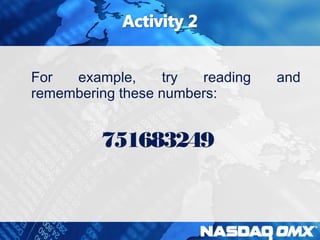
For example, try reading and 
remembering these numbers: 
751683249
Might be hard to read and remember.
Now try this one: 
751-683-249
This is easier because of 
chunking (breaking something into 
smaller bits).
Now try this one: 
123-456-789
This is easy to read because of prior 
knowledge and structure.
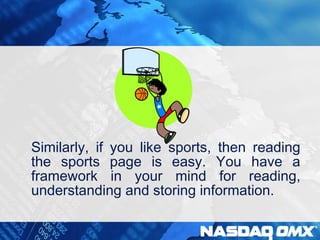
Similarly, if you like sports, then reading 
the sports page is easy. You have a 
framework in your mind for reading, 
understanding and storing information.
Reading comprehension requires 
motivation, mental frameworks for holding 
ideas, concentration and good study 
techniques.
 Broaden your background knowledge by 
reading newspapers, magazines and 
books. 
 Develop interest in knowing the current 
events.
 Good writers construct paragraphs that 
have a beginning, middle and end. 
 Often, the first sentence will give an 
overview that helps provide a framework 
for adding details. 
 Also, look for transitional words, phrases, 
idioms or paragraphs that change the 
topic.
 Really smart readers try to anticipate the 
author and predict future ideas and 
questions. 
 If you're right, this reinforces your 
understanding. 
 If you're wrong, you make adjustments 
quicker.
 Preview material, ask questions, discuss 
ideas with others. 
 The stronger your interest, the greater 
your comprehension. 
 Include time period for reading articles or 
newspaper in your day-to-day schedule.
 Study pictures, graphs and headings.
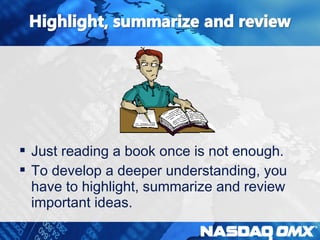
 Just reading a book once is not enough. 
 To develop a deeper understanding, you 
have to highlight, summarize and review 
important ideas.
 For most educated people, this is a lifetime 
project. 
 The best way to improve your vocabulary is 
to use a dictionary regularly. 
 You might carry around a pocket dictionary 
and use it to look up new words. 
 Or, you can keep a list of words to look up at 
the end of the day. 
 Concentrate on roots, prefixes and endings.
 Mapping 
 KWL Chart [Know Want Learned] 
 SQR3 
[Survey Question Read Re-read Review]
 Reading is fundamental to function in 
today’s society. 
 Reading will improve your communication 
skill. 
 Reading is important because it develop 
the mind. 
 Reading discover new things.
 At least spend half an hour for reading newspapers. 
 Give importance to headlines, which is the subject of 
the story. 
 Take a note on words which are new for you. 
 Increase your vocabulary: Try to learn and use ten 
new words from dictionary. 
 Understand Idioms & Phrases and try to use it in your 
conversation. 
 All these efforts will help you to develop both 
personal& professional skills.
Comprehension Skill Development

Comprehension Skill Development

  • 1.
  • 4.
    The purpose ofreading is to connect the ideas on the page to what you already know.
  • 5.
    If you don'tknow anything about a subject, then pouring words of text into your mind is like pouring water into your hand. You don't retain much.
  • 6.
    For example, tryreading and remembering these numbers: 751683249
  • 7.
    Might be hardto read and remember.
  • 8.
    Now try thisone: 751-683-249
  • 9.
    This is easierbecause of chunking (breaking something into smaller bits).
  • 10.
    Now try thisone: 123-456-789
  • 11.
    This is easyto read because of prior knowledge and structure.
  • 12.
    Similarly, if youlike sports, then reading the sports page is easy. You have a framework in your mind for reading, understanding and storing information.
  • 13.
    Reading comprehension requires motivation, mental frameworks for holding ideas, concentration and good study techniques.
  • 14.
     Broaden yourbackground knowledge by reading newspapers, magazines and books.  Develop interest in knowing the current events.
  • 15.
     Good writersconstruct paragraphs that have a beginning, middle and end.  Often, the first sentence will give an overview that helps provide a framework for adding details.  Also, look for transitional words, phrases, idioms or paragraphs that change the topic.
  • 16.
     Really smartreaders try to anticipate the author and predict future ideas and questions.  If you're right, this reinforces your understanding.  If you're wrong, you make adjustments quicker.
  • 17.
     Preview material,ask questions, discuss ideas with others.  The stronger your interest, the greater your comprehension.  Include time period for reading articles or newspaper in your day-to-day schedule.
  • 18.
     Study pictures,graphs and headings.
  • 19.
     Just readinga book once is not enough.  To develop a deeper understanding, you have to highlight, summarize and review important ideas.
  • 20.
     For mosteducated people, this is a lifetime project.  The best way to improve your vocabulary is to use a dictionary regularly.  You might carry around a pocket dictionary and use it to look up new words.  Or, you can keep a list of words to look up at the end of the day.  Concentrate on roots, prefixes and endings.
  • 21.
     Mapping KWL Chart [Know Want Learned]  SQR3 [Survey Question Read Re-read Review]
  • 22.
     Reading isfundamental to function in today’s society.  Reading will improve your communication skill.  Reading is important because it develop the mind.  Reading discover new things.
  • 24.
     At leastspend half an hour for reading newspapers.  Give importance to headlines, which is the subject of the story.  Take a note on words which are new for you.  Increase your vocabulary: Try to learn and use ten new words from dictionary.  Understand Idioms & Phrases and try to use it in your conversation.  All these efforts will help you to develop both personal& professional skills.