Two-Column Notes Made Easy Rosalyn Shahid
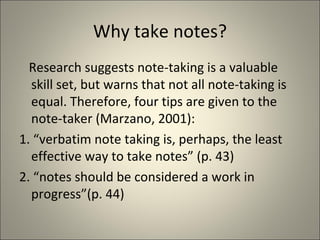
Why take notes? Research suggests note-taking is a valuable skill set, but warns that not all note-taking is  equal. Therefore, four tips are given to the note-taker (Marzano, 2001): 1. “verbatim note taking is, perhaps, the least effective way to take notes” (p. 43) 2. “notes should be considered a work in progress”(p. 44)
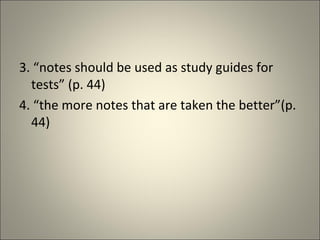
3. “notes should be used as study guides for tests” (p. 44) 4. “the more notes that are taken the better”(p. 44)
What are two-column notes? Two-column notes are one of many note-taking strategies. The purpose for this strategy is to write notes systematically using headings and subheading to structure the layout of the notes. In two-column notes the entire page is used including the ½ inch margin on the page.
Major headings are written in the left column and elaborated upon in the right column. The elaborations may take the form of bulleted points, summary statements, subheadings, defining statements, new information, or synthesis of prior and new knowledge.
What are the procedures for taking two-column notes? There are four basic procedures in two-column note-taking 1. Write the topic or chapter title across the top the notes page.
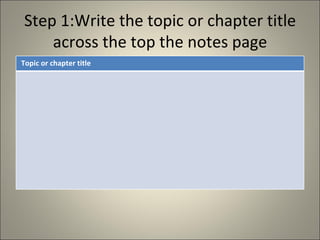
Step 1:Write the topic or chapter title across the top the notes page Topic or chapter title
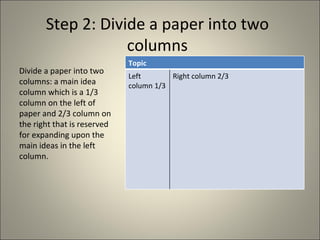
Step 2: Divide a paper into two columns Divide a paper into two columns: a main idea column which is a 1/3 column on the left of paper and 2/3 column on the right that is reserved for expanding upon the main ideas in the left column. Topic Left column 1/3 Right column 2/3
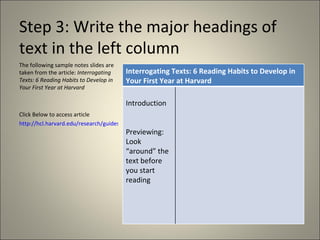
Step 3: Write the major headings of text in the left column The following sample notes slides are taken from the article:  Interrogating Texts: 6 Reading Habits to Develop in Your First Year at Harvard Click Below to access article http://hcl.harvard.edu/research/guides/lamont_handouts/interrogatingtexts.html Interrogating Texts: 6 Reading Habits to Develop in Your First Year at Harvard  Introduction Previewing: Look “around” the text before you start reading
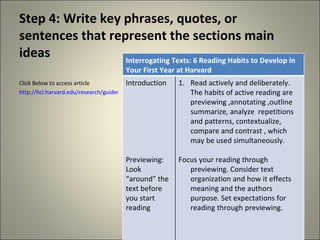
Step 4: Write key phrases, quotes, or sentences that represent the sections main ideas Click Below to access article http://hcl.harvard.edu/research/guides/lamont_handouts/interrogatingtexts.html Interrogating Texts: 6 Reading Habits to Develop in Your First Year at Harvard  Introduction Previewing: Look “around” the text before you start reading Read actively and deliberately. The habits of active reading are previewing ,annotating ,outline summarize, analyze  repetitions and patterns, contextualize, compare and contrast , which may be used simultaneously. Focus your reading through previewing. Consider text organization and how it effects meaning and the authors purpose. Set expectations for reading through previewing.
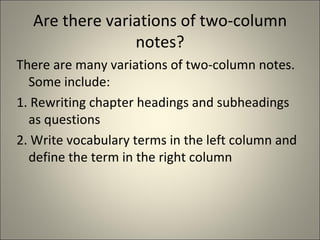
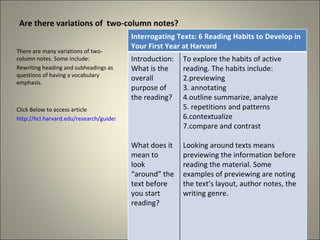
Are there variations of two-column notes? There are many variations of two-column notes. Some include: 1. Rewriting chapter headings and subheadings as questions 2. Write vocabulary terms in the left column and define the term in the right column
Are there variations of  two-column notes? There are many variations of two-column notes. Some include: Rewriting heading and subheadings as questions of having a vocabulary emphasis. Click Below to access article http://hcl.harvard.edu/research/guides/lamont_handouts/interrogatingtexts.html Interrogating Texts: 6 Reading Habits to Develop in Your First Year at Harvard  Introduction: What is the overall purpose of the reading? What does it mean to look “around” the text before you start reading? To explore the habits of active reading. The habits include:  previewing  annotating  outline summarize, analyze  repetitions and patterns contextualize  compare and contrast  Looking around texts means previewing the information before reading the material. Some examples of previewing are noting the text’s layout, author notes, the writing genre.
What classes might two-column notes be most effective? Two column notes may be effective in most disciplines, particularly areas where there is a heavy emphasis on reading. Some include: Social sciences (e.g. history, women’s studies, philosophy, sociology, psychology, and etc.) Natural sciences (e.g. chemistry, biology, physics, anatomy) English (e.g. literature and writing)
Conclusions Two-column notes are a study strategy that may positively influence: Student achievement Retention of information Organization of lecture notes Efficiency of study time management
Questions or Comments Think about the how you can include two-column notes into your study program. Please post your questions or comments on my blog  http://shahidnotetakingmadeeasy.blogspot.com/
Thank you

Two Column Notes Made Easy

  • 1.
    Two-Column Notes MadeEasy Rosalyn Shahid
  • 2.
    Why take notes?Research suggests note-taking is a valuable skill set, but warns that not all note-taking is equal. Therefore, four tips are given to the note-taker (Marzano, 2001): 1. “verbatim note taking is, perhaps, the least effective way to take notes” (p. 43) 2. “notes should be considered a work in progress”(p. 44)
  • 3.
    3. “notes shouldbe used as study guides for tests” (p. 44) 4. “the more notes that are taken the better”(p. 44)
  • 4.
    What are two-columnnotes? Two-column notes are one of many note-taking strategies. The purpose for this strategy is to write notes systematically using headings and subheading to structure the layout of the notes. In two-column notes the entire page is used including the ½ inch margin on the page.
  • 5.
    Major headings arewritten in the left column and elaborated upon in the right column. The elaborations may take the form of bulleted points, summary statements, subheadings, defining statements, new information, or synthesis of prior and new knowledge.
  • 6.
    What are theprocedures for taking two-column notes? There are four basic procedures in two-column note-taking 1. Write the topic or chapter title across the top the notes page.
  • 7.
    Step 1:Write thetopic or chapter title across the top the notes page Topic or chapter title
  • 8.
    Step 2: Dividea paper into two columns Divide a paper into two columns: a main idea column which is a 1/3 column on the left of paper and 2/3 column on the right that is reserved for expanding upon the main ideas in the left column. Topic Left column 1/3 Right column 2/3
  • 9.
    Step 3: Writethe major headings of text in the left column The following sample notes slides are taken from the article: Interrogating Texts: 6 Reading Habits to Develop in Your First Year at Harvard Click Below to access article http://hcl.harvard.edu/research/guides/lamont_handouts/interrogatingtexts.html Interrogating Texts: 6 Reading Habits to Develop in Your First Year at Harvard Introduction Previewing: Look “around” the text before you start reading
  • 10.
    Step 4: Writekey phrases, quotes, or sentences that represent the sections main ideas Click Below to access article http://hcl.harvard.edu/research/guides/lamont_handouts/interrogatingtexts.html Interrogating Texts: 6 Reading Habits to Develop in Your First Year at Harvard Introduction Previewing: Look “around” the text before you start reading Read actively and deliberately. The habits of active reading are previewing ,annotating ,outline summarize, analyze repetitions and patterns, contextualize, compare and contrast , which may be used simultaneously. Focus your reading through previewing. Consider text organization and how it effects meaning and the authors purpose. Set expectations for reading through previewing.
  • 11.
    Are there variationsof two-column notes? There are many variations of two-column notes. Some include: 1. Rewriting chapter headings and subheadings as questions 2. Write vocabulary terms in the left column and define the term in the right column
  • 12.
    Are there variationsof two-column notes? There are many variations of two-column notes. Some include: Rewriting heading and subheadings as questions of having a vocabulary emphasis. Click Below to access article http://hcl.harvard.edu/research/guides/lamont_handouts/interrogatingtexts.html Interrogating Texts: 6 Reading Habits to Develop in Your First Year at Harvard Introduction: What is the overall purpose of the reading? What does it mean to look “around” the text before you start reading? To explore the habits of active reading. The habits include: previewing annotating outline summarize, analyze repetitions and patterns contextualize compare and contrast Looking around texts means previewing the information before reading the material. Some examples of previewing are noting the text’s layout, author notes, the writing genre.
  • 13.
    What classes mighttwo-column notes be most effective? Two column notes may be effective in most disciplines, particularly areas where there is a heavy emphasis on reading. Some include: Social sciences (e.g. history, women’s studies, philosophy, sociology, psychology, and etc.) Natural sciences (e.g. chemistry, biology, physics, anatomy) English (e.g. literature and writing)
  • 14.
    Conclusions Two-column notesare a study strategy that may positively influence: Student achievement Retention of information Organization of lecture notes Efficiency of study time management
  • 15.
    Questions or CommentsThink about the how you can include two-column notes into your study program. Please post your questions or comments on my blog http://shahidnotetakingmadeeasy.blogspot.com/
  • 16.