Lauren Fairchild
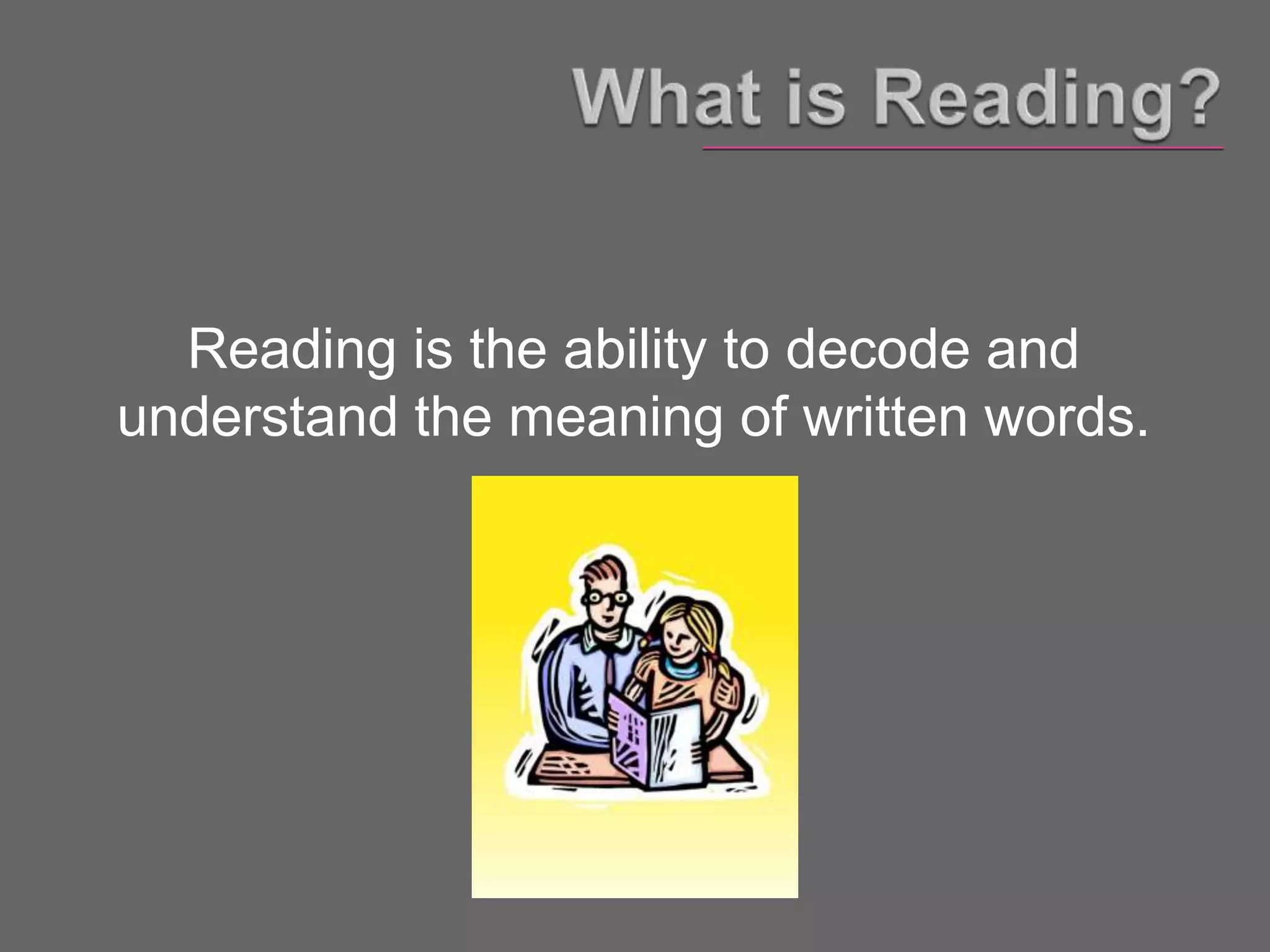
Reading is the ability to decode and
understand the meaning of written words.
It is complex.
This process is influenced by a number of factors
including:
the reader,
the text being read,
the task the reader is trying to accomplish,
the context in which the reading is being down.
 Reader: prior-knowledge or knowledge of skills the
reader brings to the reading process
 Text: the way the text is organized to form a
framework (ex: non-fiction and fiction)
 Activity/task: motivation to continue reading the
text
 Context: the amount of support provided for
reading by peers and teachers
Strategies/techniques that should be used prior to
reading the text.
1. Activate Prior Knowledge
2. Preview
3. Make predictions
4. Vocabulary review
5. Set a purpose/focus
Ask yourself:
What do I already know about the topic?
Look through the text to see what it will be about.
 Read the titles
 Read the headings
 Look at the pictures/illustrations
 If using a text book: read the side bars and
outlines to preview the chapters
 Formulate hypothesis about the context-What do
you think will happen in the text?
 Write down what you think will happen in the
text.
 Create and write down questions you think will
be answered throughout the text.
understand new vocabulary that is taught in
order to understand the text
Decide why you are reading this text.
(ex: to get information?, to help you?, to
create something?)
Once you have prepared yourself to read the text through
activating prior knowledge, previewing the text, making
predictions, review vocabulary, and setting a purpose for your
reading, you are now read to read!
The following are strategies are for you to use and will help
you stray focused while you are reading
1. check predictions
2. Monitoring text
3. analyze
4. Connect (text to text, text to world, text to self)
5. self-questioning
Ask yourself:
 Does it seem like my hypothesis will be correct?
 Does the text include information I thought would
be in it based on the titles, headings, and
pictures?
 Did I find the answers to questions I thought the
text would answer yet?
 Do I have any new predictions?
When monitoring text ask yourself “Is what I am reading making
sense?”
or
“Do I understand what I am reading?”
If you are struggling to understand:
Identify where the difficulty is.
Identify what the difficulty is.
Restate the difficult sentence/passage in their own words.
Look back through the text.
Look forward in the text for information that might help you resolve
the difficulty.
Use context clues: sematic, syntactic, picture.
Examine the structure of the text
Examine the information that is being
presented
Figure out what information is important to
know
Ask yourself : “how does the text relate to itself,
me, and the world?”
 Text to Text: how does the information being
read relate to the text? If so, how?
 Text to Self: how does the information being read
relate to you? If so, how?
 Text to World: how does the information being
read relate to the world? If so, how?
Through asking questions, you can reflect on what
you are reading.
Examples:
 Why did the author choose a certain word to
use?
 Why did the characters or people do what they
did?
 What will happen next?
 What is the author trying to tell me?
 Does this make sense?
Congratulations you have finished reading the text.
Do you put the book down and stop here?
Definitely Not!
Now, it is time to look back on what you read and learned. Here
are some strategies to use now that you have finished reading!
1. Summarize/ paraphrase
2. Reflect
3. Associate new/gained information with prior knowledge
(make connections)
4. Confirm predictions
5. Evaluate
A summary is a synthesis of the important ideas in
a text. Summaries helps you to identify the main
ideas in an expository text. Also, it will help you
evaluate your own understanding of what you have
read.
Ex: For an expository text, you will often state the
main idea and supporting details of several related
paragraphs.
This can be done through discussions, writing or
drawing about the text read.
Ask yourself:
 What were the main ideas and information in the
text?
 Why was this information important to know?
 Why did the author provide this information?
Extend your understanding of information that was
gained.
Ask yourself:
How does this new information relate to
information I already know?
Reflect on what you read and think about
the predictions you made prior to reading
the text.
Ask yourself:
 Were my predictions correct?
 Was my hypothesis correct?
Write or speak on a specified topic related to the
material that was read.
Compare and contrast information
Break down the information/material that was read.
Graphic organizers:
• visual representations between facts, terms, and ideas
within the text
K-W-L :
• a 3 column chart that helps capture before, during, and
after components of the text.
• K: Know- the prior knowledge you have about the topic
• W: Want or Will- what you want to know or will know by the
end of the text
• L: Learned – What you have learned from the text
Bursuck, W. D. & Damer, M. (2011) Teaching Reading to Students Who Are
at Risk or Have Disabilities. Upper Saddle River, New Jersey:
Pearson Education, INC..
Safadaran, M. (2013, August 30). Reading Strategies Booklet [Video file].
Retrieved from http://www.slideshare.net/majidsafadaran/reading-
strategies-booklet?related=5
Yardley, B. (2012, July 28) Reading Strategies [Video File]. Retrieved from
http://www.slideshare.net/libraryyard/reading-strategies-
13782096?from_search=2#btnNext

Before, During, & After Reading Strategies

  • 1.
  • 2.
    Reading is theability to decode and understand the meaning of written words.
  • 3.
    It is complex. Thisprocess is influenced by a number of factors including: the reader, the text being read, the task the reader is trying to accomplish, the context in which the reading is being down.
  • 4.
     Reader: prior-knowledgeor knowledge of skills the reader brings to the reading process  Text: the way the text is organized to form a framework (ex: non-fiction and fiction)  Activity/task: motivation to continue reading the text  Context: the amount of support provided for reading by peers and teachers
  • 5.
    Strategies/techniques that shouldbe used prior to reading the text. 1. Activate Prior Knowledge 2. Preview 3. Make predictions 4. Vocabulary review 5. Set a purpose/focus
  • 6.
    Ask yourself: What doI already know about the topic?
  • 7.
    Look through thetext to see what it will be about.  Read the titles  Read the headings  Look at the pictures/illustrations  If using a text book: read the side bars and outlines to preview the chapters
  • 8.
     Formulate hypothesisabout the context-What do you think will happen in the text?  Write down what you think will happen in the text.  Create and write down questions you think will be answered throughout the text.
  • 9.
    understand new vocabularythat is taught in order to understand the text
  • 10.
    Decide why youare reading this text. (ex: to get information?, to help you?, to create something?)
  • 11.
    Once you haveprepared yourself to read the text through activating prior knowledge, previewing the text, making predictions, review vocabulary, and setting a purpose for your reading, you are now read to read! The following are strategies are for you to use and will help you stray focused while you are reading 1. check predictions 2. Monitoring text 3. analyze 4. Connect (text to text, text to world, text to self) 5. self-questioning
  • 12.
    Ask yourself:  Doesit seem like my hypothesis will be correct?  Does the text include information I thought would be in it based on the titles, headings, and pictures?  Did I find the answers to questions I thought the text would answer yet?  Do I have any new predictions?
  • 13.
    When monitoring textask yourself “Is what I am reading making sense?” or “Do I understand what I am reading?” If you are struggling to understand: Identify where the difficulty is. Identify what the difficulty is. Restate the difficult sentence/passage in their own words. Look back through the text. Look forward in the text for information that might help you resolve the difficulty. Use context clues: sematic, syntactic, picture.
  • 14.
    Examine the structureof the text Examine the information that is being presented Figure out what information is important to know
  • 15.
    Ask yourself :“how does the text relate to itself, me, and the world?”  Text to Text: how does the information being read relate to the text? If so, how?  Text to Self: how does the information being read relate to you? If so, how?  Text to World: how does the information being read relate to the world? If so, how?
  • 16.
    Through asking questions,you can reflect on what you are reading. Examples:  Why did the author choose a certain word to use?  Why did the characters or people do what they did?  What will happen next?  What is the author trying to tell me?  Does this make sense?
  • 17.
    Congratulations you havefinished reading the text. Do you put the book down and stop here? Definitely Not! Now, it is time to look back on what you read and learned. Here are some strategies to use now that you have finished reading! 1. Summarize/ paraphrase 2. Reflect 3. Associate new/gained information with prior knowledge (make connections) 4. Confirm predictions 5. Evaluate
  • 18.
    A summary isa synthesis of the important ideas in a text. Summaries helps you to identify the main ideas in an expository text. Also, it will help you evaluate your own understanding of what you have read. Ex: For an expository text, you will often state the main idea and supporting details of several related paragraphs.
  • 19.
    This can bedone through discussions, writing or drawing about the text read. Ask yourself:  What were the main ideas and information in the text?  Why was this information important to know?  Why did the author provide this information?
  • 20.
    Extend your understandingof information that was gained. Ask yourself: How does this new information relate to information I already know?
  • 21.
    Reflect on whatyou read and think about the predictions you made prior to reading the text. Ask yourself:  Were my predictions correct?  Was my hypothesis correct?
  • 22.
    Write or speakon a specified topic related to the material that was read. Compare and contrast information Break down the information/material that was read.
  • 23.
    Graphic organizers: • visualrepresentations between facts, terms, and ideas within the text K-W-L : • a 3 column chart that helps capture before, during, and after components of the text. • K: Know- the prior knowledge you have about the topic • W: Want or Will- what you want to know or will know by the end of the text • L: Learned – What you have learned from the text
  • 24.
    Bursuck, W. D.& Damer, M. (2011) Teaching Reading to Students Who Are at Risk or Have Disabilities. Upper Saddle River, New Jersey: Pearson Education, INC.. Safadaran, M. (2013, August 30). Reading Strategies Booklet [Video file]. Retrieved from http://www.slideshare.net/majidsafadaran/reading- strategies-booklet?related=5 Yardley, B. (2012, July 28) Reading Strategies [Video File]. Retrieved from http://www.slideshare.net/libraryyard/reading-strategies- 13782096?from_search=2#btnNext