Vaishali S.Patil
Assosiate Professor, Department of Botany
Shri Shivaji College of Arts, Commerce & Science
Akola
Extra-nuclear Genome-
Chloroplast DNA (cpDNA)
Extra Chromosomal Inheritance or Extra Nuclear Inheritance
(Cytoplasmic Inheritance)
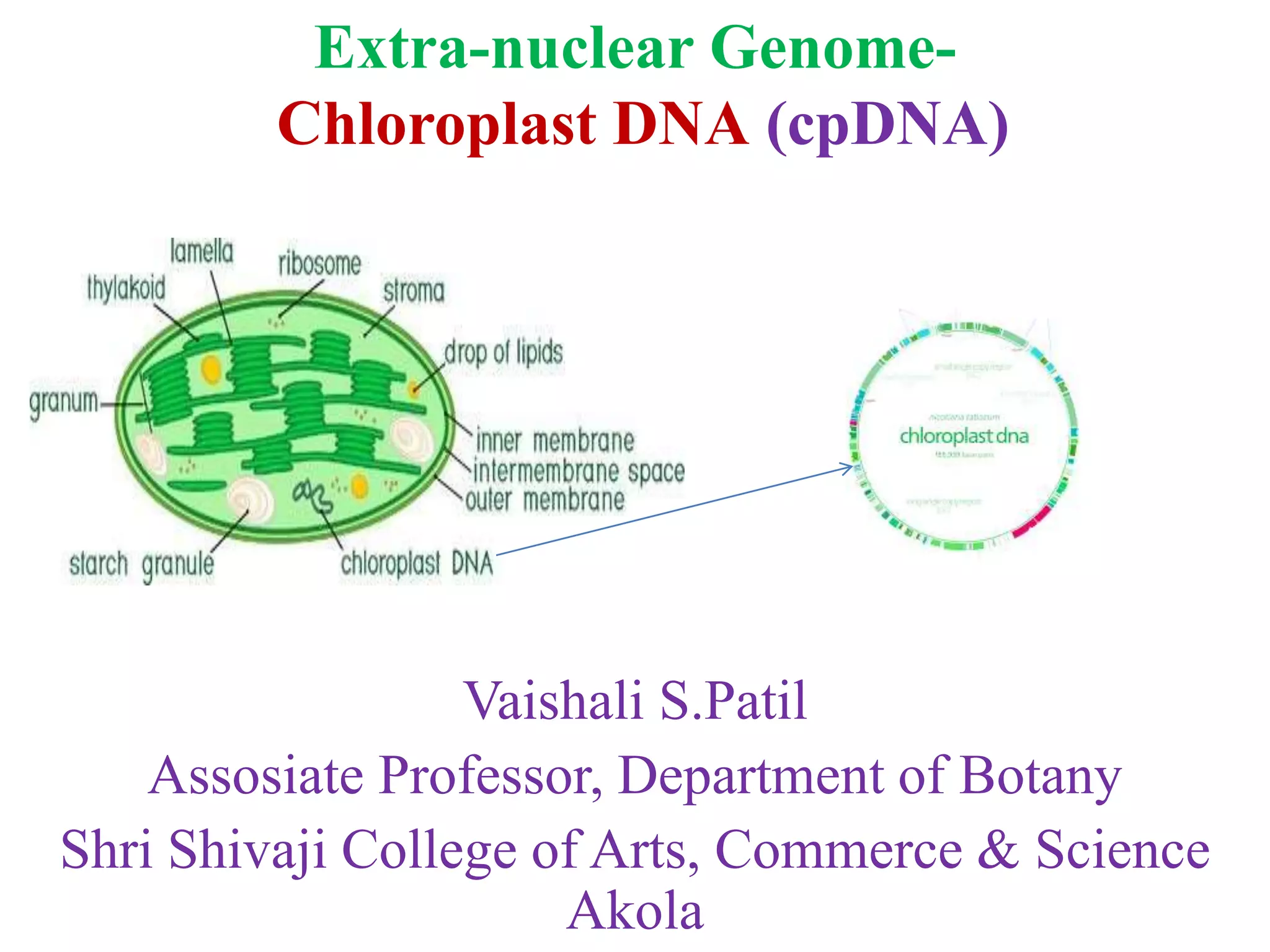
• DNA in the chloroplast that carries the code for proteins and
RNAs essential to the various functions of the chloroplast, such as
photosynthesis.
• Plantsareuniqueamonghigherorganismsinthattheymeettheirenergyneeds
throughphotosynthesis.Thespecificlocationforphotosynthesisinplantcells
isthechloroplast,whichalsocontainsasingle,circularchromosome
composedofDNA. Chloroplast DNAcontainsmanyofthegenesnecessary
forproperchloroplastfunctioning. It has improved the understanding
of photosynthesis, and also useful in studying the evolutionary
history of plants.
• DNA is the universal genetic material. Genes located in nuclear
chromosomes follow Mendelian inheritance. But certain traits are
governed either by the chloroplast or mitochondrial genes. This
phenomenon is known as extra nuclear inheritance.
. It is a kind of Non-Mendelian inheritance. Since it involves cytoplasmic
organelles such as chloroplast and mitochondrion that act as inheritance
vectors, it is also called Cytoplasmic inheritance. It is based on
independent, self-replicating extra chromosomal unit called plasmogene
located in the cytoplasmic organelles, chloroplast and mitochondrion.
In 1909 German botanist Karl Erich Correns discovered a trait in the
four-o’clock plants (Mirabilis jalapa) that appeared to be inconsistent
with Mendelian inheritance patterns.
He discovered that four-o’clock plants had a mixture of leaf colors on
the same plant. Some were all green, many were partly green and partly
white (variegated), and some were all white.
If he took pollen from a flower on a branch with all-green leaves and
used it to pollinate a flower on a branch with all-white leaves, all the
resulting seeds developed into plants with white leaves.
Likewise, if he took pollen from a flower on a branch with all-white
leaves and used it to pollinate a flower on a branch with all-green leaves,
all the resulting seeds developed into plants with green leaves.
Repeated pollen transfers in any combination always resulted in
offspring whose leaves resembled those on the branch containing the
flower that received the pollen, that is, the maternal parent. These
results could not be explained by Mendelian genetics.
Since Correns’s discovery, many other such traits have been discovered..
It is now known that the reason these traits do not follow Mendelian
inheritance patterns is that their genes are not on the chromosomes
in the nucleus of the cell where most genes are located. Instead, the
gene for the four o’clock leaf color trait is located on the single,
circular chromosome found in chloroplasts.
Because chloroplasts are specialized for photosynthesis, many of the
genes on the single chromosome produce proteins or ribonucleic acid
(RNA) that either directly or indirectly affect synthesis of
chlorophyll, the pigment primarily responsible for trapping energy
from light.
Because chlorophyll is green and because mutations in
many chloroplast genes cause chloroplasts to be unable to make
chlorophyll, most mutations result in partially or completely white
or yellow leaves.
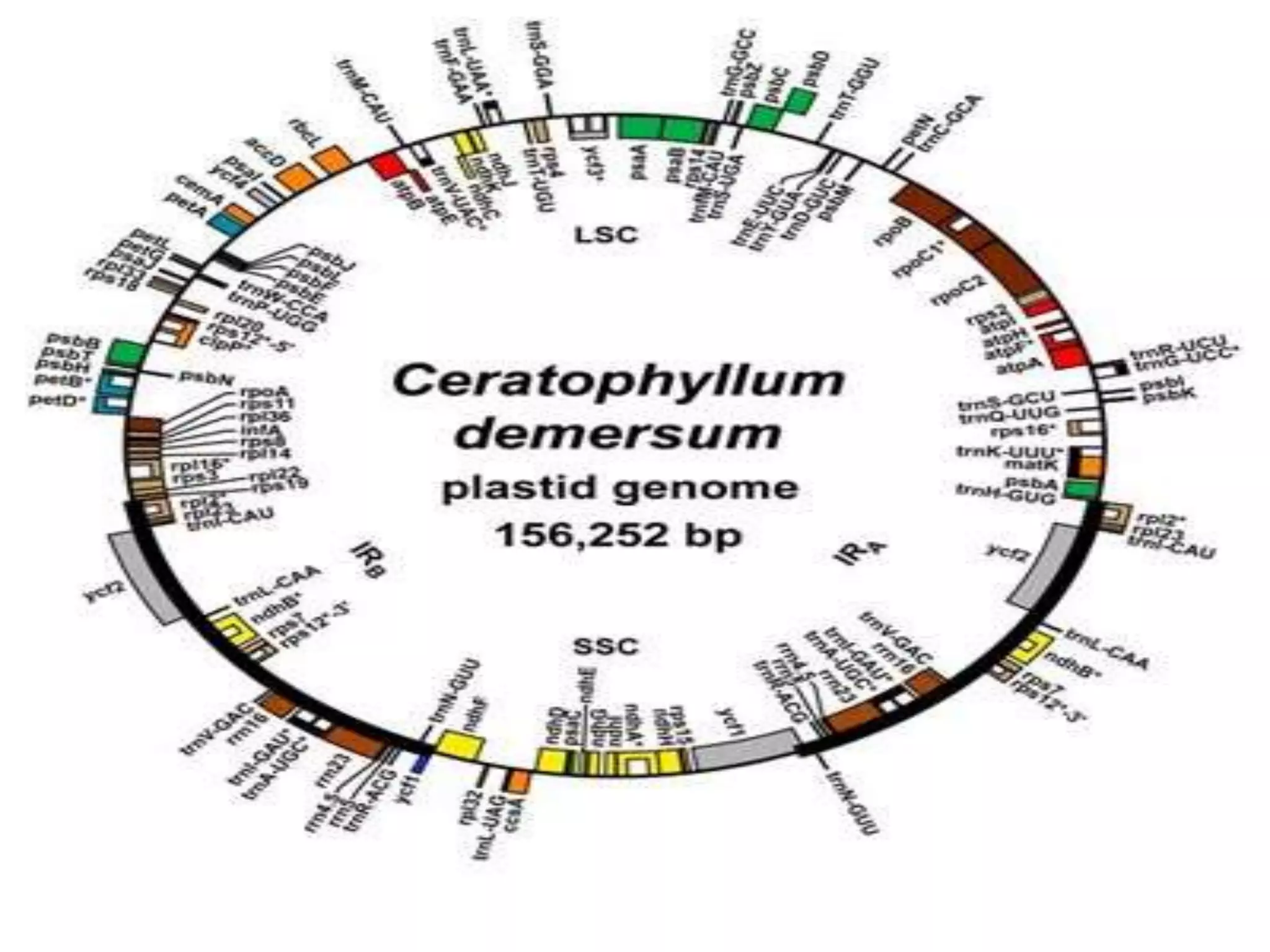
Chloroplast DNAs are circular, and are typically 120,000–170,000 base
pairs long. They can have a contour length of around 30–60
micrometers, and have a mass of about 80–130 million daltons.
Most chloroplasts have their entire chloroplast genome combined into a
single large ring, though those of dinophyte algae are a notable
exception—their genome is broken up into about forty small plasmids,
each 2,000–10,000 base pairs long.
Each minicircle contains one to three genes, but blank plasmids,
with no coding DNA, have also been found.
The size of the genome has been determined for a number of plants
and algae and ranges from 85 to 292 kilobase pairs (one kb equals
one thousand base pairs), with most being between 120 kb and 160
kb. In terms of genome size, chloroplast genomes are relatively small
and contain slightly more than one hundred genes.
Roughly half of the chloroplast genes produce either RNA molecules or
polypeptides that are important for protein synthesis. Some of the RNA
genes occur twice in the chloroplast genomes of almost all land plants
and some groups of algae.
The products of these genes represent all the ingredients needed for
chloroplasts to carry out transcription and translation of their own genes.
Half of the remaining genes produce polypeptides directly required
for the biochemical reactions of photosynthesis.
What is unusual about these genes is that their products represent only a
portion of the polypeptides required for photosynthesis. For example, the
very important enzyme ATPase, the enzyme that uses proton gradient
energy to produce the important energy molecule adenosine triphosphate
(ATP), comprises nine different polypeptides.
Six of these polypeptides are products of chloroplast genes, but the other
three are products of nuclear genes that must be transported into
the chloroplast to join with the other six polypeptides to make active
ATPase.
Another notable example is the enzyme ribulose biphosphate
carboxylase (RuBP carboxylase), which is composed of two
polypeptides. The larger polypeptide, called rbcL, is a product of
a chloroplast gene, whereas the smaller polypeptide is the product of a
nuclear gene.
The last thirty or so genes remain unidentified. Their presence is
inferred because they have DNA sequences that contain all the
components found in active genes. These kinds of genes are often
called “open reading frames” (ORFs) until the functions of their
polypeptide products are identified.
Evolutionary Advantages and Uses
Extranuclear genetic systems are quite diverse in function and
mechanisms of transmission.
These genes control only a small fraction of the total
hereditary material of the cell, in eukaryotic organisms the genes found
in mitochondria and chloroplasts are clearly essential for maintaining
life.
Although organelle DNAs clearly play an important part in cell
organization, it has been difficult to pinpoint the essential roles of
organelle DNA and protein-synthesizing systems. Many technical
difficulties, and the traditionally low priority of this field, meant that
adequate techniques for studying organelle genomes emerged slowly.
Studies of cytoplasmic genetics will doubtless have significant
applications in medical science and agriculture as well as an impact
on understanding of the evolution of genetic control mechanisms.
For example, M. M. Rhoades’s work on corn in the 1940’s forced
American geneticists to take note of research on cytoplasmic genes,
while plant breeders began to use cytoplasmically inherited pollen
sterility in the production of hybrid seed.
Cytoplasmic pollen sterility is a useful trait to incorporate into
commercial inbred lines because it ensures cross-pollination and thus
simplifies seed production.
Unfortunately, a toxin-producing fungus to which the major corn
cytoplasmic gene for pollen sterility was susceptible destroyed more than
50 percent of the corn crop in certain areas of the United States in 1970.
This disaster prompted a return to hand-detasseling.
The discovery that chloroplasts have their own DNA and the further
elucidation of their genes have had some impact on agriculture.
Several unusual, variegated leaf patterns and certain mysterious genetic
diseases of plants are now better understood. The discovery of some of
the genes that code for polypeptides required for photosynthesis has
helped increase understanding of the biochemistry of photosynthesis.
The use of chloroplast gene DNA sequences for reconstructing the
evolutionary history of various groups of plants, such as leaf shape
and flower anatomy, to try to trace the evolutionary history of
plants.
Unfortunately, there are a limited number of structural traits, and many
of them are uninformative or even misleading when used in evolutionary
studies. These limitations are overcome when gene DNA sequences are
used.eg. rbcL can be used to retrace the evolutionary history of groups of
plants such as flowering plant that are very divergent from one another
Chloroplast dna

Chloroplast dna

  • 1.
    Vaishali S.Patil Assosiate Professor,Department of Botany Shri Shivaji College of Arts, Commerce & Science Akola Extra-nuclear Genome- Chloroplast DNA (cpDNA)
  • 2.
    Extra Chromosomal Inheritanceor Extra Nuclear Inheritance (Cytoplasmic Inheritance) • DNA in the chloroplast that carries the code for proteins and RNAs essential to the various functions of the chloroplast, such as photosynthesis. • Plantsareuniqueamonghigherorganismsinthattheymeettheirenergyneeds throughphotosynthesis.Thespecificlocationforphotosynthesisinplantcells isthechloroplast,whichalsocontainsasingle,circularchromosome composedofDNA. Chloroplast DNAcontainsmanyofthegenesnecessary forproperchloroplastfunctioning. It has improved the understanding of photosynthesis, and also useful in studying the evolutionary history of plants. • DNA is the universal genetic material. Genes located in nuclear chromosomes follow Mendelian inheritance. But certain traits are governed either by the chloroplast or mitochondrial genes. This phenomenon is known as extra nuclear inheritance.
  • 3.
    . It isa kind of Non-Mendelian inheritance. Since it involves cytoplasmic organelles such as chloroplast and mitochondrion that act as inheritance vectors, it is also called Cytoplasmic inheritance. It is based on independent, self-replicating extra chromosomal unit called plasmogene located in the cytoplasmic organelles, chloroplast and mitochondrion.
  • 4.
    In 1909 Germanbotanist Karl Erich Correns discovered a trait in the four-o’clock plants (Mirabilis jalapa) that appeared to be inconsistent with Mendelian inheritance patterns. He discovered that four-o’clock plants had a mixture of leaf colors on the same plant. Some were all green, many were partly green and partly white (variegated), and some were all white. If he took pollen from a flower on a branch with all-green leaves and used it to pollinate a flower on a branch with all-white leaves, all the resulting seeds developed into plants with white leaves. Likewise, if he took pollen from a flower on a branch with all-white leaves and used it to pollinate a flower on a branch with all-green leaves, all the resulting seeds developed into plants with green leaves. Repeated pollen transfers in any combination always resulted in offspring whose leaves resembled those on the branch containing the
  • 5.
    flower that receivedthe pollen, that is, the maternal parent. These results could not be explained by Mendelian genetics. Since Correns’s discovery, many other such traits have been discovered..
  • 6.
    It is nowknown that the reason these traits do not follow Mendelian inheritance patterns is that their genes are not on the chromosomes in the nucleus of the cell where most genes are located. Instead, the gene for the four o’clock leaf color trait is located on the single, circular chromosome found in chloroplasts. Because chloroplasts are specialized for photosynthesis, many of the genes on the single chromosome produce proteins or ribonucleic acid (RNA) that either directly or indirectly affect synthesis of chlorophyll, the pigment primarily responsible for trapping energy from light. Because chlorophyll is green and because mutations in many chloroplast genes cause chloroplasts to be unable to make chlorophyll, most mutations result in partially or completely white or yellow leaves.
  • 9.
    Chloroplast DNAs arecircular, and are typically 120,000–170,000 base pairs long. They can have a contour length of around 30–60 micrometers, and have a mass of about 80–130 million daltons. Most chloroplasts have their entire chloroplast genome combined into a single large ring, though those of dinophyte algae are a notable exception—their genome is broken up into about forty small plasmids, each 2,000–10,000 base pairs long. Each minicircle contains one to three genes, but blank plasmids, with no coding DNA, have also been found. The size of the genome has been determined for a number of plants and algae and ranges from 85 to 292 kilobase pairs (one kb equals one thousand base pairs), with most being between 120 kb and 160 kb. In terms of genome size, chloroplast genomes are relatively small and contain slightly more than one hundred genes.
  • 10.
    Roughly half ofthe chloroplast genes produce either RNA molecules or polypeptides that are important for protein synthesis. Some of the RNA genes occur twice in the chloroplast genomes of almost all land plants and some groups of algae. The products of these genes represent all the ingredients needed for chloroplasts to carry out transcription and translation of their own genes. Half of the remaining genes produce polypeptides directly required for the biochemical reactions of photosynthesis. What is unusual about these genes is that their products represent only a portion of the polypeptides required for photosynthesis. For example, the very important enzyme ATPase, the enzyme that uses proton gradient energy to produce the important energy molecule adenosine triphosphate (ATP), comprises nine different polypeptides. Six of these polypeptides are products of chloroplast genes, but the other three are products of nuclear genes that must be transported into the chloroplast to join with the other six polypeptides to make active
  • 11.
    ATPase. Another notable exampleis the enzyme ribulose biphosphate carboxylase (RuBP carboxylase), which is composed of two polypeptides. The larger polypeptide, called rbcL, is a product of a chloroplast gene, whereas the smaller polypeptide is the product of a nuclear gene. The last thirty or so genes remain unidentified. Their presence is inferred because they have DNA sequences that contain all the components found in active genes. These kinds of genes are often called “open reading frames” (ORFs) until the functions of their polypeptide products are identified.
  • 12.
    Evolutionary Advantages andUses Extranuclear genetic systems are quite diverse in function and mechanisms of transmission. These genes control only a small fraction of the total hereditary material of the cell, in eukaryotic organisms the genes found in mitochondria and chloroplasts are clearly essential for maintaining life. Although organelle DNAs clearly play an important part in cell organization, it has been difficult to pinpoint the essential roles of organelle DNA and protein-synthesizing systems. Many technical difficulties, and the traditionally low priority of this field, meant that adequate techniques for studying organelle genomes emerged slowly.
  • 13.
    Studies of cytoplasmicgenetics will doubtless have significant applications in medical science and agriculture as well as an impact on understanding of the evolution of genetic control mechanisms. For example, M. M. Rhoades’s work on corn in the 1940’s forced American geneticists to take note of research on cytoplasmic genes, while plant breeders began to use cytoplasmically inherited pollen sterility in the production of hybrid seed. Cytoplasmic pollen sterility is a useful trait to incorporate into commercial inbred lines because it ensures cross-pollination and thus simplifies seed production. Unfortunately, a toxin-producing fungus to which the major corn cytoplasmic gene for pollen sterility was susceptible destroyed more than 50 percent of the corn crop in certain areas of the United States in 1970. This disaster prompted a return to hand-detasseling.
  • 14.
    The discovery thatchloroplasts have their own DNA and the further elucidation of their genes have had some impact on agriculture. Several unusual, variegated leaf patterns and certain mysterious genetic diseases of plants are now better understood. The discovery of some of the genes that code for polypeptides required for photosynthesis has helped increase understanding of the biochemistry of photosynthesis. The use of chloroplast gene DNA sequences for reconstructing the evolutionary history of various groups of plants, such as leaf shape and flower anatomy, to try to trace the evolutionary history of plants. Unfortunately, there are a limited number of structural traits, and many of them are uninformative or even misleading when used in evolutionary studies. These limitations are overcome when gene DNA sequences are used.eg. rbcL can be used to retrace the evolutionary history of groups of plants such as flowering plant that are very divergent from one another