• RECOMBINANT DNA
TECHNOLOGY
• Guided by- Mr. Firoz
Parhi
• By- Namrata Singh
• Roll No.-BS12-115
• Exam roll no.-12S85027
Recombinant
DNA
Technology
What is
recombinant DNA ?
• Recombinant DNA molecules are
Spliced Chimeric molecules
formed from two or more
different sources that have
been cleaved by restriction
enzymes and joined by ligases.
• Such DNA become a part of the host genetic
makeup and is replicated.
Recombinant DNA Technology
• Recombinant DNA Technology is a set of techniques that
enable the DNA from different sources to be identified,
isolated and recombined so that new characteristics can be
introduced into an organism.
• Recombinant DNA technology, is joining together
of DNA molecules from two different species that are inserted
into a host organism to produce new genetic combinations
that are of value to science, medicine, agriculture, and
industry. Since the focus of all genetics is the gene, the
fundamental goal of laboratory geneticists is to isolate,
characterize, and manipulate genes. Although it is relatively
easy to isolate a sample of DNA from a collection of cells,but
finding a specific gene within this DNA sample can be
compared to finding a needle in a haystack.
History
OBJECTIVES OF
RECOMBINANT DNA
TECHNOLOGY• To artificially synthesize new genes.
• To alter the genome of an organism.
• Bringing about new gene
combinations,
not found in nature.
• Understanding the hereditary diseases
and their cure.
• Improving human genome.
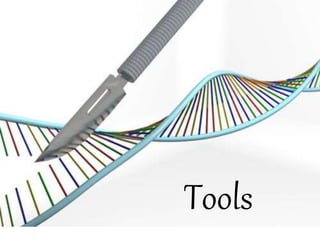
Tools
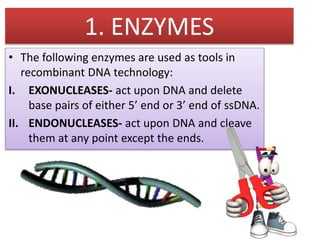
1. ENZYMES
• The following enzymes are used as tools in
recombinant DNA technology:
I. EXONUCLEASES- act upon DNA and delete
base pairs of either 5’ end or 3’ end of ssDNA.
II. ENDONUCLEASES- act upon DNA and cleave
them at any point except the ends.
1. ENZYMES
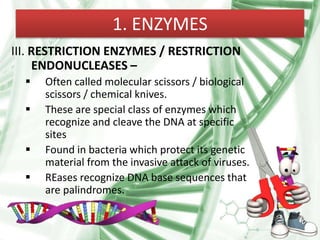
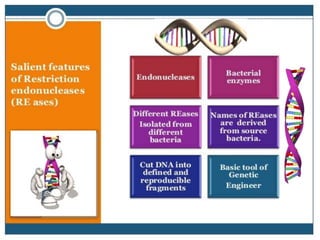
III. RESTRICTION ENZYMES / RESTRICTION
ENDONUCLEASES –
 Often called molecular scissors / biological
scissors / chemical knives.
 These are special class of enzymes which
recognize and cleave the DNA at specific
sites
 Found in bacteria which protect its genetic
material from the invasive attack of viruses.
 REases recognize DNA base sequences that
are palindromes.
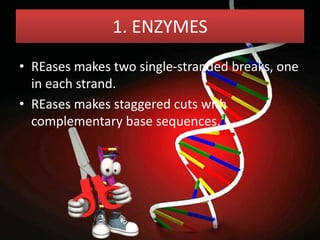
• REases makes two single-stranded breaks, one
in each strand.
• REases makes staggered cuts with
complementary base sequences.
1. ENZYMES
HISTORY OF RESTRICTION
ENDONUCLEASE
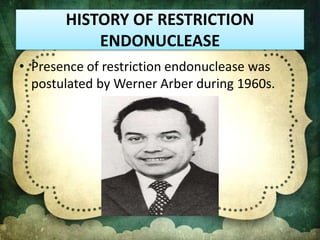
• Presence of restriction endonuclease was
postulated by Werner Arber during 1960s.
TYPES OF RESTRICTION
ENDONUCLEASES
• TYPE I –
a) Complex endonucleases
b) Have recognition sequences of about 15 bp
c) Cleave the DNA about 1000 base pairs away from
the sequence ‘’TCA’’ located within the
recognition site.
d) Examples- EcoK, EcoB.
• TYPE II-
a) remarkably stable
b) Induce cleavage either within or
immediately outside their recognition
sequences which are symmetrical.
c) Require Magnesium ions (Mg ++ ) for
cleavage.
d) First type II enzyme to be isolated was
HindII.
TYPES OF RESTRICTION
ENDONUCLEASES
• TYPE III-
a) Intermediate between the type I and type II
enzymes
b) Cleave DNA in the immediate vicinity of their
recognition sites
c) Examples- EcoP1, Eco15,
HinfIII
TYPES OF RESTRICTION
ENDONUCLEASES
RECOGNITION SEQUENCES
• The recognition sequences for type-II restriction
endonucleases form palindromes with rotational
symmetry.
• In a palindrome the base sequence in the second
half of a DNA strand is the mirror image of the
sequence in the first half
• But in a palindrome with rotational symmetry, the
base sequence in the second half of one strand of
DNA double helix is the mirror image of the second
half of its complementary strand
• Thus, in such palindromes, the base sequence in
both the strands of DNA duplex reads the same
when read from the same end(either 5’ or 3’) of
both the strands.
CLEAVAGE PATTERNS
• Most type II REases cleave the
DNA molecules within their
specific recognition sequences,
but some produce cuts
immediately outside the target
sequence, e.g., NlaIII, SauIIIA.
• These cuts are either:
I. Staggered
II. even
CLEAVAGE PATTERNS
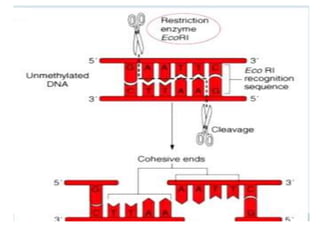
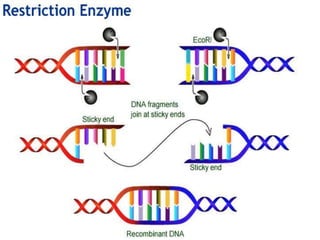
• Most enzymes produce staggered cuts in which two
strands of DNA double helix are cleaved at different
locations; this generates protruding (3’ or 5’) ends,
i.e., one strand of the double helix extends some
bases beyond the other
• Due to palindromic nature of the target sites the
two protruding ends generated by such a cleavage
by a given enzyme have complementary base
sequence.
• As a result they readily pair with each other, under
annealing conditions; such ends are called cohesive
or sticky ends.
CLEAVAGE PATTERNS
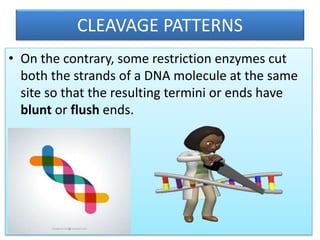
• On the contrary, some restriction enzymes cut
both the strands of a DNA molecule at the same
site so that the resulting termini or ends have
blunt or flush ends.
OTHER ENZYMES
 DNA LIGASES-
 Also known as polynucleotide
ligases.
 Present in both prokaryotes and
eukaryotes.
 Helps seal nicks between adjacent
nucleotides in a dsDNA molecule.
 The most extensively studied ligases
are of E.coli and phage T4.
 The role of DNA ligase was first
demonstrated by Mertz & Davis.
OTHER ENZYMES
 ALKALINE PHOSPHATASE (AP):
 Is used to prevent unwanted self-ligation of vector DNA
molecules during cloning procedures
 the cleaved vector molecules are treated with alkaline
phosphatases to prevent their re-circularisation
 Alkaline phosphatases removes the terminal 5’-
phosphate group. Since ligation absolutely requires a
5’-phosphate group at the site of the nick, the vector
DNA cannot be self-ligated in the absence of this group
 The single nick that remains at each of the two ends of
the DNA insert is sealed in vivo when the recombinant
DNA molecules are inserted into a host cell.
SI NUCLEASE-
o It degrades the ssDNA or single strand of the dsDNA
with cohesive ends and converts these cohesive ends
into blunt ends.
REVERSE TRANSCRIPTASE
–this enzyme synthesizes complementary DNA
(cDNA) from mRNA template.
–Discovered by – H.Temin & D.Baltimore.
2.Foreign DNA
• Also known as passenger DNA
• Contains desired gene sequence
• First isolated enzymatically and then purified
and cloned
• Can be done either before or after gene
cloning
• The cloned foreign DNA fragment expresses
normally as it expresses in the parental cell.
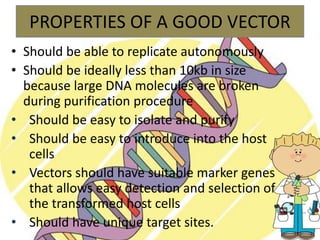
PROPERTIES OF A GOOD VECTOR
• Should be able to replicate autonomously
• Should be ideally less than 10kb in size
because large DNA molecules are broken
during purification procedure
• Should be easy to isolate and purify
• Should be easy to introduce into the host
cells
• Vectors should have suitable marker genes
that allows easy detection and selection of
the transformed host cells
• Should have unique target sites.
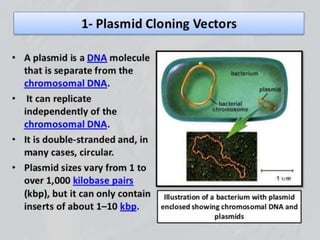
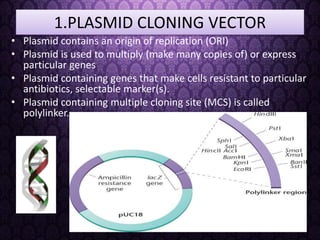
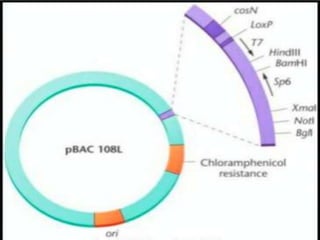
1.PLASMID CLONING VECTOR
• Plasmid contains an origin of replication (ORI)
• Plasmid is used to multiply (make many copies of) or express
particular genes
• Plasmid containing genes that make cells resistant to particular
antibiotics, selectable marker(s).
• Plasmid containing multiple cloning site (MCS) is called
polylinker.
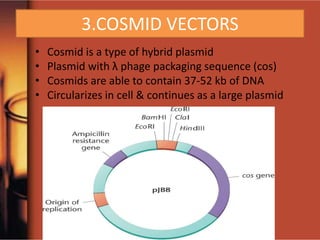
3.COSMID VECTORS
• Cosmid is a type of hybrid plasmid
• Plasmid with λ phage packaging sequence (cos)
• Cosmids are able to contain 37-52 kb of DNA
• Circularizes in cell & continues as a large plasmid
(BACs) VECTORS
• BACs vectors denotes BACTERIAL ARTIFICIAL
CHROMOSOMES.
• These vectors can hold DNA fragments upto
300 kb
• These are the plasmids constructed with the
replication origin of E.coli F factor.
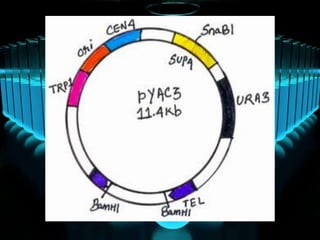
(YACs) VECTORS
• YACs denotes yeast artificial chromosomes
• These are genetically engineered chromosomes
derived from the DNA of yeast, Saccharomyces
cerevisiae, which is then ligated into bacterial
plasmid.
• Primary components of YACs are:
– ARS ( autonomously replication sequence)
– Centromere and telomere from S.cerevisiae
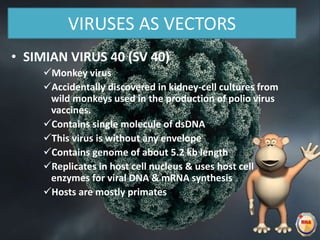
VIRUSES AS VECTORS
• SIMIAN VIRUS 40 (SV 40)
Monkey virus
Accidentally discovered in kidney-cell cultures from
wild monkeys used in the production of polio virus
vaccines.
Contains single molecule of dsDNA
This virus is without any envelope
Contains genome of about 5.2 kb length
Replicates in host cell nucleus & uses host cell
enzymes for viral DNA & mRNA synthesis
Hosts are mostly primates
• LINKERS-
Short pieces of dsDNA which has sites for the action
of one or more restriction enzymes.
The linkers can be ligated to the blunt end of the DNA
molecules
Examples- EcoRI linkers and SalI linkers.
SHUTTLE VECTORS
– contains two origins of replication
– Since these vectors can be grown in one host and
then moved into another without any extra
manipulation, they are called SHUTTLE VECTORS
STEPS IN RECOMBINANT DNA
TECHNOLOGY
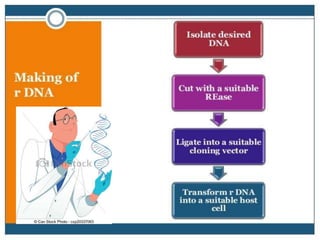
1. ISOLATION OF DESIRED DNA
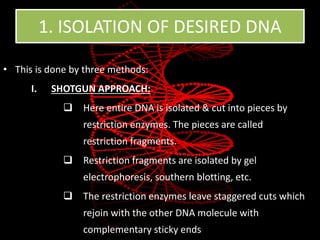
• This is done by three methods:
I. SHOTGUN APPROACH:
 Here entire DNA is isolated & cut into pieces by
restriction enzymes. The pieces are called
restriction fragments.
 Restriction fragments are isolated by gel
electrophoresis, southern blotting, etc.
 The restriction enzymes leave staggered cuts which
rejoin with the other DNA molecule with
complementary sticky ends
1. ISOLATION OF DNA
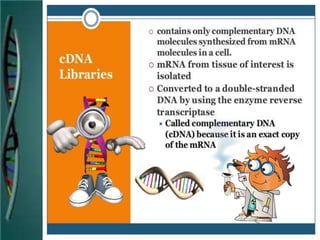
• cDNA METHOD:
Involves making of a gene from its mRNA by reverse
transcription by the help of an enzyme called reverse
transcriptase
The DNA fragment formed from mRNA is called cDNA
A ssDNA is converted into dsDNA by polymerase
enzyme
Process discovered by H.Temin & D.Baltimore(1970)
1. ISOLATION OF DNA
• Gene synthesis
If the base sequence is known then that gene can be
constructed by joining nucleotides in right order
Now a days computerized gene machines are
available to synthesize the genes of known
sequences, more easily and in a short period.
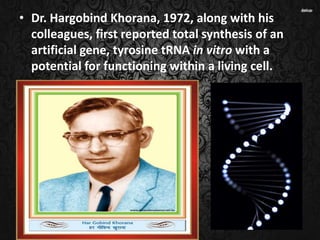
• Dr. Hargobind Khorana, 1972, along with his
colleagues, first reported total synthesis of an
artificial gene, tyrosine tRNA in vitro with a
potential for functioning within a living cell.
2. INSERTION OF FOREIGN GENES INTO
VECTORS
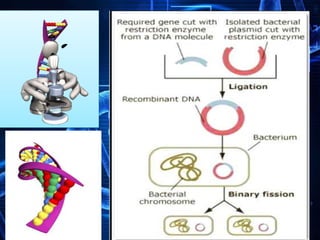
• If the vector is plasmid, then it is first isolated
from bacterial cell and treated with the same
restriction enzyme as that used to obtain target
DNA, in order to produce sticky ends
• If the target DNA has blunt ends, then the linker
DNA are joined to generate sticky ends
• Then the target DNA are inserted into the
plasmid and a recombinant vector is formed
3.INTRODUCTION OF RECOMBINANT
DNA INTO HOST CELL
 Plasmid containing foreign DNA is introduced into
the bacterial cell for multiplication.
 The bacteria commonly used is E.coli because:
• Easily available in human gut
• Genetic system has been studied in detail
• Grows rapidly with a doubling time of about 30 minutes.
4. SELECTION OF TRANSFORMED
BACTERIAL CELL
• This is done by using plasmid which has 2
genes for resistance to antibiotics:
oe.g., plasmid pBR322 has genes for resistance to
antibiotics ampicillin and tetracycline
• By this method, bacterial cells possessing
these plasmids can grow in a medium
containing both antibiotics.
• Thus, the target can be isolated from other
bacterial cell.
CLONING OF GENES
• The desired gene can be cloned by culturing the
transformed bacterial cell in petri dishes.
• Each bacterial cell may contain hundreds of
copies of plasmids and hence billions of copies of
a desired gene can be obtained in a short period
APPLICATIONS OF
RECOMBINANT DNA
TECHNOLOGY
APPLICATIONS OF
RECOMBINANT DNA
TECHNOLOGY
AGRICULTURE: Growing crops of our
own choice, pesticide resistant crops,
fruits with attractive colors
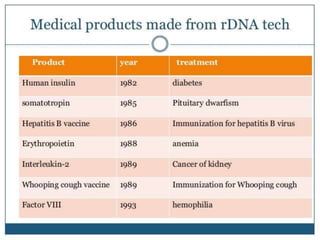
PHARMACOLOGY: artificial insulin
production, drug delivery to target
sites
MEDICINES: gene therapy, antiviral
therapy, vaccination, synthesizing
clotting factors
OTHER USES: fluorescent fishes,
glowing plants, etc.
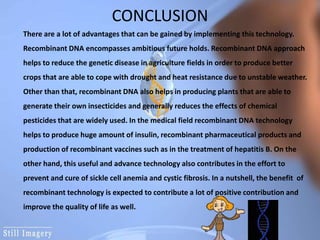
CONCLUSION
There are a lot of advantages that can be gained by implementing this technology.
Recombinant DNA encompasses ambitious future holds. Recombinant DNA approach
helps to reduce the genetic disease in agriculture fields in order to produce better
crops that are able to cope with drought and heat resistance due to unstable weather.
Other than that, recombinant DNA also helps in producing plants that are able to
generate their own insecticides and generally reduces the effects of chemical
pesticides that are widely used. In the medical field recombinant DNA technology
helps to produce huge amount of insulin, recombinant pharmaceutical products and
production of recombinant vaccines such as in the treatment of hepatitis B. On the
other hand, this useful and advance technology also contributes in the effort to
prevent and cure of sickle cell anemia and cystic fibrosis. In a nutshell, the benefit of
recombinant technology is expected to contribute a lot of positive contribution and
improve the quality of life as well.
Namrata singh -recombinant dna technology

Namrata singh -recombinant dna technology

  • 2.
    • RECOMBINANT DNA TECHNOLOGY •Guided by- Mr. Firoz Parhi • By- Namrata Singh • Roll No.-BS12-115 • Exam roll no.-12S85027
  • 3.
  • 4.
    What is recombinant DNA? • Recombinant DNA molecules are Spliced Chimeric molecules formed from two or more different sources that have been cleaved by restriction enzymes and joined by ligases. • Such DNA become a part of the host genetic makeup and is replicated.
  • 5.
    Recombinant DNA Technology •Recombinant DNA Technology is a set of techniques that enable the DNA from different sources to be identified, isolated and recombined so that new characteristics can be introduced into an organism. • Recombinant DNA technology, is joining together of DNA molecules from two different species that are inserted into a host organism to produce new genetic combinations that are of value to science, medicine, agriculture, and industry. Since the focus of all genetics is the gene, the fundamental goal of laboratory geneticists is to isolate, characterize, and manipulate genes. Although it is relatively easy to isolate a sample of DNA from a collection of cells,but finding a specific gene within this DNA sample can be compared to finding a needle in a haystack.
  • 6.
  • 9.
    OBJECTIVES OF RECOMBINANT DNA TECHNOLOGY•To artificially synthesize new genes. • To alter the genome of an organism. • Bringing about new gene combinations, not found in nature. • Understanding the hereditary diseases and their cure. • Improving human genome.
  • 10.
  • 11.
    1. ENZYMES • Thefollowing enzymes are used as tools in recombinant DNA technology: I. EXONUCLEASES- act upon DNA and delete base pairs of either 5’ end or 3’ end of ssDNA. II. ENDONUCLEASES- act upon DNA and cleave them at any point except the ends.
  • 12.
    1. ENZYMES III. RESTRICTIONENZYMES / RESTRICTION ENDONUCLEASES –  Often called molecular scissors / biological scissors / chemical knives.  These are special class of enzymes which recognize and cleave the DNA at specific sites  Found in bacteria which protect its genetic material from the invasive attack of viruses.  REases recognize DNA base sequences that are palindromes.
  • 13.
    • REases makestwo single-stranded breaks, one in each strand. • REases makes staggered cuts with complementary base sequences. 1. ENZYMES
  • 14.
    HISTORY OF RESTRICTION ENDONUCLEASE •Presence of restriction endonuclease was postulated by Werner Arber during 1960s.
  • 15.
    TYPES OF RESTRICTION ENDONUCLEASES •TYPE I – a) Complex endonucleases b) Have recognition sequences of about 15 bp c) Cleave the DNA about 1000 base pairs away from the sequence ‘’TCA’’ located within the recognition site. d) Examples- EcoK, EcoB.
  • 16.
    • TYPE II- a)remarkably stable b) Induce cleavage either within or immediately outside their recognition sequences which are symmetrical. c) Require Magnesium ions (Mg ++ ) for cleavage. d) First type II enzyme to be isolated was HindII. TYPES OF RESTRICTION ENDONUCLEASES
  • 17.
    • TYPE III- a)Intermediate between the type I and type II enzymes b) Cleave DNA in the immediate vicinity of their recognition sites c) Examples- EcoP1, Eco15, HinfIII TYPES OF RESTRICTION ENDONUCLEASES
  • 19.
    RECOGNITION SEQUENCES • Therecognition sequences for type-II restriction endonucleases form palindromes with rotational symmetry. • In a palindrome the base sequence in the second half of a DNA strand is the mirror image of the sequence in the first half • But in a palindrome with rotational symmetry, the base sequence in the second half of one strand of DNA double helix is the mirror image of the second half of its complementary strand • Thus, in such palindromes, the base sequence in both the strands of DNA duplex reads the same when read from the same end(either 5’ or 3’) of both the strands.
  • 21.
    CLEAVAGE PATTERNS • Mosttype II REases cleave the DNA molecules within their specific recognition sequences, but some produce cuts immediately outside the target sequence, e.g., NlaIII, SauIIIA. • These cuts are either: I. Staggered II. even
  • 22.
    CLEAVAGE PATTERNS • Mostenzymes produce staggered cuts in which two strands of DNA double helix are cleaved at different locations; this generates protruding (3’ or 5’) ends, i.e., one strand of the double helix extends some bases beyond the other • Due to palindromic nature of the target sites the two protruding ends generated by such a cleavage by a given enzyme have complementary base sequence. • As a result they readily pair with each other, under annealing conditions; such ends are called cohesive or sticky ends.
  • 24.
    CLEAVAGE PATTERNS • Onthe contrary, some restriction enzymes cut both the strands of a DNA molecule at the same site so that the resulting termini or ends have blunt or flush ends.
  • 25.
    OTHER ENZYMES  DNALIGASES-  Also known as polynucleotide ligases.  Present in both prokaryotes and eukaryotes.  Helps seal nicks between adjacent nucleotides in a dsDNA molecule.  The most extensively studied ligases are of E.coli and phage T4.  The role of DNA ligase was first demonstrated by Mertz & Davis.
  • 26.
    OTHER ENZYMES  ALKALINEPHOSPHATASE (AP):  Is used to prevent unwanted self-ligation of vector DNA molecules during cloning procedures  the cleaved vector molecules are treated with alkaline phosphatases to prevent their re-circularisation  Alkaline phosphatases removes the terminal 5’- phosphate group. Since ligation absolutely requires a 5’-phosphate group at the site of the nick, the vector DNA cannot be self-ligated in the absence of this group  The single nick that remains at each of the two ends of the DNA insert is sealed in vivo when the recombinant DNA molecules are inserted into a host cell.
  • 27.
    SI NUCLEASE- o Itdegrades the ssDNA or single strand of the dsDNA with cohesive ends and converts these cohesive ends into blunt ends. REVERSE TRANSCRIPTASE –this enzyme synthesizes complementary DNA (cDNA) from mRNA template. –Discovered by – H.Temin & D.Baltimore.
  • 28.
    2.Foreign DNA • Alsoknown as passenger DNA • Contains desired gene sequence • First isolated enzymatically and then purified and cloned • Can be done either before or after gene cloning • The cloned foreign DNA fragment expresses normally as it expresses in the parental cell.
  • 30.
    PROPERTIES OF AGOOD VECTOR • Should be able to replicate autonomously • Should be ideally less than 10kb in size because large DNA molecules are broken during purification procedure • Should be easy to isolate and purify • Should be easy to introduce into the host cells • Vectors should have suitable marker genes that allows easy detection and selection of the transformed host cells • Should have unique target sites.
  • 32.
    1.PLASMID CLONING VECTOR •Plasmid contains an origin of replication (ORI) • Plasmid is used to multiply (make many copies of) or express particular genes • Plasmid containing genes that make cells resistant to particular antibiotics, selectable marker(s). • Plasmid containing multiple cloning site (MCS) is called polylinker.
  • 34.
    3.COSMID VECTORS • Cosmidis a type of hybrid plasmid • Plasmid with λ phage packaging sequence (cos) • Cosmids are able to contain 37-52 kb of DNA • Circularizes in cell & continues as a large plasmid
  • 35.
    (BACs) VECTORS • BACsvectors denotes BACTERIAL ARTIFICIAL CHROMOSOMES. • These vectors can hold DNA fragments upto 300 kb • These are the plasmids constructed with the replication origin of E.coli F factor.
  • 37.
    (YACs) VECTORS • YACsdenotes yeast artificial chromosomes • These are genetically engineered chromosomes derived from the DNA of yeast, Saccharomyces cerevisiae, which is then ligated into bacterial plasmid. • Primary components of YACs are: – ARS ( autonomously replication sequence) – Centromere and telomere from S.cerevisiae
  • 39.
    VIRUSES AS VECTORS •SIMIAN VIRUS 40 (SV 40) Monkey virus Accidentally discovered in kidney-cell cultures from wild monkeys used in the production of polio virus vaccines. Contains single molecule of dsDNA This virus is without any envelope Contains genome of about 5.2 kb length Replicates in host cell nucleus & uses host cell enzymes for viral DNA & mRNA synthesis Hosts are mostly primates
  • 40.
    • LINKERS- Short piecesof dsDNA which has sites for the action of one or more restriction enzymes. The linkers can be ligated to the blunt end of the DNA molecules Examples- EcoRI linkers and SalI linkers. SHUTTLE VECTORS – contains two origins of replication – Since these vectors can be grown in one host and then moved into another without any extra manipulation, they are called SHUTTLE VECTORS
  • 44.
    STEPS IN RECOMBINANTDNA TECHNOLOGY
  • 46.
    1. ISOLATION OFDESIRED DNA • This is done by three methods: I. SHOTGUN APPROACH:  Here entire DNA is isolated & cut into pieces by restriction enzymes. The pieces are called restriction fragments.  Restriction fragments are isolated by gel electrophoresis, southern blotting, etc.  The restriction enzymes leave staggered cuts which rejoin with the other DNA molecule with complementary sticky ends
  • 47.
    1. ISOLATION OFDNA • cDNA METHOD: Involves making of a gene from its mRNA by reverse transcription by the help of an enzyme called reverse transcriptase The DNA fragment formed from mRNA is called cDNA A ssDNA is converted into dsDNA by polymerase enzyme Process discovered by H.Temin & D.Baltimore(1970)
  • 48.
    1. ISOLATION OFDNA • Gene synthesis If the base sequence is known then that gene can be constructed by joining nucleotides in right order Now a days computerized gene machines are available to synthesize the genes of known sequences, more easily and in a short period.
  • 49.
    • Dr. HargobindKhorana, 1972, along with his colleagues, first reported total synthesis of an artificial gene, tyrosine tRNA in vitro with a potential for functioning within a living cell.
  • 50.
    2. INSERTION OFFOREIGN GENES INTO VECTORS • If the vector is plasmid, then it is first isolated from bacterial cell and treated with the same restriction enzyme as that used to obtain target DNA, in order to produce sticky ends • If the target DNA has blunt ends, then the linker DNA are joined to generate sticky ends • Then the target DNA are inserted into the plasmid and a recombinant vector is formed
  • 51.
    3.INTRODUCTION OF RECOMBINANT DNAINTO HOST CELL  Plasmid containing foreign DNA is introduced into the bacterial cell for multiplication.  The bacteria commonly used is E.coli because: • Easily available in human gut • Genetic system has been studied in detail • Grows rapidly with a doubling time of about 30 minutes.
  • 52.
    4. SELECTION OFTRANSFORMED BACTERIAL CELL • This is done by using plasmid which has 2 genes for resistance to antibiotics: oe.g., plasmid pBR322 has genes for resistance to antibiotics ampicillin and tetracycline • By this method, bacterial cells possessing these plasmids can grow in a medium containing both antibiotics. • Thus, the target can be isolated from other bacterial cell.
  • 53.
    CLONING OF GENES •The desired gene can be cloned by culturing the transformed bacterial cell in petri dishes. • Each bacterial cell may contain hundreds of copies of plasmids and hence billions of copies of a desired gene can be obtained in a short period
  • 55.
  • 56.
    APPLICATIONS OF RECOMBINANT DNA TECHNOLOGY AGRICULTURE:Growing crops of our own choice, pesticide resistant crops, fruits with attractive colors PHARMACOLOGY: artificial insulin production, drug delivery to target sites MEDICINES: gene therapy, antiviral therapy, vaccination, synthesizing clotting factors OTHER USES: fluorescent fishes, glowing plants, etc.
  • 58.
    CONCLUSION There are alot of advantages that can be gained by implementing this technology. Recombinant DNA encompasses ambitious future holds. Recombinant DNA approach helps to reduce the genetic disease in agriculture fields in order to produce better crops that are able to cope with drought and heat resistance due to unstable weather. Other than that, recombinant DNA also helps in producing plants that are able to generate their own insecticides and generally reduces the effects of chemical pesticides that are widely used. In the medical field recombinant DNA technology helps to produce huge amount of insulin, recombinant pharmaceutical products and production of recombinant vaccines such as in the treatment of hepatitis B. On the other hand, this useful and advance technology also contributes in the effort to prevent and cure of sickle cell anemia and cystic fibrosis. In a nutshell, the benefit of recombinant technology is expected to contribute a lot of positive contribution and improve the quality of life as well.