
Raghavendra Institute of Pharmaceutical Education and Research - Autonomous
K.R.Palli Cross, Chiyyedu, Anantapuramu, A. P- 515721
Gene Mapping & Cloning
A Seminar as a part of curricular requirement for
Master of Pharmacy,
I Year - I semester
Presented by
Mary Vishali
(20L81S0104)
Dept of. Pharmacology
Under the guidance of
Dr. K. Soma Sekhar Reddy M.Pharm, Ph.D.
Associate Professor & HOD Pharamacology
RIPER
AUTONOMOUS
NAAC &
NBA (UG)
SIRO- DSIR
Raghavendra Institute of Pharmaceutical Education and Research - Autonomous
K.R.Palli Cross, Chiyyedu, Anantapuramu, A. P- 515721
Contents
 Introduction
 Genome Mapping
 Genetic Mapping
 Physical Mapping
 Uses & Limitations of Gene Mapping
 Cloning
 Gene Cloning
 Reproductive Cloning
 Therapeutic Cloning
 References
2
RIPER
AUTONOMOUS
NAAC &
NBA (UG)
SIRO- DSIR
Raghavendra Institute of Pharmaceutical Education and Research - Autonomous
K.R.Palli Cross, Chiyyedu, Anantapuramu, A. P- 515721
Introduction
 Gene mapping describes the methods used to identify the locus of a
gene and the distances between genes.
 The essence of all genome mapping is to place a collection of
molecular markers onto their respective positions on the genome.
Molecular markers come in all forms. Genes can be viewed as one
special type of genetic markers in the construction of genome maps,
and mapped the same way as any other markers.
3
RIPER
AUTONOMOUS
NAAC &
NBA (UG)
SIRO- DSIR
Raghavendra Institute of Pharmaceutical Education and Research - Autonomous
K.R.Palli Cross, Chiyyedu, Anantapuramu, A. P- 515721
Genome Mapping
 Genetic mapping is based on the use of genetic techniques to
construct maps showing the positions of genes and other sequence
features on a genome.
 Genetic techniques include cross-breeding experiments or,
 Case of humans, the examination of family histories
(pedigrees).
 Physical mapping uses molecular biology techniques to examine
DNA molecules directly in order to construct maps showing the
positions of sequence features, including genes.
4
RIPER
AUTONOMOUS
NAAC &
NBA (UG)
SIRO- DSIR
Raghavendra Institute of Pharmaceutical Education and Research - Autonomous
K.R.Palli Cross, Chiyyedu, Anantapuramu, A. P- 515721
Genetic Mapping
 The first steps of building a genetic map are the development of genetic
markers and a mapping population. Since the closer the two markers are
on the chromosome, the more likely they are to be passed on to the next
generation together, therefore the "co-segregation" patterns of all
markers can be used to reconstruct their order. The genotypes of each
genetic marker are recorded for both parents, and in each individual in
the following generations. The quality of the genetic maps is largely
dependent upon these two factors: the number of genetic markers on the
map and the size of the mapping population.
5
RIPER
AUTONOMOUS
NAAC &
NBA (UG)
SIRO- DSIR
Raghavendra Institute of Pharmaceutical Education and Research - Autonomous
K.R.Palli Cross, Chiyyedu, Anantapuramu, A. P- 515721
 In gene mapping, any sequence feature that can be
faithfully distinguished from the two parents can be used as a
genetic marker. Genes are represented by "traits" that can be
distinguished between two parents.
 Their linkage with other genetic markers are calculated same way
as if they are common markers and the actual gene loci are then
bracketed in a region between the two nearest neighbouring
markers.
 The entire process is then repeated by looking at more markers
which target that region to map the gene neighbourhood
6
RIPER
AUTONOMOUS
NAAC &
NBA (UG)
SIRO- DSIR
Raghavendra Institute of Pharmaceutical Education and Research - Autonomous
K.R.Palli Cross, Chiyyedu, Anantapuramu, A. P- 515721
to a higher resolution until a specific causative locus can be identified.
This process is often referred to as "positional cloning", and it is used
extensively in the study of plant species.
7
RIPER
AUTONOMOUS
NAAC &
NBA (UG)
SIRO- DSIR
Raghavendra Institute of Pharmaceutical Education and Research - Autonomous
K.R.Palli Cross, Chiyyedu, Anantapuramu, A. P- 515721
Physical Mapping
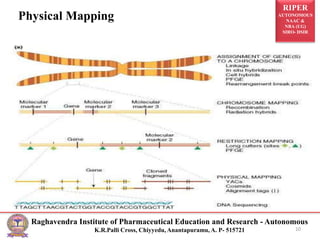
 Restriction mapping, which locates the relative positions on a DNA
molecule of the recognition sequences for restriction endonucleases;
 Fluorescent in situ hybridization (FISH), in which marker locations
are mapped by hybridizing a probe containing the marker to intact
chromosomes;
 Sequence tagged site (STS) mapping, in which the positions of short
sequences are mapped by PCR and/or hybridization analysis of
genome fragments.
8
RIPER
AUTONOMOUS
NAAC &
NBA (UG)
SIRO- DSIR
Raghavendra Institute of Pharmaceutical Education and Research - Autonomous
K.R.Palli Cross, Chiyyedu, Anantapuramu, A. P- 515721
Physical maps
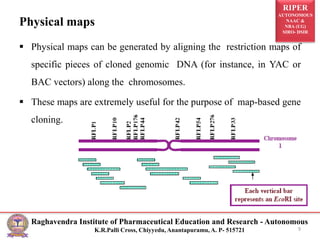
 Physical maps can be generated by aligning the restriction maps of
specific pieces of cloned genomic DNA (for instance, in YAC or
BAC vectors) along the chromosomes.
 These maps are extremely useful for the purpose of map-based gene
cloning.
9
RIPER
AUTONOMOUS
NAAC &
NBA (UG)
SIRO- DSIR
Raghavendra Institute of Pharmaceutical Education and Research - Autonomous
K.R.Palli Cross, Chiyyedu, Anantapuramu, A. P- 515721
Physical Mapping
10
RIPER
AUTONOMOUS
NAAC &
NBA (UG)
SIRO- DSIR
Raghavendra Institute of Pharmaceutical Education and Research - Autonomous
K.R.Palli Cross, Chiyyedu, Anantapuramu, A. P- 515721 11
RIPER
AUTONOMOUS
NAAC &
NBA (UG)
SIRO- DSIR
Raghavendra Institute of Pharmaceutical Education and Research - Autonomous
K.R.Palli Cross, Chiyyedu, Anantapuramu, A. P- 515721
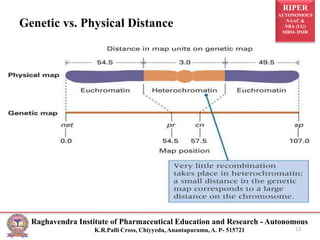
Genetic vs. Physical Distance
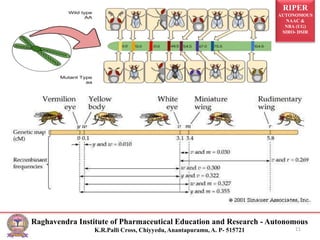
 Map distances based on recombination frequencies are not a direct
measurement of physical distance along a chromosome.
 Recombination “hot spots” overestimate physical length.
 Low rates in heterochromatin and centromeres underestimate actual
physical length.
12
RIPER
AUTONOMOUS
NAAC &
NBA (UG)
SIRO- DSIR
Raghavendra Institute of Pharmaceutical Education and Research - Autonomous
K.R.Palli Cross, Chiyyedu, Anantapuramu, A. P- 515721
Genetic vs. Physical Distance
13
RIPER
AUTONOMOUS
NAAC &
NBA (UG)
SIRO- DSIR
Raghavendra Institute of Pharmaceutical Education and Research - Autonomous
K.R.Palli Cross, Chiyyedu, Anantapuramu, A. P- 515721
Uses of Gene Mapping
 Identify genes responsible for diseases.
 Heritable diseases
 Cancer
 Identify genes responsible for traits.
 Plants or Animals
 Disease resistance
 Meat or Milk Production
14
RIPER
AUTONOMOUS
NAAC &
NBA (UG)
SIRO- DSIR
Raghavendra Institute of Pharmaceutical Education and Research - Autonomous
K.R.Palli Cross, Chiyyedu, Anantapuramu, A. P- 515721
Limitations
 A map generated by genetic techniques is rarely sufficient for
directing the sequencing phase of a genome project. This is for two
reasons:
 The resolution of a genetic map depends on the number of crossovers
that have been scored .
 Genes that are several tens of kb apart may appear at the same
position on the genetic map.
15
RIPER
AUTONOMOUS
NAAC &
NBA (UG)
SIRO- DSIR
Raghavendra Institute of Pharmaceutical Education and Research - Autonomous
K.R.Palli Cross, Chiyyedu, Anantapuramu, A. P- 515721
 Genetic maps have limited accuracy .
 Presence of recombination hotspots means that crossovers are
more likely to occur at some points rather than at others.
 physical mapping techniques has been developed to address this
problem.
16
RIPER
AUTONOMOUS
NAAC &
NBA (UG)
SIRO- DSIR
Raghavendra Institute of Pharmaceutical Education and Research - Autonomous
K.R.Palli Cross, Chiyyedu, Anantapuramu, A. P- 515721
What is Cloning
 A clone is a genetically identical copy of an organism, and it may be
naturally occurring or created in the lab. Through the process of
asexual reproduction, organisms such as bacteria (and some plants)
create offspring that are genetically identical to the parent. Modern
genetic technology can also be used to create clones.
17
RIPER
AUTONOMOUS
NAAC &
NBA (UG)
SIRO- DSIR
Raghavendra Institute of Pharmaceutical Education and Research - Autonomous
K.R.Palli Cross, Chiyyedu, Anantapuramu, A. P- 515721
Types of Cloning
 Gene Cloning
 Reproductive Cloning
 Therapeutic Coning
18
RIPER
AUTONOMOUS
NAAC &
NBA (UG)
SIRO- DSIR
Raghavendra Institute of Pharmaceutical Education and Research - Autonomous
K.R.Palli Cross, Chiyyedu, Anantapuramu, A. P- 515721
Gene Cloning
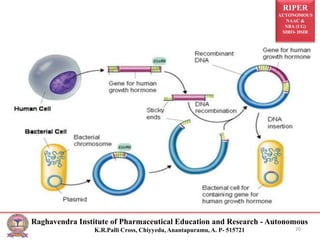
 Making multiple copies of a single gene.
 The insertion of fragment of DNA carrying a gene into a cloning vector
and subsequent propagation of recombinant DNA molecule into many
copies is known as gene cloning.
19
RIPER
AUTONOMOUS
NAAC &
NBA (UG)
SIRO- DSIR
Raghavendra Institute of Pharmaceutical Education and Research - Autonomous
K.R.Palli Cross, Chiyyedu, Anantapuramu, A. P- 515721 20
RIPER
AUTONOMOUS
NAAC &
NBA (UG)
SIRO- DSIR
Raghavendra Institute of Pharmaceutical Education and Research - Autonomous
K.R.Palli Cross, Chiyyedu, Anantapuramu, A. P- 515721
Basic Steps of Gene Cloning
 Construction of recombinant DNA molecule.
 Transport of the recombinant DNA to the host cell.
 Multiplication of recombinant DNA molecule.
 Division of the host cell.
 Numerous cell division resulting in the clone.
21
RIPER
AUTONOMOUS
NAAC &
NBA (UG)
SIRO- DSIR
Raghavendra Institute of Pharmaceutical Education and Research - Autonomous
K.R.Palli Cross, Chiyyedu, Anantapuramu, A. P- 515721
Gene cloning requires specialized tool and
techniques
 Vehicles: the central compensation of a gene cloning experiments is the
vehicle which transport the gene into the host cell and is responsible for
its replication. To act as a cloning vehicle a DNA molecule must be
capable of entering a host cell and once inside replicating to produce
multiple copies of itself.
 Vector: A DNA molecule capable of replication in a host organism into
which gene is inserted to construct a recombinant DNA molecule.
22
RIPER
AUTONOMOUS
NAAC &
NBA (UG)
SIRO- DSIR
Raghavendra Institute of Pharmaceutical Education and Research - Autonomous
K.R.Palli Cross, Chiyyedu, Anantapuramu, A. P- 515721
Characteristic of a Vector
 It must be able to replicate.
 There must be some way to introduce vector DNA into cell.
 There must be some means of detecting its presence, preferably
planting test in petri dishes.
23
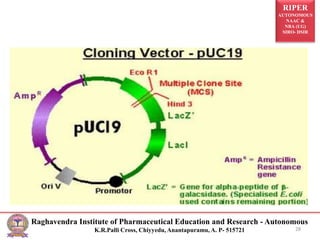
Cloning vector components
 Ori
 ampR gene
 lacZ gene
 Restriction gene
RIPER
AUTONOMOUS
NAAC &
NBA (UG)
SIRO- DSIR
Raghavendra Institute of Pharmaceutical Education and Research - Autonomous
K.R.Palli Cross, Chiyyedu, Anantapuramu, A. P- 515721
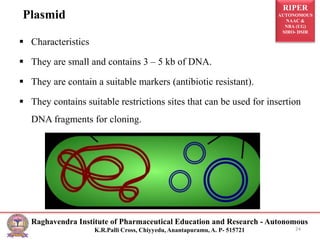
Plasmid
 Characteristics
 They are small and contains 3 – 5 kb of DNA.
 They are contain a suitable markers (antibiotic resistant).
 They contains suitable restrictions sites that can be used for insertion
DNA fragments for cloning.
24
RIPER
AUTONOMOUS
NAAC &
NBA (UG)
SIRO- DSIR
Raghavendra Institute of Pharmaceutical Education and Research - Autonomous
K.R.Palli Cross, Chiyyedu, Anantapuramu, A. P- 515721
Cloning Vector
 A plasmid into which the gene of interest is introduced.
 Contains a number of specific gene useful in selection.
25
RIPER
AUTONOMOUS
NAAC &
NBA (UG)
SIRO- DSIR
Raghavendra Institute of Pharmaceutical Education and Research - Autonomous
K.R.Palli Cross, Chiyyedu, Anantapuramu, A. P- 515721
Cloning Vector Components
 Ori
 amp R gene
 lacZ gene
 Restriction gene
 Replication origin (ori):
 Allow plasmid to replicate in the host cell
26
RIPER
AUTONOMOUS
NAAC &
NBA (UG)
SIRO- DSIR
Raghavendra Institute of Pharmaceutical Education and Research - Autonomous
K.R.Palli Cross, Chiyyedu, Anantapuramu, A. P- 515721
 Antibiotic resistance (ampR) gene: allow cells to be resistance to
ampicillin (an antibiotic).
 Selection for host cells that have resistance.
 This, selection for transformation
 β – galactosidase (lacZ) gene: enzyme produced will change a clear
substrate called X-gal into a blue product.
27
RIPER
AUTONOMOUS
NAAC &
NBA (UG)
SIRO- DSIR
Raghavendra Institute of Pharmaceutical Education and Research - Autonomous
K.R.Palli Cross, Chiyyedu, Anantapuramu, A. P- 515721 28
RIPER
AUTONOMOUS
NAAC &
NBA (UG)
SIRO- DSIR
Raghavendra Institute of Pharmaceutical Education and Research - Autonomous
K.R.Palli Cross, Chiyyedu, Anantapuramu, A. P- 515721
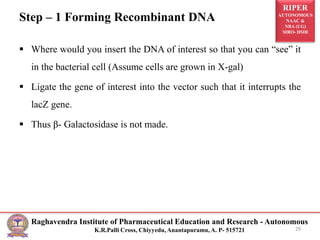
Step – 1 Forming Recombinant DNA
 Where would you insert the DNA of interest so that you can “see” it
in the bacterial cell (Assume cells are grown in X-gal)
 Ligate the gene of interest into the vector such that it interrupts the
lacZ gene.
 Thus β- Galactosidase is not made.
29
RIPER
AUTONOMOUS
NAAC &
NBA (UG)
SIRO- DSIR
Raghavendra Institute of Pharmaceutical Education and Research - Autonomous
K.R.Palli Cross, Chiyyedu, Anantapuramu, A. P- 515721
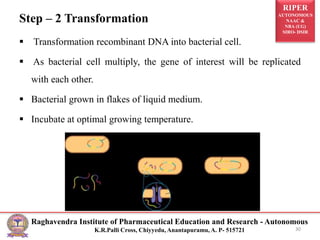
Step – 2 Transformation
 Transformation recombinant DNA into bacterial cell.
 As bacterial cell multiply, the gene of interest will be replicated
with each other.
 Bacterial grown in flakes of liquid medium.
 Incubate at optimal growing temperature.
30
RIPER
AUTONOMOUS
NAAC &
NBA (UG)
SIRO- DSIR
Raghavendra Institute of Pharmaceutical Education and Research - Autonomous
K.R.Palli Cross, Chiyyedu, Anantapuramu, A. P- 515721
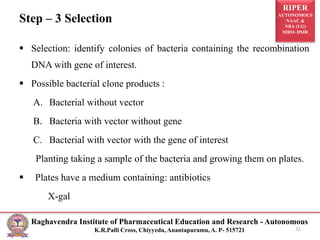
Step – 3 Selection
 Selection: identify colonies of bacteria containing the recombination
DNA with gene of interest.
 Possible bacterial clone products :
A. Bacterial without vector
B. Bacteria with vector without gene
C. Bacterial with vector with the gene of interest
Planting taking a sample of the bacteria and growing them on plates.
 Plates have a medium containing: antibiotics
X-gal
31
RIPER
AUTONOMOUS
NAAC &
NBA (UG)
SIRO- DSIR
Raghavendra Institute of Pharmaceutical Education and Research - Autonomous
K.R.Palli Cross, Chiyyedu, Anantapuramu, A. P- 515721
Selection Mechanism: Antibiotic Resistance
 Selection for bacterial clones that contains a vector (select for
proper transformation).
 Bacteria are grown on Petri plate containing a specific antibiotics.
 Vector confers antibiotics resistance to bacteria because the vector
contains an ampR gene.
 Only bacterial cells that properly transformed the vector will live
and grow on the plate.
32
RIPER
AUTONOMOUS
NAAC &
NBA (UG)
SIRO- DSIR
Raghavendra Institute of Pharmaceutical Education and Research - Autonomous
K.R.Palli Cross, Chiyyedu, Anantapuramu, A. P- 515721
Cloning Application: Bt Plants
 Bacillus Thuringiensis a bacterium used a biological pesticide.
 Bt gene is cloned into plants so that they will be resistant to pests.
33
RIPER
AUTONOMOUS
NAAC &
NBA (UG)
SIRO- DSIR
Raghavendra Institute of Pharmaceutical Education and Research - Autonomous
K.R.Palli Cross, Chiyyedu, Anantapuramu, A. P- 515721
Reproductive Cloning
 Reproductive cloning involves crating and animal that is genetically
identical to a donor animal through somatic cell nuclear transfer.
 In reproductive cloning, the newly created embryo is placed back
into the uterine environment where it can implant and develop.
 Ex. The sheep Dolly
34
RIPER
AUTONOMOUS
NAAC &
NBA (UG)
SIRO- DSIR
Raghavendra Institute of Pharmaceutical Education and Research - Autonomous
K.R.Palli Cross, Chiyyedu, Anantapuramu, A. P- 515721
Therapeutic Cloning
 In therapeutic cloning an embryo is created in a similar way to that
of the reproductive cloning but the resulting cloned cells remain in a
dish in the lab, they are not implanted into a female uterus.
35
RIPER
AUTONOMOUS
NAAC &
NBA (UG)
SIRO- DSIR
Raghavendra Institute of Pharmaceutical Education and Research - Autonomous
K.R.Palli Cross, Chiyyedu, Anantapuramu, A. P- 515721
Cloning Application: Flavr savr Tomatoes
 First genetically modified procedure.
 Genetically modified tomatoes that suppressed a gene responsible
for fruit ripening.
 Process required cloning the gene and transformation a reserve
orientation copy which would have inhibitory effects.
36
RIPER
AUTONOMOUS
NAAC &
NBA (UG)
SIRO- DSIR
Raghavendra Institute of Pharmaceutical Education and Research - Autonomous
K.R.Palli Cross, Chiyyedu, Anantapuramu, A. P- 515721
References
 T.A Brown, Gene Cloning and DNA Analysis an Introduction, Sixth
Edition.
 Anil G. Menon, Charles A. Klanke, and Yan Ru Su, Identification of
Disease Genes By Positional Cloning.
 Rita M. Cantor, Analysis of Genetic Linkage.
 Huntington’s Disease Genetics Department of neurology, Boston
University School of Medicine, Boston, Massachusetts.
37
Raghavendra Institute of Pharmaceutical Education and Research - Autonomous
K.R.Palli Cross, Chiyyedu, Anantapuramu, A. P- 515721

GENE MAPPING & CLONING

  • 1.
    Raghavendra Institute ofPharmaceutical Education and Research - Autonomous K.R.Palli Cross, Chiyyedu, Anantapuramu, A. P- 515721 Gene Mapping & Cloning A Seminar as a part of curricular requirement for Master of Pharmacy, I Year - I semester Presented by Mary Vishali (20L81S0104) Dept of. Pharmacology Under the guidance of Dr. K. Soma Sekhar Reddy M.Pharm, Ph.D. Associate Professor & HOD Pharamacology
  • 2.
    RIPER AUTONOMOUS NAAC & NBA (UG) SIRO-DSIR Raghavendra Institute of Pharmaceutical Education and Research - Autonomous K.R.Palli Cross, Chiyyedu, Anantapuramu, A. P- 515721 Contents  Introduction  Genome Mapping  Genetic Mapping  Physical Mapping  Uses & Limitations of Gene Mapping  Cloning  Gene Cloning  Reproductive Cloning  Therapeutic Cloning  References 2
  • 3.
    RIPER AUTONOMOUS NAAC & NBA (UG) SIRO-DSIR Raghavendra Institute of Pharmaceutical Education and Research - Autonomous K.R.Palli Cross, Chiyyedu, Anantapuramu, A. P- 515721 Introduction  Gene mapping describes the methods used to identify the locus of a gene and the distances between genes.  The essence of all genome mapping is to place a collection of molecular markers onto their respective positions on the genome. Molecular markers come in all forms. Genes can be viewed as one special type of genetic markers in the construction of genome maps, and mapped the same way as any other markers. 3
  • 4.
    RIPER AUTONOMOUS NAAC & NBA (UG) SIRO-DSIR Raghavendra Institute of Pharmaceutical Education and Research - Autonomous K.R.Palli Cross, Chiyyedu, Anantapuramu, A. P- 515721 Genome Mapping  Genetic mapping is based on the use of genetic techniques to construct maps showing the positions of genes and other sequence features on a genome.  Genetic techniques include cross-breeding experiments or,  Case of humans, the examination of family histories (pedigrees).  Physical mapping uses molecular biology techniques to examine DNA molecules directly in order to construct maps showing the positions of sequence features, including genes. 4
  • 5.
    RIPER AUTONOMOUS NAAC & NBA (UG) SIRO-DSIR Raghavendra Institute of Pharmaceutical Education and Research - Autonomous K.R.Palli Cross, Chiyyedu, Anantapuramu, A. P- 515721 Genetic Mapping  The first steps of building a genetic map are the development of genetic markers and a mapping population. Since the closer the two markers are on the chromosome, the more likely they are to be passed on to the next generation together, therefore the "co-segregation" patterns of all markers can be used to reconstruct their order. The genotypes of each genetic marker are recorded for both parents, and in each individual in the following generations. The quality of the genetic maps is largely dependent upon these two factors: the number of genetic markers on the map and the size of the mapping population. 5
  • 6.
    RIPER AUTONOMOUS NAAC & NBA (UG) SIRO-DSIR Raghavendra Institute of Pharmaceutical Education and Research - Autonomous K.R.Palli Cross, Chiyyedu, Anantapuramu, A. P- 515721  In gene mapping, any sequence feature that can be faithfully distinguished from the two parents can be used as a genetic marker. Genes are represented by "traits" that can be distinguished between two parents.  Their linkage with other genetic markers are calculated same way as if they are common markers and the actual gene loci are then bracketed in a region between the two nearest neighbouring markers.  The entire process is then repeated by looking at more markers which target that region to map the gene neighbourhood 6
  • 7.
    RIPER AUTONOMOUS NAAC & NBA (UG) SIRO-DSIR Raghavendra Institute of Pharmaceutical Education and Research - Autonomous K.R.Palli Cross, Chiyyedu, Anantapuramu, A. P- 515721 to a higher resolution until a specific causative locus can be identified. This process is often referred to as "positional cloning", and it is used extensively in the study of plant species. 7
  • 8.
    RIPER AUTONOMOUS NAAC & NBA (UG) SIRO-DSIR Raghavendra Institute of Pharmaceutical Education and Research - Autonomous K.R.Palli Cross, Chiyyedu, Anantapuramu, A. P- 515721 Physical Mapping  Restriction mapping, which locates the relative positions on a DNA molecule of the recognition sequences for restriction endonucleases;  Fluorescent in situ hybridization (FISH), in which marker locations are mapped by hybridizing a probe containing the marker to intact chromosomes;  Sequence tagged site (STS) mapping, in which the positions of short sequences are mapped by PCR and/or hybridization analysis of genome fragments. 8
  • 9.
    RIPER AUTONOMOUS NAAC & NBA (UG) SIRO-DSIR Raghavendra Institute of Pharmaceutical Education and Research - Autonomous K.R.Palli Cross, Chiyyedu, Anantapuramu, A. P- 515721 Physical maps  Physical maps can be generated by aligning the restriction maps of specific pieces of cloned genomic DNA (for instance, in YAC or BAC vectors) along the chromosomes.  These maps are extremely useful for the purpose of map-based gene cloning. 9
  • 10.
    RIPER AUTONOMOUS NAAC & NBA (UG) SIRO-DSIR Raghavendra Institute of Pharmaceutical Education and Research - Autonomous K.R.Palli Cross, Chiyyedu, Anantapuramu, A. P- 515721 Physical Mapping 10
  • 11.
    RIPER AUTONOMOUS NAAC & NBA (UG) SIRO-DSIR Raghavendra Institute of Pharmaceutical Education and Research - Autonomous K.R.Palli Cross, Chiyyedu, Anantapuramu, A. P- 515721 11
  • 12.
    RIPER AUTONOMOUS NAAC & NBA (UG) SIRO-DSIR Raghavendra Institute of Pharmaceutical Education and Research - Autonomous K.R.Palli Cross, Chiyyedu, Anantapuramu, A. P- 515721 Genetic vs. Physical Distance  Map distances based on recombination frequencies are not a direct measurement of physical distance along a chromosome.  Recombination “hot spots” overestimate physical length.  Low rates in heterochromatin and centromeres underestimate actual physical length. 12
  • 13.
    RIPER AUTONOMOUS NAAC & NBA (UG) SIRO-DSIR Raghavendra Institute of Pharmaceutical Education and Research - Autonomous K.R.Palli Cross, Chiyyedu, Anantapuramu, A. P- 515721 Genetic vs. Physical Distance 13
  • 14.
    RIPER AUTONOMOUS NAAC & NBA (UG) SIRO-DSIR Raghavendra Institute of Pharmaceutical Education and Research - Autonomous K.R.Palli Cross, Chiyyedu, Anantapuramu, A. P- 515721 Uses of Gene Mapping  Identify genes responsible for diseases.  Heritable diseases  Cancer  Identify genes responsible for traits.  Plants or Animals  Disease resistance  Meat or Milk Production 14
  • 15.
    RIPER AUTONOMOUS NAAC & NBA (UG) SIRO-DSIR Raghavendra Institute of Pharmaceutical Education and Research - Autonomous K.R.Palli Cross, Chiyyedu, Anantapuramu, A. P- 515721 Limitations  A map generated by genetic techniques is rarely sufficient for directing the sequencing phase of a genome project. This is for two reasons:  The resolution of a genetic map depends on the number of crossovers that have been scored .  Genes that are several tens of kb apart may appear at the same position on the genetic map. 15
  • 16.
    RIPER AUTONOMOUS NAAC & NBA (UG) SIRO-DSIR Raghavendra Institute of Pharmaceutical Education and Research - Autonomous K.R.Palli Cross, Chiyyedu, Anantapuramu, A. P- 515721  Genetic maps have limited accuracy .  Presence of recombination hotspots means that crossovers are more likely to occur at some points rather than at others.  physical mapping techniques has been developed to address this problem. 16
  • 17.
    RIPER AUTONOMOUS NAAC & NBA (UG) SIRO-DSIR Raghavendra Institute of Pharmaceutical Education and Research - Autonomous K.R.Palli Cross, Chiyyedu, Anantapuramu, A. P- 515721 What is Cloning  A clone is a genetically identical copy of an organism, and it may be naturally occurring or created in the lab. Through the process of asexual reproduction, organisms such as bacteria (and some plants) create offspring that are genetically identical to the parent. Modern genetic technology can also be used to create clones. 17
  • 18.
    RIPER AUTONOMOUS NAAC & NBA (UG) SIRO-DSIR Raghavendra Institute of Pharmaceutical Education and Research - Autonomous K.R.Palli Cross, Chiyyedu, Anantapuramu, A. P- 515721 Types of Cloning  Gene Cloning  Reproductive Cloning  Therapeutic Coning 18
  • 19.
    RIPER AUTONOMOUS NAAC & NBA (UG) SIRO-DSIR Raghavendra Institute of Pharmaceutical Education and Research - Autonomous K.R.Palli Cross, Chiyyedu, Anantapuramu, A. P- 515721 Gene Cloning  Making multiple copies of a single gene.  The insertion of fragment of DNA carrying a gene into a cloning vector and subsequent propagation of recombinant DNA molecule into many copies is known as gene cloning. 19
  • 20.
    RIPER AUTONOMOUS NAAC & NBA (UG) SIRO-DSIR Raghavendra Institute of Pharmaceutical Education and Research - Autonomous K.R.Palli Cross, Chiyyedu, Anantapuramu, A. P- 515721 20
  • 21.
    RIPER AUTONOMOUS NAAC & NBA (UG) SIRO-DSIR Raghavendra Institute of Pharmaceutical Education and Research - Autonomous K.R.Palli Cross, Chiyyedu, Anantapuramu, A. P- 515721 Basic Steps of Gene Cloning  Construction of recombinant DNA molecule.  Transport of the recombinant DNA to the host cell.  Multiplication of recombinant DNA molecule.  Division of the host cell.  Numerous cell division resulting in the clone. 21
  • 22.
    RIPER AUTONOMOUS NAAC & NBA (UG) SIRO-DSIR Raghavendra Institute of Pharmaceutical Education and Research - Autonomous K.R.Palli Cross, Chiyyedu, Anantapuramu, A. P- 515721 Gene cloning requires specialized tool and techniques  Vehicles: the central compensation of a gene cloning experiments is the vehicle which transport the gene into the host cell and is responsible for its replication. To act as a cloning vehicle a DNA molecule must be capable of entering a host cell and once inside replicating to produce multiple copies of itself.  Vector: A DNA molecule capable of replication in a host organism into which gene is inserted to construct a recombinant DNA molecule. 22
  • 23.
    RIPER AUTONOMOUS NAAC & NBA (UG) SIRO-DSIR Raghavendra Institute of Pharmaceutical Education and Research - Autonomous K.R.Palli Cross, Chiyyedu, Anantapuramu, A. P- 515721 Characteristic of a Vector  It must be able to replicate.  There must be some way to introduce vector DNA into cell.  There must be some means of detecting its presence, preferably planting test in petri dishes. 23 Cloning vector components  Ori  ampR gene  lacZ gene  Restriction gene
  • 24.
    RIPER AUTONOMOUS NAAC & NBA (UG) SIRO-DSIR Raghavendra Institute of Pharmaceutical Education and Research - Autonomous K.R.Palli Cross, Chiyyedu, Anantapuramu, A. P- 515721 Plasmid  Characteristics  They are small and contains 3 – 5 kb of DNA.  They are contain a suitable markers (antibiotic resistant).  They contains suitable restrictions sites that can be used for insertion DNA fragments for cloning. 24
  • 25.
    RIPER AUTONOMOUS NAAC & NBA (UG) SIRO-DSIR Raghavendra Institute of Pharmaceutical Education and Research - Autonomous K.R.Palli Cross, Chiyyedu, Anantapuramu, A. P- 515721 Cloning Vector  A plasmid into which the gene of interest is introduced.  Contains a number of specific gene useful in selection. 25
  • 26.
    RIPER AUTONOMOUS NAAC & NBA (UG) SIRO-DSIR Raghavendra Institute of Pharmaceutical Education and Research - Autonomous K.R.Palli Cross, Chiyyedu, Anantapuramu, A. P- 515721 Cloning Vector Components  Ori  amp R gene  lacZ gene  Restriction gene  Replication origin (ori):  Allow plasmid to replicate in the host cell 26
  • 27.
    RIPER AUTONOMOUS NAAC & NBA (UG) SIRO-DSIR Raghavendra Institute of Pharmaceutical Education and Research - Autonomous K.R.Palli Cross, Chiyyedu, Anantapuramu, A. P- 515721  Antibiotic resistance (ampR) gene: allow cells to be resistance to ampicillin (an antibiotic).  Selection for host cells that have resistance.  This, selection for transformation  β – galactosidase (lacZ) gene: enzyme produced will change a clear substrate called X-gal into a blue product. 27
  • 28.
    RIPER AUTONOMOUS NAAC & NBA (UG) SIRO-DSIR Raghavendra Institute of Pharmaceutical Education and Research - Autonomous K.R.Palli Cross, Chiyyedu, Anantapuramu, A. P- 515721 28
  • 29.
    RIPER AUTONOMOUS NAAC & NBA (UG) SIRO-DSIR Raghavendra Institute of Pharmaceutical Education and Research - Autonomous K.R.Palli Cross, Chiyyedu, Anantapuramu, A. P- 515721 Step – 1 Forming Recombinant DNA  Where would you insert the DNA of interest so that you can “see” it in the bacterial cell (Assume cells are grown in X-gal)  Ligate the gene of interest into the vector such that it interrupts the lacZ gene.  Thus β- Galactosidase is not made. 29
  • 30.
    RIPER AUTONOMOUS NAAC & NBA (UG) SIRO-DSIR Raghavendra Institute of Pharmaceutical Education and Research - Autonomous K.R.Palli Cross, Chiyyedu, Anantapuramu, A. P- 515721 Step – 2 Transformation  Transformation recombinant DNA into bacterial cell.  As bacterial cell multiply, the gene of interest will be replicated with each other.  Bacterial grown in flakes of liquid medium.  Incubate at optimal growing temperature. 30
  • 31.
    RIPER AUTONOMOUS NAAC & NBA (UG) SIRO-DSIR Raghavendra Institute of Pharmaceutical Education and Research - Autonomous K.R.Palli Cross, Chiyyedu, Anantapuramu, A. P- 515721 Step – 3 Selection  Selection: identify colonies of bacteria containing the recombination DNA with gene of interest.  Possible bacterial clone products : A. Bacterial without vector B. Bacteria with vector without gene C. Bacterial with vector with the gene of interest Planting taking a sample of the bacteria and growing them on plates.  Plates have a medium containing: antibiotics X-gal 31
  • 32.
    RIPER AUTONOMOUS NAAC & NBA (UG) SIRO-DSIR Raghavendra Institute of Pharmaceutical Education and Research - Autonomous K.R.Palli Cross, Chiyyedu, Anantapuramu, A. P- 515721 Selection Mechanism: Antibiotic Resistance  Selection for bacterial clones that contains a vector (select for proper transformation).  Bacteria are grown on Petri plate containing a specific antibiotics.  Vector confers antibiotics resistance to bacteria because the vector contains an ampR gene.  Only bacterial cells that properly transformed the vector will live and grow on the plate. 32
  • 33.
    RIPER AUTONOMOUS NAAC & NBA (UG) SIRO-DSIR Raghavendra Institute of Pharmaceutical Education and Research - Autonomous K.R.Palli Cross, Chiyyedu, Anantapuramu, A. P- 515721 Cloning Application: Bt Plants  Bacillus Thuringiensis a bacterium used a biological pesticide.  Bt gene is cloned into plants so that they will be resistant to pests. 33
  • 34.
    RIPER AUTONOMOUS NAAC & NBA (UG) SIRO-DSIR Raghavendra Institute of Pharmaceutical Education and Research - Autonomous K.R.Palli Cross, Chiyyedu, Anantapuramu, A. P- 515721 Reproductive Cloning  Reproductive cloning involves crating and animal that is genetically identical to a donor animal through somatic cell nuclear transfer.  In reproductive cloning, the newly created embryo is placed back into the uterine environment where it can implant and develop.  Ex. The sheep Dolly 34
  • 35.
    RIPER AUTONOMOUS NAAC & NBA (UG) SIRO-DSIR Raghavendra Institute of Pharmaceutical Education and Research - Autonomous K.R.Palli Cross, Chiyyedu, Anantapuramu, A. P- 515721 Therapeutic Cloning  In therapeutic cloning an embryo is created in a similar way to that of the reproductive cloning but the resulting cloned cells remain in a dish in the lab, they are not implanted into a female uterus. 35
  • 36.
    RIPER AUTONOMOUS NAAC & NBA (UG) SIRO-DSIR Raghavendra Institute of Pharmaceutical Education and Research - Autonomous K.R.Palli Cross, Chiyyedu, Anantapuramu, A. P- 515721 Cloning Application: Flavr savr Tomatoes  First genetically modified procedure.  Genetically modified tomatoes that suppressed a gene responsible for fruit ripening.  Process required cloning the gene and transformation a reserve orientation copy which would have inhibitory effects. 36
  • 37.
    RIPER AUTONOMOUS NAAC & NBA (UG) SIRO-DSIR Raghavendra Institute of Pharmaceutical Education and Research - Autonomous K.R.Palli Cross, Chiyyedu, Anantapuramu, A. P- 515721 References  T.A Brown, Gene Cloning and DNA Analysis an Introduction, Sixth Edition.  Anil G. Menon, Charles A. Klanke, and Yan Ru Su, Identification of Disease Genes By Positional Cloning.  Rita M. Cantor, Analysis of Genetic Linkage.  Huntington’s Disease Genetics Department of neurology, Boston University School of Medicine, Boston, Massachusetts. 37
  • 38.
    Raghavendra Institute ofPharmaceutical Education and Research - Autonomous K.R.Palli Cross, Chiyyedu, Anantapuramu, A. P- 515721