



PARENTERAL  CONTROLLED DRUG   DELIVERY SYSTEM Prepared By SAI S. V M.Pharm – I st  Year Dept. of Pharmaceutics KLE University, Belgaum.
Introduction Objective  Additives used in formulation Routes  of administration Approaches for formulation Type of formulation Classification Approaches for formulations of Implants Infusion Devices References CONTENTS
Objectives Site-specific delivery Reduced side effects Increased bio-availability Increased therapeutic effectiveness
 
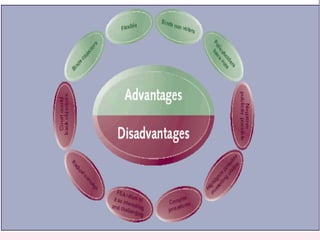
Improved patient convenience and compliance. Reduction in fluctuation in steady-state levels. Increased safety margin of high potency drugs. Maximum utilization of drug. Reduction in health care costs through improved therapy, shorter treatment period, less frequency of dosing Advantages over conventional drug delivery system
Decreased systemic availability Poor in vitro-in vivo correlation Possibility of dose dumping. Retrieval of drug is difficult in case of toxicity, poisoning or hypersensitivity reactions. Reduced potential for dosage adjustments. Higher cost of formulations. Disadvantages of controlled release dosage forms
Intravascular  Intramuscular Subcutaneous Intradermal Intraarticular Intraspinal Intrathecal Intracardiac Intrasynovial Intravaginal  Intraarterial Routes of administration
CHARACTERISTICS Free from living microbes Free from microbial products such as pyrogens Should match the osmotic nature of the blood  Free from chemical contaminants Matching specefic gravity
ADDITIVES USED DURING FORMULATION OF PARENTRALS Vehicles Stabilizers Buffering agents Tonicity factors Solubilizers Wetting, suspending, emulsifying agents Antimicrobial compounds
APPROACHES FOR FORMUALATION
PARAMETERS MANIPULATED IN THE DESIGN OF PARENTRAL CONTROLLED FORMS Route of administration Vehicles Vaso-constriction Particle size Chemical modification of drug
Approaches Use of viscous, water-miscible vehicles, such as an aqueous solution of gelatin or polyvinylpyrrolidone. Utilization of water-immiscible vehicles, such as vegetable oils, plus water-repelling agent, such as aluminum monostearate. Formation of thixotropic suspensions.
Preparation of water-insoluble drug derivatives, such as salts, complexes, and esters. Dispersion in polymeric microspheres or microcapsules, such as lactide-glycolide homopolymers or copolymers Co-administration of vasoconstrictors. Contd..,
TYPE OF FORMULATION Dissolution-controlled Depot formulations Adsorption-type Depot preparations Encapsulation-type Depot preparations Esterification-type Depot preparations
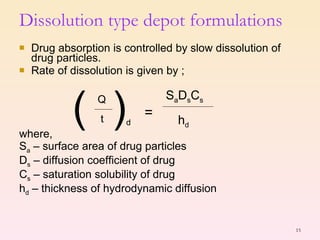
Dissolution type depot formulations Drug absorption is controlled by slow dissolution of drug particles. Rate of dissolution is given by ; where, S a  – surface area of drug particles D s  – diffusion coefficient of drug  C s  – saturation solubility of drug h d  – thickness of hydrodynamic diffusion (  Q t ) d = S a D s C s h d
Release of drug molecules is not of zero order kinetics as expected from the theoretical model. Surface area S a  of drug particles diminishes with time.  The saturation solubility C s  of the drug at the injection site cannot be easily maintained. Drawbacks
Formation of salts or Complexes with Low solubility. E.g., Aqueous suspensions of benzathine penicillin G. Suspension of macro crystals. E.g., aqueous suspension of testosterone isobutyrate for I.M. administration. Exception Penicillin G procaine suspension in gelled peanut oil for I.M. injection. Approaches
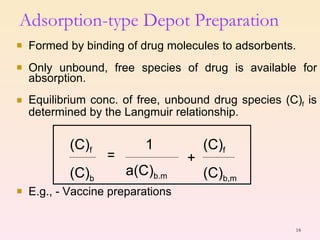
Formed by binding of drug molecules to adsorbents. Only unbound, free species of drug is available for absorption. Equilibrium conc. of free, unbound drug species (C) f  is determined by the Langmuir relationship. E.g., - Vaccine preparations Adsorption-type Depot Preparation 1 a(C) b.m (C) f (C) b = + (C) f (C) b,m
Prepared by encapsulating drug solids within a permeation barrier or dispersing drug particles in a diffusion matrix. Membrane – biodegradable or bioabsorbable macromolecules  gelatin, Dextran, polylactate, lactide-glycolide copolymers, phospholipids, and long chain fatty acids and glycerides. Encapsulation-type Depot Preparations
Contd.., E.g., naltrexone pamoate-releasing biodegradable microcapsules. Release of drug molecules is controlled by  rate of permeation across the permeation barrier the rate of biodegradation of the barrier macromolecules.
Esterifying a drug to form a bioconvertible prodrug-type ester. Forms a reservoir at the site of injection. Rate of absorption is controlled by  interfacial partitioning of drug esters from reservoir to tissue fluid. Rate of bioconversion of drug esters to regenerate active drug molecules. E.g., fluphenazine enanthate, nandrolone decanoate, and  testosterone 17B-cyprionate in oleaginous solution. Esterification-type Depot Preparation
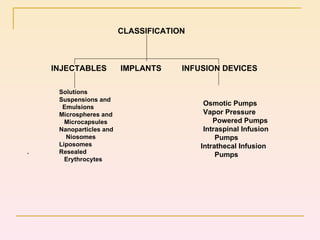
CLASSIFICATION INJECTABLES IMPLANTS INFUSION DEVICES Solutions Suspensions and Emulsions Microspheres and  Microcapsules Nanoparticles and  Niosomes Liposomes .  Resealed  Erythrocytes Osmotic Pumps Vapor Pressure Powered Pumps Intraspinal Infusion  Pumps Intrathecal Infusion Pumps
Aqueous solutions High viscosity solutions For comp. with mol. wt. more than 750 For water sol. drugs  Gelling agents or viscosity enhancers are used Complex formulations Drug forms dissociable complex with macromolecule Fixed amount of drug gets complexed Given by I.M. route Solutions
Solutions Oil solutions Drug release is controlled by controlling partitioning of drug out of oil into surrounding into aqueous medium For I.M. administration only No. of oils are limited
Suspensions Aqueous suspensions Given by I.M. or S.C. routes Conc. of solids should be 0.5 to 5 %  Particle size should be < 10  μ m
Contd.., Drug is continuosly dissolving to replenish the lost. For oil soluble drugs Only crystalline and stable polymorphic drugs are given by this form Viscosity builders can be used. E.g., crystalline zinc insulin
Suspensions Oil suspensions Given by I.M. route. Process of drug availability consists of dissolution of drug particles followed by partitioning of drug from oil solution to aqueous medium. More prolong dug action as compared to oil solution and aqueous suspension. E.g., Penicillin G procaine in vegetable oil
Can be given by I.M., S.C., or I.V. routes O/w systems are not used due to large interfacial area and rapid partitioning. W/o emulsions are used for water soluble drugs. Multiple emulsions are used generally such as w/o/w and o/w/o since an additional reservoir is presented to the drug for partitioning which can effectively retard its release rate. Emulsions
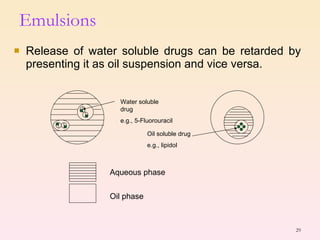
Emulsions Release of water soluble drugs can be retarded by presenting it as oil suspension and vice versa. Aqueous phase Oil phase Water soluble drug e.g., 5-Fluorouracil  Oil soluble drug e.g., lipidol
Each  microsphere  is basically a matrix of drug dispersed in a polymer from which release occurs by first order process. Polymers used are biocompatible and biodegradable. Polylactic acid, polylactide coglycolide etc. Drug release is controlled by dissolution degradation of matrix. Small matrices release drug at a faster rate. Microsphere
Microsphere For controlled release of peptide/protein drugs such as LHRH which have short half-lives. Magnetic microspheres  are developed for promoting drug targeting which are infused into an artery. Magnet is placed over the area to localize it in that region.
Drug is centrally located within the polymeric shell. Release is controlled by dissolution, diffusion or both. For potent drugs such as steroids, peptides and antineoplastics. Microcapsules
Nanoparticles  are called as nanospheres or nanocapsules depending upon the position of drugs Polymer used are biodegradable ones. Polyacrylic acid, polyglycolic acid For selective targeting therapy. Nanosomes  are closed vesicles formed in aqueous media from nonionic surfactants with or without the presence of lipids. Nanoparticles and Niosomes
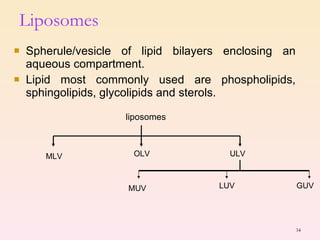
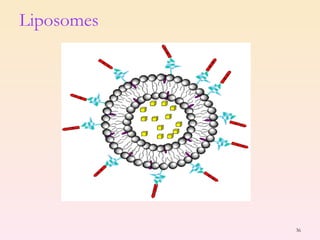
Spherule/vesicle of lipid bilayers enclosing an aqueous compartment. Lipid most commonly used are phospholipids, sphingolipids, glycolipids and sterols. Liposomes GUV liposomes MLV OLV ULV MUV LUV
Liposomes Water soluble drugs are trapped in aqueous compartment. Lipophilic ones are incorporated in the lipid phase of liposomes. Can be given by I.M., S.C., for controlled rate release. Can be given by I.V. for targeted delivery.
Liposomes
Biodegradable, biocompatible, nonimmunogenic. Can circulate intravascularly for days and allow large amounts of drug to be carried. Drug loading in erythrocytes is easy. Damaged erythrocytes are removed by liver and spleen. Resealed Erythrocytes
Envionmentally stable Biostable Biocompatible Nontoxic and noncarcinogenic Nonirritant Removable Provide constant release Ideal Characteristics
Advantages More effective and more prolonged action Small dose is sufficient Disadvantages Microsurgery is required  Advantages and Disadvantages
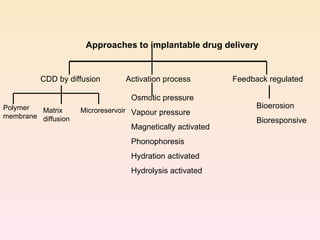
Approaches to implantable drug delivery CDD by diffusion Activation process Feedback regulated Osmotic pressure Vapour pressure Magnetically activated Phonophoresis Hydration activated Hydrolysis activated Bioerosion Bioresponsive Polymer membrane Matrix diffusion Microreservoir
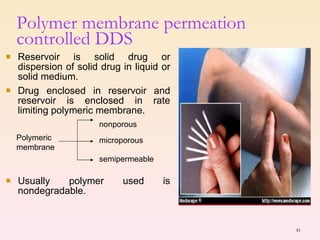
Reservoir is solid drug or dispersion of solid drug in liquid or solid medium. Drug enclosed in reservoir and reservoir is enclosed in rate limiting polymeric membrane. Usually polymer used is nondegradable. Polymer membrane permeation controlled DDS Polymeric membrane nonporous microporous semipermeable
Encapsulation of drug in reservoir can be done by encapsulation, microencapsulation, extrusion, molding or any other technique. E.g., Norplant Subdermal Implant. Contd..,
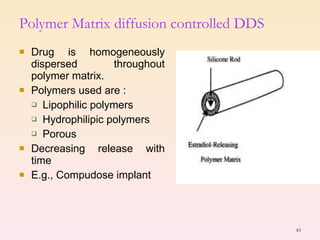
Drug is homogeneously dispersed throughout polymer matrix. Polymers used are : Lipophilic polymers Hydrophilipic polymers Porous  Decreasing release with time E.g., Compudose implant Polymer Matrix diffusion controlled DDS
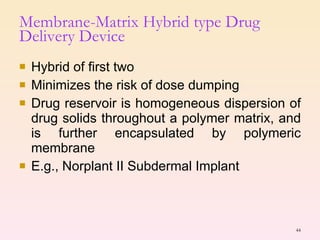
Hybrid of first two Minimizes the risk of dose dumping  Drug reservoir is homogeneous dispersion of drug solids throughout a polymer matrix, and is further encapsulated by polymeric membrane E.g., Norplant II Subdermal Implant Membrane-Matrix Hybrid type Drug Delivery Device
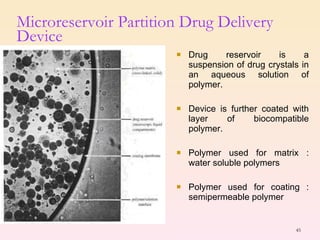
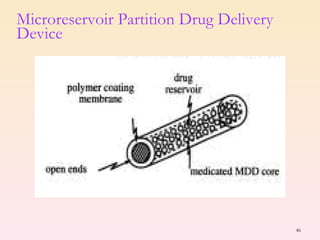
Microreservoir Partition Drug Delivery Device Drug reservoir is a suspension of drug crystals in an aqueous solution of polymer. Device is further coated with layer of biocompatible polymer. Polymer used for matrix : water soluble polymers Polymer used for coating : semipermeable polymer
Microreservoir Partition Drug Delivery Device
Osmotic pressure activated  Vapor pressure activated  Magnetically activated Controlled drug delivery by activation process
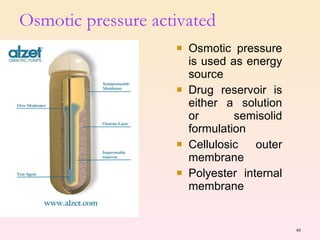
Osmotic pressure activated  Osmotic pressure is used as energy source Drug reservoir is either a solution or semisolid formulation Cellulosic outer membrane Polyester internal membrane
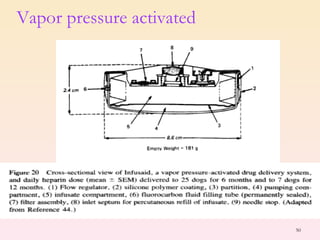
Vapor pressure activated  Vapor pressure is used as the power source. Drug reservoir is a solution formulation. Fluid which vaporizes at body temperature is used such as fluorocarbon. E.g., Infusaid Pump for Heparin.
Vapor pressure activated
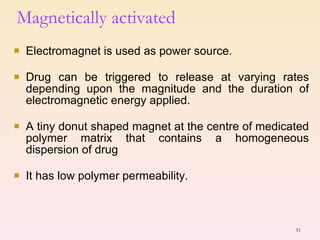
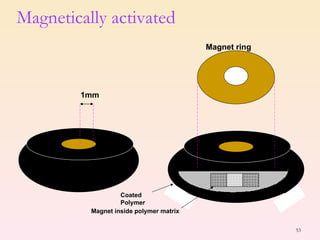
Electromagnet is used as power source. Drug can be triggered to release at varying rates depending upon the magnitude and the duration of electromagnetic energy applied. A tiny donut shaped magnet at the centre of medicated polymer matrix that contains a homogeneous dispersion of drug  It has low polymer permeability. Magnetically activated
Magnetically activated  External surface is coated with pure polymer, such as ethylene vinyl acetate copolymer or silicone copolymer. The drug is activated to release at much higher rate by applying the external magnetic field.
Magnetically activated  1mm Magnet ring Coated Polymer Magnet inside polymer matrix
Hydration activated Hydrolysis activated Feedback Regulated DDS
Releases drug upon activation by hydration of device by tissue fluid at the implantation site. Hydrohilic polymer is used for formulation which becomes swollen upon hydration. Drug gets released by diffusing through the water saturated pore channels in the swollen polymer matrix. E.g., norgestomet releasing Hydron Implant Hydration activated
Release drug upon hydrolysis of polymer base by tissue fluid at implantation site. Polymer used is bioerodible or biodegradable polymer. Pellet or bead shaped implant. Rate of drug release is determined by rate of biodegradation, polymer composition and mol. Wt., drug leading and drug polymer interactions. Erosion rate is controlled by using a buffering agent.  Hydrolysis activated
INFUSION DEVICES
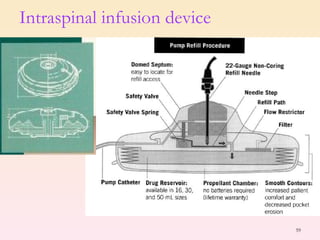
The implantable infusion pump (IIP) is a drug delivery system that provides continuous infusion of an agent at a constant and precise rate.  The purpose of an IIP is to deliver therapeutic levels of a drug directly to a target organ or compartment.  It is frequently used to deliver chemotherapy directly to the hepatic artery or superior vena cava.  Infusion devices
Intraspinal infusion device
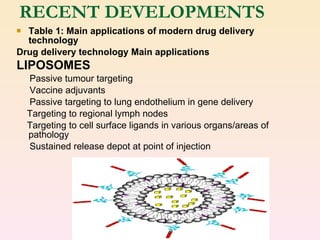
RECENT DEVELOPMENTS Table 1: Main applications of modern drug delivery technology Drug delivery technology Main applications LIPOSOMES   Passive tumour targeting  Vaccine adjuvants  Passive targeting to lung endothelium in gene delivery  Targeting to regional lymph nodes  Targeting to cell surface ligands in various organs/areas of pathology  Sustained release depot at point of injection
Niosomes   Passive tumour targeting  Vaccine adjuvants  Sustained release depot at point of injection Nanoparticles   Passive tumour targeting  Vaccine adjuvants
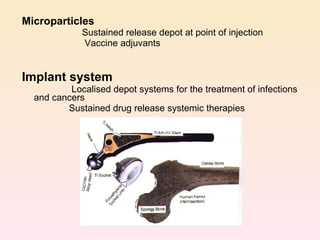
Microparticles Sustained release depot at point of injection  Vaccine adjuvants Implant system Localised depot systems for the treatment of infections  and cancers   Sustained drug release systemic therapies
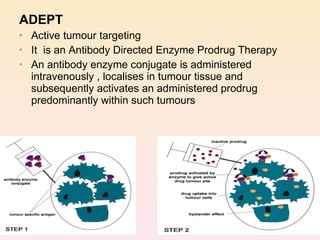
ADEPT Active tumour targeting It  is an Antibody Directed Enzyme Prodrug Therapy An antibody enzyme conjugate is administered intravenously , localises in tumour tissue and subsequently activates an administered prodrug predominantly within such tumours
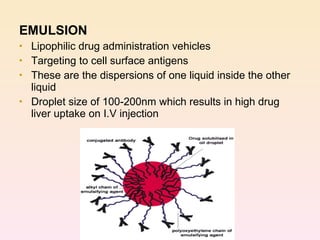
EMULSION Lipophilic drug administration vehicles  Targeting to cell surface antigens These are the dispersions of one liquid inside the other liquid Droplet size of 100-200nm which results in high drug liver uptake on I.V injection
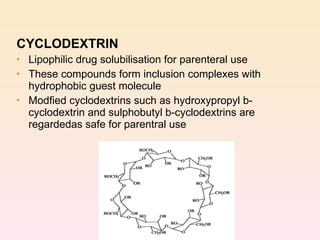
CYCLODEXTRIN Lipophilic drug solubilisation for parenteral use These compounds form inclusion complexes with hydrophobic guest molecule Modfied cyclodextrins such as hydroxypropyl b-cyclodextrin and sulphobutyl b-cyclodextrins are regardedas safe for parentral use
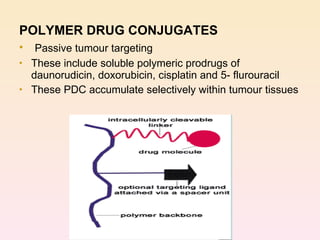
POLYMER DRUG CONJUGATES Passive tumour targeting These include soluble polymeric prodrugs of daunorudicin, doxorubicin, cisplatin and 5- flurouracil These PDC accumulate selectively within tumour tissues
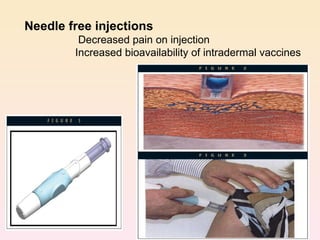
Needle free injections Decreased pain on injection  Increased bioavailability of intradermal vaccines
“ Parenteral Drug Delivery and Delivery Systems”, in “Controlled Drug Delivery System” by  Y.W.Chein ; Marcel Decker Publications Vol. 50 pg – 381 -513. “ Parenteral Drug Delivery”, in “Targeted and Controlled Drug Delivery” by  Vyas and Khar  pg – 30-33. “ Parenteral Products”, in “Controlled Drug Delivery” by  Robinson and Lee ; Marcel Decker Publications, Vol. 29 pg – 433 – 450. References
“ Parenterals” in “Sterile Dosage Forms and Delivery Systems” by  Ansel , pg 444-451, 488-489. “ Parenteral Drug Delivery Systems” in “Encyclopedia of Controlled Drug Delivery System” pg 752-753. “ Controlled Release Medication” in “Biopharmaceutics and Pharmacokinetics A Treatise” by  D.M.Brahmankar ,  Sunil B. Jaiswal ; pg 357-365. http://www.pharmainfo.net www.pharmj.com/.../education/parenteral2.html
 

Parenteral controlled drug delivery system sushmitha

  • 1.
    PARENTERAL CONTROLLEDDRUG DELIVERY SYSTEM Prepared By SAI S. V M.Pharm – I st Year Dept. of Pharmaceutics KLE University, Belgaum.
  • 2.
    Introduction Objective Additives used in formulation Routes of administration Approaches for formulation Type of formulation Classification Approaches for formulations of Implants Infusion Devices References CONTENTS
  • 3.
    Objectives Site-specific deliveryReduced side effects Increased bio-availability Increased therapeutic effectiveness
  • 4.
  • 5.
    Improved patient convenienceand compliance. Reduction in fluctuation in steady-state levels. Increased safety margin of high potency drugs. Maximum utilization of drug. Reduction in health care costs through improved therapy, shorter treatment period, less frequency of dosing Advantages over conventional drug delivery system
  • 6.
    Decreased systemic availabilityPoor in vitro-in vivo correlation Possibility of dose dumping. Retrieval of drug is difficult in case of toxicity, poisoning or hypersensitivity reactions. Reduced potential for dosage adjustments. Higher cost of formulations. Disadvantages of controlled release dosage forms
  • 7.
    Intravascular IntramuscularSubcutaneous Intradermal Intraarticular Intraspinal Intrathecal Intracardiac Intrasynovial Intravaginal Intraarterial Routes of administration
  • 8.
    CHARACTERISTICS Free fromliving microbes Free from microbial products such as pyrogens Should match the osmotic nature of the blood Free from chemical contaminants Matching specefic gravity
  • 9.
    ADDITIVES USED DURINGFORMULATION OF PARENTRALS Vehicles Stabilizers Buffering agents Tonicity factors Solubilizers Wetting, suspending, emulsifying agents Antimicrobial compounds
  • 10.
  • 11.
    PARAMETERS MANIPULATED INTHE DESIGN OF PARENTRAL CONTROLLED FORMS Route of administration Vehicles Vaso-constriction Particle size Chemical modification of drug
  • 12.
    Approaches Use ofviscous, water-miscible vehicles, such as an aqueous solution of gelatin or polyvinylpyrrolidone. Utilization of water-immiscible vehicles, such as vegetable oils, plus water-repelling agent, such as aluminum monostearate. Formation of thixotropic suspensions.
  • 13.
    Preparation of water-insolubledrug derivatives, such as salts, complexes, and esters. Dispersion in polymeric microspheres or microcapsules, such as lactide-glycolide homopolymers or copolymers Co-administration of vasoconstrictors. Contd..,
  • 14.
    TYPE OF FORMULATIONDissolution-controlled Depot formulations Adsorption-type Depot preparations Encapsulation-type Depot preparations Esterification-type Depot preparations
  • 15.
    Dissolution type depotformulations Drug absorption is controlled by slow dissolution of drug particles. Rate of dissolution is given by ; where, S a – surface area of drug particles D s – diffusion coefficient of drug C s – saturation solubility of drug h d – thickness of hydrodynamic diffusion ( Q t ) d = S a D s C s h d
  • 16.
    Release of drugmolecules is not of zero order kinetics as expected from the theoretical model. Surface area S a of drug particles diminishes with time. The saturation solubility C s of the drug at the injection site cannot be easily maintained. Drawbacks
  • 17.
    Formation of saltsor Complexes with Low solubility. E.g., Aqueous suspensions of benzathine penicillin G. Suspension of macro crystals. E.g., aqueous suspension of testosterone isobutyrate for I.M. administration. Exception Penicillin G procaine suspension in gelled peanut oil for I.M. injection. Approaches
  • 18.
    Formed by bindingof drug molecules to adsorbents. Only unbound, free species of drug is available for absorption. Equilibrium conc. of free, unbound drug species (C) f is determined by the Langmuir relationship. E.g., - Vaccine preparations Adsorption-type Depot Preparation 1 a(C) b.m (C) f (C) b = + (C) f (C) b,m
  • 19.
    Prepared by encapsulatingdrug solids within a permeation barrier or dispersing drug particles in a diffusion matrix. Membrane – biodegradable or bioabsorbable macromolecules gelatin, Dextran, polylactate, lactide-glycolide copolymers, phospholipids, and long chain fatty acids and glycerides. Encapsulation-type Depot Preparations
  • 20.
    Contd.., E.g., naltrexonepamoate-releasing biodegradable microcapsules. Release of drug molecules is controlled by rate of permeation across the permeation barrier the rate of biodegradation of the barrier macromolecules.
  • 21.
    Esterifying a drugto form a bioconvertible prodrug-type ester. Forms a reservoir at the site of injection. Rate of absorption is controlled by interfacial partitioning of drug esters from reservoir to tissue fluid. Rate of bioconversion of drug esters to regenerate active drug molecules. E.g., fluphenazine enanthate, nandrolone decanoate, and testosterone 17B-cyprionate in oleaginous solution. Esterification-type Depot Preparation
  • 22.
    CLASSIFICATION INJECTABLES IMPLANTSINFUSION DEVICES Solutions Suspensions and Emulsions Microspheres and Microcapsules Nanoparticles and Niosomes Liposomes . Resealed Erythrocytes Osmotic Pumps Vapor Pressure Powered Pumps Intraspinal Infusion Pumps Intrathecal Infusion Pumps
  • 23.
    Aqueous solutions Highviscosity solutions For comp. with mol. wt. more than 750 For water sol. drugs Gelling agents or viscosity enhancers are used Complex formulations Drug forms dissociable complex with macromolecule Fixed amount of drug gets complexed Given by I.M. route Solutions
  • 24.
    Solutions Oil solutionsDrug release is controlled by controlling partitioning of drug out of oil into surrounding into aqueous medium For I.M. administration only No. of oils are limited
  • 25.
    Suspensions Aqueous suspensionsGiven by I.M. or S.C. routes Conc. of solids should be 0.5 to 5 % Particle size should be < 10 μ m
  • 26.
    Contd.., Drug iscontinuosly dissolving to replenish the lost. For oil soluble drugs Only crystalline and stable polymorphic drugs are given by this form Viscosity builders can be used. E.g., crystalline zinc insulin
  • 27.
    Suspensions Oil suspensionsGiven by I.M. route. Process of drug availability consists of dissolution of drug particles followed by partitioning of drug from oil solution to aqueous medium. More prolong dug action as compared to oil solution and aqueous suspension. E.g., Penicillin G procaine in vegetable oil
  • 28.
    Can be givenby I.M., S.C., or I.V. routes O/w systems are not used due to large interfacial area and rapid partitioning. W/o emulsions are used for water soluble drugs. Multiple emulsions are used generally such as w/o/w and o/w/o since an additional reservoir is presented to the drug for partitioning which can effectively retard its release rate. Emulsions
  • 29.
    Emulsions Release ofwater soluble drugs can be retarded by presenting it as oil suspension and vice versa. Aqueous phase Oil phase Water soluble drug e.g., 5-Fluorouracil Oil soluble drug e.g., lipidol
  • 30.
    Each microsphere is basically a matrix of drug dispersed in a polymer from which release occurs by first order process. Polymers used are biocompatible and biodegradable. Polylactic acid, polylactide coglycolide etc. Drug release is controlled by dissolution degradation of matrix. Small matrices release drug at a faster rate. Microsphere
  • 31.
    Microsphere For controlledrelease of peptide/protein drugs such as LHRH which have short half-lives. Magnetic microspheres are developed for promoting drug targeting which are infused into an artery. Magnet is placed over the area to localize it in that region.
  • 32.
    Drug is centrallylocated within the polymeric shell. Release is controlled by dissolution, diffusion or both. For potent drugs such as steroids, peptides and antineoplastics. Microcapsules
  • 33.
    Nanoparticles arecalled as nanospheres or nanocapsules depending upon the position of drugs Polymer used are biodegradable ones. Polyacrylic acid, polyglycolic acid For selective targeting therapy. Nanosomes are closed vesicles formed in aqueous media from nonionic surfactants with or without the presence of lipids. Nanoparticles and Niosomes
  • 34.
    Spherule/vesicle of lipidbilayers enclosing an aqueous compartment. Lipid most commonly used are phospholipids, sphingolipids, glycolipids and sterols. Liposomes GUV liposomes MLV OLV ULV MUV LUV
  • 35.
    Liposomes Water solubledrugs are trapped in aqueous compartment. Lipophilic ones are incorporated in the lipid phase of liposomes. Can be given by I.M., S.C., for controlled rate release. Can be given by I.V. for targeted delivery.
  • 36.
  • 37.
    Biodegradable, biocompatible, nonimmunogenic.Can circulate intravascularly for days and allow large amounts of drug to be carried. Drug loading in erythrocytes is easy. Damaged erythrocytes are removed by liver and spleen. Resealed Erythrocytes
  • 38.
    Envionmentally stable BiostableBiocompatible Nontoxic and noncarcinogenic Nonirritant Removable Provide constant release Ideal Characteristics
  • 39.
    Advantages More effectiveand more prolonged action Small dose is sufficient Disadvantages Microsurgery is required Advantages and Disadvantages
  • 40.
    Approaches to implantabledrug delivery CDD by diffusion Activation process Feedback regulated Osmotic pressure Vapour pressure Magnetically activated Phonophoresis Hydration activated Hydrolysis activated Bioerosion Bioresponsive Polymer membrane Matrix diffusion Microreservoir
  • 41.
    Reservoir is soliddrug or dispersion of solid drug in liquid or solid medium. Drug enclosed in reservoir and reservoir is enclosed in rate limiting polymeric membrane. Usually polymer used is nondegradable. Polymer membrane permeation controlled DDS Polymeric membrane nonporous microporous semipermeable
  • 42.
    Encapsulation of drugin reservoir can be done by encapsulation, microencapsulation, extrusion, molding or any other technique. E.g., Norplant Subdermal Implant. Contd..,
  • 43.
    Drug is homogeneouslydispersed throughout polymer matrix. Polymers used are : Lipophilic polymers Hydrophilipic polymers Porous Decreasing release with time E.g., Compudose implant Polymer Matrix diffusion controlled DDS
  • 44.
    Hybrid of firsttwo Minimizes the risk of dose dumping Drug reservoir is homogeneous dispersion of drug solids throughout a polymer matrix, and is further encapsulated by polymeric membrane E.g., Norplant II Subdermal Implant Membrane-Matrix Hybrid type Drug Delivery Device
  • 45.
    Microreservoir Partition DrugDelivery Device Drug reservoir is a suspension of drug crystals in an aqueous solution of polymer. Device is further coated with layer of biocompatible polymer. Polymer used for matrix : water soluble polymers Polymer used for coating : semipermeable polymer
  • 46.
  • 47.
    Osmotic pressure activated Vapor pressure activated Magnetically activated Controlled drug delivery by activation process
  • 48.
    Osmotic pressure activated Osmotic pressure is used as energy source Drug reservoir is either a solution or semisolid formulation Cellulosic outer membrane Polyester internal membrane
  • 49.
    Vapor pressure activated Vapor pressure is used as the power source. Drug reservoir is a solution formulation. Fluid which vaporizes at body temperature is used such as fluorocarbon. E.g., Infusaid Pump for Heparin.
  • 50.
  • 51.
    Electromagnet is usedas power source. Drug can be triggered to release at varying rates depending upon the magnitude and the duration of electromagnetic energy applied. A tiny donut shaped magnet at the centre of medicated polymer matrix that contains a homogeneous dispersion of drug It has low polymer permeability. Magnetically activated
  • 52.
    Magnetically activated External surface is coated with pure polymer, such as ethylene vinyl acetate copolymer or silicone copolymer. The drug is activated to release at much higher rate by applying the external magnetic field.
  • 53.
    Magnetically activated 1mm Magnet ring Coated Polymer Magnet inside polymer matrix
  • 54.
    Hydration activated Hydrolysisactivated Feedback Regulated DDS
  • 55.
    Releases drug uponactivation by hydration of device by tissue fluid at the implantation site. Hydrohilic polymer is used for formulation which becomes swollen upon hydration. Drug gets released by diffusing through the water saturated pore channels in the swollen polymer matrix. E.g., norgestomet releasing Hydron Implant Hydration activated
  • 56.
    Release drug uponhydrolysis of polymer base by tissue fluid at implantation site. Polymer used is bioerodible or biodegradable polymer. Pellet or bead shaped implant. Rate of drug release is determined by rate of biodegradation, polymer composition and mol. Wt., drug leading and drug polymer interactions. Erosion rate is controlled by using a buffering agent. Hydrolysis activated
  • 57.
  • 58.
    The implantable infusionpump (IIP) is a drug delivery system that provides continuous infusion of an agent at a constant and precise rate. The purpose of an IIP is to deliver therapeutic levels of a drug directly to a target organ or compartment. It is frequently used to deliver chemotherapy directly to the hepatic artery or superior vena cava. Infusion devices
  • 59.
  • 60.
    RECENT DEVELOPMENTS Table1: Main applications of modern drug delivery technology Drug delivery technology Main applications LIPOSOMES Passive tumour targeting  Vaccine adjuvants  Passive targeting to lung endothelium in gene delivery  Targeting to regional lymph nodes  Targeting to cell surface ligands in various organs/areas of pathology  Sustained release depot at point of injection
  • 61.
    Niosomes Passive tumour targeting  Vaccine adjuvants  Sustained release depot at point of injection Nanoparticles Passive tumour targeting  Vaccine adjuvants
  • 62.
    Microparticles Sustained releasedepot at point of injection  Vaccine adjuvants Implant system Localised depot systems for the treatment of infections and cancers  Sustained drug release systemic therapies
  • 63.
    ADEPT Active tumourtargeting It is an Antibody Directed Enzyme Prodrug Therapy An antibody enzyme conjugate is administered intravenously , localises in tumour tissue and subsequently activates an administered prodrug predominantly within such tumours
  • 64.
    EMULSION Lipophilic drugadministration vehicles  Targeting to cell surface antigens These are the dispersions of one liquid inside the other liquid Droplet size of 100-200nm which results in high drug liver uptake on I.V injection
  • 65.
    CYCLODEXTRIN Lipophilic drugsolubilisation for parenteral use These compounds form inclusion complexes with hydrophobic guest molecule Modfied cyclodextrins such as hydroxypropyl b-cyclodextrin and sulphobutyl b-cyclodextrins are regardedas safe for parentral use
  • 66.
    POLYMER DRUG CONJUGATESPassive tumour targeting These include soluble polymeric prodrugs of daunorudicin, doxorubicin, cisplatin and 5- flurouracil These PDC accumulate selectively within tumour tissues
  • 67.
    Needle free injectionsDecreased pain on injection  Increased bioavailability of intradermal vaccines
  • 68.
    “ Parenteral DrugDelivery and Delivery Systems”, in “Controlled Drug Delivery System” by Y.W.Chein ; Marcel Decker Publications Vol. 50 pg – 381 -513. “ Parenteral Drug Delivery”, in “Targeted and Controlled Drug Delivery” by Vyas and Khar pg – 30-33. “ Parenteral Products”, in “Controlled Drug Delivery” by Robinson and Lee ; Marcel Decker Publications, Vol. 29 pg – 433 – 450. References
  • 69.
    “ Parenterals” in“Sterile Dosage Forms and Delivery Systems” by Ansel , pg 444-451, 488-489. “ Parenteral Drug Delivery Systems” in “Encyclopedia of Controlled Drug Delivery System” pg 752-753. “ Controlled Release Medication” in “Biopharmaceutics and Pharmacokinetics A Treatise” by D.M.Brahmankar , Sunil B. Jaiswal ; pg 357-365. http://www.pharmainfo.net www.pharmj.com/.../education/parenteral2.html
  • 70.