









COMPRESSION
AND
COMPACTION
Mehak Aggarwal
M.Pharm (Pharmaceutics)
Himachal Institute of Pharmacy
CONTENT
• Introduction
• Physics ofTablet Compression
• Process ofTablet Compression
• Forces involved in compression
• Effect of friction
• Distribution of Forces
• Compaction profiles
• Solubility
• References
2
Mehak Aggarwal
4/6/2022
INTRODUCTION
• Tablet is defined as a compressed unit solid dosage form containing medicaments with or without
excipients.
• Compaction represent one of the most important unit operations in the pharmaceutical industry.
• Compaction is the situation in which materials are subjected to some level of mechanical force.
• The physics behind the compaction is stated as the compression and consolidation of the two
phase system due to applied force.
• While considering the compaction and compression of tablets we have to take the properties of
powder into the consideration as they are involved in the process of the compression and
compaction.
• Derived properties of powder are: volume, density, porosity, flow properties, angle of repose etc.
3
Mehak Aggarwal
4/6/2022
COMPRESSION
Compression means reduction of bulk volume of material as a result of
the removal of gaseous phase (air) by applied pressure.
COMPACTION
Compaction of the powder is the term is used to describe the situation
in which the materials are subjected to some level of mechanical
forces.
CONSOLIDATION
Consolidation is an increase in mechanical strength of material
resulting from particle-particle interactions.
Compaction =compression + consolidation of two phases (solid-
gas) on application of force.
4
Mehak Aggarwal
4/6/2022
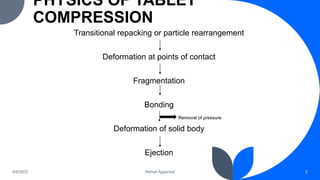
PHYSICS OF TABLET
COMPRESSION
Transitional repacking or particle rearrangement
Deformation at points of contact
Fragmentation
Bonding
Removal of pressure
Deformation of solid body
Ejection
5
Mehak Aggarwal
4/6/2022
PROCESS OF TABLET COMPRESSION
TRANSITIONAL REPACKING
When a powder is compressed initially the particles are rearranged under low
compaction pressures to form a closer packing structure.
The small particles enter the voids between the larger ones and give a closer packing
arrangement.
In this process, the energy is evolved, as a result of inter particulate friction and there
is an increase in the amount of particle surface area capable of forming inter
particulate bonds.
6
Mehak Aggarwal
4/6/2022
DEFORMATION
When the particles of granulation are so closely packed that no further filing of voids
can occur, a further increase in the compression force causes deformation at that
point of contact.
Change in shape of material occurs. At certain points the packing characteristics of
the particles reduced space or porosity of inter-particulate friction will prevent any
further rearrangement of particles.
At this point further reduction in the compact volume results in elastic or plastic
deformation.
7
Mehak Aggarwal
4/6/2022
FRAGMENTATION
As compression force increases deformed particles start fragmentation due to high
load, particles breaks into smaller fragments leading to formation of new bonding
areas.
The fragment undergo densification with infiltration of small fragments into voids.
Some particles undergo structural break down called as brittle fracture.
8
Mehak Aggarwal
4/6/2022
BONDING
After the fragmentation of the particles, as the pressure increases, formation of new
bonds between the particles at that contact area occurs. The hypothesis favoring for
increase in mechanical strength of bed of powder when subjected rising compressive
forces can be explained by following theories:
a) Liquid surface film theory
b) Intermolecular theory
c) The mechanical theory
9
Mehak Aggarwal
4/6/2022
• Liquid Surface Theory: This theory attributes bonding to the
presence of a thin liquid film which may be the consequences of
fusion or solution at the surface of the particles. This theory is a
combination of Solid bridge, Hot welding and Cold welding theory.
• Intermolecular Theory: This theory proposes that under
compressional pressure the molecules at the points of true contact
between new clean surfaces of the granules are close enough so
that Vander Waals forces interact to consolidate the particles.
• The Mechanical Theory: It occurs between irregularly shaped
particles and increase number of point of contact between the
particles. This theory proposes that under pressure the individual
particles undergo elastic or plastic deformation and edges of particle
intermesh deforming a mechanical bond.
10
Mehak Aggarwal
4/6/2022
DEFORMATION OF SOLID BODY
As the applied force /pressure is further increased, the bonded solid is consolidated
towards a limiting density by plastic/ elastic deformation of the tablet within the die.
11
Mehak Aggarwal
4/6/2022
EJECTION
The last stage in compression cycle is ejection from die.
The force necessary to eject a tablet involves the distinctive peak force required to
initiate ejection, by breaking of die wall– tablet adhesion. The second stage involves
the force required to push the tablet up the die wall, and the last force is required for
ejection.
Forces involves in the
Compression
1. Frictional forces
• Inter-particulate friction
• Die wall friction
2. Distribution force
3. Ejection Force: The force necessary to eject the finished the
tablets.
4. Radial Force.
12
Mehak Aggarwal
4/6/2022
• Frictional Forces: Interparticulate friction & Die wall Friction.
E.g. Colloidal silica E.g. Magnesium
Stearate
• Distribution Forces: Most investigational of fundamental of tableting
have been carried out on single punch presses with hydraulic
press.
• Ejection Forces: Radial die wall forces & die wall friction also
affects ejection of the compressed tablet from die. The force
necessary to eject a finished tablet is known as Ejection Force.
Variation also occurs in ejection force when lubrication is
inadequate.
• Radial Force: It is the force required by material to expand
horizontally.
13
Mehak Aggarwal
4/6/2022
Reduced by adding
glidants
Reduced by
adding lubricants
EFFECT OF FRICTION
Two major component to the frictional force.
1. Inter-particulate friction
• Occur due to particle-particle contact and more significant due at low applied load.
• These frictional effect is reduced by addition of glidants like colloidal silica or corn
starch.
2. Die wall friction.
• Die wall friction occurs from material pressed against die wall and moved it down.
• It is expressed as ‘mw’ the coefficient of die wall friction.
• This effect is reduced by the addition of lubricants. E.g. Waxes, Stearic acid, PEG.
4/6/2022 Mehak Aggarwal 14
DISTRIBUTION OF FORCES
The force distribution when compaction takes place is a single station press and is
given by-
FA=FL+FD
Where,
FA= Force applied to upper punch
FL= force transmitted to lower punch &
FD= Reaction at die wall due friction at surface.
• Mean compaction force is given by-
FM=FA+FL
2
4/6/2022 Mehak Aggarwal 15
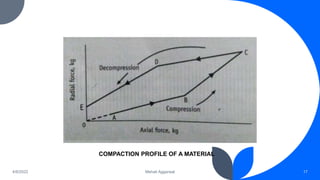
COMPACTION PROFILES
Compaction profiles are hysteresis curve that establish the
relationship between the axial pressure and radial pressure.
In compaction cycle two forces are considered:
• Axial Force:This is the vertical component applied by upper
punch during the compression.
• Radial force:This is the horizontal component observed in die
wall , when powder mass attempt to in the die wall.
4/6/2022 Mehak Aggarwal 16
4/6/2022 Mehak Aggarwal 17
COMPACTION PROFILE OF A MATERIAL
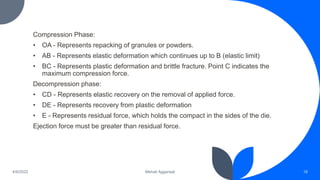
Compression Phase:
• OA - Represents repacking of granules or powders.
• AB - Represents elastic deformation which continues up to B (elastic limit)
• BC - Represents plastic deformation and brittle fracture. Point C indicates the
maximum compression force.
Decompression phase:
• CD - Represents elastic recovery on the removal of applied force.
• DE - Represents recovery from plastic deformation
• E - Represents residual force, which holds the compact in the sides of the die.
Ejection force must be greater than residual force.
4/6/2022 Mehak Aggarwal 18
• How they are measured?
It is analyzed by compaction simulators, these are attached to
punching machines which collect or measure the data from forces
on punches, displacement of punches, die wall friction, ejection
force and temperature change.
• Types of compaction profiles
1. Force-time profile
2. Force-displacement profile
3. Die wall force profile
4/6/2022 Mehak Aggarwal 19
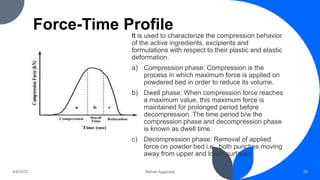
Force-Time Profile
It is used to characterize the compression behavior
of the active ingredients, excipients and
formulations with respect to their plastic and elastic
deformation.
a) Compression phase: Compression is the
process in which maximum force is applied on
powdered bed in order to reduce its volume.
b) Dwell phase: When compression force reaches
a maximum value, this maximum force is
maintained for prolonged period before
decompression. The time period b/w the
compression phase and decompression phase
is known as dwell time.
c) Decompression phase: Removal of applied
force on powder bed i.e., both punches moving
away from upper and lower surfaces.
4/6/2022 Mehak Aggarwal 20
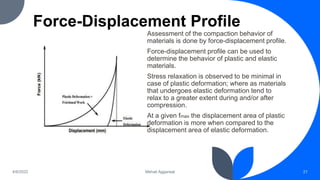
Force-Displacement Profile
Assessment of the compaction behavior of
materials is done by force-displacement profile.
Force-displacement profile can be used to
determine the behavior of plastic and elastic
materials.
Stress relaxation is observed to be minimal in
case of plastic deformation; where as materials
that undergoes elastic deformation tend to
relax to a greater extent during and/or after
compression.
At a given fmax the displacement area of plastic
deformation is more when compared to the
displacement area of elastic deformation.
4/6/2022 Mehak Aggarwal 21
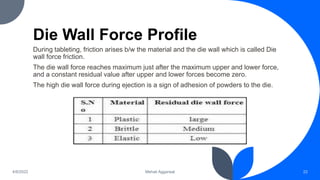
Die Wall Force Profile
During tableting, friction arises b/w the material and the die wall which is called Die
wall force friction.
The die wall force reaches maximum just after the maximum upper and lower force,
and a constant residual value after upper and lower forces become zero.
The high die wall force during ejection is a sign of adhesion of powders to the die.
4/6/2022 Mehak Aggarwal 22
Applications
• These can be used to monitor compaction cycle.
• Compaction profiles give a good assessment of the elastic
component of the powder.
• Provides information regarding the radial transmission of applied
force to the die wall.
• Helps in calculating possible ejection force and lubricant
requirements.
4/6/2022 Mehak Aggarwal 23
SOLUBILITY
• Solubility can be defined as spontaneous interactions of two or more substances
to form homogenous molecular dispersion.
Or
• Concentration of Solute in a saturated solution at constant temperature.
 Importance of Solubility:
• Therapeutic effectiveness of the drug depends on bioavailability of the drug and
hence it ultimately depends on the solubility.
• Important to achieve desired concentration of drug molecule into the systemic
circulation.
• Important in respect to the preformulation studies.
4/6/2022 Mehak Aggarwal 24
REFRENCES
• Sarsvat Patel and Arvind Bansal Compression Physics in the Formulation Development of Tablets,
Critical Reviews in Therapeutic Drug Carrier Systems, February 2006.
• Lachman, L. liberman, H. A. and kanig, Compression and Consolidation, The Theory and Practice of
industrial Pharmacy, J.L.;2009; Page No. 66- 99.
• CVS Subramanyam, Textbook of Physical pharmaceutics, Page No. 224- 227.
• Michael E. Aulton, Aulton’s Pharmaceutics The design and manufacture of medicines, Third Edition
Page No. 478,443,468-473,355-358.
• Banker GS, Anderson NR. Tablets, In: Lachman L, Liberman HA, Kanig JL, editors. The Theory and
Practice of Industrial Pharmacy, 3rd ed., Bombay, Varghese Publishing, 1976.
• Marshall K. Compression and consolidation of powdered solids, In: Lachman L, Lieberman HA, Kanig
JL, editors. The Theory and Practice of Industrial Pharmacy, 3rd ed. Bombay, Varghese Publishing,
1987.
4/6/2022 Mehak Aggarwal 25
4/6/2022 Mehak Aggarwal 26

Compression and compaction

  • 1.
  • 2.
    CONTENT • Introduction • PhysicsofTablet Compression • Process ofTablet Compression • Forces involved in compression • Effect of friction • Distribution of Forces • Compaction profiles • Solubility • References 2 Mehak Aggarwal 4/6/2022
  • 3.
    INTRODUCTION • Tablet isdefined as a compressed unit solid dosage form containing medicaments with or without excipients. • Compaction represent one of the most important unit operations in the pharmaceutical industry. • Compaction is the situation in which materials are subjected to some level of mechanical force. • The physics behind the compaction is stated as the compression and consolidation of the two phase system due to applied force. • While considering the compaction and compression of tablets we have to take the properties of powder into the consideration as they are involved in the process of the compression and compaction. • Derived properties of powder are: volume, density, porosity, flow properties, angle of repose etc. 3 Mehak Aggarwal 4/6/2022
  • 4.
    COMPRESSION Compression means reductionof bulk volume of material as a result of the removal of gaseous phase (air) by applied pressure. COMPACTION Compaction of the powder is the term is used to describe the situation in which the materials are subjected to some level of mechanical forces. CONSOLIDATION Consolidation is an increase in mechanical strength of material resulting from particle-particle interactions. Compaction =compression + consolidation of two phases (solid- gas) on application of force. 4 Mehak Aggarwal 4/6/2022
  • 5.
    PHYSICS OF TABLET COMPRESSION Transitionalrepacking or particle rearrangement Deformation at points of contact Fragmentation Bonding Removal of pressure Deformation of solid body Ejection 5 Mehak Aggarwal 4/6/2022
  • 6.
    PROCESS OF TABLETCOMPRESSION TRANSITIONAL REPACKING When a powder is compressed initially the particles are rearranged under low compaction pressures to form a closer packing structure. The small particles enter the voids between the larger ones and give a closer packing arrangement. In this process, the energy is evolved, as a result of inter particulate friction and there is an increase in the amount of particle surface area capable of forming inter particulate bonds. 6 Mehak Aggarwal 4/6/2022
  • 7.
    DEFORMATION When the particlesof granulation are so closely packed that no further filing of voids can occur, a further increase in the compression force causes deformation at that point of contact. Change in shape of material occurs. At certain points the packing characteristics of the particles reduced space or porosity of inter-particulate friction will prevent any further rearrangement of particles. At this point further reduction in the compact volume results in elastic or plastic deformation. 7 Mehak Aggarwal 4/6/2022
  • 8.
    FRAGMENTATION As compression forceincreases deformed particles start fragmentation due to high load, particles breaks into smaller fragments leading to formation of new bonding areas. The fragment undergo densification with infiltration of small fragments into voids. Some particles undergo structural break down called as brittle fracture. 8 Mehak Aggarwal 4/6/2022
  • 9.
    BONDING After the fragmentationof the particles, as the pressure increases, formation of new bonds between the particles at that contact area occurs. The hypothesis favoring for increase in mechanical strength of bed of powder when subjected rising compressive forces can be explained by following theories: a) Liquid surface film theory b) Intermolecular theory c) The mechanical theory 9 Mehak Aggarwal 4/6/2022
  • 10.
    • Liquid SurfaceTheory: This theory attributes bonding to the presence of a thin liquid film which may be the consequences of fusion or solution at the surface of the particles. This theory is a combination of Solid bridge, Hot welding and Cold welding theory. • Intermolecular Theory: This theory proposes that under compressional pressure the molecules at the points of true contact between new clean surfaces of the granules are close enough so that Vander Waals forces interact to consolidate the particles. • The Mechanical Theory: It occurs between irregularly shaped particles and increase number of point of contact between the particles. This theory proposes that under pressure the individual particles undergo elastic or plastic deformation and edges of particle intermesh deforming a mechanical bond. 10 Mehak Aggarwal 4/6/2022
  • 11.
    DEFORMATION OF SOLIDBODY As the applied force /pressure is further increased, the bonded solid is consolidated towards a limiting density by plastic/ elastic deformation of the tablet within the die. 11 Mehak Aggarwal 4/6/2022 EJECTION The last stage in compression cycle is ejection from die. The force necessary to eject a tablet involves the distinctive peak force required to initiate ejection, by breaking of die wall– tablet adhesion. The second stage involves the force required to push the tablet up the die wall, and the last force is required for ejection.
  • 12.
    Forces involves inthe Compression 1. Frictional forces • Inter-particulate friction • Die wall friction 2. Distribution force 3. Ejection Force: The force necessary to eject the finished the tablets. 4. Radial Force. 12 Mehak Aggarwal 4/6/2022
  • 13.
    • Frictional Forces:Interparticulate friction & Die wall Friction. E.g. Colloidal silica E.g. Magnesium Stearate • Distribution Forces: Most investigational of fundamental of tableting have been carried out on single punch presses with hydraulic press. • Ejection Forces: Radial die wall forces & die wall friction also affects ejection of the compressed tablet from die. The force necessary to eject a finished tablet is known as Ejection Force. Variation also occurs in ejection force when lubrication is inadequate. • Radial Force: It is the force required by material to expand horizontally. 13 Mehak Aggarwal 4/6/2022 Reduced by adding glidants Reduced by adding lubricants
  • 14.
    EFFECT OF FRICTION Twomajor component to the frictional force. 1. Inter-particulate friction • Occur due to particle-particle contact and more significant due at low applied load. • These frictional effect is reduced by addition of glidants like colloidal silica or corn starch. 2. Die wall friction. • Die wall friction occurs from material pressed against die wall and moved it down. • It is expressed as ‘mw’ the coefficient of die wall friction. • This effect is reduced by the addition of lubricants. E.g. Waxes, Stearic acid, PEG. 4/6/2022 Mehak Aggarwal 14
  • 15.
    DISTRIBUTION OF FORCES Theforce distribution when compaction takes place is a single station press and is given by- FA=FL+FD Where, FA= Force applied to upper punch FL= force transmitted to lower punch & FD= Reaction at die wall due friction at surface. • Mean compaction force is given by- FM=FA+FL 2 4/6/2022 Mehak Aggarwal 15
  • 16.
    COMPACTION PROFILES Compaction profilesare hysteresis curve that establish the relationship between the axial pressure and radial pressure. In compaction cycle two forces are considered: • Axial Force:This is the vertical component applied by upper punch during the compression. • Radial force:This is the horizontal component observed in die wall , when powder mass attempt to in the die wall. 4/6/2022 Mehak Aggarwal 16
  • 17.
    4/6/2022 Mehak Aggarwal17 COMPACTION PROFILE OF A MATERIAL
  • 18.
    Compression Phase: • OA- Represents repacking of granules or powders. • AB - Represents elastic deformation which continues up to B (elastic limit) • BC - Represents plastic deformation and brittle fracture. Point C indicates the maximum compression force. Decompression phase: • CD - Represents elastic recovery on the removal of applied force. • DE - Represents recovery from plastic deformation • E - Represents residual force, which holds the compact in the sides of the die. Ejection force must be greater than residual force. 4/6/2022 Mehak Aggarwal 18
  • 19.
    • How theyare measured? It is analyzed by compaction simulators, these are attached to punching machines which collect or measure the data from forces on punches, displacement of punches, die wall friction, ejection force and temperature change. • Types of compaction profiles 1. Force-time profile 2. Force-displacement profile 3. Die wall force profile 4/6/2022 Mehak Aggarwal 19
  • 20.
    Force-Time Profile It isused to characterize the compression behavior of the active ingredients, excipients and formulations with respect to their plastic and elastic deformation. a) Compression phase: Compression is the process in which maximum force is applied on powdered bed in order to reduce its volume. b) Dwell phase: When compression force reaches a maximum value, this maximum force is maintained for prolonged period before decompression. The time period b/w the compression phase and decompression phase is known as dwell time. c) Decompression phase: Removal of applied force on powder bed i.e., both punches moving away from upper and lower surfaces. 4/6/2022 Mehak Aggarwal 20
  • 21.
    Force-Displacement Profile Assessment ofthe compaction behavior of materials is done by force-displacement profile. Force-displacement profile can be used to determine the behavior of plastic and elastic materials. Stress relaxation is observed to be minimal in case of plastic deformation; where as materials that undergoes elastic deformation tend to relax to a greater extent during and/or after compression. At a given fmax the displacement area of plastic deformation is more when compared to the displacement area of elastic deformation. 4/6/2022 Mehak Aggarwal 21
  • 22.
    Die Wall ForceProfile During tableting, friction arises b/w the material and the die wall which is called Die wall force friction. The die wall force reaches maximum just after the maximum upper and lower force, and a constant residual value after upper and lower forces become zero. The high die wall force during ejection is a sign of adhesion of powders to the die. 4/6/2022 Mehak Aggarwal 22
  • 23.
    Applications • These canbe used to monitor compaction cycle. • Compaction profiles give a good assessment of the elastic component of the powder. • Provides information regarding the radial transmission of applied force to the die wall. • Helps in calculating possible ejection force and lubricant requirements. 4/6/2022 Mehak Aggarwal 23
  • 24.
    SOLUBILITY • Solubility canbe defined as spontaneous interactions of two or more substances to form homogenous molecular dispersion. Or • Concentration of Solute in a saturated solution at constant temperature.  Importance of Solubility: • Therapeutic effectiveness of the drug depends on bioavailability of the drug and hence it ultimately depends on the solubility. • Important to achieve desired concentration of drug molecule into the systemic circulation. • Important in respect to the preformulation studies. 4/6/2022 Mehak Aggarwal 24
  • 25.
    REFRENCES • Sarsvat Pateland Arvind Bansal Compression Physics in the Formulation Development of Tablets, Critical Reviews in Therapeutic Drug Carrier Systems, February 2006. • Lachman, L. liberman, H. A. and kanig, Compression and Consolidation, The Theory and Practice of industrial Pharmacy, J.L.;2009; Page No. 66- 99. • CVS Subramanyam, Textbook of Physical pharmaceutics, Page No. 224- 227. • Michael E. Aulton, Aulton’s Pharmaceutics The design and manufacture of medicines, Third Edition Page No. 478,443,468-473,355-358. • Banker GS, Anderson NR. Tablets, In: Lachman L, Liberman HA, Kanig JL, editors. The Theory and Practice of Industrial Pharmacy, 3rd ed., Bombay, Varghese Publishing, 1976. • Marshall K. Compression and consolidation of powdered solids, In: Lachman L, Lieberman HA, Kanig JL, editors. The Theory and Practice of Industrial Pharmacy, 3rd ed. Bombay, Varghese Publishing, 1987. 4/6/2022 Mehak Aggarwal 25
  • 26.