Recent Advancement
Recombinant DNA Technology
Introduction:
• Recombinant DNA technology involves change of genetic material to enhance the
desired characteristics of organism or their products.
• In recombinant technology DNA fragments are inserted from different sources
having desired gene or gene of interest with in a suitable vector.
• The first recombinant DNA molecule was created by Paul Berg et.al of Stanford
University and University of California in 1973.
• Recombinant technology is an emerging field and has its application in various
fields like Health agriculture and Environment.
• For example Recombinant Insulin is much effective than human insulin Lispro
(Humalog).
• Another example is Epoetin Alfa is an efficient recombinant protein
being used for treatment of anemia. Recombinant cytokine myeloid
progenitor inhibitory factor 1(MPIF-1) was a great achievement for
this technology.
• By the help of this technology side effects of anti-cancer drug can be
reduced because it has the ability to duplicate the division of
immunologically important cells.
CRISPR-CAS:
• Another recent advancement of Recombinant DNA technology CRISPR(Clustered
Regularly Interspaced Short Palindromic Repeats). This may be used as targeted
destruction of genes in Human cells.
• Besides this activation, suppression, addition and deletion of genes in Human’s
cells, mice, Zebrafish, bacteria, fruit flies etc. makes this field more efficient.
• Mouse as models can be used for study of human disease with CRISPR system.
The CRISPR of H.hispanica genome has ability to be efficiently adapted to the
nonlytic viruses.
• Associated CAS operon encodes for CAS3 nuclease and other CAS proteins. In
genetic engineering process strains are required with primer CRISPR for priming
CrRNAs production and newly formed products acceptance. Cleavage and
recognition of foreign DNA/RNA is a controlled process. Information of genetic
material is stored in the host genome with the help of photo spacer incorporation
into the CRISPR system.
• Cas9t is a gene editing tool that shows DNA endonucleases which use
RNA molecules to recognize specific target.
• Class 2 of CRISPR CAS with single protein effectors may be used as
genome editing tool. Moreover targeting of gene that are involved in
gene knock out isolation process is done by CRISPR induced
mutations. Due to its stability and enhanced immunity CRISPR CAS is
tremendously becoming popular in biological systems.
• Several other animals are being selected as a source for production of
recombinant insulin. Because recombinant insulin is similar to human
porcine insulin as described earlier so, this is cheap and easy method
and is medically suitable method.
• In tobacco first human growth hormone was expressed.
• By use of microbial strains many other drugs are also produced.
Efforts have been done to modify influenza virus by recombinant
technology for vaccines production.
GMOs and rDNA technology
GMO
Those organism whose DNA is altered by using molecular
biology technique.
rDNA Technology
DNA from two different sources are joined and a Chimeric DNA is
produced
History
 1860s Mendel cross different variety of Pea.
 1868 Friedrich Meisheher discovered the DNA
 1944 Oswald DNA as carrier of genetic information
 In 1953 Watson and Crick discovered the DNA double helix
Continue
• 1972 Stanley and Herbert introduce DNA splicing techniques.
• 1976 Stanley and Herbert production of insulin.
Recent advancement
• Fungal disease resistance
• Fertility restoration
• Non –browning phenotype
• Delayed fruit ripening
• Antibiotic resistance
• Nicotine reduction
Complications
• Gene stalking
• manipulation or expression of multiple gene
Transgenic plant example
• Cotton
• Eggplant
• Eucalyptus
• Maize
• Melon
• Papaya
Gene Therapy
A technique in which to treat genetic diseases a new DNA is
inserted into an organism is called gene therapy.
muscular dystrophy,Hemophilia, Cancer, and cystic fibrosis.
Two different types
• Somatic gene therapy
• Germline gene therapy
somatic gene therapy
When fragments of DNA is transferred to cells of body which can’t
produce sperm or eggs. effects are short lived .
• Invivo
• Exvivo
Germline gene therapy
When fragment of DNA are inserted into the cell which can produce
sperm or egg Effect of this type of gene therapy can be passed into
children or next generation
Gene therapy using vector
A gene that is inserted directly into a cell usually does not
function therefore we use a vector to deliver the gene.
• Retroviruses
• adenoviruses
Uses of gene therapy
defective gene
Vaccination
replace a cancer cell with a normal cell.
Challenges of gene therapy
The gene should be delivered on right place.
avoiding the immune response
 costly
new inserted gene does not disturb the function of other gene
• The products of recombinant DNA
technology range from proteins to
engineered organisms. Large amounts of
commercially useful proteins can be
produced by these techniques.
• Some products of this technology have
been approved for medicinal use and many
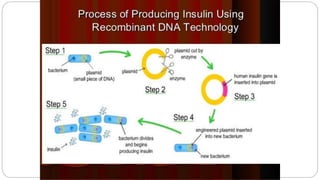
are in development .the first commercial
product of r-DNA technique was human
insulin, produced by Eli-Lilly &company
and approved for human use by U.S. Food
& drug Administration in 1982.
Human insulin
 Insulin is a poly peptide hormone that
regulates the glucose level in the blood of
vertebrates.
 key drug for treating diabetes mellitus.
 In 1985, insulin was prepared by
extraction from pancreatic glands of
slaughtered animals.
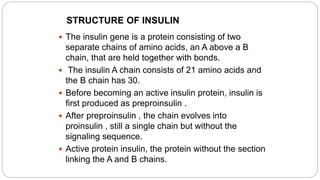
STRUCTURE OF INSULIN
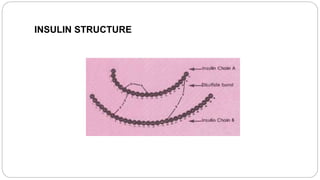
 The insulin gene is a protein consisting of two
separate chains of amino acids, an A above a B
chain, that are held together with bonds.
 The insulin A chain consists of 21 amino acids and
the B chain has 30.
 Before becoming an active insulin protein, insulin is
first produced as preproinsulin .
 After preproinsulin , the chain evolves into
proinsulin , still a single chain but without the
signaling sequence.
 Active protein insulin, the protein without the section
linking the A and B chains.
INSULIN STRUCTURE
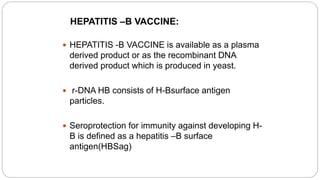
HEPATITIS –B VACCINE:
 HEPATITIS -B VACCINE is available as a plasma
derived product or as the recombinant DNA
derived product which is produced in yeast.
 r-DNA HB consists of H-Bsurface antigen
particles.
 Seroprotection for immunity against developing H-
B is defined as a hepatitis –B surface
antigen(HBSag)
PRODUCTION
 The vaccine contains one of the viral envelope proteins, hepatitis B
surface antigen .
 Produced by yeast cells, into which the genetic code for HBsAg has
been inserted.
 Afterward an immune system antibody to HBsAg is established in
the bloodstream. The antibody is known as anti-HBs. This antibody
and immune system memory then provide immunity to HBV
infection.[
INTERLEUKINS:
 IL are proteins formed by various cell types of
immune system. They are also called
HORMONES OF IMMUNE SYSTEM.
 They modulate the activity of other cells in the
immune system by binding with specific
receptors. In humans more than 20 types of IL
have been discovered
INTERFERON:
 IFN are a family of naturally occurring proteins that are produced by
immune system.
 Three classes of interferons have been identified: alfa ,beta and
gamma.
 Each class has different effects through their activities overlap.
Together the interferons directs the immunesystem‟s attack on
viruses,bacteria, tumors and other foreign substances ,they alter it
by slowing ,blocking, or changingits growth or function.
• 1798 Edward Jenner used cowpox virus to immunize
people against smallpox.
• Almost 200 years later, the comprehensive smallpox vaccination
program established by the World Health Organization.
• Vaccines weak virus used that have no ability of
producing disease.
• We weakened the virus by using Recombinant DNA technology.
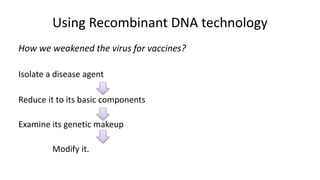
Using Recombinant DNA technology
How we weakened the virus for vaccines?
Isolate a disease agent
Reduce it to its basic components
Examine its genetic makeup
Modify it.
Types of Vaccines
1) Live Genetically Modified Vaccines
2) Recombinant Inactivated Vaccines
3) Genetic Vaccines
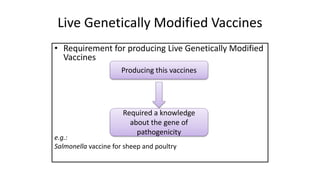
Live Genetically Modified Vaccines
• The first type of vaccine
• It can be viruses or bacteria with one or more genes deleted or
inactivated.
• We delete the pathogenic gene.
• Generally two (double-knockout) or more genes are deleted or
inactivated so this vaccine is stable and no revert to the pathogenic
agent.
Live Genetically Modified Vaccines
• Requirement for producing Live Genetically Modified
Vaccines
e.g.:
Salmonella vaccine for sheep and poultry
Producing this vaccines
Required a knowledge
about the gene of
pathogenicity
Recombinant Inactivated Vaccines
• Second type of vaccines.
• Also called subunit vaccines.
• Containing only part of the whole organism.
• Subunit vaccines can be synthetic peptides.
• Synthesized in the laboratory.
• Represent the most basic portion of a protein that induces an immune
response.
Recombinant Inactivated Vaccines
• Two methods for this production.
• First method is to isolate a protein from virus.
• But this method is not efficient
• Because sometimes proteins is denatured.
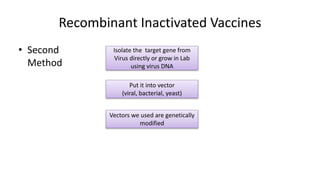
Recombinant Inactivated Vaccines
• Second
Method
Isolate the target gene from
Virus directly or grow in Lab
using virus DNA
Put it into vector
(viral, bacterial, yeast)
Vectors we used are genetically
modified
Recombinant Inactivated Vaccines
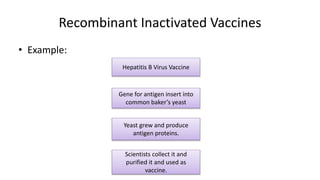
• Example:
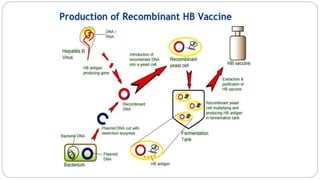
Hepatitis B Virus Vaccine
Gene for antigen insert into
common baker’s yeast
Yeast grew and produce
antigen proteins.
Scientists collect it and
purified it and used as
vaccine.
Genetic Vaccine
• New type of vaccine.
• In this, DNA or gene used alone.
• This vaccine is circular piece of DNA called plasmid that carry foreign
gene from disease agent and promoter.
• We used promoter to initiate the expression of gene.
Genetic Vaccine
• Example:
• This vaccine available for Veterinary
• Not for human
• In recombinant pharmaceutical, most microbial cells are used
in the production that create hurdles which restrict them from
producing efficient functional proteins but are handled with
alterations in cellular system.
• Some hurdles must be deal with posttranslational
modifications, cell stress response activation, low solubility and
resistance in expressing new genes.
• Some hurdles must be deal with posttranslational modifications,
cell stress response activation, low solubility and resistance in
expressing new genes.
• Changes which occur at genetic level cause protein production
deficiencies in human. This deficiency in human can also be treated
by the incorporated external genes, which fill the gaps and reach
the normal level.
• For example Escherichia coli has been used as biological framework
to produce the required molecules through affordable processes.
• Recombinant DNA technology show great impact on the
understanding of yeast biology which makes the manipulation and
the analysis of the yeast genes in yeast cells. This can also be used
in the test tubes as well.
• By using selectable marker cloning of genes and DNA
transformation by yeast has been become possible.
• The recent advancements in the field of recombinant DNA
technology has caused efficient changes and directions and
developed interesting biosynthetic pathways through genetic
manipulation.
• For example Actinomycetes are used in the pharmaceutical
production.
• Some useful compounds are being produced and manipulated
through biosynthetic pathways in health sciences which cause
the generation of novel drugs.
• Recombinant DNA tech can also be used against genetic disorders
as a gene therapy to cure.
• The production of DNA vaccines has produced the immunity
against several diseases. This process contains DNA which has
genes for the pathogenic proteins. For example, human gene
therapy is being used for the cancer treatment.
• Cancer gene therapies are being in research with low toxicity for
brain cancer, breast cancer, lungs cancer, and prostate cancer.
• And also renal transplantation, Gaucherie disease, haemophilia,
alphorn syndrome, renal fibrosis and some other diseases are
under considerations in gene therapy.

Recent advancement recombinant dna technology

  • 1.
  • 2.
    Introduction: • Recombinant DNAtechnology involves change of genetic material to enhance the desired characteristics of organism or their products. • In recombinant technology DNA fragments are inserted from different sources having desired gene or gene of interest with in a suitable vector. • The first recombinant DNA molecule was created by Paul Berg et.al of Stanford University and University of California in 1973. • Recombinant technology is an emerging field and has its application in various fields like Health agriculture and Environment. • For example Recombinant Insulin is much effective than human insulin Lispro (Humalog).
  • 3.
    • Another exampleis Epoetin Alfa is an efficient recombinant protein being used for treatment of anemia. Recombinant cytokine myeloid progenitor inhibitory factor 1(MPIF-1) was a great achievement for this technology. • By the help of this technology side effects of anti-cancer drug can be reduced because it has the ability to duplicate the division of immunologically important cells.
  • 4.
    CRISPR-CAS: • Another recentadvancement of Recombinant DNA technology CRISPR(Clustered Regularly Interspaced Short Palindromic Repeats). This may be used as targeted destruction of genes in Human cells. • Besides this activation, suppression, addition and deletion of genes in Human’s cells, mice, Zebrafish, bacteria, fruit flies etc. makes this field more efficient. • Mouse as models can be used for study of human disease with CRISPR system. The CRISPR of H.hispanica genome has ability to be efficiently adapted to the nonlytic viruses. • Associated CAS operon encodes for CAS3 nuclease and other CAS proteins. In genetic engineering process strains are required with primer CRISPR for priming CrRNAs production and newly formed products acceptance. Cleavage and recognition of foreign DNA/RNA is a controlled process. Information of genetic material is stored in the host genome with the help of photo spacer incorporation into the CRISPR system.
  • 5.
    • Cas9t isa gene editing tool that shows DNA endonucleases which use RNA molecules to recognize specific target. • Class 2 of CRISPR CAS with single protein effectors may be used as genome editing tool. Moreover targeting of gene that are involved in gene knock out isolation process is done by CRISPR induced mutations. Due to its stability and enhanced immunity CRISPR CAS is tremendously becoming popular in biological systems.
  • 6.
    • Several otheranimals are being selected as a source for production of recombinant insulin. Because recombinant insulin is similar to human porcine insulin as described earlier so, this is cheap and easy method and is medically suitable method. • In tobacco first human growth hormone was expressed. • By use of microbial strains many other drugs are also produced. Efforts have been done to modify influenza virus by recombinant technology for vaccines production.
  • 7.
    GMOs and rDNAtechnology GMO Those organism whose DNA is altered by using molecular biology technique. rDNA Technology DNA from two different sources are joined and a Chimeric DNA is produced
  • 8.
    History  1860s Mendelcross different variety of Pea.  1868 Friedrich Meisheher discovered the DNA  1944 Oswald DNA as carrier of genetic information  In 1953 Watson and Crick discovered the DNA double helix
  • 9.
    Continue • 1972 Stanleyand Herbert introduce DNA splicing techniques. • 1976 Stanley and Herbert production of insulin.
  • 10.
    Recent advancement • Fungaldisease resistance • Fertility restoration • Non –browning phenotype • Delayed fruit ripening • Antibiotic resistance • Nicotine reduction
  • 11.
    Complications • Gene stalking •manipulation or expression of multiple gene
  • 12.
    Transgenic plant example •Cotton • Eggplant • Eucalyptus • Maize • Melon • Papaya
  • 13.
    Gene Therapy A techniquein which to treat genetic diseases a new DNA is inserted into an organism is called gene therapy. muscular dystrophy,Hemophilia, Cancer, and cystic fibrosis. Two different types • Somatic gene therapy • Germline gene therapy
  • 14.
    somatic gene therapy Whenfragments of DNA is transferred to cells of body which can’t produce sperm or eggs. effects are short lived . • Invivo • Exvivo
  • 15.
    Germline gene therapy Whenfragment of DNA are inserted into the cell which can produce sperm or egg Effect of this type of gene therapy can be passed into children or next generation
  • 16.
    Gene therapy usingvector A gene that is inserted directly into a cell usually does not function therefore we use a vector to deliver the gene. • Retroviruses • adenoviruses
  • 17.
    Uses of genetherapy defective gene Vaccination replace a cancer cell with a normal cell.
  • 18.
    Challenges of genetherapy The gene should be delivered on right place. avoiding the immune response  costly new inserted gene does not disturb the function of other gene
  • 19.
    • The productsof recombinant DNA technology range from proteins to engineered organisms. Large amounts of commercially useful proteins can be produced by these techniques. • Some products of this technology have been approved for medicinal use and many are in development .the first commercial product of r-DNA technique was human insulin, produced by Eli-Lilly &company and approved for human use by U.S. Food & drug Administration in 1982.
  • 20.
    Human insulin  Insulinis a poly peptide hormone that regulates the glucose level in the blood of vertebrates.  key drug for treating diabetes mellitus.  In 1985, insulin was prepared by extraction from pancreatic glands of slaughtered animals.
  • 21.
    STRUCTURE OF INSULIN The insulin gene is a protein consisting of two separate chains of amino acids, an A above a B chain, that are held together with bonds.  The insulin A chain consists of 21 amino acids and the B chain has 30.  Before becoming an active insulin protein, insulin is first produced as preproinsulin .  After preproinsulin , the chain evolves into proinsulin , still a single chain but without the signaling sequence.  Active protein insulin, the protein without the section linking the A and B chains.
  • 22.
  • 24.
    HEPATITIS –B VACCINE: HEPATITIS -B VACCINE is available as a plasma derived product or as the recombinant DNA derived product which is produced in yeast.  r-DNA HB consists of H-Bsurface antigen particles.  Seroprotection for immunity against developing H- B is defined as a hepatitis –B surface antigen(HBSag)
  • 25.
    PRODUCTION  The vaccinecontains one of the viral envelope proteins, hepatitis B surface antigen .  Produced by yeast cells, into which the genetic code for HBsAg has been inserted.  Afterward an immune system antibody to HBsAg is established in the bloodstream. The antibody is known as anti-HBs. This antibody and immune system memory then provide immunity to HBV infection.[
  • 27.
    INTERLEUKINS:  IL areproteins formed by various cell types of immune system. They are also called HORMONES OF IMMUNE SYSTEM.  They modulate the activity of other cells in the immune system by binding with specific receptors. In humans more than 20 types of IL have been discovered
  • 28.
    INTERFERON:  IFN area family of naturally occurring proteins that are produced by immune system.  Three classes of interferons have been identified: alfa ,beta and gamma.  Each class has different effects through their activities overlap. Together the interferons directs the immunesystem‟s attack on viruses,bacteria, tumors and other foreign substances ,they alter it by slowing ,blocking, or changingits growth or function.
  • 29.
    • 1798 EdwardJenner used cowpox virus to immunize people against smallpox. • Almost 200 years later, the comprehensive smallpox vaccination program established by the World Health Organization.
  • 30.
    • Vaccines weakvirus used that have no ability of producing disease. • We weakened the virus by using Recombinant DNA technology.
  • 31.
    Using Recombinant DNAtechnology How we weakened the virus for vaccines? Isolate a disease agent Reduce it to its basic components Examine its genetic makeup Modify it.
  • 32.
    Types of Vaccines 1)Live Genetically Modified Vaccines 2) Recombinant Inactivated Vaccines 3) Genetic Vaccines
  • 33.
    Live Genetically ModifiedVaccines • The first type of vaccine • It can be viruses or bacteria with one or more genes deleted or inactivated. • We delete the pathogenic gene. • Generally two (double-knockout) or more genes are deleted or inactivated so this vaccine is stable and no revert to the pathogenic agent.
  • 34.
    Live Genetically ModifiedVaccines • Requirement for producing Live Genetically Modified Vaccines e.g.: Salmonella vaccine for sheep and poultry Producing this vaccines Required a knowledge about the gene of pathogenicity
  • 35.
    Recombinant Inactivated Vaccines •Second type of vaccines. • Also called subunit vaccines. • Containing only part of the whole organism. • Subunit vaccines can be synthetic peptides. • Synthesized in the laboratory. • Represent the most basic portion of a protein that induces an immune response.
  • 36.
    Recombinant Inactivated Vaccines •Two methods for this production. • First method is to isolate a protein from virus. • But this method is not efficient • Because sometimes proteins is denatured.
  • 37.
    Recombinant Inactivated Vaccines •Second Method Isolate the target gene from Virus directly or grow in Lab using virus DNA Put it into vector (viral, bacterial, yeast) Vectors we used are genetically modified
  • 38.
    Recombinant Inactivated Vaccines •Example: Hepatitis B Virus Vaccine Gene for antigen insert into common baker’s yeast Yeast grew and produce antigen proteins. Scientists collect it and purified it and used as vaccine.
  • 39.
    Genetic Vaccine • Newtype of vaccine. • In this, DNA or gene used alone. • This vaccine is circular piece of DNA called plasmid that carry foreign gene from disease agent and promoter. • We used promoter to initiate the expression of gene.
  • 40.
    Genetic Vaccine • Example: •This vaccine available for Veterinary • Not for human
  • 41.
    • In recombinantpharmaceutical, most microbial cells are used in the production that create hurdles which restrict them from producing efficient functional proteins but are handled with alterations in cellular system. • Some hurdles must be deal with posttranslational modifications, cell stress response activation, low solubility and resistance in expressing new genes.
  • 42.
    • Some hurdlesmust be deal with posttranslational modifications, cell stress response activation, low solubility and resistance in expressing new genes. • Changes which occur at genetic level cause protein production deficiencies in human. This deficiency in human can also be treated by the incorporated external genes, which fill the gaps and reach the normal level. • For example Escherichia coli has been used as biological framework to produce the required molecules through affordable processes.
  • 43.
    • Recombinant DNAtechnology show great impact on the understanding of yeast biology which makes the manipulation and the analysis of the yeast genes in yeast cells. This can also be used in the test tubes as well. • By using selectable marker cloning of genes and DNA transformation by yeast has been become possible. • The recent advancements in the field of recombinant DNA technology has caused efficient changes and directions and developed interesting biosynthetic pathways through genetic manipulation.
  • 44.
    • For exampleActinomycetes are used in the pharmaceutical production. • Some useful compounds are being produced and manipulated through biosynthetic pathways in health sciences which cause the generation of novel drugs.
  • 45.
    • Recombinant DNAtech can also be used against genetic disorders as a gene therapy to cure. • The production of DNA vaccines has produced the immunity against several diseases. This process contains DNA which has genes for the pathogenic proteins. For example, human gene therapy is being used for the cancer treatment. • Cancer gene therapies are being in research with low toxicity for brain cancer, breast cancer, lungs cancer, and prostate cancer. • And also renal transplantation, Gaucherie disease, haemophilia, alphorn syndrome, renal fibrosis and some other diseases are under considerations in gene therapy.