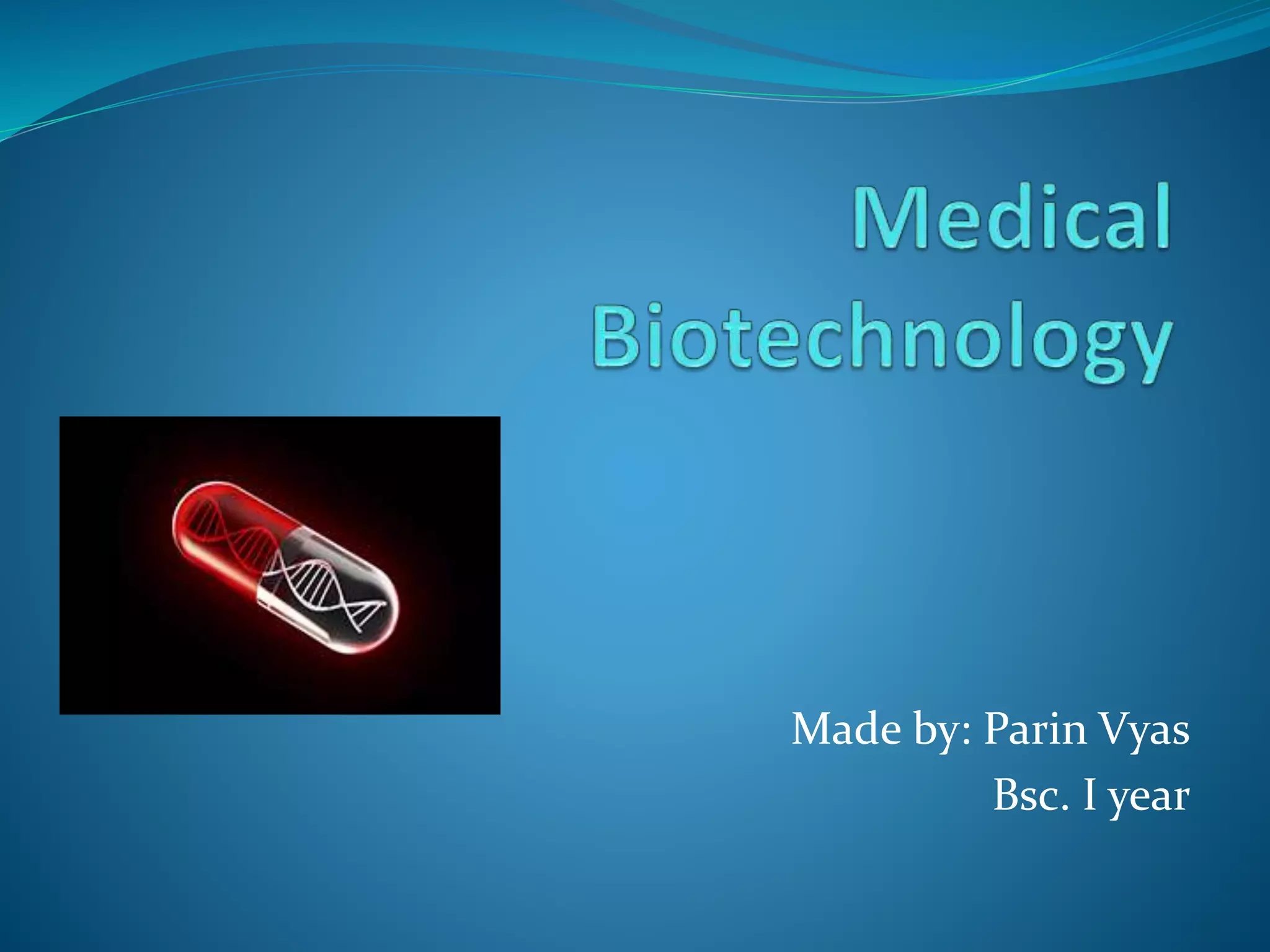
Made by: Parin Vyas
Bsc. I year
Introduction
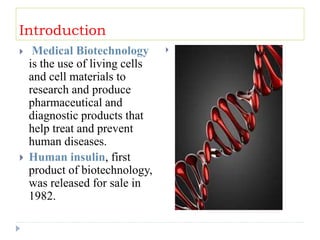
 Medical Biotechnology
is the use of living cells
and cell materials to
research and produce
pharmaceutical and
diagnostic products that
help treat and prevent
human diseases.
 Human insulin, first
product of biotechnology,
was released for sale in
1982.

Continue…
 Medicine is by means
of biotechnology
techniques so much
in diagnosing and
treating dissimilar
diseases.
 In medicine, modern
biotechnology finds
applications in areas
such as
pharmaceutical drug
discovery and
production,
pharmacogenomics,
and genetic testing.
Red biotechnology
 Or MEDICAL BIOTECHNOLOGY is
biotechnology applied to manufacture
pharmaceuticals like enzymes, antibiotics and
vaccines, and its use for molecular diagnostic.
 Genome research and proteome research are
among the most important plateform
technologies of biotechnology.
Applications of medical biotechnology
1. PHARMACOLOGY
2. GENE THERAPY
3. STEM CELLS
4. TISSUE ENGINEERING
1. Pharmacology
 Pharmacology is the branch of medicine and biology
concerned with the study of drug action, where a drug
can be broadly defined as any man-made, natural or
endogenous molecule which exerts a biochemical and
physiological effect on the cell, tissue, organ, or
organism .
 Study of the interaction that occur between a living
organism and chemical that affect normal or abnormal
biochemical function.
(a)Insulin production
 Production of genetically engineered human insulin
was one of the first breakthroughs of biotechnology
in the pharmaceutical industry.
 Insulin was first produced in Escherichia coli
through recombinant DNA technology in 1978..
 PROCESS:- The human gene for insulin is placed
into bacteria, are cultured and allowed to
produce insulin which is collected, purified and
sold to diabetics worldwide.
(b)Human growth hormone
 Production of human growth hormone was first done in 1979
using recombinant DNA technology.
 scientists produced human growth hormone by inserting DNA
coding for human growth hormone into a plasmid that was
implanted in Escherichia coli bacteria.
 This gene that was inserted into the plasmid was created by
reverse transcription of the mRNA found in pituitary glands
to complementary DNA.
 Prior to this development, human growth hormone was
extracted from the pituitary glands of cadavers, as animal
growth hormones have no therapeutic value in humans.
(c)Human Blood Clotting Factor
 Production of human clotting factors was enhanced
through recombinant DNA technology.
 Human clotting factor ix was the first to be produced
through recombinant DNA technology using
transgenic Chinese hamster ovary cells in 1986.
 Plasmids containing the factor IX gene, along with
plasmids with a gene that codes for resistance to
methotrexate, were inserted into Chinese hamster
ovary cells via transfection.
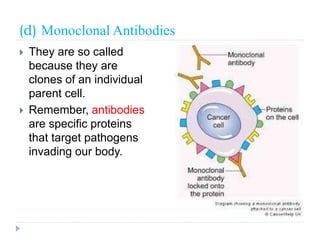
(d) Monoclonal Antibodies
 They are so called
because they are
clones of an individual
parent cell.
 Remember, antibodies
are specific proteins
that target pathogens
invading our body.
Advantages
 This technology is used primarily to fight off
cancer cells as these monoclonal antibodies can
be “trained” to target markers that show up on
cancer cells.
 The mAbs will then destroy the cancer cell and
go looking for more.
2.GENE THERAPY
 Gene therapy is the use of DNA as a pharmaceutical
agent to treat disease.
 It derives its name from the idea that DNA can be used to
supplement or alter genes within an individual cells as a
therapy to treat disease
 The most common form of gene therapy involves using
DNA that encodes a functional, therapeutic gene to
replace a mutated gene.
 Gene therapy is of two types , somatic gene therapy and
germ line gene therapy.
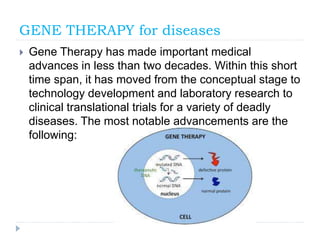
GENE THERAPY for diseases
 Gene Therapy has made important medical
advances in less than two decades. Within this short
time span, it has moved from the conceptual stage to
technology development and laboratory research to
clinical translational trials for a variety of deadly
diseases. The most notable advancements are the
following:
CHRONIC GRANULOMATUS DISORDER
(CGD)
CGD is a genetic disease in the immune system
that leads to the patients' inability to fight off
bacterial and fungal infections that can be fatal.
 Multiple gene therapy strategies have been
developed to treat a wide variety of acquired
diseases like
Cancer, Parkinson's Disease, Huntington's
Disease, Influenza, HIV, Hepatitis.
3.STEM CELLS
 Stem cells are mother cells that have the potential to
become any type of cells in the body.
 Stem cells can become cells of the blood, heart, bones,
skin, muscle, brain, etc.
 Stem cells can repair and replace tissue in human body.
 Eg. Tissue in our skin needs constant renewal that could
not take place without stem cells.
 The easiest place to get stem cells is from an embryo.
Continue……
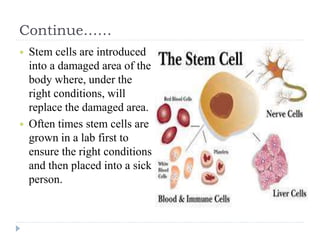
 Stem cells are introduced
into a damaged area of the
body where, under the
right conditions, will
replace the damaged area.
 Often times stem cells are
grown in a lab first to
ensure the right conditions
and then placed into a sick
person.
4.TISSUE ENGINEERING
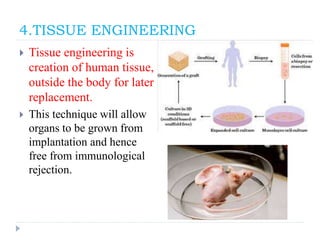
 Tissue engineering is
creation of human tissue,
outside the body for later
replacement.
 This technique will allow
organs to be grown from
implantation and hence
free from immunological
rejection.
4.TISSUE ENGINEERING
 Tissue engineers have created artificial skin,
cartilage and bone marrow.
 Current projects being undertaken include
creating an artificial liver, pancreas and
bladder.
 Again, we are far from replacing a whole
organ, but just looking for “refurbishing” our
slightly used ones at the moment.
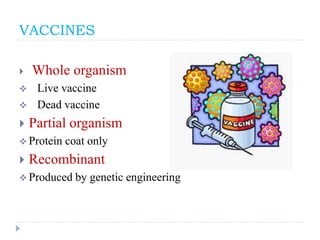
VACCINES
 Whole organism
 Live vaccine
 Dead vaccine
 Partial organism
 Protein coat only
 Recombinant
 Produced by genetic engineering
XENO-TRANSPLANTATION
 Xeno-transplantation is the use of live cells,
tissue or organs from non-human animal
species, for transplantation into a human
patient.
 Interest has grown in this area of
biotechnology because up to 50% of people
waiting to receive vital organ transplants, such
as kidney, liver and heart, die while waiting for
a donor organ.
DISADVANTAGES
a)Potential health risks
1) Allergies
2) Toxicity
3) Nutrients imbalance
4) Decrease of food diversity
b)Enviornment effects
c)Cost
THE END

Medical biotechnology

  • 1.
    Made by: ParinVyas Bsc. I year
  • 2.
    Introduction  Medical Biotechnology isthe use of living cells and cell materials to research and produce pharmaceutical and diagnostic products that help treat and prevent human diseases.  Human insulin, first product of biotechnology, was released for sale in 1982. 
  • 3.
    Continue…  Medicine isby means of biotechnology techniques so much in diagnosing and treating dissimilar diseases.  In medicine, modern biotechnology finds applications in areas such as pharmaceutical drug discovery and production, pharmacogenomics, and genetic testing.
  • 4.
    Red biotechnology  OrMEDICAL BIOTECHNOLOGY is biotechnology applied to manufacture pharmaceuticals like enzymes, antibiotics and vaccines, and its use for molecular diagnostic.  Genome research and proteome research are among the most important plateform technologies of biotechnology.
  • 5.
    Applications of medicalbiotechnology 1. PHARMACOLOGY 2. GENE THERAPY 3. STEM CELLS 4. TISSUE ENGINEERING
  • 6.
    1. Pharmacology  Pharmacologyis the branch of medicine and biology concerned with the study of drug action, where a drug can be broadly defined as any man-made, natural or endogenous molecule which exerts a biochemical and physiological effect on the cell, tissue, organ, or organism .  Study of the interaction that occur between a living organism and chemical that affect normal or abnormal biochemical function.
  • 7.
    (a)Insulin production  Productionof genetically engineered human insulin was one of the first breakthroughs of biotechnology in the pharmaceutical industry.  Insulin was first produced in Escherichia coli through recombinant DNA technology in 1978..  PROCESS:- The human gene for insulin is placed into bacteria, are cultured and allowed to produce insulin which is collected, purified and sold to diabetics worldwide.
  • 8.
    (b)Human growth hormone Production of human growth hormone was first done in 1979 using recombinant DNA technology.  scientists produced human growth hormone by inserting DNA coding for human growth hormone into a plasmid that was implanted in Escherichia coli bacteria.  This gene that was inserted into the plasmid was created by reverse transcription of the mRNA found in pituitary glands to complementary DNA.  Prior to this development, human growth hormone was extracted from the pituitary glands of cadavers, as animal growth hormones have no therapeutic value in humans.
  • 9.
    (c)Human Blood ClottingFactor  Production of human clotting factors was enhanced through recombinant DNA technology.  Human clotting factor ix was the first to be produced through recombinant DNA technology using transgenic Chinese hamster ovary cells in 1986.  Plasmids containing the factor IX gene, along with plasmids with a gene that codes for resistance to methotrexate, were inserted into Chinese hamster ovary cells via transfection.
  • 10.
    (d) Monoclonal Antibodies They are so called because they are clones of an individual parent cell.  Remember, antibodies are specific proteins that target pathogens invading our body.
  • 11.
    Advantages  This technologyis used primarily to fight off cancer cells as these monoclonal antibodies can be “trained” to target markers that show up on cancer cells.  The mAbs will then destroy the cancer cell and go looking for more.
  • 12.
    2.GENE THERAPY  Genetherapy is the use of DNA as a pharmaceutical agent to treat disease.  It derives its name from the idea that DNA can be used to supplement or alter genes within an individual cells as a therapy to treat disease  The most common form of gene therapy involves using DNA that encodes a functional, therapeutic gene to replace a mutated gene.  Gene therapy is of two types , somatic gene therapy and germ line gene therapy.
  • 13.
    GENE THERAPY fordiseases  Gene Therapy has made important medical advances in less than two decades. Within this short time span, it has moved from the conceptual stage to technology development and laboratory research to clinical translational trials for a variety of deadly diseases. The most notable advancements are the following:
  • 14.
    CHRONIC GRANULOMATUS DISORDER (CGD) CGDis a genetic disease in the immune system that leads to the patients' inability to fight off bacterial and fungal infections that can be fatal.  Multiple gene therapy strategies have been developed to treat a wide variety of acquired diseases like Cancer, Parkinson's Disease, Huntington's Disease, Influenza, HIV, Hepatitis.
  • 15.
    3.STEM CELLS  Stemcells are mother cells that have the potential to become any type of cells in the body.  Stem cells can become cells of the blood, heart, bones, skin, muscle, brain, etc.  Stem cells can repair and replace tissue in human body.  Eg. Tissue in our skin needs constant renewal that could not take place without stem cells.  The easiest place to get stem cells is from an embryo.
  • 16.
    Continue……  Stem cellsare introduced into a damaged area of the body where, under the right conditions, will replace the damaged area.  Often times stem cells are grown in a lab first to ensure the right conditions and then placed into a sick person.
  • 17.
    4.TISSUE ENGINEERING  Tissueengineering is creation of human tissue, outside the body for later replacement.  This technique will allow organs to be grown from implantation and hence free from immunological rejection.
  • 18.
    4.TISSUE ENGINEERING  Tissueengineers have created artificial skin, cartilage and bone marrow.  Current projects being undertaken include creating an artificial liver, pancreas and bladder.  Again, we are far from replacing a whole organ, but just looking for “refurbishing” our slightly used ones at the moment.
  • 19.
    VACCINES  Whole organism Live vaccine  Dead vaccine  Partial organism  Protein coat only  Recombinant  Produced by genetic engineering
  • 20.
    XENO-TRANSPLANTATION  Xeno-transplantation isthe use of live cells, tissue or organs from non-human animal species, for transplantation into a human patient.  Interest has grown in this area of biotechnology because up to 50% of people waiting to receive vital organ transplants, such as kidney, liver and heart, die while waiting for a donor organ.
  • 21.
    DISADVANTAGES a)Potential health risks 1)Allergies 2) Toxicity 3) Nutrients imbalance 4) Decrease of food diversity b)Enviornment effects c)Cost
  • 22.