PRESENTED BY: NUSRAT SHEIKH
Content
 Introduction to Blotting
 Types of blotting
 Southern blotting
 Principle
 Methods involved in southern blotting
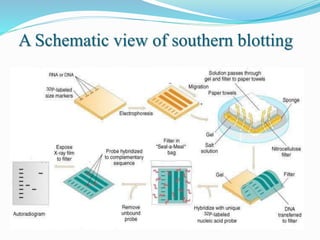
 A schematic view of southern blotting
 Application
 Advantages and Disadvantages
 Reference
Blotting
 A blot, in molecular biology and genetics, is a method of
transferring proteins, DNA or RNA, onto a carrier.
 The term "blotting" refers to the transfer of biological
samples from a gel to a membrane and their subsequent
detection on the surface of the membrane.
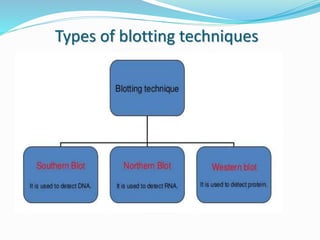
Types of blotting techniques
 1 ) Southern blotting ( to detect DNA )
 2 ) Northern blotting ( to detect RNA )
 3 ) Western blotting ( to detect protein )
Southern Blotting
 A Southern blot is a method used
in molecular biology for detection of a
specific DNA sequence in DNA samples.
 Southern blotting combines transfer
of electrophoresis -separated DNA fragments
to a filter membrane and subsequent
fragment detection by probe hybridization.
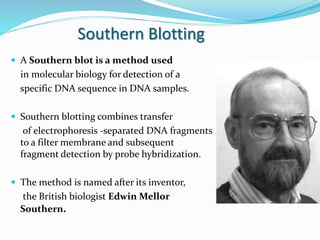
 The method is named after its inventor,
the British biologist Edwin Mellor
Southern.
Principle
 This method Involves separation, transfer and hybridization.
 The key to this method is hybridization.
Hybridization: It is the process of forming a double stranded
DNA molecule between a single-stranded DNA probe and a single-
stranded target DNA.
 There are 2 important features of Hybridization:
• The reactions are specific-the probes will only bind to targets with
a complementary sequence.
• The probe can find one molecule of target in a mixture of millions
of related but non-complementary molecules.
Methods in Southern blotting
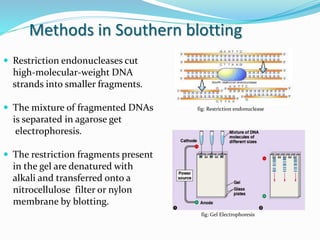
 Restriction endonucleases cut
high-molecular-weight DNA
strands into smaller fragments.
 The mixture of fragmented DNAs fig: Restriction endonuclease
is separated in agarose get
electrophoresis.
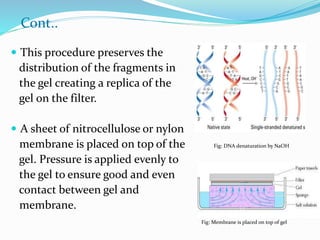
 The restriction fragments present
in the gel are denatured with
alkali and transferred onto a
nitrocellulose filter or nylon
membrane by blotting.
fig: Gel Electrophoresis
 This procedure preserves the
distribution of the fragments in
the gel creating a replica of the
gel on the filter.
 A sheet of nitrocellulose or nylon
membrane is placed on top of the Fig: DNA denaturation by NaOH
gel. Pressure is applied evenly to
the gel to ensure good and even
contact between gel and
membrane.
Fig: Membrane is placed on top of gel
Cont..
Cont..
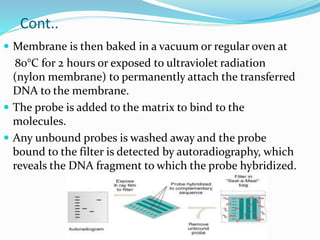
 Membrane is then baked in a vacuum or regular oven at
80°C for 2 hours or exposed to ultraviolet radiation
(nylon membrane) to permanently attach the transferred
DNA to the membrane.
 The probe is added to the matrix to bind to the
molecules.
 Any unbound probes is washed away and the probe
bound to the filter is detected by autoradiography, which
reveals the DNA fragment to which the probe hybridized.
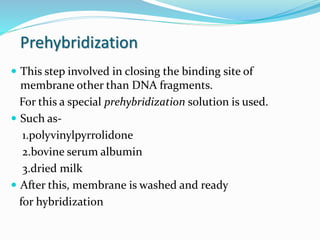
Prehybridization
 This step involved in closing the binding site of
membrane other than DNA fragments.
For this a special prehybridization solution is used.
 Such as-
1.polyvinylpyrrolidone
2.bovine serum albumin
3.dried milk
 After this, membrane is washed and ready
for hybridization
A Schematic view of southern blotting
Applications
• To identify specific DNA in a DNA sample.
• To Isolate desired DNA for construction of rDNA.
• Identify mutations, deletions, and gene rearrangements.
• Used in prognosis of cancer and in prenatal diagnosis of
genetic diseases.
• In RFLP, gene mapping and discovery.
• Diagnosis of HIV-1 and infectious disease.
• In DNA fingerprinting:
-Paternity and Maternity Testing
-Criminal Identification and Forensics
-Personal Identification
Advantages
• Effective way to detect a specific DNA sequence in a
large, complex sample of DNA.
• Can be used to quantify the amount of the present DNA.
• Cheaper than DNA sequencing
Disadvantages
• More expensive than other tests
• Complex and labour intensive
• Time consuming and cumbersome
• Require large amount of DNA
Reference
 S.P. Vyas., Pharmaceutical Biochemistry, CBS
Publishers, New Delhi,2008.
 U. Satyanarayana, U. Chakrapani, Biochemistry,
Arunabha Sen Books Pvt.Ltd., 2010.
 Robert K. Murray, Daryl K. Granner, Peter A. Mayer,
Victor W. Rodwell.,
 Harper’s Illurstrated Biochemisry, Lange Medical
publications, 2005
 http://sciencing.com
THANK YOU

southern blotting.pptx

  • 1.
  • 2.
    Content  Introduction toBlotting  Types of blotting  Southern blotting  Principle  Methods involved in southern blotting  A schematic view of southern blotting  Application  Advantages and Disadvantages  Reference
  • 3.
    Blotting  A blot,in molecular biology and genetics, is a method of transferring proteins, DNA or RNA, onto a carrier.  The term "blotting" refers to the transfer of biological samples from a gel to a membrane and their subsequent detection on the surface of the membrane.
  • 4.
    Types of blottingtechniques  1 ) Southern blotting ( to detect DNA )  2 ) Northern blotting ( to detect RNA )  3 ) Western blotting ( to detect protein )
  • 5.
    Southern Blotting  ASouthern blot is a method used in molecular biology for detection of a specific DNA sequence in DNA samples.  Southern blotting combines transfer of electrophoresis -separated DNA fragments to a filter membrane and subsequent fragment detection by probe hybridization.  The method is named after its inventor, the British biologist Edwin Mellor Southern.
  • 6.
    Principle  This methodInvolves separation, transfer and hybridization.  The key to this method is hybridization. Hybridization: It is the process of forming a double stranded DNA molecule between a single-stranded DNA probe and a single- stranded target DNA.  There are 2 important features of Hybridization: • The reactions are specific-the probes will only bind to targets with a complementary sequence. • The probe can find one molecule of target in a mixture of millions of related but non-complementary molecules.
  • 7.
    Methods in Southernblotting  Restriction endonucleases cut high-molecular-weight DNA strands into smaller fragments.  The mixture of fragmented DNAs fig: Restriction endonuclease is separated in agarose get electrophoresis.  The restriction fragments present in the gel are denatured with alkali and transferred onto a nitrocellulose filter or nylon membrane by blotting. fig: Gel Electrophoresis
  • 8.
     This procedurepreserves the distribution of the fragments in the gel creating a replica of the gel on the filter.  A sheet of nitrocellulose or nylon membrane is placed on top of the Fig: DNA denaturation by NaOH gel. Pressure is applied evenly to the gel to ensure good and even contact between gel and membrane. Fig: Membrane is placed on top of gel Cont..
  • 9.
    Cont..  Membrane isthen baked in a vacuum or regular oven at 80°C for 2 hours or exposed to ultraviolet radiation (nylon membrane) to permanently attach the transferred DNA to the membrane.  The probe is added to the matrix to bind to the molecules.  Any unbound probes is washed away and the probe bound to the filter is detected by autoradiography, which reveals the DNA fragment to which the probe hybridized.
  • 10.
    Prehybridization  This stepinvolved in closing the binding site of membrane other than DNA fragments. For this a special prehybridization solution is used.  Such as- 1.polyvinylpyrrolidone 2.bovine serum albumin 3.dried milk  After this, membrane is washed and ready for hybridization
  • 11.
    A Schematic viewof southern blotting
  • 12.
    Applications • To identifyspecific DNA in a DNA sample. • To Isolate desired DNA for construction of rDNA. • Identify mutations, deletions, and gene rearrangements. • Used in prognosis of cancer and in prenatal diagnosis of genetic diseases. • In RFLP, gene mapping and discovery. • Diagnosis of HIV-1 and infectious disease. • In DNA fingerprinting: -Paternity and Maternity Testing -Criminal Identification and Forensics -Personal Identification
  • 13.
    Advantages • Effective wayto detect a specific DNA sequence in a large, complex sample of DNA. • Can be used to quantify the amount of the present DNA. • Cheaper than DNA sequencing Disadvantages • More expensive than other tests • Complex and labour intensive • Time consuming and cumbersome • Require large amount of DNA
  • 14.
    Reference  S.P. Vyas.,Pharmaceutical Biochemistry, CBS Publishers, New Delhi,2008.  U. Satyanarayana, U. Chakrapani, Biochemistry, Arunabha Sen Books Pvt.Ltd., 2010.  Robert K. Murray, Daryl K. Granner, Peter A. Mayer, Victor W. Rodwell.,  Harper’s Illurstrated Biochemisry, Lange Medical publications, 2005  http://sciencing.com
  • 15.