DR. D.Y.PATIL INSTITUTE OF ENGINEERING,
MANAGEMENT AND RESEARCH
CONTENTS
1. Introduction
2. Literature Survey
3. Principle
4. Why Four wheel steering?
5. Phases of Quadra steering system
6. Advantages over Two Wheel Steering
7. Applications
8. Future Aspects
9. Conclusion
10. References
1. INTRODUCTION
 Allows driver to guide moving vehicle.
 Except in Rail where rail road provides steering function.
 Turning should not require greater effort.
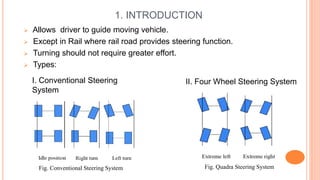
 Types:
I. Conventional Steering
System
II. Four Wheel Steering System
Fig. Conventional Steering System Fig. Quadra Steering System
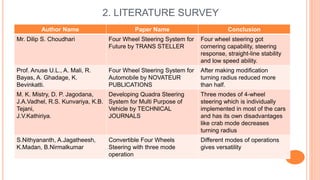
2. LITERATURE SURVEY
Author Name Paper Name Conclusion
Mr. Dilip S. Choudhari Four Wheel Steering System for
Future by TRANS STELLER
Four wheel steering got
cornering capability, steering
response, straight-line stability
and low speed ability.
Prof. Anuse U.L., A. Mali, R.
Bayas, A. Ghadage, K.
Bevinkatti.
Four Wheel Steering System for
Automobile by NOVATEUR
PUBLICATIONS
After making modification
turning radius reduced more
than half.
M. K. Mistry, D. P. Jagodana,
J.A.Vadhel, R.S. Kunvariya, K.B.
Tejani,
J.V.Kathiriya.
Developing Quadra Steering
System for Multi Purpose of
Vehicle by TECHNICAL
JOURNALS
Three modes of 4-wheel
steering which is individually
implemented in most of the cars
and has its own disadvantages
like crab mode decreases
turning radius
S.Nithyananth, A.Jagatheesh,
K.Madan, B.Nirmalkumar
Convertible Four Wheels
Steering with three mode
operation
Different modes of operations
gives versatility
3. PRINCIPLE
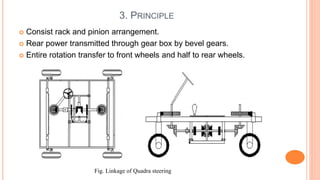
 Consist rack and pinion arrangement.
 Rear power transmitted through gear box by bevel gears.
 Entire rotation transfer to front wheels and half to rear wheels.
Fig. Linkage of Quadra steering
4. WHY FOUR WHEEL STEERING?
 Steering forces causes car to sway in 2ws.
 Tires subjected to road grip and slip angle.
 Rear wheels attempt to keep up with front wheels.
 But in 4ws all wheels respond to steering .
 Topping of vehicle reduces.
 Rear wheel lag reduces.
Fig. 4ws vs 2ws
5. PHASES OF QUADRA STEERING SYSTEM
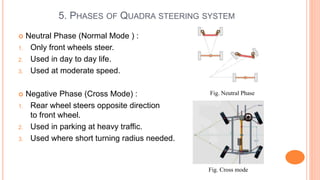
 Neutral Phase (Normal Mode ) :
1. Only front wheels steer.
2. Used in day to day life.
3. Used at moderate speed.
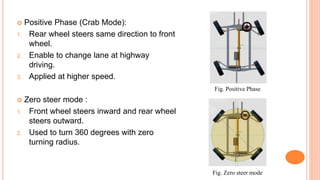
 Negative Phase (Cross Mode) :
1. Rear wheel steers opposite direction
to front wheel.
2. Used in parking at heavy traffic.
3. Used where short turning radius needed.
Fig. Cross mode
Fig. Neutral Phase
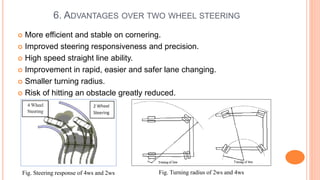
 Positive Phase (Crab Mode):
1. Rear wheel steers same direction to front
wheel.
2. Enable to change lane at highway
driving.
3. Applied at higher speed.
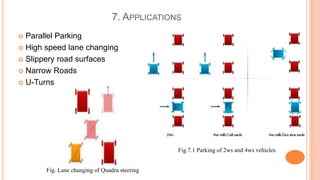
 Zero steer mode :
1. Front wheel steers inward and rear wheel
steers outward.
2. Used to turn 360 degrees with zero
turning radius.
Fig. Positive Phase
Fig. Zero steer mode
6. ADVANTAGES OVER TWO WHEEL STEERING
 More efficient and stable on cornering.
 Improved steering responsiveness and precision.
 High speed straight line ability.
 Improvement in rapid, easier and safer lane changing.
 Smaller turning radius.
 Risk of hitting an obstacle greatly reduced.
Fig. Steering response of 4ws and 2ws Fig. Turning radius of 2ws and 4ws
7. APPLICATIONS
 Parallel Parking
 High speed lane changing
 Slippery road surfaces
 Narrow Roads
 U-Turns
Fig. Lane changing of Quadra steering
Fig.7.1 Parking of 2ws and 4ws vehicles
8. FUTURE ASPECTS
 Innovative feature of system is ability to drive all four wheels by single
steering actuator.
 Implementation will allow,
1. Maximum maneuverability.
2. More static stability.
3. Front and rear wheel tracking.
4. Optimum obstacle climbing capability.
 Advanced system will work electronically by microprocessors.
9. VIDEO
8. CONCLUSION
 The Four Wheel Steering System has got
1. Lane Changing
2. Steering Response
3. Cornering Capability
4. Straight Line Stability
5. Low Speed Maneuverability

Presentation on four wheel steering system

  • 1.
    DR. D.Y.PATIL INSTITUTEOF ENGINEERING, MANAGEMENT AND RESEARCH
  • 2.
    CONTENTS 1. Introduction 2. LiteratureSurvey 3. Principle 4. Why Four wheel steering? 5. Phases of Quadra steering system 6. Advantages over Two Wheel Steering 7. Applications 8. Future Aspects 9. Conclusion 10. References
  • 3.
    1. INTRODUCTION  Allowsdriver to guide moving vehicle.  Except in Rail where rail road provides steering function.  Turning should not require greater effort.  Types: I. Conventional Steering System II. Four Wheel Steering System Fig. Conventional Steering System Fig. Quadra Steering System
  • 4.
    2. LITERATURE SURVEY AuthorName Paper Name Conclusion Mr. Dilip S. Choudhari Four Wheel Steering System for Future by TRANS STELLER Four wheel steering got cornering capability, steering response, straight-line stability and low speed ability. Prof. Anuse U.L., A. Mali, R. Bayas, A. Ghadage, K. Bevinkatti. Four Wheel Steering System for Automobile by NOVATEUR PUBLICATIONS After making modification turning radius reduced more than half. M. K. Mistry, D. P. Jagodana, J.A.Vadhel, R.S. Kunvariya, K.B. Tejani, J.V.Kathiriya. Developing Quadra Steering System for Multi Purpose of Vehicle by TECHNICAL JOURNALS Three modes of 4-wheel steering which is individually implemented in most of the cars and has its own disadvantages like crab mode decreases turning radius S.Nithyananth, A.Jagatheesh, K.Madan, B.Nirmalkumar Convertible Four Wheels Steering with three mode operation Different modes of operations gives versatility
  • 5.
    3. PRINCIPLE  Consistrack and pinion arrangement.  Rear power transmitted through gear box by bevel gears.  Entire rotation transfer to front wheels and half to rear wheels. Fig. Linkage of Quadra steering
  • 6.
    4. WHY FOURWHEEL STEERING?  Steering forces causes car to sway in 2ws.  Tires subjected to road grip and slip angle.  Rear wheels attempt to keep up with front wheels.  But in 4ws all wheels respond to steering .  Topping of vehicle reduces.  Rear wheel lag reduces. Fig. 4ws vs 2ws
  • 7.
    5. PHASES OFQUADRA STEERING SYSTEM  Neutral Phase (Normal Mode ) : 1. Only front wheels steer. 2. Used in day to day life. 3. Used at moderate speed.  Negative Phase (Cross Mode) : 1. Rear wheel steers opposite direction to front wheel. 2. Used in parking at heavy traffic. 3. Used where short turning radius needed. Fig. Cross mode Fig. Neutral Phase
  • 8.
     Positive Phase(Crab Mode): 1. Rear wheel steers same direction to front wheel. 2. Enable to change lane at highway driving. 3. Applied at higher speed.  Zero steer mode : 1. Front wheel steers inward and rear wheel steers outward. 2. Used to turn 360 degrees with zero turning radius. Fig. Positive Phase Fig. Zero steer mode
  • 9.
    6. ADVANTAGES OVERTWO WHEEL STEERING  More efficient and stable on cornering.  Improved steering responsiveness and precision.  High speed straight line ability.  Improvement in rapid, easier and safer lane changing.  Smaller turning radius.  Risk of hitting an obstacle greatly reduced. Fig. Steering response of 4ws and 2ws Fig. Turning radius of 2ws and 4ws
  • 10.
    7. APPLICATIONS  ParallelParking  High speed lane changing  Slippery road surfaces  Narrow Roads  U-Turns Fig. Lane changing of Quadra steering Fig.7.1 Parking of 2ws and 4ws vehicles
  • 11.
    8. FUTURE ASPECTS Innovative feature of system is ability to drive all four wheels by single steering actuator.  Implementation will allow, 1. Maximum maneuverability. 2. More static stability. 3. Front and rear wheel tracking. 4. Optimum obstacle climbing capability.  Advanced system will work electronically by microprocessors.
  • 12.
  • 13.
    8. CONCLUSION  TheFour Wheel Steering System has got 1. Lane Changing 2. Steering Response 3. Cornering Capability 4. Straight Line Stability 5. Low Speed Maneuverability