Real Time Machine Learning
Visualization with Spark
Chester Chen
Director of Engineering
Alpine Data
March 13, 2016
COMPANY CONFIDENTIAL2
Who am I ?
• Director of Engineering at Alpine Data
• Founder and Organizer of SF Big Analytics Meetup (3500+ members)
• Previous Employment:
– Architect / Director at Tinga, Symantec, AltaVista, Ascent Media, ClearStory
Systems, WebWare.
• Experience with Spark
– Exposed to Spark since Spark 0.6
– Architect for Alpine Spark Integration on Spark 1.1, 1.3 and 1.5.x
• Hadoop Distribution
– CDH, HDP and MapR
COMPANY CONFIDENTIAL3
Alpine Data at a Glance
Enterprise Scale Predictive Analytics with deep experience in Machine Learning, Data Science, and
Distributed Data Architectures
Industry Innovations and IP
Broad patents awarded for in-cluster and in-database machine learning - 2012
First web-based solution for end-to-end Predictive analytics - 2012
Created Industry first integrated Analytics Services Platform - 2013
First Predictive Analytics solution to be certified on Spark - 2014
Launched Touchpoints, Industry first predictive applications service layer- 2015
Global Brand Names in Financial Services, Telco/Media, Healthcare, Manufacturing, Public Sector and Retail
Visionary in the Gartner Magic Quadrant for Advanced Analytics
Key Partners:
COMPANY CONFIDENTIAL4
Lightning-fast cluster computing
Real Time ML Visualization with Spark
-- What is Spark
http://spark.apache.org/
COMPANY CONFIDENTIAL5
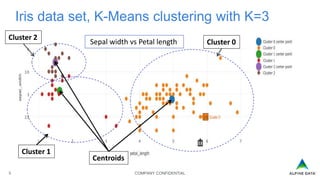
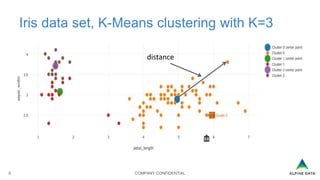
Iris data set, K-Means clustering with K=3
Cluster 2
Cluster 1
Cluster 0
Centroids
Sepal width vs Petal length
COMPANY CONFIDENTIAL6
Iris data set, K-Means clustering with K=3
distance
COMPANY CONFIDENTIAL7
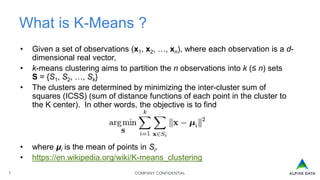
What is K-Means ?
• Given a set of observations (x1, x2, …, xn), where each observation is a d-
dimensional real vector,
• k-means clustering aims to partition the n observations into k (≤ n) sets
S = {S1, S2, …, Sk}
• The clusters are determined by minimizing the inter-cluster sum of
squares (ICSS) (sum of distance functions of each point in the cluster to
the K center). In other words, the objective is to find
• where μi is the mean of points in Si.
• https://en.wikipedia.org/wiki/K-means_clustering
COMPANY CONFIDENTIAL8
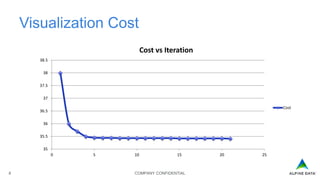
Visualization Cost
35
35.5
36
36.5
37
37.5
38
38.5
0 5 10 15 20 25
Cost vs Iteration
Cost
COMPANY CONFIDENTIAL9
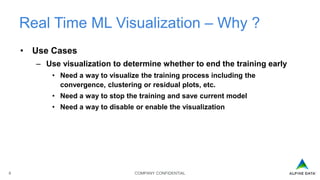
Real Time ML Visualization – Why ?
• Use Cases
– Use visualization to determine whether to end the training early
• Need a way to visualize the training process including the
convergence, clustering or residual plots, etc.
• Need a way to stop the training and save current model
• Need a way to disable or enable the visualization
COMPANY CONFIDENTIAL10
Real Time ML Visualization with Spark
DEMO
COMPANY CONFIDENTIAL11
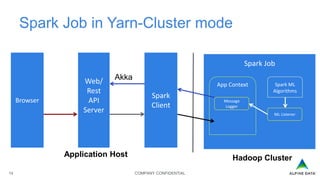
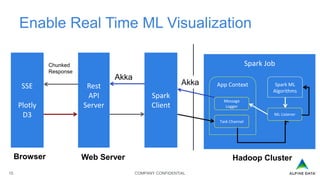
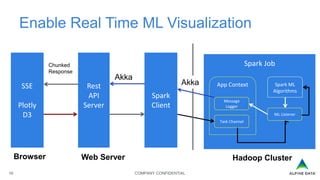
How to Enable Real Time ML Visualization ?
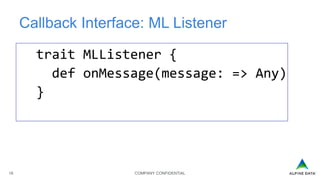
• A callback interface for Spark Machine Learning Algorithm to send messages
– Algorithms decide when and what message to send
– Algorithms don’t care how the message is delivered
• A task channel to handle the message delivery from Spark Driver to Spark Client
– It doesn’t care about the content of the message or who sent the message
• The message is delivered from Spark Client to Browser
– We use HTML5 Server-Sent Events ( SSE) and HTTP Chunked Response (PUSH)
– Pull is possible, but requires a message Queue
• Visualization using JavaScript Frameworks Plot.ly and D3
COMPANY CONFIDENTIAL12
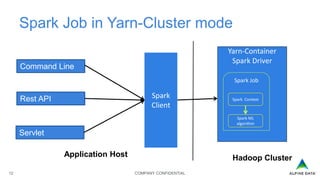
Spark Job in Yarn-Cluster mode
Spark
Client
Hadoop Cluster
Yarn-Container
Spark Driver
Spark Job
Spark Context
Spark ML
algorithm
Command Line
Rest API
Servlet
Application Host
COMPANY CONFIDENTIAL13
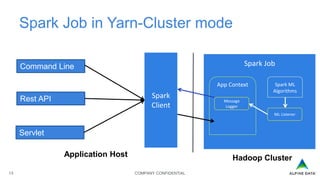
Spark Job in Yarn-Cluster mode
Spark
Client
Hadoop Cluster
Command Line
Rest API
Servlet
Application Host
Spark Job
App Context Spark ML
Algorithms
ML Listener
Message
Logger
COMPANY CONFIDENTIAL14
Spark
Client
Hadoop ClusterApplication Host
Spark Job
App Context Spark ML
Algorithms
ML Listener
Message
Logger
Spark Job in Yarn-Cluster mode
Web/
Rest
API
Server
Akka
Browser
COMPANY CONFIDENTIAL15
Enable Real Time ML Visualization
SSE
Plotly
D3
Browser
Rest
API
Server
Web Server
Spark
Client
Hadoop Cluster
Spark Job
App Context
Message
Logger
Task Channel
Spark ML
Algorithms
ML Listener
Akka
Chunked
Response
Akka
COMPANY CONFIDENTIAL16
Enable Real Time ML Visualization
SSE
Plotly
D3
Browser
Rest
API
Server
Web Server
Spark
Client
Hadoop Cluster
Spark Job
App Context
Message
Logger
Task Channel
Spark ML
Algorithms
ML Listener
Akka
Chunked
Response
Akka
COMPANY CONFIDENTIAL17
Machine Learning Listeners
COMPANY CONFIDENTIAL18
Callback Interface: ML Listener
trait MLListener {
def onMessage(message: => Any)
}
COMPANY CONFIDENTIAL19
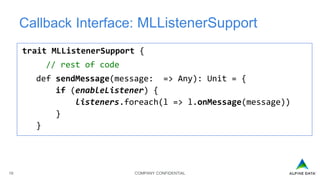
Callback Interface: MLListenerSupport
trait MLListenerSupport {
// rest of code
def sendMessage(message: => Any): Unit = {
if (enableListener) {
listeners.foreach(l => l.onMessage(message))
}
}
COMPANY CONFIDENTIAL20
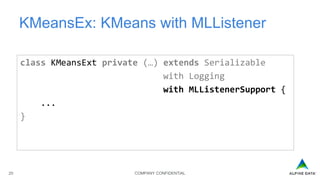
KMeansEx: KMeans with MLListener
class KMeansExt private (…) extends Serializable
with Logging
with MLListenerSupport {
...
}
COMPANY CONFIDENTIAL21
KMeansEx: KMeans with MLListener
case class KMeansCoreStats (iteration: Int, centers: Array[Vector], cost: Double )
private def runAlgorithm(data: RDD[VectorWithNorm]): KMeansModel = {
...
while (!stopIteration &&
iteration < maxIterations && !activeRuns.isEmpty) {
...
if (listenerEnabled()) {
sendMessage(KMeansCoreStats(…))
}
...
}
}
COMPANY CONFIDENTIAL22
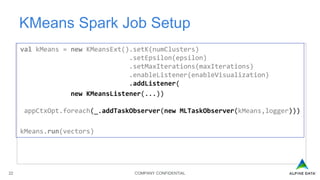
KMeans Spark Job Setup
val kMeans = new KMeansExt().setK(numClusters)
.setEpsilon(epsilon)
.setMaxIterations(maxIterations)
.enableListener(enableVisualization)
.addListener(
new KMeansListener(...))
appCtxOpt.foreach(_.addTaskObserver(new MLTaskObserver(kMeans,logger)))
kMeans.run(vectors)
COMPANY CONFIDENTIAL23
KMeans ML Listener
class KMeansListener(columnNames: List[String],
data : RDD[Vector],
logger : MessageLogger) extends MLListener{
//sampling the data
message match {
case coreStats :KMeansCoreStats =>
//use the KMeans model of the current iteration to predict sample
//cluster indexes
//construct message consists of sample, cost, iteration and centroids
//use logger to send the message out
}
COMPANY CONFIDENTIAL24
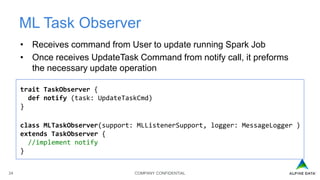
ML Task Observer
• Receives command from User to update running Spark Job
• Once receives UpdateTask Command from notify call, it preforms
the necessary update operation
trait TaskObserver {
def notify (task: UpdateTaskCmd)
}
class MLTaskObserver(support: MLListenerSupport, logger: MessageLogger )
extends TaskObserver {
//implement notify
}
COMPANY CONFIDENTIAL25
Logistic Regression MLListener
class LogisticRegression(…) extends MLListenerSupport {
def train(data: RDD[(Double, Vector)]): LogisticRegressionModel= {
// initialization code
val (rawWeights, loss) = OWLQN.runOWLQN( …)
generateLORModel(…)
}
}
COMPANY CONFIDENTIAL26
Logistic Regression MLListener
object OWLQN extends Logging {
def runOWLQN(/*args*/,mlSupport:Option[MLListenerSupport]):(Vector,
Array[Double]) = {
val costFun=new CostFun(data, mlSupport, IterationState(), /*other
args */)
val states : Iterator[lbfgs.State] =
lbfgs.iterations(
new CachedDiffFunction(costFun), initialWeights.toBreeze.toDenseVector
)
…
}
COMPANY CONFIDENTIAL27
Logistic Regression MLListener
In Cost function :
override def calculate(weights: BDV[Double]): (Double, BDV[Double]) = {
val shouldStop = mlSupport.exists(_.stopIteration)
if (!shouldStop) {
…
mlSupport.filter(_.listenerEnabled()).map { s=>
s.sendMessage( (iState.iteration, w, loss))
}
…
}
else {
…
}
}
COMPANY CONFIDENTIAL28
Task Communication Channel
COMPANY CONFIDENTIAL29
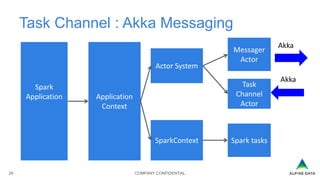
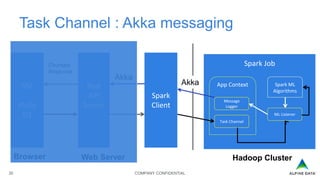
Task Channel : Akka Messaging
Spark
Application Application
Context
Actor System
Messager
Actor
Task
Channel
Actor
SparkContext Spark tasks
Akka
Akka
COMPANY CONFIDENTIAL30
Task Channel : Akka messaging
SSE
Plotly
D3
Browser
Rest
API
Server
Web Server
Spark
Client
Hadoop Cluster
Spark Job
App Context
Message
Logger
Task Channel
Spark ML
Algorithms
ML Listener
Akka
Chunked
Response
Akka
COMPANY CONFIDENTIAL31
Push To The Browser
COMPANY CONFIDENTIAL32
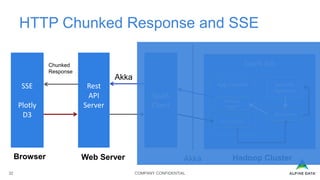
HTTP Chunked Response and SSE
SSE
Plotly
D3
Browser
Rest
API
Server
Web Server
Spark
Client
Hadoop Cluster
Spark Job
App Context
Message
Logger
Task Channel
Spark ML
Algorithms
ML Listener
Akka
Chunked
Response
Akka
COMPANY CONFIDENTIAL33
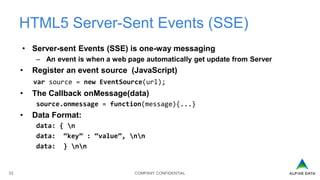
HTML5 Server-Sent Events (SSE)
• Server-sent Events (SSE) is one-way messaging
– An event is when a web page automatically get update from Server
• Register an event source (JavaScript)
var source = new EventSource(url);
• The Callback onMessage(data)
source.onmessage = function(message){...}
• Data Format:
data: { n
data: “key” : “value”, nn
data: } nn
COMPANY CONFIDENTIAL34
HTTP Chunked Response
• Spray Rest Server supports Chunked Response
val responseStart =
HttpResponse(entity = HttpEntity(`text/event-stream`, s"data: Startn"))
requestCtx.responder ! ChunkedResponseStart(responseStart).withAck(Messages.Ack)
val nextChunk = MessageChunk(s"data: $r nn")
requestCtx.responder ! nextChunk.withAck(Messages.Ack)
requestCtx.responder ! MessageChunk(s"data: Finished nn")
requestCtx.responder ! ChunkedMessageEnd
COMPANY CONFIDENTIAL35
Push vs. Pull
Push
• Pros
– The data is streamed (pushed) to browser via chunked response
– There is no need for data queue, but the data can be lost if not consumed
– Multiple pages can be pushed at the same time, which allows multiple
visualization views
• Cons
– For slow network, slow browser and fast data iterations, the data might all
show-up in browser at once, rather showing a nice iteration-by-iteration
display
– If you control the data chunked response by Network Acknowledgement,
the visualization may not show-up at all as the data is not pushed due to
slow network acknowledgement
COMPANY CONFIDENTIAL36
Push vs. Pull
Pull
• Pros
– Message does not get lost, since it can be temporarily stored in the
message queue
– The visualization will render in an even pace
• Cons
– Need to periodically send server request for update,
– We will need a message queue before the message is consumed
– Hard to support multiple pages rendering with simple message
queue
COMPANY CONFIDENTIAL37
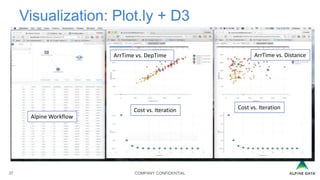
Visualization: Plot.ly + D3
Cost vs. IterationCost vs. Iteration
ArrTime vs. DistanceArrTime vs. DepTime
Alpine Workflow
COMPANY CONFIDENTIAL38
Use Plot.ly to render graph
function showCost(dataParsed) {
var costTrace = { … };
var data = [ costTrace ];
var costLayout = {
xaxis: {…},
yaxis: {…},
title: …
};
Plotly.newPlot('cost', data, costLayout);
}
COMPANY CONFIDENTIAL39
Real Time ML Visualization: Summary
• Training machine learning model involves a lot of experimentation,
we need a way to visualize the training process.
• We presented a system to enable real time machine learning
visualization with Spark:
– Gives visibility into the training of a model
– Allows us monitor the convergence of the algorithms during training
– Can stop the iterations when convergence is good enough.
COMPANY CONFIDENTIAL40
Thank You
Chester Chen
chester@alpinenow.com
LinkedIn
https://www.linkedin.com/in/chester-chen-3205992
SlideShare
http://www.slideshare.net/ChesterChen/presentations
demo video
https://youtu.be/DkbYNYQhrao

Real Time Machine Learning Visualization With Spark

  • 1.
    Real Time MachineLearning Visualization with Spark Chester Chen Director of Engineering Alpine Data March 13, 2016
  • 2.
    COMPANY CONFIDENTIAL2 Who amI ? • Director of Engineering at Alpine Data • Founder and Organizer of SF Big Analytics Meetup (3500+ members) • Previous Employment: – Architect / Director at Tinga, Symantec, AltaVista, Ascent Media, ClearStory Systems, WebWare. • Experience with Spark – Exposed to Spark since Spark 0.6 – Architect for Alpine Spark Integration on Spark 1.1, 1.3 and 1.5.x • Hadoop Distribution – CDH, HDP and MapR
  • 3.
    COMPANY CONFIDENTIAL3 Alpine Dataat a Glance Enterprise Scale Predictive Analytics with deep experience in Machine Learning, Data Science, and Distributed Data Architectures Industry Innovations and IP Broad patents awarded for in-cluster and in-database machine learning - 2012 First web-based solution for end-to-end Predictive analytics - 2012 Created Industry first integrated Analytics Services Platform - 2013 First Predictive Analytics solution to be certified on Spark - 2014 Launched Touchpoints, Industry first predictive applications service layer- 2015 Global Brand Names in Financial Services, Telco/Media, Healthcare, Manufacturing, Public Sector and Retail Visionary in the Gartner Magic Quadrant for Advanced Analytics Key Partners:
  • 4.
    COMPANY CONFIDENTIAL4 Lightning-fast clustercomputing Real Time ML Visualization with Spark -- What is Spark http://spark.apache.org/
  • 5.
    COMPANY CONFIDENTIAL5 Iris dataset, K-Means clustering with K=3 Cluster 2 Cluster 1 Cluster 0 Centroids Sepal width vs Petal length
  • 6.
    COMPANY CONFIDENTIAL6 Iris dataset, K-Means clustering with K=3 distance
  • 7.
    COMPANY CONFIDENTIAL7 What isK-Means ? • Given a set of observations (x1, x2, …, xn), where each observation is a d- dimensional real vector, • k-means clustering aims to partition the n observations into k (≤ n) sets S = {S1, S2, …, Sk} • The clusters are determined by minimizing the inter-cluster sum of squares (ICSS) (sum of distance functions of each point in the cluster to the K center). In other words, the objective is to find • where μi is the mean of points in Si. • https://en.wikipedia.org/wiki/K-means_clustering
  • 8.
  • 9.
    COMPANY CONFIDENTIAL9 Real TimeML Visualization – Why ? • Use Cases – Use visualization to determine whether to end the training early • Need a way to visualize the training process including the convergence, clustering or residual plots, etc. • Need a way to stop the training and save current model • Need a way to disable or enable the visualization
  • 10.
    COMPANY CONFIDENTIAL10 Real TimeML Visualization with Spark DEMO
  • 11.
    COMPANY CONFIDENTIAL11 How toEnable Real Time ML Visualization ? • A callback interface for Spark Machine Learning Algorithm to send messages – Algorithms decide when and what message to send – Algorithms don’t care how the message is delivered • A task channel to handle the message delivery from Spark Driver to Spark Client – It doesn’t care about the content of the message or who sent the message • The message is delivered from Spark Client to Browser – We use HTML5 Server-Sent Events ( SSE) and HTTP Chunked Response (PUSH) – Pull is possible, but requires a message Queue • Visualization using JavaScript Frameworks Plot.ly and D3
  • 12.
    COMPANY CONFIDENTIAL12 Spark Jobin Yarn-Cluster mode Spark Client Hadoop Cluster Yarn-Container Spark Driver Spark Job Spark Context Spark ML algorithm Command Line Rest API Servlet Application Host
  • 13.
    COMPANY CONFIDENTIAL13 Spark Jobin Yarn-Cluster mode Spark Client Hadoop Cluster Command Line Rest API Servlet Application Host Spark Job App Context Spark ML Algorithms ML Listener Message Logger
  • 14.
    COMPANY CONFIDENTIAL14 Spark Client Hadoop ClusterApplicationHost Spark Job App Context Spark ML Algorithms ML Listener Message Logger Spark Job in Yarn-Cluster mode Web/ Rest API Server Akka Browser
  • 15.
    COMPANY CONFIDENTIAL15 Enable RealTime ML Visualization SSE Plotly D3 Browser Rest API Server Web Server Spark Client Hadoop Cluster Spark Job App Context Message Logger Task Channel Spark ML Algorithms ML Listener Akka Chunked Response Akka
  • 16.
    COMPANY CONFIDENTIAL16 Enable RealTime ML Visualization SSE Plotly D3 Browser Rest API Server Web Server Spark Client Hadoop Cluster Spark Job App Context Message Logger Task Channel Spark ML Algorithms ML Listener Akka Chunked Response Akka
  • 17.
  • 18.
    COMPANY CONFIDENTIAL18 Callback Interface:ML Listener trait MLListener { def onMessage(message: => Any) }
  • 19.
    COMPANY CONFIDENTIAL19 Callback Interface:MLListenerSupport trait MLListenerSupport { // rest of code def sendMessage(message: => Any): Unit = { if (enableListener) { listeners.foreach(l => l.onMessage(message)) } }
  • 20.
    COMPANY CONFIDENTIAL20 KMeansEx: KMeanswith MLListener class KMeansExt private (…) extends Serializable with Logging with MLListenerSupport { ... }
  • 21.
    COMPANY CONFIDENTIAL21 KMeansEx: KMeanswith MLListener case class KMeansCoreStats (iteration: Int, centers: Array[Vector], cost: Double ) private def runAlgorithm(data: RDD[VectorWithNorm]): KMeansModel = { ... while (!stopIteration && iteration < maxIterations && !activeRuns.isEmpty) { ... if (listenerEnabled()) { sendMessage(KMeansCoreStats(…)) } ... } }
  • 22.
    COMPANY CONFIDENTIAL22 KMeans SparkJob Setup val kMeans = new KMeansExt().setK(numClusters) .setEpsilon(epsilon) .setMaxIterations(maxIterations) .enableListener(enableVisualization) .addListener( new KMeansListener(...)) appCtxOpt.foreach(_.addTaskObserver(new MLTaskObserver(kMeans,logger))) kMeans.run(vectors)
  • 23.
    COMPANY CONFIDENTIAL23 KMeans MLListener class KMeansListener(columnNames: List[String], data : RDD[Vector], logger : MessageLogger) extends MLListener{ //sampling the data message match { case coreStats :KMeansCoreStats => //use the KMeans model of the current iteration to predict sample //cluster indexes //construct message consists of sample, cost, iteration and centroids //use logger to send the message out }
  • 24.
    COMPANY CONFIDENTIAL24 ML TaskObserver • Receives command from User to update running Spark Job • Once receives UpdateTask Command from notify call, it preforms the necessary update operation trait TaskObserver { def notify (task: UpdateTaskCmd) } class MLTaskObserver(support: MLListenerSupport, logger: MessageLogger ) extends TaskObserver { //implement notify }
  • 25.
    COMPANY CONFIDENTIAL25 Logistic RegressionMLListener class LogisticRegression(…) extends MLListenerSupport { def train(data: RDD[(Double, Vector)]): LogisticRegressionModel= { // initialization code val (rawWeights, loss) = OWLQN.runOWLQN( …) generateLORModel(…) } }
  • 26.
    COMPANY CONFIDENTIAL26 Logistic RegressionMLListener object OWLQN extends Logging { def runOWLQN(/*args*/,mlSupport:Option[MLListenerSupport]):(Vector, Array[Double]) = { val costFun=new CostFun(data, mlSupport, IterationState(), /*other args */) val states : Iterator[lbfgs.State] = lbfgs.iterations( new CachedDiffFunction(costFun), initialWeights.toBreeze.toDenseVector ) … }
  • 27.
    COMPANY CONFIDENTIAL27 Logistic RegressionMLListener In Cost function : override def calculate(weights: BDV[Double]): (Double, BDV[Double]) = { val shouldStop = mlSupport.exists(_.stopIteration) if (!shouldStop) { … mlSupport.filter(_.listenerEnabled()).map { s=> s.sendMessage( (iState.iteration, w, loss)) } … } else { … } }
  • 28.
  • 29.
    COMPANY CONFIDENTIAL29 Task Channel: Akka Messaging Spark Application Application Context Actor System Messager Actor Task Channel Actor SparkContext Spark tasks Akka Akka
  • 30.
    COMPANY CONFIDENTIAL30 Task Channel: Akka messaging SSE Plotly D3 Browser Rest API Server Web Server Spark Client Hadoop Cluster Spark Job App Context Message Logger Task Channel Spark ML Algorithms ML Listener Akka Chunked Response Akka
  • 31.
  • 32.
    COMPANY CONFIDENTIAL32 HTTP ChunkedResponse and SSE SSE Plotly D3 Browser Rest API Server Web Server Spark Client Hadoop Cluster Spark Job App Context Message Logger Task Channel Spark ML Algorithms ML Listener Akka Chunked Response Akka
  • 33.
    COMPANY CONFIDENTIAL33 HTML5 Server-SentEvents (SSE) • Server-sent Events (SSE) is one-way messaging – An event is when a web page automatically get update from Server • Register an event source (JavaScript) var source = new EventSource(url); • The Callback onMessage(data) source.onmessage = function(message){...} • Data Format: data: { n data: “key” : “value”, nn data: } nn
  • 34.
    COMPANY CONFIDENTIAL34 HTTP ChunkedResponse • Spray Rest Server supports Chunked Response val responseStart = HttpResponse(entity = HttpEntity(`text/event-stream`, s"data: Startn")) requestCtx.responder ! ChunkedResponseStart(responseStart).withAck(Messages.Ack) val nextChunk = MessageChunk(s"data: $r nn") requestCtx.responder ! nextChunk.withAck(Messages.Ack) requestCtx.responder ! MessageChunk(s"data: Finished nn") requestCtx.responder ! ChunkedMessageEnd
  • 35.
    COMPANY CONFIDENTIAL35 Push vs.Pull Push • Pros – The data is streamed (pushed) to browser via chunked response – There is no need for data queue, but the data can be lost if not consumed – Multiple pages can be pushed at the same time, which allows multiple visualization views • Cons – For slow network, slow browser and fast data iterations, the data might all show-up in browser at once, rather showing a nice iteration-by-iteration display – If you control the data chunked response by Network Acknowledgement, the visualization may not show-up at all as the data is not pushed due to slow network acknowledgement
  • 36.
    COMPANY CONFIDENTIAL36 Push vs.Pull Pull • Pros – Message does not get lost, since it can be temporarily stored in the message queue – The visualization will render in an even pace • Cons – Need to periodically send server request for update, – We will need a message queue before the message is consumed – Hard to support multiple pages rendering with simple message queue
  • 37.
    COMPANY CONFIDENTIAL37 Visualization: Plot.ly+ D3 Cost vs. IterationCost vs. Iteration ArrTime vs. DistanceArrTime vs. DepTime Alpine Workflow
  • 38.
    COMPANY CONFIDENTIAL38 Use Plot.lyto render graph function showCost(dataParsed) { var costTrace = { … }; var data = [ costTrace ]; var costLayout = { xaxis: {…}, yaxis: {…}, title: … }; Plotly.newPlot('cost', data, costLayout); }
  • 39.
    COMPANY CONFIDENTIAL39 Real TimeML Visualization: Summary • Training machine learning model involves a lot of experimentation, we need a way to visualize the training process. • We presented a system to enable real time machine learning visualization with Spark: – Gives visibility into the training of a model – Allows us monitor the convergence of the algorithms during training – Can stop the iterations when convergence is good enough.
  • 40.
    COMPANY CONFIDENTIAL40 Thank You ChesterChen chester@alpinenow.com LinkedIn https://www.linkedin.com/in/chester-chen-3205992 SlideShare http://www.slideshare.net/ChesterChen/presentations demo video https://youtu.be/DkbYNYQhrao

Editor's Notes

  • #7 Steps : Choose centers Compute and min d = distance to centroid, choose new center Convergence when centroid is not changed
  • #21 Once we define the MLListener Support, we can gather stats at initial, iteration and final step and call: sendMessage(gatherKMeansStats(/*…*/))
  • #30 Turn into picture
  • #36 Two slides
  • #37 Two slides
  • #41 Share contact info? Link to slides again?