Zookeeper vs Raft: Stateful
distributed coordination with
HA and Fault Tolerance
Tyler Crain
ALLUXIO 1
Outline
1. Stateful distributed configuration services
2. What is Alluxio
3. High availability and fault tolerance in Alluxio
a. Implementation 1: Zookeeper + UFS (object store)
b. Implementation 2: Raft
2
ALLUXIO 3
Stateful distributed
coordination services
4
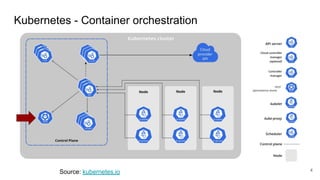
Source: kubernetes.io
Kubernetes - Container orchestration
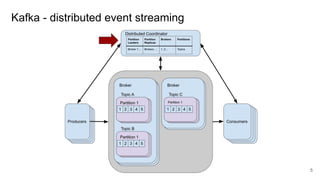
Kafka - distributed event streaming
5
6
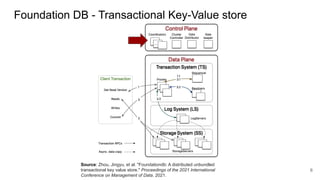
Source: Zhou, Jingyu, et al. "Foundationdb: A distributed unbundled
transactional key value store." Proceedings of the 2021 International
Conference on Management of Data. 2021.
Foundation DB - Transactional Key-Value store
7
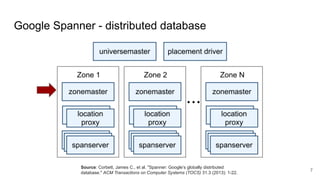
Source: Corbett, James C., et al. "Spanner: Google’s globally distributed
database." ACM Transactions on Computer Systems (TOCS) 31.3 (2013): 1-22.
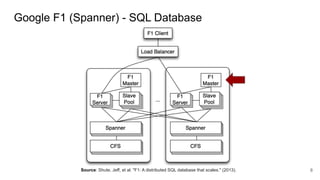
Google Spanner - distributed database
8
Source: Shute, Jeff, et al. "F1: A distributed SQL database that scales." (2013).
Google F1 (Spanner) - SQL Database
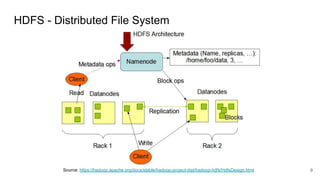
9
Source: https://hadoop.apache.org/docs/stable/hadoop-project-dist/hadoop-hdfs/HdfsDesign.html
HDFS - Distributed File System
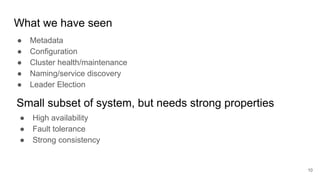
What we have seen
● Metadata
● Configuration
● Cluster health/maintenance
● Naming/service discovery
● Leader Election
10
Small subset of system, but needs strong properties
● High availability
● Fault tolerance
● Strong consistency
ALLUXIO 11
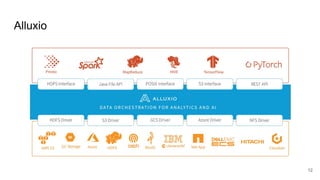
Alluxio
Alluxio
12
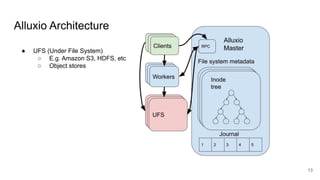
Alluxio Architecture
13
● UFS (Under File System)
○ E.g. Amazon S3, HDFS, etc
○ Object stores
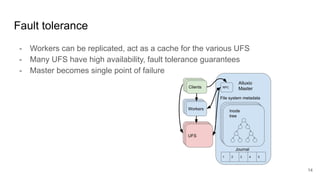
Fault tolerance
- Workers can be replicated, act as a cache for the various UFS
- Many UFS have high availability, fault tolerance guarantees
- Master becomes single point of failure
14
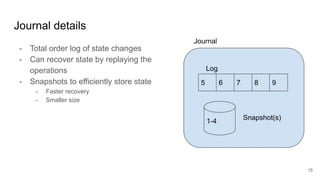
Journal details
15
- Total order log of state changes
- Can recover state by replaying the
operations
- Snapshots to efficiently store state
- Faster recovery
- Smaller size
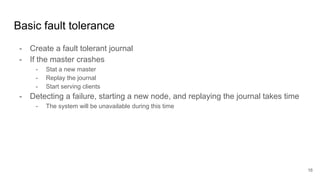
Basic fault tolerance
- Create a fault tolerant journal
- If the master crashes
- Stat a new master
- Replay the journal
- Start serving clients
- Detecting a failure, starting a new node, and replaying the journal takes time
- The system will be unavailable during this time
16
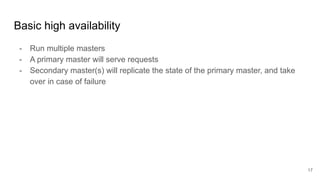
Basic high availability
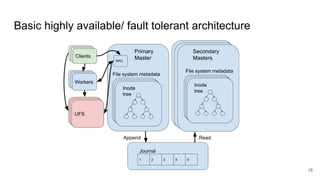
- Run multiple masters
- A primary master will serve requests
- Secondary master(s) will replicate the state of the primary master, and take
over in case of failure
17
Basic highly available/ fault tolerant architecture
18
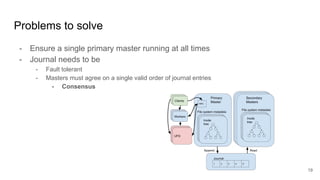
Problems to solve
- Ensure a single primary master running at all times
- Journal needs to be
- Fault tolerant
- Masters must agree on a single valid order of journal entries
- Consensus
19
ALLUXIO 20
Implementation 1:
Zookeeper + UFS Journal
Ensure a single primary master running at a time
- Leader election using Zookeeper
- Apache Zookeeper an open-source server which enables highly reliable
distributed coordination
- Provides a file-system (hierarchical namespace) like abstraction built on top of an Atomic
Broadcast (consensus) protocol
- Run on a cluster of nodes to provide fault tolerance/high availability
21
Apache Zookeeper Curator leader election recipe
- Each master subscribes to the leader election recipe
- The recipe will elect one of the nodes leader
- If the leader fails or is unable to be reached due to network issues, the recipe
will elect a new leader
22
UFS Journal
- Write journal entries to the UFS
- Use the availability / fault tolerance guarantees of the UFS
23
Does leader election solve all our problems?
- Not quite
- The Zookeeper recipe will do its best to ensure only a single node is chosen
leader at a time, but due to asynchrony in the system two nodes may believe
they are leader at the same time
- Multiple nodes may be trying to write to the journal concurrently
- Note leader election is sufficient to provide consensus, but is not a consensus protocol itself
24
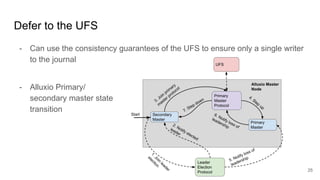
Defer to the UFS
- Can use the consistency guarantees of the UFS to ensure only a single writer
to the journal
25
- Alluxio Primary/
secondary master state
transition
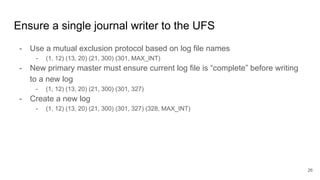
Ensure a single journal writer to the UFS
- Use a mutual exclusion protocol based on log file names
- (1, 12) (13, 20) (21, 300) (301, MAX_INT)
- New primary master must ensure current log file is “complete” before writing
to a new log
- (1, 12) (13, 20) (21, 300) (301, 327)
- Create a new log
- (1, 12) (13, 20) (21, 300) (301, 327) (328, MAX_INT)
26
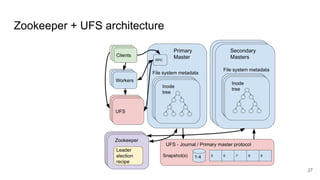
Zookeeper + UFS architecture
27
Issues
- Relies on multiple systems
- Each having their own fault tolerance/availability models
- More complicated
- Different UFS have different consistency models and performance
- May not be efficient for appending log entries
28
ALLUXIO 29
Implementation 2:
Raft Journal
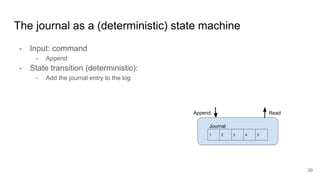
The journal as a (deterministic) state machine
- Input: command
- Append
- State transition (deterministic):
- Add the journal entry to the log
30
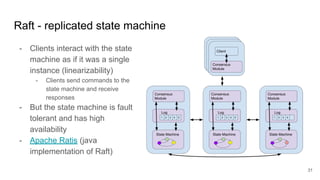
Raft - replicated state machine
- Clients interact with the state
machine as if it was a single
instance (linearizability)
- Clients send commands to the
state machine and receive
responses
- But the state machine is fault
tolerant and has high
availability
- Apache Ratis (java
implementation of Raft)
31
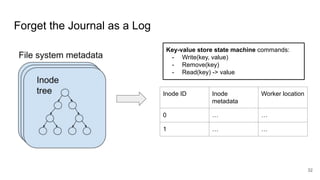
Forget the Journal as a Log
32
Inode ID Inode
metadata
Worker location
0 … …
1 … …
Key-value store state machine commands:
- Write(key, value)
- Remove(key)
- Read(key) -> value
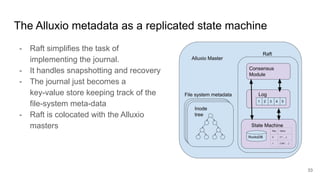
The Alluxio metadata as a replicated state machine
- Raft simplifies the task of
implementing the journal.
- It handles snapshotting and recovery
- The journal just becomes a
key-value store keeping track of the
file-system meta-data
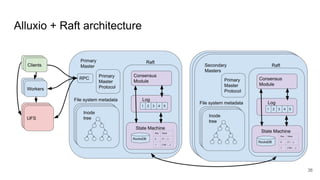
- Raft is colocated with the Alluxio
masters
33
RocksDB as the key-value store
- Log-structured merge tree
- Efficient inserts
- Key-value store
- Inode tree as a key-value map
- Alluxio provides an additional in memory cache for fast reads
- Efficient snapshots
34
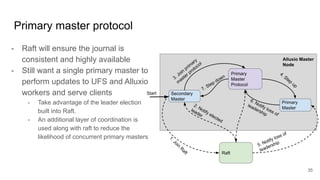
Primary master protocol
- Raft will ensure the journal is
consistent and highly available
- Still want a single primary master to
perform updates to UFS and Alluxio
workers and serve clients
- Take advantage of the leader election
built into Raft.
- An additional layer of coordination is
used along with raft to reduce the
likelihood of concurrent primary masters
35
Alluxio + Raft architecture
36
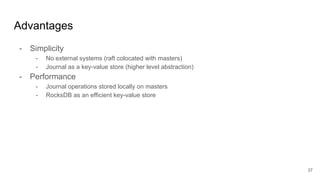
Advantages
- Simplicity
- No external systems (raft colocated with masters)
- Journal as a key-value store (higher level abstraction)
- Performance
- Journal operations stored locally on masters
- RocksDB as an efficient key-value store
37
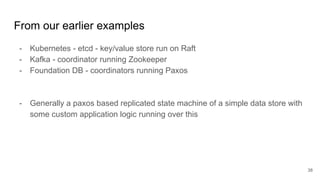
From our earlier examples
- Kubernetes - etcd - key/value store run on Raft
- Kafka - coordinator running Zookeeper
- Foundation DB - coordinators running Paxos
- Generally a paxos based replicated state machine of a simple data store with
some custom application logic running over this
38
ALLUXIO 39
Questions?
More information on Alluxio
- Web - alluxio.io
- Github - https://github.com/Alluxio/alluxio
- Slack - alluxio-community.slack.com
40

zookeeer+raft-2.pdf

  • 1.
    Zookeeper vs Raft:Stateful distributed coordination with HA and Fault Tolerance Tyler Crain ALLUXIO 1
  • 2.
    Outline 1. Stateful distributedconfiguration services 2. What is Alluxio 3. High availability and fault tolerance in Alluxio a. Implementation 1: Zookeeper + UFS (object store) b. Implementation 2: Raft 2
  • 3.
  • 4.
    4 Source: kubernetes.io Kubernetes -Container orchestration
  • 5.
    Kafka - distributedevent streaming 5
  • 6.
    6 Source: Zhou, Jingyu,et al. "Foundationdb: A distributed unbundled transactional key value store." Proceedings of the 2021 International Conference on Management of Data. 2021. Foundation DB - Transactional Key-Value store
  • 7.
    7 Source: Corbett, JamesC., et al. "Spanner: Google’s globally distributed database." ACM Transactions on Computer Systems (TOCS) 31.3 (2013): 1-22. Google Spanner - distributed database
  • 8.
    8 Source: Shute, Jeff,et al. "F1: A distributed SQL database that scales." (2013). Google F1 (Spanner) - SQL Database
  • 9.
  • 10.
    What we haveseen ● Metadata ● Configuration ● Cluster health/maintenance ● Naming/service discovery ● Leader Election 10 Small subset of system, but needs strong properties ● High availability ● Fault tolerance ● Strong consistency
  • 11.
  • 12.
  • 13.
    Alluxio Architecture 13 ● UFS(Under File System) ○ E.g. Amazon S3, HDFS, etc ○ Object stores
  • 14.
    Fault tolerance - Workerscan be replicated, act as a cache for the various UFS - Many UFS have high availability, fault tolerance guarantees - Master becomes single point of failure 14
  • 15.
    Journal details 15 - Totalorder log of state changes - Can recover state by replaying the operations - Snapshots to efficiently store state - Faster recovery - Smaller size
  • 16.
    Basic fault tolerance -Create a fault tolerant journal - If the master crashes - Stat a new master - Replay the journal - Start serving clients - Detecting a failure, starting a new node, and replaying the journal takes time - The system will be unavailable during this time 16
  • 17.
    Basic high availability -Run multiple masters - A primary master will serve requests - Secondary master(s) will replicate the state of the primary master, and take over in case of failure 17
  • 18.
    Basic highly available/fault tolerant architecture 18
  • 19.
    Problems to solve -Ensure a single primary master running at all times - Journal needs to be - Fault tolerant - Masters must agree on a single valid order of journal entries - Consensus 19
  • 20.
  • 21.
    Ensure a singleprimary master running at a time - Leader election using Zookeeper - Apache Zookeeper an open-source server which enables highly reliable distributed coordination - Provides a file-system (hierarchical namespace) like abstraction built on top of an Atomic Broadcast (consensus) protocol - Run on a cluster of nodes to provide fault tolerance/high availability 21
  • 22.
    Apache Zookeeper Curatorleader election recipe - Each master subscribes to the leader election recipe - The recipe will elect one of the nodes leader - If the leader fails or is unable to be reached due to network issues, the recipe will elect a new leader 22
  • 23.
    UFS Journal - Writejournal entries to the UFS - Use the availability / fault tolerance guarantees of the UFS 23
  • 24.
    Does leader electionsolve all our problems? - Not quite - The Zookeeper recipe will do its best to ensure only a single node is chosen leader at a time, but due to asynchrony in the system two nodes may believe they are leader at the same time - Multiple nodes may be trying to write to the journal concurrently - Note leader election is sufficient to provide consensus, but is not a consensus protocol itself 24
  • 25.
    Defer to theUFS - Can use the consistency guarantees of the UFS to ensure only a single writer to the journal 25 - Alluxio Primary/ secondary master state transition
  • 26.
    Ensure a singlejournal writer to the UFS - Use a mutual exclusion protocol based on log file names - (1, 12) (13, 20) (21, 300) (301, MAX_INT) - New primary master must ensure current log file is “complete” before writing to a new log - (1, 12) (13, 20) (21, 300) (301, 327) - Create a new log - (1, 12) (13, 20) (21, 300) (301, 327) (328, MAX_INT) 26
  • 27.
    Zookeeper + UFSarchitecture 27
  • 28.
    Issues - Relies onmultiple systems - Each having their own fault tolerance/availability models - More complicated - Different UFS have different consistency models and performance - May not be efficient for appending log entries 28
  • 29.
  • 30.
    The journal asa (deterministic) state machine - Input: command - Append - State transition (deterministic): - Add the journal entry to the log 30
  • 31.
    Raft - replicatedstate machine - Clients interact with the state machine as if it was a single instance (linearizability) - Clients send commands to the state machine and receive responses - But the state machine is fault tolerant and has high availability - Apache Ratis (java implementation of Raft) 31
  • 32.
    Forget the Journalas a Log 32 Inode ID Inode metadata Worker location 0 … … 1 … … Key-value store state machine commands: - Write(key, value) - Remove(key) - Read(key) -> value
  • 33.
    The Alluxio metadataas a replicated state machine - Raft simplifies the task of implementing the journal. - It handles snapshotting and recovery - The journal just becomes a key-value store keeping track of the file-system meta-data - Raft is colocated with the Alluxio masters 33
  • 34.
    RocksDB as thekey-value store - Log-structured merge tree - Efficient inserts - Key-value store - Inode tree as a key-value map - Alluxio provides an additional in memory cache for fast reads - Efficient snapshots 34
  • 35.
    Primary master protocol -Raft will ensure the journal is consistent and highly available - Still want a single primary master to perform updates to UFS and Alluxio workers and serve clients - Take advantage of the leader election built into Raft. - An additional layer of coordination is used along with raft to reduce the likelihood of concurrent primary masters 35
  • 36.
    Alluxio + Raftarchitecture 36
  • 37.
    Advantages - Simplicity - Noexternal systems (raft colocated with masters) - Journal as a key-value store (higher level abstraction) - Performance - Journal operations stored locally on masters - RocksDB as an efficient key-value store 37
  • 38.
    From our earlierexamples - Kubernetes - etcd - key/value store run on Raft - Kafka - coordinator running Zookeeper - Foundation DB - coordinators running Paxos - Generally a paxos based replicated state machine of a simple data store with some custom application logic running over this 38
  • 39.
  • 40.
    More information onAlluxio - Web - alluxio.io - Github - https://github.com/Alluxio/alluxio - Slack - alluxio-community.slack.com 40