ASSESSING READINGEdgar Lucero
agendaWhy reading first?Defining readingReading importance in SLAThe reader and the text/testInference in reading?Bottom-up and top-downDesigning assessment tasks 	(what to consider?)
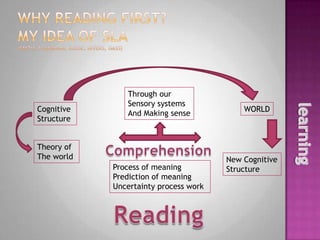
Why reading first?My idea of SLA (Smith, Flanagan, Deese, Rivers, Gass)Through ourSensory systems And Making senseCognitiveStructure WORLDlearningComprehensionTheory ofThe world New CognitiveStructure Process of meaningPrediction of meaningUncertainty process work Reading
Defining readingRead the following text…
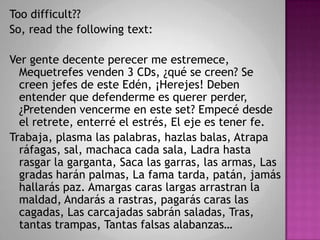
Too difficult??So, read the following text:Ver gente decente perecer me estremece, Mequetrefes venden 3 CDs, ¿qué se creen? Se creen jefes de este Edén, ¡Herejes! Deben entender que defenderme es querer perder, ¿Pretenden vencerme en este set? Empecé desde el retrete, enterré el estrés, El eje es tener fe.Trabaja, plasma las palabras, hazlas balas, Atrapa ráfagas, sal, machaca cada sala, Ladra hasta rasgar la garganta, Saca las garras, las armas, Las gradas harán palmas, La fama tarda, patán, jamás hallarás paz. Amargas caras largas arrastran la maldad, Andarás a rastras, pagarás caras las cagadas, Las carcajadas sabrán saladas, Tras, tantas trampas, Tantas falsas alabanzas…
Defining readingWhat did you do to understand the text?So, what’s reading?It is the ability to process a text through decoding, interpreting, and understanding it. (Brown, 2004)It is a process of negotiating meaning. A dialogue between the reader and the writer.(Widdowson, 1984, 1990)
Reading importance in slaReading is important because much info you need to know is communicated via written texts.We need reading to function in this modern society.It is a readily available exposure to the TL.It opens up worlds.It brings prior knowledge, cognitive development, and text processing. (Barnet, 1989)It is a social and cultural event involving written language. (Smith, 1984)
The reader and the text/testGrabe (1991)The reader approaches the text/test by careful reading and using her/his skills with clear objectives. During reading, the reader discards, reuses, and implements different strategies to interpret the text.The reader then has to activate meta cognitive awareness of the interpretation process and of individual processing strategies.
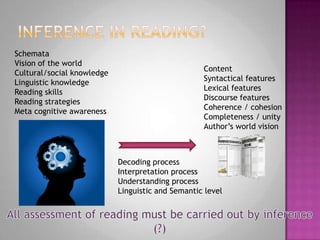
Inference in reading?SchemataVision of the worldCultural/social knowledgeLinguistic knowledgeReading skillsReading strategiesMeta cognitive awarenessContentSyntactical featuresLexical featuresDiscourse featuresCoherence / cohesionCompleteness / unityAuthor’s world visionDecoding processInterpretation processUnderstanding processLinguistic and Semantic levelAll assessment of reading must be carried out by inference (?)
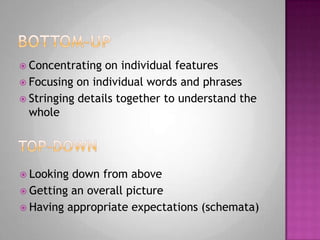
Bottom-upConcentrating on individual featuresFocusing on individual words and phrasesStringing details together to understand the wholeTop-downLooking down from above
Getting an overall picture
Having appropriate expectations (schemata)
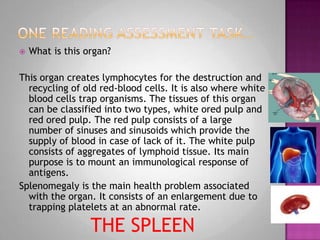
One reading assessment task…What is this organ?This organ creates lymphocytes for the destruction and recycling of old red-blood cells. It is also where white blood cells trap organisms. The tissues of this organ can be classified into two types, white ored pulp and red ored pulp. The red pulp consists of a large number of sinuses and sinusoids which provide the supply of blood in case of lack of it. The white pulp consists of aggregates of lymphoid tissue. Its main purpose is to mount an immunological response of antigens.Splenomegalyis the main health problem associated with the organ. It consists of an enlargement due to trapping platelets at an abnormal rate.THE SPLEEN
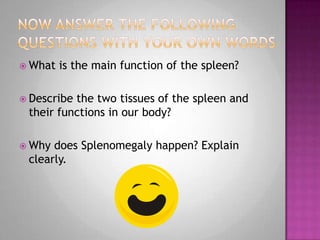
Now answer the following questions with your own wordsWhat is the main function of the spleen?Describe the two tissues of the spleen and their functions in our body?Why does Splenomegaly happen? Explain clearly.
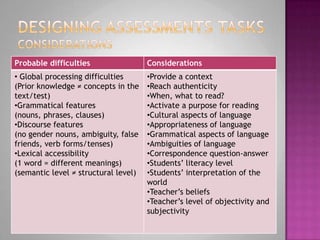
Designing assessments tasksconsiderations

Presentation assessing reading

  • 1.
  • 2.
    agendaWhy reading first?DefiningreadingReading importance in SLAThe reader and the text/testInference in reading?Bottom-up and top-downDesigning assessment tasks (what to consider?)
  • 3.
    Why reading first?Myidea of SLA (Smith, Flanagan, Deese, Rivers, Gass)Through ourSensory systems And Making senseCognitiveStructure WORLDlearningComprehensionTheory ofThe world New CognitiveStructure Process of meaningPrediction of meaningUncertainty process work Reading
  • 4.
    Defining readingRead thefollowing text…
  • 5.
    Too difficult??So, readthe following text:Ver gente decente perecer me estremece, Mequetrefes venden 3 CDs, ¿qué se creen? Se creen jefes de este Edén, ¡Herejes! Deben entender que defenderme es querer perder, ¿Pretenden vencerme en este set? Empecé desde el retrete, enterré el estrés, El eje es tener fe.Trabaja, plasma las palabras, hazlas balas, Atrapa ráfagas, sal, machaca cada sala, Ladra hasta rasgar la garganta, Saca las garras, las armas, Las gradas harán palmas, La fama tarda, patán, jamás hallarás paz. Amargas caras largas arrastran la maldad, Andarás a rastras, pagarás caras las cagadas, Las carcajadas sabrán saladas, Tras, tantas trampas, Tantas falsas alabanzas…
  • 6.
    Defining readingWhat didyou do to understand the text?So, what’s reading?It is the ability to process a text through decoding, interpreting, and understanding it. (Brown, 2004)It is a process of negotiating meaning. A dialogue between the reader and the writer.(Widdowson, 1984, 1990)
  • 7.
    Reading importance inslaReading is important because much info you need to know is communicated via written texts.We need reading to function in this modern society.It is a readily available exposure to the TL.It opens up worlds.It brings prior knowledge, cognitive development, and text processing. (Barnet, 1989)It is a social and cultural event involving written language. (Smith, 1984)
  • 8.
    The reader andthe text/testGrabe (1991)The reader approaches the text/test by careful reading and using her/his skills with clear objectives. During reading, the reader discards, reuses, and implements different strategies to interpret the text.The reader then has to activate meta cognitive awareness of the interpretation process and of individual processing strategies.
  • 9.
    Inference in reading?SchemataVisionof the worldCultural/social knowledgeLinguistic knowledgeReading skillsReading strategiesMeta cognitive awarenessContentSyntactical featuresLexical featuresDiscourse featuresCoherence / cohesionCompleteness / unityAuthor’s world visionDecoding processInterpretation processUnderstanding processLinguistic and Semantic levelAll assessment of reading must be carried out by inference (?)
  • 10.
    Bottom-upConcentrating on individualfeaturesFocusing on individual words and phrasesStringing details together to understand the wholeTop-downLooking down from above
  • 11.
  • 12.
  • 13.
    One reading assessmenttask…What is this organ?This organ creates lymphocytes for the destruction and recycling of old red-blood cells. It is also where white blood cells trap organisms. The tissues of this organ can be classified into two types, white ored pulp and red ored pulp. The red pulp consists of a large number of sinuses and sinusoids which provide the supply of blood in case of lack of it. The white pulp consists of aggregates of lymphoid tissue. Its main purpose is to mount an immunological response of antigens.Splenomegalyis the main health problem associated with the organ. It consists of an enlargement due to trapping platelets at an abnormal rate.THE SPLEEN
  • 14.
    Now answer thefollowing questions with your own wordsWhat is the main function of the spleen?Describe the two tissues of the spleen and their functions in our body?Why does Splenomegaly happen? Explain clearly.
  • 15.