Cathy C. Suarez 
BBL 5053 
University of Texas as San Antonio
Reading is _c_o_m_p_lic_a_t_e_d___. 
 Alderson (2000) describes reading as , “The most extensively 
researched and the most enigmatic of the so-called language skills.” 
 Goodman (1970) refers to reading as,” A psycholinguistic guessing-game.”
Key Points 
1. Overlap among the four skills 
2. Similarities in the types of performance among the four skills 
3. Assessment tasks: the most popular, most researched, most common 
and the oldest
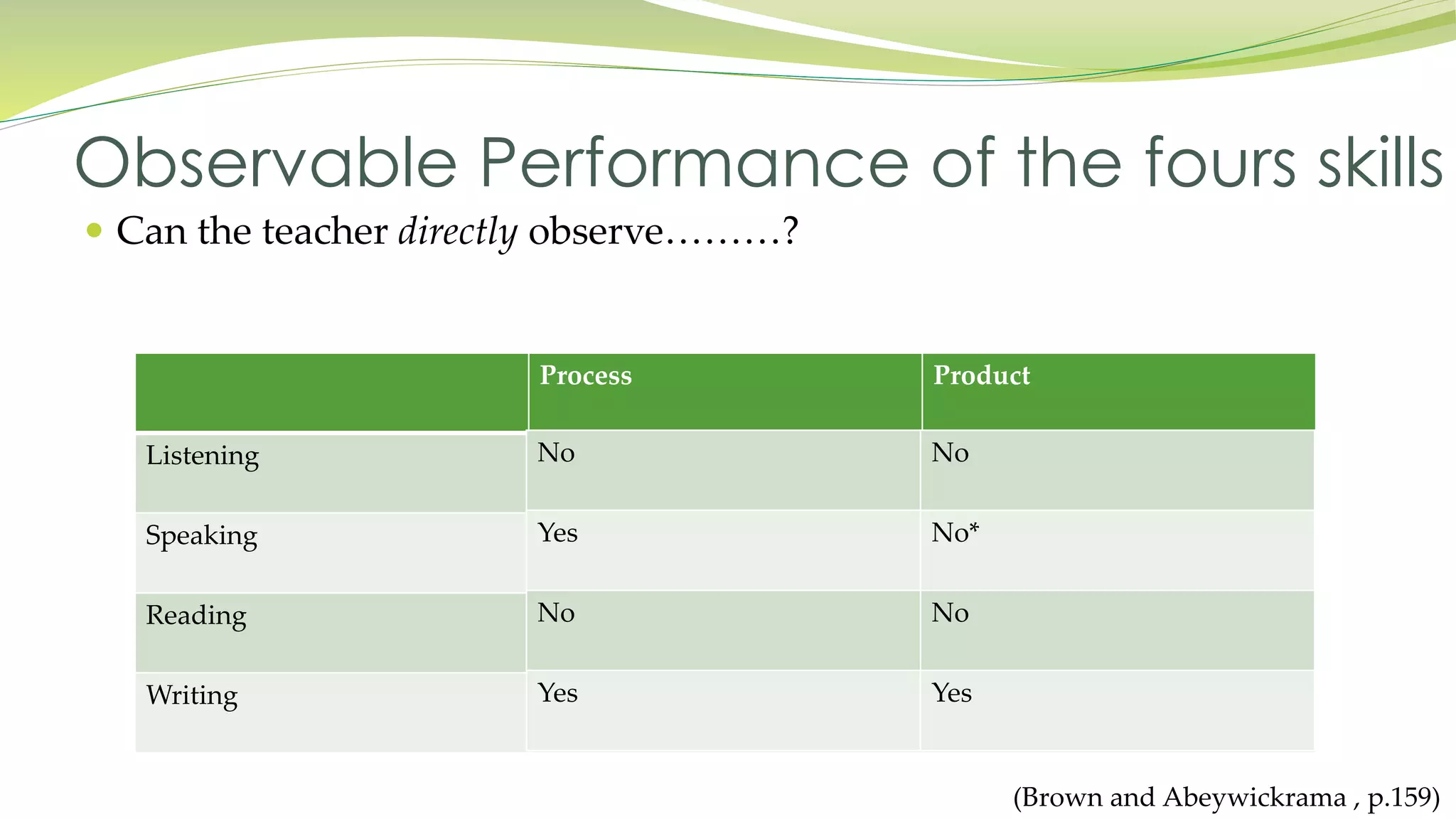
Observable Performance of the fours skills 
 Can the teacher directly observe………? 
Process Product 
Yes 
Yes Yes 
Listening 
Speaking 
Reading 
Writing 
(Brown and Abeywickrama , p.159) 
No No 
Yes No* 
No No 
Yes Yes
1. Reading Skills 
 Bottom up, top down, and schemata strategies 
 Micro and Macro skills for comprehension 
 Comprehension strategies
2. Types of Reading Performance 
● Perceptive: Letters, words, punctuation (Bottom-up processing) 
● Selective: assessment formats: picture cued-tasks, multiple-choice, 
matching, true/false 
● Interactive: reader interacts with the text, “the process of negotiating 
meaning” (Top-down processing) 
● Extensive: big picture understanding of longer texts
3. Assessment Tasks 
 Almost 20 types of tasks, corresponding to different types of reading 
performance 
 Over 30 examples, most with overlap of skills being assessed 
 Reading Aloud (S,R) 
 Written Response (R,W) 
 Picture cued-items(R, L) 
 Multiple-Choice (R) 
 Editing for grammatical 
errors (R) 
 Gap-Filling (S,R) 
 Matching (R) 
 Short-Answer Tasks (R,W) 
 Scanning (R) 
 Ordering Tasks (R) 
 Information Transfer (R,S,W) 
 Interpretation of graphic 
information ( R,S,W) 
 Skimming (R, S/W) 
 Summarizing and Responding 
(R,W) 
 Notetaking and Outlining (R,W)
Most popular, researched, oldest 
 Multiple-Choice (R) 
 Cloze Procedure (L,S,R, W) 
 Impromptu Reading with comprehension questions
Let’s Practice! 
 I wonder if the person next to me is really ____________. 
 I’m glad the presenter hasn’t put me to _______________. 
 Will they ever get the ____________ right in this classroom? 
 Is it 9:00 _________?
Summary 
 It is difficult to isolate reading from listening, speaking, and writing. 
Most assessment tasks overlap with at least one of the other skills. 
 Types of reading performance are similarly classified: 
 Selective and extensive reading, similar to listening 
 Similar to speaking there is interactive and extensive 
 There are numerous types of assessment tasks and variations to choose 
from.
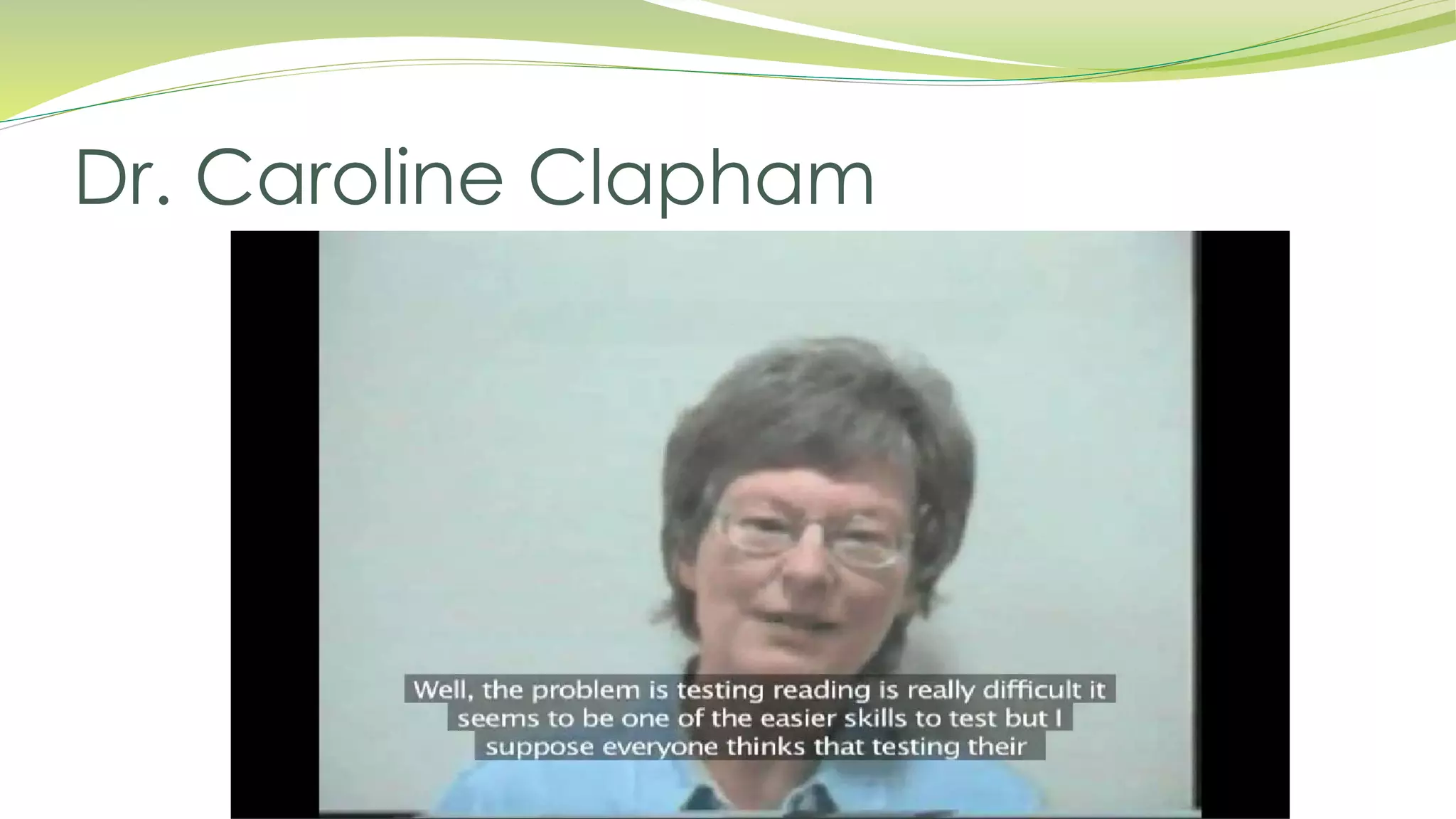
Dr. Caroline Clapham
References 
 Brown, H., & Abeywickrama, P. (2010). Language assessment: Principles and 
classroom practices (2nd ed.). White Plains, NY: Pearson Education. 
 Fulcher, G. and Thrasher, R. Language Testing Videos. In association with ILTA, 
available: http://languagetesting.info. Retrieved from 
http://languagetesting.info/video/main.html 
 Goodman, K. S. (1970). Reading: A Psycholinguistic Guessing Game. In D. V. 
Gunderson (Ed.), Language and Reading: An Interdisciplinary Approach. (pp. 107- 
119): CAL. Retrieved from 
https://login.libweb.lib.utsa.edu/login?url=http://search.proquest.com.libweb.lib.u 
tsa.edu/docview/54337249?accountid=7122

Assessing reading

  • 1.
    Cathy C. Suarez BBL 5053 University of Texas as San Antonio
  • 2.
    Reading is _c_o_m_p_lic_a_t_e_d___.  Alderson (2000) describes reading as , “The most extensively researched and the most enigmatic of the so-called language skills.”  Goodman (1970) refers to reading as,” A psycholinguistic guessing-game.”
  • 3.
    Key Points 1.Overlap among the four skills 2. Similarities in the types of performance among the four skills 3. Assessment tasks: the most popular, most researched, most common and the oldest
  • 4.
    Observable Performance ofthe fours skills  Can the teacher directly observe………? Process Product Yes Yes Yes Listening Speaking Reading Writing (Brown and Abeywickrama , p.159) No No Yes No* No No Yes Yes
  • 5.
    1. Reading Skills  Bottom up, top down, and schemata strategies  Micro and Macro skills for comprehension  Comprehension strategies
  • 6.
    2. Types ofReading Performance ● Perceptive: Letters, words, punctuation (Bottom-up processing) ● Selective: assessment formats: picture cued-tasks, multiple-choice, matching, true/false ● Interactive: reader interacts with the text, “the process of negotiating meaning” (Top-down processing) ● Extensive: big picture understanding of longer texts
  • 7.
    3. Assessment Tasks  Almost 20 types of tasks, corresponding to different types of reading performance  Over 30 examples, most with overlap of skills being assessed  Reading Aloud (S,R)  Written Response (R,W)  Picture cued-items(R, L)  Multiple-Choice (R)  Editing for grammatical errors (R)  Gap-Filling (S,R)  Matching (R)  Short-Answer Tasks (R,W)  Scanning (R)  Ordering Tasks (R)  Information Transfer (R,S,W)  Interpretation of graphic information ( R,S,W)  Skimming (R, S/W)  Summarizing and Responding (R,W)  Notetaking and Outlining (R,W)
  • 8.
    Most popular, researched,oldest  Multiple-Choice (R)  Cloze Procedure (L,S,R, W)  Impromptu Reading with comprehension questions
  • 9.
    Let’s Practice! I wonder if the person next to me is really ____________.  I’m glad the presenter hasn’t put me to _______________.  Will they ever get the ____________ right in this classroom?  Is it 9:00 _________?
  • 10.
    Summary  Itis difficult to isolate reading from listening, speaking, and writing. Most assessment tasks overlap with at least one of the other skills.  Types of reading performance are similarly classified:  Selective and extensive reading, similar to listening  Similar to speaking there is interactive and extensive  There are numerous types of assessment tasks and variations to choose from.
  • 11.
  • 12.
    References  Brown,H., & Abeywickrama, P. (2010). Language assessment: Principles and classroom practices (2nd ed.). White Plains, NY: Pearson Education.  Fulcher, G. and Thrasher, R. Language Testing Videos. In association with ILTA, available: http://languagetesting.info. Retrieved from http://languagetesting.info/video/main.html  Goodman, K. S. (1970). Reading: A Psycholinguistic Guessing Game. In D. V. Gunderson (Ed.), Language and Reading: An Interdisciplinary Approach. (pp. 107- 119): CAL. Retrieved from https://login.libweb.lib.utsa.edu/login?url=http://search.proquest.com.libweb.lib.u tsa.edu/docview/54337249?accountid=7122

Editor's Notes

  • #2 To begin, let’s make believe you are English Language Learners. I am going to use some SIOP strategies with you: gestures, build background information, interaction, and of course assessment.
  • #3 Let’s begin with An Activity that engages your listening, reading, writing and speaking skills. Please listen to my instructions and wait till I say, “Go!” Please take out a piece of paper and something to write with, or your electronic device. Complete the sentence by writing or typing your answer. When you are ready to read your answer to the class, please put 2 fingers on your nose. If I point to you, please tell us your answer. You will have 15 seconds to complete this task. Ready, Go! So who is ready to tell us your answer? Here’s what some experts quoted by the authors have to say. My answer is Reading is complicated!
  • #4 It is difficult to isolate from the other skills. Overlap exists among the skills and assessment tasks. There are also many similarities among the types of performance among the four skills. There are about 30 examples of assessment tasks described in the chapter. I will only mention aa few that have been described as the most popular, most, most common and oldest, which include: cloze, multiple-choice, and reading comprehension passages. .
  • #5 First let’s review what we discussed in last week’s presentation. Can the teacher directly observe the process and product………? 1st what is the difference? *Speaking-No, unless it’s videoed Brown and Abeywickrama (2010) inform, “All assessment of reading must be must be carried out by inference.”
  • #6 It is difficult to isolate from the other skills. Overlap exists among the skills and assessment tasks. Bottom up- processing letter, words, and phrases Top Down-comprehension strategies Schemata-applying background knowledge Micro-P 227 Discrimination of letters, retention of chunks in short term memory, process writing, recognizing grammatical forms and patterns Macro-making inferences, differentiating between literal and implied meaning, using schemata to derive meaning Comprehension Strategies-14 listed: author’s purpose, scanning for the gist, discourse markers, etc.
  • #7 Each of these comes with their own set of assessment tasks
  • #8 Each reading type has its own set of assessment tasks. Each set of tasks has variations and examples provided. There are over 30 mentioned in the chapter, most overlapping with speaking, listening and/or writing. Which tasks actually isolate reading skills? Perceptive Reading: Multiple Choice-Not just chose from a list-same/different, true/false, etc. Selective Reading: Editing-for grammatical errors . How many of you have taken this type of assessment? Who’s taken the (TOFEL) ? Matching-mostly used for vocabulary, eg. Our quiz Interactive Reading: Scanning-rapidly identifying the most relevant information Ordering-determining a logical order for given sentences In Extensive reading there are no tasks that measure reading in isolation (the last 3 on this slide). Does anyone have an idea why?
  • #9 Those were assessment tasks that isolate reading. These are the most popular, researched, oldest, and most common. Multiple-Choice for form focused-criteria : most popular method for assessing vocabulary and grammar, which is selective reading In interactive reading, the most popular and one of the most researched is the cloze procedure. Developed for native-language readers, some researchers in language acquisition field have defended it for 2nd language learners because it measures all 4 skills: L,S,R,W (See P 241 for examples) Also in interactive reading is Impromptu Reading with comprehension Questions: oldest and most common. Traditional read a passage and answer questions, eg. IELTS and TOEFL
  • #10 Please read to yourself. (L, R) Now read it to the slide to the person next to you. (R, S) The person who is listening will write your just your answers, not the entire sentence. (L, R, W, possibly S) Now switch places. (L, S, W) What does this type of activity assess?
  • #12 Noted researcher in 2nd language acquisition, and contributor to IELTS (International English Language Testing System)