READING ASSESSMENT
2ND GROUP:
1. Deni Rahmawati
2. Hapri Edayanti
3. Isna Mufida
4. Putri Maya Alimah
5. Quruin Fitrianingsih
6. Umi Sholihah
7. Yan Jati Rifa’i
Leading Lecturer:
Ida Isnawati, M.Pd
www.google.co.id/search?q=gambar+kartu
n+anak+flu&biw
Reading assessment
Begin by examining the nature of reading and the
relationship between reading in the 1st language and 2nd
language
Provide step by step procedures for assessing
reading with English language learners (ELLs)
Elaborate on a number of instructional
activities for reading that can be particularly
useful for assessment
Suggest ways for documenting teacher
observations of reading, developing reading or
writing portfolios, and using reading assessment
results for instruction
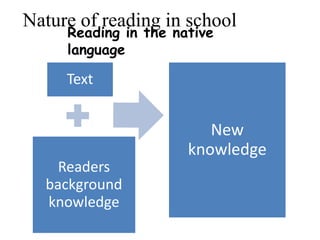
Nature of reading in school
Reading in the native
language
Text
Readers
background
knowledge
New
knowledge
Reading in a 2nd language
• Similar to those acquired in the 1st language in
that they call knowledge of sound or symbol
relationships, syntax, grammar, and semantics to
predict and confirm meaning (peregoy and boyle
1993).
• 2nd language readers use their background
knowledge regarding the topic, text structure,
their knowledge of the world, and their
knowledge of print to interact with printed page
and to make prediction.
The important differences
between 1st and 2nd language
reading
• Language proficiency and experiences of the
students. They have varied levels of language
proficiency in that language.
• They may be in the process of acquiring oral
language while also developing literacy skills in
English.
• They may have more varied levels of
background knowledge and educational
experience
Models of reading
Bottom up
models
Top down
models
Interactive
models
4 components in reading programs:
• Extensive amounts of time in class for
reading
• Direct strategy instruction in reading
comprehension
• Opportunities for colaboration
• Opportunities for discussions on
responses to reading
There is evidence that phonemics awareness is
a necessary but not sufficient condition for
becoming an efficient reader (Pearson 1993)
Phonics
Whole
language
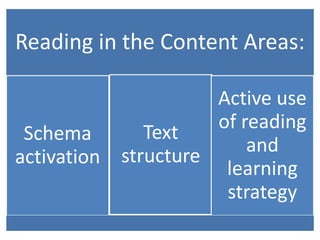
Reading in the Content Areas:
Schema
activation
Text
structure
Active use
of reading
and
learning
strategy
Implications for assessment
• The importance of determining students’ prior
knowledge
• Making students accountable for how they use
reading time in class
• Assessing students progress in acquiring both
decoding skills and reading comprehension
strategies
• Observing how students collaborate in groups as
well as how they work individually
• Reviewing students’ personal responses to
reading
Teacher consideration in student
evaluation
• Familiar with developmental learning processes and
curriculum
• Assessment and evaluation philosophy
• Know about and have experience collecting,
recording, interpreting, and analyzing multiple
sources of data
• Flexible and willing to try out multiple assessment
procedures
• Commit to understand and implement an approach
to evaluation that informs students and direct
instruction
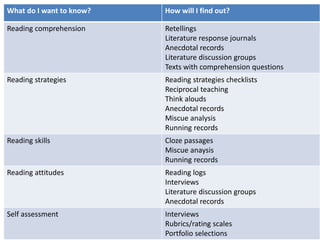
What do I want to know? How will I find out?
Reading comprehension Retellings
Literature response journals
Anecdotal records
Literature discussion groups
Texts with comprehension questions
Reading strategies Reading strategies checklists
Reciprocal teaching
Think alouds
Anecdotal records
Miscue analysis
Running records
Reading skills Cloze passages
Miscue anaysis
Running records
Reading attitudes Reading logs
Interviews
Literature discussion groups
Anecdotal records
Self assessment Interviews
Rubrics/rating scales
Portfolio selections
Authentic Assessment of Reading
Indentify Purpose
 Studying, evaluating, or diagnosing reading
behavior
 Monitoring student progress
 Supplementing and confirming information
gained from standardized and criterion-
referenced tests.
 Obtaining information not available from
other sources (Johns 1982)
Purpose for second language learners:
 Initial identification and placement of
students in need of language-based program,
such as ESL or bilingual education.
 Assessment for one level to another within a
given program.
 Placement out of an ESL/ bilingual program
and into a grade-level classroom.
 Placement in a Chapter 1 (Title 1) or special
education classroom.
 Graduation from high school.
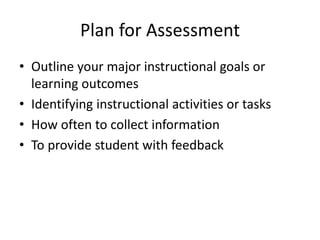
Plan for Assessment
• Outline your major instructional goals or
learning outcomes
• Identifying instructional activities or tasks
• How often to collect information
• To provide student with feedback
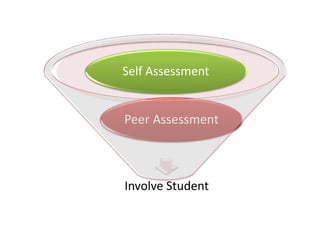
Involve Student
Peer Assessment
Self Assessment
DEVELOP RUBRICS/SCORING
PROCEDURES
• Criteria should be stated in terms of what
students can do rather than what they can not
do
• Use a model scoring rubric that you can ask
colleagues for feedback on
• Areas to be assessed includes: reading
comprehension, use of reading strategies,
decoding skills, response to reading, and
students choice in reading.
Types of Rubrics
1. Holistic Rubric
2. Analytic Rubric
SET STANDARDS
• It can be set by establishing cut-off scores on a
scoring rubric or rating scale
• Each category or level needs to be defined by
criteria to be clearly distinct from the next
level
Literature Discussion Groups
Heterogeneous
small group
Student-
directed
Teacher-
guided
Cloze Tests
Reading passages with blanks representing
words that have been deleted from the
original passage.
Types of cloze test:
 Fixed ratio cloze
Rational/purposive deletion colze
Maze technique
Limited/multiple-choice cloze
Texts with Comprehension Question
Teacher makes a copy of one page from a short
reading passage students have been asked to
read.
Students respond independently to several
comprehension questions posed by teacher.
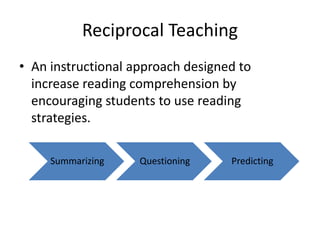
Reciprocal Teaching
• An instructional approach designed to
increase reading comprehension by
encouraging students to use reading
strategies.
Summarizing Questioning Predicting
1. Think-Alouds, Probes, and Interviews
2. Strategies Checklists or Rating Scale
3. Miscue Analysis and Running Records
4. Anecdotal Records
Think-Alouds are…
• Interactive and focus on ACTIVE
CONSTRUCTION of meaning that emphasizes
the use of prior knowledge.
Probes and individual student interviews
• Allow the teacher to discuss reading attitudes
with students, ask questions, and obtain
information on reading strategies.
Think-Alouds
• The teacher can ask
students to:
1. Look at the title and the
meaning of it,
2. Show their expectation in
reading a book,
3. Run the problems in
guessing the meaning of
words.
Probes, and Interview
• Here are some guiding
questions to use in students
interviews:
1. Do you like to read?
2. What do you like to read?
3. What your favorite novel?
4. How many times do you
spend to read?
5. Etc.
It done during teaching-and-
learning period. Think-
Alouds firstly conducted in a
whole class activity, then by
groups, and the last is
individually, more difficult
It’s useful conducting in
the beginning of school
years. This interview
characteristic is for
individual students,
easier
VS
• Checklists are list of
characteristics or behaviors that
scored as yes/no ratings. (Herman,
Ascbacher, and Winters, 1992)
• The checklists process might be
used to assess whether students
have engaged in various processes,
like required for working in small
groups, conducting a research
report, etc.
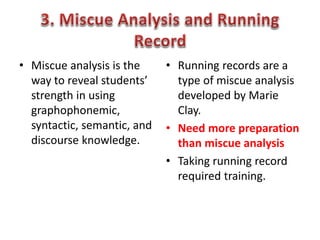
• Miscue analysis is the
way to reveal students’
strength in using
graphophonemic,
syntactic, semantic, and
discourse knowledge.
• Running records are a
type of miscue analysis
developed by Marie
Clay.
• Need more preparation
than miscue analysis
• Taking running record
required training.
4. Anecdotal Records
Definition:
As described in Chapter 4, anecdotal records are
typically brief comments specific to how a students
is performing and what he/she needs to improve
(follow-up)
WHAT IS
ANECDOTAL
RECORDS???
Anecdotal records are observational
notations describing language and
social development at a specific in
time (Routman, 1994)
READING/WRITING PORTOFOLIOS
Reading logs
Samples of students writing
Reading response journal
Anecdotal records
etc
Somewhat considered difficult
Teachers
have too
little time
Teachers
don’t
know how
to decide
what goes
inside
Teachers
don’t
know how
to begin to
evaluate
portfolios
Suggestions considered to design
reading/writing portfolios
portfolios can be compiled which document which documents each student’s growth in reading
Portfolios are being used only a limited manner
Portfolios is different from collection
Using reading assessment in
instruction
Result of authentic assessment of reading can
be used in a number ways
Informing program
placement
Determining grades
Improving instruction
Notice what students say about reading and
writing and how they use literacy in daily task
Make hyphothesis about what students need
and check against various sources of information
Use multiple assessments across time

Reading assessment

  • 1.
    READING ASSESSMENT 2ND GROUP: 1.Deni Rahmawati 2. Hapri Edayanti 3. Isna Mufida 4. Putri Maya Alimah 5. Quruin Fitrianingsih 6. Umi Sholihah 7. Yan Jati Rifa’i Leading Lecturer: Ida Isnawati, M.Pd www.google.co.id/search?q=gambar+kartu n+anak+flu&biw
  • 2.
    Reading assessment Begin byexamining the nature of reading and the relationship between reading in the 1st language and 2nd language Provide step by step procedures for assessing reading with English language learners (ELLs) Elaborate on a number of instructional activities for reading that can be particularly useful for assessment Suggest ways for documenting teacher observations of reading, developing reading or writing portfolios, and using reading assessment results for instruction
  • 3.
    Nature of readingin school Reading in the native language Text Readers background knowledge New knowledge
  • 4.
    Reading in a2nd language • Similar to those acquired in the 1st language in that they call knowledge of sound or symbol relationships, syntax, grammar, and semantics to predict and confirm meaning (peregoy and boyle 1993). • 2nd language readers use their background knowledge regarding the topic, text structure, their knowledge of the world, and their knowledge of print to interact with printed page and to make prediction.
  • 5.
    The important differences between1st and 2nd language reading • Language proficiency and experiences of the students. They have varied levels of language proficiency in that language. • They may be in the process of acquiring oral language while also developing literacy skills in English. • They may have more varied levels of background knowledge and educational experience
  • 6.
    Models of reading Bottomup models Top down models Interactive models
  • 7.
    4 components inreading programs: • Extensive amounts of time in class for reading • Direct strategy instruction in reading comprehension • Opportunities for colaboration • Opportunities for discussions on responses to reading
  • 8.
    There is evidencethat phonemics awareness is a necessary but not sufficient condition for becoming an efficient reader (Pearson 1993) Phonics Whole language
  • 9.
    Reading in theContent Areas: Schema activation Text structure Active use of reading and learning strategy
  • 10.
    Implications for assessment •The importance of determining students’ prior knowledge • Making students accountable for how they use reading time in class • Assessing students progress in acquiring both decoding skills and reading comprehension strategies • Observing how students collaborate in groups as well as how they work individually • Reviewing students’ personal responses to reading
  • 11.
    Teacher consideration instudent evaluation • Familiar with developmental learning processes and curriculum • Assessment and evaluation philosophy • Know about and have experience collecting, recording, interpreting, and analyzing multiple sources of data • Flexible and willing to try out multiple assessment procedures • Commit to understand and implement an approach to evaluation that informs students and direct instruction
  • 12.
    What do Iwant to know? How will I find out? Reading comprehension Retellings Literature response journals Anecdotal records Literature discussion groups Texts with comprehension questions Reading strategies Reading strategies checklists Reciprocal teaching Think alouds Anecdotal records Miscue analysis Running records Reading skills Cloze passages Miscue anaysis Running records Reading attitudes Reading logs Interviews Literature discussion groups Anecdotal records Self assessment Interviews Rubrics/rating scales Portfolio selections
  • 13.
    Authentic Assessment ofReading Indentify Purpose  Studying, evaluating, or diagnosing reading behavior  Monitoring student progress  Supplementing and confirming information gained from standardized and criterion- referenced tests.  Obtaining information not available from other sources (Johns 1982)
  • 14.
    Purpose for secondlanguage learners:  Initial identification and placement of students in need of language-based program, such as ESL or bilingual education.  Assessment for one level to another within a given program.  Placement out of an ESL/ bilingual program and into a grade-level classroom.  Placement in a Chapter 1 (Title 1) or special education classroom.  Graduation from high school.
  • 15.
    Plan for Assessment •Outline your major instructional goals or learning outcomes • Identifying instructional activities or tasks • How often to collect information • To provide student with feedback
  • 16.
  • 17.
    DEVELOP RUBRICS/SCORING PROCEDURES • Criteriashould be stated in terms of what students can do rather than what they can not do • Use a model scoring rubric that you can ask colleagues for feedback on • Areas to be assessed includes: reading comprehension, use of reading strategies, decoding skills, response to reading, and students choice in reading.
  • 18.
    Types of Rubrics 1.Holistic Rubric 2. Analytic Rubric
  • 19.
    SET STANDARDS • Itcan be set by establishing cut-off scores on a scoring rubric or rating scale • Each category or level needs to be defined by criteria to be clearly distinct from the next level
  • 20.
    Literature Discussion Groups Heterogeneous smallgroup Student- directed Teacher- guided
  • 21.
    Cloze Tests Reading passageswith blanks representing words that have been deleted from the original passage. Types of cloze test:  Fixed ratio cloze Rational/purposive deletion colze Maze technique Limited/multiple-choice cloze
  • 22.
    Texts with ComprehensionQuestion Teacher makes a copy of one page from a short reading passage students have been asked to read. Students respond independently to several comprehension questions posed by teacher.
  • 23.
    Reciprocal Teaching • Aninstructional approach designed to increase reading comprehension by encouraging students to use reading strategies. Summarizing Questioning Predicting
  • 24.
    1. Think-Alouds, Probes,and Interviews 2. Strategies Checklists or Rating Scale 3. Miscue Analysis and Running Records 4. Anecdotal Records
  • 25.
    Think-Alouds are… • Interactiveand focus on ACTIVE CONSTRUCTION of meaning that emphasizes the use of prior knowledge. Probes and individual student interviews • Allow the teacher to discuss reading attitudes with students, ask questions, and obtain information on reading strategies.
  • 26.
    Think-Alouds • The teachercan ask students to: 1. Look at the title and the meaning of it, 2. Show their expectation in reading a book, 3. Run the problems in guessing the meaning of words. Probes, and Interview • Here are some guiding questions to use in students interviews: 1. Do you like to read? 2. What do you like to read? 3. What your favorite novel? 4. How many times do you spend to read? 5. Etc. It done during teaching-and- learning period. Think- Alouds firstly conducted in a whole class activity, then by groups, and the last is individually, more difficult It’s useful conducting in the beginning of school years. This interview characteristic is for individual students, easier VS
  • 27.
    • Checklists arelist of characteristics or behaviors that scored as yes/no ratings. (Herman, Ascbacher, and Winters, 1992) • The checklists process might be used to assess whether students have engaged in various processes, like required for working in small groups, conducting a research report, etc.
  • 28.
    • Miscue analysisis the way to reveal students’ strength in using graphophonemic, syntactic, semantic, and discourse knowledge. • Running records are a type of miscue analysis developed by Marie Clay. • Need more preparation than miscue analysis • Taking running record required training.
  • 29.
    4. Anecdotal Records Definition: Asdescribed in Chapter 4, anecdotal records are typically brief comments specific to how a students is performing and what he/she needs to improve (follow-up) WHAT IS ANECDOTAL RECORDS??? Anecdotal records are observational notations describing language and social development at a specific in time (Routman, 1994)
  • 30.
    READING/WRITING PORTOFOLIOS Reading logs Samplesof students writing Reading response journal Anecdotal records etc
  • 31.
    Somewhat considered difficult Teachers havetoo little time Teachers don’t know how to decide what goes inside Teachers don’t know how to begin to evaluate portfolios
  • 32.
    Suggestions considered todesign reading/writing portfolios portfolios can be compiled which document which documents each student’s growth in reading Portfolios are being used only a limited manner Portfolios is different from collection
  • 33.
    Using reading assessmentin instruction Result of authentic assessment of reading can be used in a number ways Informing program placement Determining grades Improving instruction
  • 34.
    Notice what studentssay about reading and writing and how they use literacy in daily task Make hyphothesis about what students need and check against various sources of information Use multiple assessments across time