IELTS PASS
Introduction IELTS
IELTS Pass: Unit 1
What is IELTS?
IELTS, the International English Language Testing System, is designed to
assess the language ability of people who want to study or work where
English is the language of communication.
IELTS is recognized and accepted by over 9,000 organizations
worldwide, including universities, employers, professional bodies,
immigration authorities and other government agencies. For a list of
organizations that accept IELTS scores, visit www.ielts.org/recognition.
Why take IELTS?
Accessible and convenient
IELTS is offered up to four times a month in more than 130 countries.
Tests are held on Saturdays and Thursdays. To find out test dates in
your area, please contact your nearest IELTS test centre. A list of all
IELTS test locations worldwide is available at www.ielts.org.
The International Test
IELTS is internationally focused in its content. For example, texts and
tasks are sourced from publications from all over the English-speaking
world; a range of native-speaker accents (North American, Australian,
New Zealand, British etc.) are used in the Listening test; and all
standard varieties of English are accepted in test takers’ written and
spoken responses.
The Test That’s Tried and Trusted
IELTS has been developed by some of the world’s leading experts in
language assessment, and is supported by an extensive programme of
research, validation and test development.
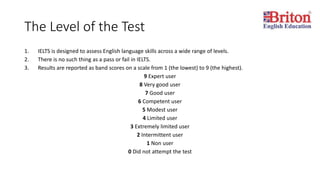
The Level of the Test
1. IELTS is designed to assess English language skills across a wide range of levels.
2. There is no such thing as a pass or fail in IELTS.
3. Results are reported as band scores on a scale from 1 (the lowest) to 9 (the highest).
9 Expert user
8 Very good user
7 Good user
6 Competent user
5 Modest user
4 Limited user
3 Extremely limited user
2 Intermittent user
1 Non user
0 Did not attempt the test
General Strategies
1. Make sure you are ready to demonstrate your English
2. Familiarize yourself with the format of the test.
3. Practice, practice & practice
4. Consider doing a practice test. Two volumes of Official IELTS Practice Materials
are available for purchase from test centers or at www.ielts.org/testtakers.
These materials include a full practice test with answers, and sample Writing
and Speaking performances with examiner comments.
5. Consider enrolling in a preparation course to improve your performance in the
test. IELTS test centers and language schools around the world offer IELTS
preparation courses.
6. More information is available from: www.ielts.org
www.britishcouncil.org/takeielts www.ieltsessentials.com/prepare
www.cambridgeenglish.org/ielts www.ielts.org/usa
Test Format
1. Types of the test:
• IELTS Academic is for test takers wishing to study at undergraduate or
postgraduate levels, and for those seeking professional registration.
• IELTS General Training is for test takers wishing to migrate to an English-
speaking country (Australia, Canada, New Zealand, UK), and for those wishing
to train or study at below degree level.
2. Sequence of the test:
• The Listening, Reading and Writing tests must be completed on the same day.
• The order in which these tests are taken may vary.
• There are no breaks between these three tests.
• The Speaking test may be taken up to seven days before or after the other
three tests.
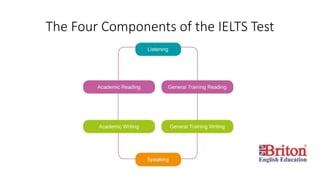
The Four Components of the IELTS Test
Listening
1. Timing: Approximately 30 minutes (plus 10 minutes’ transfer time).
2. Questions: There are 40 questions.
3. A variety of question types are used, chosen from the following:
4. multiple choice, matching, plan/ map/diagram labelling, form completion, note completion,
table completion, flow-chart completion, summary completion, sentence completion, short-
answer questions.
5. Test Parts: There are 4 sections:
 Section 1 is a conversation between two people set in an everyday social context (e.g. a conversation in an
accommodation agency).
 Section 2 is a monologue set in an everyday social context (e.g. a speech about local facilities or a talk about
the arrangements for meals during a conference).
 Section 3 is a conversation between up to four people set in an educational or training context (e.g. a
university tutor and a student discussing an assignment, or a group of students planning a research project).
 Section 4 is a monologue on an academic subject (e.g. a university lecture).
6. Each section is heard once only.
7. A variety of voices and native-speaker accents are used.
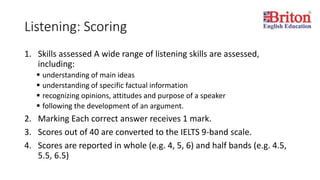
Listening: Scoring
1. Skills assessed A wide range of listening skills are assessed,
including:
 understanding of main ideas
 understanding of specific factual information
 recognizing opinions, attitudes and purpose of a speaker
 following the development of an argument.
2. Marking Each correct answer receives 1 mark.
3. Scores out of 40 are converted to the IELTS 9-band scale.
4. Scores are reported in whole (e.g. 4, 5, 6) and half bands (e.g. 4.5,
5.5, 6.5)
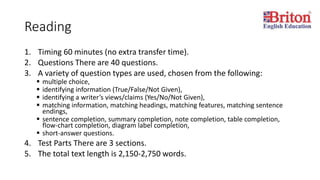
Reading
1. Timing 60 minutes (no extra transfer time).
2. Questions There are 40 questions.
3. A variety of question types are used, chosen from the following:
 multiple choice,
 identifying information (True/False/Not Given),
 identifying a writer’s views/claims (Yes/No/Not Given),
 matching information, matching headings, matching features, matching sentence
endings,
 sentence completion, summary completion, note completion, table completion,
flow-chart completion, diagram label completion,
 short-answer questions.
4. Test Parts There are 3 sections.
5. The total text length is 2,150-2,750 words.
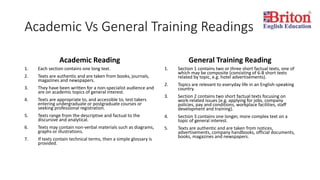
Academic Vs General Training Readings
Academic Reading
1. Each section contains one long text.
2. Texts are authentic and are taken from books, journals,
magazines and newspapers.
3. They have been written for a non-specialist audience and
are on academic topics of general interest.
4. Texts are appropriate to, and accessible to, test takers
entering undergraduate or postgraduate courses or
seeking professional registration.
5. Texts range from the descriptive and factual to the
discursive and analytical.
6. Texts may contain non-verbal materials such as diagrams,
graphs or illustrations.
7. If texts contain technical terms, then a simple glossary is
provided.
General Training Reading
1. Section 1 contains two or three short factual texts, one of
which may be composite (consisting of 6-8 short texts
related by topic, e.g. hotel advertisements).
2. Topics are relevant to everyday life in an English-speaking
country.
3. Section 2 contains two short factual texts focusing on
work-related issues (e.g. applying for jobs, company
policies, pay and conditions, workplace facilities, staff
development and training).
4. Section 3 contains one longer, more complex text on a
topic of general interest.
5. Texts are authentic and are taken from notices,
advertisements, company handbooks, official documents,
books, magazines and newspapers.
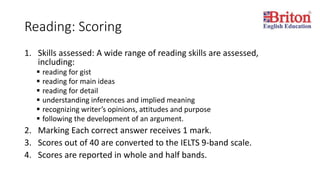
Reading: Scoring
1. Skills assessed: A wide range of reading skills are assessed,
including:
 reading for gist
 reading for main ideas
 reading for detail
 understanding inferences and implied meaning
 recognizing writer’s opinions, attitudes and purpose
 following the development of an argument.
2. Marking Each correct answer receives 1 mark.
3. Scores out of 40 are converted to the IELTS 9-band scale.
4. Scores are reported in whole and half bands.
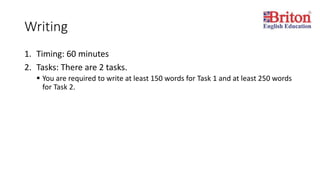
Writing
1. Timing: 60 minutes
2. Tasks: There are 2 tasks.
 You are required to write at least 150 words for Task 1 and at least 250 words
for Task 2.
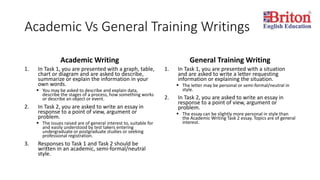
Academic Vs General Training Writings
Academic Writing
1. In Task 1, you are presented with a graph, table,
chart or diagram and are asked to describe,
summarize or explain the information in your
own words.
 You may be asked to describe and explain data,
describe the stages of a process, how something works
or describe an object or event.
2. In Task 2, you are asked to write an essay in
response to a point of view, argument or
problem.
 The issues raised are of general interest to, suitable for
and easily understood by test takers entering
undergraduate or postgraduate studies or seeking
professional registration.
3. Responses to Task 1 and Task 2 should be
written in an academic, semi-formal/neutral
style.
General Training Writing
1. In Task 1, you are presented with a situation
and are asked to write a letter requesting
information or explaining the situation.
 The letter may be personal or semi-formal/neutral in
style.
2. In Task 2, you are asked to write an essay in
response to a point of view, argument or
problem.
 The essay can be slightly more personal in style than
the Academic Writing Task 2 essay. Topics are of general
interest.
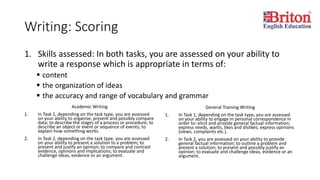
Writing: Scoring
1. Skills assessed: In both tasks, you are assessed on your ability to
write a response which is appropriate in terms of:
 content
 the organization of ideas
 the accuracy and range of vocabulary and grammar
Academic Writing
1. In Task 1, depending on the task type, you are assessed
on your ability to organise, present and possibly compare
data; to describe the stages of a process or procedure; to
describe an object or event or sequence of events; to
explain how something works.
2. In Task 2, depending on the task type, you are assessed
on your ability to present a solution to a problem; to
present and justify an opinion; to compare and contrast
evidence, opinions and implications; to evaluate and
challenge ideas, evidence or an argument.
General Training Writing
1. In Task 1, depending on the task type, you are assessed
on your ability to engage in personal correspondence in
order to: elicit and provide general factual information;
express needs, wants, likes and dislikes; express opinions
(views, complaints etc.).
2. In Task 2, you are assessed on your ability to provide
general factual information; to outline a problem and
present a solution; to present and possibly justify an
opinion; to evaluate and challenge ideas, evidence or an
argument.
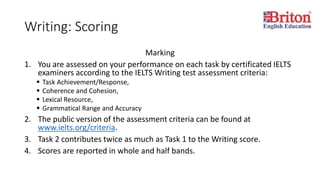
Writing: Scoring
Marking
1. You are assessed on your performance on each task by certificated IELTS
examiners according to the IELTS Writing test assessment criteria:
 Task Achievement/Response,
 Coherence and Cohesion,
 Lexical Resource,
 Grammatical Range and Accuracy
2. The public version of the assessment criteria can be found at
www.ielts.org/criteria.
3. Task 2 contributes twice as much as Task 1 to the Writing score.
4. Scores are reported in whole and half bands.
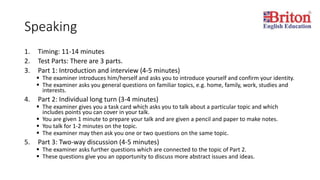
Speaking
1. Timing: 11-14 minutes
2. Test Parts: There are 3 parts.
3. Part 1: Introduction and interview (4-5 minutes)
 The examiner introduces him/herself and asks you to introduce yourself and confirm your identity.
 The examiner asks you general questions on familiar topics, e.g. home, family, work, studies and
interests.
4. Part 2: Individual long turn (3-4 minutes)
 The examiner gives you a task card which asks you to talk about a particular topic and which
includes points you can cover in your talk.
 You are given 1 minute to prepare your talk and are given a pencil and paper to make notes.
 You talk for 1-2 minutes on the topic.
 The examiner may then ask you one or two questions on the same topic.
5. Part 3: Two-way discussion (4-5 minutes)
 The examiner asks further questions which are connected to the topic of Part 2.
 These questions give you an opportunity to discuss more abstract issues and ideas.
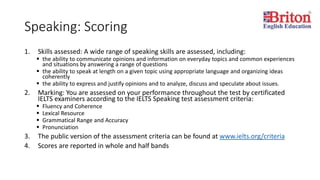
Speaking: Scoring
1. Skills assessed: A wide range of speaking skills are assessed, including:
 the ability to communicate opinions and information on everyday topics and common experiences
and situations by answering a range of questions
 the ability to speak at length on a given topic using appropriate language and organizing ideas
coherently
 the ability to express and justify opinions and to analyze, discuss and speculate about issues.
2. Marking: You are assessed on your performance throughout the test by certificated
IELTS examiners according to the IELTS Speaking test assessment criteria:
 Fluency and Coherence
 Lexical Resource
 Grammatical Range and Accuracy
 Pronunciation
3. The public version of the assessment criteria can be found at www.ielts.org/criteria
4. Scores are reported in whole and half bands

Introduction to ielts

  • 1.
  • 2.
  • 3.
    What is IELTS? IELTS,the International English Language Testing System, is designed to assess the language ability of people who want to study or work where English is the language of communication. IELTS is recognized and accepted by over 9,000 organizations worldwide, including universities, employers, professional bodies, immigration authorities and other government agencies. For a list of organizations that accept IELTS scores, visit www.ielts.org/recognition.
  • 4.
    Why take IELTS? Accessibleand convenient IELTS is offered up to four times a month in more than 130 countries. Tests are held on Saturdays and Thursdays. To find out test dates in your area, please contact your nearest IELTS test centre. A list of all IELTS test locations worldwide is available at www.ielts.org.
  • 5.
    The International Test IELTSis internationally focused in its content. For example, texts and tasks are sourced from publications from all over the English-speaking world; a range of native-speaker accents (North American, Australian, New Zealand, British etc.) are used in the Listening test; and all standard varieties of English are accepted in test takers’ written and spoken responses.
  • 6.
    The Test That’sTried and Trusted IELTS has been developed by some of the world’s leading experts in language assessment, and is supported by an extensive programme of research, validation and test development.
  • 7.
    The Level ofthe Test 1. IELTS is designed to assess English language skills across a wide range of levels. 2. There is no such thing as a pass or fail in IELTS. 3. Results are reported as band scores on a scale from 1 (the lowest) to 9 (the highest). 9 Expert user 8 Very good user 7 Good user 6 Competent user 5 Modest user 4 Limited user 3 Extremely limited user 2 Intermittent user 1 Non user 0 Did not attempt the test
  • 8.
    General Strategies 1. Makesure you are ready to demonstrate your English 2. Familiarize yourself with the format of the test. 3. Practice, practice & practice 4. Consider doing a practice test. Two volumes of Official IELTS Practice Materials are available for purchase from test centers or at www.ielts.org/testtakers. These materials include a full practice test with answers, and sample Writing and Speaking performances with examiner comments. 5. Consider enrolling in a preparation course to improve your performance in the test. IELTS test centers and language schools around the world offer IELTS preparation courses. 6. More information is available from: www.ielts.org www.britishcouncil.org/takeielts www.ieltsessentials.com/prepare www.cambridgeenglish.org/ielts www.ielts.org/usa
  • 9.
    Test Format 1. Typesof the test: • IELTS Academic is for test takers wishing to study at undergraduate or postgraduate levels, and for those seeking professional registration. • IELTS General Training is for test takers wishing to migrate to an English- speaking country (Australia, Canada, New Zealand, UK), and for those wishing to train or study at below degree level. 2. Sequence of the test: • The Listening, Reading and Writing tests must be completed on the same day. • The order in which these tests are taken may vary. • There are no breaks between these three tests. • The Speaking test may be taken up to seven days before or after the other three tests.
  • 10.
    The Four Componentsof the IELTS Test
  • 11.
    Listening 1. Timing: Approximately30 minutes (plus 10 minutes’ transfer time). 2. Questions: There are 40 questions. 3. A variety of question types are used, chosen from the following: 4. multiple choice, matching, plan/ map/diagram labelling, form completion, note completion, table completion, flow-chart completion, summary completion, sentence completion, short- answer questions. 5. Test Parts: There are 4 sections:  Section 1 is a conversation between two people set in an everyday social context (e.g. a conversation in an accommodation agency).  Section 2 is a monologue set in an everyday social context (e.g. a speech about local facilities or a talk about the arrangements for meals during a conference).  Section 3 is a conversation between up to four people set in an educational or training context (e.g. a university tutor and a student discussing an assignment, or a group of students planning a research project).  Section 4 is a monologue on an academic subject (e.g. a university lecture). 6. Each section is heard once only. 7. A variety of voices and native-speaker accents are used.
  • 12.
    Listening: Scoring 1. Skillsassessed A wide range of listening skills are assessed, including:  understanding of main ideas  understanding of specific factual information  recognizing opinions, attitudes and purpose of a speaker  following the development of an argument. 2. Marking Each correct answer receives 1 mark. 3. Scores out of 40 are converted to the IELTS 9-band scale. 4. Scores are reported in whole (e.g. 4, 5, 6) and half bands (e.g. 4.5, 5.5, 6.5)
  • 13.
    Reading 1. Timing 60minutes (no extra transfer time). 2. Questions There are 40 questions. 3. A variety of question types are used, chosen from the following:  multiple choice,  identifying information (True/False/Not Given),  identifying a writer’s views/claims (Yes/No/Not Given),  matching information, matching headings, matching features, matching sentence endings,  sentence completion, summary completion, note completion, table completion, flow-chart completion, diagram label completion,  short-answer questions. 4. Test Parts There are 3 sections. 5. The total text length is 2,150-2,750 words.
  • 14.
    Academic Vs GeneralTraining Readings Academic Reading 1. Each section contains one long text. 2. Texts are authentic and are taken from books, journals, magazines and newspapers. 3. They have been written for a non-specialist audience and are on academic topics of general interest. 4. Texts are appropriate to, and accessible to, test takers entering undergraduate or postgraduate courses or seeking professional registration. 5. Texts range from the descriptive and factual to the discursive and analytical. 6. Texts may contain non-verbal materials such as diagrams, graphs or illustrations. 7. If texts contain technical terms, then a simple glossary is provided. General Training Reading 1. Section 1 contains two or three short factual texts, one of which may be composite (consisting of 6-8 short texts related by topic, e.g. hotel advertisements). 2. Topics are relevant to everyday life in an English-speaking country. 3. Section 2 contains two short factual texts focusing on work-related issues (e.g. applying for jobs, company policies, pay and conditions, workplace facilities, staff development and training). 4. Section 3 contains one longer, more complex text on a topic of general interest. 5. Texts are authentic and are taken from notices, advertisements, company handbooks, official documents, books, magazines and newspapers.
  • 15.
    Reading: Scoring 1. Skillsassessed: A wide range of reading skills are assessed, including:  reading for gist  reading for main ideas  reading for detail  understanding inferences and implied meaning  recognizing writer’s opinions, attitudes and purpose  following the development of an argument. 2. Marking Each correct answer receives 1 mark. 3. Scores out of 40 are converted to the IELTS 9-band scale. 4. Scores are reported in whole and half bands.
  • 16.
    Writing 1. Timing: 60minutes 2. Tasks: There are 2 tasks.  You are required to write at least 150 words for Task 1 and at least 250 words for Task 2.
  • 17.
    Academic Vs GeneralTraining Writings Academic Writing 1. In Task 1, you are presented with a graph, table, chart or diagram and are asked to describe, summarize or explain the information in your own words.  You may be asked to describe and explain data, describe the stages of a process, how something works or describe an object or event. 2. In Task 2, you are asked to write an essay in response to a point of view, argument or problem.  The issues raised are of general interest to, suitable for and easily understood by test takers entering undergraduate or postgraduate studies or seeking professional registration. 3. Responses to Task 1 and Task 2 should be written in an academic, semi-formal/neutral style. General Training Writing 1. In Task 1, you are presented with a situation and are asked to write a letter requesting information or explaining the situation.  The letter may be personal or semi-formal/neutral in style. 2. In Task 2, you are asked to write an essay in response to a point of view, argument or problem.  The essay can be slightly more personal in style than the Academic Writing Task 2 essay. Topics are of general interest.
  • 18.
    Writing: Scoring 1. Skillsassessed: In both tasks, you are assessed on your ability to write a response which is appropriate in terms of:  content  the organization of ideas  the accuracy and range of vocabulary and grammar Academic Writing 1. In Task 1, depending on the task type, you are assessed on your ability to organise, present and possibly compare data; to describe the stages of a process or procedure; to describe an object or event or sequence of events; to explain how something works. 2. In Task 2, depending on the task type, you are assessed on your ability to present a solution to a problem; to present and justify an opinion; to compare and contrast evidence, opinions and implications; to evaluate and challenge ideas, evidence or an argument. General Training Writing 1. In Task 1, depending on the task type, you are assessed on your ability to engage in personal correspondence in order to: elicit and provide general factual information; express needs, wants, likes and dislikes; express opinions (views, complaints etc.). 2. In Task 2, you are assessed on your ability to provide general factual information; to outline a problem and present a solution; to present and possibly justify an opinion; to evaluate and challenge ideas, evidence or an argument.
  • 19.
    Writing: Scoring Marking 1. Youare assessed on your performance on each task by certificated IELTS examiners according to the IELTS Writing test assessment criteria:  Task Achievement/Response,  Coherence and Cohesion,  Lexical Resource,  Grammatical Range and Accuracy 2. The public version of the assessment criteria can be found at www.ielts.org/criteria. 3. Task 2 contributes twice as much as Task 1 to the Writing score. 4. Scores are reported in whole and half bands.
  • 20.
    Speaking 1. Timing: 11-14minutes 2. Test Parts: There are 3 parts. 3. Part 1: Introduction and interview (4-5 minutes)  The examiner introduces him/herself and asks you to introduce yourself and confirm your identity.  The examiner asks you general questions on familiar topics, e.g. home, family, work, studies and interests. 4. Part 2: Individual long turn (3-4 minutes)  The examiner gives you a task card which asks you to talk about a particular topic and which includes points you can cover in your talk.  You are given 1 minute to prepare your talk and are given a pencil and paper to make notes.  You talk for 1-2 minutes on the topic.  The examiner may then ask you one or two questions on the same topic. 5. Part 3: Two-way discussion (4-5 minutes)  The examiner asks further questions which are connected to the topic of Part 2.  These questions give you an opportunity to discuss more abstract issues and ideas.
  • 21.
    Speaking: Scoring 1. Skillsassessed: A wide range of speaking skills are assessed, including:  the ability to communicate opinions and information on everyday topics and common experiences and situations by answering a range of questions  the ability to speak at length on a given topic using appropriate language and organizing ideas coherently  the ability to express and justify opinions and to analyze, discuss and speculate about issues. 2. Marking: You are assessed on your performance throughout the test by certificated IELTS examiners according to the IELTS Speaking test assessment criteria:  Fluency and Coherence  Lexical Resource  Grammatical Range and Accuracy  Pronunciation 3. The public version of the assessment criteria can be found at www.ielts.org/criteria 4. Scores are reported in whole and half bands