By Diana Marcela Murcia
  Horasis Toro Vargas
      Omar Cruz
What is reading assessment?

 Is a process in which teachers use to measure the
 reading and comprehension skills of students.

 It requires planning and organization such as:
Identify the purpose.

 Studying, evaluating, or diagnosing sts reading
 behavior.

 Monitoring student progress.


 Identifying learners` needs.


                                                    3
Plan for assessment


        After having identified the assessment
         purpose………
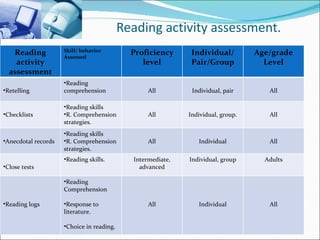
        Different types of reading assessment activities.


October 18, 2005   Copyright: Sarah L Swart, 2005.          4
Reading activity assessment.
                     Skill/ behavior
   Reading           Assessed
                                             Proficiency      Individual/         Age/grade
    activity                                    level         Pair/Group            Level
  assessment
                     •Reading
•Retelling           comprehension                All         Individual, pair       All

                     •Reading skills
•Checklists          •R. Comprehension            All        Individual, group.      All
                     strategies.
                     •Reading skills
•Anecdotal records   •R. Comprehension            All           Individual           All
                     strategies.
                     •Reading skills.        Intermediate,   Individual, group      Adults
•Close tests                                   advanced

                     •Reading
                     Comprehension

•Reading logs        •Response to                 All           Individual           All
                     literature.

                     •Choice in reading.
Involve Students


 Self-Assessment: is the process of looking at oneself in
  order to assess aspects that are important to one's identity.

 What have I learned about reading in the class?
 How do I feel about reading?
 What do I need to improve in reading?
 How do I read?
Involve Students


 Peer assessment: is the assessment of student work by other
  students. This might be used for formative feedback or summative
  grading purposes.


                                                                     7
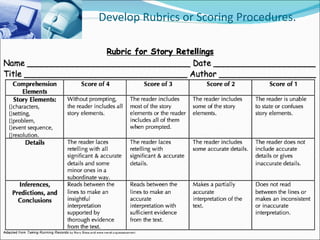
Develop Rubrics or Scoring Procedures.
SET STANDARDS

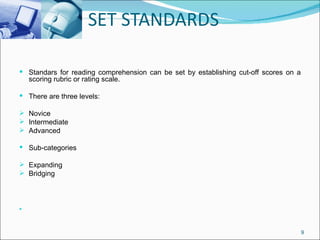
 Standars for reading comprehension can be set by establishing cut-off scores on a
    scoring rubric or rating scale.

 There are three levels:

 Novice
 Intermediate
 Advanced

 Sub-categories

 Expanding
 Bridging





                                                                                      9
SELECT ASSESSMENT
                 ACTIVITIES

 Assessment of reading should be embedded in activities for teaching
    reading.
   Instructional activities
   Retelling
   Reading logs
   Literature respose logs/ jornals
   Literature discussion group
   Cloze tests
   Text with comprehension questions
   Reciprocal teaching


                                                                    10
Pa had to Walk to
 In the                           town with his big
 woods.                          bundle of furs, but
 It was                           he couldn´t take
Snowing.           Title              his gun.
           little house in the
           big wood.

                  Author
           l.i. Wilde

                                        He would
                                         walk fast.
    Pa                                  He would
    Ma                                 return soon.
Title      Author      Date I     Date I     How i feel about it:
                       Began      Finished
                       Reading:   Reading:


Gorilla                4/16/95    4/18/95    This book is abat a lit to gile
                                             that wats to se a re gaela then
                                             her fader bot her a toy garila
                                             That he gu and gu and gu and
                                             to a ril gorila o wel i lob the
                                             story.


Matthews   Leo Leone   6/8/95     6/9/95     I likd the part wen Matthews
                                             was in hes drean
Dream                                        I like ol of the ameizen
                                             pekchers and Matthews paiten
                                             in to. Thes book is abat a moos
                                             tha waders what he wat to be
                                             and he does no want he wats to
                                             be. a paiter
LITERATURE RESPONSE
                                   LOGS/JOURNALS

 Research show the responding to literature helps students become
  better readers. With literature response logs, students respond in
  writing to materials they have read.

 LITERATURE DISCUSSION GROUPS
  Literature discussion groups are heterogeneous small group(five to
  eight students), student-directed, and teacher-guided discussions that
  occur while students are in the process of reading a book(Hill and
  Ruptic 1994; Routman 1994).
 CLOZE TESTS
  These are reading passages with blanks represententing words which
  have been deleted from the original text the blanks which are filled in
  by the teacher
                   Copyright: Sarah L Swart, 2005.                          13
 TEXTS WITH COMPREHENSION QUESTIONS
    The mayority of teachers are familiar with asking questions to
 determine comprehension of reading passages. An idea shared with us
 by an ESL Resource Teacher at the middle school level allows
 immmediate identification of a student´s comprehension level with
 specifict texts.

 RECIPROCAL TEACHING
  Reciprocal teaching is an instructional approach designed in order to
 increase reading comprehension by encouraging students to use
 reading strategies.


                 Copyright: Sarah L Swart, 2005.                      14
One of the most
effective  ways    for
teacher to assess a
student’s     reading
comprehension       is
through       teacher
observation (Routman
1994).
TYPES OF TEACHER
                      OBSERVATION
 Think Alouds, probes
 and interviews.

 Strategies checklist or
 Rating scales.

 Miscue and Running
 Records.

 Anecdotal Records.
READING/WRITING
                       PORTFOLIOS
Another great way to assess
 or monitor the student’s
 process is using portfolios.
 With this assess technique
 not also the teacher will see
 the advance, but the
 student will also have the
 opportunity      to   assess
 himself about his process.
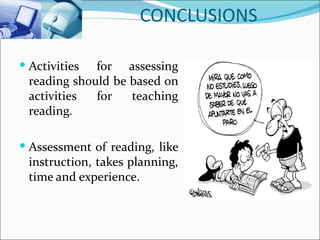
CONCLUSIONS

 Activities for assessing
 reading should be based on
 activities  for   teaching
 reading.

 Assessment of reading, like
 instruction, takes planning,
 time and experience.
CONCLUSIONS

 Assessment of reading
 must include decoding
 skills   and  reading
 comprehension
 strategies.

 Include        student
 attitudes and feelings
 toward reading.
Reading assessment
Reading assessment

Reading assessment

  • 1.
    By Diana MarcelaMurcia Horasis Toro Vargas Omar Cruz
  • 2.
    What is readingassessment?  Is a process in which teachers use to measure the reading and comprehension skills of students.  It requires planning and organization such as:
  • 3.
    Identify the purpose. Studying, evaluating, or diagnosing sts reading behavior.  Monitoring student progress.  Identifying learners` needs. 3
  • 4.
    Plan for assessment After having identified the assessment purpose……… Different types of reading assessment activities. October 18, 2005 Copyright: Sarah L Swart, 2005. 4
  • 5.
    Reading activity assessment. Skill/ behavior Reading Assessed Proficiency Individual/ Age/grade activity level Pair/Group Level assessment •Reading •Retelling comprehension All Individual, pair All •Reading skills •Checklists •R. Comprehension All Individual, group. All strategies. •Reading skills •Anecdotal records •R. Comprehension All Individual All strategies. •Reading skills. Intermediate, Individual, group Adults •Close tests advanced •Reading Comprehension •Reading logs •Response to All Individual All literature. •Choice in reading.
  • 6.
    Involve Students  Self-Assessment:is the process of looking at oneself in order to assess aspects that are important to one's identity.  What have I learned about reading in the class?  How do I feel about reading?  What do I need to improve in reading?  How do I read?
  • 7.
    Involve Students  Peerassessment: is the assessment of student work by other students. This might be used for formative feedback or summative grading purposes. 7
  • 8.
    Develop Rubrics orScoring Procedures.
  • 9.
    SET STANDARDS  Standarsfor reading comprehension can be set by establishing cut-off scores on a scoring rubric or rating scale.  There are three levels:  Novice  Intermediate  Advanced  Sub-categories  Expanding  Bridging  9
  • 10.
    SELECT ASSESSMENT ACTIVITIES  Assessment of reading should be embedded in activities for teaching reading.  Instructional activities  Retelling  Reading logs  Literature respose logs/ jornals  Literature discussion group  Cloze tests  Text with comprehension questions  Reciprocal teaching 10
  • 11.
    Pa had toWalk to In the town with his big woods. bundle of furs, but It was he couldn´t take Snowing. Title his gun. little house in the big wood. Author l.i. Wilde He would walk fast. Pa He would Ma return soon.
  • 12.
    Title Author Date I Date I How i feel about it: Began Finished Reading: Reading: Gorilla 4/16/95 4/18/95 This book is abat a lit to gile that wats to se a re gaela then her fader bot her a toy garila That he gu and gu and gu and to a ril gorila o wel i lob the story. Matthews Leo Leone 6/8/95 6/9/95 I likd the part wen Matthews was in hes drean Dream I like ol of the ameizen pekchers and Matthews paiten in to. Thes book is abat a moos tha waders what he wat to be and he does no want he wats to be. a paiter
  • 13.
    LITERATURE RESPONSE LOGS/JOURNALS  Research show the responding to literature helps students become better readers. With literature response logs, students respond in writing to materials they have read.  LITERATURE DISCUSSION GROUPS Literature discussion groups are heterogeneous small group(five to eight students), student-directed, and teacher-guided discussions that occur while students are in the process of reading a book(Hill and Ruptic 1994; Routman 1994).  CLOZE TESTS These are reading passages with blanks represententing words which have been deleted from the original text the blanks which are filled in by the teacher Copyright: Sarah L Swart, 2005. 13
  • 14.
     TEXTS WITHCOMPREHENSION QUESTIONS The mayority of teachers are familiar with asking questions to determine comprehension of reading passages. An idea shared with us by an ESL Resource Teacher at the middle school level allows immmediate identification of a student´s comprehension level with specifict texts.  RECIPROCAL TEACHING Reciprocal teaching is an instructional approach designed in order to increase reading comprehension by encouraging students to use reading strategies. Copyright: Sarah L Swart, 2005. 14
  • 15.
    One of themost effective ways for teacher to assess a student’s reading comprehension is through teacher observation (Routman 1994).
  • 16.
    TYPES OF TEACHER OBSERVATION  Think Alouds, probes and interviews.  Strategies checklist or Rating scales.  Miscue and Running Records.  Anecdotal Records.
  • 17.
    READING/WRITING PORTFOLIOS Another great way to assess or monitor the student’s process is using portfolios. With this assess technique not also the teacher will see the advance, but the student will also have the opportunity to assess himself about his process.
  • 18.
    CONCLUSIONS  Activities forassessing reading should be based on activities for teaching reading.  Assessment of reading, like instruction, takes planning, time and experience.
  • 19.
    CONCLUSIONS  Assessment ofreading must include decoding skills and reading comprehension strategies.  Include student attitudes and feelings toward reading.