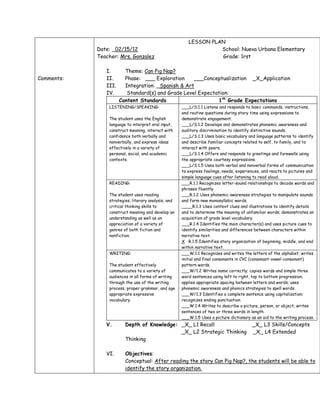
LESSON PLAN
            Date: _02/15/12                                       School: Nueva Urbana Elementary
            Teacher: Mrs. Gonzalez                                Grade: 1rst

               I.       Theme: Can Pig Nap?
Comments:      II.      Phase: ___ Exploration     ___Conceptualization _X_Application
               III.     Integration: _Spanish & Art
               IV.       Standard(s) and Grade Level Expectation:
                      Content Standards                     1th Grade Expectations
                LISTENING/SPEAKING:                  ___L/S.1.1 Listens and responds to basic commands, instructions,
                                                     and routine questions during story time using expressions to
                The student uses the English         demonstrate engagement.
                language to interpret oral input,    ___L/S.1.2 Develops and demonstrates phonemic awareness and
                construct meaning, interact with     auditory discrimination to identify distinctive sounds.
                confidence both verbally and         ___L/S.1.3 Uses basic vocabulary and language patterns to identify
                nonverbally, and express ideas       and describe familiar concepts related to self, to family, and to
                effectively in a variety of          interact with peers.
                personal, social, and academic       ___L/S.1.4 Offers and responds to greetings and farewells using
                contexts.                            the appropriate courtesy expressions.
                                                     ___L/S.1.5 Uses both verbal and nonverbal forms of communication
                                                     to express feelings, needs, experiences, and reacts to pictures and
                                                     simple language cues after listening to read aloud.
                READING:                             ___R.1.1 Recognizes letter-sound relationships to decode words and
                                                     phrases fluently.
                The student uses reading             ___R.1.2 Uses phonemic awareness strategies to manipulate sounds
                strategies, literary analysis, and   and form new monosyllabic words.
                critical thinking skills to          ____R.1.3 Uses context clues and illustrations to identify details
                construct meaning and develop an     and to determine the meaning of unfamiliar words; demonstrates an
                understanding as well as an          acquisition of grade level vocabulary.
                appreciation of a variety of         ___R.1.4 Identifies the main character(s) and uses picture cues to
                genres of both fiction and           identify similarities and differences between characters within
                nonfiction.                          narrative text.
                                                     X R.1.5 Identifies story organization of beginning, middle, and end
                                                     within narrative text.
                WRITING:                             ___W.1.1 Recognizes and writes the letters of the alphabet; writes
                                                     initial and final consonants in CVC (consonant-vowel-consonant)
                The student effectively              pattern words.
                communicates to a variety of         ___W/1.2 Writes name correctly; copies words and simple three
                audiences in all forms of writing    word sentences using left to right, top to bottom progression;
                through the use of the writing       applies appropriate spacing between letters and words; uses
                process, proper grammar, and age     phonemic awareness and phonics strategies to spell words.
                appropriate expressive               ___W/1.3 Identifies a complete sentence using capitalization;
                vocabulary.                          recognizes ending punctuation.
                                                     ___W.1.4 Writes to describe a picture, person, or object; writes
                                                     sentences of two or three words in length.
                                                     ___W.1.5 Uses a picture dictionary as an aid to the writing process.
               V.       Depth of Knowledge: _X_ L1 Recall                                _X_ L3 Skills/Concepts
                                            _X_ L2 Strategic Thinking                    _X_ L4 Extended
                        Thinking

               VI.      Objectives:
                        Conceptual: After reading the story Can Pig Nap?, the students will be able to
                        identify the story organization.
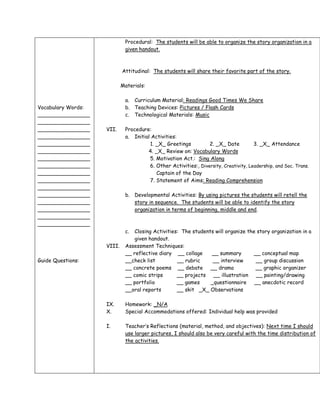
Procedural: The students will be able to organize the story organization in a
                             given handout.


                            Attitudinal: The students will share their favorite part of the story.

                            Materials:

                             a. Curriculum Material: Readings Good Times We Share
Vocabulary Words:            b. Teaching Devices: Pictures / Flash Cards
________________             c. Technological Materials: Music
________________
________________    VII.     Procedure:
________________             a. Initial Activities:
________________                       1. _X_ Greetings          2. _X_ Date          3. _X_ Attendance
________________                      4. _X_ Review on: Vocabulary Words
________________                       5. Motivation Act.: Sing Along
________________                       6. Other Activities:, Diversity, Creativity, Leadership, and Soc. Trans.
________________                          Captain of the Day
________________                       7. Statement of Aims: Reading Comprehension
________________
________________             b. Developmental Activities: By using pictures the students will retell the
________________                story in sequence. The students will be able to identify the story
________________                organization in terms of beginning, middle and end.
________________
________________
                             c.  Closing Activities: The students will organize the story organization in a
                                 given handout.
                    VIII.    Assessment Techniques:
                             __ reflective diary __ collage     __ summary        __ conceptual map
Guide Questions:             __check list          __ rubric     __ interview      __ group discussion
                             __ concrete poems __ debate __ drama                  __ graphic organizer
                             __ comic strips       __ projects __ illustration __ painting/drawing
                             __ portfolio          __ games     _questionnaire __ anecdotic record
                             __oral reports        __ skit _X_ Observations

                    IX.      Homework: _N/A
                    X.       Special Accommodations offered: Individual help was provided

                    I.       Teacher’s Reflections (material, method, and objectives): Next time I should
                             use larger pictures, I should also be very careful with the time distribution of
                             the activities.
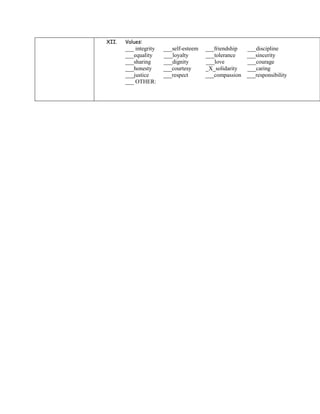
XII.   Values:
       ___ integrity   ___self-esteem   ___friendship ___discipline
       ___equality     ___loyalty       ___tolerance  ___sincerity
       ___sharing      ___dignity       ___love       ___courage
       ___honesty      ___courtesy      _X_solidarity ___caring
       ___justice      ___respect       ___compassion ___responsibility
       ___ OTHER:
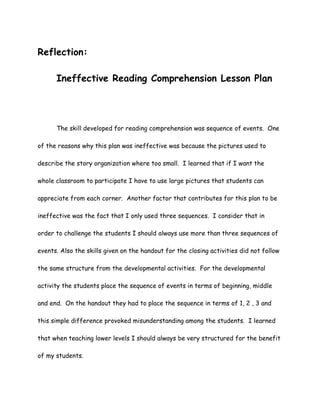
Reflection:

      Ineffective Reading Comprehension Lesson Plan


      The skill developed for reading comprehension was sequence of events. One

of the reasons why this plan was ineffective was because the pictures used to

describe the story organization where too small. I learned that if I want the

whole classroom to participate I have to use large pictures that students can

appreciate from each corner. Another factor that contributes for this plan to be

ineffective was the fact that I only used three sequences. I consider that in

order to challenge the students I should always use more than three sequences of

events. Also the skills given on the handout for the closing activities did not follow

the same structure from the developmental activities. For the developmental

activity the students place the sequence of events in terms of beginning, middle

and end. On the handout they had to place the sequence in terms of 1, 2 , 3 and

this simple difference provoked misunderstanding among the students. I learned

that when teaching lower levels I should always be very structured for the benefit

of my students.

Ineffective reading comprehension Lesson Plan

  • 1.
    LESSON PLAN Date: _02/15/12 School: Nueva Urbana Elementary Teacher: Mrs. Gonzalez Grade: 1rst I. Theme: Can Pig Nap? Comments: II. Phase: ___ Exploration ___Conceptualization _X_Application III. Integration: _Spanish & Art IV. Standard(s) and Grade Level Expectation: Content Standards 1th Grade Expectations LISTENING/SPEAKING: ___L/S.1.1 Listens and responds to basic commands, instructions, and routine questions during story time using expressions to The student uses the English demonstrate engagement. language to interpret oral input, ___L/S.1.2 Develops and demonstrates phonemic awareness and construct meaning, interact with auditory discrimination to identify distinctive sounds. confidence both verbally and ___L/S.1.3 Uses basic vocabulary and language patterns to identify nonverbally, and express ideas and describe familiar concepts related to self, to family, and to effectively in a variety of interact with peers. personal, social, and academic ___L/S.1.4 Offers and responds to greetings and farewells using contexts. the appropriate courtesy expressions. ___L/S.1.5 Uses both verbal and nonverbal forms of communication to express feelings, needs, experiences, and reacts to pictures and simple language cues after listening to read aloud. READING: ___R.1.1 Recognizes letter-sound relationships to decode words and phrases fluently. The student uses reading ___R.1.2 Uses phonemic awareness strategies to manipulate sounds strategies, literary analysis, and and form new monosyllabic words. critical thinking skills to ____R.1.3 Uses context clues and illustrations to identify details construct meaning and develop an and to determine the meaning of unfamiliar words; demonstrates an understanding as well as an acquisition of grade level vocabulary. appreciation of a variety of ___R.1.4 Identifies the main character(s) and uses picture cues to genres of both fiction and identify similarities and differences between characters within nonfiction. narrative text. X R.1.5 Identifies story organization of beginning, middle, and end within narrative text. WRITING: ___W.1.1 Recognizes and writes the letters of the alphabet; writes initial and final consonants in CVC (consonant-vowel-consonant) The student effectively pattern words. communicates to a variety of ___W/1.2 Writes name correctly; copies words and simple three audiences in all forms of writing word sentences using left to right, top to bottom progression; through the use of the writing applies appropriate spacing between letters and words; uses process, proper grammar, and age phonemic awareness and phonics strategies to spell words. appropriate expressive ___W/1.3 Identifies a complete sentence using capitalization; vocabulary. recognizes ending punctuation. ___W.1.4 Writes to describe a picture, person, or object; writes sentences of two or three words in length. ___W.1.5 Uses a picture dictionary as an aid to the writing process. V. Depth of Knowledge: _X_ L1 Recall _X_ L3 Skills/Concepts _X_ L2 Strategic Thinking _X_ L4 Extended Thinking VI. Objectives: Conceptual: After reading the story Can Pig Nap?, the students will be able to identify the story organization.
  • 2.
    Procedural: The studentswill be able to organize the story organization in a given handout. Attitudinal: The students will share their favorite part of the story. Materials: a. Curriculum Material: Readings Good Times We Share Vocabulary Words: b. Teaching Devices: Pictures / Flash Cards ________________ c. Technological Materials: Music ________________ ________________ VII. Procedure: ________________ a. Initial Activities: ________________ 1. _X_ Greetings 2. _X_ Date 3. _X_ Attendance ________________ 4. _X_ Review on: Vocabulary Words ________________ 5. Motivation Act.: Sing Along ________________ 6. Other Activities:, Diversity, Creativity, Leadership, and Soc. Trans. ________________ Captain of the Day ________________ 7. Statement of Aims: Reading Comprehension ________________ ________________ b. Developmental Activities: By using pictures the students will retell the ________________ story in sequence. The students will be able to identify the story ________________ organization in terms of beginning, middle and end. ________________ ________________ c. Closing Activities: The students will organize the story organization in a given handout. VIII. Assessment Techniques: __ reflective diary __ collage __ summary __ conceptual map Guide Questions: __check list __ rubric __ interview __ group discussion __ concrete poems __ debate __ drama __ graphic organizer __ comic strips __ projects __ illustration __ painting/drawing __ portfolio __ games _questionnaire __ anecdotic record __oral reports __ skit _X_ Observations IX. Homework: _N/A X. Special Accommodations offered: Individual help was provided I. Teacher’s Reflections (material, method, and objectives): Next time I should use larger pictures, I should also be very careful with the time distribution of the activities.
  • 3.
    XII. Values: ___ integrity ___self-esteem ___friendship ___discipline ___equality ___loyalty ___tolerance ___sincerity ___sharing ___dignity ___love ___courage ___honesty ___courtesy _X_solidarity ___caring ___justice ___respect ___compassion ___responsibility ___ OTHER:
  • 4.
    Reflection: Ineffective Reading Comprehension Lesson Plan The skill developed for reading comprehension was sequence of events. One of the reasons why this plan was ineffective was because the pictures used to describe the story organization where too small. I learned that if I want the whole classroom to participate I have to use large pictures that students can appreciate from each corner. Another factor that contributes for this plan to be ineffective was the fact that I only used three sequences. I consider that in order to challenge the students I should always use more than three sequences of events. Also the skills given on the handout for the closing activities did not follow the same structure from the developmental activities. For the developmental activity the students place the sequence of events in terms of beginning, middle and end. On the handout they had to place the sequence in terms of 1, 2 , 3 and this simple difference provoked misunderstanding among the students. I learned that when teaching lower levels I should always be very structured for the benefit of my students.