COGNITIVE STRATEGIES
 Cognitive strategy instruction develops the thinking
skills that will make students strategic, flexible learners.
People use such strategies all the time, like writing a
note to remember an important fact. For some
students, cognitive strategies must be explicitly taught
so they will be able to consciously think, "This is the
information I want, and this is the tool I can use to get
it." Students must also have multiple opportunities to
practice cognitive strategies.Thus, strategies become
power tools, with greater flexibility.
COGNITIVE STRATEGIES: ATOOLKIT FOR
READERS
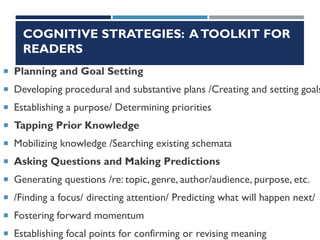
 Planning and Goal Setting
 Developing procedural and substantive plans /Creating and setting goals
 Establishing a purpose/ Determining priorities
 Tapping Prior Knowledge
 Mobilizing knowledge /Searching existing schemata
 Asking Questions and Making Predictions
 Generating questions /re: topic, genre, author/audience, purpose, etc.
 /Finding a focus/ directing attention/ Predicting what will happen next/
 Fostering forward momentum
 Establishing focal points for confirming or revising meaning
COGNITIVE STRATEGIES: ATOOLKIT FOR
READERS
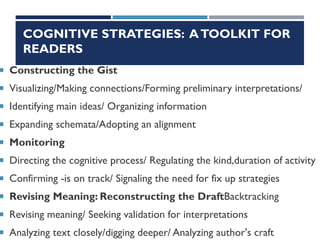
 Constructing the Gist
 Visualizing/Making connections/Forming preliminary interpretations/
 Identifying main ideas/ Organizing information
 Expanding schemata/Adopting an alignment
 Monitoring
 Directing the cognitive process/ Regulating the kind,duration of activity
 Confirming -is on track/ Signaling the need for fix up strategies
 Revising Meaning: Reconstructing the DraftBacktracking
 Revising meaning/ Seeking validation for interpretations
 Analyzing text closely/digging deeper/ Analyzing author's craft
COGNITIVE STRATEGIES: ATOOLKIT FOR
READERS
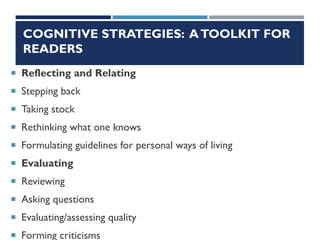
 Reflecting and Relating
 Stepping back
 Taking stock
 Rethinking what one knows
 Formulating guidelines for personal ways of living
 Evaluating
 Reviewing
 Asking questions
 Evaluating/assessing quality
 Forming criticisms
COGNITIVE STRATEGIES
STRATEGY EXAMPLES
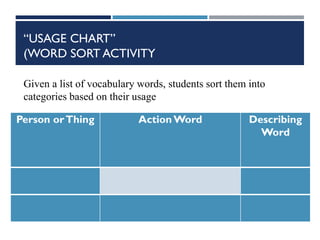
“USAGE CHART”
(WORD SORT ACTIVITY
Person orThing Action Word Describing
Word
Given a list of vocabulary words, students sort them into
categories based on their usage
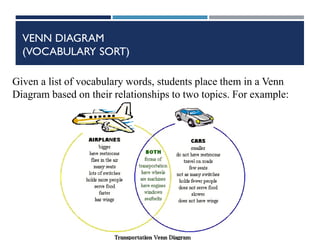
VENN DIAGRAM
(VOCABULARY SORT)
Given a list of vocabulary words, students place them in a Venn
Diagram based on their relationships to two topics. For example:
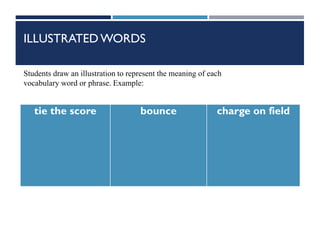
ILLUSTRATED WORDS
tie the score bounce charge on field
Students draw an illustration to represent the meaning of each
vocabulary word or phrase. Example:
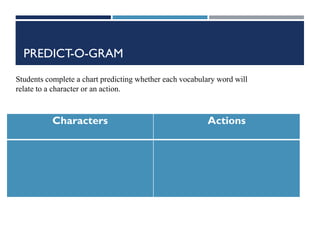
PREDICT-O-GRAM
Characters Actions
Students complete a chart predicting whether each vocabulary word will
relate to a character or an action.
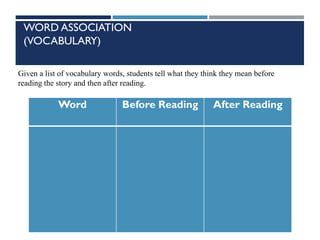
WORD ASSOCIATION
(VOCABULARY)
Word Before Reading After Reading
Given a list of vocabulary words, students tell what they think they mean before
reading the story and then after reading.
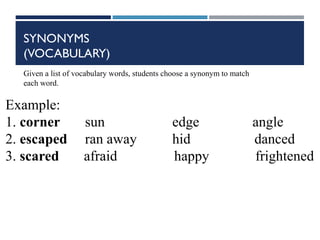
SYNONYMS
(VOCABULARY)
Given a list of vocabulary words, students choose a synonym to match
each word.
Example:
1. corner sun edge angle
2. escaped ran away hid danced
3. scared afraid happy frightened
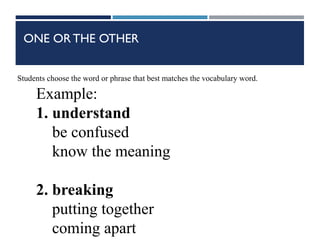
ONE OR THE OTHER
Students choose the word or phrase that best matches the vocabulary word.
Example:
1. understand
be confused
know the meaning
2. breaking
putting together
coming apart
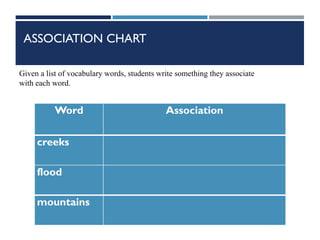
ASSOCIATION CHART
Given a list of vocabulary words, students write something they associate
with each word.
Word Association
creeks
flood
mountains
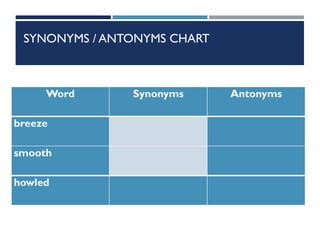
SYNONYMS / ANTONYMS CHART
Word Synonyms Antonyms
breeze
smooth
howled
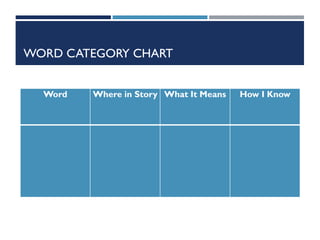
WORD CATEGORY CHART
Word Where in Story What It Means How I Know
VOCABULARY EXPLORE PAST TENSE
 Example:
 I like to wander in the museum.
 I wandered in the museum
PRACTICING
Repeating
 Imitate a native speaker (pronunciation, intonation, vocabulary, etc)
 Listen regularly to the news in English, the weather report, etc., in order to
get familiar with the new vocabulary in context. (listen to it every morning)
 Repeating a song several times (play karaoke)
 Look for patterns in written documents (something you can consider for
writing next time)
 Read a paragraph several times for different purposes (to get a general idea,
to look for details, to predict, to write down questions, etc)
 When you write, check the paragraph to see if you have the main ideas, then check
punctuation.
 Use the “Suggestopedia” Method. Play music and repeat the same oral
passage several times at different speeds.
FORMALLY PRACTICING WITH SOUNDS AND
WRITING SYSTEMS
 Record your voice and then compare it with a native
speaker’s voice
 When you have a clear understanding of the pronunciation,
say the words and look at yourself in the mirror.
 Compare similar sounding words in terms of their written
representation (symbols) (minimal pairs)
Minimal Pairs
LOOK VS LUKE
PULL VS PUL
FULL VS FOOL
HAT VS HUT
RECOGNIZING AND USING FORMULAS AND
PATTERNS
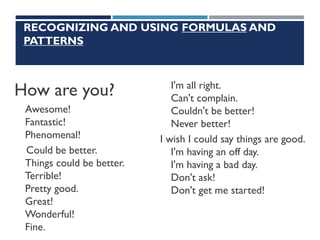
How are you?
Awesome!
Fantastic!
Phenomenal!
Could be better.
Things could be better.
Terrible!
Pretty good.
Great!
Wonderful!
Fine.
I'm all right.
Can't complain.
Couldn't be better!
Never better!
I wish I could say things are good.
I'm having an off day.
I'm having a bad day.
Don't ask!
Don't get me started!
PRACTICING NATURALISTICALLY (ALL SKILLS)
 Write an e-mail in English/ Chat with your friends.
 Read or listen to something you can use in your
daily activities (familiar topics).
 Create role plays or simulations with your friends
(for example, a telephone conversation).
 Speak to a native speaker whenever you have the
chance.
RECEIVING AND SENDING MESSAGES
Getting the idea quickly
Use skimming to get a general idea of a text
Read the first sentence of each paragraph
Read the first and last paragraphs
Use scanning to look for specific information
You search for key words or ideas. In most cases,
you know what you're looking for, so you're
concentrating on finding a particular answer.
USING RESOURCES FOR RECEIVING AND
SENDING MESSAGES (ALL SKILLS)
 Always use printed/online resources such as dictionaries
 Consult grammar books, encyclopedias, websites, glossaries on
different topics. (grammar in use)
 www.englishclub.com
 www.thesaurus.com
 http://dictionary.cambridge.org/
 www.wordreference.com
 http://www.rhymezone.com/
 http://www.mansioningles.com/
 http://www.eslflow.com/
 http://www.merriam-webster.com/dictionary/bag
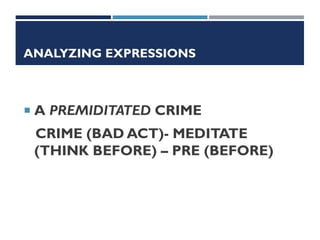
ANALYZING EXPRESSIONS
 A PREMIDITATED CRIME
CRIME (BAD ACT)- MEDITATE
(THINK BEFORE) – PRE (BEFORE)
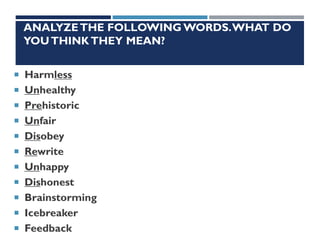
ANALYZETHE FOLLOWING WORDS.WHAT DO
YOUTHINKTHEY MEAN?
 Harmless
 Unhealthy
 Prehistoric
 Unfair
 Disobey
 Rewrite
 Unhappy
 Dishonest
 Brainstorming
 Icebreaker
 Feedback

Cognitive strategies

  • 1.
  • 2.
    COGNITIVE STRATEGIES  Cognitivestrategy instruction develops the thinking skills that will make students strategic, flexible learners. People use such strategies all the time, like writing a note to remember an important fact. For some students, cognitive strategies must be explicitly taught so they will be able to consciously think, "This is the information I want, and this is the tool I can use to get it." Students must also have multiple opportunities to practice cognitive strategies.Thus, strategies become power tools, with greater flexibility.
  • 3.
    COGNITIVE STRATEGIES: ATOOLKITFOR READERS  Planning and Goal Setting  Developing procedural and substantive plans /Creating and setting goals  Establishing a purpose/ Determining priorities  Tapping Prior Knowledge  Mobilizing knowledge /Searching existing schemata  Asking Questions and Making Predictions  Generating questions /re: topic, genre, author/audience, purpose, etc.  /Finding a focus/ directing attention/ Predicting what will happen next/  Fostering forward momentum  Establishing focal points for confirming or revising meaning
  • 4.
    COGNITIVE STRATEGIES: ATOOLKITFOR READERS  Constructing the Gist  Visualizing/Making connections/Forming preliminary interpretations/  Identifying main ideas/ Organizing information  Expanding schemata/Adopting an alignment  Monitoring  Directing the cognitive process/ Regulating the kind,duration of activity  Confirming -is on track/ Signaling the need for fix up strategies  Revising Meaning: Reconstructing the DraftBacktracking  Revising meaning/ Seeking validation for interpretations  Analyzing text closely/digging deeper/ Analyzing author's craft
  • 5.
    COGNITIVE STRATEGIES: ATOOLKITFOR READERS  Reflecting and Relating  Stepping back  Taking stock  Rethinking what one knows  Formulating guidelines for personal ways of living  Evaluating  Reviewing  Asking questions  Evaluating/assessing quality  Forming criticisms
  • 6.
  • 7.
    “USAGE CHART” (WORD SORTACTIVITY Person orThing Action Word Describing Word Given a list of vocabulary words, students sort them into categories based on their usage
  • 8.
    VENN DIAGRAM (VOCABULARY SORT) Givena list of vocabulary words, students place them in a Venn Diagram based on their relationships to two topics. For example:
  • 9.
    ILLUSTRATED WORDS tie thescore bounce charge on field Students draw an illustration to represent the meaning of each vocabulary word or phrase. Example:
  • 10.
    PREDICT-O-GRAM Characters Actions Students completea chart predicting whether each vocabulary word will relate to a character or an action.
  • 11.
    WORD ASSOCIATION (VOCABULARY) Word BeforeReading After Reading Given a list of vocabulary words, students tell what they think they mean before reading the story and then after reading.
  • 12.
    SYNONYMS (VOCABULARY) Given a listof vocabulary words, students choose a synonym to match each word. Example: 1. corner sun edge angle 2. escaped ran away hid danced 3. scared afraid happy frightened
  • 13.
    ONE OR THEOTHER Students choose the word or phrase that best matches the vocabulary word. Example: 1. understand be confused know the meaning 2. breaking putting together coming apart
  • 14.
    ASSOCIATION CHART Given alist of vocabulary words, students write something they associate with each word. Word Association creeks flood mountains
  • 15.
    SYNONYMS / ANTONYMSCHART Word Synonyms Antonyms breeze smooth howled
  • 16.
    WORD CATEGORY CHART WordWhere in Story What It Means How I Know
  • 17.
    VOCABULARY EXPLORE PASTTENSE  Example:  I like to wander in the museum.  I wandered in the museum
  • 18.
    PRACTICING Repeating  Imitate anative speaker (pronunciation, intonation, vocabulary, etc)  Listen regularly to the news in English, the weather report, etc., in order to get familiar with the new vocabulary in context. (listen to it every morning)  Repeating a song several times (play karaoke)  Look for patterns in written documents (something you can consider for writing next time)  Read a paragraph several times for different purposes (to get a general idea, to look for details, to predict, to write down questions, etc)  When you write, check the paragraph to see if you have the main ideas, then check punctuation.  Use the “Suggestopedia” Method. Play music and repeat the same oral passage several times at different speeds.
  • 19.
    FORMALLY PRACTICING WITHSOUNDS AND WRITING SYSTEMS  Record your voice and then compare it with a native speaker’s voice  When you have a clear understanding of the pronunciation, say the words and look at yourself in the mirror.  Compare similar sounding words in terms of their written representation (symbols) (minimal pairs) Minimal Pairs LOOK VS LUKE PULL VS PUL FULL VS FOOL HAT VS HUT
  • 20.
    RECOGNIZING AND USINGFORMULAS AND PATTERNS How are you? Awesome! Fantastic! Phenomenal! Could be better. Things could be better. Terrible! Pretty good. Great! Wonderful! Fine. I'm all right. Can't complain. Couldn't be better! Never better! I wish I could say things are good. I'm having an off day. I'm having a bad day. Don't ask! Don't get me started!
  • 21.
    PRACTICING NATURALISTICALLY (ALLSKILLS)  Write an e-mail in English/ Chat with your friends.  Read or listen to something you can use in your daily activities (familiar topics).  Create role plays or simulations with your friends (for example, a telephone conversation).  Speak to a native speaker whenever you have the chance.
  • 22.
    RECEIVING AND SENDINGMESSAGES Getting the idea quickly Use skimming to get a general idea of a text Read the first sentence of each paragraph Read the first and last paragraphs Use scanning to look for specific information You search for key words or ideas. In most cases, you know what you're looking for, so you're concentrating on finding a particular answer.
  • 23.
    USING RESOURCES FORRECEIVING AND SENDING MESSAGES (ALL SKILLS)  Always use printed/online resources such as dictionaries  Consult grammar books, encyclopedias, websites, glossaries on different topics. (grammar in use)  www.englishclub.com  www.thesaurus.com  http://dictionary.cambridge.org/  www.wordreference.com  http://www.rhymezone.com/  http://www.mansioningles.com/  http://www.eslflow.com/  http://www.merriam-webster.com/dictionary/bag
  • 24.
    ANALYZING EXPRESSIONS  APREMIDITATED CRIME CRIME (BAD ACT)- MEDITATE (THINK BEFORE) – PRE (BEFORE)
  • 25.
    ANALYZETHE FOLLOWING WORDS.WHATDO YOUTHINKTHEY MEAN?  Harmless  Unhealthy  Prehistoric  Unfair  Disobey  Rewrite  Unhappy  Dishonest  Brainstorming  Icebreaker  Feedback