

Yes, You CAN Talk!
Engaging Middle Readers in Discussion
            about Text


  North Carolina Reading Association Conference
            March 2012 Raleigh, NC
Create a vision
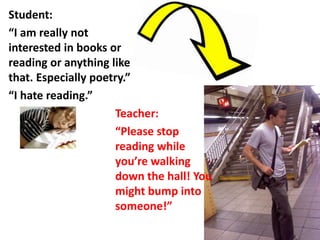
Student:
“I am really not
interested in books or
reading or anything like
that. Especially poetry.”
“I hate reading.”
                     Teacher:
                     “Please stop
                     reading while
                     you’re walking
                     down the hall! You
                     might bump into
                     someone!”
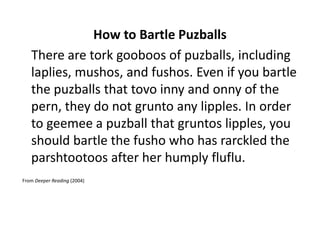
How to Bartle Puzballs
   There are tork gooboos of puzballs, including
   laplies, mushos, and fushos. Even if you bartle
   the puzballs that tovo inny and onny of the
   pern, they do not grunto any lipples. In order
   to geemee a puzball that gruntos lipples, you
   should bartle the fusho who has rarckled the
   parshtootoos after her humply fluflu.
From Deeper Reading (2004)
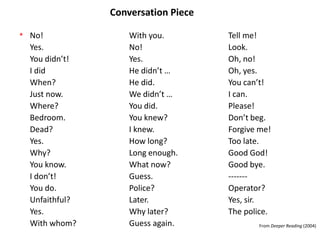
Conversation Piece

* No!               With you.        Tell me!
  Yes.              No!              Look.
  You didn’t!       Yes.             Oh, no!
  I did             He didn’t …      Oh, yes.
  When?             He did.          You can’t!
  Just now.         We didn’t …      I can.
  Where?            You did.         Please!
  Bedroom.          You knew?        Don’t beg.
  Dead?             I knew.          Forgive me!
  Yes.              How long?        Too late.
  Why?              Long enough.     Good God!
  You know.         What now?        Good bye.
  I don’t!          Guess.           -------
  You do.           Police?          Operator?
  Unfaithful?       Later.           Yes, sir.
  Yes.              Why later?       The police.
  With whom?        Guess again.            From Deeper Reading (2004)
GOAL

MOTIVATED & ENGAGED
     readers who
   THINK DEEPLY
     about text.
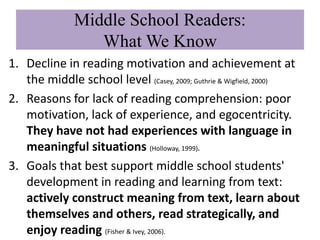
Middle School Readers:
                 What We Know
1. Decline in reading motivation and achievement at
   the middle school level (Casey, 2009; Guthrie & Wigfield, 2000)
2. Reasons for lack of reading comprehension: poor
   motivation, lack of experience, and egocentricity.
   They have not had experiences with language in
   meaningful situations (Holloway, 1999).
3. Goals that best support middle school students'
   development in reading and learning from text:
   actively construct meaning from text, learn about
   themselves and others, read strategically, and
   enjoy reading (Fisher & Ivey, 2006).
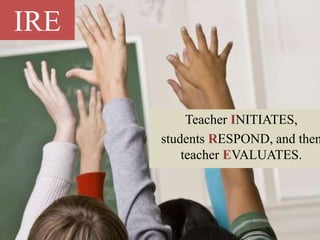
IRE


           Teacher INITIATES,
      students RESPOND, and then
          teacher EVALUATES.
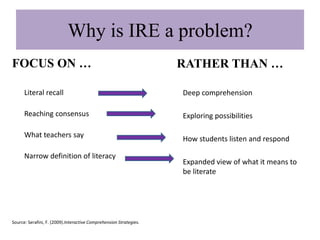
Why is IRE a problem?
FOCUS ON …                                                          RATHER THAN …

      Literal recall                                                Deep comprehension

      Reaching consensus                                            Exploring possibilities

      What teachers say
                                                                    How students listen and respond

      Narrow definition of literacy
                                                                    Expanded view of what it means to
                                                                    be literate


Source: Serafini, F. (2009).Interactive Comprehension Strategies.
Social Constructivist
                        Literacy Learning

Actively construct meaning from text as a
joint activity rather than one that is
transmitted from the teacher to the student.
(Lee & Smagorinsky, 2000; McKeown, Beck, & Blake, 2009)
Literature Discussions

Can be effective methods to support
engagement at all levels
(Burns, 1998; Casey 2008/2009; Heller, 2006; Lloyd, 2004; Long & Gove, 2003; Swaggerty, 2009; Wiebe Berry & Englert,
2005).


Can also promote reading comprehension and
learning
(Applebee, Langer, Nystrand, & Gamoran, 2009; McKeown, Beck, & Blake, 2009; Pardo, 2004; Wiebe Berry & Englert, 2005).
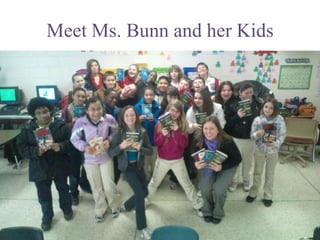
Meet Ms. Bunn and her Kids
• 72 sixth grade students
• 3 blocks of Language Arts
INVITE CHAOS:
Getting Started with Literature Circles

    MODEL,
         MODEL,
              MODEL
       SCAFFOLD, SCAFFOLD, SCAFFOLD:
       “All learning is social at first, with an expert guiding
      the learning through scaffolding. An expert teacher
      gradually turns over the responsibility of the task to
              the learner, moving back in to the dialogue as
                                           needed.” ~Vygotsky
Getting Started
1. TEACH THE PROCESS
  Choose books, plan with your group, read
  carefully with your role in mind, bring your
  completed role sheet and talk about the book
  with your group, share with the whole class,
  complete a response project.

2. WHOLE CLASS PRACTICE TOGETHER
  Teach roles and model each one. Ex: everyone
  tries being the Discussion Director in small groups,
  filling out role sheet first, then “trying on” the role
  in small groups.
ROLES
Discussion Director: acts as group’s facilitator; creates questions to increase
comprehension; asks who, what, why, when, where, how, and what if; open-ended
questions that will stimulate discussion; focus on themes/big ideas
Word Wizard: locates amazing/interesting words; looks for new words or words used
in unusual ways; clarifies word meanings and pronunciations; uses research resource;
points to the words in context
Literary Luminary: locates examples of amazing/interesting writing that could be
read aloud to the group; guides oral reading for a purpose; examines figurative language,
parts of speech, and vivid descriptions
Reporter: prepares a summary of the book or selected reading; highlights the
important details, events, and characters.
Connector: makes text-to-self, text-to-world, and text-to-text connections; makes
connections to what you’re studying; make disconnections.
Checker: checks for completion of assignments; evaluates participation; helps monitor
discussion for equal participation
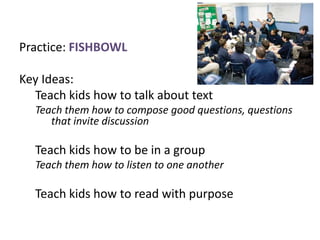
Practice: FISHBOWL

Key Ideas:
  Teach kids how to talk about text
  Teach them how to compose good questions, questions
     that invite discussion

  Teach kids how to be in a group
  Teach them how to listen to one another

  Teach kids how to read with purpose
PLANNING Literature
            Circle Meetings
High-interest books, span ability levels

Book talks

Students rank order books

Teacher build groups based on choice
(sometimes ability)
First Meeting
• Teacher reads aloud a few chapters to build
  excitement, set the tone, model pronunciation
  of new/difficult words
• Determine roles
• Determine how far to read
• Reminders: How to “be” in a group and how
  to read with your role in mind
DURING: Literature Circle Meetings
• Adequate talk time
• Put kids in a circle
• Sit on the outside
• Float and dip
• Strategies such as non-evaluative responses (hmmmm
  … ok…) tell students that they are to continue the
  dialogue
• Encourage kids to be respectful of one another’s
  perspectives and experiences
• Reinforce positive, respectful, constructive
  contributions
• Set goals for next meeting
Reflect
• What went well?
• What could be improved?
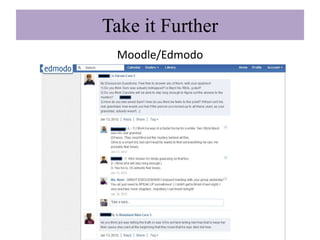
Take it Further
 Moodle/Edmodo
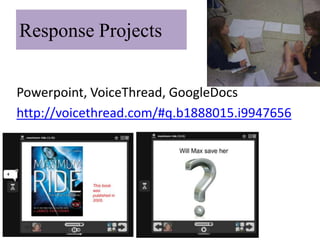
Response Projects


Powerpoint, VoiceThread, GoogleDocs
http://voicethread.com/#q.b1888015.i9947656
Extra Support for Strugglers
Make sure they can read their books
Meet with them more often to make sure
  they are reading and are ready for the
  discussion
Give them extra opportunities to ask
  questions
Make sure they feel success with reading
Keep them excited and motivated
Resource


Getting Started with Literature Circles
         (readwritethink.org)
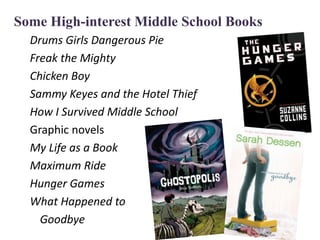
Some High-interest Middle School Books
  Drums Girls Dangerous Pie
  Freak the Mighty
  Chicken Boy
  Sammy Keyes and the Hotel Thief
  How I Survived Middle School
  Graphic novels
  My Life as a Book
  Maximum Ride
  Hunger Games
  What Happened to
    Goodbye
Elizabeth Swaggerty                Kelley Bunn
Reading Education                  Grade 6 Language Arts Teacher
East Carolina University           Chocowinity Middle School
swaggertye@ecu.edu                 kbunn@beaufort.k12.nc.us
http://swaggertye.wordpress.com/

Yes, you can talk!

  • 1.
    Yes, You CANTalk! Engaging Middle Readers in Discussion about Text North Carolina Reading Association Conference March 2012 Raleigh, NC
  • 2.
  • 3.
    Student: “I am reallynot interested in books or reading or anything like that. Especially poetry.” “I hate reading.” Teacher: “Please stop reading while you’re walking down the hall! You might bump into someone!”
  • 4.
    How to BartlePuzballs There are tork gooboos of puzballs, including laplies, mushos, and fushos. Even if you bartle the puzballs that tovo inny and onny of the pern, they do not grunto any lipples. In order to geemee a puzball that gruntos lipples, you should bartle the fusho who has rarckled the parshtootoos after her humply fluflu. From Deeper Reading (2004)
  • 5.
    Conversation Piece * No! With you. Tell me! Yes. No! Look. You didn’t! Yes. Oh, no! I did He didn’t … Oh, yes. When? He did. You can’t! Just now. We didn’t … I can. Where? You did. Please! Bedroom. You knew? Don’t beg. Dead? I knew. Forgive me! Yes. How long? Too late. Why? Long enough. Good God! You know. What now? Good bye. I don’t! Guess. ------- You do. Police? Operator? Unfaithful? Later. Yes, sir. Yes. Why later? The police. With whom? Guess again. From Deeper Reading (2004)
  • 6.
    GOAL MOTIVATED & ENGAGED readers who THINK DEEPLY about text.
  • 7.
    Middle School Readers: What We Know 1. Decline in reading motivation and achievement at the middle school level (Casey, 2009; Guthrie & Wigfield, 2000) 2. Reasons for lack of reading comprehension: poor motivation, lack of experience, and egocentricity. They have not had experiences with language in meaningful situations (Holloway, 1999). 3. Goals that best support middle school students' development in reading and learning from text: actively construct meaning from text, learn about themselves and others, read strategically, and enjoy reading (Fisher & Ivey, 2006).
  • 8.
    IRE Teacher INITIATES, students RESPOND, and then teacher EVALUATES.
  • 9.
    Why is IREa problem? FOCUS ON … RATHER THAN … Literal recall Deep comprehension Reaching consensus Exploring possibilities What teachers say How students listen and respond Narrow definition of literacy Expanded view of what it means to be literate Source: Serafini, F. (2009).Interactive Comprehension Strategies.
  • 10.
    Social Constructivist Literacy Learning Actively construct meaning from text as a joint activity rather than one that is transmitted from the teacher to the student. (Lee & Smagorinsky, 2000; McKeown, Beck, & Blake, 2009)
  • 11.
    Literature Discussions Can beeffective methods to support engagement at all levels (Burns, 1998; Casey 2008/2009; Heller, 2006; Lloyd, 2004; Long & Gove, 2003; Swaggerty, 2009; Wiebe Berry & Englert, 2005). Can also promote reading comprehension and learning (Applebee, Langer, Nystrand, & Gamoran, 2009; McKeown, Beck, & Blake, 2009; Pardo, 2004; Wiebe Berry & Englert, 2005).
  • 12.
    Meet Ms. Bunnand her Kids • 72 sixth grade students • 3 blocks of Language Arts
  • 13.
    INVITE CHAOS: Getting Startedwith Literature Circles MODEL, MODEL, MODEL SCAFFOLD, SCAFFOLD, SCAFFOLD: “All learning is social at first, with an expert guiding the learning through scaffolding. An expert teacher gradually turns over the responsibility of the task to the learner, moving back in to the dialogue as needed.” ~Vygotsky
  • 14.
    Getting Started 1. TEACHTHE PROCESS Choose books, plan with your group, read carefully with your role in mind, bring your completed role sheet and talk about the book with your group, share with the whole class, complete a response project. 2. WHOLE CLASS PRACTICE TOGETHER Teach roles and model each one. Ex: everyone tries being the Discussion Director in small groups, filling out role sheet first, then “trying on” the role in small groups.
  • 15.
    ROLES Discussion Director: actsas group’s facilitator; creates questions to increase comprehension; asks who, what, why, when, where, how, and what if; open-ended questions that will stimulate discussion; focus on themes/big ideas Word Wizard: locates amazing/interesting words; looks for new words or words used in unusual ways; clarifies word meanings and pronunciations; uses research resource; points to the words in context Literary Luminary: locates examples of amazing/interesting writing that could be read aloud to the group; guides oral reading for a purpose; examines figurative language, parts of speech, and vivid descriptions Reporter: prepares a summary of the book or selected reading; highlights the important details, events, and characters. Connector: makes text-to-self, text-to-world, and text-to-text connections; makes connections to what you’re studying; make disconnections. Checker: checks for completion of assignments; evaluates participation; helps monitor discussion for equal participation
  • 16.
    Practice: FISHBOWL Key Ideas: Teach kids how to talk about text Teach them how to compose good questions, questions that invite discussion Teach kids how to be in a group Teach them how to listen to one another Teach kids how to read with purpose
  • 17.
    PLANNING Literature Circle Meetings High-interest books, span ability levels Book talks Students rank order books Teacher build groups based on choice (sometimes ability)
  • 18.
    First Meeting • Teacherreads aloud a few chapters to build excitement, set the tone, model pronunciation of new/difficult words • Determine roles • Determine how far to read • Reminders: How to “be” in a group and how to read with your role in mind
  • 19.
    DURING: Literature CircleMeetings • Adequate talk time • Put kids in a circle • Sit on the outside • Float and dip • Strategies such as non-evaluative responses (hmmmm … ok…) tell students that they are to continue the dialogue • Encourage kids to be respectful of one another’s perspectives and experiences • Reinforce positive, respectful, constructive contributions • Set goals for next meeting
  • 20.
    Reflect • What wentwell? • What could be improved?
  • 21.
    Take it Further Moodle/Edmodo
  • 22.
    Response Projects Powerpoint, VoiceThread,GoogleDocs http://voicethread.com/#q.b1888015.i9947656
  • 23.
    Extra Support forStrugglers Make sure they can read their books Meet with them more often to make sure they are reading and are ready for the discussion Give them extra opportunities to ask questions Make sure they feel success with reading Keep them excited and motivated
  • 24.
    Resource Getting Started withLiterature Circles (readwritethink.org)
  • 25.
    Some High-interest MiddleSchool Books Drums Girls Dangerous Pie Freak the Mighty Chicken Boy Sammy Keyes and the Hotel Thief How I Survived Middle School Graphic novels My Life as a Book Maximum Ride Hunger Games What Happened to Goodbye
  • 26.
    Elizabeth Swaggerty Kelley Bunn Reading Education Grade 6 Language Arts Teacher East Carolina University Chocowinity Middle School swaggertye@ecu.edu kbunn@beaufort.k12.nc.us http://swaggertye.wordpress.com/

Editor's Notes

  • #2 Introduce presenters and their relationship with one another. Describe how collaboration came about and kelley’s instruction prior to the collaboration.
  • #3 Envisioned what we wanted for students as literate beings
  • #4 We observed students who said this: and we envisioned a shift in attitude like this: I actually observed Kelley say this to a kid in the hallway at the end of the year last year. We envisioned motivated readers who choose to read.
  • #5 We also want readers who can comprehend text, thinking critically about text. Let’s take a look at this example of text comprehension. How many gooboos of puzballs are there? (tork) What are the laplies, mushos and fushos? (torkgooboos of puzballs) Even if you bartle the puzballs that tovoinny and onny of the pern, they will not what? (will not grunto any lipples) How can you geemee a puzball that gruntoslipples? (bartle the fusho who has rarckled her parshtootoos after her humplyfluflu).
  • #6 Question: What happened in this story? Readers who look below the surface who can apply a little inferences will come up with a copmlex story compared to the few short words on the page. This is what we want … readers who can move beyond the literal and who can interpret the text. Readers who read way beyond a puzball mentality.
  • #7 Readers who choose to read for pleasure Move past the literal and make inferences based on what they’re reading – move past the puzball mentality.
  • #8 What does the research say?There is a documented decline in reading motivation and achievement at the ms level. This is esp bothersome since we know that motivation leads to more reading which leads to achievement. In other words, practice makes kids better readers and if they stop practicing at the middle school level, they won’t get better. There are links between this and later drop outs. We also know that we need to incorporate more opportunities to actively construct meaning from text, learn about themselves and others, read strategically, and enjoy reading.
  • #9 What is happening in MS classrooms in terms of instruction?In the 70s and 80s researchers such as Meham, Sinclair and Coulthard and Courtney Cazden wrote about the IRE pattern of talk (discourse) in classrooms: teachers INITIATE a discussion topic, most often by posing a question to which students are expected to rESPOND. Then teachers EVALUATE the response. Teachers speak when they wish, decide which topics are important, determine who will talk and for how long, and interject their own responses and interpretations, control the pace and direction of discussion. They also decide what is right and wrong. Teachers do most of the talking.
  • #10 Reduce comprehension to literal recallTeacher-directed talk focuses on reaching consensus, rather than exploring possibilitiesFocus remains on what teachers say, rather than on how students listen and respond.What it means to be fully literate has expanded
  • #11 Let’s embrace this RATHER THAN Column and shift to social constructivist learning in our classrooms. Move away from traditional classroom discourse (IRE) Authentic student talk about text to achieve deeper comprehensionScaffold student talk (gradual release of responsibility to the learner – L. Vygotsky)
  • #12 Literature Discussions can be effective methods to support both ENGAGEMENT and COMPREHENSION
  • #13 Meet Ms. Bunn: Now that I’ve laid the groundwork for a shift from teacher-led whole group instruction to more student driven activities and learning, I’ll hand it over to master teacher, Kelley Bunn who will share with you how to become more comfortable with the “chaos” of literature discussions.
  • #14 As with any new learning activity, you’ll need to do a lot of modeling first, and then scaffold students’ learning by providing lots of support at first, and then eventually turn the responsibility of leading discussions over to the students.
  • #20 Give them enough time to talk.Put kids in a circle.Float and dip in …Supporting them more in the beginning by keeping the conversation going and focused and pushing them to think deeply and consider other perspectives.Freak the Mighty – What would you do if you were Maxwell …not just Maxwell, but Maxwell in Maxwell’s context/situation.Sitting on the outside of the circle to position.Encourage kids to be respectful of one another’s perspectives and experiences (cancer, jail).
  • #22 Its already chaotic, – teach them how to navigate the digital platform (dictionary.com, typing, searching for info.).why not go all the way??
  • #23 The book shows you how to look at the world a different wayby looking down on it. You should read the book because it is adventurous and funny.