RADIO RECEIVERS
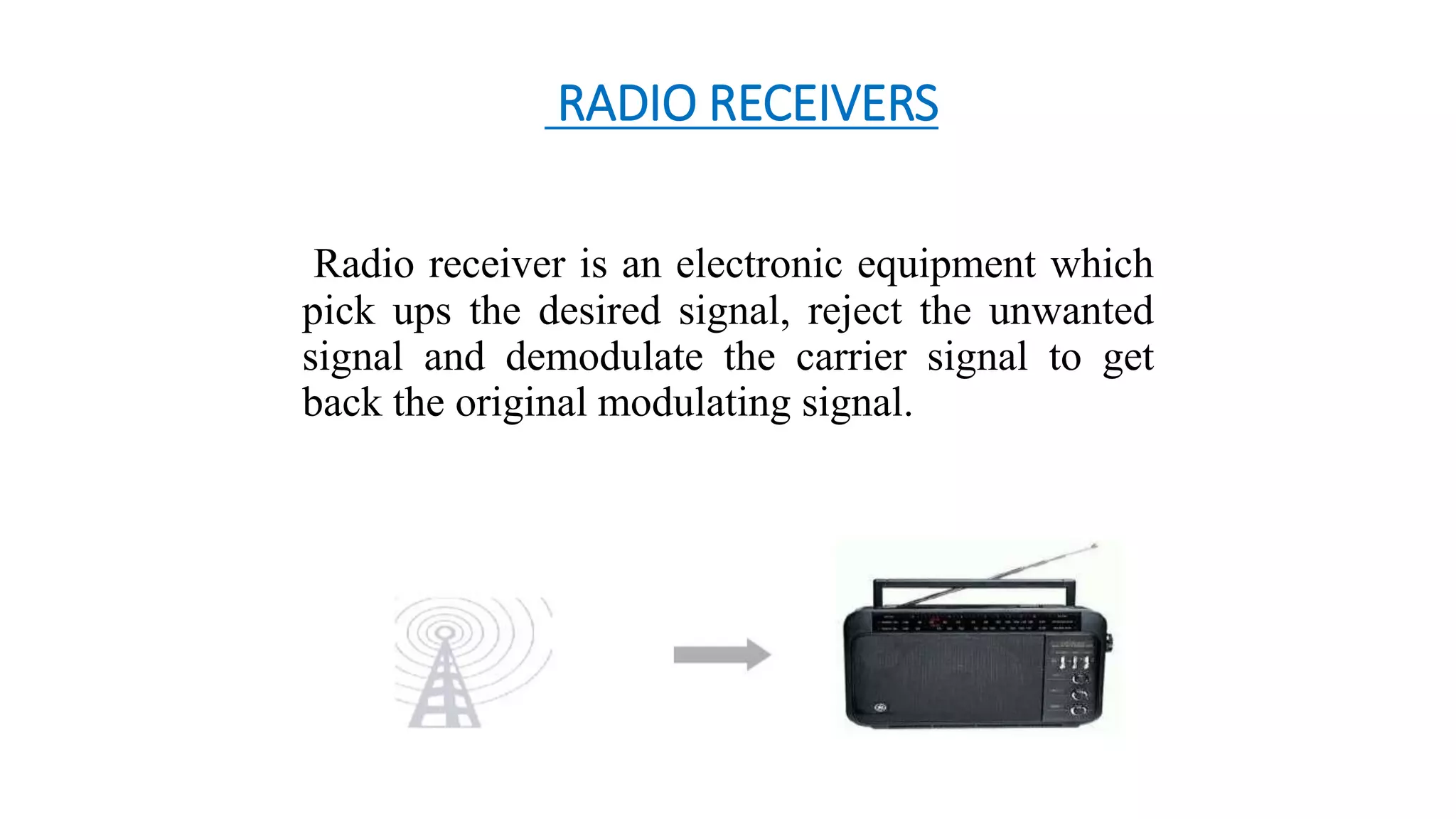
Radio receiver is an electronic equipment which
pick ups the desired signal, reject the unwanted
signal and demodulate the carrier signal to get
back the original modulating signal.
Basic Functions of AM Receivers
i. Reception: Receiving antenna receives or picks up energy from the various EM waves
radiated by radio transmitter
ii. Selection: This consists in selecting or responding to desired radio wave with
the exclusion of all others.
iii. Detection or demodulation: The desired signal in the form of a modulated carrier
voltage is detected in a detector circuit to recover the original modulating voltage.
iv. Reproduction: This consists in feeding the detected signal to a loudspeaker or headphones
to reproduce the sound waves giving the original programme.
Design of Receiver
• The radio receiver has to be cost effective
• Requirements:
• Has to work according to application as for AM or FM
signals
• Tune to and amplify desired radio station
• Filter out all other stations
• Demodulator has to work with all radio stations
regardless of carrier frequency
Features
i. Simplicity of Operation: These receivers are required to be handled by listeners who have
Little technical knowledge and hence simplicity of operation is essential.
ii. Good Fidelity: Fidelity of a receiver is it’s ability to reproduce exact replica of the
transmitted signals at the receiver output.
iii. Good Selectivity: The selectivity of an AM receiver is defined as it’s ability to accept or
select the desired band of frequency and reject all other unwanted frequencies which can be
interfering signals.
iv. Average Sensitivity: Sensitivity of a receiver is it’s ability to identify and amplify weak
signals at receiver output.
v. Adaptability to different types of aerials: The receiving aerial intercepts EM waves. A
broadcast receiver should be designed to operate satisfactory with any type of aerial.
Classification of Radio Receivers
Depending upon application
•AM Receivers - receive broadcast of speech or music
from AM transmitters which operate on long wave,
medium wave or short wave bands.
•FM Receivers – receive broadcast programs from FM
transmitters which operate in VHF or UHF bands.
•Communication Receivers - used for reception
of telegraph and short wave telephone signals.
•Television Receivers - used to receive television
broadcast in VHF or UHF bands.
•Radar Receivers – used to receive radio
detection and ranging signals.
•Principles
•Frequency Spectrum Sharing
(many transmitters using one
medium)
•Demodulating desired signal
and rejecting other signals
transmitted at the same time
Receivers
•Radio system should be able to receive any type of
audio source simultaneously.
• Different stations with different sources transmit
signals simultaneously.
• Different listeners tune to different stations
simultaneously.
Types of Receiver
1. Tuned Radio-Frequency (TRF) or Straight
Receivers (Operates in a straight forward
manner without frequency conversion)
2. Superheterodyne Receiver (To heterodyne
means to mix. Received RF signal is
converted to standard Inter-mediate (IF)
frequency before detection takes place)
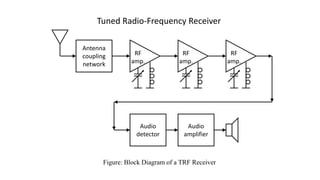
Tuned Radio-Frequency Receiver
Audio
detector
Audio
amplifier
RF
amp.
RF
amp.
RF
amp.
Antenna
coupling
network
Figure: Block Diagram of a TRF Receiver
Tuned Radio Frequency (TRF) Receiver:
• Composed of RF amplifiers and detectors.
• No frequency conversion
• It is not often used.
• Difficult to design tunable RF stages.
• Difficult to obtain high gain RF amplifiers
•Selectivity decreases as the carrier frequency
increases
Assignment
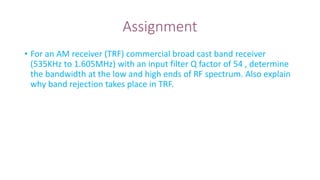
• For an AM receiver (TRF) commercial broad cast band receiver
(535KHz to 1.605MHz) with an input filter Q factor of 54 , determine
the bandwidth at the low and high ends of RF spectrum. Also explain
why band rejection takes place in TRF.
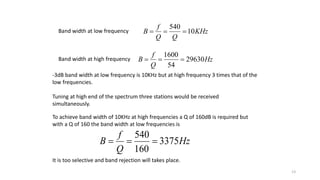
Band width at low frequency KHz
Q
Q
f
B 10
540



Band width at high frequency Hz
Q
f
B 29630
54
1600



-3dB band width at low frequency is 10KHz but at high frequency 3 times that of the
low frequencies.
Tuning at high end of the spectrum three stations would be received
simultaneously.
To achieve band width of 10KHz at high frequencies a Q of 160dB is required but
with a Q of 160 the band width at low frequencies is
It is too selective and band rejection will takes place.
Hz
Q
f
B 3375
160
540



13

Lecture_02.pptx

  • 1.
    RADIO RECEIVERS Radio receiveris an electronic equipment which pick ups the desired signal, reject the unwanted signal and demodulate the carrier signal to get back the original modulating signal.
  • 2.
    Basic Functions ofAM Receivers i. Reception: Receiving antenna receives or picks up energy from the various EM waves radiated by radio transmitter ii. Selection: This consists in selecting or responding to desired radio wave with the exclusion of all others. iii. Detection or demodulation: The desired signal in the form of a modulated carrier voltage is detected in a detector circuit to recover the original modulating voltage. iv. Reproduction: This consists in feeding the detected signal to a loudspeaker or headphones to reproduce the sound waves giving the original programme.
  • 3.
    Design of Receiver •The radio receiver has to be cost effective • Requirements: • Has to work according to application as for AM or FM signals • Tune to and amplify desired radio station • Filter out all other stations • Demodulator has to work with all radio stations regardless of carrier frequency
  • 4.
    Features i. Simplicity ofOperation: These receivers are required to be handled by listeners who have Little technical knowledge and hence simplicity of operation is essential. ii. Good Fidelity: Fidelity of a receiver is it’s ability to reproduce exact replica of the transmitted signals at the receiver output. iii. Good Selectivity: The selectivity of an AM receiver is defined as it’s ability to accept or select the desired band of frequency and reject all other unwanted frequencies which can be interfering signals. iv. Average Sensitivity: Sensitivity of a receiver is it’s ability to identify and amplify weak signals at receiver output. v. Adaptability to different types of aerials: The receiving aerial intercepts EM waves. A broadcast receiver should be designed to operate satisfactory with any type of aerial.
  • 5.
    Classification of RadioReceivers Depending upon application •AM Receivers - receive broadcast of speech or music from AM transmitters which operate on long wave, medium wave or short wave bands. •FM Receivers – receive broadcast programs from FM transmitters which operate in VHF or UHF bands.
  • 6.
    •Communication Receivers -used for reception of telegraph and short wave telephone signals. •Television Receivers - used to receive television broadcast in VHF or UHF bands. •Radar Receivers – used to receive radio detection and ranging signals.
  • 7.
    •Principles •Frequency Spectrum Sharing (manytransmitters using one medium) •Demodulating desired signal and rejecting other signals transmitted at the same time
  • 8.
    Receivers •Radio system shouldbe able to receive any type of audio source simultaneously. • Different stations with different sources transmit signals simultaneously. • Different listeners tune to different stations simultaneously.
  • 9.
    Types of Receiver 1.Tuned Radio-Frequency (TRF) or Straight Receivers (Operates in a straight forward manner without frequency conversion) 2. Superheterodyne Receiver (To heterodyne means to mix. Received RF signal is converted to standard Inter-mediate (IF) frequency before detection takes place)
  • 10.
  • 11.
    Tuned Radio Frequency(TRF) Receiver: • Composed of RF amplifiers and detectors. • No frequency conversion • It is not often used. • Difficult to design tunable RF stages. • Difficult to obtain high gain RF amplifiers •Selectivity decreases as the carrier frequency increases
  • 12.
    Assignment • For anAM receiver (TRF) commercial broad cast band receiver (535KHz to 1.605MHz) with an input filter Q factor of 54 , determine the bandwidth at the low and high ends of RF spectrum. Also explain why band rejection takes place in TRF.
  • 13.
    Band width atlow frequency KHz Q Q f B 10 540    Band width at high frequency Hz Q f B 29630 54 1600    -3dB band width at low frequency is 10KHz but at high frequency 3 times that of the low frequencies. Tuning at high end of the spectrum three stations would be received simultaneously. To achieve band width of 10KHz at high frequencies a Q of 160dB is required but with a Q of 160 the band width at low frequencies is It is too selective and band rejection will takes place. Hz Q f B 3375 160 540    13