Welcome To E-Shop
Presentation
Presented By
Hossain Md Sazzat 13-24552-2
BSc. In EEE
Faculty: A.H.M Shatil
Introduction
1 .Radio is the radiation of electromagnetic
signals through the atmosphere or free space.
2. The transmission and reception of
electromagnetic waves of radio frequency,
especially those carrying sound messages.
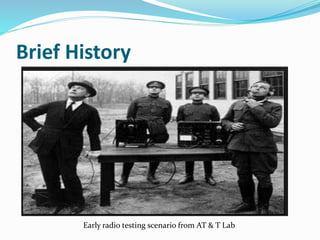
Brief History
Early radio testing scenario from AT & T Lab
History
** In 1873 James Clerk Maxwell showed mathematically
that electromagnetic waves could propagate through free
space.
** The first intentional transmission of a signal by means
of electromagnetic waves was performed in an experiment
by David Edward Hughes around 1880.
** In 1888 Heinrich Rudolf Hertz was able to prove
transmitted electromagnetic waves in an experiment
confirming Maxwell's theory of electromagnetism.
History
** Nikola Tesla experimentally demonstrated the
transmission and radiation of radio frequency energy in
1892 .
** 1895, Marconi built a wireless system capable of
transmitting signals at long distances (1.5 mi. / 2.4 km).
** From Marconi's experiments, the phenomenon that
transmission range is proportional to the square of antenna
height is known as "Marconi's law".
Classification of radio waves
Class
1 .Very Low Frequency
2.Low frequency
3. Medium frequency
4.High frequency
5.Very high frequency
6.Ultra high frequency
7.Super high frequency
Frequency Range
10 to 30 kHz
30 to 300 kHz
300 to 3000 kHz
3 to 30 MHz
30 to 300 MHz
300 to 3000 MHz
3000 to 30000 MHz
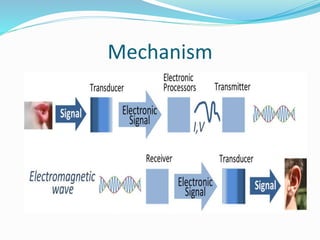
Mechanism
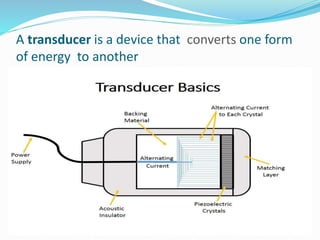
A transducer is a device that converts one form
of energy to another
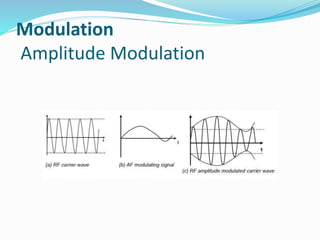
Modulation
Amplitude Modulation
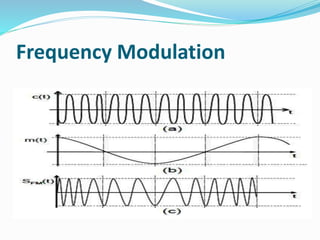
Frequency Modulation
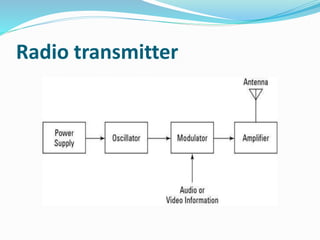
Radio transmitter
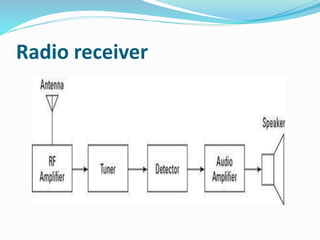
Radio receiver
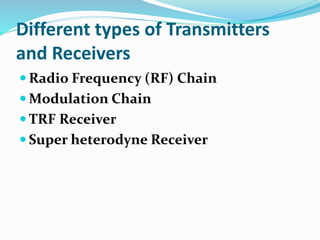
Different types of Transmitters
and Receivers
 Radio Frequency (RF) Chain
 Modulation Chain
 TRF Receiver
 Super heterodyne Receiver
TRF Receiver
Superheterodyne Receiver
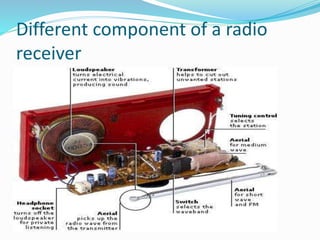
Different component of a radio
receiver
Uses of radio waves
 Here are some common uses
1 . Wireless technology
2. Mobile telephone communication
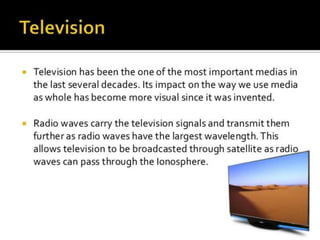
3 .television
4 .Radar
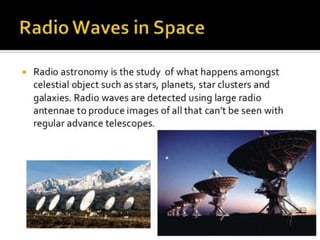
5 .radio waves in space
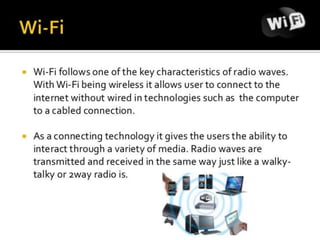
6 .WiFi
And many ,many Others
Advantages
 It’s also a cheap form of communication and it travels
through the air so no wires are needed.
 Radio communication can be possible where any
satellite and cell phone service are not available.
Disadvantages
 It has low frequency so it can't transmit a lot of data
one time.
 In this communication system we can’t transfer video
or picture only voice signal can be transferred.
Future Technology for Radio
Communication
Cognitive Radio Networks
 Cognitive radios have the ability to monitor, sense, and
detect the conditions of their operating environment.
 A cognitive radio is an intelligent radio that can be
programmed and configured dynamically. Its
transceiver is designed to use the best wireless
channels .
Conclusion
 The radio communications has been used over a
hundred years now.
 The uses of radio communication increasing day by
day & its being used by a wide range of electronic
sector.
 This technology is upgrading to give us better
satisfaction
References
[1 ] Microphone IMAGE. Posted by Tom (2007). Houston’s
Clear Thinkers. Weblog [Online] August 22. Available
from:
http://blog.kir.com/archives/2007/08/sports_talk_rad.asp
[Accessed 22/01/11]
[ 2] National Astronauts and Space Administration. [Web
Definition] [Accessed 22/01/11] Available form:
http://science.hq.nasa.gov/kids/imagers/ems/radio.html
[3] National Astronauts and Space Administration(2010).
[Online Image] [Accessed 22/01/11] Available form:
http://science.hq.nasa.gov/kids/imagers/ems/radio.html
Basic radio  communication

Basic radio communication

  • 1.
  • 2.
    Presented By Hossain MdSazzat 13-24552-2 BSc. In EEE Faculty: A.H.M Shatil
  • 3.
    Introduction 1 .Radio isthe radiation of electromagnetic signals through the atmosphere or free space. 2. The transmission and reception of electromagnetic waves of radio frequency, especially those carrying sound messages.
  • 4.
    Brief History Early radiotesting scenario from AT & T Lab
  • 5.
    History ** In 1873James Clerk Maxwell showed mathematically that electromagnetic waves could propagate through free space. ** The first intentional transmission of a signal by means of electromagnetic waves was performed in an experiment by David Edward Hughes around 1880. ** In 1888 Heinrich Rudolf Hertz was able to prove transmitted electromagnetic waves in an experiment confirming Maxwell's theory of electromagnetism.
  • 6.
    History ** Nikola Teslaexperimentally demonstrated the transmission and radiation of radio frequency energy in 1892 . ** 1895, Marconi built a wireless system capable of transmitting signals at long distances (1.5 mi. / 2.4 km). ** From Marconi's experiments, the phenomenon that transmission range is proportional to the square of antenna height is known as "Marconi's law".
  • 7.
    Classification of radiowaves Class 1 .Very Low Frequency 2.Low frequency 3. Medium frequency 4.High frequency 5.Very high frequency 6.Ultra high frequency 7.Super high frequency Frequency Range 10 to 30 kHz 30 to 300 kHz 300 to 3000 kHz 3 to 30 MHz 30 to 300 MHz 300 to 3000 MHz 3000 to 30000 MHz
  • 8.
  • 9.
    A transducer isa device that converts one form of energy to another
  • 10.
  • 11.
  • 12.
  • 13.
  • 14.
    Different types ofTransmitters and Receivers  Radio Frequency (RF) Chain  Modulation Chain  TRF Receiver  Super heterodyne Receiver
  • 15.
  • 16.
  • 17.
    Different component ofa radio receiver
  • 18.
    Uses of radiowaves  Here are some common uses 1 . Wireless technology 2. Mobile telephone communication 3 .television 4 .Radar 5 .radio waves in space 6 .WiFi And many ,many Others
  • 25.
    Advantages  It’s alsoa cheap form of communication and it travels through the air so no wires are needed.  Radio communication can be possible where any satellite and cell phone service are not available.
  • 26.
    Disadvantages  It haslow frequency so it can't transmit a lot of data one time.  In this communication system we can’t transfer video or picture only voice signal can be transferred.
  • 27.
    Future Technology forRadio Communication Cognitive Radio Networks  Cognitive radios have the ability to monitor, sense, and detect the conditions of their operating environment.  A cognitive radio is an intelligent radio that can be programmed and configured dynamically. Its transceiver is designed to use the best wireless channels .
  • 28.
    Conclusion  The radiocommunications has been used over a hundred years now.  The uses of radio communication increasing day by day & its being used by a wide range of electronic sector.  This technology is upgrading to give us better satisfaction
  • 29.
    References [1 ] MicrophoneIMAGE. Posted by Tom (2007). Houston’s Clear Thinkers. Weblog [Online] August 22. Available from: http://blog.kir.com/archives/2007/08/sports_talk_rad.asp [Accessed 22/01/11] [ 2] National Astronauts and Space Administration. [Web Definition] [Accessed 22/01/11] Available form: http://science.hq.nasa.gov/kids/imagers/ems/radio.html [3] National Astronauts and Space Administration(2010). [Online Image] [Accessed 22/01/11] Available form: http://science.hq.nasa.gov/kids/imagers/ems/radio.html