
M A N A G E M E N T I N F O R M A T I O N S Y S T E M
PRESENTATION
ON
RFID
4/20/2014
1
Overview
 What is RFID?
 Brief History
 How RFID Works
 Current Applications
 Future Applications
 Potential Research
 Advantages and Disadvantages
 Privacy concern
 Regulations
 Conclusion
4/20/2014
2
What is RFID?
 RFID is an acronym for radio frequency
identification.
 Briefly the RF stand for “radio-frequency” and ID
means “identifier” that allows an item,
 The use of radio frequency tags to identify real
objects, for instance a library book, to be identified,
accessed, stored, reprogrammed and communicated
by using radio waves
4/20/2014
3
Brief History
 First Bar code patents – 1930s
 First use of RFID device – 2nd world war – Britain used
RFID-like technology for Identify- Friend or Foe
 Commercial Operation begun from 1960’s …
 In 1970s developers, inventors, companies, academic
institution and government sectors were actively worked
on RFID
 Most common application were tracked person and
objects, identified goods in supply chain, reusable
container, high value tools, security, controlling access to
building, networks, payment systems and other assets.
4/20/2014
4
Identification Examples
 Bar Codes
 License Plates
 Social Security Numbers
 Student ID
 Serial Numbers
 Car Keys
 Database Keys
4/20/2014
5
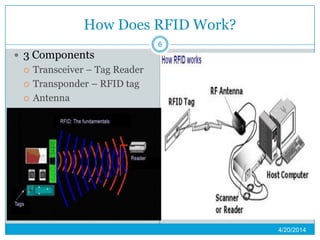
How Does RFID Work?
 3 Components
 Transceiver – Tag Reader
 Transponder – RFID tag
 Antenna
4/20/2014
6
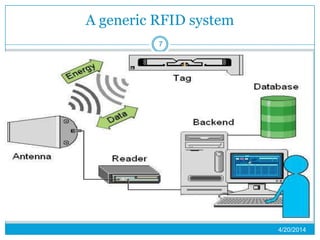
A generic RFID system
4/20/2014
7
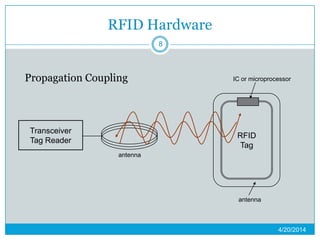
RFID Hardware
Propagation Coupling
Transceiver
Tag Reader
antenna
RFID
Tag
IC or microprocessor
antenna
4/20/2014
8
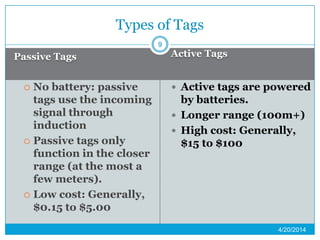
Passive Tags Active Tags
 No battery: passive
tags use the incoming
signal through
induction
 Passive tags only
function in the closer
range (at the most a
few meters).
 Low cost: Generally,
$0.15 to $5.00
 Active tags are powered
by batteries.
 Longer range (100m+)
 High cost: Generally,
$15 to $100
Types of Tags
4/20/2014
9
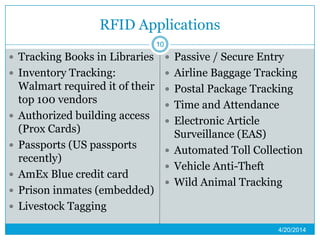
RFID Applications
 Tracking Books in Libraries
 Inventory Tracking:
Walmart required it of their
top 100 vendors
 Authorized building access
(Prox Cards)
 Passports (US passports
recently)
 AmEx Blue credit card
 Prison inmates (embedded)
 Livestock Tagging
 Passive / Secure Entry
 Airline Baggage Tracking
 Postal Package Tracking
 Time and Attendance
 Electronic Article
Surveillance (EAS)
 Automated Toll Collection
 Vehicle Anti-Theft
 Wild Animal Tracking
4/20/2014
10
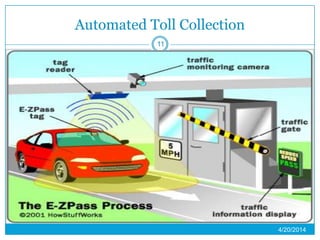
Automated Toll Collection
4/20/2014
11
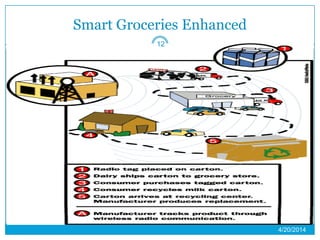
Smart Groceries Enhanced
4/20/2014
12
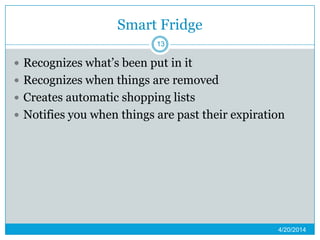
Smart Fridge
 Recognizes what’s been put in it
 Recognizes when things are removed
 Creates automatic shopping lists
 Notifies you when things are past their expiration
4/20/2014
13
RFID’s Advantages
 Automatically identify
objects
 Store data on a tag
 Can be hidden
 Work in harsh
environments
 Improve Customer
Services
 Easily Prevent Theft
 An AUTO-ID based
System
 A method for controlling
inventory
 Saving Time and Money
 Minimize Work Stress of
Staff
 Offering Self Check out/in
4/20/2014
14
RFID’s Disadvantages
 Lack of standards!
 Short range in case of passive tag
 Cost
 Privacy concerns
4/20/2014
15
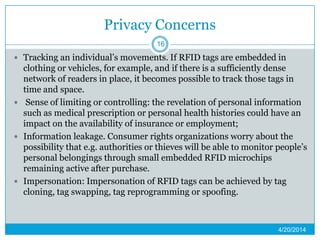
Privacy Concerns
 Tracking an individual’s movements. If RFID tags are embedded in
clothing or vehicles, for example, and if there is a sufficiently dense
network of readers in place, it becomes possible to track those tags in
time and space.
 Sense of limiting or controlling: the revelation of personal information
such as medical prescription or personal health histories could have an
impact on the availability of insurance or employment;
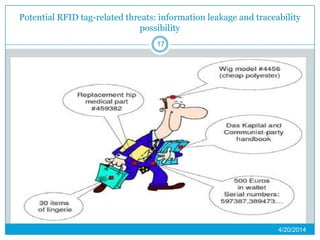
 Information leakage. Consumer rights organizations worry about the
possibility that e.g. authorities or thieves will be able to monitor people’s
personal belongings through small embedded RFID microchips
remaining active after purchase.
 Impersonation: Impersonation of RFID tags can be achieved by tag
cloning, tag swapping, tag reprogramming or spoofing.
4/20/2014
16
Potential RFID tag-related threats: information leakage and traceability
possibility
4/20/2014
17
Regulation
 Currently no global body governing RFID frequency
allocation
 In Europe, tags must be removed from packaging
before disposal due to recycling disruptions and
health regulations
 There is limited or no regulation of RFID’s for the
most part leading to more controversy
4/20/2014
18
Conclusion
 RFID technology is rapidly is becoming more
standardized, but problems do still exist
 The number of adopters of RFID technology is
growing
 Regulation and education is necessary to quell some
of the fears regarding RFID technology and it’s
implications
4/20/2014
19
4/20/201420
THANK
YOU

Radio-frequency_identification‎

  • 1.
    M A NA G E M E N T I N F O R M A T I O N S Y S T E M PRESENTATION ON RFID 4/20/2014 1
  • 2.
    Overview  What isRFID?  Brief History  How RFID Works  Current Applications  Future Applications  Potential Research  Advantages and Disadvantages  Privacy concern  Regulations  Conclusion 4/20/2014 2
  • 3.
    What is RFID? RFID is an acronym for radio frequency identification.  Briefly the RF stand for “radio-frequency” and ID means “identifier” that allows an item,  The use of radio frequency tags to identify real objects, for instance a library book, to be identified, accessed, stored, reprogrammed and communicated by using radio waves 4/20/2014 3
  • 4.
    Brief History  FirstBar code patents – 1930s  First use of RFID device – 2nd world war – Britain used RFID-like technology for Identify- Friend or Foe  Commercial Operation begun from 1960’s …  In 1970s developers, inventors, companies, academic institution and government sectors were actively worked on RFID  Most common application were tracked person and objects, identified goods in supply chain, reusable container, high value tools, security, controlling access to building, networks, payment systems and other assets. 4/20/2014 4
  • 5.
    Identification Examples  BarCodes  License Plates  Social Security Numbers  Student ID  Serial Numbers  Car Keys  Database Keys 4/20/2014 5
  • 6.
    How Does RFIDWork?  3 Components  Transceiver – Tag Reader  Transponder – RFID tag  Antenna 4/20/2014 6
  • 7.
    A generic RFIDsystem 4/20/2014 7
  • 8.
    RFID Hardware Propagation Coupling Transceiver TagReader antenna RFID Tag IC or microprocessor antenna 4/20/2014 8
  • 9.
    Passive Tags ActiveTags  No battery: passive tags use the incoming signal through induction  Passive tags only function in the closer range (at the most a few meters).  Low cost: Generally, $0.15 to $5.00  Active tags are powered by batteries.  Longer range (100m+)  High cost: Generally, $15 to $100 Types of Tags 4/20/2014 9
  • 10.
    RFID Applications  TrackingBooks in Libraries  Inventory Tracking: Walmart required it of their top 100 vendors  Authorized building access (Prox Cards)  Passports (US passports recently)  AmEx Blue credit card  Prison inmates (embedded)  Livestock Tagging  Passive / Secure Entry  Airline Baggage Tracking  Postal Package Tracking  Time and Attendance  Electronic Article Surveillance (EAS)  Automated Toll Collection  Vehicle Anti-Theft  Wild Animal Tracking 4/20/2014 10
  • 11.
  • 12.
  • 13.
    Smart Fridge  Recognizeswhat’s been put in it  Recognizes when things are removed  Creates automatic shopping lists  Notifies you when things are past their expiration 4/20/2014 13
  • 14.
    RFID’s Advantages  Automaticallyidentify objects  Store data on a tag  Can be hidden  Work in harsh environments  Improve Customer Services  Easily Prevent Theft  An AUTO-ID based System  A method for controlling inventory  Saving Time and Money  Minimize Work Stress of Staff  Offering Self Check out/in 4/20/2014 14
  • 15.
    RFID’s Disadvantages  Lackof standards!  Short range in case of passive tag  Cost  Privacy concerns 4/20/2014 15
  • 16.
    Privacy Concerns  Trackingan individual’s movements. If RFID tags are embedded in clothing or vehicles, for example, and if there is a sufficiently dense network of readers in place, it becomes possible to track those tags in time and space.  Sense of limiting or controlling: the revelation of personal information such as medical prescription or personal health histories could have an impact on the availability of insurance or employment;  Information leakage. Consumer rights organizations worry about the possibility that e.g. authorities or thieves will be able to monitor people’s personal belongings through small embedded RFID microchips remaining active after purchase.  Impersonation: Impersonation of RFID tags can be achieved by tag cloning, tag swapping, tag reprogramming or spoofing. 4/20/2014 16
  • 17.
    Potential RFID tag-relatedthreats: information leakage and traceability possibility 4/20/2014 17
  • 18.
    Regulation  Currently noglobal body governing RFID frequency allocation  In Europe, tags must be removed from packaging before disposal due to recycling disruptions and health regulations  There is limited or no regulation of RFID’s for the most part leading to more controversy 4/20/2014 18
  • 19.
    Conclusion  RFID technologyis rapidly is becoming more standardized, but problems do still exist  The number of adopters of RFID technology is growing  Regulation and education is necessary to quell some of the fears regarding RFID technology and it’s implications 4/20/2014 19
  • 20.