Design and Simulation of
Passive
UHF RFID Tag
Supervisor: Dr. Irfanullah
Group Members:
Haroon Ahmed FA11-BEE-054
Nabeel Muqarab FA11-BEE-074
Rehan Zaffar FA11-BEE-087
Objectives:
• To design, simulate and fabricate
passive UHF RFID tag.
• To measure input impedance of the
fabricated tag for matching with RFID
tag IC.
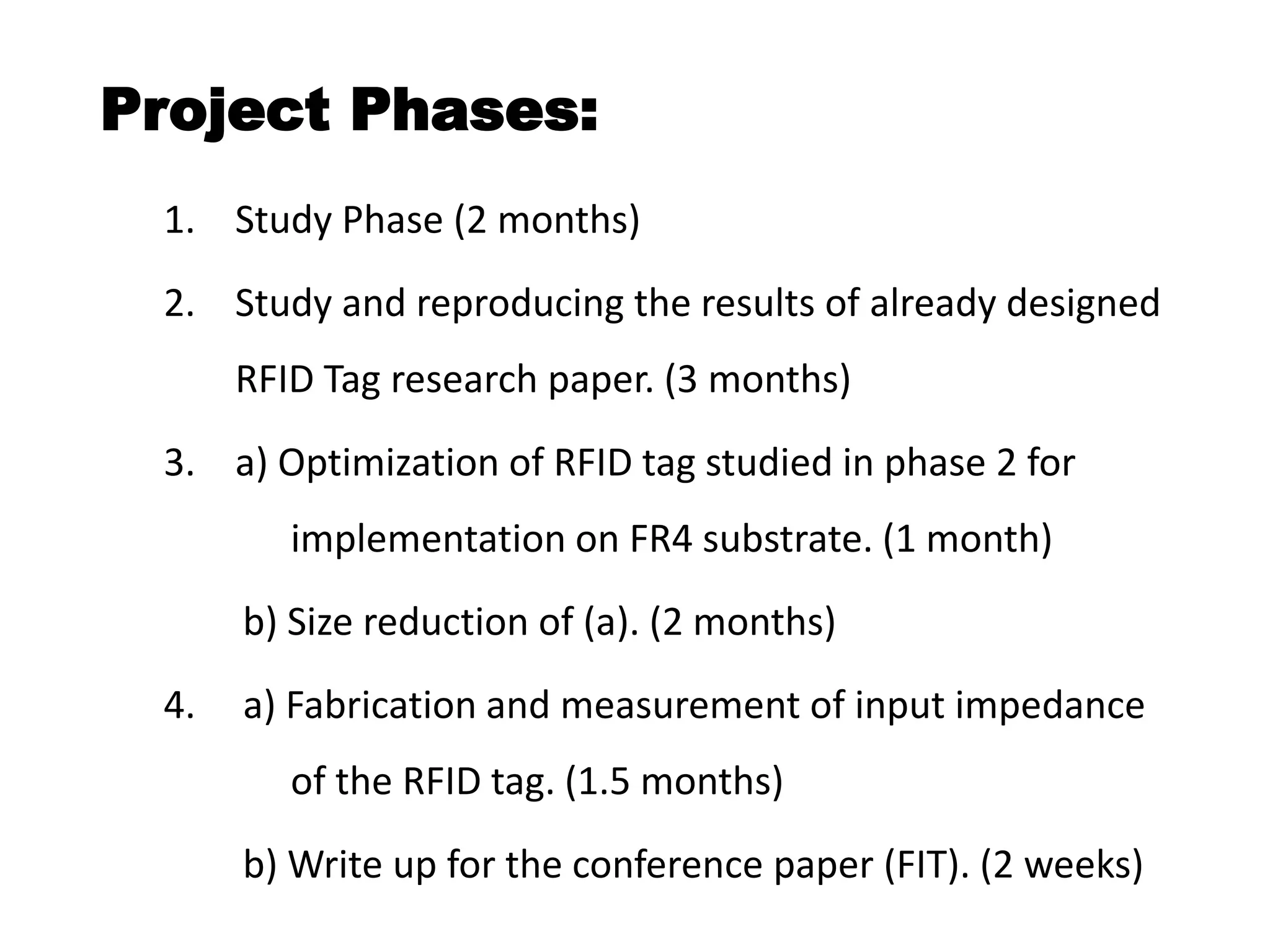
Project Phases:
1. Study Phase (2 months)
2. Study and reproducing the results of already designed
RFID Tag research paper. (3 months)
3. a) Optimization of RFID tag studied in phase 2 for
implementation on FR4 substrate. (1 month)
b) Size reduction of (a). (2 months)
4. a) Fabrication and measurement of input impedance
of the RFID tag. (1.5 months)
b) Write up for the conference paper (FIT). (2 weeks)
Block Diagram:
[1] Antenna Theory and Design by Warren L. Stutzman 3rd Edition
Fig.1 Block Diagram of RFID System [1]
Passive RFID Tag System:
• Reader
• Emits RF signal.
• Collects Data stored in tag.
• Tag
• Converts RF signal to DC voltage
for powering up the circuitry.
• Process and returns RF signal
containing identification data.
Introduction:
RFID:
A radio frequency identification (RFID) system identifies an
object without direct contact through digital wireless
techniques.
RFID Allocated Freq. Bands [2]:
Frequency Band Name Frequencies Passive Read Distance
Low Frequency (LF) 120-140 KHz 10-120 cm
High Frequency (HF) 13.56 MHz 10-20 cm
Ultra High Frequency (UHF) 865-928 MHz Less than 10 m
Microwave (MW) 2.45 & 5.8 MHz Less than 3 m
Ultra Wideband 3.1-10.6 GHz 10 m
[2] Antenna Theory and Design by Warren L. Stutzman 3rd Edition
RFID Frequency Bands [3]
• USA: 902 – 928 MHz
• China : 840.5 – 844.75 / 920.25 – 924.75 MHz
• Europe : 865- 868 MHz
[3] D. Puente, et al “Matching radio frequency identification tag compact dipole
antennas to an arbitrary chip impedance” IET Microwaves, Antennas & Propagation
2008
Reproducing the results of:
S. Sajal, et al “A Low Cost Flexible Passive
UHF RFID Tag for Sensing Moisture Based
on Antenna Polarization”, IEEE, 2014.
Physical Structure:
.
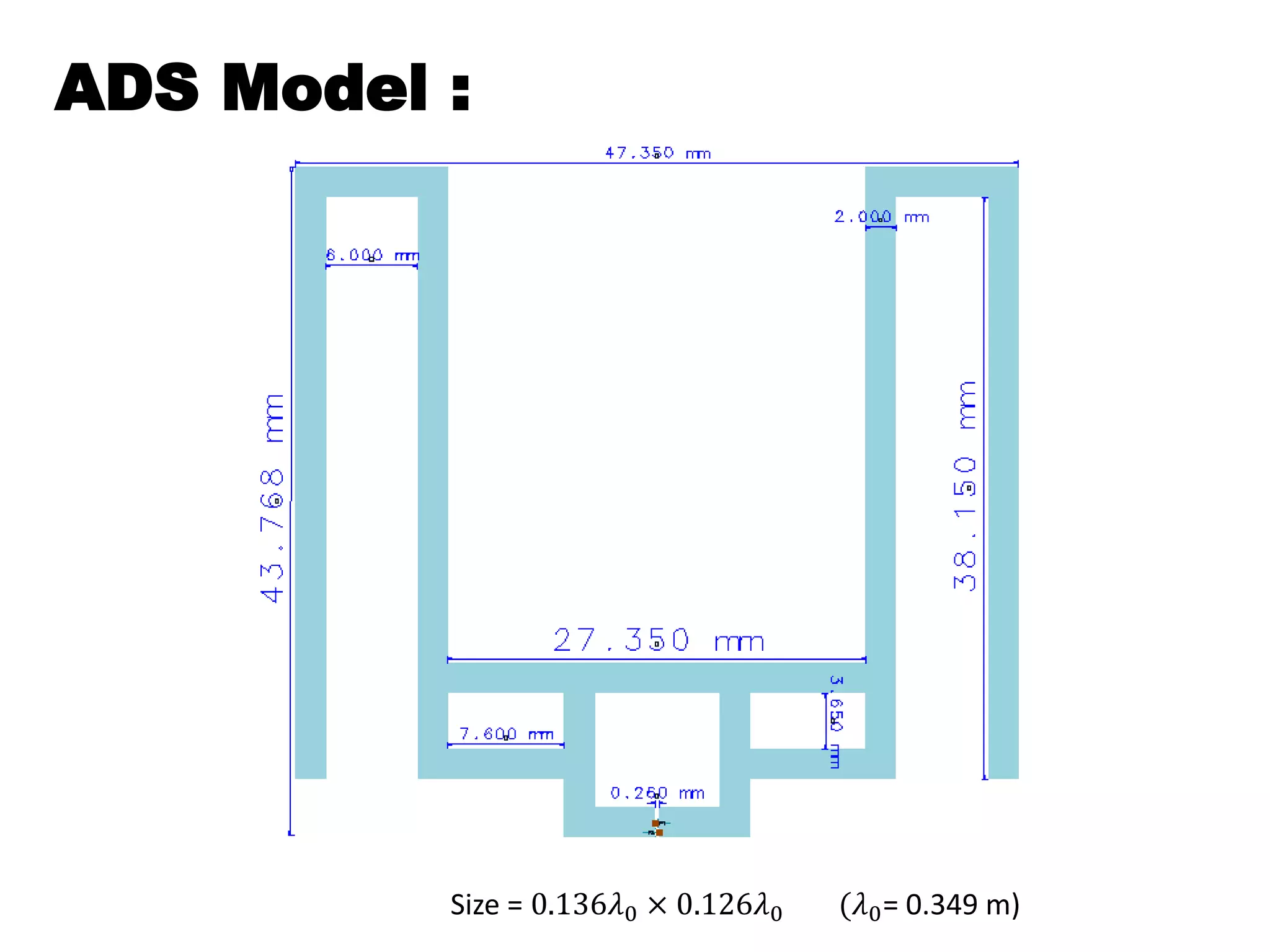
Fig. 2. Dimension of the Antenna; a= 2 mm, b = 27.35 mm, c = 32.35 mm,
d = 38 mm, e = 7.6 mm, f = 3.65 mm, g = 6 mm [4]
[4] S. Sajal et al, “A Low Cost Flexible Passive UHF RFID Tag for Sensing Moisture Based on Antenna
Polarization”, IEEE, 2014
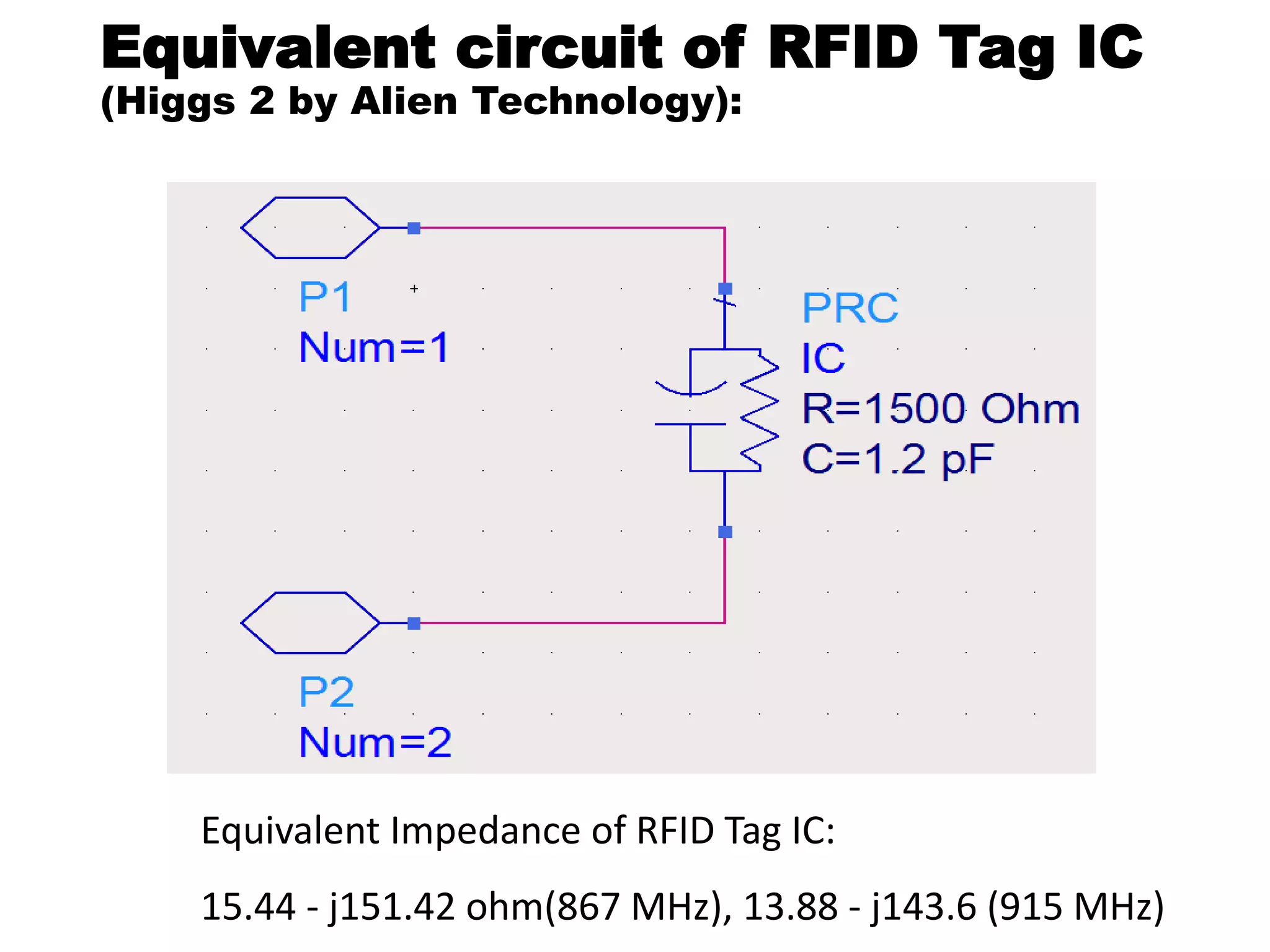
Equivalent circuit of RFID Tag IC
(Higgs 2 by Alien Technology):
.
Equivalent Impedance of RFID Tag IC:
15.44 - j151.42 ohm(867 MHz), 13.88 - j143.6 (915 MHz)
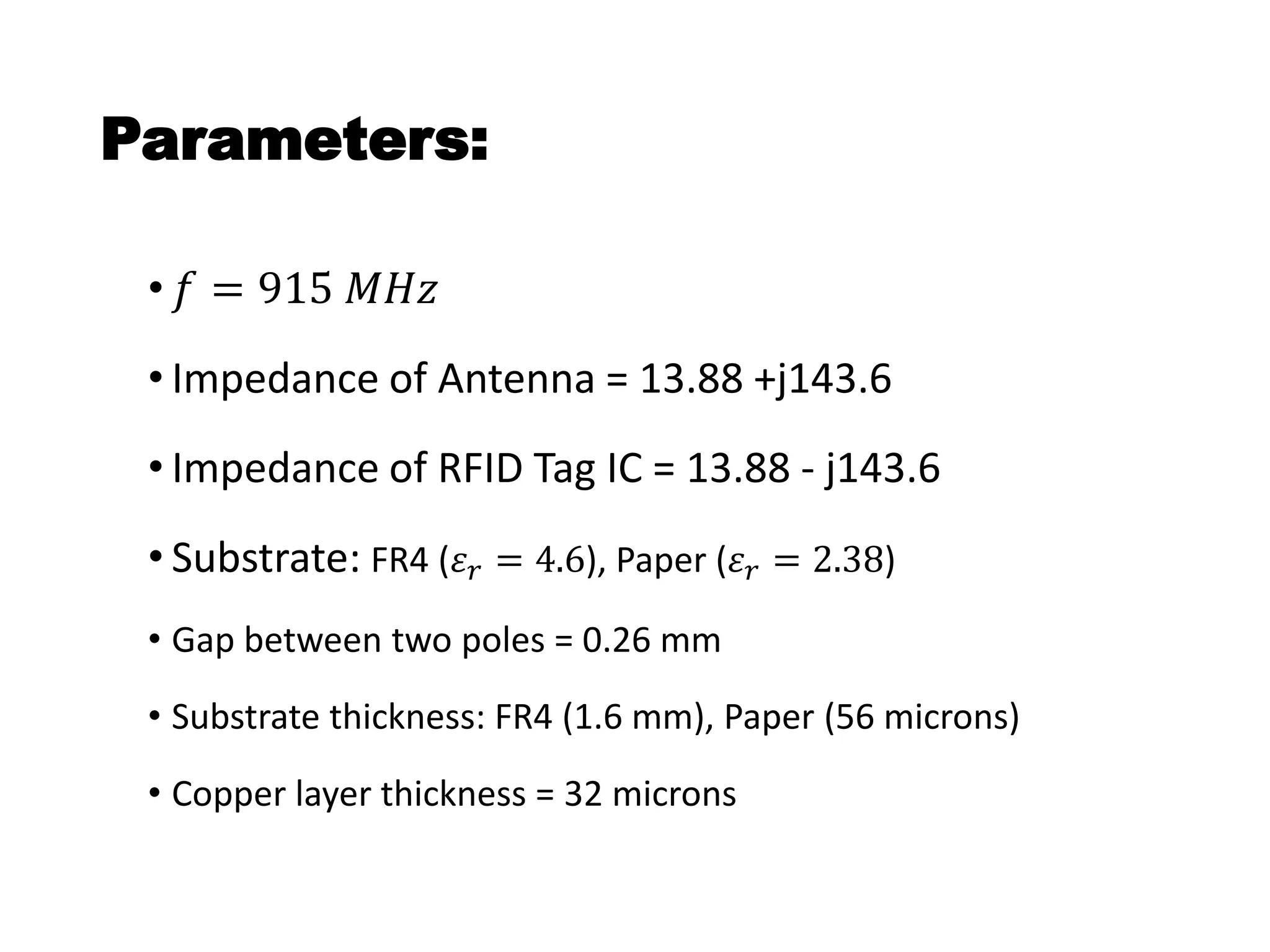
Parameters:
• 𝑓 = 915 𝑀𝐻𝑧
• Impedance of Antenna = 13.88 +j143.6
• Impedance of RFID Tag IC = 13.88 - j143.6
• Substrate: FR4 (𝜀 𝑟 = 4.6), Paper (𝜀 𝑟 = 2.38)
• Gap between two poles = 0.26 mm
• Substrate thickness: FR4 (1.6 mm), Paper (56 microns)
• Copper layer thickness = 32 microns
ADS Model :
Size = 0.136𝜆0 × 0.126𝜆0 (𝜆0= 0.349 m)
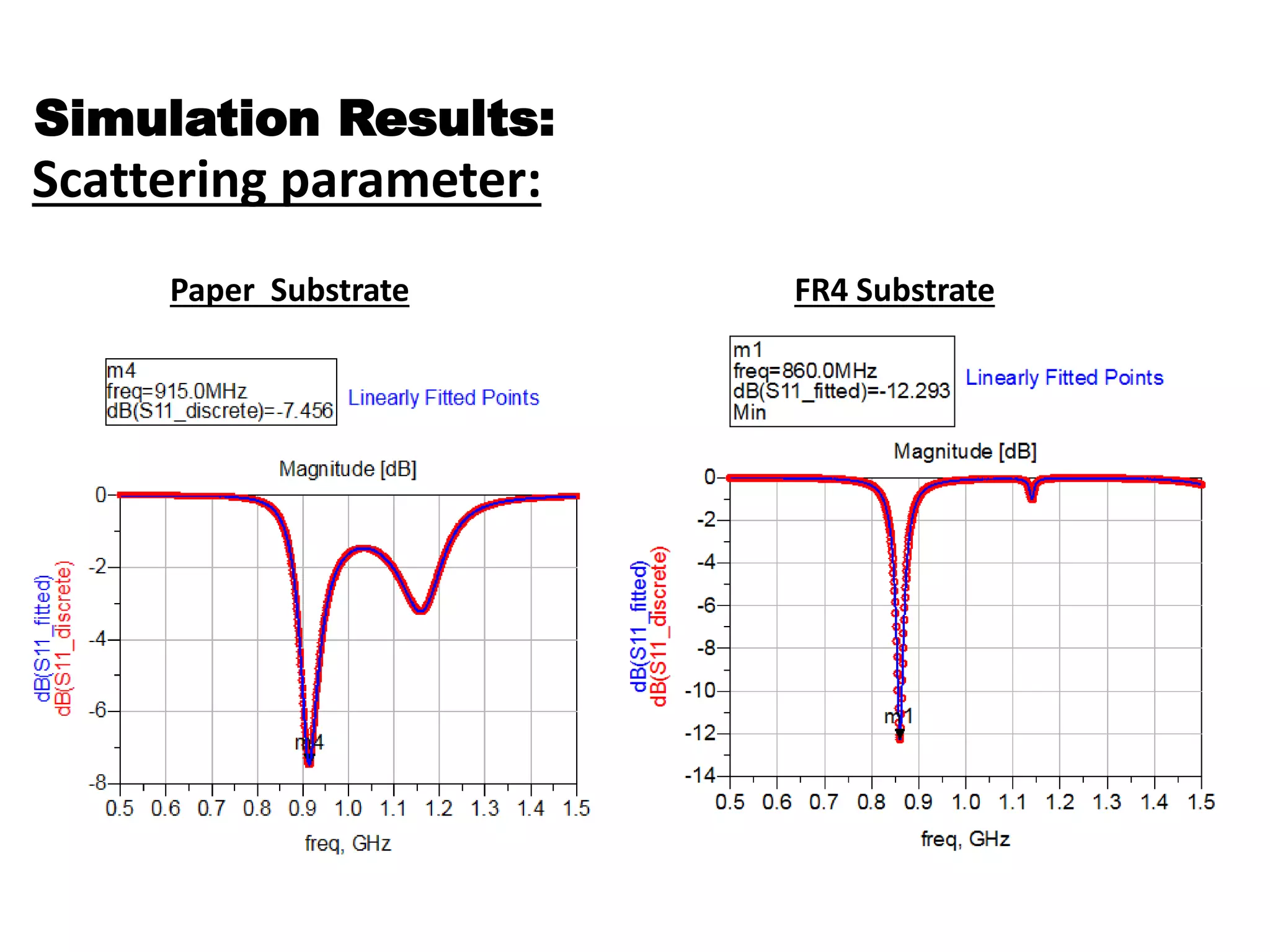
Simulation Results:
Scattering parameter:
FR4 SubstratePaper Substrate
Size Reduction and Impedance
Matching(Smith Chart)[5] :
For an antenna to have an admittance of 𝑌𝑎 = 𝑔 𝑎 + 𝑗𝑏 𝑎 and the chip
admittance to be 𝑌𝑐 = 𝑔𝑐 + 𝑗𝑏𝑐 for the optimal power transfer
between the antenna and tag 𝑌𝑎 = 𝑌𝑐
∗ at the design frequency
1) Making 𝑔 𝑎 = 𝑔𝑐 by scaling
For 𝑔 𝑎 = 𝑔𝑐 scaling factor is used
𝞺 =
𝑓
𝑓0
Where f is either
𝑓 = 𝑓1
Or 𝑓 = 𝑓2
If 𝑓1 < 𝑓2 𝑠𝑜 𝑓1 is chosen for more compact design.
[5] D. Puente, et al “Matching radio frequency identification tag compact dipole
antennas to an arbitrary chip impedance” IET Microwaves, Antennas & Propagation
2008
Size Reduction and Impedance
Matching(Smith Chart)[5] :
2) Making 𝑏 𝑎 = −𝑏𝑐 by short circuit stub.
To make 𝑏 𝑎 = −𝑏 𝑐 we select the proper value of Reactance.
𝑋𝑠𝑡𝑢𝑏 =
1
𝑏 𝑐+𝑏
𝑙 =
1
𝛽
𝑎𝑟𝑐𝑡𝑎𝑛
𝑋𝑠𝑡𝑢𝑏
𝑍0
𝑍0 = 𝜂0 𝐴
𝑍0 Characteristic impedance (for c = 1.2 mm and b = 1.5 mm ,
𝑍0 =226.5)
𝜂0 Intrinsic Impedance (377 Ohm)
[5] D. Puente, et al “Matching radio frequency identification tag compact dipole antennas to
an arbitrary chip impedance” IET Microwaves, Antennas & Propagation 2008
Size Reduction and Impedance
Matching(Smith Chart)[5] :
• 𝐴 =
2𝜋
ln(2( 1+𝐾 𝑎 + 4𝐾 𝑎
1 4/ 1+𝐾 𝑎 − 4𝐾 𝑎
1 4))
• 0 ≤ 𝐴 ≤ 1 , 0 ≤ 𝑘 ≤
1
2
• 𝑘 𝑎 = 1 − 𝑘2 , 𝑘 =
𝑐
𝑐+2𝑏
[5] D. Puente, et al “Matching radio frequency identification tag compact dipole antennas to
an arbitrary chip impedance” IET Microwaves, Antennas & Propagation 2008
Proposed Design
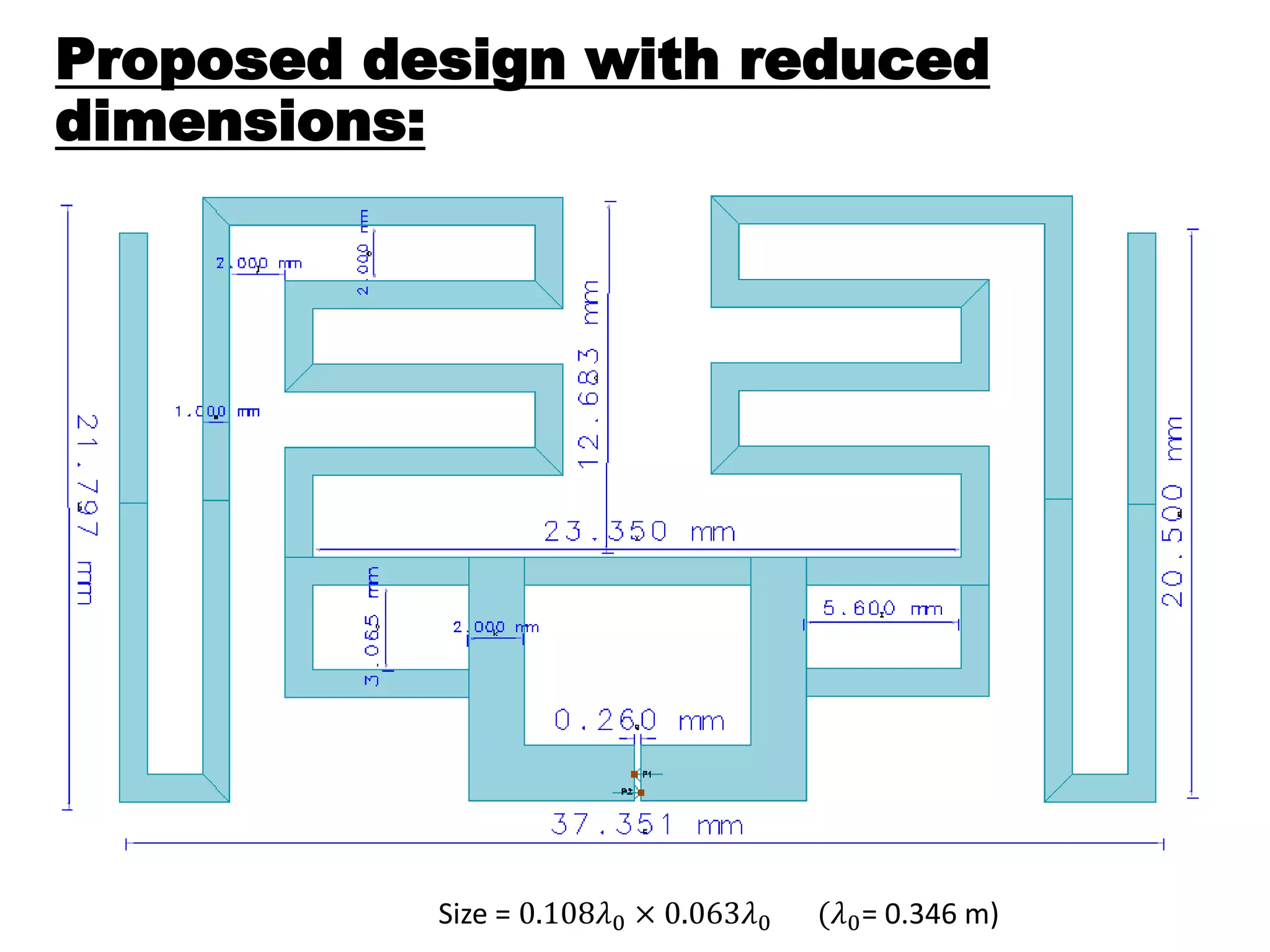
Proposed design with reduced
dimensions:
Size = 0.108𝜆0 × 0.063𝜆0 (𝜆0= 0.346 m)
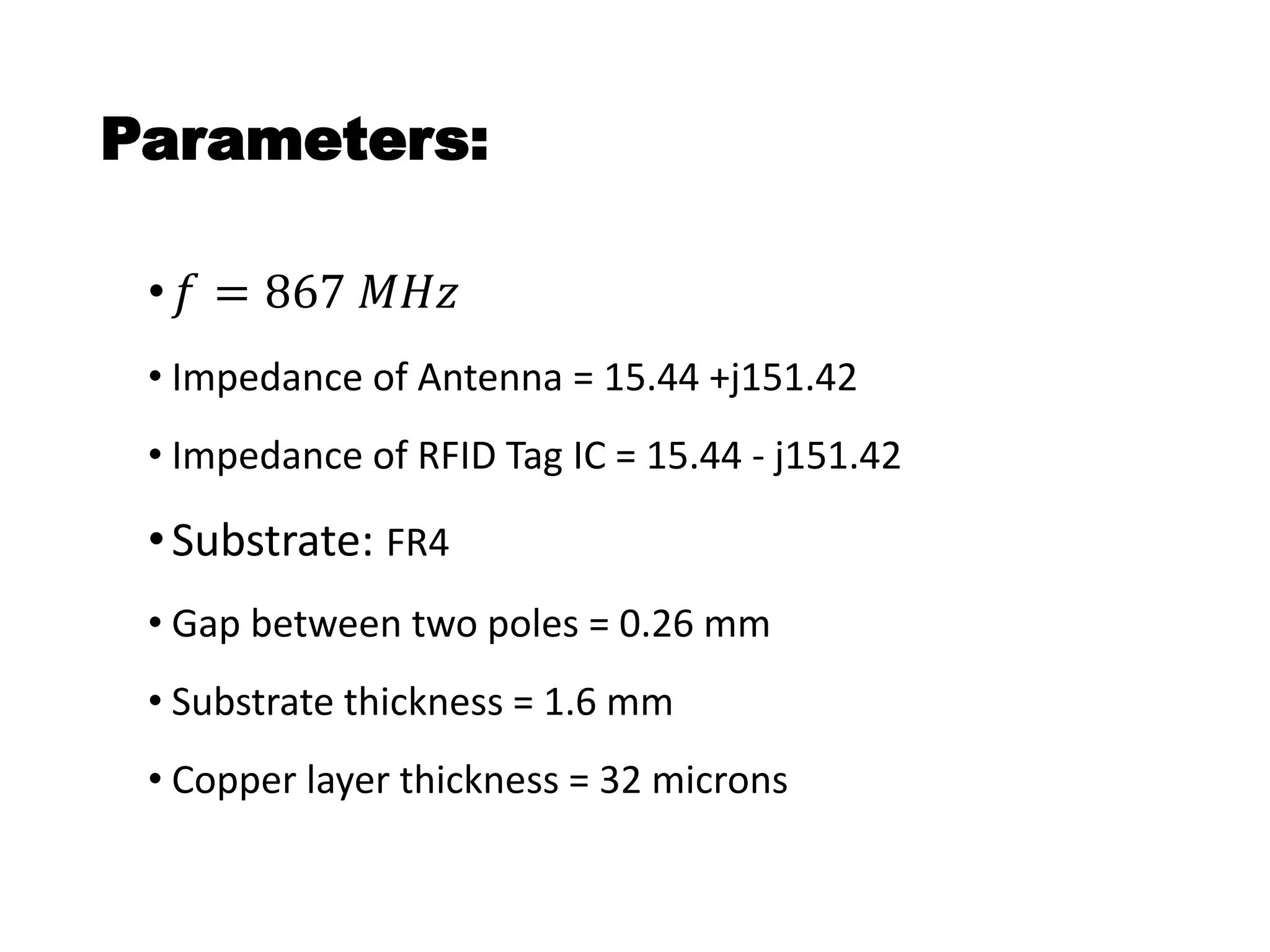
Parameters:
• 𝑓 = 867 𝑀𝐻𝑧
• Impedance of Antenna = 15.44 +j151.42
• Impedance of RFID Tag IC = 15.44 - j151.42
•Substrate: FR4
• Gap between two poles = 0.26 mm
• Substrate thickness = 1.6 mm
• Copper layer thickness = 32 microns
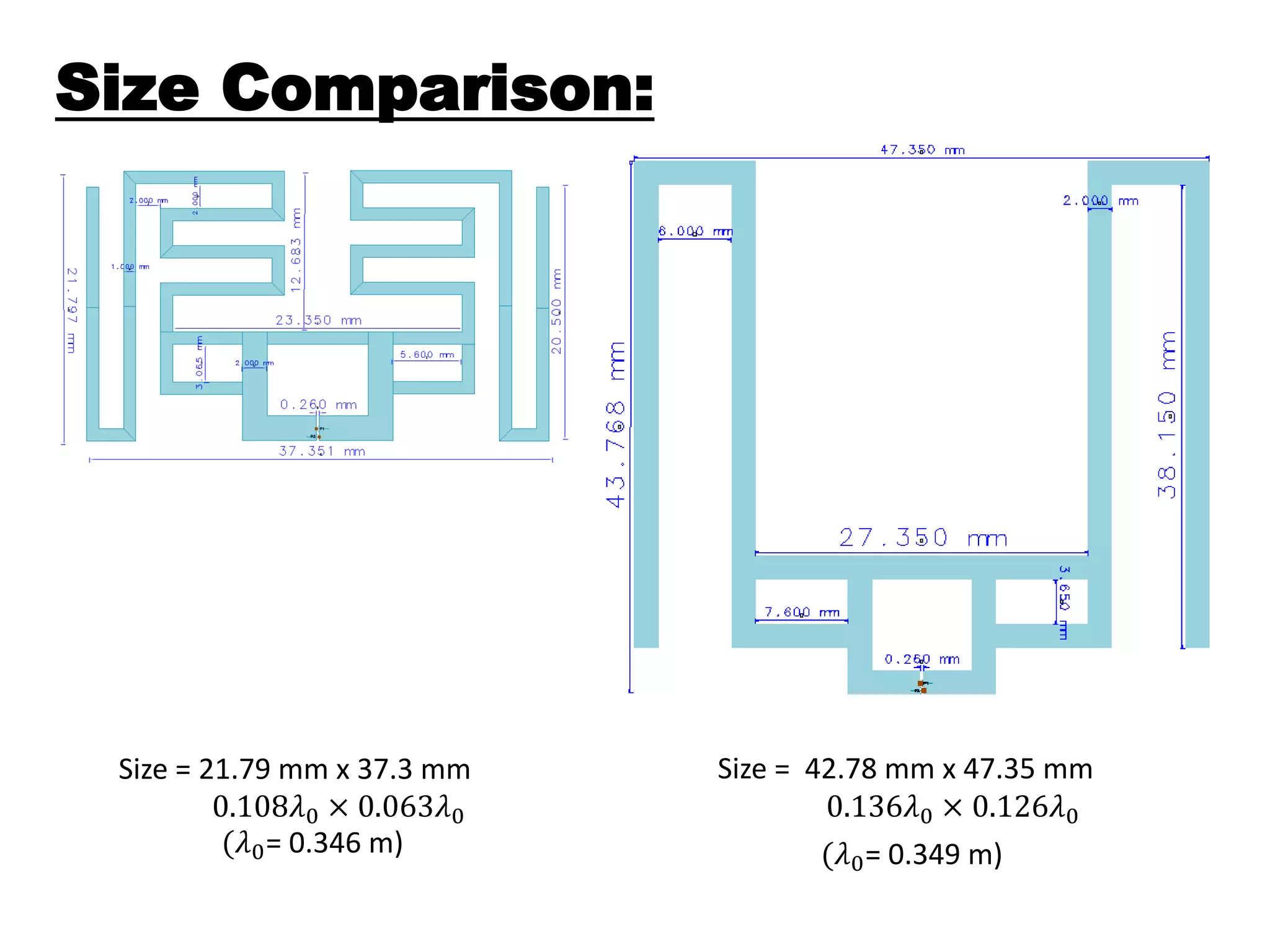
Size Comparison:
Size = 21.79 mm x 37.3 mm
0.108𝜆0 × 0.063𝜆0
(𝜆0= 0.346 m)
Size = 42.78 mm x 47.35 mm
0.136𝜆0 × 0.126𝜆0
(𝜆0= 0.349 m)
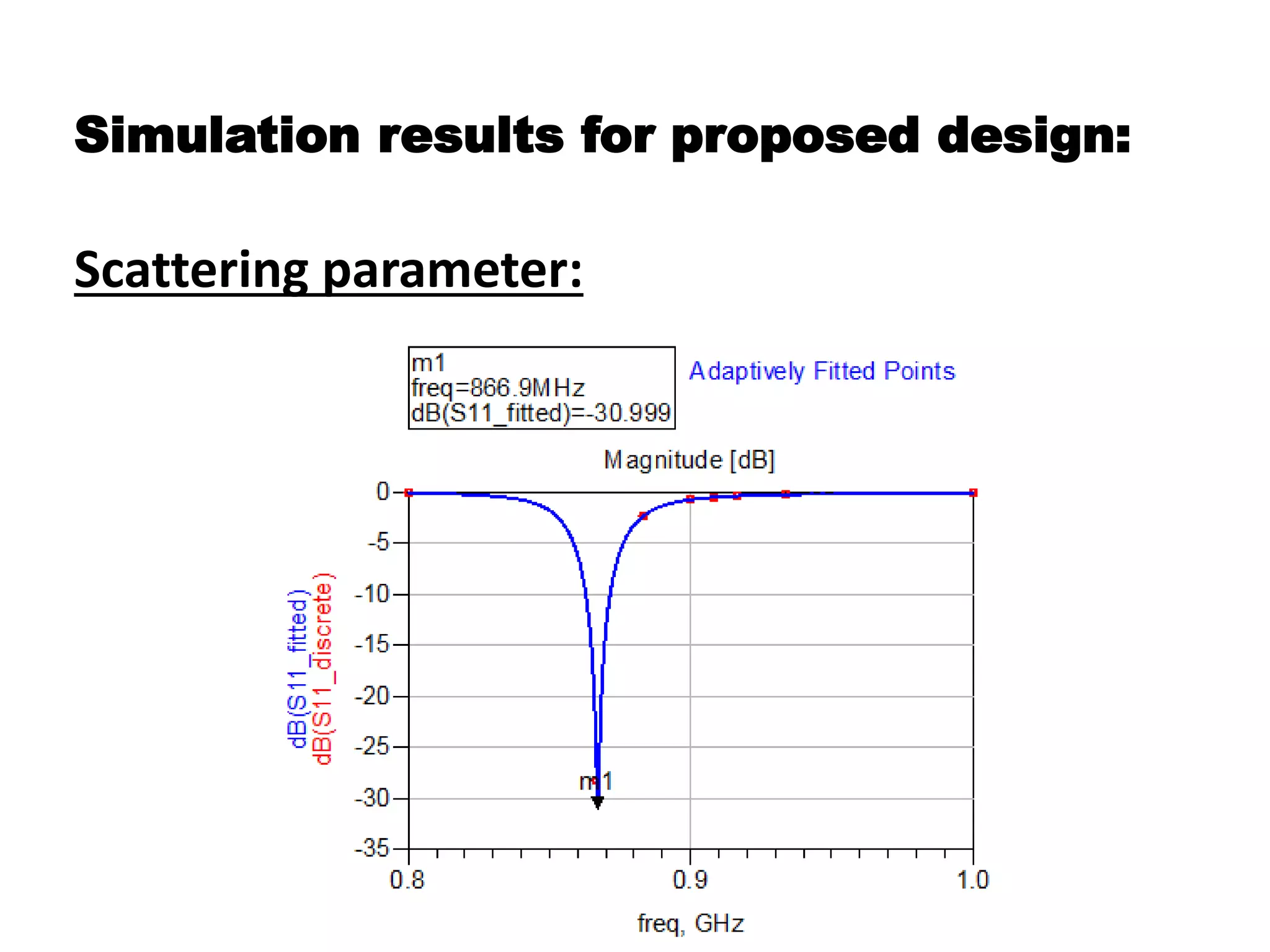
Simulation results for proposed design:
Scattering parameter:
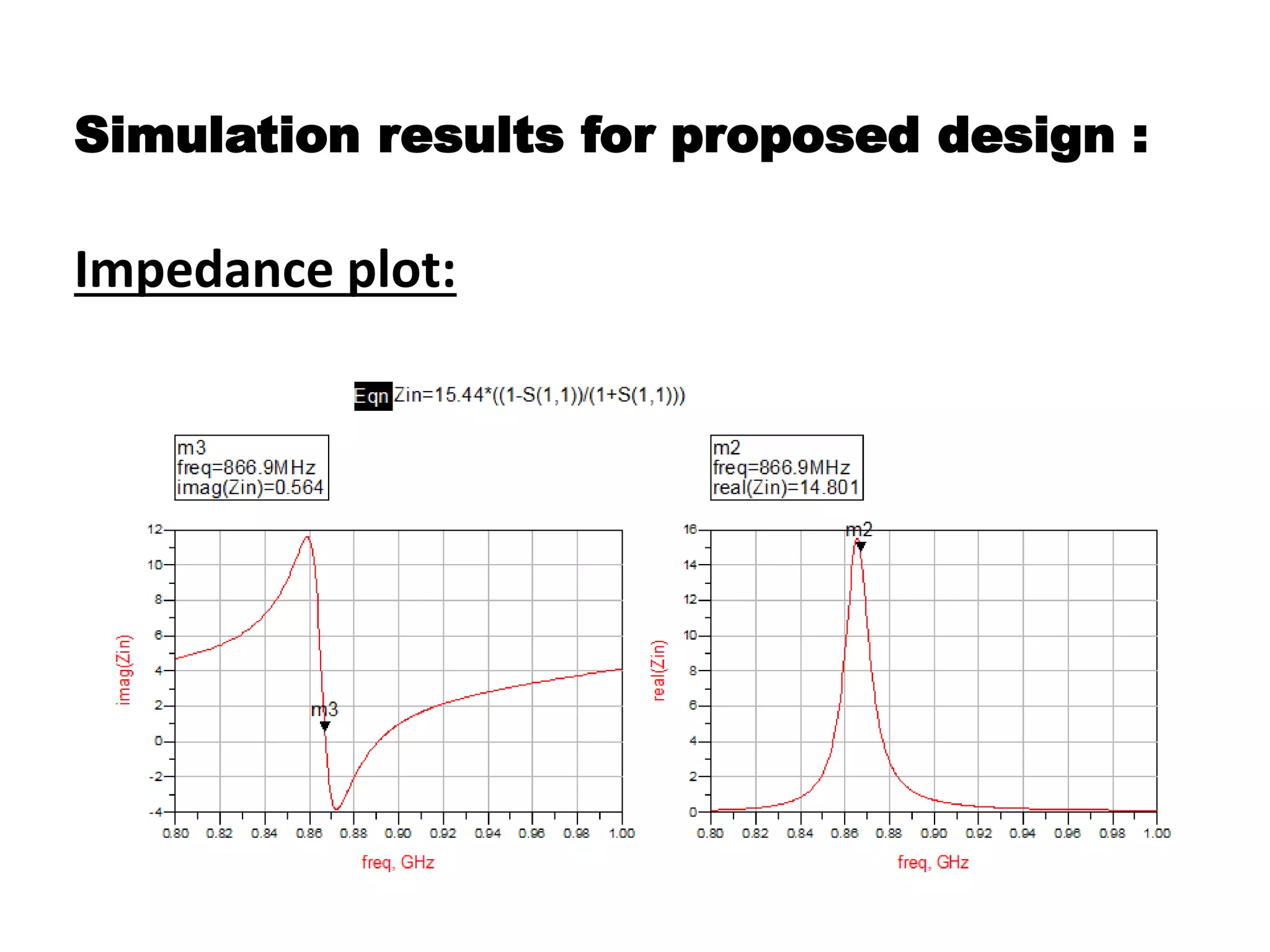
Simulation results for proposed design :
Impedance plot:
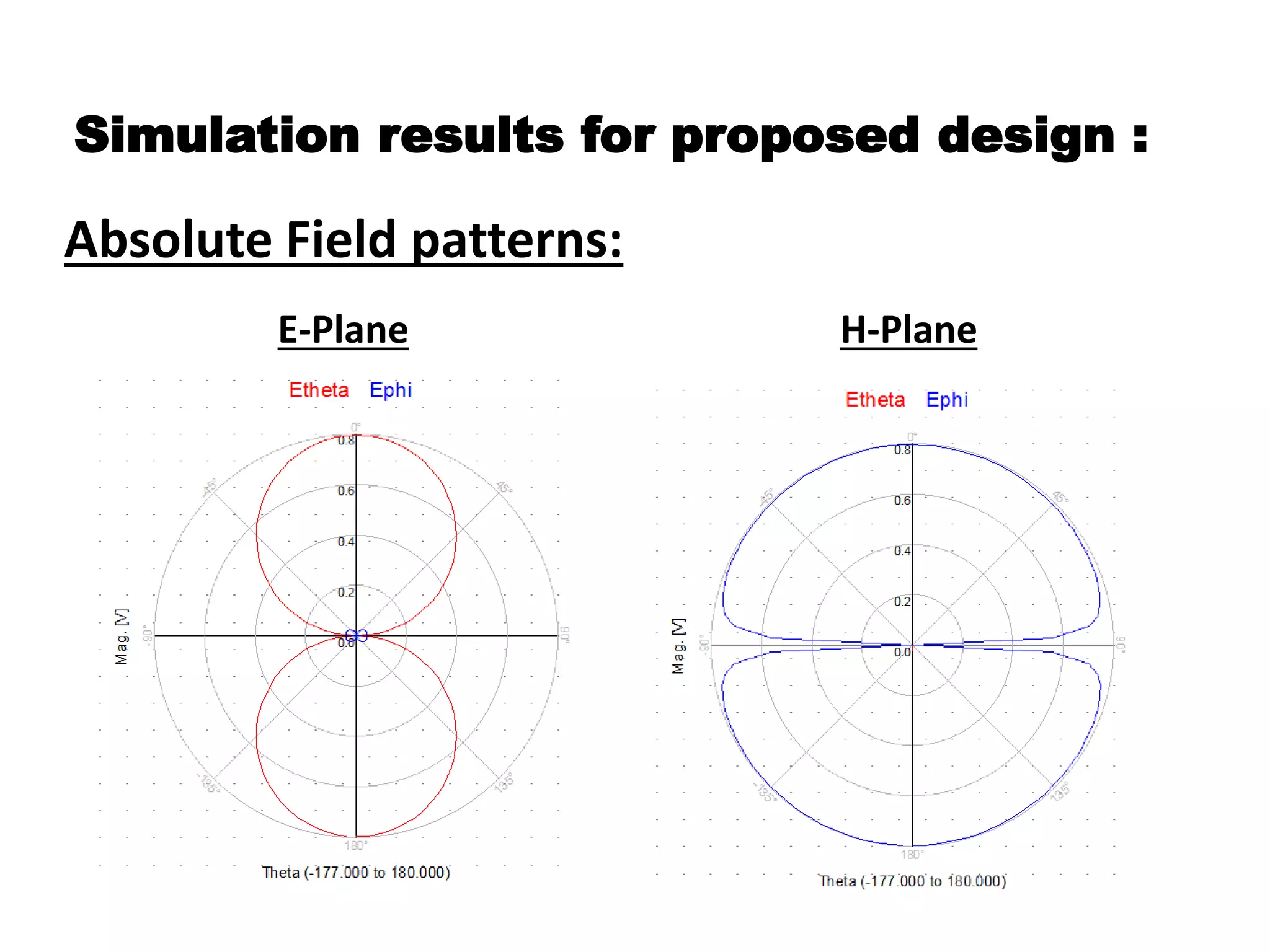
Simulation results for proposed design :
Absolute Field patterns:
E-Plane H-Plane
Simulation results for proposed design :
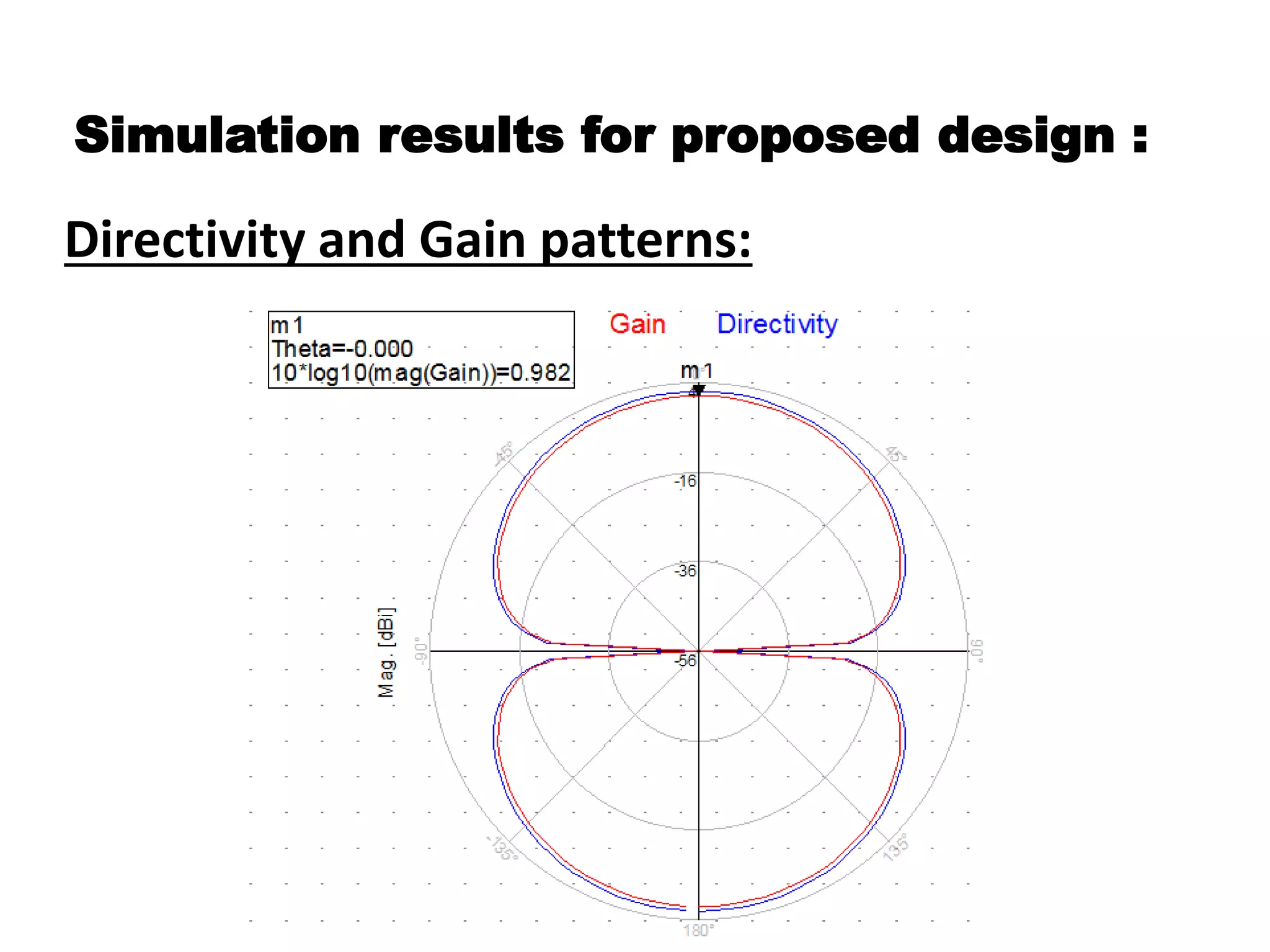
Directivity and Gain patterns:
Simulation results for proposed design :
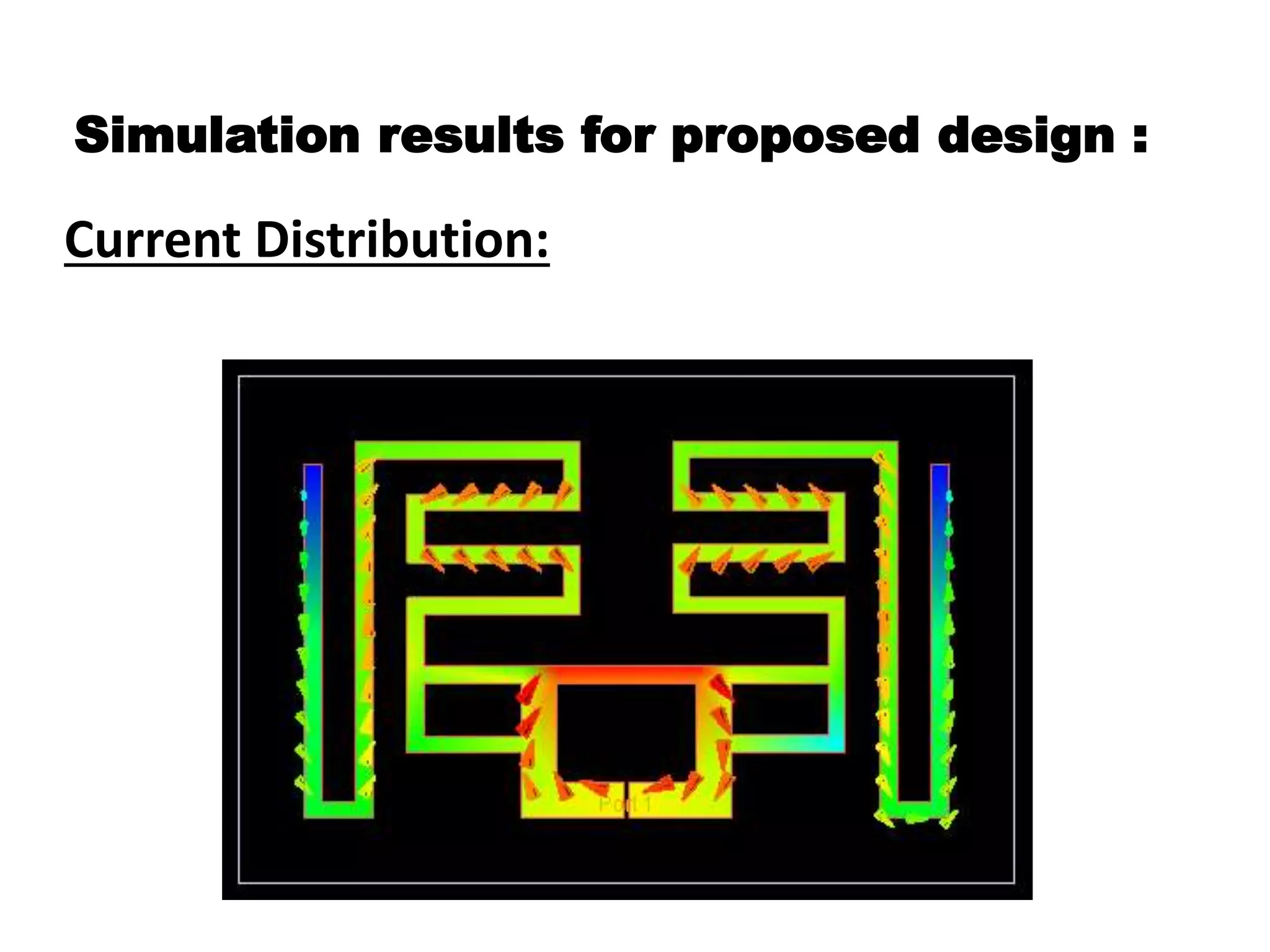
Current Distribution:
Read Range Calculation: [6]
Friis Transmission Equation
𝑃𝑟
𝑃𝑡
=
𝜆
4𝜋𝑅
2
𝐺𝑡 𝐺𝑟 (1)
Where R is our read range.
[6] Antenna Theory Analysis and Design by Constantine A. Balanis 3rd Edition
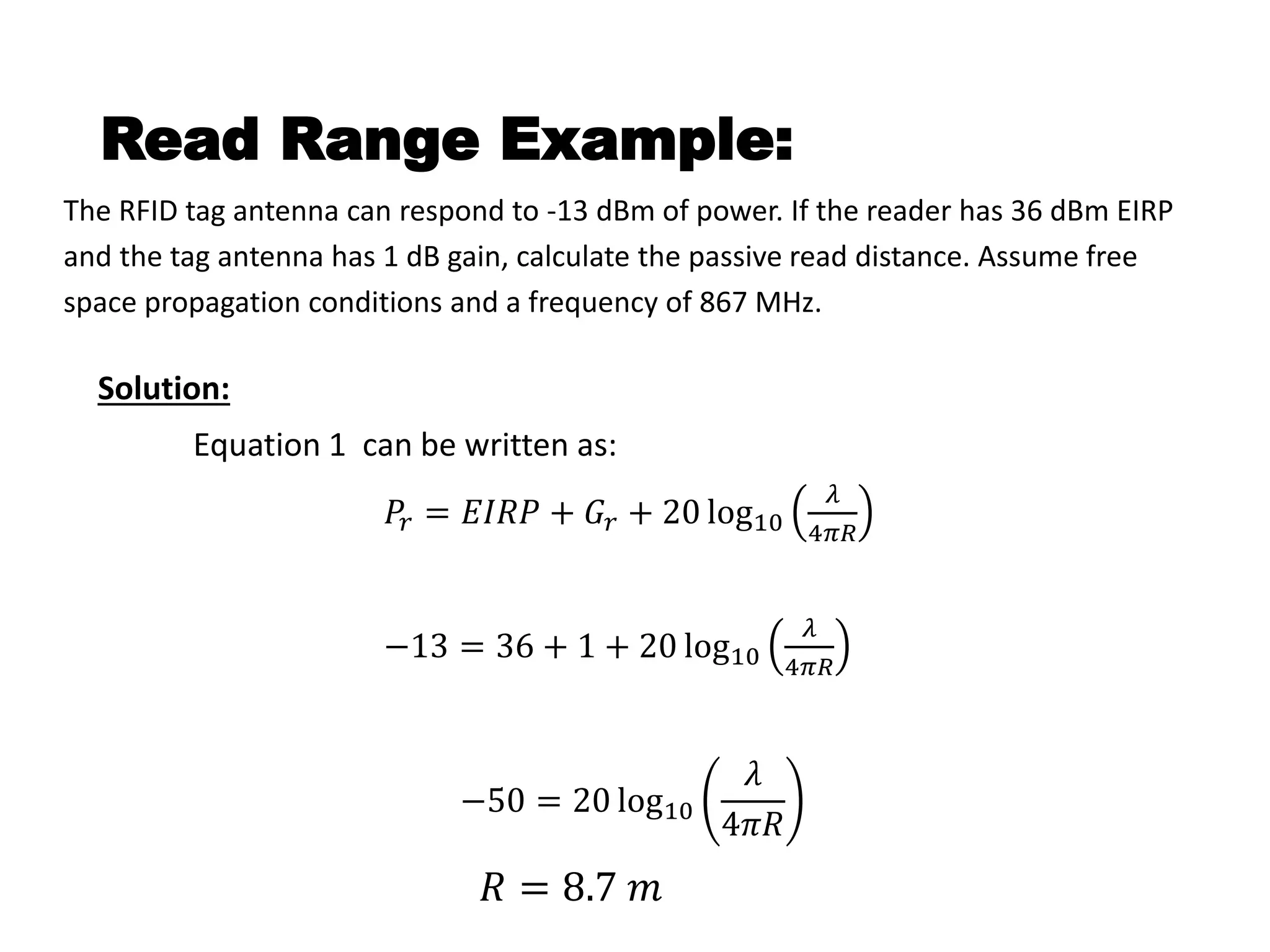
Read Range Example:
Solution:
Equation 1 can be written as:
𝑃𝑟 = 𝐸𝐼𝑅𝑃 + 𝐺𝑟 + 20 log10
𝜆
4𝜋𝑅
−13 = 36 + 1 + 20 log10
𝜆
4𝜋𝑅
−50 = 20 log10
𝜆
4𝜋𝑅
𝑅 = 8.7 𝑚
The RFID tag antenna can respond to -13 dBm of power. If the reader has 36 dBm EIRP
and the tag antenna has 1 dB gain, calculate the passive read distance. Assume free
space propagation conditions and a frequency of 867 MHz.
First
Measurement
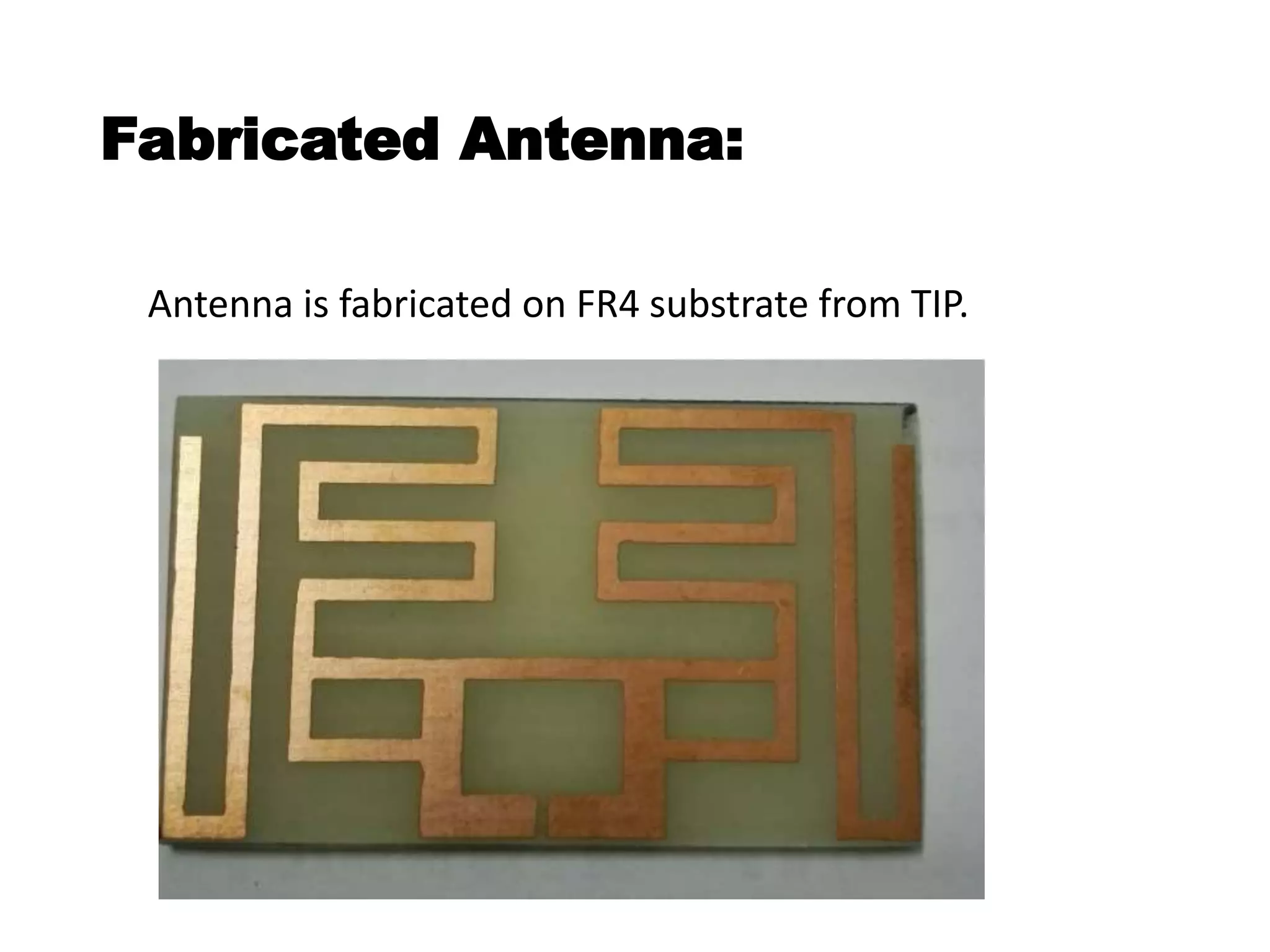
Fabricated Antenna:
Antenna is fabricated on FR4 substrate from TIP.
Image Theory [7]:
The monopole antenna results from applying image theory to the
dipole. If a conducting plane is placed below a single element of length
L/2 carrying a current, then the combined system acts essentially
identically to a dipole of length L except that the radiation takes place
only in the space above the plane, so the directivity is doubled and the
radiation resistance is halved(Figure 3).
Figure 3. Image theory applied to the monopole antenna
[7] ANTENNAS AND PROPAGATION FOR WIRELESS COMMUNICATION SYSTEMS
2nd Edition by SIMON R. SAUNDERS
Image Theory :
• The impedance of a monopole antenna mounted vertically above an
infinite ground plane is one half of that of a full dipole antenna. For a
quarter-wave monopole (L= 𝜆/4 ), the impedance is half of that of a
half-wave dipole.
• Theoretically, 7 times the wavelength size of the ground plane
behaves almost like an infinite ground plane. For our design, at
operating frequency, its dimensions are:
10 ft * 10 ft
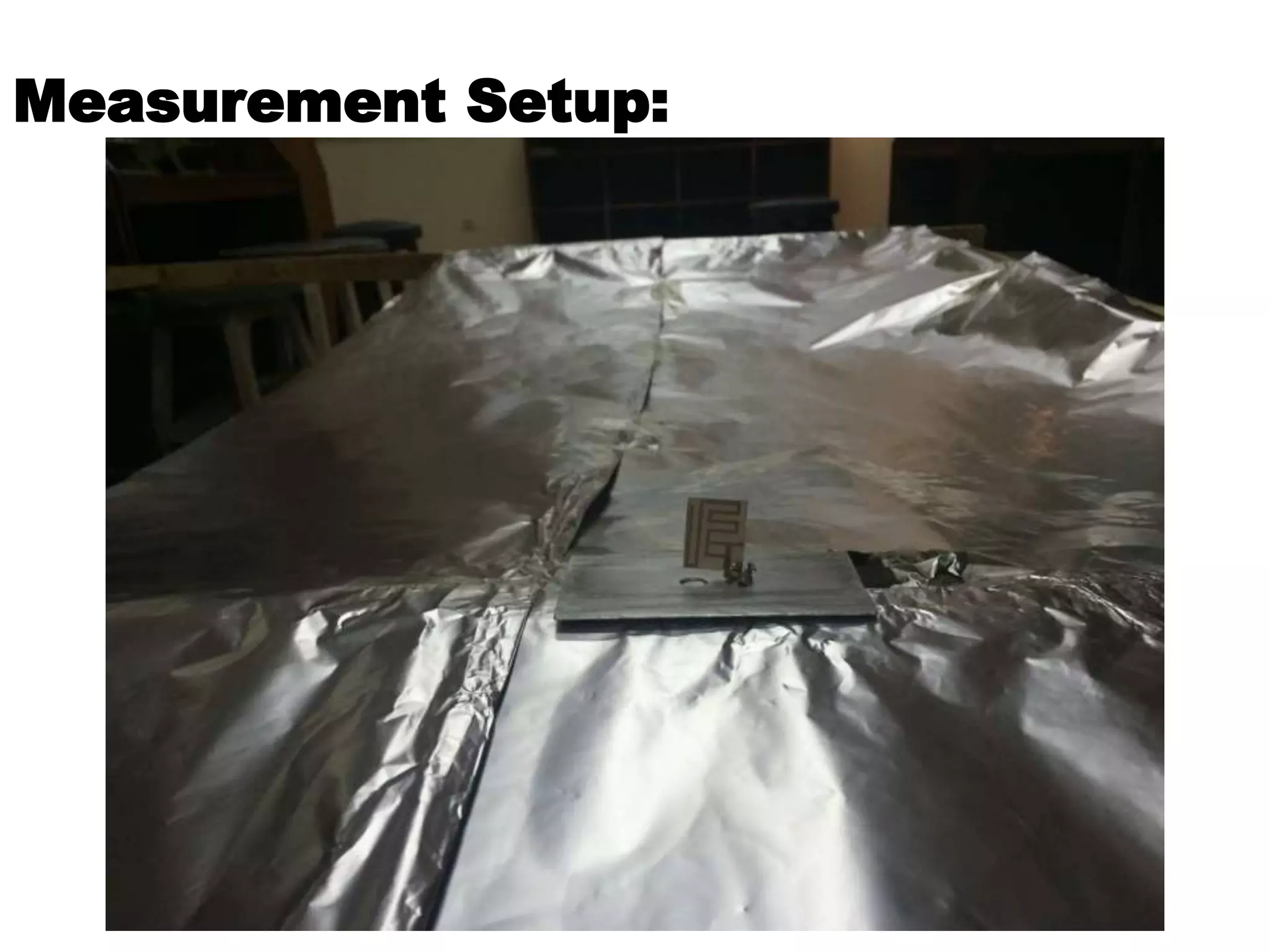
Measurement Setup:
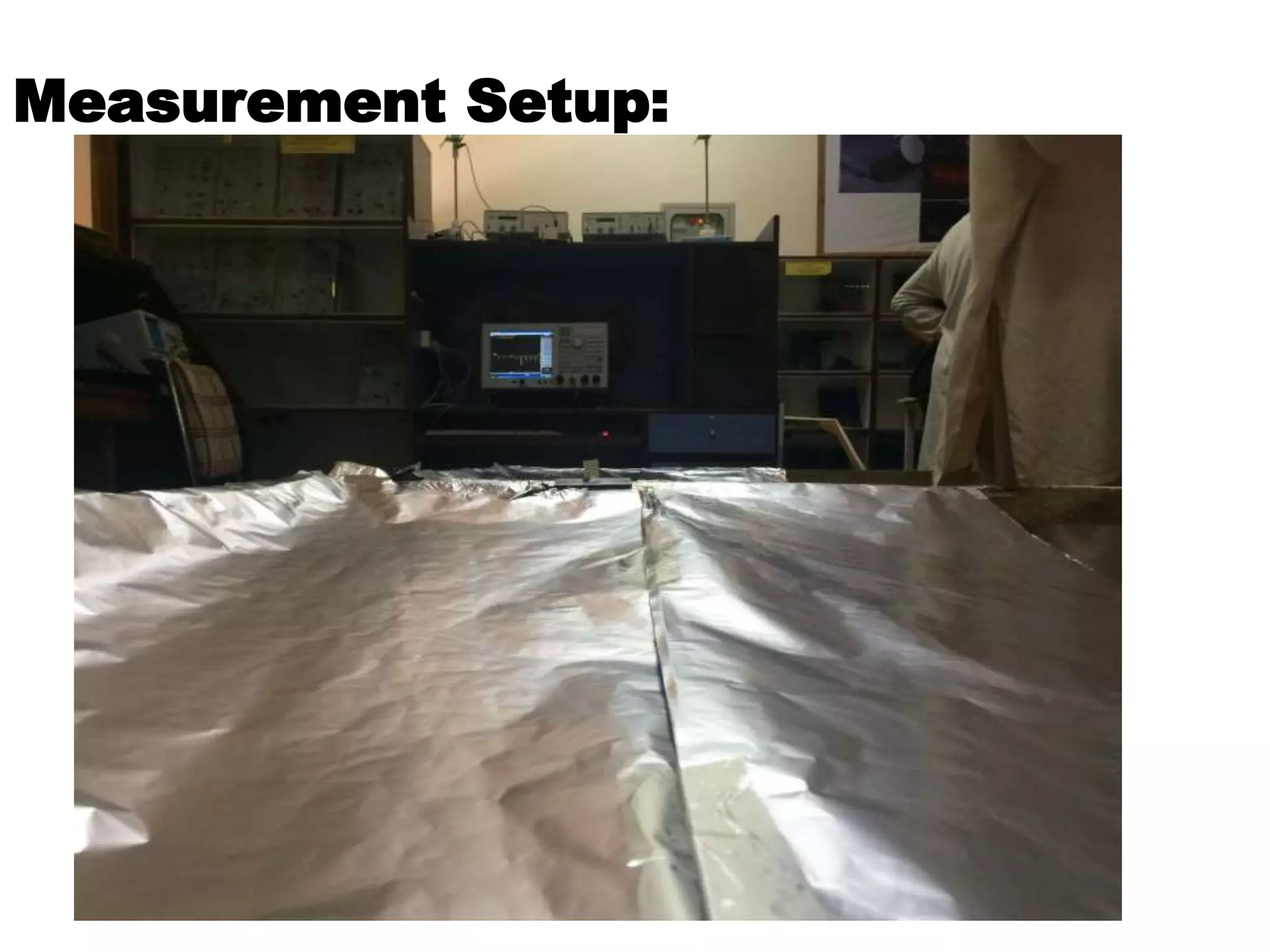
Measurement Setup:
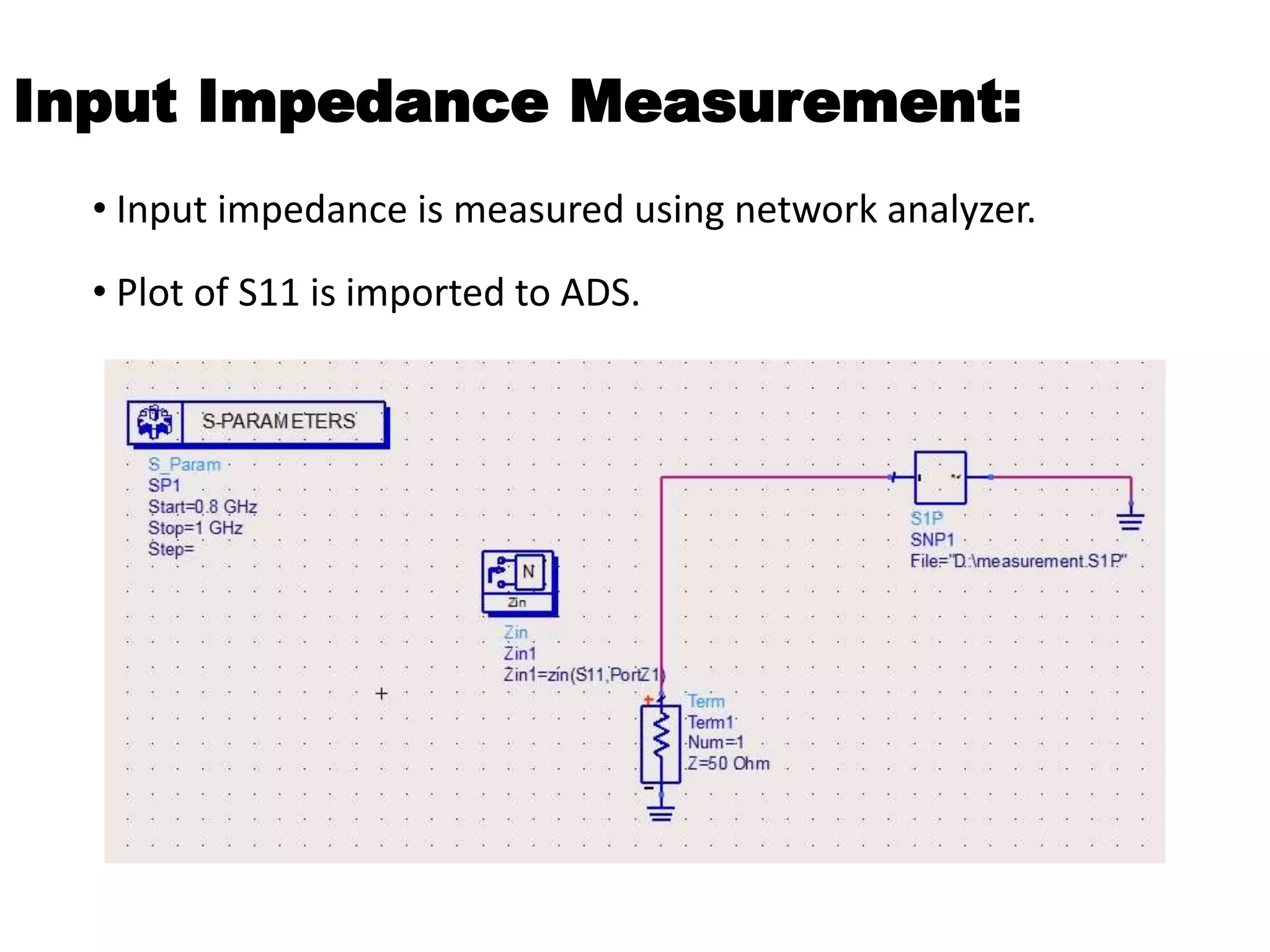
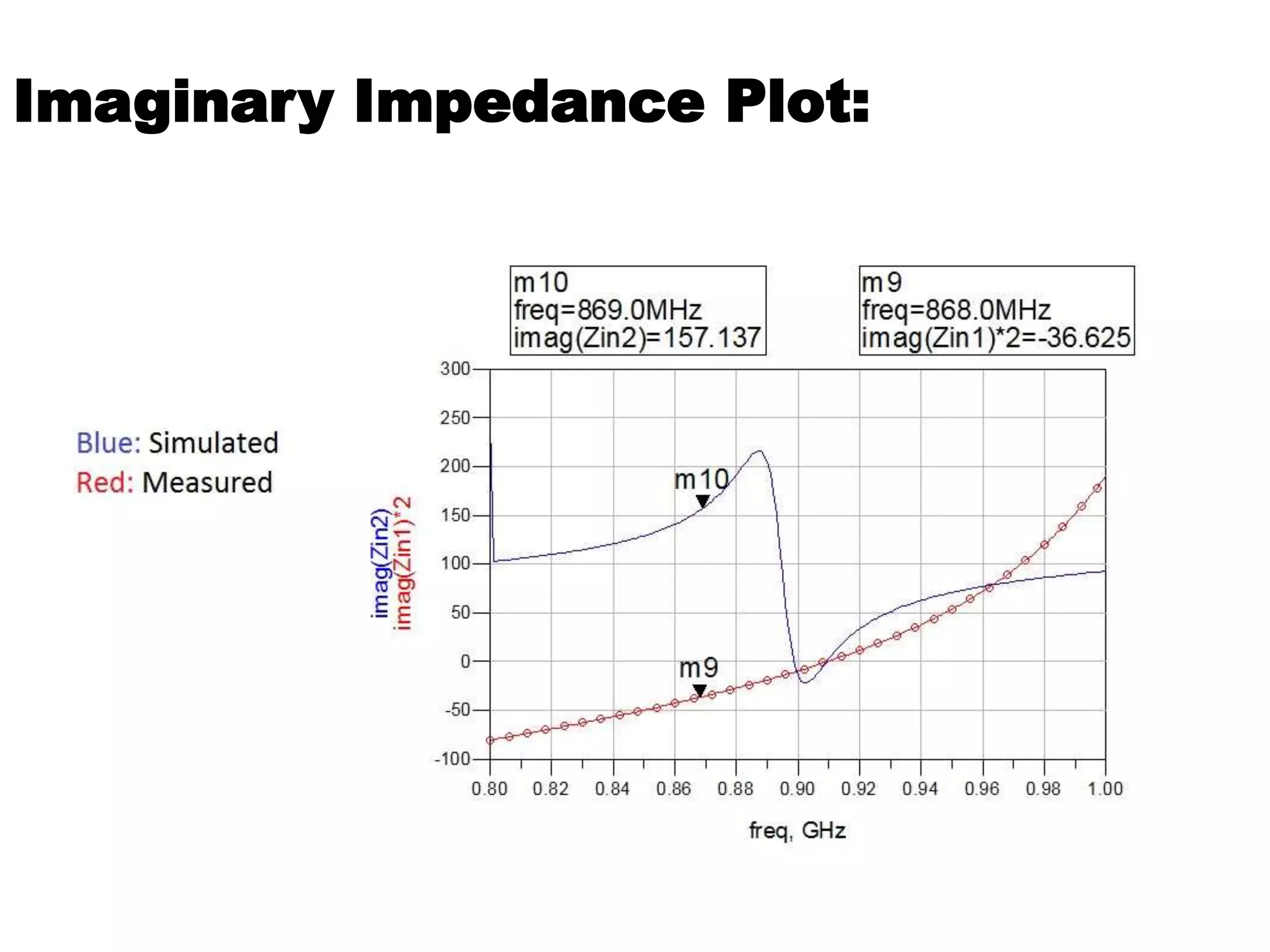
Input Impedance Measurement:
• Input impedance is measured using network analyzer.
• Plot of S11 is imported to ADS.
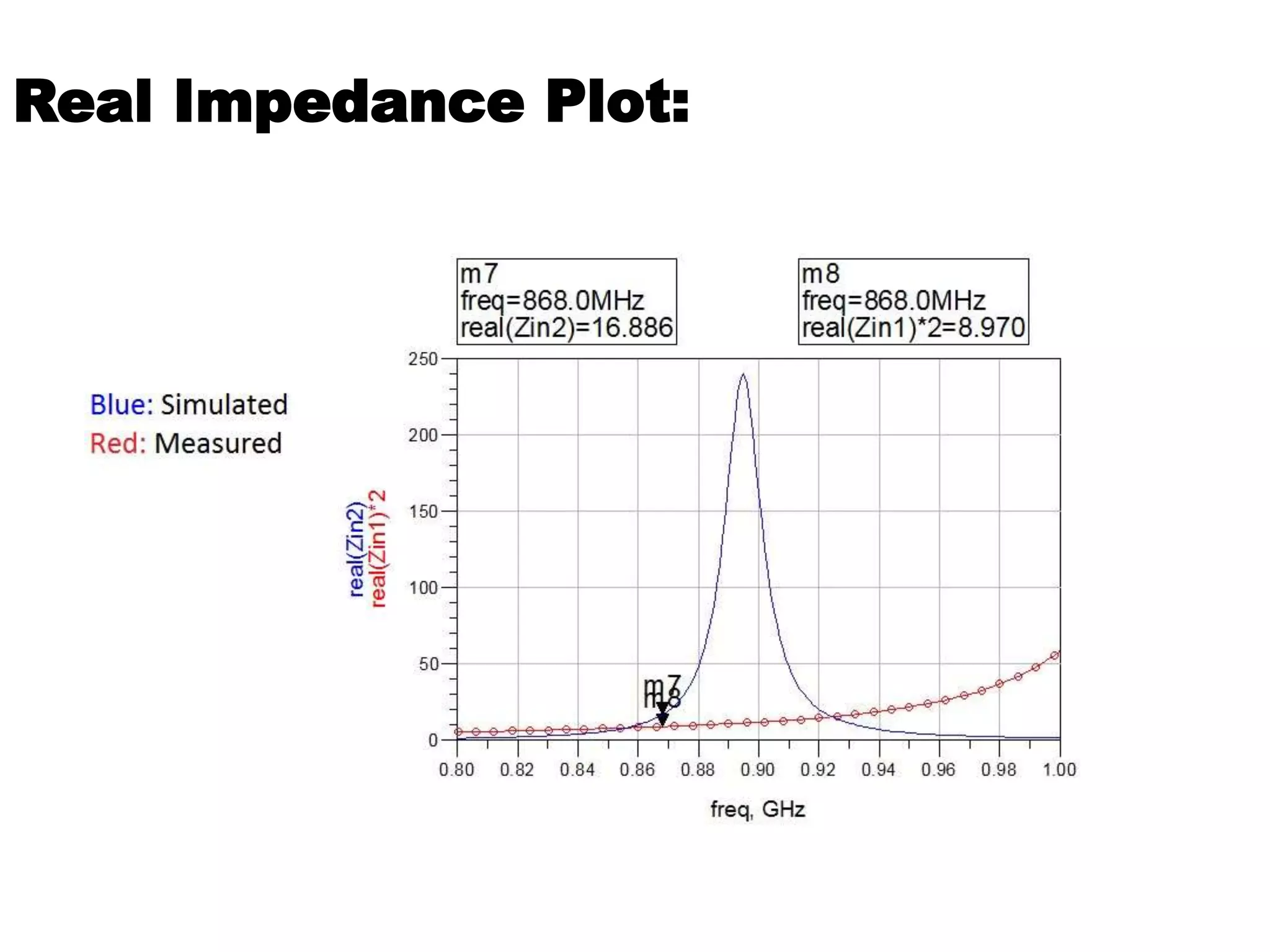
Real Impedance Plot:
Imaginary Impedance Plot:
Comments on First Measurement Results:
• Ground plane (copper) of 10 ft x 10 ft was not available.
• So we used aluminum foil (10 ft x 5 ft) as a ground plane.
• Deviation in measured and simulated results.
Second
Measurements
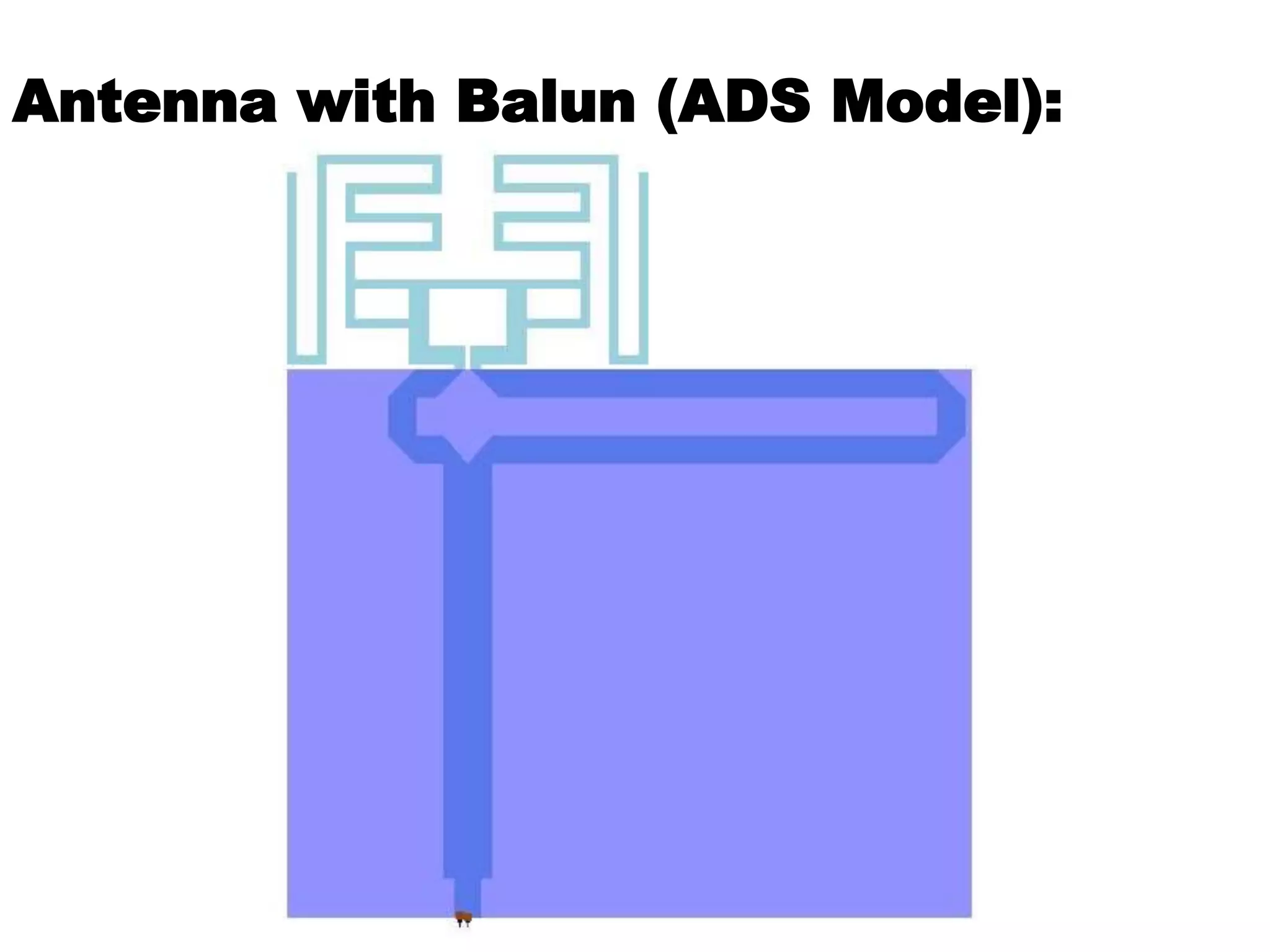
Designing a Microstrip Balun [8]:
Fig.4 Microstrip Balun
[8] A Broadband unipolar Microstrip to CPS Transition 1997 Asia Pacific Microwave Conference
By changing l1 and l2 so that,
l1-l2= 𝜆 𝑔/4 it gives the
required results .
Antenna with Balun (ADS Model):
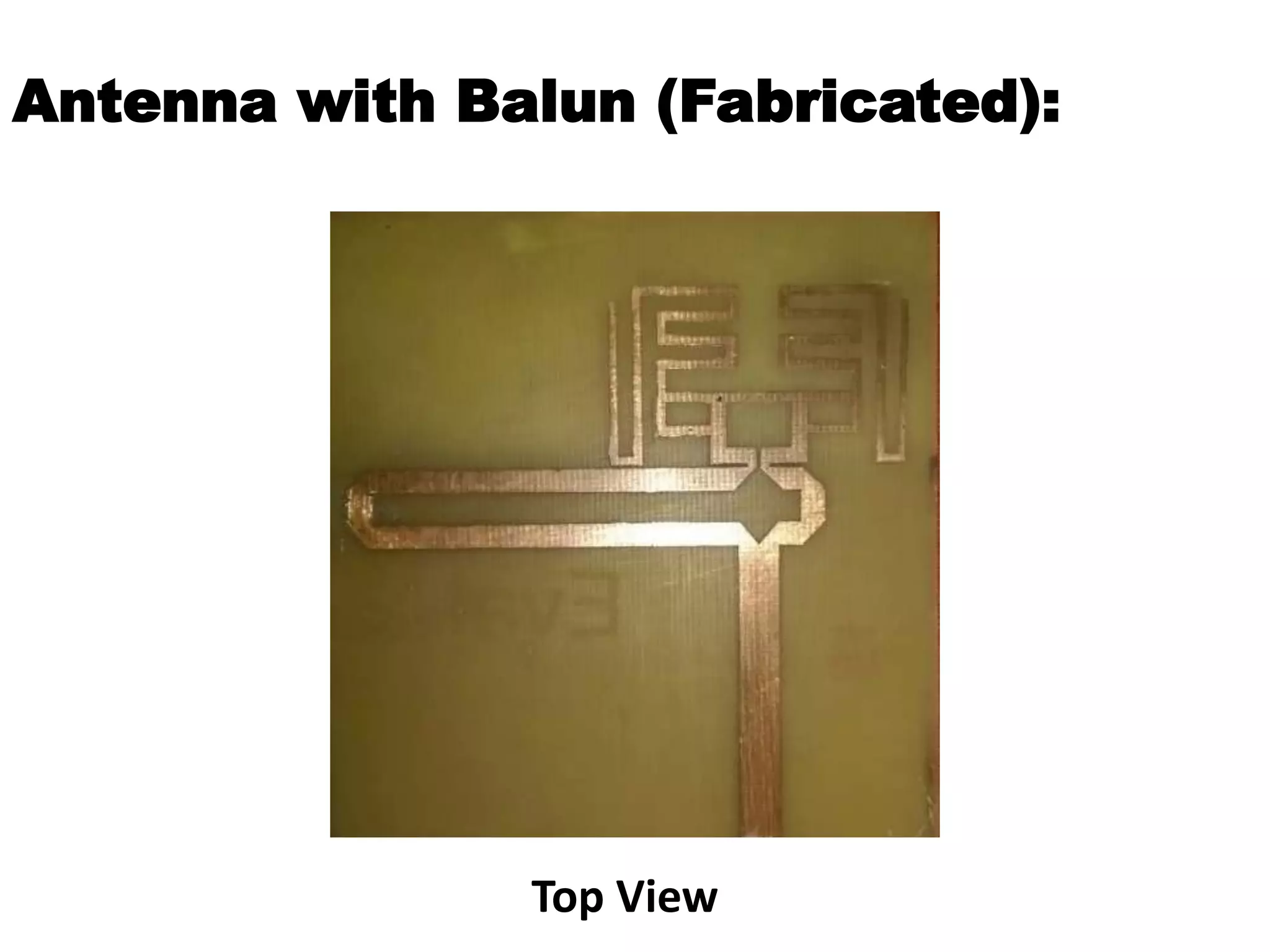
Antenna with Balun (Fabricated):
Top View
Antenna with Balun (Fabricated):
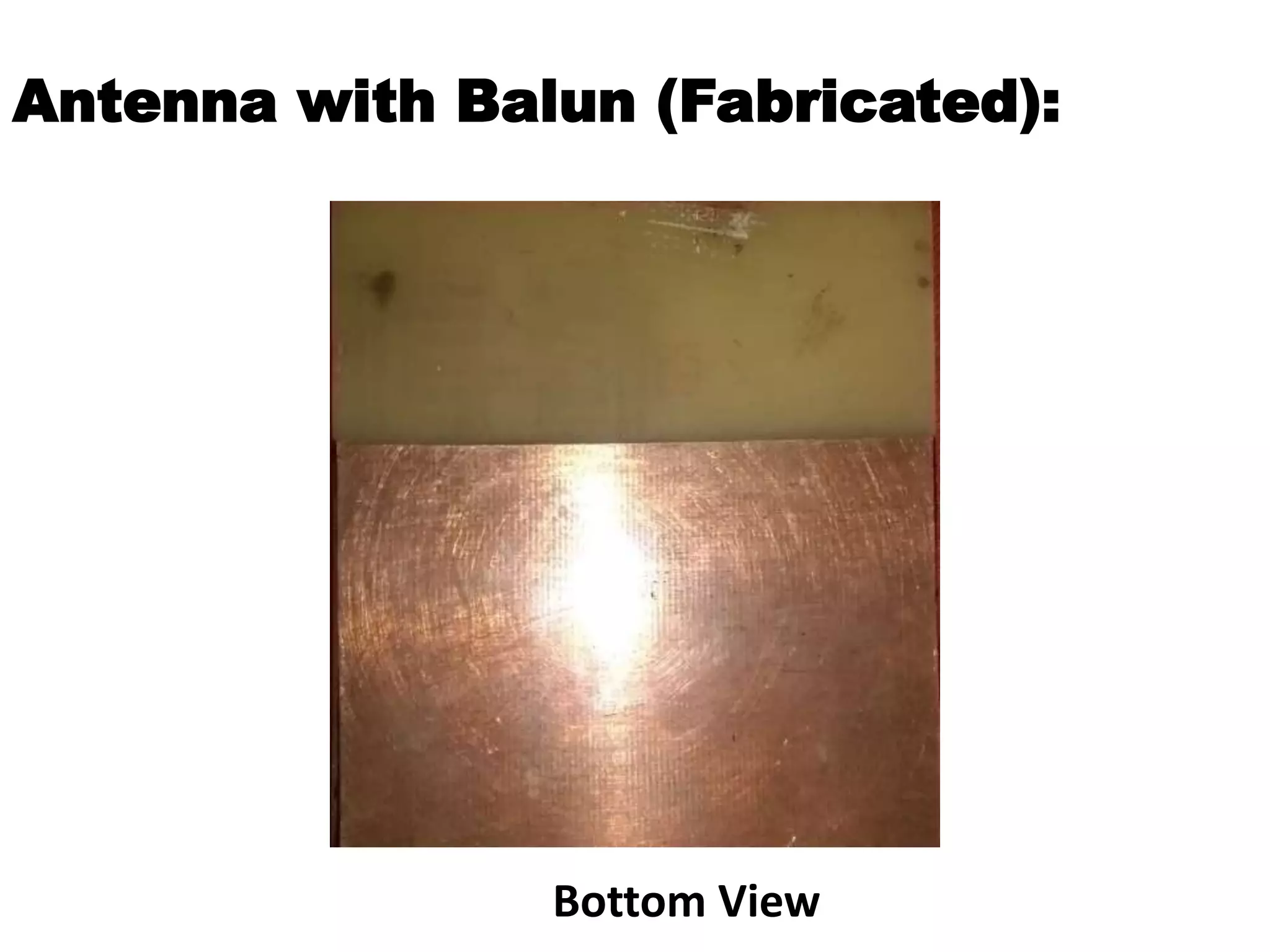
Bottom View
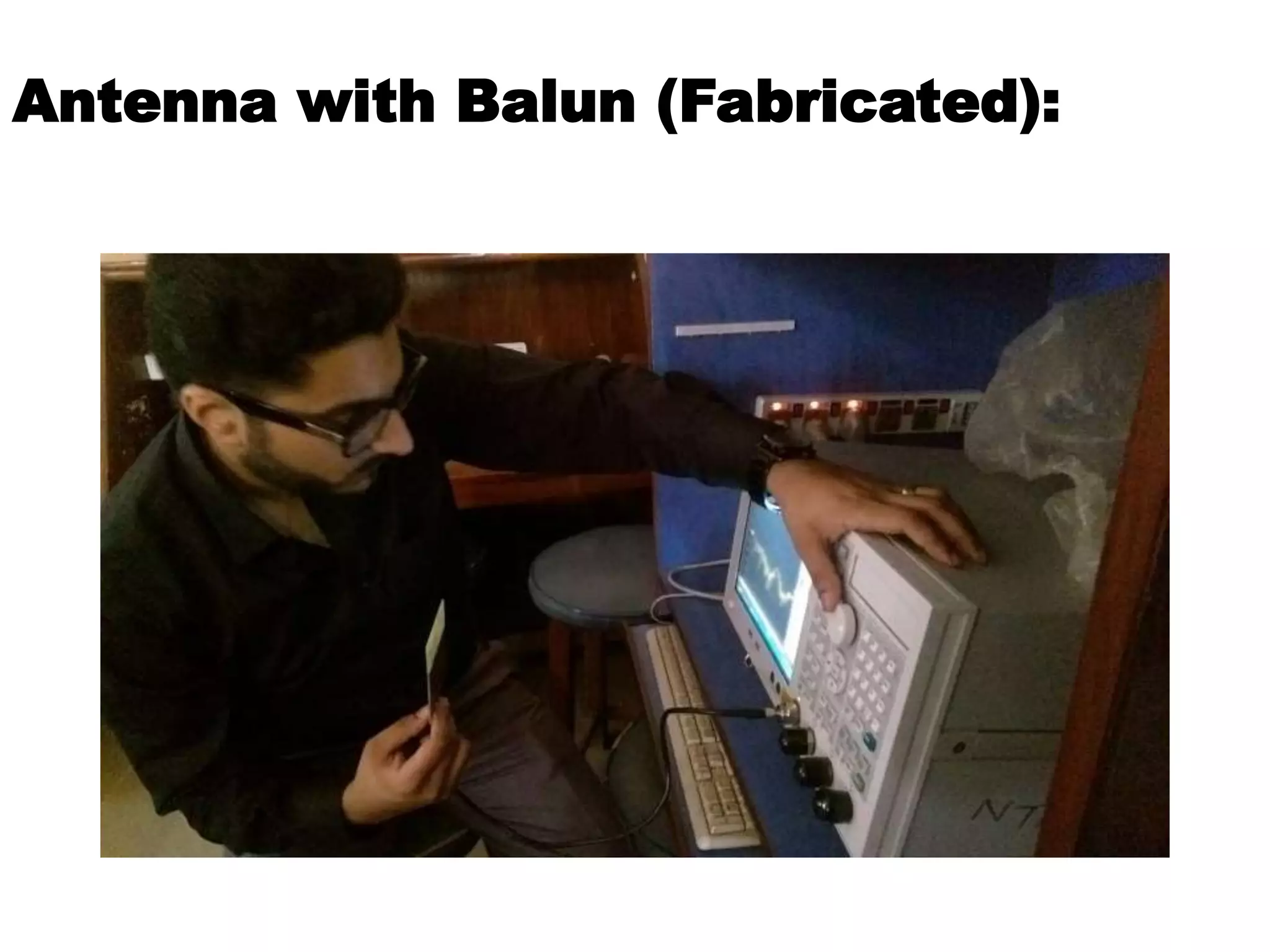
Antenna with Balun (Fabricated):
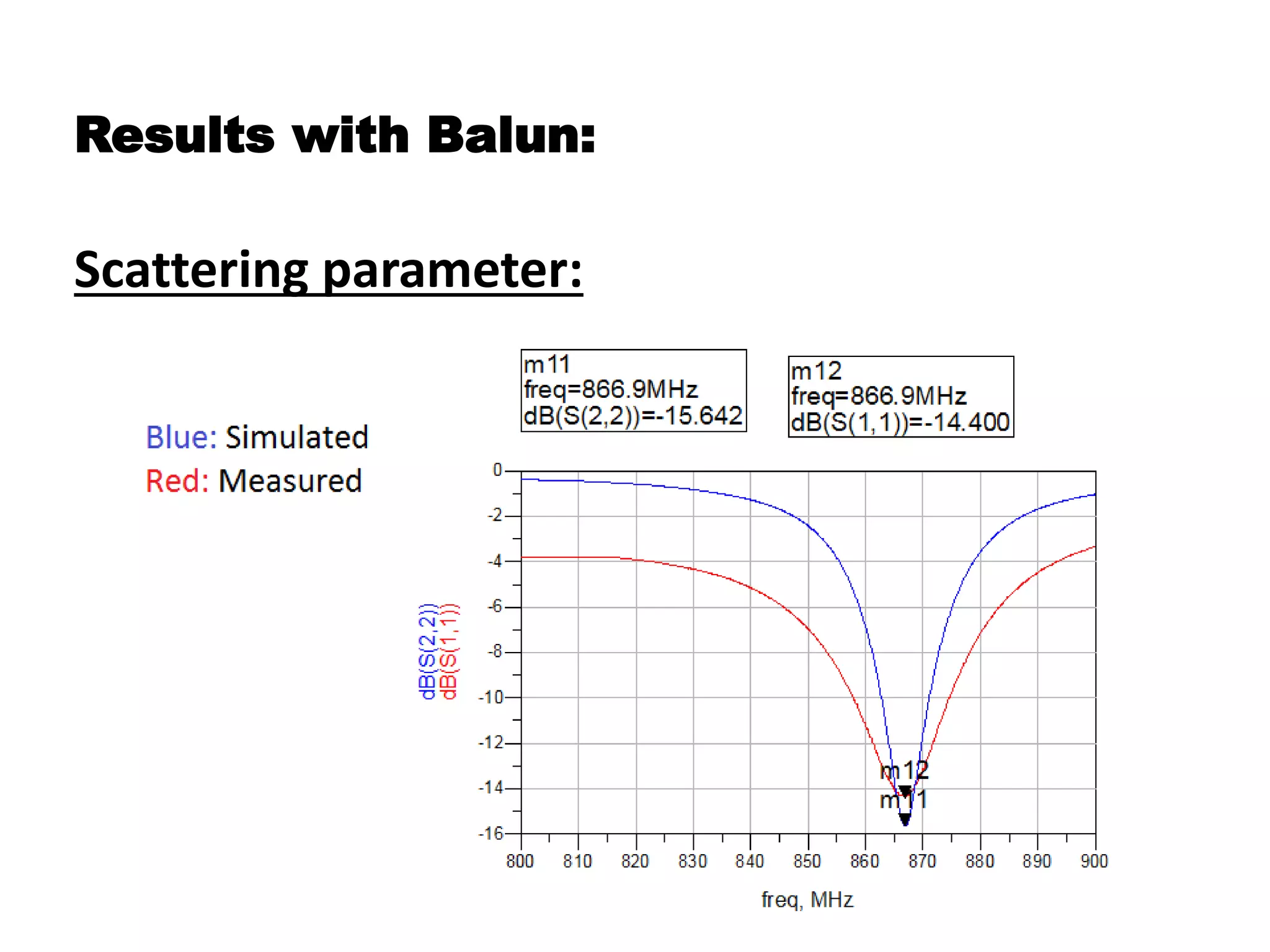
Results with Balun:
Scattering parameter:
Questions
and
Answers

FYP 4th presentation

  • 1.
    Design and Simulationof Passive UHF RFID Tag Supervisor: Dr. Irfanullah Group Members: Haroon Ahmed FA11-BEE-054 Nabeel Muqarab FA11-BEE-074 Rehan Zaffar FA11-BEE-087
  • 2.
    Objectives: • To design,simulate and fabricate passive UHF RFID tag. • To measure input impedance of the fabricated tag for matching with RFID tag IC.
  • 3.
    Project Phases: 1. StudyPhase (2 months) 2. Study and reproducing the results of already designed RFID Tag research paper. (3 months) 3. a) Optimization of RFID tag studied in phase 2 for implementation on FR4 substrate. (1 month) b) Size reduction of (a). (2 months) 4. a) Fabrication and measurement of input impedance of the RFID tag. (1.5 months) b) Write up for the conference paper (FIT). (2 weeks)
  • 4.
    Block Diagram: [1] AntennaTheory and Design by Warren L. Stutzman 3rd Edition Fig.1 Block Diagram of RFID System [1] Passive RFID Tag System: • Reader • Emits RF signal. • Collects Data stored in tag. • Tag • Converts RF signal to DC voltage for powering up the circuitry. • Process and returns RF signal containing identification data. Introduction: RFID: A radio frequency identification (RFID) system identifies an object without direct contact through digital wireless techniques.
  • 5.
    RFID Allocated Freq.Bands [2]: Frequency Band Name Frequencies Passive Read Distance Low Frequency (LF) 120-140 KHz 10-120 cm High Frequency (HF) 13.56 MHz 10-20 cm Ultra High Frequency (UHF) 865-928 MHz Less than 10 m Microwave (MW) 2.45 & 5.8 MHz Less than 3 m Ultra Wideband 3.1-10.6 GHz 10 m [2] Antenna Theory and Design by Warren L. Stutzman 3rd Edition
  • 6.
    RFID Frequency Bands[3] • USA: 902 – 928 MHz • China : 840.5 – 844.75 / 920.25 – 924.75 MHz • Europe : 865- 868 MHz [3] D. Puente, et al “Matching radio frequency identification tag compact dipole antennas to an arbitrary chip impedance” IET Microwaves, Antennas & Propagation 2008
  • 7.
    Reproducing the resultsof: S. Sajal, et al “A Low Cost Flexible Passive UHF RFID Tag for Sensing Moisture Based on Antenna Polarization”, IEEE, 2014.
  • 8.
    Physical Structure: . Fig. 2.Dimension of the Antenna; a= 2 mm, b = 27.35 mm, c = 32.35 mm, d = 38 mm, e = 7.6 mm, f = 3.65 mm, g = 6 mm [4] [4] S. Sajal et al, “A Low Cost Flexible Passive UHF RFID Tag for Sensing Moisture Based on Antenna Polarization”, IEEE, 2014
  • 9.
    Equivalent circuit ofRFID Tag IC (Higgs 2 by Alien Technology): . Equivalent Impedance of RFID Tag IC: 15.44 - j151.42 ohm(867 MHz), 13.88 - j143.6 (915 MHz)
  • 10.
    Parameters: • 𝑓 =915 𝑀𝐻𝑧 • Impedance of Antenna = 13.88 +j143.6 • Impedance of RFID Tag IC = 13.88 - j143.6 • Substrate: FR4 (𝜀 𝑟 = 4.6), Paper (𝜀 𝑟 = 2.38) • Gap between two poles = 0.26 mm • Substrate thickness: FR4 (1.6 mm), Paper (56 microns) • Copper layer thickness = 32 microns
  • 11.
    ADS Model : Size= 0.136𝜆0 × 0.126𝜆0 (𝜆0= 0.349 m)
  • 12.
  • 13.
    Size Reduction andImpedance Matching(Smith Chart)[5] : For an antenna to have an admittance of 𝑌𝑎 = 𝑔 𝑎 + 𝑗𝑏 𝑎 and the chip admittance to be 𝑌𝑐 = 𝑔𝑐 + 𝑗𝑏𝑐 for the optimal power transfer between the antenna and tag 𝑌𝑎 = 𝑌𝑐 ∗ at the design frequency 1) Making 𝑔 𝑎 = 𝑔𝑐 by scaling For 𝑔 𝑎 = 𝑔𝑐 scaling factor is used 𝞺 = 𝑓 𝑓0 Where f is either 𝑓 = 𝑓1 Or 𝑓 = 𝑓2 If 𝑓1 < 𝑓2 𝑠𝑜 𝑓1 is chosen for more compact design. [5] D. Puente, et al “Matching radio frequency identification tag compact dipole antennas to an arbitrary chip impedance” IET Microwaves, Antennas & Propagation 2008
  • 14.
    Size Reduction andImpedance Matching(Smith Chart)[5] : 2) Making 𝑏 𝑎 = −𝑏𝑐 by short circuit stub. To make 𝑏 𝑎 = −𝑏 𝑐 we select the proper value of Reactance. 𝑋𝑠𝑡𝑢𝑏 = 1 𝑏 𝑐+𝑏 𝑙 = 1 𝛽 𝑎𝑟𝑐𝑡𝑎𝑛 𝑋𝑠𝑡𝑢𝑏 𝑍0 𝑍0 = 𝜂0 𝐴 𝑍0 Characteristic impedance (for c = 1.2 mm and b = 1.5 mm , 𝑍0 =226.5) 𝜂0 Intrinsic Impedance (377 Ohm) [5] D. Puente, et al “Matching radio frequency identification tag compact dipole antennas to an arbitrary chip impedance” IET Microwaves, Antennas & Propagation 2008
  • 15.
    Size Reduction andImpedance Matching(Smith Chart)[5] : • 𝐴 = 2𝜋 ln(2( 1+𝐾 𝑎 + 4𝐾 𝑎 1 4/ 1+𝐾 𝑎 − 4𝐾 𝑎 1 4)) • 0 ≤ 𝐴 ≤ 1 , 0 ≤ 𝑘 ≤ 1 2 • 𝑘 𝑎 = 1 − 𝑘2 , 𝑘 = 𝑐 𝑐+2𝑏 [5] D. Puente, et al “Matching radio frequency identification tag compact dipole antennas to an arbitrary chip impedance” IET Microwaves, Antennas & Propagation 2008
  • 16.
  • 17.
    Proposed design withreduced dimensions: Size = 0.108𝜆0 × 0.063𝜆0 (𝜆0= 0.346 m)
  • 18.
    Parameters: • 𝑓 =867 𝑀𝐻𝑧 • Impedance of Antenna = 15.44 +j151.42 • Impedance of RFID Tag IC = 15.44 - j151.42 •Substrate: FR4 • Gap between two poles = 0.26 mm • Substrate thickness = 1.6 mm • Copper layer thickness = 32 microns
  • 19.
    Size Comparison: Size =21.79 mm x 37.3 mm 0.108𝜆0 × 0.063𝜆0 (𝜆0= 0.346 m) Size = 42.78 mm x 47.35 mm 0.136𝜆0 × 0.126𝜆0 (𝜆0= 0.349 m)
  • 20.
    Simulation results forproposed design: Scattering parameter:
  • 21.
    Simulation results forproposed design : Impedance plot:
  • 22.
    Simulation results forproposed design : Absolute Field patterns: E-Plane H-Plane
  • 23.
    Simulation results forproposed design : Directivity and Gain patterns:
  • 24.
    Simulation results forproposed design : Current Distribution:
  • 25.
    Read Range Calculation:[6] Friis Transmission Equation 𝑃𝑟 𝑃𝑡 = 𝜆 4𝜋𝑅 2 𝐺𝑡 𝐺𝑟 (1) Where R is our read range. [6] Antenna Theory Analysis and Design by Constantine A. Balanis 3rd Edition
  • 26.
    Read Range Example: Solution: Equation1 can be written as: 𝑃𝑟 = 𝐸𝐼𝑅𝑃 + 𝐺𝑟 + 20 log10 𝜆 4𝜋𝑅 −13 = 36 + 1 + 20 log10 𝜆 4𝜋𝑅 −50 = 20 log10 𝜆 4𝜋𝑅 𝑅 = 8.7 𝑚 The RFID tag antenna can respond to -13 dBm of power. If the reader has 36 dBm EIRP and the tag antenna has 1 dB gain, calculate the passive read distance. Assume free space propagation conditions and a frequency of 867 MHz.
  • 27.
  • 28.
    Fabricated Antenna: Antenna isfabricated on FR4 substrate from TIP.
  • 29.
    Image Theory [7]: Themonopole antenna results from applying image theory to the dipole. If a conducting plane is placed below a single element of length L/2 carrying a current, then the combined system acts essentially identically to a dipole of length L except that the radiation takes place only in the space above the plane, so the directivity is doubled and the radiation resistance is halved(Figure 3). Figure 3. Image theory applied to the monopole antenna [7] ANTENNAS AND PROPAGATION FOR WIRELESS COMMUNICATION SYSTEMS 2nd Edition by SIMON R. SAUNDERS
  • 30.
    Image Theory : •The impedance of a monopole antenna mounted vertically above an infinite ground plane is one half of that of a full dipole antenna. For a quarter-wave monopole (L= 𝜆/4 ), the impedance is half of that of a half-wave dipole. • Theoretically, 7 times the wavelength size of the ground plane behaves almost like an infinite ground plane. For our design, at operating frequency, its dimensions are: 10 ft * 10 ft
  • 31.
  • 32.
  • 33.
    Input Impedance Measurement: •Input impedance is measured using network analyzer. • Plot of S11 is imported to ADS.
  • 34.
  • 35.
  • 36.
    Comments on FirstMeasurement Results: • Ground plane (copper) of 10 ft x 10 ft was not available. • So we used aluminum foil (10 ft x 5 ft) as a ground plane. • Deviation in measured and simulated results.
  • 37.
  • 38.
    Designing a MicrostripBalun [8]: Fig.4 Microstrip Balun [8] A Broadband unipolar Microstrip to CPS Transition 1997 Asia Pacific Microwave Conference By changing l1 and l2 so that, l1-l2= 𝜆 𝑔/4 it gives the required results .
  • 39.
    Antenna with Balun(ADS Model):
  • 40.
    Antenna with Balun(Fabricated): Top View
  • 41.
    Antenna with Balun(Fabricated): Bottom View
  • 42.
    Antenna with Balun(Fabricated):
  • 43.
  • 44.