RFID TAG THE WORLD OF OBJECTS Davide Del Monte –  www.diplod.it   – Complex Adaptive Systems 2008 – Management Engineering – unimore –  http://www.ingre.unimore.it/
What is RFID technology Detection of interactions with RFID tagged Objects Inferring activities from interaction: ADL (activities of daily living) RFIG Lamps: Interacting with a self-describing world via photosensing wireless tags and projectors Applications in the real world Java experiments with Alien reader Outline Davide Del Monte - www.diplod.it - Management Engineering @ unimore Jun 2, 2009
What is RFID Davide Del Monte - www.diplod.it - Management Engineering @ unimore Jun 2, 2009
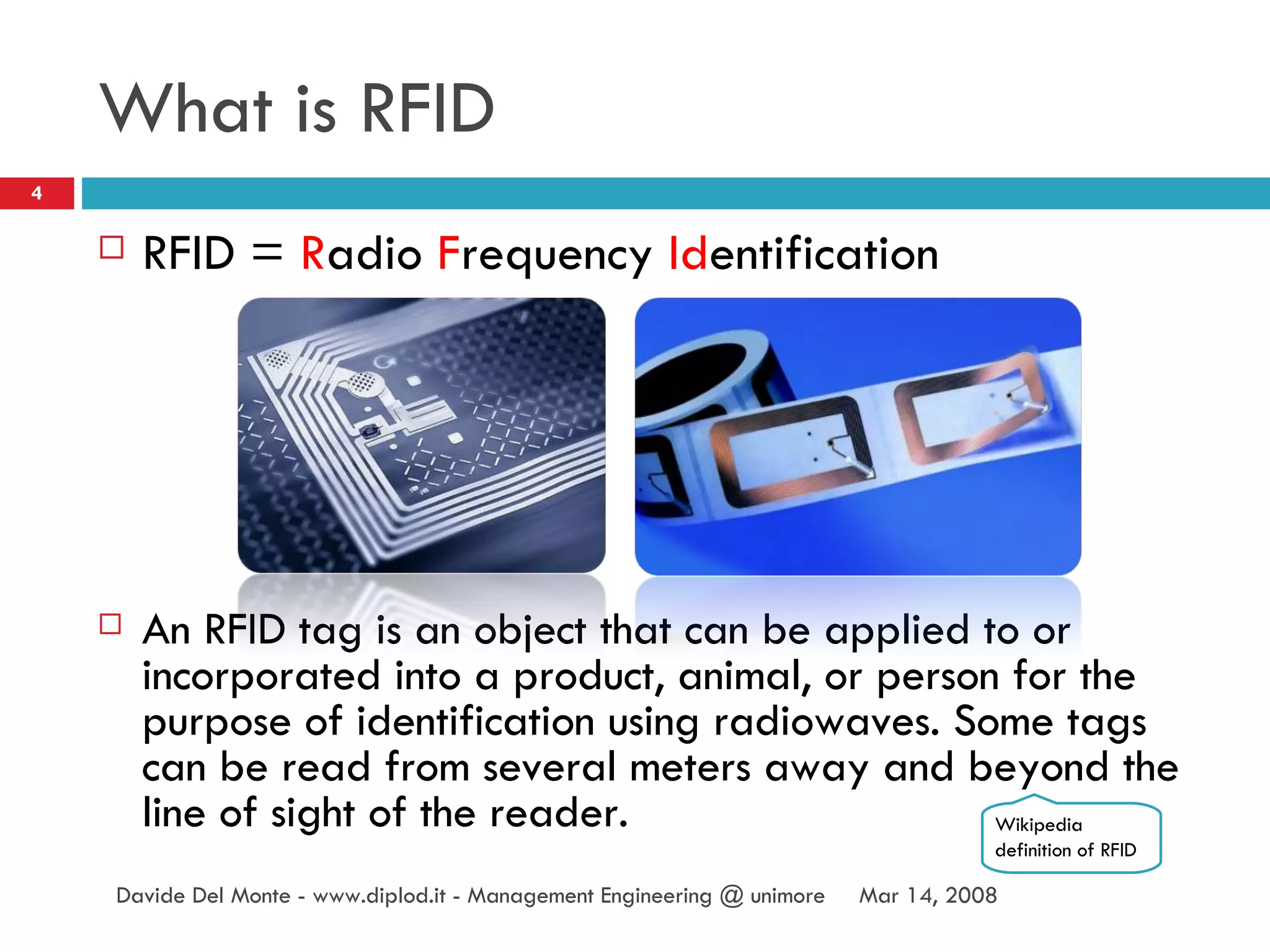
What is RFID RFID =  R adio  F requency  Id entification An RFID tag is an object that can be applied to or incorporated into a product, animal, or person for the purpose of identification using radiowaves. Some tags can be read from several meters away and beyond the line of sight of the reader. Davide Del Monte - www.diplod.it - Management Engineering @ unimore Jun 2, 2009 Wikipedia definition of RFID
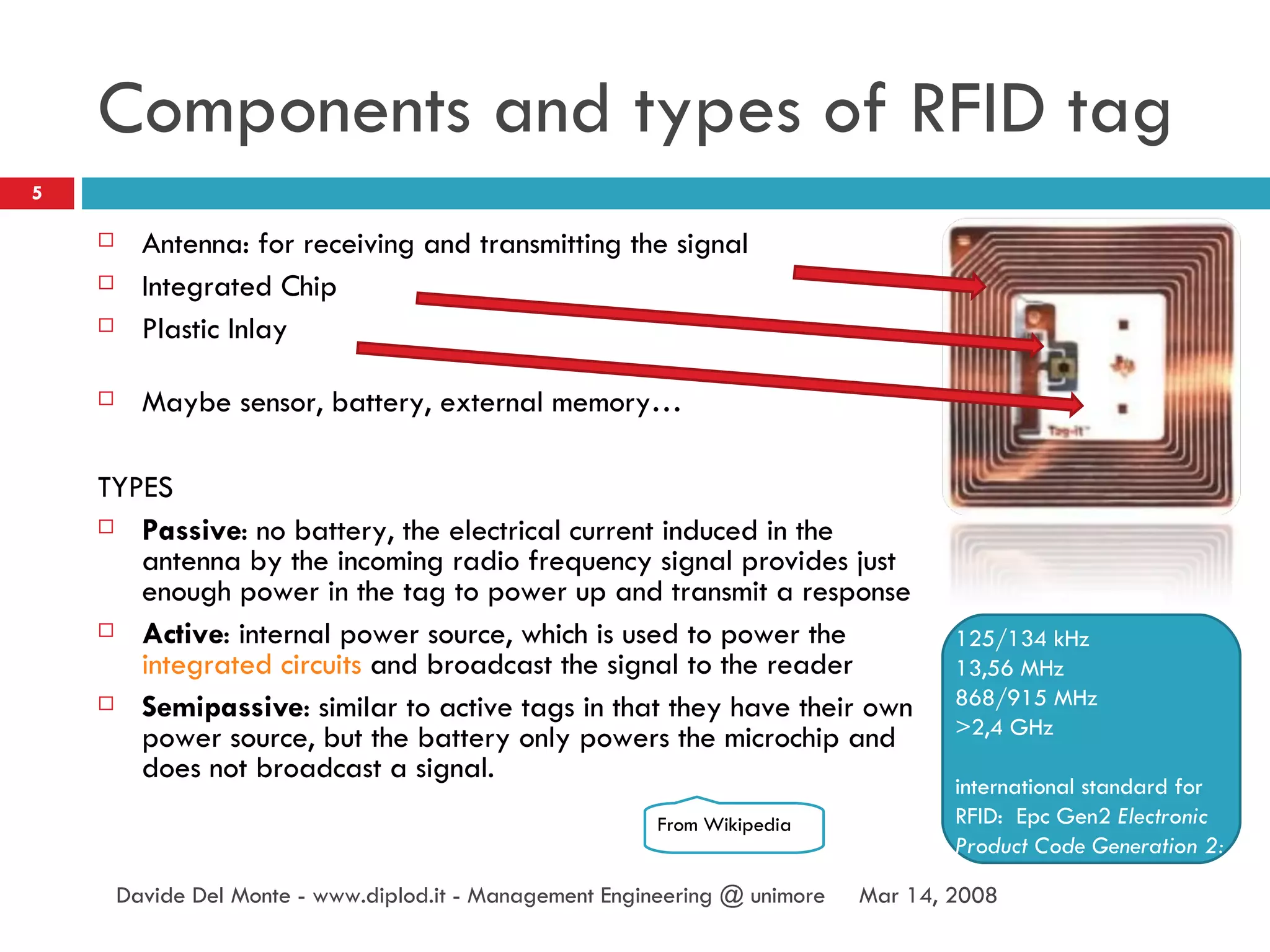
Components and types of RFID tag Antenna:  for receiving and transmitting the signal Integrated Chip Plastic Inlay Maybe sensor, battery, external memory… TYPES Passive : no battery, t he electrical current induced in the antenna by the incoming radio frequency signal provides just enough power in the tag to power up and transmit a response Active :  internal power source, which is used to power the  integrated circuits  and broadcast the signal to the reader Semipassive :  similar to active tags in that they have their own power source, but the battery only powers the microchip and does not broadcast a signal. Davide Del Monte - www.diplod.it - Management Engineering @ unimore Jun 2, 2009 125/134 kHz 13,56 MHz 868/915 MHz >2,4 GHz international standard for RFID:  Epc Gen2  Electronic Product Code Generation 2: From Wikipedia
Communication in passive tags Jun 2, 2009 Davide Del Monte - www.diplod.it - Management Engineering @ unimore Image from Alien Guide Image from Alien Guide
RFID vs BAR CODE Is possible to attach a tag on many surfaces Estimated production for 2008: 2-3 billion No line-of-sight Many informations and/or applications Can be reprogrammed in the field to reflect current information Cheap: 0,20 $ Now everything has a bar code Requires line-of-sight Only ID information Data is fixed at the moment the label is printed Cost free RFID BAR CODE Davide Del Monte - www.diplod.it - Management Engineering @ unimore Jun 2, 2009 ..but RFID are not only for identification scope..
I sense a disturbance in the force: unobtrusive detection of interactions with RIFID-tagged objects K.P. Fishkin, B. Jiang, M. Philippose, S. Roy Intel research Seattle – 2004 Department of Electrical Engineering, University of Washington Detection of interactions with RFID tagged Objects Davide Del Monte - www.diplod.it - Management Engineering @ unimore Jun 2, 2009
Idea “ A novel method to infer interactions with passive RFID tagged objects is described. The method allows unobtrusive detection of human interactions with RFID tagged objects without requiring any modifications to existing communications protocols or RFID hardware. The object motion detection algorithm was integrated into a RFID monitoring system and tested in laboratory  and home environments.” Davide Del Monte - www.diplod.it - Management Engineering @ unimore Jun 2, 2009
Tagged objects and movements Existing readers support a “poll” command, wherein the reader transmits  N poll  commands per second to tags and reports the number of received responses for each tag.  We therefore define a  response rate α as the ratio of responses to polls. α  C [0..1] When 0, the tag cannot be seen at all. When 1, the tag is always  seen. The response rate can be used to approximate  the RF signal strength The algorithm detect interaction reliably, and as quickly as possible after the event has occurred Jun 2, 2009 Davide Del Monte - www.diplod.it - Management Engineering @ unimore
Response rate  α Left: The response rate at 4 different distances, with N=20.  Right: The relationship between mean and standard deviation of response rate (N=10) Jun 2, 2009 Davide Del Monte - www.diplod.it - Management Engineering @ unimore Left:  Response rate as a function of distance from the reader antenna  Right: Response rate as a function of angle between the reader and tag antenna
Experiments and scenarios The first scenario represents a typical living-room interaction. Four items were tagged: a hardbound book, a magazine, a deck of cards, and a TV remote control. A sequence of typical interactions with these objects were performed, 30 interactions in total: objects were picked up and/or put down 23 times, an object was motioned with while in the hand 3 times, and a hand was waved in front of each object, for a total of 4 interactions. Two readers were used, both  wall-mounted, on perpendicular walls Jun 2, 2009 Davide Del Monte - www.diplod.it - Management Engineering @ unimore All 23 pick up / put down events were detected, all 3 motions with an object were detected, and all 4 hand-waves were correctly labeled as occlusions: 100% accuracy by the algorithm. No false positives occurred. A second experiment  was then performed with the same tagged objects but this time time using only a single wall-mounted reader. This time 9 pick up / put down events were performed and 3 interactions where one object was placed atop another All 9 pick up / put down events were detected, and one of the 3 placements were detected: the other two were not. No false positives occurred. Overall, 10 of 12 events were detected, for an accuracy of 83%.
Parameters and conclusions One dificult of measuring any RFID technique is that RFID signal streght is impacted by many variables: Flooring Distance between tag and reader Number of tags and their placement on object Number of readers and thier deployment topology Number of nearby tags Number of objects moved simultaneously Tag orientation Amount and direction of tag rotation Tag type Type of reader As ubiquitous computer matures, it will be possibile to detect interaction thanks to increasingly unobtrusive sensor networks Jun 2, 2009 Davide Del Monte - www.diplod.it - Management Engineering @ unimore
M. Philipose, K.P. Fishkin, M. Perkovitz (Intel research center) D.J. Patterson, D. Fox, H. Kautz (university of Washington) D. Hähnel (university of Freiburg) Inferring activities from interaction with objects Jun 2, 2009 Davide Del Monte - www.diplod.it - Management Engineering @ unimore
Idea The idea is to infer activities from interactions with object, combining the RFID tag data with time and sequences of activities. PROACT The system has three components: specialized sensors to detect object interactions, a probabilistic engine that infers activities given observations from sensors, and a model creator that lets us easily create probabilistic models of activities. Jun 2, 2009 Davide Del Monte - www.diplod.it - Management Engineering @ unimore
Prototype and models To sense tags,  the user wears a prototype glove with an RFID-detecting antenna in the  palm Activities are represented as linear sequences of activity stages For example,  we can model the making of tea as a three-stage activity: boil the water; steep the tea in the water; and flavor the tea with milk, sugar, or lemon Is possible to convert activities in a probabilistic model. These  models are typically difficult to create  without intensive hand tuning Jun 2, 2009 Davide Del Monte - www.diplod.it - Management Engineering @ unimore
Create the model Once we specify the objects involved in each stage, we must define the object  involvement probabilities these describe the probability of using the object in that activity state ( what percentage of sandwiches involve ham?) PROACT  automatically determines these probabilities Authors postulated  that if an activity  A occurs on n1 Web pages (the best extant approximation of human discourse), and  n2 pages  contain the activity and an object  T, then  the involvement probability for  T in A  is approximately equal to  n2/n1.  These numbers are obtained via the  Google  API Jun 2, 2009 Davide Del Monte - www.diplod.it - Management Engineering @ unimore
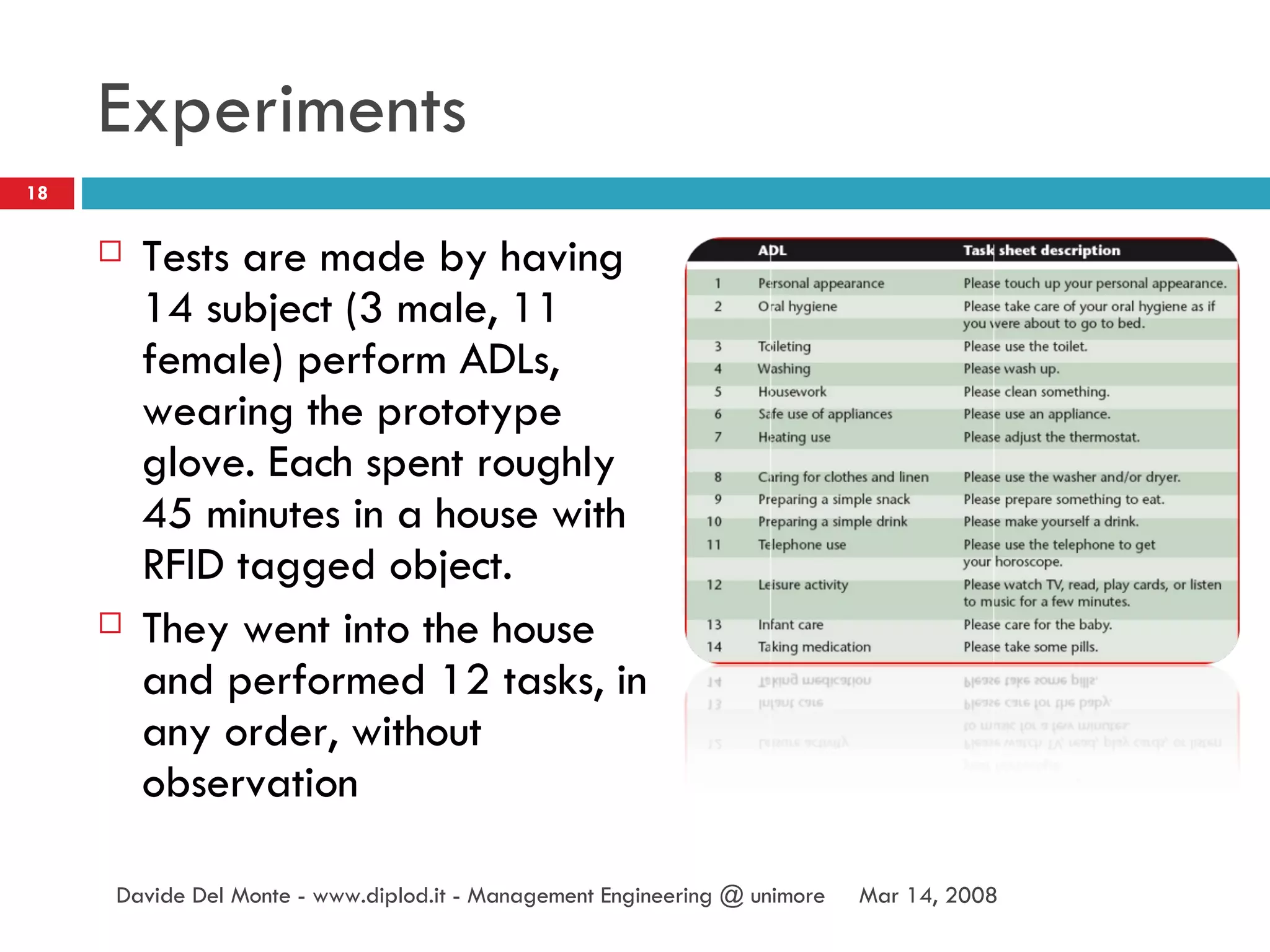
Experiments Tests are made by having 14 subject (3 male,  11 female) perform ADLs, wearing the prototype glove. Each spent roughly 45 minutes in a house with RFID tagged object. They went into the house and performed 12 tasks, in any  order, without observation Jun 2, 2009 Davide Del Monte - www.diplod.it - Management Engineering @ unimore
Results When PROACT correctly claimed an activity occurred, it scored a true positive (TP); an incorrect claim scored a false positive (FP). If an activity occurred and PROACT didn’t report it, PROACT scored a false negative (FN). The Table shows the  results for each ADL. Jun 2, 2009 Davide Del Monte - www.diplod.it - Management Engineering @ unimore PROACT correctly inferred that an activity occurred 88 percent of the time Applications are possible in health-care: ADL monitoring of elders with earlystage dementia
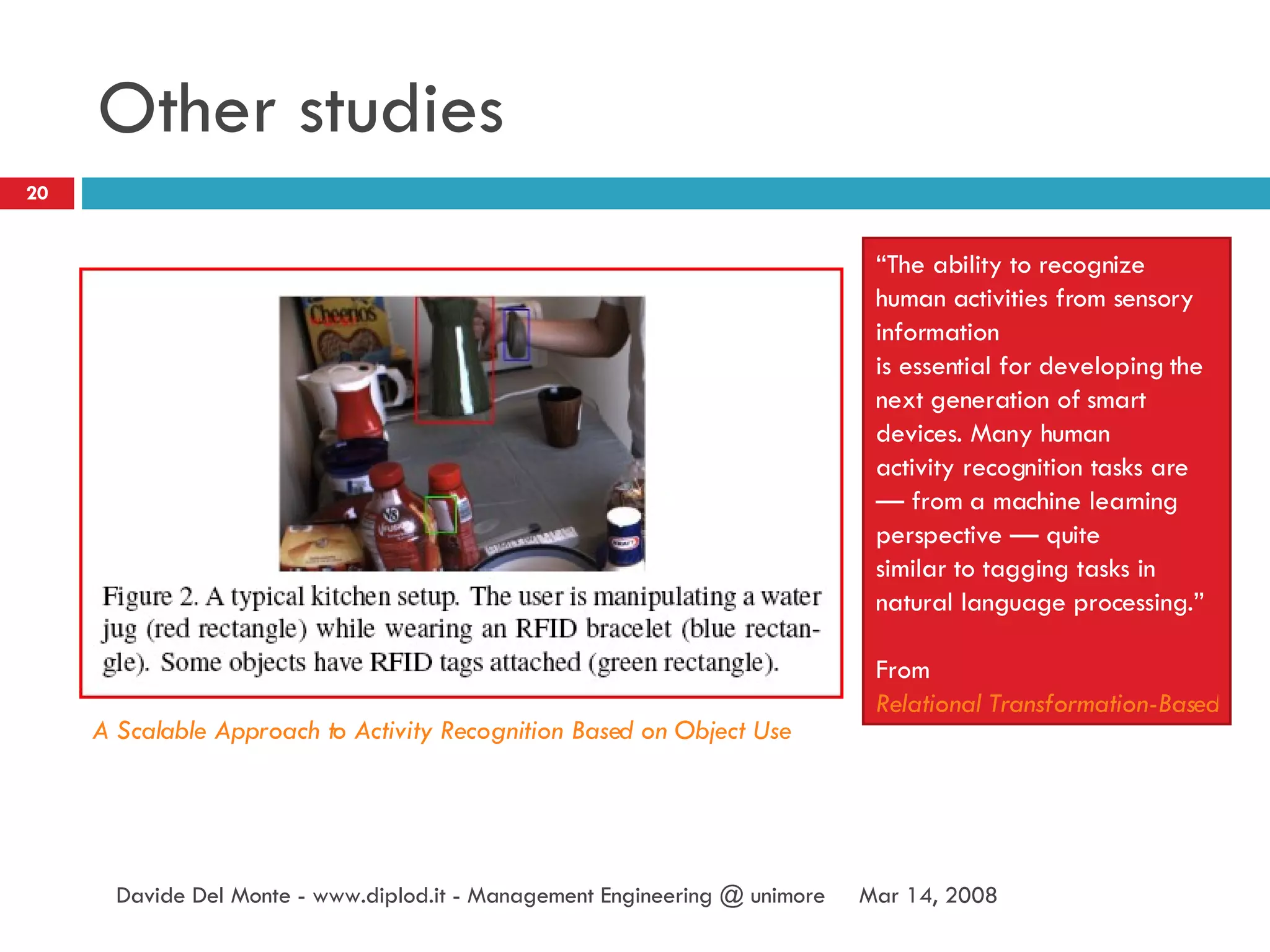
Other studies Jun 2, 2009 Davide Del Monte - www.diplod.it - Management Engineering @ unimore A Scalable Approach to Activity Recognition Based on Object Use “ The ability to recognize human activities from sensory information is essential for developing the next generation of smart devices. Many human activity recognition tasks are — from a machine learning perspective — quite similar to tagging tasks in natural language processing.” From  Relational Transformation-Based Tagging for Human Activity Recognition
R. Raskar, P. Beardsley, J. Van Baar, Y. Wang, P. Dietz, J. Lee, D. Leigh, T. Willwacher (Mitsubischi Electric Research Labs, Cambridge) RFIG Lamps: Interacting with a self-describing world via photosensing wireless tags and projectors Jun 2, 2009 Davide Del Monte - www.diplod.it - Management Engineering @ unimore
Each tag is augmented with a photo sensor to significantly extend the functionality and support radio frequency identity and geometry (RFIG) discovery Objects become self-describing Jun 2, 2009 Davide Del Monte - www.diplod.it - Management Engineering @ unimore
Augmented reality At the mitsubishi lab they are working on handheld system to project information on tagged object and reproduce an “augmented reality” On the objects there is a photo sensor that detects the light to allow programming on rfid tags Jun 2, 2009 Davide Del Monte - www.diplod.it - Management Engineering @ unimore
Applications and most common uses for RFID ..but we aren’t Neo. In the real world? Jun 2, 2009 Davide Del Monte - www.diplod.it - Management Engineering @ unimore
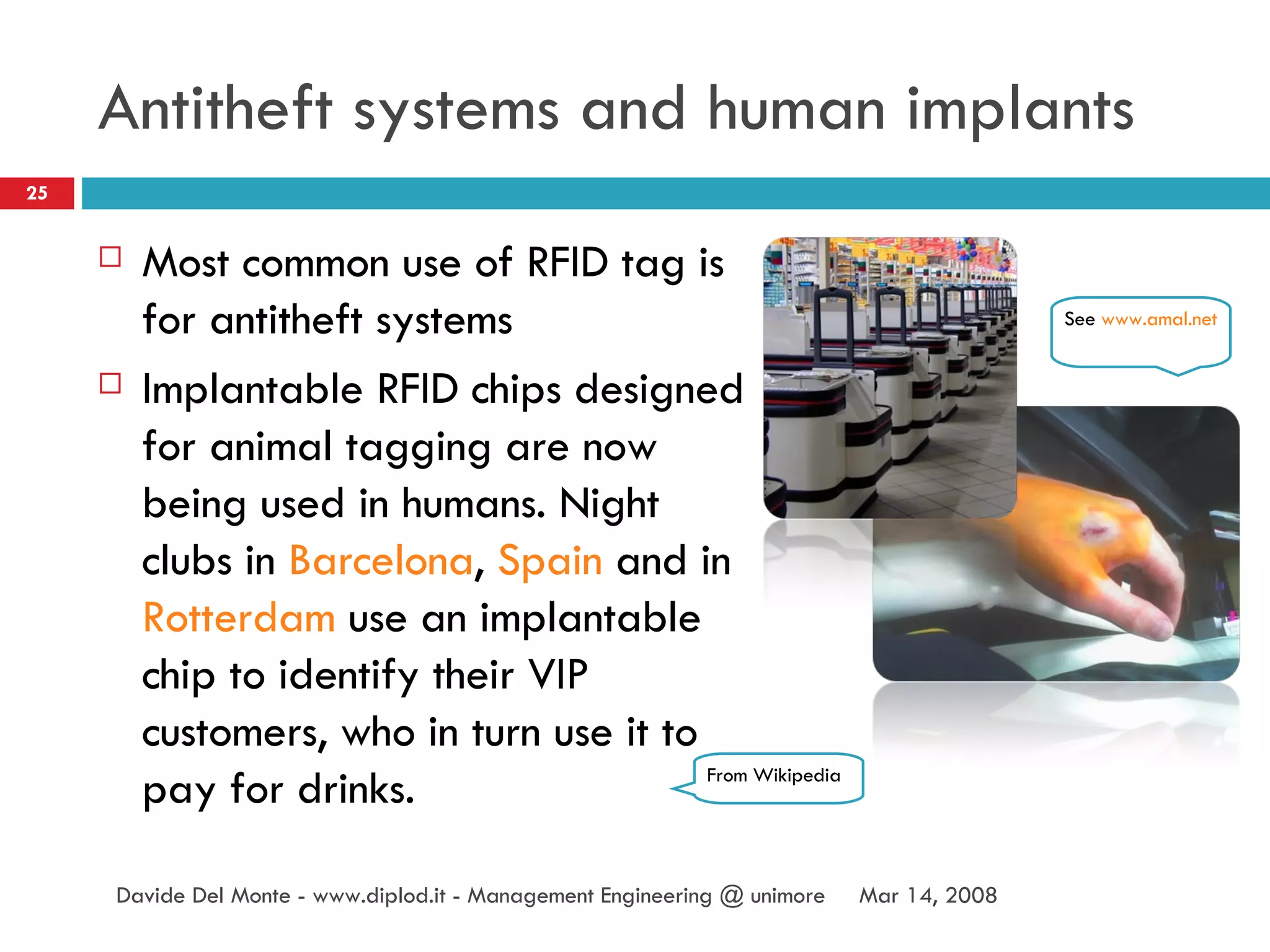
Antitheft systems and human implants Most common use of RFID tag is for antitheft systems Implantable RFID chips designed for animal tagging are now being used in humans. Night clubs in  Barcelona ,  Spain  and in  Rotterdam  use an implantable chip to identify their VIP customers, who in turn use it to pay for drinks.   Jun 2, 2009 Davide Del Monte - www.diplod.it - Management Engineering @ unimore See  www.amal.net   From Wikipedia
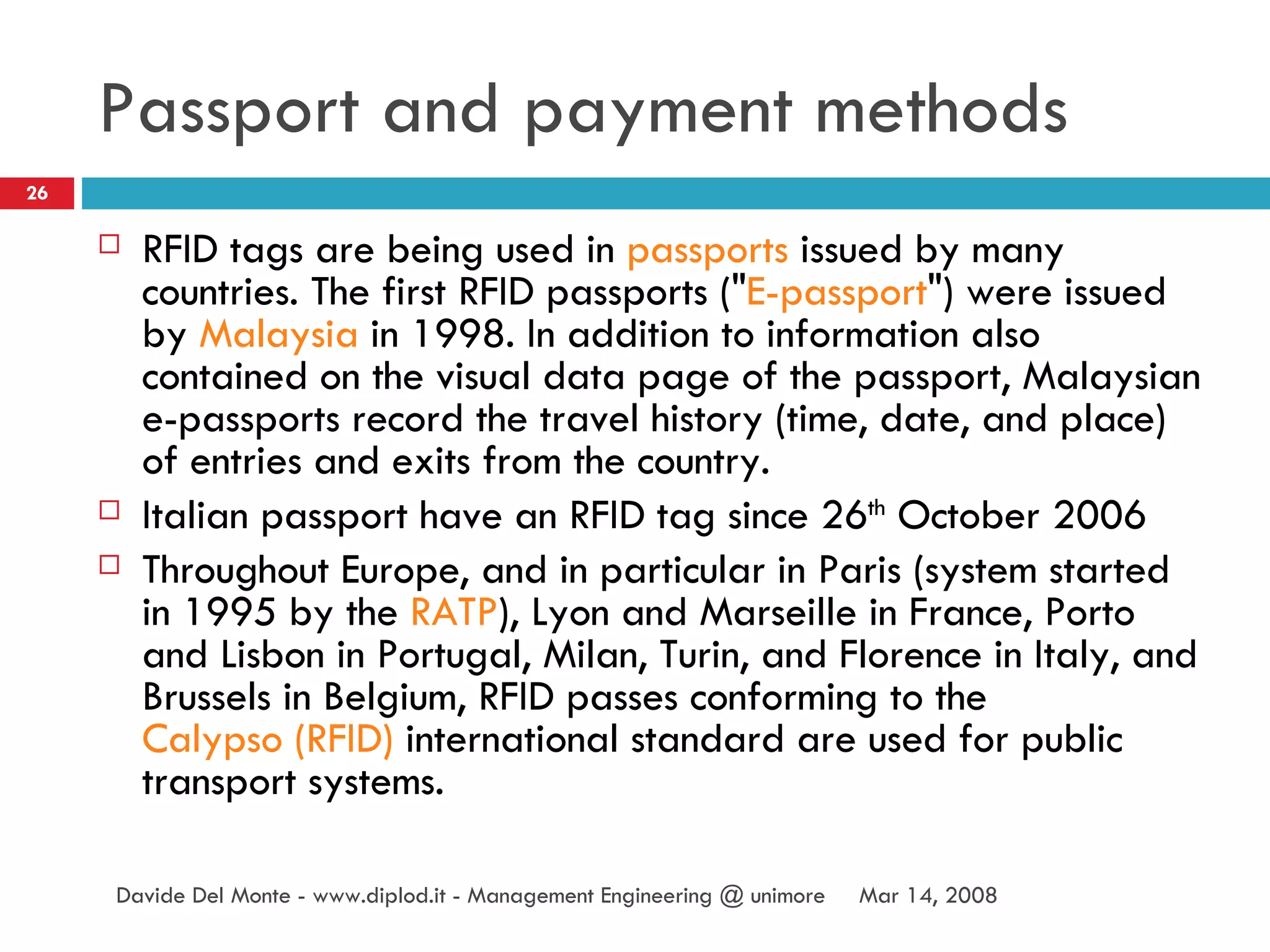
Passport and payment methods RFID tags are being used in  passports  issued by many countries. The first RFID passports (" E-passport ") were issued by  Malaysia  in 1998. In addition to information also contained on the visual data page of the passport, Malaysian e-passports record the travel history (time, date, and place) of entries and exits from the country. Italian passport have an RFID tag since 26 th  October 2006 Throughout Europe, and in particular in Paris (system started in 1995 by the  RATP ), Lyon and Marseille in France, Porto and Lisbon in Portugal, Milan, Turin, and Florence in Italy, and Brussels in Belgium, RFID passes conforming to the  Calypso (RFID)  international standard are used for public transport systems. Jun 2, 2009 Davide Del Monte - www.diplod.it - Management Engineering @ unimore
Logistic and Domotic Inventory systems:  in an academic study [19]  performed at Wal-Mart, RFID reduced Out-of-Stocks by 30 percent for products selling between 0.1 and 15 units a day. Product Tracking: integrated supply chain from warehouse to consumer. See the story “ How and why you will talk to your tomatoes ” Domotic systems for findind object Tag environments, question tags for environmental conditions ( ubiquity of RFID tags) Jun 2, 2009 Davide Del Monte - www.diplod.it - Management Engineering @ unimore
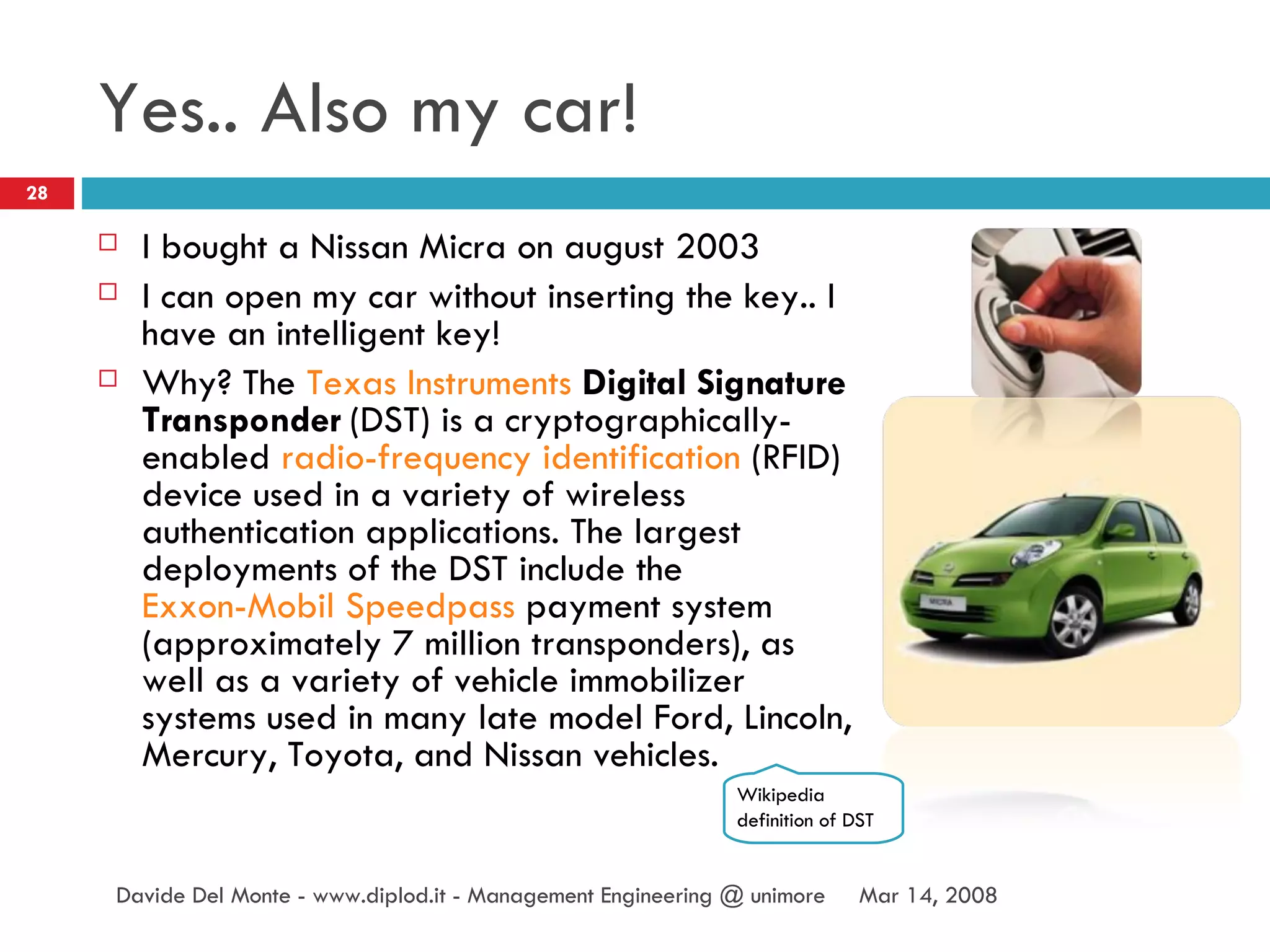
Yes.. Also my car! I bought a Nissan Micra on august 2003 I can open my car without inserting the key.. I have an intelligent key! Why? The  Texas Instruments   Digital Signature Transponder  (DST) is a cryptographically-enabled  radio-frequency identification  (RFID) device used in a variety of wireless authentication applications. The largest deployments of the DST include the  Exxon-Mobil   Speedpass  payment system (approximately 7 million transponders), as well as a variety of vehicle immobilizer systems used in many late model Ford, Lincoln, Mercury, Toyota, and Nissan vehicles. Jun 2, 2009 Davide Del Monte - www.diplod.it - Management Engineering @ unimore Wikipedia definition of DST
And much more.. Lap scoring (racing) Animal Identification E-tickets Hospital Musea, libraries schools and universities The  privacy  is a real problem:  a primary security concern surrounding technology is the illicit tracking of RFID tags. Tags which are world-readable pose a risk to both personal location privacy and corporate/military security.  Privacy organizations have expressed concerns in the context of ongoing efforts to embed electronic product code (EPC) RFID tags in consumer products. Jun 2, 2009 Davide Del Monte - www.diplod.it - Management Engineering @ unimore From Wikipedia
Test I made at DISMI Java Experiments with Alien Jun 2, 2009 Davide Del Monte - www.diplod.it - Management Engineering @ unimore
The reader has two antennas and is connected to a notebook via TCP/IP port Orange labels are RFID tags Alien reader Jun 2, 2009 Davide Del Monte - www.diplod.it - Management Engineering @ unimore
To connect Alien with the notebook you have to specify the IP address Setting IP Address Jun 2, 2009 Davide Del Monte - www.diplod.it - Management Engineering @ unimore
MessageListenerTest Instantiating the reader at a network address and  specifying a network address for replies. AutoStopTimer is the time for reading tags. This is a critical value!  // Instantiate a new reader object, and open a connection on the NET AlienClass1Reader reader = new AlienClass1Reader(); reader.setConnection("192.168.0.2",23); reader.setUsername("alien"); reader.setPassword("password"); reader.open(); // Set up Notification. reader.setNotifyAddress("192.168.0.1",service.getListenerPort()); reader.setNotifyFormat(AlienClass1Reader.XML_FORMAT);  // Listener only supports XML messages reader.setNotifyTrigger("TrueFalse");  // Notify whether there's a tag or not reader.setNotifyMode(AlienClass1Reader.ON); // Set up AutoMode reader.autoModeReset(); reader.setAutoStopTimer( 4000 );  // Read for 4 second reader.setAutoMode(AlienClass1Reader.ON); Jun 2, 2009 Davide Del Monte - www.diplod.it - Management Engineering @ unimore
MessageReceived If there are tags in the antenna’s area, the system reports a message with the tag’s identification number, the time when the tag was discovered, and last time the tag was seen. The main method only initializes the class MessageListenerTest public void messageReceived(Message message){ System.out.println(&quot;\nMessage Received:&quot;); if (message.getTagCount() == 0) { System.out.println(&quot;(No Tags)&quot;); } else { for (int i = 0; i < message.getTagCount(); i++) { Tag tag = message.getTag(i); System.out.println(tag.toLongString()); } } } //Main metod public static final void main(String args[]){ try { MessageListenerTest test = new MessageListenerTest(); } catch (Exception e) { System.out.println(&quot;Error:&quot; + e.toString()); } } Jun 2, 2009 Davide Del Monte - www.diplod.it - Management Engineering @ unimore
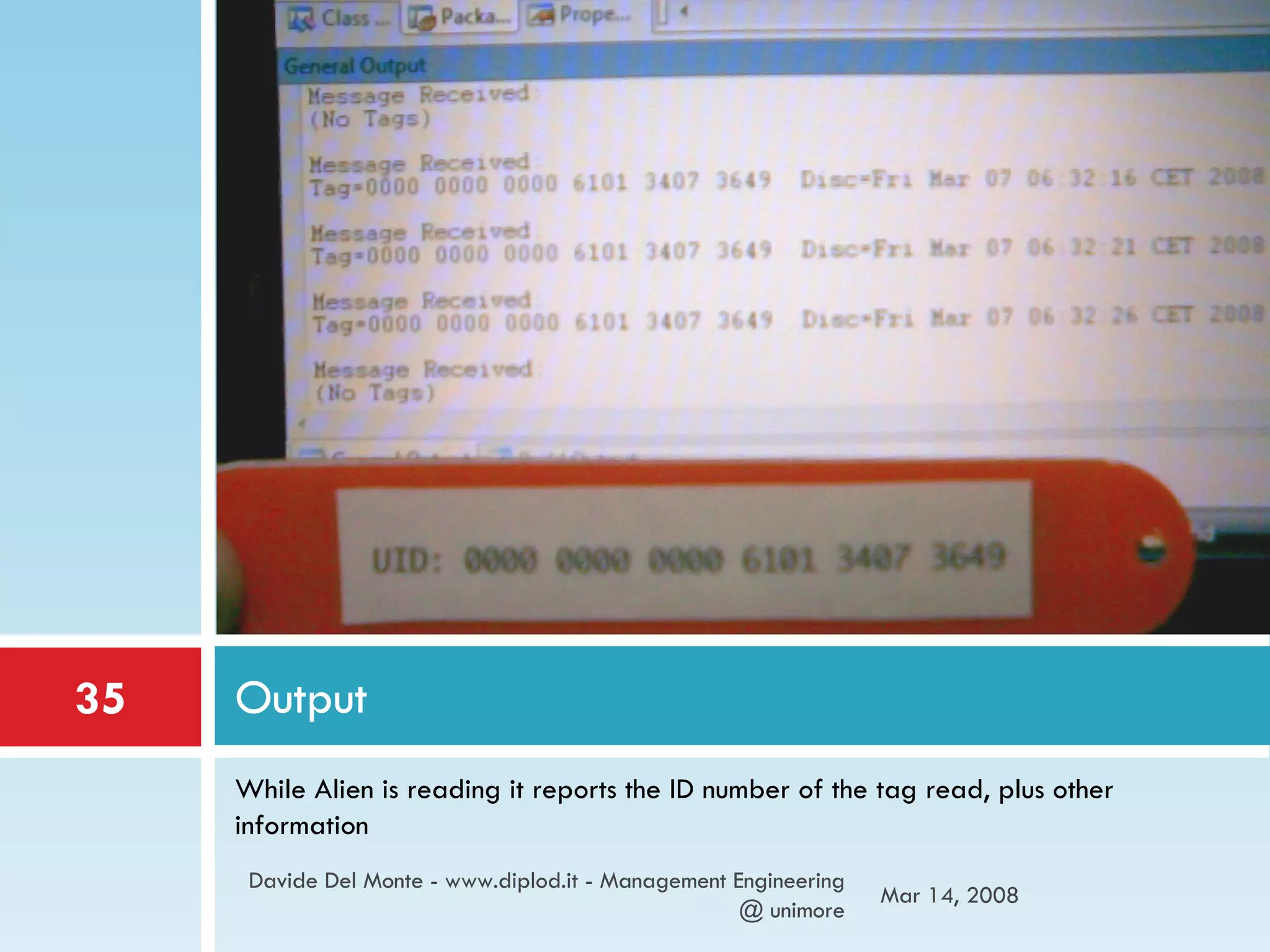
While Alien is reading it reports the ID number of the tag read, plus other information Output Jun 2, 2009 Davide Del Monte - www.diplod.it - Management Engineering @ unimore
Output Typical output is a sequence of information You can also obtain this information in a XML file This function is very powerfull, you can integrate this informations with a web service to realize different kinds of applications. Jun 2, 2009 Davide Del Monte - www.diplod.it - Management Engineering @ unimore
XML Message XML message is obtained with the method getXML() of the object Message. This is the output when a new tag is read by Alien. Message Received: Tag=0000 0000 0000 6101 3407 3649  Disc=Fri Mar 07 08:11:50 CET 2008  Last=Fri Mar 07 08:11:52 CET 2008  Count=9  Ant=0 XML message:  <Alien-RFID-Reader-Auto-Notification> <ReaderName>Alien RFID Reader</ReaderName> <ReaderType>Alien RFID Tag Reader, Model: </ReaderType> <IPAddress>192.168.0.2</IPAddress> <CommandPort>23</CommandPort> <Time>2008/03/07 08:11:55</Time> <Reason>AUTO MODE EVALUATES TRUE</Reason> <StartTriggerLines>0</StartTriggerLines> <StopTriggerLines>0</StopTriggerLines> <Alien-RFID-Tag-List> <Alien-RFID-Tag> <TagID>0000 0000 0000 6101 3407 3649</TagID> <DiscoveryTime>2008/03/07 08:11:50</DiscoveryTime> <LastSeenTime>2008/03/07 08:11:52</LastSeenTime> <Antenna>0</Antenna> <ReadCount>9</ReadCount> </Alien-RFID-Tag> </Alien-RFID-Tag-List> </Alien-RFID-Reader-Auto-Notification> Jun 2, 2009 Davide Del Monte - www.diplod.it - Management Engineering @ unimore
Writing Data Is possible to write and update data of RFID tags Programming commands are not enabled by default; to enable it is necessary to pass the command (see later for ASCII commands): Alien >set Function = Programmer Then there are some methods to write data Jun 2, 2009 Davide Del Monte - www.diplod.it - Management Engineering @ unimore String tagID = &quot;12345678&quot;; reader.setProgAntenna(0); //set the antenna for programming tag reader.eraseTag(); //erase data reader.programTag(tagID); //set new tag ID
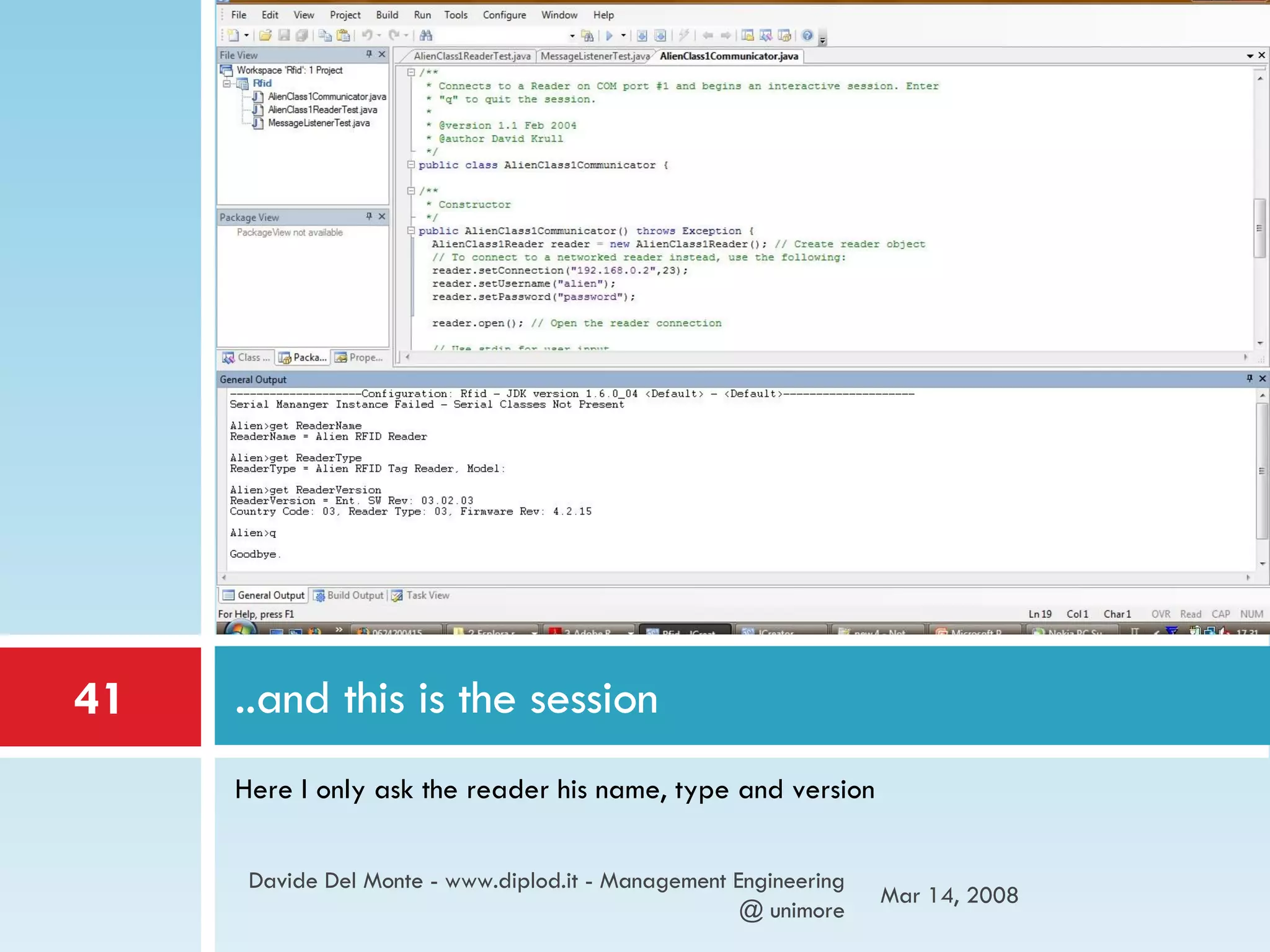
Session The most basic way to communicate with a reader is to use a method called doReaderCommand(), which sends an ASCII command and returns the  ASCII response String readerName = reader.doReaderCommand(&quot;get ReaderName&quot;); Whit few line of code is possible to create a session to comunicate with Alien You can perform the same commands with java methods or with ASCII strings Jun 2, 2009 Davide Del Monte - www.diplod.it - Management Engineering @ unimore
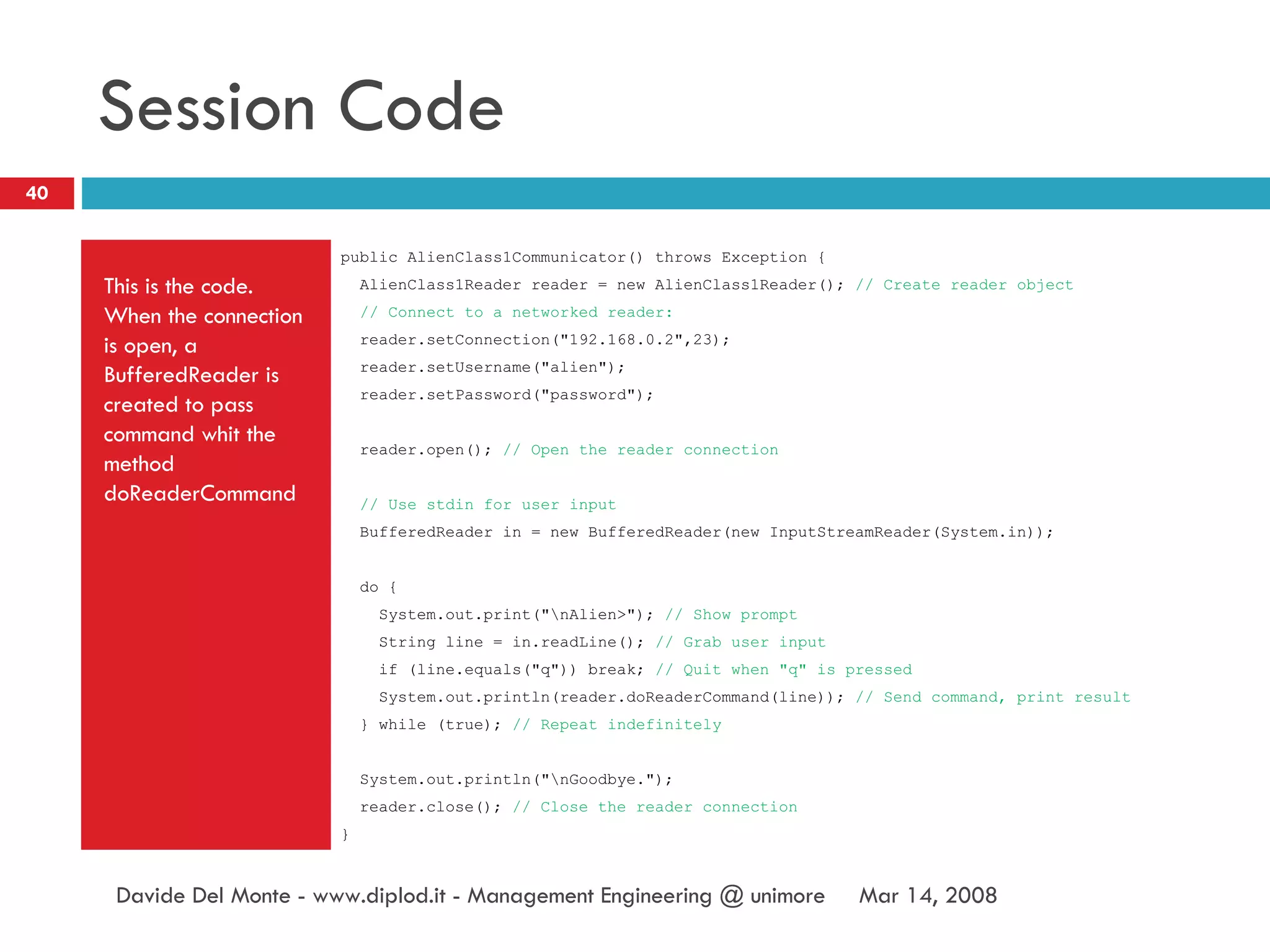
Session Code This is the code. When the connection is open, a BufferedReader is created to pass command whit the method doReaderCommand public AlienClass1Communicator() throws Exception { AlienClass1Reader reader = new AlienClass1Reader();  // Create reader object // Connect to a networked reader: reader.setConnection(&quot;192.168.0.2&quot;,23); reader.setUsername(&quot;alien&quot;); reader.setPassword(&quot;password&quot;); reader.open();  // Open the reader connection // Use stdin for user input BufferedReader in = new BufferedReader(new InputStreamReader(System.in)); do { System.out.print(&quot;\nAlien>&quot;);  // Show prompt String line = in.readLine();  // Grab user input if (line.equals(&quot;q&quot;)) break;  // Quit when &quot;q&quot; is pressed System.out.println(reader.doReaderCommand(line));  // Send command, print result } while (true);  // Repeat indefinitely System.out.println(&quot;\nGoodbye.&quot;); reader.close();  // Close the reader connection } Jun 2, 2009 Davide Del Monte - www.diplod.it - Management Engineering @ unimore
Here I only ask the reader his name, type and version ..and this is the session Jun 2, 2009 Davide Del Monte - www.diplod.it - Management Engineering @ unimore
THANKS Davide Del Monte –  www.diplod.it   – Complex Adaptive Systems 2008 – Management Engineering – unimore –  http://www.ingre.unimore.it/ Bibliography I Sense a Disturbance in the Force: Unobtrusive Detection of  Interactions with RFID-tagged Objects http://www.intel-research.net/Publications/Seattle/062420041544_244.pdf Inferring Activities from Interactions with Objects. http://192.5.53.208/u/kautz/papers/pervasive_proact_final.pdf A Scalable Approach to Activity Recognition Based on Object Use http://seattleweb.intel-research.net/people/matthai/pubs/iccv07.pdf RFIG Lamps: Interacting with a self-describing world via photosensing wireless tags and projectors http://www.merl.com/people/raskar/Sig04/ Alien Technology http://www.alientechnology.com/ EPC http://www.epcglobalinc.org/home Amal Graafstra http://www.amal.net/ Wikipedia http://en.wikipedia.org/wiki/RFID

RFID tag - technology and scenarios

  • 1.
    RFID TAG THEWORLD OF OBJECTS Davide Del Monte – www.diplod.it – Complex Adaptive Systems 2008 – Management Engineering – unimore – http://www.ingre.unimore.it/
  • 2.
    What is RFIDtechnology Detection of interactions with RFID tagged Objects Inferring activities from interaction: ADL (activities of daily living) RFIG Lamps: Interacting with a self-describing world via photosensing wireless tags and projectors Applications in the real world Java experiments with Alien reader Outline Davide Del Monte - www.diplod.it - Management Engineering @ unimore Jun 2, 2009
  • 3.
    What is RFIDDavide Del Monte - www.diplod.it - Management Engineering @ unimore Jun 2, 2009
  • 4.
    What is RFIDRFID = R adio F requency Id entification An RFID tag is an object that can be applied to or incorporated into a product, animal, or person for the purpose of identification using radiowaves. Some tags can be read from several meters away and beyond the line of sight of the reader. Davide Del Monte - www.diplod.it - Management Engineering @ unimore Jun 2, 2009 Wikipedia definition of RFID
  • 5.
    Components and typesof RFID tag Antenna: for receiving and transmitting the signal Integrated Chip Plastic Inlay Maybe sensor, battery, external memory… TYPES Passive : no battery, t he electrical current induced in the antenna by the incoming radio frequency signal provides just enough power in the tag to power up and transmit a response Active : internal power source, which is used to power the integrated circuits and broadcast the signal to the reader Semipassive : similar to active tags in that they have their own power source, but the battery only powers the microchip and does not broadcast a signal. Davide Del Monte - www.diplod.it - Management Engineering @ unimore Jun 2, 2009 125/134 kHz 13,56 MHz 868/915 MHz >2,4 GHz international standard for RFID: Epc Gen2 Electronic Product Code Generation 2: From Wikipedia
  • 6.
    Communication in passivetags Jun 2, 2009 Davide Del Monte - www.diplod.it - Management Engineering @ unimore Image from Alien Guide Image from Alien Guide
  • 7.
    RFID vs BARCODE Is possible to attach a tag on many surfaces Estimated production for 2008: 2-3 billion No line-of-sight Many informations and/or applications Can be reprogrammed in the field to reflect current information Cheap: 0,20 $ Now everything has a bar code Requires line-of-sight Only ID information Data is fixed at the moment the label is printed Cost free RFID BAR CODE Davide Del Monte - www.diplod.it - Management Engineering @ unimore Jun 2, 2009 ..but RFID are not only for identification scope..
  • 8.
    I sense adisturbance in the force: unobtrusive detection of interactions with RIFID-tagged objects K.P. Fishkin, B. Jiang, M. Philippose, S. Roy Intel research Seattle – 2004 Department of Electrical Engineering, University of Washington Detection of interactions with RFID tagged Objects Davide Del Monte - www.diplod.it - Management Engineering @ unimore Jun 2, 2009
  • 9.
    Idea “ Anovel method to infer interactions with passive RFID tagged objects is described. The method allows unobtrusive detection of human interactions with RFID tagged objects without requiring any modifications to existing communications protocols or RFID hardware. The object motion detection algorithm was integrated into a RFID monitoring system and tested in laboratory and home environments.” Davide Del Monte - www.diplod.it - Management Engineering @ unimore Jun 2, 2009
  • 10.
    Tagged objects andmovements Existing readers support a “poll” command, wherein the reader transmits N poll commands per second to tags and reports the number of received responses for each tag. We therefore define a response rate α as the ratio of responses to polls. α C [0..1] When 0, the tag cannot be seen at all. When 1, the tag is always seen. The response rate can be used to approximate the RF signal strength The algorithm detect interaction reliably, and as quickly as possible after the event has occurred Jun 2, 2009 Davide Del Monte - www.diplod.it - Management Engineering @ unimore
  • 11.
    Response rate α Left: The response rate at 4 different distances, with N=20. Right: The relationship between mean and standard deviation of response rate (N=10) Jun 2, 2009 Davide Del Monte - www.diplod.it - Management Engineering @ unimore Left: Response rate as a function of distance from the reader antenna Right: Response rate as a function of angle between the reader and tag antenna
  • 12.
    Experiments and scenariosThe first scenario represents a typical living-room interaction. Four items were tagged: a hardbound book, a magazine, a deck of cards, and a TV remote control. A sequence of typical interactions with these objects were performed, 30 interactions in total: objects were picked up and/or put down 23 times, an object was motioned with while in the hand 3 times, and a hand was waved in front of each object, for a total of 4 interactions. Two readers were used, both wall-mounted, on perpendicular walls Jun 2, 2009 Davide Del Monte - www.diplod.it - Management Engineering @ unimore All 23 pick up / put down events were detected, all 3 motions with an object were detected, and all 4 hand-waves were correctly labeled as occlusions: 100% accuracy by the algorithm. No false positives occurred. A second experiment was then performed with the same tagged objects but this time time using only a single wall-mounted reader. This time 9 pick up / put down events were performed and 3 interactions where one object was placed atop another All 9 pick up / put down events were detected, and one of the 3 placements were detected: the other two were not. No false positives occurred. Overall, 10 of 12 events were detected, for an accuracy of 83%.
  • 13.
    Parameters and conclusionsOne dificult of measuring any RFID technique is that RFID signal streght is impacted by many variables: Flooring Distance between tag and reader Number of tags and their placement on object Number of readers and thier deployment topology Number of nearby tags Number of objects moved simultaneously Tag orientation Amount and direction of tag rotation Tag type Type of reader As ubiquitous computer matures, it will be possibile to detect interaction thanks to increasingly unobtrusive sensor networks Jun 2, 2009 Davide Del Monte - www.diplod.it - Management Engineering @ unimore
  • 14.
    M. Philipose, K.P.Fishkin, M. Perkovitz (Intel research center) D.J. Patterson, D. Fox, H. Kautz (university of Washington) D. Hähnel (university of Freiburg) Inferring activities from interaction with objects Jun 2, 2009 Davide Del Monte - www.diplod.it - Management Engineering @ unimore
  • 15.
    Idea The ideais to infer activities from interactions with object, combining the RFID tag data with time and sequences of activities. PROACT The system has three components: specialized sensors to detect object interactions, a probabilistic engine that infers activities given observations from sensors, and a model creator that lets us easily create probabilistic models of activities. Jun 2, 2009 Davide Del Monte - www.diplod.it - Management Engineering @ unimore
  • 16.
    Prototype and modelsTo sense tags, the user wears a prototype glove with an RFID-detecting antenna in the palm Activities are represented as linear sequences of activity stages For example, we can model the making of tea as a three-stage activity: boil the water; steep the tea in the water; and flavor the tea with milk, sugar, or lemon Is possible to convert activities in a probabilistic model. These models are typically difficult to create without intensive hand tuning Jun 2, 2009 Davide Del Monte - www.diplod.it - Management Engineering @ unimore
  • 17.
    Create the modelOnce we specify the objects involved in each stage, we must define the object involvement probabilities these describe the probability of using the object in that activity state ( what percentage of sandwiches involve ham?) PROACT automatically determines these probabilities Authors postulated that if an activity A occurs on n1 Web pages (the best extant approximation of human discourse), and n2 pages contain the activity and an object T, then the involvement probability for T in A is approximately equal to n2/n1. These numbers are obtained via the Google API Jun 2, 2009 Davide Del Monte - www.diplod.it - Management Engineering @ unimore
  • 18.
    Experiments Tests aremade by having 14 subject (3 male, 11 female) perform ADLs, wearing the prototype glove. Each spent roughly 45 minutes in a house with RFID tagged object. They went into the house and performed 12 tasks, in any order, without observation Jun 2, 2009 Davide Del Monte - www.diplod.it - Management Engineering @ unimore
  • 19.
    Results When PROACTcorrectly claimed an activity occurred, it scored a true positive (TP); an incorrect claim scored a false positive (FP). If an activity occurred and PROACT didn’t report it, PROACT scored a false negative (FN). The Table shows the results for each ADL. Jun 2, 2009 Davide Del Monte - www.diplod.it - Management Engineering @ unimore PROACT correctly inferred that an activity occurred 88 percent of the time Applications are possible in health-care: ADL monitoring of elders with earlystage dementia
  • 20.
    Other studies Jun2, 2009 Davide Del Monte - www.diplod.it - Management Engineering @ unimore A Scalable Approach to Activity Recognition Based on Object Use “ The ability to recognize human activities from sensory information is essential for developing the next generation of smart devices. Many human activity recognition tasks are — from a machine learning perspective — quite similar to tagging tasks in natural language processing.” From Relational Transformation-Based Tagging for Human Activity Recognition
  • 21.
    R. Raskar, P.Beardsley, J. Van Baar, Y. Wang, P. Dietz, J. Lee, D. Leigh, T. Willwacher (Mitsubischi Electric Research Labs, Cambridge) RFIG Lamps: Interacting with a self-describing world via photosensing wireless tags and projectors Jun 2, 2009 Davide Del Monte - www.diplod.it - Management Engineering @ unimore
  • 22.
    Each tag isaugmented with a photo sensor to significantly extend the functionality and support radio frequency identity and geometry (RFIG) discovery Objects become self-describing Jun 2, 2009 Davide Del Monte - www.diplod.it - Management Engineering @ unimore
  • 23.
    Augmented reality Atthe mitsubishi lab they are working on handheld system to project information on tagged object and reproduce an “augmented reality” On the objects there is a photo sensor that detects the light to allow programming on rfid tags Jun 2, 2009 Davide Del Monte - www.diplod.it - Management Engineering @ unimore
  • 24.
    Applications and mostcommon uses for RFID ..but we aren’t Neo. In the real world? Jun 2, 2009 Davide Del Monte - www.diplod.it - Management Engineering @ unimore
  • 25.
    Antitheft systems andhuman implants Most common use of RFID tag is for antitheft systems Implantable RFID chips designed for animal tagging are now being used in humans. Night clubs in Barcelona , Spain and in Rotterdam use an implantable chip to identify their VIP customers, who in turn use it to pay for drinks. Jun 2, 2009 Davide Del Monte - www.diplod.it - Management Engineering @ unimore See www.amal.net From Wikipedia
  • 26.
    Passport and paymentmethods RFID tags are being used in passports issued by many countries. The first RFID passports (&quot; E-passport &quot;) were issued by Malaysia in 1998. In addition to information also contained on the visual data page of the passport, Malaysian e-passports record the travel history (time, date, and place) of entries and exits from the country. Italian passport have an RFID tag since 26 th October 2006 Throughout Europe, and in particular in Paris (system started in 1995 by the RATP ), Lyon and Marseille in France, Porto and Lisbon in Portugal, Milan, Turin, and Florence in Italy, and Brussels in Belgium, RFID passes conforming to the Calypso (RFID) international standard are used for public transport systems. Jun 2, 2009 Davide Del Monte - www.diplod.it - Management Engineering @ unimore
  • 27.
    Logistic and DomoticInventory systems: in an academic study [19] performed at Wal-Mart, RFID reduced Out-of-Stocks by 30 percent for products selling between 0.1 and 15 units a day. Product Tracking: integrated supply chain from warehouse to consumer. See the story “ How and why you will talk to your tomatoes ” Domotic systems for findind object Tag environments, question tags for environmental conditions ( ubiquity of RFID tags) Jun 2, 2009 Davide Del Monte - www.diplod.it - Management Engineering @ unimore
  • 28.
    Yes.. Also mycar! I bought a Nissan Micra on august 2003 I can open my car without inserting the key.. I have an intelligent key! Why? The Texas Instruments Digital Signature Transponder (DST) is a cryptographically-enabled radio-frequency identification (RFID) device used in a variety of wireless authentication applications. The largest deployments of the DST include the Exxon-Mobil Speedpass payment system (approximately 7 million transponders), as well as a variety of vehicle immobilizer systems used in many late model Ford, Lincoln, Mercury, Toyota, and Nissan vehicles. Jun 2, 2009 Davide Del Monte - www.diplod.it - Management Engineering @ unimore Wikipedia definition of DST
  • 29.
    And much more..Lap scoring (racing) Animal Identification E-tickets Hospital Musea, libraries schools and universities The privacy is a real problem: a primary security concern surrounding technology is the illicit tracking of RFID tags. Tags which are world-readable pose a risk to both personal location privacy and corporate/military security. Privacy organizations have expressed concerns in the context of ongoing efforts to embed electronic product code (EPC) RFID tags in consumer products. Jun 2, 2009 Davide Del Monte - www.diplod.it - Management Engineering @ unimore From Wikipedia
  • 30.
    Test I madeat DISMI Java Experiments with Alien Jun 2, 2009 Davide Del Monte - www.diplod.it - Management Engineering @ unimore
  • 31.
    The reader hastwo antennas and is connected to a notebook via TCP/IP port Orange labels are RFID tags Alien reader Jun 2, 2009 Davide Del Monte - www.diplod.it - Management Engineering @ unimore
  • 32.
    To connect Alienwith the notebook you have to specify the IP address Setting IP Address Jun 2, 2009 Davide Del Monte - www.diplod.it - Management Engineering @ unimore
  • 33.
    MessageListenerTest Instantiating thereader at a network address and specifying a network address for replies. AutoStopTimer is the time for reading tags. This is a critical value! // Instantiate a new reader object, and open a connection on the NET AlienClass1Reader reader = new AlienClass1Reader(); reader.setConnection(&quot;192.168.0.2&quot;,23); reader.setUsername(&quot;alien&quot;); reader.setPassword(&quot;password&quot;); reader.open(); // Set up Notification. reader.setNotifyAddress(&quot;192.168.0.1&quot;,service.getListenerPort()); reader.setNotifyFormat(AlienClass1Reader.XML_FORMAT); // Listener only supports XML messages reader.setNotifyTrigger(&quot;TrueFalse&quot;); // Notify whether there's a tag or not reader.setNotifyMode(AlienClass1Reader.ON); // Set up AutoMode reader.autoModeReset(); reader.setAutoStopTimer( 4000 ); // Read for 4 second reader.setAutoMode(AlienClass1Reader.ON); Jun 2, 2009 Davide Del Monte - www.diplod.it - Management Engineering @ unimore
  • 34.
    MessageReceived If thereare tags in the antenna’s area, the system reports a message with the tag’s identification number, the time when the tag was discovered, and last time the tag was seen. The main method only initializes the class MessageListenerTest public void messageReceived(Message message){ System.out.println(&quot;\nMessage Received:&quot;); if (message.getTagCount() == 0) { System.out.println(&quot;(No Tags)&quot;); } else { for (int i = 0; i < message.getTagCount(); i++) { Tag tag = message.getTag(i); System.out.println(tag.toLongString()); } } } //Main metod public static final void main(String args[]){ try { MessageListenerTest test = new MessageListenerTest(); } catch (Exception e) { System.out.println(&quot;Error:&quot; + e.toString()); } } Jun 2, 2009 Davide Del Monte - www.diplod.it - Management Engineering @ unimore
  • 35.
    While Alien isreading it reports the ID number of the tag read, plus other information Output Jun 2, 2009 Davide Del Monte - www.diplod.it - Management Engineering @ unimore
  • 36.
    Output Typical outputis a sequence of information You can also obtain this information in a XML file This function is very powerfull, you can integrate this informations with a web service to realize different kinds of applications. Jun 2, 2009 Davide Del Monte - www.diplod.it - Management Engineering @ unimore
  • 37.
    XML Message XMLmessage is obtained with the method getXML() of the object Message. This is the output when a new tag is read by Alien. Message Received: Tag=0000 0000 0000 6101 3407 3649 Disc=Fri Mar 07 08:11:50 CET 2008 Last=Fri Mar 07 08:11:52 CET 2008 Count=9 Ant=0 XML message: <Alien-RFID-Reader-Auto-Notification> <ReaderName>Alien RFID Reader</ReaderName> <ReaderType>Alien RFID Tag Reader, Model: </ReaderType> <IPAddress>192.168.0.2</IPAddress> <CommandPort>23</CommandPort> <Time>2008/03/07 08:11:55</Time> <Reason>AUTO MODE EVALUATES TRUE</Reason> <StartTriggerLines>0</StartTriggerLines> <StopTriggerLines>0</StopTriggerLines> <Alien-RFID-Tag-List> <Alien-RFID-Tag> <TagID>0000 0000 0000 6101 3407 3649</TagID> <DiscoveryTime>2008/03/07 08:11:50</DiscoveryTime> <LastSeenTime>2008/03/07 08:11:52</LastSeenTime> <Antenna>0</Antenna> <ReadCount>9</ReadCount> </Alien-RFID-Tag> </Alien-RFID-Tag-List> </Alien-RFID-Reader-Auto-Notification> Jun 2, 2009 Davide Del Monte - www.diplod.it - Management Engineering @ unimore
  • 38.
    Writing Data Ispossible to write and update data of RFID tags Programming commands are not enabled by default; to enable it is necessary to pass the command (see later for ASCII commands): Alien >set Function = Programmer Then there are some methods to write data Jun 2, 2009 Davide Del Monte - www.diplod.it - Management Engineering @ unimore String tagID = &quot;12345678&quot;; reader.setProgAntenna(0); //set the antenna for programming tag reader.eraseTag(); //erase data reader.programTag(tagID); //set new tag ID
  • 39.
    Session The mostbasic way to communicate with a reader is to use a method called doReaderCommand(), which sends an ASCII command and returns the ASCII response String readerName = reader.doReaderCommand(&quot;get ReaderName&quot;); Whit few line of code is possible to create a session to comunicate with Alien You can perform the same commands with java methods or with ASCII strings Jun 2, 2009 Davide Del Monte - www.diplod.it - Management Engineering @ unimore
  • 40.
    Session Code Thisis the code. When the connection is open, a BufferedReader is created to pass command whit the method doReaderCommand public AlienClass1Communicator() throws Exception { AlienClass1Reader reader = new AlienClass1Reader(); // Create reader object // Connect to a networked reader: reader.setConnection(&quot;192.168.0.2&quot;,23); reader.setUsername(&quot;alien&quot;); reader.setPassword(&quot;password&quot;); reader.open(); // Open the reader connection // Use stdin for user input BufferedReader in = new BufferedReader(new InputStreamReader(System.in)); do { System.out.print(&quot;\nAlien>&quot;); // Show prompt String line = in.readLine(); // Grab user input if (line.equals(&quot;q&quot;)) break; // Quit when &quot;q&quot; is pressed System.out.println(reader.doReaderCommand(line)); // Send command, print result } while (true); // Repeat indefinitely System.out.println(&quot;\nGoodbye.&quot;); reader.close(); // Close the reader connection } Jun 2, 2009 Davide Del Monte - www.diplod.it - Management Engineering @ unimore
  • 41.
    Here I onlyask the reader his name, type and version ..and this is the session Jun 2, 2009 Davide Del Monte - www.diplod.it - Management Engineering @ unimore
  • 42.
    THANKS Davide DelMonte – www.diplod.it – Complex Adaptive Systems 2008 – Management Engineering – unimore – http://www.ingre.unimore.it/ Bibliography I Sense a Disturbance in the Force: Unobtrusive Detection of Interactions with RFID-tagged Objects http://www.intel-research.net/Publications/Seattle/062420041544_244.pdf Inferring Activities from Interactions with Objects. http://192.5.53.208/u/kautz/papers/pervasive_proact_final.pdf A Scalable Approach to Activity Recognition Based on Object Use http://seattleweb.intel-research.net/people/matthai/pubs/iccv07.pdf RFIG Lamps: Interacting with a self-describing world via photosensing wireless tags and projectors http://www.merl.com/people/raskar/Sig04/ Alien Technology http://www.alientechnology.com/ EPC http://www.epcglobalinc.org/home Amal Graafstra http://www.amal.net/ Wikipedia http://en.wikipedia.org/wiki/RFID