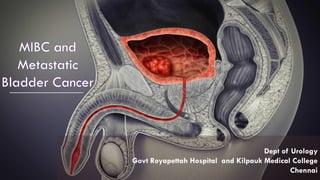
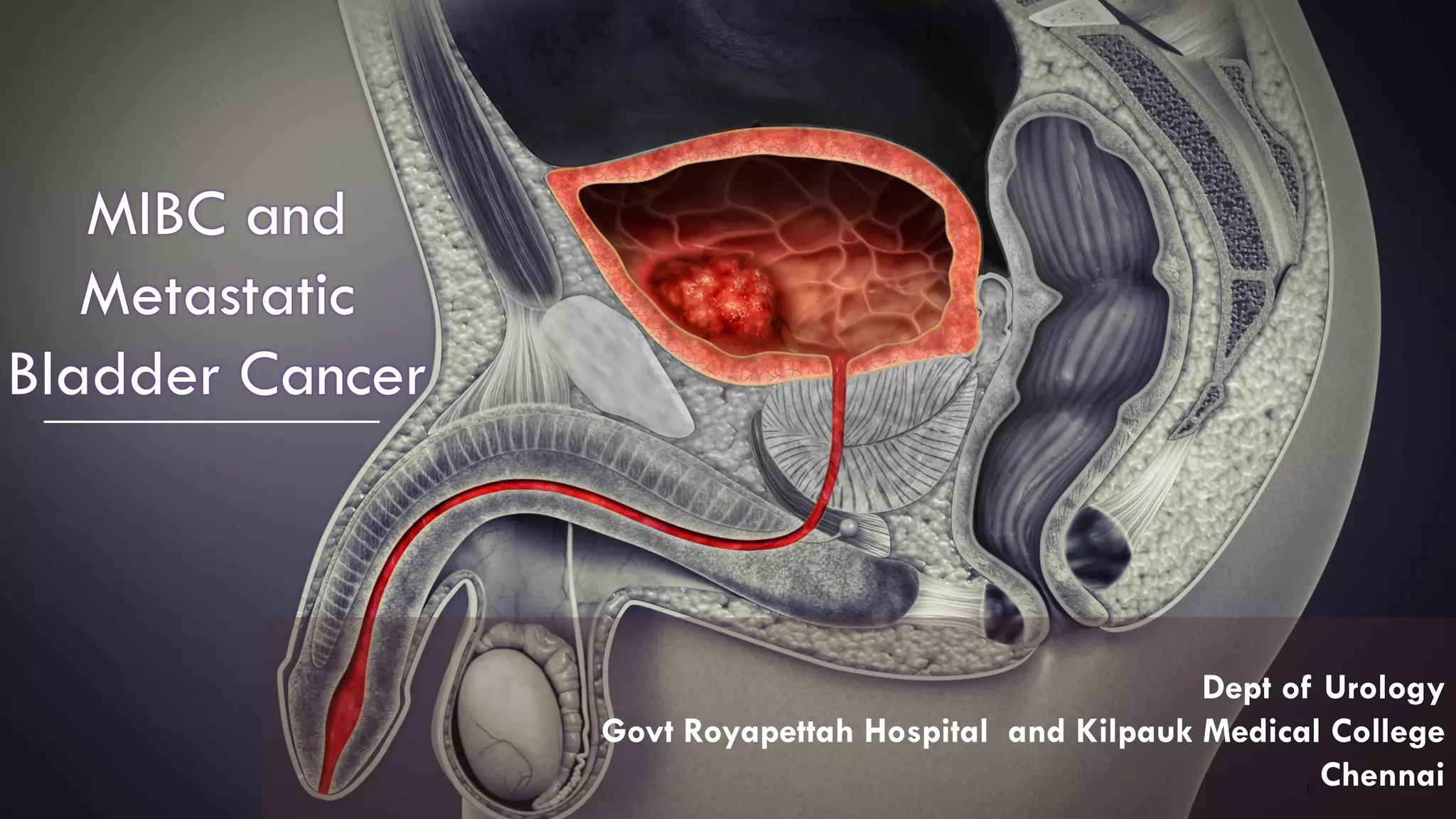
MIBC and
Metastatic
Bladder Cancer
Dept of Urology
Govt Royapettah Hospital and Kilpauk Medical College
Chennai
1
MODERATORS:
Professors:
Prof. Dr. G. Sivasankar, M.S., M.Ch.,
Prof. Dr. A. Senthilvel, M.S., M.Ch.,
Asst Professors:
Dr. J. Sivabalan, M.S., M.Ch.,
Dr. R. Bhargavi, M.S., M.Ch.,
Dr. S. Raju, M.S., M.Ch.,
Dr. K. Muthurathinam, M.S., M.Ch.,
Dr. D. Tamilselvan, M.S., M.Ch.,
Dr. K. Senthilkumar, M.S., M.Ch.
DEPT OF UROLOGY, GRH AND KMC, CHENNAI. 2
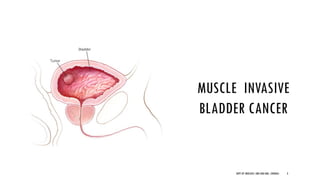
MUSCLE INVASIVE
BLADDER CANCER
3
DEPT OF UROLOGY, GRH AND KMC, CHENNAI.
Percentage of patients
presenting with muscle
invasive bladder cancer at
initial presentation.
20%
TO
30%
4
DEPT OF UROLOGY, GRH AND KMC, CHENNAI.
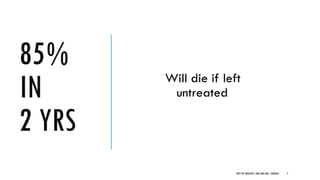
Will die if left
untreated
85%
IN
2 YRS
5
DEPT OF UROLOGY, GRH AND KMC, CHENNAI.
HOW WE COME ACROSS THE PATIENT?
1. Patient undergoes TURBT for bladder growth, report shows muscle invasion.
2. Patient undergoes ReTURBT with no evidence on muscle invasion in the first biopsy,
repeat biopsy shows evidence of muscle invasion.
3. Patient comes with a large bladder mass, with obvious radiographic evidence of
muscle invasion in the form of perivesical fat stranding, extravesical mass, infiltration
into nearby structures.
4. Patient is a known case of TCC bladder, underwent TURBT and is on regular
cystoscopic followup. During a followup cystoscopy, a growth was found, and the
biopsy shows evidence of muscle invasion.
6
DEPT OF UROLOGY, GRH AND KMC, CHENNAI.
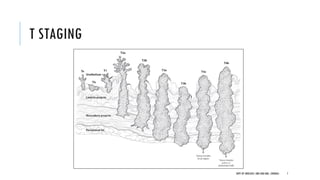
T STAGING
7
DEPT OF UROLOGY, GRH AND KMC, CHENNAI.
DIVERTICULUM
THERE IS NO T2
8
DEPT OF UROLOGY, GRH AND KMC, CHENNAI.
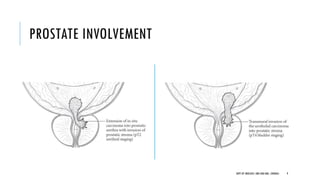
PROSTATE INVOLVEMENT
9
DEPT OF UROLOGY, GRH AND KMC, CHENNAI.
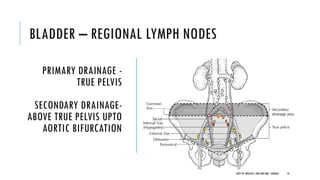
BLADDER – REGIONAL LYMPH NODES
PRIMARY DRAINAGE -
TRUE PELVIS
SECONDARY DRAINAGE-
ABOVE TRUE PELVIS UPTO
AORTIC BIFURCATION
10
DEPT OF UROLOGY, GRH AND KMC, CHENNAI.
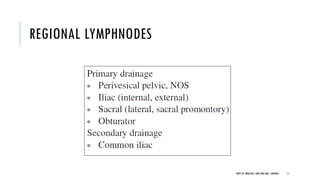
REGIONAL LYMPHNODES
11
DEPT OF UROLOGY, GRH AND KMC, CHENNAI.
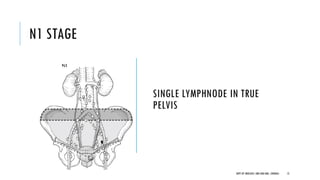
N1 STAGE
SINGLE LYMPHNODE IN TRUE
PELVIS
12
DEPT OF UROLOGY, GRH AND KMC, CHENNAI.
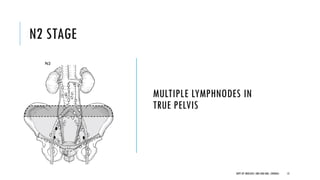
N2 STAGE
MULTIPLE LYMPHNODES IN
TRUE PELVIS
13
DEPT OF UROLOGY, GRH AND KMC, CHENNAI.
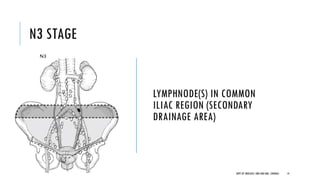
N3 STAGE
LYMPHNODE(S) IN COMMON
ILIAC REGION (SECONDARY
DRAINAGE AREA)
14
DEPT OF UROLOGY, GRH AND KMC, CHENNAI.
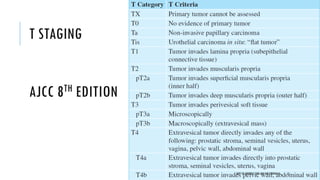
T STAGING
AJCC 8TH EDITION
15
DEPT OF UROLOGY, GRH AND KMC, CHENNAI.
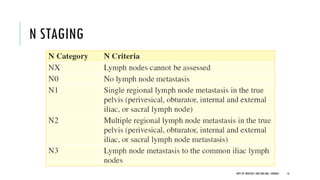
N STAGING
16
DEPT OF UROLOGY, GRH AND KMC, CHENNAI.
DISTANT METASTASIS
17
DEPT OF UROLOGY, GRH AND KMC, CHENNAI.
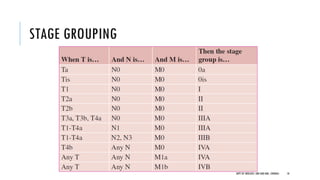
STAGE GROUPING
18
DEPT OF UROLOGY, GRH AND KMC, CHENNAI.
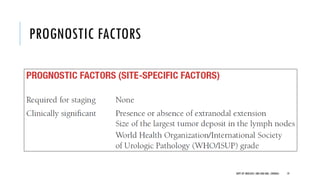
PROGNOSTIC FACTORS
19
DEPT OF UROLOGY, GRH AND KMC, CHENNAI.
CLINICAL STAGING
1. Transurethral resection specimen
2. Bimanual examination of the patient under anaesthesia
3. Liver function tests
4. Chest radiography
5. Contrast enhanced cross sectional imaging
20
DEPT OF UROLOGY, GRH AND KMC, CHENNAI.
BIMANUAL EXAMINATION UNDER ANAESTHESIA
Place dominant hand on the suprapubic region and one or two fingers of the non
dominant hand in the rectum (in males) and vagina (in females).
Done before and after resection.
Finding (Marshall)
T2a – Non palpable
T2b- Induration but no three dimensional mass
T3a- Three dimensional mobile mass
T4a- Invading adjacent structures
T4b- Fixed to pelvic sidewall and not mobile
21
DEPT OF UROLOGY, GRH AND KMC, CHENNAI.
Do CECT abdomen and
pelvis in all cases
before TURBT???
NO
22
DEPT OF UROLOGY, GRH AND KMC, CHENNAI.
Biopsy shows muscle
invasion now…
What next?
OK, NOT
DONE
BUT…
23
DEPT OF UROLOGY, GRH AND KMC, CHENNAI.
Do contrast study 7 days after TURBT.
To avoid overstaging as T3.
24
DEPT OF UROLOGY, GRH AND KMC, CHENNAI.
T2-4A, N0 M0
Radical Cystectomy
With
Bilateral pelvic lymph node
dissection
25
DEPT OF UROLOGY, GRH AND KMC, CHENNAI.
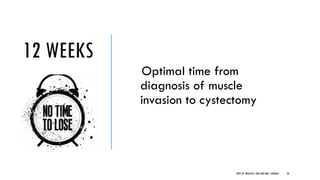
Optimal time from
diagnosis of muscle
invasion to cystectomy
12 WEEKS
26
DEPT OF UROLOGY, GRH AND KMC, CHENNAI.
RADICAL CYSTECTOMY
In men,
Removal of:
Bladder with surrounding perivesical soft
tissue
Prostate
Seminal vesicles
In Women,
Removal of:
Bladder with surrounding perivesical soft
tissue
Uterus with cervix
Ovaries
Anterior vagina
27
DEPT OF UROLOGY, GRH AND KMC, CHENNAI.
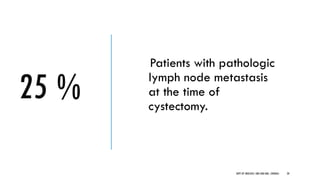
Patients with pathologic
lymph node metastasis
at the time of
cystectomy.
25 %
28
DEPT OF UROLOGY, GRH AND KMC, CHENNAI.
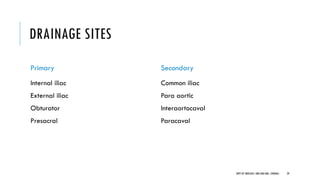
DRAINAGE SITES
Primary
Internal iliac
External iliac
Obturator
Presacral
Secondary
Common iliac
Para aortic
Interaortocaval
Paracaval
29
DEPT OF UROLOGY, GRH AND KMC, CHENNAI.
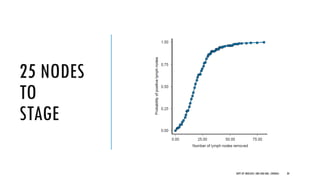
25 NODES
TO
STAGE
30
DEPT OF UROLOGY, GRH AND KMC, CHENNAI.
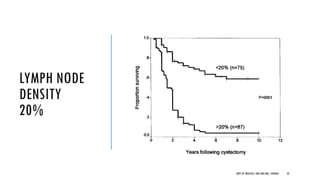
LYMPH NODE DENSITY
Percentage of positive nodes relative to the total number of nodes removed.
<20 % is good prognosis. (Herr et al 2003)
31
DEPT OF UROLOGY, GRH AND KMC, CHENNAI.
LYMPH NODE
DENSITY
20%
32
DEPT OF UROLOGY, GRH AND KMC, CHENNAI.
PELVIC LYMPHADENECTOMY
1. Standard template pelvic lymphadenectomy
2. Extended pelvic lymphadenectomy
3. Dissection upto inferior mesenteric artery origin
33
DEPT OF UROLOGY, GRH AND KMC, CHENNAI.
STANDARD TEMPLATE PELVIC LYMPHADENECTOMY
Laterally – Genitofemoral nerve
Medially – Internal iliac artery
Superiorly- Point at which the ureter
crosses the common iliac artery
Inferiorly- Cooper’s ligament
34
DEPT OF UROLOGY, GRH AND KMC, CHENNAI.
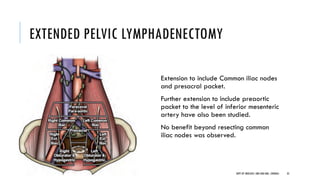
EXTENDED PELVIC LYMPHADENECTOMY
Extension to include Common iliac nodes
and presacral packet.
Further extension to include preaortic
packet to the level of inferior mesenteric
artery have also been studied.
No benefit beyond resecting common
iliac nodes was observed.
35
DEPT OF UROLOGY, GRH AND KMC, CHENNAI.
INTRA OPERATIVE
DECISION
MAKING
36
DEPT OF UROLOGY, GRH AND KMC, CHENNAI.
DON’T PERFORM CYSTECTOMY, WHEN..
1. Unresectable bulky lymphnode metastasis
2. Extensive periureteral disease
3. Bladder fixed to pelvic side wall
4. Tumour is invading rectosigmoid colon.
37
DEPT OF UROLOGY, GRH AND KMC, CHENNAI.
NEGATIVE URETERIC MARGIN?
Intra operative frozen analysis remains controversial.
12.7 % - Positive margin rate.
Ureter margin status- independent predictor of upper tract recurrence after
cystectomy.
Hence, attempt to clear the distal ureter of tumour when feasible at the time of
radical cystectomy.
38
DEPT OF UROLOGY, GRH AND KMC, CHENNAI.
URETHRECTOMY IN MEN, IF..
Do transurethral prostatic biopsy before cystectomy,
Consider urethrectomy, if..
Diffuse CIS of the prostatic urethra or ducts is present.
Prostatic stromal invasion is present.
39
DEPT OF UROLOGY, GRH AND KMC, CHENNAI.
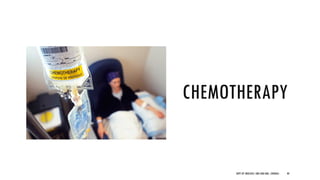
CHEMOTHERAPY
40
DEPT OF UROLOGY, GRH AND KMC, CHENNAI.
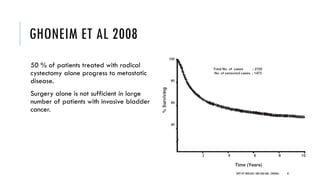
GHONEIM ET AL 2008
50 % of patients treated with radical
cystectomy alone progress to metastatic
disease.
Surgery alone is not sufficient in large
number of patients with invasive bladder
cancer.
41
DEPT OF UROLOGY, GRH AND KMC, CHENNAI.
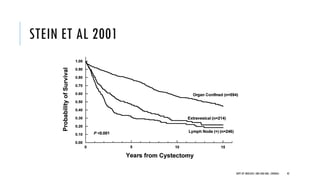
STEIN ET AL 2001
42
DEPT OF UROLOGY, GRH AND KMC, CHENNAI.
NEO ADJUVANT CHEMO - ADVANTAGES
1. Chemotherapy is delivered at the earliest time point, when the burden of
micrometastatic disease is expected to be low;
2. in vivo chemo-sensitivity is tested; and
3. tolerability of chemotherapy is expected to be better before than after
cystectomy
43
DEPT OF UROLOGY, GRH AND KMC, CHENNAI.
NEO ADJUVANT CHEMO - DISADVANTAGES
1. Errors in staging may lead to overtreatment
2. delayed cystectomy, compromising outcome in patients not sensitive to
chemotherapy and
3. side effects of chemotherapy affecting the outcome of surgery and type of urinary
diversion
44
DEPT OF UROLOGY, GRH AND KMC, CHENNAI.
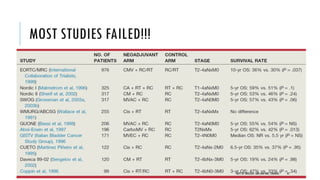
MOST STUDIES FAILED!!!
45
DEPT OF UROLOGY, GRH AND KMC, CHENNAI.
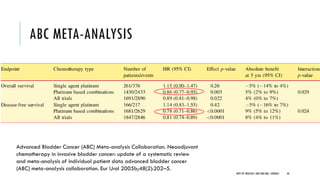
ABC META-ANALYSIS
Advanced Bladder Cancer (ABC) Meta-analysis Collaboration. Neoadjuvant
chemotherapy in invasive bladder cancer: update of a systematic review
and meta-analysis of individual patient data advanced bladder cancer
(ABC) meta-analysis collaboration. Eur Urol 2005b;48(2):202–5.
46
DEPT OF UROLOGY, GRH AND KMC, CHENNAI.
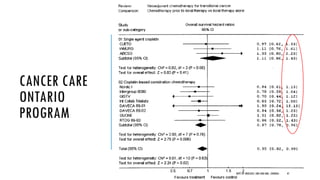
CANCER CARE
ONTARIO
PROGRAM
47
DEPT OF UROLOGY, GRH AND KMC, CHENNAI.
STATISTICIANS
OR
MAGICIANS??
48
DEPT OF UROLOGY, GRH AND KMC, CHENNAI.
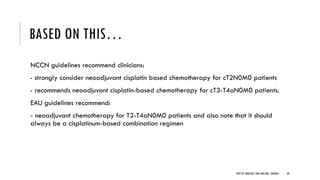
BASED ON THIS…
NCCN guidelines recommend clinicians:
- strongly consider neoadjuvant cisplatin based chemotherapy for cT2N0M0 patients
- recommends neoadjuvant cisplatin-based chemotherapy for cT3-T4aN0M0 patients.
EAU guidelines recommend:
- neoadjuvant chemotherapy for T2-T4aN0M0 patients and also note that it should
always be a cisplatinum-based combination regimen
49
DEPT OF UROLOGY, GRH AND KMC, CHENNAI.
REMEMBER?? STEIN ET AL 2001
50
DEPT OF UROLOGY, GRH AND KMC, CHENNAI.
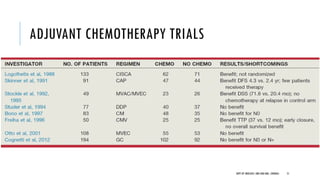
ADJUVANT CHEMOTHERAPY TRIALS
51
DEPT OF UROLOGY, GRH AND KMC, CHENNAI.
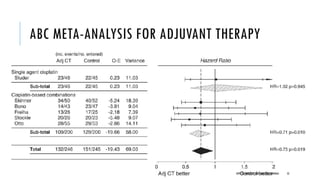
ABC META-ANALYSIS FOR ADJUVANT THERAPY
52
DEPT OF UROLOGY, GRH AND KMC, CHENNAI.
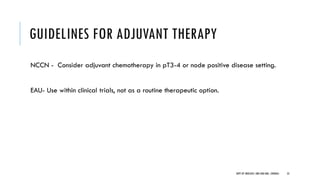
GUIDELINES FOR ADJUVANT THERAPY
NCCN - Consider adjuvant chemotherapy in pT3-4 or node positive disease setting.
EAU- Use within clinical trials, not as a routine therapeutic option.
53
DEPT OF UROLOGY, GRH AND KMC, CHENNAI.
ADJUVANT CHEMORADIATION
20% - 40% of pT3 and pT4 patients have pelvic failures at 5 years.
Perioperative chemotherapy does not significantly improve the risk.
After pelvic failure, median survival is just 9 months.
Hence, radiation therapy was tried to reduce pelvic failure risk in pT3-4 lesions with
negative margins.
54
DEPT OF UROLOGY, GRH AND KMC, CHENNAI.
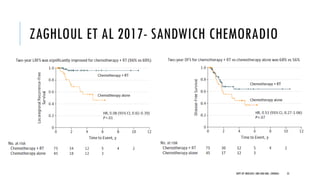
ZAGHLOUL ET AL 2017- SANDWICH CHEMORADIO
55
DEPT OF UROLOGY, GRH AND KMC, CHENNAI.
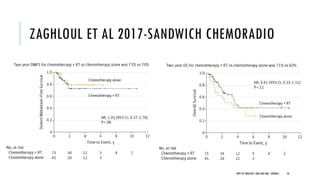
ZAGHLOUL ET AL 2017-SANDWICH CHEMORADIO
56
DEPT OF UROLOGY, GRH AND KMC, CHENNAI.
WHEN ADJUVANT RADIATION?
Substantially increase risk of postoperative small bowel obstruction.
Should be cautiously used.
Strongest case: Positive surgical margins noted after radical cystectomy.
Ongoing studies in:
pT3-4
Less than 10 nodes identified
N+ disease.
57
DEPT OF UROLOGY, GRH AND KMC, CHENNAI.
Percentage of pT0 in cystectomy specimens
of MIBC cancers.
In other words, all cancer tissue was
removed in the TURBT itself.
10%
58
DEPT OF UROLOGY, GRH AND KMC, CHENNAI.
BLADDER PRESERVATION IN MIBC
High incidence of perioperative complications
Classically older population with multiple medical comorbidities
Goal: Curative with functionally intact bladder.
Multimodality therapy:
1. Radical TUR
2. Chemotherapy
3. Systemic radiotherapy
59
DEPT OF UROLOGY, GRH AND KMC, CHENNAI.
ELIGIBLE CANDIDATES
1. Refusing for cystectomy
2. Medically unfit for cystectomy
3. Highly selected medically fit patients
60
DEPT OF UROLOGY, GRH AND KMC, CHENNAI.
AVOID BLADDER PRESERVATION IN…
1. Hydronephrosis
2. Obvious T3 disease on imaging
3. Presence of CIS
4. Multifocal tumours and / or
5. Incomplete macroscopic tumor resection
61
DEPT OF UROLOGY, GRH AND KMC, CHENNAI.
MEDICALLY FIT PATIENT SELECTION CRITERIA
1. Limited burden of disease (< 4 cm in maximal dimension, unifocal, not cT3b)
2. No hydronephrosis
3. Can be grossly resectable by TUR
4. Adequate bladder function
5. No CIS
6. Highly motivated patient
62
DEPT OF UROLOGY, GRH AND KMC, CHENNAI.
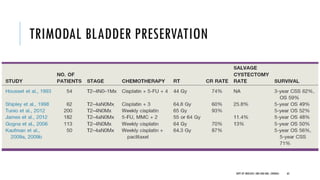
TRIMODAL BLADDER PRESERVATION
63
DEPT OF UROLOGY, GRH AND KMC, CHENNAI.
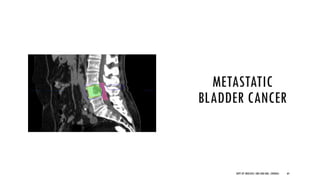
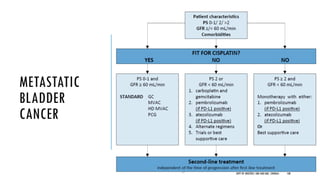
METASTATIC
BLADDER CANCER
64
DEPT OF UROLOGY, GRH AND KMC, CHENNAI.
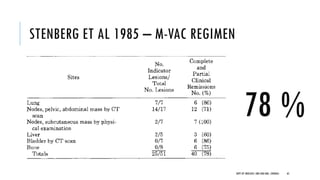
STENBERG ET AL 1985 – M-VAC REGIMEN
78 %
65
DEPT OF UROLOGY, GRH AND KMC, CHENNAI.
METASTATIC BLADDER CANCER
Systemic cisplatin-based combination chemotherapy is the standard of care.
First line regimens: MVAC, HD-MVAC and gemcitabine/cisplatin.
Median survival after chemotherapy 14 months.
66
DEPT OF UROLOGY, GRH AND KMC, CHENNAI.
NON-CISPLATIN CANDIDATES CRITERIA
1. ECOG performance status >2
2. Creatinine clearance <60 ml/min
3. Grade 2 or above of audiometric hearing loss
4. Grade 2 or above of peripheral neuropathy
5. Newyork heart association Class III or higher heart failure
67
DEPT OF UROLOGY, GRH AND KMC, CHENNAI.
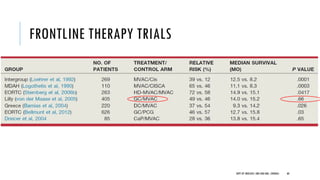
FRONTLINE THERAPY TRIALS
68
DEPT OF UROLOGY, GRH AND KMC, CHENNAI.
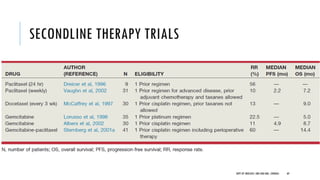
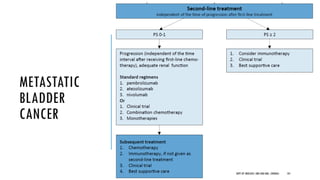
SECONDLINE THERAPY TRIALS
69
DEPT OF UROLOGY, GRH AND KMC, CHENNAI.
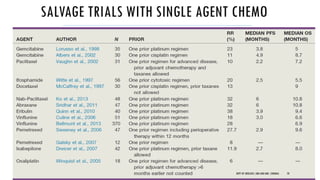
SALVAGE TRIALS WITH SINGLE AGENT CHEMO
70
DEPT OF UROLOGY, GRH AND KMC, CHENNAI.
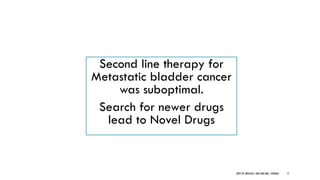
Second line therapy for
Metastatic bladder cancer
was suboptimal.
Search for newer drugs
lead to Novel Drugs
71
DEPT OF UROLOGY, GRH AND KMC, CHENNAI.
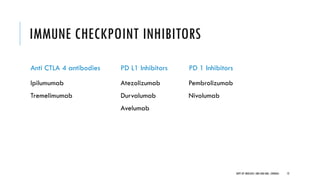
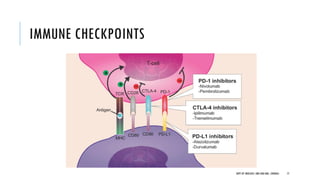
IMMUNE CHECKPOINT INHIBITORS
Anti CTLA 4 antibodies
Ipilumumab
Tremelimumab
PD L1 Inhibitors
Atezolizumab
Durvalumab
Avelumab
PD 1 Inhibitors
Pembrolizumab
Nivolumab
72
DEPT OF UROLOGY, GRH AND KMC, CHENNAI.
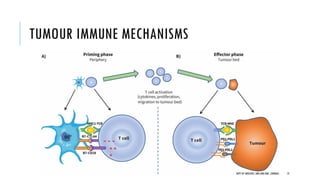
TUMOUR IMMUNE MECHANISMS
73
DEPT OF UROLOGY, GRH AND KMC, CHENNAI.
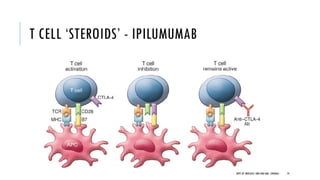
T CELL ‘STEROIDS’ - IPILUMUMAB
74
DEPT OF UROLOGY, GRH AND KMC, CHENNAI.
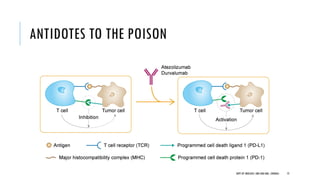
ANTIDOTES TO THE POISON
75
DEPT OF UROLOGY, GRH AND KMC, CHENNAI.
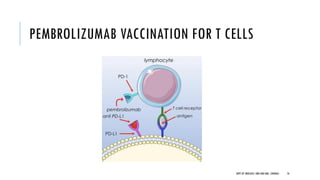
PEMBROLIZUMAB VACCINATION FOR T CELLS
76
DEPT OF UROLOGY, GRH AND KMC, CHENNAI.
IMMUNE CHECKPOINTS
77
DEPT OF UROLOGY, GRH AND KMC, CHENNAI.
TRIALS AND DRUGS
IMVigor – Atezolizumab
KEYNOTE- Pembrolizumab
CheckMate- Nivolumab
JAVELIN - Avelumab
78
DEPT OF UROLOGY, GRH AND KMC, CHENNAI.
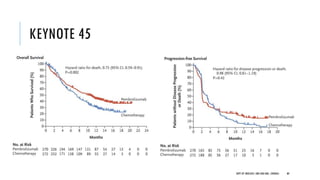
Aim:
- Comparison of Pembrolizumab with investigator’s choice
of chemotherapy with paclitaxel, docetaxel, or vinflunine
- as second-line therapy in patients with advanced
urothelial carcinoma that progressed during or after the
receipt of platinum-based chemotherapy.
KEYNOTE 45
79
DEPT OF UROLOGY, GRH AND KMC, CHENNAI.
KEYNOTE 45
80
DEPT OF UROLOGY, GRH AND KMC, CHENNAI.
PEMBROLIZUMAB
Based on this trial, FDA has given approval for the use of Pembrolizumab for:
Metastatic urothelial carcinoma previously treated with platinum-based
chemotherapy
81
DEPT OF UROLOGY, GRH AND KMC, CHENNAI.
FIRST LINE AGENTS IN CISPLATIN INELIGIBLE
PATIENTS
IMVigor210 – Atezolizumab
KEYNOTE 052 - Pembrolizumab
82
DEPT OF UROLOGY, GRH AND KMC, CHENNAI.
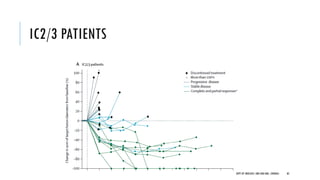
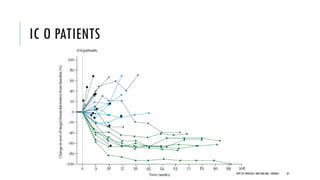
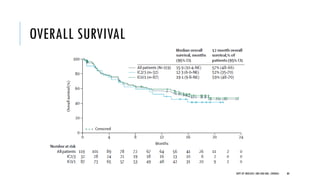
IMVIGOR 210- ATEZOLIZUMAB
Previously cisplatin untreated ineligible patients.
Patients received 1200 mg intravenous atezolizumab every 21 days until
unacceptable toxicity or investigator-assessed radiographic progression.
Progression of lesions were monitored using RECIST criteria for solid tumours.
83
DEPT OF UROLOGY, GRH AND KMC, CHENNAI.
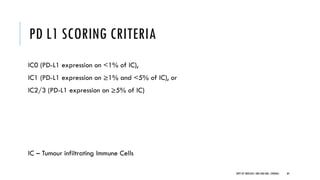
PD L1 SCORING CRITERIA
IC0 (PD-L1 expression on <1% of IC),
IC1 (PD-L1 expression on ≥1% and <5% of IC), or
IC2/3 (PD-L1 expression on ≥5% of IC)
IC – Tumour infiltrating Immune Cells
84
DEPT OF UROLOGY, GRH AND KMC, CHENNAI.
IC2/3 PATIENTS
85
DEPT OF UROLOGY, GRH AND KMC, CHENNAI.
IC 1 PATIENTS
86
DEPT OF UROLOGY, GRH AND KMC, CHENNAI.
IC O PATIENTS
87
DEPT OF UROLOGY, GRH AND KMC, CHENNAI.
OVERALL SURVIVAL
88
DEPT OF UROLOGY, GRH AND KMC, CHENNAI.
KEYNOTE 052
First-line pembrolizumab in cisplatin-ineligible patients with locally advanced and
unresectable or metastatic urothelial cancer.
Enrolled patients received intravenous pembrolizumab 200 mg every 3 weeks.
Response was evaluated using RECIST criteria for solid tumours.
89
DEPT OF UROLOGY, GRH AND KMC, CHENNAI.
KEYNOTE 052
90
DEPT OF UROLOGY, GRH AND KMC, CHENNAI.
CURRENT STATUS
Metastatic urothelial cancer in second line setting.
Atezolizumab,
Durvalumab,
Avelumab.
Metastatic urothelial cancer first line setting in Cisplatin ineligible candidates:
Atezolizumab
Pembrolizumab
91
DEPT OF UROLOGY, GRH AND KMC, CHENNAI.
GUIDELINES 2020
92
DEPT OF UROLOGY, GRH AND KMC, CHENNAI.
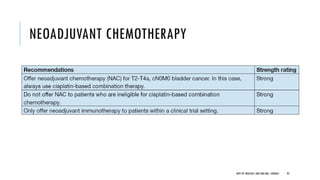
NEOADJUVANT CHEMOTHERAPY
93
DEPT OF UROLOGY, GRH AND KMC, CHENNAI.
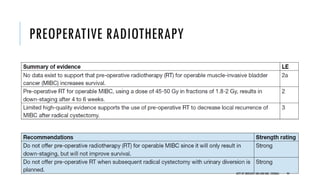
PREOPERATIVE RADIOTHERAPY
94
DEPT OF UROLOGY, GRH AND KMC, CHENNAI.
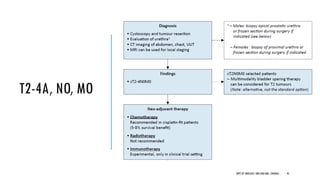
T2-4A, NO, MO
95
DEPT OF UROLOGY, GRH AND KMC, CHENNAI.
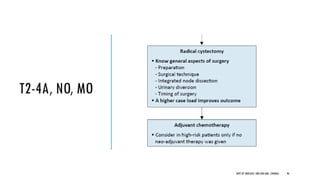
T2-4A, NO, MO
96
DEPT OF UROLOGY, GRH AND KMC, CHENNAI.
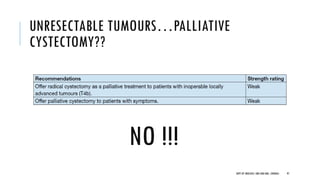
UNRESECTABLE TUMOURS…PALLIATIVE
CYSTECTOMY??
NO !!!
97
DEPT OF UROLOGY, GRH AND KMC, CHENNAI.
CLINICAL OR N+ DISEASE
98
DEPT OF UROLOGY, GRH AND KMC, CHENNAI.
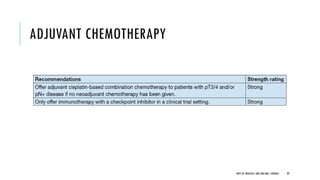
ADJUVANT CHEMOTHERAPY
99
DEPT OF UROLOGY, GRH AND KMC, CHENNAI.
METASTATIC
BLADDER
CANCER
100
DEPT OF UROLOGY, GRH AND KMC, CHENNAI.
METASTATIC
BLADDER
CANCER
101
DEPT OF UROLOGY, GRH AND KMC, CHENNAI.
102
DEPT OF UROLOGY, GRH AND KMC, CHENNAI.

MIBC & Metastatic Urinary Bladder carcinoma

  • 1.
    MIBC and Metastatic Bladder Cancer Deptof Urology Govt Royapettah Hospital and Kilpauk Medical College Chennai 1
  • 2.
    MODERATORS: Professors: Prof. Dr. G.Sivasankar, M.S., M.Ch., Prof. Dr. A. Senthilvel, M.S., M.Ch., Asst Professors: Dr. J. Sivabalan, M.S., M.Ch., Dr. R. Bhargavi, M.S., M.Ch., Dr. S. Raju, M.S., M.Ch., Dr. K. Muthurathinam, M.S., M.Ch., Dr. D. Tamilselvan, M.S., M.Ch., Dr. K. Senthilkumar, M.S., M.Ch. DEPT OF UROLOGY, GRH AND KMC, CHENNAI. 2
  • 3.
    MUSCLE INVASIVE BLADDER CANCER 3 DEPTOF UROLOGY, GRH AND KMC, CHENNAI.
  • 4.
    Percentage of patients presentingwith muscle invasive bladder cancer at initial presentation. 20% TO 30% 4 DEPT OF UROLOGY, GRH AND KMC, CHENNAI.
  • 5.
    Will die ifleft untreated 85% IN 2 YRS 5 DEPT OF UROLOGY, GRH AND KMC, CHENNAI.
  • 6.
    HOW WE COMEACROSS THE PATIENT? 1. Patient undergoes TURBT for bladder growth, report shows muscle invasion. 2. Patient undergoes ReTURBT with no evidence on muscle invasion in the first biopsy, repeat biopsy shows evidence of muscle invasion. 3. Patient comes with a large bladder mass, with obvious radiographic evidence of muscle invasion in the form of perivesical fat stranding, extravesical mass, infiltration into nearby structures. 4. Patient is a known case of TCC bladder, underwent TURBT and is on regular cystoscopic followup. During a followup cystoscopy, a growth was found, and the biopsy shows evidence of muscle invasion. 6 DEPT OF UROLOGY, GRH AND KMC, CHENNAI.
  • 7.
    T STAGING 7 DEPT OFUROLOGY, GRH AND KMC, CHENNAI.
  • 8.
    DIVERTICULUM THERE IS NOT2 8 DEPT OF UROLOGY, GRH AND KMC, CHENNAI.
  • 9.
    PROSTATE INVOLVEMENT 9 DEPT OFUROLOGY, GRH AND KMC, CHENNAI.
  • 10.
    BLADDER – REGIONALLYMPH NODES PRIMARY DRAINAGE - TRUE PELVIS SECONDARY DRAINAGE- ABOVE TRUE PELVIS UPTO AORTIC BIFURCATION 10 DEPT OF UROLOGY, GRH AND KMC, CHENNAI.
  • 11.
    REGIONAL LYMPHNODES 11 DEPT OFUROLOGY, GRH AND KMC, CHENNAI.
  • 12.
    N1 STAGE SINGLE LYMPHNODEIN TRUE PELVIS 12 DEPT OF UROLOGY, GRH AND KMC, CHENNAI.
  • 13.
    N2 STAGE MULTIPLE LYMPHNODESIN TRUE PELVIS 13 DEPT OF UROLOGY, GRH AND KMC, CHENNAI.
  • 14.
    N3 STAGE LYMPHNODE(S) INCOMMON ILIAC REGION (SECONDARY DRAINAGE AREA) 14 DEPT OF UROLOGY, GRH AND KMC, CHENNAI.
  • 15.
    T STAGING AJCC 8THEDITION 15 DEPT OF UROLOGY, GRH AND KMC, CHENNAI.
  • 16.
    N STAGING 16 DEPT OFUROLOGY, GRH AND KMC, CHENNAI.
  • 17.
    DISTANT METASTASIS 17 DEPT OFUROLOGY, GRH AND KMC, CHENNAI.
  • 18.
    STAGE GROUPING 18 DEPT OFUROLOGY, GRH AND KMC, CHENNAI.
  • 19.
    PROGNOSTIC FACTORS 19 DEPT OFUROLOGY, GRH AND KMC, CHENNAI.
  • 20.
    CLINICAL STAGING 1. Transurethralresection specimen 2. Bimanual examination of the patient under anaesthesia 3. Liver function tests 4. Chest radiography 5. Contrast enhanced cross sectional imaging 20 DEPT OF UROLOGY, GRH AND KMC, CHENNAI.
  • 21.
    BIMANUAL EXAMINATION UNDERANAESTHESIA Place dominant hand on the suprapubic region and one or two fingers of the non dominant hand in the rectum (in males) and vagina (in females). Done before and after resection. Finding (Marshall) T2a – Non palpable T2b- Induration but no three dimensional mass T3a- Three dimensional mobile mass T4a- Invading adjacent structures T4b- Fixed to pelvic sidewall and not mobile 21 DEPT OF UROLOGY, GRH AND KMC, CHENNAI.
  • 22.
    Do CECT abdomenand pelvis in all cases before TURBT??? NO 22 DEPT OF UROLOGY, GRH AND KMC, CHENNAI.
  • 23.
    Biopsy shows muscle invasionnow… What next? OK, NOT DONE BUT… 23 DEPT OF UROLOGY, GRH AND KMC, CHENNAI.
  • 24.
    Do contrast study7 days after TURBT. To avoid overstaging as T3. 24 DEPT OF UROLOGY, GRH AND KMC, CHENNAI.
  • 25.
    T2-4A, N0 M0 RadicalCystectomy With Bilateral pelvic lymph node dissection 25 DEPT OF UROLOGY, GRH AND KMC, CHENNAI.
  • 26.
    Optimal time from diagnosisof muscle invasion to cystectomy 12 WEEKS 26 DEPT OF UROLOGY, GRH AND KMC, CHENNAI.
  • 27.
    RADICAL CYSTECTOMY In men, Removalof: Bladder with surrounding perivesical soft tissue Prostate Seminal vesicles In Women, Removal of: Bladder with surrounding perivesical soft tissue Uterus with cervix Ovaries Anterior vagina 27 DEPT OF UROLOGY, GRH AND KMC, CHENNAI.
  • 28.
    Patients with pathologic lymphnode metastasis at the time of cystectomy. 25 % 28 DEPT OF UROLOGY, GRH AND KMC, CHENNAI.
  • 29.
    DRAINAGE SITES Primary Internal iliac Externaliliac Obturator Presacral Secondary Common iliac Para aortic Interaortocaval Paracaval 29 DEPT OF UROLOGY, GRH AND KMC, CHENNAI.
  • 30.
    25 NODES TO STAGE 30 DEPT OFUROLOGY, GRH AND KMC, CHENNAI.
  • 31.
    LYMPH NODE DENSITY Percentageof positive nodes relative to the total number of nodes removed. <20 % is good prognosis. (Herr et al 2003) 31 DEPT OF UROLOGY, GRH AND KMC, CHENNAI.
  • 32.
    LYMPH NODE DENSITY 20% 32 DEPT OFUROLOGY, GRH AND KMC, CHENNAI.
  • 33.
    PELVIC LYMPHADENECTOMY 1. Standardtemplate pelvic lymphadenectomy 2. Extended pelvic lymphadenectomy 3. Dissection upto inferior mesenteric artery origin 33 DEPT OF UROLOGY, GRH AND KMC, CHENNAI.
  • 34.
    STANDARD TEMPLATE PELVICLYMPHADENECTOMY Laterally – Genitofemoral nerve Medially – Internal iliac artery Superiorly- Point at which the ureter crosses the common iliac artery Inferiorly- Cooper’s ligament 34 DEPT OF UROLOGY, GRH AND KMC, CHENNAI.
  • 35.
    EXTENDED PELVIC LYMPHADENECTOMY Extensionto include Common iliac nodes and presacral packet. Further extension to include preaortic packet to the level of inferior mesenteric artery have also been studied. No benefit beyond resecting common iliac nodes was observed. 35 DEPT OF UROLOGY, GRH AND KMC, CHENNAI.
  • 36.
    INTRA OPERATIVE DECISION MAKING 36 DEPT OFUROLOGY, GRH AND KMC, CHENNAI.
  • 37.
    DON’T PERFORM CYSTECTOMY,WHEN.. 1. Unresectable bulky lymphnode metastasis 2. Extensive periureteral disease 3. Bladder fixed to pelvic side wall 4. Tumour is invading rectosigmoid colon. 37 DEPT OF UROLOGY, GRH AND KMC, CHENNAI.
  • 38.
    NEGATIVE URETERIC MARGIN? Intraoperative frozen analysis remains controversial. 12.7 % - Positive margin rate. Ureter margin status- independent predictor of upper tract recurrence after cystectomy. Hence, attempt to clear the distal ureter of tumour when feasible at the time of radical cystectomy. 38 DEPT OF UROLOGY, GRH AND KMC, CHENNAI.
  • 39.
    URETHRECTOMY IN MEN,IF.. Do transurethral prostatic biopsy before cystectomy, Consider urethrectomy, if.. Diffuse CIS of the prostatic urethra or ducts is present. Prostatic stromal invasion is present. 39 DEPT OF UROLOGY, GRH AND KMC, CHENNAI.
  • 40.
    CHEMOTHERAPY 40 DEPT OF UROLOGY,GRH AND KMC, CHENNAI.
  • 41.
    GHONEIM ET AL2008 50 % of patients treated with radical cystectomy alone progress to metastatic disease. Surgery alone is not sufficient in large number of patients with invasive bladder cancer. 41 DEPT OF UROLOGY, GRH AND KMC, CHENNAI.
  • 42.
    STEIN ET AL2001 42 DEPT OF UROLOGY, GRH AND KMC, CHENNAI.
  • 43.
    NEO ADJUVANT CHEMO- ADVANTAGES 1. Chemotherapy is delivered at the earliest time point, when the burden of micrometastatic disease is expected to be low; 2. in vivo chemo-sensitivity is tested; and 3. tolerability of chemotherapy is expected to be better before than after cystectomy 43 DEPT OF UROLOGY, GRH AND KMC, CHENNAI.
  • 44.
    NEO ADJUVANT CHEMO- DISADVANTAGES 1. Errors in staging may lead to overtreatment 2. delayed cystectomy, compromising outcome in patients not sensitive to chemotherapy and 3. side effects of chemotherapy affecting the outcome of surgery and type of urinary diversion 44 DEPT OF UROLOGY, GRH AND KMC, CHENNAI.
  • 45.
    MOST STUDIES FAILED!!! 45 DEPTOF UROLOGY, GRH AND KMC, CHENNAI.
  • 46.
    ABC META-ANALYSIS Advanced BladderCancer (ABC) Meta-analysis Collaboration. Neoadjuvant chemotherapy in invasive bladder cancer: update of a systematic review and meta-analysis of individual patient data advanced bladder cancer (ABC) meta-analysis collaboration. Eur Urol 2005b;48(2):202–5. 46 DEPT OF UROLOGY, GRH AND KMC, CHENNAI.
  • 47.
    CANCER CARE ONTARIO PROGRAM 47 DEPT OFUROLOGY, GRH AND KMC, CHENNAI.
  • 48.
  • 49.
    BASED ON THIS… NCCNguidelines recommend clinicians: - strongly consider neoadjuvant cisplatin based chemotherapy for cT2N0M0 patients - recommends neoadjuvant cisplatin-based chemotherapy for cT3-T4aN0M0 patients. EAU guidelines recommend: - neoadjuvant chemotherapy for T2-T4aN0M0 patients and also note that it should always be a cisplatinum-based combination regimen 49 DEPT OF UROLOGY, GRH AND KMC, CHENNAI.
  • 50.
    REMEMBER?? STEIN ETAL 2001 50 DEPT OF UROLOGY, GRH AND KMC, CHENNAI.
  • 51.
    ADJUVANT CHEMOTHERAPY TRIALS 51 DEPTOF UROLOGY, GRH AND KMC, CHENNAI.
  • 52.
    ABC META-ANALYSIS FORADJUVANT THERAPY 52 DEPT OF UROLOGY, GRH AND KMC, CHENNAI.
  • 53.
    GUIDELINES FOR ADJUVANTTHERAPY NCCN - Consider adjuvant chemotherapy in pT3-4 or node positive disease setting. EAU- Use within clinical trials, not as a routine therapeutic option. 53 DEPT OF UROLOGY, GRH AND KMC, CHENNAI.
  • 54.
    ADJUVANT CHEMORADIATION 20% -40% of pT3 and pT4 patients have pelvic failures at 5 years. Perioperative chemotherapy does not significantly improve the risk. After pelvic failure, median survival is just 9 months. Hence, radiation therapy was tried to reduce pelvic failure risk in pT3-4 lesions with negative margins. 54 DEPT OF UROLOGY, GRH AND KMC, CHENNAI.
  • 55.
    ZAGHLOUL ET AL2017- SANDWICH CHEMORADIO 55 DEPT OF UROLOGY, GRH AND KMC, CHENNAI.
  • 56.
    ZAGHLOUL ET AL2017-SANDWICH CHEMORADIO 56 DEPT OF UROLOGY, GRH AND KMC, CHENNAI.
  • 57.
    WHEN ADJUVANT RADIATION? Substantiallyincrease risk of postoperative small bowel obstruction. Should be cautiously used. Strongest case: Positive surgical margins noted after radical cystectomy. Ongoing studies in: pT3-4 Less than 10 nodes identified N+ disease. 57 DEPT OF UROLOGY, GRH AND KMC, CHENNAI.
  • 58.
    Percentage of pT0in cystectomy specimens of MIBC cancers. In other words, all cancer tissue was removed in the TURBT itself. 10% 58 DEPT OF UROLOGY, GRH AND KMC, CHENNAI.
  • 59.
    BLADDER PRESERVATION INMIBC High incidence of perioperative complications Classically older population with multiple medical comorbidities Goal: Curative with functionally intact bladder. Multimodality therapy: 1. Radical TUR 2. Chemotherapy 3. Systemic radiotherapy 59 DEPT OF UROLOGY, GRH AND KMC, CHENNAI.
  • 60.
    ELIGIBLE CANDIDATES 1. Refusingfor cystectomy 2. Medically unfit for cystectomy 3. Highly selected medically fit patients 60 DEPT OF UROLOGY, GRH AND KMC, CHENNAI.
  • 61.
    AVOID BLADDER PRESERVATIONIN… 1. Hydronephrosis 2. Obvious T3 disease on imaging 3. Presence of CIS 4. Multifocal tumours and / or 5. Incomplete macroscopic tumor resection 61 DEPT OF UROLOGY, GRH AND KMC, CHENNAI.
  • 62.
    MEDICALLY FIT PATIENTSELECTION CRITERIA 1. Limited burden of disease (< 4 cm in maximal dimension, unifocal, not cT3b) 2. No hydronephrosis 3. Can be grossly resectable by TUR 4. Adequate bladder function 5. No CIS 6. Highly motivated patient 62 DEPT OF UROLOGY, GRH AND KMC, CHENNAI.
  • 63.
    TRIMODAL BLADDER PRESERVATION 63 DEPTOF UROLOGY, GRH AND KMC, CHENNAI.
  • 64.
    METASTATIC BLADDER CANCER 64 DEPT OFUROLOGY, GRH AND KMC, CHENNAI.
  • 65.
    STENBERG ET AL1985 – M-VAC REGIMEN 78 % 65 DEPT OF UROLOGY, GRH AND KMC, CHENNAI.
  • 66.
    METASTATIC BLADDER CANCER Systemiccisplatin-based combination chemotherapy is the standard of care. First line regimens: MVAC, HD-MVAC and gemcitabine/cisplatin. Median survival after chemotherapy 14 months. 66 DEPT OF UROLOGY, GRH AND KMC, CHENNAI.
  • 67.
    NON-CISPLATIN CANDIDATES CRITERIA 1.ECOG performance status >2 2. Creatinine clearance <60 ml/min 3. Grade 2 or above of audiometric hearing loss 4. Grade 2 or above of peripheral neuropathy 5. Newyork heart association Class III or higher heart failure 67 DEPT OF UROLOGY, GRH AND KMC, CHENNAI.
  • 68.
    FRONTLINE THERAPY TRIALS 68 DEPTOF UROLOGY, GRH AND KMC, CHENNAI.
  • 69.
    SECONDLINE THERAPY TRIALS 69 DEPTOF UROLOGY, GRH AND KMC, CHENNAI.
  • 70.
    SALVAGE TRIALS WITHSINGLE AGENT CHEMO 70 DEPT OF UROLOGY, GRH AND KMC, CHENNAI.
  • 71.
    Second line therapyfor Metastatic bladder cancer was suboptimal. Search for newer drugs lead to Novel Drugs 71 DEPT OF UROLOGY, GRH AND KMC, CHENNAI.
  • 72.
    IMMUNE CHECKPOINT INHIBITORS AntiCTLA 4 antibodies Ipilumumab Tremelimumab PD L1 Inhibitors Atezolizumab Durvalumab Avelumab PD 1 Inhibitors Pembrolizumab Nivolumab 72 DEPT OF UROLOGY, GRH AND KMC, CHENNAI.
  • 73.
    TUMOUR IMMUNE MECHANISMS 73 DEPTOF UROLOGY, GRH AND KMC, CHENNAI.
  • 74.
    T CELL ‘STEROIDS’- IPILUMUMAB 74 DEPT OF UROLOGY, GRH AND KMC, CHENNAI.
  • 75.
    ANTIDOTES TO THEPOISON 75 DEPT OF UROLOGY, GRH AND KMC, CHENNAI.
  • 76.
    PEMBROLIZUMAB VACCINATION FORT CELLS 76 DEPT OF UROLOGY, GRH AND KMC, CHENNAI.
  • 77.
    IMMUNE CHECKPOINTS 77 DEPT OFUROLOGY, GRH AND KMC, CHENNAI.
  • 78.
    TRIALS AND DRUGS IMVigor– Atezolizumab KEYNOTE- Pembrolizumab CheckMate- Nivolumab JAVELIN - Avelumab 78 DEPT OF UROLOGY, GRH AND KMC, CHENNAI.
  • 79.
    Aim: - Comparison ofPembrolizumab with investigator’s choice of chemotherapy with paclitaxel, docetaxel, or vinflunine - as second-line therapy in patients with advanced urothelial carcinoma that progressed during or after the receipt of platinum-based chemotherapy. KEYNOTE 45 79 DEPT OF UROLOGY, GRH AND KMC, CHENNAI.
  • 80.
    KEYNOTE 45 80 DEPT OFUROLOGY, GRH AND KMC, CHENNAI.
  • 81.
    PEMBROLIZUMAB Based on thistrial, FDA has given approval for the use of Pembrolizumab for: Metastatic urothelial carcinoma previously treated with platinum-based chemotherapy 81 DEPT OF UROLOGY, GRH AND KMC, CHENNAI.
  • 82.
    FIRST LINE AGENTSIN CISPLATIN INELIGIBLE PATIENTS IMVigor210 – Atezolizumab KEYNOTE 052 - Pembrolizumab 82 DEPT OF UROLOGY, GRH AND KMC, CHENNAI.
  • 83.
    IMVIGOR 210- ATEZOLIZUMAB Previouslycisplatin untreated ineligible patients. Patients received 1200 mg intravenous atezolizumab every 21 days until unacceptable toxicity or investigator-assessed radiographic progression. Progression of lesions were monitored using RECIST criteria for solid tumours. 83 DEPT OF UROLOGY, GRH AND KMC, CHENNAI.
  • 84.
    PD L1 SCORINGCRITERIA IC0 (PD-L1 expression on <1% of IC), IC1 (PD-L1 expression on ≥1% and <5% of IC), or IC2/3 (PD-L1 expression on ≥5% of IC) IC – Tumour infiltrating Immune Cells 84 DEPT OF UROLOGY, GRH AND KMC, CHENNAI.
  • 85.
    IC2/3 PATIENTS 85 DEPT OFUROLOGY, GRH AND KMC, CHENNAI.
  • 86.
    IC 1 PATIENTS 86 DEPTOF UROLOGY, GRH AND KMC, CHENNAI.
  • 87.
    IC O PATIENTS 87 DEPTOF UROLOGY, GRH AND KMC, CHENNAI.
  • 88.
    OVERALL SURVIVAL 88 DEPT OFUROLOGY, GRH AND KMC, CHENNAI.
  • 89.
    KEYNOTE 052 First-line pembrolizumabin cisplatin-ineligible patients with locally advanced and unresectable or metastatic urothelial cancer. Enrolled patients received intravenous pembrolizumab 200 mg every 3 weeks. Response was evaluated using RECIST criteria for solid tumours. 89 DEPT OF UROLOGY, GRH AND KMC, CHENNAI.
  • 90.
    KEYNOTE 052 90 DEPT OFUROLOGY, GRH AND KMC, CHENNAI.
  • 91.
    CURRENT STATUS Metastatic urothelialcancer in second line setting. Atezolizumab, Durvalumab, Avelumab. Metastatic urothelial cancer first line setting in Cisplatin ineligible candidates: Atezolizumab Pembrolizumab 91 DEPT OF UROLOGY, GRH AND KMC, CHENNAI.
  • 92.
    GUIDELINES 2020 92 DEPT OFUROLOGY, GRH AND KMC, CHENNAI.
  • 93.
    NEOADJUVANT CHEMOTHERAPY 93 DEPT OFUROLOGY, GRH AND KMC, CHENNAI.
  • 94.
    PREOPERATIVE RADIOTHERAPY 94 DEPT OFUROLOGY, GRH AND KMC, CHENNAI.
  • 95.
    T2-4A, NO, MO 95 DEPTOF UROLOGY, GRH AND KMC, CHENNAI.
  • 96.
    T2-4A, NO, MO 96 DEPTOF UROLOGY, GRH AND KMC, CHENNAI.
  • 97.
  • 98.
    CLINICAL OR N+DISEASE 98 DEPT OF UROLOGY, GRH AND KMC, CHENNAI.
  • 99.
    ADJUVANT CHEMOTHERAPY 99 DEPT OFUROLOGY, GRH AND KMC, CHENNAI.
  • 100.
  • 101.
  • 102.
    102 DEPT OF UROLOGY,GRH AND KMC, CHENNAI.