Marwan Younis
German Aerospace Center (DLR)
Microwaves and Radar Institute
82230 Oberpfaffenhofen, Germany
e‐mail: marwan.younis@dlr.de / Web: www.dlr.de/HR
Synthetic Aperture Radar (SAR):
Principles and Applications
slide 2
German Aerospace Center Microwaves and Radar Institute
PART III
Theory: SAR Image Formation and
Image Properties
SAR Image Formation
z
y
x
Antenna
Azimuth
range
SAR Basic Principle
1) pulsed radar system
(PRF = Pulse Repetition Frequency)
2) two dimensional imaging
(range x azimuth)
3) range resolution
4) azimuth resolution
5) Radar system must be coherent!
Te
Lsa
2
a
a
d


2
o
r
p
c
B


antenna
> 100 Mbit/s kbit/s
SAR Data Flow
Transmitter
Receiver
Data
Recording
Range
compression
Azimuth
compression
Image
evaluation
Image
interpretation
SAR
raw data
SAR
image data
signal generator
Mixer
power
amplifier
low noise
amplifier
circulator
base band signal
I
Q
A
D
A
D
-90°
I/Q demodulator
Synthetic Aperture Radar (SAR)
ultra stable
oscillator
Coherent Measurement Principle
transmit
t (time)
Total time delay 1 = 1
o
2 . r
c
Coherent demodulation
Received echo signal 1
phase change 1
1
4.
. object
phase r



  
1
4.
. object
phase r



  
1

A
Imaginary Part
Real Part
Coherent Measurement Principle
transmit
Total time delay 2 = 2
o
2 . r
c
Coherent demodulation
2
4.
. object
phase r



  
2
4.
. object
phase r



  
phase change 2
t (time)
Received echo signal 2
2

A
Imaginary Part
Real Part
   
 



 



 t
f
j
A
t
f
A 0
0 2
exp
2
cos
complex representation:
 


 j
A exp
after demodulation:

A
amplitude:
2
A
intensity, power:

phase:
Every pixel of a complex SAR image consists of a real and an imaginary part,
i.e. it is a phasor and contains amplitude and phase information.
A
Phasor Representation of SAR Signal
4.
. object
r



  
phase information
Imaginary Part
Real Part
o


amplitude information backscattering coefficient
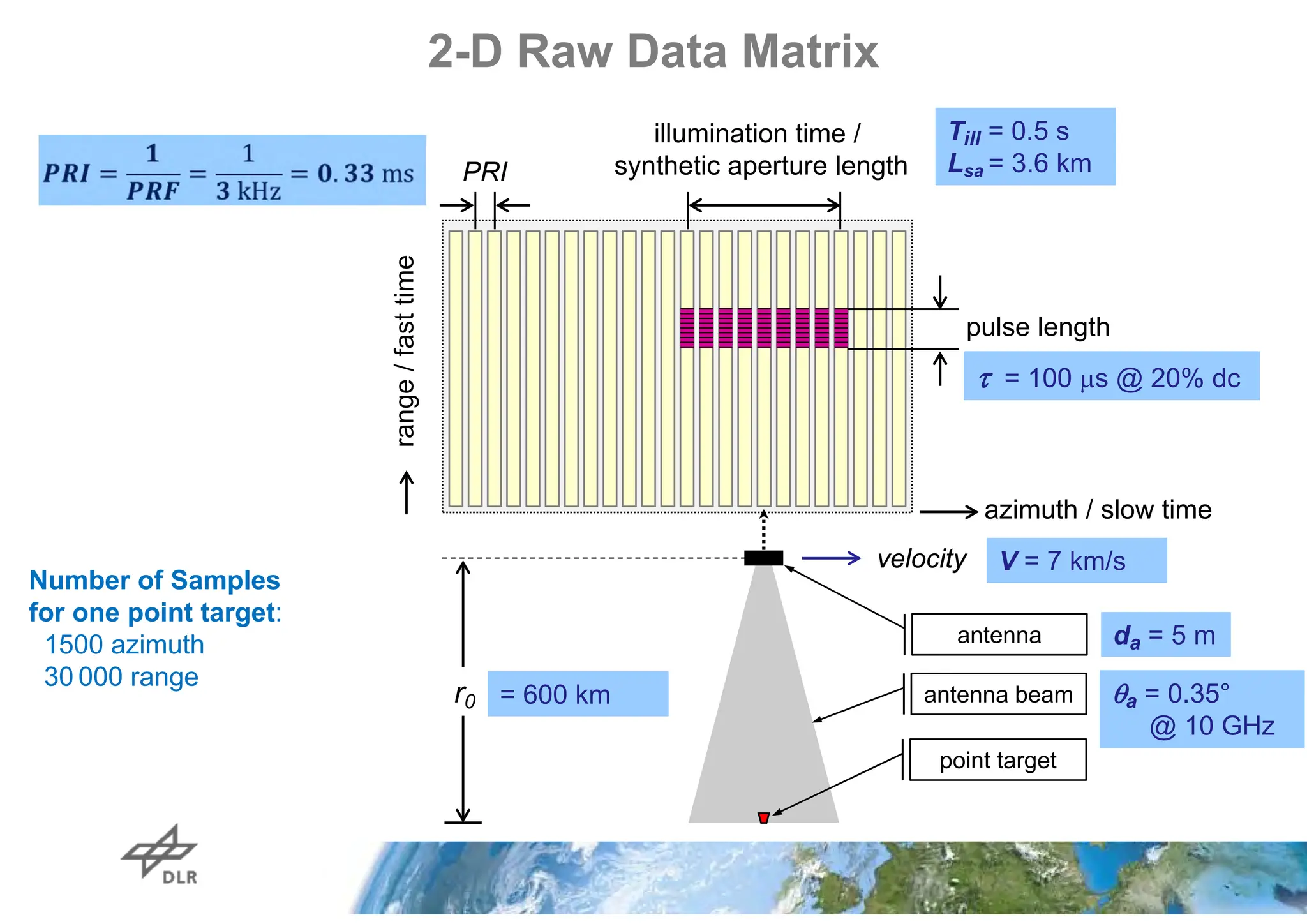
r0
velocity
point target
range
/
fast
time
antenna beam
antenna
azimuth / slow time
pulse length
illumination time /
synthetic aperture length
2-D Raw Data Matrix
PRI
Number of Samples
for one point target:
1500 azimuth
30 000 range
Till = 0.5 s
Lsa = 3.6 km
 = 100 s @ 20% dc
V = 7 km/s
da = 5 m
a = 0.35°
@ 10 GHz
= 600 km
Formation of Azimuth Chirp Signal
time
azimuth
azimuth
signal
Number of Samples
for one point target:
1500 azimuth
30 000 range
time delay t=t1
Synthetic Aperture Formation and Processing
Detection
convolution
SAR
processor
point target response resolution of synthetic aperture
coherent summation
12
point target
flight
direction
beamwidth
of real aperture
antenna
SAR
sensor
Detection convolution
SAR
processor
received azimuth signal
point target response resolution of synthetic aperture
phase
corrections
coherent summation
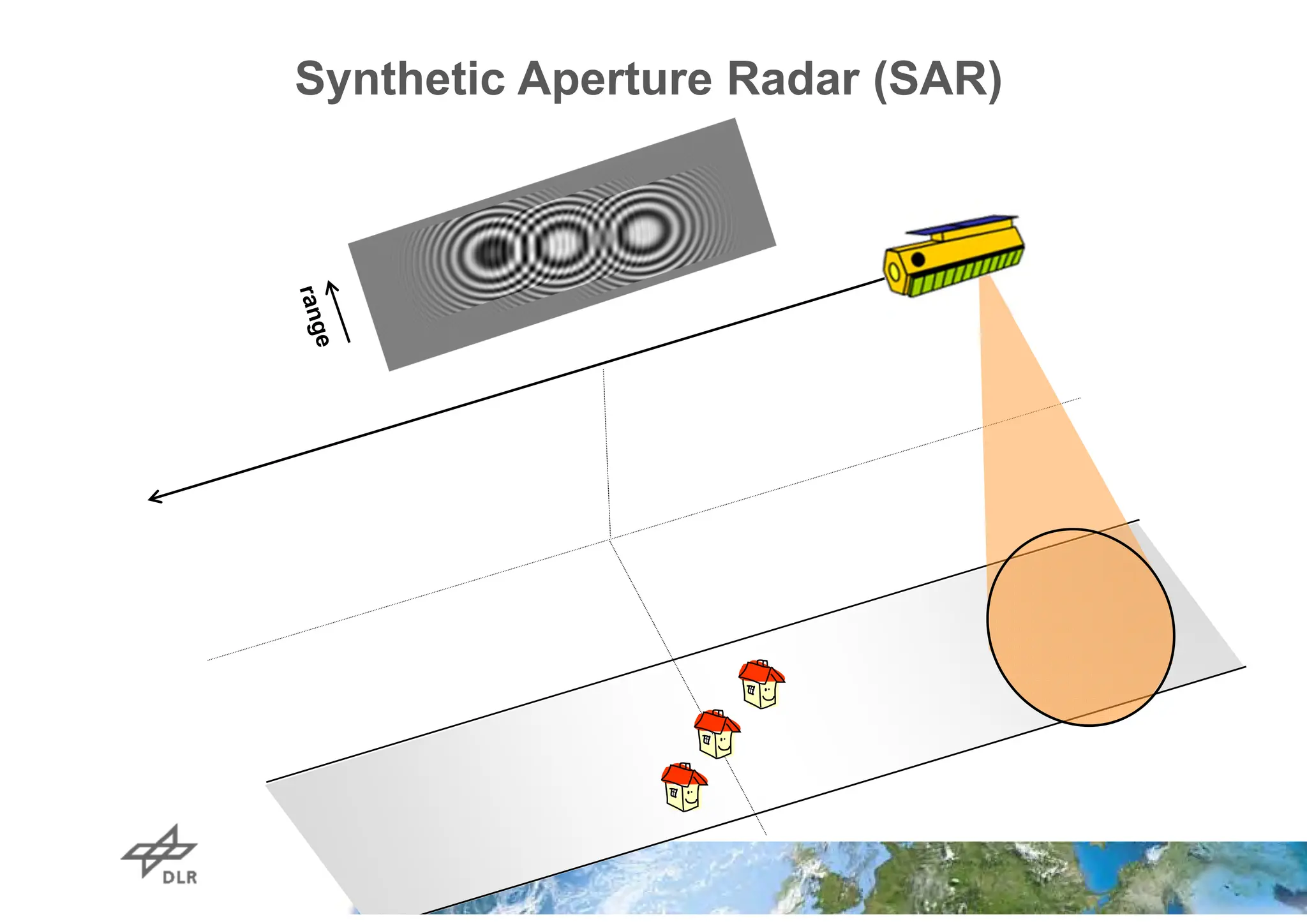
Synthetic Aperture Radar (SAR)
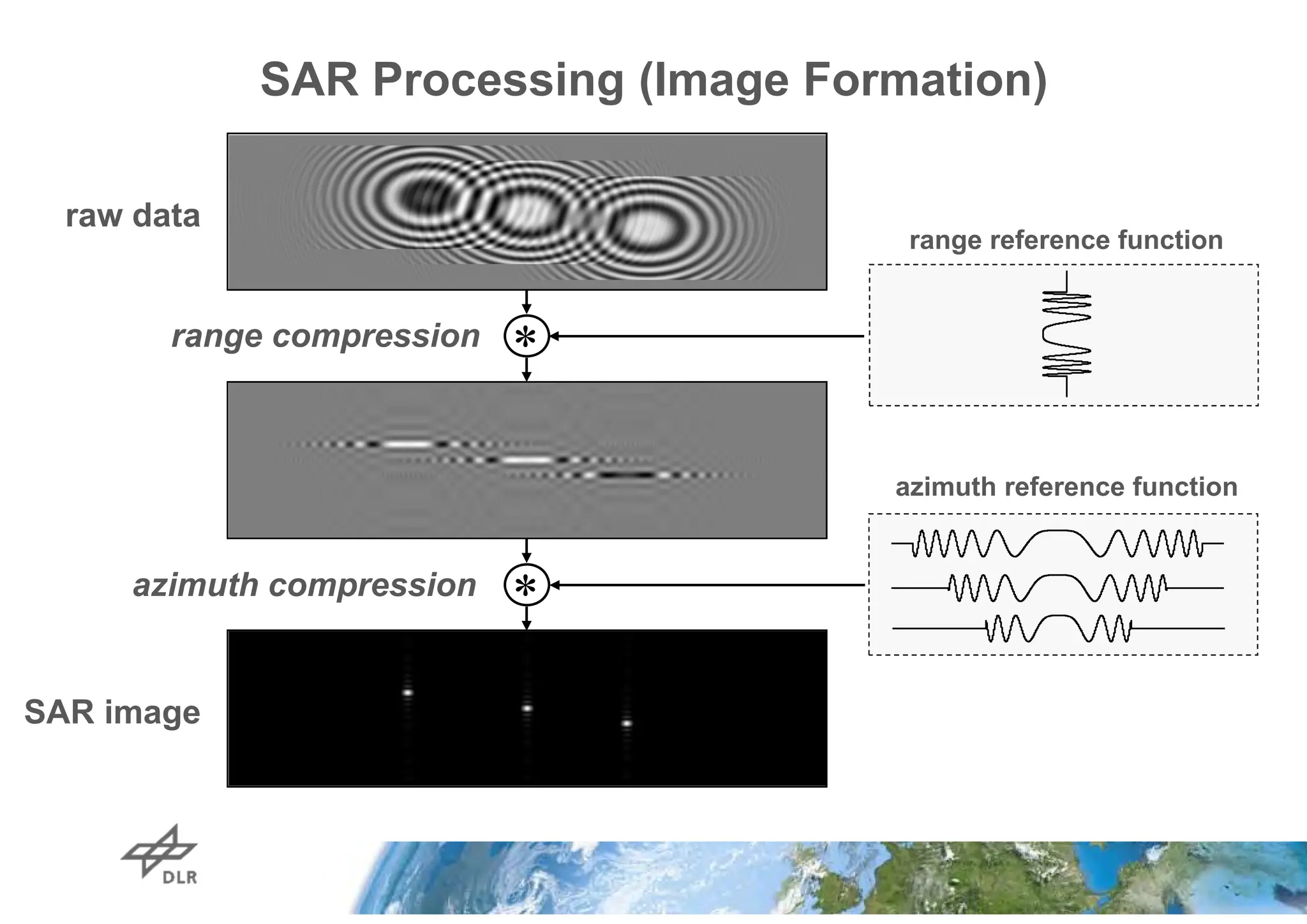
SAR Processing (Image Formation)


raw data
SAR image
range compression
azimuth compression
range reference function
azimuth reference function
Pulse Compression by Convolution
convolution
t
e

e
T
point target response
range
reference
function
range
SAR signal
t
t
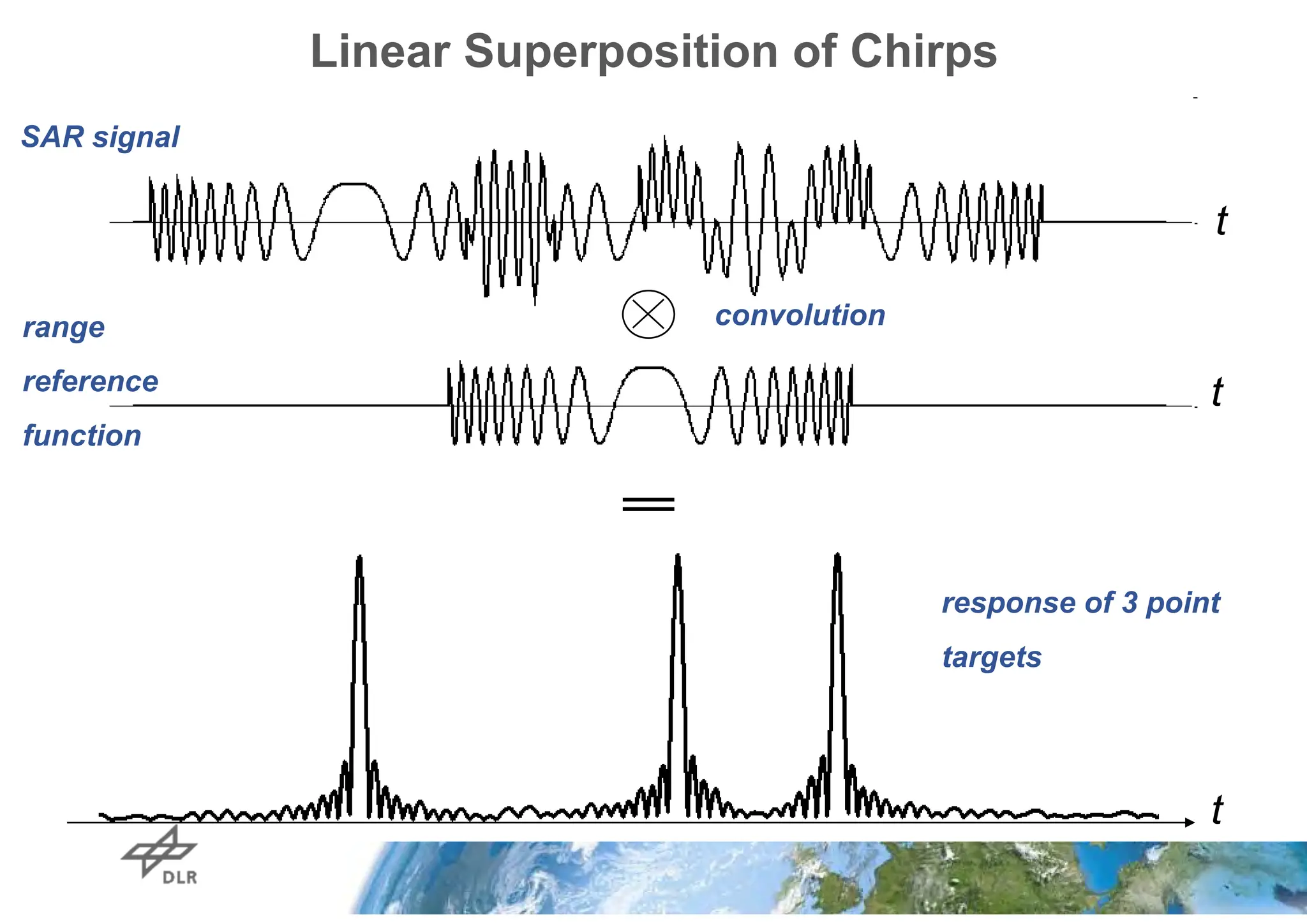
Linear Superposition of Chirps
convolution
t
t
t
range
reference
function
SAR signal
response of 3 point
targets
Folie 17
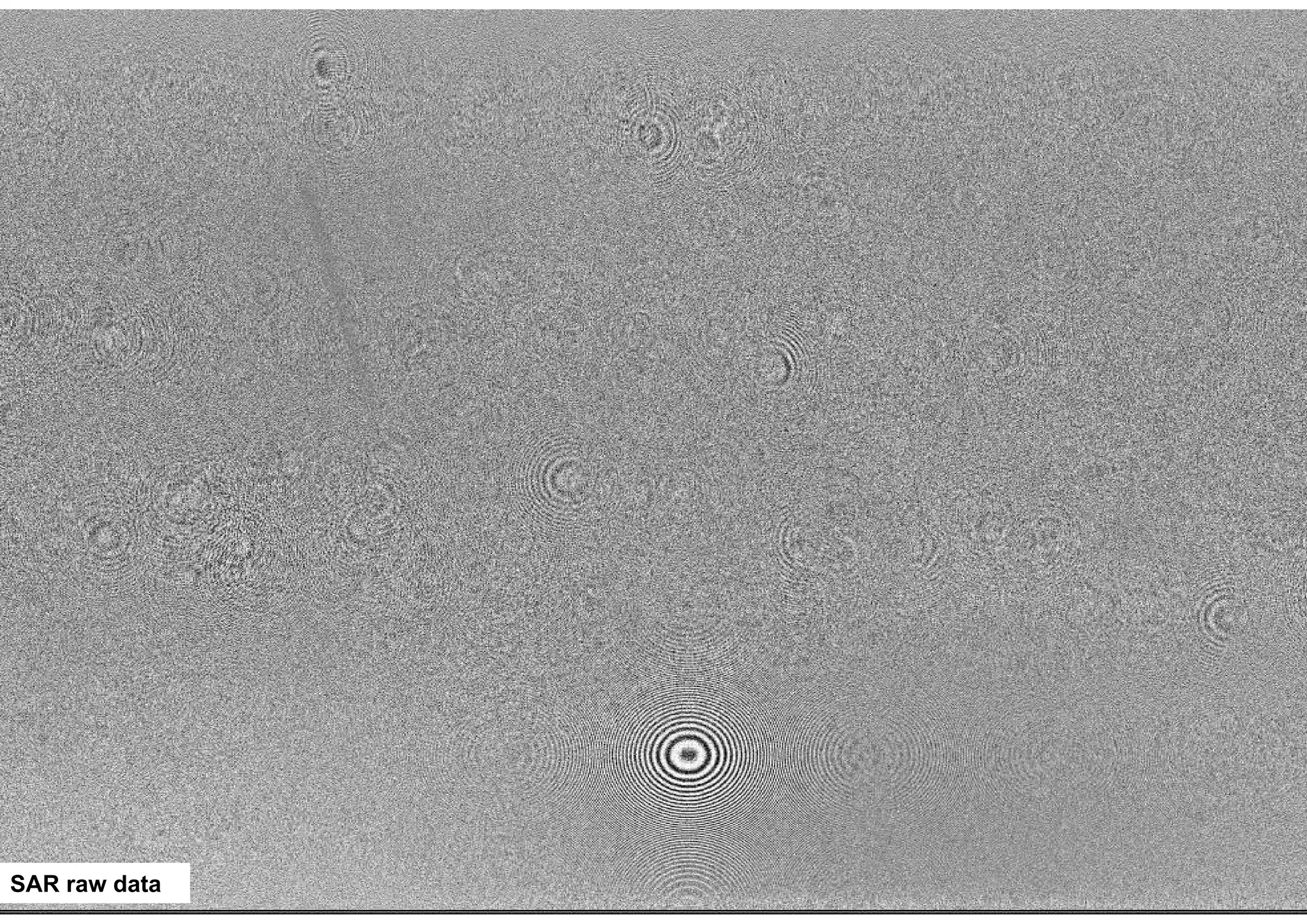
SAR raw data
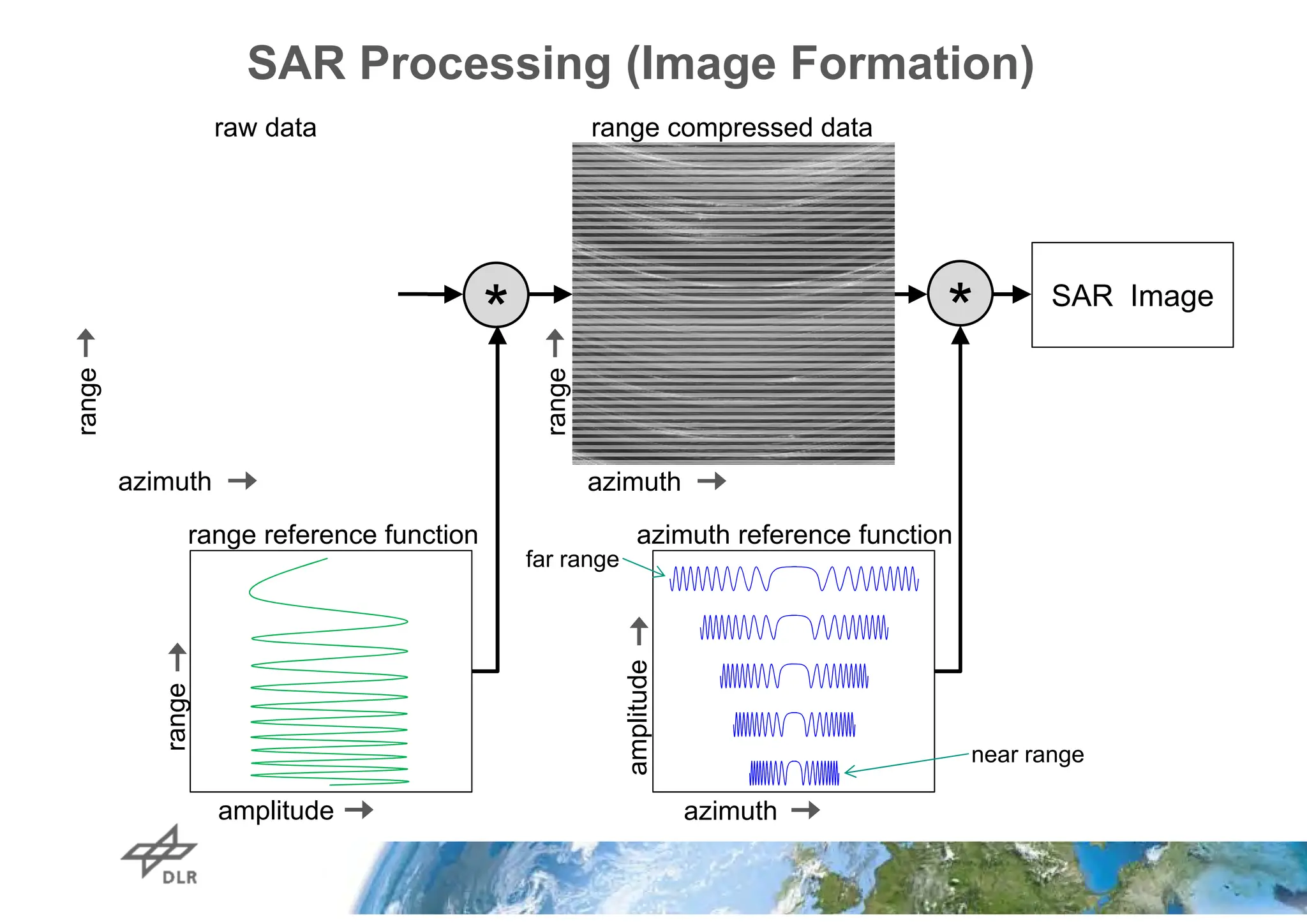
SAR Processing (Image Formation)
far range
near range
SAR Image
* *
azimuth
range
azimuth
range
raw data range compressed data
azimuth reference function
range reference function
amplitude
range
azimuth
amplitude
SAR Processing (Image Formation)
Summary: SAR Processing
1. Step: Range compression
• Generation of range reference function
• Matched filtering using convolution of range signal with range reference
function
2. Step: Azimuth compression
• Generation of azimuth reference function
• Matched filtering using convolution of azimuth signal with azimuth
reference function
3. Step: Calculation of the modulus of the SAR image (detection)
• This step is not required in case that the phase information is used (e.g.
polarimetry, interferometry etc.)
Normally the convolution is carried out in frequency domain
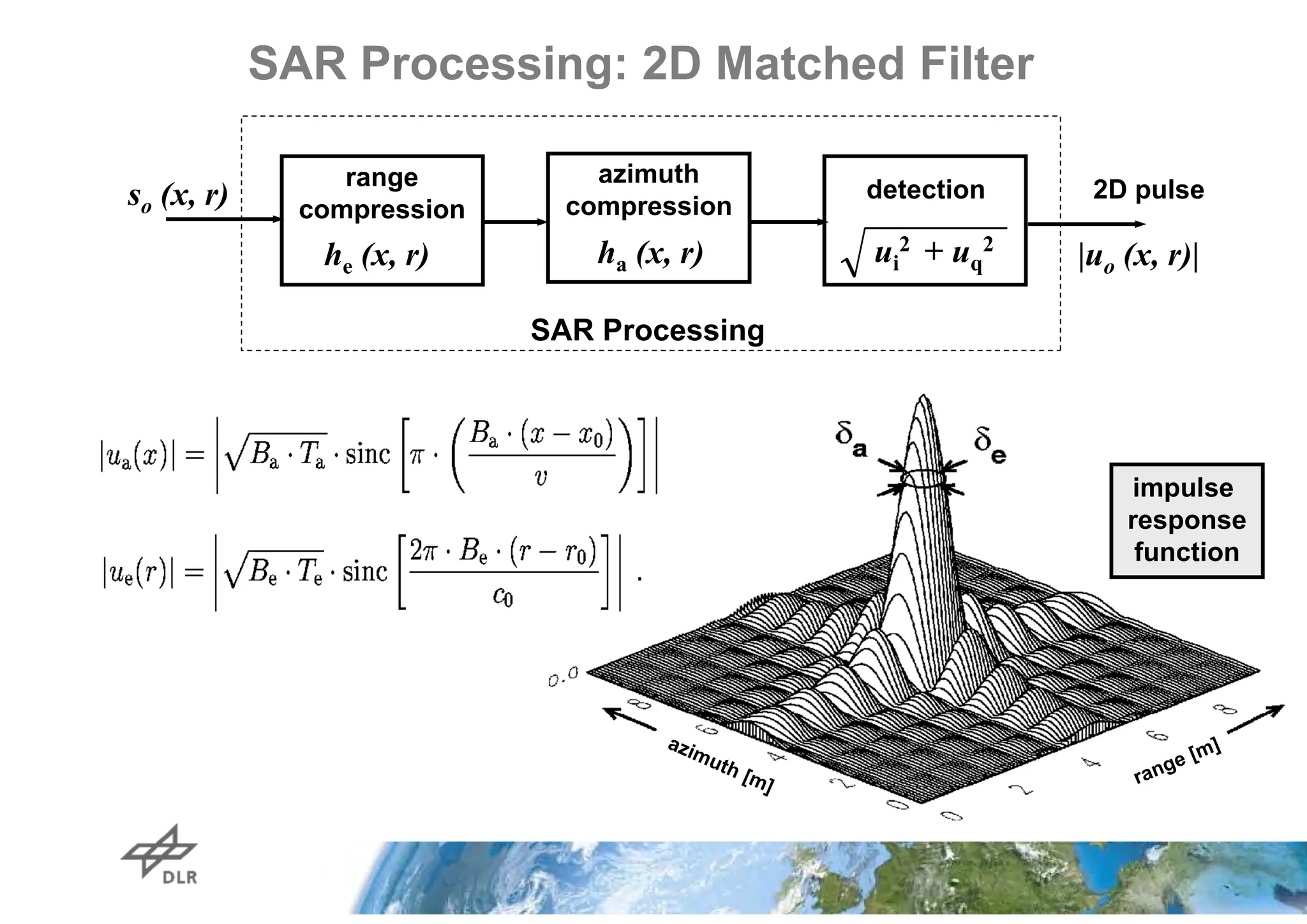
SAR Processing: 2D Matched Filter
he (x, r) ha (x, r) ui
2 + uq
2
azimuth
compression
detection
range
compression
SAR Processing
2D pulse
|uo (x, r)|
so (x, r)
impulse
response
function
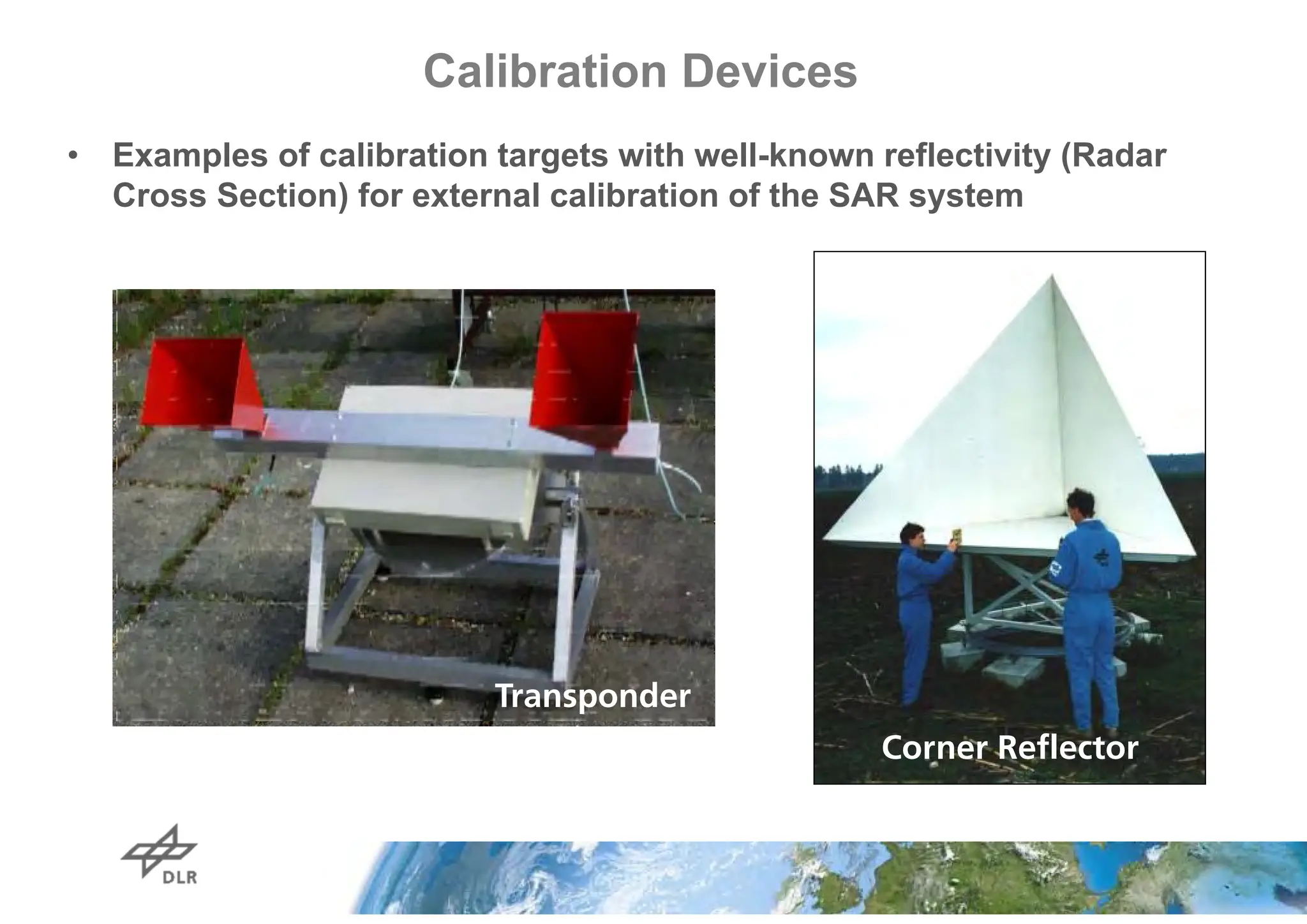
Calibration of SAR Images
• Examples of calibration targets with well-known reflectivity (Radar
Cross Section) for external calibration of the SAR system
Corner Reflector
Calibration Devices
Transponder
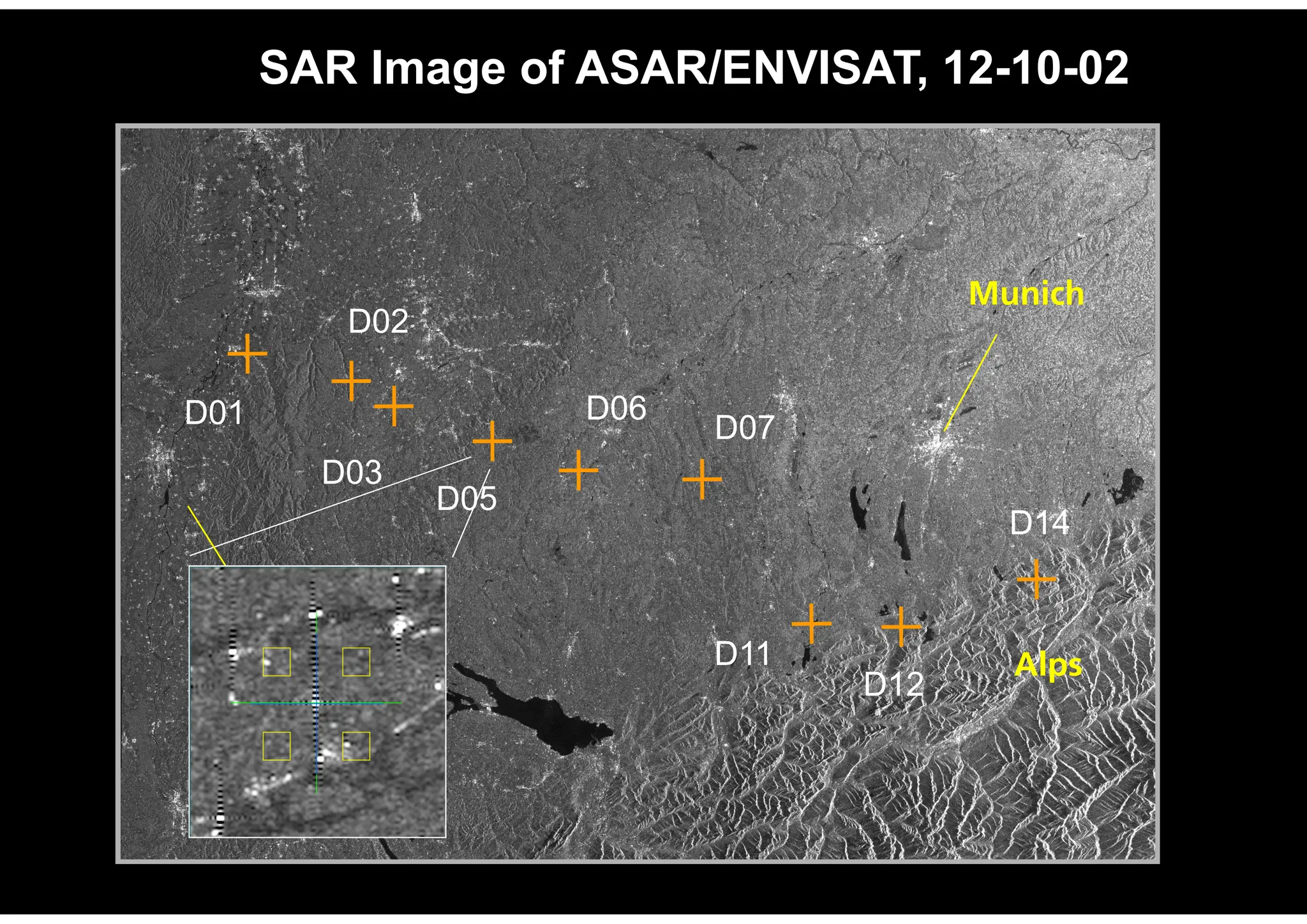
SAR Image of ASAR/ENVISAT, 12-10-02
D14
D01 D06
D02
D07
D03
D05
D11
D12
Munich
Alps
Strasbourg
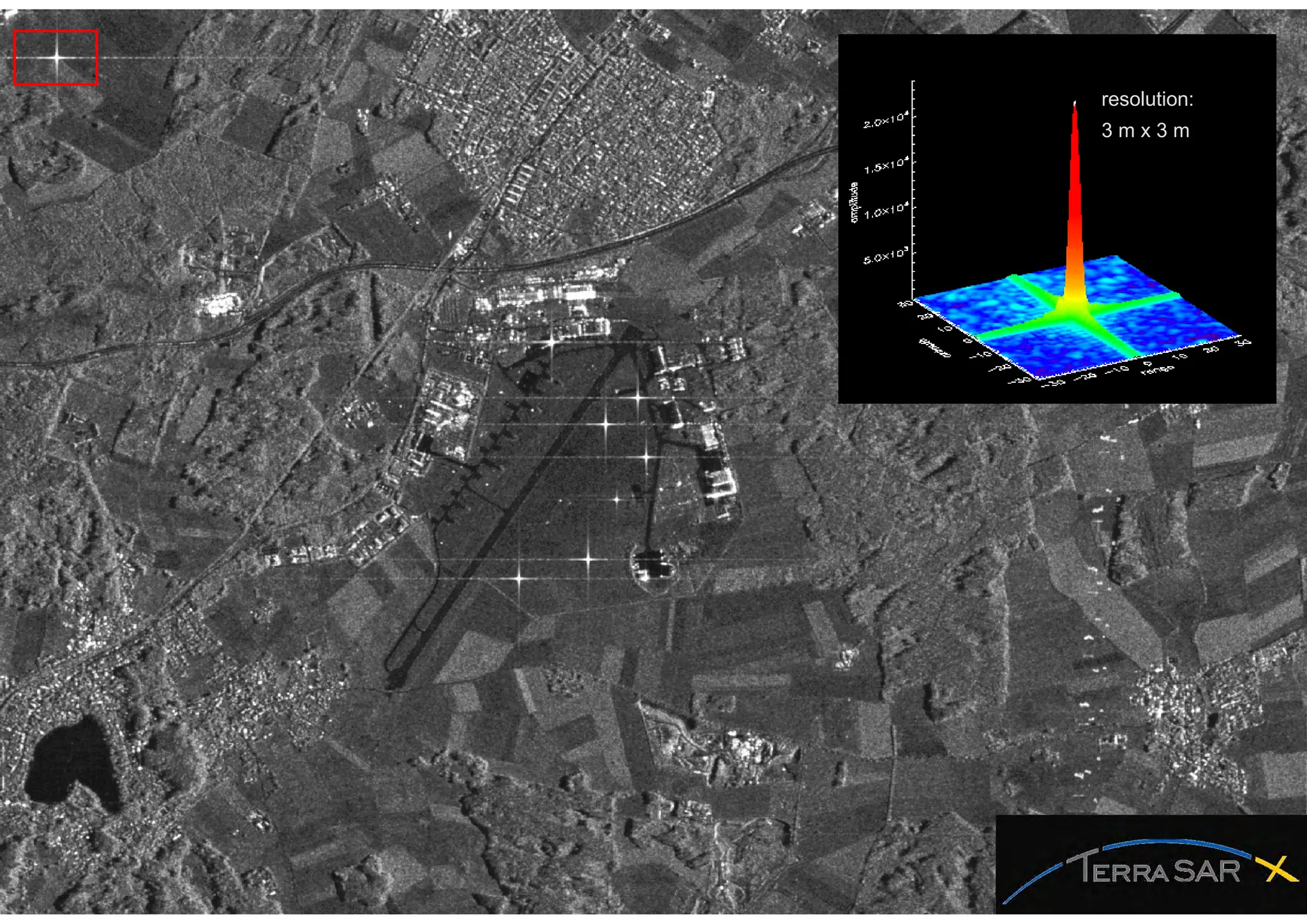
resolution:
3 m x 3 m
SAR Image Properties
– Geometric Distortions –
27
Montserrat
Volcano
Stripmap
VV-pol.
• 9. Oct. 2007
Eruption: 29.
July 2008
• 1. Aug. 2008
• 12. Aug. 2008
near range
far range
azimuth
shadow
layover
Slant-to-Ground-Range Conversion
platform
(orbit)
height
ground range
á
á
´
a
• Slant range signal travel time
• Ground range projection onto a reference plane
Range Quantities
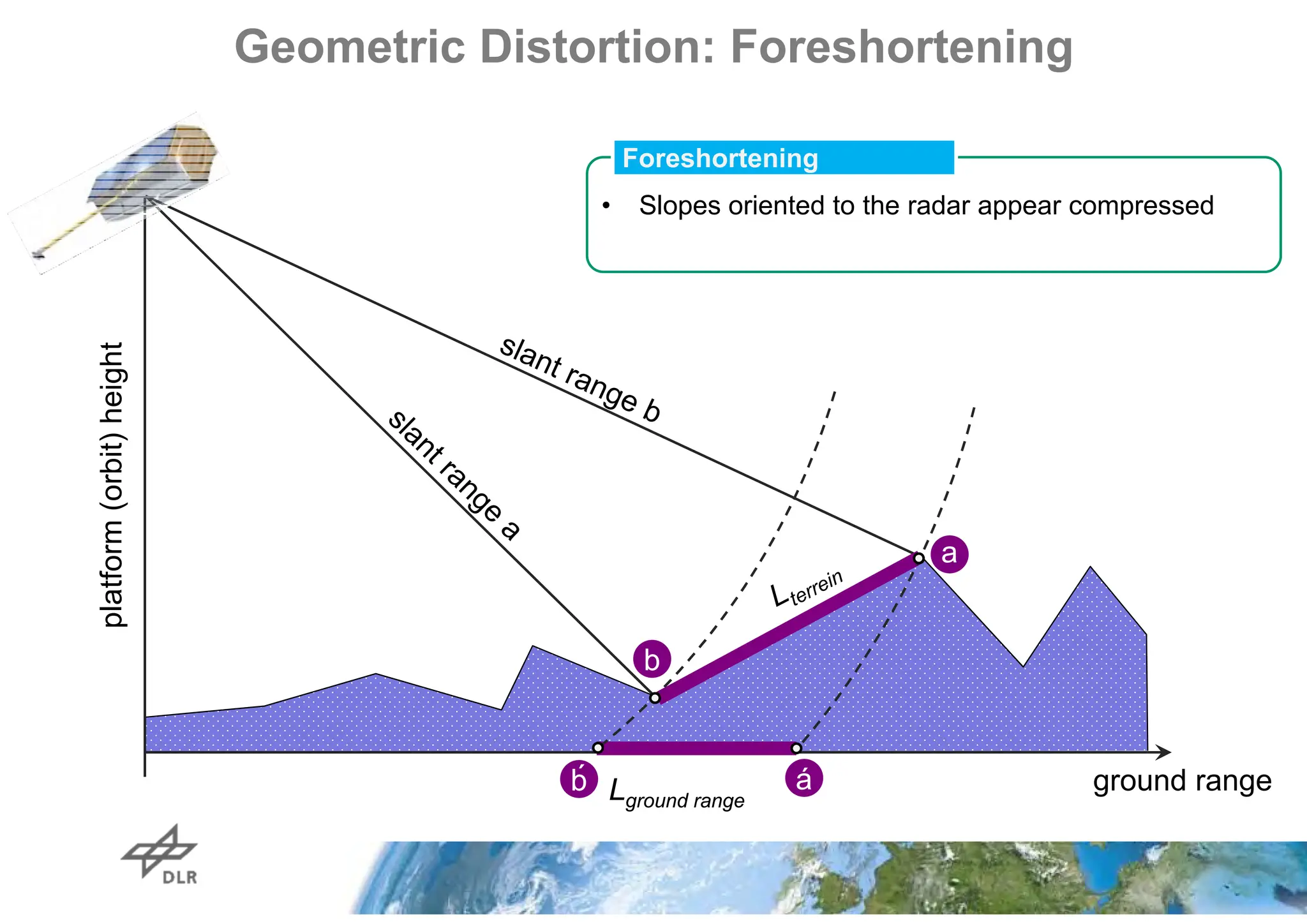
Geometric Distortion: Foreshortening
ground range
platform
(orbit)
height
Lground range
á
a
b
b́
• Slopes oriented to the radar appear compressed
Foreshortening
Geometric Distortion: Foreshortening
platform
(orbit)
height
ground range
Lground range
• Slopes oriented to the radar appear compressed
• Slopes tilted away from the radar appear lengthened
Foreshortening
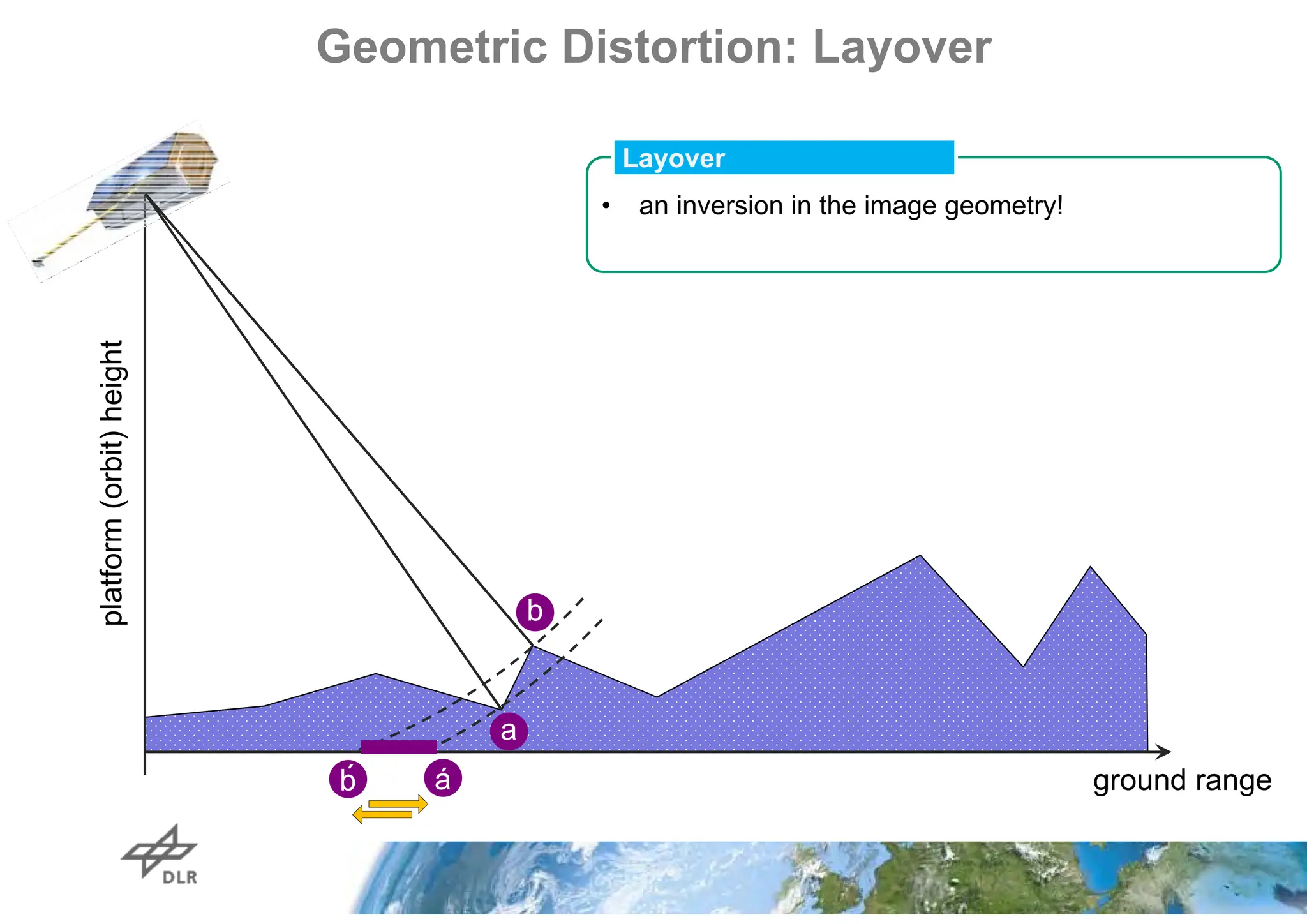
Geometric Distortion: Layover
platform
(orbit)
height
ground range
a
b
á
b́
• an inversion in the image geometry!
Layover
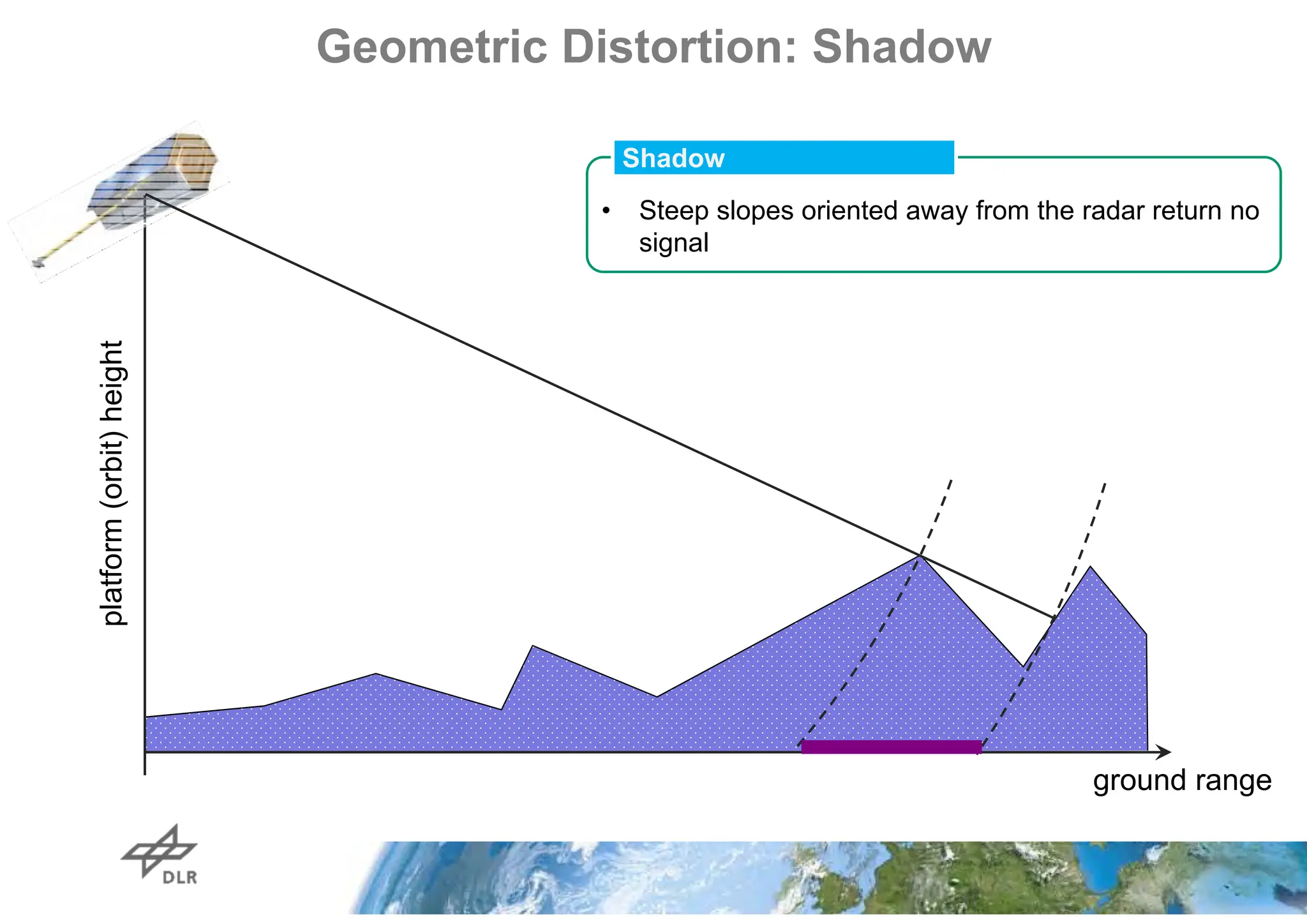
Geometric Distortion: Shadow
ground range
platform
(orbit)
height
• Steep slopes oriented away from the radar return no
signal
Shadow
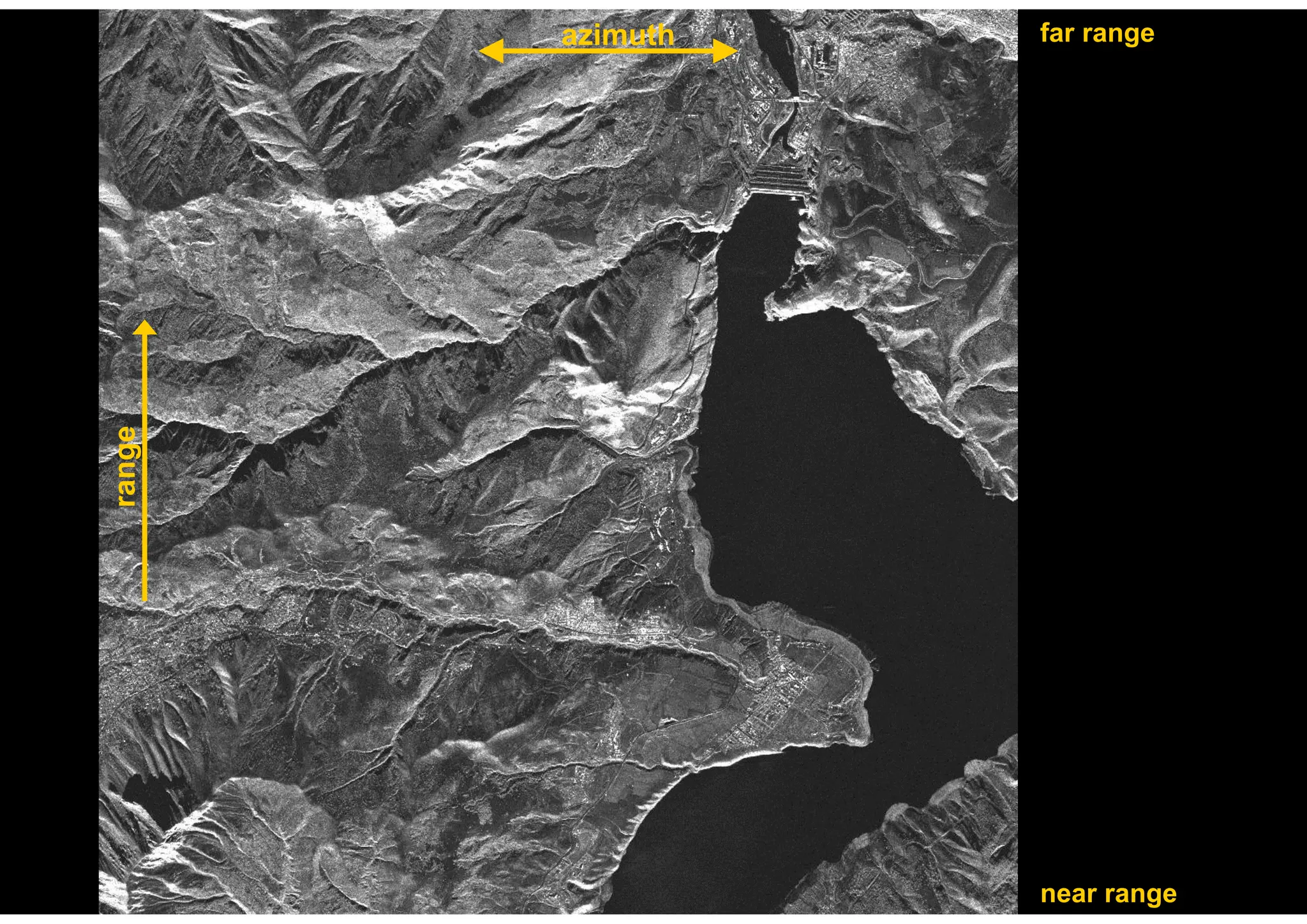
Consider the radar image below. What is the illumination direction of the radar?
range
azimuth near range
far range
range
azimuth
near range
far range
SAR Image Properties
– Speckle –
ERS-1 image / ESA
Kaufbeuren, Germany
F-SAR, X-band quadpol
0.25m resolution
Kaufbeuren, Germany
F-SAR X-band quadpol
0.25m resolution
Speckle
• SAR image can be modeled as:
|u(x, r)| = |  (x, r)  uo (x, r) |
SAR signal modeling
where
|u(x, r)| SAR image
 (x, r) scene complex reflectivity
uo (x, r) SAR impulse response
Scene
 (x, r) se (x, r) sa (x, r)
he (x, r)
ha (x, r)
ui
2 + uq
2
azimuth
compression
azimuth
modulation
detection
pulse
modulation
pulse
compression
SAR processing
SAR image
|uo (x, r)|
• For a point target:  = 1
SAR system
SAR signal modeling
• Distributed targets have surface roughness comparable or smaller than
radar wavelength
• Resolution of the SAR sensor cannot resolve individual scatterers
• For each resolution cell,  (x, r) is equal to the sum of all scatterers contributions i. e.
|u(xo, ro)| = |  (xo, ro)  uo (x, r) | = |  i (xo, ro)  uo (x, r) |

random sum
real
imaginary
Szene mit Streuobjekten
Speckle
Im
Re
Im
Re
Radarbild (Betrag)
SAR image
imaged area with
distributed targets
random sum
random sum
Speckle
• Inherent to coherent systems
• Probability distribution function has a exponential distribution, i.e.
average value = standard deviation
• Speckle makes SAR image interpretation more difficult
E-SAR high resolution image
(0.6 m x 2 m)
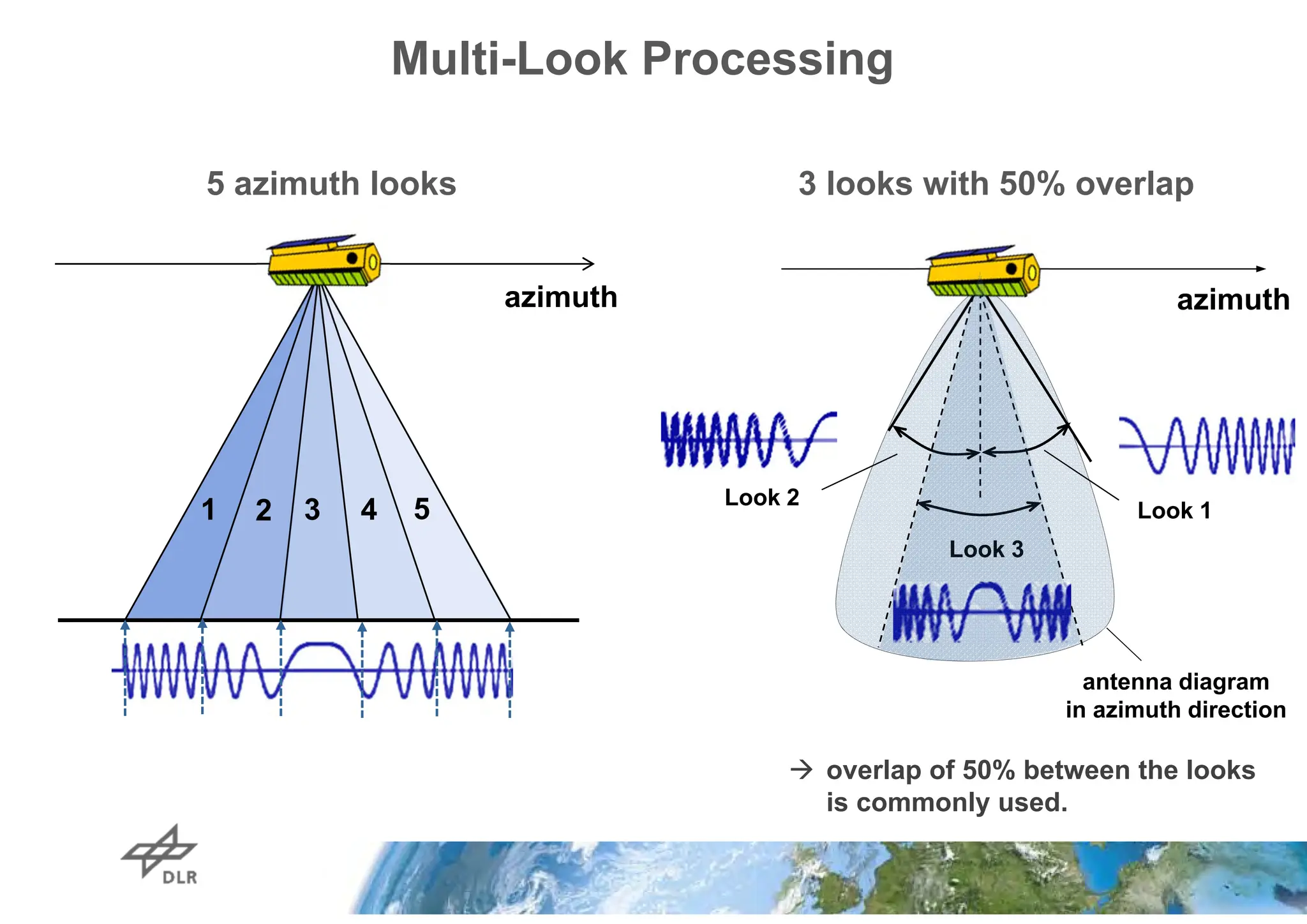
Multi-Look Processing
antenna diagram
in azimuth direction
3 looks with 50% overlap
5 azimuth looks
 overlap of 50% between the looks
is commonly used.
azimuth
1 2 3 4 5 Look 1
Look 2
Look 3
azimuth
Σ
ui
2 + uq
2
sa (x, r)
ha3
(x, r)
ha2
(x, r)
ha1
(x, r)
ui
2 + uq
2
ui
2 + uq
2
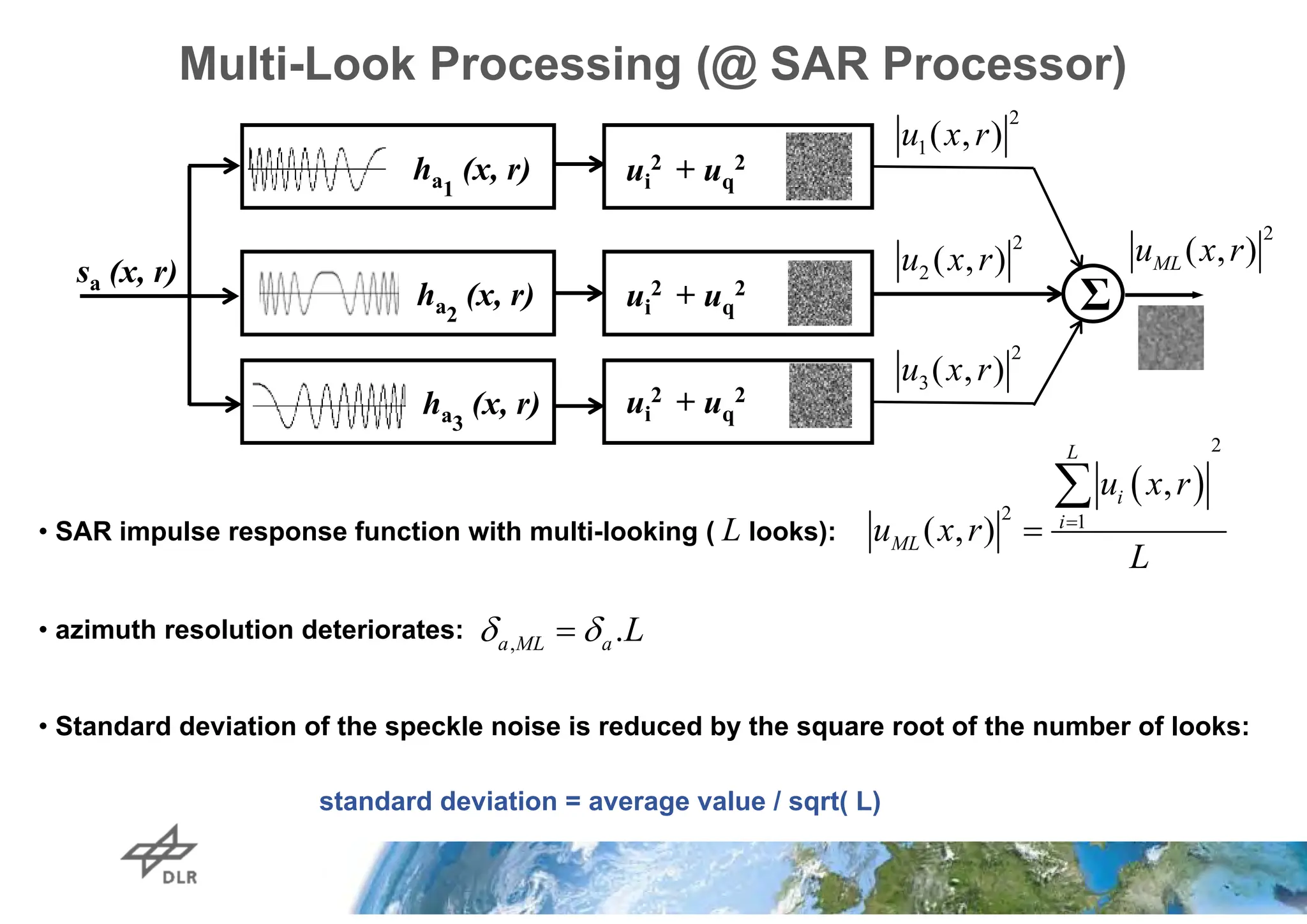
• SAR impulse response function with multi-looking ( L looks):
• azimuth resolution deteriorates:
• Standard deviation of the speckle noise is reduced by the square root of the number of looks:
standard deviation = average value / sqrt( L)
 
2
2 1
,
( , ) 


L
i
i
ML
u x r
u x r
L
2
( , )
ML
u x r
2
1( , )
u x r
Multi-Look Processing (@ SAR Processor)
2
2 ( , )
u x r
2
3( , )
u x r
, .
 

a ML a L
Multi-Look Processing
image value image value image value
frequency
frequency
frequency
Statistics of SAR Signal for Distributed Targets
Scene
 (x)
Doppler
Modulation
Ba
f
Spectrum
ha1
(x)
ha2
(x)
ui
2 + uq
2
ui
2 + uq
2
ui
2 + uq
2
Gaussian
distribution
μi = μq= 0
 i=  q= P0 / 2
μi = μq= 0
 i=  q= P0 / 2
Exponential
distribution
μ = 2  i
2
 2
= μ2
Gamma
distribution
-distribution
μ = 2  i
2
2
= μ2
/ L0
Gaussian
distribution
μ ... average value ;  ... standard deviation
2
ML
u
ML
u
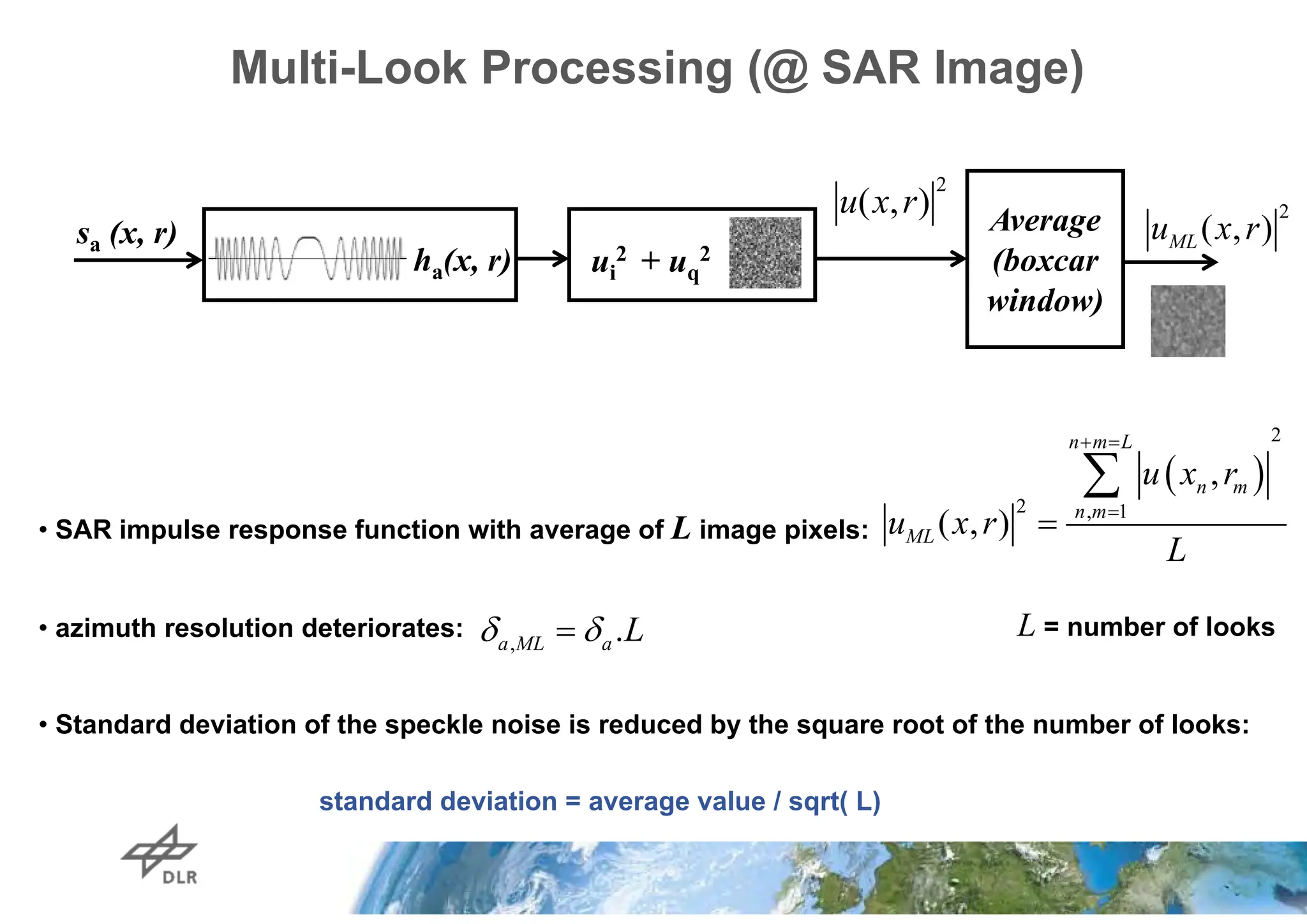
Multi-Look Processing (@ SAR Image)
• SAR impulse response function with average of L image pixels:
• azimuth resolution deteriorates:
• Standard deviation of the speckle noise is reduced by the square root of the number of looks:
standard deviation = average value / sqrt( L)
ui
2 + uq
2
Average
(boxcar
window)
sa (x, r)
ha(x, r)
2
( , )
ML
u x r
L = number of looks
, .
 

a ML a L
 
2
2 , 1
,
( , )
 



n m L
n m
n m
ML
u x r
u x r
L
2
( , )
u x r
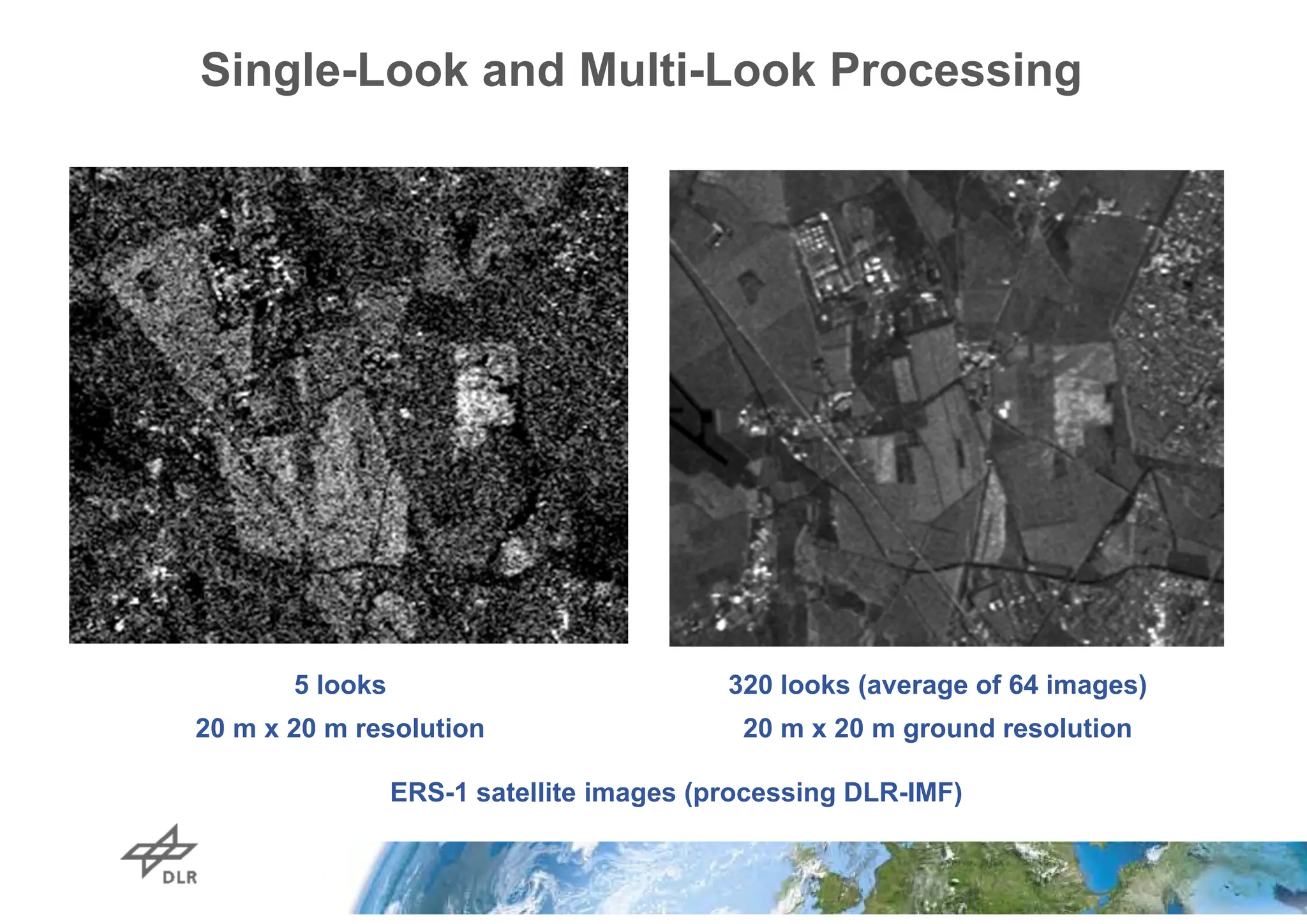
5 looks
20 m x 20 m resolution
320 looks (average of 64 images)
20 m x 20 m ground resolution
Single-Look and Multi-Look Processing
ERS-1 satellite images (processing DLR-IMF)
original SAR image (1 look)
Airborne SAR AeS-1
speckle filtered
Adaptive Filtering
(Model based approach)
Speckle Reduction with Image Filtering
Summary: Speckle
• SAR image of distributed targets contains speckle noise.
• Speckle noise is inherent in coherent radar systems.
• The average value of the speckle amplitude is equal to its standard deviation
(exponential distribution).
• Multi-look processing or spatial averaging is used to reduce the speckle
noise. Standard deviation decreases with .
• An overlap of 50% between the looks is commonly used.
• Speckle noise can also be reduced by averaging the final image
eff
L
PART IV
Advanced SAR Techniques
and Future Developments
Advanced SAR Imaging Modes
- ScanSAR Mode -
ScanSAR Imaging
A
B
C
• Synthetic aperture is shared between the subswaths (not contiguous within one
subswath)
• Mosaic Operation is required in azimuth and range directions to join the azimuth
bursts and the range sub-swaths
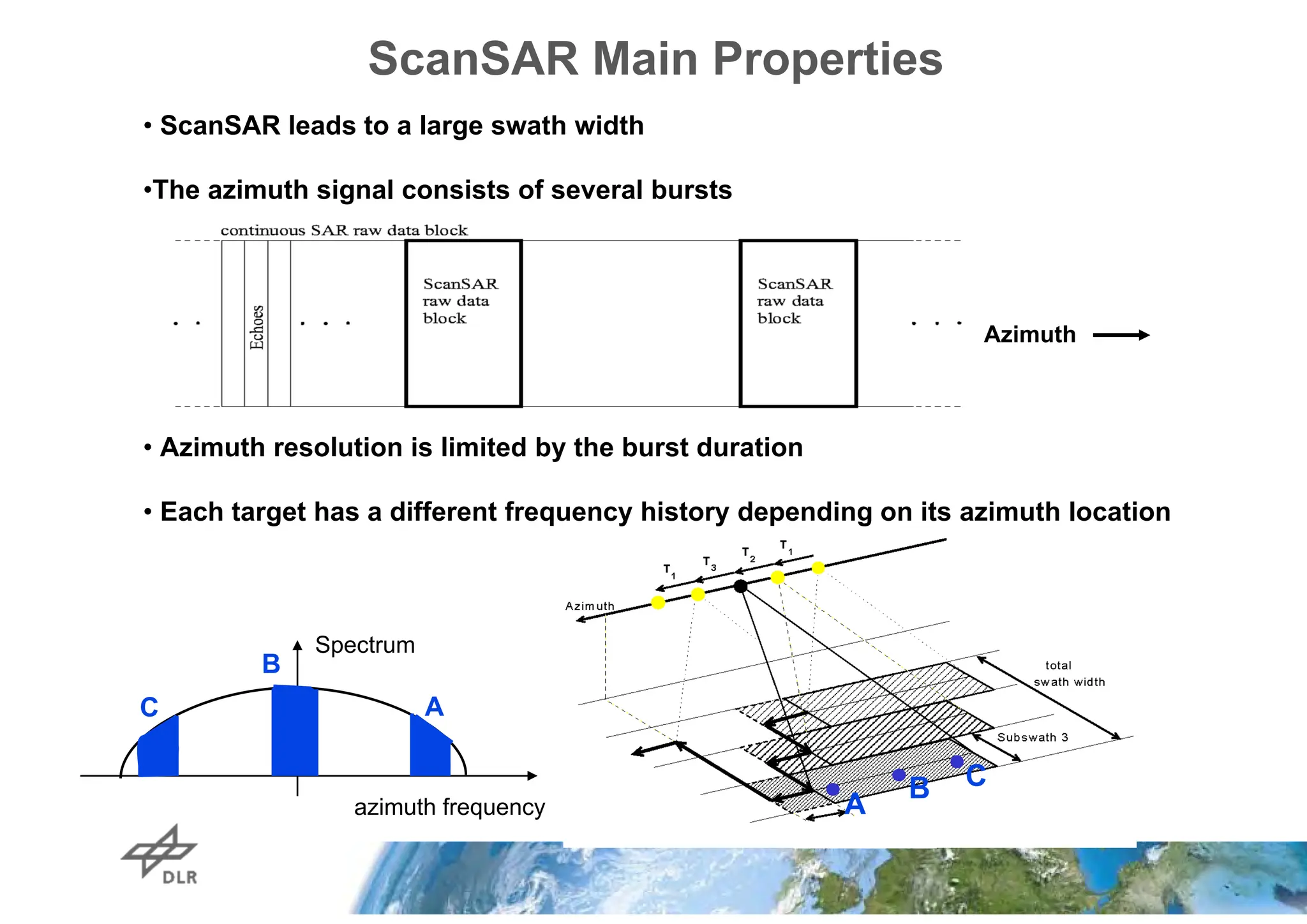
ScanSAR Main Properties
• ScanSAR leads to a large swath width
•The azimuth signal consists of several bursts
• Azimuth resolution is limited by the burst duration
• Each target has a different frequency history depending on its azimuth location
Azimuth
azimuth frequency
Spectrum
A
B
C
C
A
B C
ScanSAR Imaging (Chickasha, Oklahoma, USA)
Subswath
2
Subswath
1
(near range)
Subswath
3
Subswath
4
(far range)
azimuth
SIR-C image
L-band, VV
ASAR SCANSAR Image (Munich Area) ASAR ScanSAR Image
ASAR Image
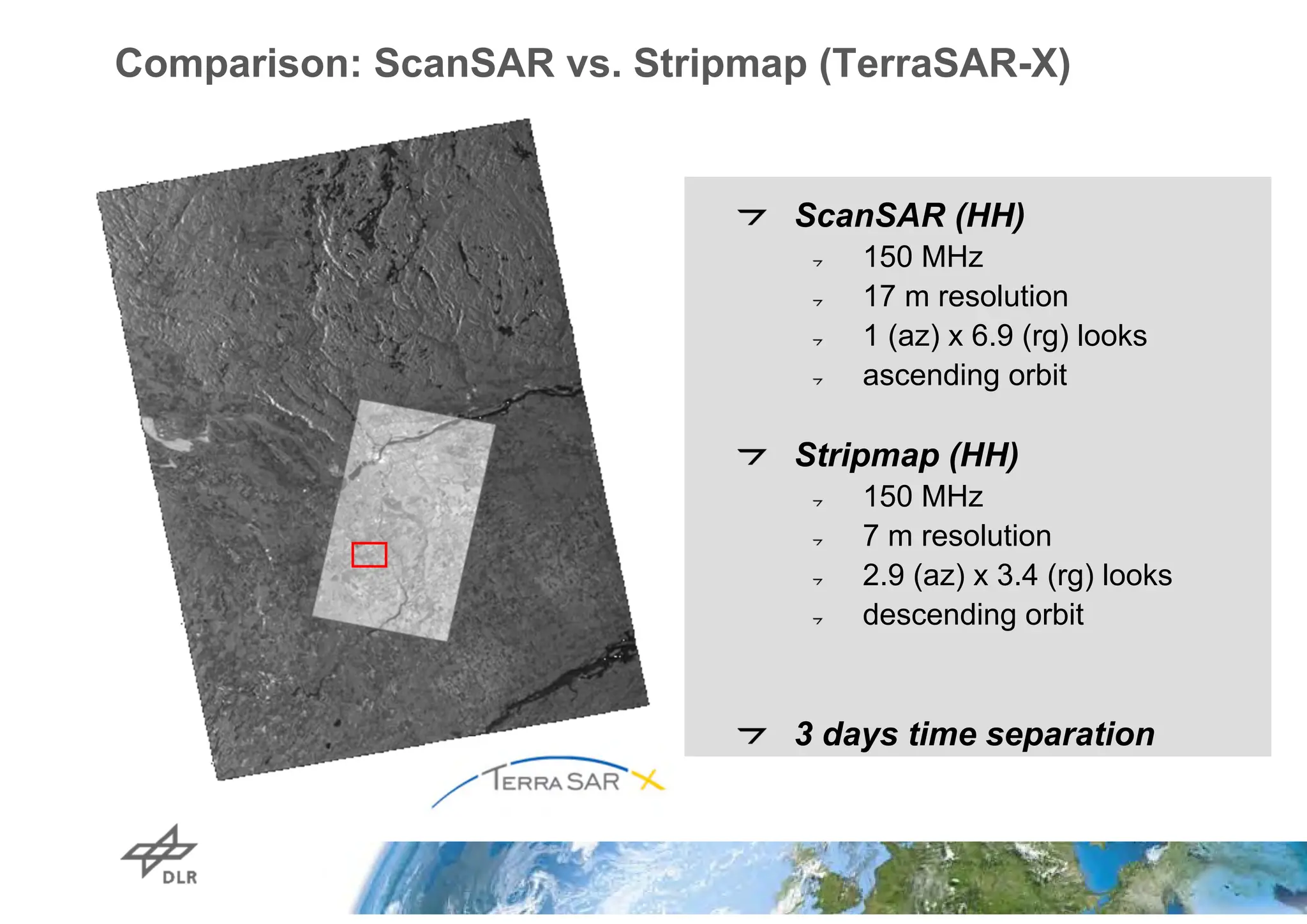
Comparison: ScanSAR vs. Stripmap (TerraSAR-X)
ScanSAR (HH)
150 MHz
17 m resolution
1 (az) x 6.9 (rg) looks
ascending orbit
Stripmap (HH)
150 MHz
7 m resolution
2.9 (az) x 3.4 (rg) looks
descending orbit
3 days time separation
ScanSAR
EEC-RE
17 m res.
illumination
~3 km x 4 km
ScanSAR
Stripmap
EEC-RE
7 m res.
illumination
~3 km x 4 km
Stripmap
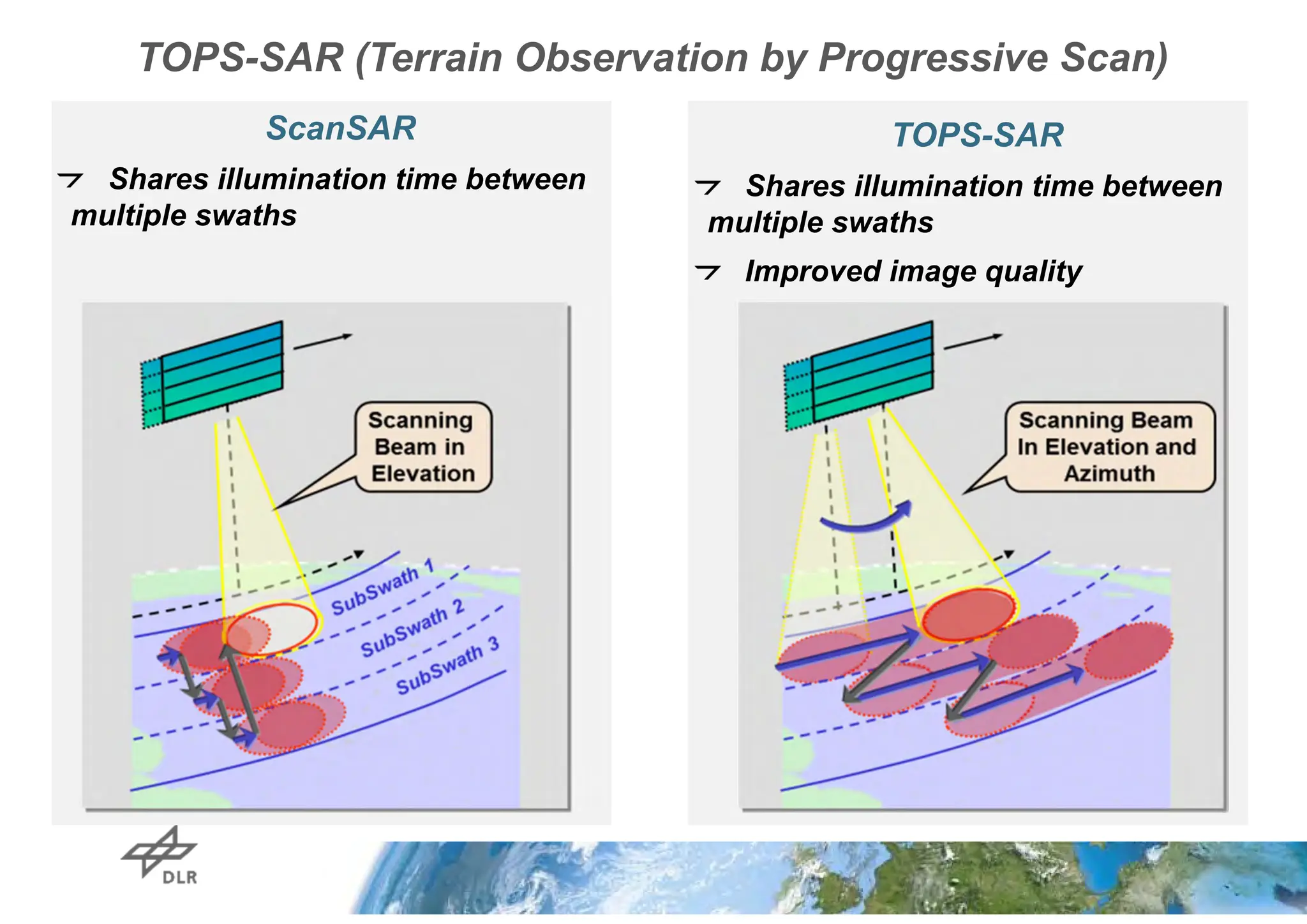
TOPS-SAR (Terrain Observation by Progressive Scan)
ScanSAR
Shares illumination time between
multiple swaths
TOPS-SAR
Shares illumination time between
multiple swaths
Improved image quality
Advanced SAR Imaging Modes
- Spotlight Mode -
Azimuth
Spotlight Synthetic Aperture
End of
imaging
Begin of
imaging
image center
synthetic aperture of
stripmap mode
• Non continuous imaging mode, but very high azimuth resolution
• Spotlight azimuth resolution
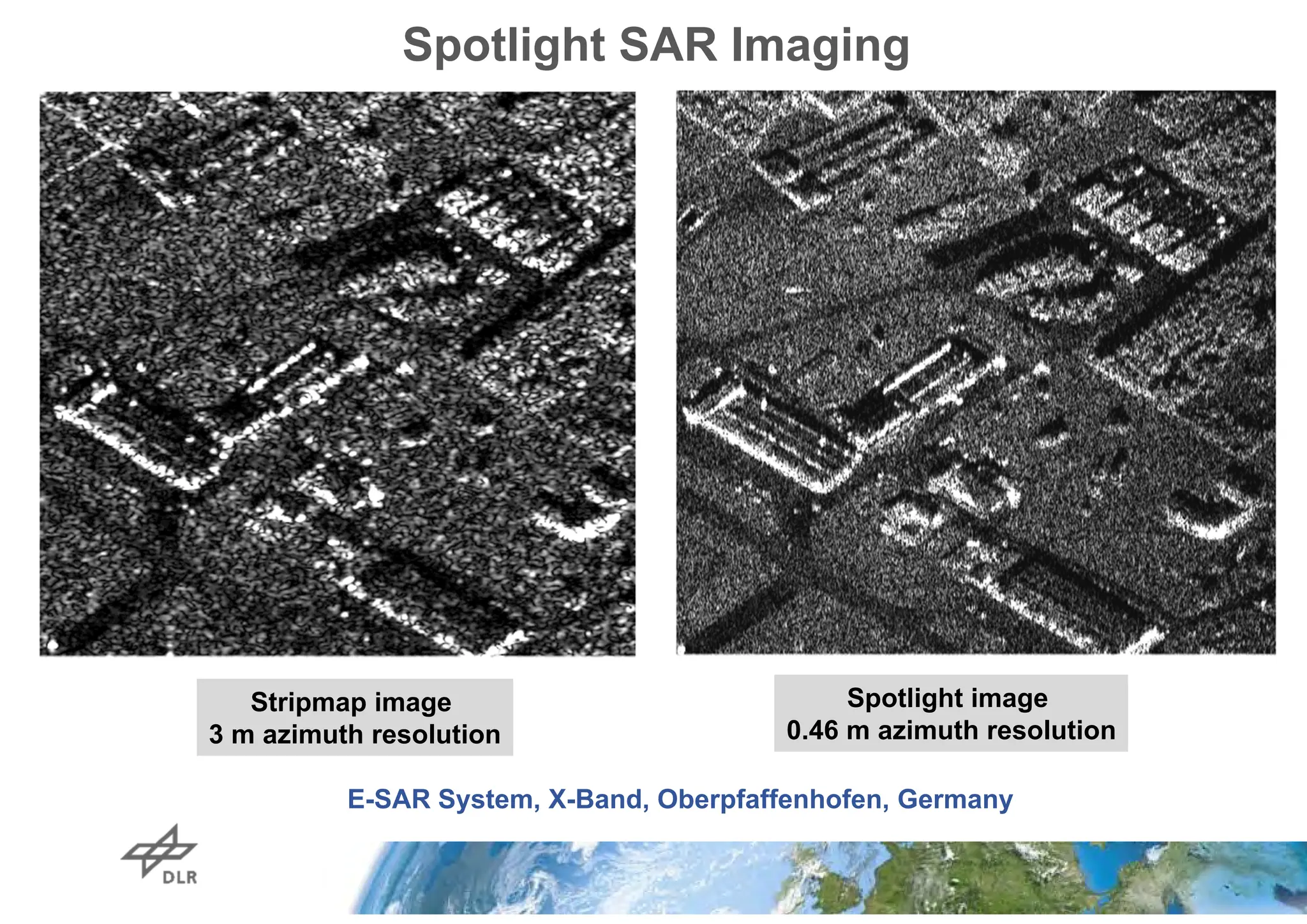
Spotlight SAR Imaging
Stripmap image
3 m azimuth resolution
Spotlight image
0.46 m azimuth resolution
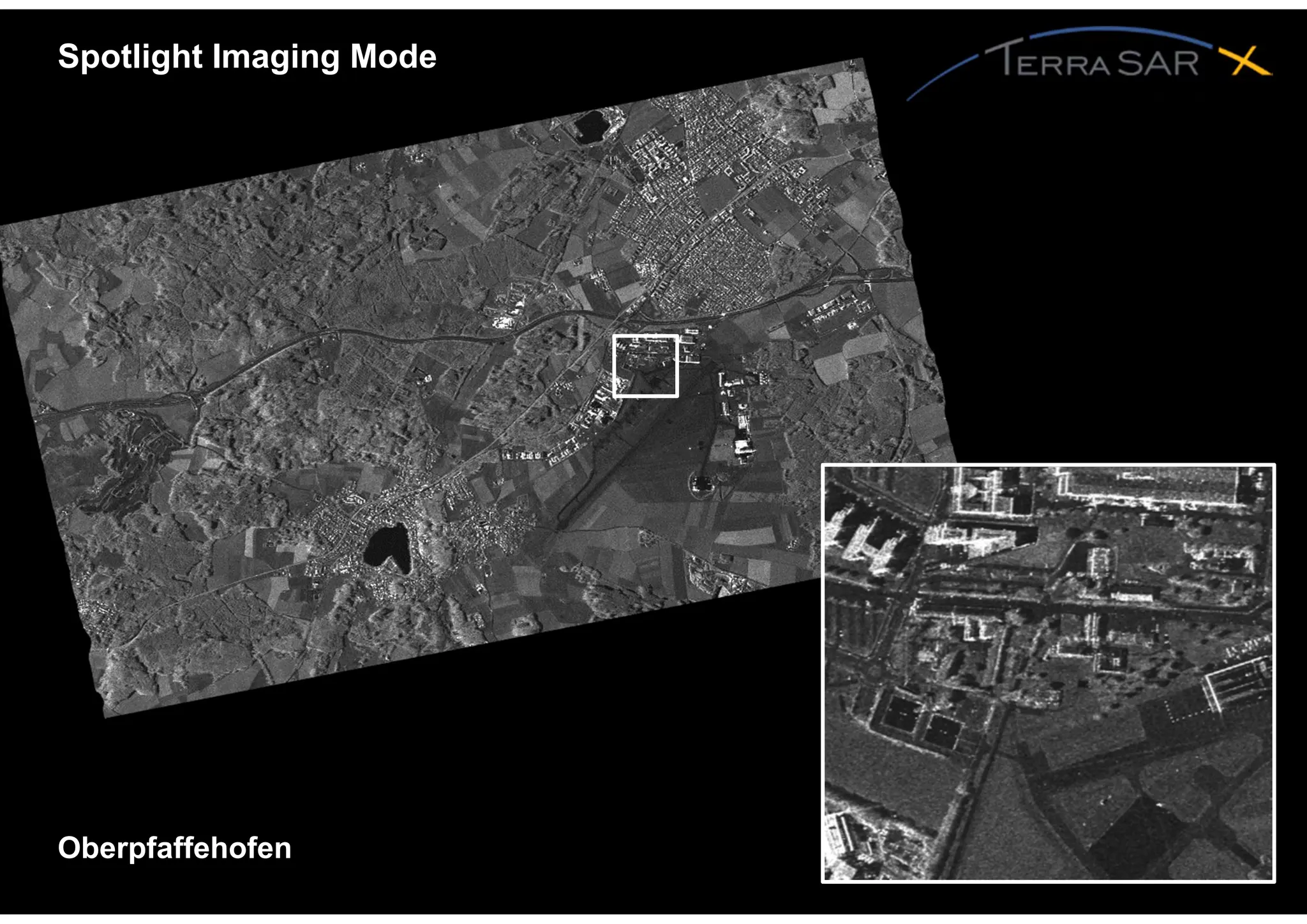
E-SAR System, X-Band, Oberpfaffenhofen, Germany
Spotlight SAR Imaging
High Resolution Spotlight, HH-Pol., spot_040, 37° inc. angle, 150 MHz
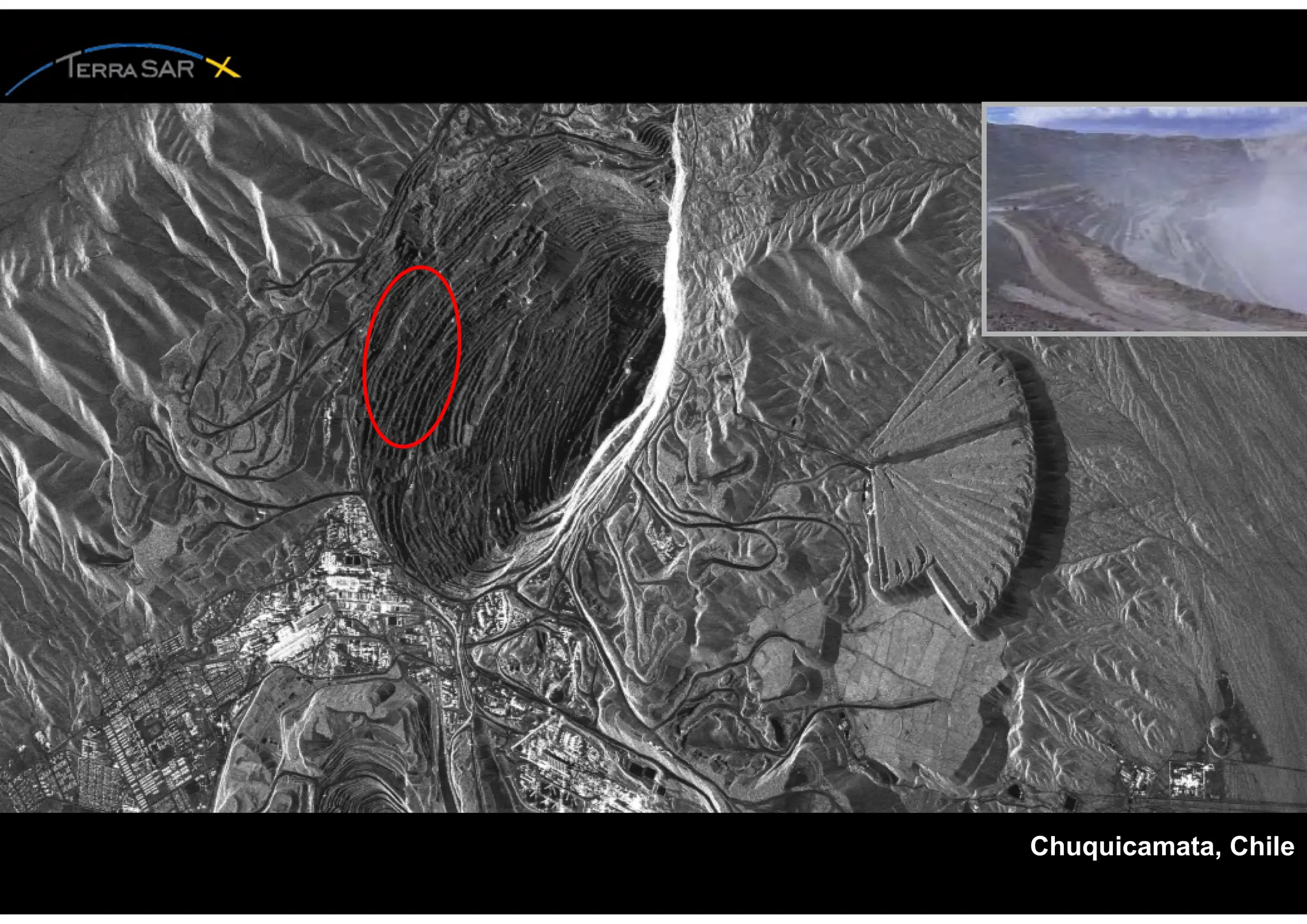
Chuquicamata, Chile
L1B SAR Processing: High Resolution Spotlight
HR Spotlight (VV), 150 MHz range bandwidth, θincid ≈ 35°, 5 km x 10 km
az
rng
Chuquicamata, Chile
Folie 67 Pau.Prats@dlr.de
Oberpfaffehofen
Spotlight Imaging Mode
Outlook
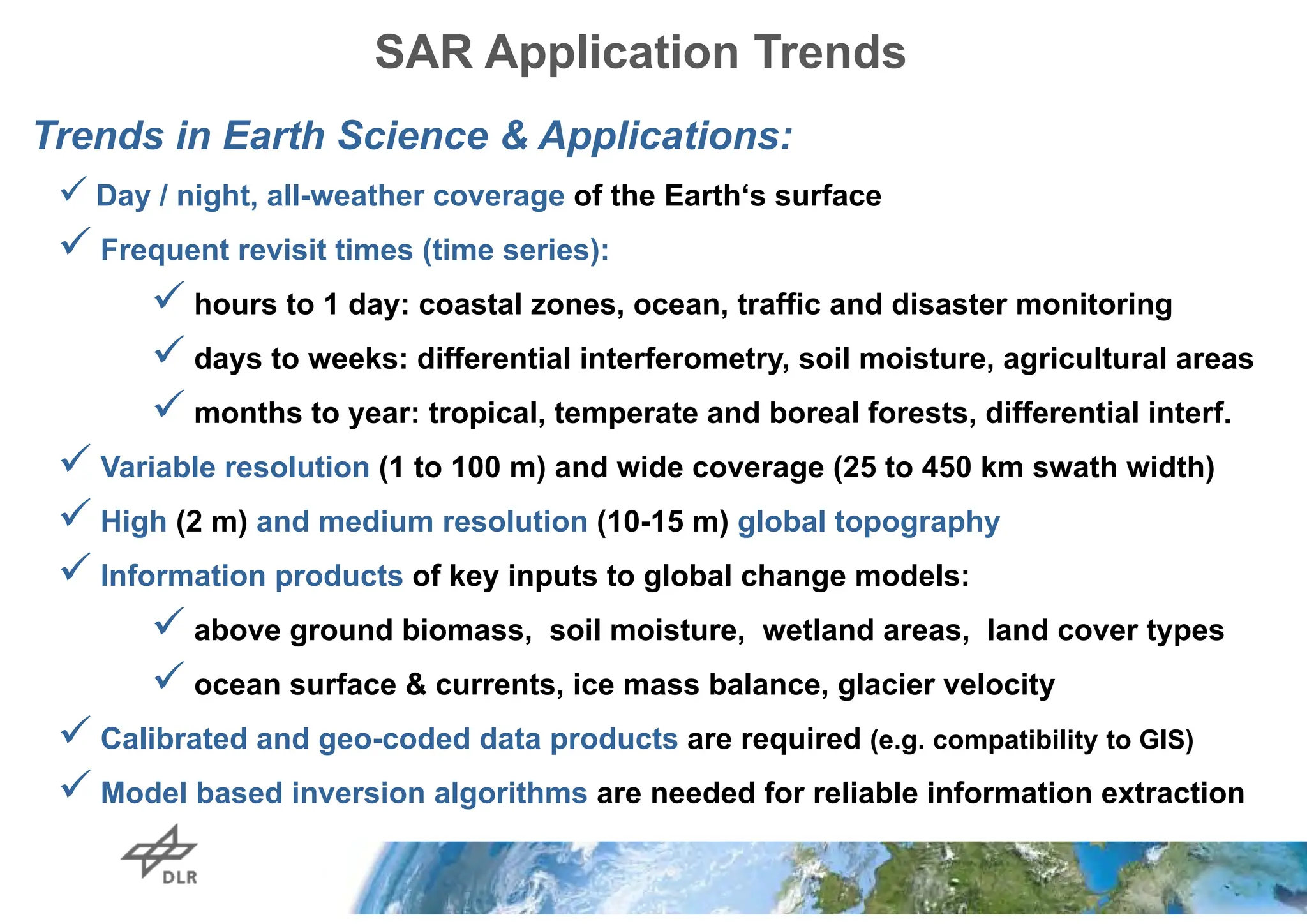
SAR Application Trends
Trends in Earth Science & Applications:
 Day / night, all-weather coverage of the Earth‘s surface
 Frequent revisit times (time series):
 hours to 1 day: coastal zones, ocean, traffic and disaster monitoring
 days to weeks: differential interferometry, soil moisture, agricultural areas
 months to year: tropical, temperate and boreal forests, differential interf.
 Variable resolution (1 to 100 m) and wide coverage (25 to 450 km swath width)
 High (2 m) and medium resolution (10-15 m) global topography
 Information products of key inputs to global change models:
 above ground biomass, soil moisture, wetland areas, land cover types
 ocean surface & currents, ice mass balance, glacier velocity
 Calibrated and geo-coded data products are required (e.g. compatibility to GIS)
 Model based inversion algorithms are needed for reliable information extraction
slide 70
German Aerospace Center Microwaves and Radar Institute
Summary: SAR Principles and Applications
• High resolution capability (independent of flight altitude)
• Weather independence by selecting proper frequency range
• Day/night imaging capability due to own illumination
• Complementary to optical systems
• Polarization signature can be exploited (physical structure, dielectric constant)
• Terrain Topography can be measured by means of interferometry
• Innumerous applications areas
• Great interest in the scientific community as well as for commercial and
security related applications
References
References I
SAR Principles and Applications
 CEOS EO Handbook – Catalogue of Satellite Instruments. On-line available: http://www.eohandbook.com, Oct. 2012.
 Curlander, J.C., McDonough, R.N.: Synthetic Aperture Radar: Systems and Signal Processing. Wiley, 1991.
 Elachi, C. and J. van Zyl, Introduction to the Physics and Techniques of Remote Sensing. John Wiley & Sons, 2006
 Henderson, F. und Lewis, A.: Manual of Remote Sensing: Principles and Applications of Imaging Radar. Wiley, 1998.
 Lee, J.S. and Pottier, E.: Polarimetric Radar Imaging: From Basics to Applications. CRC Press, 2009.
 Massonnet, D. and Souryis, J.C.: Imaging with Synthetic Aperture Radar. EPFL & CRC Press, 2008.
 McDonough, R.N. et al: Image Formation from Spaceborne Synthetic Aperture Radar Signals. Johns Hopkins APL
Technical Digest, Vol. 6, No. 4, 1985, S. 300-312.
 Moreira, A., Prats-Iraola, P., Younis, M., Krieger, G., Hajnsek, Irena and Papathanassiou, K.: A Tutorial on Synthetic
Aperture Radar. IEEE Geoscience and Remote Sensing Magazine, 1 (1), 2013, pp. 6-43.
 Tomiyasu, K.: Tutorial Review of Synthetic-Aperture Radar (SAR) with Applications to Imaging of the Ocean Surface.
In: IEEE Proc., Vol. 66, No. 5, May 1978.
 Woodhouse, I.: Introduction to Microwave Remote Sensing, CRC, Taylor & Francis, 2006.
References II
SAR Processing
 Cumming, Ian and Frank Wong, Digital Processing of Synthetic Aperture Radar Data, Artech House, 2005
 Franceschetti G. und R. Lanari.: Synthetic Aperture Radar Processing. CRC Press, USA, 1999
 Li, F.K., Croft, C., Held,D.: Comparison of Several Techniques to Obtain Multiple-Look SAR Imagery. In: IEEE
Trans. Geoscience and Remote Sensing, Vol. 21, No. 3, Juli 1983.
 Moreira, A., Mittermayer, J., Scheiber, R.: Extended Chirp Scaling Algorithm for Air- and Spaceborne SAR Data
Processing in Stripmap and ScanSAR Imaging Modes. In: IEEE Trans. Geoscience and Remote Sensing, Vol. 34,
No. 5, 1996.
SAR Image Properties
 Oliver, C. und S. Quegan. Understanding Synthetic Aperture Radar Images. SciTech Publishing, Inc., 2004.
 Raney, R. K.: Theory and Measure of Certain Image Norms in SAR. IEEE Trans. Geosci. Remote Sensing, Vol. 23,
No.3, Mai 1985.
 Raney, R. K. und Wessels, G. J.: Spatial Considerations in SAR Speckle Simulation. IEEE Trans. Geosci. Remote
Sensing, Vol. 26, No. 5, Sept. 1988, S. 666-672.
 Tomiyasu, K.: Conceptual Performance of a Satellite Borne, Wide Swath Synthetic Aperture Radar. In: IEEE Trans.
Geoscience and Remote Sensing, Vol. 19, No. 2, April 1981, S. 108-116.
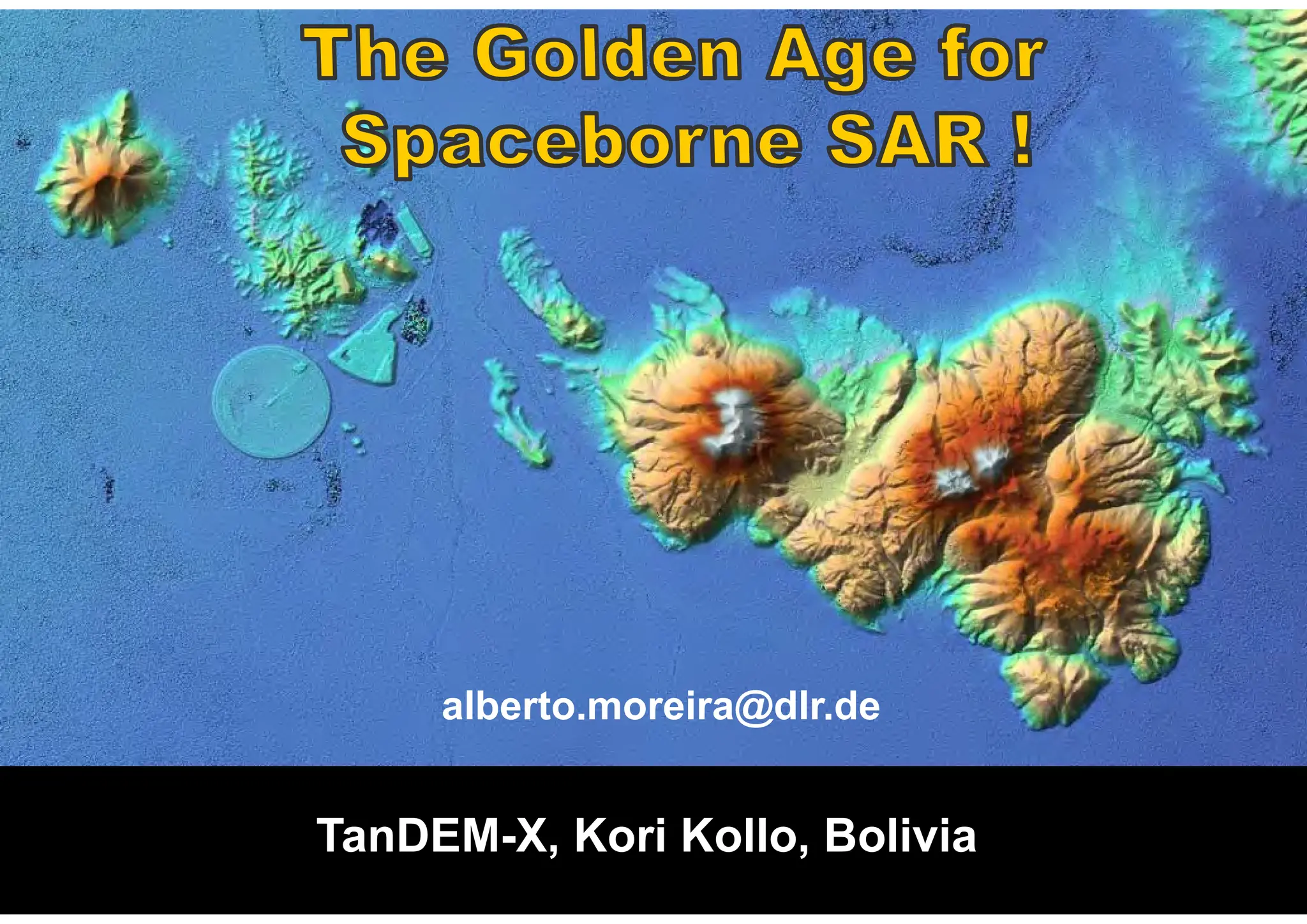
TanDEM-X, Kori Kollo, Bolivia
alberto.moreira@dlr.de

SAR Principles and Applications_SVKS.pdf

  • 1.
    Marwan Younis German AerospaceCenter (DLR) Microwaves and Radar Institute 82230 Oberpfaffenhofen, Germany e‐mail: marwan.younis@dlr.de / Web: www.dlr.de/HR Synthetic Aperture Radar (SAR): Principles and Applications
  • 2.
    slide 2 German AerospaceCenter Microwaves and Radar Institute PART III Theory: SAR Image Formation and Image Properties
  • 3.
  • 4.
    z y x Antenna Azimuth range SAR Basic Principle 1)pulsed radar system (PRF = Pulse Repetition Frequency) 2) two dimensional imaging (range x azimuth) 3) range resolution 4) azimuth resolution 5) Radar system must be coherent! Te Lsa 2 a a d   2 o r p c B  
  • 5.
    antenna > 100 Mbit/skbit/s SAR Data Flow Transmitter Receiver Data Recording Range compression Azimuth compression Image evaluation Image interpretation SAR raw data SAR image data
  • 6.
    signal generator Mixer power amplifier low noise amplifier circulator baseband signal I Q A D A D -90° I/Q demodulator Synthetic Aperture Radar (SAR) ultra stable oscillator
  • 7.
    Coherent Measurement Principle transmit t(time) Total time delay 1 = 1 o 2 . r c Coherent demodulation Received echo signal 1 phase change 1 1 4. . object phase r       1 4. . object phase r       1  A Imaginary Part Real Part
  • 8.
    Coherent Measurement Principle transmit Totaltime delay 2 = 2 o 2 . r c Coherent demodulation 2 4. . object phase r       2 4. . object phase r       phase change 2 t (time) Received echo signal 2 2  A Imaginary Part Real Part
  • 9.
                  t f j A t f A 0 0 2 exp 2 cos complex representation:      j A exp after demodulation:  A amplitude: 2 A intensity, power:  phase: Every pixel of a complex SAR image consists of a real and an imaginary part, i.e. it is a phasor and contains amplitude and phase information. A Phasor Representation of SAR Signal 4. . object r       phase information Imaginary Part Real Part o   amplitude information backscattering coefficient
  • 10.
    r0 velocity point target range / fast time antenna beam antenna azimuth/ slow time pulse length illumination time / synthetic aperture length 2-D Raw Data Matrix PRI Number of Samples for one point target: 1500 azimuth 30 000 range Till = 0.5 s Lsa = 3.6 km  = 100 s @ 20% dc V = 7 km/s da = 5 m a = 0.35° @ 10 GHz = 600 km
  • 11.
    Formation of AzimuthChirp Signal time azimuth azimuth signal Number of Samples for one point target: 1500 azimuth 30 000 range time delay t=t1
  • 12.
    Synthetic Aperture Formationand Processing Detection convolution SAR processor point target response resolution of synthetic aperture coherent summation 12 point target flight direction beamwidth of real aperture antenna SAR sensor Detection convolution SAR processor received azimuth signal point target response resolution of synthetic aperture phase corrections coherent summation
  • 13.
  • 14.
    SAR Processing (ImageFormation)   raw data SAR image range compression azimuth compression range reference function azimuth reference function
  • 15.
    Pulse Compression byConvolution convolution t e  e T point target response range reference function range SAR signal t t
  • 16.
    Linear Superposition ofChirps convolution t t t range reference function SAR signal response of 3 point targets
  • 17.
  • 18.
    SAR Processing (ImageFormation) far range near range SAR Image * * azimuth range azimuth range raw data range compressed data azimuth reference function range reference function amplitude range azimuth amplitude
  • 19.
  • 20.
    Summary: SAR Processing 1.Step: Range compression • Generation of range reference function • Matched filtering using convolution of range signal with range reference function 2. Step: Azimuth compression • Generation of azimuth reference function • Matched filtering using convolution of azimuth signal with azimuth reference function 3. Step: Calculation of the modulus of the SAR image (detection) • This step is not required in case that the phase information is used (e.g. polarimetry, interferometry etc.) Normally the convolution is carried out in frequency domain
  • 21.
    SAR Processing: 2DMatched Filter he (x, r) ha (x, r) ui 2 + uq 2 azimuth compression detection range compression SAR Processing 2D pulse |uo (x, r)| so (x, r) impulse response function
  • 22.
  • 23.
    • Examples ofcalibration targets with well-known reflectivity (Radar Cross Section) for external calibration of the SAR system Corner Reflector Calibration Devices Transponder
  • 24.
    SAR Image ofASAR/ENVISAT, 12-10-02 D14 D01 D06 D02 D07 D03 D05 D11 D12 Munich Alps Strasbourg
  • 25.
  • 26.
    SAR Image Properties –Geometric Distortions –
  • 27.
    27 Montserrat Volcano Stripmap VV-pol. • 9. Oct.2007 Eruption: 29. July 2008 • 1. Aug. 2008 • 12. Aug. 2008 near range far range azimuth shadow layover
  • 28.
    Slant-to-Ground-Range Conversion platform (orbit) height ground range á á ´ a •Slant range signal travel time • Ground range projection onto a reference plane Range Quantities
  • 29.
    Geometric Distortion: Foreshortening groundrange platform (orbit) height Lground range á a b b́ • Slopes oriented to the radar appear compressed Foreshortening
  • 30.
    Geometric Distortion: Foreshortening platform (orbit) height groundrange Lground range • Slopes oriented to the radar appear compressed • Slopes tilted away from the radar appear lengthened Foreshortening
  • 31.
    Geometric Distortion: Layover platform (orbit) height groundrange a b á b́ • an inversion in the image geometry! Layover
  • 32.
    Geometric Distortion: Shadow groundrange platform (orbit) height • Steep slopes oriented away from the radar return no signal Shadow
  • 33.
    Consider the radarimage below. What is the illumination direction of the radar?
  • 34.
  • 35.
  • 36.
  • 37.
  • 38.
    Kaufbeuren, Germany F-SAR, X-bandquadpol 0.25m resolution
  • 39.
    Kaufbeuren, Germany F-SAR X-bandquadpol 0.25m resolution Speckle
  • 40.
    • SAR imagecan be modeled as: |u(x, r)| = |  (x, r)  uo (x, r) | SAR signal modeling where |u(x, r)| SAR image  (x, r) scene complex reflectivity uo (x, r) SAR impulse response Scene  (x, r) se (x, r) sa (x, r) he (x, r) ha (x, r) ui 2 + uq 2 azimuth compression azimuth modulation detection pulse modulation pulse compression SAR processing SAR image |uo (x, r)| • For a point target:  = 1 SAR system
  • 41.
    SAR signal modeling •Distributed targets have surface roughness comparable or smaller than radar wavelength • Resolution of the SAR sensor cannot resolve individual scatterers • For each resolution cell,  (x, r) is equal to the sum of all scatterers contributions i. e. |u(xo, ro)| = |  (xo, ro)  uo (x, r) | = |  i (xo, ro)  uo (x, r) |  random sum real imaginary
  • 42.
    Szene mit Streuobjekten Speckle Im Re Im Re Radarbild(Betrag) SAR image imaged area with distributed targets random sum random sum
  • 43.
    Speckle • Inherent tocoherent systems • Probability distribution function has a exponential distribution, i.e. average value = standard deviation • Speckle makes SAR image interpretation more difficult E-SAR high resolution image (0.6 m x 2 m)
  • 44.
    Multi-Look Processing antenna diagram inazimuth direction 3 looks with 50% overlap 5 azimuth looks  overlap of 50% between the looks is commonly used. azimuth 1 2 3 4 5 Look 1 Look 2 Look 3 azimuth
  • 45.
    Σ ui 2 + uq 2 sa(x, r) ha3 (x, r) ha2 (x, r) ha1 (x, r) ui 2 + uq 2 ui 2 + uq 2 • SAR impulse response function with multi-looking ( L looks): • azimuth resolution deteriorates: • Standard deviation of the speckle noise is reduced by the square root of the number of looks: standard deviation = average value / sqrt( L)   2 2 1 , ( , )    L i i ML u x r u x r L 2 ( , ) ML u x r 2 1( , ) u x r Multi-Look Processing (@ SAR Processor) 2 2 ( , ) u x r 2 3( , ) u x r , .    a ML a L
  • 46.
    Multi-Look Processing image valueimage value image value frequency frequency frequency
  • 47.
    Statistics of SARSignal for Distributed Targets Scene  (x) Doppler Modulation Ba f Spectrum ha1 (x) ha2 (x) ui 2 + uq 2 ui 2 + uq 2 ui 2 + uq 2 Gaussian distribution μi = μq= 0  i=  q= P0 / 2 μi = μq= 0  i=  q= P0 / 2 Exponential distribution μ = 2  i 2  2 = μ2 Gamma distribution -distribution μ = 2  i 2 2 = μ2 / L0 Gaussian distribution μ ... average value ;  ... standard deviation 2 ML u ML u
  • 48.
    Multi-Look Processing (@SAR Image) • SAR impulse response function with average of L image pixels: • azimuth resolution deteriorates: • Standard deviation of the speckle noise is reduced by the square root of the number of looks: standard deviation = average value / sqrt( L) ui 2 + uq 2 Average (boxcar window) sa (x, r) ha(x, r) 2 ( , ) ML u x r L = number of looks , .    a ML a L   2 2 , 1 , ( , )      n m L n m n m ML u x r u x r L 2 ( , ) u x r
  • 49.
    5 looks 20 mx 20 m resolution 320 looks (average of 64 images) 20 m x 20 m ground resolution Single-Look and Multi-Look Processing ERS-1 satellite images (processing DLR-IMF)
  • 50.
    original SAR image(1 look) Airborne SAR AeS-1 speckle filtered Adaptive Filtering (Model based approach) Speckle Reduction with Image Filtering
  • 51.
    Summary: Speckle • SARimage of distributed targets contains speckle noise. • Speckle noise is inherent in coherent radar systems. • The average value of the speckle amplitude is equal to its standard deviation (exponential distribution). • Multi-look processing or spatial averaging is used to reduce the speckle noise. Standard deviation decreases with . • An overlap of 50% between the looks is commonly used. • Speckle noise can also be reduced by averaging the final image eff L
  • 52.
    PART IV Advanced SARTechniques and Future Developments
  • 53.
    Advanced SAR ImagingModes - ScanSAR Mode -
  • 54.
    ScanSAR Imaging A B C • Syntheticaperture is shared between the subswaths (not contiguous within one subswath) • Mosaic Operation is required in azimuth and range directions to join the azimuth bursts and the range sub-swaths
  • 55.
    ScanSAR Main Properties •ScanSAR leads to a large swath width •The azimuth signal consists of several bursts • Azimuth resolution is limited by the burst duration • Each target has a different frequency history depending on its azimuth location Azimuth azimuth frequency Spectrum A B C C A B C
  • 57.
    ScanSAR Imaging (Chickasha,Oklahoma, USA) Subswath 2 Subswath 1 (near range) Subswath 3 Subswath 4 (far range) azimuth SIR-C image L-band, VV
  • 58.
    ASAR SCANSAR Image(Munich Area) ASAR ScanSAR Image ASAR Image
  • 59.
    Comparison: ScanSAR vs.Stripmap (TerraSAR-X) ScanSAR (HH) 150 MHz 17 m resolution 1 (az) x 6.9 (rg) looks ascending orbit Stripmap (HH) 150 MHz 7 m resolution 2.9 (az) x 3.4 (rg) looks descending orbit 3 days time separation
  • 60.
  • 61.
  • 62.
    TOPS-SAR (Terrain Observationby Progressive Scan) ScanSAR Shares illumination time between multiple swaths TOPS-SAR Shares illumination time between multiple swaths Improved image quality
  • 63.
    Advanced SAR ImagingModes - Spotlight Mode -
  • 64.
    Azimuth Spotlight Synthetic Aperture Endof imaging Begin of imaging image center synthetic aperture of stripmap mode • Non continuous imaging mode, but very high azimuth resolution • Spotlight azimuth resolution Spotlight SAR Imaging
  • 65.
    Stripmap image 3 mazimuth resolution Spotlight image 0.46 m azimuth resolution E-SAR System, X-Band, Oberpfaffenhofen, Germany Spotlight SAR Imaging
  • 66.
    High Resolution Spotlight,HH-Pol., spot_040, 37° inc. angle, 150 MHz Chuquicamata, Chile L1B SAR Processing: High Resolution Spotlight HR Spotlight (VV), 150 MHz range bandwidth, θincid ≈ 35°, 5 km x 10 km az rng Chuquicamata, Chile
  • 67.
  • 68.
  • 69.
    SAR Application Trends Trendsin Earth Science & Applications:  Day / night, all-weather coverage of the Earth‘s surface  Frequent revisit times (time series):  hours to 1 day: coastal zones, ocean, traffic and disaster monitoring  days to weeks: differential interferometry, soil moisture, agricultural areas  months to year: tropical, temperate and boreal forests, differential interf.  Variable resolution (1 to 100 m) and wide coverage (25 to 450 km swath width)  High (2 m) and medium resolution (10-15 m) global topography  Information products of key inputs to global change models:  above ground biomass, soil moisture, wetland areas, land cover types  ocean surface & currents, ice mass balance, glacier velocity  Calibrated and geo-coded data products are required (e.g. compatibility to GIS)  Model based inversion algorithms are needed for reliable information extraction
  • 70.
    slide 70 German AerospaceCenter Microwaves and Radar Institute Summary: SAR Principles and Applications • High resolution capability (independent of flight altitude) • Weather independence by selecting proper frequency range • Day/night imaging capability due to own illumination • Complementary to optical systems • Polarization signature can be exploited (physical structure, dielectric constant) • Terrain Topography can be measured by means of interferometry • Innumerous applications areas • Great interest in the scientific community as well as for commercial and security related applications
  • 71.
  • 72.
    References I SAR Principlesand Applications  CEOS EO Handbook – Catalogue of Satellite Instruments. On-line available: http://www.eohandbook.com, Oct. 2012.  Curlander, J.C., McDonough, R.N.: Synthetic Aperture Radar: Systems and Signal Processing. Wiley, 1991.  Elachi, C. and J. van Zyl, Introduction to the Physics and Techniques of Remote Sensing. John Wiley & Sons, 2006  Henderson, F. und Lewis, A.: Manual of Remote Sensing: Principles and Applications of Imaging Radar. Wiley, 1998.  Lee, J.S. and Pottier, E.: Polarimetric Radar Imaging: From Basics to Applications. CRC Press, 2009.  Massonnet, D. and Souryis, J.C.: Imaging with Synthetic Aperture Radar. EPFL & CRC Press, 2008.  McDonough, R.N. et al: Image Formation from Spaceborne Synthetic Aperture Radar Signals. Johns Hopkins APL Technical Digest, Vol. 6, No. 4, 1985, S. 300-312.  Moreira, A., Prats-Iraola, P., Younis, M., Krieger, G., Hajnsek, Irena and Papathanassiou, K.: A Tutorial on Synthetic Aperture Radar. IEEE Geoscience and Remote Sensing Magazine, 1 (1), 2013, pp. 6-43.  Tomiyasu, K.: Tutorial Review of Synthetic-Aperture Radar (SAR) with Applications to Imaging of the Ocean Surface. In: IEEE Proc., Vol. 66, No. 5, May 1978.  Woodhouse, I.: Introduction to Microwave Remote Sensing, CRC, Taylor & Francis, 2006.
  • 73.
    References II SAR Processing Cumming, Ian and Frank Wong, Digital Processing of Synthetic Aperture Radar Data, Artech House, 2005  Franceschetti G. und R. Lanari.: Synthetic Aperture Radar Processing. CRC Press, USA, 1999  Li, F.K., Croft, C., Held,D.: Comparison of Several Techniques to Obtain Multiple-Look SAR Imagery. In: IEEE Trans. Geoscience and Remote Sensing, Vol. 21, No. 3, Juli 1983.  Moreira, A., Mittermayer, J., Scheiber, R.: Extended Chirp Scaling Algorithm for Air- and Spaceborne SAR Data Processing in Stripmap and ScanSAR Imaging Modes. In: IEEE Trans. Geoscience and Remote Sensing, Vol. 34, No. 5, 1996. SAR Image Properties  Oliver, C. und S. Quegan. Understanding Synthetic Aperture Radar Images. SciTech Publishing, Inc., 2004.  Raney, R. K.: Theory and Measure of Certain Image Norms in SAR. IEEE Trans. Geosci. Remote Sensing, Vol. 23, No.3, Mai 1985.  Raney, R. K. und Wessels, G. J.: Spatial Considerations in SAR Speckle Simulation. IEEE Trans. Geosci. Remote Sensing, Vol. 26, No. 5, Sept. 1988, S. 666-672.  Tomiyasu, K.: Conceptual Performance of a Satellite Borne, Wide Swath Synthetic Aperture Radar. In: IEEE Trans. Geoscience and Remote Sensing, Vol. 19, No. 2, April 1981, S. 108-116.
  • 74.
    TanDEM-X, Kori Kollo,Bolivia alberto.moreira@dlr.de