WHAT IS QUORUMSENSING?
- A cell-to-cell communication mechanism in
bacteria.
- Enables bacteria to coordinate group
behavior based on population density.
Importance: Regulates critical activities like
biofilm formation, virulence, and antibiotic
resistance.
3.
MECHANISM
OF QUORUM
SENSING
Autoinducers: Smallsignaling molecules
produced and released by bacteria.
Types: N-acyl homoserine lactones (AHLs)
in Gram-negative bacteria, peptides in
Gram-positive bacteria.
Signal Detection:
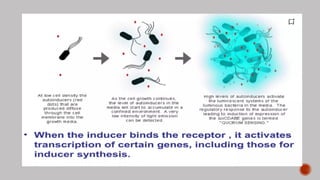
- Autoinducers increase in concentration
as population grows.
- Once a threshold is reached, they bind
to specific receptors, triggering gene
expression.
4.
HISTORY & DISCOVERY
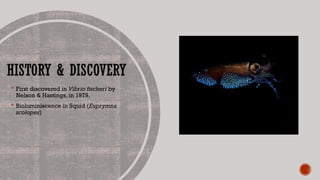
First discovered in Vibrio fischeri by
Nelson & Hastings, in 1979.
Bioluminiscence in Squid (Euprymna
scolopes)
5.
QUORUM SENSING INGRAM NEGATIVE
BACTERIA
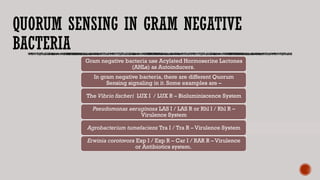
Gram negative bacteria use Acylated Hormoserine Lactones
(AHLs) as Autoinducers.
In gram negative bacteria, there are different Quorum
Sensing signaling in it. Some examples are –
The Vibrio fischeri LUX I / LUX R – Bioluminiscence System
Pseudomonas aeruginosa LAS I / LAS R or Rhl I / Rhl R –
Virulence System
Agrobacterium tumefaciens Tra I / Tra R – Virulence System
Erwinia corotovora Exp I / Exp R – Car I / RAR R – Virulence
or Antibiotics system.
6.
VIBRIO FISCHERI
A gramnegative bacteria
using LUX I / LUX R System for
its Bioluminiscence system in
water.
Lives both as specific
symbiont in the light organs of
certain marine fish and squid
and as free living organisms
in seawater.
When at low cell density in
seawater, cultures of this
bacterium appear dark.
However, when at high cell
density within the light
organs, the population emits
light and become
biolumiscent.
9.
IN DETAIL…
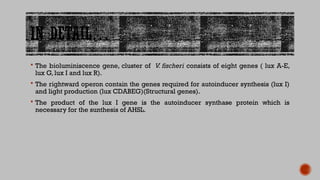
Thebioluminiscence gene, cluster of V
. fischeri consists of eight genes ( lux A-E,
lux G, lux I and lux R).
The rightward operon contain the genes required for autoinducer synthesis (lux I)
and light production (lux CDABEG)(Structural genes).
The product of the lux I gene is the autoinducer synthase protein which is
necessary for the sunthesis of AHSL.
10.
CONTD…
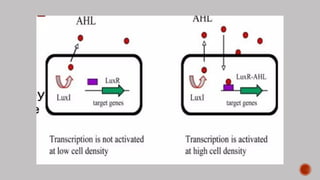
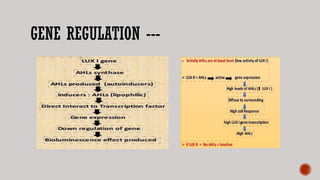
The leftwordoperon consists of a transcriptional activator, lux R. At a low cell
densities lux I is transcribed at a basal level and AHLs slowly accumulates in the
medium until it reaches a sufficiently high concentration.
It is then thought to interact with autoinducer domain of Lux R forming a complex.
The Lux R – AHLs complex then binds to the lux promoter region upstream of lux I,
known as the lux box, and strongly stimulates transcription of the luxlCDABEG
operon.
This causes an induction of luminiscence and generates a positive feedback loop,
leading to further expression of lux I and more AHLs.
QUORUM SENSING INGRAM POSITIVE BACTERIA
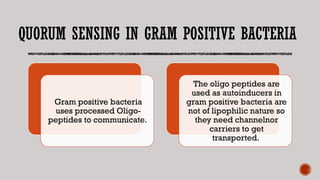
Gram positive bacteria
uses processed Oligo-
peptides to communicate.
The oligo peptides are
used as autoinducers in
gram positive bacteria are
not of lipophilic nature so
they need channelnor
carriers to get
transported.
13.
QUORUM SENSING INGRAM POSITIVE BACTERIA
Each gram-positive bacterium uses a specific signal different from other bacteria and the receptors are
sensitive to the signal structures.
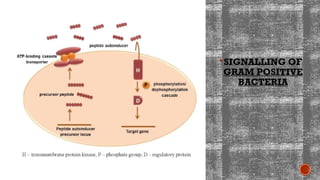
Gram-positive bacteria communicate using modified oligopeptides AIP (autoinducing peptide) as signals
and two component membrane bound sensor histidine kinases as receptors.
The cell membrane is impermeable to peptides and thus specialized transporters are required to secrete
AIPs.
The AIPs are encoded as precursors (proAIPs). The transporter system processes the pro-AIPs. Processed
AIPs range in size from 5 to 17 amino acids (from ~50 amino acids).
Extracellular AIPs are detected via membrane-bound two-component sensor kinases which
autophosphorylate at conserved histidines when bound by the AIP.
Phosphoryl group is transferred to aspartate present on a cytoplasmic response-regulator protein, and the
phosphorylated response regulator controls expression of QS-target genes.
14.
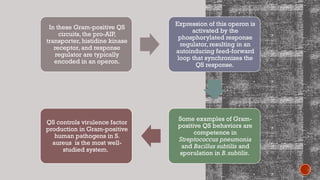
In these Gram-positiveQS
circuits, the pro-AIP,
transporter, histidine kinase
receptor, and response
regulator are typically
encoded in an operon.
Expression of this operon is
activated by the
phosphorylated response
regulator, resulting in an
autoinducing feed-forward
loop that synchronizes the
QS response.
Some examples of Gram-
positive QS behaviors are
competence in
Streptococcus pneumonia
and Bacillus subtilis and
sporulation in B. subtilis.
QS controls virulence factor
production in Gram-positive
human pathogens in S.
aureus is the most well-
studied system.
FUNCTIONS
OF
QUORUM
SENSING
IN
BACTERIA
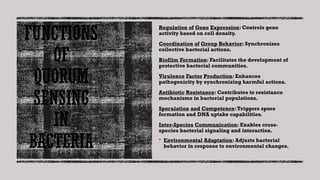
Regulation of GeneExpression: Controls gene
activity based on cell density.
Coordination of Group Behavior: Synchronizes
collective bacterial actions.
Biofilm Formation: Facilitates the development of
protective bacterial communities.
Virulence Factor Production: Enhances
pathogenicity by synchronizing harmful actions.
Antibiotic Resistance: Contributes to resistance
mechanisms in bacterial populations.
Sporulation and Competence:Triggers spore
formation and DNA uptake capabilities.
Inter-Species Communication: Enables cross-
species bacterial signaling and interaction.
Environmental Adaptation: Adjusts bacterial
behavior in response to environmental changes.
17.
REFERENCES
Bassler BL,Wright M, Showalter RE, Silverman MR. 1993. Intercellular signalling in Vibrio harveyi:
sequence and function of genes regulating expression of luminescence. Mol. Microbiol. 9:773–86
Bassler BL, Wright M, Silverman MR. 1994a. Multiple signalling systems controlling expression of
luminescence in Vibrio harveyi: sequence and function of genes encoding a second sensory pathway.
Mol. Microbiol. 13:273–86
Bassler BL, Wright M, Silverman MR. 1994b. Sequence and function of LuxO, a negative regulator of
luminescence in Vibrio harveyi. Mol. Microbiol. 12:403–12
Bassler BL,Waters CM. 2005. Quorum sensing: Cell-to-Cell communication in bacteria. Annul. Rev. Cell
Dev. Biol.21:319-46
Smith RS, Iglewski BH. 2003. P. aeruginosa quorum-sensing systems and virulence. Curr. Opin.
Microbiol. 6:56–60
Stevens AM, Dolan KM, Greenberg EP. 1994. Synergistic binding of the Vibrio fischeri LuxR
transcriptional activator domain and RNA polymerase to the lux promoter region. Proc. Natl. Acad. Sci.
USA 91:12619–23
Visick KL, Foster J, Doino J, McFall-Ngai M, Ruby EG. 2000. Vibrio fischeri lux genes play an important
role in colonization and development of the host light organ. J. Bacteriol. 182:4578–86





![谷歌留痕技术 [ 𝙩𝙤𝙥 𝟮𝟯𝟯. 𝙘 𝙤𝙢 ]](https://cdn.slidesharecdn.com/ss_thumbnails/top233-260130174328-3833018c-thumbnail.jpg?width=640&height=640&fit=bounds)


