SATYAM SINGH
PhD Scholor, IIT-Indore
-TYPES-
1- CELLULAR ENGINEERING
2- ENZYME ENGINEERING
3- METABOLIC ENGINEERING
 Metabolic engineering is a field where directed
improvement of cellular properties through the
modification of specific biochemical reactions or the
introduction of new pathways, by using the
recombinant DNA technology.
 Metabolic engineering is basically meant for
the production of chemicals, fuels,
pharmaceuticals and medicine by altering the
metabolic pathways.
 Metabolic engineering is determined by commercial
applications by which we can modify the developing strains
for production of useful metabolites.
 This technology need overexpression or down-regulation of
certain proteins in a metabolic pathway, such that the cell
produces a new product.
 First main step for successful engineering requires the
complete understanding of host cell environment for genetic
modifications.
 The effect of genetic manipulation on growth should also be
examined.
 The genetic manipulation may negatively effect on metabolic
burden.
 For example, genetic manipulation for overexpression of
phosphoenolpyruvate (PEP) inhibits heat-shock response and
nitrogen regulation.
 To achieve the product several methods can be optimize, such as
elimination of competitive pathway and toxic byproduct and
expression of a heterologous enzyme to improve the synthesis of
products, are used for the modification of the host cell.
 In classical metabolic engineering approach, genetic manipulation
is based on the prior knowledge of enzyme network pathway and its
kinetics; on the other hand, in inverse metabolic engineering the
environmental or genetic conditions are considered for the desired
phenotype for genetic manipulation.
 A number of approaches are used for secondary metabolites
improvement using bacteria in metabolic engineering, such as
 (1) heterologous expression of gene clusters
 (2) regulatory networks pathway engineering.
 (3) gene insertion or deletion
 (4) stimulation using certain substrates.
 Therefore, metabolic engineering is currently used as cell factories
for production of amino acids, biofuels, pharmaceuticals,
bioplastics, platform chemicals, silk proteins, etc.
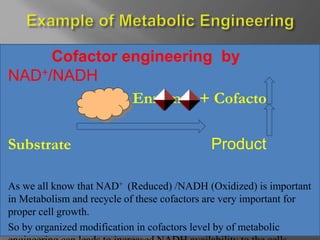
Cofactor engineering by
NAD+/NADH
Enzymes + Cofactor
Substrate Product
As we all know that NAD+ (Reduced) /NADH (Oxidized) is important
in Metabolism and recycle of these cofactors are very important for
proper cell growth.
So by organized modification in cofactors level by of metabolic
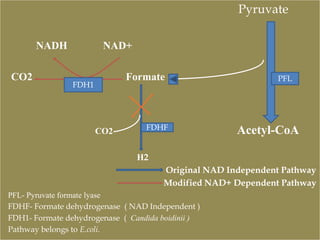
Pyruvate
NADH NAD+
CO2 Formate PFL
CO2 Acetyl-CoA
H2
Original NAD Independent Pathway
Modified NAD+ Dependent Pathway
PFL- Pyruvate formate lyase
FDHF- Formate dehydrogenase ( NAD Independent )
FDH1- Formate dehydrogenase ( Candida boidinii )
Pathway belongs to E.coli.
FDH1
PFL
FDHF
Thank You

Metabolic engineering ppt

  • 1.
  • 2.
    -TYPES- 1- CELLULAR ENGINEERING 2-ENZYME ENGINEERING 3- METABOLIC ENGINEERING
  • 3.
     Metabolic engineeringis a field where directed improvement of cellular properties through the modification of specific biochemical reactions or the introduction of new pathways, by using the recombinant DNA technology.  Metabolic engineering is basically meant for the production of chemicals, fuels, pharmaceuticals and medicine by altering the metabolic pathways.
  • 4.
     Metabolic engineeringis determined by commercial applications by which we can modify the developing strains for production of useful metabolites.  This technology need overexpression or down-regulation of certain proteins in a metabolic pathway, such that the cell produces a new product.  First main step for successful engineering requires the complete understanding of host cell environment for genetic modifications.  The effect of genetic manipulation on growth should also be examined.  The genetic manipulation may negatively effect on metabolic burden.  For example, genetic manipulation for overexpression of phosphoenolpyruvate (PEP) inhibits heat-shock response and nitrogen regulation.
  • 5.
     To achievethe product several methods can be optimize, such as elimination of competitive pathway and toxic byproduct and expression of a heterologous enzyme to improve the synthesis of products, are used for the modification of the host cell.  In classical metabolic engineering approach, genetic manipulation is based on the prior knowledge of enzyme network pathway and its kinetics; on the other hand, in inverse metabolic engineering the environmental or genetic conditions are considered for the desired phenotype for genetic manipulation.  A number of approaches are used for secondary metabolites improvement using bacteria in metabolic engineering, such as  (1) heterologous expression of gene clusters  (2) regulatory networks pathway engineering.  (3) gene insertion or deletion  (4) stimulation using certain substrates.  Therefore, metabolic engineering is currently used as cell factories for production of amino acids, biofuels, pharmaceuticals, bioplastics, platform chemicals, silk proteins, etc.
  • 6.
    Cofactor engineering by NAD+/NADH Enzymes+ Cofactor Substrate Product As we all know that NAD+ (Reduced) /NADH (Oxidized) is important in Metabolism and recycle of these cofactors are very important for proper cell growth. So by organized modification in cofactors level by of metabolic
  • 7.
    Pyruvate NADH NAD+ CO2 FormatePFL CO2 Acetyl-CoA H2 Original NAD Independent Pathway Modified NAD+ Dependent Pathway PFL- Pyruvate formate lyase FDHF- Formate dehydrogenase ( NAD Independent ) FDH1- Formate dehydrogenase ( Candida boidinii ) Pathway belongs to E.coli. FDH1 PFL FDHF
  • 8.