Question 
types
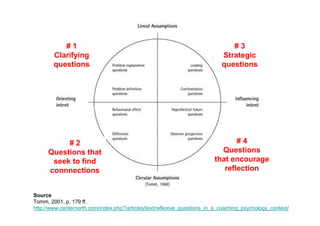
Lineal assumptions 
Questions that are strategic, 
leading, confrontational 
Questions that clarify, explain 
and define problems 
Questions that explore 
connnections and differences 
Circular assumptions 
Type # 3 
Type # 1 
Type # 2 
http://www.centernorth.com/index.php?/articles/text/reflexive_questions_in_a_coaching_psychology_context/ 
Influencing intent 
Orienting intent 
Type # 4 
Questions that encourage 
reflection
Type # 1 
Questions that clarify, 
explain and define problems
Goals of clarifying problems 
 To get information about a problem, i.e. be curious. 
 To define the reasons for a problem.
Questions to define the problem 
 What is the problem in one word / sentence? 
 What exactly happened? 
 Which events led to the problem? 
 What kind of help do you need? 
 How did the problem happen? 
 How is…. done at the company? 
 Who did what? 
 Where did it happen? 
 When did it happen?
Questions to define reasons for the problem 
 Why do you think it happened? Ask 5 x why. 
 Could it be that it happened because ..…? 
 Why are the values of the company not practiced 
in interaction with customers?
Further inspiration 
http://www.slideshare.net/frankcalberg/problem-analysis-methods
Type # 2 
Questions that explore 
connections and differences
Goal of questions that find connections 
To find connections between persons, 
objects, actions, perceptions, ideas, 
feelings, events, beliefs, context.
Examples of what questions 
 What relation do you see between events A and B? 
 What relation do you see between what person x did 
and….? 
 What connection do you see among activities? 
 What impact will the activities launched have on 
customers and people who work for the company?
Examples of how questions 
 How does person x get along with person y? 
 How does person A think about person B?
Examples of who questions 
 Who do you think worries most about this problem? 
 This seems to be a problem for you. 
For whom is it not a problem?
Type # 3 
Questions that are strategic, 
leading, confrontational
Goal of strategic questions 
To influence / help a person do things in 
new ways, for example by encouraging the 
person to challenge rules / assumptions.
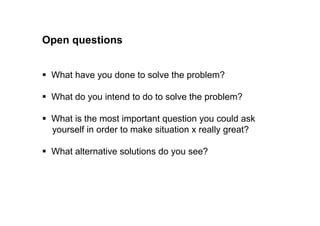
Open questions 
 What have you done to solve the problem? 
 What do you intend to do to solve the problem? 
 What is the most important question you could ask 
yourself in order to make situation x really great? 
 What alternative solutions do you see?
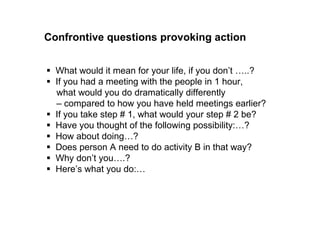
Confrontive questions provoking action 
 What would it mean for your life, if you don’t …..? 
 If you had a meeting with the people in 1 hour, what would 
you do differently compared to how you have held meetings 
earlier? 
 If you take step # 1, what would your step # 2 be? 
 Have you thought of the following possibility:…? 
 How about doing…? 
 Does person A need to do activity B in that way? 
 Why don’t you….? 
 Here’s what you do:…
Type # 4 
Questions that 
encourage reflection
Goals of questions that encourage reflection 
 To encourage a person to think / reflect about his/her 
own way of doing things? 
 To help a person discover himself / herself in new ways. 
 To call forth personal knowledge.
 Reflecting on what you have done, what do you think 
you did well? 
 Looking back, what would you have done differently? 
 Reflecting on the experience you had, which personal 
values of yours have become more important for you?
 How do you think others experience the conflict 
you are having with your colleague? 
 Think of someone you truly respect and admire. 
What would he / she do in your position? 
 What do you think is blocking you / holding you back 
from doing ….? 
 How did it make you feel, when ….. happened?
 What would be different in your life, if ….? 
 I hear your concern about getting the right sales people to 
pull off this campaign. If we could get the right people, what 
could the campaign look like?
Further inspiration 
http://business.financialpost.com/2012/01/14/coaching-advice-from-the-pros/ 
http://www.familytherapy.org/documents/Interventive3.PDF 
https://hbr.org/2014/09/coaching-an-employee-who-doesnt-want-help/ 
https://hbr.org/2013/12/conflict-strategies-for-nice-people/ 
https://hbr.org/2014/11/tactics-for-asking-good-follow-up-questions 
https://hbr.org/2012/11/to-have-the-most-impact-ask-qu 
https://www.youtube.com/watch?v=1bknGdA_xdw 
http://www.slideshare.net/frankcalberg/listening-tips 
http://www.slideshare.net/frankcalberg/questions-to-discover-your-values 
http://www.slideshare.net/frankcalberg/questions-that-challenge-the-way-you-think
Thank you for your interest. For further inspiration 
and personalized services, feel welcome to visit 
http://www.frankcalberg.com 
Have a great day.

Types of questions

  • 1.
  • 2.
    Lineal assumptions Questionsthat are strategic, leading, confrontational Questions that clarify, explain and define problems Questions that explore connnections and differences Circular assumptions Type # 3 Type # 1 Type # 2 http://www.centernorth.com/index.php?/articles/text/reflexive_questions_in_a_coaching_psychology_context/ Influencing intent Orienting intent Type # 4 Questions that encourage reflection
  • 3.
    Type # 1 Questions that clarify, explain and define problems
  • 4.
    Goals of clarifyingproblems  To get information about a problem, i.e. be curious.  To define the reasons for a problem.
  • 5.
    Questions to definethe problem  What is the problem in one word / sentence?  What exactly happened?  Which events led to the problem?  What kind of help do you need?  How did the problem happen?  How is…. done at the company?  Who did what?  Where did it happen?  When did it happen?
  • 6.
    Questions to definereasons for the problem  Why do you think it happened? Ask 5 x why.  Could it be that it happened because ..…?  Why are the values of the company not practiced in interaction with customers?
  • 7.
  • 8.
    Type # 2 Questions that explore connections and differences
  • 9.
    Goal of questionsthat find connections To find connections between persons, objects, actions, perceptions, ideas, feelings, events, beliefs, context.
  • 10.
    Examples of whatquestions  What relation do you see between events A and B?  What relation do you see between what person x did and….?  What connection do you see among activities?  What impact will the activities launched have on customers and people who work for the company?
  • 11.
    Examples of howquestions  How does person x get along with person y?  How does person A think about person B?
  • 12.
    Examples of whoquestions  Who do you think worries most about this problem?  This seems to be a problem for you. For whom is it not a problem?
  • 13.
    Type # 3 Questions that are strategic, leading, confrontational
  • 14.
    Goal of strategicquestions To influence / help a person do things in new ways, for example by encouraging the person to challenge rules / assumptions.
  • 15.
    Open questions What have you done to solve the problem?  What do you intend to do to solve the problem?  What is the most important question you could ask yourself in order to make situation x really great?  What alternative solutions do you see?
  • 16.
    Confrontive questions provokingaction  What would it mean for your life, if you don’t …..?  If you had a meeting with the people in 1 hour, what would you do differently compared to how you have held meetings earlier?  If you take step # 1, what would your step # 2 be?  Have you thought of the following possibility:…?  How about doing…?  Does person A need to do activity B in that way?  Why don’t you….?  Here’s what you do:…
  • 17.
    Type # 4 Questions that encourage reflection
  • 18.
    Goals of questionsthat encourage reflection  To encourage a person to think / reflect about his/her own way of doing things?  To help a person discover himself / herself in new ways.  To call forth personal knowledge.
  • 19.
     Reflecting onwhat you have done, what do you think you did well?  Looking back, what would you have done differently?  Reflecting on the experience you had, which personal values of yours have become more important for you?
  • 20.
     How doyou think others experience the conflict you are having with your colleague?  Think of someone you truly respect and admire. What would he / she do in your position?  What do you think is blocking you / holding you back from doing ….?  How did it make you feel, when ….. happened?
  • 21.
     What wouldbe different in your life, if ….?  I hear your concern about getting the right sales people to pull off this campaign. If we could get the right people, what could the campaign look like?
  • 22.
    Further inspiration http://business.financialpost.com/2012/01/14/coaching-advice-from-the-pros/ http://www.familytherapy.org/documents/Interventive3.PDF https://hbr.org/2014/09/coaching-an-employee-who-doesnt-want-help/ https://hbr.org/2013/12/conflict-strategies-for-nice-people/ https://hbr.org/2014/11/tactics-for-asking-good-follow-up-questions https://hbr.org/2012/11/to-have-the-most-impact-ask-qu https://www.youtube.com/watch?v=1bknGdA_xdw http://www.slideshare.net/frankcalberg/listening-tips http://www.slideshare.net/frankcalberg/questions-to-discover-your-values http://www.slideshare.net/frankcalberg/questions-that-challenge-the-way-you-think
  • 23.
    Thank you foryour interest. For further inspiration and personalized services, feel welcome to visit http://www.frankcalberg.com Have a great day.