1
 A cloze test is an exercise,
test, or assessment consisting
of a portion of language with
certain items, words, or signs
removed, where the
participant is asked to replace
the missing language item.
2
 Cloze tests require the ability to
understand context
and vocabulary in order to identify
the correct language or part of
speech that belongs in the deleted
passages. This exercise is
commonly administered for the
assessment of native and
second language learning and
instruction
3

Research indicates that teachers at many
elementary schools require their students
to read books and materials that they often
struggle to read. This condition is largely
based on the graded system which
assumes that all children learn all things at
virtually the same time. It seems imperative
that teachers choose materials which
match the students' reading skills.
4

To accomplish this, the first task is to
determine the appropriateness of reading
materials for various students. To some
extent, the standardized achievement tests
offered at least once a school year in most
school systems, provide such information.
However, the results of such
5
 Words may be deleted from the text in
question either mechanically (every nth
word) or selectively, depending on exactly
what aspect it is intended to test for.
 The methodology is the subject of an
extensive academic literature; teachers
commonly devise ad hoc tests.
 Cloze deletion tests may be used with
the spacing effect to improve long-term
retention of vocabulary, facts, etc.
6
 Cloze exercises are beneficial for learners in
many ways, but three most important are
that
 (1) They have real-world application,
 (2) They provide learners with natural-like
settings, and that
 (3) They can be flexibly and personally
tailored to meet learning needs.
7
 Usage- or task-based techniques are the most effective
language learning tools (Tomlinson).
 Studies have shown that young learners benefit far
greater from interactive activities rather than individual
work in course books.
 Adolescent and mature learners benefit from task-based
language learning that enhance and nurture their
creativity, rather than simple learning by rote.
 Traditional vocabulary flash cards are useful for mapping
individual words to their meanings, but limited in their
real world application;
8
 Cloze tests are the natural next
step, bridging the gap between
individual work and interaction.
 Cloze tests promote active
production of vocabulary, not just
recognition.
 They can be used to bolster
vocabulary usage and free recall,
reinforce grammatical knowledge
and structural recognition, and
strengthen overall comprehension.
9
 Benefit of cloze exercises are that
they provide learners with natural-
like settings to try out new
vocabulary items.
 This natural input is a crucial
component of what language
acquisitionists sometimes refer to as
“the richness of the base”.
10
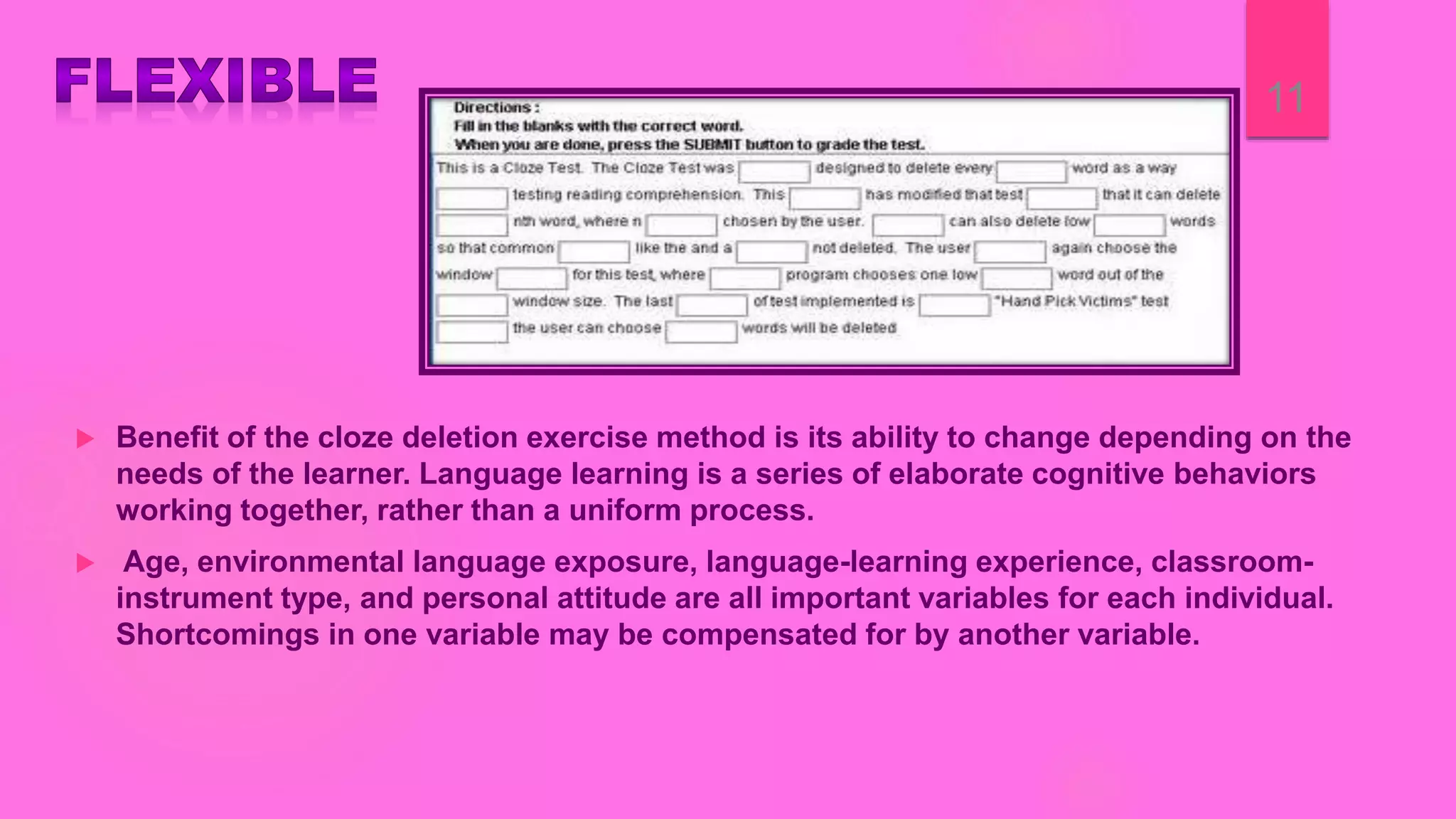
 Benefit of the cloze deletion exercise method is its ability to change depending on the
needs of the learner. Language learning is a series of elaborate cognitive behaviors
working together, rather than a uniform process.
 Age, environmental language exposure, language-learning experience, classroom-
instrument type, and personal attitude are all important variables for each individual.
Shortcomings in one variable may be compensated for by another variable.
11
 Llanguage learning is invariably going to be
hard work but there are a number of
intervening factors that can inhibit or
enhance an individual’s success.
 Various techniques can make language
learning easier, and one of the more
effective exercises are close deletion tests.
 Cloze deletion exercises have been used
for decades by language learners of all
levels, and have been shown to benefit
learning in a number of ways.
 They emphasize usage-based learning, can
be tailored to individual needs, and are
flexible in their application.
12
13

Cloze test

  • 1.
  • 2.
     A clozetest is an exercise, test, or assessment consisting of a portion of language with certain items, words, or signs removed, where the participant is asked to replace the missing language item. 2
  • 3.
     Cloze testsrequire the ability to understand context and vocabulary in order to identify the correct language or part of speech that belongs in the deleted passages. This exercise is commonly administered for the assessment of native and second language learning and instruction 3
  • 4.
     Research indicates thatteachers at many elementary schools require their students to read books and materials that they often struggle to read. This condition is largely based on the graded system which assumes that all children learn all things at virtually the same time. It seems imperative that teachers choose materials which match the students' reading skills. 4
  • 5.
     To accomplish this,the first task is to determine the appropriateness of reading materials for various students. To some extent, the standardized achievement tests offered at least once a school year in most school systems, provide such information. However, the results of such 5
  • 6.
     Words maybe deleted from the text in question either mechanically (every nth word) or selectively, depending on exactly what aspect it is intended to test for.  The methodology is the subject of an extensive academic literature; teachers commonly devise ad hoc tests.  Cloze deletion tests may be used with the spacing effect to improve long-term retention of vocabulary, facts, etc. 6
  • 7.
     Cloze exercisesare beneficial for learners in many ways, but three most important are that  (1) They have real-world application,  (2) They provide learners with natural-like settings, and that  (3) They can be flexibly and personally tailored to meet learning needs. 7
  • 8.
     Usage- ortask-based techniques are the most effective language learning tools (Tomlinson).  Studies have shown that young learners benefit far greater from interactive activities rather than individual work in course books.  Adolescent and mature learners benefit from task-based language learning that enhance and nurture their creativity, rather than simple learning by rote.  Traditional vocabulary flash cards are useful for mapping individual words to their meanings, but limited in their real world application; 8
  • 9.
     Cloze testsare the natural next step, bridging the gap between individual work and interaction.  Cloze tests promote active production of vocabulary, not just recognition.  They can be used to bolster vocabulary usage and free recall, reinforce grammatical knowledge and structural recognition, and strengthen overall comprehension. 9
  • 10.
     Benefit ofcloze exercises are that they provide learners with natural- like settings to try out new vocabulary items.  This natural input is a crucial component of what language acquisitionists sometimes refer to as “the richness of the base”. 10
  • 11.
     Benefit ofthe cloze deletion exercise method is its ability to change depending on the needs of the learner. Language learning is a series of elaborate cognitive behaviors working together, rather than a uniform process.  Age, environmental language exposure, language-learning experience, classroom- instrument type, and personal attitude are all important variables for each individual. Shortcomings in one variable may be compensated for by another variable. 11
  • 12.
     Llanguage learningis invariably going to be hard work but there are a number of intervening factors that can inhibit or enhance an individual’s success.  Various techniques can make language learning easier, and one of the more effective exercises are close deletion tests.  Cloze deletion exercises have been used for decades by language learners of all levels, and have been shown to benefit learning in a number of ways.  They emphasize usage-based learning, can be tailored to individual needs, and are flexible in their application. 12
  • 13.