The PEACE Model of Investigative Interviewing
To view the presentation live, please visit -
peace.interviewmanagementsolutions.com/registration
(Running time: 38 minutes)
The PEACE Model of Investigative Interviewing
Aims -
• By the end of this workshop you’ll be able to:
• Understand what the PEACE model framework is
• Understand how the PEACE model can be used
The PEACE Model of Investigative Interviewing
Welcome!
• By way of introduction:
• A career investigator with over 30 years investigative experience
• Law enforcement trainer as a Lecturer in Policing with Charles
Sturt University
• Honours Degree qualified and trained as a specialist interviewer of
children and other vulnerable victims of crime with Kent Police in
the UK
The PEACE Model of Investigative Interviewing
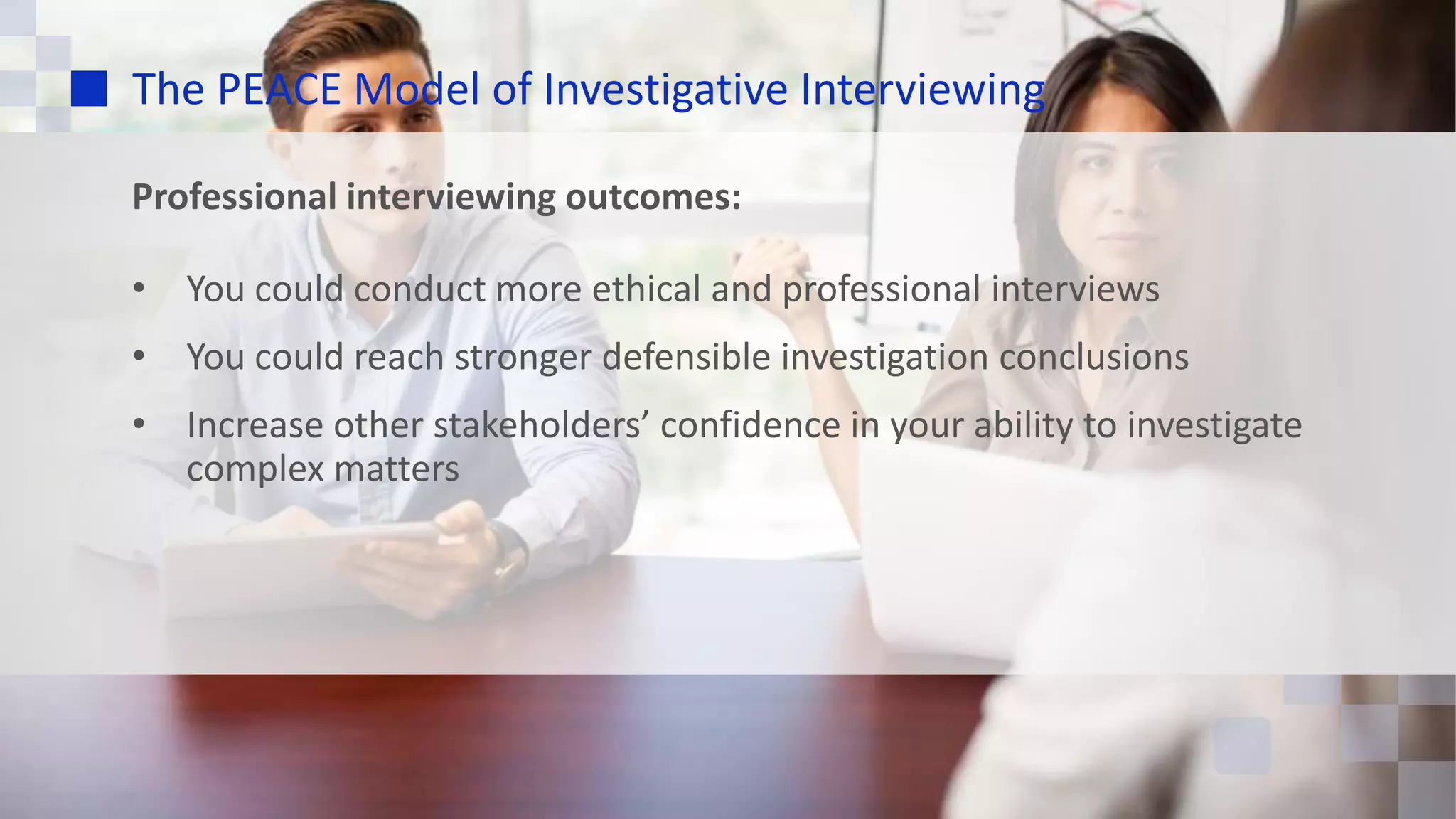
Professional interviewing outcomes:
• You could conduct more ethical and professional interviews
• You could reach stronger defensible investigation conclusions
• Increase other stakeholders’ confidence in your ability to investigate
complex matters
The PEACE Model of Investigative Interviewing
Objectives -
• By the end of this workshop you’ll be able to:
• Understand and describe the working parts of the PEACE model
framework
• Describe the key considerations when planning and preparing for any type
of interview
• Understand how to apply the model to plan, conduct and evaluate your
investigative interviews
The PEACE Model of Investigative Interviewing
What is the PEACE Model?
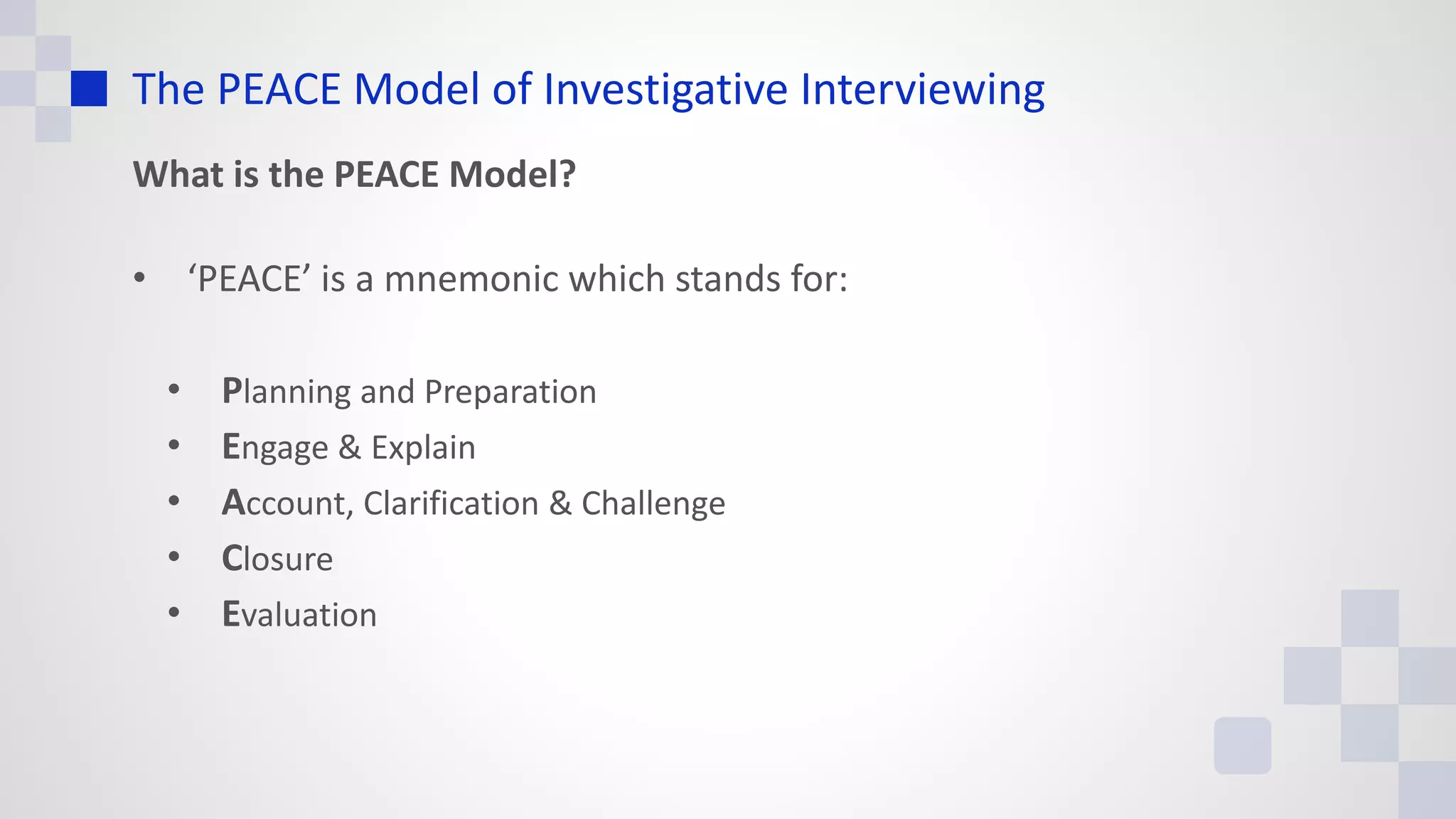
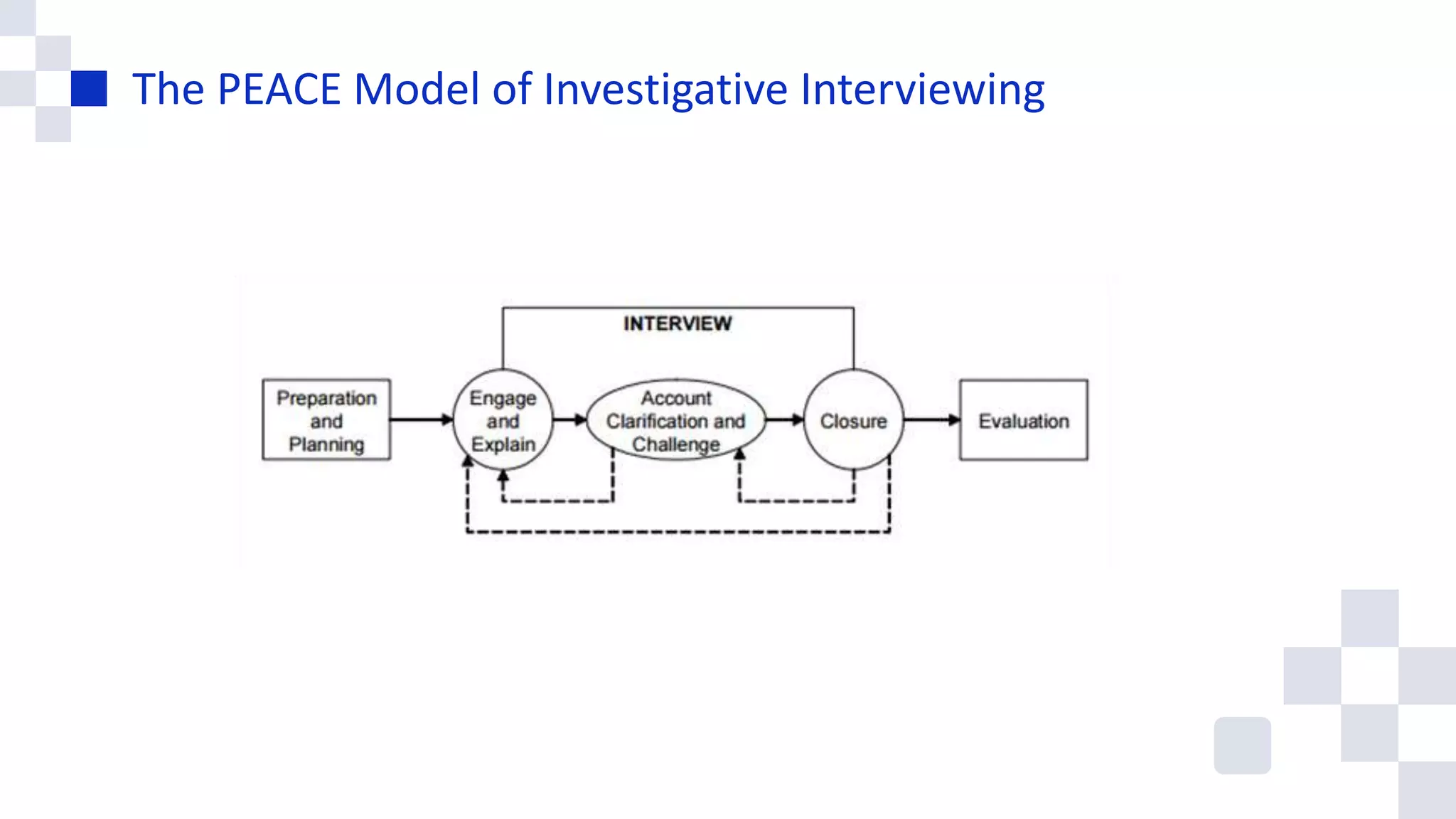
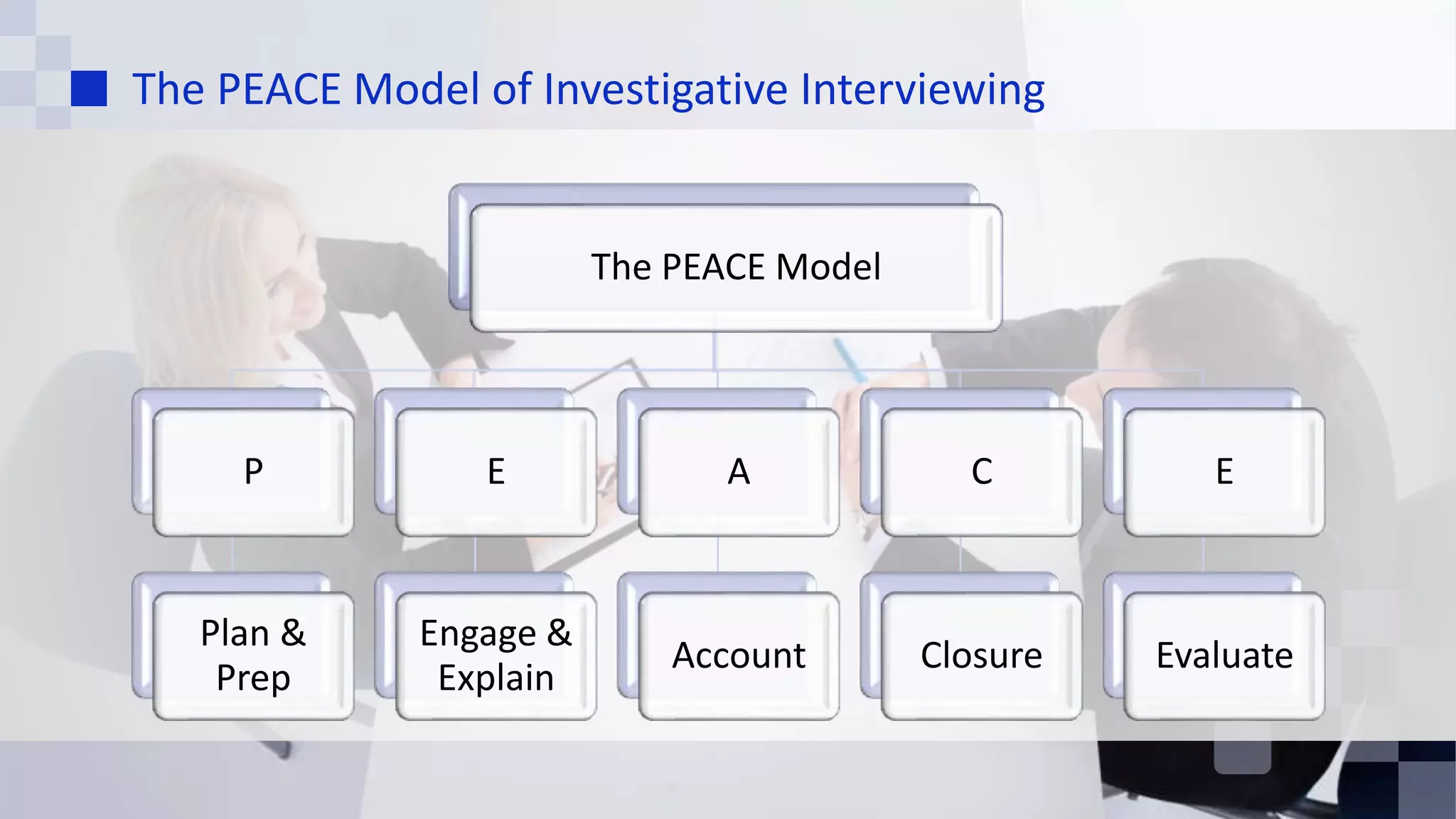
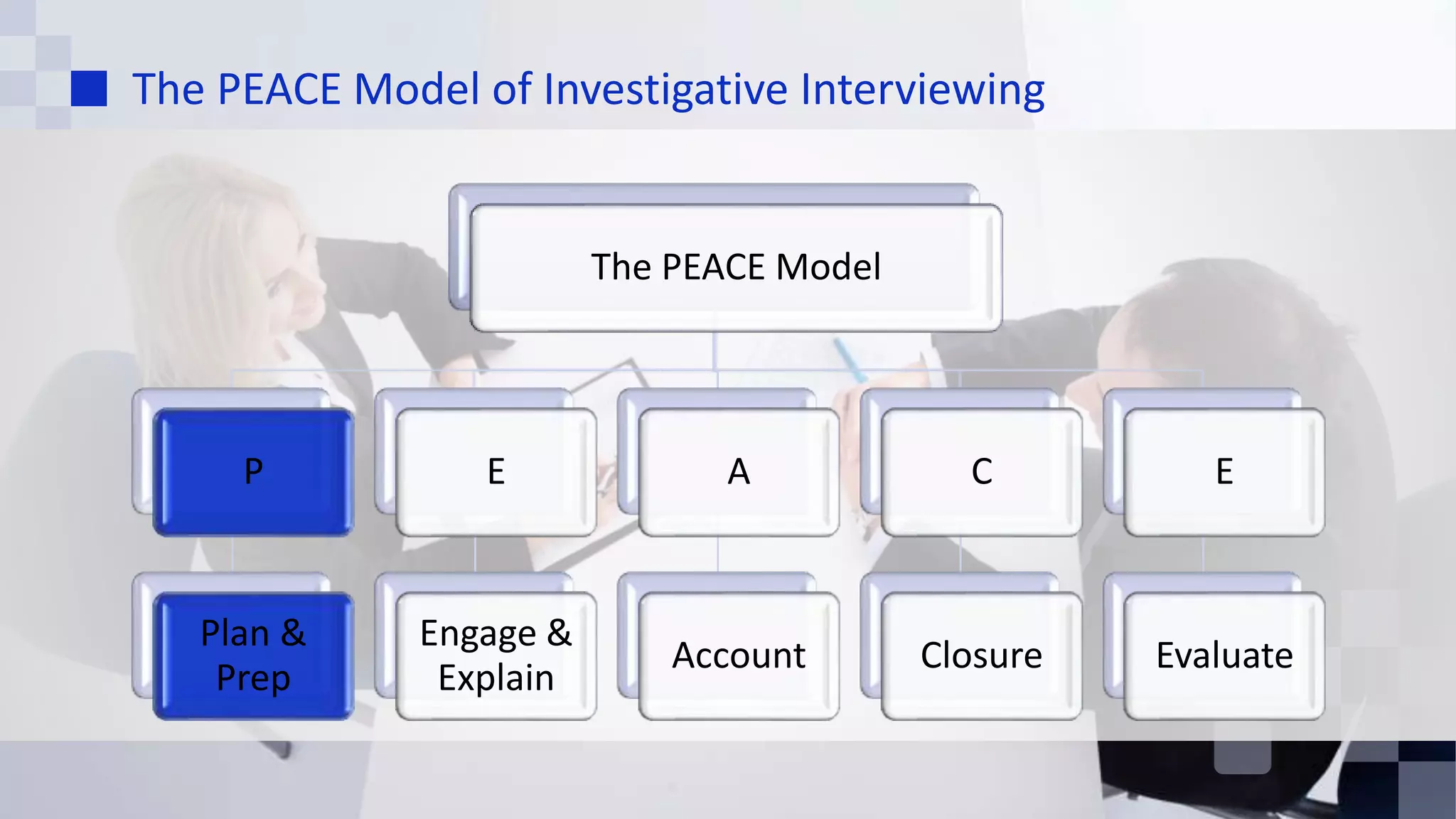
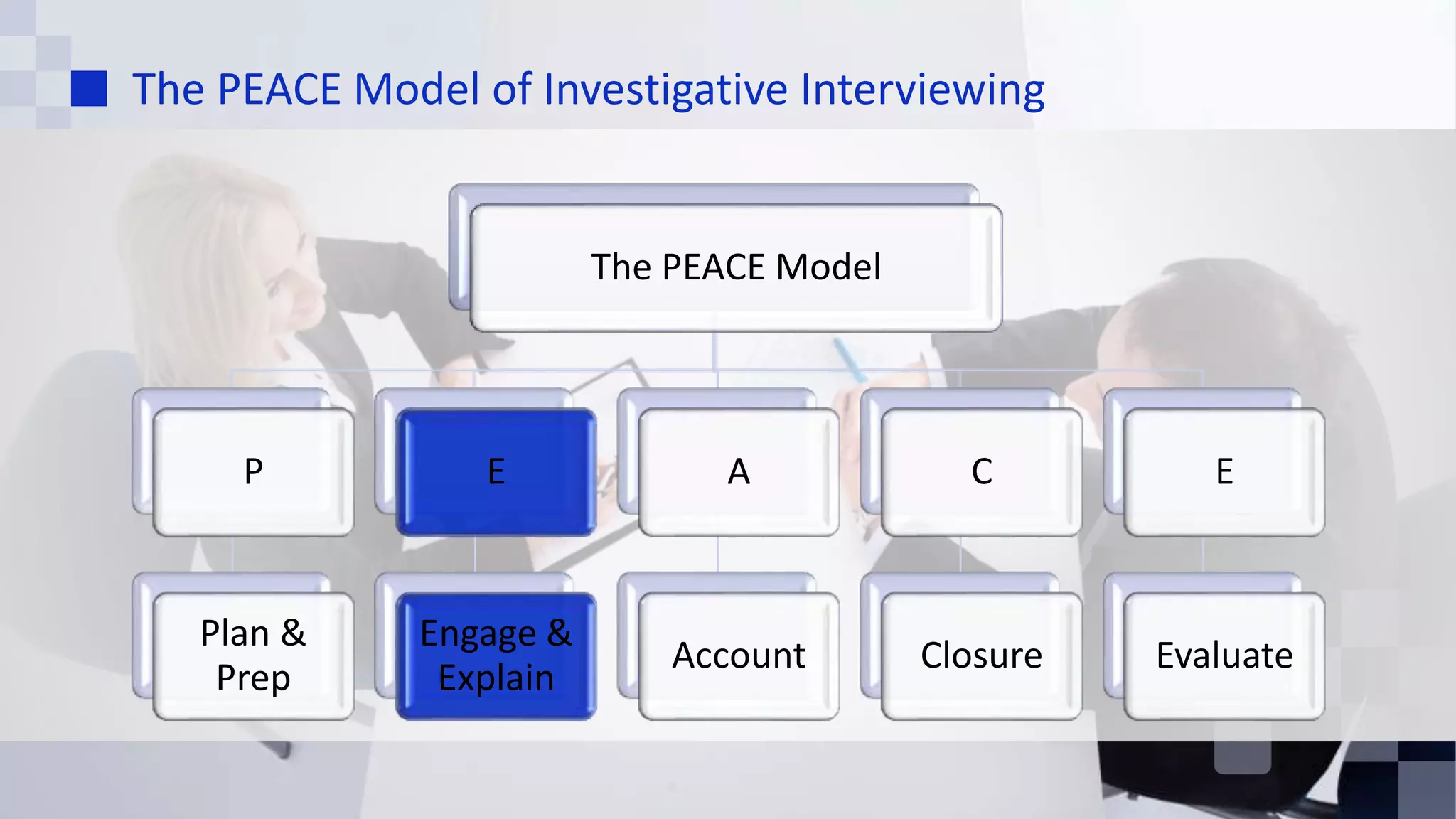
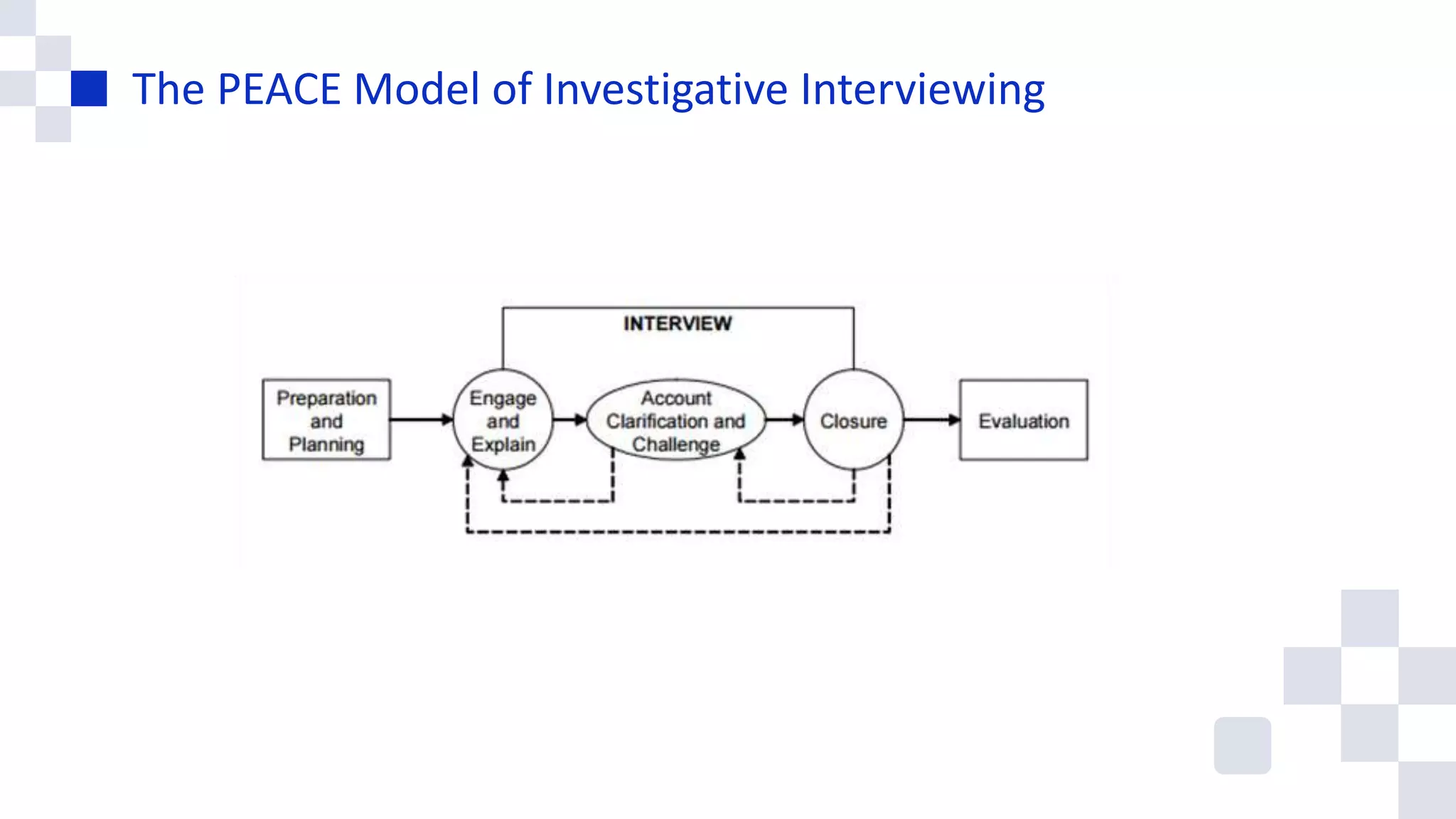
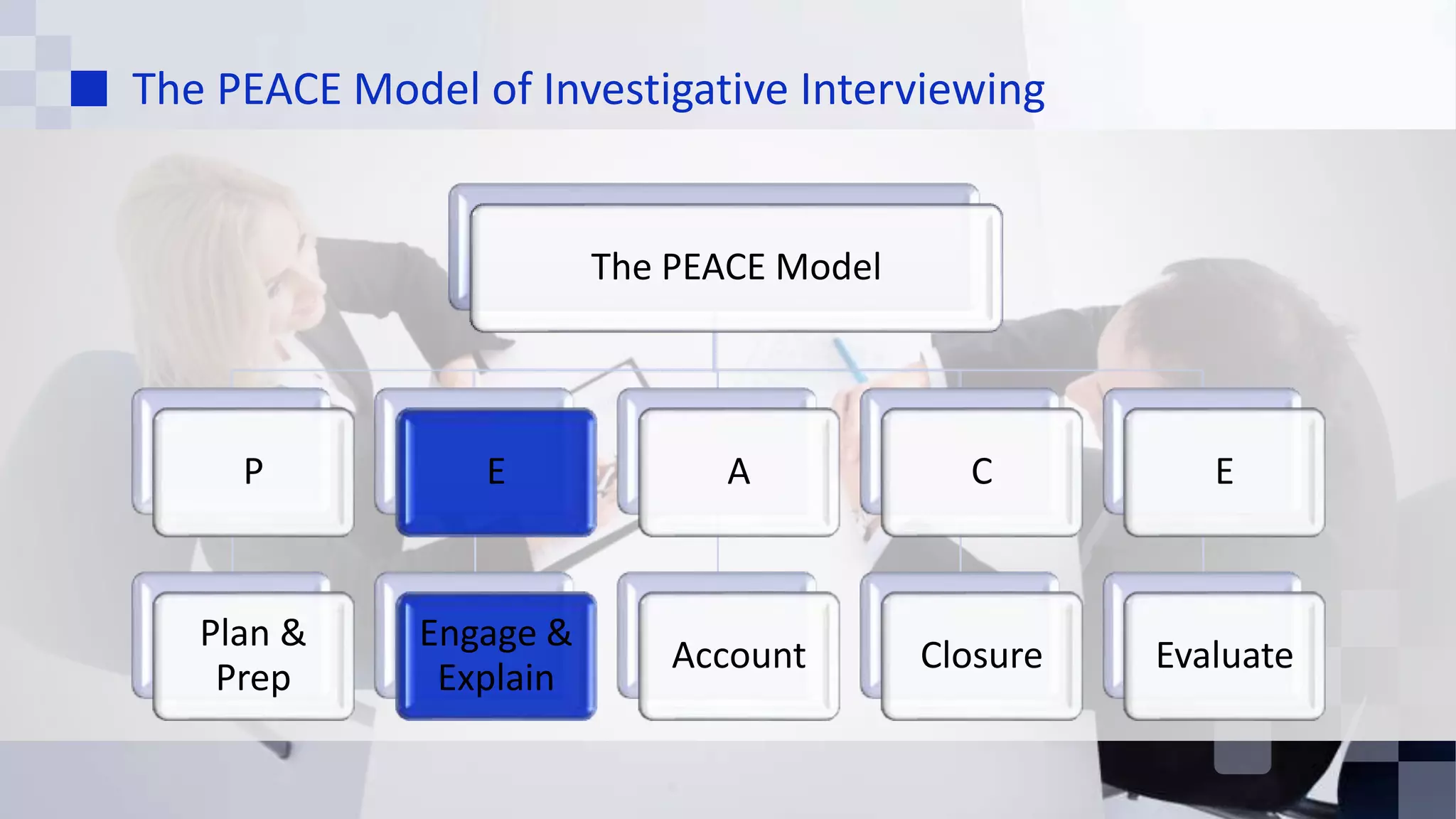
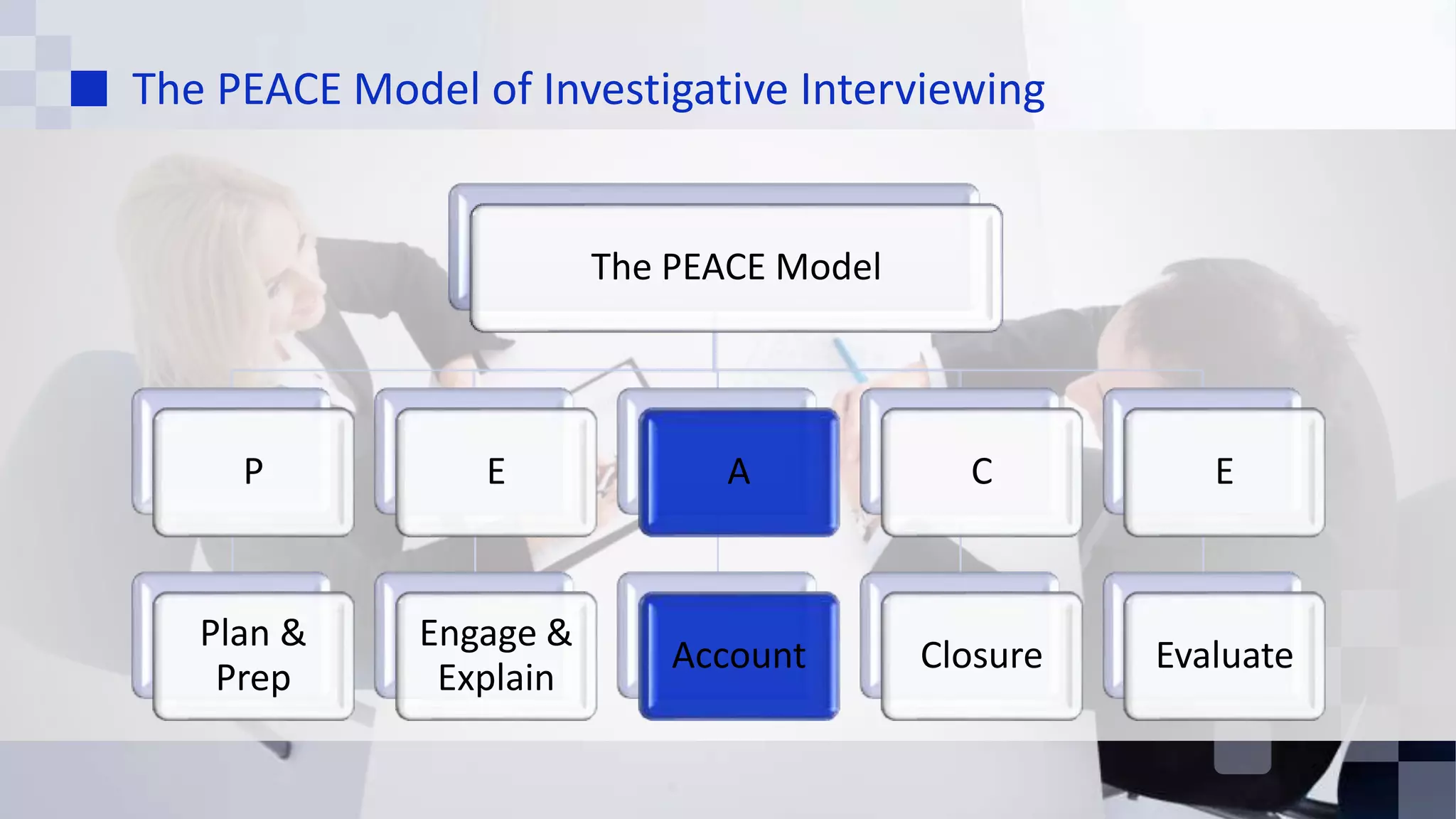
• ‘PEACE’ is a mnemonic which stands for:
• Planning and Preparation
• Engage & Explain
• Account, Clarification & Challenge
• Closure
• Evaluation
The PEACE Model of Investigative Interviewing
The Background -
• Created in the UK in the 1980s following a series of interviewing failings
that led to miscarriages of justice
• Designed to offer a more effective and ethical alternative to persuasive and
‘confession-focussed’ interviewing techniques
• Now being used by law enforcement around the world
The PEACE Model of Investigative Interviewing
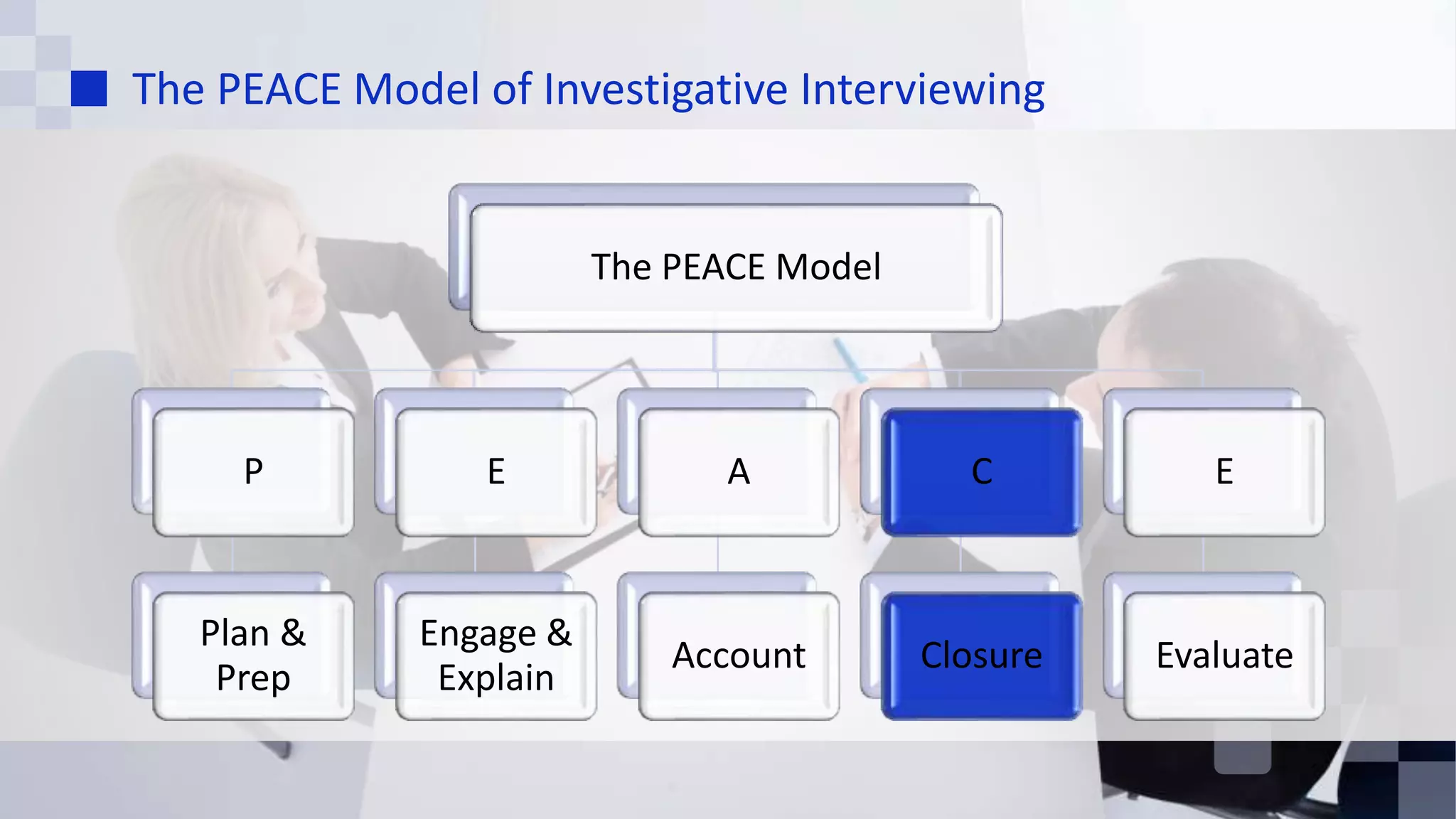
The PEACE Model
P
Plan &
Prep
E
Engage &
Explain
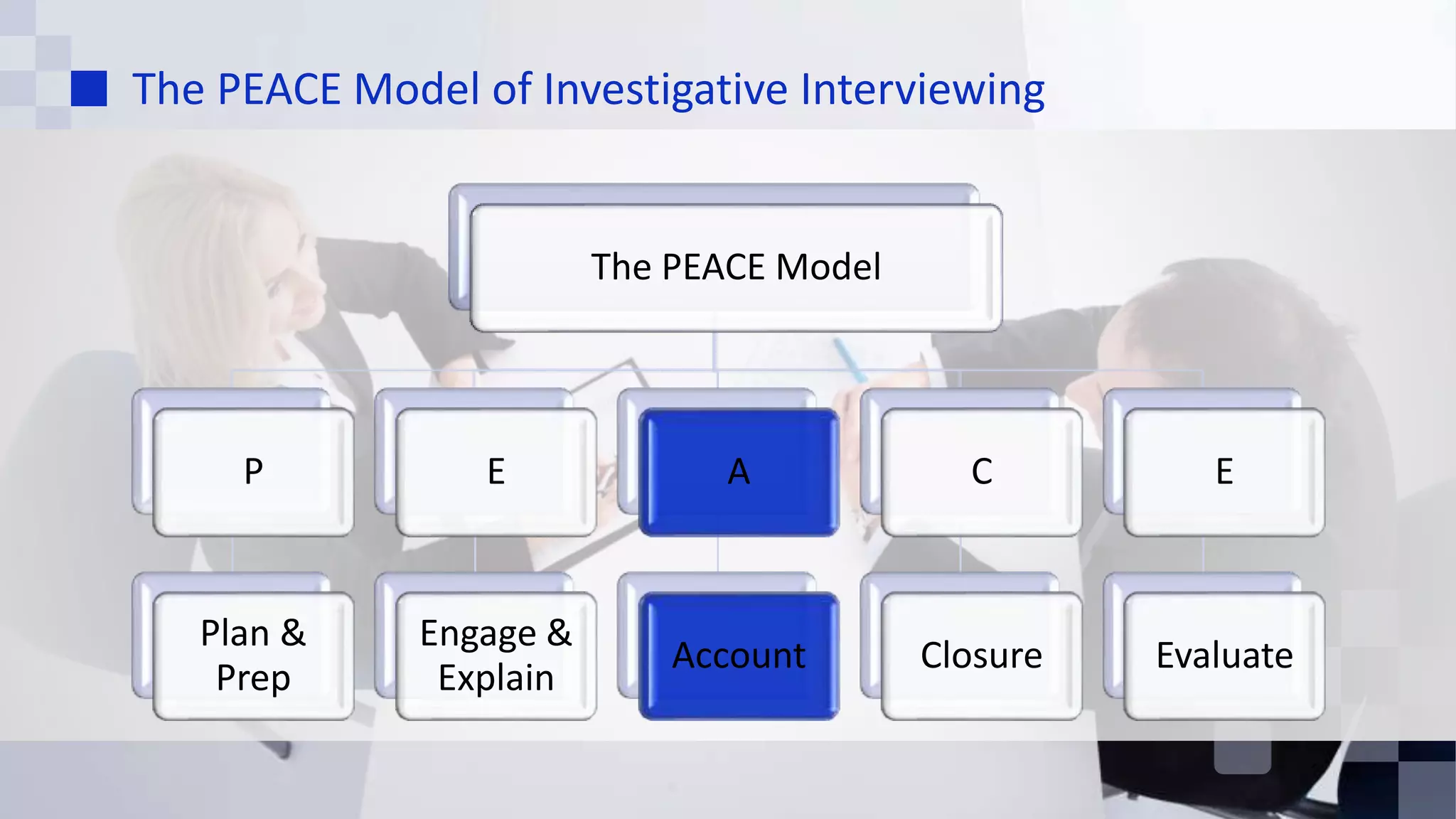
A
Account
C
Closure
E
Evaluate
The PEACE Model of Investigative Interviewing
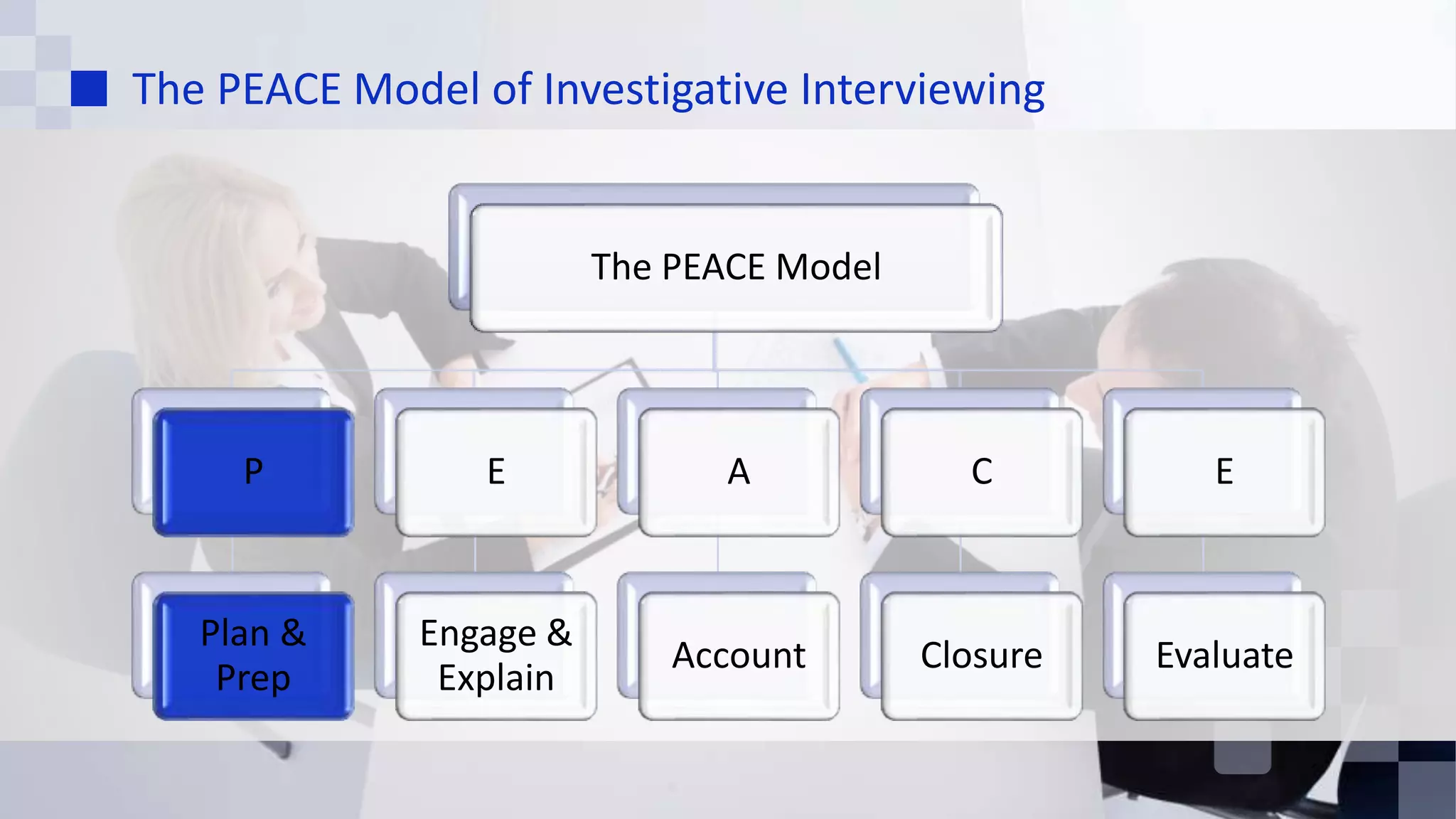
The PEACE Model
P
Plan &
Prep
E
Engage &
Explain
A
Account
C
Closure
E
Evaluate
The PEACE Model of Investigative Interviewing
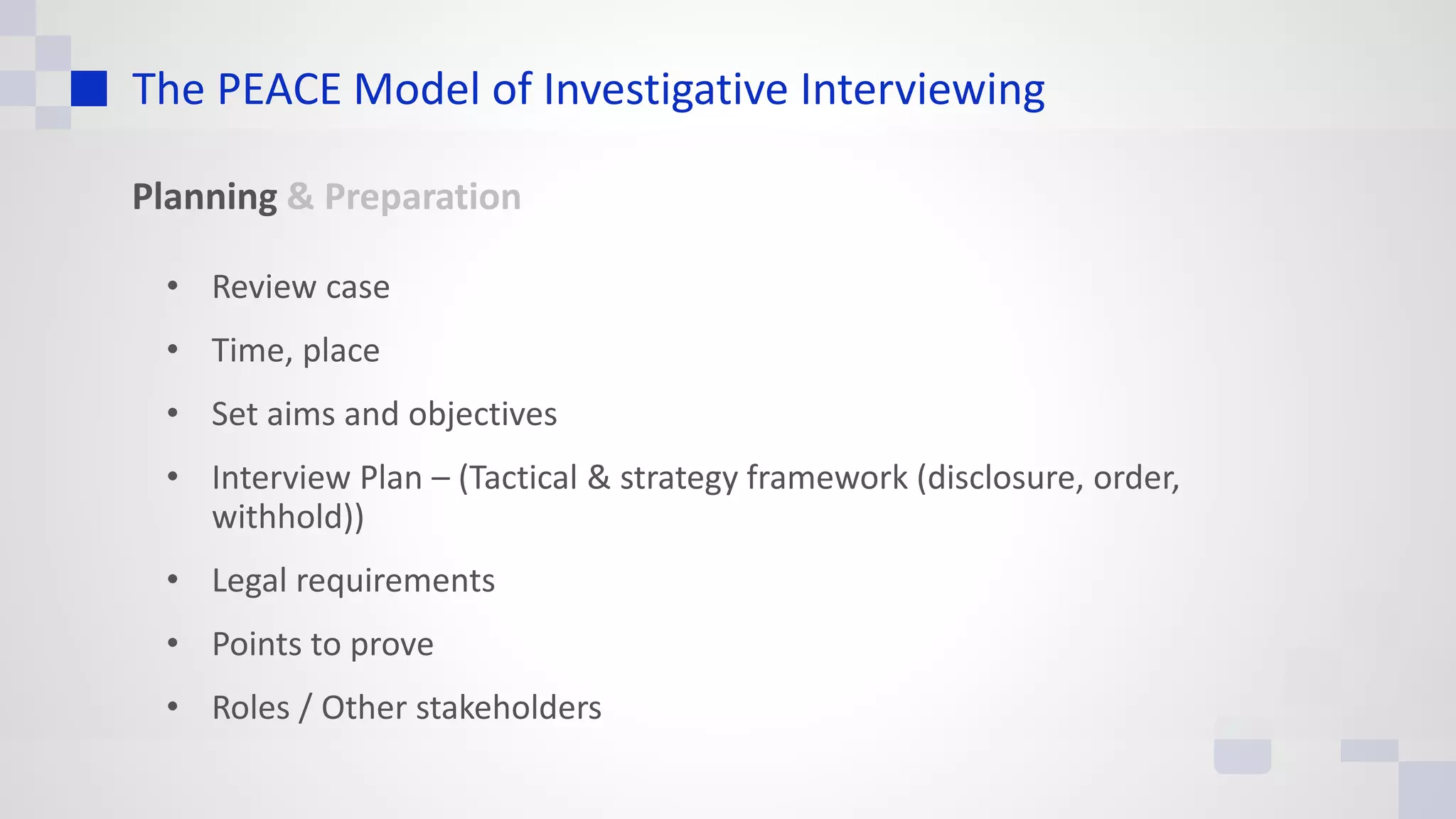
Planning & Preparation
• Review case
• Time, place
• Set aims and objectives
• Interview Plan – (Tactical & strategy framework (disclosure, order,
withhold))
• Legal requirements
• Points to prove
• Roles / Other stakeholders
The PEACE Model of Investigative Interviewing
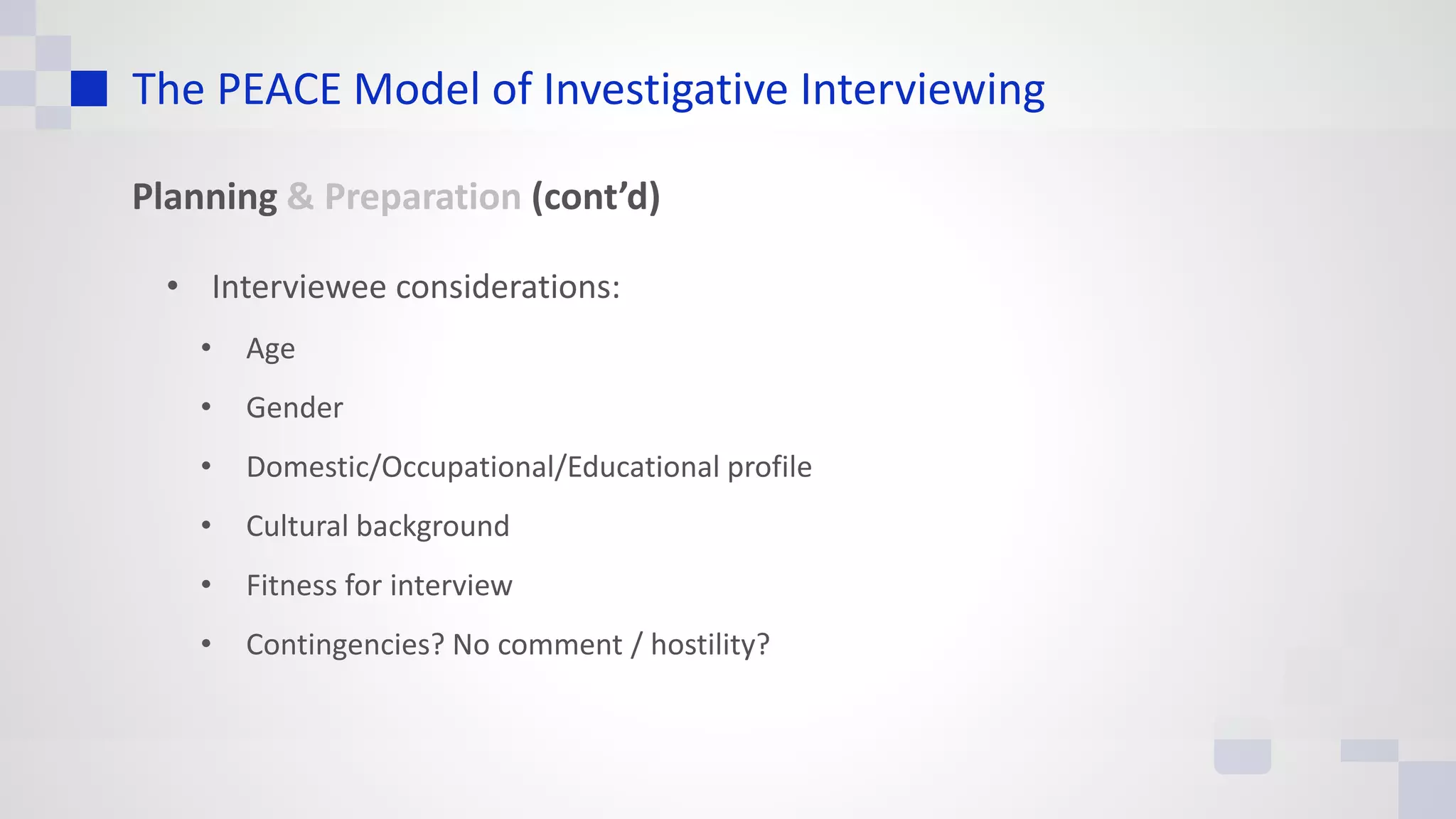
Planning & Preparation (cont’d)
• Interviewee considerations:
• Age
• Gender
• Domestic/Occupational/Educational profile
• Cultural background
• Fitness for interview
• Contingencies? No comment / hostility?
The PEACE Model of Investigative Interviewing
The PEACE Model
P
Plan &
Prep
E
Engage &
Explain
A
Account
C
Closure
E
Evaluate
The PEACE Model of Investigative Interviewing
The PEACE Model
P
Plan &
Prep
E
Engage &
Explain
A
Account
C
Closure
E
Evaluate
The PEACE Model of Investigative Interviewing
Engage & Explain
• Create a professional and positive first impression
• Establish rapport
• Set out clearly the reason for the interview
• Set out the structure – “During this interview….”
• Explain roles / recording / note-taking etc
• Check on interviewee’s needs/understanding – any questions/worries or
concerns?
The PEACE Model of Investigative Interviewing
The PEACE Model
P
Plan &
Prep
E
Engage &
Explain
A
Account
C
Closure
E
Evaluate
The PEACE Model of Investigative Interviewing
The PEACE Model
P
Plan &
Prep
E
Engage &
Explain
A
Account
C
Closure
E
Evaluate
The PEACE Model of Investigative Interviewing
Managing the Account -
• The Free Recall model
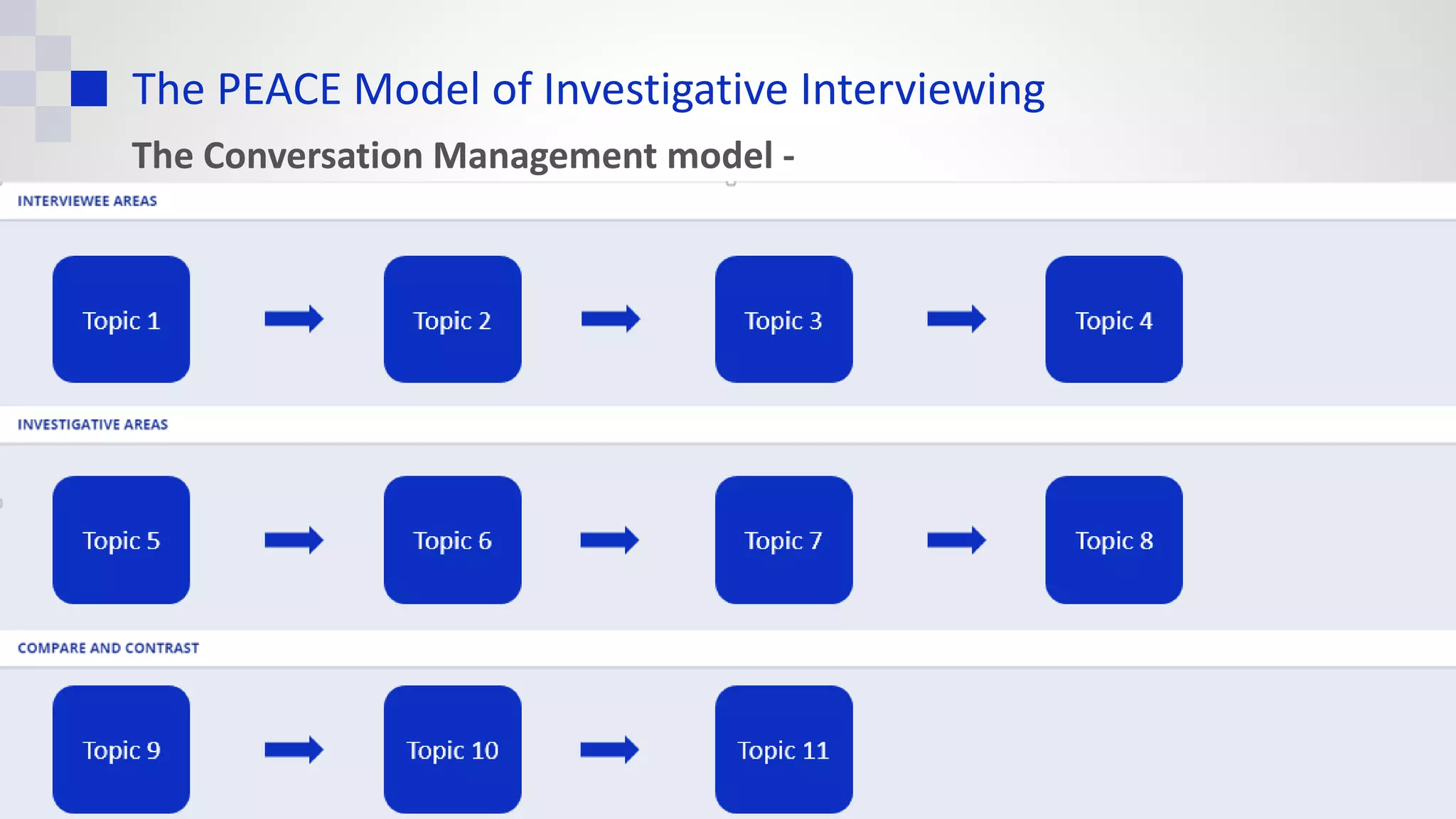
• The Conversation Management model
The PEACE Model of Investigative Interviewing
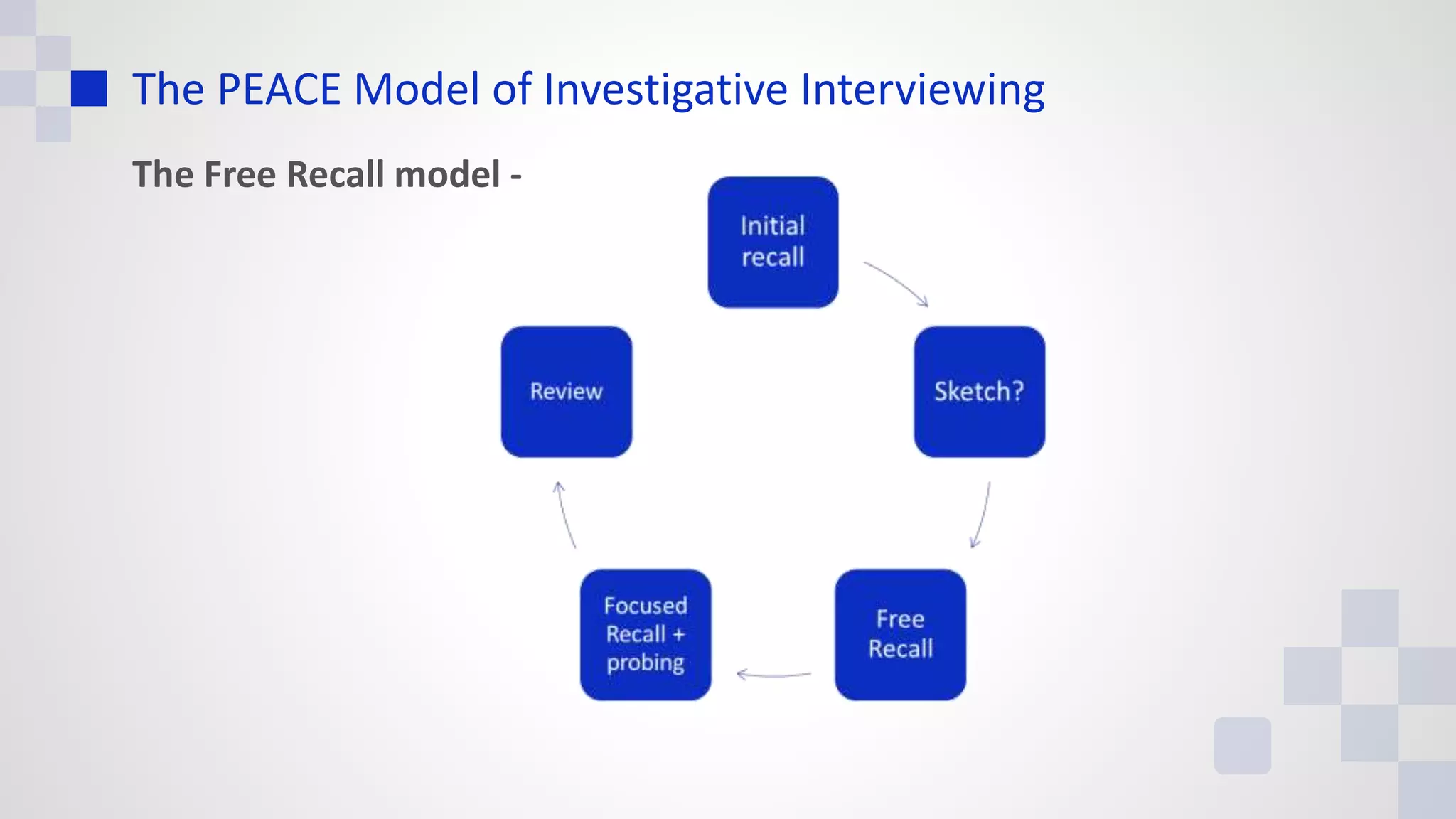
The Free Recall model -
The PEACE Model of Investigative Interviewing
The Conversation Management model -
The PEACE Model of Investigative Interviewing
The Free Recall model -
• A model of interviewing designed to illicit a comprehensive narrative
account of an event or incident
• Designed to obtain a full and accurate account from an interviewee
through minimal use of questions
• Proven to facilitate up 47%* increase in recalled information
compared with non-use of the model
• Used when the interviewee has witnessed an ‘episodic’ event
* Fisher, Ronald P.; Geiselman, R Edward; Amador, Michael (1989) Field Test of the Cognitive Interview: Enhancing the
Recollection of Actual Victims and Witnesses of Crime, Journal of Applied Psychology, Issue: Volume 74(5), October
1989, p 722–727.
The PEACE Model of Investigative Interviewing
Overview -
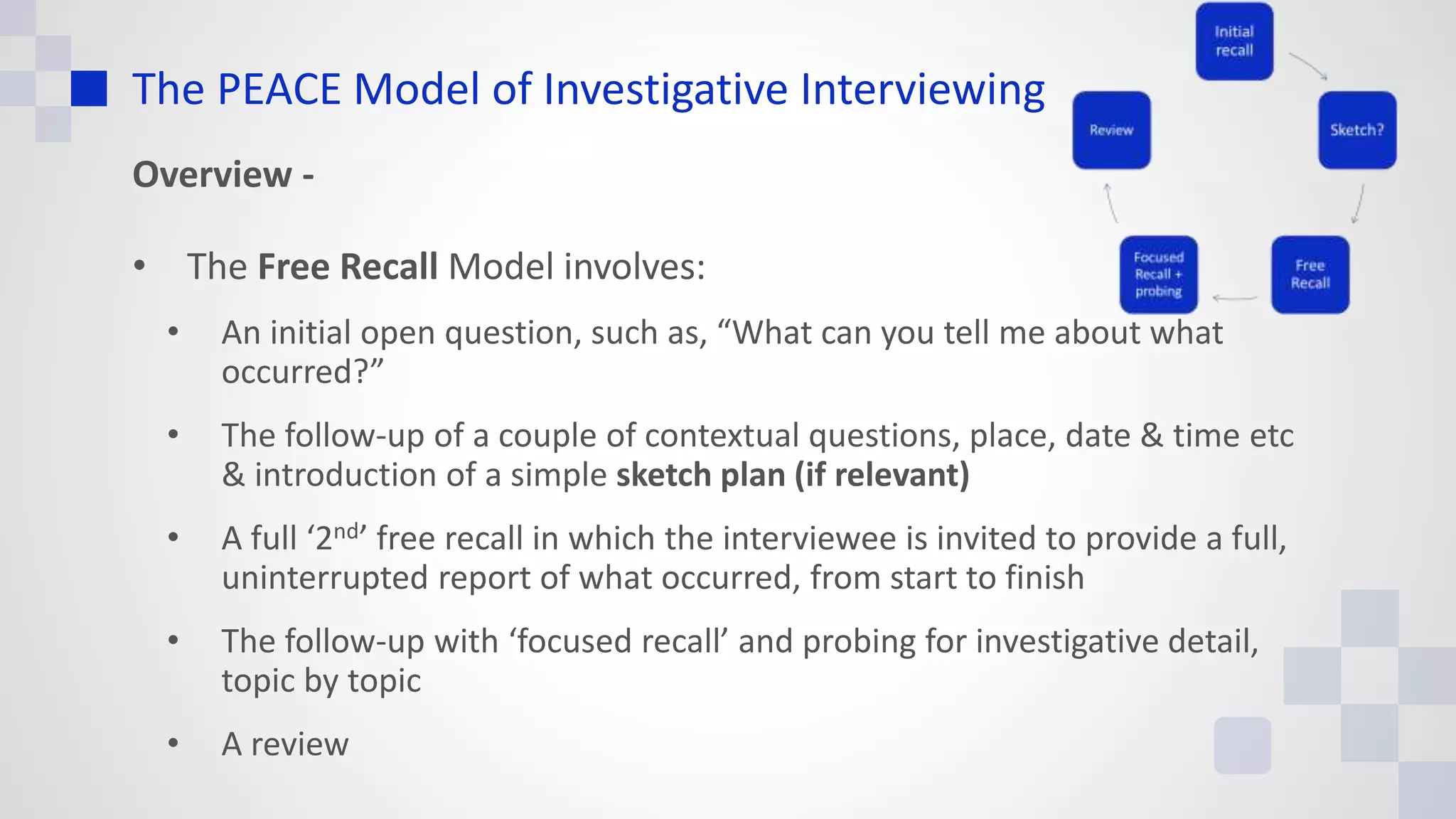
• The Free Recall Model involves:
• An initial open question, such as, “What can you tell me about what
occurred?”
• The follow-up of a couple of contextual questions, place, date & time etc
& introduction of a simple sketch plan (if relevant)
• A full ‘2nd’ free recall in which the interviewee is invited to provide a full,
uninterrupted report of what occurred, from start to finish
• The follow-up with ‘focused recall’ and probing for investigative detail,
topic by topic
• A review
The PEACE Model of
Investigative Interviewing
Conversation Management Model -
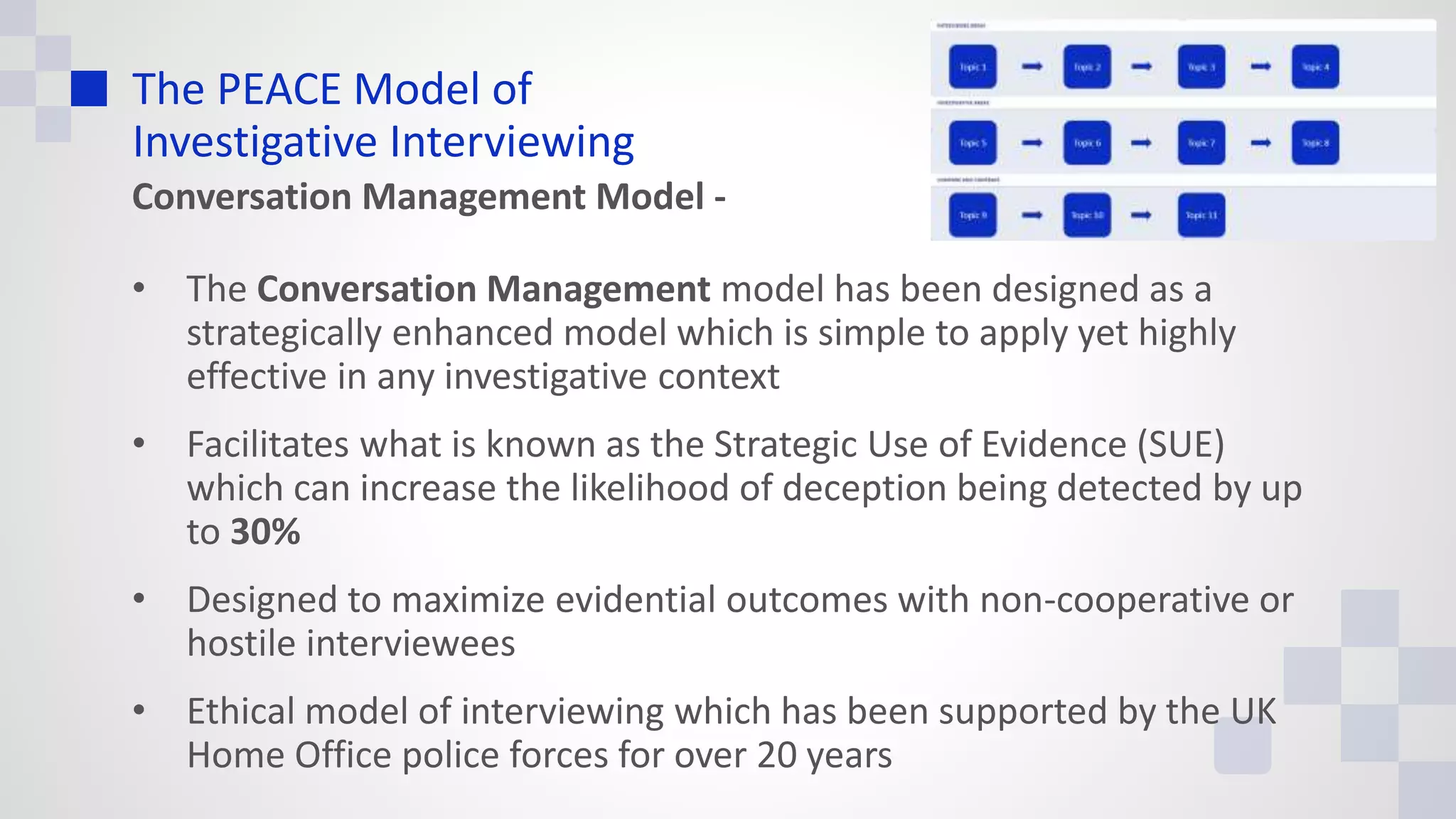
• The Conversation Management model has been designed as a
strategically enhanced model which is simple to apply yet highly
effective in any investigative context
• Facilitates what is known as the Strategic Use of Evidence (SUE)
which can increase the likelihood of deception being detected by up
to 30%*
*Sleen, van der J. (2009). 'A structured model for Investigative Interviewing of Suspects.' In Bull, R, Valentine, T &
Williamson, T 'Handbook of Psychology of Investigative Interviewing: Current Developments and Future
Directions' (Chapter 3; pp35-53). West Sussex: Wiley-Blackwell..
The PEACE Model of
Investigative Interviewing
Conversation Management Model -
• The Conversation Management model has been designed as a
strategically enhanced model which is simple to apply yet highly
effective in any investigative context
• Facilitates what is known as the Strategic Use of Evidence (SUE)
which can increase the likelihood of deception being detected by up
to 30%
• Designed to maximize evidential outcomes with non-cooperative or
hostile interviewees
• Ethical model of interviewing which has been supported by the UK
Home Office police forces for over 20 years
The PEACE Model of
Investigative Interviewing
Overview -
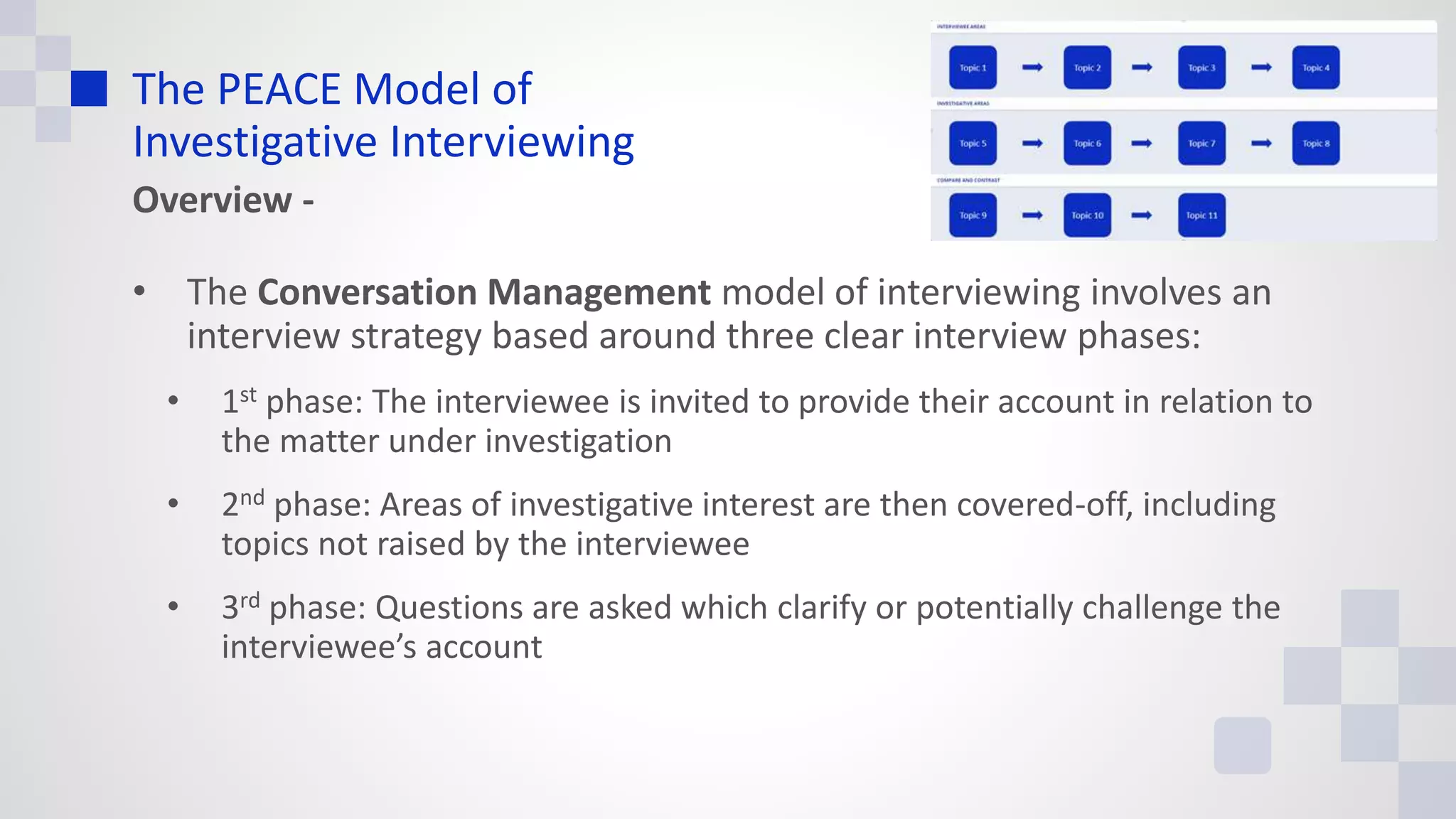
• The Conversation Management model of interviewing involves an
interview strategy based around three clear interview phases:
• 1st phase: The interviewee is invited to provide their account in relation to
the matter under investigation
• 2nd phase: Areas of investigative interest are then covered-off, including
topics not raised by the interviewee
• 3rd phase: Questions are asked which clarify or potentially challenge the
interviewee’s account
The PEACE Model of Investigative Interviewing
Summary -
• The Conversation Management and Free Recall models of
interviewing are inter-changeable and could potentially be used
within the same interview. Their use will depend on:
• What it is that is being discussed
• The level of cooperation being shown by the interviewee
The PEACE Model of Investigative Interviewing
The PEACE Model
P
Plan &
Prep
E
Engage &
Explain
A
Account
C
Closure
E
Evaluate
The PEACE Model of Investigative Interviewing
The PEACE Model
P
Plan &
Prep
E
Engage &
Explain
A
Account
C
Closure
E
Evaluate
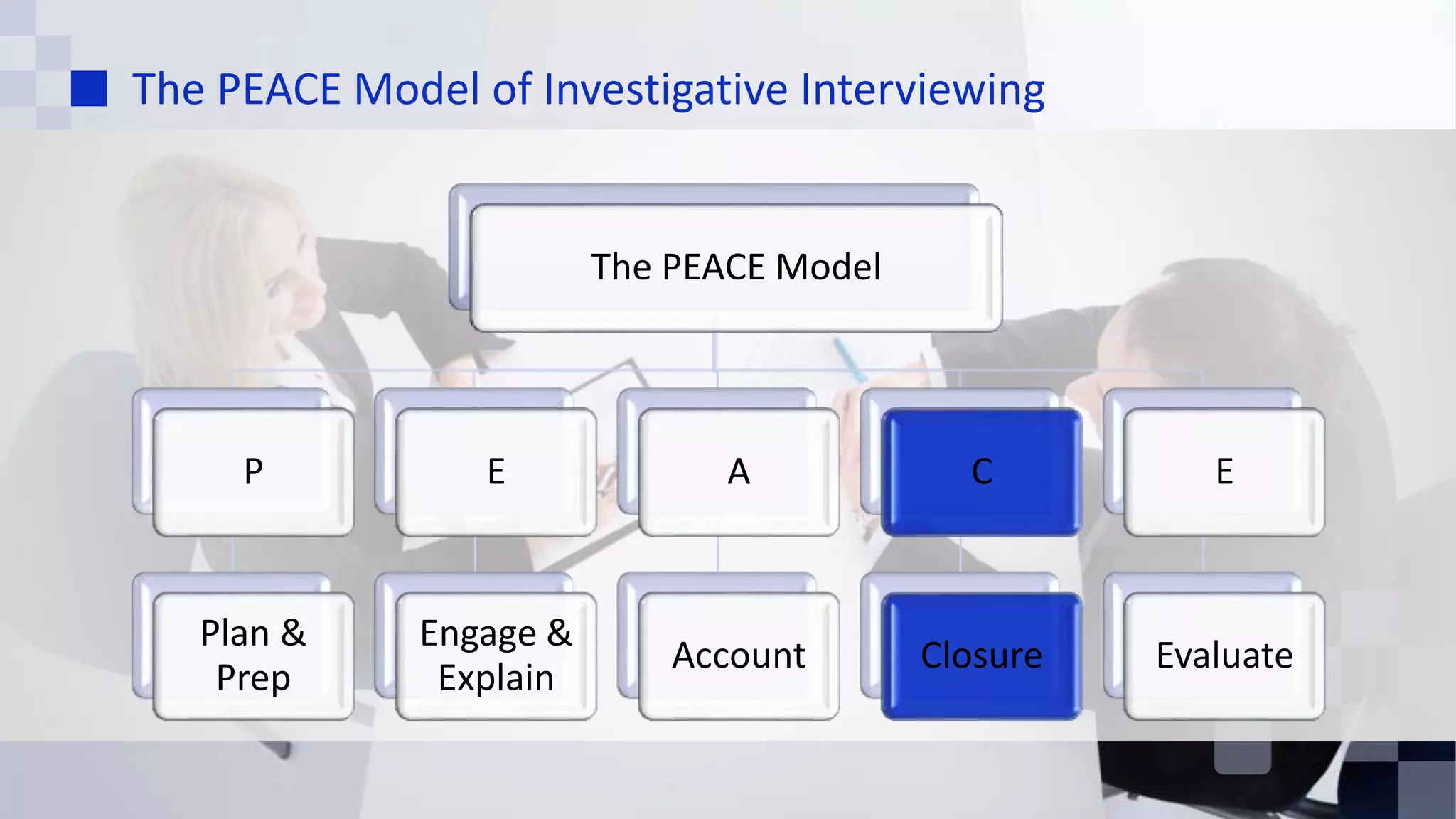
The PEACE Model of Investigative Interviewing
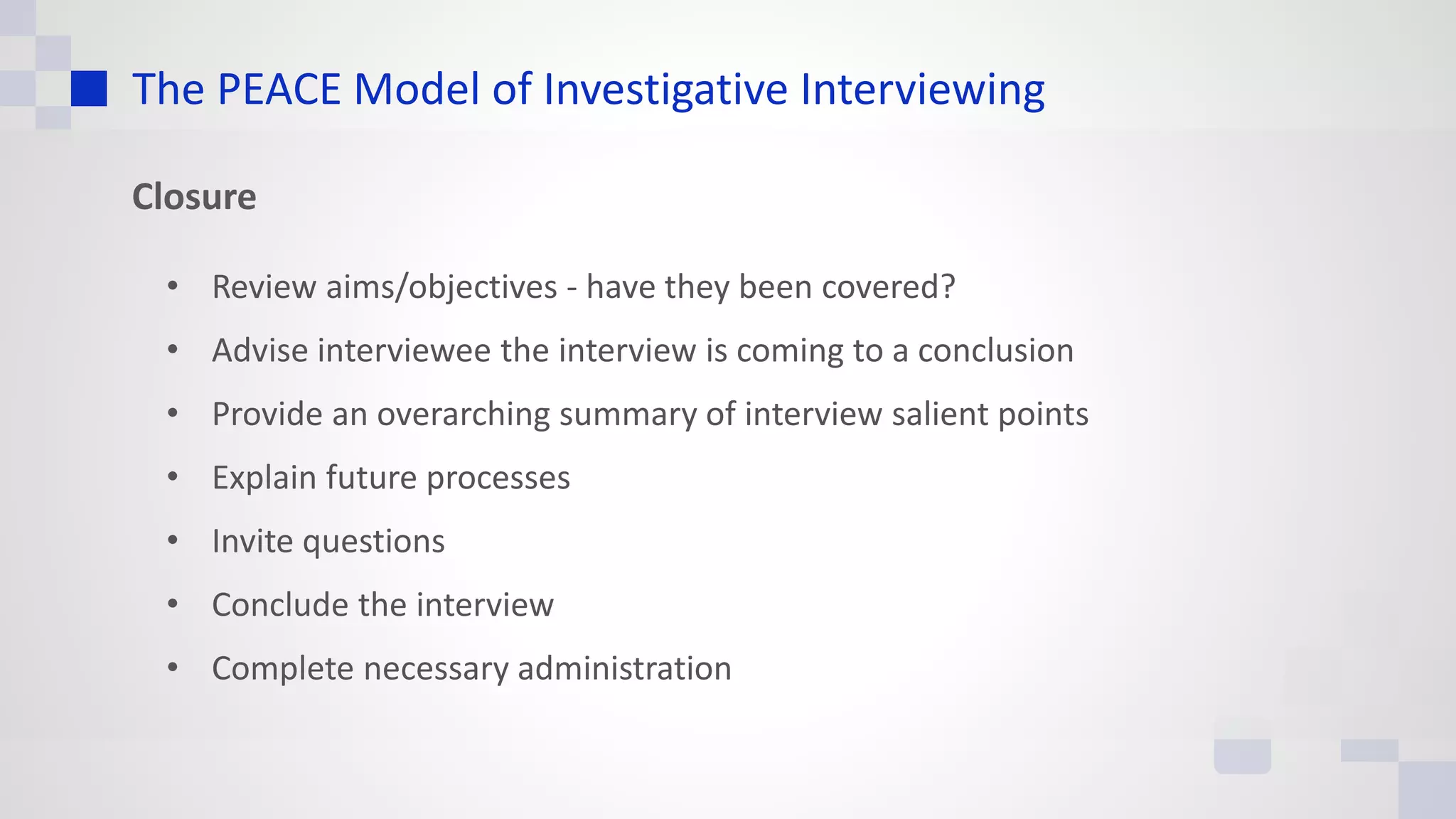
Closure
• Review aims/objectives - have they been covered?
• Advise interviewee the interview is coming to a conclusion
• Provide an overarching summary of interview salient points
• Explain future processes
• Invite questions
• Conclude the interview
• Complete necessary administration
The PEACE Model of Investigative Interviewing
The PEACE Model
P
Plan &
Prep
E
Engage &
Explain
A
Account
C
Closure
E
Evaluate
The PEACE Model of Investigative Interviewing
The PEACE Model
P
Plan &
Prep
E
Engage &
Explain
A
Account
C
Closure
E
Evaluate
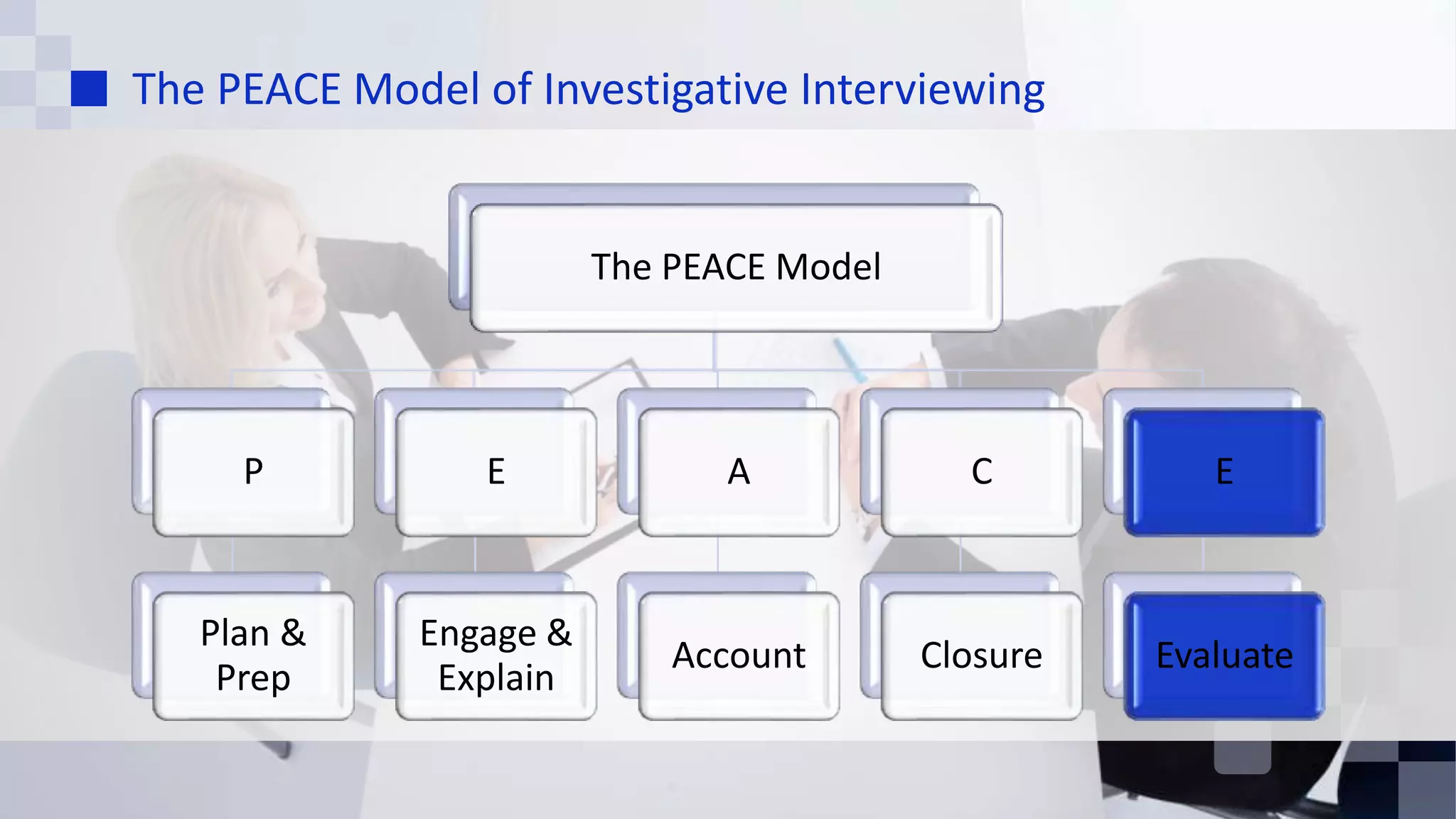
The PEACE Model of Investigative Interviewing
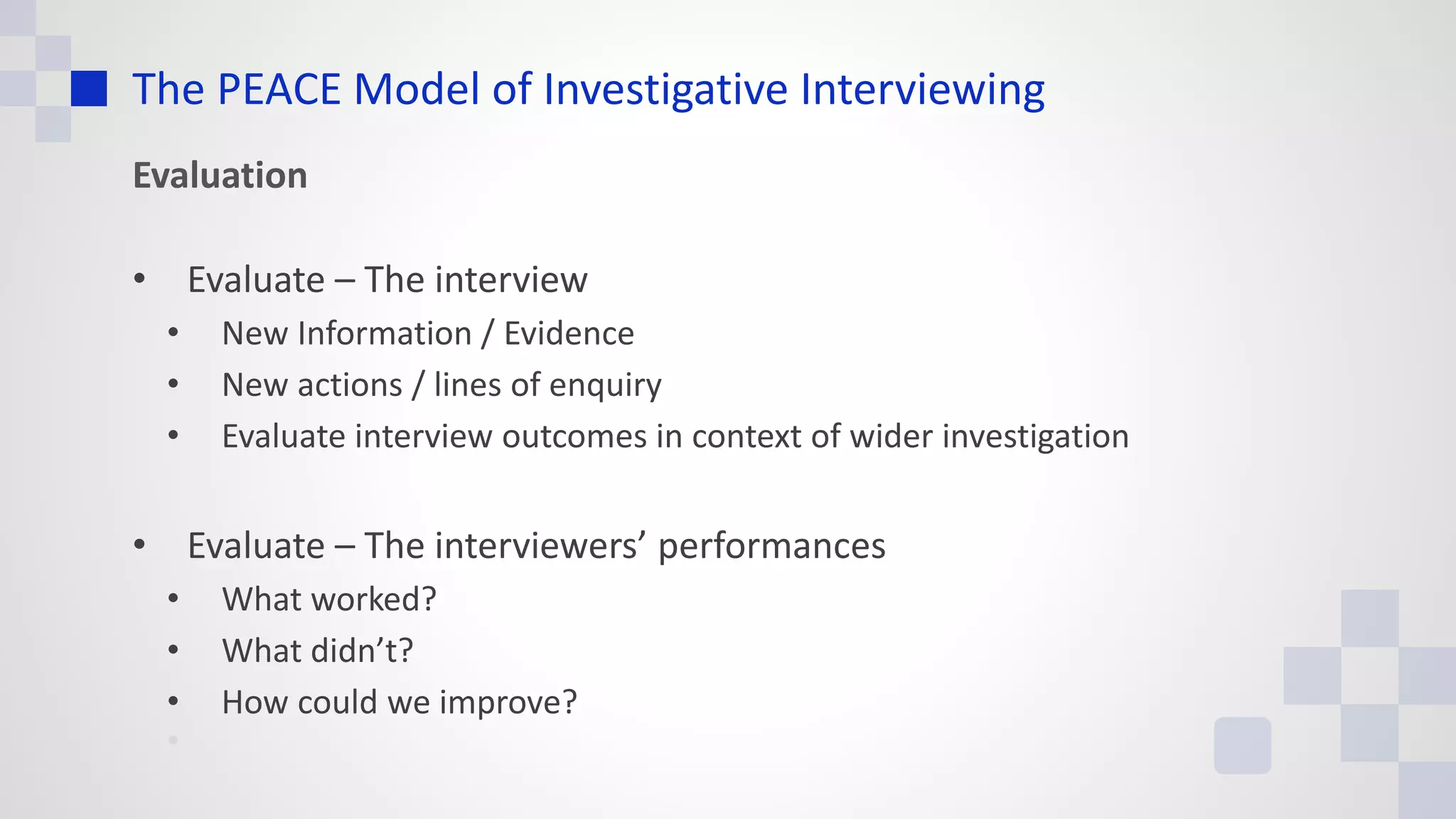
Evaluation
• Evaluate – The interview
• New Information / Evidence
• New actions / lines of enquiry
• Evaluate interview outcomes in context of wider investigation
• Evaluate – The interviewers’ performances
• What worked?
• What didn’t?
• How could we improve?
•
The PEACE Model of Investigative Interviewing
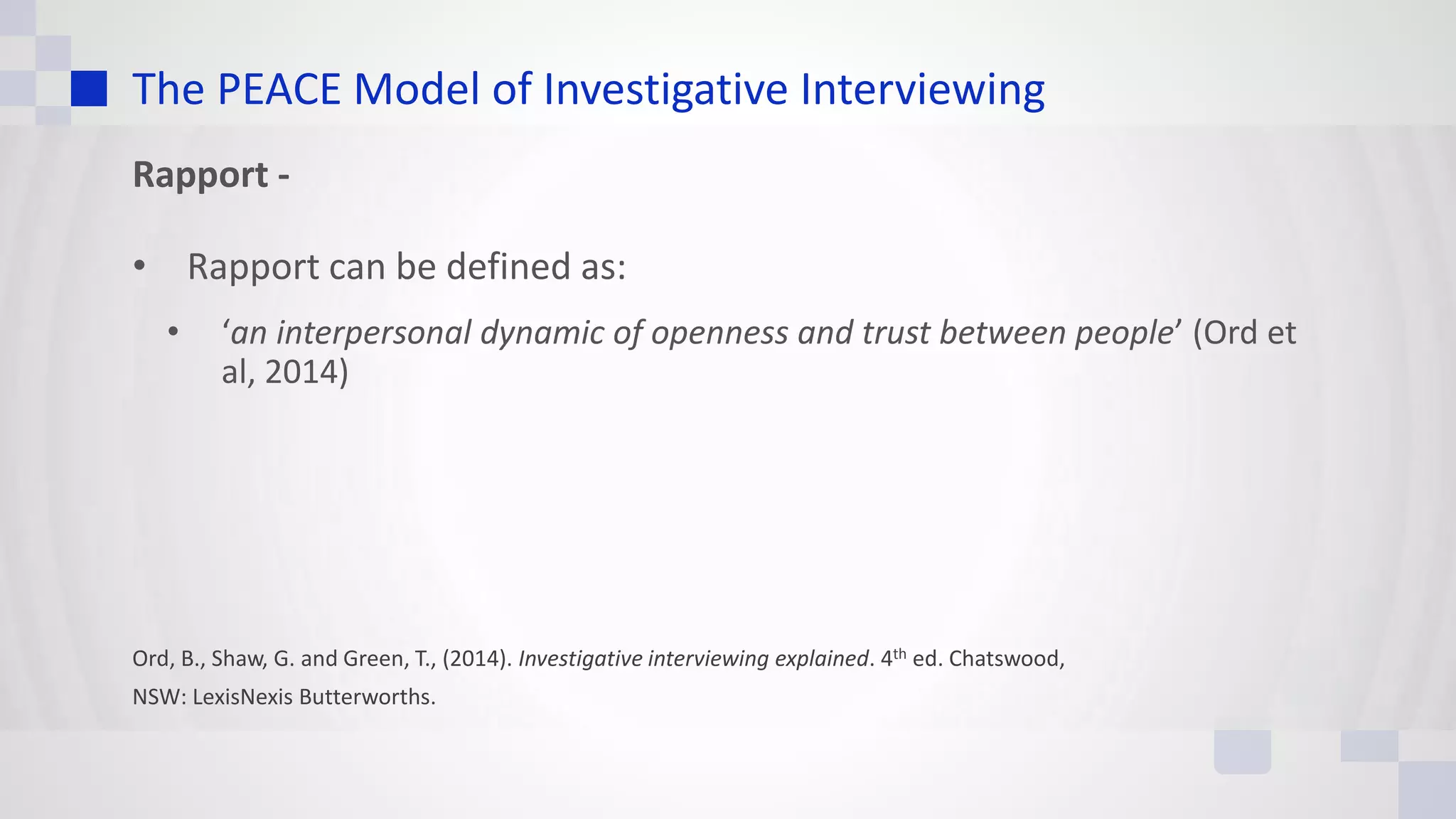
Rapport -
• Rapport can be defined as:
• ‘an interpersonal dynamic of openness and trust between people’ (Ord et
al, 2014)
Ord, B., Shaw, G. and Green, T., (2014). Investigative interviewing explained. 4th ed. Chatswood,
NSW: LexisNexis Butterworths.
The PEACE Model of Investigative Interviewing
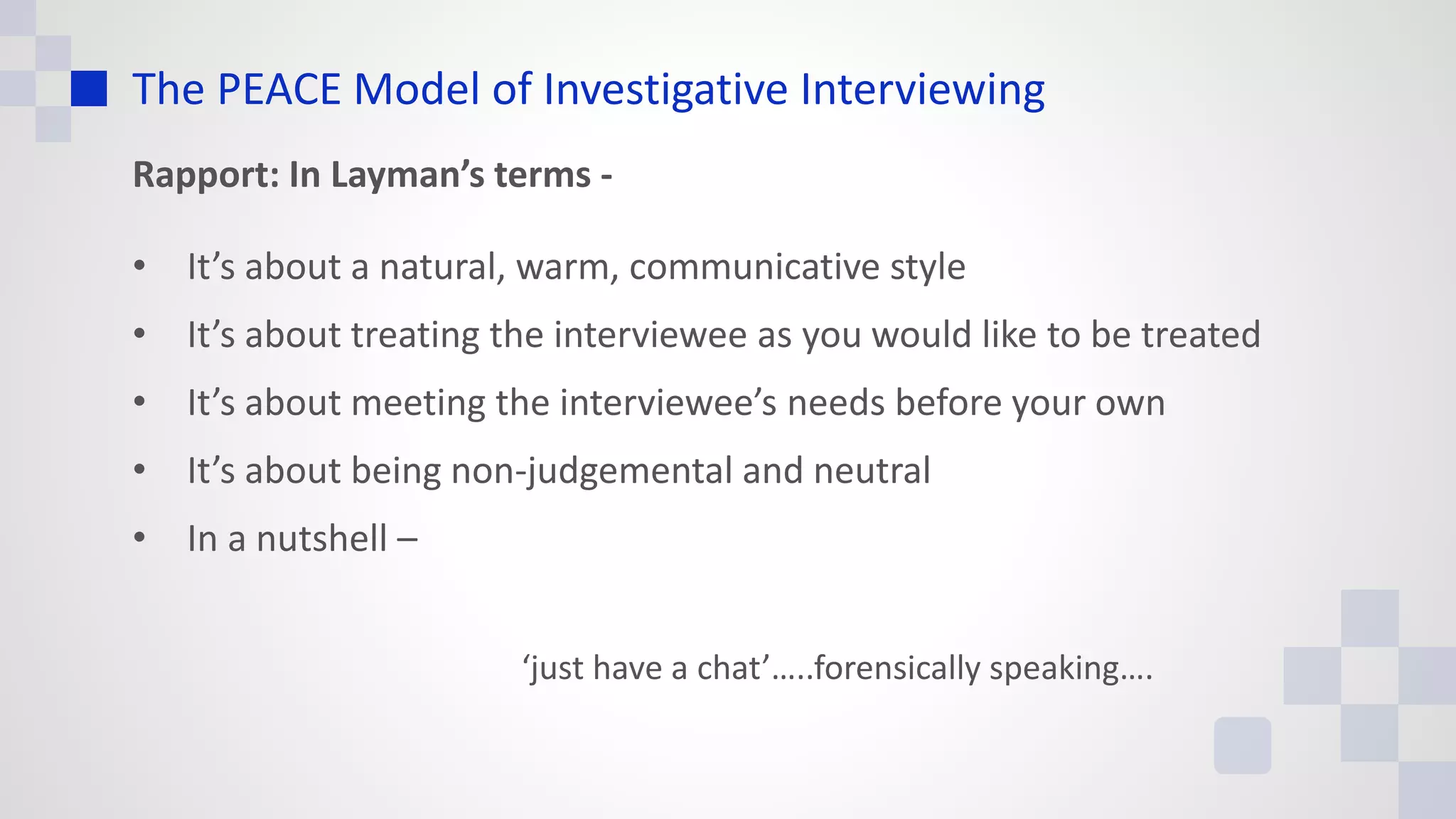
Rapport: In Layman’s terms -
• It’s about a natural, warm, communicative style
• It’s about treating the interviewee as you would like to be treated
• It’s about meeting the interviewee’s needs before your own
• It’s about being non-judgemental and neutral
• In a nutshell –
‘just have a chat’…..forensically speaking….
The PEACE Model of Investigative Interviewing
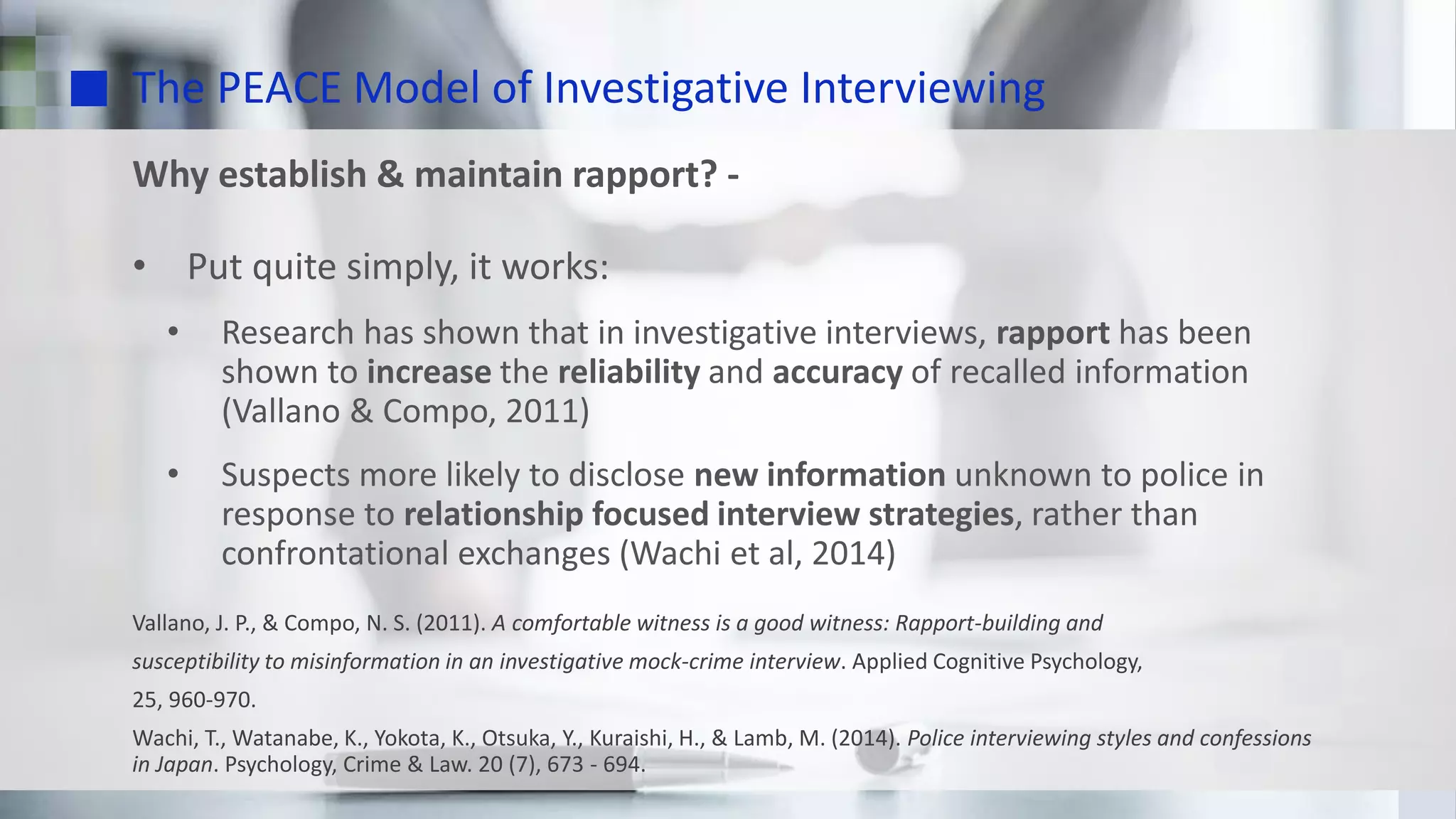
Why establish & maintain rapport? -
• Put quite simply, it works:
• Research has shown that in investigative interviews, rapport has been
shown to increase the reliability and accuracy of recalled information
(Vallano & Compo, 2011)
• Suspects more likely to disclose new information unknown to police in
response to relationship focused interview strategies, rather than
confrontational exchanges (Wachi et al, 2014)
Vallano, J. P., & Compo, N. S. (2011). A comfortable witness is a good witness: Rapport-building and
susceptibility to misinformation in an investigative mock-crime interview. Applied Cognitive Psychology,
25, 960-970.
Wachi, T., Watanabe, K., Yokota, K., Otsuka, Y., Kuraishi, H., & Lamb, M. (2014). Police interviewing styles and confessions
in Japan. Psychology, Crime & Law. 20 (7), 673 - 694.
The PEACE Model of Investigative Interviewing
Conclusion… you can now:
• Understand and describe the working parts of the PEACE model
framework
• Describe the key considerations when planning and preparing for any
type of investigative interview
• Understand how to apply the PEACE model to enhance and further
professionalise your approach to investigative interviewing
• Understand the importance of rapport in an interviewing exchange

The PEACE Model of Investigative Interviewing

  • 1.
    The PEACE Modelof Investigative Interviewing
  • 2.
    The PEACE Modelof Investigative Interviewing To view the presentation live, please visit - peace.interviewmanagementsolutions.com/registration (Running time: 38 minutes)
  • 3.
    The PEACE Modelof Investigative Interviewing Aims - • By the end of this workshop you’ll be able to: • Understand what the PEACE model framework is • Understand how the PEACE model can be used
  • 4.
    The PEACE Modelof Investigative Interviewing Welcome! • By way of introduction: • A career investigator with over 30 years investigative experience • Law enforcement trainer as a Lecturer in Policing with Charles Sturt University • Honours Degree qualified and trained as a specialist interviewer of children and other vulnerable victims of crime with Kent Police in the UK
  • 5.
    The PEACE Modelof Investigative Interviewing Professional interviewing outcomes: • You could conduct more ethical and professional interviews • You could reach stronger defensible investigation conclusions • Increase other stakeholders’ confidence in your ability to investigate complex matters
  • 6.
    The PEACE Modelof Investigative Interviewing Objectives - • By the end of this workshop you’ll be able to: • Understand and describe the working parts of the PEACE model framework • Describe the key considerations when planning and preparing for any type of interview • Understand how to apply the model to plan, conduct and evaluate your investigative interviews
  • 7.
    The PEACE Modelof Investigative Interviewing What is the PEACE Model? • ‘PEACE’ is a mnemonic which stands for: • Planning and Preparation • Engage & Explain • Account, Clarification & Challenge • Closure • Evaluation
  • 8.
    The PEACE Modelof Investigative Interviewing The Background - • Created in the UK in the 1980s following a series of interviewing failings that led to miscarriages of justice • Designed to offer a more effective and ethical alternative to persuasive and ‘confession-focussed’ interviewing techniques • Now being used by law enforcement around the world
  • 9.
    The PEACE Modelof Investigative Interviewing
  • 10.
    The PEACE Modelof Investigative Interviewing The PEACE Model P Plan & Prep E Engage & Explain A Account C Closure E Evaluate
  • 11.
    The PEACE Modelof Investigative Interviewing The PEACE Model P Plan & Prep E Engage & Explain A Account C Closure E Evaluate
  • 12.
    The PEACE Modelof Investigative Interviewing Planning & Preparation • Review case • Time, place • Set aims and objectives • Interview Plan – (Tactical & strategy framework (disclosure, order, withhold)) • Legal requirements • Points to prove • Roles / Other stakeholders
  • 13.
    The PEACE Modelof Investigative Interviewing Planning & Preparation (cont’d) • Interviewee considerations: • Age • Gender • Domestic/Occupational/Educational profile • Cultural background • Fitness for interview • Contingencies? No comment / hostility?
  • 14.
    The PEACE Modelof Investigative Interviewing The PEACE Model P Plan & Prep E Engage & Explain A Account C Closure E Evaluate
  • 15.
    The PEACE Modelof Investigative Interviewing The PEACE Model P Plan & Prep E Engage & Explain A Account C Closure E Evaluate
  • 16.
    The PEACE Modelof Investigative Interviewing Engage & Explain • Create a professional and positive first impression • Establish rapport • Set out clearly the reason for the interview • Set out the structure – “During this interview….” • Explain roles / recording / note-taking etc • Check on interviewee’s needs/understanding – any questions/worries or concerns?
  • 17.
    The PEACE Modelof Investigative Interviewing
  • 18.
    The PEACE Modelof Investigative Interviewing The PEACE Model P Plan & Prep E Engage & Explain A Account C Closure E Evaluate
  • 19.
    The PEACE Modelof Investigative Interviewing The PEACE Model P Plan & Prep E Engage & Explain A Account C Closure E Evaluate
  • 20.
    The PEACE Modelof Investigative Interviewing Managing the Account - • The Free Recall model • The Conversation Management model
  • 21.
    The PEACE Modelof Investigative Interviewing The Free Recall model -
  • 22.
    The PEACE Modelof Investigative Interviewing The Conversation Management model -
  • 23.
    The PEACE Modelof Investigative Interviewing The Free Recall model - • A model of interviewing designed to illicit a comprehensive narrative account of an event or incident • Designed to obtain a full and accurate account from an interviewee through minimal use of questions • Proven to facilitate up 47%* increase in recalled information compared with non-use of the model • Used when the interviewee has witnessed an ‘episodic’ event * Fisher, Ronald P.; Geiselman, R Edward; Amador, Michael (1989) Field Test of the Cognitive Interview: Enhancing the Recollection of Actual Victims and Witnesses of Crime, Journal of Applied Psychology, Issue: Volume 74(5), October 1989, p 722–727.
  • 24.
    The PEACE Modelof Investigative Interviewing Overview - • The Free Recall Model involves: • An initial open question, such as, “What can you tell me about what occurred?” • The follow-up of a couple of contextual questions, place, date & time etc & introduction of a simple sketch plan (if relevant) • A full ‘2nd’ free recall in which the interviewee is invited to provide a full, uninterrupted report of what occurred, from start to finish • The follow-up with ‘focused recall’ and probing for investigative detail, topic by topic • A review
  • 25.
    The PEACE Modelof Investigative Interviewing Conversation Management Model - • The Conversation Management model has been designed as a strategically enhanced model which is simple to apply yet highly effective in any investigative context • Facilitates what is known as the Strategic Use of Evidence (SUE) which can increase the likelihood of deception being detected by up to 30%* *Sleen, van der J. (2009). 'A structured model for Investigative Interviewing of Suspects.' In Bull, R, Valentine, T & Williamson, T 'Handbook of Psychology of Investigative Interviewing: Current Developments and Future Directions' (Chapter 3; pp35-53). West Sussex: Wiley-Blackwell..
  • 26.
    The PEACE Modelof Investigative Interviewing Conversation Management Model - • The Conversation Management model has been designed as a strategically enhanced model which is simple to apply yet highly effective in any investigative context • Facilitates what is known as the Strategic Use of Evidence (SUE) which can increase the likelihood of deception being detected by up to 30% • Designed to maximize evidential outcomes with non-cooperative or hostile interviewees • Ethical model of interviewing which has been supported by the UK Home Office police forces for over 20 years
  • 27.
    The PEACE Modelof Investigative Interviewing Overview - • The Conversation Management model of interviewing involves an interview strategy based around three clear interview phases: • 1st phase: The interviewee is invited to provide their account in relation to the matter under investigation • 2nd phase: Areas of investigative interest are then covered-off, including topics not raised by the interviewee • 3rd phase: Questions are asked which clarify or potentially challenge the interviewee’s account
  • 28.
    The PEACE Modelof Investigative Interviewing Summary - • The Conversation Management and Free Recall models of interviewing are inter-changeable and could potentially be used within the same interview. Their use will depend on: • What it is that is being discussed • The level of cooperation being shown by the interviewee
  • 29.
    The PEACE Modelof Investigative Interviewing The PEACE Model P Plan & Prep E Engage & Explain A Account C Closure E Evaluate
  • 30.
    The PEACE Modelof Investigative Interviewing The PEACE Model P Plan & Prep E Engage & Explain A Account C Closure E Evaluate
  • 31.
    The PEACE Modelof Investigative Interviewing Closure • Review aims/objectives - have they been covered? • Advise interviewee the interview is coming to a conclusion • Provide an overarching summary of interview salient points • Explain future processes • Invite questions • Conclude the interview • Complete necessary administration
  • 32.
    The PEACE Modelof Investigative Interviewing The PEACE Model P Plan & Prep E Engage & Explain A Account C Closure E Evaluate
  • 33.
    The PEACE Modelof Investigative Interviewing The PEACE Model P Plan & Prep E Engage & Explain A Account C Closure E Evaluate
  • 34.
    The PEACE Modelof Investigative Interviewing Evaluation • Evaluate – The interview • New Information / Evidence • New actions / lines of enquiry • Evaluate interview outcomes in context of wider investigation • Evaluate – The interviewers’ performances • What worked? • What didn’t? • How could we improve? •
  • 35.
    The PEACE Modelof Investigative Interviewing Rapport - • Rapport can be defined as: • ‘an interpersonal dynamic of openness and trust between people’ (Ord et al, 2014) Ord, B., Shaw, G. and Green, T., (2014). Investigative interviewing explained. 4th ed. Chatswood, NSW: LexisNexis Butterworths.
  • 36.
    The PEACE Modelof Investigative Interviewing Rapport: In Layman’s terms - • It’s about a natural, warm, communicative style • It’s about treating the interviewee as you would like to be treated • It’s about meeting the interviewee’s needs before your own • It’s about being non-judgemental and neutral • In a nutshell – ‘just have a chat’…..forensically speaking….
  • 37.
    The PEACE Modelof Investigative Interviewing Why establish & maintain rapport? - • Put quite simply, it works: • Research has shown that in investigative interviews, rapport has been shown to increase the reliability and accuracy of recalled information (Vallano & Compo, 2011) • Suspects more likely to disclose new information unknown to police in response to relationship focused interview strategies, rather than confrontational exchanges (Wachi et al, 2014) Vallano, J. P., & Compo, N. S. (2011). A comfortable witness is a good witness: Rapport-building and susceptibility to misinformation in an investigative mock-crime interview. Applied Cognitive Psychology, 25, 960-970. Wachi, T., Watanabe, K., Yokota, K., Otsuka, Y., Kuraishi, H., & Lamb, M. (2014). Police interviewing styles and confessions in Japan. Psychology, Crime & Law. 20 (7), 673 - 694.
  • 38.
    The PEACE Modelof Investigative Interviewing Conclusion… you can now: • Understand and describe the working parts of the PEACE model framework • Describe the key considerations when planning and preparing for any type of investigative interview • Understand how to apply the PEACE model to enhance and further professionalise your approach to investigative interviewing • Understand the importance of rapport in an interviewing exchange

Editor's Notes

  • #21 What happens if you feel that you’re not really being listened to? How does it make you feel? Don’t assume you already know what the interviewee is going to tell you. Keep an open mind.
  • #22 What happens if you feel that you’re not really being listened to? How does it make you feel? Don’t assume you already know what the interviewee is going to tell you. Keep an open mind.
  • #23 What happens if you feel that you’re not really being listened to? How does it make you feel? Don’t assume you already know what the interviewee is going to tell you. Keep an open mind.
  • #24 What happens if you feel that you’re not really being listened to? How does it make you feel? Don’t assume you already know what the interviewee is going to tell you. Keep an open mind.
  • #37 An investigative interview can be a rather formal affair………… ………. Try to just
  • #38 If you don’t like talking to someone, you probably won’t say very much….