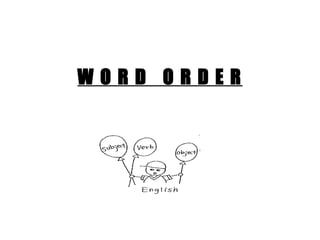
W O R D  O R D E R
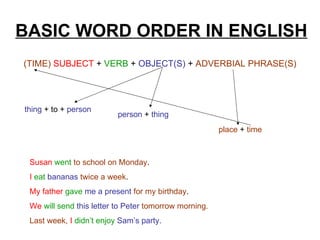
BASIC WORD ORDER IN ENGLISH (TIME)   SUBJECT  +  VERB  +  OBJECT(S)  +  ADVERBIAL PHRASE(S) thing  + to +  person person  +  thing place  +  time Susan   went   to school on Monday . I   eat   bananas   twice a week . My father   gave   me a present   for my birthday . We   will send   this letter to Peter   tomorrow morning. Last week,   I   didn’t enjoy  Sam’s party.
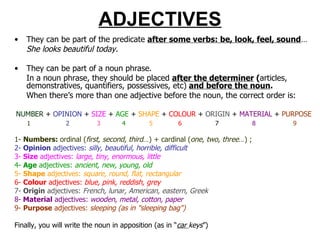
ADJECTIVES They can be part of the predicate  after some verbs: be, look, feel, sound … She looks beautiful today. They can be part of a noun phrase.  In a noun phrase, they should be placed  after the determiner  ( articles, demonstratives, quantifiers, possessives, etc)   and before the noun . When there’s more than one adjective before the noun, the correct order is: NUMBER   +  OPINION  +  SIZE  +  AGE  +  SHAPE  +  COLOUR  +  ORIGIN  +  MATERIAL  +  PURPOSE 1   2   3   4   5   6   7   8   9 1-  Numbers:  ordinal ( first, second, third …) + cardinal ( one, two, three …) ;  2-  O pinion  adjectives:  silly, beautiful, horrible, difficult 3-  S ize  adjectives:  large, tiny, enormous, little 4-  A ge  adjectives:  ancient, new, young, old 5-  S hape  adjectives:  square, round, flat, rectangular 6-  C olour  adjectives:  blue, pink, reddish, grey 7-  Origin  adjectives:  French, lunar, American, eastern, Greek 8-  M aterial  adjectives:  wooden, metal, cotton, paper 9-  P urpose  adjectives:  sleeping (as in "sleeping bag")  Finally, you will write the noun in apposition (as in “ car  keys ”)
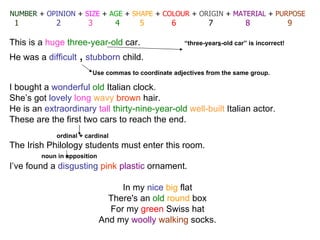
NUMBER   +  OPINION  +  SIZE  +  AGE  +  SHAPE  +  COLOUR  +  ORIGIN  +  MATERIAL  +  PURPOSE 1   2   3   4   5   6   7   8   9 This is a  huge   three-year-old  car.  “three-year s -old car” is incorrect! He was a  difficult  ,   stubborn  child. I bought a  wonderful   old   Italian  clock. She’s got  lovely   long   wavy   brown  hair. He is an  extraordinary   tall   thirty-nine-year-old   well-built   Italian  actor. These are the first two cars to reach the end.   ordinal + cardinal  The  Irish  Philology students must enter this room. noun in apposition I’ve found a  disgusting   pink   plastic  ornament. In my  nice   big  flat There's an  old   round  box For my  green   Swiss  hat And my  woolly   walking  socks. Use commas to coordinate adjectives from the same group.
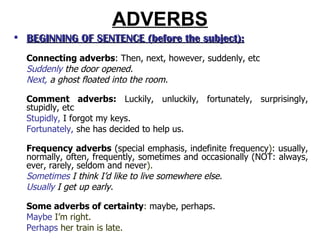
ADVERBS BEGINNING OF SENTENCE  (before the subject ): Connecting adverbs : Then, next, however, suddenly, etc Suddenly  the door opened. Next,  a ghost floated into the room. Comment adverbs:  Luckily, unluckily, fortunately, surprisingly, stupidly, etc Stupidly,  I forgot my keys. Fortunately,  she has decided to help us. Frequency adverbs   (special emphasis, indefinite frequency ) :  usually, normally, often, frequently, sometimes and occasionally (NOT: always, ever, rarely, seldom and never ). Sometimes  I think I’d like to live somewhere else. Usually  I get up early. Some adverbs of certainty :  maybe, perhaps. Maybe  I’m right. Perhaps  her train is late.
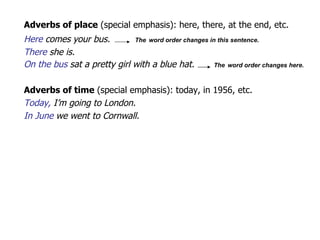
Adverbs of place   (special emphasis ): here, there, at the end, etc. Here  comes your bus.  The   word order changes in this sentence.  There  she is. On the bus  sat a pretty girl with a blue hat.  The   word order changes here.  Adverbs of time   (special emphasis ): today, in 1956, etc. Today,  I’m going to London. In June  we went to Cornwall.
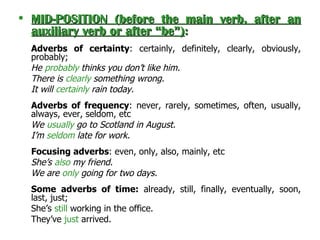
MID-POSITION (before the main verb, after an auxiliary verb or after “be” ) :   Adverbs of certainty : certainly, definitely, clearly, obviously, probably;  He  probably  thinks you don’t like him. There is  clearly  something wrong. It will  certainly  rain today. Adverbs of frequency : never, rarely, sometimes, often, usually, always, ever, seldom, etc  We  usually  go to Scotland in August. I’m  seldom  late for work. Focusing adverbs : even, only, also, mainly, etc She’s  also  my friend. We are  only  going for two days. Some   adverbs of time:  already, still, finally, eventually, soon, last, just;  She’s  still  working in the office. They’ve  just  arrived.
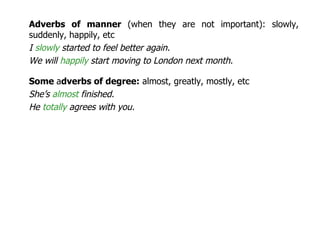
Adverbs of manner  (when they are not important): slowly, suddenly, happily, etc I  slowly  started to feel better again. We will  happily  start moving to London next month.  Some  a dverbs of degree:  almost, greatly, mostly, etc She’s  almost  finished. He  totally  agrees with you.
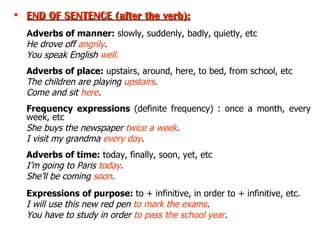
END OF SENTENCE  (after the verb ): A dverbs of manner:  slowly, suddenly, badly, quietly, etc   He drove off  angrily . You speak English  well. Adverbs of place:  upstairs, around, here, to bed, from school, etc The children are playing  upstairs . Come and sit  here . Frequency expressions  (definite frequency)   : once a month, every week, etc She buys the newspaper  twice a week . I visit my grandma  every day . Adverbs of time:  today, finally, soon, yet, etc I’m going to Paris  today . She’ll be coming  soon . Expressions of purpose:  to + infinitive, in order to + infinitive, etc. I will use this new red pen  to mark the exams . You have to study in order  to pass the school year .
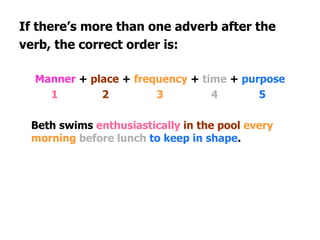
If there’s more than one adverb after the verb, the correct order is: Manner  +  place  +  frequency  +  time  +  purpose 1   2   3 4   5 Beth swims  enthusiastically   in the pool   every morning   before lunch   to keep in shape .
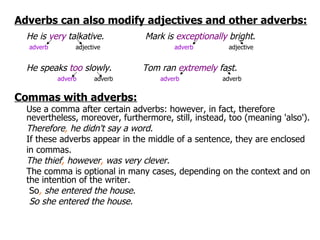
Adverbs can also modify adjectives and other adverbs: He is  very  talkative.  Mark is  exceptionally  bright .   adverb   adjective adverb  adjective He speaks  too  slowly. Tom ran  extremely  fast.   adverb   adverb   adverb  adverb  Commas with adverbs: Use a comma after certain adverbs: however, in fact, therefore nevertheless, moreover, furthermore, still, instead, too (meaning 'also'). Therefore ,  he didn't say a word. If these adverbs appear in the middle of a sentence, they are enclosed in commas. The thief ,  however ,  was very clever. The comma is optional in many cases, depending on the context and on the intention of the writer.   So ,  she entered the house.   So she entered the house.

Word order

  • 1.
    W O RD O R D E R
  • 2.
    BASIC WORD ORDERIN ENGLISH (TIME) SUBJECT + VERB + OBJECT(S) + ADVERBIAL PHRASE(S) thing + to + person person + thing place + time Susan went to school on Monday . I eat bananas twice a week . My father gave me a present for my birthday . We will send this letter to Peter tomorrow morning. Last week, I didn’t enjoy Sam’s party.
  • 3.
    ADJECTIVES They canbe part of the predicate after some verbs: be, look, feel, sound … She looks beautiful today. They can be part of a noun phrase. In a noun phrase, they should be placed after the determiner ( articles, demonstratives, quantifiers, possessives, etc) and before the noun . When there’s more than one adjective before the noun, the correct order is: NUMBER + OPINION + SIZE + AGE + SHAPE + COLOUR + ORIGIN + MATERIAL + PURPOSE 1 2 3 4 5 6 7 8 9 1- Numbers: ordinal ( first, second, third …) + cardinal ( one, two, three …) ; 2- O pinion  adjectives: silly, beautiful, horrible, difficult 3- S ize  adjectives: large, tiny, enormous, little 4- A ge  adjectives: ancient, new, young, old 5- S hape  adjectives: square, round, flat, rectangular 6- C olour  adjectives: blue, pink, reddish, grey 7- Origin  adjectives: French, lunar, American, eastern, Greek 8- M aterial  adjectives: wooden, metal, cotton, paper 9- P urpose  adjectives: sleeping (as in "sleeping bag") Finally, you will write the noun in apposition (as in “ car keys ”)
  • 4.
    NUMBER + OPINION + SIZE + AGE + SHAPE + COLOUR + ORIGIN + MATERIAL + PURPOSE 1 2 3 4 5 6 7 8 9 This is a huge three-year-old car. “three-year s -old car” is incorrect! He was a difficult , stubborn child. I bought a wonderful old Italian clock. She’s got lovely long wavy brown hair. He is an extraordinary tall thirty-nine-year-old well-built Italian actor. These are the first two cars to reach the end. ordinal + cardinal The Irish Philology students must enter this room. noun in apposition I’ve found a disgusting pink plastic ornament. In my nice big flat There's an old round box For my green Swiss hat And my woolly walking socks. Use commas to coordinate adjectives from the same group.
  • 5.
    ADVERBS BEGINNING OFSENTENCE (before the subject ): Connecting adverbs : Then, next, however, suddenly, etc Suddenly the door opened. Next, a ghost floated into the room. Comment adverbs: Luckily, unluckily, fortunately, surprisingly, stupidly, etc Stupidly, I forgot my keys. Fortunately, she has decided to help us. Frequency adverbs (special emphasis, indefinite frequency ) : usually, normally, often, frequently, sometimes and occasionally (NOT: always, ever, rarely, seldom and never ). Sometimes I think I’d like to live somewhere else. Usually I get up early. Some adverbs of certainty : maybe, perhaps. Maybe I’m right. Perhaps her train is late.
  • 6.
    Adverbs of place (special emphasis ): here, there, at the end, etc. Here comes your bus. The word order changes in this sentence. There she is. On the bus sat a pretty girl with a blue hat. The word order changes here. Adverbs of time (special emphasis ): today, in 1956, etc. Today, I’m going to London. In June we went to Cornwall.
  • 7.
    MID-POSITION (before themain verb, after an auxiliary verb or after “be” ) : Adverbs of certainty : certainly, definitely, clearly, obviously, probably; He probably thinks you don’t like him. There is clearly something wrong. It will certainly rain today. Adverbs of frequency : never, rarely, sometimes, often, usually, always, ever, seldom, etc We usually go to Scotland in August. I’m seldom late for work. Focusing adverbs : even, only, also, mainly, etc She’s also my friend. We are only going for two days. Some adverbs of time: already, still, finally, eventually, soon, last, just; She’s still working in the office. They’ve just arrived.
  • 8.
    Adverbs of manner (when they are not important): slowly, suddenly, happily, etc I slowly started to feel better again. We will happily start moving to London next month. Some a dverbs of degree: almost, greatly, mostly, etc She’s almost finished. He totally agrees with you.
  • 9.
    END OF SENTENCE (after the verb ): A dverbs of manner: slowly, suddenly, badly, quietly, etc He drove off angrily . You speak English well. Adverbs of place: upstairs, around, here, to bed, from school, etc The children are playing upstairs . Come and sit here . Frequency expressions (definite frequency) : once a month, every week, etc She buys the newspaper twice a week . I visit my grandma every day . Adverbs of time: today, finally, soon, yet, etc I’m going to Paris today . She’ll be coming soon . Expressions of purpose: to + infinitive, in order to + infinitive, etc. I will use this new red pen to mark the exams . You have to study in order to pass the school year .
  • 10.
    If there’s morethan one adverb after the verb, the correct order is: Manner + place + frequency + time + purpose 1 2 3 4 5 Beth swims enthusiastically in the pool every morning before lunch to keep in shape .
  • 11.
    Adverbs can alsomodify adjectives and other adverbs: He is very talkative. Mark is exceptionally bright . adverb adjective adverb adjective He speaks too slowly. Tom ran extremely fast. adverb adverb adverb adverb Commas with adverbs: Use a comma after certain adverbs: however, in fact, therefore nevertheless, moreover, furthermore, still, instead, too (meaning 'also'). Therefore , he didn't say a word. If these adverbs appear in the middle of a sentence, they are enclosed in commas. The thief , however , was very clever. The comma is optional in many cases, depending on the context and on the intention of the writer.   So , she entered the house.   So she entered the house.