Critical Thinking and Problem
Solving
Priti Agarwal
Learning Outcomes
By the end of this presentation, you will:


Better understand what critical thinking is



Know why critical thinking is important



Use critical thinking techniques in cracking interviews
“ (Thinking) . . . which exemplifies the perfections of thinking. . .”

“Disciplined,
self-directed
thinking . . . ”
In “everyday” language:
•

Thinking “outside” the box

•

Thinking about thinking

•

“Unlimited” thinking

•

Divergent thinking
Why is Critical Thinking Important?
A well cultivated critical thinker:
•raises vital questions and problems,
•formulating them clearly and THROUGH ACTIVITIES
TIME PERMITTING, WORK precisely;
•gathers and assesses relevant information, to
IN YOUR BOOKLET.
interpret it effectively
BE SURE TO THINK CRITICALLY!
•comes to well-reasoned conclusions and solutions, testing
them against relevant criteria and standards;
•thinks openmindedly within alternative systems of thought,
•communicates effectively with others in figuring out solutions
to complex problems.
Goal: to become cultivated critical thinkers
Cultivated critical
thinkers . . .
By :
--raising vital questions
--formulating questions clearly and
 Raises vital questions and
precisely
problems, formulating them clearly and

precisely;

Raise vital questions
Formulate questions
and problems clearly, precisely
•Gather information
•Analyze and assess it

• Evaluate it

By:



Gathers and assesses relevant then
--gathering information,
--assessing it and determining
information, using abstract ideas to
what it means
interpret it effectively, and what it is
worth
By:
--drawing conclusions from the
information
presented
--finding possible, plausible solutions and
testing them with relevant criteria

Draw conclusions
Find solutions
Use relevant criteria
to test them
Keep an open mind

By
--maintaining an open mind
Network w/others;
keep lines of communication open



Communicates effectively with others
By networking with
in figuring out solutions to complex
others and maintaining
problems.

open lines of
communication with
them
and others.
To become a cultivated critical thinker:

Dare to think outside the
box!
• Develop a sense of observation and curiosity
• Become interested in finding new solutions
• Share ideas
• Ask pertinent questions
• Assess statements and arguments
• Seek understanding and information
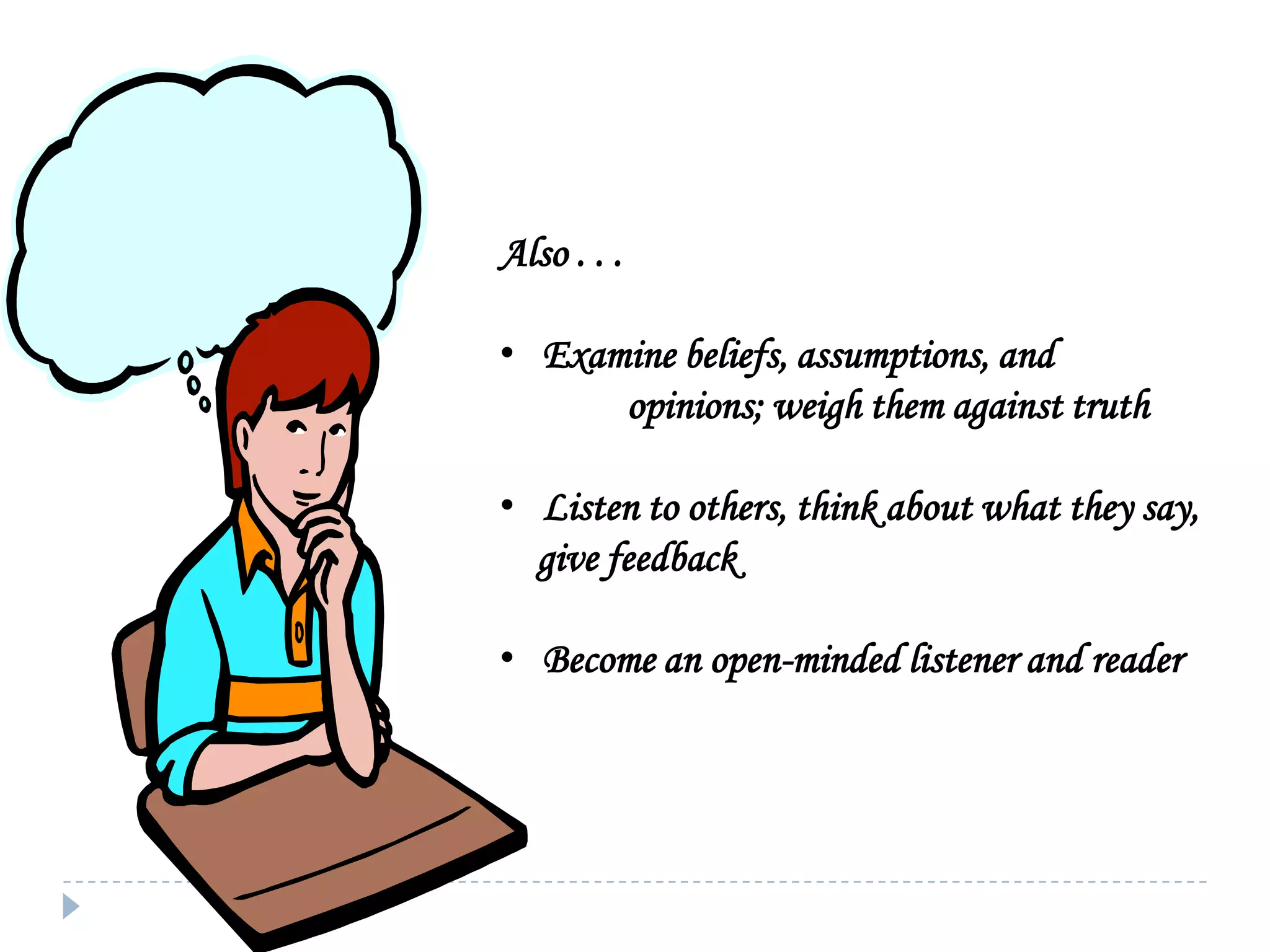
Also . . .
• Examine beliefs, assumptions, and
opinions; weigh them against truth
• Listen to others, think about what they say,
give feedback
• Become an open-minded listener and reader
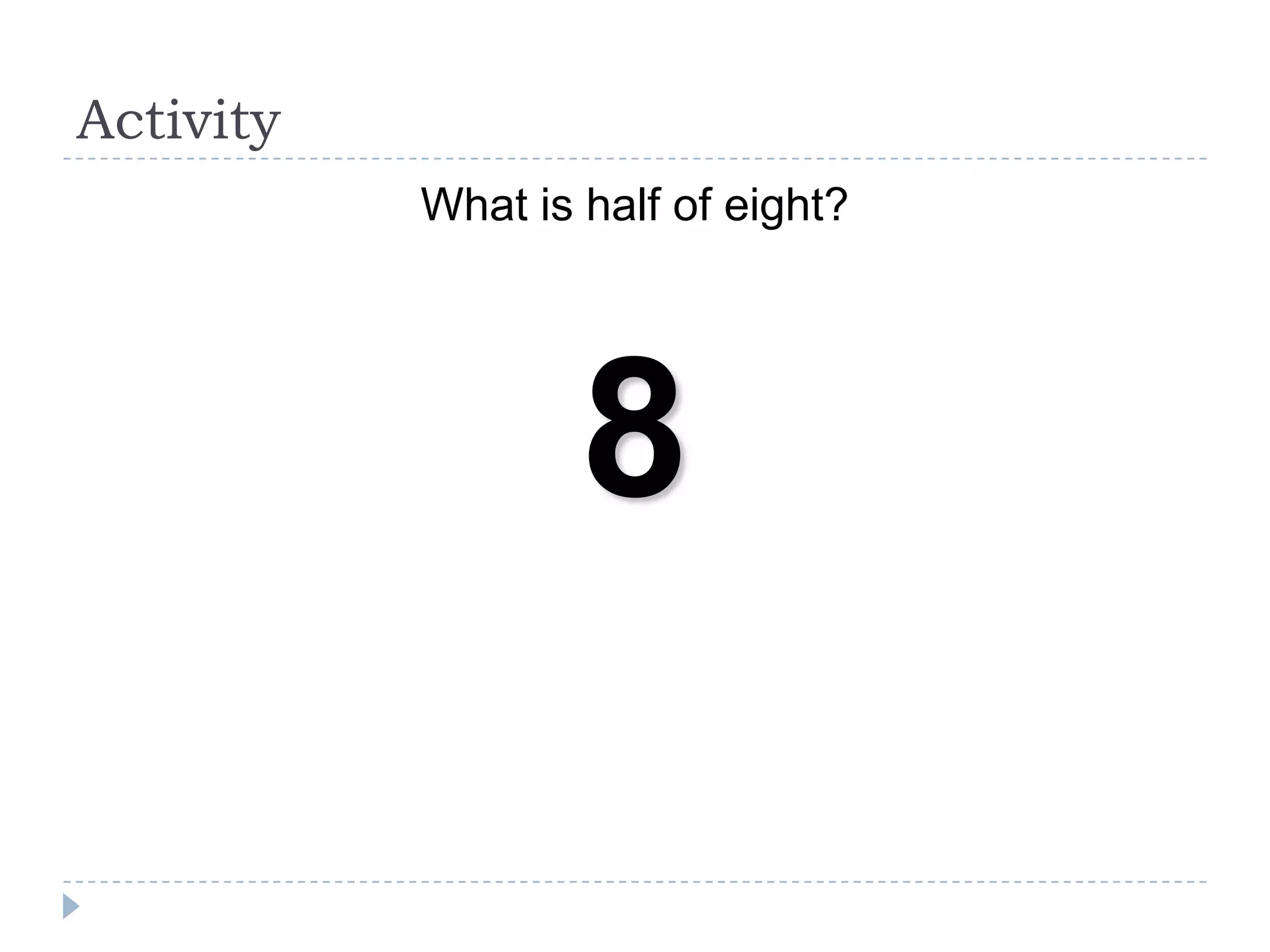
Activity
What is half of eight?

8
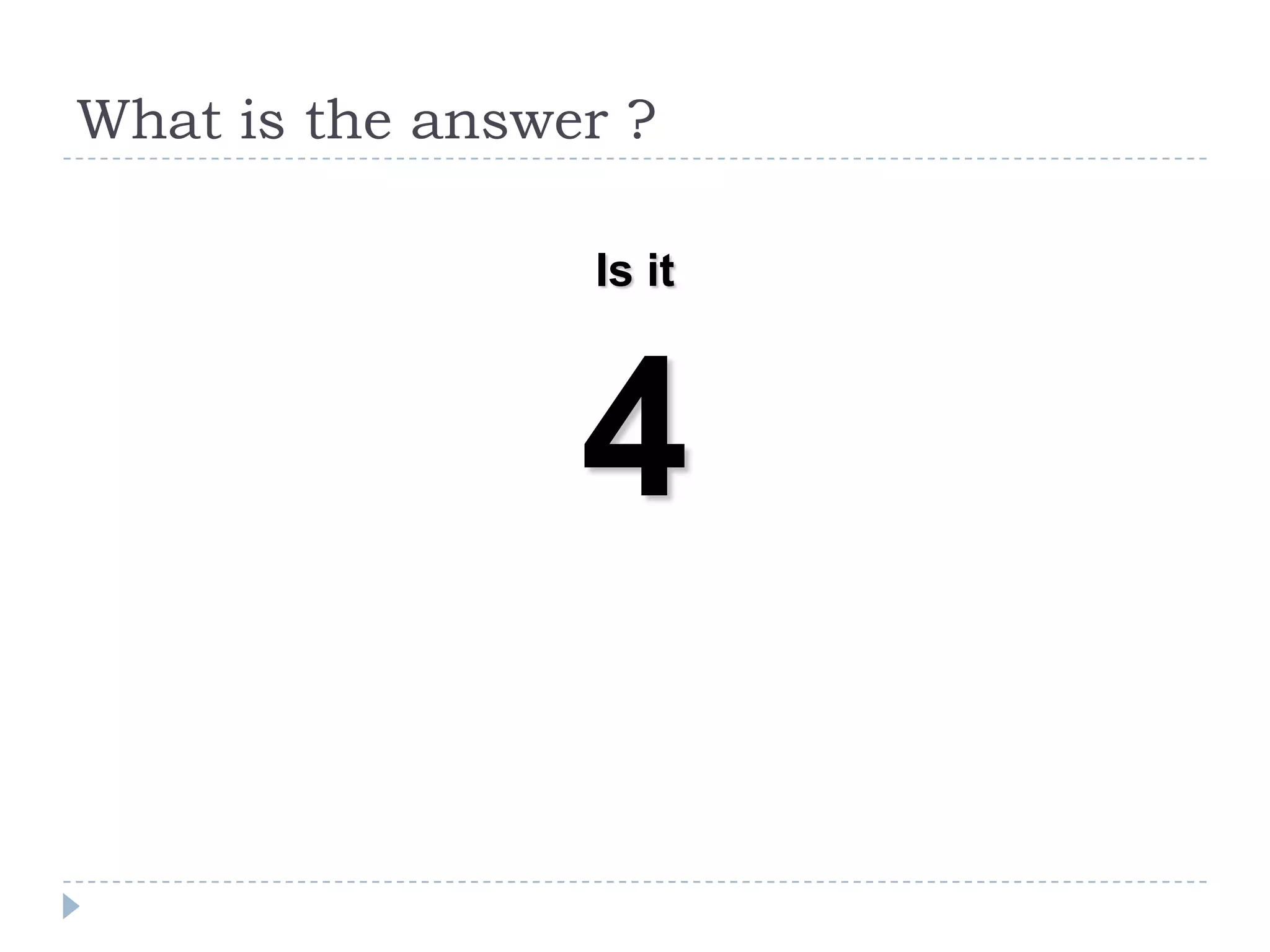
What is the answer ?
Is it

4
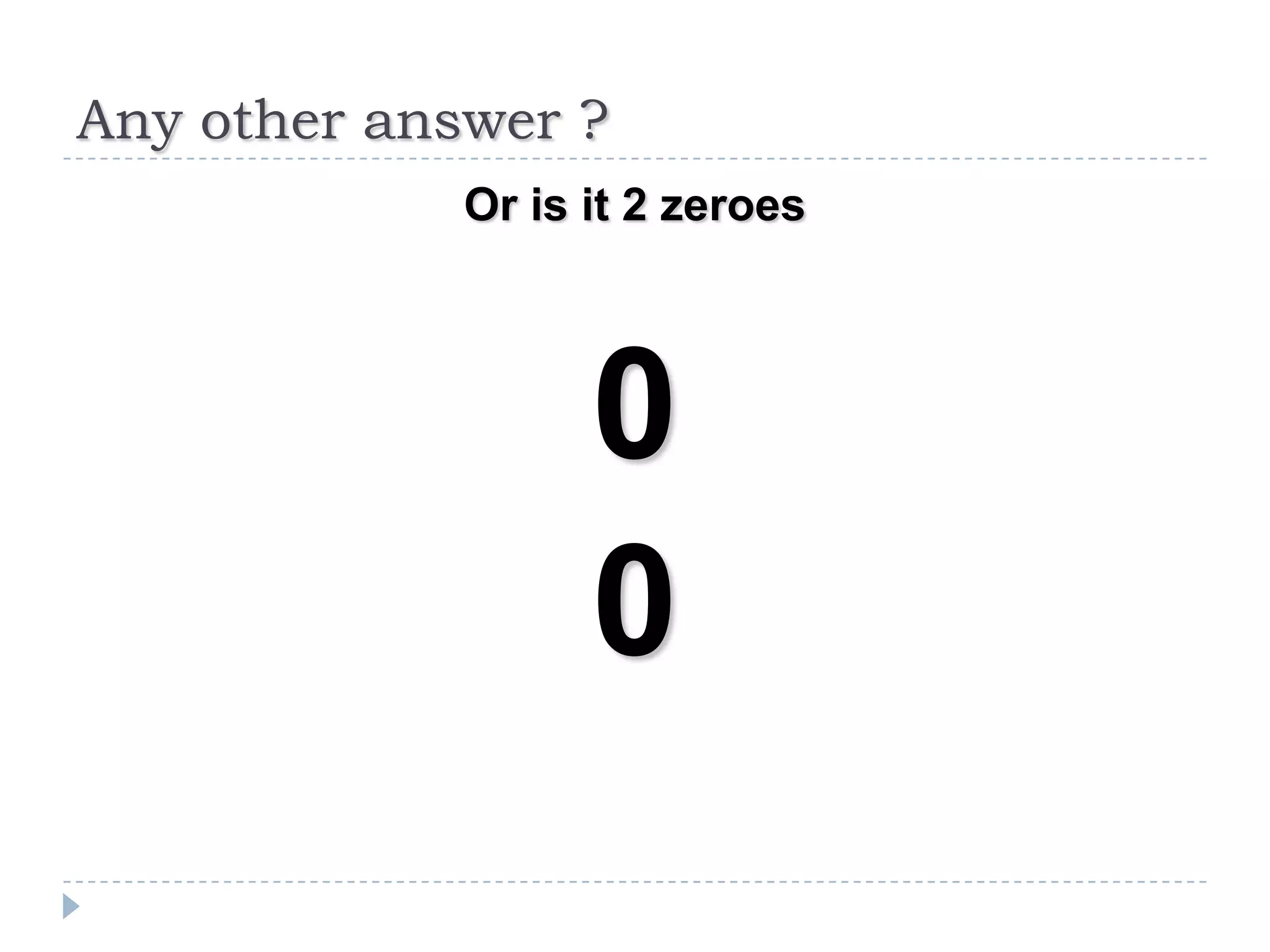
Any other answer ?
Or is it 2 zeroes

0
0
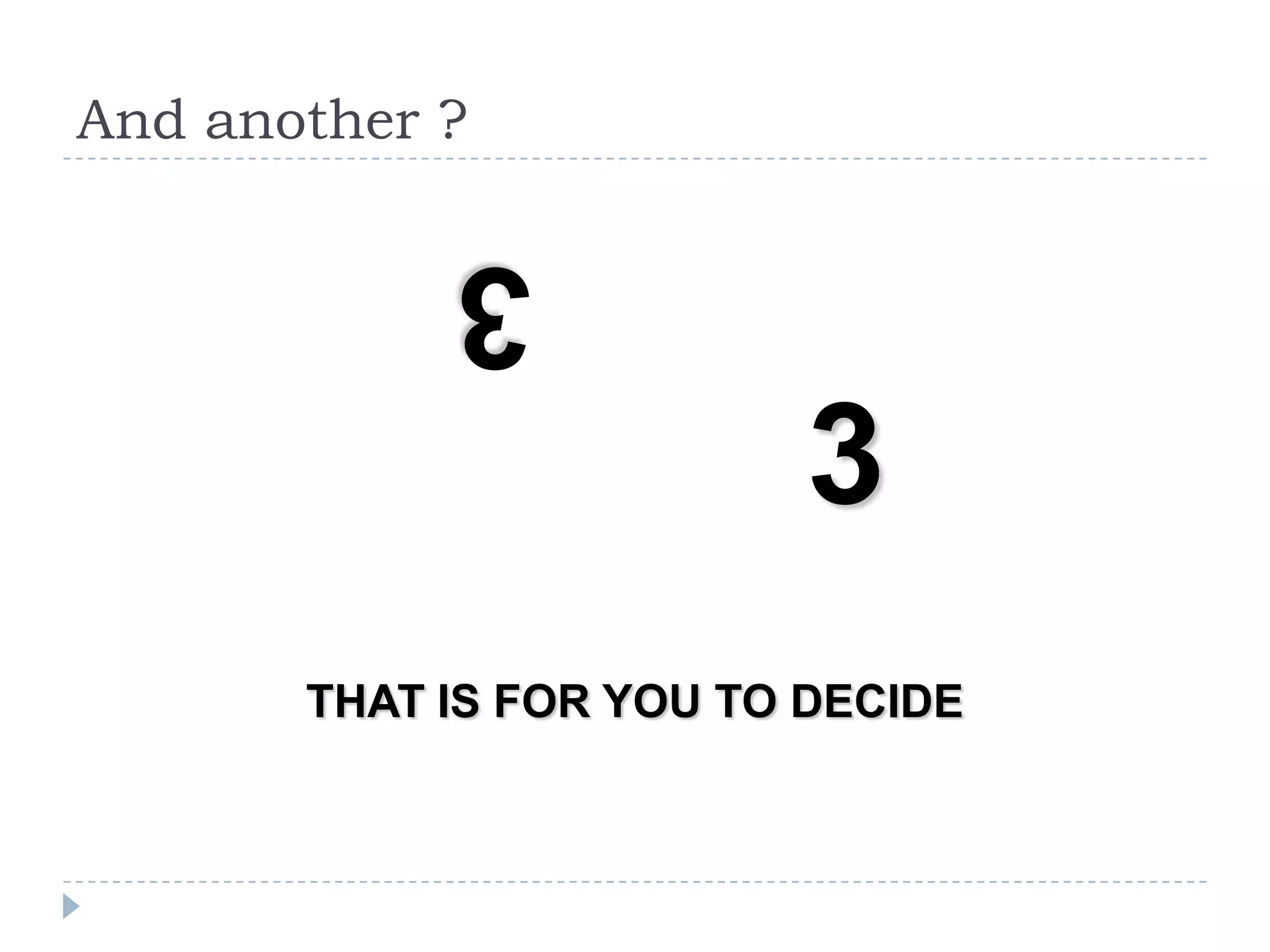
And another ?

3
THAT IS FOR YOU TO DECIDE
Activity

Without lifting your pencil from the paper, draw exactly
four straight, connected lines that will go through all
nine dots, but through each dot only once.
Problem

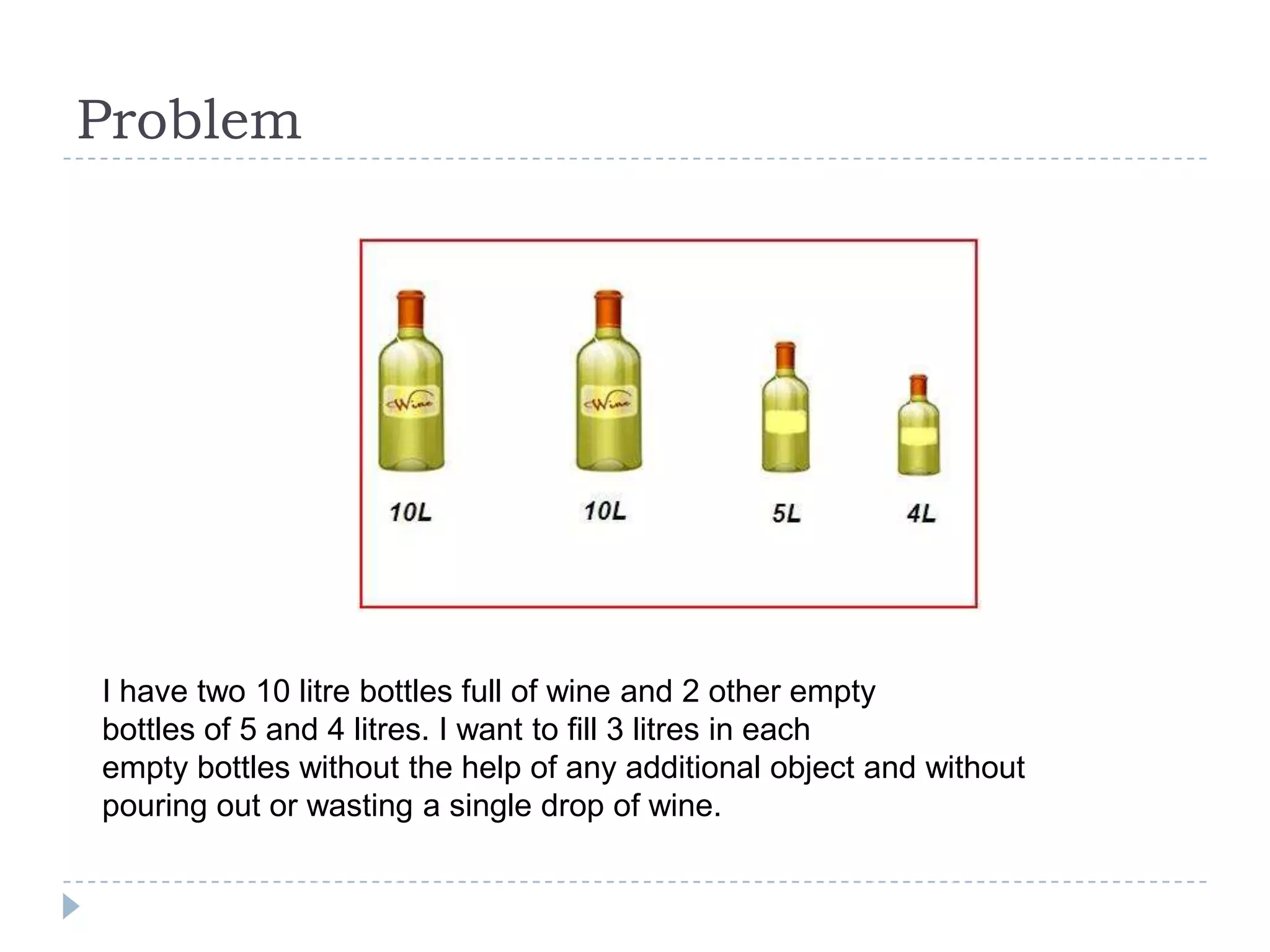
I have two 10 litre bottles full of wine and 2 other empty
bottles of 5 and 4 litres. I want to fill 3 litres in each
empty bottles without the help of any additional object and without
pouring out or wasting a single drop of wine.
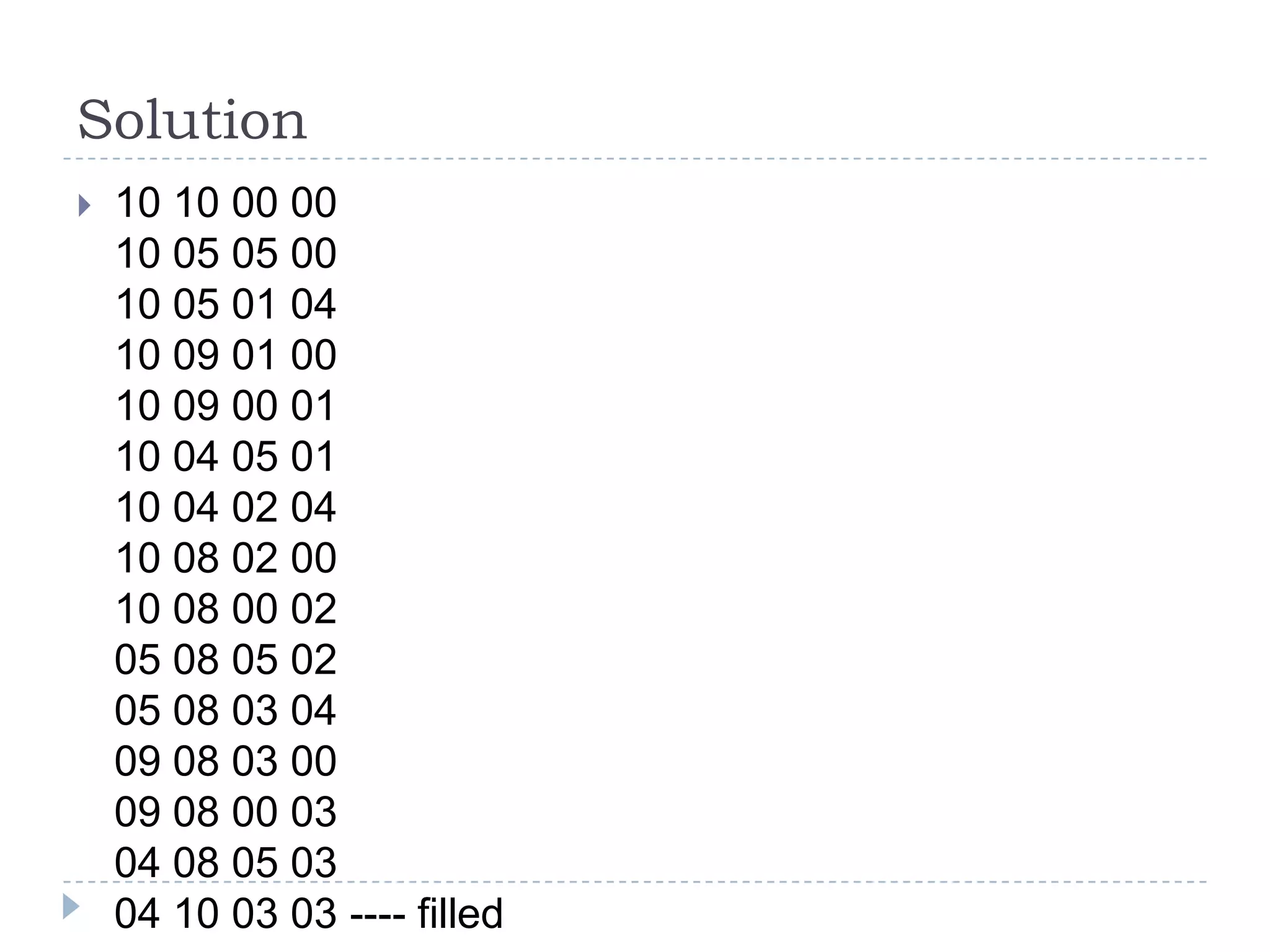
Solution


10 10 00 00
10 05 05 00
10 05 01 04
10 09 01 00
10 09 00 01
10 04 05 01
10 04 02 04
10 08 02 00
10 08 00 02
05 08 05 02
05 08 03 04
09 08 03 00
09 08 00 03
04 08 05 03
04 10 03 03 ---- filled
The image shows a huge Bengal Tiger standing in a bamboo
forest. Your mission is to look for "The Hidden Tiger" in the
image below.
Who

SHOULD

think critically?

< Video on baby using problem solving techniques>
Problem SolvingCase Study Based Interviews
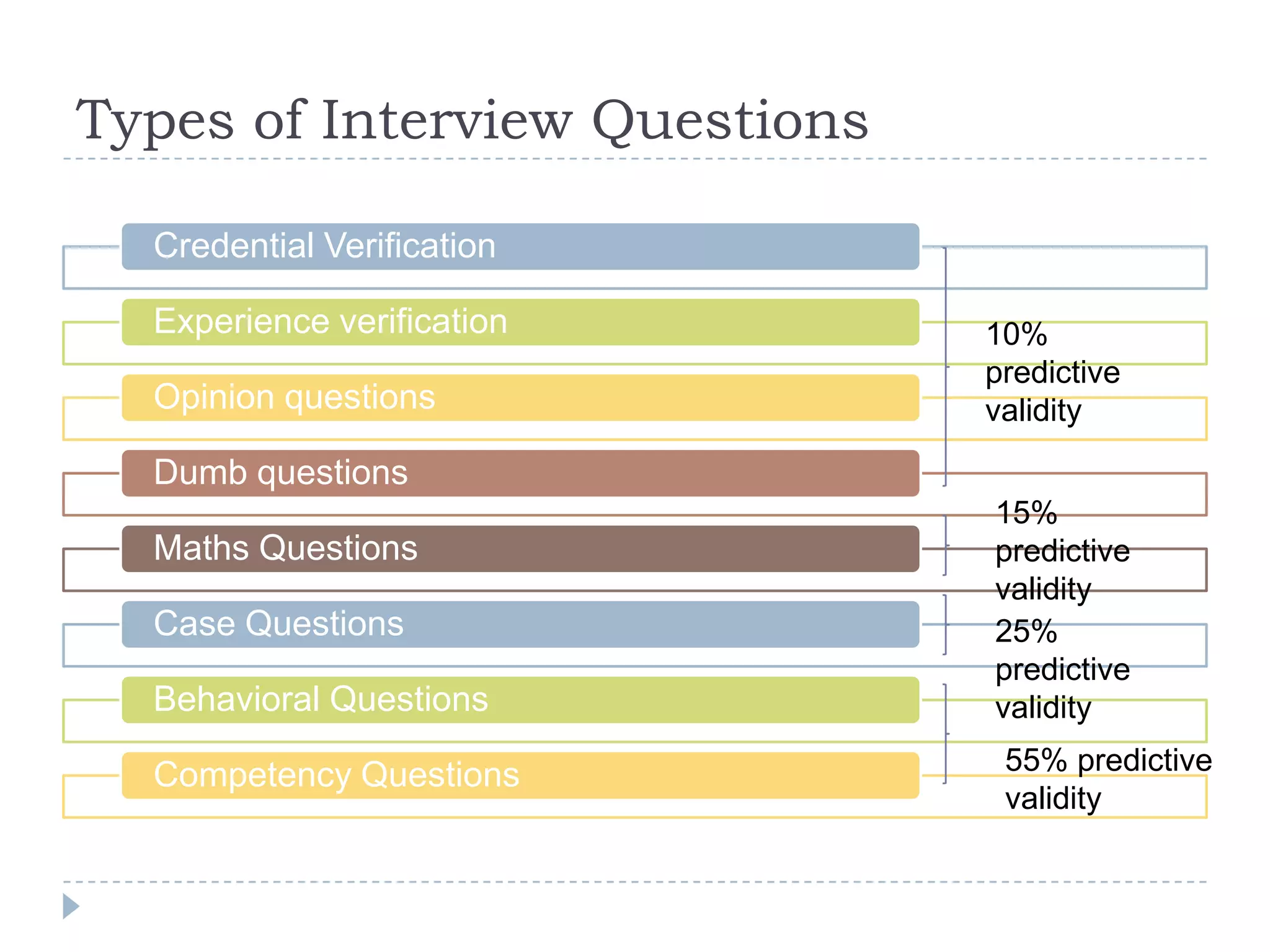
Types of Interview Questions
Credential Verification
Experience verification
Opinion questions

10%
predictive
validity

Dumb questions

Maths Questions
Case Questions
Behavioral Questions
Competency Questions

15%
predictive
validity
25%
predictive
validity
55% predictive
validity
Types of Interview Questions

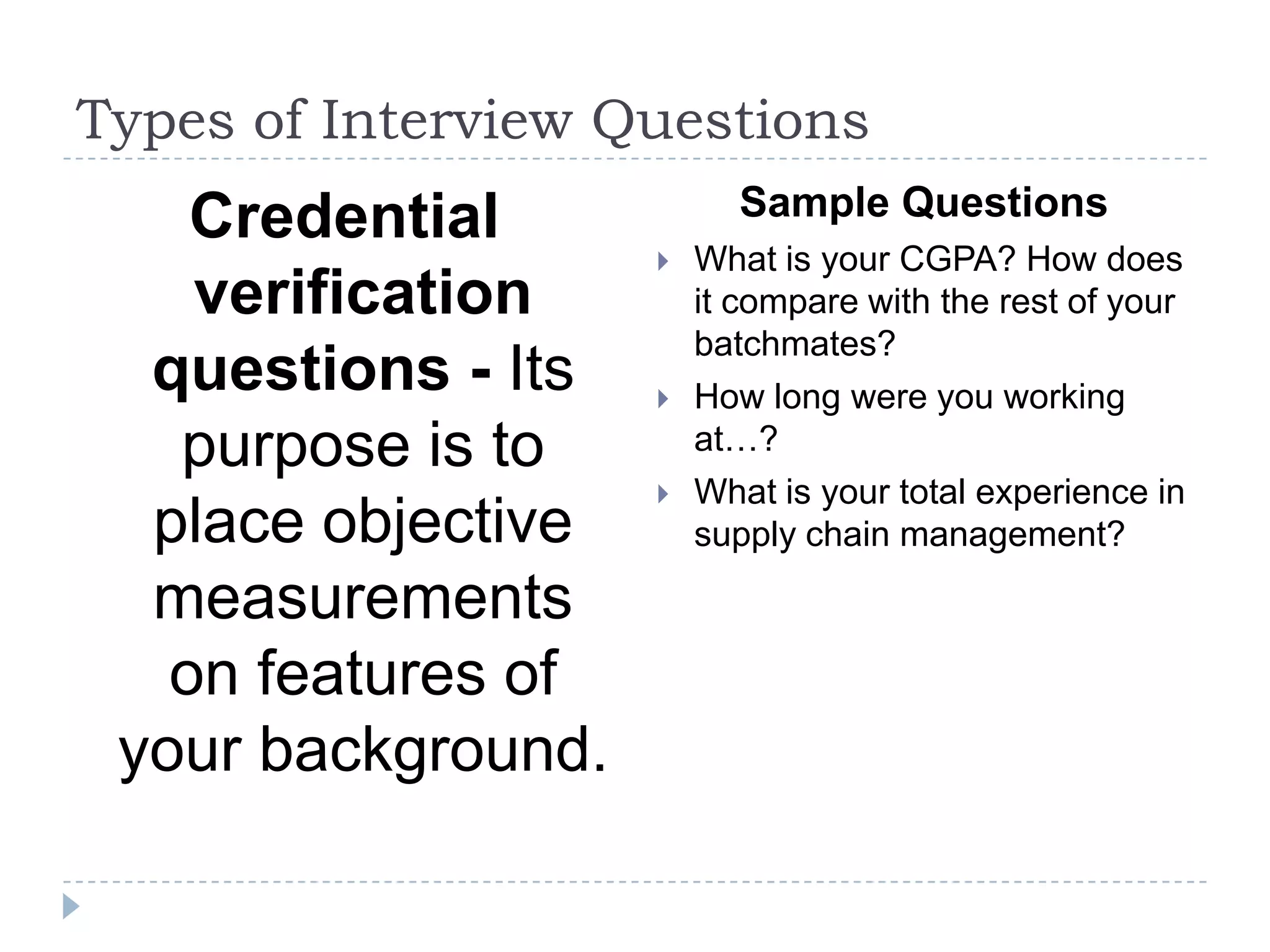
Credential
verification
questions - Its
purpose is to
place objective
measurements
on features of
your background.

Sample Questions





What is your CGPA? How does
it compare with the rest of your
batchmates?
How long were you working
at…?
What is your total experience in
supply chain management?
Types of Interview Questions

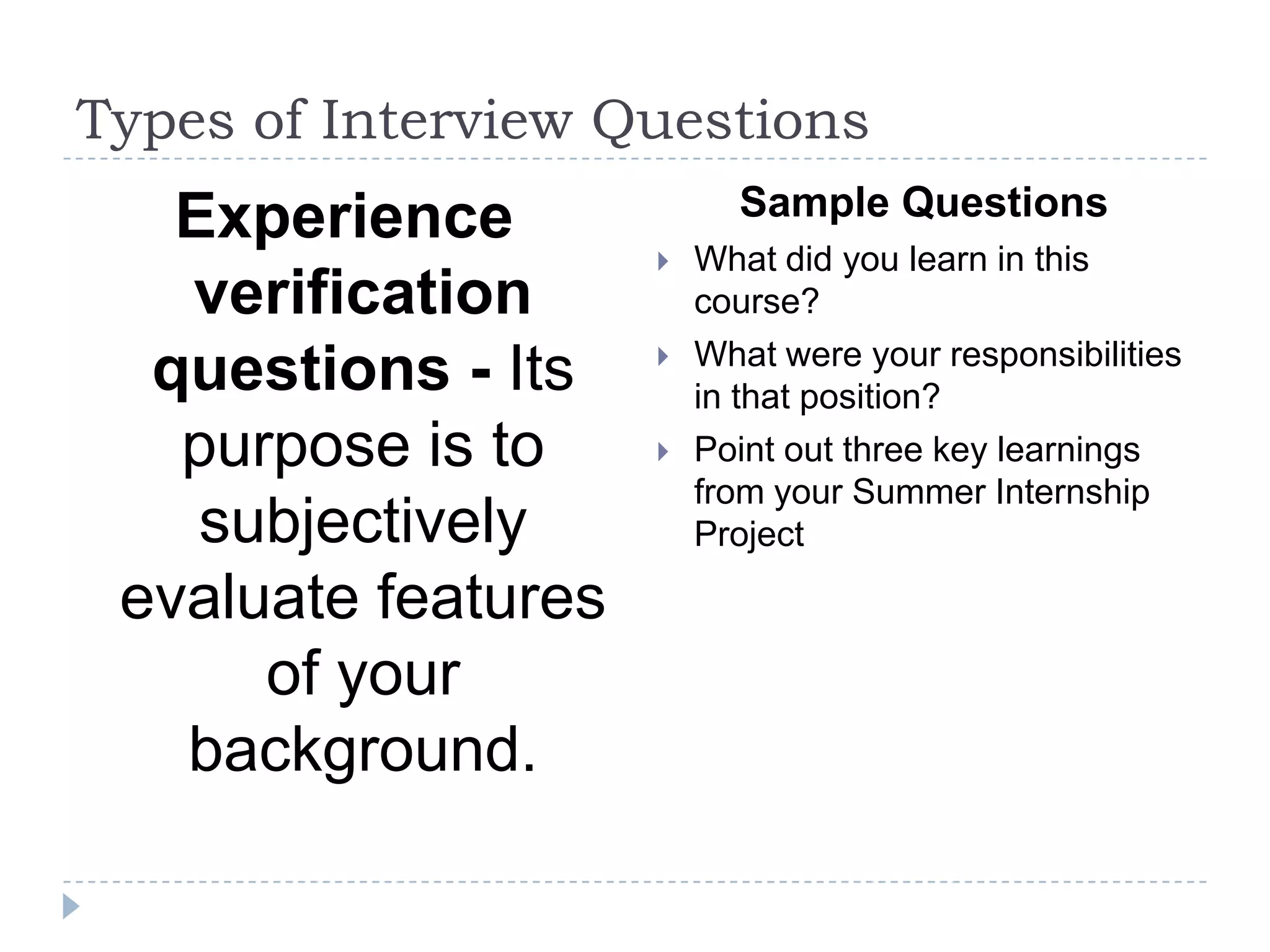
Experience
verification
questions - Its
purpose is to
subjectively
evaluate features
of your
background.

Sample Questions




What did you learn in this
course?
What were your responsibilities
in that position?
Point out three key learnings
from your Summer Internship
Project
Types of Interview Questions

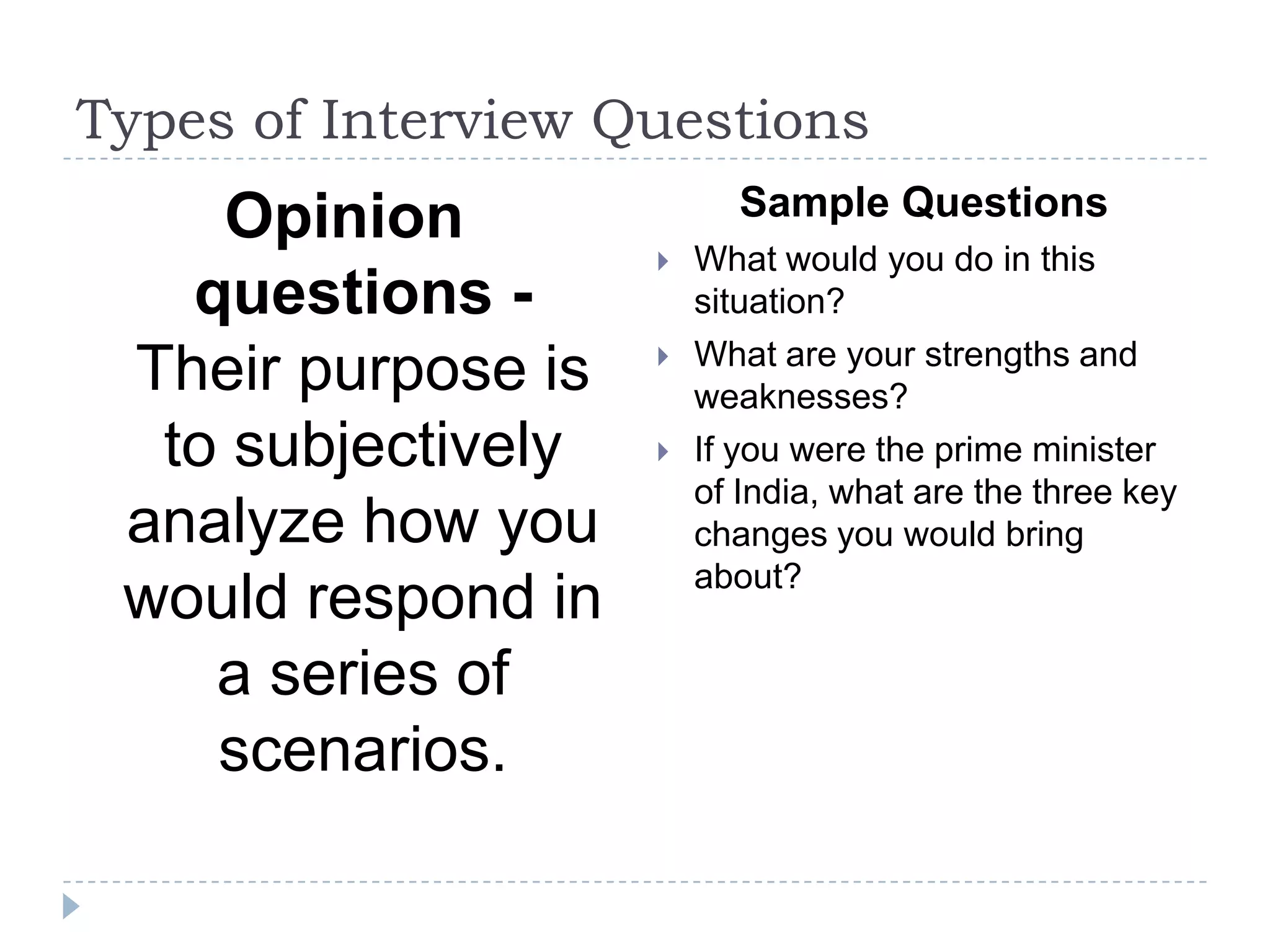
Opinion
questions Their purpose is
to subjectively
analyze how you
would respond in
a series of
scenarios.

Sample Questions




What would you do in this
situation?
What are your strengths and
weaknesses?
If you were the prime minister
of India, what are the three key
changes you would bring
about?
Types of Interview Questions
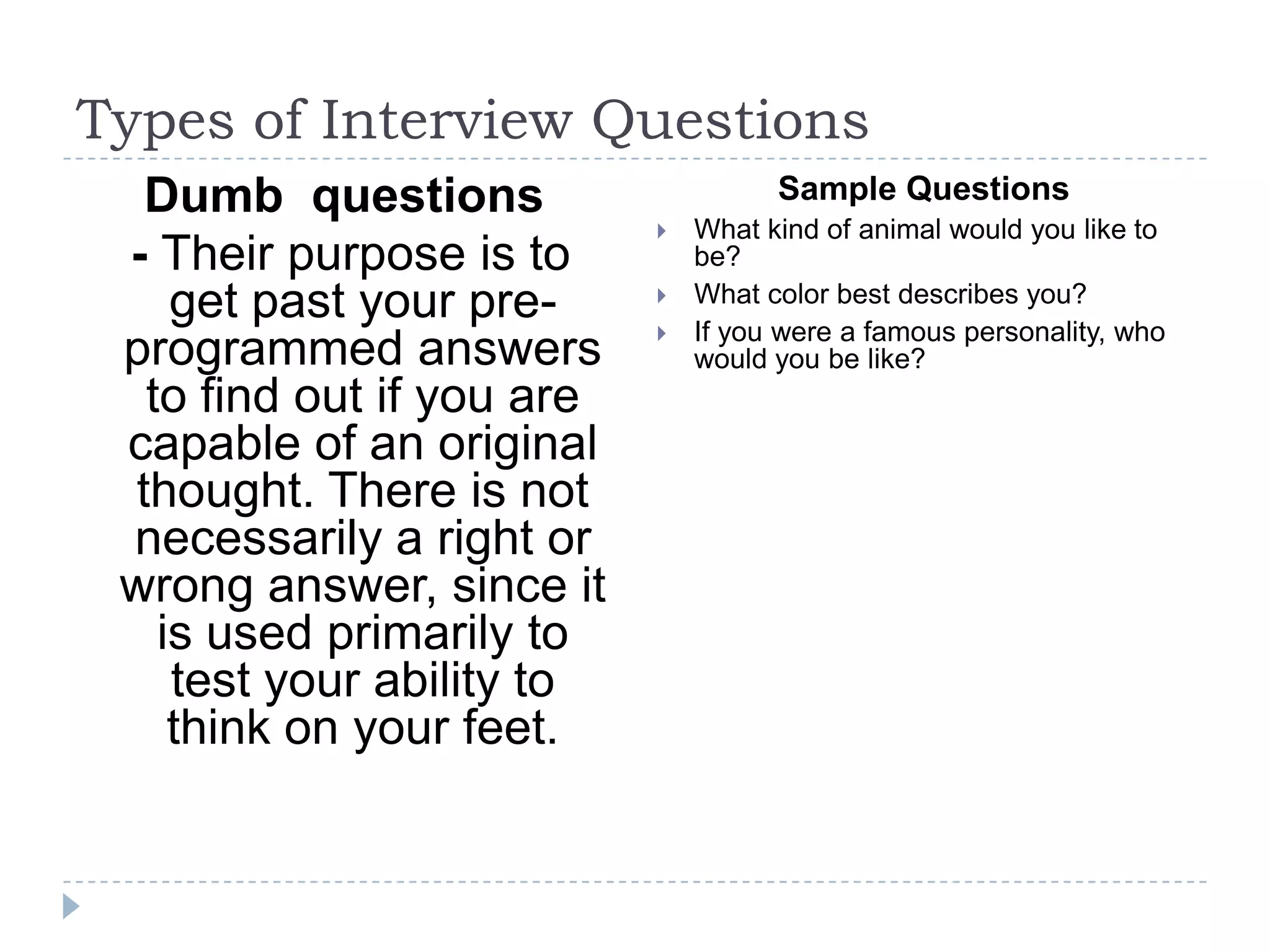
Dumb questions
- Their purpose is to
get past your preprogrammed answers
to find out if you are
capable of an original
thought. There is not
necessarily a right or
wrong answer, since it
is used primarily to
test your ability to
think on your feet.

Sample Questions





What kind of animal would you like to
be?
What color best describes you?
If you were a famous personality, who
would you be like?
Types of Interview Questions


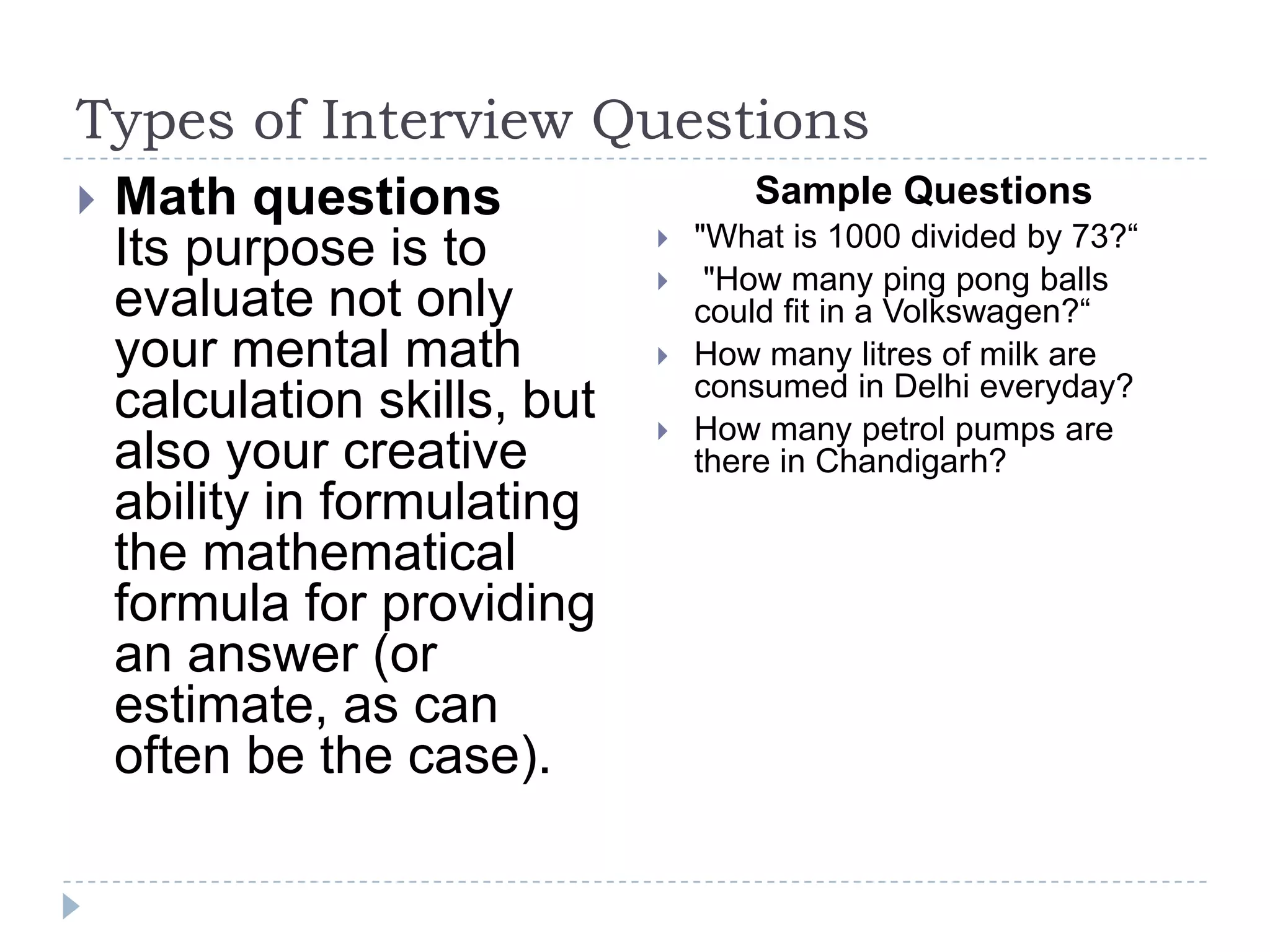
Math questions
Its purpose is to
evaluate not only
your mental math
calculation skills, but
also your creative
ability in formulating
the mathematical
formula for providing
an answer (or
estimate, as can
often be the case).

Sample Questions





"What is 1000 divided by 73?“
"How many ping pong balls
could fit in a Volkswagen?“
How many litres of milk are
consumed in Delhi everyday?
How many petrol pumps are
there in Chandigarh?
Types of Interview Questions


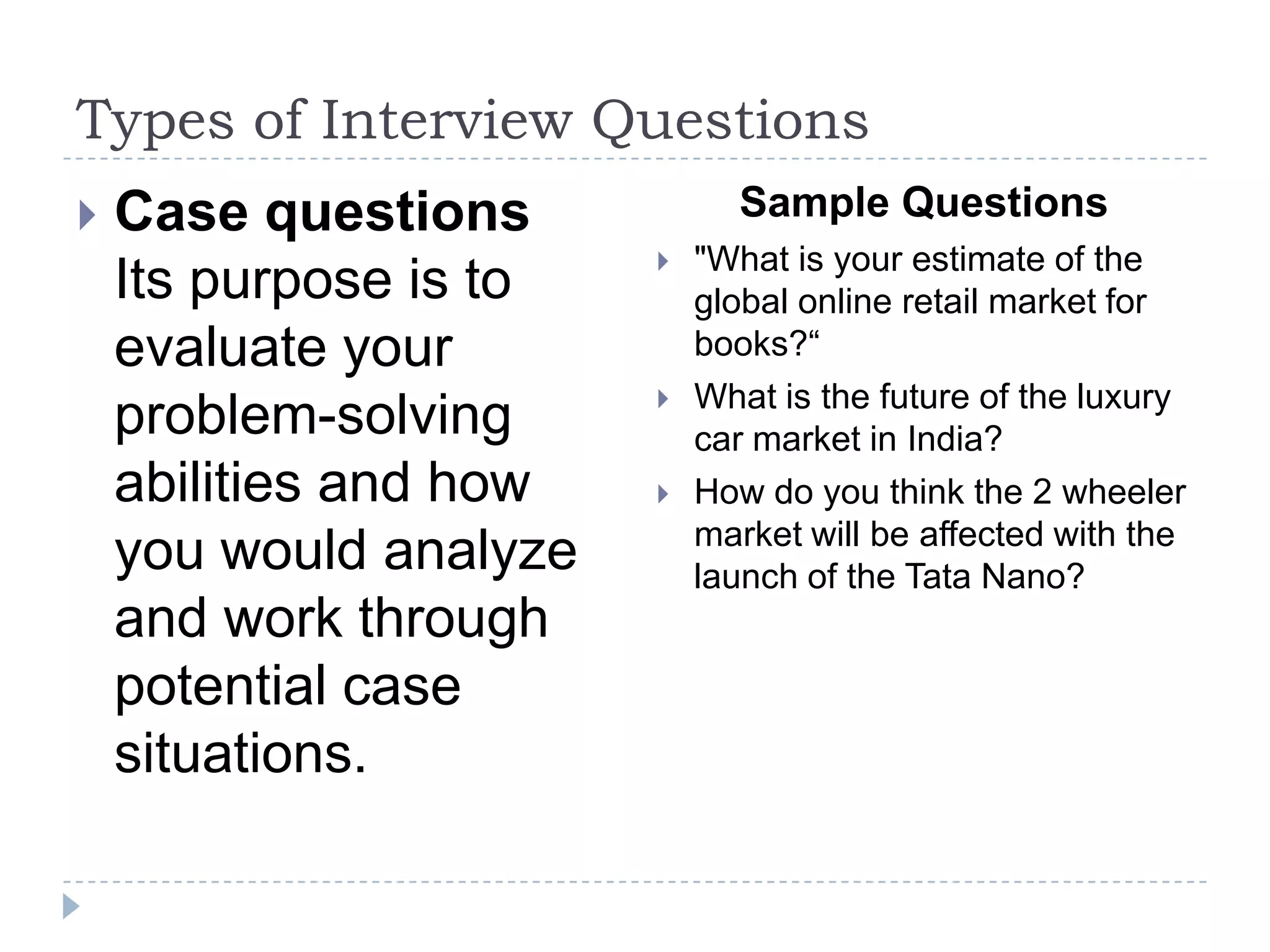
Case questions
Its purpose is to
evaluate your
problem-solving
abilities and how
you would analyze
and work through
potential case
situations.
Sample Questions





"What is your estimate of the
global online retail market for
books?“
What is the future of the luxury
car market in India?
How do you think the 2 wheeler
market will be affected with the
launch of the Tata Nano?
Types of Interview Questions


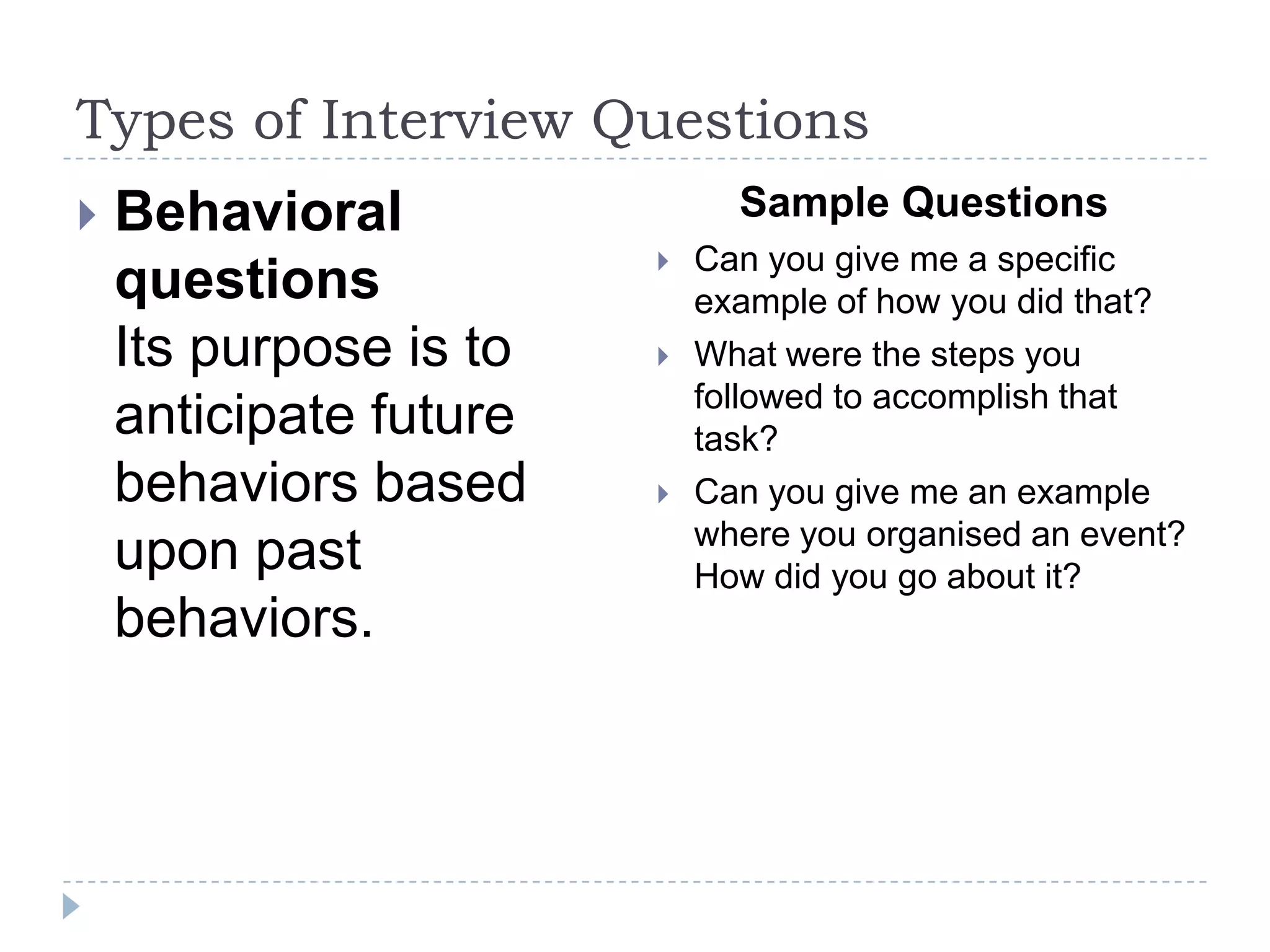
Behavioral
questions
Its purpose is to
anticipate future
behaviors based
upon past
behaviors.

Sample Questions





Can you give me a specific
example of how you did that?
What were the steps you
followed to accomplish that
task?
Can you give me an example
where you organised an event?
How did you go about it?
Types of Interview Questions


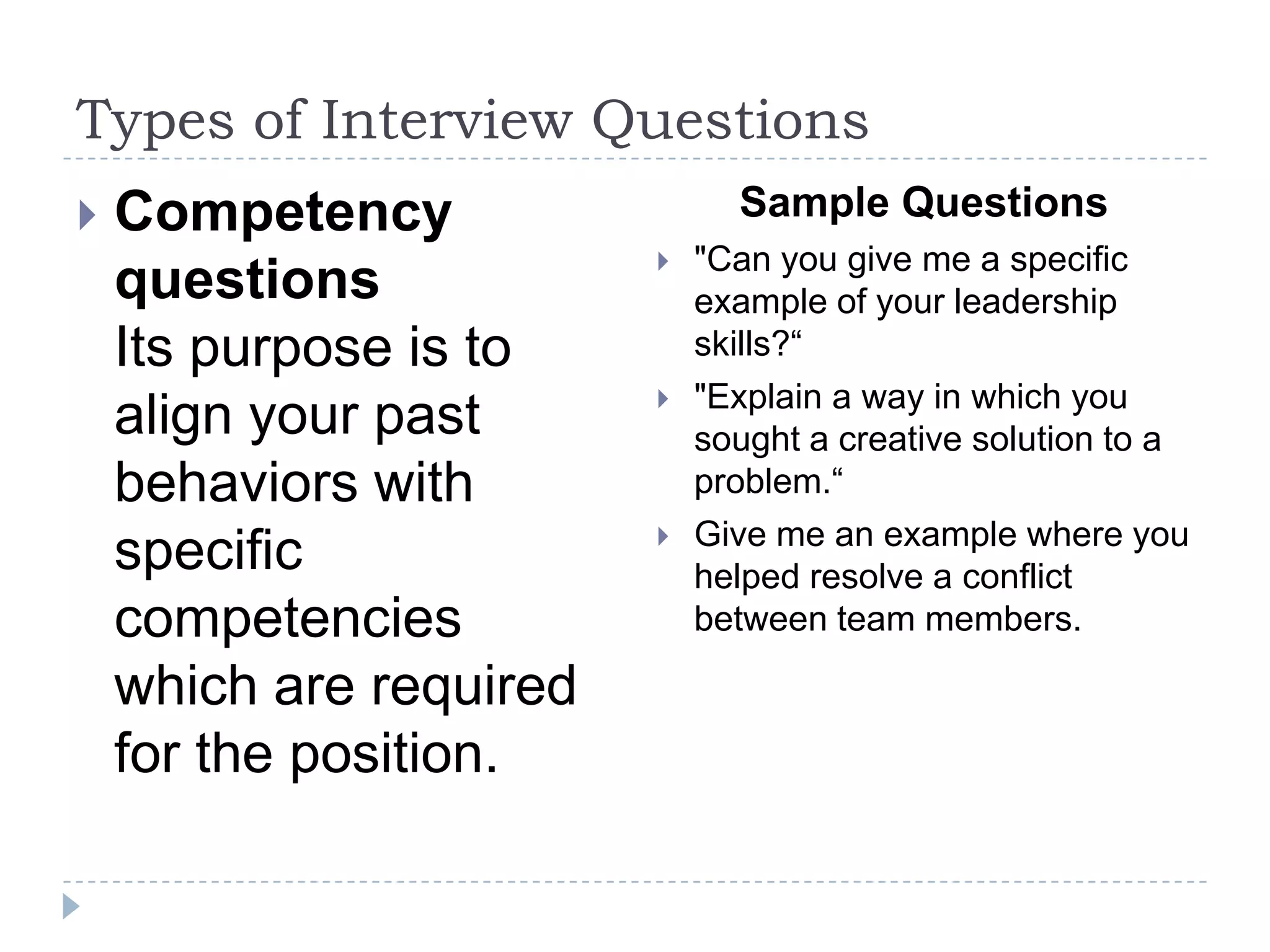
Competency
questions
Its purpose is to
align your past
behaviors with
specific
competencies
which are required
for the position.

Sample Questions






"Can you give me a specific
example of your leadership
skills?“
"Explain a way in which you
sought a creative solution to a
problem.“
Give me an example where you
helped resolve a conflict
between team members.
Agenda






•What is the format and structure of a case interview?
•Which skills are case interviews trying to test?
•What are some common myths about case interviews?
•How do I crack a case interview?
OBJECTIVES


Introduce the consulting case interview format




Objectives
Typical structure
Evaluation

Mock case simulation and discussion







Framing
Analysis
Conclusions

Case interview preparation tips
Case interviews require interviewees to solve business
problems on‐the‐spot





“The most accurate predictor of future performance is the ability to
solve on the‐job problems in real‐time”
Focused on problem solving abilities:
The interviewee must work with the interviewer to solve business
problems
Q&A format: Interviewer moves on to successive questions with
relatively little discussion thereafter
WHAT DO COMPANIES LOOK FOR?
Not “The Answer”

Creativity
Apply a unique
perspective to business
situations
See the big picture

Draw conclusions from
partial information
• Make assumptions,
see patterns, and
generate hypotheses

Poise
Appear excited by the
kinds of issues
consultants face
Are not intimidated by
process or problems
Assimilate information
quickly and effectively
Ask insightful questions

Analytics
Provide structure to
unstructured problems
Break problems into
components

Apply transparent,
logical thinking to each
component
Synthesize discussion
into solution
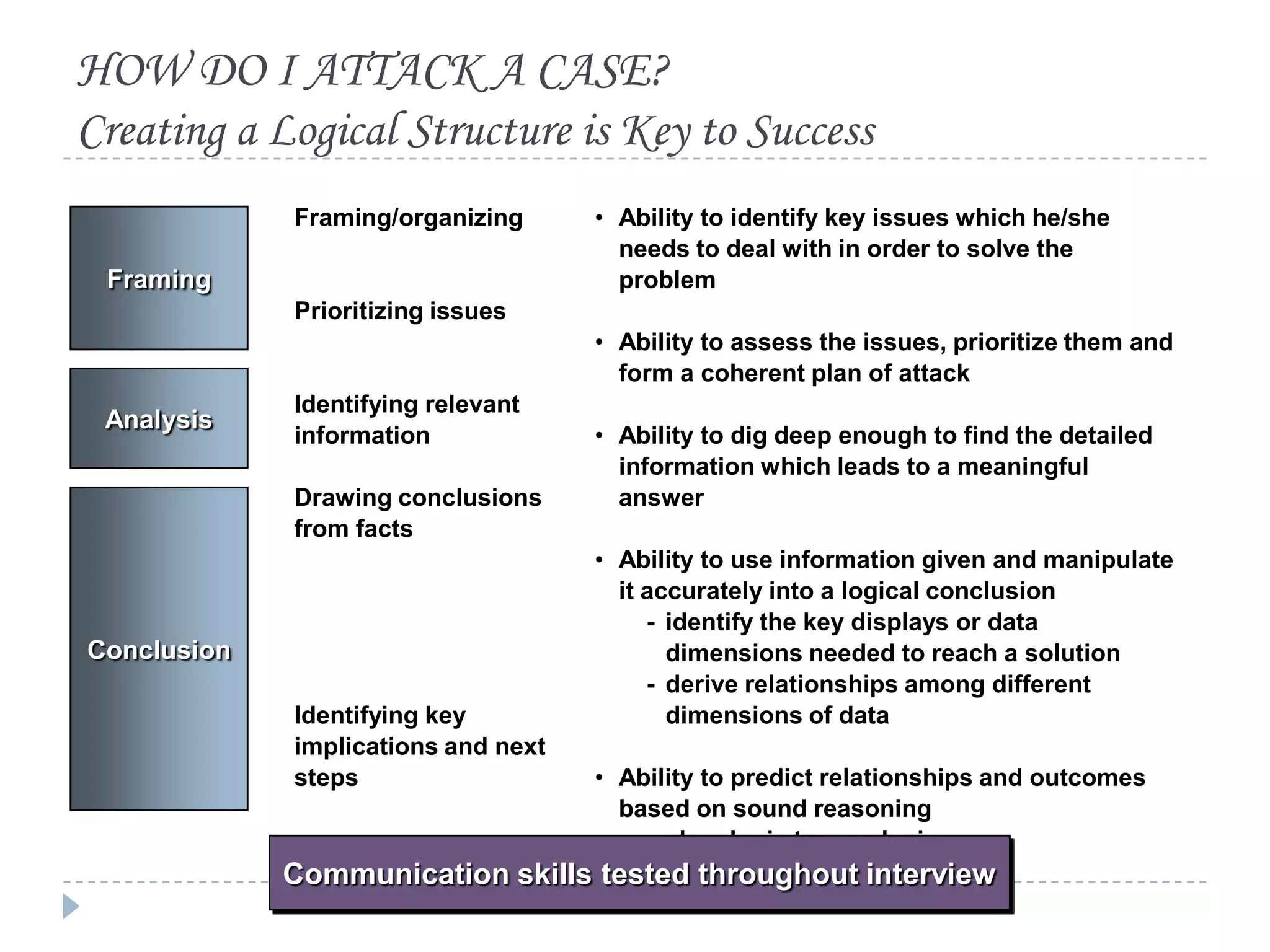
HOW DO I ATTACK A CASE?
Creating a Logical Structure is Key to Success
Framing/organizing

Framing

• Ability to identify key issues which he/she
needs to deal with in order to solve the
problem

Prioritizing issues
• Ability to assess the issues, prioritize them and
form a coherent plan of attack

Analysis

Identifying relevant
information
Drawing conclusions
from facts

Conclusion
Identifying key
implications and next
steps

Communication

• Ability to dig deep enough to find the detailed
information which leads to a meaningful
answer
• Ability to use information given and manipulate
it accurately into a logical conclusion
- identify the key displays or data
dimensions needed to reach a solution
- derive relationships among different
dimensions of data

• Ability to predict relationships and outcomes
based on sound reasoning
- clear logic to conclusion
- delineation of alternatives
skills tested throughout interview
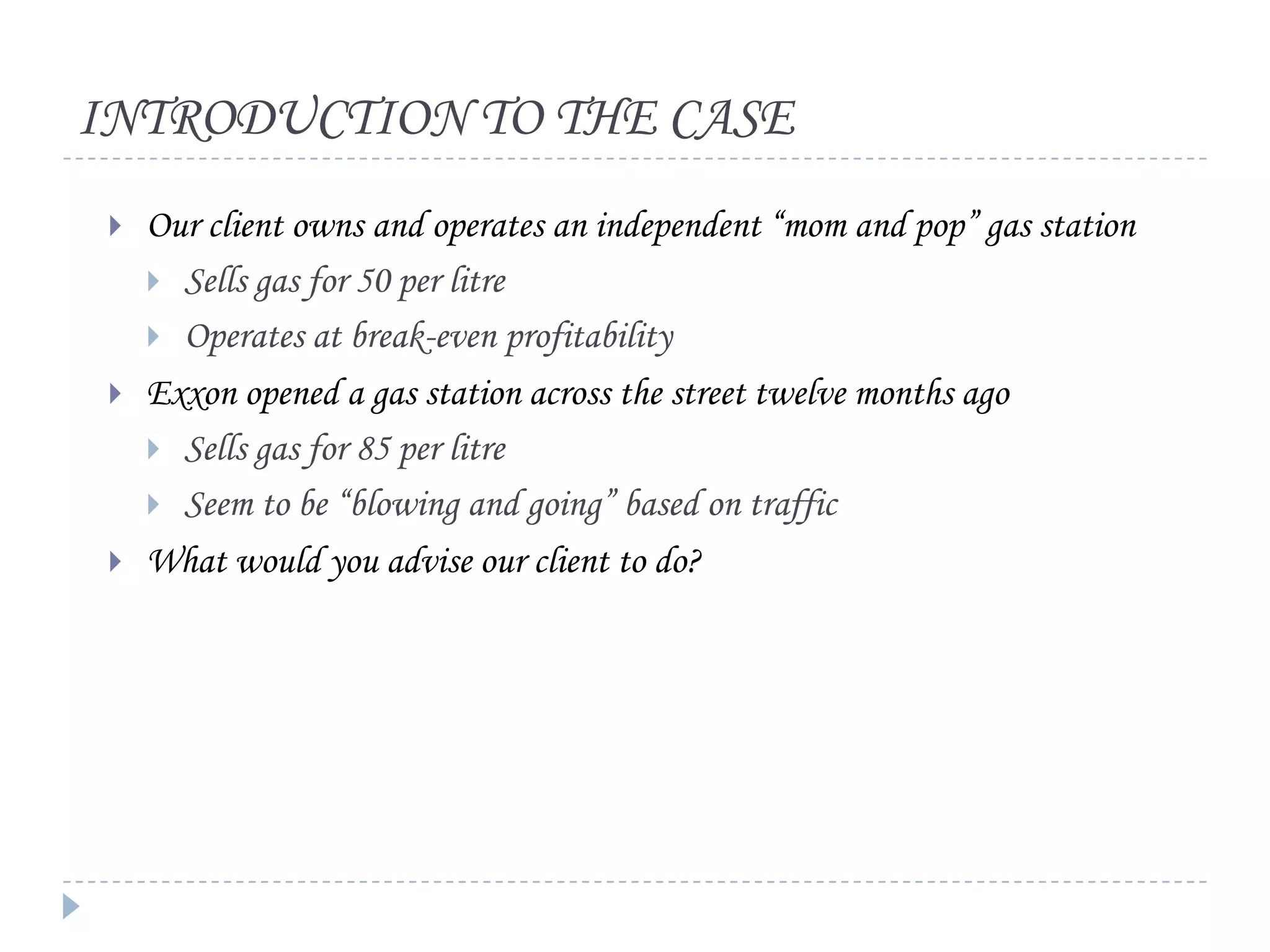
INTRODUCTION TO THE CASE






Our client owns and operates an independent “mom and pop” gas station
 Sells gas for 50 per litre
 Operates at break-even profitability
Exxon opened a gas station across the street twelve months ago
 Sells gas for 85 per litre
 Seem to be “blowing and going” based on traffic
What would you advise our client to do?
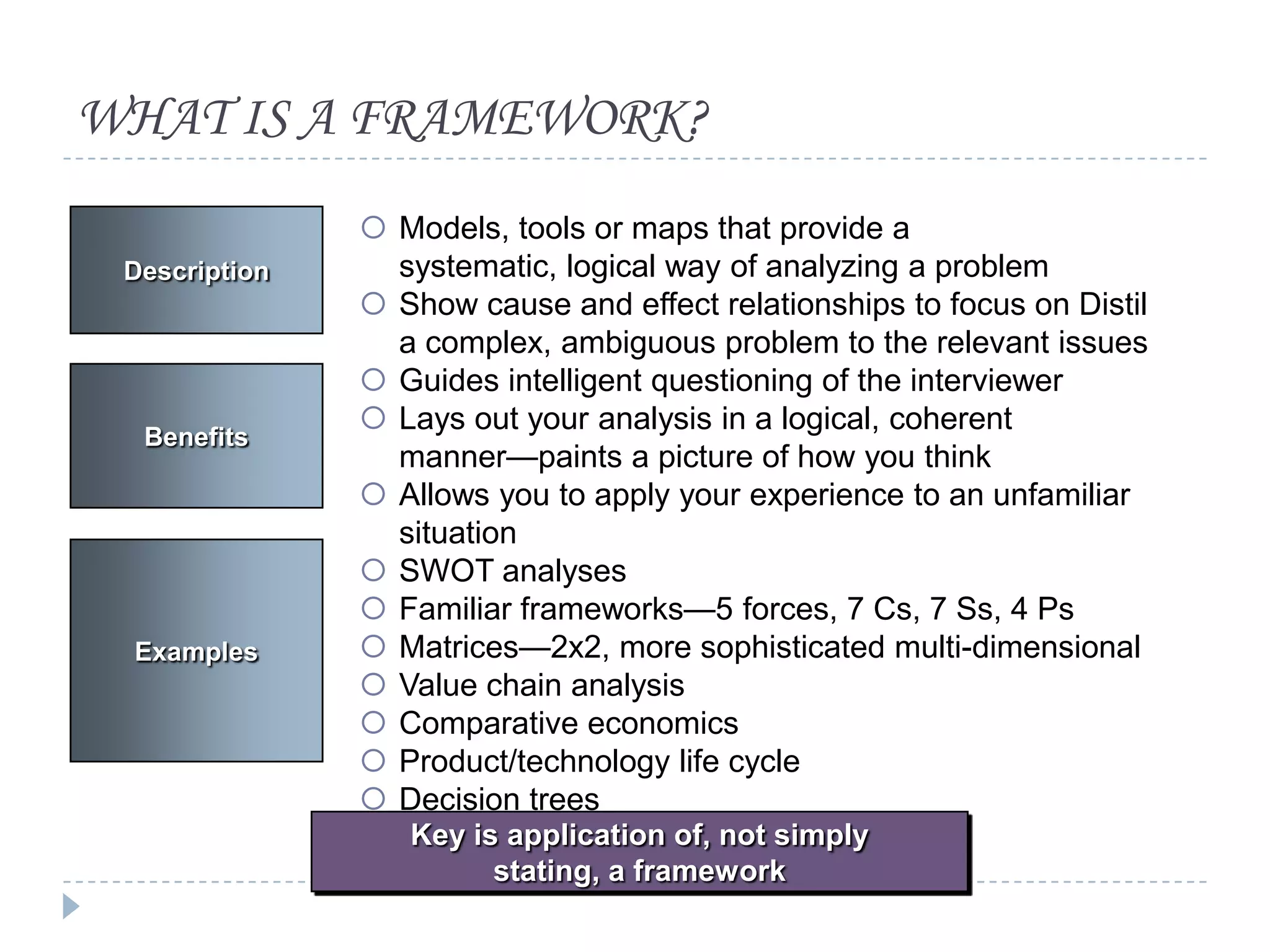
WHAT IS A FRAMEWORK?
Description

Benefits

Examples

 Models, tools or maps that provide a
systematic, logical way of analyzing a problem
 Show cause and effect relationships to focus on Distil
a complex, ambiguous problem to the relevant issues
 Guides intelligent questioning of the interviewer
 Lays out your analysis in a logical, coherent
manner—paints a picture of how you think
 Allows you to apply your experience to an unfamiliar
situation
 SWOT analyses
 Familiar frameworks—5 forces, 7 Cs, 7 Ss, 4 Ps
 Matrices—2x2, more sophisticated multi-dimensional
 Value chain analysis
 Comparative economics
 Product/technology life cycle
 Decision trees
Key is application of, not simply
stating, a framework
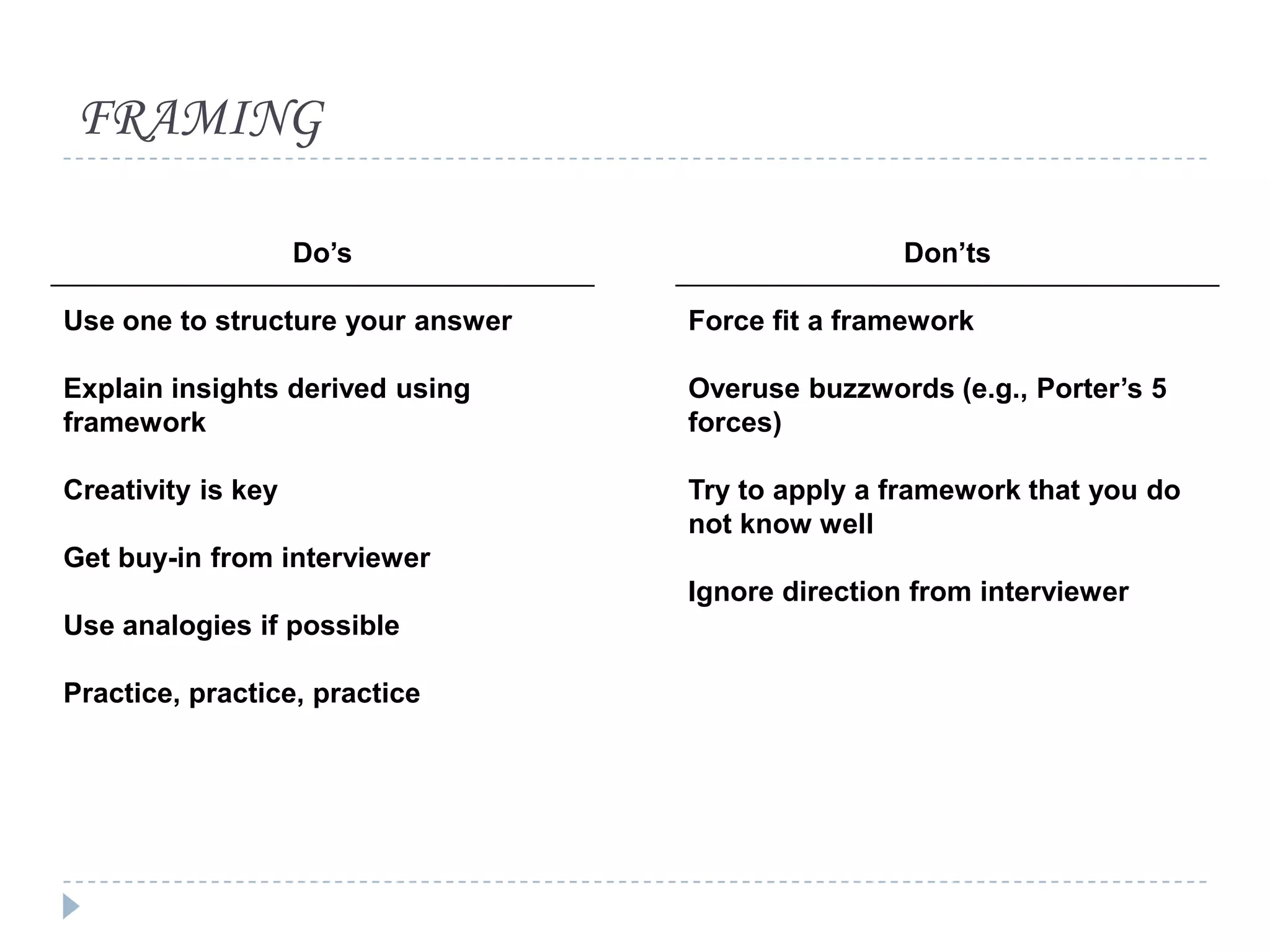
FRAMING
Do’s

Don’ts

Use one to structure your answer

Force fit a framework

Explain insights derived using
framework

Overuse buzzwords (e.g., Porter’s 5
forces)

Creativity is key

Try to apply a framework that you do
not know well

Get buy-in from interviewer
Ignore direction from interviewer
Use analogies if possible
Practice, practice, practice
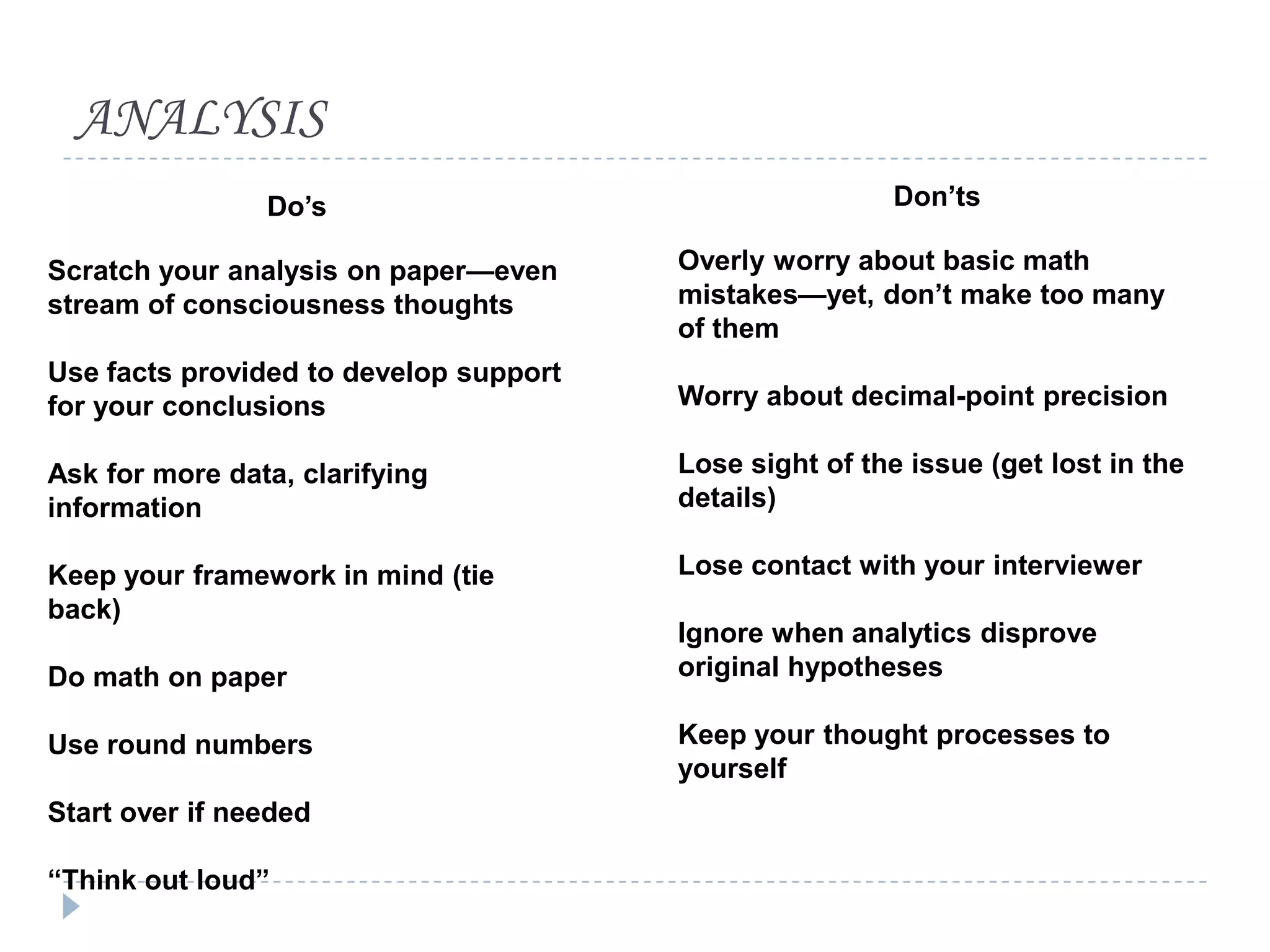
ANALYSIS
Do’s

Don’ts

Scratch your analysis on paper—even
stream of consciousness thoughts

Overly worry about basic math
mistakes—yet, don’t make too many
of them

Use facts provided to develop support
for your conclusions

Worry about decimal-point precision

Ask for more data, clarifying
information

Lose sight of the issue (get lost in the
details)

Keep your framework in mind (tie
back)

Lose contact with your interviewer

Do math on paper
Use round numbers

Start over if needed
“Think out loud”

Ignore when analytics disprove
original hypotheses

Keep your thought processes to
yourself
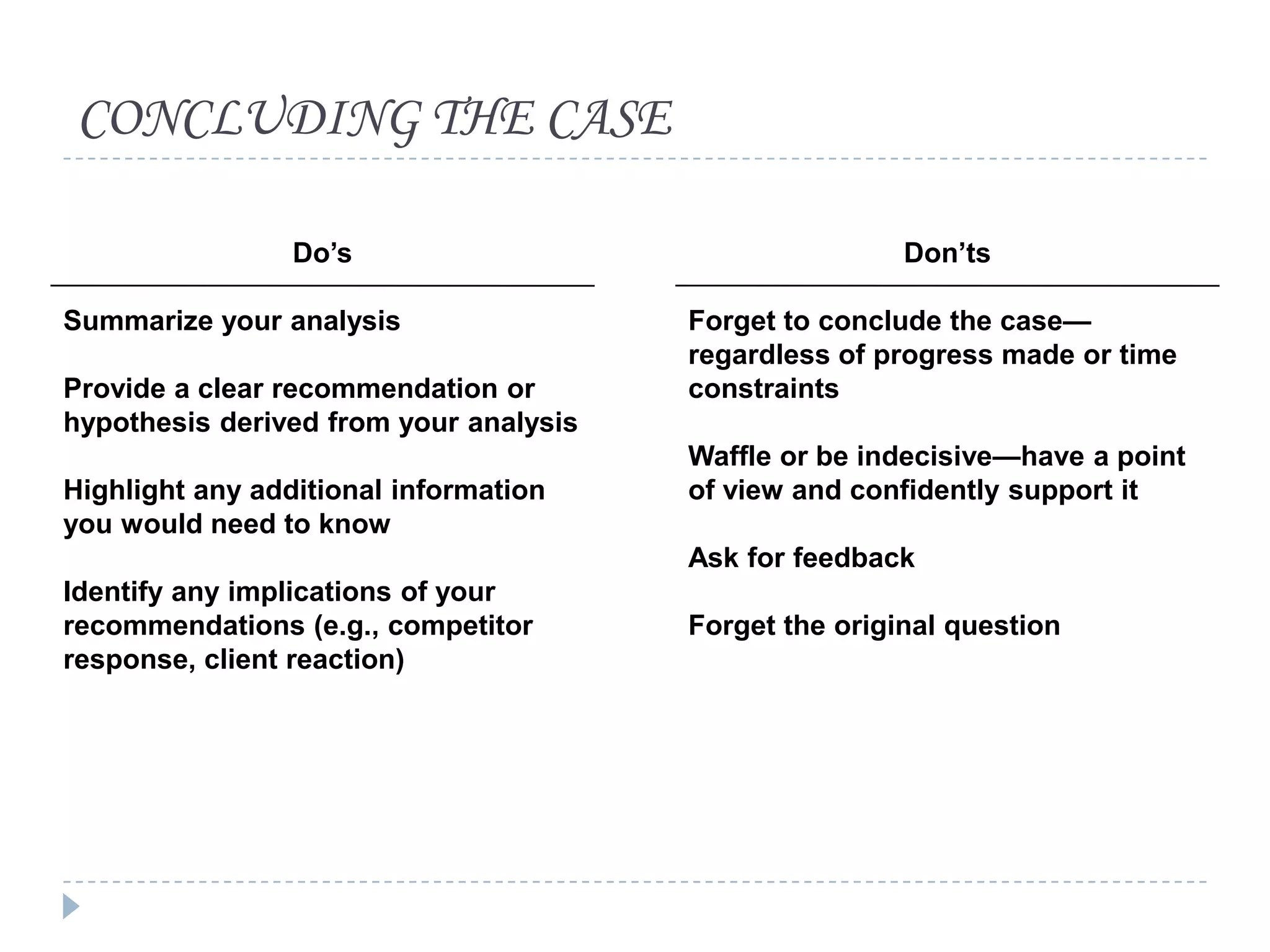
CONCLUDING THE CASE
Do’s

Summarize your analysis
Provide a clear recommendation or
hypothesis derived from your analysis
Highlight any additional information
you would need to know

Don’ts

Forget to conclude the case—
regardless of progress made or time
constraints
Waffle or be indecisive—have a point
of view and confidently support it
Ask for feedback

Identify any implications of your
recommendations (e.g., competitor
response, client reaction)

Forget the original question
PRACTICAL TIPS FOR SUCCESS


Bring a pen/pencil and a pad of paper



Feel free to pause, particularly at the beginning



Don’t panic—ask questions to clarify facts, learn more information



Structure your analysis before you begin



Think out loud



Be clear about your assumptions



Silence can be golden



Do what makes you comfortable—approach with your personal style, not what you think is
expected

Most importantly, have fun!
Activity- Problem Solving for following cases


How many pencils are sold annually in the India?



How many dogs are there in Delhi?



What are the chances of rolling double sixes three times in a row?



A pharmaceutical company is trying to decide whether to manufacture
its drugs in-house or outsource; how would you help?



The company that owns “Fruity” drink has seen a decline in revenues
over the past five years; what should it think about?
Thank You!!

Using critical thinking to crack case based interviews

  • 1.
    Critical Thinking andProblem Solving Priti Agarwal
  • 2.
    Learning Outcomes By theend of this presentation, you will:  Better understand what critical thinking is  Know why critical thinking is important  Use critical thinking techniques in cracking interviews
  • 3.
    “ (Thinking) .. . which exemplifies the perfections of thinking. . .” “Disciplined, self-directed thinking . . . ”
  • 4.
    In “everyday” language: • Thinking“outside” the box • Thinking about thinking • “Unlimited” thinking • Divergent thinking
  • 5.
    Why is CriticalThinking Important? A well cultivated critical thinker: •raises vital questions and problems, •formulating them clearly and THROUGH ACTIVITIES TIME PERMITTING, WORK precisely; •gathers and assesses relevant information, to IN YOUR BOOKLET. interpret it effectively BE SURE TO THINK CRITICALLY! •comes to well-reasoned conclusions and solutions, testing them against relevant criteria and standards; •thinks openmindedly within alternative systems of thought, •communicates effectively with others in figuring out solutions to complex problems.
  • 6.
    Goal: to becomecultivated critical thinkers Cultivated critical thinkers . . .
  • 7.
    By : --raising vitalquestions --formulating questions clearly and  Raises vital questions and precisely problems, formulating them clearly and precisely; Raise vital questions Formulate questions and problems clearly, precisely
  • 8.
    •Gather information •Analyze andassess it • Evaluate it By:  Gathers and assesses relevant then --gathering information, --assessing it and determining information, using abstract ideas to what it means interpret it effectively, and what it is worth
  • 9.
    By: --drawing conclusions fromthe information presented --finding possible, plausible solutions and testing them with relevant criteria Draw conclusions Find solutions Use relevant criteria to test them
  • 10.
    Keep an openmind By --maintaining an open mind
  • 11.
    Network w/others; keep linesof communication open  Communicates effectively with others By networking with in figuring out solutions to complex others and maintaining problems. open lines of communication with them and others.
  • 12.
    To become acultivated critical thinker: Dare to think outside the box! • Develop a sense of observation and curiosity • Become interested in finding new solutions • Share ideas • Ask pertinent questions • Assess statements and arguments • Seek understanding and information
  • 13.
    Also . .. • Examine beliefs, assumptions, and opinions; weigh them against truth • Listen to others, think about what they say, give feedback • Become an open-minded listener and reader
  • 14.
  • 15.
    What is theanswer ? Is it 4
  • 16.
    Any other answer? Or is it 2 zeroes 0 0
  • 17.
    And another ? 3 THATIS FOR YOU TO DECIDE
  • 18.
    Activity Without lifting yourpencil from the paper, draw exactly four straight, connected lines that will go through all nine dots, but through each dot only once.
  • 19.
    Problem I have two10 litre bottles full of wine and 2 other empty bottles of 5 and 4 litres. I want to fill 3 litres in each empty bottles without the help of any additional object and without pouring out or wasting a single drop of wine.
  • 20.
    Solution  10 10 0000 10 05 05 00 10 05 01 04 10 09 01 00 10 09 00 01 10 04 05 01 10 04 02 04 10 08 02 00 10 08 00 02 05 08 05 02 05 08 03 04 09 08 03 00 09 08 00 03 04 08 05 03 04 10 03 03 ---- filled
  • 21.
    The image showsa huge Bengal Tiger standing in a bamboo forest. Your mission is to look for "The Hidden Tiger" in the image below.
  • 22.
    Who SHOULD think critically? < Videoon baby using problem solving techniques>
  • 23.
    Problem SolvingCase StudyBased Interviews
  • 24.
    Types of InterviewQuestions Credential Verification Experience verification Opinion questions 10% predictive validity Dumb questions Maths Questions Case Questions Behavioral Questions Competency Questions 15% predictive validity 25% predictive validity 55% predictive validity
  • 25.
    Types of InterviewQuestions Credential verification questions - Its purpose is to place objective measurements on features of your background. Sample Questions    What is your CGPA? How does it compare with the rest of your batchmates? How long were you working at…? What is your total experience in supply chain management?
  • 26.
    Types of InterviewQuestions Experience verification questions - Its purpose is to subjectively evaluate features of your background. Sample Questions    What did you learn in this course? What were your responsibilities in that position? Point out three key learnings from your Summer Internship Project
  • 27.
    Types of InterviewQuestions Opinion questions Their purpose is to subjectively analyze how you would respond in a series of scenarios. Sample Questions    What would you do in this situation? What are your strengths and weaknesses? If you were the prime minister of India, what are the three key changes you would bring about?
  • 28.
    Types of InterviewQuestions Dumb questions - Their purpose is to get past your preprogrammed answers to find out if you are capable of an original thought. There is not necessarily a right or wrong answer, since it is used primarily to test your ability to think on your feet. Sample Questions    What kind of animal would you like to be? What color best describes you? If you were a famous personality, who would you be like?
  • 29.
    Types of InterviewQuestions  Math questions Its purpose is to evaluate not only your mental math calculation skills, but also your creative ability in formulating the mathematical formula for providing an answer (or estimate, as can often be the case). Sample Questions     "What is 1000 divided by 73?“ "How many ping pong balls could fit in a Volkswagen?“ How many litres of milk are consumed in Delhi everyday? How many petrol pumps are there in Chandigarh?
  • 30.
    Types of InterviewQuestions  Case questions Its purpose is to evaluate your problem-solving abilities and how you would analyze and work through potential case situations. Sample Questions    "What is your estimate of the global online retail market for books?“ What is the future of the luxury car market in India? How do you think the 2 wheeler market will be affected with the launch of the Tata Nano?
  • 31.
    Types of InterviewQuestions  Behavioral questions Its purpose is to anticipate future behaviors based upon past behaviors. Sample Questions    Can you give me a specific example of how you did that? What were the steps you followed to accomplish that task? Can you give me an example where you organised an event? How did you go about it?
  • 32.
    Types of InterviewQuestions  Competency questions Its purpose is to align your past behaviors with specific competencies which are required for the position. Sample Questions    "Can you give me a specific example of your leadership skills?“ "Explain a way in which you sought a creative solution to a problem.“ Give me an example where you helped resolve a conflict between team members.
  • 33.
    Agenda     •What is theformat and structure of a case interview? •Which skills are case interviews trying to test? •What are some common myths about case interviews? •How do I crack a case interview?
  • 34.
    OBJECTIVES  Introduce the consultingcase interview format    Objectives Typical structure Evaluation Mock case simulation and discussion     Framing Analysis Conclusions Case interview preparation tips
  • 35.
    Case interviews requireinterviewees to solve business problems on‐the‐spot     “The most accurate predictor of future performance is the ability to solve on the‐job problems in real‐time” Focused on problem solving abilities: The interviewee must work with the interviewer to solve business problems Q&A format: Interviewer moves on to successive questions with relatively little discussion thereafter
  • 36.
    WHAT DO COMPANIESLOOK FOR? Not “The Answer” Creativity Apply a unique perspective to business situations See the big picture Draw conclusions from partial information • Make assumptions, see patterns, and generate hypotheses Poise Appear excited by the kinds of issues consultants face Are not intimidated by process or problems Assimilate information quickly and effectively Ask insightful questions Analytics Provide structure to unstructured problems Break problems into components Apply transparent, logical thinking to each component Synthesize discussion into solution
  • 37.
    HOW DO IATTACK A CASE? Creating a Logical Structure is Key to Success Framing/organizing Framing • Ability to identify key issues which he/she needs to deal with in order to solve the problem Prioritizing issues • Ability to assess the issues, prioritize them and form a coherent plan of attack Analysis Identifying relevant information Drawing conclusions from facts Conclusion Identifying key implications and next steps Communication • Ability to dig deep enough to find the detailed information which leads to a meaningful answer • Ability to use information given and manipulate it accurately into a logical conclusion - identify the key displays or data dimensions needed to reach a solution - derive relationships among different dimensions of data • Ability to predict relationships and outcomes based on sound reasoning - clear logic to conclusion - delineation of alternatives skills tested throughout interview
  • 38.
    INTRODUCTION TO THECASE    Our client owns and operates an independent “mom and pop” gas station  Sells gas for 50 per litre  Operates at break-even profitability Exxon opened a gas station across the street twelve months ago  Sells gas for 85 per litre  Seem to be “blowing and going” based on traffic What would you advise our client to do?
  • 39.
    WHAT IS AFRAMEWORK? Description Benefits Examples  Models, tools or maps that provide a systematic, logical way of analyzing a problem  Show cause and effect relationships to focus on Distil a complex, ambiguous problem to the relevant issues  Guides intelligent questioning of the interviewer  Lays out your analysis in a logical, coherent manner—paints a picture of how you think  Allows you to apply your experience to an unfamiliar situation  SWOT analyses  Familiar frameworks—5 forces, 7 Cs, 7 Ss, 4 Ps  Matrices—2x2, more sophisticated multi-dimensional  Value chain analysis  Comparative economics  Product/technology life cycle  Decision trees Key is application of, not simply stating, a framework
  • 40.
    FRAMING Do’s Don’ts Use one tostructure your answer Force fit a framework Explain insights derived using framework Overuse buzzwords (e.g., Porter’s 5 forces) Creativity is key Try to apply a framework that you do not know well Get buy-in from interviewer Ignore direction from interviewer Use analogies if possible Practice, practice, practice
  • 41.
    ANALYSIS Do’s Don’ts Scratch your analysison paper—even stream of consciousness thoughts Overly worry about basic math mistakes—yet, don’t make too many of them Use facts provided to develop support for your conclusions Worry about decimal-point precision Ask for more data, clarifying information Lose sight of the issue (get lost in the details) Keep your framework in mind (tie back) Lose contact with your interviewer Do math on paper Use round numbers Start over if needed “Think out loud” Ignore when analytics disprove original hypotheses Keep your thought processes to yourself
  • 42.
    CONCLUDING THE CASE Do’s Summarizeyour analysis Provide a clear recommendation or hypothesis derived from your analysis Highlight any additional information you would need to know Don’ts Forget to conclude the case— regardless of progress made or time constraints Waffle or be indecisive—have a point of view and confidently support it Ask for feedback Identify any implications of your recommendations (e.g., competitor response, client reaction) Forget the original question
  • 43.
    PRACTICAL TIPS FORSUCCESS  Bring a pen/pencil and a pad of paper  Feel free to pause, particularly at the beginning  Don’t panic—ask questions to clarify facts, learn more information  Structure your analysis before you begin  Think out loud  Be clear about your assumptions  Silence can be golden  Do what makes you comfortable—approach with your personal style, not what you think is expected Most importantly, have fun!
  • 44.
    Activity- Problem Solvingfor following cases  How many pencils are sold annually in the India?  How many dogs are there in Delhi?  What are the chances of rolling double sixes three times in a row?  A pharmaceutical company is trying to decide whether to manufacture its drugs in-house or outsource; how would you help?  The company that owns “Fruity” drink has seen a decline in revenues over the past five years; what should it think about?
  • 45.

Editor's Notes

  • #25 It is interesting to note that the first four types of interview questions listed have a predictive validity for on the job success of just 10 percent. And 10 percent predictive validity is the same level that is generated from a simple resume review. Math questions increase the predictive validity to 15 percent (since it tests intelligence, commonly a key competency for most positions) and case questions raise the predictive validity to 25 percent (and slightly higher for consulting positions). Behavioral and competency interviewing, on the other hand, yield a predictive validity of 55 percent. Still far from perfect, yet much more reliable for most interviewers. Interestingly, the first four question types are still the favored approach by most untrained interviewers, simply due to lack of experience. Behavioral and competency interviewing is gaining greater acceptance by trained interviewers because past performance is the most reliable indicator of future results, especially when it is tied to the specific competencies for the position. Companies such as Accenture have modified this approach with specific critical behavioral interviewing to target those behaviors which provide the highest correlation with the required competencies for highly predictive positive results.